COFFEE
Makes everything better for you
Profesor coordonator :
Frumuselu Mihai Daniel
Studenti :
Chelariu Alexandra
Sandu Marina
Stan Maria
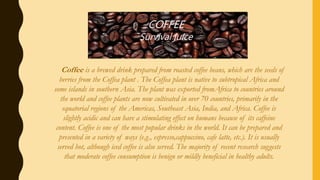
Coffee is a brewed drink prepared from roasted coffee beans, which are the seeds of
berries from the Coffea plant . The Coffea plant is native to subtropical Africa and
some islands in southern Asia. The plant was exported fromAfrica to countries around
the world and coffee plants are now cultivated in over 70 countries, primarily in the
equatorial regions of the Americas, Southeast Asia, India, and Africa. Coffee is
slightly acidic and can have a stimulating effect on humans because of its caffeine
content. Coffee is one of the most popular drinks in the world. It can be prepared and
presented in a variety of ways (e.g., espresso,cappuccino, cafe latte, etc.). It is usually
served hot, although iced coffee is also served. The majority of recent research suggests
that moderate coffee consumption is benign or mildly beneficial in healthy adults.
COFFEE
Survival juice
The earliest credible evidence of coffee-drinking appears in the middle of the
15th century in the Sufi shrines of Yemen. In the Horn of Africa and Yemen, coffee
was used in local religious ceremonies.
As these ceremonies conflicted with the beliefs
of the Christian church, the Ethiopian Church
banned the secular consumption of coffee until
the reign of Emperor Menelik II.The beverage
was also banned in Ottoman Turkey during
the 17th century for political reasons, and was
associated with rebellious political activities in
Europe.
Coffee is a major export commodity: it is the top
agricultural export for numerous countries and
among the world's largest legal agricultural
export and one of the most valuable
commodities exported by developing countries.
Green (unroasted) coffee is one of the most
traded agricultural commodities in the world.
Some controversy is associated with coffee cultivation and its
impact on the environment. Consequently, fair trade coffee and
organic coffee are an expanding market.
Here are a few things you
never knew about coffee
• It all strated with dancing goats. . Legend has it...ethiopian
shepherds first noticed the effects of caffeine when they saw
their goats appearing to became frisky and "dance" after
eating coffee berries.
• Originally, coffee was eaten. African tribes mixed coffee berries
with fat wich formes edible : energy balls .
• In 1675, the King of England banned coffee houses, claiming
they were places where people met to conspire against him .
• Coffee is the second most traded commodity on Earth ( Oil is
the first ) .
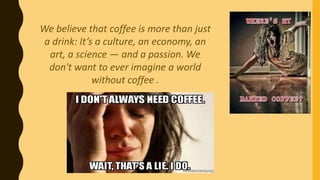
We believe that coffee is more than just
a drink: It’s a culture, an economy, an
art, a science — and a passion. We
don't want to ever imagine a world
without coffee .

English project

  • 1.
    COFFEE Makes everything betterfor you Profesor coordonator : Frumuselu Mihai Daniel Studenti : Chelariu Alexandra Sandu Marina Stan Maria
  • 2.
    Coffee is abrewed drink prepared from roasted coffee beans, which are the seeds of berries from the Coffea plant . The Coffea plant is native to subtropical Africa and some islands in southern Asia. The plant was exported fromAfrica to countries around the world and coffee plants are now cultivated in over 70 countries, primarily in the equatorial regions of the Americas, Southeast Asia, India, and Africa. Coffee is slightly acidic and can have a stimulating effect on humans because of its caffeine content. Coffee is one of the most popular drinks in the world. It can be prepared and presented in a variety of ways (e.g., espresso,cappuccino, cafe latte, etc.). It is usually served hot, although iced coffee is also served. The majority of recent research suggests that moderate coffee consumption is benign or mildly beneficial in healthy adults. COFFEE Survival juice
  • 3.
    The earliest credibleevidence of coffee-drinking appears in the middle of the 15th century in the Sufi shrines of Yemen. In the Horn of Africa and Yemen, coffee was used in local religious ceremonies. As these ceremonies conflicted with the beliefs of the Christian church, the Ethiopian Church banned the secular consumption of coffee until the reign of Emperor Menelik II.The beverage was also banned in Ottoman Turkey during the 17th century for political reasons, and was associated with rebellious political activities in Europe.
  • 4.
    Coffee is amajor export commodity: it is the top agricultural export for numerous countries and among the world's largest legal agricultural export and one of the most valuable commodities exported by developing countries. Green (unroasted) coffee is one of the most traded agricultural commodities in the world. Some controversy is associated with coffee cultivation and its impact on the environment. Consequently, fair trade coffee and organic coffee are an expanding market.
  • 5.
    Here are afew things you never knew about coffee • It all strated with dancing goats. . Legend has it...ethiopian shepherds first noticed the effects of caffeine when they saw their goats appearing to became frisky and "dance" after eating coffee berries. • Originally, coffee was eaten. African tribes mixed coffee berries with fat wich formes edible : energy balls . • In 1675, the King of England banned coffee houses, claiming they were places where people met to conspire against him . • Coffee is the second most traded commodity on Earth ( Oil is the first ) .
  • 6.
    We believe thatcoffee is more than just a drink: It’s a culture, an economy, an art, a science — and a passion. We don't want to ever imagine a world without coffee .