Suhăianu Andreea Mădălina
Dogaru Maria Magdalena
Dumitru Ciprian
8312
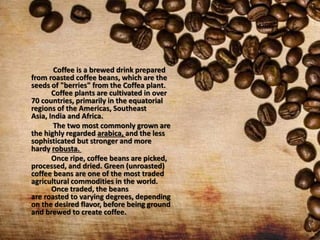
Coffee is a brewed drink prepared
from roasted coffee beans, which are the
seeds of "berries" from the Coffea plant.
Coffee plants are cultivated in over
70 countries, primarily in the equatorial
regions of the Americas, Southeast
Asia, India and Africa.
The two most commonly grown are
the highly regarded arabica, and the less
sophisticated but stronger and more
hardy robusta.
Once ripe, coffee beans are picked,
processed, and dried. Green (unroasted)
coffee beans are one of the most traded
agricultural commodities in the world.
Once traded, the beans
are roasted to varying degrees, depending
on the desired flavor, before being ground
and brewed to create coffee.
Coffee berries and their seeds undergo several
processes before they become the familiar roasted
coffee.
Berries have been traditionally selectively picked by
hand; a labor-intensive method, it involves the selection
of only the berries at the peak of ripeness.
More commonly, crops are strip picked, where all
berries are harvested simultaneously regardless of
ripeness by person or machine.
After picking, green coffee is processed by one of
two methods—the dry process method, simpler and less
labor-intensive as the berries can be strip picked, and
the wet process method, which incorporates
fermentation into the process and yields a mild coffee.
Coffee cultivation first took place in
Southern Arabia; The earliest credible evidence of
coffee-drinking appears in the middle of the 15th
century in the Sufi shrines of Yemen. In the Horn of
Africa and Yemen, coffee was used in local religious
ceremonies. As these ceremonies conflicted with the
beliefs of the Christian church, the Ethiopian
Church banned the secular consumption of coffee
until the reign of Emperor Menelik II. The beverage
was also banned in Ottoman Turkey during the 17th
century for political reasons, and was associated with
rebellious political activities in Europe.
1. Coffee Can Make You Smarter
2. Coffee Can Help You Burn Fat and
Improves Physical Performance
3. Coffee May Drastically Lower
Your Risk of Type II Diabetes
4. Coffee May Lower Your Risk of
Alzheimer’s and Parkinson’s
5. Coffee May be Extremely Good
For Your Liver
6. Coffee May Decrease Your Risk of
Dying
7. Coffee is Loaded With Nutrients
and Antioxidants
1. The caffeine in coffee increases your stress hormones.
2. Coffee consumption can lead to iron
deficiency anemia by interfering with iron absorption,
especially in mothers and infants.
3. Caffeine can cause anxiety, especially in high doses
and in those with pre-existing anxiety disorders.
4. Coffee caffeine may aggravate pre-existing conditions
such as migraines, arrhythmias, and cause sleep
disturbances.
5. Addiction is often an issue with coffee drinkers and
makes it really difficult to rely on the body's natural
source of energy.
6. Habituation to caffeine decreases insulin sensitivity,
making it difficult for your cells to respond
appropriately to blood sugar.
Quotes About
Coffee
“What do you want?"
"Just coffee. Black - like my soul.”
― Cassandra Clare, City of Bones
“Black as night, sweet as sin.”
― Neil Gaiman, Anansi Boys
“I'd rather take coffee than
compliments just now.”
― Louisa May Alcott, Little Women
“An empty coffee cup is full of hope.
Now there’s something worth voting
for.”
― Jarod Kintz, I love Blue Ribbon Coffee
Thank you for your attention!
Our sources were:
http://authoritynutrition.com/why-
is-coffee-good-for-you/
http://www.hungryforchange.tv/artic
le/10-reasons-to-quit-coffee-plus-
healthy-alternatives
http://www.goodreads.com/quotes/
tag/coffee

Coffee

  • 1.
    Suhăianu Andreea Mădălina DogaruMaria Magdalena Dumitru Ciprian 8312
  • 2.
    Coffee is abrewed drink prepared from roasted coffee beans, which are the seeds of "berries" from the Coffea plant. Coffee plants are cultivated in over 70 countries, primarily in the equatorial regions of the Americas, Southeast Asia, India and Africa. The two most commonly grown are the highly regarded arabica, and the less sophisticated but stronger and more hardy robusta. Once ripe, coffee beans are picked, processed, and dried. Green (unroasted) coffee beans are one of the most traded agricultural commodities in the world. Once traded, the beans are roasted to varying degrees, depending on the desired flavor, before being ground and brewed to create coffee.
  • 3.
    Coffee berries andtheir seeds undergo several processes before they become the familiar roasted coffee. Berries have been traditionally selectively picked by hand; a labor-intensive method, it involves the selection of only the berries at the peak of ripeness. More commonly, crops are strip picked, where all berries are harvested simultaneously regardless of ripeness by person or machine. After picking, green coffee is processed by one of two methods—the dry process method, simpler and less labor-intensive as the berries can be strip picked, and the wet process method, which incorporates fermentation into the process and yields a mild coffee.
  • 4.
    Coffee cultivation firsttook place in Southern Arabia; The earliest credible evidence of coffee-drinking appears in the middle of the 15th century in the Sufi shrines of Yemen. In the Horn of Africa and Yemen, coffee was used in local religious ceremonies. As these ceremonies conflicted with the beliefs of the Christian church, the Ethiopian Church banned the secular consumption of coffee until the reign of Emperor Menelik II. The beverage was also banned in Ottoman Turkey during the 17th century for political reasons, and was associated with rebellious political activities in Europe.
  • 6.
    1. Coffee CanMake You Smarter 2. Coffee Can Help You Burn Fat and Improves Physical Performance 3. Coffee May Drastically Lower Your Risk of Type II Diabetes 4. Coffee May Lower Your Risk of Alzheimer’s and Parkinson’s 5. Coffee May be Extremely Good For Your Liver 6. Coffee May Decrease Your Risk of Dying 7. Coffee is Loaded With Nutrients and Antioxidants
  • 7.
    1. The caffeinein coffee increases your stress hormones. 2. Coffee consumption can lead to iron deficiency anemia by interfering with iron absorption, especially in mothers and infants. 3. Caffeine can cause anxiety, especially in high doses and in those with pre-existing anxiety disorders. 4. Coffee caffeine may aggravate pre-existing conditions such as migraines, arrhythmias, and cause sleep disturbances. 5. Addiction is often an issue with coffee drinkers and makes it really difficult to rely on the body's natural source of energy. 6. Habituation to caffeine decreases insulin sensitivity, making it difficult for your cells to respond appropriately to blood sugar.
  • 8.
    Quotes About Coffee “What doyou want?" "Just coffee. Black - like my soul.” ― Cassandra Clare, City of Bones “Black as night, sweet as sin.” ― Neil Gaiman, Anansi Boys “I'd rather take coffee than compliments just now.” ― Louisa May Alcott, Little Women “An empty coffee cup is full of hope. Now there’s something worth voting for.” ― Jarod Kintz, I love Blue Ribbon Coffee
  • 10.
    Thank you foryour attention! Our sources were: http://authoritynutrition.com/why- is-coffee-good-for-you/ http://www.hungryforchange.tv/artic le/10-reasons-to-quit-coffee-plus- healthy-alternatives http://www.goodreads.com/quotes/ tag/coffee