MODAL VERBS
  BACHILLERATO
Characteristics
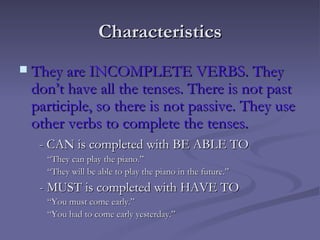
   They are INCOMPLETE VERBS. They
    don’t have all the tenses. There is not past
    participle, so there is not passive. They use
    other verbs to complete the tenses.
     - CAN is completed with BE ABLE TO
      “They can play the piano.”
      “They will be able to play the piano in the future.”
     - MUST is completed with HAVE TO
      “You must come early.”
      “You had to come early yesterday.”
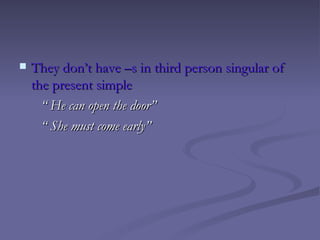
   They don’t have –s in third person singular of
    the present simple
      “ He can open the door”
      “ She must come early”
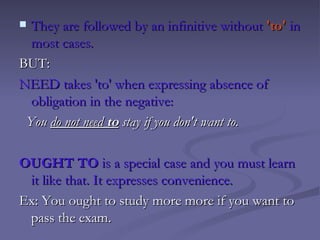
  They are followed by an infinitive without 'to' in
   most cases.
BUT:
NEED takes 'to' when expressing absence of
   obligation in the negative:
  You do not need to stay if you don't want to.
 
OUGHT TO is a special case and you must learn
   it like that. It expresses convenience.
Ex: You ought to study more more if you want to
   pass the exam.
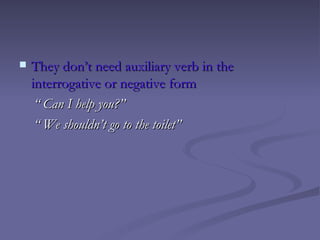
   They don’t need auxiliary verb in the
    interrogative or negative form
     “ Can I help you?”
     “ We shouldn’t go to the toilet”
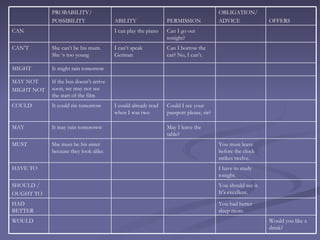
PROBABILITY/                                                               OBLIGATION/
            POSSIBILITY                 ABILITY                PERMISSION              ADVICE               OFFERS
CAN                                     I can play the piano   Can I go out
                                                               tonight?
CAN’T       She can’t be his mum.       I can’t speak          Can I borrow the
            She ‘s too young            German                 car? No, I can’t.

MIGHT       It might rain tomorrow

MAY NOT     If the bus doesn’t arrive
MIGHT NOT   soon, we may not see
            the start of the film
COULD       It could rin tomorrow       I could already read   Could I see your
                                        when I was two         passport please, sir?

MAY         It may rain tomoroww                               May I leave the
                                                               table?
MUST        She must be his sister                                                     You must leave
            because they look alike.                                                   before the clock
                                                                                       strikes twelve.
HAVE TO                                                                                I have to study
                                                                                       tonight.
SHOULD /                                                                               You should see it.
OUGHT TO                                                                               It’s excellent.
HAD                                                                                    You had better
BETTER                                                                                 sleep more.
WOULD                                                                                                       Would you like a
                                                                                                            drink?
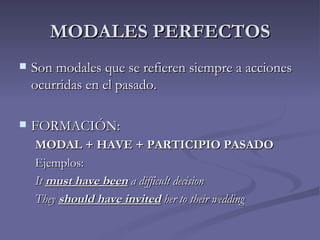
MODALES PERFECTOS
   Son modales que se refieren siempre a acciones
    ocurridas en el pasado.

   FORMACIÓN:
    MODAL + HAVE + PARTICIPIO PASADO
    Ejemplos:
    It must have been a difficult decision
    They should have invited her to their wedding
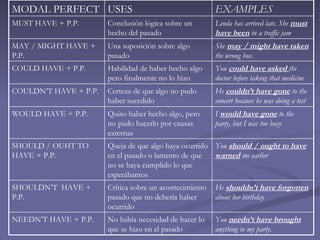
MODAL PERFECT USES                                       EXAMPLES
MUST HAVE + P.P.       Conclusión lógica sobre un        Linda has arrived late. She must
                       hecho del pasado                  have been in a traffic jam
MAY / MIGHT HAVE +     Una suposición sobre algo         She may / might have taken
P.P.                   pasado                            the wrong bus.
COULD HAVE + P.P.      Habilidad de haber hecho algo     You could have asked the
                       pero finalmente no lo hizo        doctor before taking that medicine
COULDN’T HAVE + P.P.   Certeza de que algo no pudo       He couldn’t have gone to the
                       haber sucedido                    concert because he was doing a test
WOULD HAVE + P.P.      Quiso haber hecho algo, pero      I would have gone to the
                       no pudo hacerlo por causas        party, but I was too busy
                       externas
SHOULD / OUHT TO       Queja de que algo haya ocurrido You should / ought to have
HAVE + P.P.            en el pasado o lamento de que   warned me earlier
                       no se haya cumplido lo que
                       esperábamos
SHOULDN’T HAVE +       Crítica sobre un acontecimiento   He shouldn’t have forgotten
P.P.                   pasado que no debería haber       about her birthday
                       ocurrido
NEEDN’T HAVE + P.P.    No había necesidad de hacer lo    You needn’t have brought
                       que se hizo en el pasado          anything to my party.

English -modal_verbs

  • 1.
    MODAL VERBS BACHILLERATO
  • 2.
    Characteristics  They are INCOMPLETE VERBS. They don’t have all the tenses. There is not past participle, so there is not passive. They use other verbs to complete the tenses. - CAN is completed with BE ABLE TO “They can play the piano.” “They will be able to play the piano in the future.” - MUST is completed with HAVE TO “You must come early.” “You had to come early yesterday.”
  • 3.
    They don’t have –s in third person singular of the present simple “ He can open the door” “ She must come early”
  • 4.
     Theyare followed by an infinitive without 'to' in most cases. BUT: NEED takes 'to' when expressing absence of obligation in the negative: You do not need to stay if you don't want to.   OUGHT TO is a special case and you must learn it like that. It expresses convenience. Ex: You ought to study more more if you want to pass the exam.
  • 5.
    They don’t need auxiliary verb in the interrogative or negative form “ Can I help you?” “ We shouldn’t go to the toilet”
  • 6.
    PROBABILITY/ OBLIGATION/ POSSIBILITY ABILITY PERMISSION ADVICE OFFERS CAN I can play the piano Can I go out tonight? CAN’T She can’t be his mum. I can’t speak Can I borrow the She ‘s too young German car? No, I can’t. MIGHT It might rain tomorrow MAY NOT If the bus doesn’t arrive MIGHT NOT soon, we may not see the start of the film COULD It could rin tomorrow I could already read Could I see your when I was two passport please, sir? MAY It may rain tomoroww May I leave the table? MUST She must be his sister You must leave because they look alike. before the clock strikes twelve. HAVE TO I have to study tonight. SHOULD / You should see it. OUGHT TO It’s excellent. HAD You had better BETTER sleep more. WOULD Would you like a drink?
  • 7.
    MODALES PERFECTOS  Son modales que se refieren siempre a acciones ocurridas en el pasado.  FORMACIÓN: MODAL + HAVE + PARTICIPIO PASADO Ejemplos: It must have been a difficult decision They should have invited her to their wedding
  • 8.
    MODAL PERFECT USES EXAMPLES MUST HAVE + P.P. Conclusión lógica sobre un Linda has arrived late. She must hecho del pasado have been in a traffic jam MAY / MIGHT HAVE + Una suposición sobre algo She may / might have taken P.P. pasado the wrong bus. COULD HAVE + P.P. Habilidad de haber hecho algo You could have asked the pero finalmente no lo hizo doctor before taking that medicine COULDN’T HAVE + P.P. Certeza de que algo no pudo He couldn’t have gone to the haber sucedido concert because he was doing a test WOULD HAVE + P.P. Quiso haber hecho algo, pero I would have gone to the no pudo hacerlo por causas party, but I was too busy externas SHOULD / OUHT TO Queja de que algo haya ocurrido You should / ought to have HAVE + P.P. en el pasado o lamento de que warned me earlier no se haya cumplido lo que esperábamos SHOULDN’T HAVE + Crítica sobre un acontecimiento He shouldn’t have forgotten P.P. pasado que no debería haber about her birthday ocurrido NEEDN’T HAVE + P.P. No había necesidad de hacer lo You needn’t have brought que se hizo en el pasado anything to my party.