CG EN5RC-IIg-2.12
A. Setting the Stage
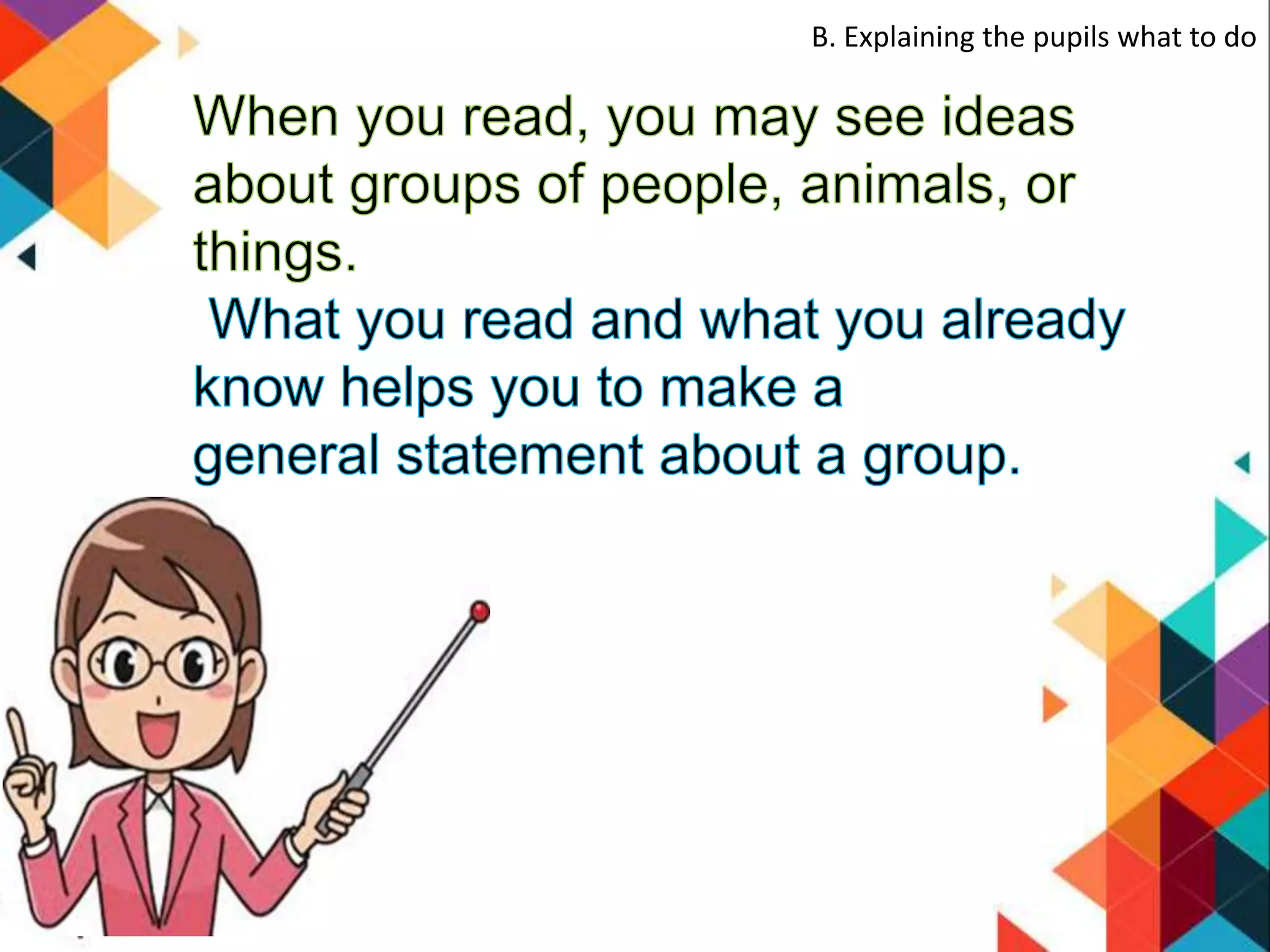
B. Explaining the pupils what to do
C. Modeling
Read the situation to the pupils aloud.
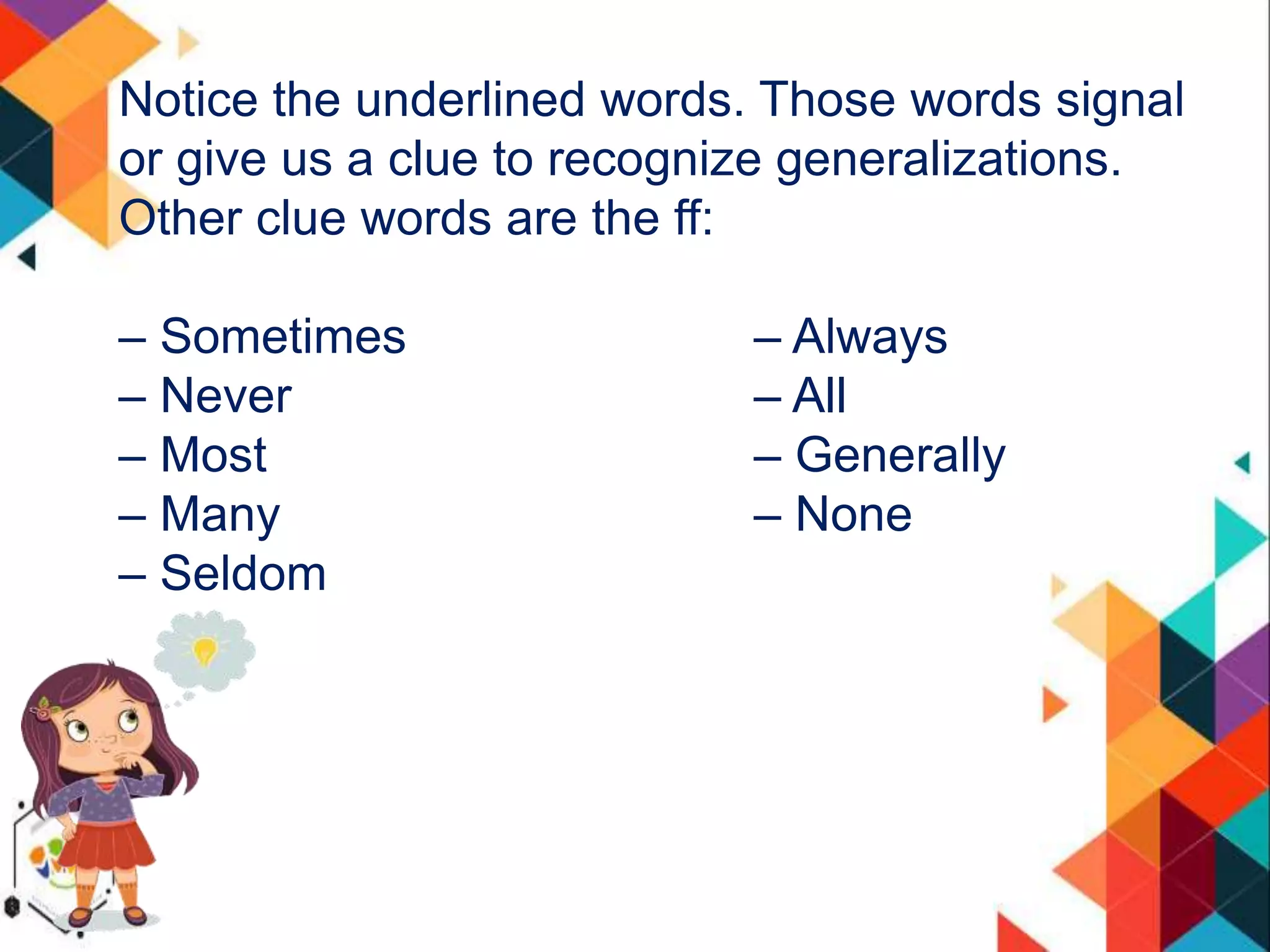
Notice the underlined words. Those words signal
or give us a clue to recognize generalizations.
Other clue words are the ff:
– Sometimes – Always
– Never – All
– Most – Generally
– Many – None
– Seldom
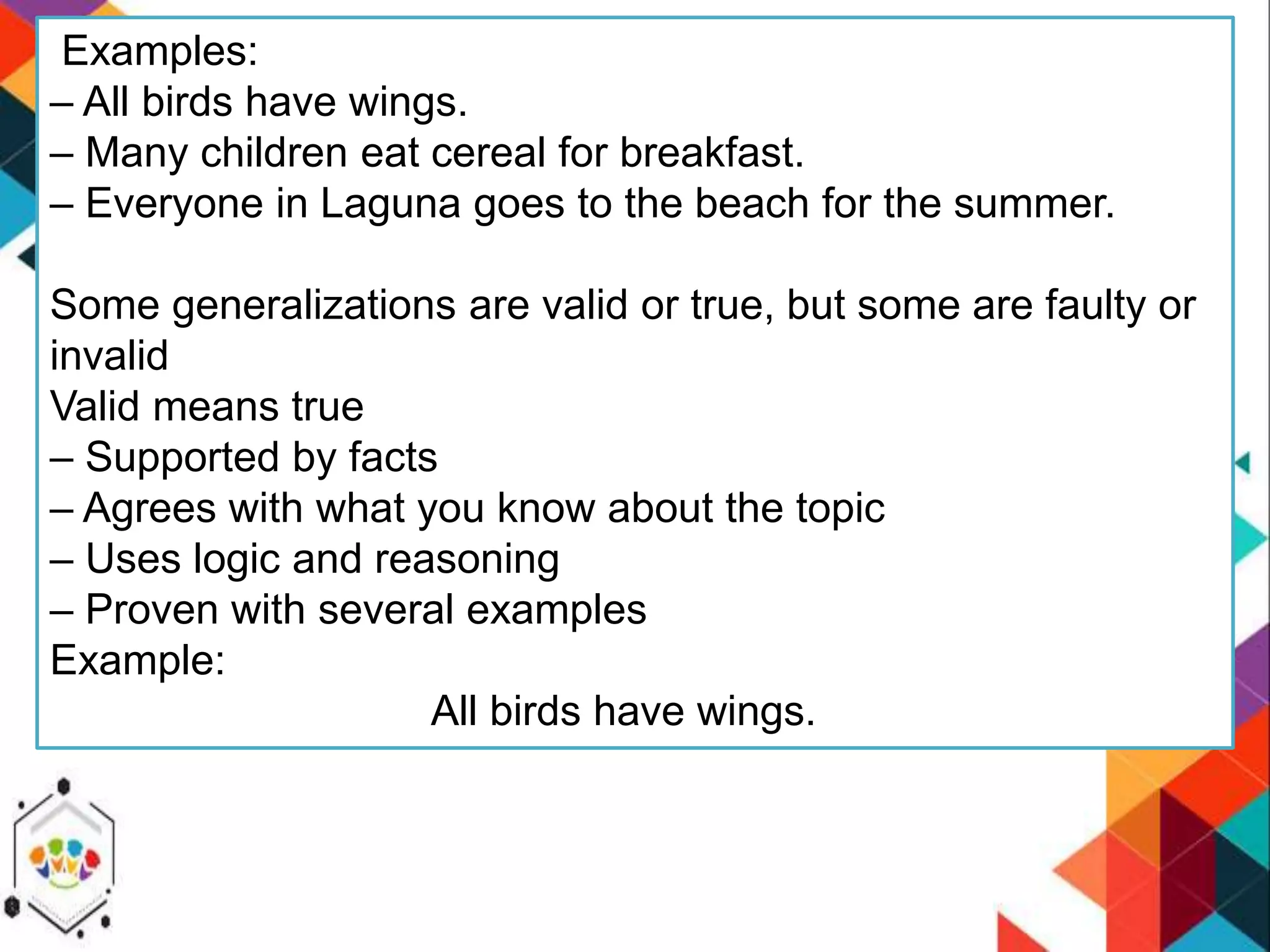
Examples:
– All birds have wings.
– Many children eat cereal for breakfast.
– Everyone in Laguna goes to the beach for the summer.
Some generalizations are valid or true, but some are faulty or
invalid
Valid means true
– Supported by facts
– Agrees with what you know about the topic
– Uses logic and reasoning
– Proven with several examples
Example:
All birds have wings.
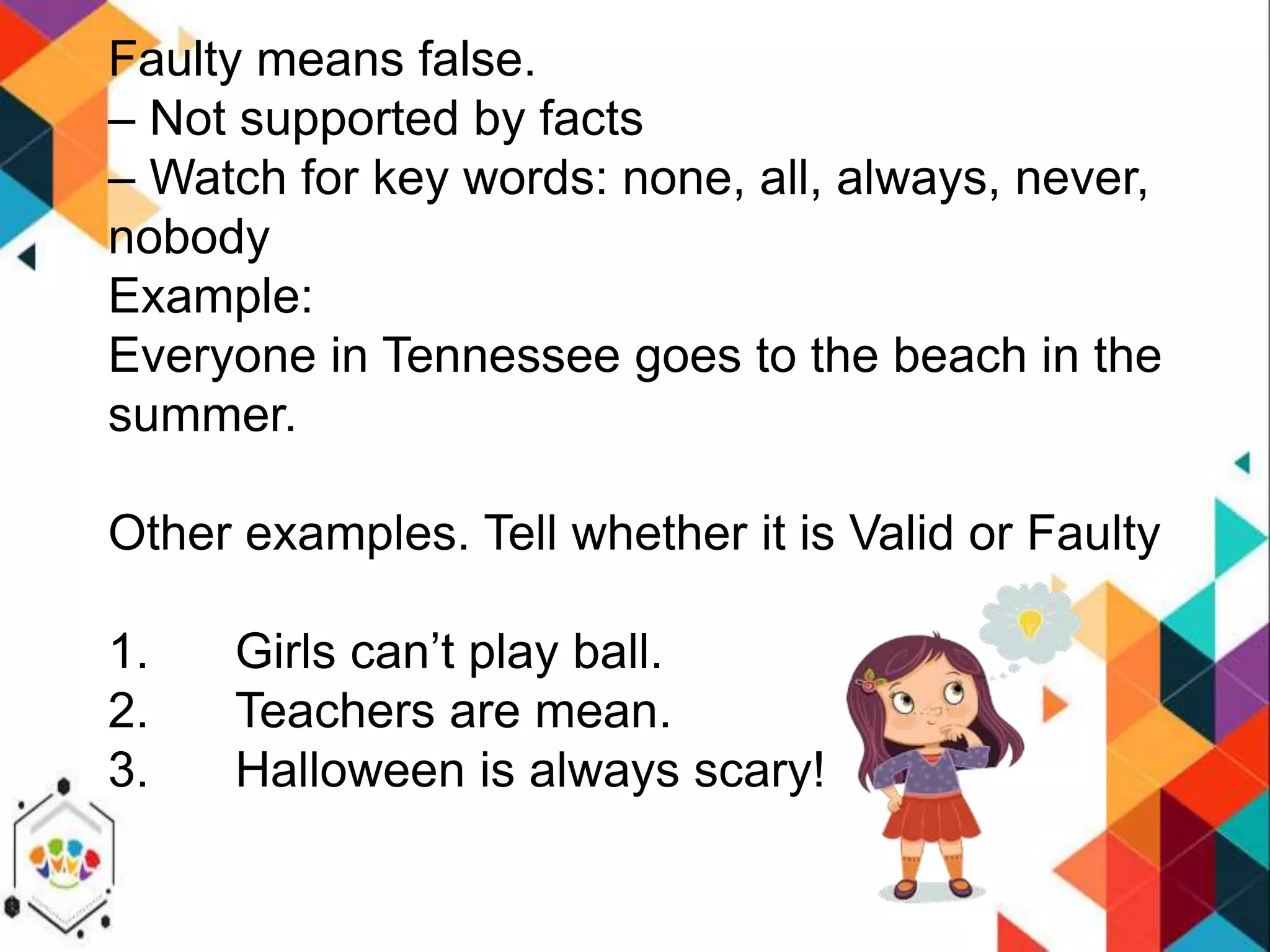
Faulty means false.
– Not supported by facts
– Watch for key words: none, all, always, never,
nobody
Example:
Everyone in Tennessee goes to the beach in the
summer.
Other examples. Tell whether it is Valid or Faulty
1. Girls can’t play ball.
2. Teachers are mean.
3. Halloween is always scary!
D. Guided Practice
1. All birds have wings. But not all
birds can fly. Birds that do not fly are
called flightless birds. The penguin is
one example. It uses its wings to swim
underwater. Ostriches and emus flap
their wings when they want to scare an
enemy. Rheas use their wings like
rudders when they are running from an
enemy. There is even a kind of small
parrot that climbs trees and then uses its
wings to parachute to the ground.
What can you say in general
about flightless birds?
a. All flightless birds are
large.
b. Flightless birds have
different uses for their wings.
c. Flightless birds are fast
runners.
d. The wings of flightless
birds are useless.
2. Ants are one of the most
widespread insects in the world.
Ants are called social insects
because they live in colonies
made up of other ants. A colony
may have a few dozen or several
million ants living in it. Ants in a
colony are divided into different
groups. Worker ants look for
food and take care of the young.
Soldier ants defend the nest
from invaders. The queen ant
lays eggs. These are the three
main groups in a ant colony.
What generalization can you
make about ants based upon your
reading?
a. All ants live in large colonies.
b. All ants work to defend the
colony.
c. All ants in a colony have a job.
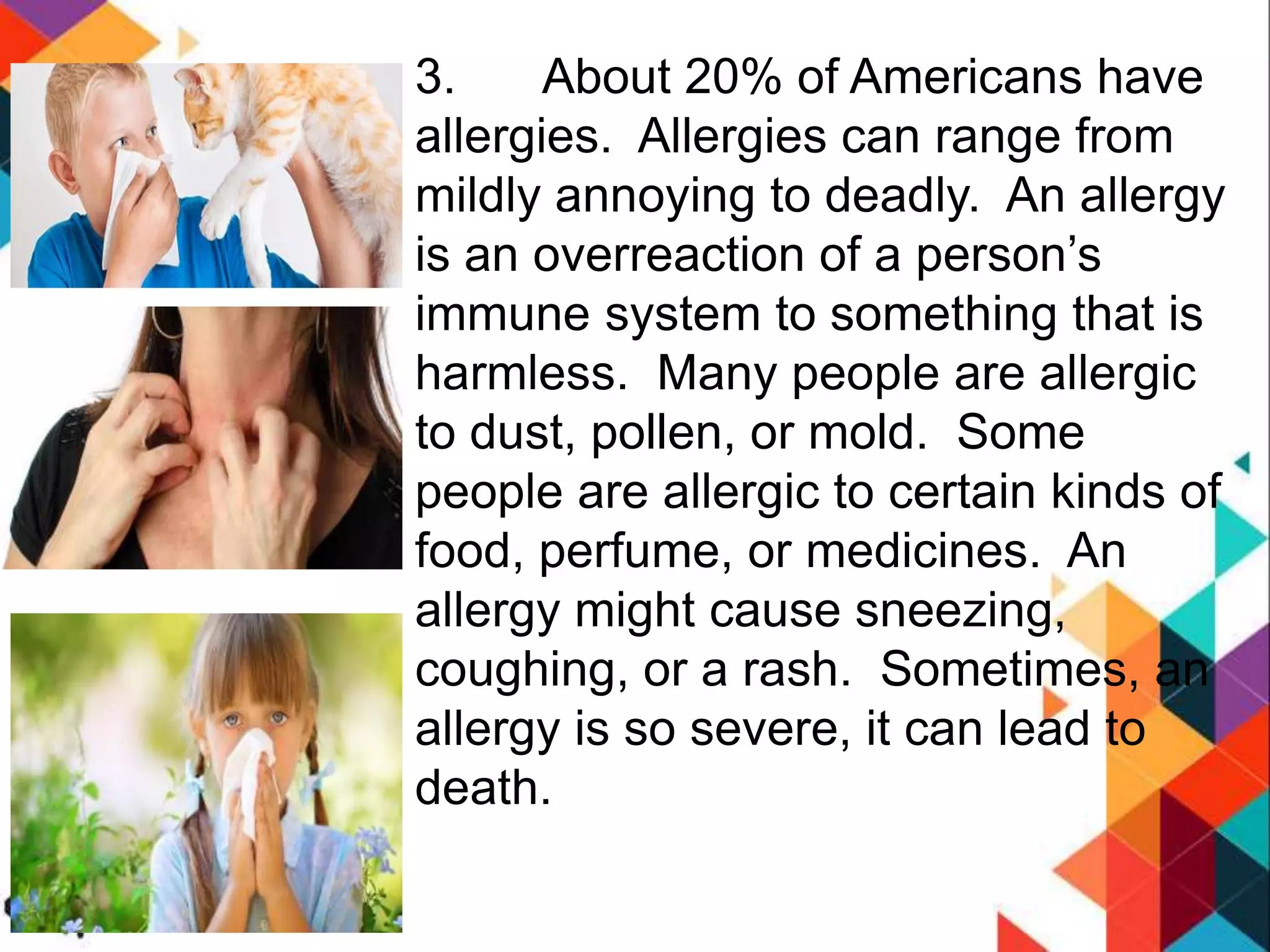
3. About 20% of Americans have
allergies. Allergies can range from
mildly annoying to deadly. An allergy
is an overreaction of a person’s
immune system to something that is
harmless. Many people are allergic
to dust, pollen, or mold. Some
people are allergic to certain kinds of
food, perfume, or medicines. An
allergy might cause sneezing,
coughing, or a rash. Sometimes, an
allergy is so severe, it can lead to
death.
What generalization can you make
about allergies based upon your
reading?
a. All allergies are deadly.
b. Allergies can cause different
reactions in different people.
c. Everyone has allergies.
E. Independent Practice
Group 2.
Write valid
generalizations
about fishes
Group 3. Write 5 generalizations
about baby alligators
1. All animals migrate every year.
2. Most children like pizza.
3. All boys play sports.
4. It always snows in the winter.
5. Girls can’t catch.
F. Closure
What have you learned from today’s lesson?
• Generalizations make broad
statements
• Some are valid, others are faulty.
• Valid generalizations are supported by
facts, examples, and logical thinking. [evidence]
• Watch out for words like all or never.
IV. Evaluation:
Read the paragraph
then answer the following
questions.
Humans can live to be 80, 90 or even 100 years
old. In a few rare cases, they can live even longer.
Most animals, however, have far shorter lives than
humans. Here are some maximum life spans for small
animals. A mouse, a popular pet rodent, lives for
about 3 years. If you get one as pet, don’t plan on
having it until you go away to college. Guppies, the
popular pet fish, live longer. They reach 5 years in age.
Giant spiders can live a surprisingly long time as long
as 20 years.
What about large animals? Two of the biggest
animals have similar life spans. The maximum life
span of an elephant is 77 years. The maximum life
span of a blue whale is 80 years. Bears are another
large animals that can live for quite a long time.
And how about reptiles? Alligators can live for
more than 70 years. Turtles can live even longer.
Some species of turtle can reach over 100 years in
age.
1. List one generalization you can find in the passage.
_________________________________________________
_________________________________________________
2. List one simple fact you can find in the passage.
___________________________________________________
___________________________________________________
3. Is this generalization supported by the facts in the passage?
Explain why o why not?
Fish live longer than rodents.
_________________________________________________
_________________________________________________
4. I this generalization supported by the facts in the passage?
Explain why or why not?
No animals can live to be 100 years old.
_______________________________________________________
_________________________________________________
5. Make a generalization that is not too broad based on facts in
the passage.
_______________________________________________________
____________________________________________________
English 5-q2-week-7-make-generalizations-by-sir-rei-marasigan

English 5-q2-week-7-make-generalizations-by-sir-rei-marasigan

  • 1.
  • 2.
  • 4.
    B. Explaining thepupils what to do
  • 6.
    C. Modeling Read thesituation to the pupils aloud.
  • 10.
    Notice the underlinedwords. Those words signal or give us a clue to recognize generalizations. Other clue words are the ff: – Sometimes – Always – Never – All – Most – Generally – Many – None – Seldom
  • 11.
    Examples: – All birdshave wings. – Many children eat cereal for breakfast. – Everyone in Laguna goes to the beach for the summer. Some generalizations are valid or true, but some are faulty or invalid Valid means true – Supported by facts – Agrees with what you know about the topic – Uses logic and reasoning – Proven with several examples Example: All birds have wings.
  • 12.
    Faulty means false. –Not supported by facts – Watch for key words: none, all, always, never, nobody Example: Everyone in Tennessee goes to the beach in the summer. Other examples. Tell whether it is Valid or Faulty 1. Girls can’t play ball. 2. Teachers are mean. 3. Halloween is always scary!
  • 13.
    D. Guided Practice 1.All birds have wings. But not all birds can fly. Birds that do not fly are called flightless birds. The penguin is one example. It uses its wings to swim underwater. Ostriches and emus flap their wings when they want to scare an enemy. Rheas use their wings like rudders when they are running from an enemy. There is even a kind of small parrot that climbs trees and then uses its wings to parachute to the ground.
  • 14.
    What can yousay in general about flightless birds? a. All flightless birds are large. b. Flightless birds have different uses for their wings. c. Flightless birds are fast runners. d. The wings of flightless birds are useless.
  • 15.
    2. Ants areone of the most widespread insects in the world. Ants are called social insects because they live in colonies made up of other ants. A colony may have a few dozen or several million ants living in it. Ants in a colony are divided into different groups. Worker ants look for food and take care of the young. Soldier ants defend the nest from invaders. The queen ant lays eggs. These are the three main groups in a ant colony.
  • 16.
    What generalization canyou make about ants based upon your reading? a. All ants live in large colonies. b. All ants work to defend the colony. c. All ants in a colony have a job.
  • 17.
    3. About 20%of Americans have allergies. Allergies can range from mildly annoying to deadly. An allergy is an overreaction of a person’s immune system to something that is harmless. Many people are allergic to dust, pollen, or mold. Some people are allergic to certain kinds of food, perfume, or medicines. An allergy might cause sneezing, coughing, or a rash. Sometimes, an allergy is so severe, it can lead to death.
  • 18.
    What generalization canyou make about allergies based upon your reading? a. All allergies are deadly. b. Allergies can cause different reactions in different people. c. Everyone has allergies.
  • 19.
  • 21.
  • 22.
    Group 3. Write5 generalizations about baby alligators
  • 23.
    1. All animalsmigrate every year. 2. Most children like pizza. 3. All boys play sports. 4. It always snows in the winter. 5. Girls can’t catch.
  • 24.
    F. Closure What haveyou learned from today’s lesson? • Generalizations make broad statements • Some are valid, others are faulty. • Valid generalizations are supported by facts, examples, and logical thinking. [evidence] • Watch out for words like all or never.
  • 25.
    IV. Evaluation: Read theparagraph then answer the following questions.
  • 26.
    Humans can liveto be 80, 90 or even 100 years old. In a few rare cases, they can live even longer. Most animals, however, have far shorter lives than humans. Here are some maximum life spans for small animals. A mouse, a popular pet rodent, lives for about 3 years. If you get one as pet, don’t plan on having it until you go away to college. Guppies, the popular pet fish, live longer. They reach 5 years in age. Giant spiders can live a surprisingly long time as long as 20 years.
  • 27.
    What about largeanimals? Two of the biggest animals have similar life spans. The maximum life span of an elephant is 77 years. The maximum life span of a blue whale is 80 years. Bears are another large animals that can live for quite a long time. And how about reptiles? Alligators can live for more than 70 years. Turtles can live even longer. Some species of turtle can reach over 100 years in age.
  • 28.
    1. List onegeneralization you can find in the passage. _________________________________________________ _________________________________________________ 2. List one simple fact you can find in the passage. ___________________________________________________ ___________________________________________________ 3. Is this generalization supported by the facts in the passage? Explain why o why not? Fish live longer than rodents. _________________________________________________ _________________________________________________
  • 29.
    4. I thisgeneralization supported by the facts in the passage? Explain why or why not? No animals can live to be 100 years old. _______________________________________________________ _________________________________________________ 5. Make a generalization that is not too broad based on facts in the passage. _______________________________________________________ ____________________________________________________