
Special Jeopardy!
Direct Questions
Direct questions are the “normal” questions that
we can ask friends, family members, and people
who we know well.

         Example of a direct question:
          “Where’s the bathroom?”
               “What’s up?”
Indirect Questions (p. 35)
 Indirect questions are a little more formal and
                     polite.

We use them when talking to a person we don’t
know very well, or in professional situations, and
         their form is a little different.

       Example of an indirect question:
 “Could you tell me where the bathroom is?”
           “How are you today?”
Difference: Direct vs. Indirect
            Direct                                 Indirect
          Begins with:                              Phrases:

• Who                                 •     Could you tell me…
• What                                •     Do you know…
• Where                               •     I was wondering…
• When                                •     Do you have any idea…
** How **                             •     I’d like to know…
                                      •     Would it be possible…
                                      •     Is there any chance…

 In general: Any question which does not start with “Wh” is indirect
Brainstorm 10 “Wh” questions
 Lets turn some into indirect questions
             You do the rest.
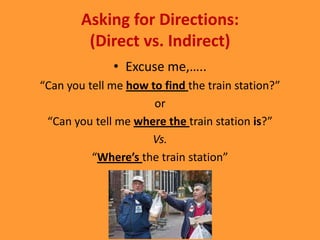
Asking for Directions:
         (Direct vs. Indirect)
              • Excuse me,…..
“Can you tell me how to find the train station?”
                      or
 “Can you tell me where the train station is?”
                     Vs.
          “Where’s the train station”
Practice the Conversation 9A (p.35)
 • After both partners have been A and B
   • Insert information about the public
 transportation you use in your city or town.
10 A p. 36
 • Turn the questions into indirect questions
               • (10 minutes)
• Walk around and interview two classmates.
               • (10 minutes)
5 Minute Break
Eating at a Restaurant


Two teams: What’s the name of our Thai
            restaurants?
Lets think of some Thai foods:
As a waiter:
What kinds of questions would you ask?


     Direct or indirect questions?
As a customer:
What kind’s of questions do you want to ask?


            Direct or Indirect?
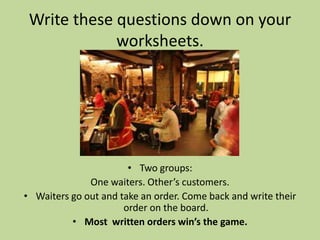
Write these questions down on your
             worksheets.


                       • Two groups:
              One waiters. Other’s customers.
• Waiters go out and take an order. Come back and write their
                      order on the board.
          • Most written orders win’s the game.
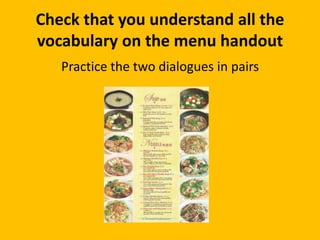
Check that you understand all the
vocabulary on the menu handout
   Practice the two dialogues in pairs
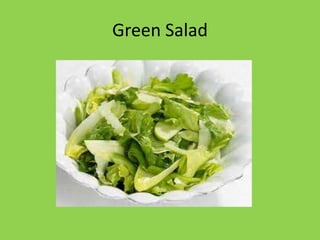
Green Salad
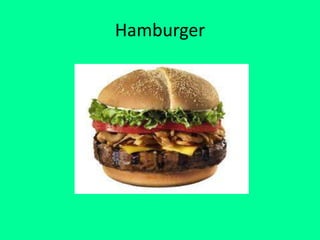
Hamburger
Tacos
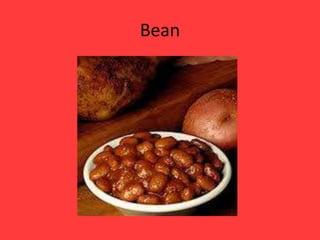
Bean
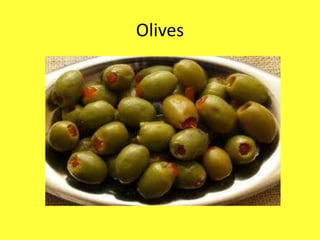
Olives
Pepperoni
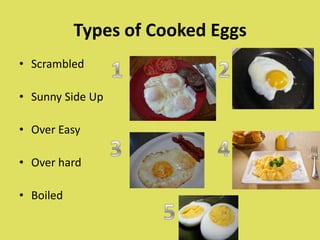
Types of Cooked Eggs
• Scrambled

• Sunny Side Up

• Over Easy

• Over hard

• Boiled
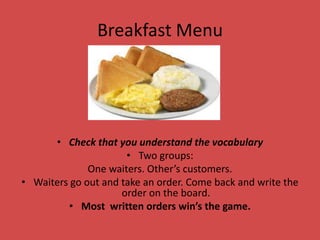
Breakfast Menu


      • Check that you understand the vocabulary
                      • Two groups:
              One waiters. Other’s customers.
• Waiters go out and take an order. Come back and write the
                     order on the board.
         • Most written orders win’s the game.
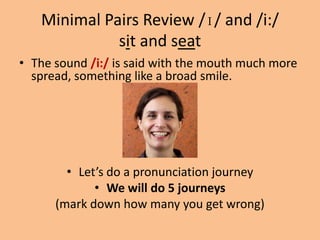
Minimal Pairs Review /ɪ/ and /i:/
             sit and seat
• The sound /i:/ is said with the mouth much more
  spread, something like a broad smile.


        • Let’s do a pronunciation journey
             • We will do 5 journeys
      (mark down how many you get wrong)
Journey 1:
 Left                   Right


• Grin                • Green
 • His                 • He’s
  • Is                 • Ease
  • It                  • Eat
Journey 2:
  Left                   Right


• Shill                • She’ll
• Sick                 • Seek
 • Sin                 • Seen
• Still                • Steal
Journey 3:
 Left                  Right


• Gin                 • Gene
• Grid                • Greed
 • Hip                 • Heap
 • Kid                • Keyed
Journey 4:
 Left                  Right


• Fist                • Feast
• Fizz                • Fees
• Pill                 • Peel
• Pip                 • Peep
Journey 5:
  Left                  Right


• Sim                  • Seam
 • Sip                 • Seep
• Skit                 • Skeet
• Slick                • Sleek
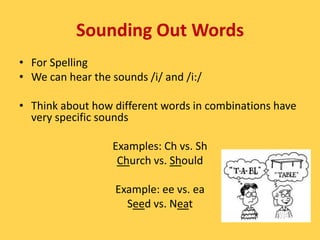
Sounding Out Words
• For Spelling
• We can hear the sounds /i/ and /i:/

• Think about how different words in combinations have
  very specific sounds

                  Examples: Ch vs. Sh
                   Church vs. Should

                   Example: ee vs. ea
                     Seed vs. Neat
Spelling
• Understanding the sounds of letters can help
  you spell even if you have never seen the
  word before.

       • Example Should as /Sh-o-u-ld/
   (breaking the sounds into separate parts)

              • Phonetics Video.
Spelling Test
Spell the following words
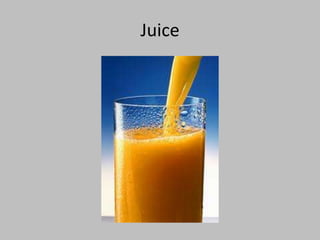
Juice
Tofu
Beef
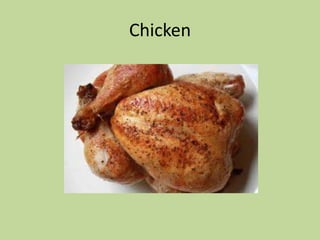
Chicken
Carrots
Tomatoes
Milk
Butter
Eggs
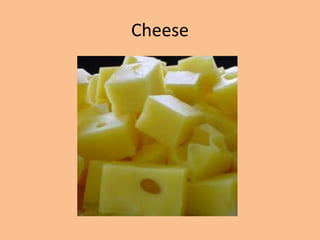
Cheese
Fish
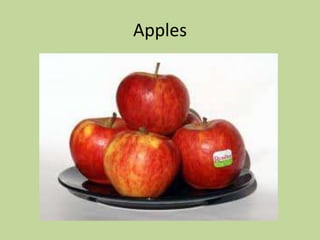
Apples
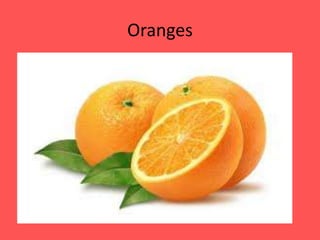
Oranges
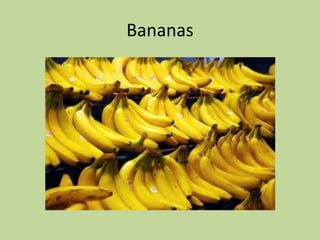
Bananas
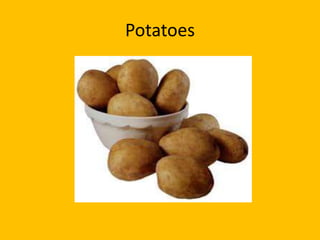
Potatoes
Corn
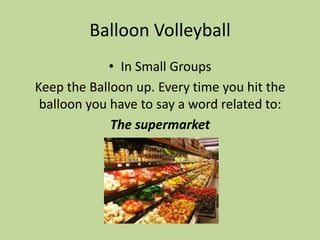
Balloon Volleyball
             • In Small Groups
Keep the Balloon up. Every time you hit the
 balloon you have to say a word related to:
             The supermarket
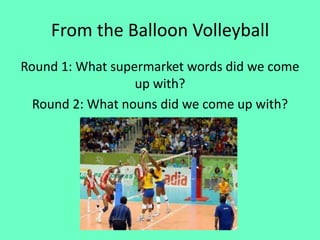
From the Balloon Volleyball
Round 1: What supermarket words did we come
                  up with?
  Round 2: What nouns did we come up with?
Countable vs. Uncountable Review
Countable (a/an)   Uncountable (some/any)
• Dog              • Water
• People           • Salt
• City             • Air
• Town             • Grass
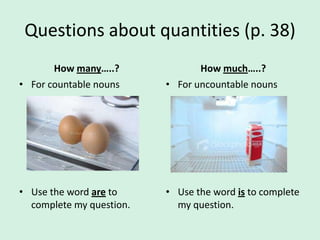
Questions about quantities (p. 38)
       How many…..?              How much…..?
• For countable nouns     • For uncountable nouns


• Use the word are to     • Use the word is to complete
  complete my question.     my question.
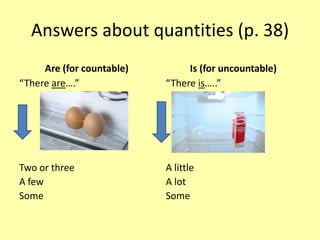
Answers about quantities (p. 38)
     Are (for countable)        Is (for uncountable)
“There are….”              “There is…..”


Two or three               A little
A few                      A lot
Some                       Some
Muffins Worksheet
Write the questions for finding the ingredients
   needed to make muffins in the dialogue
Answers:
            •        Q: How much flour do you need?

                     •
                  A: 2 cups self-raising flour
                          •
    •       Q: How much brown sugar do you need?

                         •
                    A: ½ cup brown sugar
                          •
    •       Q: How much vegetable oil do you need?

                •        A: 1/3 cup (80mL) vegetable oil

            •         Q: How much milk do you need?

                             •    A: 1 cup milk

            •        Q: How many eggs do you need?
                               •
                           •    A:2 eggs

        •           Q: How many bananas do you need?

•       A: Two large bananas. To make 1 cup mashed.
Muffin Man!
• Videos + Song
Summary
• Jeopardy
• Direct vs. Indirect
  Questions
• Eating at Restaurants
• Spelling + Sounding Out
  Words
• How many vs. How
  much
• Muffin Man Song

English 2 lesson 13

  • 1.
  • 2.
    Direct Questions Direct questionsare the “normal” questions that we can ask friends, family members, and people who we know well. Example of a direct question: “Where’s the bathroom?” “What’s up?”
  • 3.
    Indirect Questions (p.35) Indirect questions are a little more formal and polite. We use them when talking to a person we don’t know very well, or in professional situations, and their form is a little different. Example of an indirect question: “Could you tell me where the bathroom is?” “How are you today?”
  • 4.
    Difference: Direct vs.Indirect Direct Indirect Begins with: Phrases: • Who • Could you tell me… • What • Do you know… • Where • I was wondering… • When • Do you have any idea… ** How ** • I’d like to know… • Would it be possible… • Is there any chance… In general: Any question which does not start with “Wh” is indirect
  • 5.
    Brainstorm 10 “Wh”questions Lets turn some into indirect questions You do the rest.
  • 6.
    Asking for Directions: (Direct vs. Indirect) • Excuse me,….. “Can you tell me how to find the train station?” or “Can you tell me where the train station is?” Vs. “Where’s the train station”
  • 7.
    Practice the Conversation9A (p.35) • After both partners have been A and B • Insert information about the public transportation you use in your city or town.
  • 8.
    10 A p.36 • Turn the questions into indirect questions • (10 minutes) • Walk around and interview two classmates. • (10 minutes)
  • 9.
  • 10.
    Eating at aRestaurant Two teams: What’s the name of our Thai restaurants?
  • 11.
    Lets think ofsome Thai foods:
  • 12.
    As a waiter: Whatkinds of questions would you ask? Direct or indirect questions?
  • 13.
    As a customer: Whatkind’s of questions do you want to ask? Direct or Indirect?
  • 14.
    Write these questionsdown on your worksheets. • Two groups: One waiters. Other’s customers. • Waiters go out and take an order. Come back and write their order on the board. • Most written orders win’s the game.
  • 15.
    Check that youunderstand all the vocabulary on the menu handout Practice the two dialogues in pairs
  • 16.
  • 17.
  • 18.
  • 19.
  • 20.
  • 21.
  • 22.
    Types of CookedEggs • Scrambled • Sunny Side Up • Over Easy • Over hard • Boiled
  • 23.
    Breakfast Menu • Check that you understand the vocabulary • Two groups: One waiters. Other’s customers. • Waiters go out and take an order. Come back and write the order on the board. • Most written orders win’s the game.
  • 24.
    Minimal Pairs Review/ɪ/ and /i:/ sit and seat • The sound /i:/ is said with the mouth much more spread, something like a broad smile. • Let’s do a pronunciation journey • We will do 5 journeys (mark down how many you get wrong)
  • 25.
    Journey 1: Left Right • Grin • Green • His • He’s • Is • Ease • It • Eat
  • 26.
    Journey 2: Left Right • Shill • She’ll • Sick • Seek • Sin • Seen • Still • Steal
  • 27.
    Journey 3: Left Right • Gin • Gene • Grid • Greed • Hip • Heap • Kid • Keyed
  • 28.
    Journey 4: Left Right • Fist • Feast • Fizz • Fees • Pill • Peel • Pip • Peep
  • 29.
    Journey 5: Left Right • Sim • Seam • Sip • Seep • Skit • Skeet • Slick • Sleek
  • 30.
    Sounding Out Words •For Spelling • We can hear the sounds /i/ and /i:/ • Think about how different words in combinations have very specific sounds Examples: Ch vs. Sh Church vs. Should Example: ee vs. ea Seed vs. Neat
  • 31.
    Spelling • Understanding thesounds of letters can help you spell even if you have never seen the word before. • Example Should as /Sh-o-u-ld/ (breaking the sounds into separate parts) • Phonetics Video.
  • 32.
    Spelling Test Spell thefollowing words
  • 33.
  • 34.
  • 35.
  • 36.
  • 37.
  • 38.
  • 39.
  • 40.
  • 41.
  • 42.
  • 43.
  • 44.
  • 45.
  • 46.
  • 47.
  • 48.
  • 49.
    Balloon Volleyball • In Small Groups Keep the Balloon up. Every time you hit the balloon you have to say a word related to: The supermarket
  • 50.
    From the BalloonVolleyball Round 1: What supermarket words did we come up with? Round 2: What nouns did we come up with?
  • 51.
    Countable vs. UncountableReview Countable (a/an) Uncountable (some/any) • Dog • Water • People • Salt • City • Air • Town • Grass
  • 52.
    Questions about quantities(p. 38) How many…..? How much…..? • For countable nouns • For uncountable nouns • Use the word are to • Use the word is to complete complete my question. my question.
  • 53.
    Answers about quantities(p. 38) Are (for countable) Is (for uncountable) “There are….” “There is…..” Two or three A little A few A lot Some Some
  • 54.
    Muffins Worksheet Write thequestions for finding the ingredients needed to make muffins in the dialogue
  • 55.
    Answers: • Q: How much flour do you need? • A: 2 cups self-raising flour • • Q: How much brown sugar do you need? • A: ½ cup brown sugar • • Q: How much vegetable oil do you need? • A: 1/3 cup (80mL) vegetable oil • Q: How much milk do you need? • A: 1 cup milk • Q: How many eggs do you need? • • A:2 eggs • Q: How many bananas do you need? • A: Two large bananas. To make 1 cup mashed.
  • 56.
  • 57.
    Summary • Jeopardy • Directvs. Indirect Questions • Eating at Restaurants • Spelling + Sounding Out Words • How many vs. How much • Muffin Man Song