TEXTUAL AIDS
IN UNDERSTANDING
TEXTS
ENGLISH 10: TOPIC 2
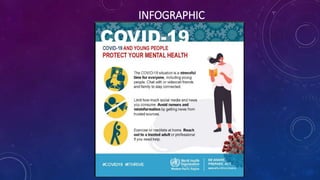
INFOGRAPHIC
TEXTUAL AIDS
DIRECTIONS: CHOOSE THE LETTER OF YOUR ANSWER. WRITE
YOUR ANSWERS IN YOUR NOTEBOOK.
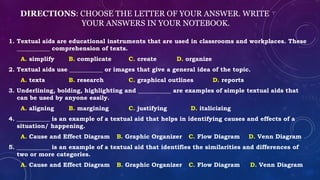
1. Textual aids are educational instruments that are used in classrooms and workplaces. These
___________ comprehension of texts.
A. simplify B. complicate C. create D. organize
2. Textual aids use ___________ or images that give a general idea of the topic.
A. texts B. research C. graphical outlines D. reports
3. Underlining, bolding, highlighting and ___________ are examples of simple textual aids that
can be used by anyone easily.
A. aligning B. margining C. justifying D. italicizing
4. ___________ is an example of a textual aid that helps in identifying causes and effects of a
situation/ happening.
A. Cause and Effect Diagram B. Graphic Organizer C. Flow Diagram D. Venn Diagram
5. ___________ is an example of a textual aid that identifies the similarities and differences of
two or more categories.
A. Cause and Effect Diagram B. Graphic Organizer C. Flow Diagram D. Venn Diagram
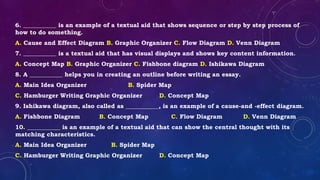
6. ___________ is an example of a textual aid that shows sequence or step by step process of
how to do something.
A. Cause and Effect Diagram B. Graphic Organizer C. Flow Diagram D. Venn Diagram
7. ___________ is a textual aid that has visual displays and shows key content information.
A. Concept Map B. Graphic Organizer C. Fishbone diagram D. Ishikawa Diagram
8. A ___________ helps you in creating an outline before writing an essay.
A. Main Idea Organizer B. Spider Map
C. Hamburger Writing Graphic Organizer D. Concept Map
9. Ishikawa diagram, also called as ___________, is an example of a cause-and -effect diagram.
A. Fishbone Diagram B. Concept Map C. Flow Diagram D. Venn Diagram
10. ___________ is an example of a textual aid that can show the central thought with its
matching characteristics.
A. Main Idea Organizer B. Spider Map
C. Hamburger Writing Graphic Organizer D. Concept Map
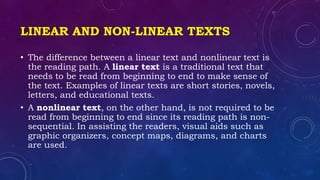
LINEAR AND NON-LINEAR TEXTS
• The difference between a linear text and nonlinear text is
the reading path. A linear text is a traditional text that
needs to be read from beginning to end to make sense of
the text. Examples of linear texts are short stories, novels,
letters, and educational texts.
• A nonlinear text, on the other hand, is not required to be
read from beginning to end since its reading path is non-
sequential. In assisting the readers, visual aids such as
graphic organizers, concept maps, diagrams, and charts
are used.
TRANSCODING LINEAR TO NONLINEAR TEXT
AND VICE VERSA
• Transcoding Linear to Nonlinear text and vice versa is a skill
that one has to be familiar with since it can be used in our
everyday lives. There will be times when you would have to
transcode a linear text to nonlinear text to make it easier for
other people to understand it and a nonlinear text to linear
text to have a detailed description of a certain topic.
• To transcode a linear text to nonlinear text, follow these
simple steps.
Step 1
Read the text and get the main idea.
Step 2
Extract necessary information for the visual
presentation.
Step 3
Remember to use keywords or phrases only.
Step 4
Classify information into categories.
Step 5
Make sure to use the correct non-linear text to
present the information.
OTHER EXAMPLES OF TEXTUAL AIDS
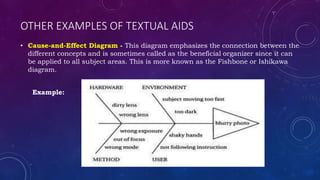
• Cause-and-Effect Diagram - This diagram emphasizes the connection between the
different concepts and is sometimes called as the beneficial organizer since it can
be applied to all subject areas. This is more known as the Fishbone or Ishikawa
diagram.
Example:
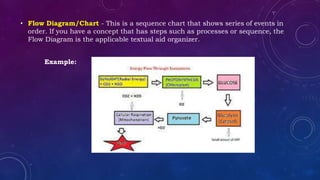
• Flow Diagram/Chart - This is a sequence chart that shows series of events in
order. If you have a concept that has steps such as processes or sequence, the
Flow Diagram is the applicable textual aid organizer.
Example:
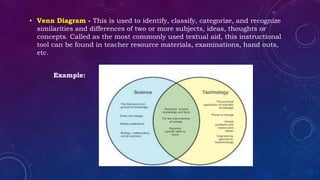
• Venn Diagram - This is used to identify, classify, categorize, and recognize
similarities and differences of two or more subjects, ideas, thoughts or
concepts. Called as the most commonly used textual aid, this instructional
tool can be found in teacher resource materials, examinations, hand outs,
etc.
Example:
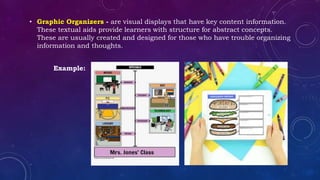
• Graphic Organizers - are visual displays that have key content information.
These textual aids provide learners with structure for abstract concepts.
These are usually created and designed for those who have trouble organizing
information and thoughts.
Example:
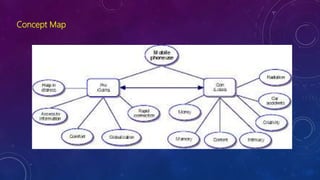
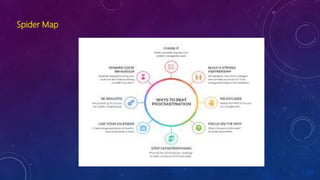
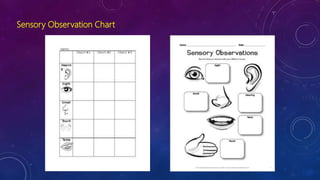
• Other forms of non-textual information
include concept maps, spider map,
sensory observation chart, line graph, bar
graph, pie graph, pictograph and other
related images. Information may also be
presented in a form of infographics.
Concept Map
Spider Map
Sensory Observation Chart
ACTIVITY PROPER
Directions: What is your favorite dish or dessert
recipe? In your notebook, present the steps in
preparing or cooking your favorite food using a flow
chart/diagram.
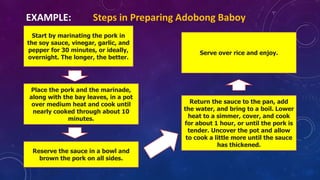
Start by marinating the pork in
the soy sauce, vinegar, garlic, and
pepper for 30 minutes, or ideally,
overnight. The longer, the better.
Place the pork and the marinade,
along with the bay leaves, in a pot
over medium heat and cook until
nearly cooked through about 10
minutes.
Reserve the sauce in a bowl and
brown the pork on all sides.
Return the sauce to the pan, add
the water, and bring to a boil. Lower
heat to a simmer, cover, and cook
for about 1 hour, or until the pork is
tender. Uncover the pot and allow
to cook a little more until the sauce
has thickened.
Serve over rice and enjoy.
EXAMPLE: Steps in Preparing Adobong Baboy
INDIVIDUAL WRITTEN TASK
Directions: In your notebook, transform the text below into a non-
textual information source.
Sharks and whales are classic examples of two different animals
revealing similar traits in the same environment. One of the similarities
of these two marine animals is their habitat. They both live in the vast
range of depth in their environment. They also have the same fin
structure. They only have a single tail for propulsion and because they
are both large aquatic animals, they both consume large volume of
food; however, sharks hunt for their food. Whales do not have this
hunting tendency. Another difference of sharks to whales is their class.
Whales are mammals while sharks are fish but they both live in the
ocean. Also, whales have bones while sharks only have cartilages.

English 10 Topic 2.pptx

  • 1.
  • 2.
  • 5.
  • 6.
    DIRECTIONS: CHOOSE THELETTER OF YOUR ANSWER. WRITE YOUR ANSWERS IN YOUR NOTEBOOK. 1. Textual aids are educational instruments that are used in classrooms and workplaces. These ___________ comprehension of texts. A. simplify B. complicate C. create D. organize 2. Textual aids use ___________ or images that give a general idea of the topic. A. texts B. research C. graphical outlines D. reports 3. Underlining, bolding, highlighting and ___________ are examples of simple textual aids that can be used by anyone easily. A. aligning B. margining C. justifying D. italicizing 4. ___________ is an example of a textual aid that helps in identifying causes and effects of a situation/ happening. A. Cause and Effect Diagram B. Graphic Organizer C. Flow Diagram D. Venn Diagram 5. ___________ is an example of a textual aid that identifies the similarities and differences of two or more categories. A. Cause and Effect Diagram B. Graphic Organizer C. Flow Diagram D. Venn Diagram
  • 7.
    6. ___________ isan example of a textual aid that shows sequence or step by step process of how to do something. A. Cause and Effect Diagram B. Graphic Organizer C. Flow Diagram D. Venn Diagram 7. ___________ is a textual aid that has visual displays and shows key content information. A. Concept Map B. Graphic Organizer C. Fishbone diagram D. Ishikawa Diagram 8. A ___________ helps you in creating an outline before writing an essay. A. Main Idea Organizer B. Spider Map C. Hamburger Writing Graphic Organizer D. Concept Map 9. Ishikawa diagram, also called as ___________, is an example of a cause-and -effect diagram. A. Fishbone Diagram B. Concept Map C. Flow Diagram D. Venn Diagram 10. ___________ is an example of a textual aid that can show the central thought with its matching characteristics. A. Main Idea Organizer B. Spider Map C. Hamburger Writing Graphic Organizer D. Concept Map
  • 8.
    LINEAR AND NON-LINEARTEXTS • The difference between a linear text and nonlinear text is the reading path. A linear text is a traditional text that needs to be read from beginning to end to make sense of the text. Examples of linear texts are short stories, novels, letters, and educational texts. • A nonlinear text, on the other hand, is not required to be read from beginning to end since its reading path is non- sequential. In assisting the readers, visual aids such as graphic organizers, concept maps, diagrams, and charts are used.
  • 9.
    TRANSCODING LINEAR TONONLINEAR TEXT AND VICE VERSA • Transcoding Linear to Nonlinear text and vice versa is a skill that one has to be familiar with since it can be used in our everyday lives. There will be times when you would have to transcode a linear text to nonlinear text to make it easier for other people to understand it and a nonlinear text to linear text to have a detailed description of a certain topic. • To transcode a linear text to nonlinear text, follow these simple steps.
  • 10.
    Step 1 Read thetext and get the main idea. Step 2 Extract necessary information for the visual presentation. Step 3 Remember to use keywords or phrases only.
  • 11.
    Step 4 Classify informationinto categories. Step 5 Make sure to use the correct non-linear text to present the information.
  • 12.
    OTHER EXAMPLES OFTEXTUAL AIDS • Cause-and-Effect Diagram - This diagram emphasizes the connection between the different concepts and is sometimes called as the beneficial organizer since it can be applied to all subject areas. This is more known as the Fishbone or Ishikawa diagram. Example:
  • 13.
    • Flow Diagram/Chart- This is a sequence chart that shows series of events in order. If you have a concept that has steps such as processes or sequence, the Flow Diagram is the applicable textual aid organizer. Example:
  • 14.
    • Venn Diagram- This is used to identify, classify, categorize, and recognize similarities and differences of two or more subjects, ideas, thoughts or concepts. Called as the most commonly used textual aid, this instructional tool can be found in teacher resource materials, examinations, hand outs, etc. Example:
  • 15.
    • Graphic Organizers- are visual displays that have key content information. These textual aids provide learners with structure for abstract concepts. These are usually created and designed for those who have trouble organizing information and thoughts. Example:
  • 16.
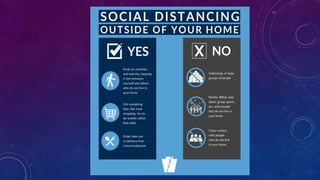
    • Other formsof non-textual information include concept maps, spider map, sensory observation chart, line graph, bar graph, pie graph, pictograph and other related images. Information may also be presented in a form of infographics.
  • 17.
  • 18.
  • 19.
  • 21.
    ACTIVITY PROPER Directions: Whatis your favorite dish or dessert recipe? In your notebook, present the steps in preparing or cooking your favorite food using a flow chart/diagram.
  • 22.
    Start by marinatingthe pork in the soy sauce, vinegar, garlic, and pepper for 30 minutes, or ideally, overnight. The longer, the better. Place the pork and the marinade, along with the bay leaves, in a pot over medium heat and cook until nearly cooked through about 10 minutes. Reserve the sauce in a bowl and brown the pork on all sides. Return the sauce to the pan, add the water, and bring to a boil. Lower heat to a simmer, cover, and cook for about 1 hour, or until the pork is tender. Uncover the pot and allow to cook a little more until the sauce has thickened. Serve over rice and enjoy. EXAMPLE: Steps in Preparing Adobong Baboy
  • 23.
    INDIVIDUAL WRITTEN TASK Directions:In your notebook, transform the text below into a non- textual information source. Sharks and whales are classic examples of two different animals revealing similar traits in the same environment. One of the similarities of these two marine animals is their habitat. They both live in the vast range of depth in their environment. They also have the same fin structure. They only have a single tail for propulsion and because they are both large aquatic animals, they both consume large volume of food; however, sharks hunt for their food. Whales do not have this hunting tendency. Another difference of sharks to whales is their class. Whales are mammals while sharks are fish but they both live in the ocean. Also, whales have bones while sharks only have cartilages.