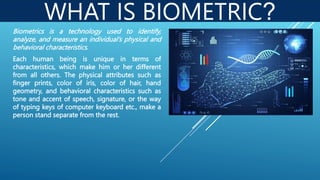
Biometrics is a technology used to identify,
analyze, and measure an individual’s physical and
behavioral characteristics.
Each human being is unique in terms of
characteristics, which make him or her different
from all others. The physical attributes such as
finger prints, color of iris, color of hair, hand
geometry, and behavioral characteristics such as
tone and accent of speech, signature, or the way
of typing keys of computer keyboard etc., make a
person stand separate from the rest.
WHAT IS BIOMETRIC?
 With increasing use of Information Technology in
the field of banking, science, medication, etc.,
there is an immense need to protect the systems
and data from unauthorized users.
Why Biometrics is Required?
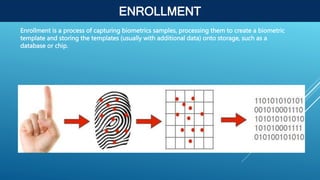
Enrollment is a process of capturing biometrics samples, processing them to create a biometric
template and storing the templates (usually with additional data) onto storage, such as a
database or chip.
ENROLLMENT
This process tries to find out answer of question, “Are you
the same who you are claiming to be?”, or, “Do I know
you?” This is one-to-many matching and comparison of a
person’s biometrics with the whole database.
 Verification : This is the one-to-one process of matching where live
sample entered by the candidate is compared with a previously
stored template in the database. If both are matching with more
than 70% agreeable similarity, then the verification is successful.
 Authorization : It is the process of assigning access rights to the
authenticated or verified users. It tries to find out the answer for the
question, “Are you eligible to have certain rights to access this
resource?”
AUTHENTICATION
The entire security structure of biometrics
authentication is based on comparison.
Biometric systems capture and store
individual characteristics that remain
constant over time, such as fingerprints,
voice, retinal patterns, facial recognition,
and hand patterns. When a user makes an
authentication request, the system
compares their biometrics with the data in
the database. If there's an accurate match,
access is granted.
WORKING PROCESS
TYPES OF BIOMETRIC
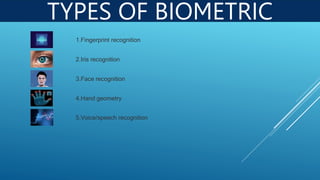
1.Fingerprint recognition
2.Iris recognition
3.Face recognition
4.Hand geometry
5.Voice/speech recognition
The fingerprint recognition involves
snapping an image using a fingerprint
scanner which is then digitally
compared with a previously stored
snapshot of your fingerprints. The
scanner processor sees whether the
loops, whorls and arches have any
similarity. An important point to be
noted is that the scanner doesn’t keep
the complete image of your
fingerprint. It only stores information
about specific points in the form of
binary numbers.
Fingerprint recognition
Iris recognition works on the basis of
iris pattern in human eye. The iris is
the pigmented elastic tissue that has
adjustable circular opening in center. It
controls the diameter of pupil. In adult
humans, the texture of iris is stable
throughout their lives. The iris patterns
of left and right eyes are different. The
iris patterns and colors change from
person to person.
Iris Recognition
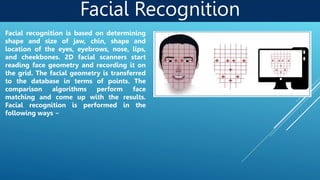
Facial recognition is based on determining
shape and size of jaw, chin, shape and
location of the eyes, eyebrows, nose, lips,
and cheekbones. 2D facial scanners start
reading face geometry and recording it on
the grid. The facial geometry is transferred
to the database in terms of points. The
comparison algorithms perform face
matching and come up with the results.
Facial recognition is performed in the
following ways −
Facial Recognition
It includes measuring length and
width of palm, surface area, length
and position of fingers, and overall
bone structure of the hand. A person’s
hand is unique and can be used to
identify a person from others.
Hand Geometry Recognition
Voice Recognition is also called Speaker
Recognition. At the time of enrollment, the user
needs to speak a word or phrase into a
microphone. This is necessary to acquire speech
sample of a candidate.
The electrical signal from the microphone is
converted into digital signal by an Analog to
Digital (ADC) converter. It is recorded into the
computer memory as a digitized sample. The
computer then compares and attempts to match
the input voice of candidate with the stored
digitized voice sample and identifies the
candidate.
Voice Recognition
Conclusion
 Biometrics system allows for increased security, convenience and
accountability while detecting and deterring froud . Biometric solution one of
the best & strongest security feature to benefit individuals and institutions.
engineering topic SEMINAR BIOMETRIC2.pptx

engineering topic SEMINAR BIOMETRIC2.pptx

  • 2.
    Biometrics is atechnology used to identify, analyze, and measure an individual’s physical and behavioral characteristics. Each human being is unique in terms of characteristics, which make him or her different from all others. The physical attributes such as finger prints, color of iris, color of hair, hand geometry, and behavioral characteristics such as tone and accent of speech, signature, or the way of typing keys of computer keyboard etc., make a person stand separate from the rest. WHAT IS BIOMETRIC?
  • 3.
     With increasinguse of Information Technology in the field of banking, science, medication, etc., there is an immense need to protect the systems and data from unauthorized users. Why Biometrics is Required?
  • 4.
    Enrollment is aprocess of capturing biometrics samples, processing them to create a biometric template and storing the templates (usually with additional data) onto storage, such as a database or chip. ENROLLMENT
  • 5.
    This process triesto find out answer of question, “Are you the same who you are claiming to be?”, or, “Do I know you?” This is one-to-many matching and comparison of a person’s biometrics with the whole database.  Verification : This is the one-to-one process of matching where live sample entered by the candidate is compared with a previously stored template in the database. If both are matching with more than 70% agreeable similarity, then the verification is successful.  Authorization : It is the process of assigning access rights to the authenticated or verified users. It tries to find out the answer for the question, “Are you eligible to have certain rights to access this resource?” AUTHENTICATION
  • 6.
    The entire securitystructure of biometrics authentication is based on comparison. Biometric systems capture and store individual characteristics that remain constant over time, such as fingerprints, voice, retinal patterns, facial recognition, and hand patterns. When a user makes an authentication request, the system compares their biometrics with the data in the database. If there's an accurate match, access is granted. WORKING PROCESS
  • 7.
    TYPES OF BIOMETRIC 1.Fingerprintrecognition 2.Iris recognition 3.Face recognition 4.Hand geometry 5.Voice/speech recognition
  • 8.
    The fingerprint recognitioninvolves snapping an image using a fingerprint scanner which is then digitally compared with a previously stored snapshot of your fingerprints. The scanner processor sees whether the loops, whorls and arches have any similarity. An important point to be noted is that the scanner doesn’t keep the complete image of your fingerprint. It only stores information about specific points in the form of binary numbers. Fingerprint recognition
  • 9.
    Iris recognition workson the basis of iris pattern in human eye. The iris is the pigmented elastic tissue that has adjustable circular opening in center. It controls the diameter of pupil. In adult humans, the texture of iris is stable throughout their lives. The iris patterns of left and right eyes are different. The iris patterns and colors change from person to person. Iris Recognition
  • 10.
    Facial recognition isbased on determining shape and size of jaw, chin, shape and location of the eyes, eyebrows, nose, lips, and cheekbones. 2D facial scanners start reading face geometry and recording it on the grid. The facial geometry is transferred to the database in terms of points. The comparison algorithms perform face matching and come up with the results. Facial recognition is performed in the following ways − Facial Recognition
  • 11.
    It includes measuringlength and width of palm, surface area, length and position of fingers, and overall bone structure of the hand. A person’s hand is unique and can be used to identify a person from others. Hand Geometry Recognition
  • 12.
    Voice Recognition isalso called Speaker Recognition. At the time of enrollment, the user needs to speak a word or phrase into a microphone. This is necessary to acquire speech sample of a candidate. The electrical signal from the microphone is converted into digital signal by an Analog to Digital (ADC) converter. It is recorded into the computer memory as a digitized sample. The computer then compares and attempts to match the input voice of candidate with the stored digitized voice sample and identifies the candidate. Voice Recognition
  • 13.
    Conclusion  Biometrics systemallows for increased security, convenience and accountability while detecting and deterring froud . Biometric solution one of the best & strongest security feature to benefit individuals and institutions.