Basic information
Course Code 22MCA262
CIE Marks 50
Teaching Hours/Week (L:P:SDA) 2:0:2
SEE Marks 50
Total Hours of Pedagogy 40
Total Marks 100
Credits 03
Exam Hours 03
Module-1 INTRODUCTION TO Al AND PRODUCTION
SYSTEMS: Introduction to AI-Problem formulation, Problem
Definition -Production systems, Control strategies, Search strategies.
Problem characteristics, Production system characteristics -
Specialized productions system- Problem solving methods – Problem
graphs, Matching, Indexing and Heuristic functions -Hill Climbing-
Depth first and Breath first, Constraints satisfaction – Related
algorithms, Measure of performance and analysis of search
algorithms.
Introduction to Artificial Intelligence
Definition: Artificial Intelligence (AI) is a branch of Science which deals with helping machines to find solutions
to complex problems in a more human-like fashion.
This generally involves borrowing characteristics from human intelligence, and applying them as algorithms in a
computer friendly way.AI is the branch of computer science that attempts to approximate the results of human
reasoning by organizing and manipulating factual and heuristic knowledge.
AI is generally associated with Computer Science, but it has many important links with other fields such as
Math's, Psychology, Cognition, Biology and Philosophy, among many others
Areas of AI activity
 expert systems,
 natural language
 Understanding
 speech
 recognition, vision, and robotics.
Our ability to combine knowledge from all these fields will ultimately benefit our progress in the quest of
creating an intelligent artificial being.
The term was coined in 1956 by John McCarthy at the Massachusetts
Institute of Technology.
There are several programming languages that are known as AI
languages because they are used almost exclusively for AI applications.
The two most common are LISP (List Processing) and Prolog
(Programming Logic).
The greatest advances have occurred in the field of games playing. The
best computer chess programs are now capable of beating humans. In
May, 1997, an IBM super-computer called Deep Blue defeated world
chess champion Gary Kasparov in a chess match.
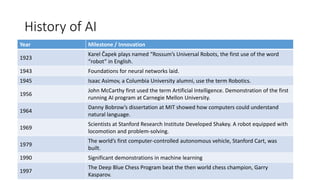
History of AI
Year Milestone / Innovation
1923
Karel Čapek plays named “Rossum’s Universal Robots, the first use of the word
“robot” in English.
1943 Foundations for neural networks laid.
1945 Isaac Asimov, a Columbia University alumni, use the term Robotics.
1956
John McCarthy first used the term Artificial Intelligence. Demonstration of the first
running AI program at Carnegie Mellon University.
1964
Danny Bobrow’s dissertation at MIT showed how computers could understand
natural language.
1969
Scientists at Stanford Research Institute Developed Shakey. A robot equipped with
locomotion and problem-solving.
1979
The world’s first computer-controlled autonomous vehicle, Stanford Cart, was
built.
1990 Significant demonstrations in machine learning
1997
The Deep Blue Chess Program beat the then world chess champion, Garry
Kasparov.
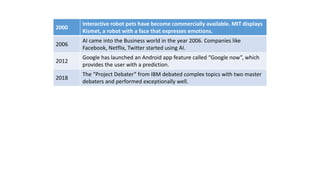
2000
Interactive robot pets have become commercially available. MIT displays
Kismet, a robot with a face that expresses emotions.
2006
AI came into the Business world in the year 2006. Companies like
Facebook, Netflix, Twitter started using AI.
2012
Google has launched an Android app feature called “Google now”, which
provides the user with a prediction.
2018
The “Project Debater” from IBM debated complex topics with two master
debaters and performed exceptionally well.
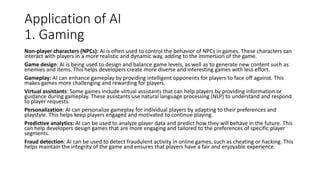
Application of AI
1. Gaming
Non-player characters (NPCs): AI is often used to control the behavior of NPCs in games. These characters can
interact with players in a more realistic and dynamic way, adding to the immersion of the game.
Game design: AI is being used to design and balance game levels, as well as to generate new content such as
enemies and items. This helps developers create more diverse and interesting games with less effort.
Gameplay: AI can enhance gameplay by providing intelligent opponents for players to face off against. This
makes games more challenging and rewarding for players.
Virtual assistants: Some games include virtual assistants that can help players by providing information or
guidance during gameplay. These assistants use natural language processing (NLP) to understand and respond
to player requests.
Personalization: AI can personalize gameplay for individual players by adapting to their preferences and
playstyle. This helps keep players engaged and motivated to continue playing.
Predictive analytics: AI can be used to analyze player data and predict how they will behave in the future. This
can help developers design games that are more engaging and tailored to the preferences of specific player
segments.
Fraud detection: AI can be used to detect fraudulent activity in online games, such as cheating or hacking. This
helps maintain the integrity of the game and ensures that players have a fair and enjoyable experience.
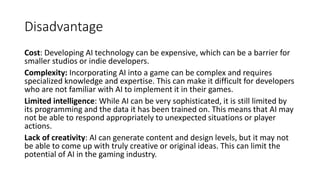
Disadvantage
Cost: Developing AI technology can be expensive, which can be a barrier for
smaller studios or indie developers.
Complexity: Incorporating AI into a game can be complex and requires
specialized knowledge and expertise. This can make it difficult for developers
who are not familiar with AI to implement it in their games.
Limited intelligence: While AI can be very sophisticated, it is still limited by
its programming and the data it has been trained on. This means that AI may
not be able to respond appropriately to unexpected situations or player
actions.
Lack of creativity: AI can generate content and design levels, but it may not
be able to come up with truly creative or original ideas. This can limit the
potential of AI in the gaming industry.
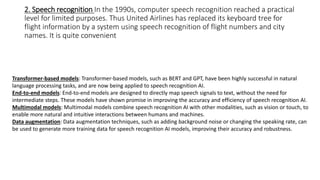
2. Speech recognition In the 1990s, computer speech recognition reached a practical
level for limited purposes. Thus United Airlines has replaced its keyboard tree for
flight information by a system using speech recognition of flight numbers and city
names. It is quite convenient
Transformer-based models: Transformer-based models, such as BERT and GPT, have been highly successful in natural
language processing tasks, and are now being applied to speech recognition AI.
End-to-end models: End-to-end models are designed to directly map speech signals to text, without the need for
intermediate steps. These models have shown promise in improving the accuracy and efficiency of speech recognition AI.
Multimodal models: Multimodal models combine speech recognition AI with other modalities, such as vision or touch, to
enable more natural and intuitive interactions between humans and machines.
Data augmentation: Data augmentation techniques, such as adding background noise or changing the speaking rate, can
be used to generate more training data for speech recognition AI models, improving their accuracy and robustness.
3. Understanding natural language Just getting a sequence of words into a
computer is not enough. Parsing sentences is not enough either. The computer
has to be provided with an understanding of the domain the text is about, and
this is presently possible only for very limited domains.
How does natural language processing work?
• NLP enables computers to understand natural language as humans do.
Whether the language is spoken or written, natural language processing uses
artificial intelligence to take real-world input, process it, and make sense of it
in a way a computer can understand. Just as humans have different sensors --
such as ears to hear and eyes to see -- computers have programs to read and
microphones to collect audio. And just as humans have a brain to process that
input, computers have a program to process their respective inputs. At some
point in processing, the input is converted to code that the computer can
understand.
4. Expert system
The expert systems are capable of −
 Advising
 Instructing and assisting human in decision making
 Demonstrating
 Deriving a solution
 Diagnosing
 Explaining
 Interpreting input
 Predicting results
 Justifying the conclusion
 Suggesting alternative options to a problem
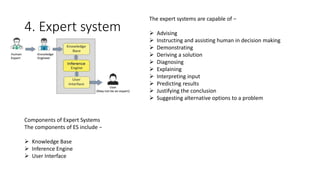
Components of Expert Systems
The components of ES include −
 Knowledge Base
 Inference Engine
 User Interface
Applications of Expert System
The following table shows where ES can be applied.
Application Description
Design Domain Camera lens design, automobile design.
Medical Domain Diagnosis Systems to deduce cause of disease from observed data, conduction medical
operations on humans.
Monitoring Systems Comparing data continuously with observed system or with prescribed behavior such as
leakage monitoring in long petroleum pipeline.
Process Control Systems Controlling a physical process based on monitoring.
Knowledge Domain Finding out faults in vehicles, computers.
Finance/CommerceDetection of possible fraud, suspicious transactions, stock market trading, Airline scheduling, cargo
scheduling.
5. Intelligent Robots − Robots are able to perform the tasks given by a human. They have sensors to detect physical
data from the real world such as light, heat, temperature, movement, sound,bump, and pressure. They have efficient
processors, multiple sensors and huge memory, to exhibit intelligence. In addition, they are capable of learning from
their mistakes and they can adapt to the new environment
In the world of robotics, AI has proven to be a valuable asset in a variety of applications. From customer service to
manufacturing, AI has made its mark and continues to revolutionize the way we think about and interact with robots.
Let’s take a closer look at some of the key areas where AI is being used alongside robotics today.
Customer Service: AI-powered chatbots are becoming increasingly common in customer service applications.
Assembly: AI has proven to be an invaluable tool in this, especially in complex manufacturing industries such as
aerospace. With the help of advanced vision systems, AI can enable real-time course correction and can be used to
help a robot automatically learn the best paths for certain processes while in operation.
Packaging: to improve efficiency, accuracy and cost-effectiveness. By continuously refining and saving certain motions
made by robotic systems, AI helps make installing and moving robotic equipment easier for everyone.
Imaging: Across many industries — including assembly and logistics — accurate imaging is crucial. With the assistance
of AI,
Machine Learning: Machine learning is a powerful tool for robots. By exploring their surroundings, robots can learn
from their surrounding. find ways around obstacles and solve problems to complete tasks more efficiently. From home
robots like vacuum cleaners to manufacturing robots in factories, machine learning is helping robots become more
intelligent and adaptable in their work.
Subfields of Artificial Intelligence
Here, are some important subfields of Artificial Intelligence:
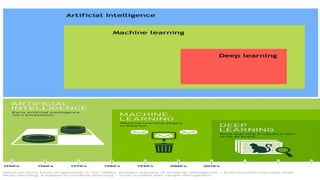
Machine Learning: Machine learning is the art of studying algorithms that learn from examples and experiences. Machine
learning is based on the idea that some patterns in the data were identified and used for future predictions.
Deep Learning: Deep learning is a sub-field of machine learning. Deep learning does not mean the machine learns more in-
depth knowledge; it uses different layers to learn from the data. The depth of the model is represented by the number of
layers in the model. For instance, the Google LeNet model for image recognition counts 22 layers.
Natural Language Processing: A neural network is a group of connected I/O units where each connection has a weight
associated with its computer programs. It helps you to build predictive models from large databases. This model builds upon
the human nervous system. You can use this model to conduct image understanding, human learning, computer speech, etc.
Expert Systems: An expert system is an interactive and reliable computer-based decision-making system that uses facts and
heuristics to solve complex decision-making problems. It is also considered at the highest level of human intelligence. The
main goal of an expert system is to solve the most complex issues in a specific domain.
Fuzzy Logic: Fuzzy Logic is defined as a many-valued logic form that may have truth values of variables in any real number
between 0 and 1. It is the handle concept of partial truth. In real life, we may encounter a situation where we can’t decide
whether the statement is true or false
Neural networks
A neural network is a type of artificial intelligence model inspired by the structure and function of the human brain. It consists
of layers of interconnected nodes, or neurons, that can process input data and produce output signals. Each neuron receives
input signals from other neurons, processes them using an activation function, and sends the output to other neurons in the
next layer. Neural networks are trained using supervised learning techniques, where the weights of the connections between
the neurons are adjusted to minimize the error between the predicted and actual outputs. Neural networks are a powerful tool
in artificial intelligence and have been used in many applications, including image and speech recognition, natural language
processing, and autonomous systems.
Types of Artificial Intelligence
There are three main types of artificial intelligence: rule-based, decision tree, and neural
networks.
Narrow AI is a type of AI that helps you perform a dedicated task with intelligence.
General AI is a type of AI intelligence that can perform any intellectual task efficiently like
a human.
Rule-based AI is based on a set of pre-determined rules that are applied to an input data
set. The system then produces a corresponding output.
Decision tree AI is similar to rule-based AI in that it uses sets of pre-determined rules to
make decisions. However, the decision tree also allows for branching and looping to
consider different options.
Super AI is a type of AI that allows computers to understand human language and
respond in a natural way.
Robot intelligence is a type of AI that allows robots to have complex cognitive abilities,
including reasoning, planning, and learning.
Where is AI used? Examples
AI has broad applications-
• Artificial Intelligence is used to reduce or avoid repetitive
tasks. For instance, AI can repeat a task continuously,
without fatigue. AI never rests, and it is indifferent to the
task to carry out.
• Artificial intelligence improves an existing product. Before
the age of machine learning, core products were built
upon hard-code rules. Firms introduced artificial
intelligence to enhance the functionality of the product
rather than starting from scratch to design new products.
You can think of a Facebook image. A few years ago, you
had to tag your friends manually. Nowadays, with the
help of AI, Facebook gives you a friend’s
recommendation.
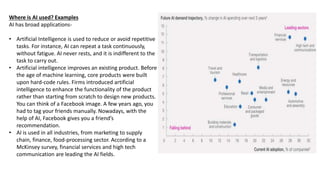
• AI is used in all industries, from marketing to supply
chain, finance, food-processing sector. According to a
McKinsey survey, financial services and high tech
communication are leading the AI fields.
Problem Solving
There are four things that are to be followed in order to solve a problem:
1. Define the problem. A precise definition that must include precise specifications of what
the initial situation(s) will be as well as what final situations constitute acceptable
solutions to the problem.
2. Problem must be analyzed. Some of the important features land up having an immense
impact on the appropriateness of various possible techniques for solving the problem.
• 3. Isolate and represent the task knowledge that is necessary to solve the problem.
• 4. Amongst the available ones choose the best problem-solving technique(s) and apply
the
• same to the particular problem
Search Algorithms in Artificial Intelligence
• Search algorithms are one of the most important areas of Artificial
Intelligence. This topic will explain all about the search algorithms in
AI.
Problem-solving agents:
In Artificial Intelligence, Search techniques are universal problem-
solving methods. Rational agents or Problem-solving agents in AI
mostly used these search strategies or algorithms to solve a specific
problem and provide the best result. Problem-solving agents are the
goal-based agents and use atomic representation. In this topic, we will
learn various problem-solving search algorithms.
Properties of Search Algorithms:
Following are the four essential properties of search algorithms to compare
the efficiency of these algorithms:
Completeness: A search algorithm is said to be complete if it guarantees to
return a solution if at least any solution exists for any random input.
Optimality: If a solution found for an algorithm is guaranteed to be the
best solution (lowest path cost) among all other solutions, then such a
solution for is said to be an optimal solution.
Time Complexity: Time complexity is a measure of time for an algorithm to
complete its task.
Space Complexity: It is the maximum storage space required at any point
during the search, as the complexity of the problem.
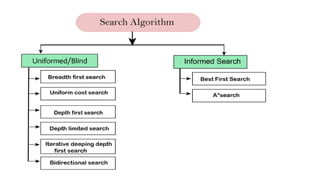
Types of search algorithms
• Based on the search problems we can classify the search algorithms
into uninformed (Blind search) search and informed search
(Heuristic search) algorithms.
Uninformed/Blind Search
• The uninformed search does not contain any domain knowledge such
as closeness, the location of the goal. It operates in a brute-force way
as it only includes information about how to traverse the tree and
how to identify leaf and goal nodes. Uninformed search applies a way
in which search tree is searched without any information about the
search space like initial state operators and test for the goal, so it is
also called blind search. It examines each node of the tree until it
achieves the goal node.
It can be divided into five main types:
 Breadth-first search
 Uniform cost search
 Depth-first search
 Iterative deepening depth-first search
 Bidirectional Search
Informed Search
• Informed search algorithms use domain knowledge. In an informed search,
problem information is available which can guide the search. Informed
search strategies can find a solution more efficiently than an uninformed
search strategy. Informed search is also called a Heuristic search
• Informed search can solve much complex problem which could not be
solved in another way.
An example of informed search algorithms is a traveling salesman problem.
Greedy Search
A* Search
What is Heuristic Search – Techniques & Hill
Climbing in AI
What is a Heuristic Search?
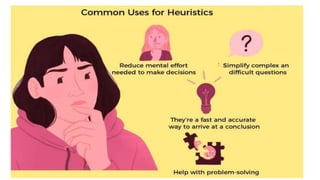
• A Heuristic is a technique to solve a problem faster than classic methods, or to find an
approximate solution when classic methods cannot. This is a kind of a shortcut as we often trade
one of optimality, completeness, accuracy, or precision for speed.
• A Heuristic (or a heuristic function) takes a look at search algorithms. At each branching step, it
evaluates the available information and makes a decision on which branch to follow.
• It does so by ranking alternatives. The Heuristic is any device that is often effective but will not
guarantee work in every case.
• So why do we need heuristics? One reason is to produce, in a reasonable amount of time, a
solution that is good enough for the problem in question. It doesn’t have to be the best- an
approximate solution will do since this is fast enough.
• Most problems are exponential. Heuristic Search let us reduce this to a rather polynomial
number. We use this in AI because we can put it to use in situations where we can’t find known
algorithms.
• We can say Heuristic Techniques are weak methods because they are vulnerable to combinatorial
explosion.
Hill Climbing Algorithm in Artificial Intelligence
• Hill climbing algorithm is a local search algorithm which continuously moves in
the direction of increasing elevation/value to find the peak of the mountain or
best solution to the problem. It terminates when it reaches a peak value where
no neighbor has a higher value.
• Hill climbing algorithm is a technique which is used for optimizing the
mathematical problems. One of the widely discussed examples of Hill climbing
algorithm is Traveling-salesman Problem in which we need to minimize the
distance traveled by the salesman.
• It is also called greedy local search as it only looks to its good immediate neighbor
state and not beyond that.
• A node of hill climbing algorithm has two components which are state and value.
• Hill Climbing is mostly used when a good heuristic is available.
• In this algorithm, we don't need to maintain and handle the search tree or graph
as it only keeps a single current st
Features of Hill Climbing:
Following are some main features of Hill Climbing Algorithm:
• Generate and Test variant: Hill Climbing is the variant of Generate
and Test method. The Generate and Test method produce feedback
which helps to decide which direction to move in the search space.
• Greedy approach: Hill-climbing algorithm search moves in the
direction which optimizes the cost.
• No backtracking: It does not backtrack the search space, as it does
not remember the previous states.
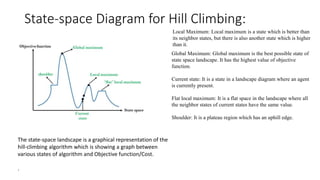
State-space Diagram for Hill Climbing:
The state-space landscape is a graphical representation of the
hill-climbing algorithm which is showing a graph between
various states of algorithm and Objective function/Cost.
.
Local Maximum: Local maximum is a state which is better than
its neighbor states, but there is also another state which is higher
than it.
Global Maximum: Global maximum is the best possible state of
state space landscape. It has the highest value of objective
function.
Current state: It is a state in a landscape diagram where an agent
is currently present.
Flat local maximum: It is a flat space in the landscape where all
the neighbor states of current states have the same value.
Shoulder: It is a plateau region which has an uphill edge.
Types of Hill Climbing Algorithm:
• Simple hill Climbing:
• Steepest-Ascent hill-climbing:
• Stochastic hill Climbing:
Simple Hill Climbing:
Simple hill climbing is the simplest way to implement a hill climbing
algorithm. It only evaluates the neighbor node state at a time and
selects the first one which optimizes current cost and set it as a
current state. It only checks it's one successor state, and if it finds
better than the current state, then move else be in the same state.
This algorithm has the following features:
Less time consuming
Less optimal solution and the solution is not guaranteed
Algorithm for Simple Hill Climbing:
Step 1: Evaluate the initial state, if it is goal state then return success and
Stop.
Step 2: Loop Until a solution is found or there is no new operator left to
apply.
Step 3: Select and apply an operator to the current state.
Step 4: Check new state:
If it is goal state, then return success and quit.
Else if it is better than the current state then assign new state as a current state.
Else if not better than the current state, then return to step2.
Step 5: Exit.
2. Steepest-Ascent hill climbing:
The steepest-Ascent algorithm is a variation of simple hill climbing algorithm. This algorithm examines all the neighboring
nodes of the current state and selects one neighbor node which is closest to the goal state. This algorithm consumes
more time as it searches for multiple neighbors
Algorithm for Steepest-Ascent hill climbing:
Step 1: Evaluate the initial state, if it is goal state then return success and stop, else make current state as initial state.
Step 2: Loop until a solution is found or the current state does not change.
Let SUCC be a state such that any successor of the current state will be better than it.
For each operator that applies to the current state:
Apply the new operator and generate a new state.
Evaluate the new state.
If it is goal state, then return it and quit, else compare it to the SUCC.
If it is better than SUCC, then set new state as SUCC.
If the SUCC is better than the current state, then set current state to SUCC.
Step 5: Exit.
3. Stochastic hill climbing:
• Stochastic hill climbing does not examine for all its neighbor before
moving. Rather, this search algorithm selects one neighbor node at
random and decides whether to choose it as a current state or
examine another state.
Hill Climbing in Artifical Intelligence
• Let’s discuss some of the features of this algorithm (Hill Climbing):
• It is a variant of the generate-and-test algorithm
• It makes use of the greedy approach
• This means it keeps generating possible solutions until it finds the
expected solution, and moves only in the direction which optimizes the
cost function for it.
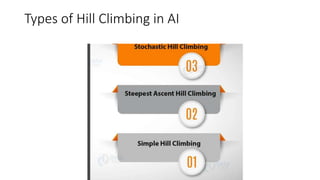
Types of Hill Climbing in AI
Simple Hill Climbing- This examines one neighboring
node at a time and selects the first one that optimizes
the current cost to be the next node.
Steepest Ascent Hill Climbing- This examines all
neighboring nodes and selects the one closest to the
solution state.
This selects a neighboring node at random and
decides whether to move to it or examine another.

ARTIFICIAL INTELLLLIGENCEE modul11_AI.pptx

  • 1.
    Basic information Course Code22MCA262 CIE Marks 50 Teaching Hours/Week (L:P:SDA) 2:0:2 SEE Marks 50 Total Hours of Pedagogy 40 Total Marks 100 Credits 03 Exam Hours 03
  • 2.
    Module-1 INTRODUCTION TOAl AND PRODUCTION SYSTEMS: Introduction to AI-Problem formulation, Problem Definition -Production systems, Control strategies, Search strategies. Problem characteristics, Production system characteristics - Specialized productions system- Problem solving methods – Problem graphs, Matching, Indexing and Heuristic functions -Hill Climbing- Depth first and Breath first, Constraints satisfaction – Related algorithms, Measure of performance and analysis of search algorithms.
  • 3.
    Introduction to ArtificialIntelligence Definition: Artificial Intelligence (AI) is a branch of Science which deals with helping machines to find solutions to complex problems in a more human-like fashion. This generally involves borrowing characteristics from human intelligence, and applying them as algorithms in a computer friendly way.AI is the branch of computer science that attempts to approximate the results of human reasoning by organizing and manipulating factual and heuristic knowledge. AI is generally associated with Computer Science, but it has many important links with other fields such as Math's, Psychology, Cognition, Biology and Philosophy, among many others Areas of AI activity  expert systems,  natural language  Understanding  speech  recognition, vision, and robotics. Our ability to combine knowledge from all these fields will ultimately benefit our progress in the quest of creating an intelligent artificial being.
  • 4.
    The term wascoined in 1956 by John McCarthy at the Massachusetts Institute of Technology. There are several programming languages that are known as AI languages because they are used almost exclusively for AI applications. The two most common are LISP (List Processing) and Prolog (Programming Logic). The greatest advances have occurred in the field of games playing. The best computer chess programs are now capable of beating humans. In May, 1997, an IBM super-computer called Deep Blue defeated world chess champion Gary Kasparov in a chess match.
  • 5.
    History of AI YearMilestone / Innovation 1923 Karel Čapek plays named “Rossum’s Universal Robots, the first use of the word “robot” in English. 1943 Foundations for neural networks laid. 1945 Isaac Asimov, a Columbia University alumni, use the term Robotics. 1956 John McCarthy first used the term Artificial Intelligence. Demonstration of the first running AI program at Carnegie Mellon University. 1964 Danny Bobrow’s dissertation at MIT showed how computers could understand natural language. 1969 Scientists at Stanford Research Institute Developed Shakey. A robot equipped with locomotion and problem-solving. 1979 The world’s first computer-controlled autonomous vehicle, Stanford Cart, was built. 1990 Significant demonstrations in machine learning 1997 The Deep Blue Chess Program beat the then world chess champion, Garry Kasparov.
  • 6.
    2000 Interactive robot petshave become commercially available. MIT displays Kismet, a robot with a face that expresses emotions. 2006 AI came into the Business world in the year 2006. Companies like Facebook, Netflix, Twitter started using AI. 2012 Google has launched an Android app feature called “Google now”, which provides the user with a prediction. 2018 The “Project Debater” from IBM debated complex topics with two master debaters and performed exceptionally well.
  • 7.
    Application of AI 1.Gaming Non-player characters (NPCs): AI is often used to control the behavior of NPCs in games. These characters can interact with players in a more realistic and dynamic way, adding to the immersion of the game. Game design: AI is being used to design and balance game levels, as well as to generate new content such as enemies and items. This helps developers create more diverse and interesting games with less effort. Gameplay: AI can enhance gameplay by providing intelligent opponents for players to face off against. This makes games more challenging and rewarding for players. Virtual assistants: Some games include virtual assistants that can help players by providing information or guidance during gameplay. These assistants use natural language processing (NLP) to understand and respond to player requests. Personalization: AI can personalize gameplay for individual players by adapting to their preferences and playstyle. This helps keep players engaged and motivated to continue playing. Predictive analytics: AI can be used to analyze player data and predict how they will behave in the future. This can help developers design games that are more engaging and tailored to the preferences of specific player segments. Fraud detection: AI can be used to detect fraudulent activity in online games, such as cheating or hacking. This helps maintain the integrity of the game and ensures that players have a fair and enjoyable experience.
  • 8.
    Disadvantage Cost: Developing AItechnology can be expensive, which can be a barrier for smaller studios or indie developers. Complexity: Incorporating AI into a game can be complex and requires specialized knowledge and expertise. This can make it difficult for developers who are not familiar with AI to implement it in their games. Limited intelligence: While AI can be very sophisticated, it is still limited by its programming and the data it has been trained on. This means that AI may not be able to respond appropriately to unexpected situations or player actions. Lack of creativity: AI can generate content and design levels, but it may not be able to come up with truly creative or original ideas. This can limit the potential of AI in the gaming industry.
  • 9.
    2. Speech recognitionIn the 1990s, computer speech recognition reached a practical level for limited purposes. Thus United Airlines has replaced its keyboard tree for flight information by a system using speech recognition of flight numbers and city names. It is quite convenient Transformer-based models: Transformer-based models, such as BERT and GPT, have been highly successful in natural language processing tasks, and are now being applied to speech recognition AI. End-to-end models: End-to-end models are designed to directly map speech signals to text, without the need for intermediate steps. These models have shown promise in improving the accuracy and efficiency of speech recognition AI. Multimodal models: Multimodal models combine speech recognition AI with other modalities, such as vision or touch, to enable more natural and intuitive interactions between humans and machines. Data augmentation: Data augmentation techniques, such as adding background noise or changing the speaking rate, can be used to generate more training data for speech recognition AI models, improving their accuracy and robustness.
  • 10.
    3. Understanding naturallanguage Just getting a sequence of words into a computer is not enough. Parsing sentences is not enough either. The computer has to be provided with an understanding of the domain the text is about, and this is presently possible only for very limited domains. How does natural language processing work? • NLP enables computers to understand natural language as humans do. Whether the language is spoken or written, natural language processing uses artificial intelligence to take real-world input, process it, and make sense of it in a way a computer can understand. Just as humans have different sensors -- such as ears to hear and eyes to see -- computers have programs to read and microphones to collect audio. And just as humans have a brain to process that input, computers have a program to process their respective inputs. At some point in processing, the input is converted to code that the computer can understand.
  • 11.
    4. Expert system Theexpert systems are capable of −  Advising  Instructing and assisting human in decision making  Demonstrating  Deriving a solution  Diagnosing  Explaining  Interpreting input  Predicting results  Justifying the conclusion  Suggesting alternative options to a problem Components of Expert Systems The components of ES include −  Knowledge Base  Inference Engine  User Interface
  • 12.
    Applications of ExpertSystem The following table shows where ES can be applied. Application Description Design Domain Camera lens design, automobile design. Medical Domain Diagnosis Systems to deduce cause of disease from observed data, conduction medical operations on humans. Monitoring Systems Comparing data continuously with observed system or with prescribed behavior such as leakage monitoring in long petroleum pipeline. Process Control Systems Controlling a physical process based on monitoring. Knowledge Domain Finding out faults in vehicles, computers. Finance/CommerceDetection of possible fraud, suspicious transactions, stock market trading, Airline scheduling, cargo scheduling.
  • 13.
    5. Intelligent Robots− Robots are able to perform the tasks given by a human. They have sensors to detect physical data from the real world such as light, heat, temperature, movement, sound,bump, and pressure. They have efficient processors, multiple sensors and huge memory, to exhibit intelligence. In addition, they are capable of learning from their mistakes and they can adapt to the new environment In the world of robotics, AI has proven to be a valuable asset in a variety of applications. From customer service to manufacturing, AI has made its mark and continues to revolutionize the way we think about and interact with robots. Let’s take a closer look at some of the key areas where AI is being used alongside robotics today. Customer Service: AI-powered chatbots are becoming increasingly common in customer service applications. Assembly: AI has proven to be an invaluable tool in this, especially in complex manufacturing industries such as aerospace. With the help of advanced vision systems, AI can enable real-time course correction and can be used to help a robot automatically learn the best paths for certain processes while in operation. Packaging: to improve efficiency, accuracy and cost-effectiveness. By continuously refining and saving certain motions made by robotic systems, AI helps make installing and moving robotic equipment easier for everyone. Imaging: Across many industries — including assembly and logistics — accurate imaging is crucial. With the assistance of AI, Machine Learning: Machine learning is a powerful tool for robots. By exploring their surroundings, robots can learn from their surrounding. find ways around obstacles and solve problems to complete tasks more efficiently. From home robots like vacuum cleaners to manufacturing robots in factories, machine learning is helping robots become more intelligent and adaptable in their work.
  • 15.
    Subfields of ArtificialIntelligence Here, are some important subfields of Artificial Intelligence: Machine Learning: Machine learning is the art of studying algorithms that learn from examples and experiences. Machine learning is based on the idea that some patterns in the data were identified and used for future predictions. Deep Learning: Deep learning is a sub-field of machine learning. Deep learning does not mean the machine learns more in- depth knowledge; it uses different layers to learn from the data. The depth of the model is represented by the number of layers in the model. For instance, the Google LeNet model for image recognition counts 22 layers. Natural Language Processing: A neural network is a group of connected I/O units where each connection has a weight associated with its computer programs. It helps you to build predictive models from large databases. This model builds upon the human nervous system. You can use this model to conduct image understanding, human learning, computer speech, etc. Expert Systems: An expert system is an interactive and reliable computer-based decision-making system that uses facts and heuristics to solve complex decision-making problems. It is also considered at the highest level of human intelligence. The main goal of an expert system is to solve the most complex issues in a specific domain. Fuzzy Logic: Fuzzy Logic is defined as a many-valued logic form that may have truth values of variables in any real number between 0 and 1. It is the handle concept of partial truth. In real life, we may encounter a situation where we can’t decide whether the statement is true or false
  • 16.
    Neural networks A neuralnetwork is a type of artificial intelligence model inspired by the structure and function of the human brain. It consists of layers of interconnected nodes, or neurons, that can process input data and produce output signals. Each neuron receives input signals from other neurons, processes them using an activation function, and sends the output to other neurons in the next layer. Neural networks are trained using supervised learning techniques, where the weights of the connections between the neurons are adjusted to minimize the error between the predicted and actual outputs. Neural networks are a powerful tool in artificial intelligence and have been used in many applications, including image and speech recognition, natural language processing, and autonomous systems.
  • 17.
    Types of ArtificialIntelligence There are three main types of artificial intelligence: rule-based, decision tree, and neural networks. Narrow AI is a type of AI that helps you perform a dedicated task with intelligence. General AI is a type of AI intelligence that can perform any intellectual task efficiently like a human. Rule-based AI is based on a set of pre-determined rules that are applied to an input data set. The system then produces a corresponding output. Decision tree AI is similar to rule-based AI in that it uses sets of pre-determined rules to make decisions. However, the decision tree also allows for branching and looping to consider different options. Super AI is a type of AI that allows computers to understand human language and respond in a natural way. Robot intelligence is a type of AI that allows robots to have complex cognitive abilities, including reasoning, planning, and learning.
  • 18.
    Where is AIused? Examples AI has broad applications- • Artificial Intelligence is used to reduce or avoid repetitive tasks. For instance, AI can repeat a task continuously, without fatigue. AI never rests, and it is indifferent to the task to carry out. • Artificial intelligence improves an existing product. Before the age of machine learning, core products were built upon hard-code rules. Firms introduced artificial intelligence to enhance the functionality of the product rather than starting from scratch to design new products. You can think of a Facebook image. A few years ago, you had to tag your friends manually. Nowadays, with the help of AI, Facebook gives you a friend’s recommendation. • AI is used in all industries, from marketing to supply chain, finance, food-processing sector. According to a McKinsey survey, financial services and high tech communication are leading the AI fields.
  • 19.
    Problem Solving There arefour things that are to be followed in order to solve a problem: 1. Define the problem. A precise definition that must include precise specifications of what the initial situation(s) will be as well as what final situations constitute acceptable solutions to the problem. 2. Problem must be analyzed. Some of the important features land up having an immense impact on the appropriateness of various possible techniques for solving the problem. • 3. Isolate and represent the task knowledge that is necessary to solve the problem. • 4. Amongst the available ones choose the best problem-solving technique(s) and apply the • same to the particular problem
  • 20.
    Search Algorithms inArtificial Intelligence • Search algorithms are one of the most important areas of Artificial Intelligence. This topic will explain all about the search algorithms in AI.
  • 21.
    Problem-solving agents: In ArtificialIntelligence, Search techniques are universal problem- solving methods. Rational agents or Problem-solving agents in AI mostly used these search strategies or algorithms to solve a specific problem and provide the best result. Problem-solving agents are the goal-based agents and use atomic representation. In this topic, we will learn various problem-solving search algorithms.
  • 22.
    Properties of SearchAlgorithms: Following are the four essential properties of search algorithms to compare the efficiency of these algorithms: Completeness: A search algorithm is said to be complete if it guarantees to return a solution if at least any solution exists for any random input. Optimality: If a solution found for an algorithm is guaranteed to be the best solution (lowest path cost) among all other solutions, then such a solution for is said to be an optimal solution. Time Complexity: Time complexity is a measure of time for an algorithm to complete its task. Space Complexity: It is the maximum storage space required at any point during the search, as the complexity of the problem.
  • 23.
    Types of searchalgorithms • Based on the search problems we can classify the search algorithms into uninformed (Blind search) search and informed search (Heuristic search) algorithms.
  • 25.
    Uninformed/Blind Search • Theuninformed search does not contain any domain knowledge such as closeness, the location of the goal. It operates in a brute-force way as it only includes information about how to traverse the tree and how to identify leaf and goal nodes. Uninformed search applies a way in which search tree is searched without any information about the search space like initial state operators and test for the goal, so it is also called blind search. It examines each node of the tree until it achieves the goal node.
  • 26.
    It can bedivided into five main types:  Breadth-first search  Uniform cost search  Depth-first search  Iterative deepening depth-first search  Bidirectional Search
  • 27.
    Informed Search • Informedsearch algorithms use domain knowledge. In an informed search, problem information is available which can guide the search. Informed search strategies can find a solution more efficiently than an uninformed search strategy. Informed search is also called a Heuristic search • Informed search can solve much complex problem which could not be solved in another way. An example of informed search algorithms is a traveling salesman problem. Greedy Search A* Search
  • 28.
    What is HeuristicSearch – Techniques & Hill Climbing in AI
  • 29.
    What is aHeuristic Search? • A Heuristic is a technique to solve a problem faster than classic methods, or to find an approximate solution when classic methods cannot. This is a kind of a shortcut as we often trade one of optimality, completeness, accuracy, or precision for speed. • A Heuristic (or a heuristic function) takes a look at search algorithms. At each branching step, it evaluates the available information and makes a decision on which branch to follow. • It does so by ranking alternatives. The Heuristic is any device that is often effective but will not guarantee work in every case. • So why do we need heuristics? One reason is to produce, in a reasonable amount of time, a solution that is good enough for the problem in question. It doesn’t have to be the best- an approximate solution will do since this is fast enough. • Most problems are exponential. Heuristic Search let us reduce this to a rather polynomial number. We use this in AI because we can put it to use in situations where we can’t find known algorithms. • We can say Heuristic Techniques are weak methods because they are vulnerable to combinatorial explosion.
  • 31.
    Hill Climbing Algorithmin Artificial Intelligence • Hill climbing algorithm is a local search algorithm which continuously moves in the direction of increasing elevation/value to find the peak of the mountain or best solution to the problem. It terminates when it reaches a peak value where no neighbor has a higher value. • Hill climbing algorithm is a technique which is used for optimizing the mathematical problems. One of the widely discussed examples of Hill climbing algorithm is Traveling-salesman Problem in which we need to minimize the distance traveled by the salesman. • It is also called greedy local search as it only looks to its good immediate neighbor state and not beyond that. • A node of hill climbing algorithm has two components which are state and value. • Hill Climbing is mostly used when a good heuristic is available. • In this algorithm, we don't need to maintain and handle the search tree or graph as it only keeps a single current st
  • 32.
    Features of HillClimbing: Following are some main features of Hill Climbing Algorithm: • Generate and Test variant: Hill Climbing is the variant of Generate and Test method. The Generate and Test method produce feedback which helps to decide which direction to move in the search space. • Greedy approach: Hill-climbing algorithm search moves in the direction which optimizes the cost. • No backtracking: It does not backtrack the search space, as it does not remember the previous states.
  • 33.
    State-space Diagram forHill Climbing: The state-space landscape is a graphical representation of the hill-climbing algorithm which is showing a graph between various states of algorithm and Objective function/Cost. . Local Maximum: Local maximum is a state which is better than its neighbor states, but there is also another state which is higher than it. Global Maximum: Global maximum is the best possible state of state space landscape. It has the highest value of objective function. Current state: It is a state in a landscape diagram where an agent is currently present. Flat local maximum: It is a flat space in the landscape where all the neighbor states of current states have the same value. Shoulder: It is a plateau region which has an uphill edge.
  • 34.
    Types of HillClimbing Algorithm: • Simple hill Climbing: • Steepest-Ascent hill-climbing: • Stochastic hill Climbing:
  • 35.
    Simple Hill Climbing: Simplehill climbing is the simplest way to implement a hill climbing algorithm. It only evaluates the neighbor node state at a time and selects the first one which optimizes current cost and set it as a current state. It only checks it's one successor state, and if it finds better than the current state, then move else be in the same state. This algorithm has the following features: Less time consuming Less optimal solution and the solution is not guaranteed
  • 36.
    Algorithm for SimpleHill Climbing: Step 1: Evaluate the initial state, if it is goal state then return success and Stop. Step 2: Loop Until a solution is found or there is no new operator left to apply. Step 3: Select and apply an operator to the current state. Step 4: Check new state: If it is goal state, then return success and quit. Else if it is better than the current state then assign new state as a current state. Else if not better than the current state, then return to step2. Step 5: Exit.
  • 37.
    2. Steepest-Ascent hillclimbing: The steepest-Ascent algorithm is a variation of simple hill climbing algorithm. This algorithm examines all the neighboring nodes of the current state and selects one neighbor node which is closest to the goal state. This algorithm consumes more time as it searches for multiple neighbors Algorithm for Steepest-Ascent hill climbing: Step 1: Evaluate the initial state, if it is goal state then return success and stop, else make current state as initial state. Step 2: Loop until a solution is found or the current state does not change. Let SUCC be a state such that any successor of the current state will be better than it. For each operator that applies to the current state: Apply the new operator and generate a new state. Evaluate the new state. If it is goal state, then return it and quit, else compare it to the SUCC. If it is better than SUCC, then set new state as SUCC. If the SUCC is better than the current state, then set current state to SUCC. Step 5: Exit.
  • 38.
    3. Stochastic hillclimbing: • Stochastic hill climbing does not examine for all its neighbor before moving. Rather, this search algorithm selects one neighbor node at random and decides whether to choose it as a current state or examine another state.
  • 39.
    Hill Climbing inArtifical Intelligence
  • 40.
    • Let’s discusssome of the features of this algorithm (Hill Climbing): • It is a variant of the generate-and-test algorithm • It makes use of the greedy approach • This means it keeps generating possible solutions until it finds the expected solution, and moves only in the direction which optimizes the cost function for it.
  • 41.
    Types of HillClimbing in AI
  • 42.
    Simple Hill Climbing-This examines one neighboring node at a time and selects the first one that optimizes the current cost to be the next node. Steepest Ascent Hill Climbing- This examines all neighboring nodes and selects the one closest to the solution state. This selects a neighboring node at random and decides whether to move to it or examine another.