© Ian Sommerville 2018
Agile Software Engineering
© Ian Sommerville 2018:Agile Software Engineering
• Software products must be brought to market quickly so rapid software
development and delivery is essential.
• Virtually all software products are now developed using an agile
approach.
• Agile software engineering focuses on delivering functionality quickly,
responding to changing product specifications and minimizing
development overheads.
• A large number of ‘agile methods’ have been developed.
• There is no ‘best’ agile method or technique.
• It depends on who is using the technique, the development team and the type of
product being developed
Agile software engineering
2
© Ian Sommerville 2018:Agile Software Engineering
• Plan-driven development evolved to support the engineering of large,
long-lifetime systems (such as aircraft control systems) where teams
may be geographically dispersed and work on the software for several
years.
• This approach is based on controlled and rigorous software development
processes that include detailed project planning, requirements specification and
analysis and system modelling.
• However, plan-driven development involves significant overheads and
documentation and it does not support the rapid development and delivery of
software.
• Agile methods were developed in the 1990s to address this problem.
• These methods focus on the software rather than its documentation, develop
software in a series of increments and aim to reduce process bureaucracy as
much as possible.
Agile methods
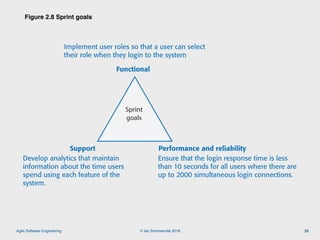
3
© Ian Sommerville 2018:Agile Software Engineering
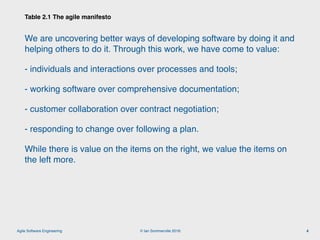
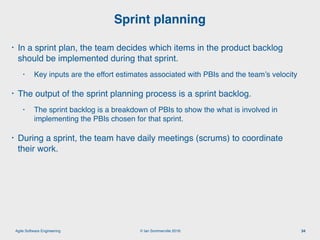
We are uncovering better ways of developing software by doing it and
helping others to do it. Through this work, we have come to value:
- individuals and interactions over processes and tools;
- working software over comprehensive documentation;
- customer collaboration over contract negotiation;
- responding to change over following a plan.
While there is value on the items on the right, we value the items on
the left more.
Table 2.1 The agile manifesto
4
© Ian Sommerville 2018:Agile Software Engineering
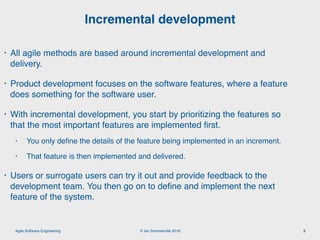
• All agile methods are based around incremental development and
delivery.
• Product development focuses on the software features, where a feature
does something for the software user.
• With incremental development, you start by prioritizing the features so
that the most important features are implemented first.
• You only define the details of the feature being implemented in an increment.
• That feature is then implemented and delivered.
• Users or surrogate users can try it out and provide feedback to the
development team. You then go on to define and implement the next
feature of the system.
Incremental development
5
© Ian Sommerville 2018:Agile Software Engineering
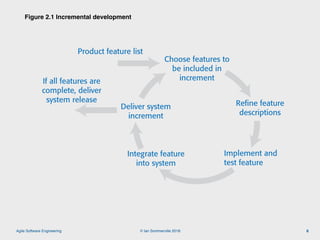
Figure 2.1 Incremental development
6
Figure 2.1 Incremental development
Product feature list
If all features are
complete, deliver
system release
Choose features to
be included in
increment
Refine feature
descriptions
Deliver system
increment
Integrate feature
into system
Implement and
test feature
© Ian Sommerville 2018:Agile Software Engineering
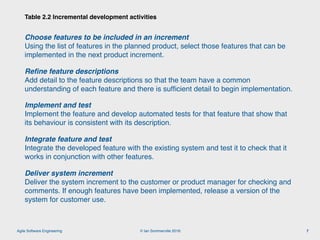
Choose features to be included in an increment

Using the list of features in the planned product, select those features that can be
implemented in the next product increment.
Refine feature descriptions

Add detail to the feature descriptions so that the team have a common
understanding of each feature and there is sufficient detail to begin implementation.
Implement and test

Implement the feature and develop automated tests for that feature that show that
its behaviour is consistent with its description.
Integrate feature and test

Integrate the developed feature with the existing system and test it to check that it
works in conjunction with other features.
Deliver system increment

Deliver the system increment to the customer or product manager for checking and
comments. If enough features have been implemented, release a version of the
system for customer use.
Table 2.2 Incremental development activities
7
© Ian Sommerville 2018:Agile Software Engineering
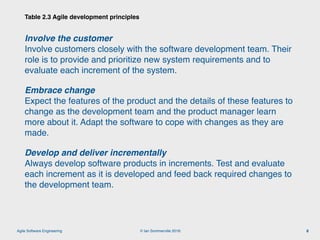
Involve the customer 

Involve customers closely with the software development team. Their
role is to provide and prioritize new system requirements and to
evaluate each increment of the system.
Embrace change 

Expect the features of the product and the details of these features to
change as the development team and the product manager learn
more about it. Adapt the software to cope with changes as they are
made.
Develop and deliver incrementally 

Always develop software products in increments. Test and evaluate
each increment as it is developed and feed back required changes to
the development team. 

Table 2.3 Agile development principles
8
© Ian Sommerville 2018:Agile Software Engineering
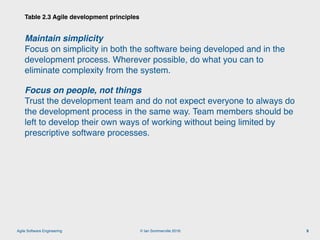
Maintain simplicity

Focus on simplicity in both the software being developed and in the
development process. Wherever possible, do what you can to
eliminate complexity from the system.
Focus on people, not things 

Trust the development team and do not expect everyone to always do
the development process in the same way. Team members should be
left to develop their own ways of working without being limited by
prescriptive software processes.
Table 2.3 Agile development principles
9
© Ian Sommerville 2018:Agile Software Engineering
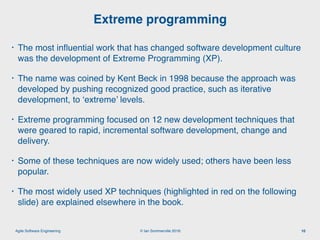
• The most influential work that has changed software development culture
was the development of Extreme Programming (XP).
• The name was coined by Kent Beck in 1998 because the approach was
developed by pushing recognized good practice, such as iterative
development, to ‘extreme’ levels.
• Extreme programming focused on 12 new development techniques that
were geared to rapid, incremental software development, change and
delivery.
• Some of these techniques are now widely used; others have been less
popular.
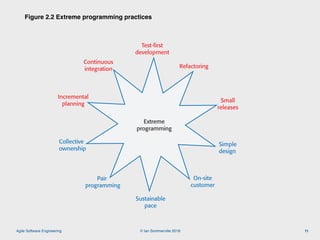
• The most widely used XP techniques (highlighted in red on the following
slide) are explained elsewhere in the book.
Extreme programming
10
© Ian Sommerville 2018:Agile Software Engineering
Figure 2.2 Extreme programming practices
11
Test-first
development
Refactoring
Pair
programming
Simple
design
On-site
customer
Sustainable
pace
Continuous
integration
Small
releases
Incremental
planning
Collective
ownership
Extreme
programming
Figure 2.2 Extreme programming practices
© Ian Sommerville 2018:Agile Software Engineering
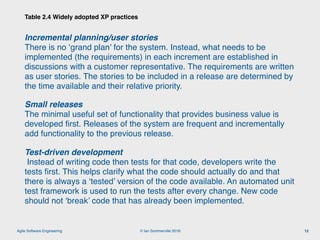
Incremental planning/user stories 

There is no ‘grand plan’ for the system. Instead, what needs to be
implemented (the requirements) in each increment are established in
discussions with a customer representative. The requirements are written
as user stories. The stories to be included in a release are determined by
the time available and their relative priority.
Small releases

The minimal useful set of functionality that provides business value is
developed first. Releases of the system are frequent and incrementally
add functionality to the previous release.
Test-driven development

Instead of writing code then tests for that code, developers write the
tests first. This helps clarify what the code should actually do and that
there is always a ‘tested’ version of the code available. An automated unit
test framework is used to run the tests after every change. New code
should not ‘break’ code that has already been implemented.
Table 2.4 Widely adopted XP practices
12
© Ian Sommerville 2018:Agile Software Engineering
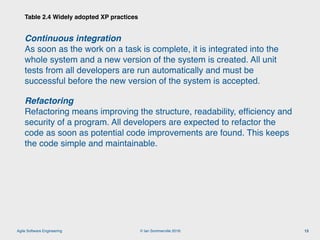
Continuous integration 

As soon as the work on a task is complete, it is integrated into the
whole system and a new version of the system is created. All unit
tests from all developers are run automatically and must be
successful before the new version of the system is accepted.
Refactoring

Refactoring means improving the structure, readability, efficiency and
security of a program. All developers are expected to refactor the
code as soon as potential code improvements are found. This keeps
the code simple and maintainable.
Table 2.4 Widely adopted XP practices
13
© Ian Sommerville 2018:Agile Software Engineering
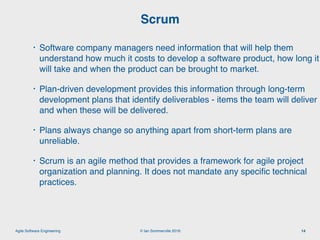
• Software company managers need information that will help them
understand how much it costs to develop a software product, how long it
will take and when the product can be brought to market.
• Plan-driven development provides this information through long-term
development plans that identify deliverables - items the team will deliver
and when these will be delivered.
• Plans always change so anything apart from short-term plans are
unreliable.
• Scrum is an agile method that provides a framework for agile project
organization and planning. It does not mandate any specific technical
practices.
Scrum
14
© Ian Sommerville 2018:Agile Software Engineering
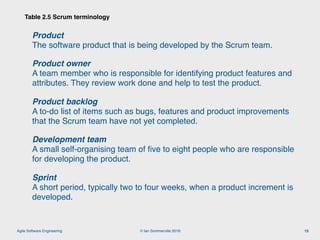
Product

The software product that is being developed by the Scrum team.
Product owner

A team member who is responsible for identifying product features and
attributes. They review work done and help to test the product.
Product backlog 

A to-do list of items such as bugs, features and product improvements
that the Scrum team have not yet completed.
Development team

A small self-organising team of five to eight people who are responsible
for developing the product.
Sprint 

A short period, typically two to four weeks, when a product increment is
developed.
Table 2.5 Scrum terminology
15
© Ian Sommerville 2018:Agile Software Engineering
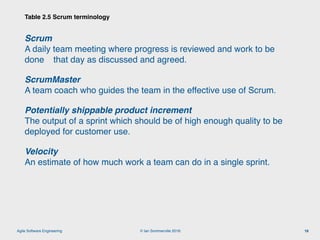
Scrum 

A daily team meeting where progress is reviewed and work to be
done that day as discussed and agreed.
ScrumMaster 

A team coach who guides the team in the effective use of Scrum.
Potentially shippable product increment

The output of a sprint which should be of high enough quality to be
deployed for customer use.
Velocity

An estimate of how much work a team can do in a single sprint.
Table 2.5 Scrum terminology
16
© Ian Sommerville 2018:Agile Software Engineering
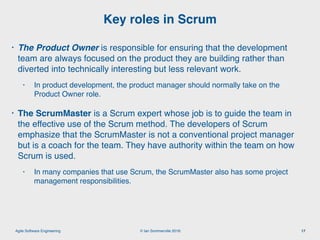
• The Product Owner is responsible for ensuring that the development
team are always focused on the product they are building rather than
diverted into technically interesting but less relevant work.
• In product development, the product manager should normally take on the
Product Owner role.
• The ScrumMaster is a Scrum expert whose job is to guide the team in
the effective use of the Scrum method. The developers of Scrum
emphasize that the ScrumMaster is not a conventional project manager
but is a coach for the team. They have authority within the team on how
Scrum is used.
• In many companies that use Scrum, the ScrumMaster also has some project
management responsibilities.
Key roles in Scrum
17
© Ian Sommerville 2018:Agile Software Engineering
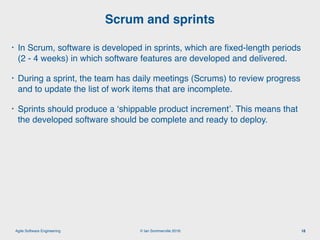
• In Scrum, software is developed in sprints, which are fixed-length periods
(2 - 4 weeks) in which software features are developed and delivered.
• During a sprint, the team has daily meetings (Scrums) to review progress
and to update the list of work items that are incomplete.
• Sprints should produce a ‘shippable product increment’. This means that
the developed software should be complete and ready to deploy.
Scrum and sprints
18
© Ian Sommerville 2018:Agile Software Engineering
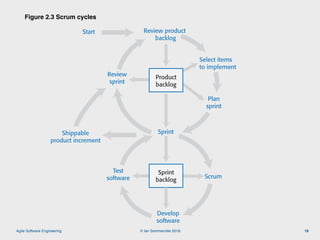
Figure 2.3 Scrum cycles
19
Scrum
Develop
software
Test
software
Select items
to implement
Plan
sprint
Sprint
Review
sprint
Review product
backlog
Figure 2.3. Scrum cycles
Product
backlog
Shippable
product increment
Sprint
backlog
Start
© Ian Sommerville 2018:Agile Software Engineering
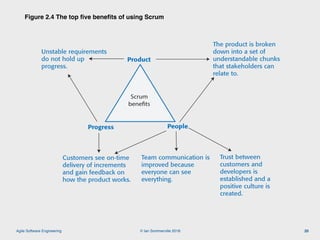
Figure 2.4 The top five benefits of using Scrum
20
Product
Progress People
Unstable requirements
do not hold up
progress.
The product is broken
down into a set of
understandable chunks
that stakeholders can
relate to.
Customers see on-time
delivery of increments
and gain feedback on
how the product works.
Team communication is
improved because
everyone can see
everything.
Scrum
benefits
Figure 2.4 The top-five benefits of using Scrum
Trust between
customers and
developers is
established and a
positive culture is
created.
© Ian Sommerville 2018:Agile Software Engineering
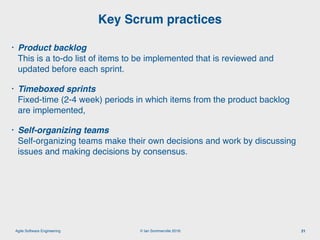
• Product backlog

This is a to-do list of items to be implemented that is reviewed and
updated before each sprint.
• Timeboxed sprints

Fixed-time (2-4 week) periods in which items from the product backlog
are implemented,
• Self-organizing teams

Self-organizing teams make their own decisions and work by discussing
issues and making decisions by consensus.

Key Scrum practices
21
© Ian Sommerville 2018:Agile Software Engineering
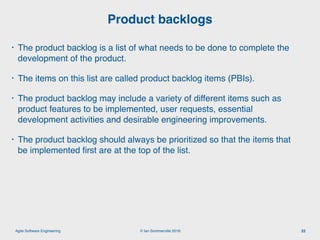
• The product backlog is a list of what needs to be done to complete the
development of the product.
• The items on this list are called product backlog items (PBIs).
• The product backlog may include a variety of different items such as
product features to be implemented, user requests, essential
development activities and desirable engineering improvements.
• The product backlog should always be prioritized so that the items that
be implemented first are at the top of the list.
Product backlogs
22
© Ian Sommerville 2018:Agile Software Engineering
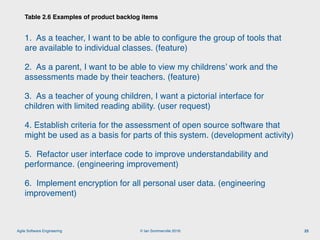
1. As a teacher, I want to be able to configure the group of tools that
are available to individual classes. (feature)
2. As a parent, I want to be able to view my childrens’ work and the
assessments made by their teachers. (feature)
3. As a teacher of young children, I want a pictorial interface for
children with limited reading ability. (user request)
4. Establish criteria for the assessment of open source software that
might be used as a basis for parts of this system. (development activity)
5. Refactor user interface code to improve understandability and
performance. (engineering improvement)
6. Implement encryption for all personal user data. (engineering
improvement)
Table 2.6 Examples of product backlog items
23
© Ian Sommerville 2018:Agile Software Engineering
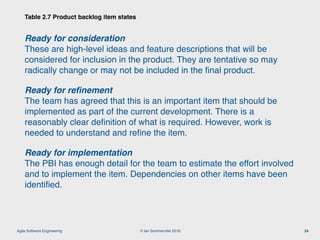
Ready for consideration

These are high-level ideas and feature descriptions that will be
considered for inclusion in the product. They are tentative so may
radically change or may not be included in the final product.
Ready for refinement 

The team has agreed that this is an important item that should be
implemented as part of the current development. There is a
reasonably clear definition of what is required. However, work is
needed to understand and refine the item.
Ready for implementation 

The PBI has enough detail for the team to estimate the effort involved
and to implement the item. Dependencies on other items have been
identified.
Table 2.7 Product backlog item states
24
© Ian Sommerville 2018:Agile Software Engineering
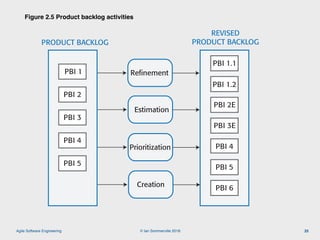
Figure 2.5 Product backlog activities
25
Figure 2.5 Product backlog activities
PRODUCT BACKLOG
Creation
Refinement
Estimation
PBI 1
PBI 2
PBI 3
PBI 5
PBI 4
PBI 4
PBI 1.1
PBI 1.2
PBI 3E
PBI 2E
Prioritization
Creation PBI 6
PBI 5
REVISED
PRODUCT BACKLOG
© Ian Sommerville 2018:Agile Software Engineering
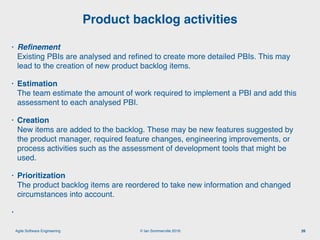
• Refinement 

Existing PBIs are analysed and refined to create more detailed PBIs. This may
lead to the creation of new product backlog items.
• Estimation

The team estimate the amount of work required to implement a PBI and add this
assessment to each analysed PBI.
• Creation 

New items are added to the backlog. These may be new features suggested by
the product manager, required feature changes, engineering improvements, or
process activities such as the assessment of development tools that might be
used.
• Prioritization

The product backlog items are reordered to take new information and changed
circumstances into account.
•
Product backlog activities
26
© Ian Sommerville 2018:Agile Software Engineering
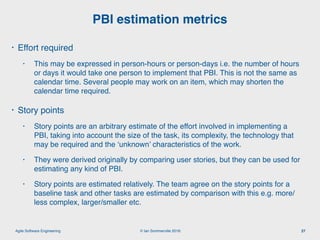
• Effort required
• This may be expressed in person-hours or person-days i.e. the number of hours
or days it would take one person to implement that PBI. This is not the same as
calendar time. Several people may work on an item, which may shorten the
calendar time required.
• Story points
• Story points are an arbitrary estimate of the effort involved in implementing a
PBI, taking into account the size of the task, its complexity, the technology that
may be required and the ‘unknown’ characteristics of the work.
• They were derived originally by comparing user stories, but they can be used for
estimating any kind of PBI.
• Story points are estimated relatively. The team agree on the story points for a
baseline task and other tasks are estimated by comparison with this e.g. more/
less complex, larger/smaller etc.
PBI estimation metrics
27
© Ian Sommerville 2018:Agile Software Engineering
• Products are developed in a series of sprints, each of which delivers an
increment of the product or supporting software.
• Sprints are short duration activities (1-4 weeks) and take place between
a defined start and end date. Sprints are timeboxed, which means that
development stops at the end of a sprint whether or not the work has
been completed.
• During a sprint, the team work on the items from the product backlog.
Timeboxed sprints
28
© Ian Sommerville 2018:Agile Software Engineering
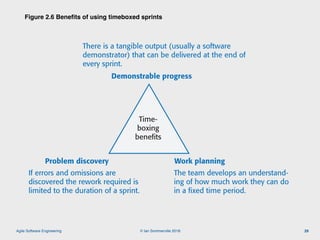
Figure 2.6 Benefits of using timeboxed sprints
29
Demonstrable progress
Problem discovery Work planning
There is a tangible output (usually a software
demonstrator) that can be delivered at the end of
every sprint.
If errors and omissions are
discovered the rework required is
limited to the duration of a sprint.
The team develops an understand-
ing of how much work they can do
in a fixed time period.
Time-
boxing
benefits
Figure 2.6 Benefits of using timeboxed sprints
© Ian Sommerville 2018:Agile Software Engineering
• Sprint planning 

Work items to be completed in that sprint are selected and, if necessary,
refined to create a sprint backlog. This should not last more than a day at
the beginning of the sprint.
• Sprint execution

The team work to implement the sprint backlog items that have been
chosen for that sprint. If it is impossible to complete all of the sprint
backlog items, the sprint is not extended. The unfinished items are
returned to the product backlog and queued for a future sprint.
• Sprint reviewing

The work done in the sprint is reviewed by the team and (possibly)
external stakeholders. The team reflect on what went well and what went
wrong during the sprint with a view to improving their work process.
Sprint activities
30
© Ian Sommerville 2018:Agile Software Engineering
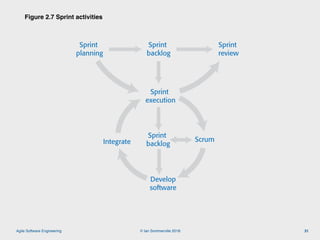
Figure 2.7 Sprint activities
31
Sprint
planning
Sprint
review
Sprint
backlog
Figure 2.7 Sprint activities
Scrum
Develop
software
Integrate
Sprint
execution
Sprint
backlog
© Ian Sommerville 2018:Agile Software Engineering
• Establish an agreed sprint goal
• Sprint goals may be focused on software functionality, support or performance
and reliability,.
• Decide on the list of items from the product backlog that should be
implemented
• Create a sprint backlog.
• This is a more detailed version of the product backlog that records the work to
be done during the sprint
Sprint planning
32
© Ian Sommerville 2018:Agile Software Engineering
Figure 2.8 Sprint goals
33
Functional
Support Performance and reliability
Implement user roles so that a user can select
their role when they login to the system
Develop analytics that maintain
information about the time users
spend using each feature of the
system.
Ensure that the login response time is less
than 10 seconds for all users where there are
up to 2000 simultaneous login connections.
Sprint
goals
Figure 2.8 Sprint goals
© Ian Sommerville 2018:Agile Software Engineering
• In a sprint plan, the team decides which items in the product backlog
should be implemented during that sprint.
• Key inputs are the effort estimates associated with PBIs and the team’s velocity
• The output of the sprint planning process is a sprint backlog.
• The sprint backlog is a breakdown of PBIs to show the what is involved in
implementing the PBIs chosen for that sprint.
• During a sprint, the team have daily meetings (scrums) to coordinate
their work.
Sprint planning
34
© Ian Sommerville 2018:Agile Software Engineering
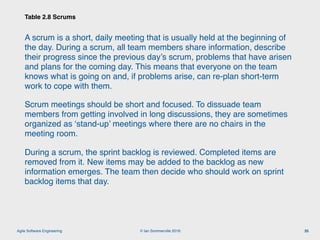
A scrum is a short, daily meeting that is usually held at the beginning of
the day. During a scrum, all team members share information, describe
their progress since the previous day’s scrum, problems that have arisen
and plans for the coming day. This means that everyone on the team
knows what is going on and, if problems arise, can re-plan short-term
work to cope with them.
Scrum meetings should be short and focused. To dissuade team
members from getting involved in long discussions, they are sometimes
organized as ‘stand-up’ meetings where there are no chairs in the
meeting room.
During a scrum, the sprint backlog is reviewed. Completed items are
removed from it. New items may be added to the backlog as new
information emerges. The team then decide who should work on sprint
backlog items that day.
Table 2.8 Scrums
35
© Ian Sommerville 2018:Agile Software Engineering
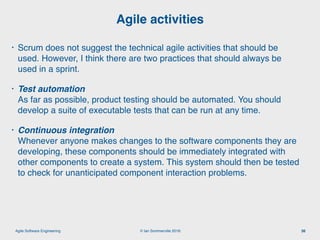
• Scrum does not suggest the technical agile activities that should be
used. However, I think there are two practices that should always be
used in a sprint.
• Test automation

As far as possible, product testing should be automated. You should
develop a suite of executable tests that can be run at any time.
• Continuous integration

Whenever anyone makes changes to the software components they are
developing, these components should be immediately integrated with
other components to create a system. This system should then be tested
to check for unanticipated component interaction problems.
Agile activities
36
© Ian Sommerville 2018:Agile Software Engineering
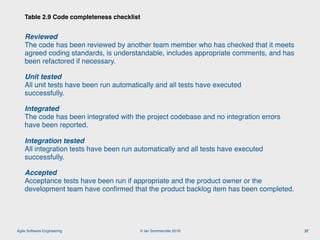
Reviewed

The code has been reviewed by another team member who has checked that it meets
agreed coding standards, is understandable, includes appropriate comments, and has
been refactored if necessary.
Unit tested

All unit tests have been run automatically and all tests have executed
successfully.
Integrated

The code has been integrated with the project codebase and no integration errors
have been reported.
Integration tested 

All integration tests have been run automatically and all tests have executed
successfully.
Accepted

Acceptance tests have been run if appropriate and the product owner or the
development team have confirmed that the product backlog item has been completed.
Table 2.9 Code completeness checklist
37
© Ian Sommerville 2018:Agile Software Engineering
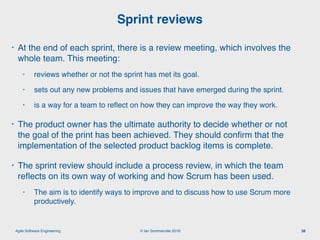
• At the end of each sprint, there is a review meeting, which involves the
whole team. This meeting:
• reviews whether or not the sprint has met its goal.
• sets out any new problems and issues that have emerged during the sprint.
• is a way for a team to reflect on how they can improve the way they work.
• The product owner has the ultimate authority to decide whether or not
the goal of the print has been achieved. They should confirm that the
implementation of the selected product backlog items is complete.
• The sprint review should include a process review, in which the team
reflects on its own way of working and how Scrum has been used.
• The aim is to identify ways to improve and to discuss how to use Scrum more
productively.
Sprint reviews
38
© Ian Sommerville 2018:Agile Software Engineering
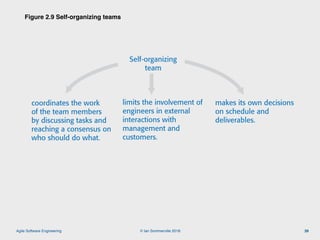
Figure 2.9 Self-organizing teams
39
Self-organizing
team
Figure 2.9 Self-organizing teams
coordinates the work
of the team members
by discussing tasks and
reaching a consensus on
who should do what.
limits the involvement of
engineers in external
interactions with
management and
customers.
makes its own decisions
on schedule and
deliverables.
© Ian Sommerville 2018:Agile Software Engineering
• The ideal Scrum team size is between 5 and 8 people.
• Teams have to tackle diverse tasks and so usually require people with different
skills, such as networking, user experience, database design and so on.
• They usually involve people with different levels of experience.
• A team of 5-8 people is large enough to be diverse yet small enough to
communicate informally and effectively and to agree on the priorities of the
team.
• The advantage of a self-organizing team is that it can be a cohesive
team that can adapt to change.
• Because the team rather than individuals take responsibility for the work, they
can cope with people leaving and joining the team.
• Good team communication means that team members inevitably learn
something about each other’s areas
Team size and composition
40
© Ian Sommerville 2018:Agile Software Engineering
• The developers of Scrum assumed that teams would be co-located.
They would work in the same room and could communicate informally.
• Daily scrums mean that the team members know what’s been done and what
others are doing.
• However, the use of daily scrums as a coordination mechanism is based
on two assumptions that are not always correct:
• Scrum assumes that the team will be made up of full-time workers who share a
workspace. In reality, team members may be part-time and may work in different
places. For a student project team, the team members may take different
classes at different times.
• Scrum assumes that all team members can attend a morning meeting to
coordinate the work for the day. However, some team members may work
flexible hours (e.g. because of childcare responsibilities) or may work on several
projects at the same time.
Team coordination
41
© Ian Sommerville 2018:Agile Software Engineering
• External interactions are interactions that team members have with
people outside of the team.
• In Scrum, the idea is that developers should focus on development and
only the ScrumMaster and Product Owner should be involved in external
interactions.
• The intention is that the team should be able to work on software
development without external interference or distractions.
External interactions
42
© Ian Sommerville 2018:Agile Software Engineering
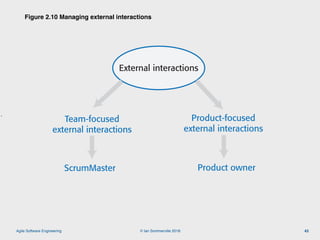
Figure 2.10 Managing external interactions
43
External interactions
ScrumMaster Product owner
Figure 2.10 Managing external interactions
Product-focused
external interactions
Team-focused
external interactions
© Ian Sommerville 2018:Agile Software Engineering
• In all but the smallest product development companies, there is a need
for development teams to report on progress to company management.
• A self-organizing team has to appoint someone to take on these
responsibilities.
• Because of the need to maintain continuity of communication with people
outside of the group, rotating these activities around team members is not a
viable approach.
• The developers of Scrum did not envisage that the ScrumMaster should
also have project management responsibilities.
• In many companies, however, the ScrumMaster has to take on project
management responsibilities.
• They know the work going on and are in the best position to provide accurate
information and project plans and progress.
Project management
44
© Ian Sommerville 2018:Agile Software Engineering
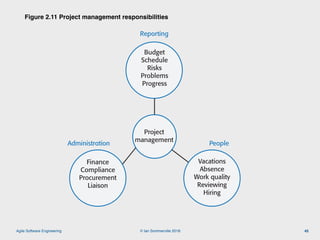
Figure 2.11 Project management responsibilities
45
Project
management
Reporting
Administration
Figure 2.11 Project management responsibilities
Budget
Schedule
Risks
Problems
Progress
Finance
Compliance
Procurement
Liaison
Vacations
Absence
Work quality
Reviewing
Hiring
People
© Ian Sommerville 2018:Agile Software Engineering
• The best way to develop software products is to use agile software engineering
methods that are geared to rapid product development and delivery.
• Agile methods are based around iterative development and the minimization of
overheads during the development process.
• Extreme programming (XP) is an influential agile method that introduced agile
development practices such as user stories, test-first development and
continuous integration. These are now mainstream software development
activities.
• Scrum is an agile method that focuses on agile planning and management.
Unlike XP, it does not define the engineering practices to be used. The
development team may use any technical practices that they believe are
appropriate for the product being developed.
• In Scrum, work to be done is maintained in a product backlog – a list of work
items to be completed. Each increment of the software implements some of the
work items from the product backlog.
Key points 1
46
© Ian Sommerville 2018:Agile Software Engineering
• Sprints are fixed-time activities (usually 2–4 weeks) where a product
increment is developed. Increments should be ‘potentially shippable’ i.e.
they should not need further work before they are delivered.
• A self-organizing team is a development team that organizes the work to
be done by discussion and agreement amongst team members.
• Scrum practices such as the product backlog, sprints and self-organizing
teams can be used in any agile development process, even if other
aspects of Scrum are not used.
Key points 2
47

Engineering Software Products: 2. agile software engineering

  • 1.
    © Ian Sommerville2018 Agile Software Engineering
  • 2.
    © Ian Sommerville2018:Agile Software Engineering • Software products must be brought to market quickly so rapid software development and delivery is essential. • Virtually all software products are now developed using an agile approach. • Agile software engineering focuses on delivering functionality quickly, responding to changing product specifications and minimizing development overheads. • A large number of ‘agile methods’ have been developed. • There is no ‘best’ agile method or technique. • It depends on who is using the technique, the development team and the type of product being developed Agile software engineering 2
  • 3.
    © Ian Sommerville2018:Agile Software Engineering • Plan-driven development evolved to support the engineering of large, long-lifetime systems (such as aircraft control systems) where teams may be geographically dispersed and work on the software for several years. • This approach is based on controlled and rigorous software development processes that include detailed project planning, requirements specification and analysis and system modelling. • However, plan-driven development involves significant overheads and documentation and it does not support the rapid development and delivery of software. • Agile methods were developed in the 1990s to address this problem. • These methods focus on the software rather than its documentation, develop software in a series of increments and aim to reduce process bureaucracy as much as possible. Agile methods 3
  • 4.
    © Ian Sommerville2018:Agile Software Engineering We are uncovering better ways of developing software by doing it and helping others to do it. Through this work, we have come to value: - individuals and interactions over processes and tools; - working software over comprehensive documentation; - customer collaboration over contract negotiation; - responding to change over following a plan. While there is value on the items on the right, we value the items on the left more. Table 2.1 The agile manifesto 4
  • 5.
    © Ian Sommerville2018:Agile Software Engineering • All agile methods are based around incremental development and delivery. • Product development focuses on the software features, where a feature does something for the software user. • With incremental development, you start by prioritizing the features so that the most important features are implemented first. • You only define the details of the feature being implemented in an increment. • That feature is then implemented and delivered. • Users or surrogate users can try it out and provide feedback to the development team. You then go on to define and implement the next feature of the system. Incremental development 5
  • 6.
    © Ian Sommerville2018:Agile Software Engineering Figure 2.1 Incremental development 6 Figure 2.1 Incremental development Product feature list If all features are complete, deliver system release Choose features to be included in increment Refine feature descriptions Deliver system increment Integrate feature into system Implement and test feature
  • 7.
    © Ian Sommerville2018:Agile Software Engineering Choose features to be included in an increment
 Using the list of features in the planned product, select those features that can be implemented in the next product increment. Refine feature descriptions
 Add detail to the feature descriptions so that the team have a common understanding of each feature and there is sufficient detail to begin implementation. Implement and test
 Implement the feature and develop automated tests for that feature that show that its behaviour is consistent with its description. Integrate feature and test
 Integrate the developed feature with the existing system and test it to check that it works in conjunction with other features. Deliver system increment
 Deliver the system increment to the customer or product manager for checking and comments. If enough features have been implemented, release a version of the system for customer use. Table 2.2 Incremental development activities 7
  • 8.
    © Ian Sommerville2018:Agile Software Engineering Involve the customer 
 Involve customers closely with the software development team. Their role is to provide and prioritize new system requirements and to evaluate each increment of the system. Embrace change 
 Expect the features of the product and the details of these features to change as the development team and the product manager learn more about it. Adapt the software to cope with changes as they are made. Develop and deliver incrementally 
 Always develop software products in increments. Test and evaluate each increment as it is developed and feed back required changes to the development team. 
 Table 2.3 Agile development principles 8
  • 9.
    © Ian Sommerville2018:Agile Software Engineering Maintain simplicity
 Focus on simplicity in both the software being developed and in the development process. Wherever possible, do what you can to eliminate complexity from the system. Focus on people, not things 
 Trust the development team and do not expect everyone to always do the development process in the same way. Team members should be left to develop their own ways of working without being limited by prescriptive software processes. Table 2.3 Agile development principles 9
  • 10.
    © Ian Sommerville2018:Agile Software Engineering • The most influential work that has changed software development culture was the development of Extreme Programming (XP). • The name was coined by Kent Beck in 1998 because the approach was developed by pushing recognized good practice, such as iterative development, to ‘extreme’ levels. • Extreme programming focused on 12 new development techniques that were geared to rapid, incremental software development, change and delivery. • Some of these techniques are now widely used; others have been less popular. • The most widely used XP techniques (highlighted in red on the following slide) are explained elsewhere in the book. Extreme programming 10
  • 11.
    © Ian Sommerville2018:Agile Software Engineering Figure 2.2 Extreme programming practices 11 Test-first development Refactoring Pair programming Simple design On-site customer Sustainable pace Continuous integration Small releases Incremental planning Collective ownership Extreme programming Figure 2.2 Extreme programming practices
  • 12.
    © Ian Sommerville2018:Agile Software Engineering Incremental planning/user stories 
 There is no ‘grand plan’ for the system. Instead, what needs to be implemented (the requirements) in each increment are established in discussions with a customer representative. The requirements are written as user stories. The stories to be included in a release are determined by the time available and their relative priority. Small releases
 The minimal useful set of functionality that provides business value is developed first. Releases of the system are frequent and incrementally add functionality to the previous release. Test-driven development
 Instead of writing code then tests for that code, developers write the tests first. This helps clarify what the code should actually do and that there is always a ‘tested’ version of the code available. An automated unit test framework is used to run the tests after every change. New code should not ‘break’ code that has already been implemented. Table 2.4 Widely adopted XP practices 12
  • 13.
    © Ian Sommerville2018:Agile Software Engineering Continuous integration 
 As soon as the work on a task is complete, it is integrated into the whole system and a new version of the system is created. All unit tests from all developers are run automatically and must be successful before the new version of the system is accepted. Refactoring
 Refactoring means improving the structure, readability, efficiency and security of a program. All developers are expected to refactor the code as soon as potential code improvements are found. This keeps the code simple and maintainable. Table 2.4 Widely adopted XP practices 13
  • 14.
    © Ian Sommerville2018:Agile Software Engineering • Software company managers need information that will help them understand how much it costs to develop a software product, how long it will take and when the product can be brought to market. • Plan-driven development provides this information through long-term development plans that identify deliverables - items the team will deliver and when these will be delivered. • Plans always change so anything apart from short-term plans are unreliable. • Scrum is an agile method that provides a framework for agile project organization and planning. It does not mandate any specific technical practices. Scrum 14
  • 15.
    © Ian Sommerville2018:Agile Software Engineering Product
 The software product that is being developed by the Scrum team. Product owner
 A team member who is responsible for identifying product features and attributes. They review work done and help to test the product. Product backlog 
 A to-do list of items such as bugs, features and product improvements that the Scrum team have not yet completed. Development team
 A small self-organising team of five to eight people who are responsible for developing the product. Sprint 
 A short period, typically two to four weeks, when a product increment is developed. Table 2.5 Scrum terminology 15
  • 16.
    © Ian Sommerville2018:Agile Software Engineering Scrum 
 A daily team meeting where progress is reviewed and work to be done that day as discussed and agreed. ScrumMaster 
 A team coach who guides the team in the effective use of Scrum. Potentially shippable product increment
 The output of a sprint which should be of high enough quality to be deployed for customer use. Velocity
 An estimate of how much work a team can do in a single sprint. Table 2.5 Scrum terminology 16
  • 17.
    © Ian Sommerville2018:Agile Software Engineering • The Product Owner is responsible for ensuring that the development team are always focused on the product they are building rather than diverted into technically interesting but less relevant work. • In product development, the product manager should normally take on the Product Owner role. • The ScrumMaster is a Scrum expert whose job is to guide the team in the effective use of the Scrum method. The developers of Scrum emphasize that the ScrumMaster is not a conventional project manager but is a coach for the team. They have authority within the team on how Scrum is used. • In many companies that use Scrum, the ScrumMaster also has some project management responsibilities. Key roles in Scrum 17
  • 18.
    © Ian Sommerville2018:Agile Software Engineering • In Scrum, software is developed in sprints, which are fixed-length periods (2 - 4 weeks) in which software features are developed and delivered. • During a sprint, the team has daily meetings (Scrums) to review progress and to update the list of work items that are incomplete. • Sprints should produce a ‘shippable product increment’. This means that the developed software should be complete and ready to deploy. Scrum and sprints 18
  • 19.
    © Ian Sommerville2018:Agile Software Engineering Figure 2.3 Scrum cycles 19 Scrum Develop software Test software Select items to implement Plan sprint Sprint Review sprint Review product backlog Figure 2.3. Scrum cycles Product backlog Shippable product increment Sprint backlog Start
  • 20.
    © Ian Sommerville2018:Agile Software Engineering Figure 2.4 The top five benefits of using Scrum 20 Product Progress People Unstable requirements do not hold up progress. The product is broken down into a set of understandable chunks that stakeholders can relate to. Customers see on-time delivery of increments and gain feedback on how the product works. Team communication is improved because everyone can see everything. Scrum benefits Figure 2.4 The top-five benefits of using Scrum Trust between customers and developers is established and a positive culture is created.
  • 21.
    © Ian Sommerville2018:Agile Software Engineering • Product backlog
 This is a to-do list of items to be implemented that is reviewed and updated before each sprint. • Timeboxed sprints
 Fixed-time (2-4 week) periods in which items from the product backlog are implemented, • Self-organizing teams
 Self-organizing teams make their own decisions and work by discussing issues and making decisions by consensus.
 Key Scrum practices 21
  • 22.
    © Ian Sommerville2018:Agile Software Engineering • The product backlog is a list of what needs to be done to complete the development of the product. • The items on this list are called product backlog items (PBIs). • The product backlog may include a variety of different items such as product features to be implemented, user requests, essential development activities and desirable engineering improvements. • The product backlog should always be prioritized so that the items that be implemented first are at the top of the list. Product backlogs 22
  • 23.
    © Ian Sommerville2018:Agile Software Engineering 1. As a teacher, I want to be able to configure the group of tools that are available to individual classes. (feature) 2. As a parent, I want to be able to view my childrens’ work and the assessments made by their teachers. (feature) 3. As a teacher of young children, I want a pictorial interface for children with limited reading ability. (user request) 4. Establish criteria for the assessment of open source software that might be used as a basis for parts of this system. (development activity) 5. Refactor user interface code to improve understandability and performance. (engineering improvement) 6. Implement encryption for all personal user data. (engineering improvement) Table 2.6 Examples of product backlog items 23
  • 24.
    © Ian Sommerville2018:Agile Software Engineering Ready for consideration
 These are high-level ideas and feature descriptions that will be considered for inclusion in the product. They are tentative so may radically change or may not be included in the final product. Ready for refinement 
 The team has agreed that this is an important item that should be implemented as part of the current development. There is a reasonably clear definition of what is required. However, work is needed to understand and refine the item. Ready for implementation 
 The PBI has enough detail for the team to estimate the effort involved and to implement the item. Dependencies on other items have been identified. Table 2.7 Product backlog item states 24
  • 25.
    © Ian Sommerville2018:Agile Software Engineering Figure 2.5 Product backlog activities 25 Figure 2.5 Product backlog activities PRODUCT BACKLOG Creation Refinement Estimation PBI 1 PBI 2 PBI 3 PBI 5 PBI 4 PBI 4 PBI 1.1 PBI 1.2 PBI 3E PBI 2E Prioritization Creation PBI 6 PBI 5 REVISED PRODUCT BACKLOG
  • 26.
    © Ian Sommerville2018:Agile Software Engineering • Refinement 
 Existing PBIs are analysed and refined to create more detailed PBIs. This may lead to the creation of new product backlog items. • Estimation
 The team estimate the amount of work required to implement a PBI and add this assessment to each analysed PBI. • Creation 
 New items are added to the backlog. These may be new features suggested by the product manager, required feature changes, engineering improvements, or process activities such as the assessment of development tools that might be used. • Prioritization
 The product backlog items are reordered to take new information and changed circumstances into account. • Product backlog activities 26
  • 27.
    © Ian Sommerville2018:Agile Software Engineering • Effort required • This may be expressed in person-hours or person-days i.e. the number of hours or days it would take one person to implement that PBI. This is not the same as calendar time. Several people may work on an item, which may shorten the calendar time required. • Story points • Story points are an arbitrary estimate of the effort involved in implementing a PBI, taking into account the size of the task, its complexity, the technology that may be required and the ‘unknown’ characteristics of the work. • They were derived originally by comparing user stories, but they can be used for estimating any kind of PBI. • Story points are estimated relatively. The team agree on the story points for a baseline task and other tasks are estimated by comparison with this e.g. more/ less complex, larger/smaller etc. PBI estimation metrics 27
  • 28.
    © Ian Sommerville2018:Agile Software Engineering • Products are developed in a series of sprints, each of which delivers an increment of the product or supporting software. • Sprints are short duration activities (1-4 weeks) and take place between a defined start and end date. Sprints are timeboxed, which means that development stops at the end of a sprint whether or not the work has been completed. • During a sprint, the team work on the items from the product backlog. Timeboxed sprints 28
  • 29.
    © Ian Sommerville2018:Agile Software Engineering Figure 2.6 Benefits of using timeboxed sprints 29 Demonstrable progress Problem discovery Work planning There is a tangible output (usually a software demonstrator) that can be delivered at the end of every sprint. If errors and omissions are discovered the rework required is limited to the duration of a sprint. The team develops an understand- ing of how much work they can do in a fixed time period. Time- boxing benefits Figure 2.6 Benefits of using timeboxed sprints
  • 30.
    © Ian Sommerville2018:Agile Software Engineering • Sprint planning 
 Work items to be completed in that sprint are selected and, if necessary, refined to create a sprint backlog. This should not last more than a day at the beginning of the sprint. • Sprint execution
 The team work to implement the sprint backlog items that have been chosen for that sprint. If it is impossible to complete all of the sprint backlog items, the sprint is not extended. The unfinished items are returned to the product backlog and queued for a future sprint. • Sprint reviewing
 The work done in the sprint is reviewed by the team and (possibly) external stakeholders. The team reflect on what went well and what went wrong during the sprint with a view to improving their work process. Sprint activities 30
  • 31.
    © Ian Sommerville2018:Agile Software Engineering Figure 2.7 Sprint activities 31 Sprint planning Sprint review Sprint backlog Figure 2.7 Sprint activities Scrum Develop software Integrate Sprint execution Sprint backlog
  • 32.
    © Ian Sommerville2018:Agile Software Engineering • Establish an agreed sprint goal • Sprint goals may be focused on software functionality, support or performance and reliability,. • Decide on the list of items from the product backlog that should be implemented • Create a sprint backlog. • This is a more detailed version of the product backlog that records the work to be done during the sprint Sprint planning 32
  • 33.
    © Ian Sommerville2018:Agile Software Engineering Figure 2.8 Sprint goals 33 Functional Support Performance and reliability Implement user roles so that a user can select their role when they login to the system Develop analytics that maintain information about the time users spend using each feature of the system. Ensure that the login response time is less than 10 seconds for all users where there are up to 2000 simultaneous login connections. Sprint goals Figure 2.8 Sprint goals
  • 34.
    © Ian Sommerville2018:Agile Software Engineering • In a sprint plan, the team decides which items in the product backlog should be implemented during that sprint. • Key inputs are the effort estimates associated with PBIs and the team’s velocity • The output of the sprint planning process is a sprint backlog. • The sprint backlog is a breakdown of PBIs to show the what is involved in implementing the PBIs chosen for that sprint. • During a sprint, the team have daily meetings (scrums) to coordinate their work. Sprint planning 34
  • 35.
    © Ian Sommerville2018:Agile Software Engineering A scrum is a short, daily meeting that is usually held at the beginning of the day. During a scrum, all team members share information, describe their progress since the previous day’s scrum, problems that have arisen and plans for the coming day. This means that everyone on the team knows what is going on and, if problems arise, can re-plan short-term work to cope with them. Scrum meetings should be short and focused. To dissuade team members from getting involved in long discussions, they are sometimes organized as ‘stand-up’ meetings where there are no chairs in the meeting room. During a scrum, the sprint backlog is reviewed. Completed items are removed from it. New items may be added to the backlog as new information emerges. The team then decide who should work on sprint backlog items that day. Table 2.8 Scrums 35
  • 36.
    © Ian Sommerville2018:Agile Software Engineering • Scrum does not suggest the technical agile activities that should be used. However, I think there are two practices that should always be used in a sprint. • Test automation
 As far as possible, product testing should be automated. You should develop a suite of executable tests that can be run at any time. • Continuous integration
 Whenever anyone makes changes to the software components they are developing, these components should be immediately integrated with other components to create a system. This system should then be tested to check for unanticipated component interaction problems. Agile activities 36
  • 37.
    © Ian Sommerville2018:Agile Software Engineering Reviewed
 The code has been reviewed by another team member who has checked that it meets agreed coding standards, is understandable, includes appropriate comments, and has been refactored if necessary. Unit tested
 All unit tests have been run automatically and all tests have executed successfully. Integrated
 The code has been integrated with the project codebase and no integration errors have been reported. Integration tested 
 All integration tests have been run automatically and all tests have executed successfully. Accepted
 Acceptance tests have been run if appropriate and the product owner or the development team have confirmed that the product backlog item has been completed. Table 2.9 Code completeness checklist 37
  • 38.
    © Ian Sommerville2018:Agile Software Engineering • At the end of each sprint, there is a review meeting, which involves the whole team. This meeting: • reviews whether or not the sprint has met its goal. • sets out any new problems and issues that have emerged during the sprint. • is a way for a team to reflect on how they can improve the way they work. • The product owner has the ultimate authority to decide whether or not the goal of the print has been achieved. They should confirm that the implementation of the selected product backlog items is complete. • The sprint review should include a process review, in which the team reflects on its own way of working and how Scrum has been used. • The aim is to identify ways to improve and to discuss how to use Scrum more productively. Sprint reviews 38
  • 39.
    © Ian Sommerville2018:Agile Software Engineering Figure 2.9 Self-organizing teams 39 Self-organizing team Figure 2.9 Self-organizing teams coordinates the work of the team members by discussing tasks and reaching a consensus on who should do what. limits the involvement of engineers in external interactions with management and customers. makes its own decisions on schedule and deliverables.
  • 40.
    © Ian Sommerville2018:Agile Software Engineering • The ideal Scrum team size is between 5 and 8 people. • Teams have to tackle diverse tasks and so usually require people with different skills, such as networking, user experience, database design and so on. • They usually involve people with different levels of experience. • A team of 5-8 people is large enough to be diverse yet small enough to communicate informally and effectively and to agree on the priorities of the team. • The advantage of a self-organizing team is that it can be a cohesive team that can adapt to change. • Because the team rather than individuals take responsibility for the work, they can cope with people leaving and joining the team. • Good team communication means that team members inevitably learn something about each other’s areas Team size and composition 40
  • 41.
    © Ian Sommerville2018:Agile Software Engineering • The developers of Scrum assumed that teams would be co-located. They would work in the same room and could communicate informally. • Daily scrums mean that the team members know what’s been done and what others are doing. • However, the use of daily scrums as a coordination mechanism is based on two assumptions that are not always correct: • Scrum assumes that the team will be made up of full-time workers who share a workspace. In reality, team members may be part-time and may work in different places. For a student project team, the team members may take different classes at different times. • Scrum assumes that all team members can attend a morning meeting to coordinate the work for the day. However, some team members may work flexible hours (e.g. because of childcare responsibilities) or may work on several projects at the same time. Team coordination 41
  • 42.
    © Ian Sommerville2018:Agile Software Engineering • External interactions are interactions that team members have with people outside of the team. • In Scrum, the idea is that developers should focus on development and only the ScrumMaster and Product Owner should be involved in external interactions. • The intention is that the team should be able to work on software development without external interference or distractions. External interactions 42
  • 43.
    © Ian Sommerville2018:Agile Software Engineering Figure 2.10 Managing external interactions 43 External interactions ScrumMaster Product owner Figure 2.10 Managing external interactions Product-focused external interactions Team-focused external interactions
  • 44.
    © Ian Sommerville2018:Agile Software Engineering • In all but the smallest product development companies, there is a need for development teams to report on progress to company management. • A self-organizing team has to appoint someone to take on these responsibilities. • Because of the need to maintain continuity of communication with people outside of the group, rotating these activities around team members is not a viable approach. • The developers of Scrum did not envisage that the ScrumMaster should also have project management responsibilities. • In many companies, however, the ScrumMaster has to take on project management responsibilities. • They know the work going on and are in the best position to provide accurate information and project plans and progress. Project management 44
  • 45.
    © Ian Sommerville2018:Agile Software Engineering Figure 2.11 Project management responsibilities 45 Project management Reporting Administration Figure 2.11 Project management responsibilities Budget Schedule Risks Problems Progress Finance Compliance Procurement Liaison Vacations Absence Work quality Reviewing Hiring People
  • 46.
    © Ian Sommerville2018:Agile Software Engineering • The best way to develop software products is to use agile software engineering methods that are geared to rapid product development and delivery. • Agile methods are based around iterative development and the minimization of overheads during the development process. • Extreme programming (XP) is an influential agile method that introduced agile development practices such as user stories, test-first development and continuous integration. These are now mainstream software development activities. • Scrum is an agile method that focuses on agile planning and management. Unlike XP, it does not define the engineering practices to be used. The development team may use any technical practices that they believe are appropriate for the product being developed. • In Scrum, work to be done is maintained in a product backlog – a list of work items to be completed. Each increment of the software implements some of the work items from the product backlog. Key points 1 46
  • 47.
    © Ian Sommerville2018:Agile Software Engineering • Sprints are fixed-time activities (usually 2–4 weeks) where a product increment is developed. Increments should be ‘potentially shippable’ i.e. they should not need further work before they are delivered. • A self-organizing team is a development team that organizes the work to be done by discussion and agreement amongst team members. • Scrum practices such as the product backlog, sprints and self-organizing teams can be used in any agile development process, even if other aspects of Scrum are not used. Key points 2 47