Topics covered
• Agilemethods
• Plan-driven and agile development
• Extreme programming
2
3.
Rapid software development
•Rapid development and delivery is now often the
most important requirement for software systems
Software has to evolve quickly to reflect changing
business needs.
• Rapid software development
– Specification, design and implementation are inter-leaved
– System is developed as a series of versions with
stakeholders involved in version evaluation
– User interfaces are often developed using an IDE and
graphical toolset.
3
4.
Agile methods
• Dissatisfactionwith the overheads involved in software design
methods of the 1980s and 1990s led to the creation of agile
methods. These methods:
– Focus on the code rather than the design
– Are based on an iterative approach to software development
– Are intended to deliver working software quickly and evolve this
quickly to meet changing requirements.
• The aim of agile methods is to reduce overheads in the
software process (e.g. by limiting documentation) and to be
able to respond quickly to changing requirements without
excessive rework.
4
5.
5
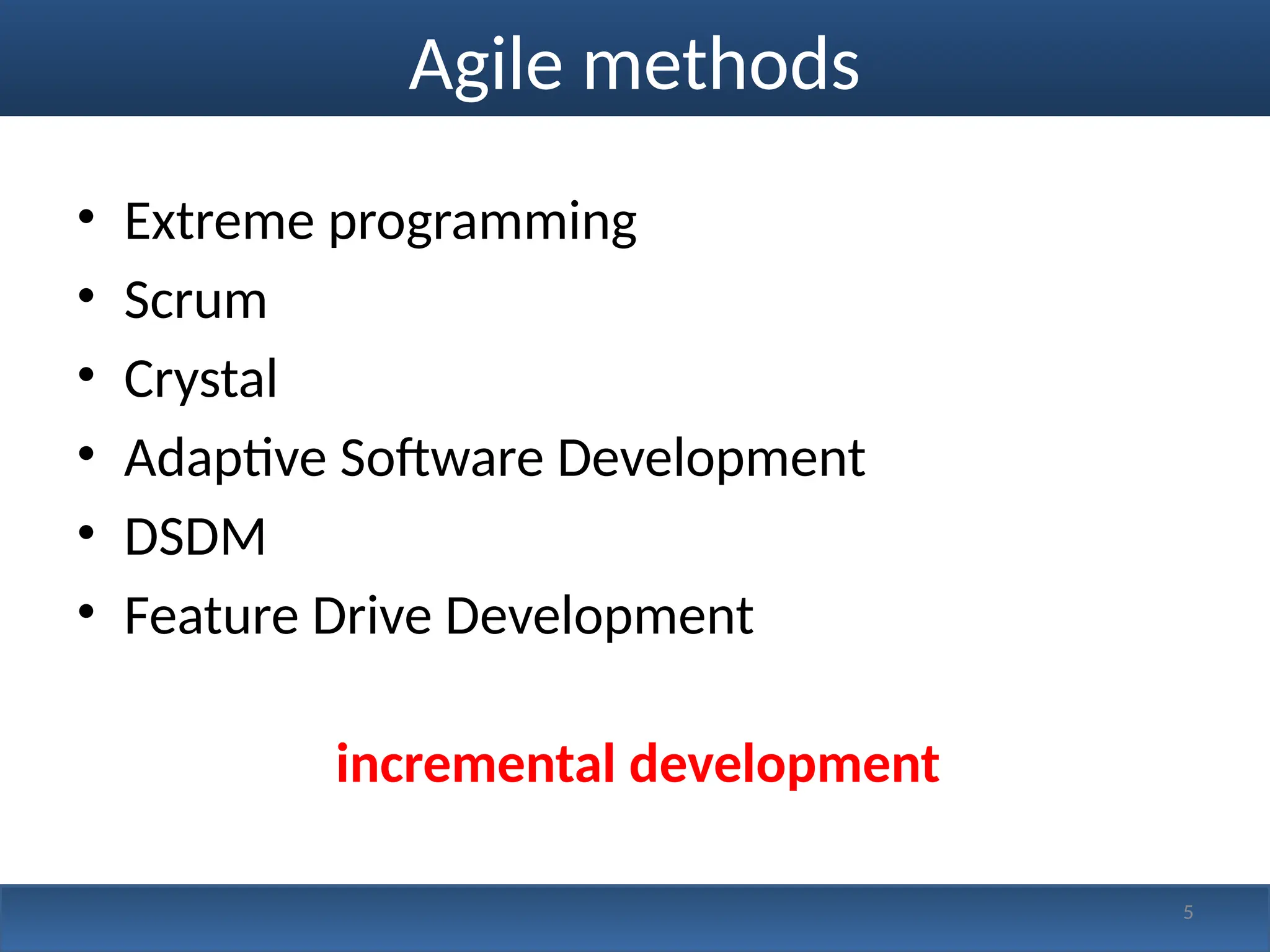
Agile methods
• Extremeprogramming
• Scrum
• Crystal
• Adaptive Software Development
• DSDM
• Feature Drive Development
incremental development
6.
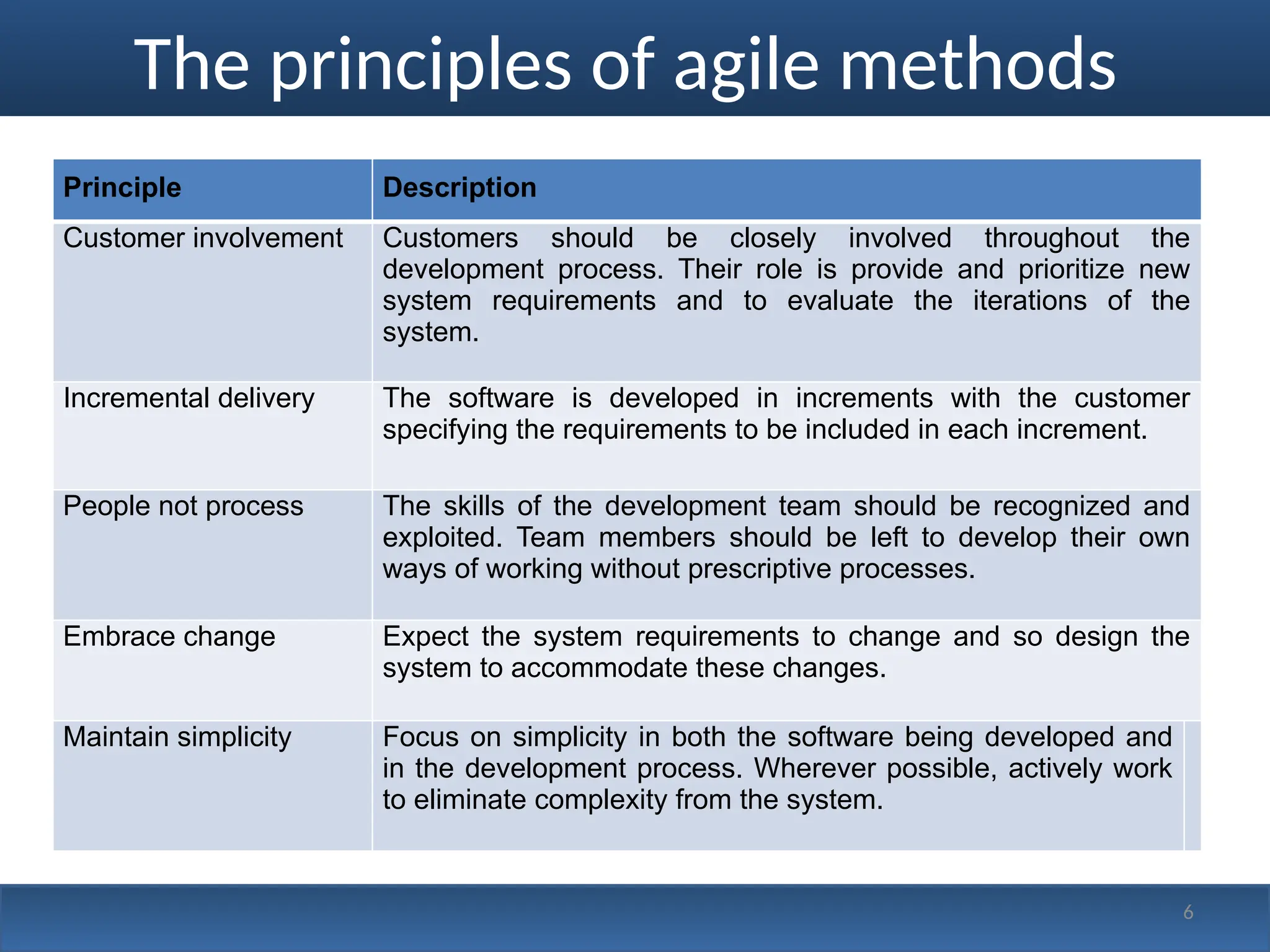
The principles ofagile methods
Principle Description
Customer involvement Customers should be closely involved throughout the
development process. Their role is provide and prioritize new
system requirements and to evaluate the iterations of the
system.
Incremental delivery The software is developed in increments with the customer
specifying the requirements to be included in each increment.
People not process The skills of the development team should be recognized and
exploited. Team members should be left to develop their own
ways of working without prescriptive processes.
Embrace change Expect the system requirements to change and so design the
system to accommodate these changes.
Maintain simplicity Focus on simplicity in both the software being developed and
in the development process. Wherever possible, actively work
to eliminate complexity from the system.
6
7.
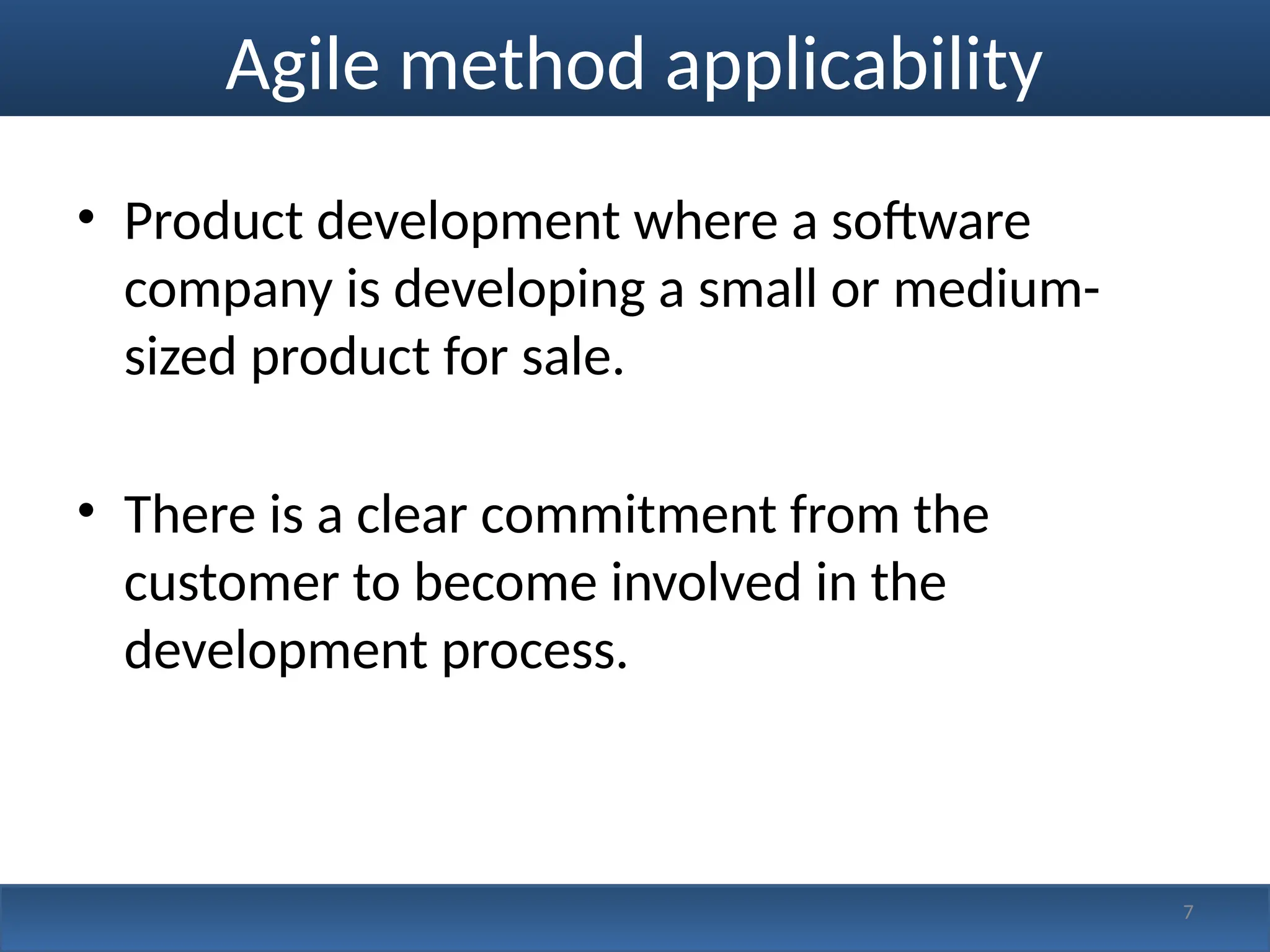
Agile method applicability
•Product development where a software
company is developing a small or medium-
sized product for sale.
• There is a clear commitment from the
customer to become involved in the
development process.
7
8.
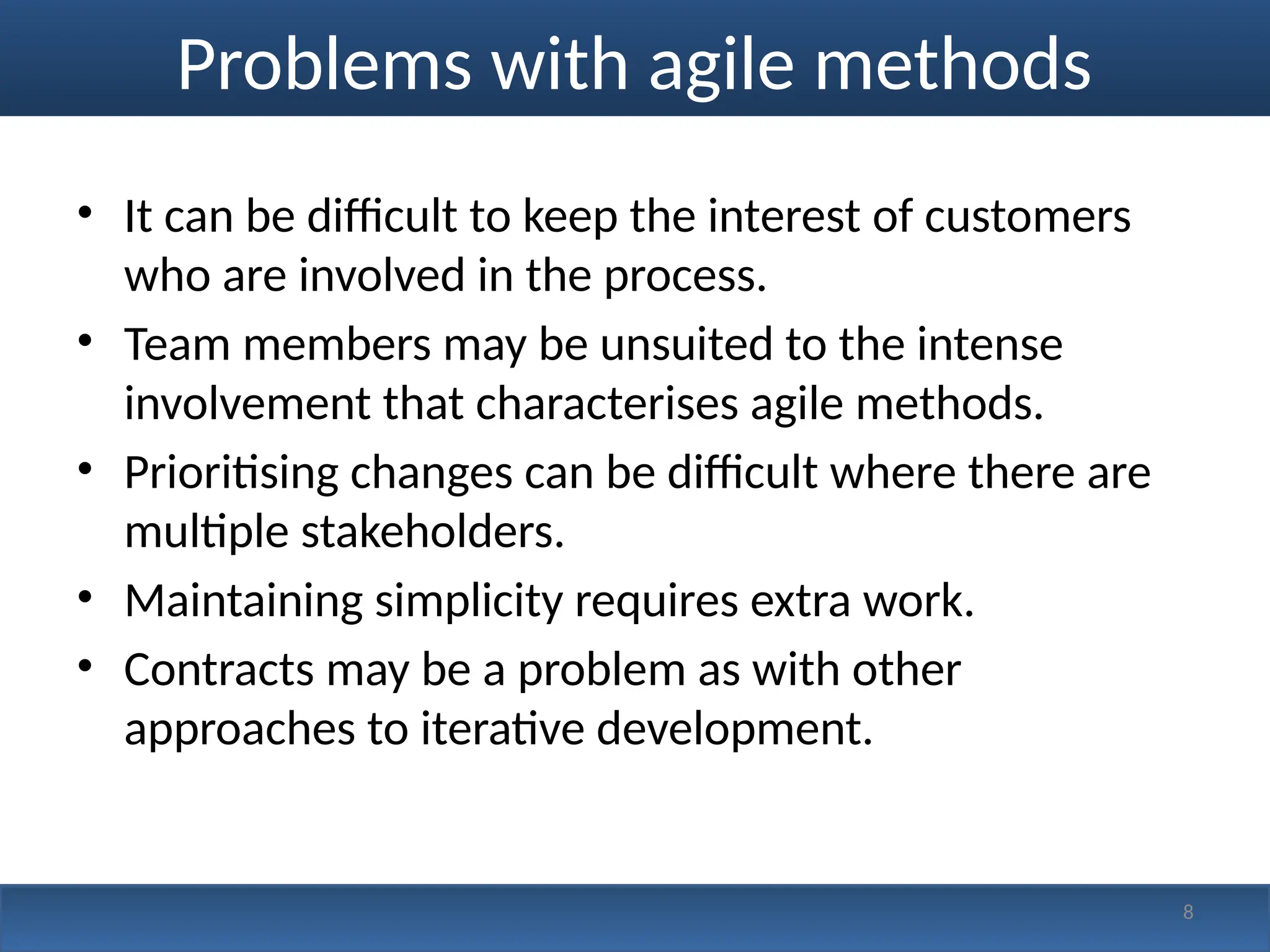
Problems with agilemethods
• It can be difficult to keep the interest of customers
who are involved in the process.
• Team members may be unsuited to the intense
involvement that characterises agile methods.
• Prioritising changes can be difficult where there are
multiple stakeholders.
• Maintaining simplicity requires extra work.
• Contracts may be a problem as with other
approaches to iterative development.
8
9.
Agile methods andsoftware maintenance
• Most organizations spend more on maintaining existing
software than they do on new software development. So,
if agile methods are to be successful, they have to support
maintenance as well as original development.
• Two key issues:
– Are systems that are developed using an agile approach
maintainable, given the emphasis in the development process
of minimizing formal documentation?
– Can agile methods be used effectively for evolving a system in
response to customer change requests?
• Problems may arise if original development team cannot
be maintained.
9
10.
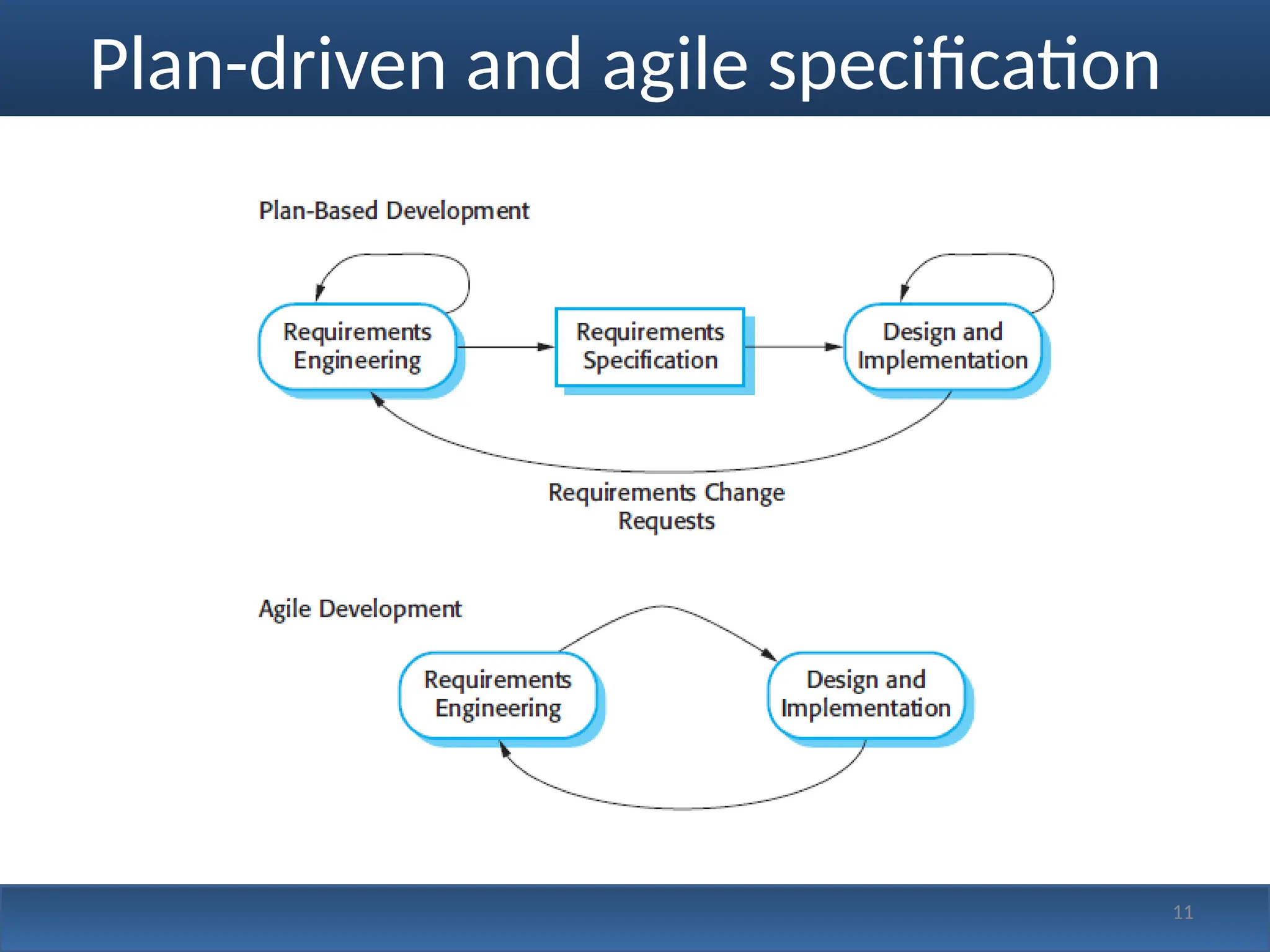
Plan-driven and agiledevelopment
• Plan-driven development
– A plan-driven approach to software engineering is based
around separate development stages with the outputs to be
produced at each of these stages planned in advance.
– Not necessarily waterfall model – plan-driven, incremental
development is possible
– Iteration occurs within activities.
• Agile development
– Specification, design, implementation and testing are inter-
leaved and the outputs from the development process are
decided through a process of negotiation during the
software development process.
10
Plan-driven or Agile?
Mostprojects include elements of plan-driven and agile
processes. Deciding on the balance depends on:
• Is it important to have a very detailed specification and design
before moving to implementation?
If so, you probably need to use a plan-driven approach.
• Is an incremental delivery strategy, where you deliver the
software to customers and get rapid feedback from them,
realistic?
If so, consider using agile methods.
• How large is the system that is being developed?
Agile methods are most effective when the system can be developed with
a small co-located team who can communicate informally.
12
13.
Plan-driven or Agile?
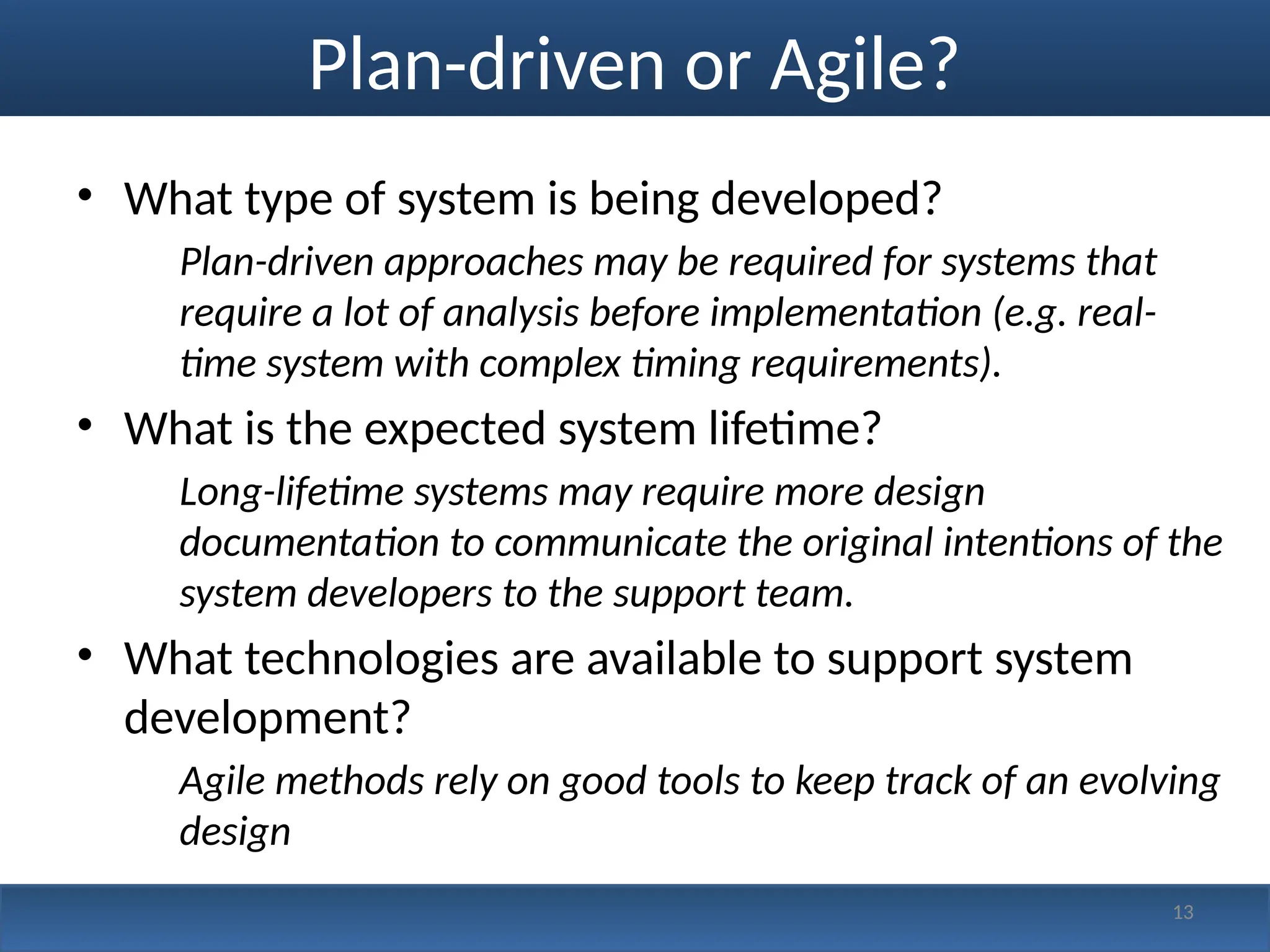
•What type of system is being developed?
Plan-driven approaches may be required for systems that
require a lot of analysis before implementation (e.g. real-
time system with complex timing requirements).
• What is the expected system lifetime?
Long-lifetime systems may require more design
documentation to communicate the original intentions of the
system developers to the support team.
• What technologies are available to support system
development?
Agile methods rely on good tools to keep track of an evolving
design
13
14.
14
Plan-driven or Agile?
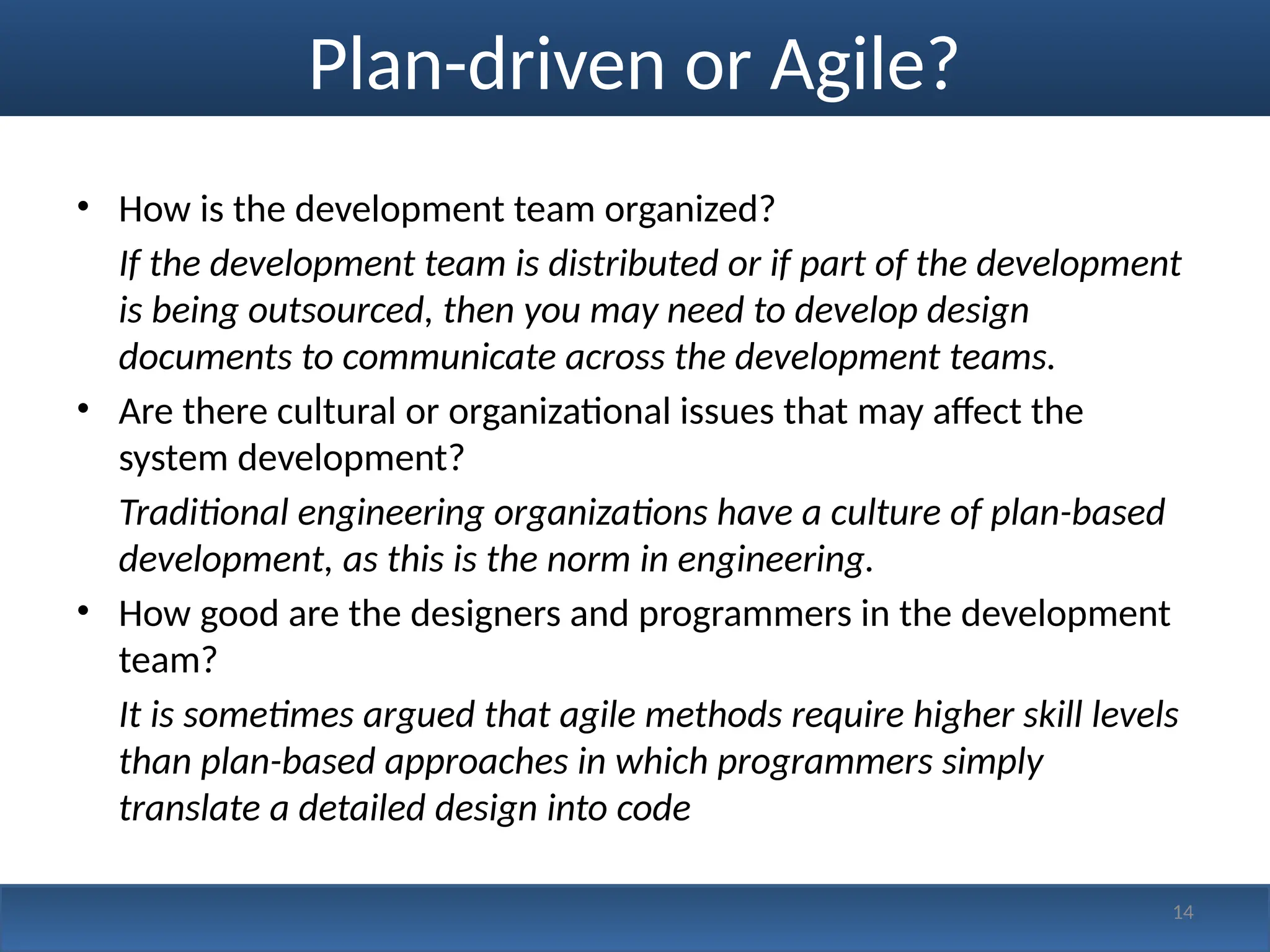
•How is the development team organized?
If the development team is distributed or if part of the development
is being outsourced, then you may need to develop design
documents to communicate across the development teams.
• Are there cultural or organizational issues that may affect the
system development?
Traditional engineering organizations have a culture of plan-based
development, as this is the norm in engineering.
• How good are the designers and programmers in the development
team?
It is sometimes argued that agile methods require higher skill levels
than plan-based approaches in which programmers simply
translate a detailed design into code
15.
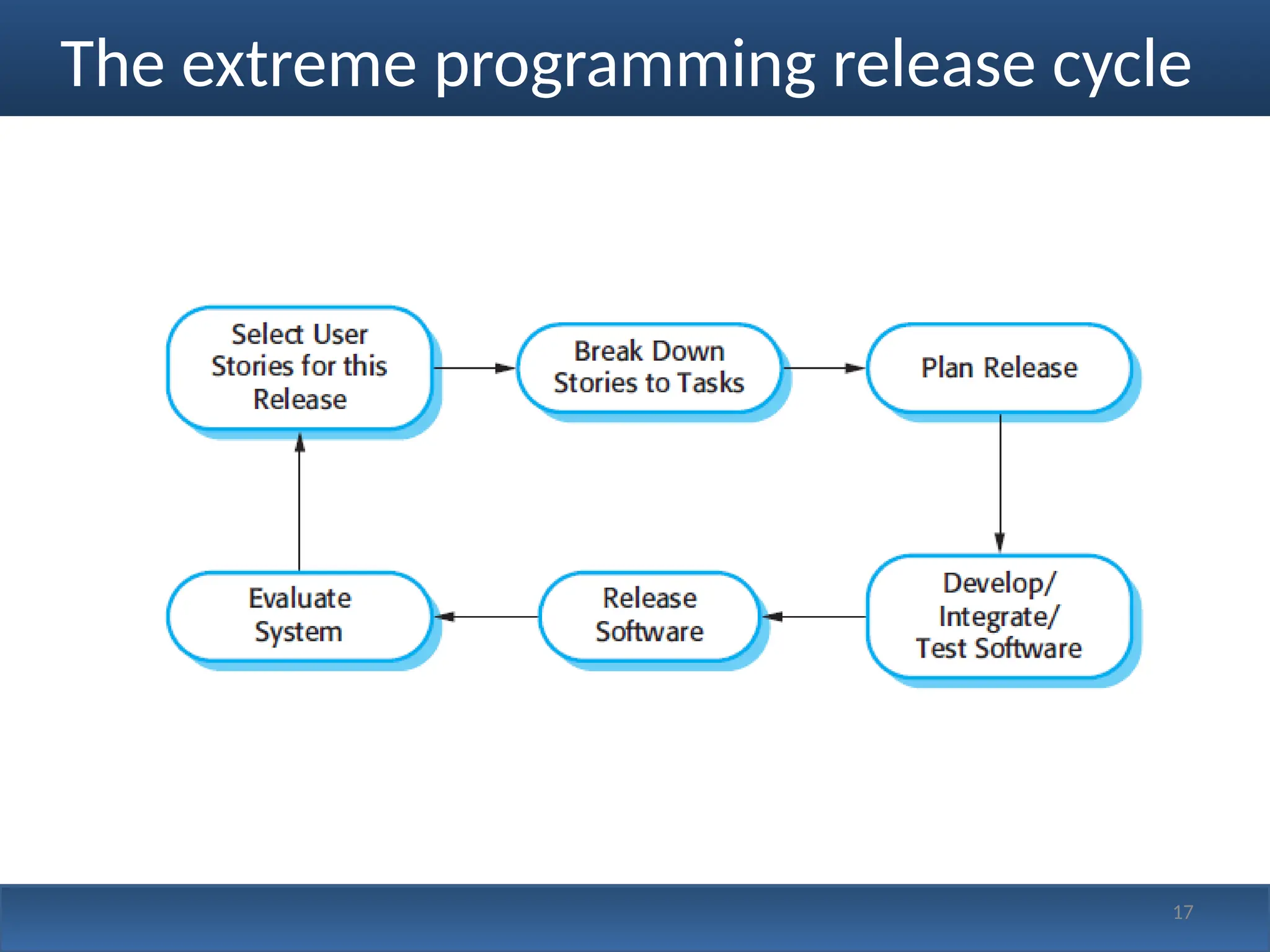
Extreme programming
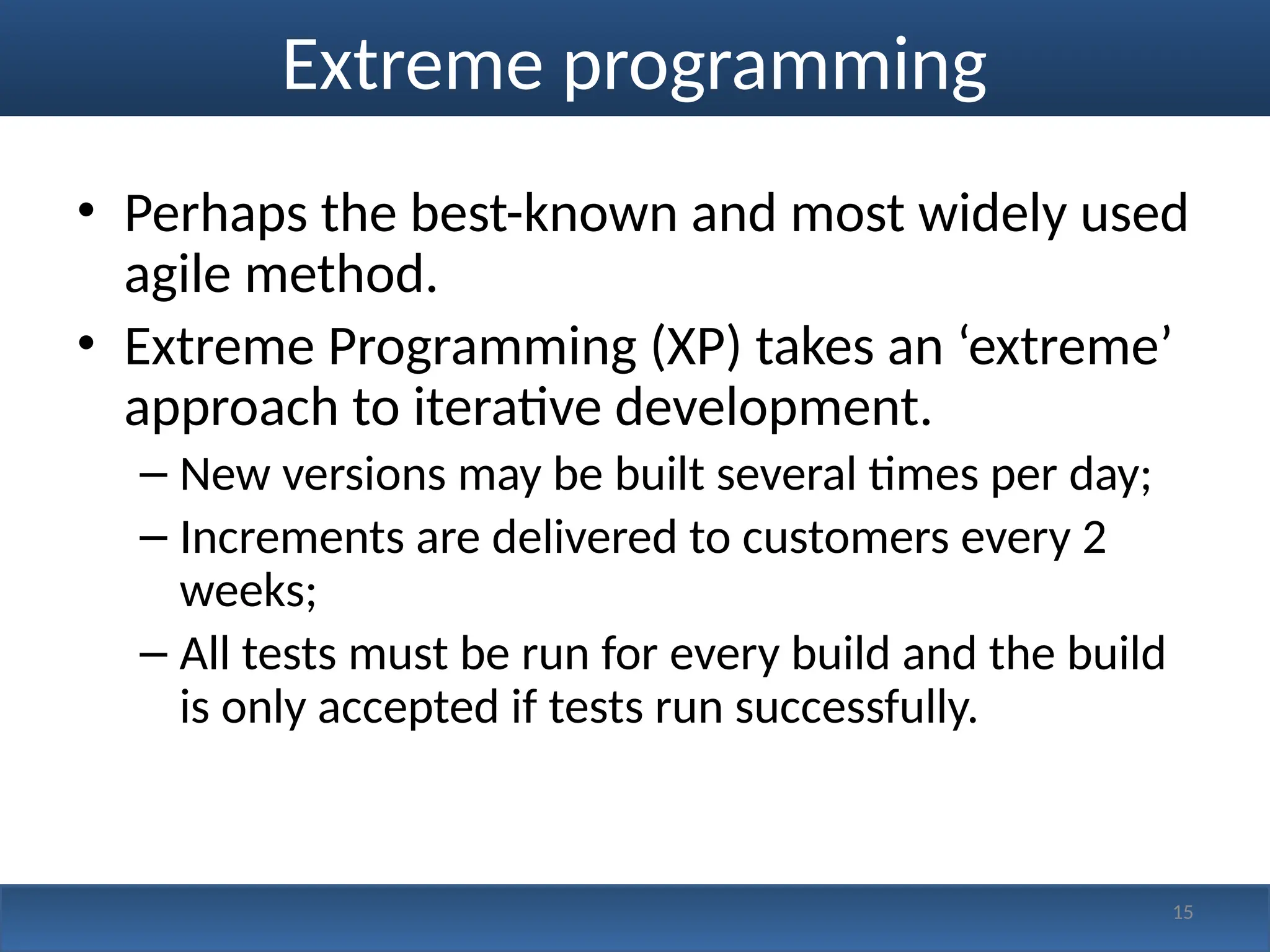
• Perhapsthe best-known and most widely used
agile method.
• Extreme Programming (XP) takes an ‘extreme’
approach to iterative development.
– New versions may be built several times per day;
– Increments are delivered to customers every 2
weeks;
– All tests must be run for every build and the build
is only accepted if tests run successfully.
15
16.
XP and agileprinciples
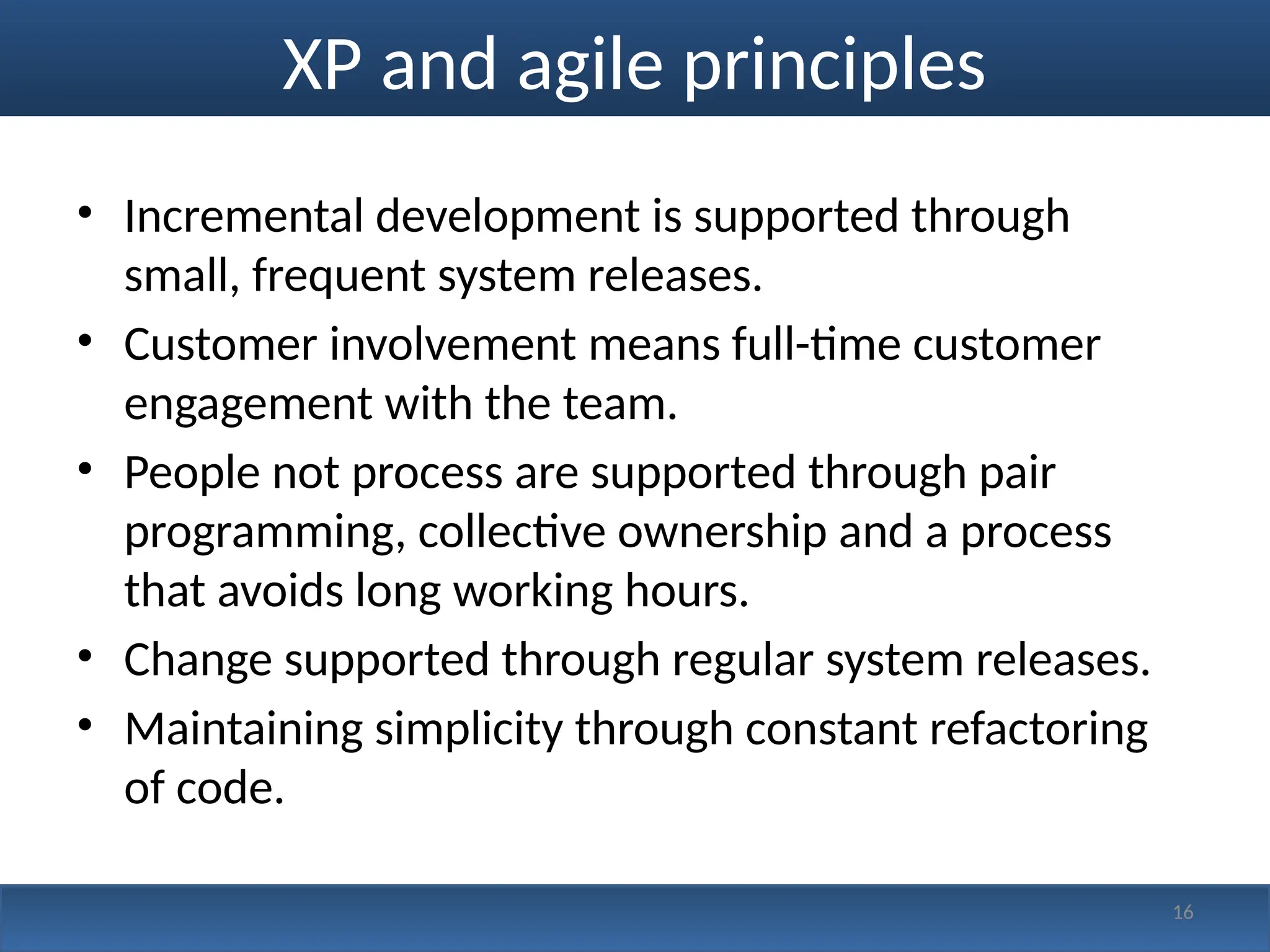
• Incremental development is supported through
small, frequent system releases.
• Customer involvement means full-time customer
engagement with the team.
• People not process are supported through pair
programming, collective ownership and a process
that avoids long working hours.
• Change supported through regular system releases.
• Maintaining simplicity through constant refactoring
of code.
16
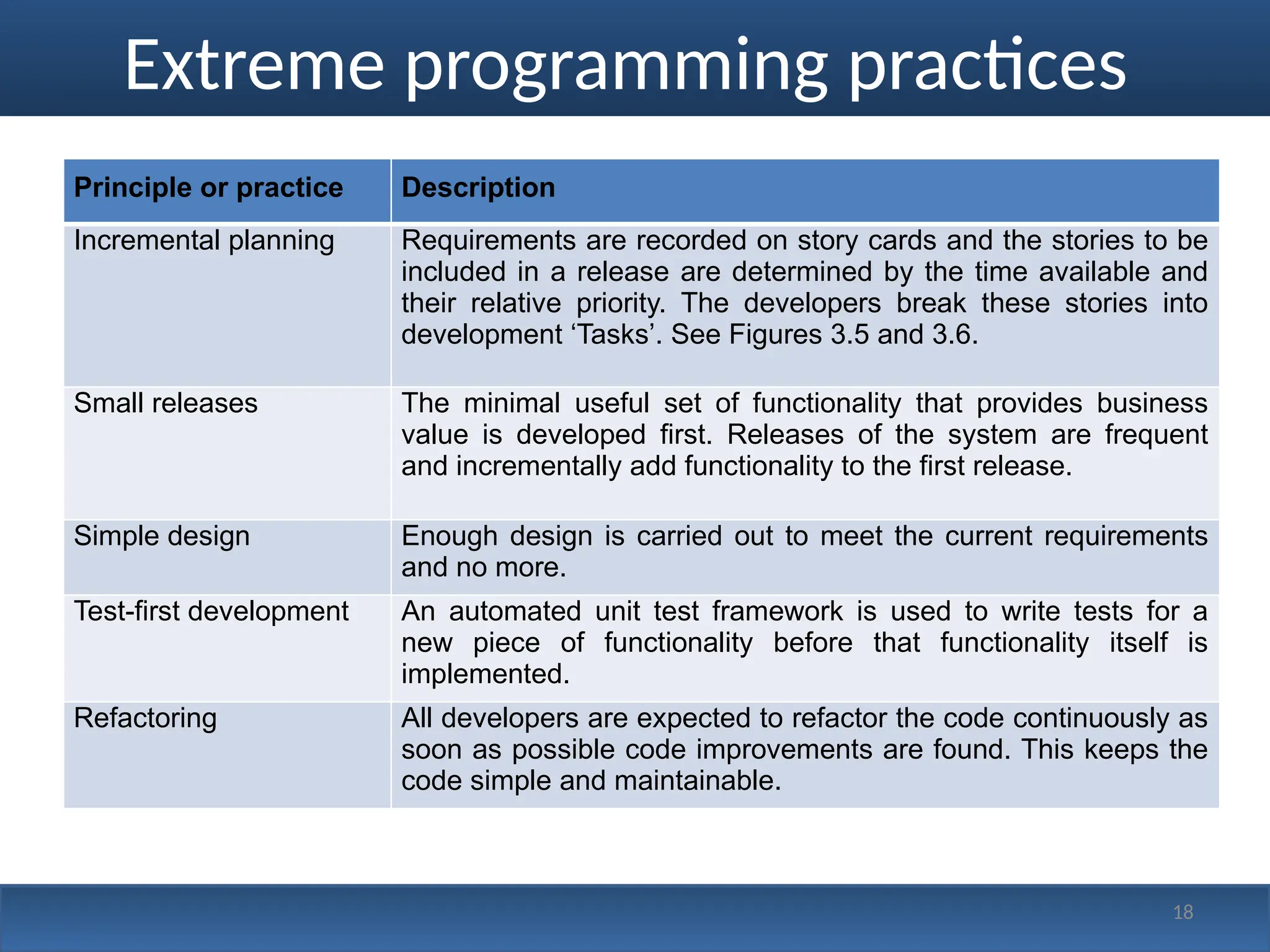
Extreme programming practices
Principleor practice Description
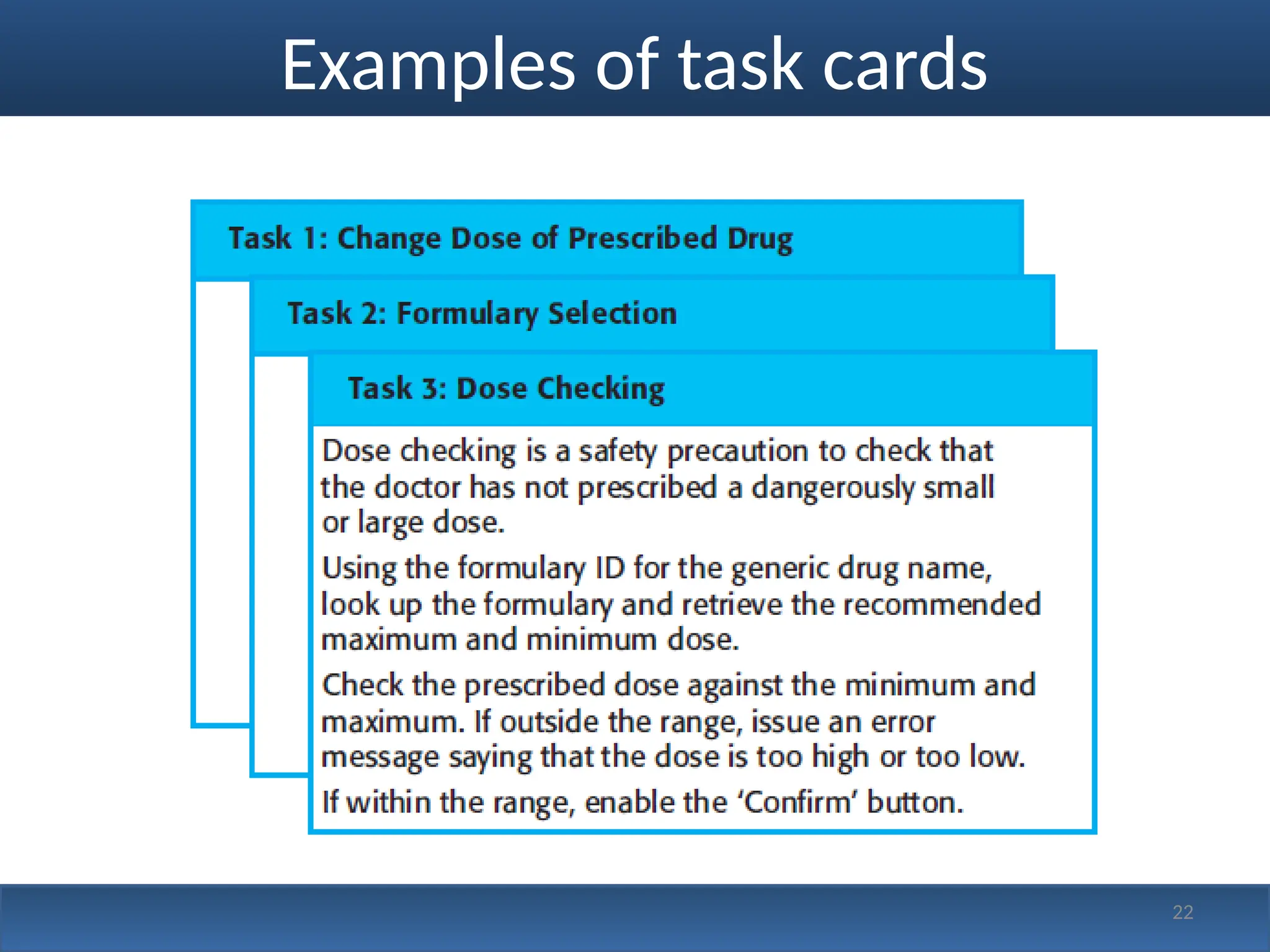
Incremental planning Requirements are recorded on story cards and the stories to be
included in a release are determined by the time available and
their relative priority. The developers break these stories into
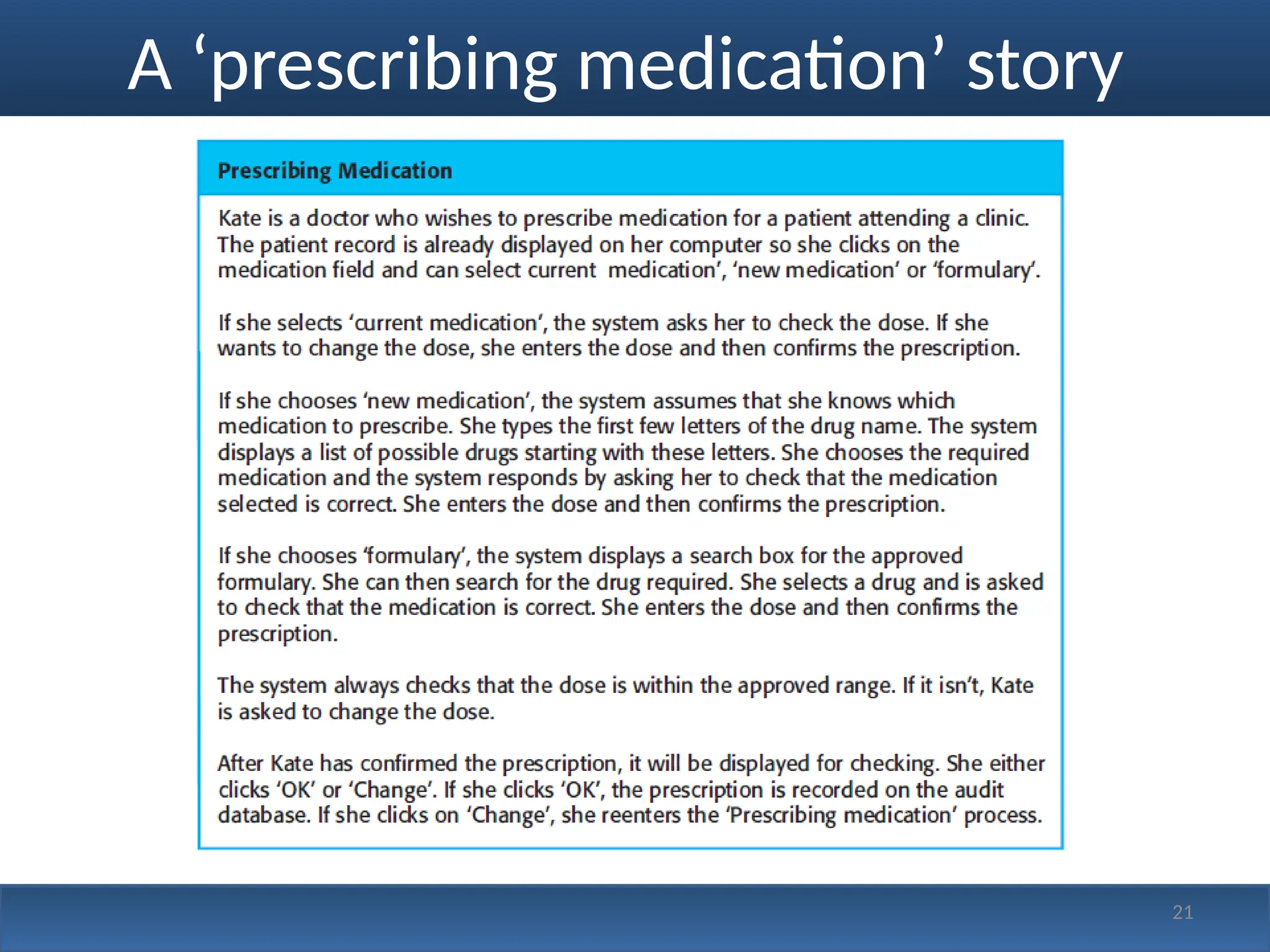
development ‘Tasks’. See Figures 3.5 and 3.6.
Small releases The minimal useful set of functionality that provides business
value is developed first. Releases of the system are frequent
and incrementally add functionality to the first release.
Simple design Enough design is carried out to meet the current requirements
and no more.
Test-first development An automated unit test framework is used to write tests for a
new piece of functionality before that functionality itself is
implemented.
Refactoring All developers are expected to refactor the code continuously as
soon as possible code improvements are found. This keeps the
code simple and maintainable.
18
19.
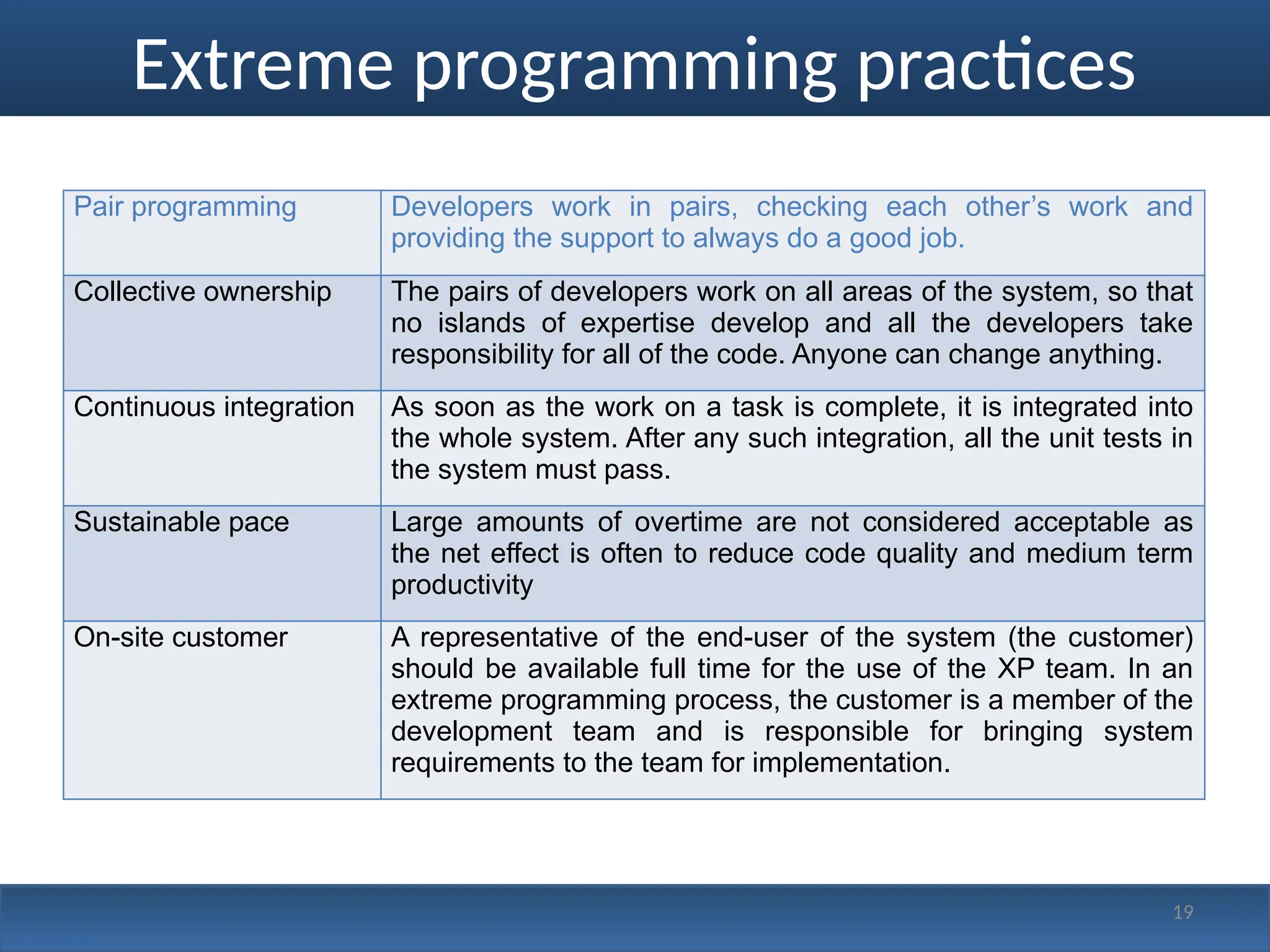
Extreme programming practices
Pairprogramming Developers work in pairs, checking each other’s work and
providing the support to always do a good job.
Collective ownership The pairs of developers work on all areas of the system, so that
no islands of expertise develop and all the developers take
responsibility for all of the code. Anyone can change anything.
Continuous integration As soon as the work on a task is complete, it is integrated into
the whole system. After any such integration, all the unit tests in
the system must pass.
Sustainable pace Large amounts of overtime are not considered acceptable as
the net effect is often to reduce code quality and medium term
productivity
On-site customer A representative of the end-user of the system (the customer)
should be available full time for the use of the XP team. In an
extreme programming process, the customer is a member of the
development team and is responsible for bringing system
requirements to the team for implementation.
19
20.
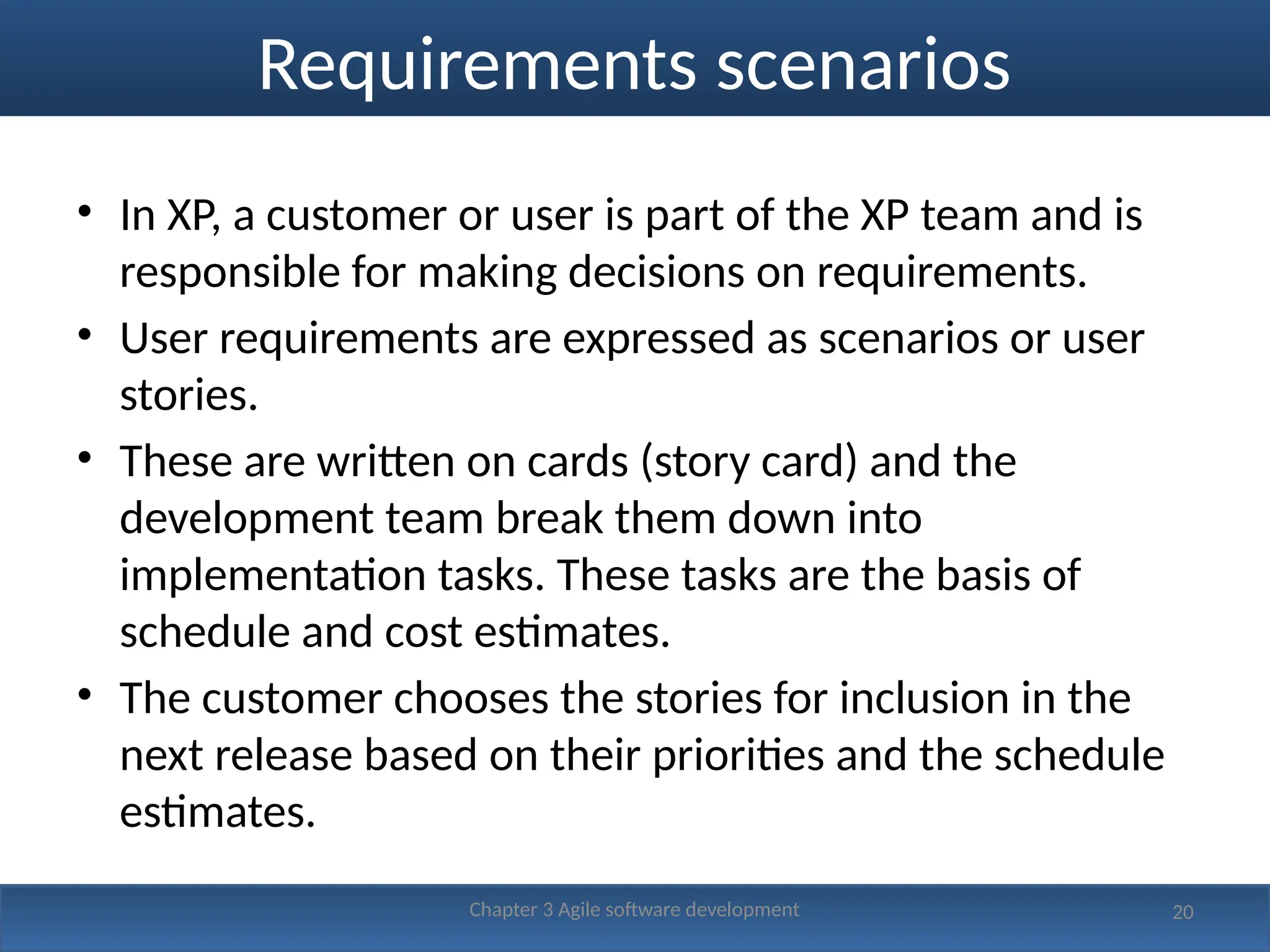
Requirements scenarios
• InXP, a customer or user is part of the XP team and is
responsible for making decisions on requirements.
• User requirements are expressed as scenarios or user
stories.
• These are written on cards (story card) and the
development team break them down into
implementation tasks. These tasks are the basis of
schedule and cost estimates.
• The customer chooses the stories for inclusion in the
next release based on their priorities and the schedule
estimates.
20
Chapter 3 Agile software development
XP and change
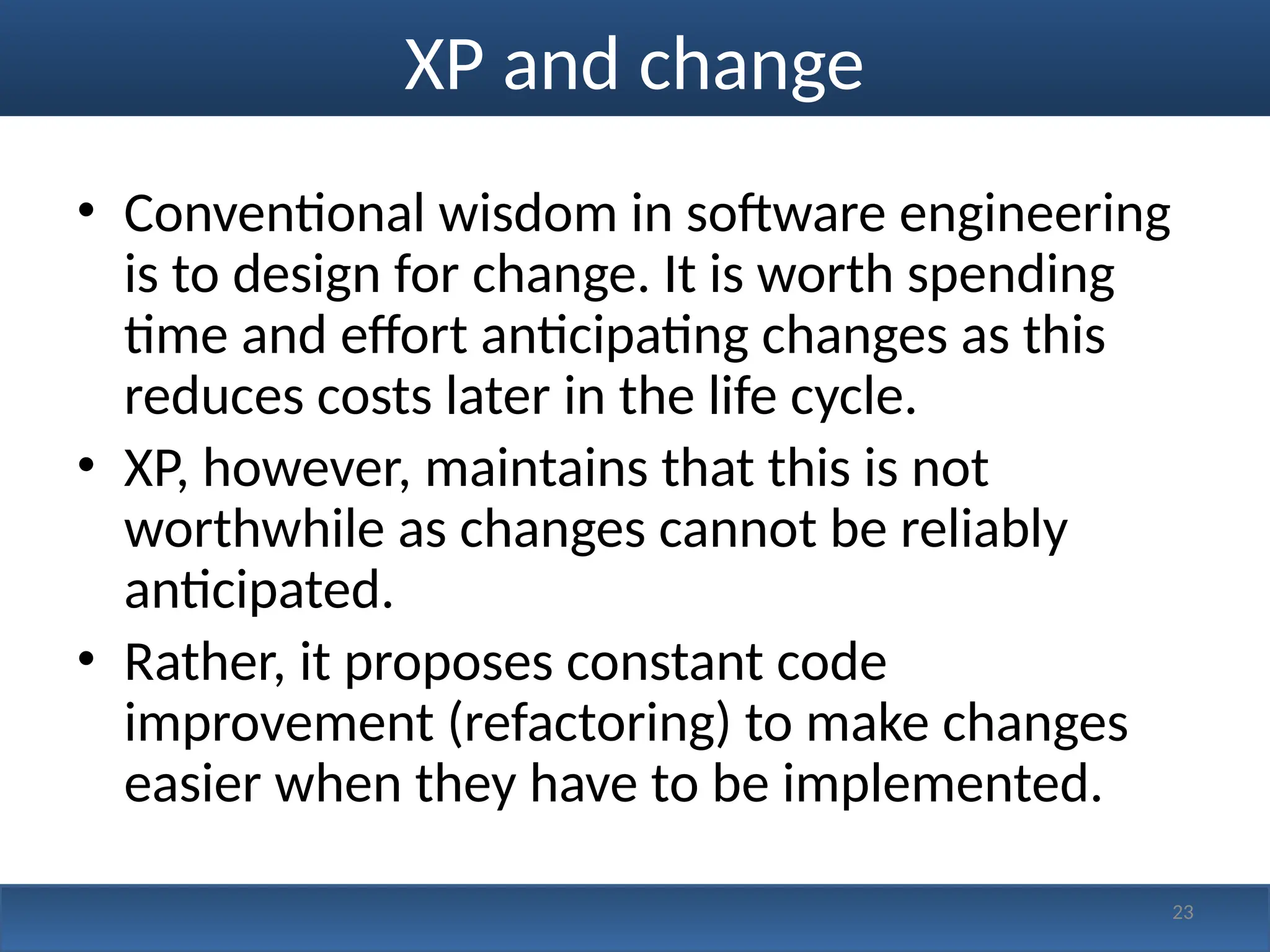
•Conventional wisdom in software engineering
is to design for change. It is worth spending
time and effort anticipating changes as this
reduces costs later in the life cycle.
• XP, however, maintains that this is not
worthwhile as changes cannot be reliably
anticipated.
• Rather, it proposes constant code
improvement (refactoring) to make changes
easier when they have to be implemented.
23
24.
Refactoring
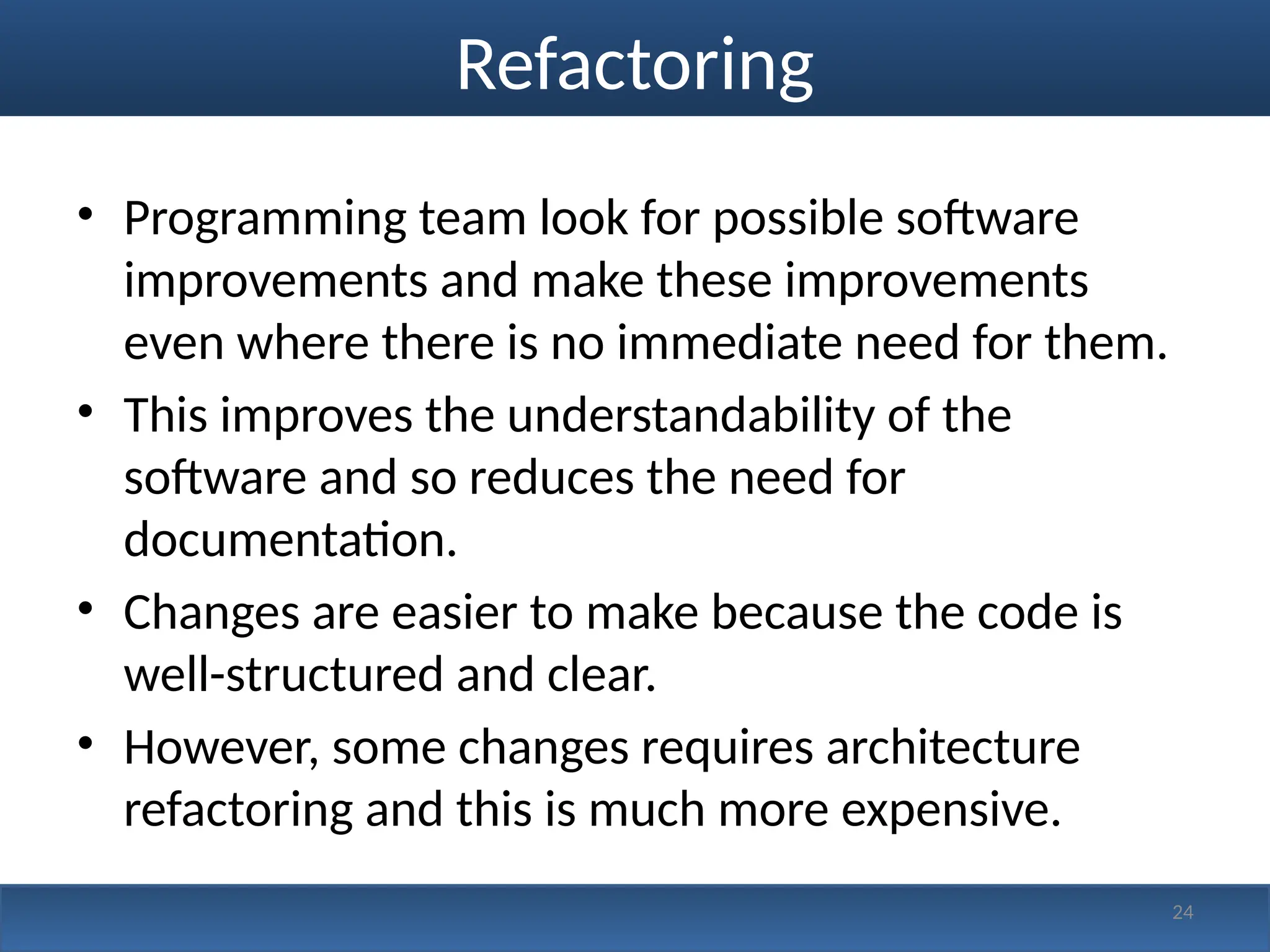
• Programming teamlook for possible software
improvements and make these improvements
even where there is no immediate need for them.
• This improves the understandability of the
software and so reduces the need for
documentation.
• Changes are easier to make because the code is
well-structured and clear.
• However, some changes requires architecture
refactoring and this is much more expensive.
24
25.
Examples of refactoring
•Re-organization of a class hierarchy to remove
duplicate code.
• Tidying up and renaming attributes and
methods to make them easier to understand.
• The replacement of inline code with calls to
methods that have been included in a
program library.
25
26.
Key points
• Agilemethods are incremental development methods that
focus on rapid development, frequent releases of the
software, reducing process overheads and producing high-
quality code.
• Agile methods involve the customer directly in the
development process.
• The decision on whether to use an agile or a plan-driven
approach to development should depend on the type of
software being developed, the capabilities of the
development team and the culture of the company
developing the system.
• Extreme programming is a well-known agile method
26
27.
Testing in XP
•Testing is central to XP and XP has developed an
approach where the program is tested after
every change has been made.
• XP testing features:
– Test-first development.
– Incremental test development from scenarios.
– User involvement in test development and validation.
– Automated test harnesses are used to run all
component tests each time that a new release is
built.
27
Chapter 3 Agile software development
28.
Test-first development
• Writingtests before code clarifies the
requirements to be implemented.
• Tests are written as programs rather than data so
that they can be executed automatically. The test
includes a check that it has executed correctly.
– Usually relies on a testing framework such as Junit.
• All previous and new tests are run automatically
when new functionality is added, thus checking
that the new functionality has not introduced
errors.
28
30
Bài tập
• Nộpbáo cáo: 31/12/2013
• Số trang: <=20
• Nộp bản mềm qua email hieuvd@vnu.edu.vn
với tiêu đề “[ASE] Bài tập – Nhóm 1”. Tên file
báo cáo là Nhom1.doc, Nhom1.docx, hoặc
Nhom1.zip
Editor's Notes
#4 Trong nhung du an nho, chi phi cua viec len ke hoach, viet tai lieu chiem nhieu
Tai lieu khong phan anh duoc phan mem
![30
Bài tập
• Nộp báo cáo: 31/12/2013
• Số trang: <=20
• Nộp bản mềm qua email hieuvd@vnu.edu.vn
với tiêu đề “[ASE] Bài tập – Nhóm 1”. Tên file
báo cáo là Nhom1.doc, Nhom1.docx, hoặc
Nhom1.zip](https://image.slidesharecdn.com/3-agile-software-development-250405080902-b62a1eb9/75/Agile-Software-Development-in-SAP-ERP-pptx-30-2048.jpg)


