Engineering Graphics
Presents BY
A.S.VAGH
M.Tech (IPED) , B.E. Mechanical, PGDIM
E-mail Id: asvagh@india.com
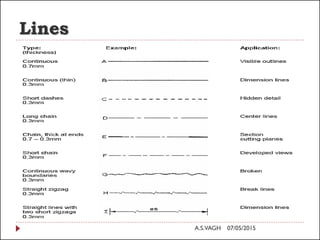
Lines
07/05/2015A.S.VAGH
1
2
3 4
5
6
7
8
9
10
14
13
12 11
Viewing-plane line
Extension line
Dimension Line Center Line
Hidden Line
Break Line
Cutting-plane Line
Visible Line
Center Line (of motion)
Leader
VIEW B-BSECTION A-A
Section Line
Phantom Line
07/05/2015A.S.VAGH
Horizontal Lines
07/05/2015A.S.VAGH
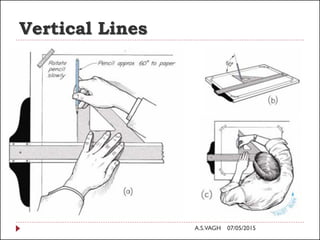
Vertical Lines
07/05/2015A.S.VAGH
Inclined Lines
07/05/2015A.S.VAGH
07/05/2015A.S.VAGH
Parallel Lines
07/05/2015A.S.VAGH
Perpendicular Lines
07/05/2015A.S.VAGH
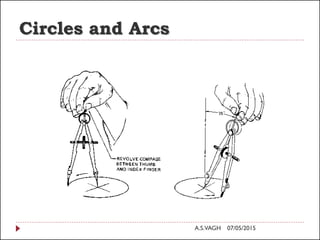
Circles and Arcs
07/05/2015A.S.VAGH
Drawing a circle of a given
diameter with a compass
07/05/2015A.S.VAGH
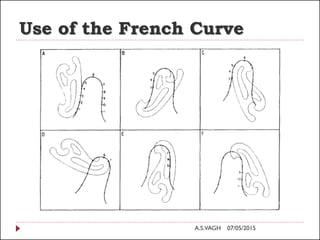
Use of the French Curve
07/05/2015A.S.VAGH
Guidelines for Lettering
 For uniformity, all letters should be the same height,
proportion and inclination. A necessary tactic for
maintaining uniformity is the use of guidelines.
07/05/2015A.S.VAGH
Guidelines for Lettering
 Ascender is the part of the lowercase letter that extends
above the body of the letter.
 Descender is the part of the lowercase letters that
extends below the body letter.
07/05/2015A.S.VAGH
Lettering
 Writing titles, dimensions, notes and other important
particular on a drawing is called lettering.
 Lettering should be done properly in clear,
understandable & uniform style.
 It should be in plain & simple style so that it could be
done free hand & speedily.
 Note: Use of drawing instruments in lettering takes
considerable time and hence, it should be avoided
efficiency in the art of lettering can be achieved by careful
& continuous practice.
07/05/2015A.S.VAGH
Lettering
 The size of letter is specified by its height.
 Generally the ratio of height to width for most of the
capital letters are taken as 6:5 and for most of the
lower case letters are taken as 4:4.
 Main letter are generally written in 10 mm to 12 mm
 Subtitle is written in 3 mm to 6 mm
 Notes, Dimension fig etc. written in 3 mm to 4 mm.
 Space between the words is generally 2 to 5 mm in
lettering.
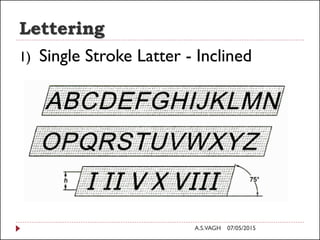
 Inclined latter write in an inclination of 750.
07/05/2015A.S.VAGH
Lettering
1) Single Stroke Latter
a) Vertical
b) Inclined
2) Gothic Letter
07/05/2015A.S.VAGH
Lettering
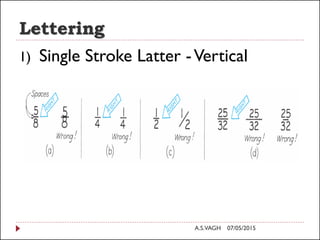
1) Single Stroke Latter -Vertical
07/05/2015A.S.VAGH
Lettering
1) Single Stroke Latter -Vertical
07/05/2015A.S.VAGH
Lettering
1) Single Stroke Latter -Vertical
07/05/2015A.S.VAGH
Lettering
1) Single Stroke Latter -Vertical
07/05/2015A.S.VAGH
Lettering
1) Single Stroke Latter - Inclined
07/05/2015A.S.VAGH
Dimensioning
 Every drawing, whether a scale drawing or a freehand
drawing, besides showing the true shape of an object,
must supply its exact length, breadth, height, sizes and
positions of holes, grooves etc. and such other details
relating to the manufacture of that object. Supplying
this information on a drawing is called Dimensioning.
 Lines, figures, numerals, symbols, notes etc. are used
for this purpose.
07/05/2015A.S.VAGH
Dimensioning terms & notations
 Dimension line: Thin continuous line. It is terminated
by arrowheads touching the outline, extension lines
or Centre lines.
 Extension line: Thin continuous line drawn in
extension of an outline. It extend by about 3 mm
beyond the dimension line.
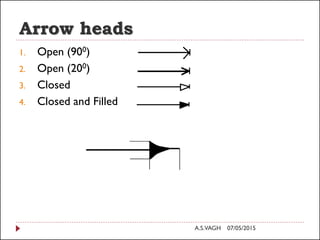
 Arrow head: Placed at each end of dimension line.
Touch outline, extension line or Centre line. Length
of arrowhead should be three times it max width. The
space betn them is nearly filled up.
 Leader: Thin continuous line connecting a note or
dimension fig with future.
07/05/2015A.S.VAGH
Dimensioning terms & notations
07/05/2015A.S.VAGH
Arrow heads
1. Open (900)
2. Open (200)
3. Closed
4. Closed and Filled
07/05/2015A.S.VAGH
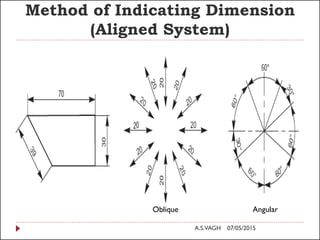
Method of Indicating Dimension
(Aligned System)
Oblique Angular
07/05/2015A.S.VAGH
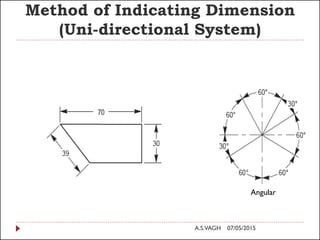
Method of Indicating Dimension
(Uni-directional System)
Angular
07/05/2015A.S.VAGH
07/05/2015A.S.VAGH
Dimensions
Shape Identification Symbols
07/05/2015A.S.VAGH
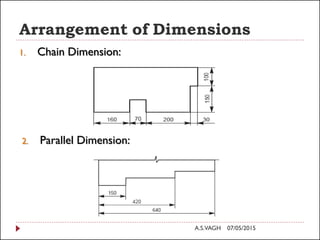
Arrangement of Dimensions
1. Chain Dimension:
2. Parallel Dimension:
07/05/2015A.S.VAGH
Arrangement of Dimensions
3. Super Imposed Continuous (Less Space) Dimension:
4. Combined (Chain & Parallel) Dimension:
07/05/2015A.S.VAGH
Arrangement of Dimensions
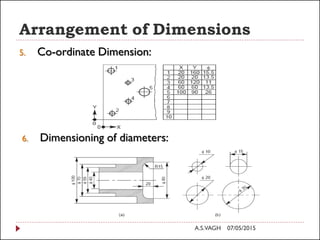
5. Co-ordinate Dimension:
6. Dimensioning of diameters:
07/05/2015A.S.VAGH
Arrangement of Dimensions
7. Dimensioning of chords, arcs and angles:
8. Dimensioning of Radius:
07/05/2015A.S.VAGH
Arrangement of Dimensions
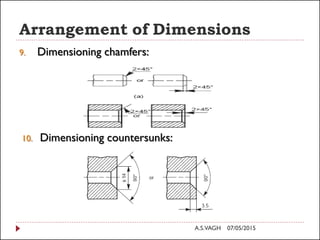
9. Dimensioning chamfers:
10. Dimensioning countersunks:
07/05/2015A.S.VAGH
Arrangement of Dimensions
11. Dimensioning Screw Thread:
12. DimensioningTaper Future:
07/05/2015A.S.VAGH
Notes in Dimensions
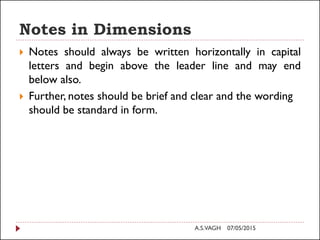
 Notes should always be written horizontally in capital
letters and begin above the leader line and may end
below also.
 Further, notes should be brief and clear and the wording
should be standard in form.
07/05/2015A.S.VAGH
07/05/2015A.S.VAGH
07/05/2015A.S.VAGH
BIS–SP 46
 BIS is the National Standards body formed by the
government of India on 1 April 1987, replacing ISI existing
earlier.
 The objective of BIS is to develop the industries and
commercial growth of the country by developing globally
acceptable standard for product.
 It works in association with other standard-developing
organization worldwide, in particular with the ISO.
 BIS has recommended & published various standards for
technical drawings.
 These standards are available in the form of IS code and
Special Publication 46: 2003.
07/05/2015A.S.VAGH
BIS–SP 46
 These standards are available in the form of IS code and
Special Publication 46: 2003.
 In short,
 The standard which is for “Engineering
Drawing Practice For Schools & Colleges”.
 And used in the educational institution for
engineering drawing or graphics.
07/05/2015A.S.VAGH
07/05/2015A.S.VAGH
07/05/2015A.S.VAGH
07/05/2015A.S.VAGH
07/05/2015A.S.VAGH
07/05/2015A.S.VAGH
07/05/2015A.S.VAGH
07/05/2015A.S.VAGH
07/05/2015A.S.VAGH
1
2
3
4
5
6
7
8
9
10
BA
D
C
1
2
3
4
5
6
7
8
9
10
Steps:
1. Draw both axes as perpendicular bisectors
of each other & name their ends as shown.
2. Taking their intersecting point as a center,
draw two concentric circles considering both
as respective diameters.
3. Divide both circles in 12 equal parts &
name as shown.
4. From all points of outer circle draw vertical
lines downwards and upwards respectively.
5.From all points of inner circle draw
horizontal lines to intersect those vertical
lines.
6. Mark all intersecting points properly as
those are the points on ellipse.
7. Join all these points along with the ends of
both axes in smooth possible curve. It is
required ellipse.
Problem 1 :-
Draw ellipse by concentric circle method.
Take major axis 100 mm and minor axis 70 mm long.
ELLIPSE
BY CONCENTRIC CIRCLE METHOD
07/05/2015A.S.VAGH
07/05/2015A.S.VAGH

Engineering graphics instructions

  • 1.
    Engineering Graphics Presents BY A.S.VAGH M.Tech(IPED) , B.E. Mechanical, PGDIM E-mail Id: asvagh@india.com
  • 2.
  • 3.
    1 2 3 4 5 6 7 8 9 10 14 13 12 11 Viewing-planeline Extension line Dimension Line Center Line Hidden Line Break Line Cutting-plane Line Visible Line Center Line (of motion) Leader VIEW B-BSECTION A-A Section Line Phantom Line 07/05/2015A.S.VAGH
  • 4.
  • 5.
  • 6.
  • 7.
  • 8.
  • 9.
  • 10.
  • 11.
    Drawing a circleof a given diameter with a compass 07/05/2015A.S.VAGH
  • 12.
    Use of theFrench Curve 07/05/2015A.S.VAGH
  • 13.
    Guidelines for Lettering For uniformity, all letters should be the same height, proportion and inclination. A necessary tactic for maintaining uniformity is the use of guidelines. 07/05/2015A.S.VAGH
  • 14.
    Guidelines for Lettering Ascender is the part of the lowercase letter that extends above the body of the letter.  Descender is the part of the lowercase letters that extends below the body letter. 07/05/2015A.S.VAGH
  • 15.
    Lettering  Writing titles,dimensions, notes and other important particular on a drawing is called lettering.  Lettering should be done properly in clear, understandable & uniform style.  It should be in plain & simple style so that it could be done free hand & speedily.  Note: Use of drawing instruments in lettering takes considerable time and hence, it should be avoided efficiency in the art of lettering can be achieved by careful & continuous practice. 07/05/2015A.S.VAGH
  • 16.
    Lettering  The sizeof letter is specified by its height.  Generally the ratio of height to width for most of the capital letters are taken as 6:5 and for most of the lower case letters are taken as 4:4.  Main letter are generally written in 10 mm to 12 mm  Subtitle is written in 3 mm to 6 mm  Notes, Dimension fig etc. written in 3 mm to 4 mm.  Space between the words is generally 2 to 5 mm in lettering.  Inclined latter write in an inclination of 750. 07/05/2015A.S.VAGH
  • 17.
    Lettering 1) Single StrokeLatter a) Vertical b) Inclined 2) Gothic Letter 07/05/2015A.S.VAGH
  • 18.
    Lettering 1) Single StrokeLatter -Vertical 07/05/2015A.S.VAGH
  • 19.
    Lettering 1) Single StrokeLatter -Vertical 07/05/2015A.S.VAGH
  • 20.
    Lettering 1) Single StrokeLatter -Vertical 07/05/2015A.S.VAGH
  • 21.
    Lettering 1) Single StrokeLatter -Vertical 07/05/2015A.S.VAGH
  • 22.
    Lettering 1) Single StrokeLatter - Inclined 07/05/2015A.S.VAGH
  • 23.
    Dimensioning  Every drawing,whether a scale drawing or a freehand drawing, besides showing the true shape of an object, must supply its exact length, breadth, height, sizes and positions of holes, grooves etc. and such other details relating to the manufacture of that object. Supplying this information on a drawing is called Dimensioning.  Lines, figures, numerals, symbols, notes etc. are used for this purpose. 07/05/2015A.S.VAGH
  • 24.
    Dimensioning terms &notations  Dimension line: Thin continuous line. It is terminated by arrowheads touching the outline, extension lines or Centre lines.  Extension line: Thin continuous line drawn in extension of an outline. It extend by about 3 mm beyond the dimension line.  Arrow head: Placed at each end of dimension line. Touch outline, extension line or Centre line. Length of arrowhead should be three times it max width. The space betn them is nearly filled up.  Leader: Thin continuous line connecting a note or dimension fig with future. 07/05/2015A.S.VAGH
  • 25.
    Dimensioning terms &notations 07/05/2015A.S.VAGH
  • 26.
    Arrow heads 1. Open(900) 2. Open (200) 3. Closed 4. Closed and Filled 07/05/2015A.S.VAGH
  • 27.
    Method of IndicatingDimension (Aligned System) Oblique Angular 07/05/2015A.S.VAGH
  • 28.
    Method of IndicatingDimension (Uni-directional System) Angular 07/05/2015A.S.VAGH
  • 29.
  • 30.
  • 31.
    Arrangement of Dimensions 1.Chain Dimension: 2. Parallel Dimension: 07/05/2015A.S.VAGH
  • 32.
    Arrangement of Dimensions 3.Super Imposed Continuous (Less Space) Dimension: 4. Combined (Chain & Parallel) Dimension: 07/05/2015A.S.VAGH
  • 33.
    Arrangement of Dimensions 5.Co-ordinate Dimension: 6. Dimensioning of diameters: 07/05/2015A.S.VAGH
  • 34.
    Arrangement of Dimensions 7.Dimensioning of chords, arcs and angles: 8. Dimensioning of Radius: 07/05/2015A.S.VAGH
  • 35.
    Arrangement of Dimensions 9.Dimensioning chamfers: 10. Dimensioning countersunks: 07/05/2015A.S.VAGH
  • 36.
    Arrangement of Dimensions 11.Dimensioning Screw Thread: 12. DimensioningTaper Future: 07/05/2015A.S.VAGH
  • 37.
    Notes in Dimensions Notes should always be written horizontally in capital letters and begin above the leader line and may end below also.  Further, notes should be brief and clear and the wording should be standard in form. 07/05/2015A.S.VAGH
  • 38.
  • 39.
  • 40.
    BIS–SP 46  BISis the National Standards body formed by the government of India on 1 April 1987, replacing ISI existing earlier.  The objective of BIS is to develop the industries and commercial growth of the country by developing globally acceptable standard for product.  It works in association with other standard-developing organization worldwide, in particular with the ISO.  BIS has recommended & published various standards for technical drawings.  These standards are available in the form of IS code and Special Publication 46: 2003. 07/05/2015A.S.VAGH
  • 41.
    BIS–SP 46  Thesestandards are available in the form of IS code and Special Publication 46: 2003.  In short,  The standard which is for “Engineering Drawing Practice For Schools & Colleges”.  And used in the educational institution for engineering drawing or graphics. 07/05/2015A.S.VAGH
  • 42.
  • 43.
  • 44.
  • 45.
  • 46.
  • 47.
  • 48.
  • 49.
  • 50.
    1 2 3 4 5 6 7 8 9 10 BA D C 1 2 3 4 5 6 7 8 9 10 Steps: 1. Draw bothaxes as perpendicular bisectors of each other & name their ends as shown. 2. Taking their intersecting point as a center, draw two concentric circles considering both as respective diameters. 3. Divide both circles in 12 equal parts & name as shown. 4. From all points of outer circle draw vertical lines downwards and upwards respectively. 5.From all points of inner circle draw horizontal lines to intersect those vertical lines. 6. Mark all intersecting points properly as those are the points on ellipse. 7. Join all these points along with the ends of both axes in smooth possible curve. It is required ellipse. Problem 1 :- Draw ellipse by concentric circle method. Take major axis 100 mm and minor axis 70 mm long. ELLIPSE BY CONCENTRIC CIRCLE METHOD 07/05/2015A.S.VAGH
  • 52.