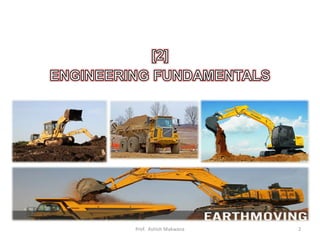
Prepared by
Prof. Ashish Makwana
Civil Engineering Dept. - MEFGI
1Prof. Ashish Makwana
2Prof. Ashish Makwana
PRESENTATION
OUTLINE…
• General
• Compaction
• Effect of compaction on soil properties
• MDD and OMC
• Types of Soils
• Soil properties
• Fundamental definitions
• Rolling Resistance
3Prof. Ashish Makwana
• Grade Resistance
• Coefficient of Traction
• Rimpull
• Drawbar Pull
• Effect of Altitude on Performance of IC Engines
• Effect of Pressure and Temperature on
performance of IC engines
PRESENTATION
OUTLINE…
4Prof. Ashish Makwana
GENERAL
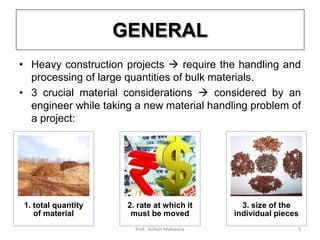
• Heavy construction projects  require the handling and
processing of large quantities of bulk materials.
• 3 crucial material considerations  considered by an
engineer while taking a new material handling problem of
a project:
1. total quantity
of material
2. rate at which it
must be moved
3. size of the
individual pieces
5Prof. Ashish Makwana
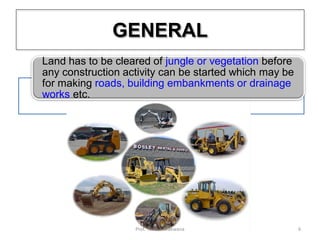
Land has to be cleared of jungle or vegetation before
any construction activity can be started which may be
for making roads, building embankments or drainage
works etc.
GENERAL
6Prof. Ashish Makwana
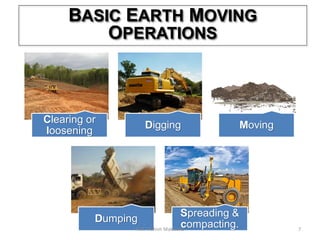
Clearing or
loosening
Digging Moving
Dumping
Spreading &
compacting.
BASIC EARTH MOVING
OPERATIONS
7Prof. Ashish Makwana
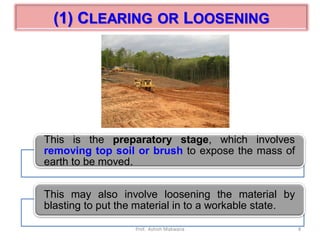
(1) CLEARING OR LOOSENING
This is the preparatory stage, which involves
removing top soil or brush to expose the mass of
earth to be moved.
This may also involve loosening the material by
blasting to put the material in to a workable state.
8Prof. Ashish Makwana
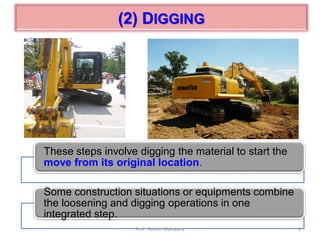
(2) DIGGING
These steps involve digging the material to start the
move from its original location.
Some construction situations or equipments combine
the loosening and digging operations in one
integrated step.
9Prof. Ashish Makwana
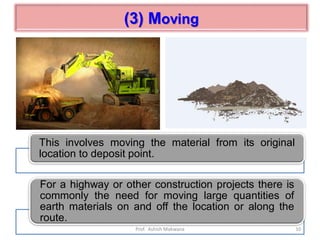
(3) Moving
This involves moving the material from its original
location to deposit point.
For a highway or other construction projects there is
commonly the need for moving large quantities of
earth materials on and off the location or along the
route.
10Prof. Ashish Makwana
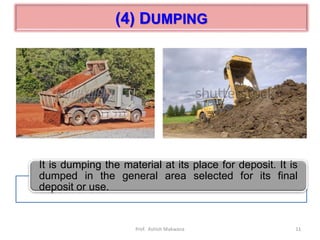
(4) DUMPING
It is dumping the material at its place for deposit. It is
dumped in the general area selected for its final
deposit or use.
11Prof. Ashish Makwana
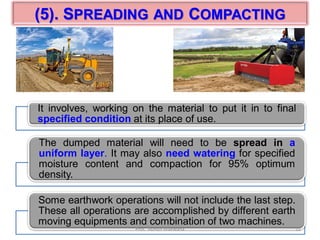
(5). SPREADING AND COMPACTING
It involves, working on the material to put it in to final
specified condition at its place of use.
The dumped material will need to be spread in a
uniform layer. It may also need watering for specified
moisture content and compaction for 95% optimum
density.
Some earthwork operations will not include the last step.
These all operations are accomplished by different earth
moving equipments and combination of two machines.
12Prof. Ashish Makwana
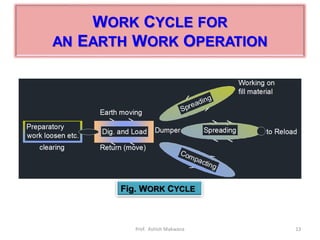
WORK CYCLE FOR
AN EARTH WORK OPERATION
Fig. WORK CYCLE
13Prof. Ashish Makwana
COMPACTION
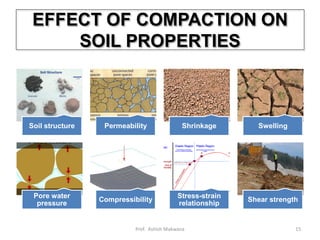
• Compaction is a process by which soil particles are
artificially rearranged and packed together into a closer
state of contact by mechanical means in order to
decrease the void ratio of the soil and thus increase dry
density.
14Prof. Ashish Makwana
EFFECT OF COMPACTION ON
SOIL PROPERTIES
Soil structure Permeability Shrinkage Swelling
Pore water
pressure
Compressibility
Stress-strain
relationship
Shear strength
15Prof. Ashish Makwana
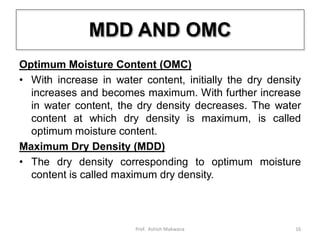
MDD AND OMC
Optimum Moisture Content (OMC)
• With increase in water content, initially the dry density
increases and becomes maximum. With further increase
in water content, the dry density decreases. The water
content at which dry density is maximum, is called
optimum moisture content.
Maximum Dry Density (MDD)
• The dry density corresponding to optimum moisture
content is called maximum dry density.
16Prof. Ashish Makwana
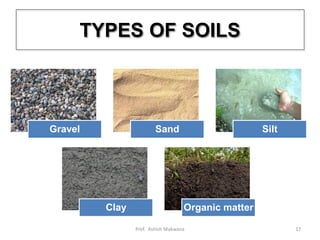
TYPES OF SOILS
Gravel Sand Silt
Clay Organic matter
17Prof. Ashish Makwana
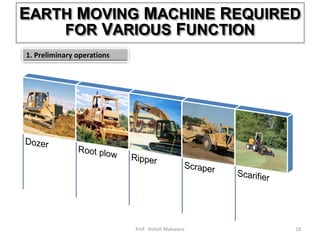
1. Preliminary operations
EARTH MOVING MACHINE REQUIRED
FOR VARIOUS FUNCTION
18Prof. Ashish Makwana
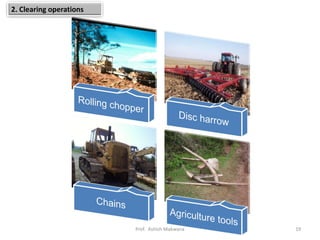
2. Clearing operations
19Prof. Ashish Makwana
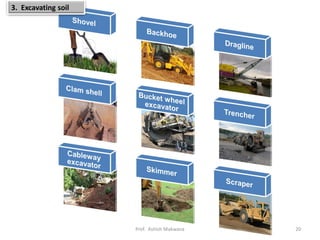
3. Excavating soil
20Prof. Ashish Makwana
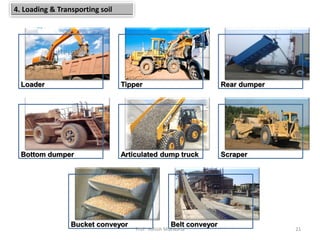
Loader Tipper Rear dumper
Bottom dumper Articulated dump truck Scraper
Bucket conveyor Belt conveyor
4. Loading & Transporting soil
21Prof. Ashish Makwana
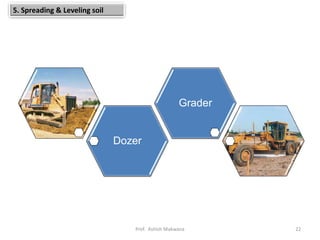
Dozer
Grader
5. Spreading & Leveling soil
22Prof. Ashish Makwana
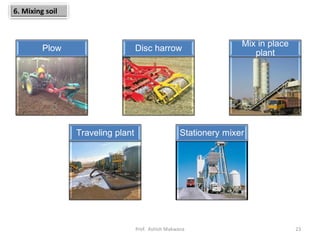
Plow Disc harrow
Mix in place
plant
Traveling plant Stationery mixer
6. Mixing soil
23Prof. Ashish Makwana
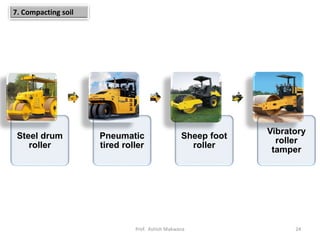
Steel drum
roller
Pneumatic
tired roller
Sheep foot
roller
Vibratory
roller
tamper
7. Compacting soil
24Prof. Ashish Makwana
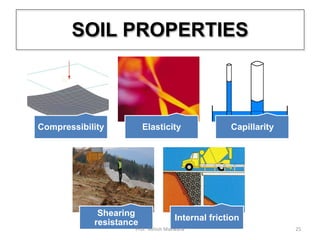
SOIL PROPERTIES
Compressibility Elasticity Capillarity
Shearing
resistance
Internal friction
25Prof. Ashish Makwana
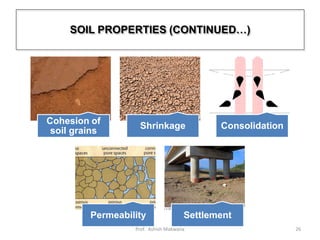
SOIL PROPERTIES (CONTINUED…)
Cohesion of
soil grains
Shrinkage Consolidation
Permeability Settlement
26Prof. Ashish Makwana
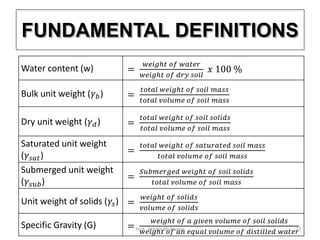
FUNDAMENTAL DEFINITIONS
Water content (w) =
𝑤𝑒𝑖𝑔ℎ𝑡 𝑜𝑓 𝑤𝑎𝑡𝑒𝑟
𝑤𝑒𝑖𝑔ℎ𝑡 𝑜𝑓 𝑑𝑟𝑦 𝑠𝑜𝑖𝑙
𝑥 100 %
Bulk unit weight (𝛾 𝑏) =
𝑡𝑜𝑡𝑎𝑙 𝑤𝑒𝑖𝑔ℎ𝑡 𝑜𝑓 𝑠𝑜𝑖𝑙 𝑚𝑎𝑠𝑠
𝑡𝑜𝑡𝑎𝑙 𝑣𝑜𝑙𝑢𝑚𝑒 𝑜𝑓 𝑠𝑜𝑖𝑙 𝑚𝑎𝑠𝑠
Dry unit weight (𝛾 𝑑) =
𝑡𝑜𝑡𝑎𝑙 𝑤𝑒𝑖𝑔ℎ𝑡 𝑜𝑓 𝑠𝑜𝑖𝑙 𝑠𝑜𝑙𝑖𝑑𝑠
𝑡𝑜𝑡𝑎𝑙 𝑣𝑜𝑙𝑢𝑚𝑒 𝑜𝑓 𝑠𝑜𝑖𝑙 𝑚𝑎𝑠𝑠
Saturated unit weight
(𝛾𝑠𝑎𝑡)
=
𝑡𝑜𝑡𝑎𝑙 𝑤𝑒𝑖𝑔ℎ𝑡 𝑜𝑓 𝑠𝑎𝑡𝑢𝑟𝑎𝑡𝑒𝑑 𝑠𝑜𝑖𝑙 𝑚𝑎𝑠𝑠
𝑡𝑜𝑡𝑎𝑙 𝑣𝑜𝑙𝑢𝑚𝑒 𝑜𝑓 𝑠𝑜𝑖𝑙 𝑚𝑎𝑠𝑠
Submerged unit weight
(𝛾𝑠𝑢𝑏)
=
𝑆𝑢𝑏𝑚𝑒𝑟𝑔𝑒𝑑 𝑤𝑒𝑖𝑔ℎ𝑡 𝑜𝑓 𝑠𝑜𝑖𝑙 𝑠𝑜𝑙𝑖𝑑𝑠
𝑡𝑜𝑡𝑎𝑙 𝑣𝑜𝑙𝑢𝑚𝑒 𝑜𝑓 𝑠𝑜𝑖𝑙 𝑚𝑎𝑠𝑠
Unit weight of solids (𝛾𝑠) =
𝑤𝑒𝑖𝑔ℎ𝑡 𝑜𝑓 𝑠𝑜𝑙𝑖𝑑𝑠
𝑣𝑜𝑙𝑢𝑚𝑒 𝑜𝑓 𝑠𝑜𝑙𝑖𝑑𝑠
Specific Gravity (G) =
𝑤𝑒𝑖𝑔ℎ𝑡 𝑜𝑓 𝑎 𝑔𝑖𝑣𝑒𝑛 𝑣𝑜𝑙𝑢𝑚𝑒 𝑜𝑓 𝑠𝑜𝑖𝑙 𝑠𝑜𝑙𝑖𝑑𝑠
𝑤𝑒𝑖𝑔ℎ𝑡 𝑜𝑓 𝑎𝑛 𝑒𝑞𝑢𝑎𝑙 𝑣𝑜𝑙𝑢𝑚𝑒 𝑜𝑓 𝑑𝑖𝑠𝑡𝑖𝑙𝑙𝑒𝑑 𝑤𝑎𝑡𝑒𝑟27Prof. Ashish Makwana
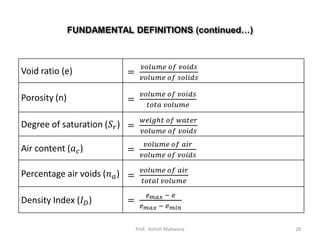
FUNDAMENTAL DEFINITIONS (continued…)
Void ratio (e) =
𝑣𝑜𝑙𝑢𝑚𝑒 𝑜𝑓 𝑣𝑜𝑖𝑑𝑠
𝑣𝑜𝑙𝑢𝑚𝑒 𝑜𝑓 𝑠𝑜𝑙𝑖𝑑𝑠
Porosity (n) =
𝑣𝑜𝑙𝑢𝑚𝑒 𝑜𝑓 𝑣𝑜𝑖𝑑𝑠
𝑡𝑜𝑡𝑎 𝑣𝑜𝑙𝑢𝑚𝑒
Degree of saturation (𝑆 𝑟) =
𝑤𝑒𝑖𝑔ℎ𝑡 𝑜𝑓 𝑤𝑎𝑡𝑒𝑟
𝑣𝑜𝑙𝑢𝑚𝑒 𝑜𝑓 𝑣𝑜𝑖𝑑𝑠
Air content (𝑎 𝑐) =
𝑣𝑜𝑙𝑢𝑚𝑒 𝑜𝑓 𝑎𝑖𝑟
𝑣𝑜𝑙𝑢𝑚𝑒 𝑜𝑓 𝑣𝑜𝑖𝑑𝑠
Percentage air voids (𝑛 𝑎) =
𝑣𝑜𝑙𝑢𝑚𝑒 𝑜𝑓 𝑎𝑖𝑟
𝑡𝑜𝑡𝑎𝑙 𝑣𝑜𝑙𝑢𝑚𝑒
Density Index (𝐼 𝐷) =
𝑒 𝑚𝑎𝑥 − 𝑒
𝑒 𝑚𝑎𝑥 − 𝑒 𝑚𝑖𝑛
28Prof. Ashish Makwana
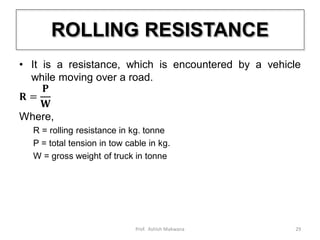
ROLLING RESISTANCE
• It is a resistance, which is encountered by a vehicle
while moving over a road.

𝐑 =
𝐏
𝐖
Where,
R = rolling resistance in kg. tonne
P = total tension in tow cable in kg.
W = gross weight of truck in tonne
29Prof. Ashish Makwana
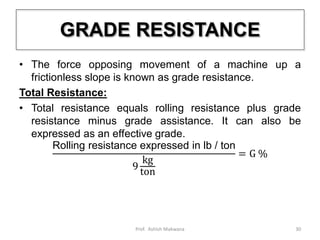
GRADE RESISTANCE
• The force opposing movement of a machine up a
frictionless slope is known as grade resistance.
Total Resistance:
• Total resistance equals rolling resistance plus grade
resistance minus grade assistance. It can also be
expressed as an effective grade.
Rolling resistance expressed in lb / ton
9
kg
ton
= G %
30Prof. Ashish Makwana
COEFFICIENT OF TRACTION
• The coefficient of traction is defined as the factor by
which the load on a driving tyre (ie. downward force)
should be multiplied to determine the maximum possible
tractive force between the tyre of track and the surface of
road before slipping occurs.
31Prof. Ashish Makwana
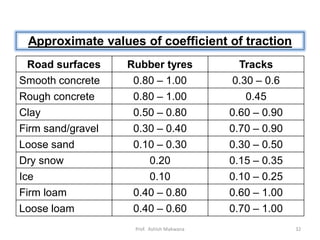
Approximate values of coefficient of traction
Road surfaces Rubber tyres Tracks
Smooth concrete 0.80 – 1.00 0.30 – 0.6
Rough concrete 0.80 – 1.00 0.45
Clay 0.50 – 0.80 0.60 – 0.90
Firm sand/gravel 0.30 – 0.40 0.70 – 0.90
Loose sand 0.10 – 0.30 0.30 – 0.50
Dry snow 0.20 0.15 – 0.35
Ice 0.10 0.10 – 0.25
Firm loam 0.40 – 0.80 0.60 – 1.00
Loose loam 0.40 – 0.60 0.70 – 1.00
32Prof. Ashish Makwana
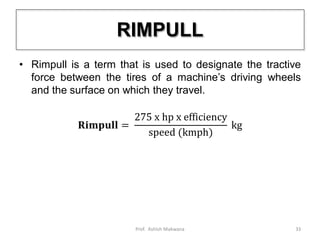
RIMPULL
• Rimpull is a term that is used to designate the tractive
force between the tires of a machine’s driving wheels
and the surface on which they travel.
𝐑𝐢𝐦𝐩𝐮𝐥𝐥 =
275 x hp x efficiency
speed (kmph)
kg
33Prof. Ashish Makwana
DRAWBAR PULL
• The towing force a crawler can exert on a load is
referred to as drawbar pull. Drawbar pull is typically
expressed in kilograms.
• To determine the drawbar pull available for towing a load
it is necessary to subtract from the total pulling force
available at the engine the force required to overcome
the total resistance imposed by the haul conditions.
• If a crawler tractor tows a load up a slope, its drawbar
pull will be reduced by 9 kg. for each ton of weight of the
tractor for each 1% slope.
34Prof. Ashish Makwana
EFFECT OF ALTITUDE ON
PERFORMANCE OF IC ENGINES
• When a manufacture provides a flywheel horse power
rating it is based on standard conditions, such as a
temperature of 15.50℃ and sea-level barometric
pressure of mercury (76 cm).
• For natural operation at altitudes above see level will
cause a significant decrease in available engine power.
This power is caused by the decrease in air density due
to increase in altitude. The air density in turn affects the
fuel to – air ratio during combustion in the engine’s
piston.
• For all practical purposes, the loss in power may by
approximately taken as 1% for every 100 m. above the
first 300 m.
35Prof. Ashish Makwana
EFFECT OF PRESSURE AND TEMPERATURE
ON PERFORMANCE OF IC ENGINES
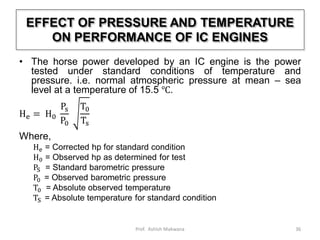
• The horse power developed by an IC engine is the power
tested under standard conditions of temperature and
pressure. i.e. normal atmospheric pressure at mean – sea
level at a temperature of 15.5 ℃.
He = H0
Ps
P0
T0
Ts
Where,
He = Corrected hp for standard condition
H0 = Observed hp as determined for test
PS = Standard barometric pressure
P0 = Observed barometric pressure
T0 = Absolute observed temperature
TS = Absolute temperature for standard condition
36Prof. Ashish Makwana
37Prof. Ashish Makwana

Engineering fundamentals_Advanced Construction Technology (Semester-6), Civil Engineering

  • 1.
    Prepared by Prof. AshishMakwana Civil Engineering Dept. - MEFGI 1Prof. Ashish Makwana
  • 2.
  • 3.
    PRESENTATION OUTLINE… • General • Compaction •Effect of compaction on soil properties • MDD and OMC • Types of Soils • Soil properties • Fundamental definitions • Rolling Resistance 3Prof. Ashish Makwana
  • 4.
    • Grade Resistance •Coefficient of Traction • Rimpull • Drawbar Pull • Effect of Altitude on Performance of IC Engines • Effect of Pressure and Temperature on performance of IC engines PRESENTATION OUTLINE… 4Prof. Ashish Makwana
  • 5.
    GENERAL • Heavy constructionprojects  require the handling and processing of large quantities of bulk materials. • 3 crucial material considerations  considered by an engineer while taking a new material handling problem of a project: 1. total quantity of material 2. rate at which it must be moved 3. size of the individual pieces 5Prof. Ashish Makwana
  • 6.
    Land has tobe cleared of jungle or vegetation before any construction activity can be started which may be for making roads, building embankments or drainage works etc. GENERAL 6Prof. Ashish Makwana
  • 7.
    Clearing or loosening Digging Moving Dumping Spreading& compacting. BASIC EARTH MOVING OPERATIONS 7Prof. Ashish Makwana
  • 8.
    (1) CLEARING ORLOOSENING This is the preparatory stage, which involves removing top soil or brush to expose the mass of earth to be moved. This may also involve loosening the material by blasting to put the material in to a workable state. 8Prof. Ashish Makwana
  • 9.
    (2) DIGGING These stepsinvolve digging the material to start the move from its original location. Some construction situations or equipments combine the loosening and digging operations in one integrated step. 9Prof. Ashish Makwana
  • 10.
    (3) Moving This involvesmoving the material from its original location to deposit point. For a highway or other construction projects there is commonly the need for moving large quantities of earth materials on and off the location or along the route. 10Prof. Ashish Makwana
  • 11.
    (4) DUMPING It isdumping the material at its place for deposit. It is dumped in the general area selected for its final deposit or use. 11Prof. Ashish Makwana
  • 12.
    (5). SPREADING ANDCOMPACTING It involves, working on the material to put it in to final specified condition at its place of use. The dumped material will need to be spread in a uniform layer. It may also need watering for specified moisture content and compaction for 95% optimum density. Some earthwork operations will not include the last step. These all operations are accomplished by different earth moving equipments and combination of two machines. 12Prof. Ashish Makwana
  • 13.
    WORK CYCLE FOR ANEARTH WORK OPERATION Fig. WORK CYCLE 13Prof. Ashish Makwana
  • 14.
    COMPACTION • Compaction isa process by which soil particles are artificially rearranged and packed together into a closer state of contact by mechanical means in order to decrease the void ratio of the soil and thus increase dry density. 14Prof. Ashish Makwana
  • 15.
    EFFECT OF COMPACTIONON SOIL PROPERTIES Soil structure Permeability Shrinkage Swelling Pore water pressure Compressibility Stress-strain relationship Shear strength 15Prof. Ashish Makwana
  • 16.
    MDD AND OMC OptimumMoisture Content (OMC) • With increase in water content, initially the dry density increases and becomes maximum. With further increase in water content, the dry density decreases. The water content at which dry density is maximum, is called optimum moisture content. Maximum Dry Density (MDD) • The dry density corresponding to optimum moisture content is called maximum dry density. 16Prof. Ashish Makwana
  • 17.
    TYPES OF SOILS GravelSand Silt Clay Organic matter 17Prof. Ashish Makwana
  • 18.
    1. Preliminary operations EARTHMOVING MACHINE REQUIRED FOR VARIOUS FUNCTION 18Prof. Ashish Makwana
  • 19.
  • 20.
  • 21.
    Loader Tipper Reardumper Bottom dumper Articulated dump truck Scraper Bucket conveyor Belt conveyor 4. Loading & Transporting soil 21Prof. Ashish Makwana
  • 22.
    Dozer Grader 5. Spreading &Leveling soil 22Prof. Ashish Makwana
  • 23.
    Plow Disc harrow Mixin place plant Traveling plant Stationery mixer 6. Mixing soil 23Prof. Ashish Makwana
  • 24.
    Steel drum roller Pneumatic tired roller Sheepfoot roller Vibratory roller tamper 7. Compacting soil 24Prof. Ashish Makwana
  • 25.
    SOIL PROPERTIES Compressibility ElasticityCapillarity Shearing resistance Internal friction 25Prof. Ashish Makwana
  • 26.
    SOIL PROPERTIES (CONTINUED…) Cohesionof soil grains Shrinkage Consolidation Permeability Settlement 26Prof. Ashish Makwana
  • 27.
    FUNDAMENTAL DEFINITIONS Water content(w) = 𝑤𝑒𝑖𝑔ℎ𝑡 𝑜𝑓 𝑤𝑎𝑡𝑒𝑟 𝑤𝑒𝑖𝑔ℎ𝑡 𝑜𝑓 𝑑𝑟𝑦 𝑠𝑜𝑖𝑙 𝑥 100 % Bulk unit weight (𝛾 𝑏) = 𝑡𝑜𝑡𝑎𝑙 𝑤𝑒𝑖𝑔ℎ𝑡 𝑜𝑓 𝑠𝑜𝑖𝑙 𝑚𝑎𝑠𝑠 𝑡𝑜𝑡𝑎𝑙 𝑣𝑜𝑙𝑢𝑚𝑒 𝑜𝑓 𝑠𝑜𝑖𝑙 𝑚𝑎𝑠𝑠 Dry unit weight (𝛾 𝑑) = 𝑡𝑜𝑡𝑎𝑙 𝑤𝑒𝑖𝑔ℎ𝑡 𝑜𝑓 𝑠𝑜𝑖𝑙 𝑠𝑜𝑙𝑖𝑑𝑠 𝑡𝑜𝑡𝑎𝑙 𝑣𝑜𝑙𝑢𝑚𝑒 𝑜𝑓 𝑠𝑜𝑖𝑙 𝑚𝑎𝑠𝑠 Saturated unit weight (𝛾𝑠𝑎𝑡) = 𝑡𝑜𝑡𝑎𝑙 𝑤𝑒𝑖𝑔ℎ𝑡 𝑜𝑓 𝑠𝑎𝑡𝑢𝑟𝑎𝑡𝑒𝑑 𝑠𝑜𝑖𝑙 𝑚𝑎𝑠𝑠 𝑡𝑜𝑡𝑎𝑙 𝑣𝑜𝑙𝑢𝑚𝑒 𝑜𝑓 𝑠𝑜𝑖𝑙 𝑚𝑎𝑠𝑠 Submerged unit weight (𝛾𝑠𝑢𝑏) = 𝑆𝑢𝑏𝑚𝑒𝑟𝑔𝑒𝑑 𝑤𝑒𝑖𝑔ℎ𝑡 𝑜𝑓 𝑠𝑜𝑖𝑙 𝑠𝑜𝑙𝑖𝑑𝑠 𝑡𝑜𝑡𝑎𝑙 𝑣𝑜𝑙𝑢𝑚𝑒 𝑜𝑓 𝑠𝑜𝑖𝑙 𝑚𝑎𝑠𝑠 Unit weight of solids (𝛾𝑠) = 𝑤𝑒𝑖𝑔ℎ𝑡 𝑜𝑓 𝑠𝑜𝑙𝑖𝑑𝑠 𝑣𝑜𝑙𝑢𝑚𝑒 𝑜𝑓 𝑠𝑜𝑙𝑖𝑑𝑠 Specific Gravity (G) = 𝑤𝑒𝑖𝑔ℎ𝑡 𝑜𝑓 𝑎 𝑔𝑖𝑣𝑒𝑛 𝑣𝑜𝑙𝑢𝑚𝑒 𝑜𝑓 𝑠𝑜𝑖𝑙 𝑠𝑜𝑙𝑖𝑑𝑠 𝑤𝑒𝑖𝑔ℎ𝑡 𝑜𝑓 𝑎𝑛 𝑒𝑞𝑢𝑎𝑙 𝑣𝑜𝑙𝑢𝑚𝑒 𝑜𝑓 𝑑𝑖𝑠𝑡𝑖𝑙𝑙𝑒𝑑 𝑤𝑎𝑡𝑒𝑟27Prof. Ashish Makwana
  • 28.
    FUNDAMENTAL DEFINITIONS (continued…) Voidratio (e) = 𝑣𝑜𝑙𝑢𝑚𝑒 𝑜𝑓 𝑣𝑜𝑖𝑑𝑠 𝑣𝑜𝑙𝑢𝑚𝑒 𝑜𝑓 𝑠𝑜𝑙𝑖𝑑𝑠 Porosity (n) = 𝑣𝑜𝑙𝑢𝑚𝑒 𝑜𝑓 𝑣𝑜𝑖𝑑𝑠 𝑡𝑜𝑡𝑎 𝑣𝑜𝑙𝑢𝑚𝑒 Degree of saturation (𝑆 𝑟) = 𝑤𝑒𝑖𝑔ℎ𝑡 𝑜𝑓 𝑤𝑎𝑡𝑒𝑟 𝑣𝑜𝑙𝑢𝑚𝑒 𝑜𝑓 𝑣𝑜𝑖𝑑𝑠 Air content (𝑎 𝑐) = 𝑣𝑜𝑙𝑢𝑚𝑒 𝑜𝑓 𝑎𝑖𝑟 𝑣𝑜𝑙𝑢𝑚𝑒 𝑜𝑓 𝑣𝑜𝑖𝑑𝑠 Percentage air voids (𝑛 𝑎) = 𝑣𝑜𝑙𝑢𝑚𝑒 𝑜𝑓 𝑎𝑖𝑟 𝑡𝑜𝑡𝑎𝑙 𝑣𝑜𝑙𝑢𝑚𝑒 Density Index (𝐼 𝐷) = 𝑒 𝑚𝑎𝑥 − 𝑒 𝑒 𝑚𝑎𝑥 − 𝑒 𝑚𝑖𝑛 28Prof. Ashish Makwana
  • 29.
    ROLLING RESISTANCE • Itis a resistance, which is encountered by a vehicle while moving over a road. 𝐑 = 𝐏 𝐖 Where, R = rolling resistance in kg. tonne P = total tension in tow cable in kg. W = gross weight of truck in tonne 29Prof. Ashish Makwana
  • 30.
    GRADE RESISTANCE • Theforce opposing movement of a machine up a frictionless slope is known as grade resistance. Total Resistance: • Total resistance equals rolling resistance plus grade resistance minus grade assistance. It can also be expressed as an effective grade. Rolling resistance expressed in lb / ton 9 kg ton = G % 30Prof. Ashish Makwana
  • 31.
    COEFFICIENT OF TRACTION •The coefficient of traction is defined as the factor by which the load on a driving tyre (ie. downward force) should be multiplied to determine the maximum possible tractive force between the tyre of track and the surface of road before slipping occurs. 31Prof. Ashish Makwana
  • 32.
    Approximate values ofcoefficient of traction Road surfaces Rubber tyres Tracks Smooth concrete 0.80 – 1.00 0.30 – 0.6 Rough concrete 0.80 – 1.00 0.45 Clay 0.50 – 0.80 0.60 – 0.90 Firm sand/gravel 0.30 – 0.40 0.70 – 0.90 Loose sand 0.10 – 0.30 0.30 – 0.50 Dry snow 0.20 0.15 – 0.35 Ice 0.10 0.10 – 0.25 Firm loam 0.40 – 0.80 0.60 – 1.00 Loose loam 0.40 – 0.60 0.70 – 1.00 32Prof. Ashish Makwana
  • 33.
    RIMPULL • Rimpull isa term that is used to designate the tractive force between the tires of a machine’s driving wheels and the surface on which they travel. 𝐑𝐢𝐦𝐩𝐮𝐥𝐥 = 275 x hp x efficiency speed (kmph) kg 33Prof. Ashish Makwana
  • 34.
    DRAWBAR PULL • Thetowing force a crawler can exert on a load is referred to as drawbar pull. Drawbar pull is typically expressed in kilograms. • To determine the drawbar pull available for towing a load it is necessary to subtract from the total pulling force available at the engine the force required to overcome the total resistance imposed by the haul conditions. • If a crawler tractor tows a load up a slope, its drawbar pull will be reduced by 9 kg. for each ton of weight of the tractor for each 1% slope. 34Prof. Ashish Makwana
  • 35.
    EFFECT OF ALTITUDEON PERFORMANCE OF IC ENGINES • When a manufacture provides a flywheel horse power rating it is based on standard conditions, such as a temperature of 15.50℃ and sea-level barometric pressure of mercury (76 cm). • For natural operation at altitudes above see level will cause a significant decrease in available engine power. This power is caused by the decrease in air density due to increase in altitude. The air density in turn affects the fuel to – air ratio during combustion in the engine’s piston. • For all practical purposes, the loss in power may by approximately taken as 1% for every 100 m. above the first 300 m. 35Prof. Ashish Makwana
  • 36.
    EFFECT OF PRESSUREAND TEMPERATURE ON PERFORMANCE OF IC ENGINES • The horse power developed by an IC engine is the power tested under standard conditions of temperature and pressure. i.e. normal atmospheric pressure at mean – sea level at a temperature of 15.5 ℃. He = H0 Ps P0 T0 Ts Where, He = Corrected hp for standard condition H0 = Observed hp as determined for test PS = Standard barometric pressure P0 = Observed barometric pressure T0 = Absolute observed temperature TS = Absolute temperature for standard condition 36Prof. Ashish Makwana
  • 37.