EngagingEngaging People with Dementia:People with Dementia:
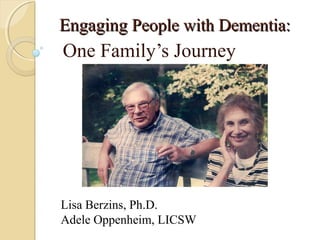
One Family’s Journey
Lisa Berzins, Ph.D.
Adele Oppenheim, LICSW
What Causes Dementia?What Causes Dementia?
Dementia is caused when the brain is
damaged by diseases or a series of strokes
Alzheimer’s disease is the most common
but many other diseases result in dementia
◦ Specific symptoms depend on the parts
of the brain that are damaged
◦ The speed of progression varies.
What is Dementia?What is Dementia?
A set of symptoms that reflect impairment
of cognitive functioning such as:
◦ Memory; difficulty recalling recent
events
◦ Executive functioning; concentrating,
planning or organizing
◦ Language; difficulty following a
conversation or finding the right word
What is Dementia?What is Dementia?
◦ Visual-spatial skills; problems judging
distances and seeing objects in three
dimensions
◦ Orientation; confusion or losing track
of day, date and place
◦ Changes in mood and behavior;
irritable, anxious, agitated, withdrawn,
depressed
Medical Model and DementiaMedical Model and Dementia
Focus on etiology, prevalence,
progression of symptoms and treatments
Currently, there is no definitive
knowledge of cause(s) or cure
Anti-dementia drugs may slow the
progression in early stages
Anti-psychotic drugs may help reduce
depression, agitation and/or aggression
but can have harmful side effects
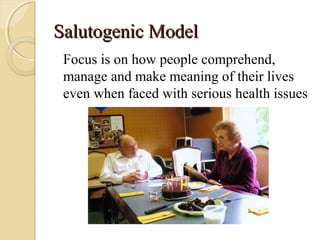
Salutogenic ModelSalutogenic Model
Focus is on how people comprehend,
manage and make meaning of their lives
even when faced with serious health issues
Salutogenic ModelSalutogenic Model
• Cognition and understanding-making sense of the
world and making decisions
• Communication- speaking, expressing needs and
emotions
• Physical ability
• Skills
• Organization and structure
• Interpersonal connections-relationships, social life
• Capacity for self-care
With dementia, emphasis is on
adjustment by the person and significant
others to changes in abilities such as
EngagementEngagement
Many environments lack stimulation.
Evaluation of 17 care homes found that
people spent less than 13% of waking
hours engaged in meaningful activity
Another study found that residents on
average spent only two minutes a day in
meaningful social interaction.
Unmet needs can precipitate increased
irritability/aggression and often result in
prescription of anti-psychotic medication.
Singing and DementiaSinging and Dementia
The preservation of musicality in people
with dementia is commonly observed.
Listening to music and singing have been
shown to reduce depression, agitation,
aggression, impaired social interactions
and sleep disturbance.
Hormones that stimulate memory, social
bonding, reduce stress and boost the
immune system increase during and after
singing.
Singing and DementiaSinging and Dementia
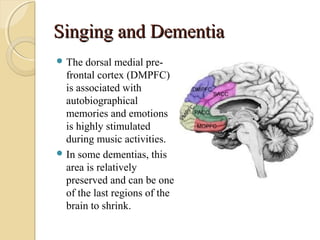
 The dorsal medial pre-
frontal cortex (DMPFC)
is associated with
autobiographical
memories and emotions
is highly stimulated
during music activities.
 In some dementias, this
area is relatively
preserved and can be one
of the last regions of the
brain to shrink.
Singing and DementiaSinging and Dementia
“Singing is integral to the life quality of those who
are in progressive dementia and their caregivers.
It functions to provide islands of arousal,
awareness, familiarity, comfort, community and
success like nothing else can. It is particularly
valuable as an intervention because it is accessible
to a wide array of individuals…and can include
persons across cultures and socioeconomic strata.
It is also effective in severe, late stage dementia
when responses to other stimuli are nonexistent.”
-Alicia Clair
Engagement ResearchEngagement Research
Research by Cohen-Mansfield et al. evaluated
the benefits of simple activities and interactions
such as conversations, joint participation in
games or physical activities and music. The
interventions were based on a standardized
framework but personalized to the person’s
current and previous interests, occupation,
cognitive and functional abilities and symptoms.
Results: Overall symptoms of agitation,
including shouting, were reduced by 25%
Engagement ResearchEngagement Research
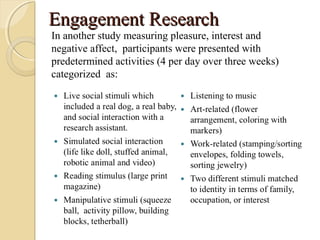
In another study measuring pleasure, interest and
negative affect, participants were presented with
predetermined activities (4 per day over three weeks)
categorized as:
Engagement ResearchEngagement Research
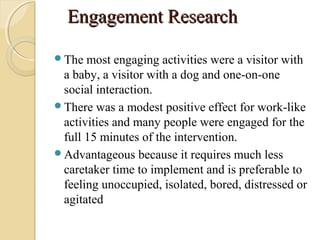
The most engaging activities were a visitor with
a baby, a visitor with a dog and one-on-one
social interaction.
There was a modest positive effect for work-like
activities and many people were engaged for the
full 15 minutes of the intervention.
Advantageous because it requires much less
caretaker time to implement and is preferable to
feeling unoccupied, isolated, bored, distressed or
agitated
Humor and DementiaHumor and Dementia
SMILE study in Australia studied the
impact of humor therapy on mood,
agitation, behavioral disturbances and social
engagement. They found that weekly visits
by clowns, plus the training of staff
members to provide humor therapy, reduced
agitation by 20% among 180 residents in 17
nursing homes compared with a control
group.
Humor and Dementia Video
Humor and DementiaHumor and Dementia
The authors noted that the effect was the
same effect that would be expected with the
use of antipsychotic medication.
Results from the study also showed
improvements in levels of depression
among residents correlated with the
enthusiasm and dedication of nursing home
staff trained in humor therapy.
Reminiscence Therapy and LifeReminiscence Therapy and Life
Story WorkStory Work
RT (Reminiscence Therapy) is a
biographical intervention that involves
either group reminiscence work where the
past is discussed or the use of stimuli such
as music or pictures.
LSW (Life Story Work) focuses on
putting together a life story album for the
individual.
It is most effective for individuals with
mild to moderate dementia.
Benefits of RT and LSWBenefits of RT and LSW
It can improve the relationship, whether
family or professional, between the person
with dementia and their caretakers.
It allows the individual to map where they
have been, their jobs, favorite foods and
other information specific to his/her life.
Benefits of RT and LSWBenefits of RT and LSW
Improvements in depression, loneliness
and general well-being
Can be especially valuable and grounding
when the person is transferred from a
home to an institutional setting or between
institutions
United States LagsUnited States Lags
US released first national plan in 2012
France began addressing dementia in
2001 and is now carrying out its third
national plan.
England launched their National
Dementia strategy in 2009 which sets out
17 recommendations focusing on raising
awareness and understanding, early
diagnosis and support, and living well
with dementia.
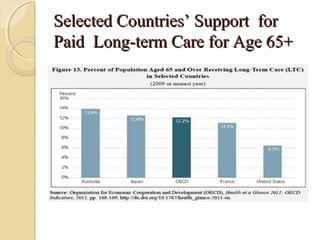
Selected CountriesSelected Countries’ Support for’ Support for
Paid Long-term Care for Age 65+Paid Long-term Care for Age 65+
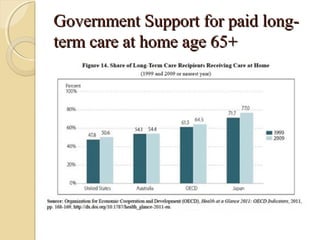
Government Support for paid long-Government Support for paid long-
term care at home age 65+term care at home age 65+
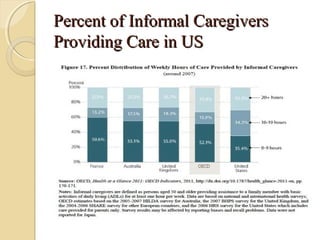
Percent of Informal CaregiversPercent of Informal Caregivers
Providing Care in USProviding Care in US
European AlzheimerEuropean Alzheimer’s Alliance’s Alliance
 Committed to prevention, diagnosis, treatment, research
and social policies
 Austria, Belgium, Bulgaria, Cypress, Czech Republic,
Denmark, Finland, France, Germany, Greece, Ireland,
Luxemborg, Malta, Netherlands, Norway, Poland
Portugal, Romania, Slovenia, Spain, Switzerland,
Turkey, United Kingdom
 Countries outside of Europe include Australia, Japan,
Israel, Taiwan
ConclusionConclusion
“For me, the take-away is clear. Other
countries with which the US is closely
aligned have embraced long-term care as a
social responsibility while we have not.
Unless and until we do so, caregivers here
will be among the most harried, stressed
and burdened among wealthy, developed
countries in the world.”
- Judith Graham, New York Times
Engaging people with Dementia

Engaging people with Dementia

  • 1.
    EngagingEngaging People withDementia:People with Dementia: One Family’s Journey Lisa Berzins, Ph.D. Adele Oppenheim, LICSW
  • 2.
    What Causes Dementia?WhatCauses Dementia? Dementia is caused when the brain is damaged by diseases or a series of strokes Alzheimer’s disease is the most common but many other diseases result in dementia ◦ Specific symptoms depend on the parts of the brain that are damaged ◦ The speed of progression varies.
  • 3.
    What is Dementia?Whatis Dementia? A set of symptoms that reflect impairment of cognitive functioning such as: ◦ Memory; difficulty recalling recent events ◦ Executive functioning; concentrating, planning or organizing ◦ Language; difficulty following a conversation or finding the right word
  • 4.
    What is Dementia?Whatis Dementia? ◦ Visual-spatial skills; problems judging distances and seeing objects in three dimensions ◦ Orientation; confusion or losing track of day, date and place ◦ Changes in mood and behavior; irritable, anxious, agitated, withdrawn, depressed
  • 5.
    Medical Model andDementiaMedical Model and Dementia Focus on etiology, prevalence, progression of symptoms and treatments Currently, there is no definitive knowledge of cause(s) or cure Anti-dementia drugs may slow the progression in early stages Anti-psychotic drugs may help reduce depression, agitation and/or aggression but can have harmful side effects
  • 6.
    Salutogenic ModelSalutogenic Model Focusis on how people comprehend, manage and make meaning of their lives even when faced with serious health issues
  • 7.
    Salutogenic ModelSalutogenic Model •Cognition and understanding-making sense of the world and making decisions • Communication- speaking, expressing needs and emotions • Physical ability • Skills • Organization and structure • Interpersonal connections-relationships, social life • Capacity for self-care With dementia, emphasis is on adjustment by the person and significant others to changes in abilities such as
  • 8.
    EngagementEngagement Many environments lackstimulation. Evaluation of 17 care homes found that people spent less than 13% of waking hours engaged in meaningful activity Another study found that residents on average spent only two minutes a day in meaningful social interaction. Unmet needs can precipitate increased irritability/aggression and often result in prescription of anti-psychotic medication.
  • 9.
    Singing and DementiaSingingand Dementia The preservation of musicality in people with dementia is commonly observed. Listening to music and singing have been shown to reduce depression, agitation, aggression, impaired social interactions and sleep disturbance. Hormones that stimulate memory, social bonding, reduce stress and boost the immune system increase during and after singing.
  • 10.
    Singing and DementiaSingingand Dementia  The dorsal medial pre- frontal cortex (DMPFC) is associated with autobiographical memories and emotions is highly stimulated during music activities.  In some dementias, this area is relatively preserved and can be one of the last regions of the brain to shrink.
  • 11.
    Singing and DementiaSingingand Dementia “Singing is integral to the life quality of those who are in progressive dementia and their caregivers. It functions to provide islands of arousal, awareness, familiarity, comfort, community and success like nothing else can. It is particularly valuable as an intervention because it is accessible to a wide array of individuals…and can include persons across cultures and socioeconomic strata. It is also effective in severe, late stage dementia when responses to other stimuli are nonexistent.” -Alicia Clair
  • 12.
    Engagement ResearchEngagement Research Researchby Cohen-Mansfield et al. evaluated the benefits of simple activities and interactions such as conversations, joint participation in games or physical activities and music. The interventions were based on a standardized framework but personalized to the person’s current and previous interests, occupation, cognitive and functional abilities and symptoms. Results: Overall symptoms of agitation, including shouting, were reduced by 25%
  • 13.
    Engagement ResearchEngagement Research Inanother study measuring pleasure, interest and negative affect, participants were presented with predetermined activities (4 per day over three weeks) categorized as:
  • 14.
    Engagement ResearchEngagement Research Themost engaging activities were a visitor with a baby, a visitor with a dog and one-on-one social interaction. There was a modest positive effect for work-like activities and many people were engaged for the full 15 minutes of the intervention. Advantageous because it requires much less caretaker time to implement and is preferable to feeling unoccupied, isolated, bored, distressed or agitated
  • 15.
    Humor and DementiaHumorand Dementia SMILE study in Australia studied the impact of humor therapy on mood, agitation, behavioral disturbances and social engagement. They found that weekly visits by clowns, plus the training of staff members to provide humor therapy, reduced agitation by 20% among 180 residents in 17 nursing homes compared with a control group. Humor and Dementia Video
  • 16.
    Humor and DementiaHumorand Dementia The authors noted that the effect was the same effect that would be expected with the use of antipsychotic medication. Results from the study also showed improvements in levels of depression among residents correlated with the enthusiasm and dedication of nursing home staff trained in humor therapy.
  • 17.
    Reminiscence Therapy andLifeReminiscence Therapy and Life Story WorkStory Work RT (Reminiscence Therapy) is a biographical intervention that involves either group reminiscence work where the past is discussed or the use of stimuli such as music or pictures. LSW (Life Story Work) focuses on putting together a life story album for the individual. It is most effective for individuals with mild to moderate dementia.
  • 18.
    Benefits of RTand LSWBenefits of RT and LSW It can improve the relationship, whether family or professional, between the person with dementia and their caretakers. It allows the individual to map where they have been, their jobs, favorite foods and other information specific to his/her life.
  • 19.
    Benefits of RTand LSWBenefits of RT and LSW Improvements in depression, loneliness and general well-being Can be especially valuable and grounding when the person is transferred from a home to an institutional setting or between institutions
  • 20.
    United States LagsUnitedStates Lags US released first national plan in 2012 France began addressing dementia in 2001 and is now carrying out its third national plan. England launched their National Dementia strategy in 2009 which sets out 17 recommendations focusing on raising awareness and understanding, early diagnosis and support, and living well with dementia.
  • 21.
    Selected CountriesSelected Countries’Support for’ Support for Paid Long-term Care for Age 65+Paid Long-term Care for Age 65+
  • 22.
    Government Support forpaid long-Government Support for paid long- term care at home age 65+term care at home age 65+
  • 23.
    Percent of InformalCaregiversPercent of Informal Caregivers Providing Care in USProviding Care in US
  • 24.
    European AlzheimerEuropean Alzheimer’sAlliance’s Alliance  Committed to prevention, diagnosis, treatment, research and social policies  Austria, Belgium, Bulgaria, Cypress, Czech Republic, Denmark, Finland, France, Germany, Greece, Ireland, Luxemborg, Malta, Netherlands, Norway, Poland Portugal, Romania, Slovenia, Spain, Switzerland, Turkey, United Kingdom  Countries outside of Europe include Australia, Japan, Israel, Taiwan
  • 25.
    ConclusionConclusion “For me, thetake-away is clear. Other countries with which the US is closely aligned have embraced long-term care as a social responsibility while we have not. Unless and until we do so, caregivers here will be among the most harried, stressed and burdened among wealthy, developed countries in the world.” - Judith Graham, New York Times

Editor's Notes

  • #22 OECD (Organization for Economic Cooperation and Development) includes 30 other developed countries)
  • #23 US ranks
  • #24 US is the highest compared to France, Australia and Britain, all of which provide more paid long-term care.