Engaging Government Understanding and communicating with bureaucracies
My ‘theoretical orientation’ Bureaucracies aren’t necessarily bad or wrong Neither government nor private sector is without faults Some really smart and highly qualified people work in bureaucracies  –  MBAs, MPAs, PhDs, MDs, RNs, MScs, PharmDs and more Most of the characteristics and behaviours attributed to government bureaucracies are replicated in large private sector entities Likely that this is simply how humans shape their relationships in large structures
The nature of bureaucracy
Bureaucracies are complex! Bewildering array of job titles Director General (acting) Assistant Deputy Minister T eam Lead  –  Inter-ministry Coordination Manager  –  Organizational Effectiveness Senior Analyst, Performance and Accountability Planning and Development Officer III Often job function, reporting relationships and responsibilities are obscure (to the outsider)
Complexity is deep
The political dimension Added layer of complexity Elected officials are the ‘CEOs’ of ministries and departments Accompanied by advisors and consultants of various age and maturity Chief of staff S pecial assistants M anagement elite reports to them Political staff may reach into the bureaucracy at any level and directly engage
Political imperatives Bureaucracies (and bureaucrats) are often permanent  –  politicians can be fired every 4 years Politics is a highly structured competition, governed by normative rules (e.g. parliamentary procedure) Bureaucratic and political interests and goals are seldom perfectly aligned U ltimately the job of a politician is to get re-elected Bureaucracies must serve politicians Officially they are representatives of the people Unofficially the bureaucracy is the tool that will enable re-election
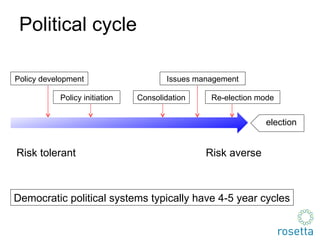
Political cycle Risk averse Democratic political systems typically have 4-5 year cycles  Risk tolerant election Policy development Policy initiation Consolidation Issues management Re-election mode
Common features S tarkly defined roles and job functions Often unions of various types Impersonality of relationships Formal processes for communicating in and between units H ierarchy Workers (division between field and central offices) Line management Management elites Enshrined rules and procedures
Bureaucracies can be siloed Between ministries Inside ministries Responsibilities clearly defined Distaste for blurred lines Interest in other silos is limited
Some characteristics Very busy places  –   Parkinson’s Law  ‘work expands so as to fill the time available for its completion’ Self-sustaining entities Inertia is a factor  –  things like to keep on doing what they are already doing Permanence  –  few bureaucracies go out of business; they may be renamed, reshaped Tacit purpose is to preserve (and often grow) the organization Stability seeking  –  equilibrium is good Tension between Management  –  keeping the system running Leadership  –  effecting change, introducing innovation
What sort of person works here?
Bureaucratic ‘personality’ W illingness to comply with superior’s wishes C onfidence in expert judgement P reference for impersonal relationships D esire for security provided by standardized roles and processes I dentification with the organization  –  belief that bureaucracy is the most effective form of administration Often risk averse
Relationships within the bureaucracy Compliance and positive attitudes upward  Competitiveness horizontally  Exercise of power downward Peers Superiors Subordinates
Telling your story
The public angle Public sector bureaucracies are designed to serve the public interest  –  they see themselves as stewards Is there a ‘fit’?  Is what you are saying appropriate  –  is the ‘ask’ relevant to government interests? Does it align with avowed and implicit policy, responsibilities? How does your story fit the public interest as it is told? How does it paint your organization  –  corporate partner, handout recipient, part of the problem? Is the language you are using public-minded? Example: your company needs $10 million in government support for a research project Is this: Government handing taxpayer $ to a for-profit multinational? Government creating opportunities for science and strengthening R&D infrastructure?
Sandwich method + + Interest-based preface Core messaging Common interests again Embed your points in a discussion that highlights common interests and acknowledges government imperatives
Simplicity Work on your elevator pitch  –  this is the backbone of the story you will tell Add detail as your audience shows a need for it Essential pieces of the pitch are: Answer to the ‘so what’ question Benefits as well as solutions to existing problems Example: Red Rain Biotech is building a centre of excellence in immunology … and needs a $10 million contribution to do it So what  –  helps build R&D capacity and strengthen the biotechnology hub already in place; fits with existing university-based research; patient benefit Benefits  –  this will create 20 new positions in the life sciences, help attract new talent, create the infrastructure for further research to come Fixes problems  –  our biotechnology hub needs more R&D, otherwise it will be seen as an ‘also-ran’ venture, losing out to bigger centres
Be useful Bureaucrats are busy people They are developing complex initiatives of their own or trying to operationalize ideas coming from the political sphere There is limited time to figure out how your idea or ask is going to work Be simple in your overview  –  this will work by doing X and Y … Create a policy solution of your own – presented in their language Make whatever you are asking for is a turn-key solution with limited or no burden on government – don’t make them work to do something for your benefit
The win Figure out how to position your ask as a win for the public Help bureaucrats sell your concept to political authorities Help political decision-makers sell the idea to the public (and protect themselves from criticism) If necessary build a coalition of external stakeholders who support your position  –  they can engage bureaucracies
A word on silos Bureaucrats are measured by their successes in their particular area of responsibility  –  your proposal should help them show themselves as successful Telling them how they could do something to benefit some other part of government will not likely be received well Examples: Asking a drug program to list your product because it would reduce spending in hospitals for a specific surgical intervention is going to be a hard sell Showing how a drug program could list an anti-psychotic drug that would reduce the burden schizophrenics place on the corrections system would also be a hard sell Respect the silos
Paul McIvor 416.516.7095 416.906.1276 C [email_address] 179 Fern Avenue Toronto, ON, Canada M6R 1K2 Contact

Engaging Government Web

  • 1.
    Engaging Government Understandingand communicating with bureaucracies
  • 2.
    My ‘theoretical orientation’Bureaucracies aren’t necessarily bad or wrong Neither government nor private sector is without faults Some really smart and highly qualified people work in bureaucracies – MBAs, MPAs, PhDs, MDs, RNs, MScs, PharmDs and more Most of the characteristics and behaviours attributed to government bureaucracies are replicated in large private sector entities Likely that this is simply how humans shape their relationships in large structures
  • 3.
    The nature ofbureaucracy
  • 4.
    Bureaucracies are complex!Bewildering array of job titles Director General (acting) Assistant Deputy Minister T eam Lead – Inter-ministry Coordination Manager – Organizational Effectiveness Senior Analyst, Performance and Accountability Planning and Development Officer III Often job function, reporting relationships and responsibilities are obscure (to the outsider)
  • 5.
  • 6.
    The political dimensionAdded layer of complexity Elected officials are the ‘CEOs’ of ministries and departments Accompanied by advisors and consultants of various age and maturity Chief of staff S pecial assistants M anagement elite reports to them Political staff may reach into the bureaucracy at any level and directly engage
  • 7.
    Political imperatives Bureaucracies(and bureaucrats) are often permanent – politicians can be fired every 4 years Politics is a highly structured competition, governed by normative rules (e.g. parliamentary procedure) Bureaucratic and political interests and goals are seldom perfectly aligned U ltimately the job of a politician is to get re-elected Bureaucracies must serve politicians Officially they are representatives of the people Unofficially the bureaucracy is the tool that will enable re-election
  • 8.
    Political cycle Riskaverse Democratic political systems typically have 4-5 year cycles Risk tolerant election Policy development Policy initiation Consolidation Issues management Re-election mode
  • 9.
    Common features Starkly defined roles and job functions Often unions of various types Impersonality of relationships Formal processes for communicating in and between units H ierarchy Workers (division between field and central offices) Line management Management elites Enshrined rules and procedures
  • 10.
    Bureaucracies can besiloed Between ministries Inside ministries Responsibilities clearly defined Distaste for blurred lines Interest in other silos is limited
  • 11.
    Some characteristics Verybusy places – Parkinson’s Law ‘work expands so as to fill the time available for its completion’ Self-sustaining entities Inertia is a factor – things like to keep on doing what they are already doing Permanence – few bureaucracies go out of business; they may be renamed, reshaped Tacit purpose is to preserve (and often grow) the organization Stability seeking – equilibrium is good Tension between Management – keeping the system running Leadership – effecting change, introducing innovation
  • 12.
    What sort ofperson works here?
  • 13.
    Bureaucratic ‘personality’ Willingness to comply with superior’s wishes C onfidence in expert judgement P reference for impersonal relationships D esire for security provided by standardized roles and processes I dentification with the organization – belief that bureaucracy is the most effective form of administration Often risk averse
  • 14.
    Relationships within thebureaucracy Compliance and positive attitudes upward Competitiveness horizontally Exercise of power downward Peers Superiors Subordinates
  • 15.
  • 16.
    The public anglePublic sector bureaucracies are designed to serve the public interest – they see themselves as stewards Is there a ‘fit’? Is what you are saying appropriate – is the ‘ask’ relevant to government interests? Does it align with avowed and implicit policy, responsibilities? How does your story fit the public interest as it is told? How does it paint your organization – corporate partner, handout recipient, part of the problem? Is the language you are using public-minded? Example: your company needs $10 million in government support for a research project Is this: Government handing taxpayer $ to a for-profit multinational? Government creating opportunities for science and strengthening R&D infrastructure?
  • 17.
    Sandwich method ++ Interest-based preface Core messaging Common interests again Embed your points in a discussion that highlights common interests and acknowledges government imperatives
  • 18.
    Simplicity Work onyour elevator pitch – this is the backbone of the story you will tell Add detail as your audience shows a need for it Essential pieces of the pitch are: Answer to the ‘so what’ question Benefits as well as solutions to existing problems Example: Red Rain Biotech is building a centre of excellence in immunology … and needs a $10 million contribution to do it So what – helps build R&D capacity and strengthen the biotechnology hub already in place; fits with existing university-based research; patient benefit Benefits – this will create 20 new positions in the life sciences, help attract new talent, create the infrastructure for further research to come Fixes problems – our biotechnology hub needs more R&D, otherwise it will be seen as an ‘also-ran’ venture, losing out to bigger centres
  • 19.
    Be useful Bureaucratsare busy people They are developing complex initiatives of their own or trying to operationalize ideas coming from the political sphere There is limited time to figure out how your idea or ask is going to work Be simple in your overview – this will work by doing X and Y … Create a policy solution of your own – presented in their language Make whatever you are asking for is a turn-key solution with limited or no burden on government – don’t make them work to do something for your benefit
  • 20.
    The win Figureout how to position your ask as a win for the public Help bureaucrats sell your concept to political authorities Help political decision-makers sell the idea to the public (and protect themselves from criticism) If necessary build a coalition of external stakeholders who support your position – they can engage bureaucracies
  • 21.
    A word onsilos Bureaucrats are measured by their successes in their particular area of responsibility – your proposal should help them show themselves as successful Telling them how they could do something to benefit some other part of government will not likely be received well Examples: Asking a drug program to list your product because it would reduce spending in hospitals for a specific surgical intervention is going to be a hard sell Showing how a drug program could list an anti-psychotic drug that would reduce the burden schizophrenics place on the corrections system would also be a hard sell Respect the silos
  • 22.
    Paul McIvor 416.516.7095416.906.1276 C [email_address] 179 Fern Avenue Toronto, ON, Canada M6R 1K2 Contact