IMPLEMENTING REGIONAL
POLICIES EFFECTIVELY
MULTI-LEVEL GOVERNANCE ISSUES
Joaquim Oliveira Martins, Head, Regional development Policy
Division
Meeting of the High-Level Group of Macro-regional Strategies
3 June 2015,
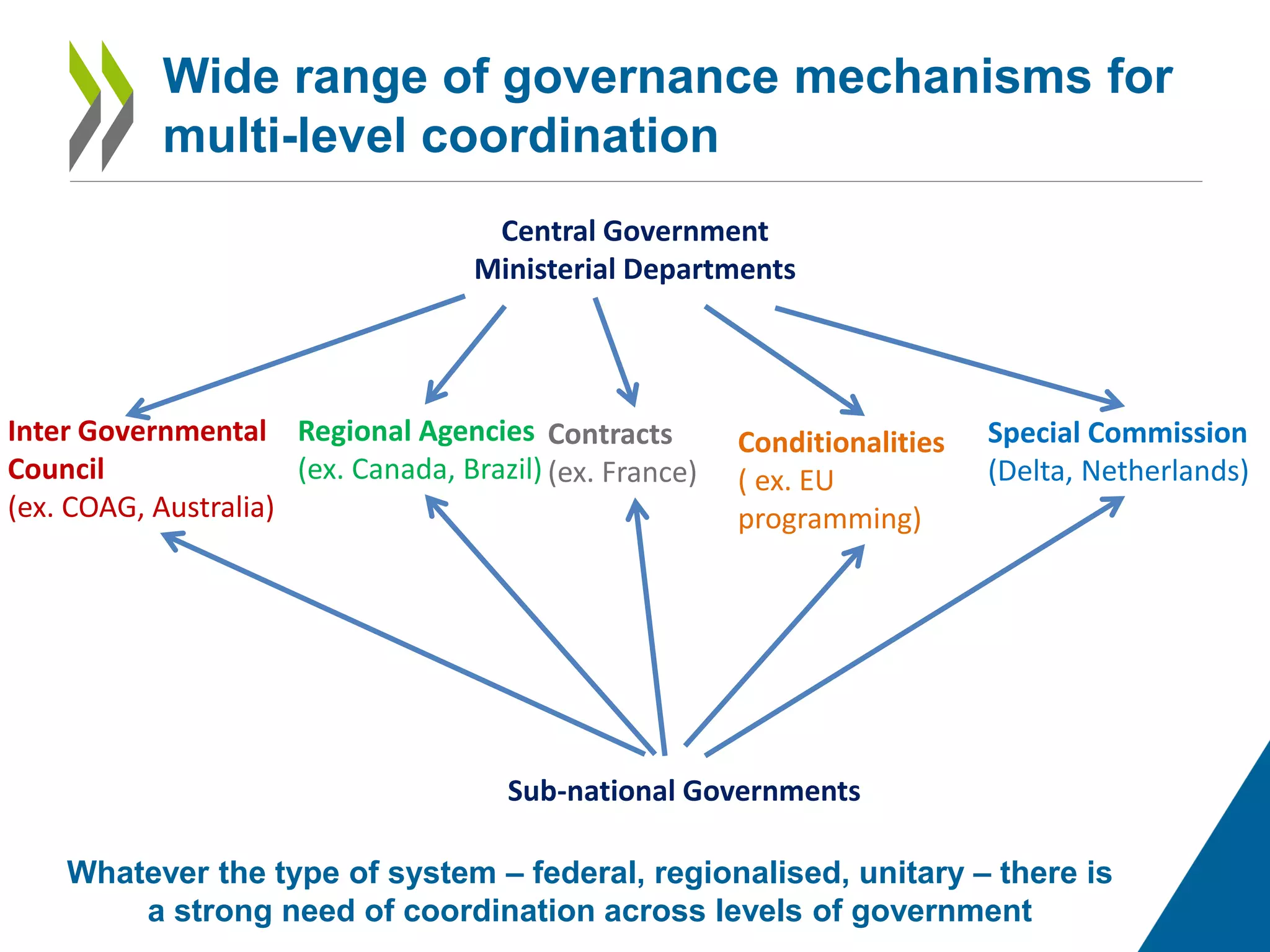
Central Government
Ministerial Departments
Sub-national Governments
Inter Governmental
Council
(ex. COAG, Australia)
Regional Agencies
(ex. Canada, Brazil)
Contracts
(ex. France)
Special Commission
(Delta, Netherlands)
Whatever the type of system – federal, regionalised, unitary – there is
a strong need of coordination across levels of government
Wide range of governance mechanisms for
multi-level coordination
Conditionalities
( ex. EU
programming)
3
The blockages of
coordination/cooperation and
their governance solutions
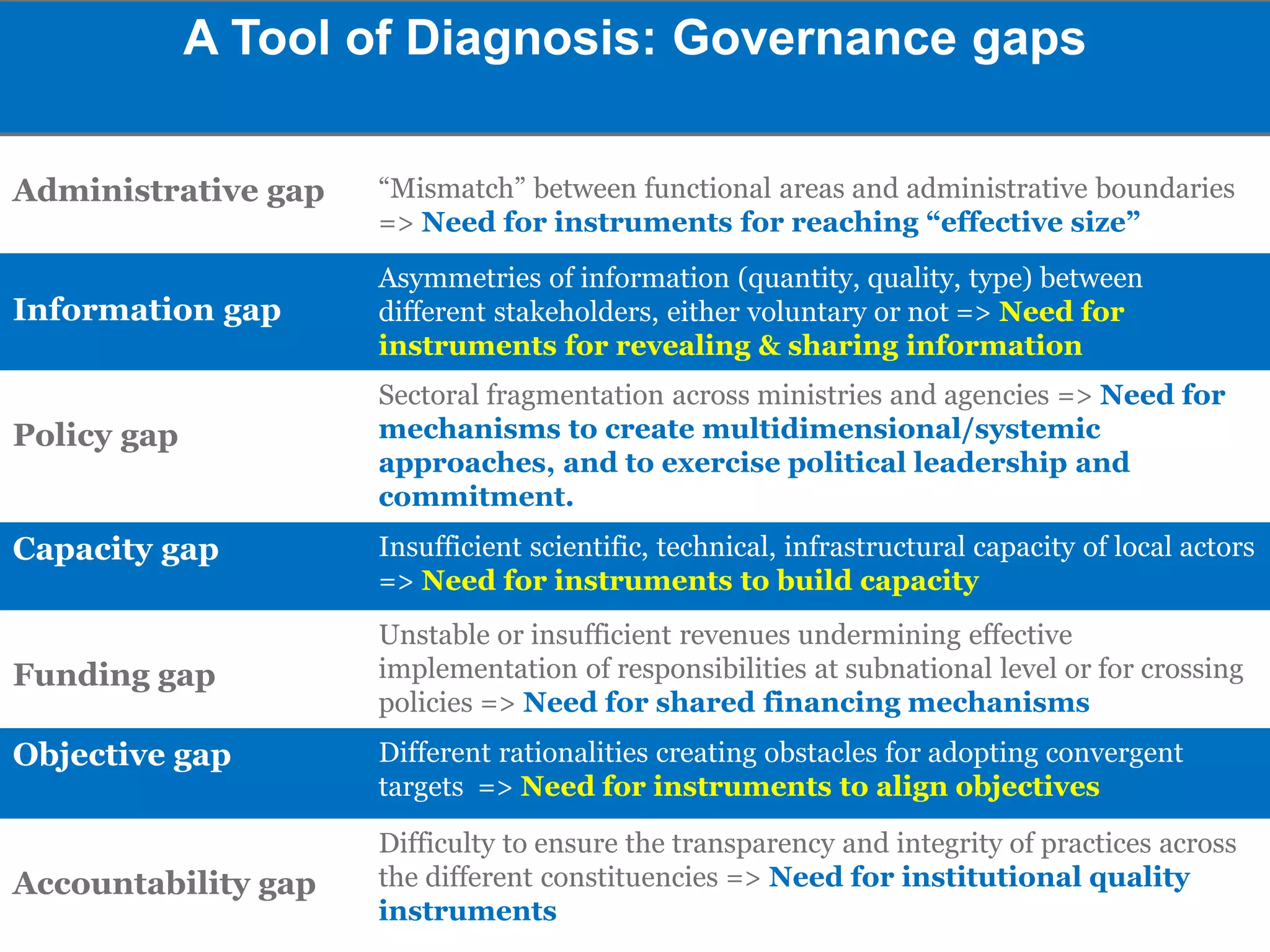
A Tool of Diagnosis: Governance gaps
Administrative gap “Mismatch” between functional areas and administrative boundaries
=> Need for instruments for reaching “effective size”
Information gap
Asymmetries of information (quantity, quality, type) between
different stakeholders, either voluntary or not => Need for
instruments for revealing & sharing information
Policy gap
Sectoral fragmentation across ministries and agencies => Need for
mechanisms to create multidimensional/systemic
approaches, and to exercise political leadership and
commitment.
Capacity gap Insufficient scientific, technical, infrastructural capacity of local actors
=> Need for instruments to build capacity
Funding gap
Unstable or insufficient revenues undermining effective
implementation of responsibilities at subnational level or for crossing
policies => Need for shared financing mechanisms
Objective gap Different rationalities creating obstacles for adopting convergent
targets => Need for instruments to align objectives
Accountability gap
Difficulty to ensure the transparency and integrity of practices across
the different constituencies => Need for institutional quality
instruments
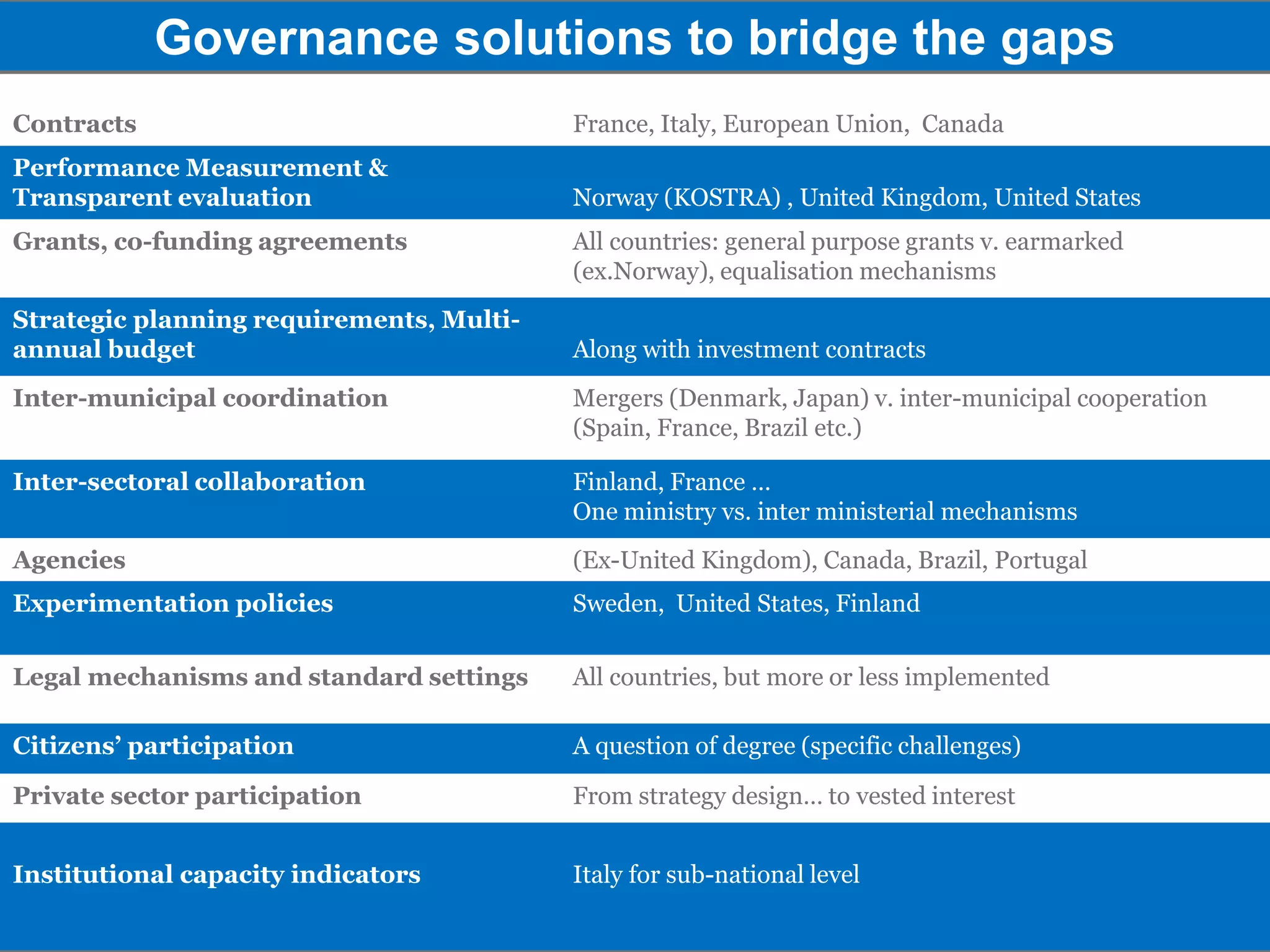
Governance solutions to bridge the gaps
Contracts France, Italy, European Union, Canada
Performance Measurement &
Transparent evaluation Norway (KOSTRA) , United Kingdom, United States
Grants, co-funding agreements All countries: general purpose grants v. earmarked
(ex.Norway), equalisation mechanisms
Strategic planning requirements, Multi-
annual budget Along with investment contracts
Inter-municipal coordination Mergers (Denmark, Japan) v. inter-municipal cooperation
(Spain, France, Brazil etc.)
Inter-sectoral collaboration Finland, France …
One ministry vs. inter ministerial mechanisms
Agencies (Ex-United Kingdom), Canada, Brazil, Portugal
Experimentation policies Sweden, United States, Finland
Legal mechanisms and standard settings All countries, but more or less implemented
Citizens’ participation A question of degree (specific challenges)
Private sector participation From strategy design… to vested interest
Institutional capacity indicators Italy for sub-national level
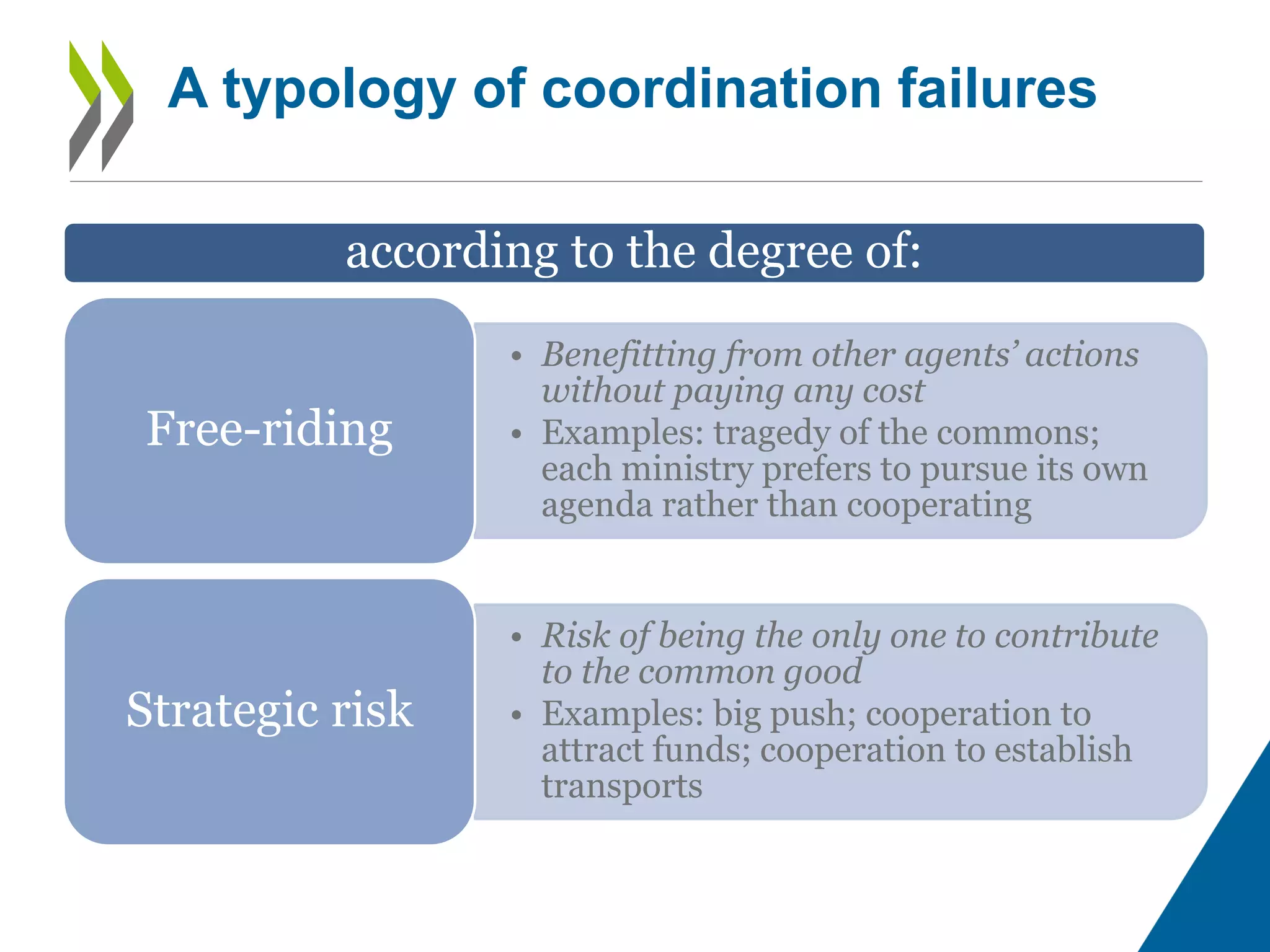
according to the degree of:
• Benefitting from other agents’ actions
without paying any cost
• Examples: tragedy of the commons;
each ministry prefers to pursue its own
agenda rather than cooperating
Free-riding
• Risk of being the only one to contribute
to the common good
• Examples: big push; cooperation to
attract funds; cooperation to establish
transports
Strategic risk
A typology of coordination failures
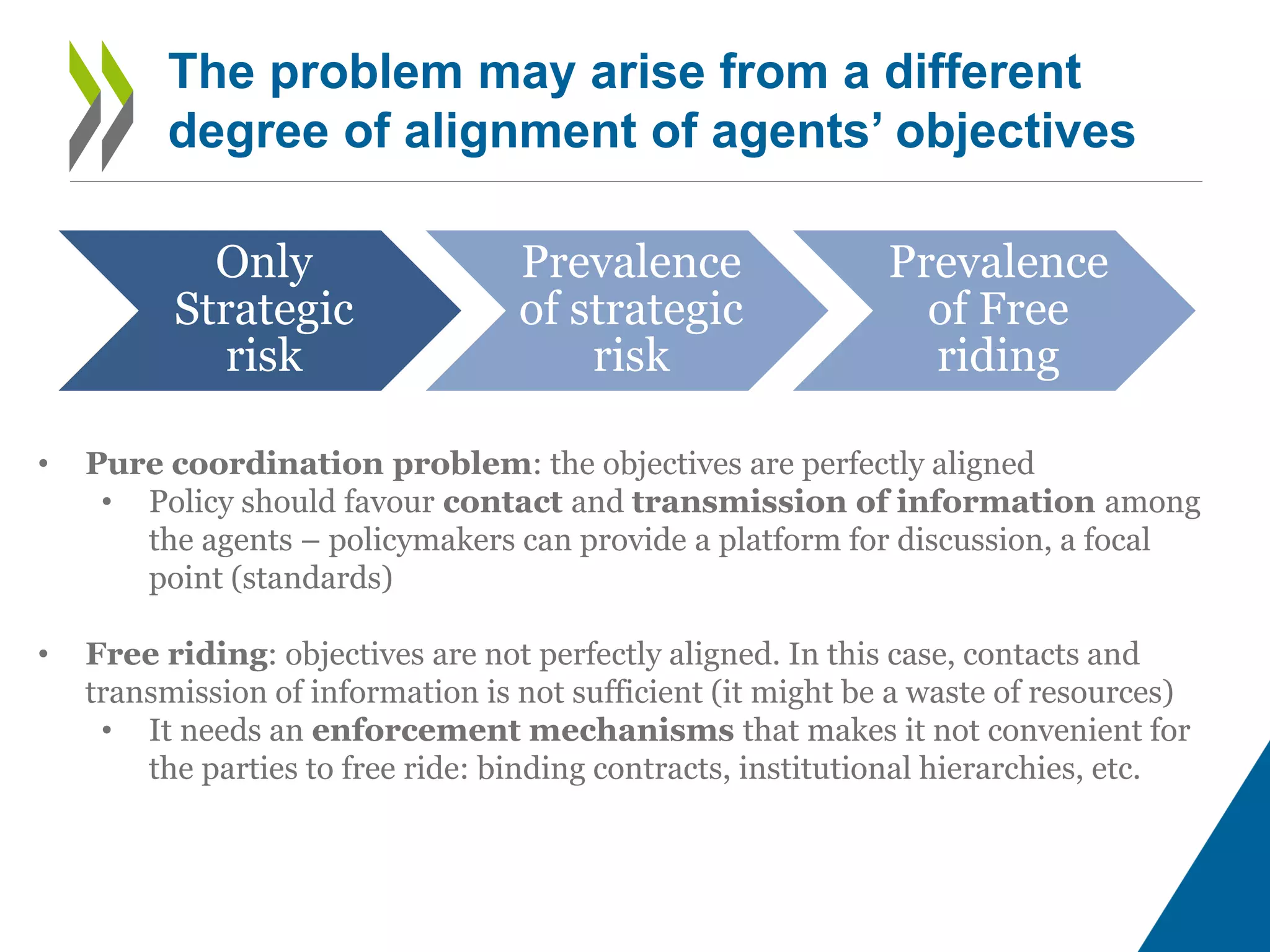
Only
Strategic
risk
Prevalence
of strategic
risk
Prevalence
of Free
riding
The problem may arise from a different
degree of alignment of agents’ objectives
• Pure coordination problem: the objectives are perfectly aligned
• Policy should favour contact and transmission of information among
the agents – policymakers can provide a platform for discussion, a focal
point (standards)
• Free riding: objectives are not perfectly aligned. In this case, contacts and
transmission of information is not sufficient (it might be a waste of resources)
• It needs an enforcement mechanisms that makes it not convenient for
the parties to free ride: binding contracts, institutional hierarchies, etc.
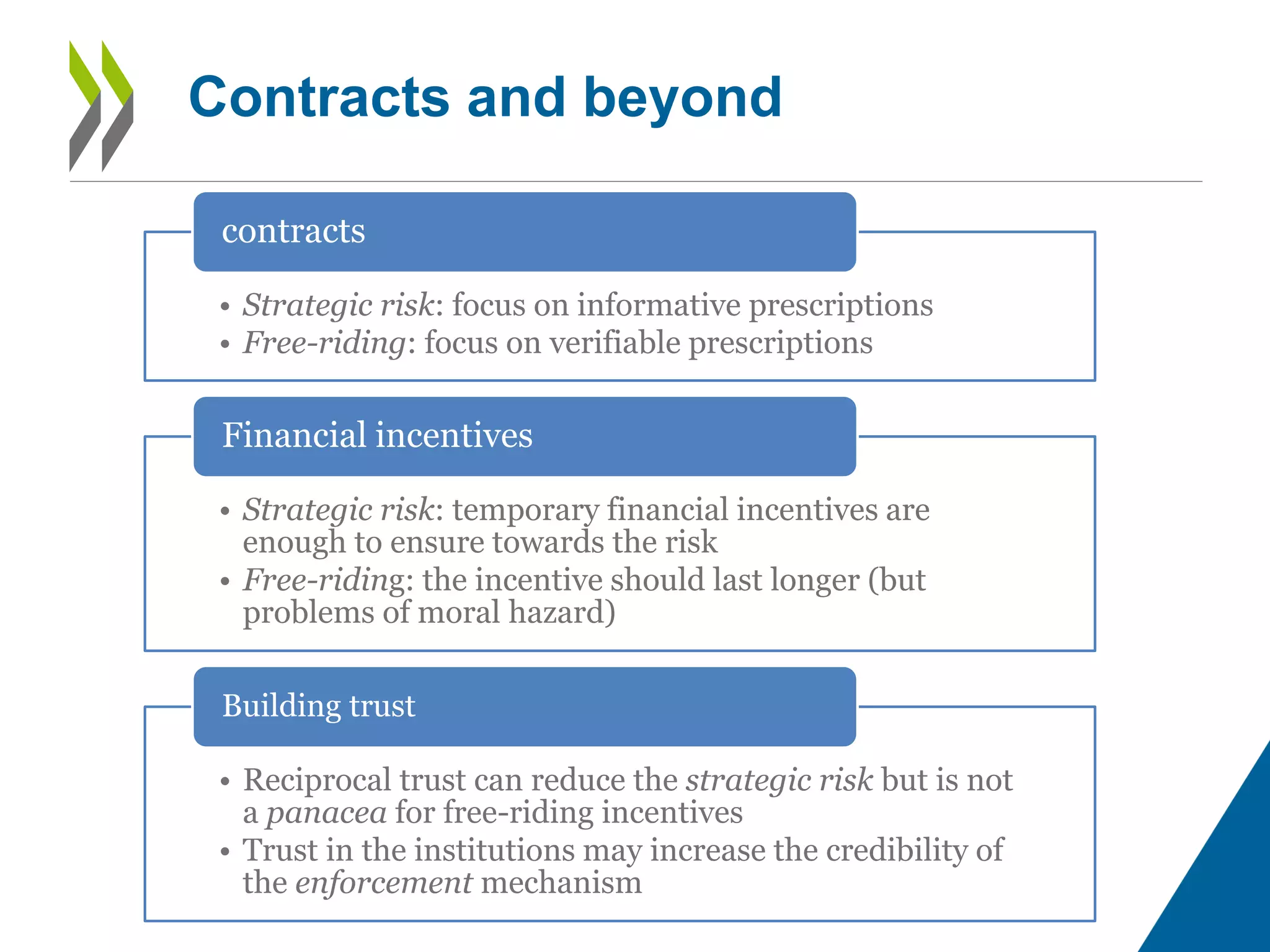
Contracts and beyond
• Strategic risk: focus on informative prescriptions
• Free-riding: focus on verifiable prescriptions
contracts
• Strategic risk: temporary financial incentives are
enough to ensure towards the risk
• Free-riding: the incentive should last longer (but
problems of moral hazard)
Financial incentives
• Reciprocal trust can reduce the strategic risk but is not
a panacea for free-riding incentives
• Trust in the institutions may increase the credibility of
the enforcement mechanism
Building trust
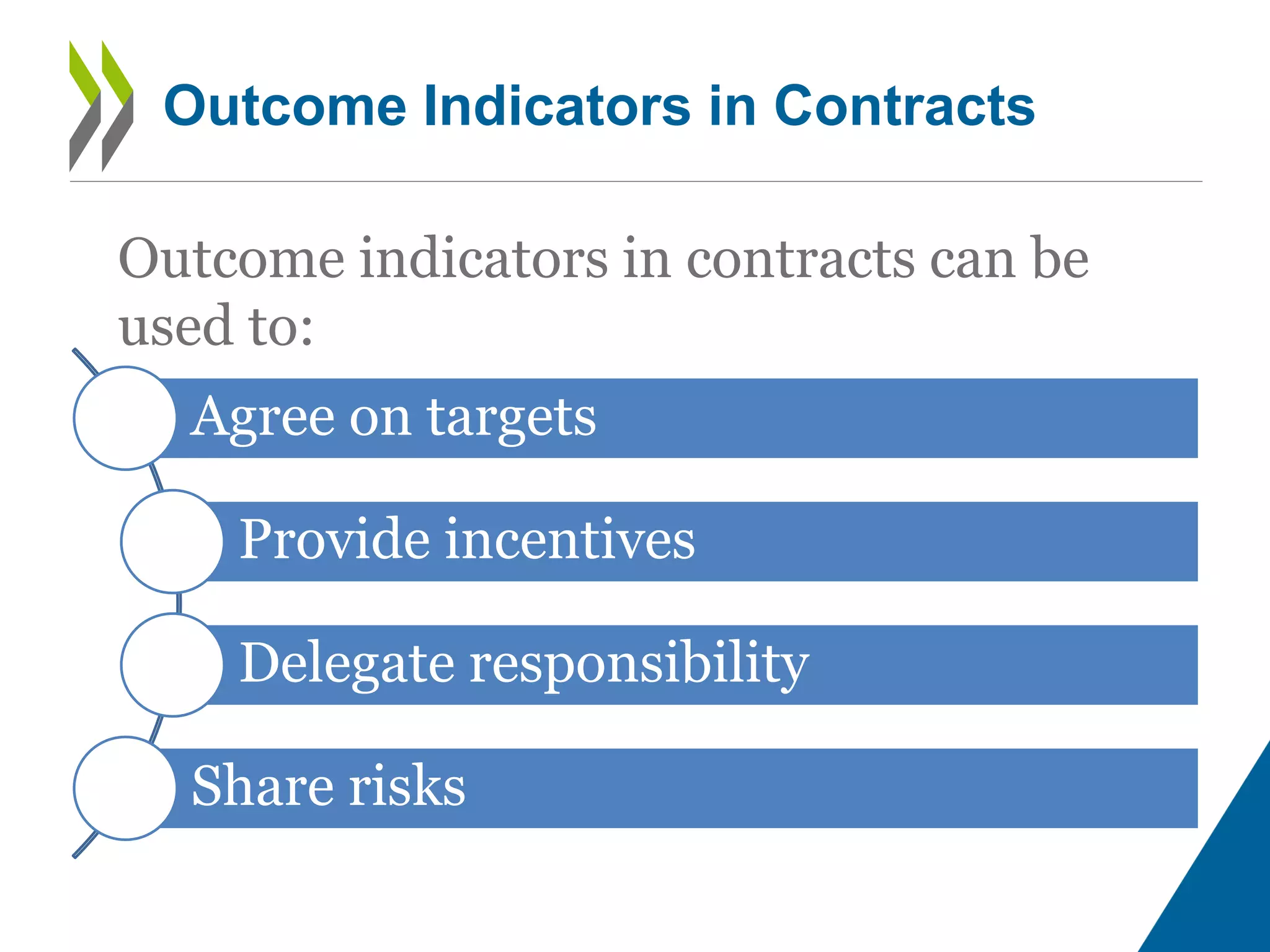
Agree on targets
Provide incentives
Delegate responsibility
Share risks
Outcome Indicators in Contracts
Outcome indicators in contracts can be
used to:
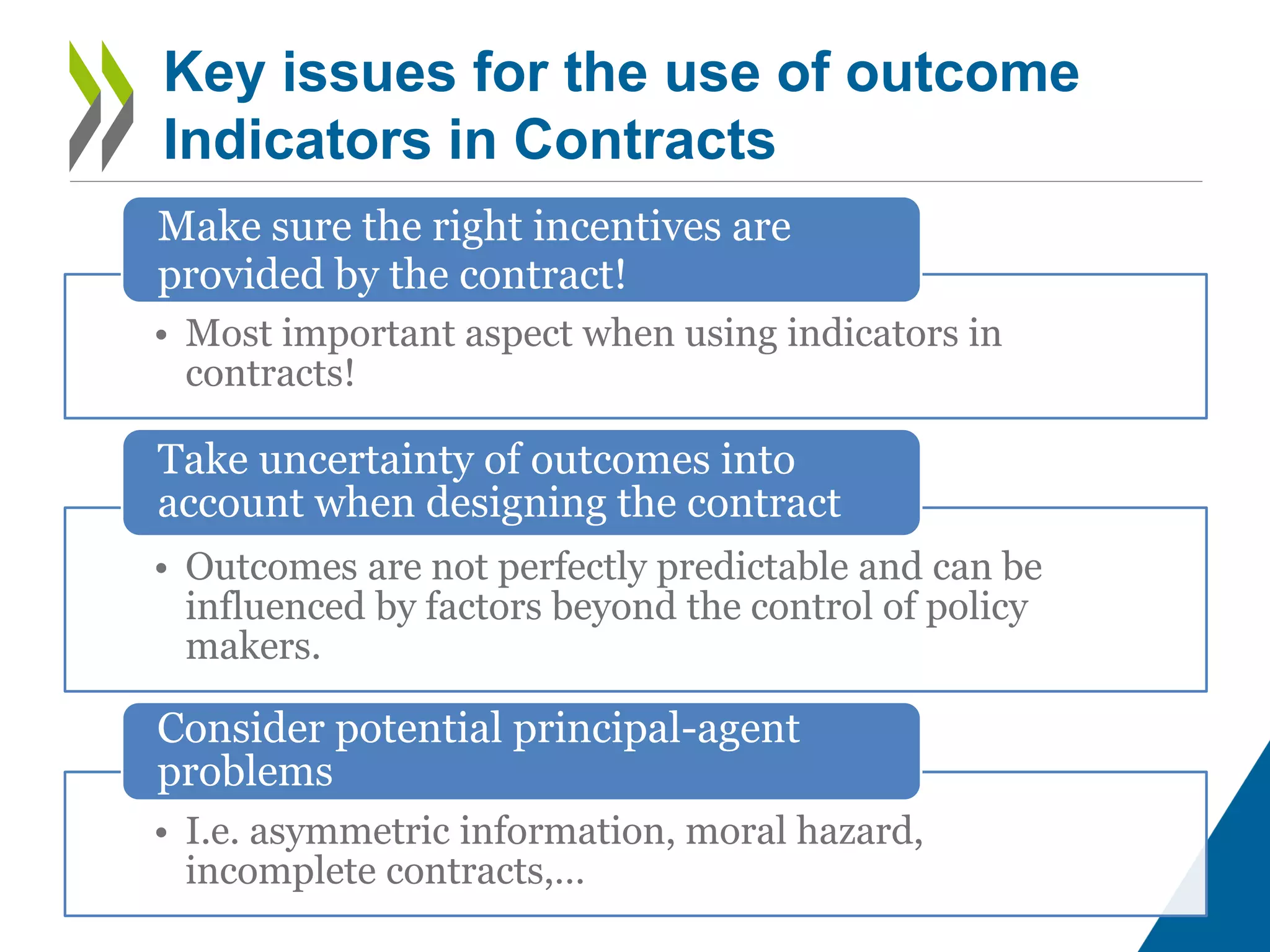
• Most important aspect when using indicators in
contracts!
Make sure the right incentives are
provided by the contract!
• Outcomes are not perfectly predictable and can be
influenced by factors beyond the control of policy
makers.
Take uncertainty of outcomes into
account when designing the contract
• I.e. asymmetric information, moral hazard,
incomplete contracts,…
Consider potential principal-agent
problems
Key issues for the use of outcome
Indicators in Contracts
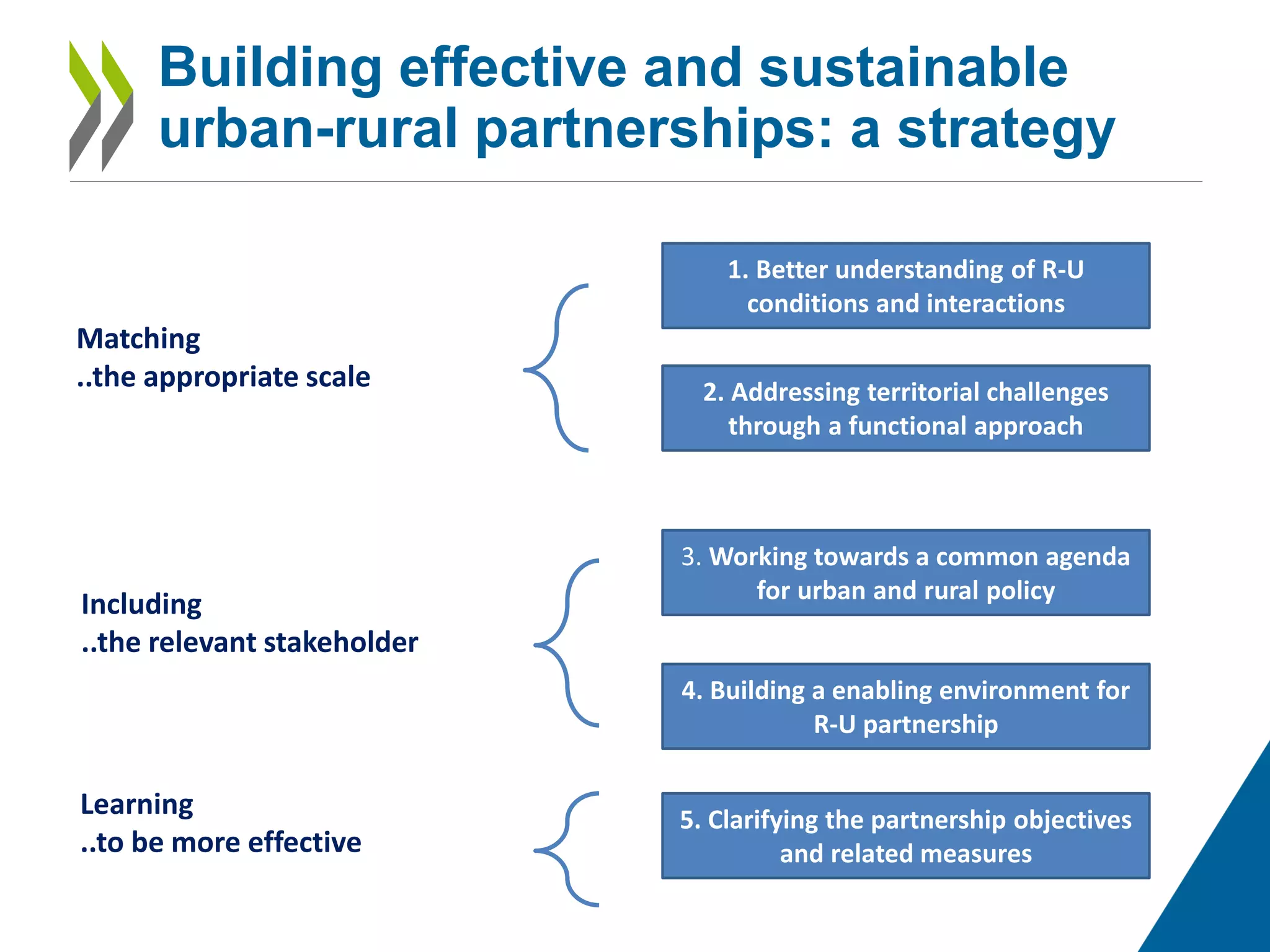
Building effective and sustainable
urban-rural partnerships: a strategy
Matching
..the appropriate scale
Including
..the relevant stakeholder
Learning
..to be more effective
1. Better understanding of R-U
conditions and interactions
2. Addressing territorial challenges
through a functional approach
3. Working towards a common agenda
for urban and rural policy
4. Building a enabling environment for
R-U partnership
5. Clarifying the partnership objectives
and related measures
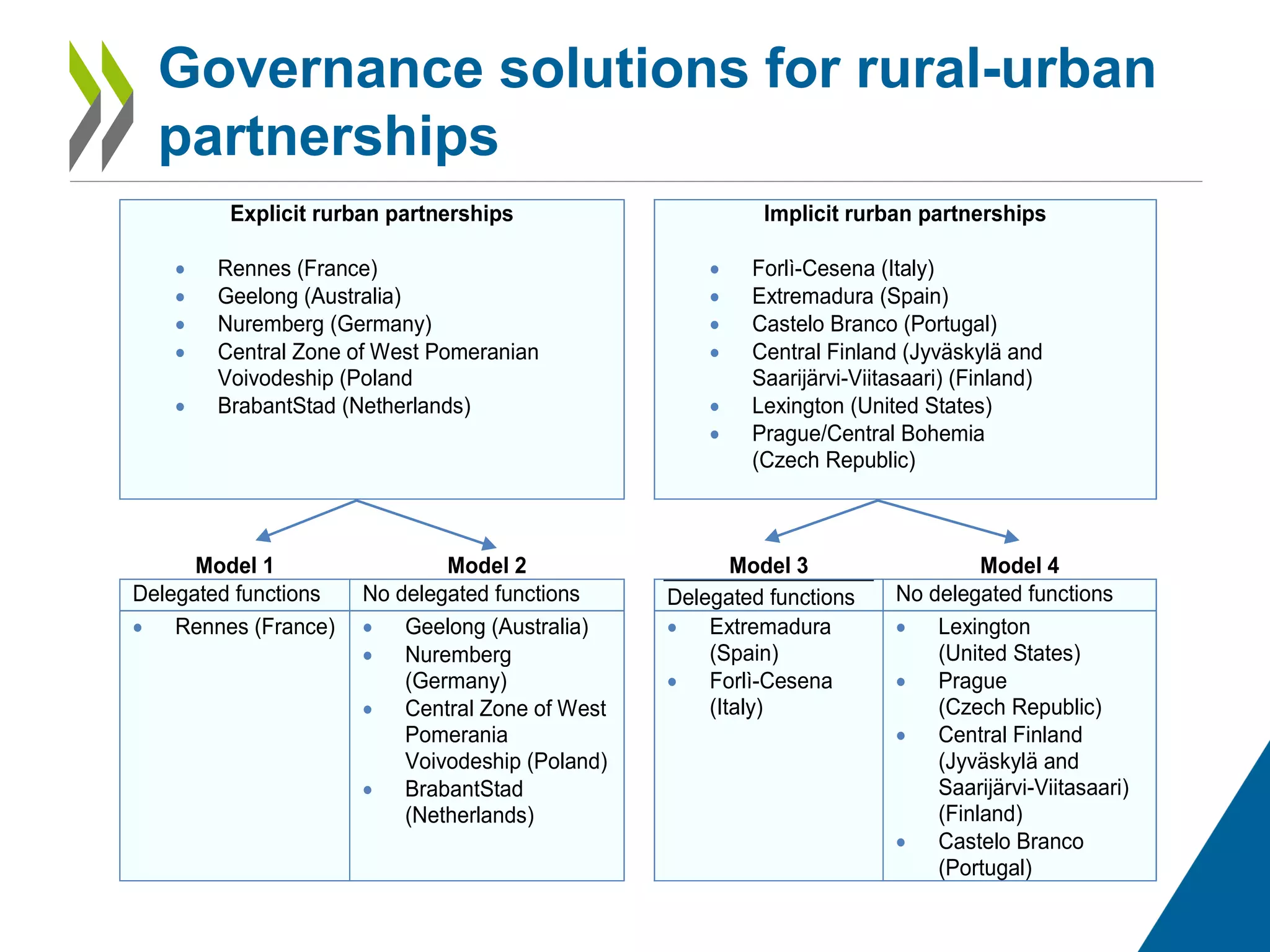
Governance solutions for rural-urban
partnerships
Explicit rurban partnerships
 Rennes (France)
 Geelong (Australia)
 Nuremberg (Germany)
 Central Zone of West Pomeranian
Voivodeship (Poland
 BrabantStad (Netherlands)
Implicit rurban partnerships
 Forlì-Cesena (Italy)
 Extremadura (Spain)
 Castelo Branco (Portugal)
 Central Finland (Jyväskylä and
Saarijärvi-Viitasaari) (Finland)
 Lexington (United States)
 Prague/Central Bohemia
(Czech Republic)
Model 1 Model 2 Model 3 Model 4
Delegated functions No delegated functions Delegated functions No delegated functions
 Rennes (France)  Geelong (Australia)
 Nuremberg
(Germany)
 Central Zone of West
Pomerania
Voivodeship (Poland)
 BrabantStad
(Netherlands)
 Extremadura
(Spain)
 Forlì-Cesena
(Italy)
 Lexington
(United States)
 Prague
(Czech Republic)
 Central Finland
(Jyväskylä and
Saarijärvi-Viitasaari)
(Finland)
 Castelo Branco
(Portugal)
13
Cross-border cooperation: the
case of innovation
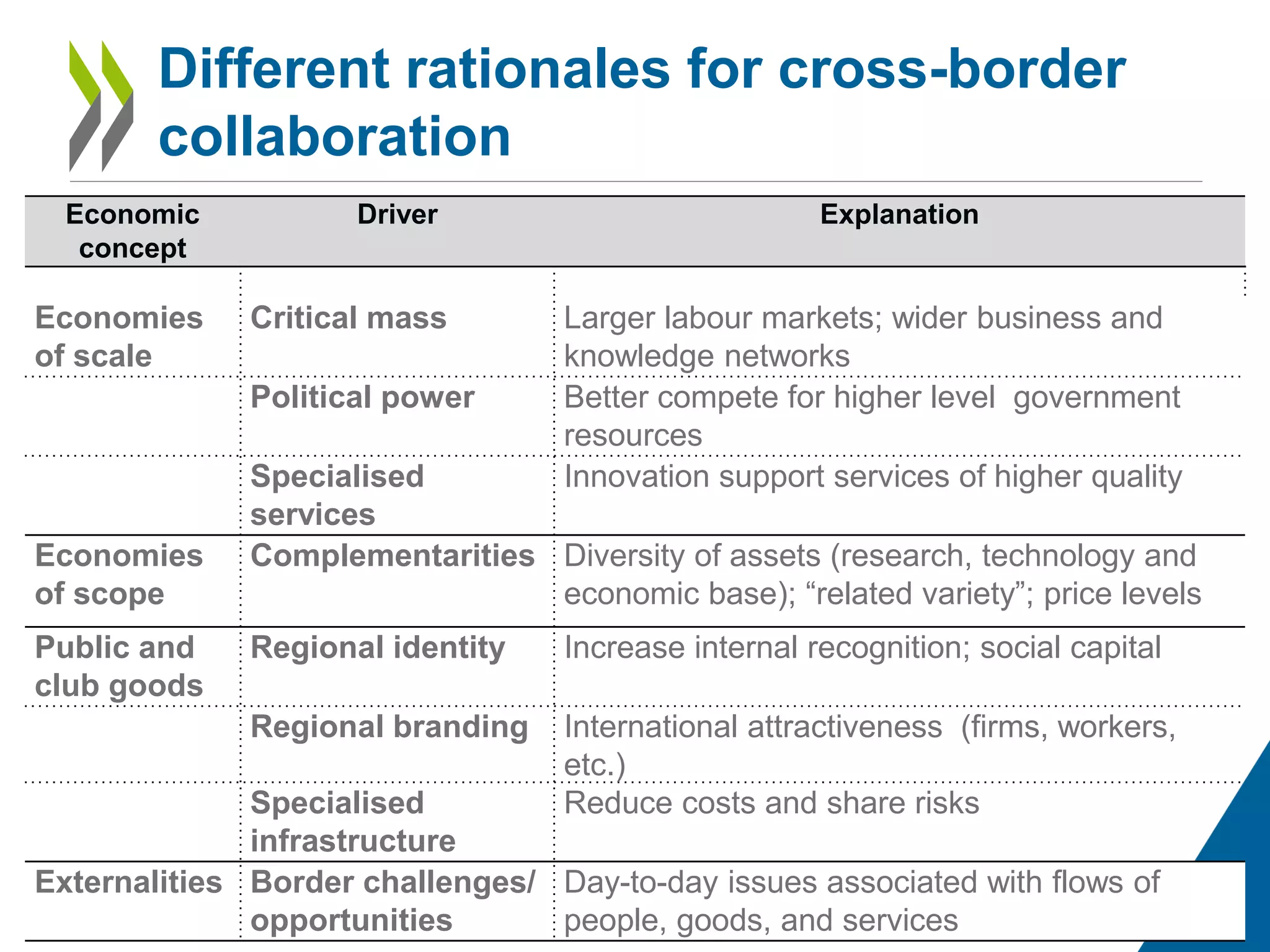
Different rationales for cross-border
collaboration
Economic
concept
Driver Explanation
Economies
of scale
Critical mass Larger labour markets; wider business and
knowledge networks
Political power Better compete for higher level government
resources
Specialised
services
Innovation support services of higher quality
Economies
of scope
Complementarities Diversity of assets (research, technology and
economic base); “related variety”; price levels
Public and
club goods
Regional identity Increase internal recognition; social capital
Regional branding International attractiveness (firms, workers,
etc.)
Specialised
infrastructure
Reduce costs and share risks
Externalities Border challenges/
opportunities
Day-to-day issues associated with flows of
people, goods, and services
14
15
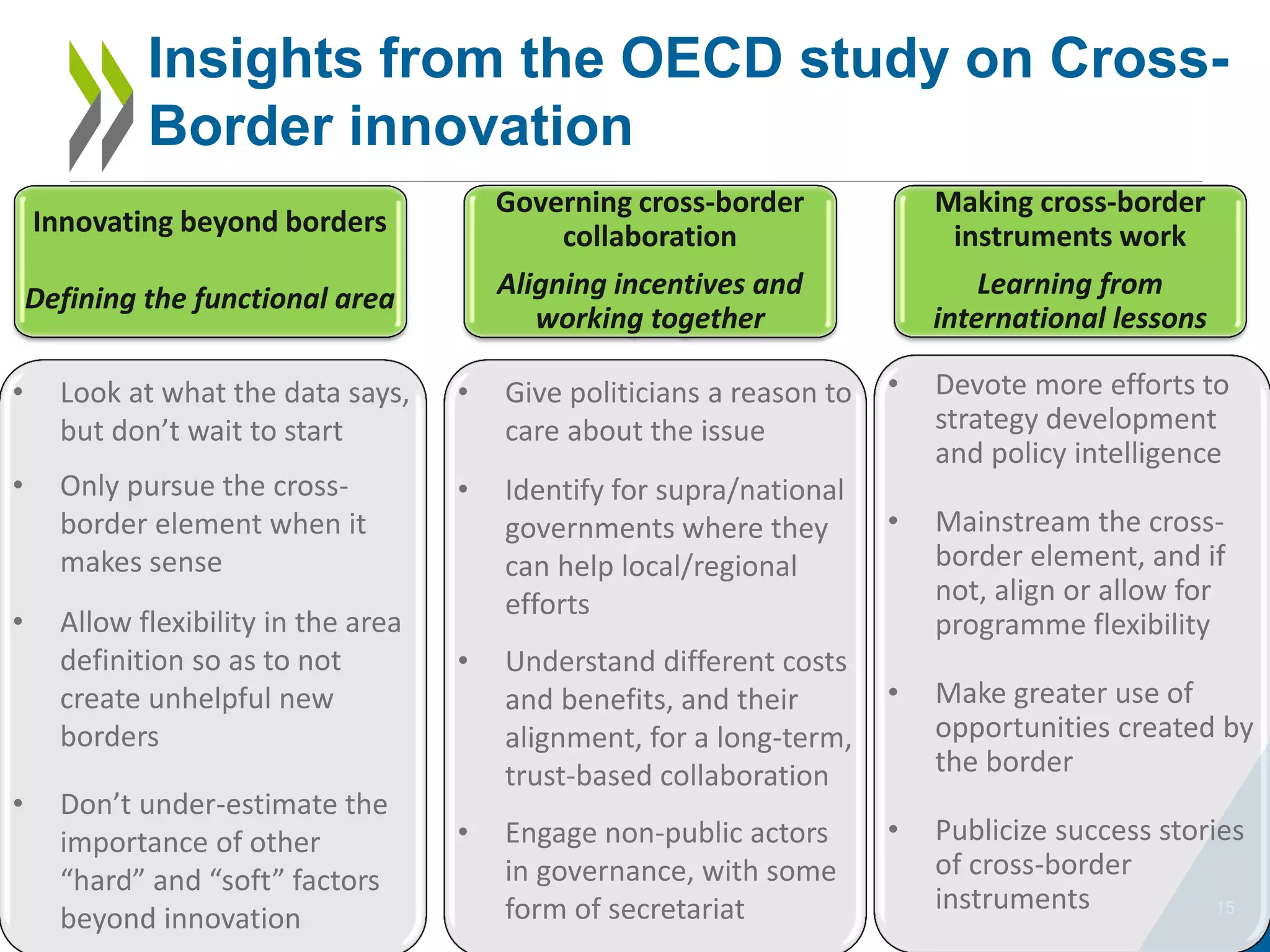
Innovating beyond borders
Defining the functional area
• Devote more efforts to
strategy development
and policy intelligence
• Mainstream the cross-
border element, and if
not, align or allow for
programme flexibility
• Make greater use of
opportunities created by
the border
• Publicize success stories
of cross-border
instruments
Governing cross-border
collaboration
Aligning incentives and
working together
Making cross-border
instruments work
Learning from
international lessons
• Look at what the data says,
but don’t wait to start
• Only pursue the cross-
border element when it
makes sense
• Allow flexibility in the area
definition so as to not
create unhelpful new
borders
• Don’t under-estimate the
importance of other
“hard” and “soft” factors
beyond innovation
• Give politicians a reason to
care about the issue
• Identify for supra/national
governments where they
can help local/regional
efforts
• Understand different costs
and benefits, and their
alignment, for a long-term,
trust-based collaboration
• Engage non-public actors
in governance, with some
form of secretariat
Insights from the OECD study on Cross-
Border innovation
16
Gains from improved
Governance: the case of metro
areas
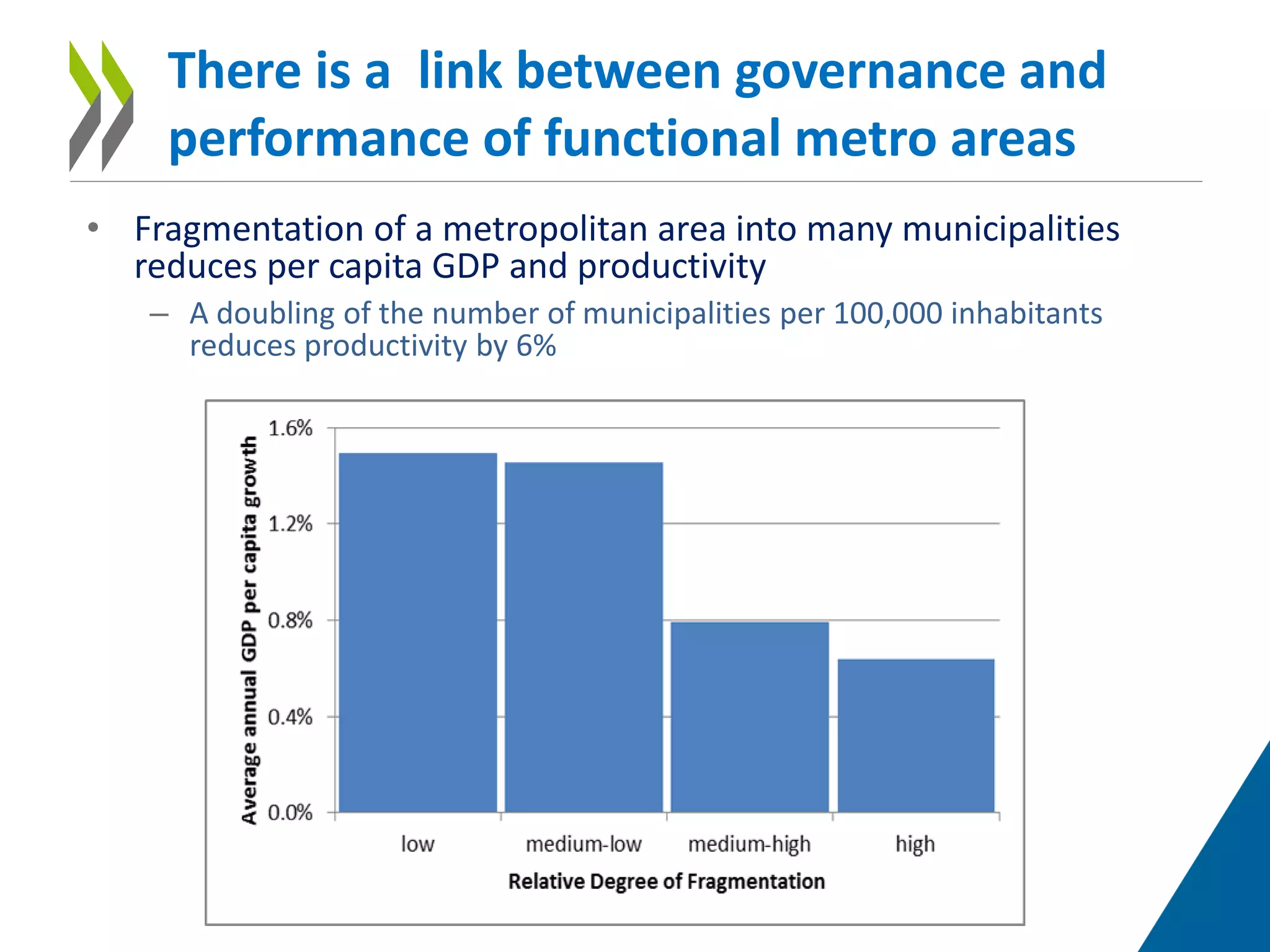
• Fragmentation of a metropolitan area into many municipalities
reduces per capita GDP and productivity
– A doubling of the number of municipalities per 100,000 inhabitants
reduces productivity by 6%
There is a link between governance and
performance of functional metro areas
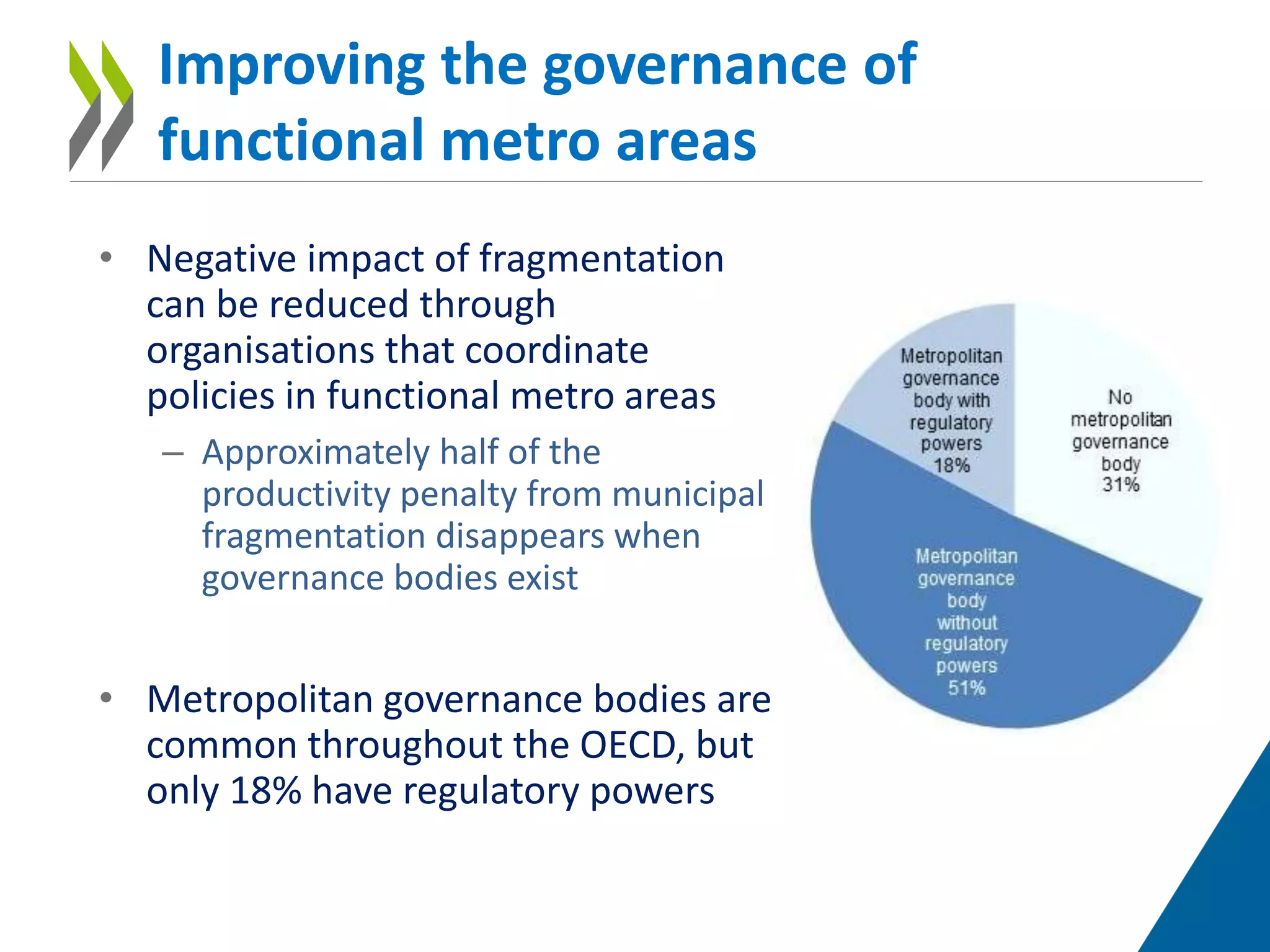
• Negative impact of fragmentation
can be reduced through
organisations that coordinate
policies in functional metro areas
– Approximately half of the
productivity penalty from municipal
fragmentation disappears when
governance bodies exist
• Metropolitan governance bodies are
common throughout the OECD, but
only 18% have regulatory powers
Improving the governance of
functional metro areas
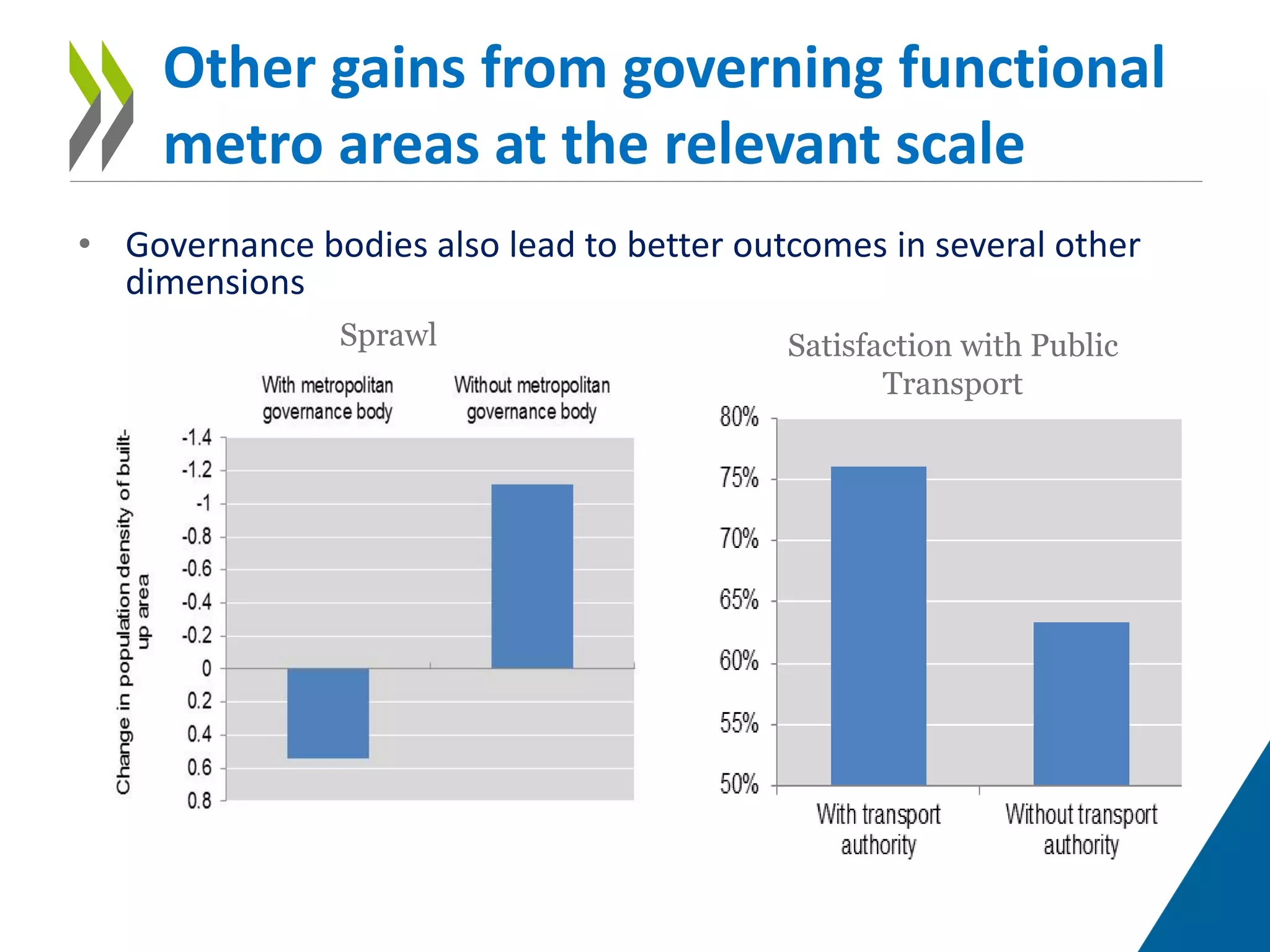
• Governance bodies also lead to better outcomes in several other
dimensions
Other gains from governing functional
metro areas at the relevant scale
Sprawl Satisfaction with Public
Transport
20
Improving the governance of
Public Investment
21
Governance challenges of Public Investment
are typically under-estimated
 No straightforward link between interest rates and
investment – many parameters come into play: fiscal rules,
trust, currently “wait & see” mode, regulatory challenges
that hinder investment
 Public investment is intrinsically a very fragmented
activity done essentially by SNGs (mostly municipalities)
 Thus, greater focus on governance is needed (not just
financing)
 Investment challenges go well beyond the financing dimension of
investment
 Not a problem of supply of capital, but a problem on the demand
side
 Under-estimation of governance challenges and capacity, notably
at the sub-national level
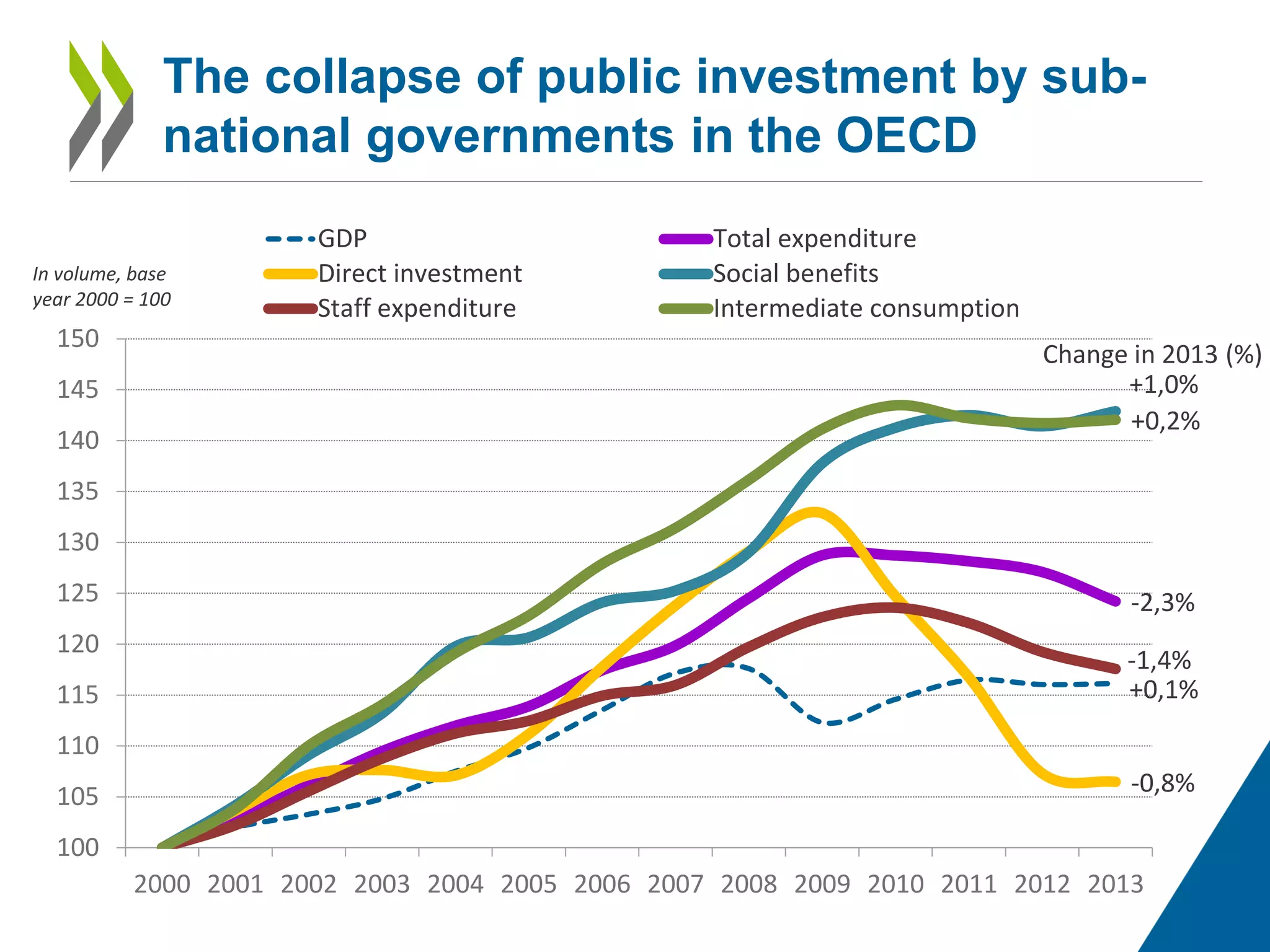
The collapse of public investment by sub-
national governments in the OECD
In volume, base
year 2000 = 100
Change in 2013 (%)
+0,1%
-2,3%
-0,8%
+1,0%
-1,4%
+0,2%
100
105
110
115
120
125
130
135
140
145
150
2000 2001 2002 2003 2004 2005 2006 2007 2008 2009 2010 2011 2012 2013
GDP Total expenditure
Direct investment Social benefits
Staff expenditure Intermediate consumption
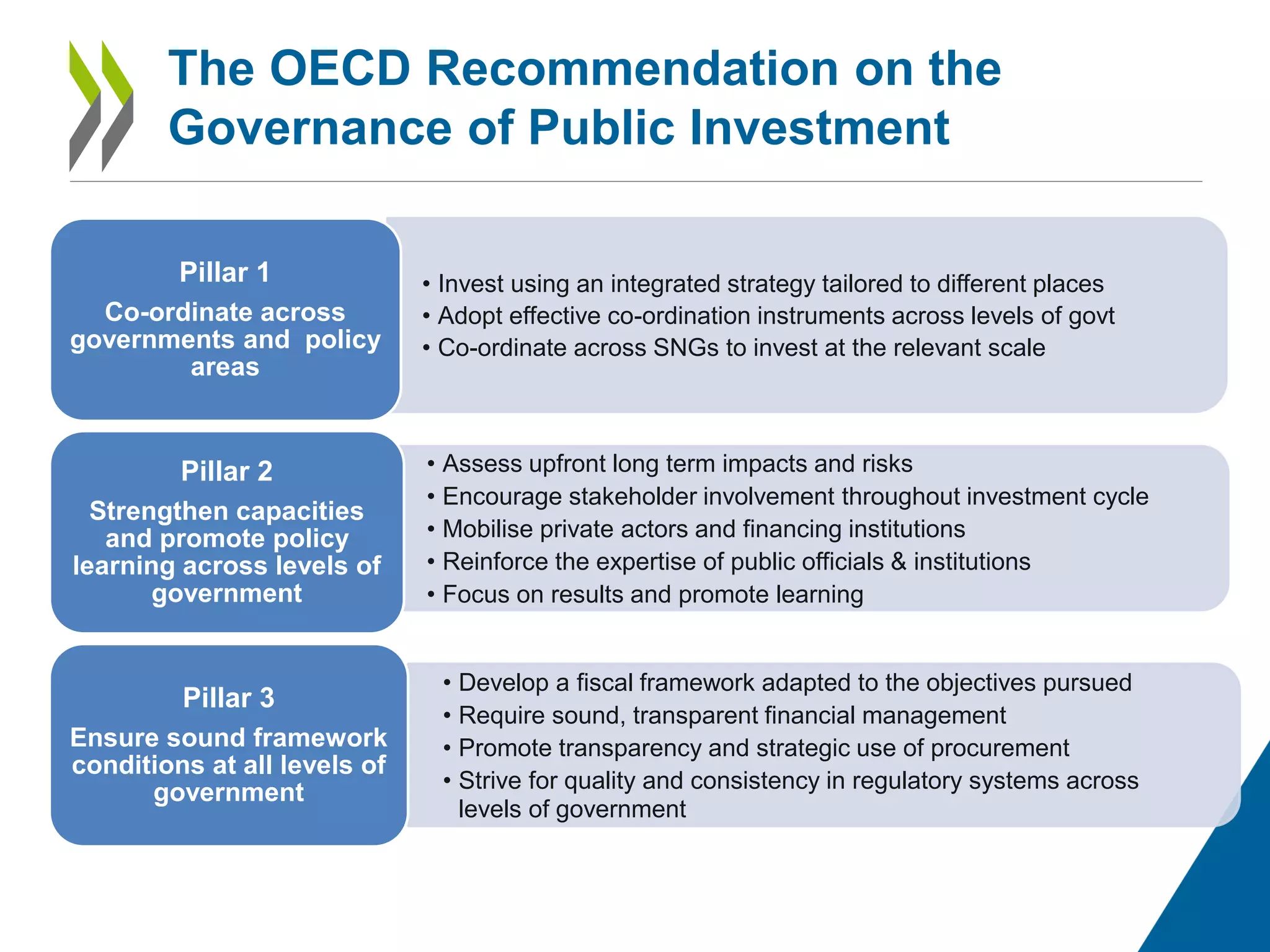
• Invest using an integrated strategy tailored to different places
• Adopt effective co-ordination instruments across levels of govt
• Co-ordinate across SNGs to invest at the relevant scale
Pillar 1
Co-ordinate across
governments and policy
areas
• Assess upfront long term impacts and risks
• Encourage stakeholder involvement throughout investment cycle
• Mobilise private actors and financing institutions
• Reinforce the expertise of public officials & institutions
• Focus on results and promote learning
Pillar 2
Strengthen capacities
and promote policy
learning across levels of
government
• Develop a fiscal framework adapted to the objectives pursued
• Require sound, transparent financial management
• Promote transparency and strategic use of procurement
• Strive for quality and consistency in regulatory systems across
levels of government
Pillar 3
Ensure sound framework
conditions at all levels of
government
The OECD Recommendation on the
Governance of Public Investment
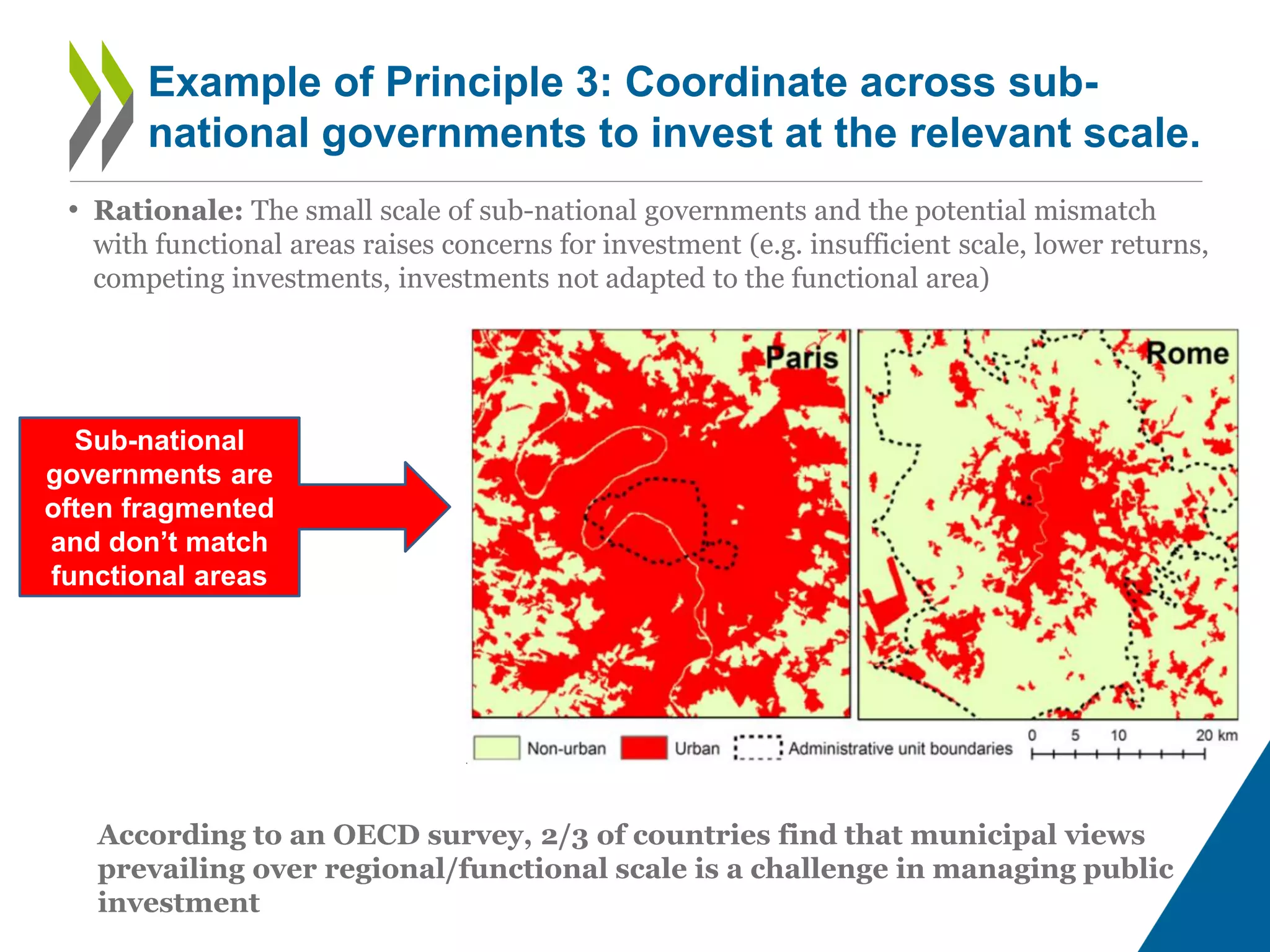
Sub-national
governments are
often fragmented
and don’t match
functional areas
Example of Principle 3: Coordinate across sub-
national governments to invest at the relevant scale.
• Rationale: The small scale of sub-national governments and the potential mismatch
with functional areas raises concerns for investment (e.g. insufficient scale, lower returns,
competing investments, investments not adapted to the functional area)
According to an OECD survey, 2/3 of countries find that municipal views
prevailing over regional/functional scale is a challenge in managing public
investment
25
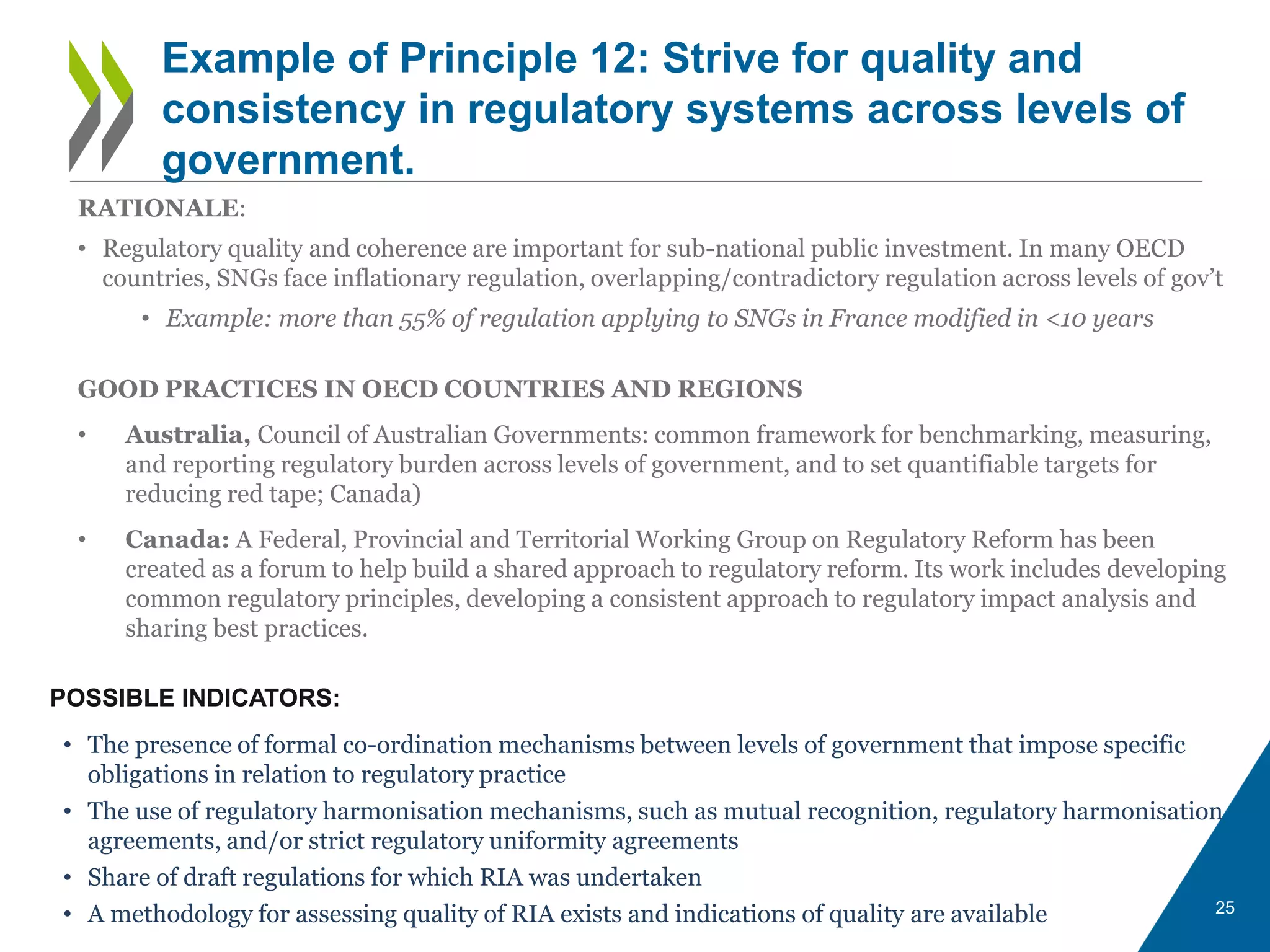
Example of Principle 12: Strive for quality and
consistency in regulatory systems across levels of
government.
POSSIBLE INDICATORS:
• The presence of formal co-ordination mechanisms between levels of government that impose specific
obligations in relation to regulatory practice
• The use of regulatory harmonisation mechanisms, such as mutual recognition, regulatory harmonisation
agreements, and/or strict regulatory uniformity agreements
• Share of draft regulations for which RIA was undertaken
• A methodology for assessing quality of RIA exists and indications of quality are available
RATIONALE:
• Regulatory quality and coherence are important for sub-national public investment. In many OECD
countries, SNGs face inflationary regulation, overlapping/contradictory regulation across levels of gov’t
• Example: more than 55% of regulation applying to SNGs in France modified in <10 years
GOOD PRACTICES IN OECD COUNTRIES AND REGIONS
• Australia, Council of Australian Governments: common framework for benchmarking, measuring,
and reporting regulatory burden across levels of government, and to set quantifiable targets for
reducing red tape; Canada)
• Canada: A Federal, Provincial and Territorial Working Group on Regulatory Reform has been
created as a forum to help build a shared approach to regulatory reform. Its work includes developing
common regulatory principles, developing a consistent approach to regulatory impact analysis and
sharing best practices.
26
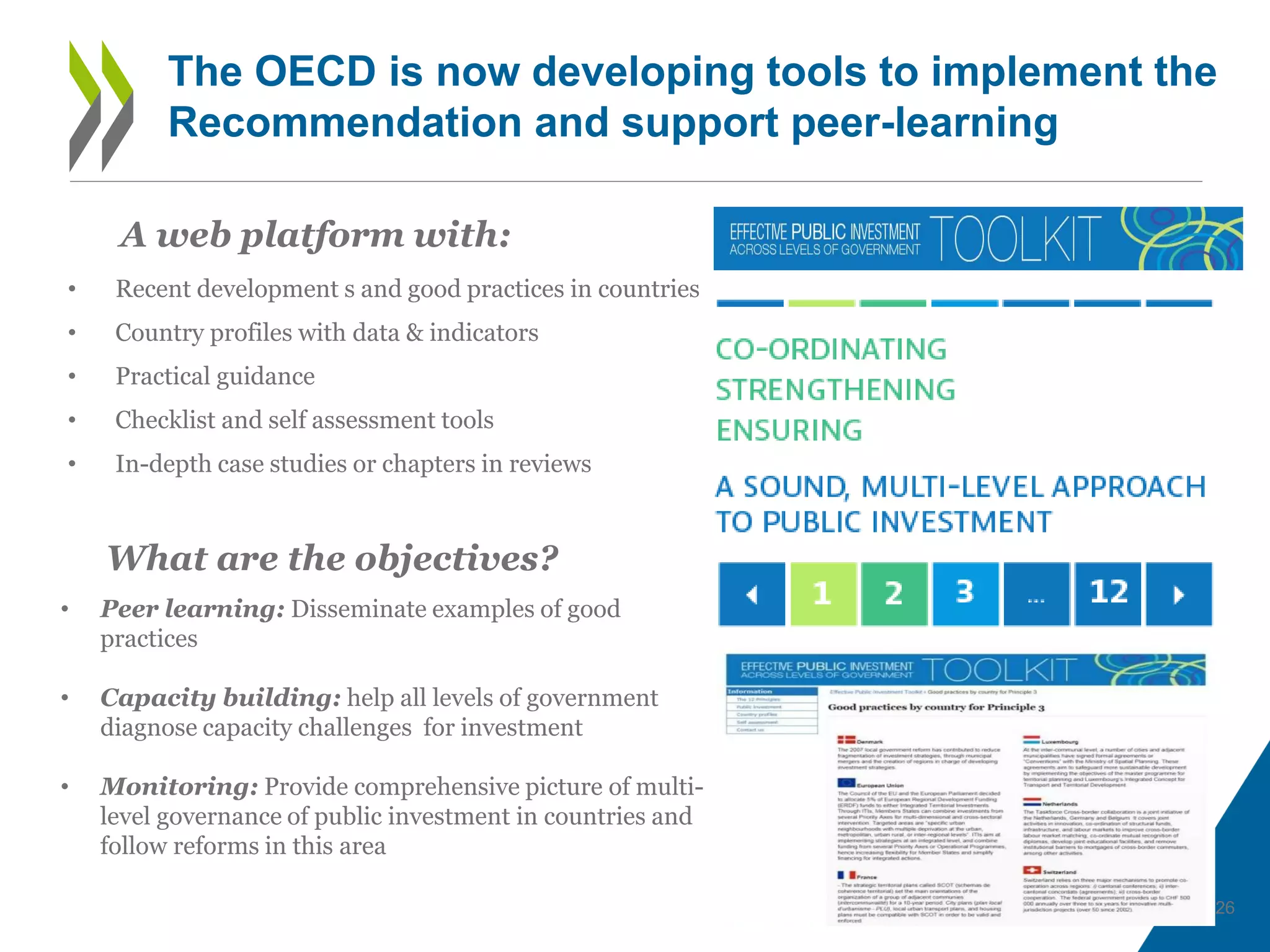
The OECD is now developing tools to implement the
Recommendation and support peer-learning
• Recent development s and good practices in countries
• Country profiles with data & indicators
• Practical guidance
• Checklist and self assessment tools
• In-depth case studies or chapters in reviews
• Peer learning: Disseminate examples of good
practices
• Capacity building: help all levels of government
diagnose capacity challenges for investment
• Monitoring: Provide comprehensive picture of multi-
level governance of public investment in countries and
follow reforms in this area
A web platform with:
What are the objectives?
27
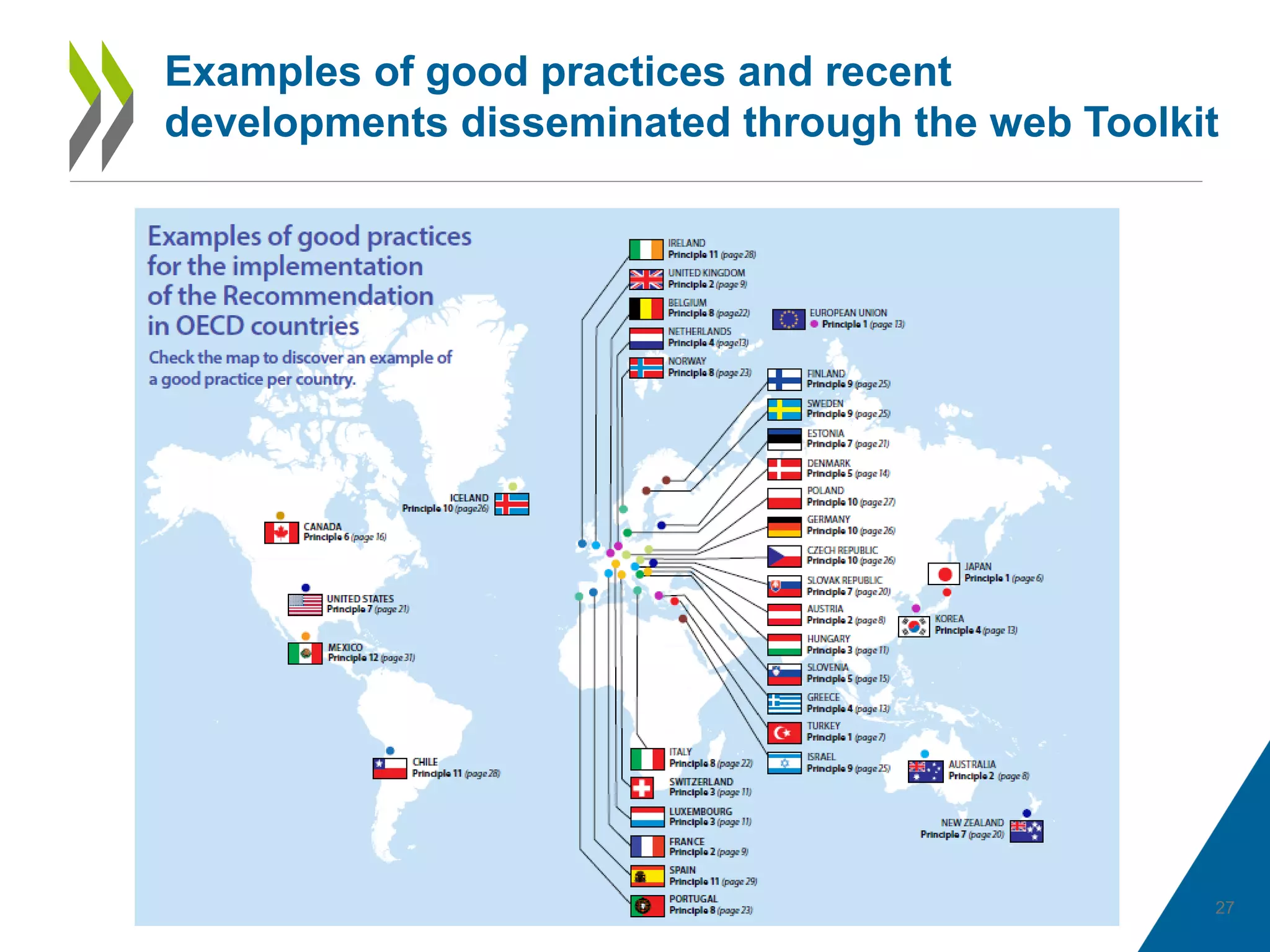
Examples of good practices and recent
developments disseminated through the web Toolkit
28
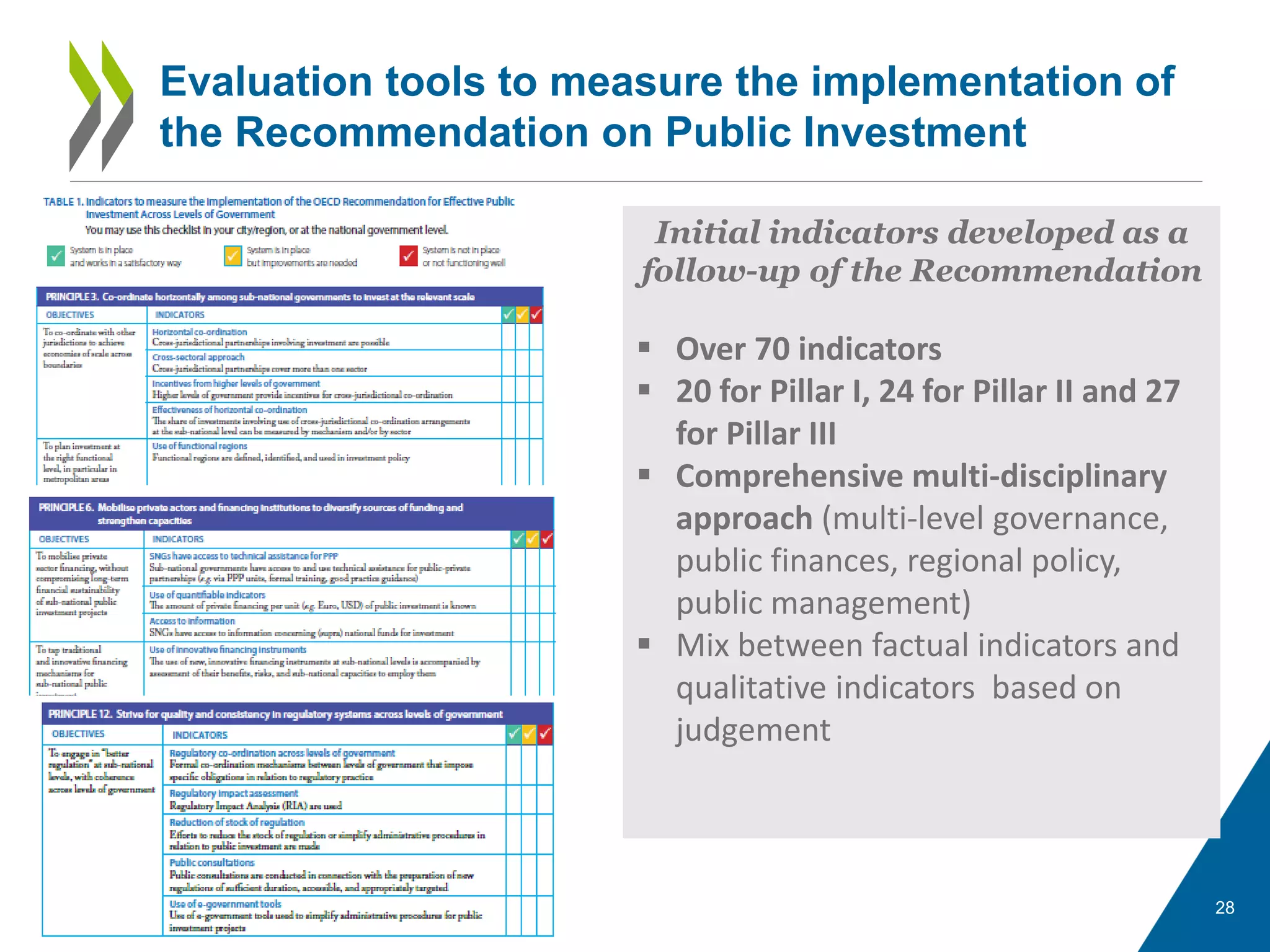
Evaluation tools to measure the implementation of
the Recommendation on Public Investment
Initial indicators developed as a
follow-up of the Recommendation
 Over 70 indicators
 20 for Pillar I, 24 for Pillar II and 27
for Pillar III
 Comprehensive multi-disciplinary
approach (multi-level governance,
public finances, regional policy,
public management)
 Mix between factual indicators and
qualitative indicators based on
judgement
29
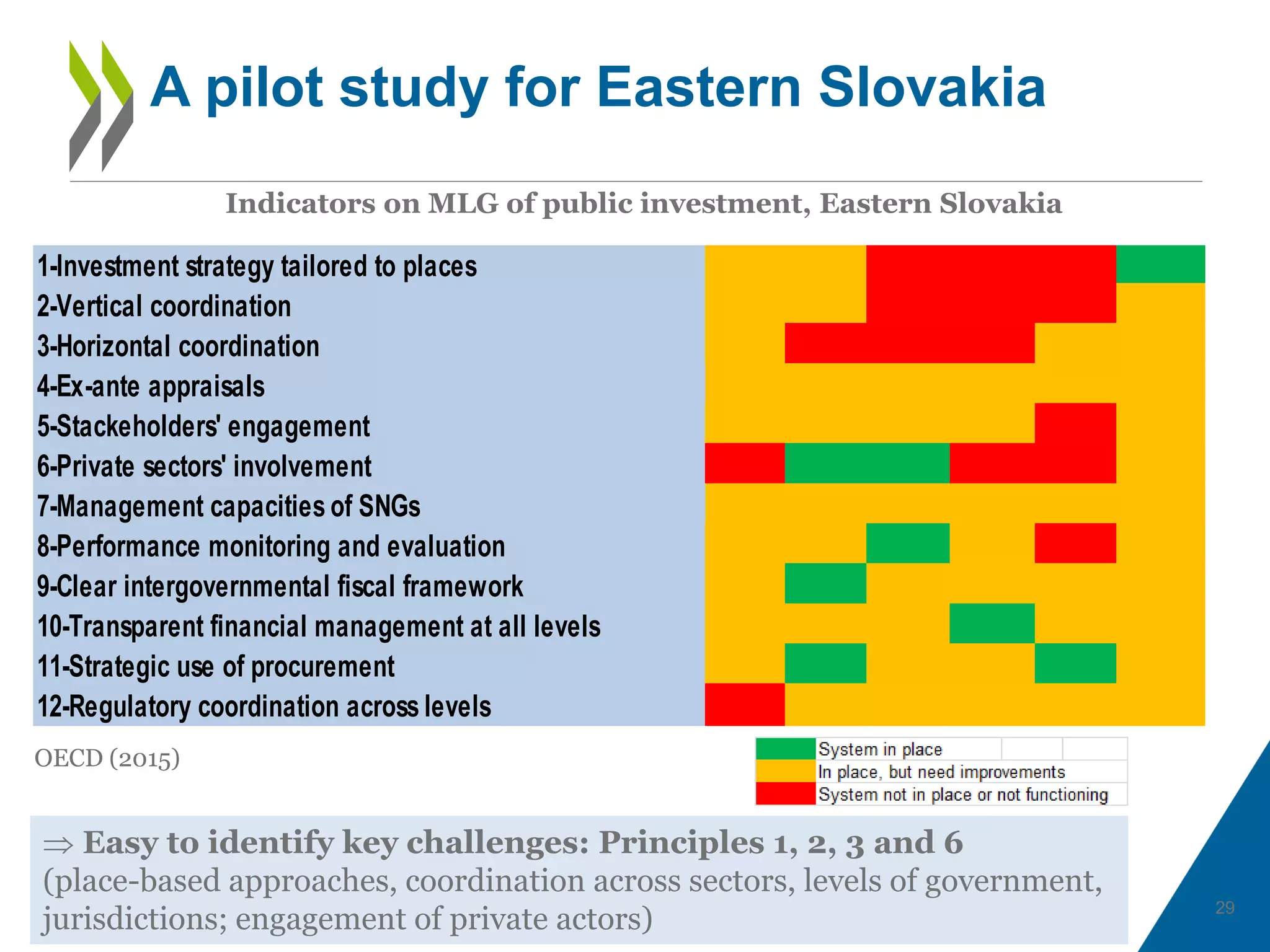
A pilot study for Eastern Slovakia
Indicators on MLG of public investment, Eastern Slovakia
OECD (2015)
 Easy to identify key challenges: Principles 1, 2, 3 and 6
(place-based approaches, coordination across sectors, levels of government,
jurisdictions; engagement of private actors)
1-Investment strategy tailored to places
2-Vertical coordination
3-Horizontal coordination
4-Ex-ante appraisals
5-Stackeholders' engagement
6-Private sectors' involvement
7-Management capacities of SNGs
8-Performance monitoring and evaluation
9-Clear intergovernmental fiscal framework
10-Transparent financial management at all levels
11-Strategic use of procurement
12-Regulatory coordination across levels
30
Thank you!
Joaquim.Oliveira@oecd.org
www.oecd.org/gov/regionaldevelopment
http://www.oecd.org/gov/regional-policy/oecd-principles-
on-effective-public-investment.htm

Implementing regional-policies-effectively

  • 1.
    IMPLEMENTING REGIONAL POLICIES EFFECTIVELY MULTI-LEVELGOVERNANCE ISSUES Joaquim Oliveira Martins, Head, Regional development Policy Division Meeting of the High-Level Group of Macro-regional Strategies 3 June 2015,
  • 2.
    Central Government Ministerial Departments Sub-nationalGovernments Inter Governmental Council (ex. COAG, Australia) Regional Agencies (ex. Canada, Brazil) Contracts (ex. France) Special Commission (Delta, Netherlands) Whatever the type of system – federal, regionalised, unitary – there is a strong need of coordination across levels of government Wide range of governance mechanisms for multi-level coordination Conditionalities ( ex. EU programming)
  • 3.
    3 The blockages of coordination/cooperationand their governance solutions
  • 4.
    A Tool ofDiagnosis: Governance gaps Administrative gap “Mismatch” between functional areas and administrative boundaries => Need for instruments for reaching “effective size” Information gap Asymmetries of information (quantity, quality, type) between different stakeholders, either voluntary or not => Need for instruments for revealing & sharing information Policy gap Sectoral fragmentation across ministries and agencies => Need for mechanisms to create multidimensional/systemic approaches, and to exercise political leadership and commitment. Capacity gap Insufficient scientific, technical, infrastructural capacity of local actors => Need for instruments to build capacity Funding gap Unstable or insufficient revenues undermining effective implementation of responsibilities at subnational level or for crossing policies => Need for shared financing mechanisms Objective gap Different rationalities creating obstacles for adopting convergent targets => Need for instruments to align objectives Accountability gap Difficulty to ensure the transparency and integrity of practices across the different constituencies => Need for institutional quality instruments
  • 5.
    Governance solutions tobridge the gaps Contracts France, Italy, European Union, Canada Performance Measurement & Transparent evaluation Norway (KOSTRA) , United Kingdom, United States Grants, co-funding agreements All countries: general purpose grants v. earmarked (ex.Norway), equalisation mechanisms Strategic planning requirements, Multi- annual budget Along with investment contracts Inter-municipal coordination Mergers (Denmark, Japan) v. inter-municipal cooperation (Spain, France, Brazil etc.) Inter-sectoral collaboration Finland, France … One ministry vs. inter ministerial mechanisms Agencies (Ex-United Kingdom), Canada, Brazil, Portugal Experimentation policies Sweden, United States, Finland Legal mechanisms and standard settings All countries, but more or less implemented Citizens’ participation A question of degree (specific challenges) Private sector participation From strategy design… to vested interest Institutional capacity indicators Italy for sub-national level
  • 6.
    according to thedegree of: • Benefitting from other agents’ actions without paying any cost • Examples: tragedy of the commons; each ministry prefers to pursue its own agenda rather than cooperating Free-riding • Risk of being the only one to contribute to the common good • Examples: big push; cooperation to attract funds; cooperation to establish transports Strategic risk A typology of coordination failures
  • 7.
    Only Strategic risk Prevalence of strategic risk Prevalence of Free riding Theproblem may arise from a different degree of alignment of agents’ objectives • Pure coordination problem: the objectives are perfectly aligned • Policy should favour contact and transmission of information among the agents – policymakers can provide a platform for discussion, a focal point (standards) • Free riding: objectives are not perfectly aligned. In this case, contacts and transmission of information is not sufficient (it might be a waste of resources) • It needs an enforcement mechanisms that makes it not convenient for the parties to free ride: binding contracts, institutional hierarchies, etc.
  • 8.
    Contracts and beyond •Strategic risk: focus on informative prescriptions • Free-riding: focus on verifiable prescriptions contracts • Strategic risk: temporary financial incentives are enough to ensure towards the risk • Free-riding: the incentive should last longer (but problems of moral hazard) Financial incentives • Reciprocal trust can reduce the strategic risk but is not a panacea for free-riding incentives • Trust in the institutions may increase the credibility of the enforcement mechanism Building trust
  • 9.
    Agree on targets Provideincentives Delegate responsibility Share risks Outcome Indicators in Contracts Outcome indicators in contracts can be used to:
  • 10.
    • Most importantaspect when using indicators in contracts! Make sure the right incentives are provided by the contract! • Outcomes are not perfectly predictable and can be influenced by factors beyond the control of policy makers. Take uncertainty of outcomes into account when designing the contract • I.e. asymmetric information, moral hazard, incomplete contracts,… Consider potential principal-agent problems Key issues for the use of outcome Indicators in Contracts
  • 11.
    Building effective andsustainable urban-rural partnerships: a strategy Matching ..the appropriate scale Including ..the relevant stakeholder Learning ..to be more effective 1. Better understanding of R-U conditions and interactions 2. Addressing territorial challenges through a functional approach 3. Working towards a common agenda for urban and rural policy 4. Building a enabling environment for R-U partnership 5. Clarifying the partnership objectives and related measures
  • 12.
    Governance solutions forrural-urban partnerships Explicit rurban partnerships  Rennes (France)  Geelong (Australia)  Nuremberg (Germany)  Central Zone of West Pomeranian Voivodeship (Poland  BrabantStad (Netherlands) Implicit rurban partnerships  Forlì-Cesena (Italy)  Extremadura (Spain)  Castelo Branco (Portugal)  Central Finland (Jyväskylä and Saarijärvi-Viitasaari) (Finland)  Lexington (United States)  Prague/Central Bohemia (Czech Republic) Model 1 Model 2 Model 3 Model 4 Delegated functions No delegated functions Delegated functions No delegated functions  Rennes (France)  Geelong (Australia)  Nuremberg (Germany)  Central Zone of West Pomerania Voivodeship (Poland)  BrabantStad (Netherlands)  Extremadura (Spain)  Forlì-Cesena (Italy)  Lexington (United States)  Prague (Czech Republic)  Central Finland (Jyväskylä and Saarijärvi-Viitasaari) (Finland)  Castelo Branco (Portugal)
  • 13.
  • 14.
    Different rationales forcross-border collaboration Economic concept Driver Explanation Economies of scale Critical mass Larger labour markets; wider business and knowledge networks Political power Better compete for higher level government resources Specialised services Innovation support services of higher quality Economies of scope Complementarities Diversity of assets (research, technology and economic base); “related variety”; price levels Public and club goods Regional identity Increase internal recognition; social capital Regional branding International attractiveness (firms, workers, etc.) Specialised infrastructure Reduce costs and share risks Externalities Border challenges/ opportunities Day-to-day issues associated with flows of people, goods, and services 14
  • 15.
    15 Innovating beyond borders Definingthe functional area • Devote more efforts to strategy development and policy intelligence • Mainstream the cross- border element, and if not, align or allow for programme flexibility • Make greater use of opportunities created by the border • Publicize success stories of cross-border instruments Governing cross-border collaboration Aligning incentives and working together Making cross-border instruments work Learning from international lessons • Look at what the data says, but don’t wait to start • Only pursue the cross- border element when it makes sense • Allow flexibility in the area definition so as to not create unhelpful new borders • Don’t under-estimate the importance of other “hard” and “soft” factors beyond innovation • Give politicians a reason to care about the issue • Identify for supra/national governments where they can help local/regional efforts • Understand different costs and benefits, and their alignment, for a long-term, trust-based collaboration • Engage non-public actors in governance, with some form of secretariat Insights from the OECD study on Cross- Border innovation
  • 16.
    16 Gains from improved Governance:the case of metro areas
  • 17.
    • Fragmentation ofa metropolitan area into many municipalities reduces per capita GDP and productivity – A doubling of the number of municipalities per 100,000 inhabitants reduces productivity by 6% There is a link between governance and performance of functional metro areas
  • 18.
    • Negative impactof fragmentation can be reduced through organisations that coordinate policies in functional metro areas – Approximately half of the productivity penalty from municipal fragmentation disappears when governance bodies exist • Metropolitan governance bodies are common throughout the OECD, but only 18% have regulatory powers Improving the governance of functional metro areas
  • 19.
    • Governance bodiesalso lead to better outcomes in several other dimensions Other gains from governing functional metro areas at the relevant scale Sprawl Satisfaction with Public Transport
  • 20.
    20 Improving the governanceof Public Investment
  • 21.
    21 Governance challenges ofPublic Investment are typically under-estimated  No straightforward link between interest rates and investment – many parameters come into play: fiscal rules, trust, currently “wait & see” mode, regulatory challenges that hinder investment  Public investment is intrinsically a very fragmented activity done essentially by SNGs (mostly municipalities)  Thus, greater focus on governance is needed (not just financing)  Investment challenges go well beyond the financing dimension of investment  Not a problem of supply of capital, but a problem on the demand side  Under-estimation of governance challenges and capacity, notably at the sub-national level
  • 22.
    The collapse ofpublic investment by sub- national governments in the OECD In volume, base year 2000 = 100 Change in 2013 (%) +0,1% -2,3% -0,8% +1,0% -1,4% +0,2% 100 105 110 115 120 125 130 135 140 145 150 2000 2001 2002 2003 2004 2005 2006 2007 2008 2009 2010 2011 2012 2013 GDP Total expenditure Direct investment Social benefits Staff expenditure Intermediate consumption
  • 23.
    • Invest usingan integrated strategy tailored to different places • Adopt effective co-ordination instruments across levels of govt • Co-ordinate across SNGs to invest at the relevant scale Pillar 1 Co-ordinate across governments and policy areas • Assess upfront long term impacts and risks • Encourage stakeholder involvement throughout investment cycle • Mobilise private actors and financing institutions • Reinforce the expertise of public officials & institutions • Focus on results and promote learning Pillar 2 Strengthen capacities and promote policy learning across levels of government • Develop a fiscal framework adapted to the objectives pursued • Require sound, transparent financial management • Promote transparency and strategic use of procurement • Strive for quality and consistency in regulatory systems across levels of government Pillar 3 Ensure sound framework conditions at all levels of government The OECD Recommendation on the Governance of Public Investment
  • 24.
    Sub-national governments are often fragmented anddon’t match functional areas Example of Principle 3: Coordinate across sub- national governments to invest at the relevant scale. • Rationale: The small scale of sub-national governments and the potential mismatch with functional areas raises concerns for investment (e.g. insufficient scale, lower returns, competing investments, investments not adapted to the functional area) According to an OECD survey, 2/3 of countries find that municipal views prevailing over regional/functional scale is a challenge in managing public investment
  • 25.
    25 Example of Principle12: Strive for quality and consistency in regulatory systems across levels of government. POSSIBLE INDICATORS: • The presence of formal co-ordination mechanisms between levels of government that impose specific obligations in relation to regulatory practice • The use of regulatory harmonisation mechanisms, such as mutual recognition, regulatory harmonisation agreements, and/or strict regulatory uniformity agreements • Share of draft regulations for which RIA was undertaken • A methodology for assessing quality of RIA exists and indications of quality are available RATIONALE: • Regulatory quality and coherence are important for sub-national public investment. In many OECD countries, SNGs face inflationary regulation, overlapping/contradictory regulation across levels of gov’t • Example: more than 55% of regulation applying to SNGs in France modified in <10 years GOOD PRACTICES IN OECD COUNTRIES AND REGIONS • Australia, Council of Australian Governments: common framework for benchmarking, measuring, and reporting regulatory burden across levels of government, and to set quantifiable targets for reducing red tape; Canada) • Canada: A Federal, Provincial and Territorial Working Group on Regulatory Reform has been created as a forum to help build a shared approach to regulatory reform. Its work includes developing common regulatory principles, developing a consistent approach to regulatory impact analysis and sharing best practices.
  • 26.
    26 The OECD isnow developing tools to implement the Recommendation and support peer-learning • Recent development s and good practices in countries • Country profiles with data & indicators • Practical guidance • Checklist and self assessment tools • In-depth case studies or chapters in reviews • Peer learning: Disseminate examples of good practices • Capacity building: help all levels of government diagnose capacity challenges for investment • Monitoring: Provide comprehensive picture of multi- level governance of public investment in countries and follow reforms in this area A web platform with: What are the objectives?
  • 27.
    27 Examples of goodpractices and recent developments disseminated through the web Toolkit
  • 28.
    28 Evaluation tools tomeasure the implementation of the Recommendation on Public Investment Initial indicators developed as a follow-up of the Recommendation  Over 70 indicators  20 for Pillar I, 24 for Pillar II and 27 for Pillar III  Comprehensive multi-disciplinary approach (multi-level governance, public finances, regional policy, public management)  Mix between factual indicators and qualitative indicators based on judgement
  • 29.
    29 A pilot studyfor Eastern Slovakia Indicators on MLG of public investment, Eastern Slovakia OECD (2015)  Easy to identify key challenges: Principles 1, 2, 3 and 6 (place-based approaches, coordination across sectors, levels of government, jurisdictions; engagement of private actors) 1-Investment strategy tailored to places 2-Vertical coordination 3-Horizontal coordination 4-Ex-ante appraisals 5-Stackeholders' engagement 6-Private sectors' involvement 7-Management capacities of SNGs 8-Performance monitoring and evaluation 9-Clear intergovernmental fiscal framework 10-Transparent financial management at all levels 11-Strategic use of procurement 12-Regulatory coordination across levels
  • 30.