Responsible Research and Innovation
Alexandra Okada, Gemma Young and Jude Sanders
contact: ale.okada@open.ac.uk
RRI Common
language?
RRI
Impact?
RRI
awareness?
Stakeholder
influences?RRI
standards?
RRI informal
learning?
Local actions global
thinking
Time,
investments
Recommendati
ons
References:
Hoban, G. (2002) Teacher learning for educational change. Buckingham, UK: Open University Press
Wenger, Etienne (1998). Communities of Practice: Learning, Meaning, and Identity. Cambridge: Cambridge University Press.
Buysse, V., Sparkman, K. L., Wesley, P. W. (2003). Communities of practice: Connecting what we know with what we do. Exceptional Children, 69(3),
263-277.
Kikis-Papadakis K. & Chaimala, F. (2015) The embedment of Responsible Research and Innovation aspects in European Science curricula. ESERA
Grossman, P., Wineburg, S., & Woolworth, S. (2001). Toward a theory of teacher community. Teachers College Record, 103(6), 942-1012
Dwyer, D. Ringstaff, C. and Sanholtz, J. (1991) Changes in teachers' beliefs and practices in technology-rich classrooms, Educational Leadership, 48
(8) 45-54.
Okada, A. et al. (2015) Responsible Research and Innovation & Science Education report
Shulman, L. S. (1986). Those who understand: Knowledge growth in teaching. Educational researcher, 4-14
OER on Cutting-edge
Science & Technology
How to foster Teachers’ communities of practice (CoP) via OER and
MOOC ?
Energy consumption dilemma:
a shorter shower or banish blow-dries?
Dilemmas are topical socio-scientific issues which
students discuss to apply their knowledge to the
applications and implications of science
1. Dilemma with Discussions2. Problem-Solution via Conversations 3. Scenarios-based projects
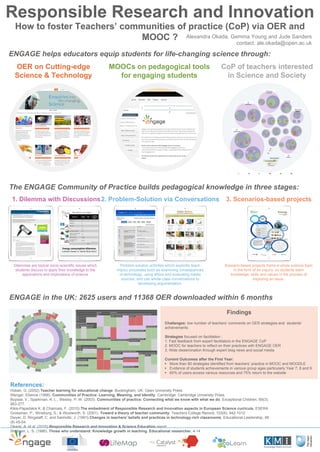
The ENGAGE Community of Practice builds pedagogical knowledge in three stages:
MOOCs on pedagogical tools
for engaging students
CoP of teachers interested
in Science and Society
Findings
Challenges: low number of teachers’ comments on OER strategies and students’
achievements
Strategies focused on facilitation :
1. Fast feedback from expert facilitators in the ENGAGE CoP
2. MOOC for teachers to reflect on their practices with ENGAGE OER
3. Wide dissemination through expert blog news and social media
Current Outcomes after the First Year:
• More than 80 strategies identified from teachers’ practice in MOOC and MOODLE
• Evidence of students achievements in various group ages particularly Year 7, 8 and 9
• 60% of users access various resources and 75% return to the website
ENGAGE in the UK: 2625 users and 11368 OER downloaded within 6 months
ENGAGE helps educators equip students for life-changing science through:
Problem-solution activities which explicitly teach
inquiry processes such as examining consequences
of technology, using ethics and evaluating media
sources, and use whole-class conversations to
developing argumentation.
Scenario-based projects frame a whole science topic
in the form of an inquiry, so students learn
knowledge, skills and values in the process of
exploring an issue.

Engage hub poster

  • 1.
    Responsible Research andInnovation Alexandra Okada, Gemma Young and Jude Sanders contact: ale.okada@open.ac.uk RRI Common language? RRI Impact? RRI awareness? Stakeholder influences?RRI standards? RRI informal learning? Local actions global thinking Time, investments Recommendati ons References: Hoban, G. (2002) Teacher learning for educational change. Buckingham, UK: Open University Press Wenger, Etienne (1998). Communities of Practice: Learning, Meaning, and Identity. Cambridge: Cambridge University Press. Buysse, V., Sparkman, K. L., Wesley, P. W. (2003). Communities of practice: Connecting what we know with what we do. Exceptional Children, 69(3), 263-277. Kikis-Papadakis K. & Chaimala, F. (2015) The embedment of Responsible Research and Innovation aspects in European Science curricula. ESERA Grossman, P., Wineburg, S., & Woolworth, S. (2001). Toward a theory of teacher community. Teachers College Record, 103(6), 942-1012 Dwyer, D. Ringstaff, C. and Sanholtz, J. (1991) Changes in teachers' beliefs and practices in technology-rich classrooms, Educational Leadership, 48 (8) 45-54. Okada, A. et al. (2015) Responsible Research and Innovation & Science Education report Shulman, L. S. (1986). Those who understand: Knowledge growth in teaching. Educational researcher, 4-14 OER on Cutting-edge Science & Technology How to foster Teachers’ communities of practice (CoP) via OER and MOOC ? Energy consumption dilemma: a shorter shower or banish blow-dries? Dilemmas are topical socio-scientific issues which students discuss to apply their knowledge to the applications and implications of science 1. Dilemma with Discussions2. Problem-Solution via Conversations 3. Scenarios-based projects The ENGAGE Community of Practice builds pedagogical knowledge in three stages: MOOCs on pedagogical tools for engaging students CoP of teachers interested in Science and Society Findings Challenges: low number of teachers’ comments on OER strategies and students’ achievements Strategies focused on facilitation : 1. Fast feedback from expert facilitators in the ENGAGE CoP 2. MOOC for teachers to reflect on their practices with ENGAGE OER 3. Wide dissemination through expert blog news and social media Current Outcomes after the First Year: • More than 80 strategies identified from teachers’ practice in MOOC and MOODLE • Evidence of students achievements in various group ages particularly Year 7, 8 and 9 • 60% of users access various resources and 75% return to the website ENGAGE in the UK: 2625 users and 11368 OER downloaded within 6 months ENGAGE helps educators equip students for life-changing science through: Problem-solution activities which explicitly teach inquiry processes such as examining consequences of technology, using ethics and evaluating media sources, and use whole-class conversations to developing argumentation. Scenario-based projects frame a whole science topic in the form of an inquiry, so students learn knowledge, skills and values in the process of exploring an issue.