ENGAGE HEARTS
AND MINDSPLANNING WITH YOUTH
AUSTIN, TX
September 14, 2016
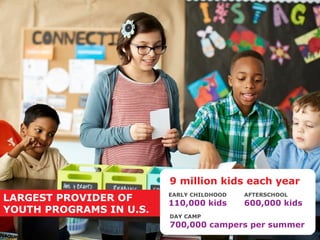
LARGEST PROVIDER OF
YOUTH PROGRAMS IN U.S.
EARLY CHILDHOOD
110,000 kids
9 million kids each year
AFTERSCHOOL
600,000 kids
DAY CAMP
700,000 campers per summer
DESIRED SHORT-TERM OUTCOMES
Achievement
• Youth feel that their
efforts are valued and
recognized
• Increased youth
perception of self as
capable leader
• Increased [youth] sense
of self confidence/esteem
• Increased knowledge and
awareness of
development
pathway/progress (youth,
staff, families)
Relationships
• Staff have an increased
knowledge of each youth’s
personality, likes/dislikes,
interests
• Families feel informed and
included in program and
youth development
• Youth feel that they can
openly and honestly
communicate with staff
• Increased transparency
with current & potential
community partners
Belonging
• Youth feel valued by peers
and staff, part of
Afterschool “team”
• Youth feel included in
program development
and/or delivery
• Increased awareness of
diversity, including
different perspectives,
ideas, and customs.
• Staff feel responsible for
youth development
YOUTH LED ACTIVITIES
BUT WHY?
• Helps Youth take responsibility for aspect of the program and their
own development
– Think for themselves
– Develop Problem Solving Skills
– Critically Thinking Skills
– Staff and Youth work together to implement suitable activities
4 | ENGAGE HEARTS AND MINDS | ©2011 YMCA of the USA
ADORA SVITAK-WHAT ADULTS CAN LEARN FROM KIDS
SIX STEPS TO
FACILITATION
FACILITATION SKILLS
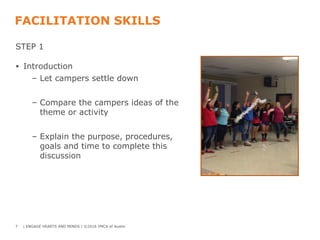
STEP 1
• Introduction
– Let campers settle down
– Compare the campers ideas of the
theme or activity
– Explain the purpose, procedures,
goals and time to complete this
discussion
7 | ENGAGE HEARTS AND MINDS | ©2016 YMCA of Austin
FACILITATION SKILLS
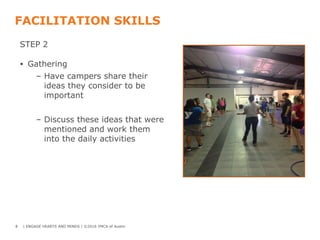
STEP 2
• Gathering
– Have campers share their
ideas they consider to be
important
– Discuss these ideas that were
mentioned and work them
into the daily activities
8 | ENGAGE HEARTS AND MINDS | ©2016 YMCA of Austin
FACILITATION SKILLS
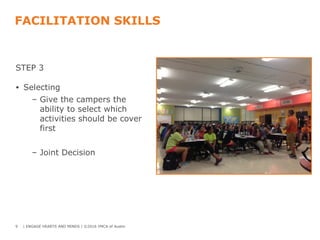
STEP 3
• Selecting
– Give the campers the
ability to select which
activities should be cover
first
– Joint Decision
9 | ENGAGE HEARTS AND MINDS | ©2016 YMCA of Austin
FACILITATION SKILLS
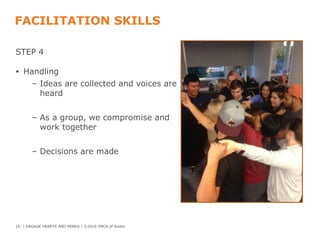
STEP 4
• Handling
– Ideas are collected and voices are
heard
– As a group, we compromise and
work together
– Decisions are made
10 | ENGAGE HEARTS AND MINDS | ©2016 YMCA of Austin
FACILITATION SKILLS
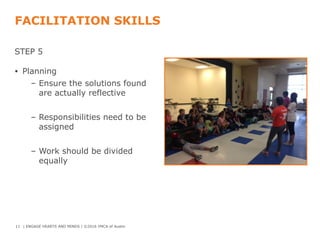
STEP 5
• Planning
– Ensure the solutions found
are actually reflective
– Responsibilities need to be
assigned
– Work should be divided
equally
11 | ENGAGE HEARTS AND MINDS | ©2016 YMCA of Austin
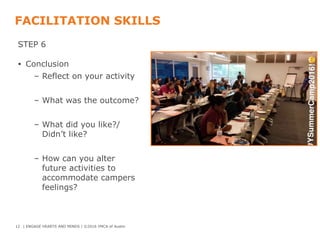
FACILITATION SKILLS
STEP 6
• Conclusion
– Reflect on your activity
– What was the outcome?
– What did you like?/
Didn’t like?
– How can you alter
future activities to
accommodate campers
feelings?
12 | ENGAGE HEARTS AND MINDS | ©2016 YMCA of Austin
RECAP
INTRODUCTION
GATHERING
SELECTING
HANDLING
PLANNING
CONCLUSION
REVISIT YOUR IMPACT STORY
IMPLEMENTING
FACILITATION
SKILLS
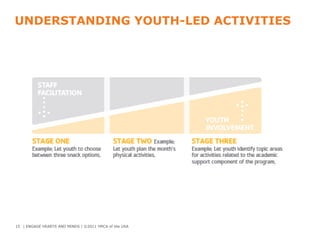
UNDERSTANDING YOUTH-LED ACTIVITIES
15 | ENGAGE HEARTS AND MINDS | ©2011 YMCA of the USA
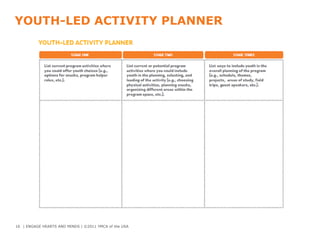
YOUTH-LED ACTIVITY PLANNER
16 | ENGAGE HEARTS AND MINDS | ©2011 YMCA of the USA
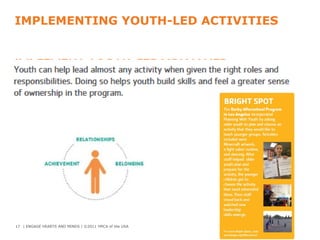
IMPLEMENTING YOUTH-LED ACTIVITIES
17 | ENGAGE HEARTS AND MINDS | ©2011 YMCA of the USA
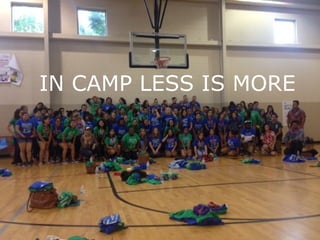
IN CAMP LESS IS MORE
18 | PRESENTATION TITLE HERE | ©2011 YMCA of the USA
IN CAMP LESS IS MORE
THANK YOU
Adan Gaona & Jacqueline Salazar
YMCA OF AUSTIN
Adan.Gaona@austinymca.org
Jacqueline.Salazar@austinymca.org

Engage Hearts and Minds 2016

  • 1.
    ENGAGE HEARTS AND MINDSPLANNINGWITH YOUTH AUSTIN, TX September 14, 2016
  • 2.
    LARGEST PROVIDER OF YOUTHPROGRAMS IN U.S. EARLY CHILDHOOD 110,000 kids 9 million kids each year AFTERSCHOOL 600,000 kids DAY CAMP 700,000 campers per summer
  • 3.
    DESIRED SHORT-TERM OUTCOMES Achievement •Youth feel that their efforts are valued and recognized • Increased youth perception of self as capable leader • Increased [youth] sense of self confidence/esteem • Increased knowledge and awareness of development pathway/progress (youth, staff, families) Relationships • Staff have an increased knowledge of each youth’s personality, likes/dislikes, interests • Families feel informed and included in program and youth development • Youth feel that they can openly and honestly communicate with staff • Increased transparency with current & potential community partners Belonging • Youth feel valued by peers and staff, part of Afterschool “team” • Youth feel included in program development and/or delivery • Increased awareness of diversity, including different perspectives, ideas, and customs. • Staff feel responsible for youth development
  • 4.
    YOUTH LED ACTIVITIES BUTWHY? • Helps Youth take responsibility for aspect of the program and their own development – Think for themselves – Develop Problem Solving Skills – Critically Thinking Skills – Staff and Youth work together to implement suitable activities 4 | ENGAGE HEARTS AND MINDS | ©2011 YMCA of the USA
  • 5.
    ADORA SVITAK-WHAT ADULTSCAN LEARN FROM KIDS
  • 6.
  • 7.
    FACILITATION SKILLS STEP 1 •Introduction – Let campers settle down – Compare the campers ideas of the theme or activity – Explain the purpose, procedures, goals and time to complete this discussion 7 | ENGAGE HEARTS AND MINDS | ©2016 YMCA of Austin
  • 8.
    FACILITATION SKILLS STEP 2 •Gathering – Have campers share their ideas they consider to be important – Discuss these ideas that were mentioned and work them into the daily activities 8 | ENGAGE HEARTS AND MINDS | ©2016 YMCA of Austin
  • 9.
    FACILITATION SKILLS STEP 3 •Selecting – Give the campers the ability to select which activities should be cover first – Joint Decision 9 | ENGAGE HEARTS AND MINDS | ©2016 YMCA of Austin
  • 10.
    FACILITATION SKILLS STEP 4 •Handling – Ideas are collected and voices are heard – As a group, we compromise and work together – Decisions are made 10 | ENGAGE HEARTS AND MINDS | ©2016 YMCA of Austin
  • 11.
    FACILITATION SKILLS STEP 5 •Planning – Ensure the solutions found are actually reflective – Responsibilities need to be assigned – Work should be divided equally 11 | ENGAGE HEARTS AND MINDS | ©2016 YMCA of Austin
  • 12.
    FACILITATION SKILLS STEP 6 •Conclusion – Reflect on your activity – What was the outcome? – What did you like?/ Didn’t like? – How can you alter future activities to accommodate campers feelings? 12 | ENGAGE HEARTS AND MINDS | ©2016 YMCA of Austin
  • 13.
  • 14.
  • 15.
    UNDERSTANDING YOUTH-LED ACTIVITIES 15| ENGAGE HEARTS AND MINDS | ©2011 YMCA of the USA
  • 16.
    YOUTH-LED ACTIVITY PLANNER 16| ENGAGE HEARTS AND MINDS | ©2011 YMCA of the USA
  • 17.
    IMPLEMENTING YOUTH-LED ACTIVITIES 17| ENGAGE HEARTS AND MINDS | ©2011 YMCA of the USA
  • 18.
    IN CAMP LESSIS MORE 18 | PRESENTATION TITLE HERE | ©2011 YMCA of the USA IN CAMP LESS IS MORE
  • 19.
    THANK YOU Adan Gaona& Jacqueline Salazar YMCA OF AUSTIN Adan.Gaona@austinymca.org Jacqueline.Salazar@austinymca.org

Editor's Notes

  • #3 We are a part of a large network of YMCAs across the country all invested in nurturing the potential of youth from cradle to career.
  • #4 Our levers of change are achievement (click), relationships (click), and belonging (click). By focusing on these things, we believe we can influence these short-term outcomes, which ultimately help us achieve our future desired state and long-term outcomes. (just highlight a few)
  • #7 Facilitation is an important skill that takes time to develop. As a counselor your role here is to help people share their differences and ideas but your job is to put it all together and put into Action. Successful Moderation only meets this: Structure Safety Orientation Everyone generally knows the context of the conversation but they all have a different idea of it. Youtube Video Search for personal clarification: SixSteps Facilitation by Josef W. Seifert
  • #8 You have created a great working atmosphere and cleared any misunderstandings that floated in the air in advance. You might have those campers who feel that “Their” topics or ideas are much more important than others. This will lead us to step 2
  • #9 Share: This means that everyone feels involved in this process therefore making sure everyone feels responsible for the results. This also ensures that no topic/ideas are forgotten. But as always you might have that camper who feels that their topic should be discussed or dealt with first. This should be avoided because as a group they can better help identify the most urgent topic/Ideas that work best.
  • #10 Allowing campers to work as a group to vote on what topics are more important. This allows campers to really think about the things that matter most to everyone. Joint decisions can lead to avoided discussions therefore allowing for more time to focus on other areas. At this point all campers should be contempt and motivated to move on to the next step.
  • #11 You want to make sure every camper has the ability to share their ideas with the group. This gives them enough personal space to do this. You can have a suggestion box for this concept
  • #12 As the facilitator you want to make sure that these ideas/topics are reflective of the topic in hand. Responsibilities need to be assigned, deadlines and the facilitator needs to monitor the results. We need to make sure that all the responsibility is not put on one camper/person Distribute the task evenly based on the campers interest/expertise with the agreement of the groups suggestions
  • #13 Connecting their stories to the activity – Think about the outcome of your impact story. What was your role? Did you give them the freedom to think,choose a game, take a leadership role? Write it down
  • #16 Ask staff to turn to their workbook to page 2 “Planning with youth” The benefits to working with youth in the planning are as follows: Decision making Negotiation Collaboration Empathy Trainer say: start with identifying activities that are: Safe Constructive Manageable for youth to lead Point out to the three stages of supporting youth led activities. Remind staff that these steps can take time but the ulitmate goal is to let go and let youth lead activities. These stages are progressive and build upon one another.
  • #17 Trainer Say: We are going to open our workbook to Page 4 in “Planning with youth” With your camp staff take 3 minutes to discuss: “Stage One”- Remember that this stage requires more facilitation from you versus the youth. (Point out to the stages from slide 13)- These should be small roles that you know your campers can take on… After Five Minutes ask staff to share some of the tasks they have written down: Examples: Choosing the snacks, Y-buck distributor, Character value assistant, Giving titles to campers, selecting activity for the day; helping with rules, Counting kids, etc. Now ask staff to take 5 Minutes to Discuss: Stage 2- This stage should focus on the PLANING of the activities already taking place. This is less facilitation and a little more youth led (Point out to stages from slide 13) After ask staff to share some of the planning activities on hand already Examples: Helping lead a game, reading a book to camper, attention getters, songs, skits etc . .(This is less facilitation and a little more youth led) Now ask staff to take 5 Minutes to discuss Stage 3- This stage youth have input in the planning on the day to day activities associated with the themes. This stage focuses on more youth led and less facilitation from youth staff but as a support system to them After ask staff to share some of the planning activities on hand already Examples: C.A.T.C.H Assistant (Assign campers to pick a game and relate it to the theme they can lead with littles?), Pick the songs for opening ceremony, skit, Pick the crafts, create samples and lead it, Let them pick what activities they want to do that Is associated with the them.
  • #18 Ask someone to read the big message Remind staff how this focuses on our three key drivers of success. This particularly helps with belonging, building those relationships with counselors, campers and with peers. Achievement is measured by the success and mentorship of the counselor. The ultimate goal is to have your own “ Bright spot” in your camp! Celebrate these successes and let them know that this can be achieved by every single camp site.
  • #19 Need to add more