ASSESSMENT PROJECT
Carolyn Young
INTRODUCTION
• The importance…
• Able to recognize mistakes or errors with an individuals movement, use Newell’s
model to help address reason’s behind mistakes, and identify ways to help
individuals improve technique or form.
• Test of Gross Motor Development-2 (TGMD-2)
• Tests the gross motor abilities of 3-10 year olds through various activities that
involve the use of large and multiple muscle groups
• Senior Fitness Test
• Tests the flexibility and stamina of individuals over 60 years of age
• Newell’s Model
• Helps identify factors from 3 specific areas (individual, environmental, task) that
affect motor abilities
TGMD2 STRENGTHS
• Participant #1 (Brenden)
• Dribbling-8/8
• Overhand Throwing-8/8
• Participant #2 (Warren)
• Striking a Stationary Ball-10/10
• Overhand Throwing-8/8
TGMD2 WEAKNESSES
PARTICIPANT #1 (BRENDEN)
• Kicking-4/8 • Leaping-4/6
TGMD2 WEAKNESSES
PARTICIPANT #2 (WARREN)
• Galloping-5/8 • Dribbling-6/8
SENIOR FITNESS STRENGTHS
• Participant #1 (Henry)
• Arm curls
• Sit and Reach
• Participant #2 (Christine)
• 8 foot up and go
• Chair Stands
SENIOR FITNESS WEAKNESSES
PARTICIPANT #1 (HENRY)
• Back Scratch Test (5th percentile) • 2 minute Step Test (10th percentile)
SENIOR FITNESS WEAKNESSES
PARTICIPANT #2 (CHRISTINE)
• Back Scratch (Less than 5th
percentile) • Sit and Reach (15th percentile)
RESULTS (TGMD2)
• Participant #1 (Brenden)
• The participant displays strong athleticism. This was inferred from the environment
he was found in prior to assessment (3 on 3 basketball tournament) and his
involvement in many sports when asked. His dribbling and throwing skills are most
likely very good because he often uses these skills in the activities he chooses to
be in.
• Individual (Functional) & Environmental Constraint
• Participant #2 (Warren)
• This participant comes from a very athletic family and athletically focused
background. From a very early age he was expected to be involved in sports, so
it is no surprise that his strengths are skills that come from being involved in
baseball, which also happens to be his favorite sport.
• Individual (Functional) & Environmental Constraint
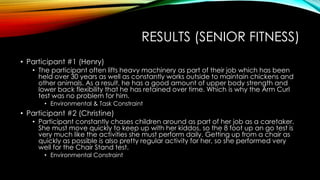
RESULTS (SENIOR FITNESS)
• Participant #1 (Henry)
• The participant often lifts heavy machinery as part of their job which has been
held over 30 years as well as constantly works outside to maintain chickens and
other animals. As a result, he has a good amount of upper body strength and
lower back flexibility that he has retained over time. Which is why the Arm Curl
test was no problem for him.
• Environmental & Task Constraint
• Participant #2 (Christine)
• Participant constantly chases children around as part of her job as a caretaker.
She must move quickly to keep up with her kiddos, so the 8 foot up an go test is
very much like the activities she must perform daily. Getting up from a chair as
quickly as possible is also pretty regular activity for her, so she performed very
well for the Chair Stand test.
• Environmental Constraint
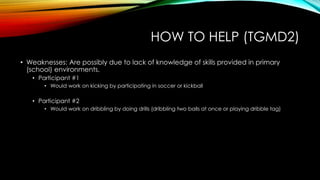
HOW TO HELP (TGMD2)
• Weaknesses: Are possibly due to lack of knowledge of skills provided in primary
(school) environments.
• Participant #1
• Would work on kicking by participating in soccer or kickball
• Participant #2
• Would work on dribbling by doing drills (dribbling two balls at once or playing dribble tag)
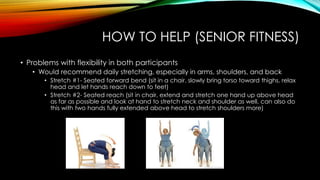
HOW TO HELP (SENIOR FITNESS)
• Problems with flexibility in both participants
• Would recommend daily stretching, especially in arms, shoulders, and back
• Stretch #1- Seated forward bend (sit in a chair, slowly bring torso toward thighs, relax
head and let hands reach down to feet)
• Stretch #2- Seated reach (sit in chair, extend and stretch one hand up above head
as far as possible and look at hand to stretch neck and shoulder as well, can also do
this with two hands fully extended above head to stretch shoulders more)
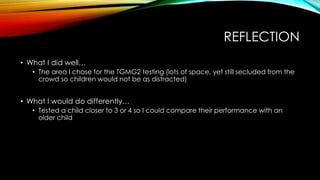
REFLECTION
• What I did well…
• The area I chose for the TGMG2 testing (lots of space, yet still secluded from the
crowd so children would not be as distracted)
• What I would do differently…
• Tested a child closer to 3 or 4 so I could compare their performance with an
older child

Assesment Project PPT

  • 1.
  • 2.
    INTRODUCTION • The importance… •Able to recognize mistakes or errors with an individuals movement, use Newell’s model to help address reason’s behind mistakes, and identify ways to help individuals improve technique or form. • Test of Gross Motor Development-2 (TGMD-2) • Tests the gross motor abilities of 3-10 year olds through various activities that involve the use of large and multiple muscle groups • Senior Fitness Test • Tests the flexibility and stamina of individuals over 60 years of age • Newell’s Model • Helps identify factors from 3 specific areas (individual, environmental, task) that affect motor abilities
  • 3.
    TGMD2 STRENGTHS • Participant#1 (Brenden) • Dribbling-8/8 • Overhand Throwing-8/8 • Participant #2 (Warren) • Striking a Stationary Ball-10/10 • Overhand Throwing-8/8
  • 4.
    TGMD2 WEAKNESSES PARTICIPANT #1(BRENDEN) • Kicking-4/8 • Leaping-4/6
  • 5.
    TGMD2 WEAKNESSES PARTICIPANT #2(WARREN) • Galloping-5/8 • Dribbling-6/8
  • 6.
    SENIOR FITNESS STRENGTHS •Participant #1 (Henry) • Arm curls • Sit and Reach • Participant #2 (Christine) • 8 foot up and go • Chair Stands
  • 7.
    SENIOR FITNESS WEAKNESSES PARTICIPANT#1 (HENRY) • Back Scratch Test (5th percentile) • 2 minute Step Test (10th percentile)
  • 8.
    SENIOR FITNESS WEAKNESSES PARTICIPANT#2 (CHRISTINE) • Back Scratch (Less than 5th percentile) • Sit and Reach (15th percentile)
  • 9.
    RESULTS (TGMD2) • Participant#1 (Brenden) • The participant displays strong athleticism. This was inferred from the environment he was found in prior to assessment (3 on 3 basketball tournament) and his involvement in many sports when asked. His dribbling and throwing skills are most likely very good because he often uses these skills in the activities he chooses to be in. • Individual (Functional) & Environmental Constraint • Participant #2 (Warren) • This participant comes from a very athletic family and athletically focused background. From a very early age he was expected to be involved in sports, so it is no surprise that his strengths are skills that come from being involved in baseball, which also happens to be his favorite sport. • Individual (Functional) & Environmental Constraint
  • 10.
    RESULTS (SENIOR FITNESS) •Participant #1 (Henry) • The participant often lifts heavy machinery as part of their job which has been held over 30 years as well as constantly works outside to maintain chickens and other animals. As a result, he has a good amount of upper body strength and lower back flexibility that he has retained over time. Which is why the Arm Curl test was no problem for him. • Environmental & Task Constraint • Participant #2 (Christine) • Participant constantly chases children around as part of her job as a caretaker. She must move quickly to keep up with her kiddos, so the 8 foot up an go test is very much like the activities she must perform daily. Getting up from a chair as quickly as possible is also pretty regular activity for her, so she performed very well for the Chair Stand test. • Environmental Constraint
  • 11.
    HOW TO HELP(TGMD2) • Weaknesses: Are possibly due to lack of knowledge of skills provided in primary (school) environments. • Participant #1 • Would work on kicking by participating in soccer or kickball • Participant #2 • Would work on dribbling by doing drills (dribbling two balls at once or playing dribble tag)
  • 12.
    HOW TO HELP(SENIOR FITNESS) • Problems with flexibility in both participants • Would recommend daily stretching, especially in arms, shoulders, and back • Stretch #1- Seated forward bend (sit in a chair, slowly bring torso toward thighs, relax head and let hands reach down to feet) • Stretch #2- Seated reach (sit in chair, extend and stretch one hand up above head as far as possible and look at hand to stretch neck and shoulder as well, can also do this with two hands fully extended above head to stretch shoulders more)
  • 13.
    REFLECTION • What Idid well… • The area I chose for the TGMG2 testing (lots of space, yet still secluded from the crowd so children would not be as distracted) • What I would do differently… • Tested a child closer to 3 or 4 so I could compare their performance with an older child