Active and
Active and
Passive
Passive
Voice
Voice
ENGLISH 7
QUARTER 1 | WEEK 4
ENGLISH 7 | MODULE 3
karla.tembrevilla@depedmakati.ph
Simple Past Tense of the Verb
Past Participle of the Verb
ENGLISH 7
MODULE 3
Things to remember:
ACTIVE AND PASSIVE VOICE
BE - verbs (is, are, was, were)
Future Tense - will be
Simple Past
The simple past is a
verb tense that is used
to talk about things
that happened or
existed before now.
eat - ate , write - wrote , do - did
dance - danced, walk - walked
Past
Participle
A past participle is a
word that (1) formed
from a verb, (2) is used
as an adjective or to
form verb tense, and (3)
probably ends with "-
ed," "-d," "-t," "-en," or "-
n."
eat - eaten , write - written , do - done
dance - danced, walk - walked
Identify the
Simple Past
and Past
Participle of
the verbs
Example: take
took- simple past taken - past participle
shake
buy
play
break
cook
1.
2.
3.
4.
5.
6. change
7. bite
8. know
9. blow
10. freeze
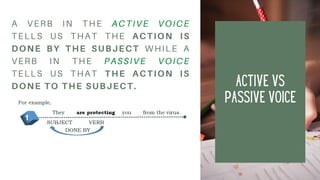
A VERB IN THE ACTIVE VOICE
TELLS US THAT THE ACTION IS
DONE BY THE SUBJECT WHILE A
VERB IN THE PASSIVE VOICE
TELLS US THAT THE ACTION IS
DONE TO THE SUBJECT. ACTIVE VS
PASSIVE VOICE
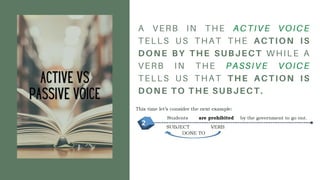
A VERB IN THE ACTIVE VOICE
TELLS US THAT THE ACTION IS
DONE BY THE SUBJECT WHILE A
VERB IN THE PASSIVE VOICE
TELLS US THAT THE ACTION IS
DONE TO THE SUBJECT.
ACTIVE VS
ACTIVE VS
PASSIVE VOICE
PASSIVE VOICE
ACTIVE VS
ACTIVE VS
PASSIVE VOICE
PASSIVE VOICE
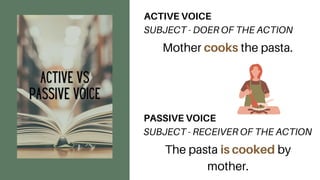
ACTIVE VOICE
SUBJECT - DOER OF THE ACTION
PASSIVE VOICE
SUBJECT - RECEIVER OF THE ACTION
Mother cooks the pasta.
The pasta is cooked by
mother.
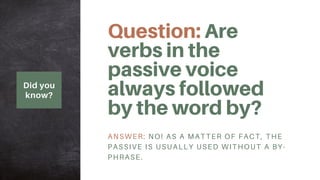
Question: Are
verbs in the
passive voice
always followed
by the word by?
ANSWER: NO! AS A MATTER OF FACT, THE
PASSIVE IS USUALLY USED WITHOUT A BY-
PHRASE.
Did you
know?
Take
a
look!
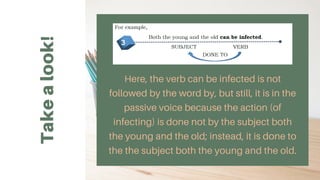
Here, the verb can be infected is not
followed by the word by, but still, it is in the
passive voice because the action (of
infecting) is done not by the subject both
the young and the old; instead, it is done to
the the subject both the young and the old.
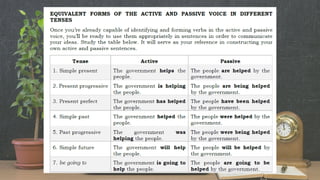
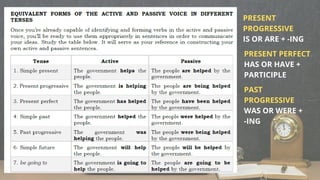
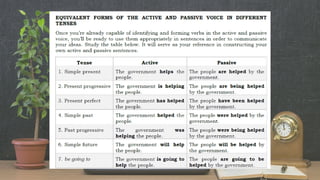
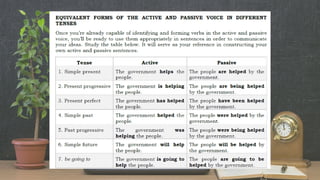
PRESENT
PROGRESSIVE
IS OR ARE + -ING
PRESENT PERFECT
HAS OR HAVE +
PARTICIPLE
PAST
PROGRESSIVE
WAS OR WERE +
-ING
Changing
Voices
ACTIVE TO
Passive Voice
Active to Passive
Active to Passive
Thousands of tourists visit
the Lion's Head every
year.
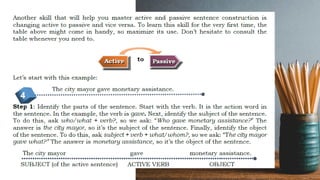
Identify the subject, verb and
object.
Let's Practice!
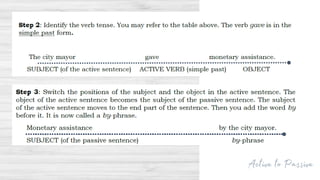
Identify the VERB TENSE. Decide
whether is, are, was, were etc
Switch the position of SUBJECT
AND OBJECT.
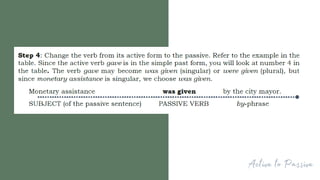
Change the equavelent verb from
its active form to the passive.
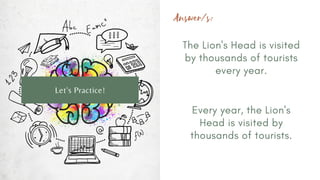
The Lion's Head is visited
by thousands of tourists
every year.
Let's Practice!
Every year, the Lion's
Head is visited by
thousands of tourists.
Answer/s:
Now let's
try this!
P A S S I V E T O
Active
Passive to Active
Passive to Active
Passive to Active
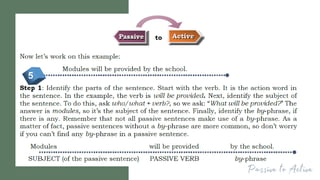
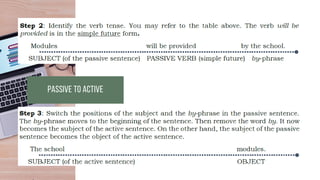
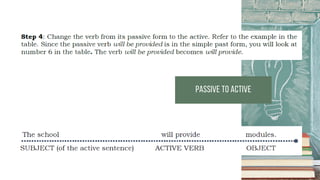
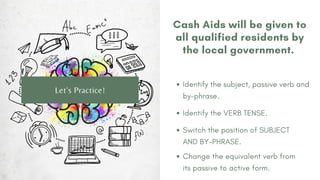
Cash Aids will be given to
all qualified residents by
the local government.
Identify the subject, passive verb and
by-phrase.
Let's Practice!
Identify the VERB TENSE.
Switch the position of SUBJECT
AND BY-PHRASE.
Change the equivalent verb from
its passive to active form.
ENG7-QTR1-MODULE3-ACTIVE-PASSIVE-VOICE.pdf

ENG7-QTR1-MODULE3-ACTIVE-PASSIVE-VOICE.pdf

  • 1.
    Active and Active and Passive Passive Voice Voice ENGLISH7 QUARTER 1 | WEEK 4 ENGLISH 7 | MODULE 3 karla.tembrevilla@depedmakati.ph
  • 2.
    Simple Past Tenseof the Verb Past Participle of the Verb ENGLISH 7 MODULE 3 Things to remember: ACTIVE AND PASSIVE VOICE BE - verbs (is, are, was, were) Future Tense - will be
  • 3.
    Simple Past The simplepast is a verb tense that is used to talk about things that happened or existed before now. eat - ate , write - wrote , do - did dance - danced, walk - walked
  • 4.
    Past Participle A past participleis a word that (1) formed from a verb, (2) is used as an adjective or to form verb tense, and (3) probably ends with "- ed," "-d," "-t," "-en," or "- n." eat - eaten , write - written , do - done dance - danced, walk - walked
  • 5.
    Identify the Simple Past andPast Participle of the verbs Example: take took- simple past taken - past participle shake buy play break cook 1. 2. 3. 4. 5. 6. change 7. bite 8. know 9. blow 10. freeze
  • 6.
    A VERB INTHE ACTIVE VOICE TELLS US THAT THE ACTION IS DONE BY THE SUBJECT WHILE A VERB IN THE PASSIVE VOICE TELLS US THAT THE ACTION IS DONE TO THE SUBJECT. ACTIVE VS PASSIVE VOICE
  • 7.
    A VERB INTHE ACTIVE VOICE TELLS US THAT THE ACTION IS DONE BY THE SUBJECT WHILE A VERB IN THE PASSIVE VOICE TELLS US THAT THE ACTION IS DONE TO THE SUBJECT. ACTIVE VS ACTIVE VS PASSIVE VOICE PASSIVE VOICE
  • 8.
    ACTIVE VS ACTIVE VS PASSIVEVOICE PASSIVE VOICE ACTIVE VOICE SUBJECT - DOER OF THE ACTION PASSIVE VOICE SUBJECT - RECEIVER OF THE ACTION Mother cooks the pasta. The pasta is cooked by mother.
  • 9.
    Question: Are verbs inthe passive voice always followed by the word by? ANSWER: NO! AS A MATTER OF FACT, THE PASSIVE IS USUALLY USED WITHOUT A BY- PHRASE. Did you know?
  • 10.
    Take a look! Here, the verbcan be infected is not followed by the word by, but still, it is in the passive voice because the action (of infecting) is done not by the subject both the young and the old; instead, it is done to the the subject both the young and the old.
  • 12.
    PRESENT PROGRESSIVE IS OR ARE+ -ING PRESENT PERFECT HAS OR HAVE + PARTICIPLE PAST PROGRESSIVE WAS OR WERE + -ING
  • 13.
  • 15.
  • 16.
  • 17.
    Thousands of touristsvisit the Lion's Head every year. Identify the subject, verb and object. Let's Practice! Identify the VERB TENSE. Decide whether is, are, was, were etc Switch the position of SUBJECT AND OBJECT. Change the equavelent verb from its active form to the passive.
  • 19.
    The Lion's Headis visited by thousands of tourists every year. Let's Practice! Every year, the Lion's Head is visited by thousands of tourists. Answer/s:
  • 20.
    Now let's try this! PA S S I V E T O Active
  • 21.
  • 22.
  • 23.
  • 24.
    Cash Aids willbe given to all qualified residents by the local government. Identify the subject, passive verb and by-phrase. Let's Practice! Identify the VERB TENSE. Switch the position of SUBJECT AND BY-PHRASE. Change the equivalent verb from its passive to active form.