-Dr. Seuss
YOU
WILL
AND
YOU
CAN.
“There are so many things
you can learn about, but
You’ll miss the best things
if you keep your eyes shut.”
RIDDLE
TIME!
I’M TALL WHEN I’M
YOUNG, AND I’M
SHORT WHEN I’M OLD.
WHAT AM I?
RIDDLE
TIME!
I’M TALL WHEN I’M
YOUNG, AND I’M
SHORT WHEN I’M OLD.
WHAT AM I?
CANDLE
RIDDLE
TIME!
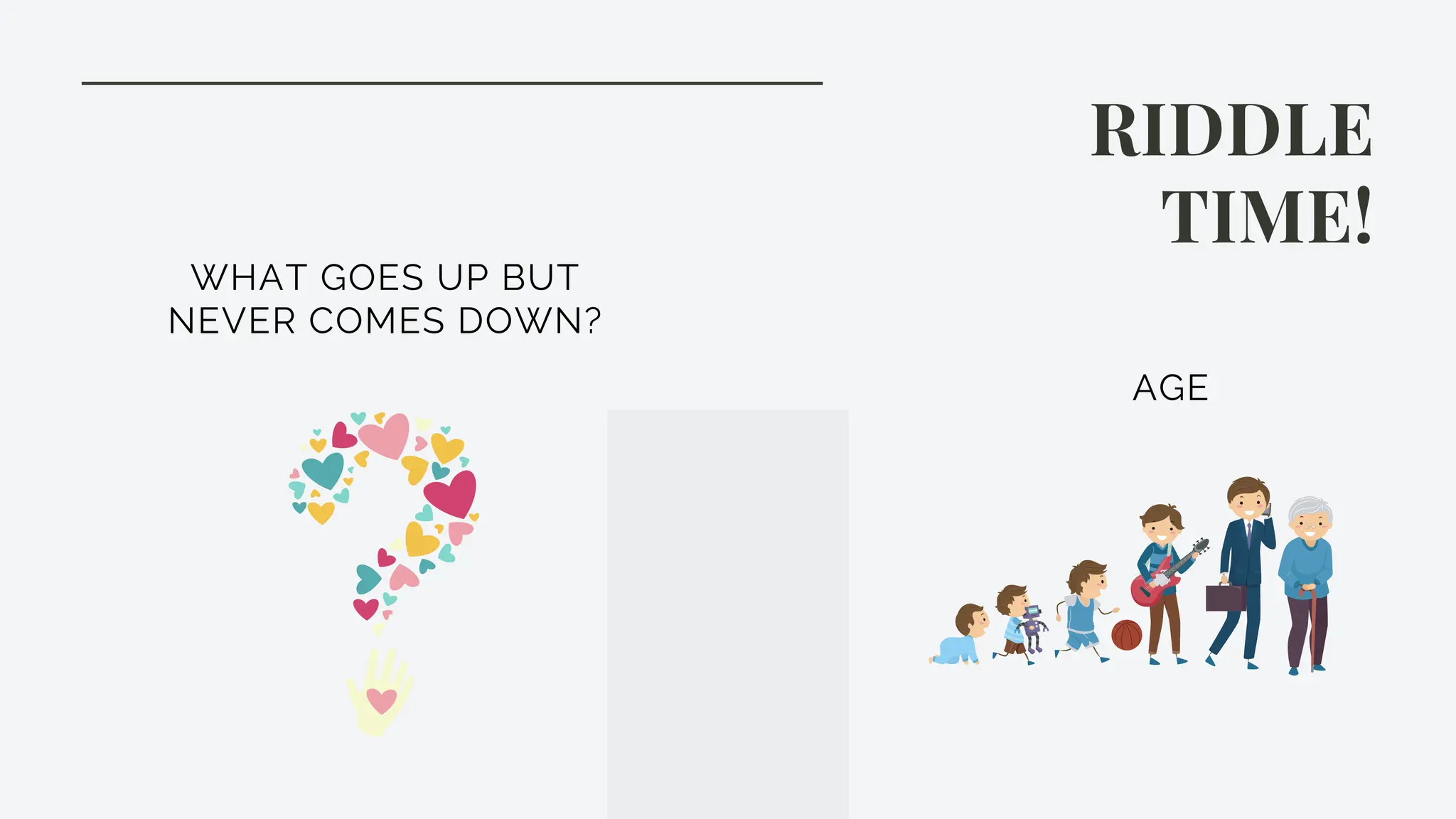
WHAT GOES UP BUT
NEVER COMES DOWN?
RIDDLE
TIME!
WHAT GOES UP BUT
NEVER COMES DOWN?
AGE
RIDDLE
TIME!
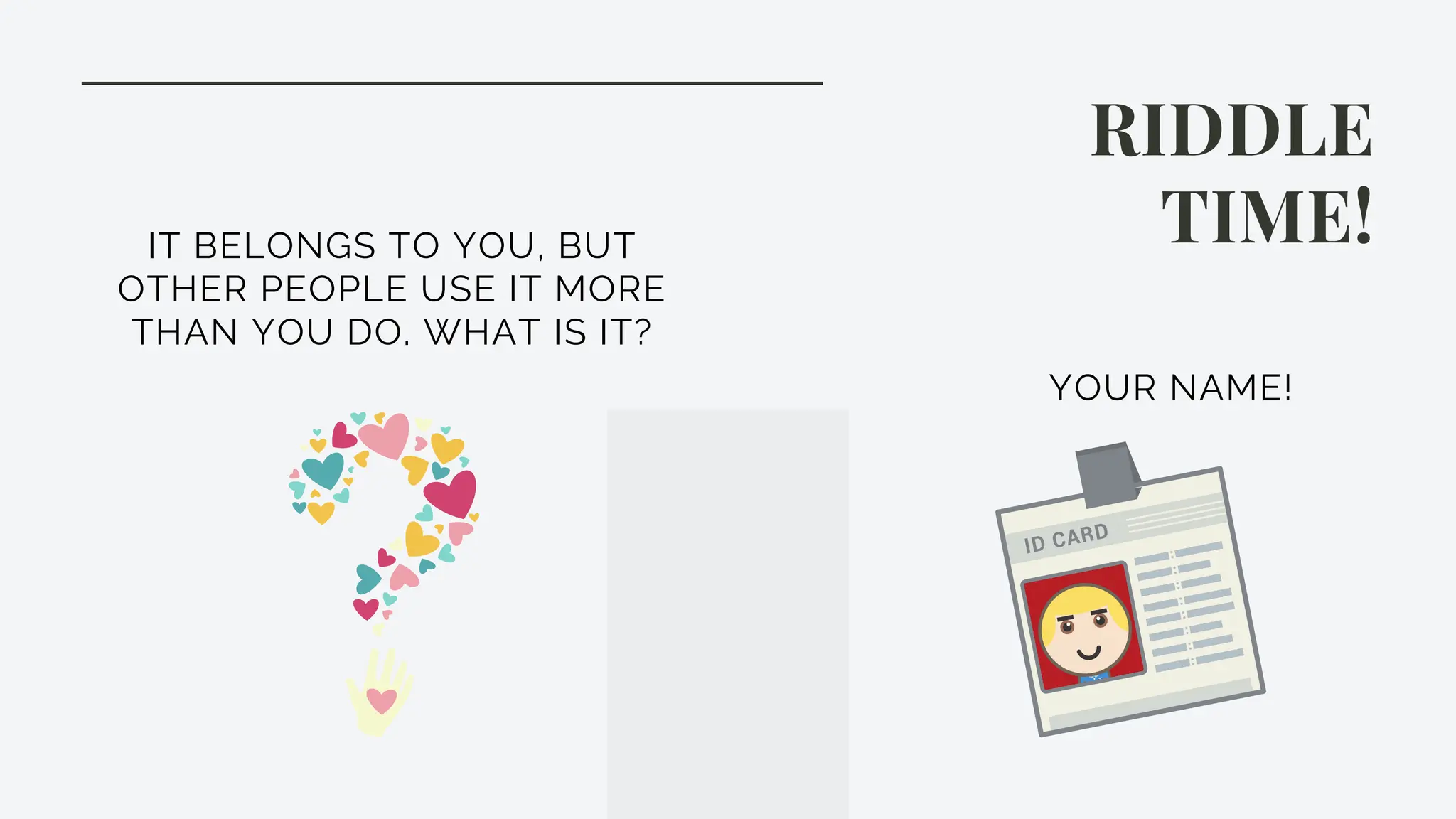
IT BELONGS TO YOU, BUT
OTHER PEOPLE USE IT MORE
THAN YOU DO. WHAT IS IT?
RIDDLE
TIME!
IT BELONGS TO YOU, BUT
OTHER PEOPLE USE IT MORE
THAN YOU DO. WHAT IS IT?
YOUR NAME!
RIDDLE
TIME!
I HAVE BRANCHES, BUT NO
FRUIT, TRUNK OR LEAVES.
WHAT AM I?
RIDDLE
TIME!
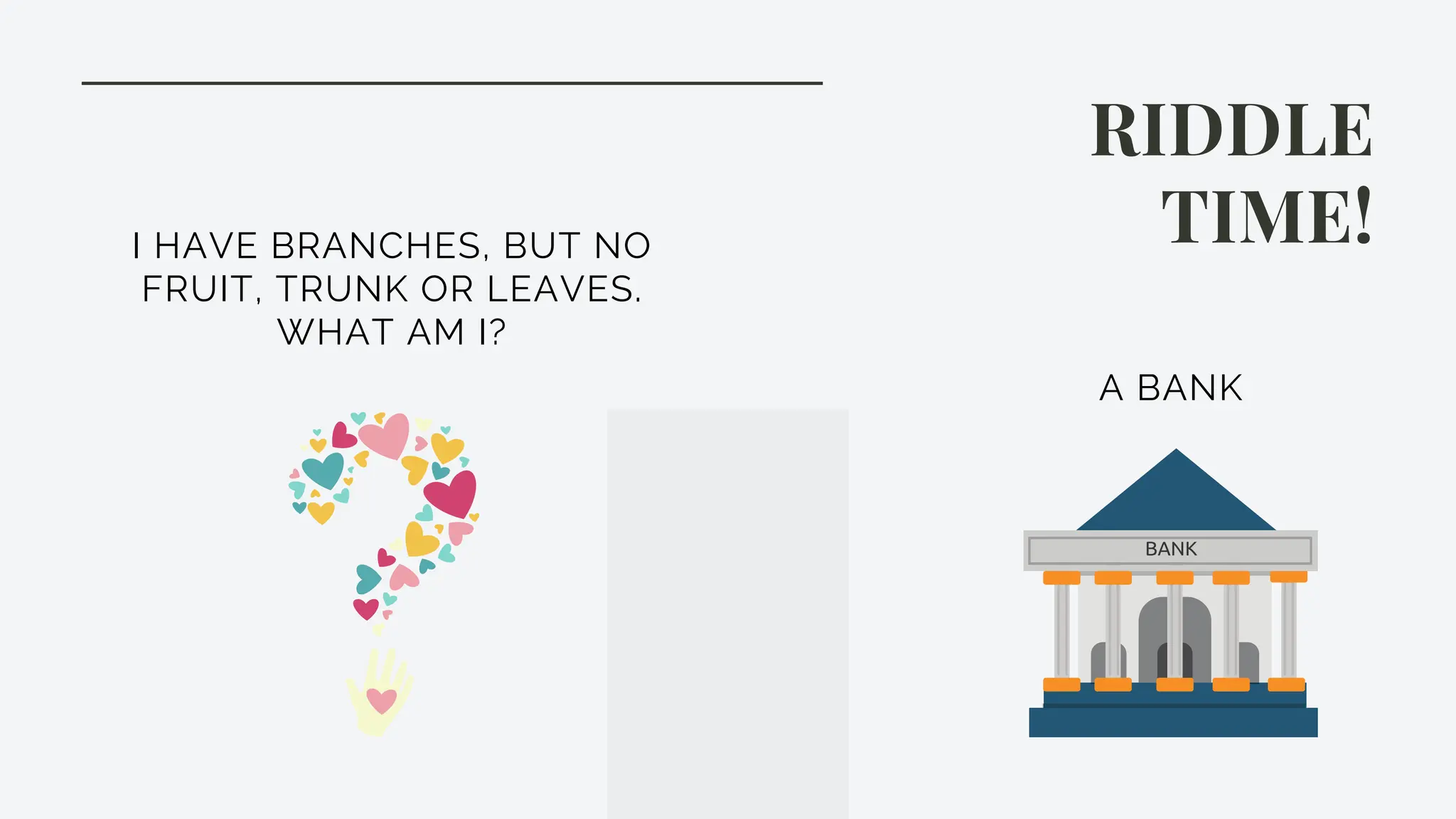
I HAVE BRANCHES, BUT NO
FRUIT, TRUNK OR LEAVES.
WHAT AM I?
A BANK
RIDDLE
TIME!
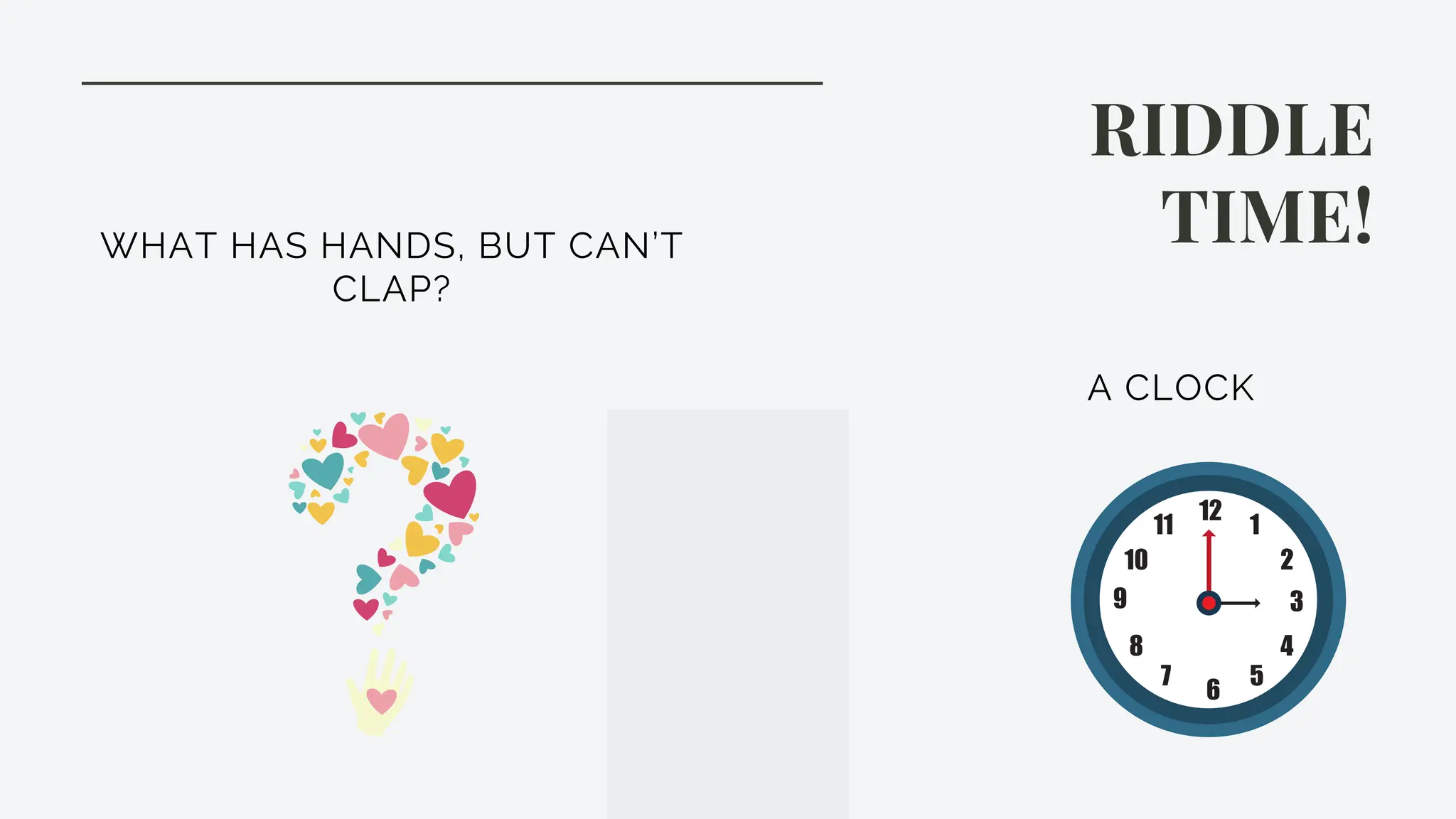
WHAT HAS HANDS, BUT CAN’T
CLAP?
RIDDLE
TIME!
WHAT HAS HANDS, BUT CAN’T
CLAP?
A CLOCK
WEEK 6 | GRAMMAR
DIRECT &
REPORTED
SPEECH
Grade 7 | Module 5
Ms. Karla Tembrevilla
Teacher
1. transform direct speech
to indirect speech and
indirect to direct with the
correct use of pronouns,
verb tense, connectors
and adverbs
Objectives:
2. use direct and indirect
speech in expressing
ideas
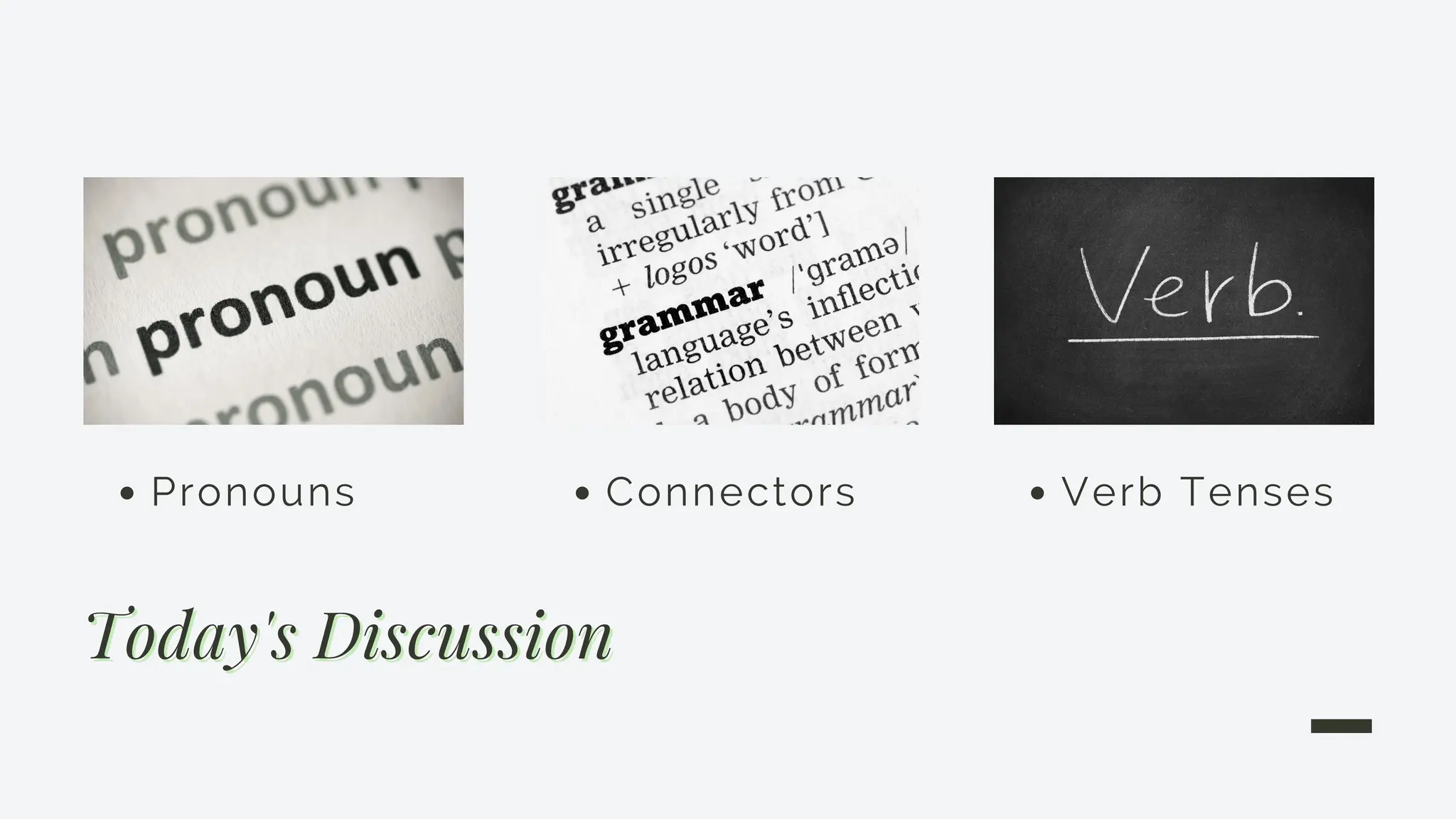
Today's Discussion
Today's Discussion
Pronouns Connectors Verb Tenses
PRONOUNS
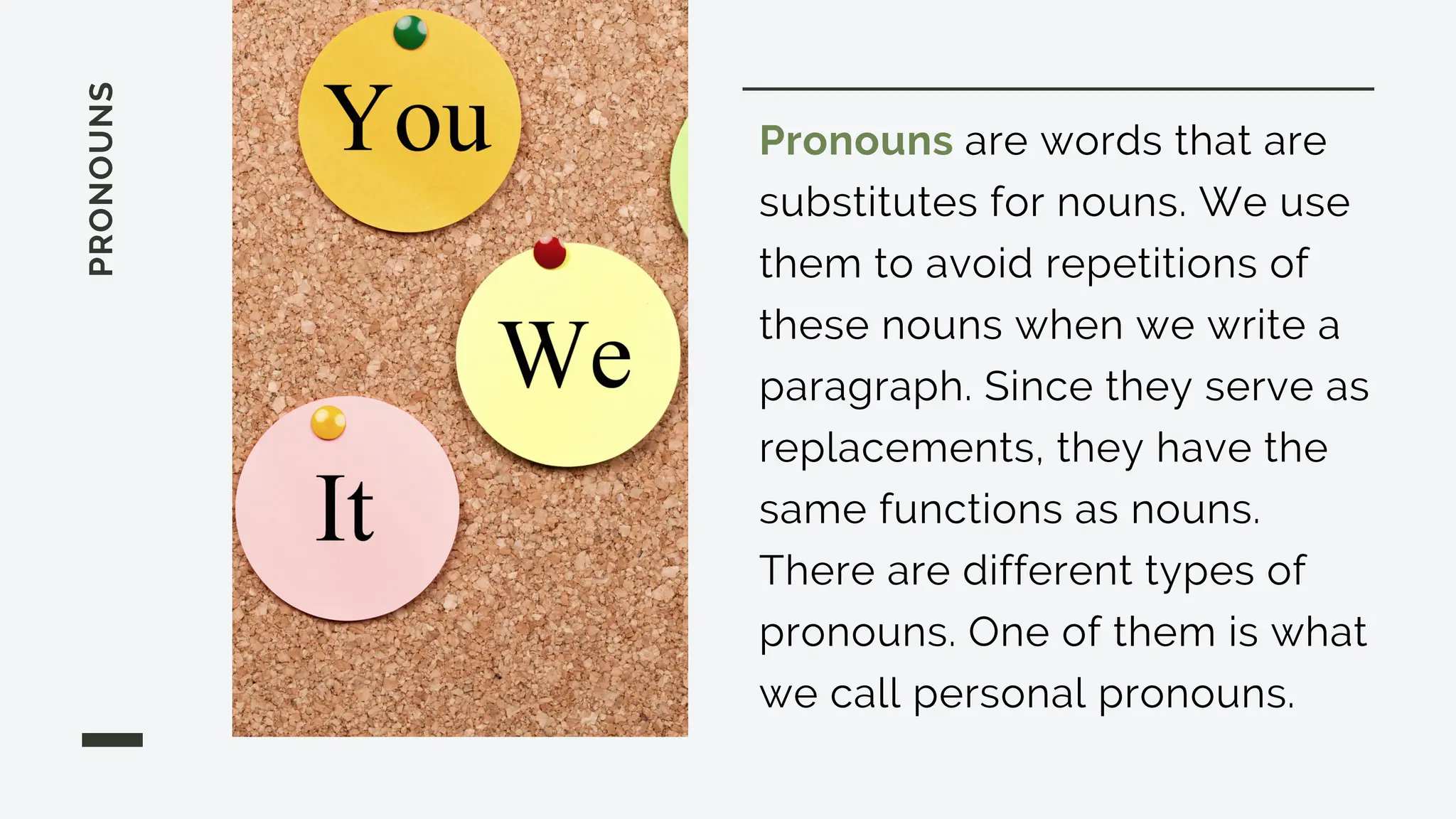
Pronouns are words that are
substitutes for nouns. We use
them to avoid repetitions of
these nouns when we write a
paragraph. Since they serve as
replacements, they have the
same functions as nouns.
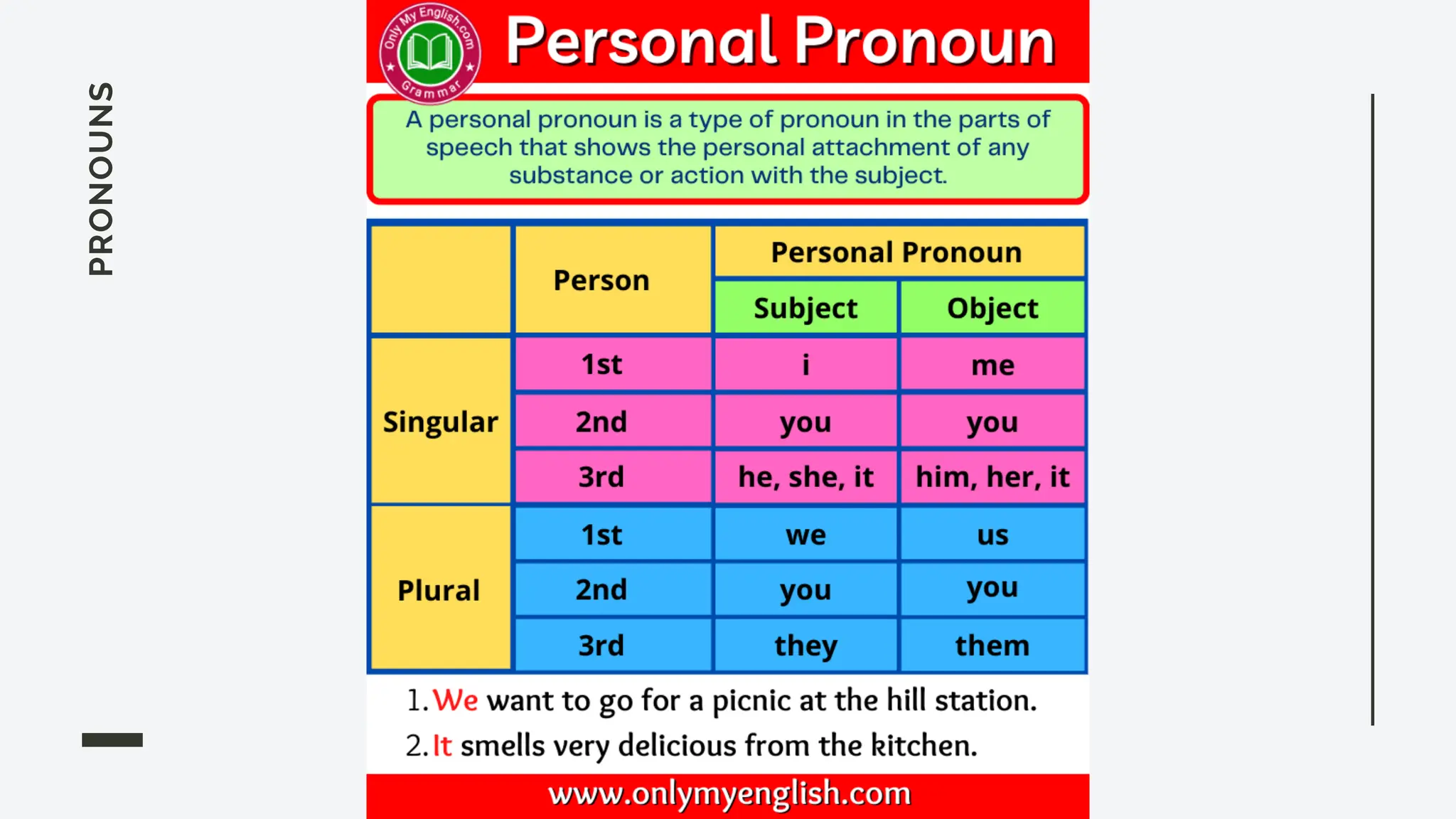
There are different types of
pronouns. One of them is what
we call personal pronouns.
PRONOUNS
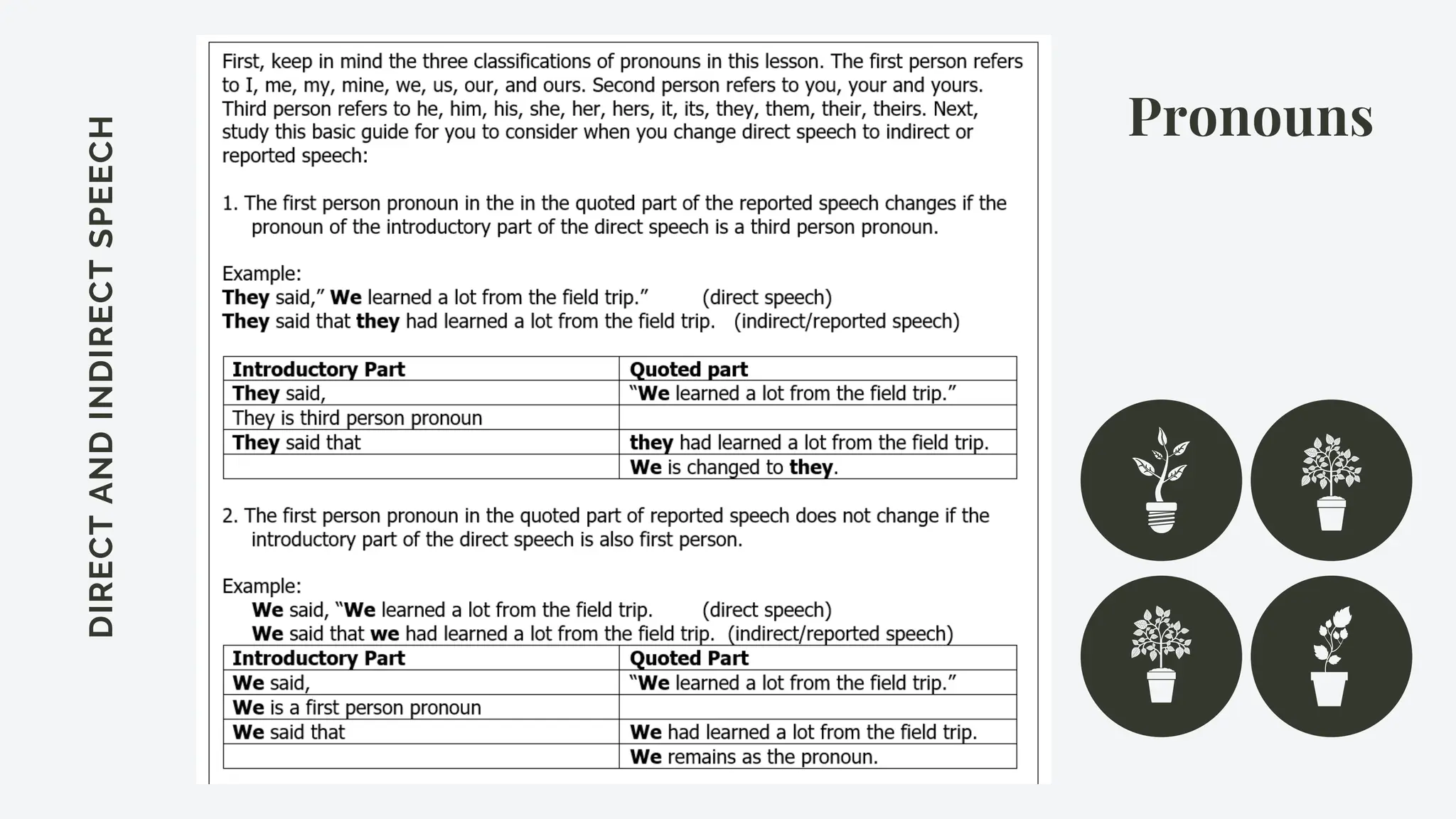
Pronouns
DIRECT
AND
INDIRECT
SPEECH
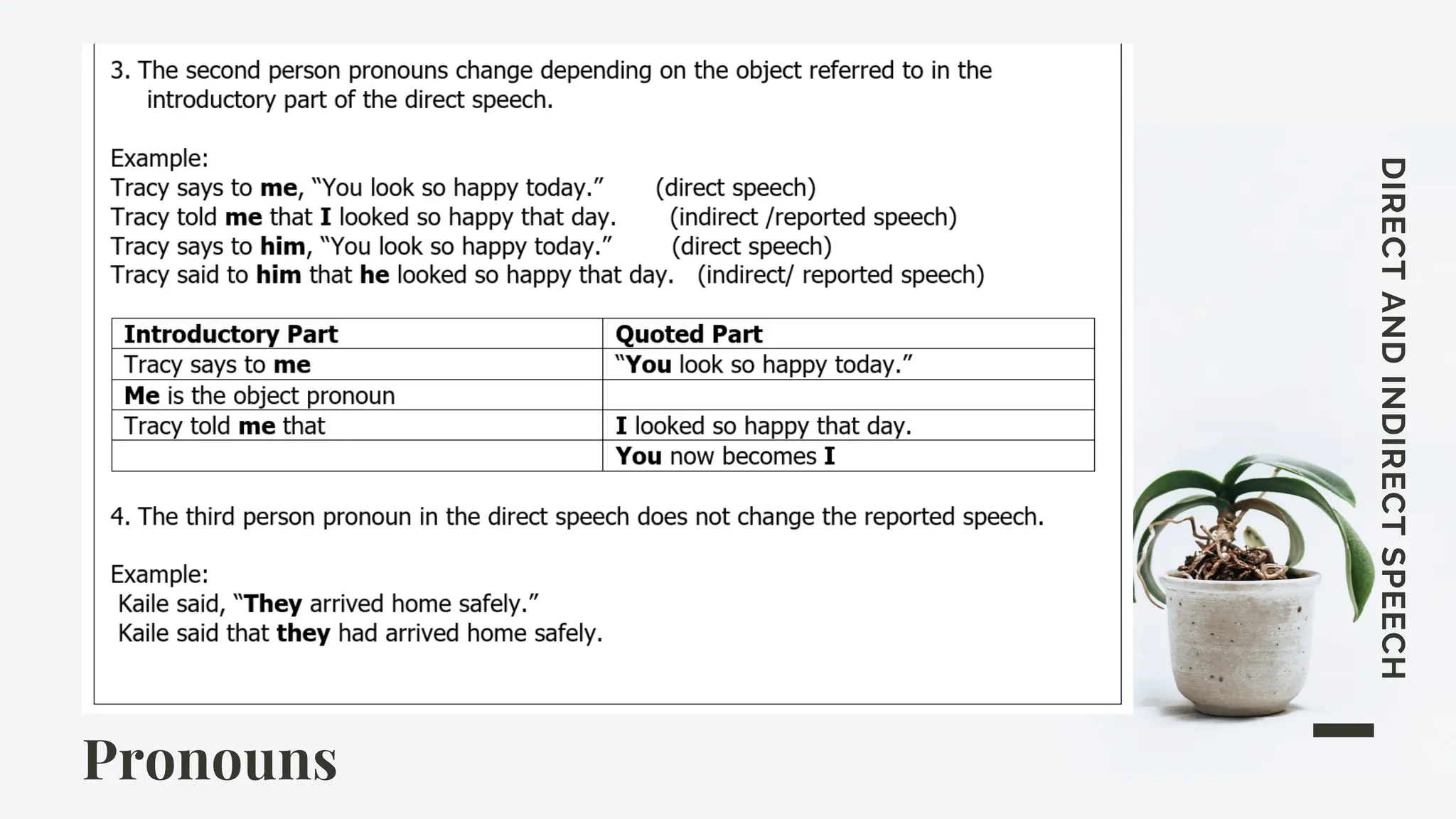
Pronouns
DIRECT
AND
INDIRECT
SPEECH
Pronouns
DIRECT
AND
INDIRECT
SPEECH
Pronouns
DIRECT
AND
INDIRECT
SPEECH
Pronouns
DIRECT
AND
INDIRECT
SPEECH
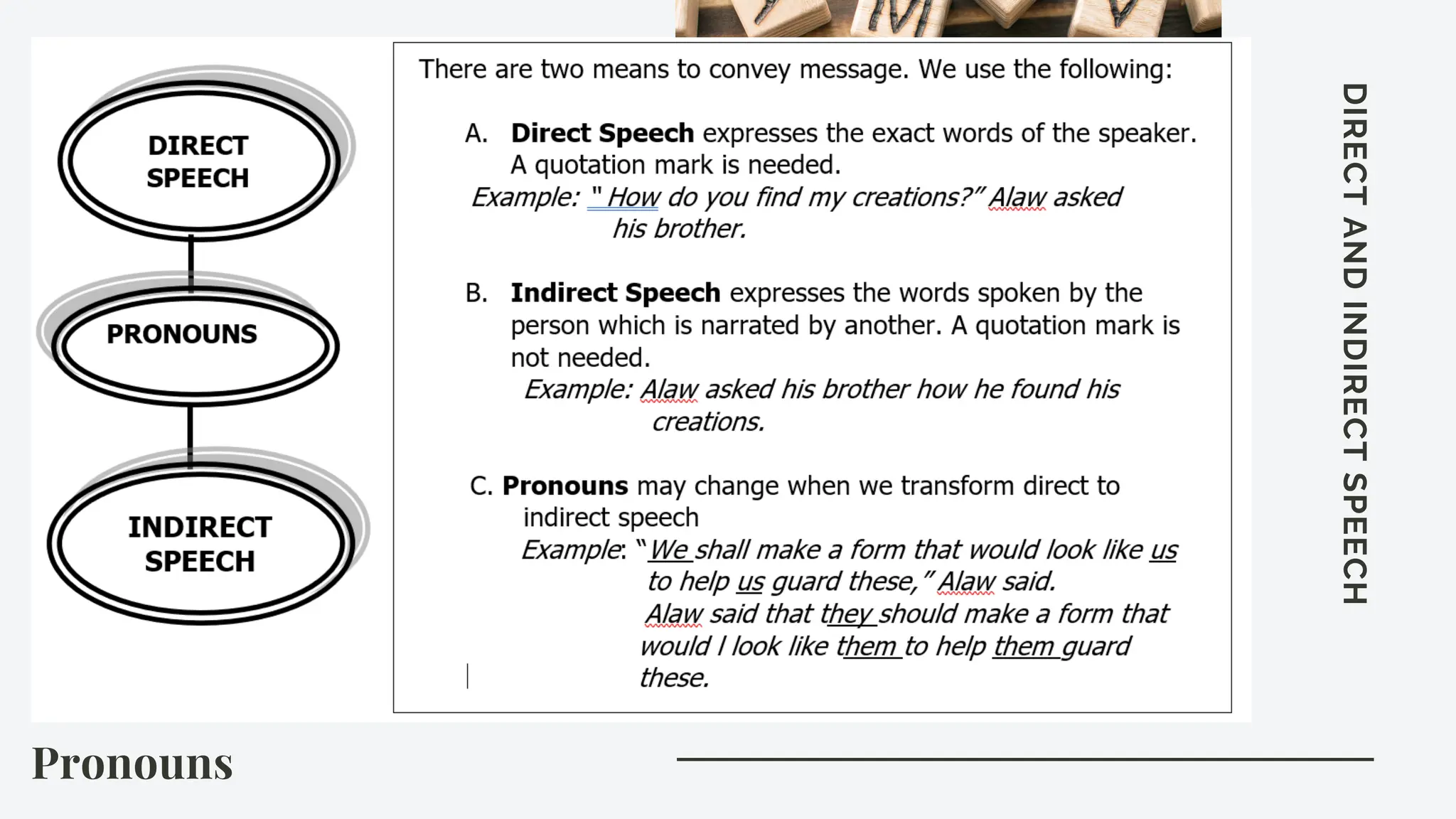
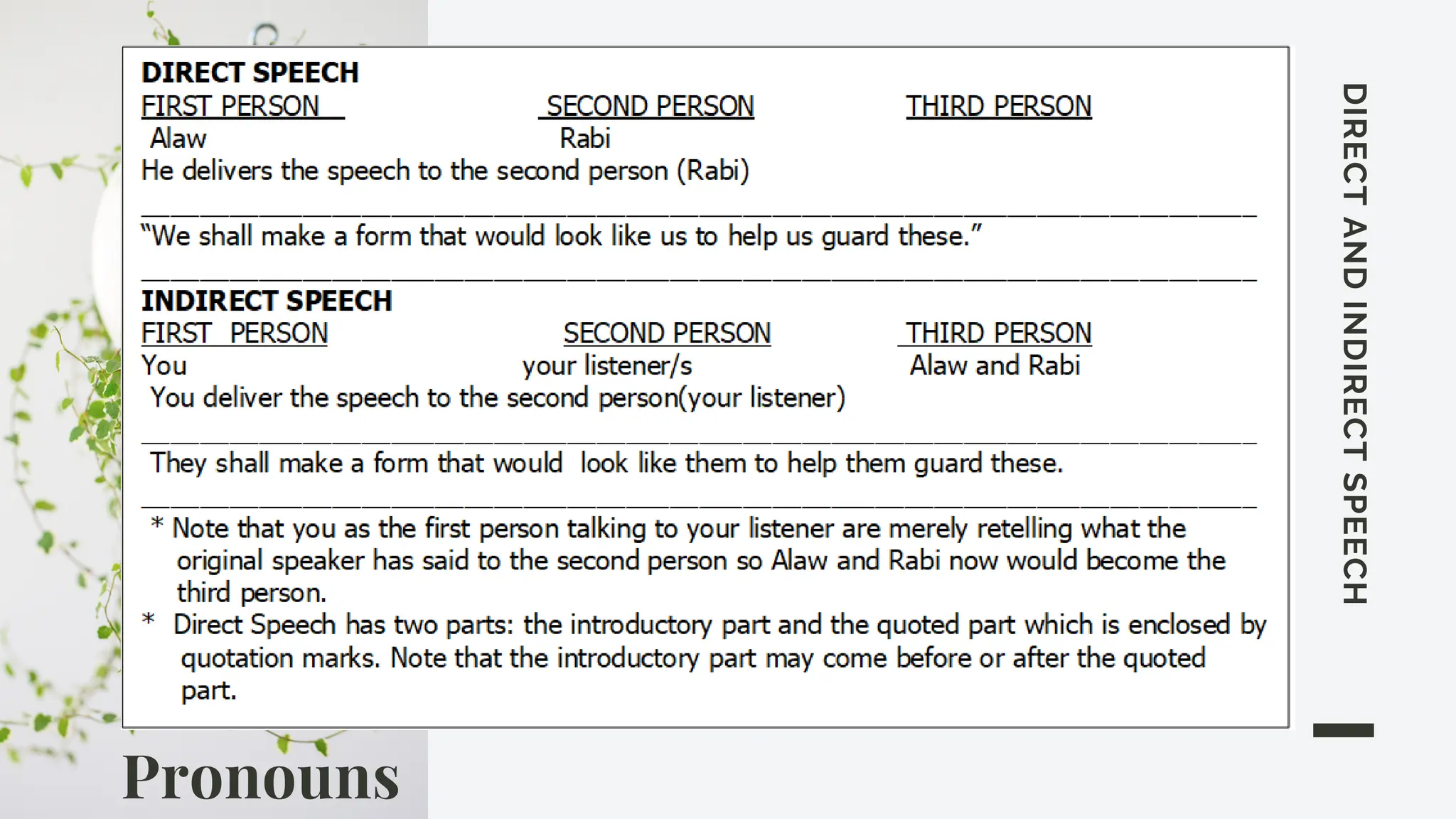
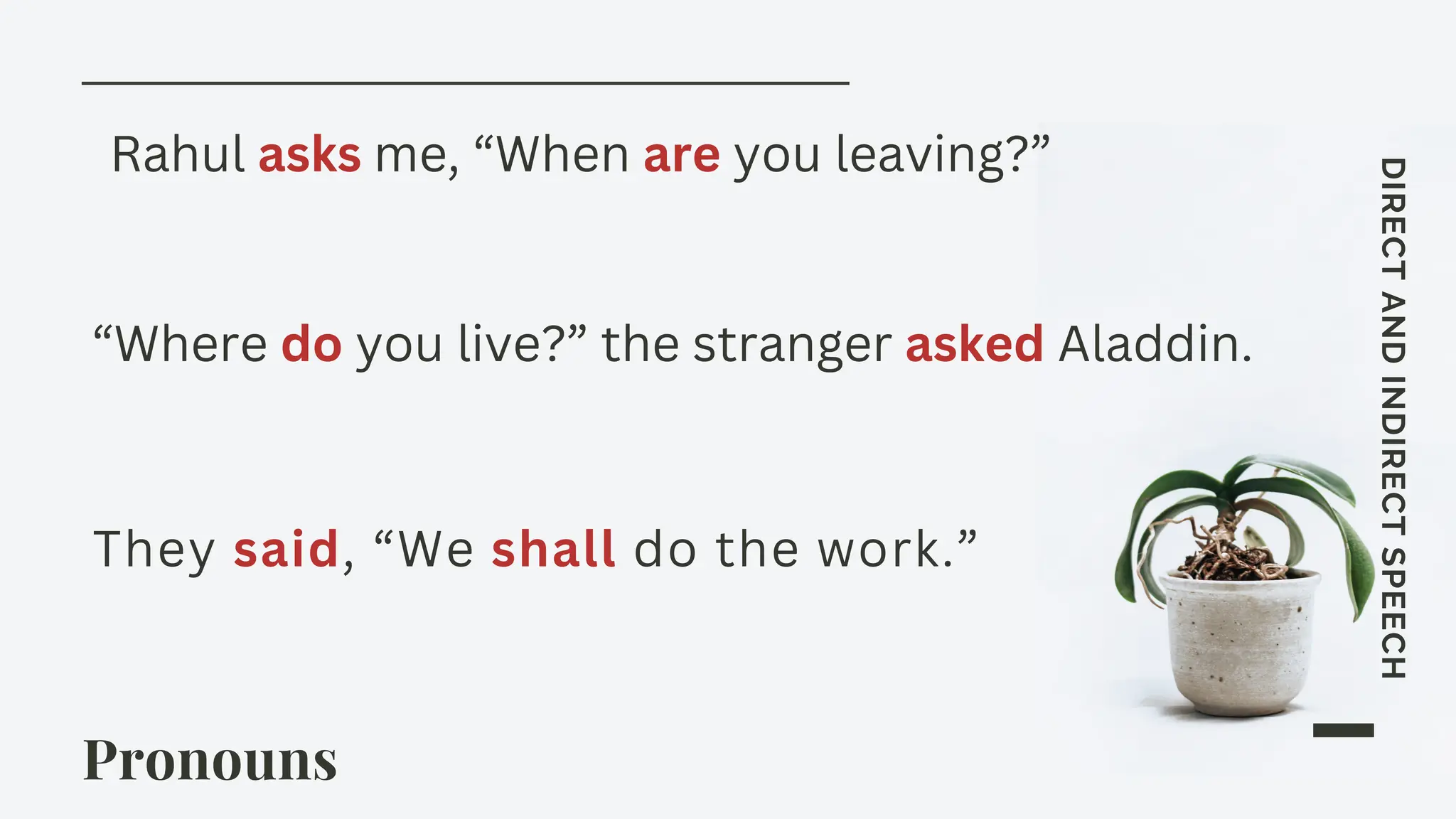
Rahul asks me, “When are you leaving?”
“Where do you live?” the stranger asked Aladdin.
They said, “We shall do the work.”
Pronouns
DIRECT
AND
INDIRECT
SPEECH
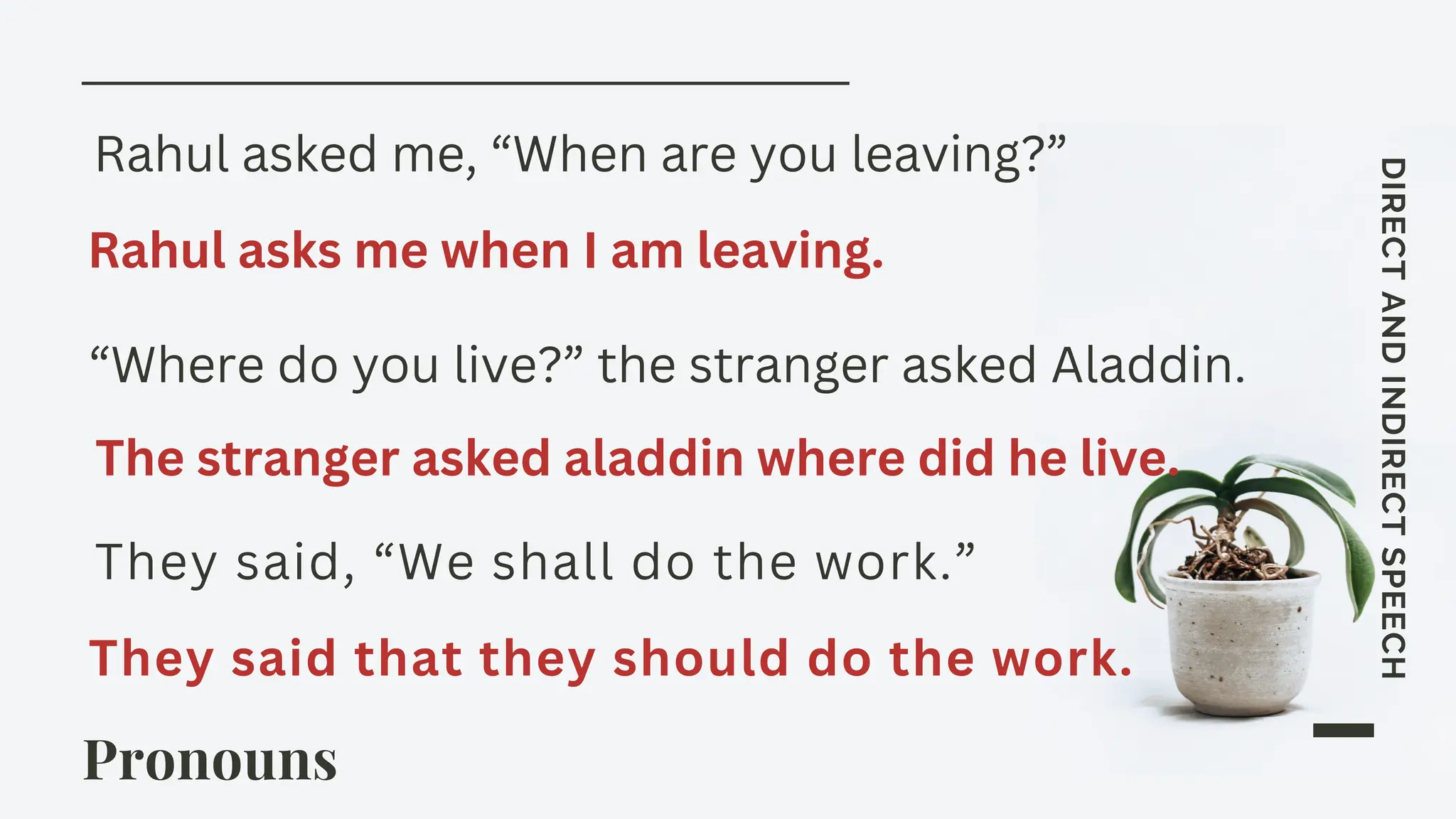
Rahul asked me, “When are you leaving?”
“Where do you live?” the stranger asked Aladdin.
They said, “We shall do the work.”
Rahul asks me when I am leaving.
The stranger asked aladdin where did he live.
They said that they should do the work.
Pronouns
DIRECT
AND
INDIRECT
SPEECH
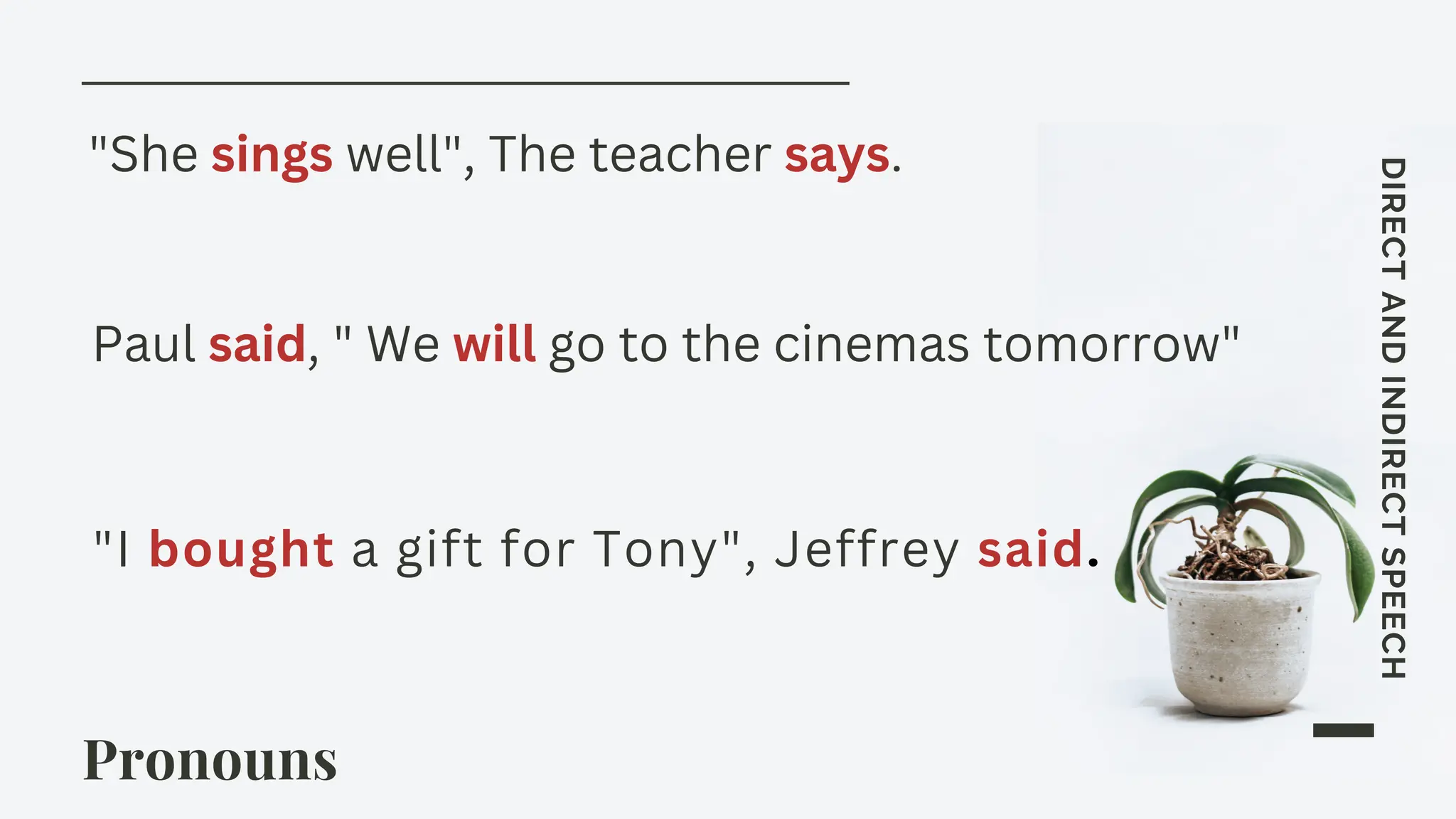
"She sings well", The teacher says.
Paul said, " We will go to the cinemas tomorrow"
"I bought a gift for Tony", Jeffrey said.
Pronouns
DIRECT
AND
INDIRECT
SPEECH
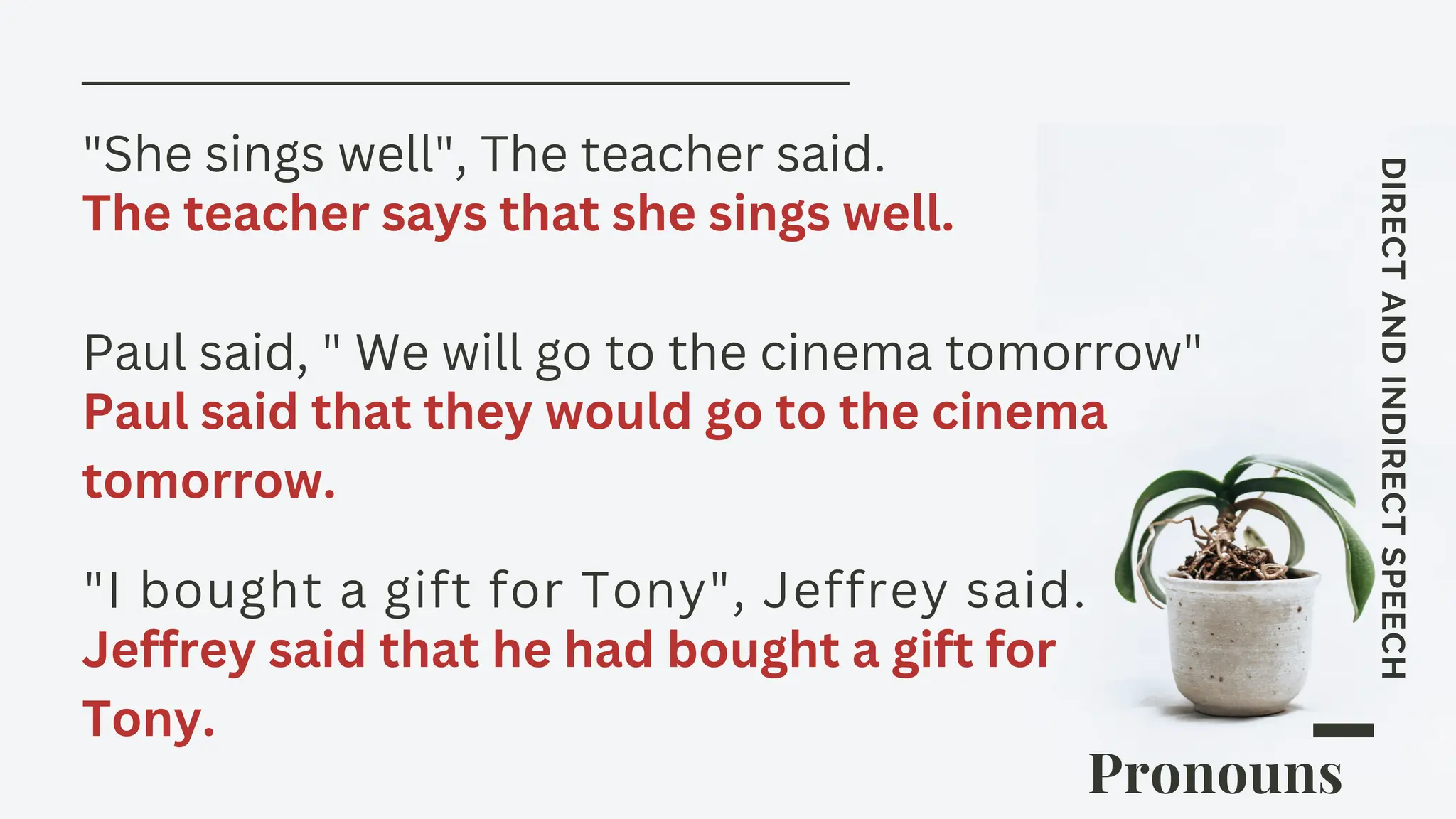
"She sings well", The teacher said.
Paul said, " We will go to the cinema tomorrow"
"I bought a gift for Tony", Jeffrey said.
The teacher says that she sings well.
Paul said that they would go to the cinema
tomorrow.
Jeffrey said that he had bought a gift for
Tony.
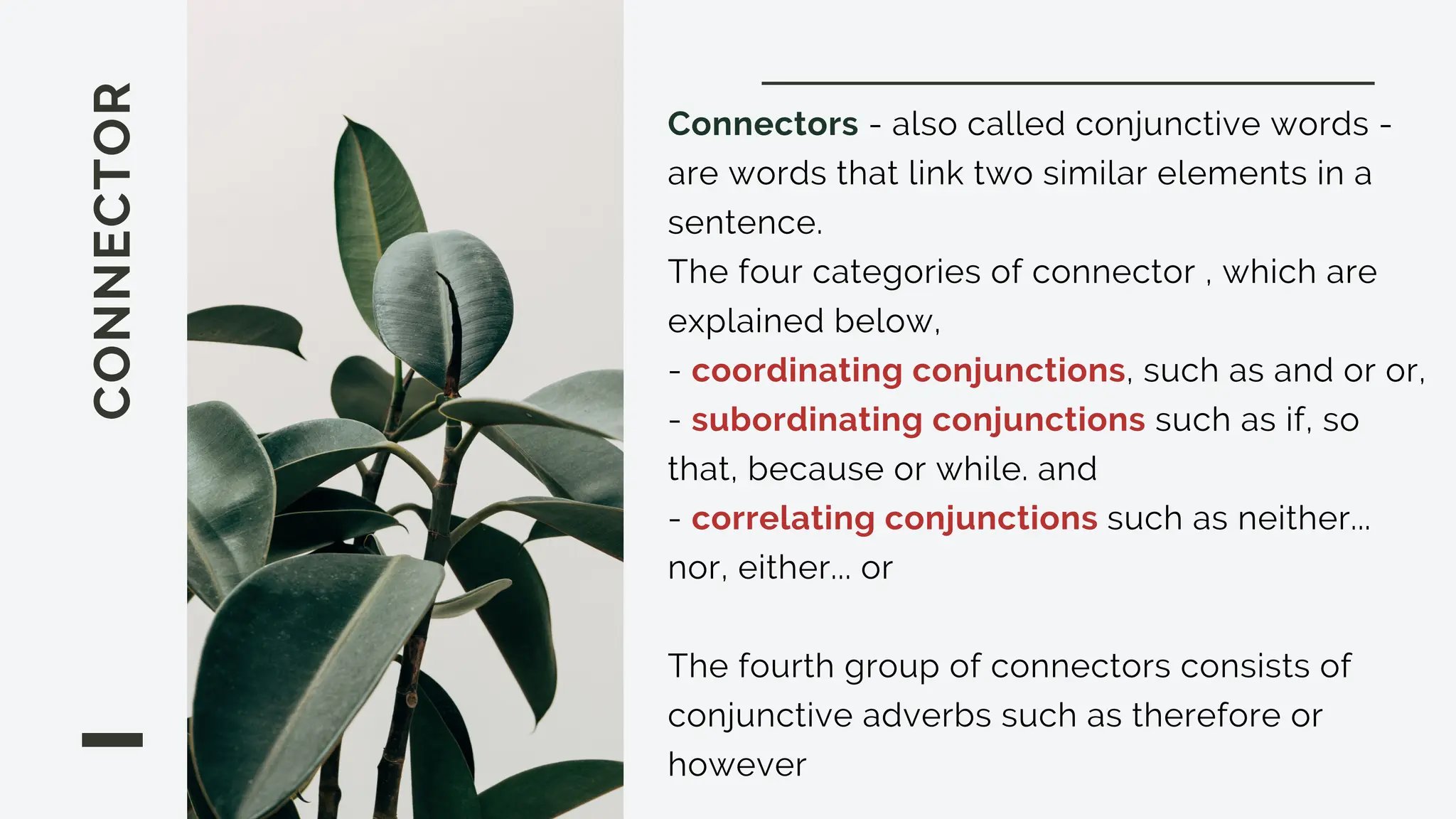
CONNECTOR Connectors - also called conjunctive words -
are words that link two similar elements in a
sentence.
The four categories of connector , which are
explained below,
- coordinating conjunctions, such as and or or,
- subordinating conjunctions such as if, so
that, because or while. and
- correlating conjunctions such as neither...
nor, either... or
The fourth group of connectors consists of
conjunctive adverbs such as therefore or
however
Connectors
DIRECT
AND
INDIRECT
SPEECH
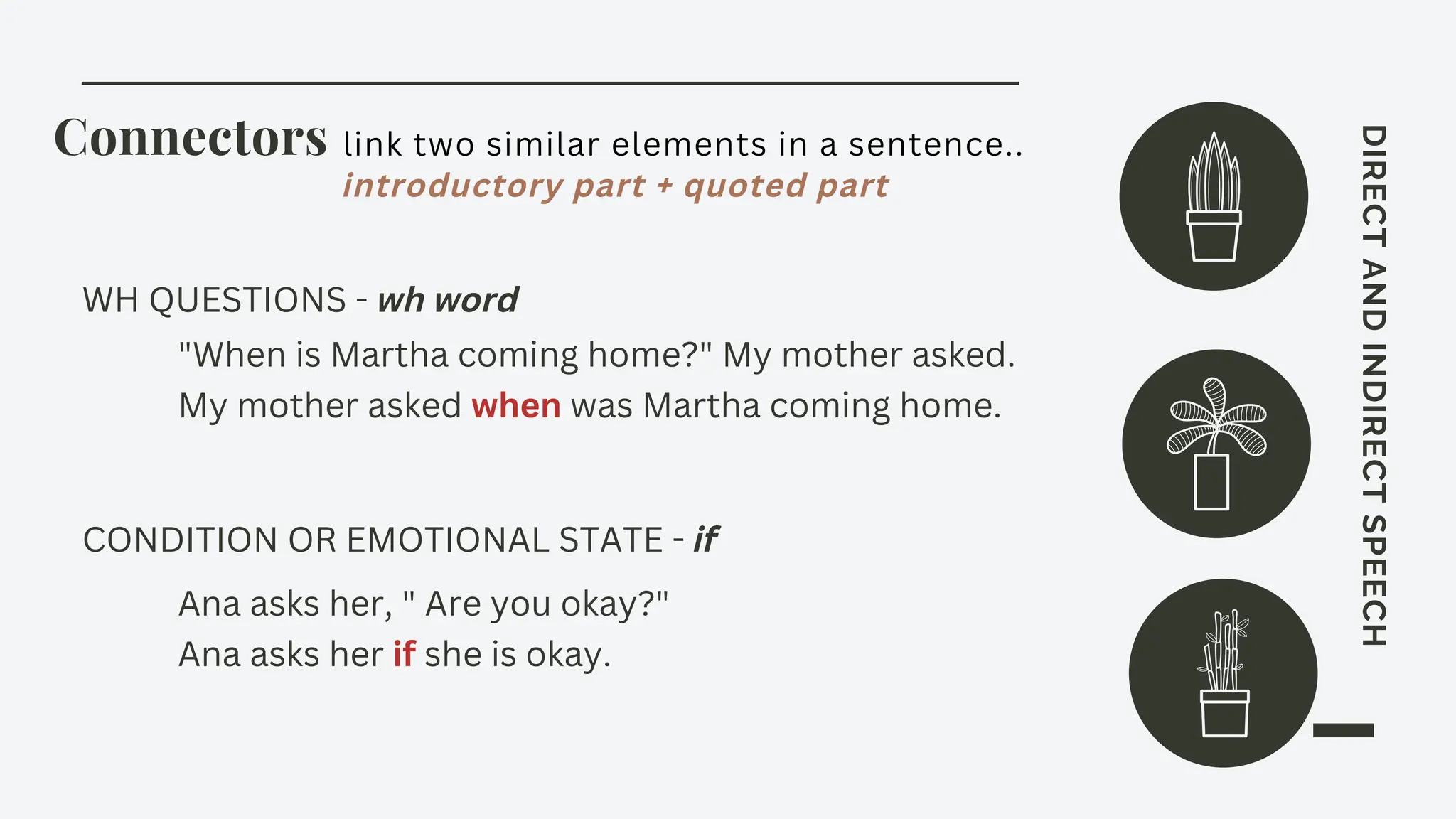
WH QUESTIONS - wh word
CONDITION OR EMOTIONAL STATE - if
Ana asks her, " Are you okay?"
Ana asks her if she is okay.
"When is Martha coming home?" My mother asked.
My mother asked when was Martha coming home.
link two similar elements in a sentence..
introductory part + quoted part
Connectors
DIRECT
AND
INDIRECT
SPEECH
COMMAND OR REQUEST - to
DECLARATIVE STATEMENT - that
"Go to your bed early", Mom told Diego.
Mom told Diego to go to bed early.
"We are getting late for the class", We told her.
We told her that we were getting late for the class.
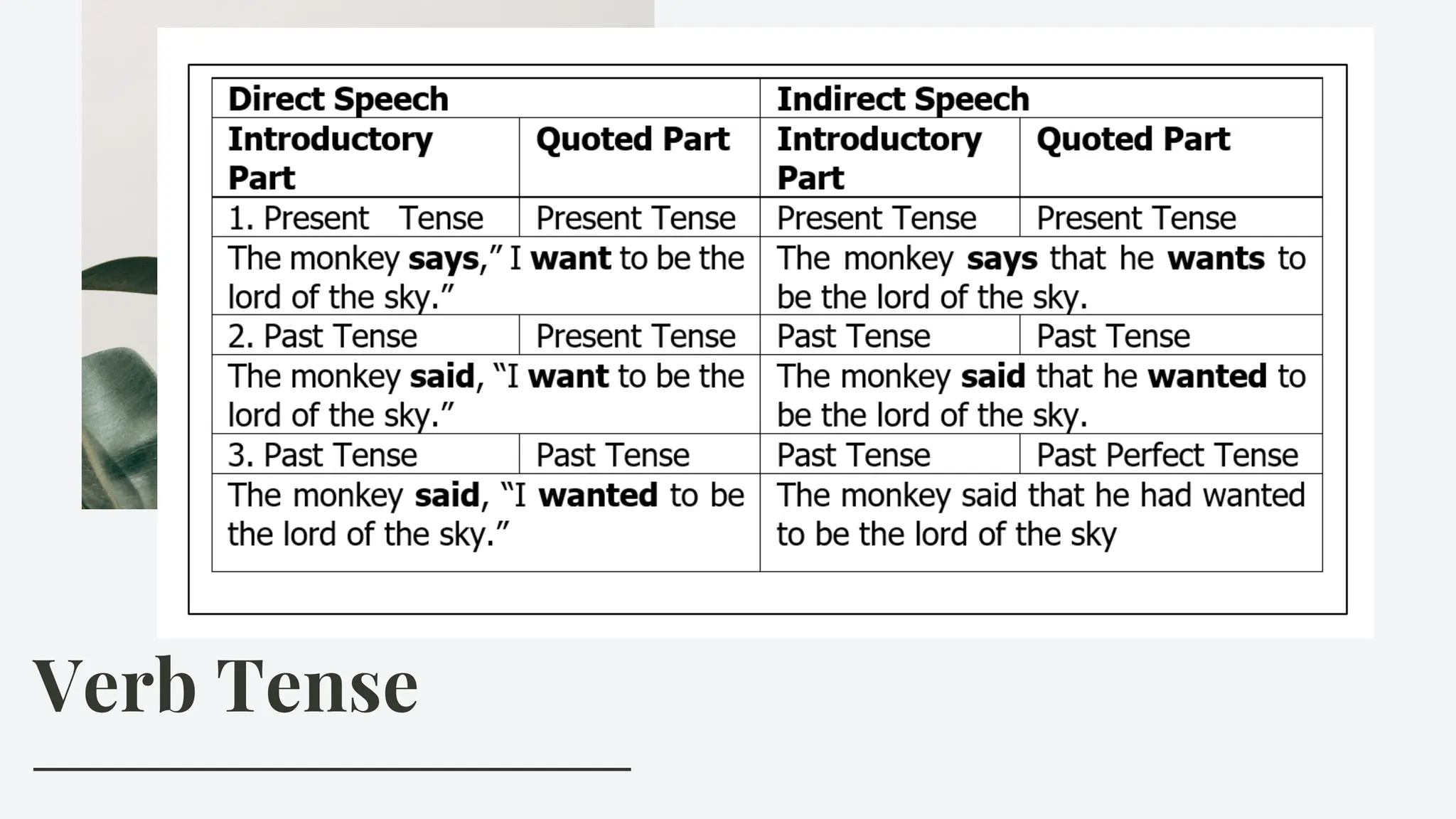
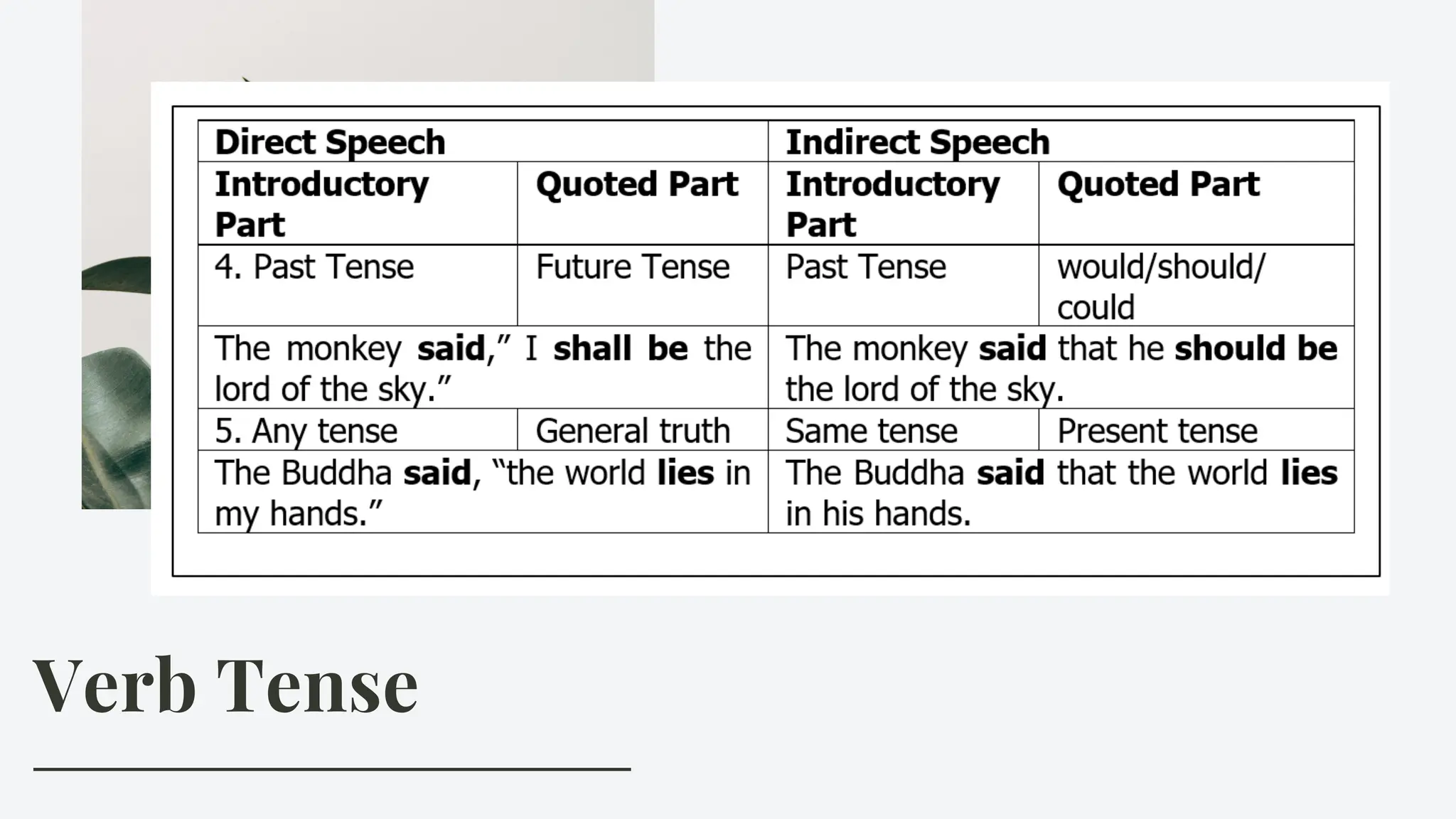
Verb Tense
Verb Tense
Connectors
DIRECT
AND
INDIRECT
SPEECH
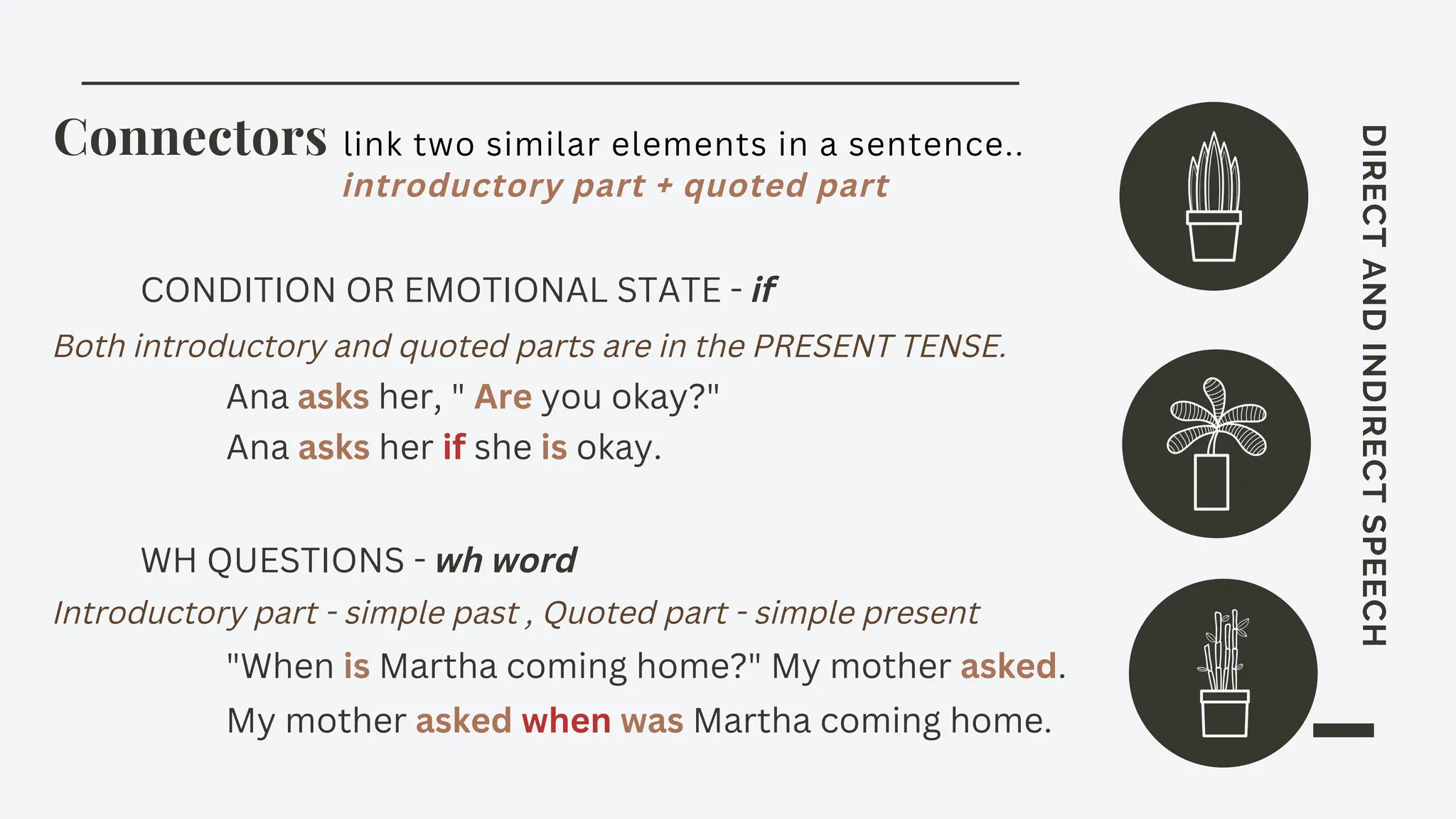
WH QUESTIONS - wh word
CONDITION OR EMOTIONAL STATE - if
Ana asks her, " Are you okay?"
Ana asks her if she is okay.
"When is Martha coming home?" My mother asked.
My mother asked when was Martha coming home.
link two similar elements in a sentence..
introductory part + quoted part
Both introductory and quoted parts are in the PRESENT TENSE.
Introductory part - simple past , Quoted part - simple present
Connectors
DIRECT
AND
INDIRECT
SPEECH
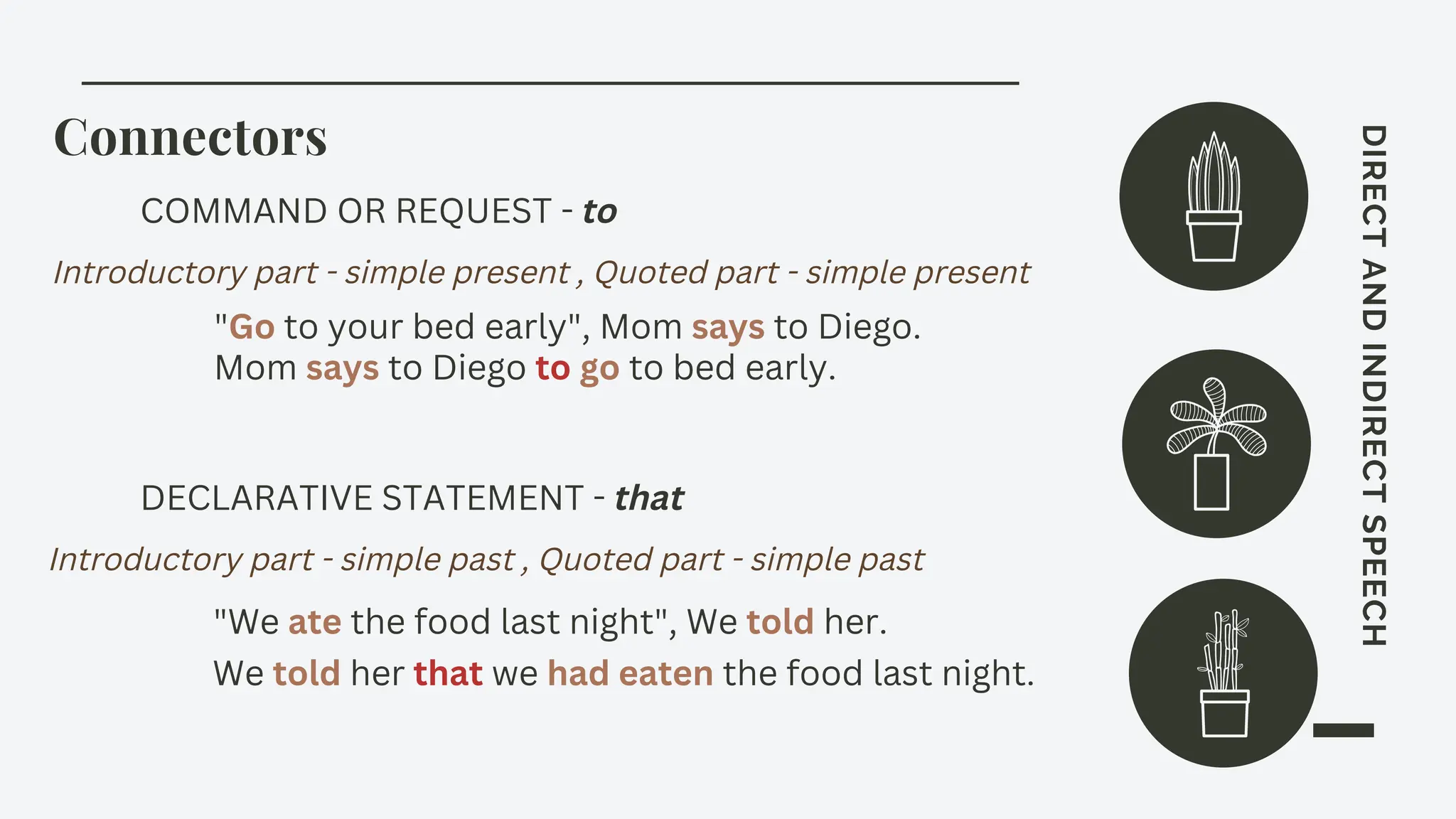
COMMAND OR REQUEST - to
DECLARATIVE STATEMENT - that
"Go to your bed early", Mom says to Diego.
Mom says to Diego to go to bed early.
"We ate the food last night", We told her.
We told her that we had eaten the food last night.
Introductory part - simple present , Quoted part - simple present
Introductory part - simple past , Quoted part - simple past
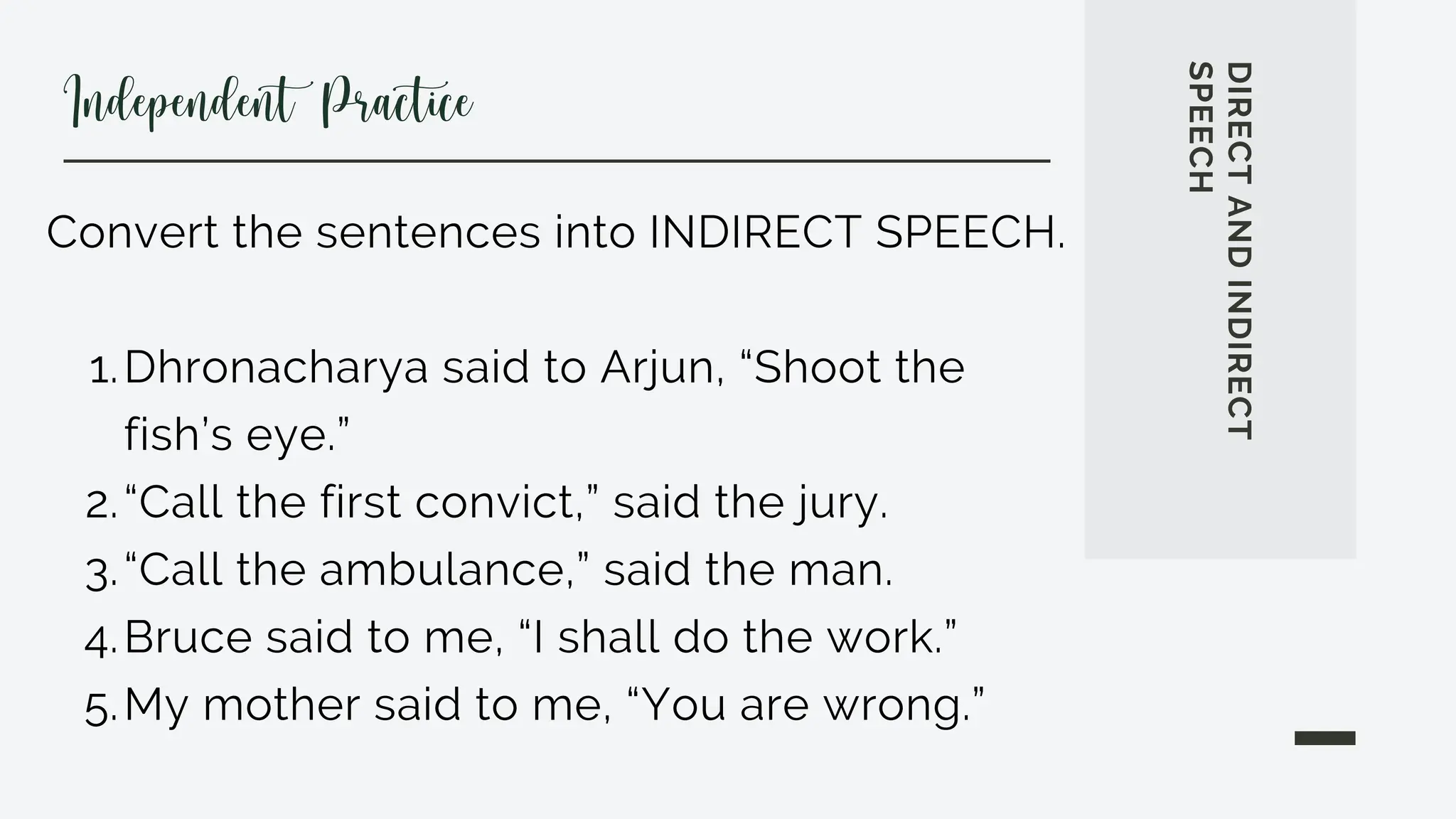
Dhronacharya said to Arjun, “Shoot the
fish’s eye.”
“Call the first convict,” said the jury.
“Call the ambulance,” said the man.
Bruce said to me, “I shall do the work.”
My mother said to me, “You are wrong.”
Convert the sentences into INDIRECT SPEECH.
1.
2.
3.
4.
5.
DIRECT
AND
INDIRECT
SPEECH
Independent Practice
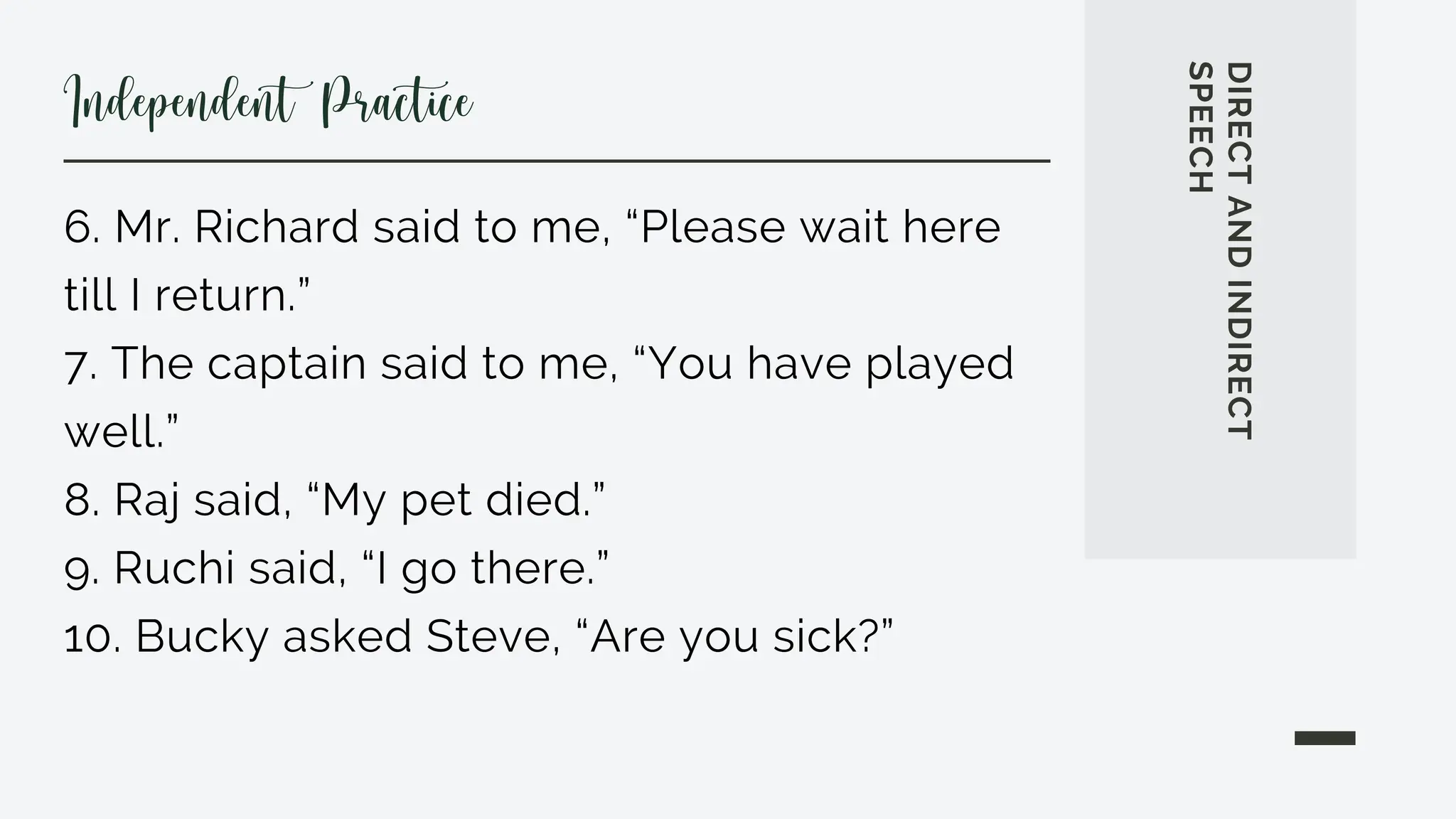
6. Mr. Richard said to me, “Please wait here
till I return.”
7. The captain said to me, “You have played
well.”
8. Raj said, “My pet died.”
9. Ruchi said, “I go there.”
10. Bucky asked Steve, “Are you sick?”
DIRECT
AND
INDIRECT
SPEECH
Independent Practice
DIRECT
AND
INDIRECT
SPEECH
LET'S
TRY
THIS!
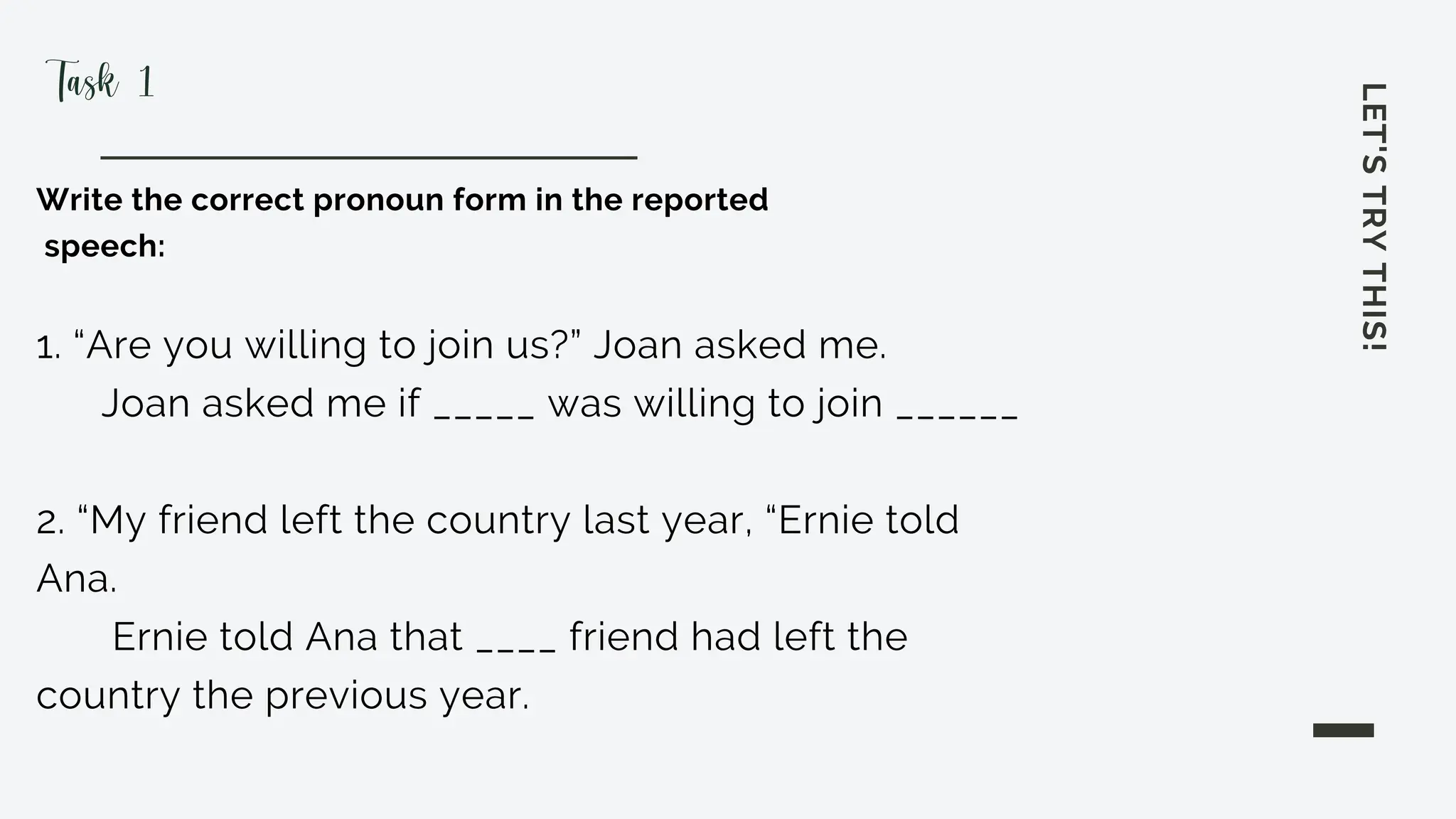
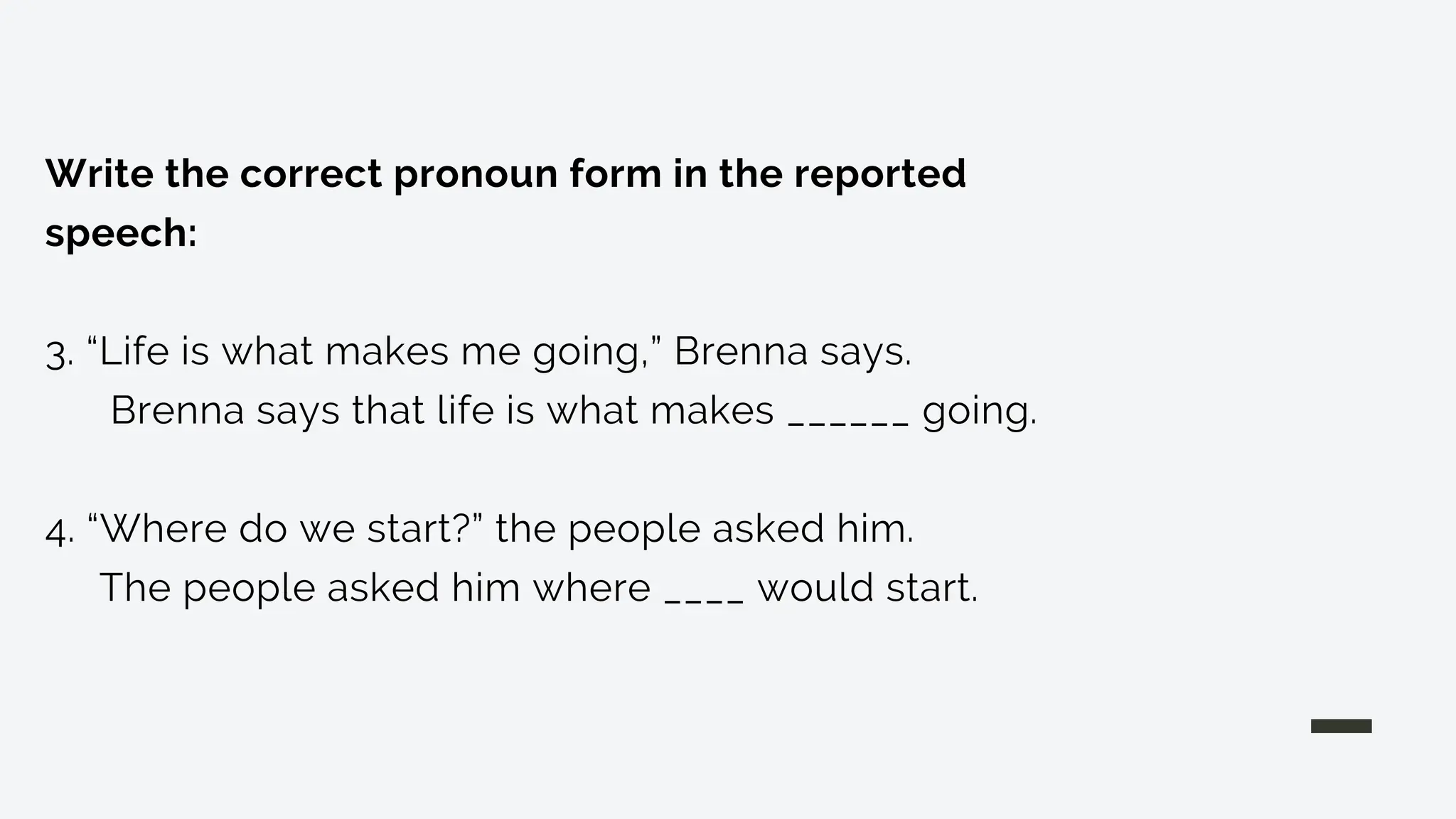
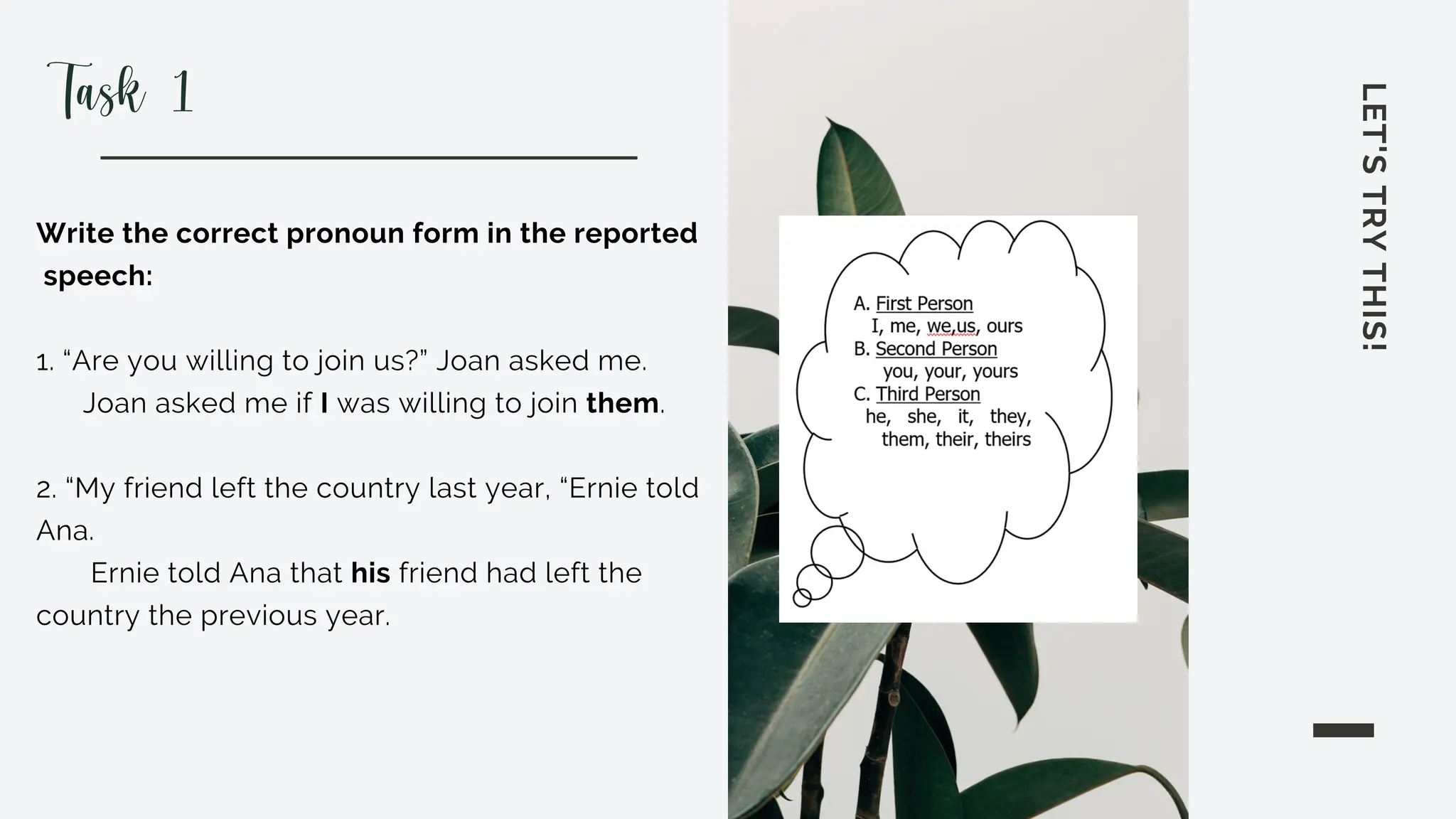
Write the correct pronoun form in the reported
speech:
1. “Are you willing to join us?” Joan asked me.
Joan asked me if _____ was willing to join ______
2. “My friend left the country last year, “Ernie told
Ana.
Ernie told Ana that ____ friend had left the
country the previous year.
Task 1
Write the correct pronoun form in the reported
speech:
3. “Life is what makes me going,” Brenna says.
Brenna says that life is what makes ______ going.
4. “Where do we start?” the people asked him.
The people asked him where ____ would start.
LET'S
TRY
THIS!
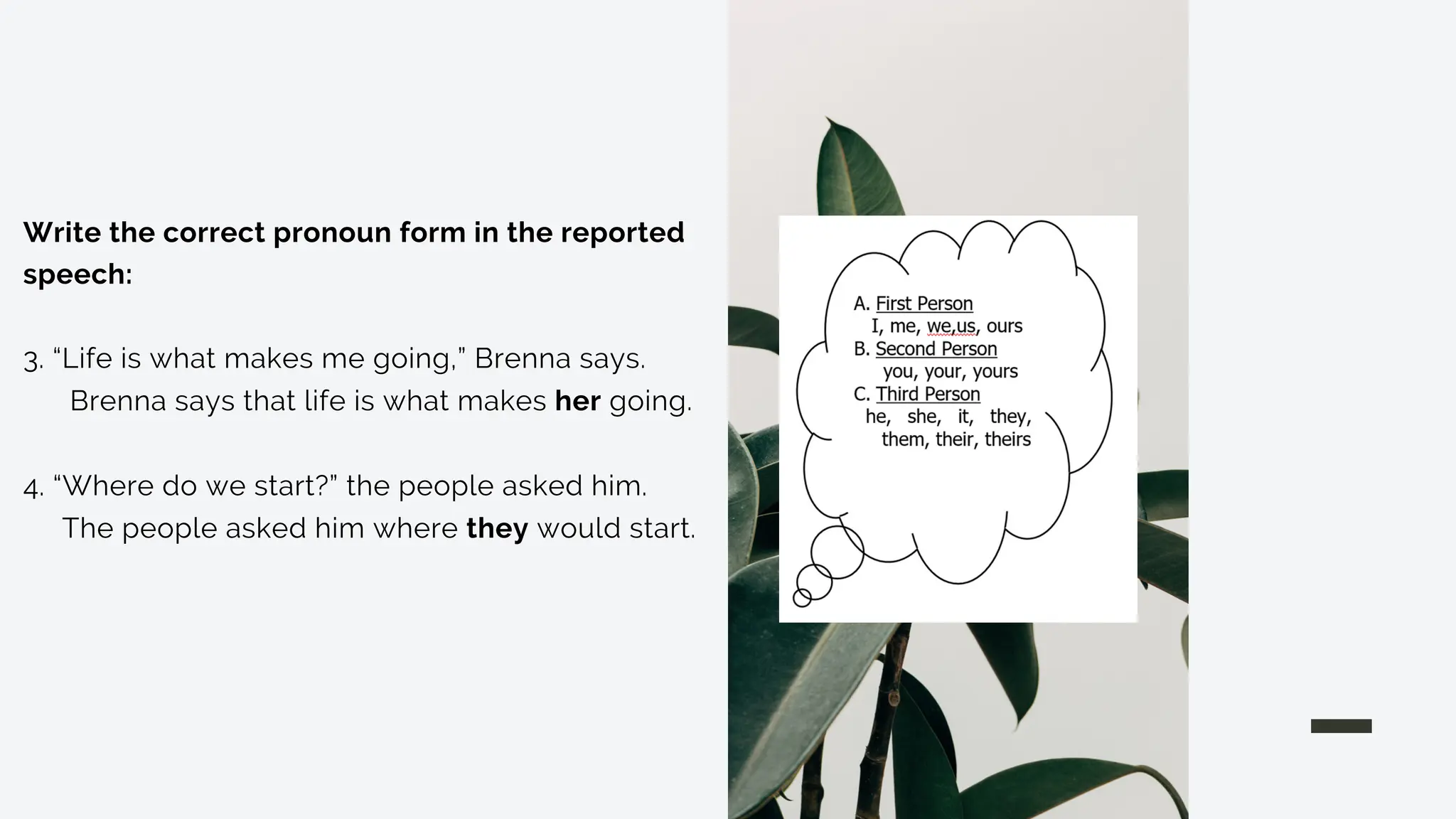
Write the correct pronoun form in the reported
speech:
1. “Are you willing to join us?” Joan asked me.
Joan asked me if I was willing to join them.
2. “My friend left the country last year, “Ernie told
Ana.
Ernie told Ana that his friend had left the
country the previous year.
Task 1
Write the correct pronoun form in the reported
speech:
3. “Life is what makes me going,” Brenna says.
Brenna says that life is what makes her going.
4. “Where do we start?” the people asked him.
The people asked him where they would start.
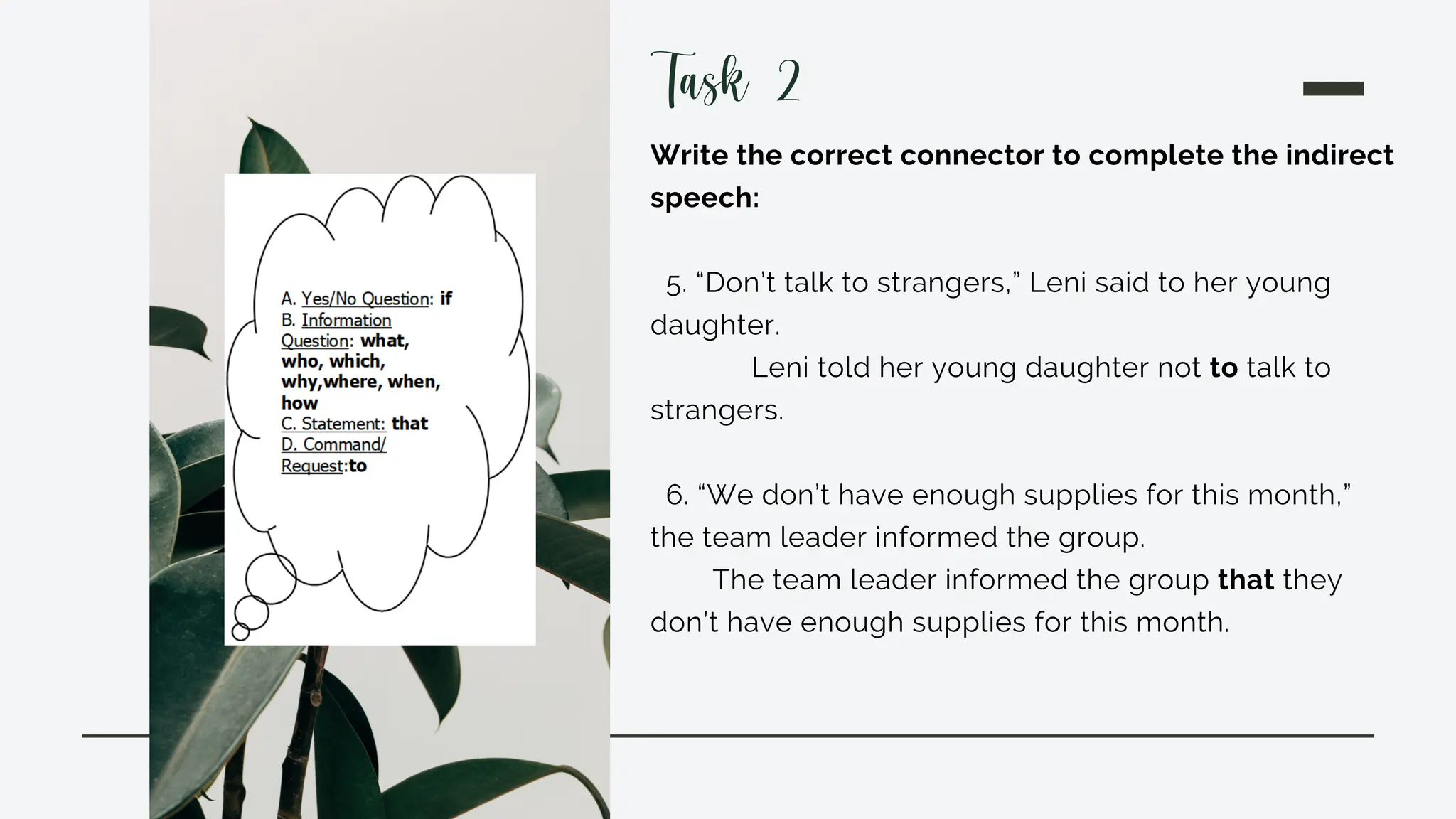
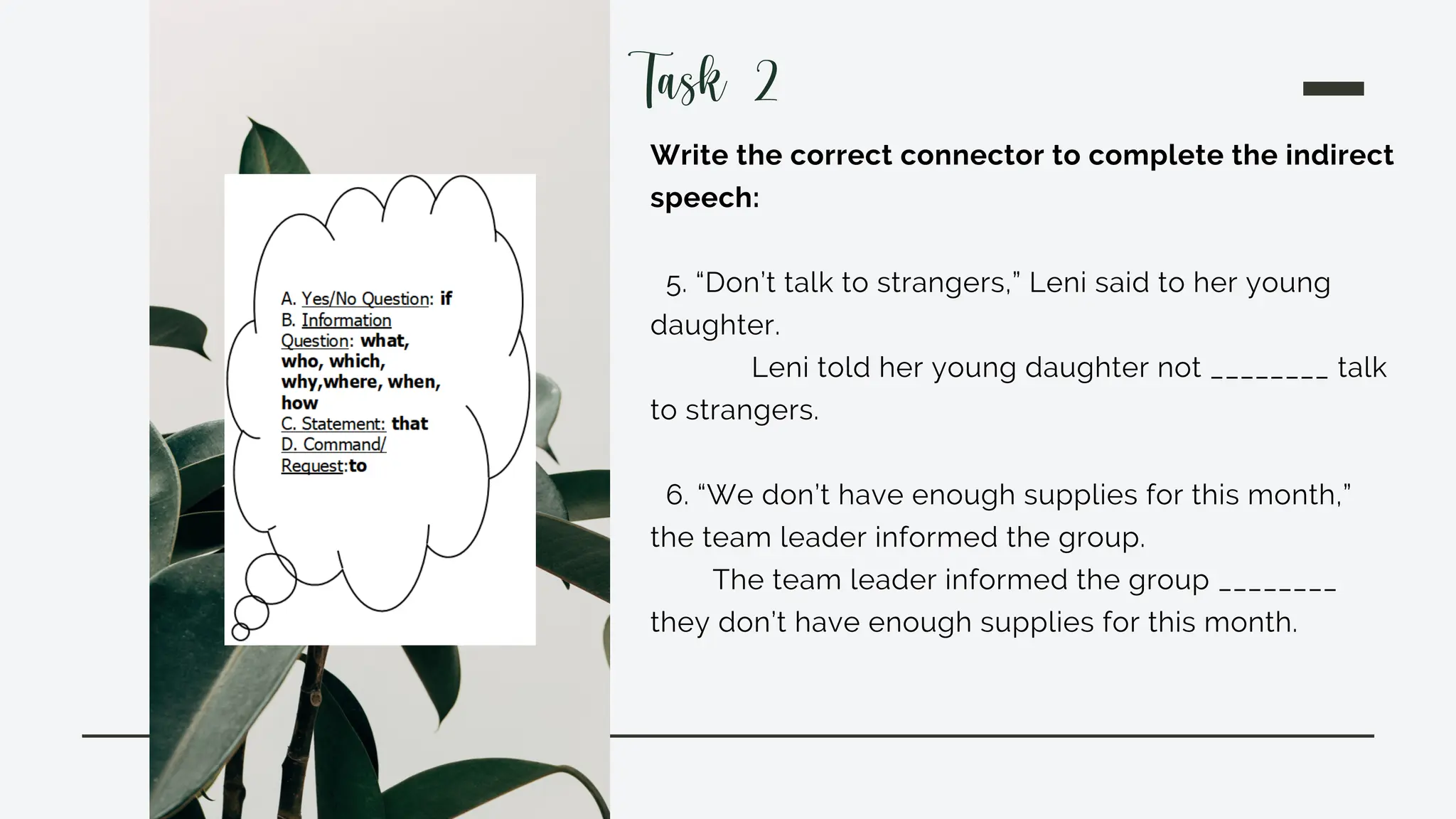
Write the correct connector to complete the indirect
speech:
5. “Don’t talk to strangers,” Leni said to her young
daughter.
Leni told her young daughter not ________ talk
to strangers.
6. “We don’t have enough supplies for this month,”
the team leader informed the group.
The team leader informed the group ________
they don’t have enough supplies for this month.
Task 2
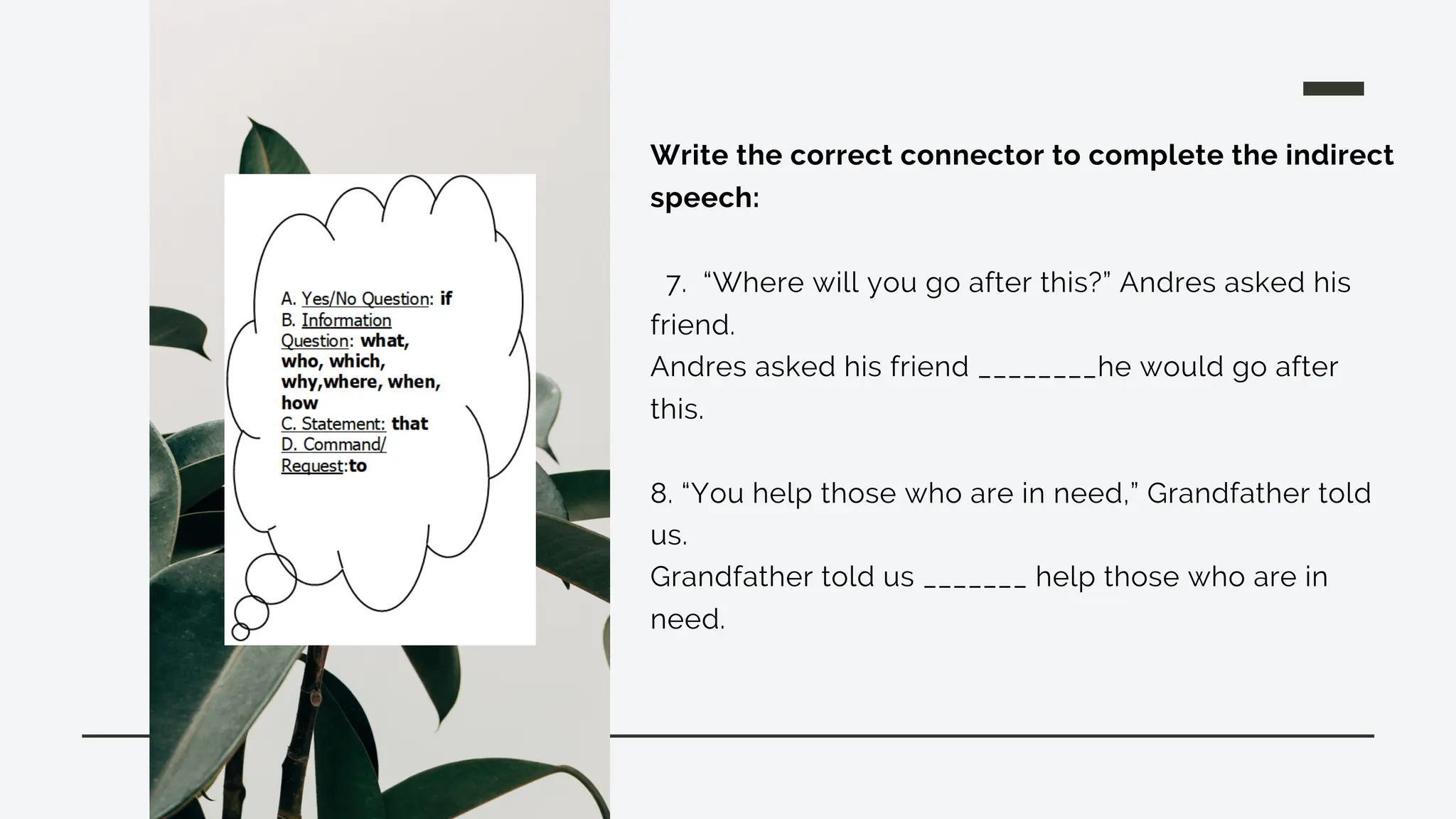
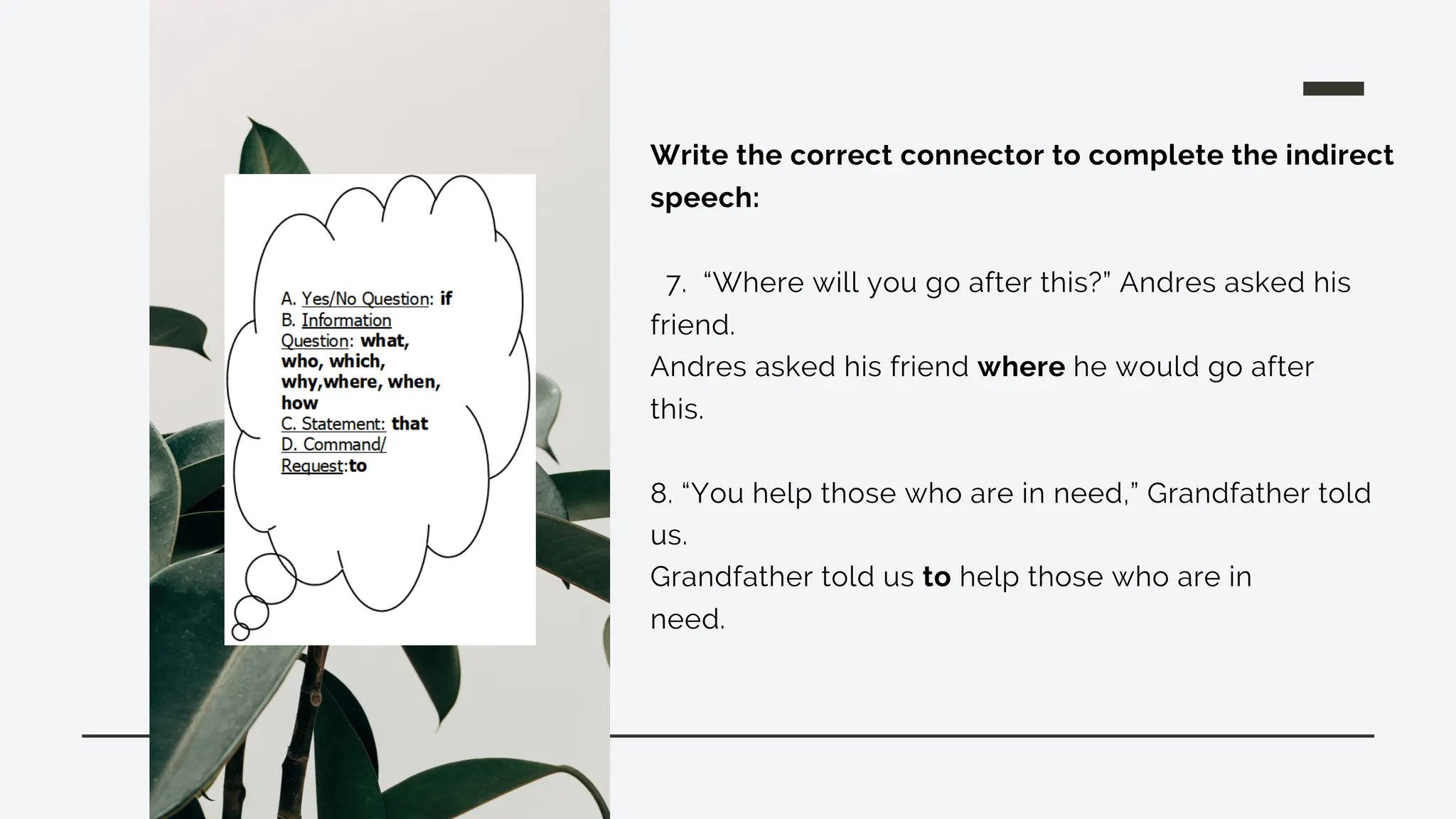
Write the correct connector to complete the indirect
speech:
7. “Where will you go after this?” Andres asked his
friend.
Andres asked his friend ________he would go after
this.
8. “You help those who are in need,” Grandfather told
us.
Grandfather told us _______ help those who are in
need.
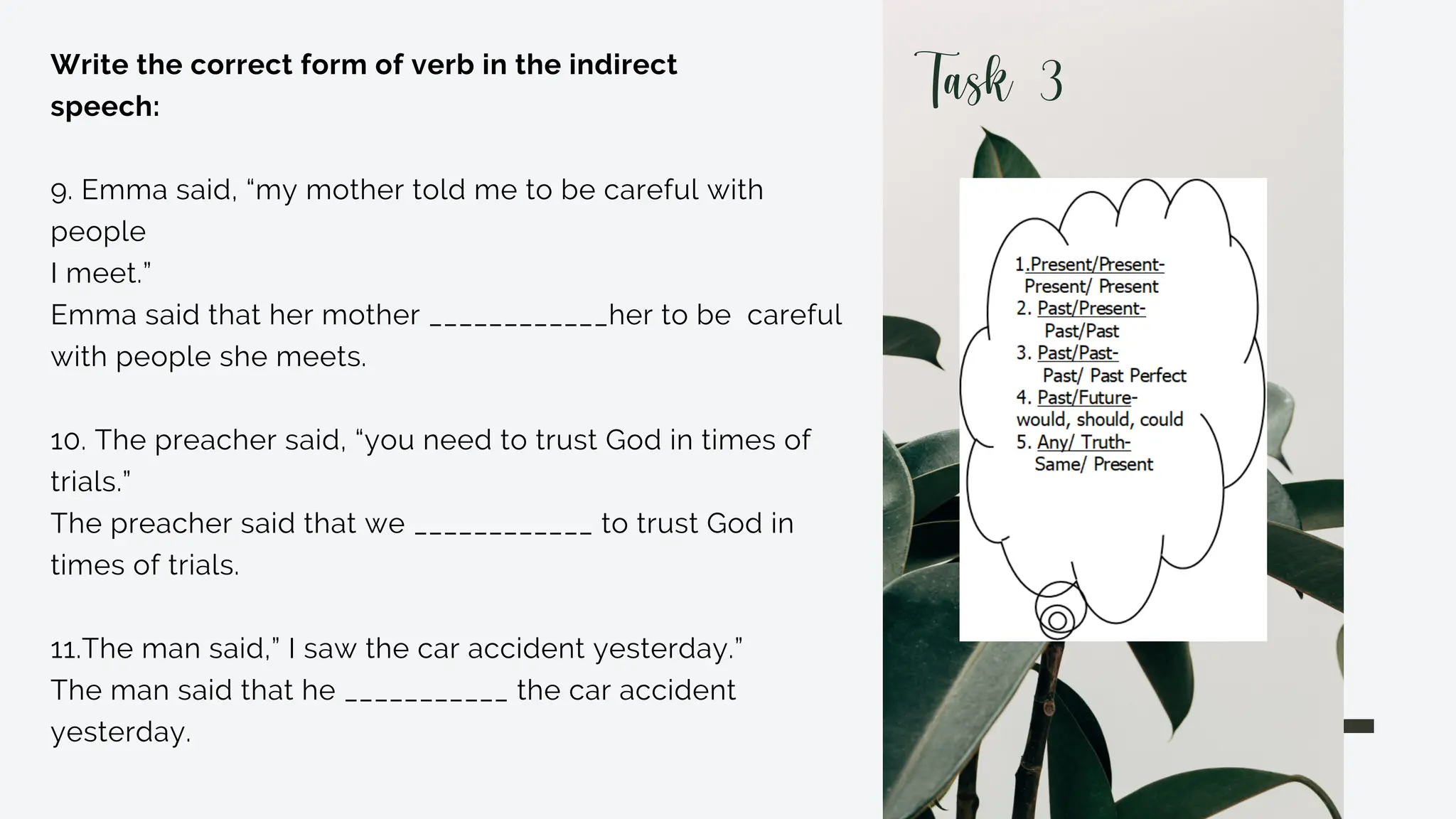
Write the correct form of verb in the indirect
speech:
9. Emma said, “my mother told me to be careful with
people
I meet.”
Emma said that her mother ____________her to be careful
with people she meets.
10. The preacher said, “you need to trust God in times of
trials.”
The preacher said that we ____________ to trust God in
times of trials.
11.The man said,” I saw the car accident yesterday.”
The man said that he ___________ the car accident
yesterday.
Task 3
Write the correct connector to complete the indirect
speech:
5. “Don’t talk to strangers,” Leni said to her young
daughter.
Leni told her young daughter not to talk to
strangers.
6. “We don’t have enough supplies for this month,”
the team leader informed the group.
The team leader informed the group that they
don’t have enough supplies for this month.
Task 2
Write the correct connector to complete the indirect
speech:
7. “Where will you go after this?” Andres asked his
friend.
Andres asked his friend where he would go after
this.
8. “You help those who are in need,” Grandfather told
us.
Grandfather told us to help those who are in
need.
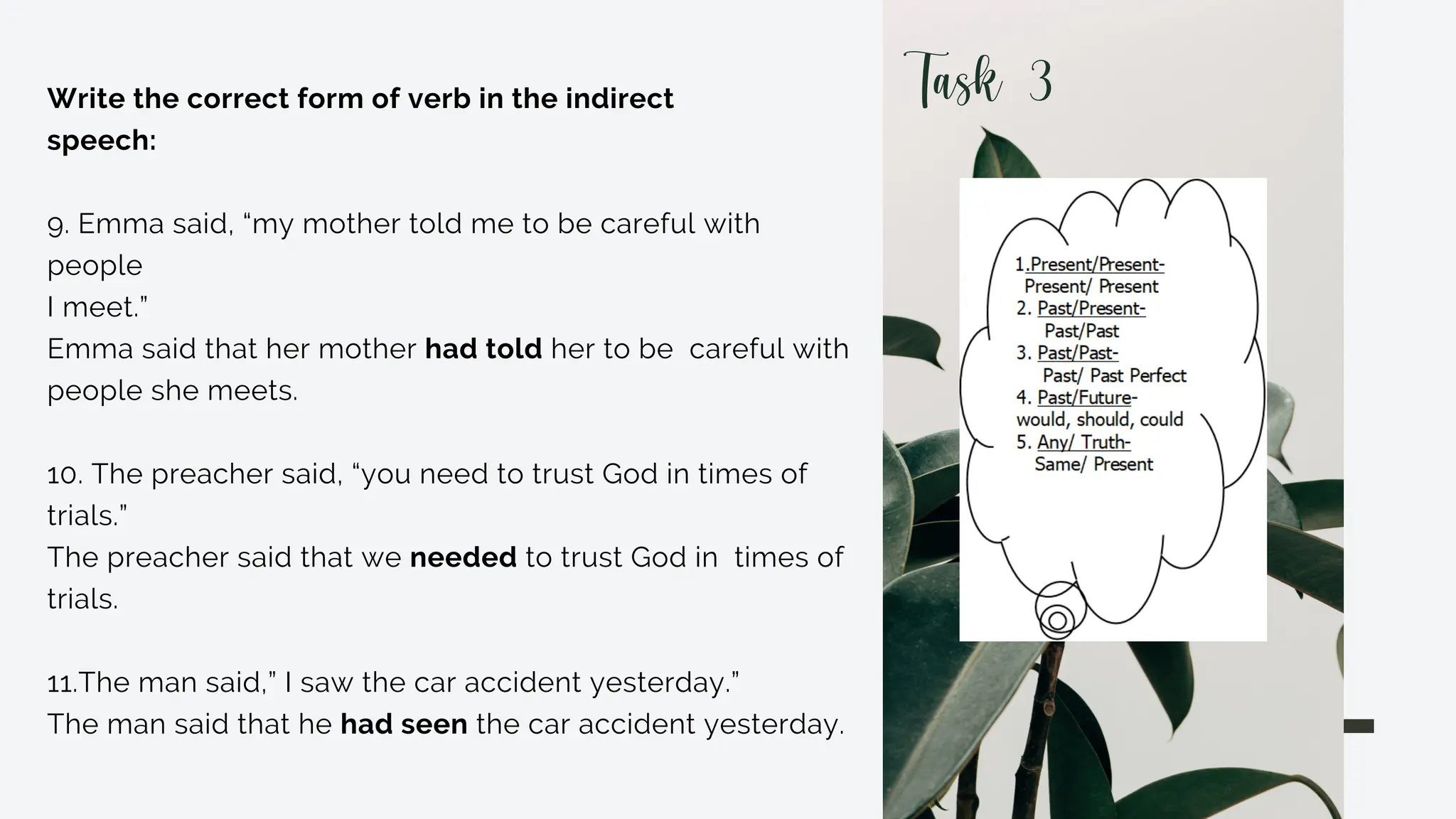
Write the correct form of verb in the indirect
speech:
9. Emma said, “my mother told me to be careful with
people
I meet.”
Emma said that her mother had told her to be careful with
people she meets.
10. The preacher said, “you need to trust God in times of
trials.”
The preacher said that we needed to trust God in times of
trials.
11.The man said,” I saw the car accident yesterday.”
The man said that he had seen the car accident yesterday.
Task 3
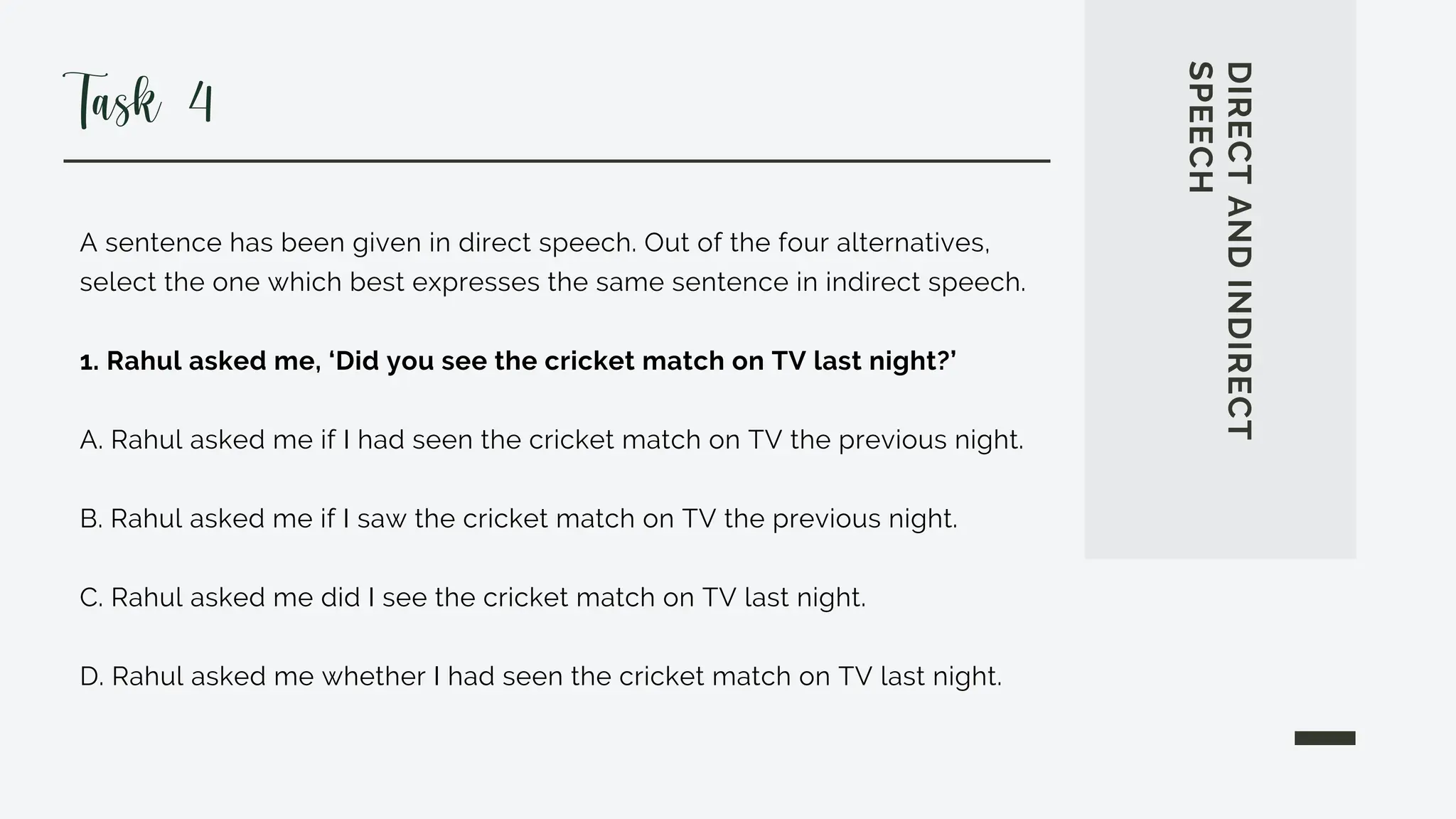
A sentence has been given in direct speech. Out of the four alternatives,
select the one which best expresses the same sentence in indirect speech.
1. Rahul asked me, ‘Did you see the cricket match on TV last night?’
A. Rahul asked me if I had seen the cricket match on TV the previous night.
B. Rahul asked me if I saw the cricket match on TV the previous night.
C. Rahul asked me did I see the cricket match on TV last night.
D. Rahul asked me whether I had seen the cricket match on TV last night.
DIRECT
AND
INDIRECT
SPEECH
Task 4
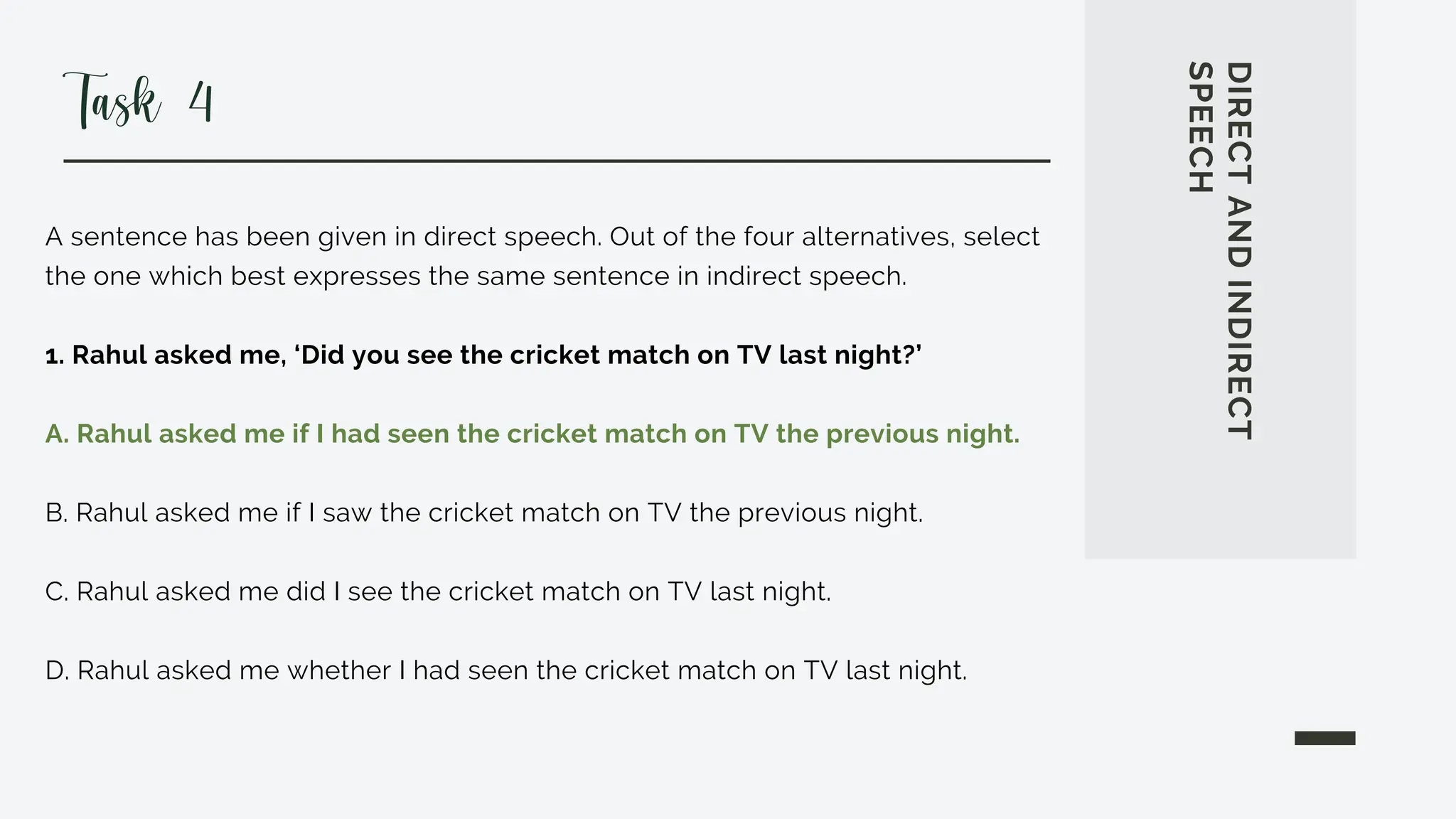
A sentence has been given in direct speech. Out of the four alternatives, select
the one which best expresses the same sentence in indirect speech.
1. Rahul asked me, ‘Did you see the cricket match on TV last night?’
A. Rahul asked me if I had seen the cricket match on TV the previous night.
B. Rahul asked me if I saw the cricket match on TV the previous night.
C. Rahul asked me did I see the cricket match on TV last night.
D. Rahul asked me whether I had seen the cricket match on TV last night.
DIRECT
AND
INDIRECT
SPEECH
Task 4
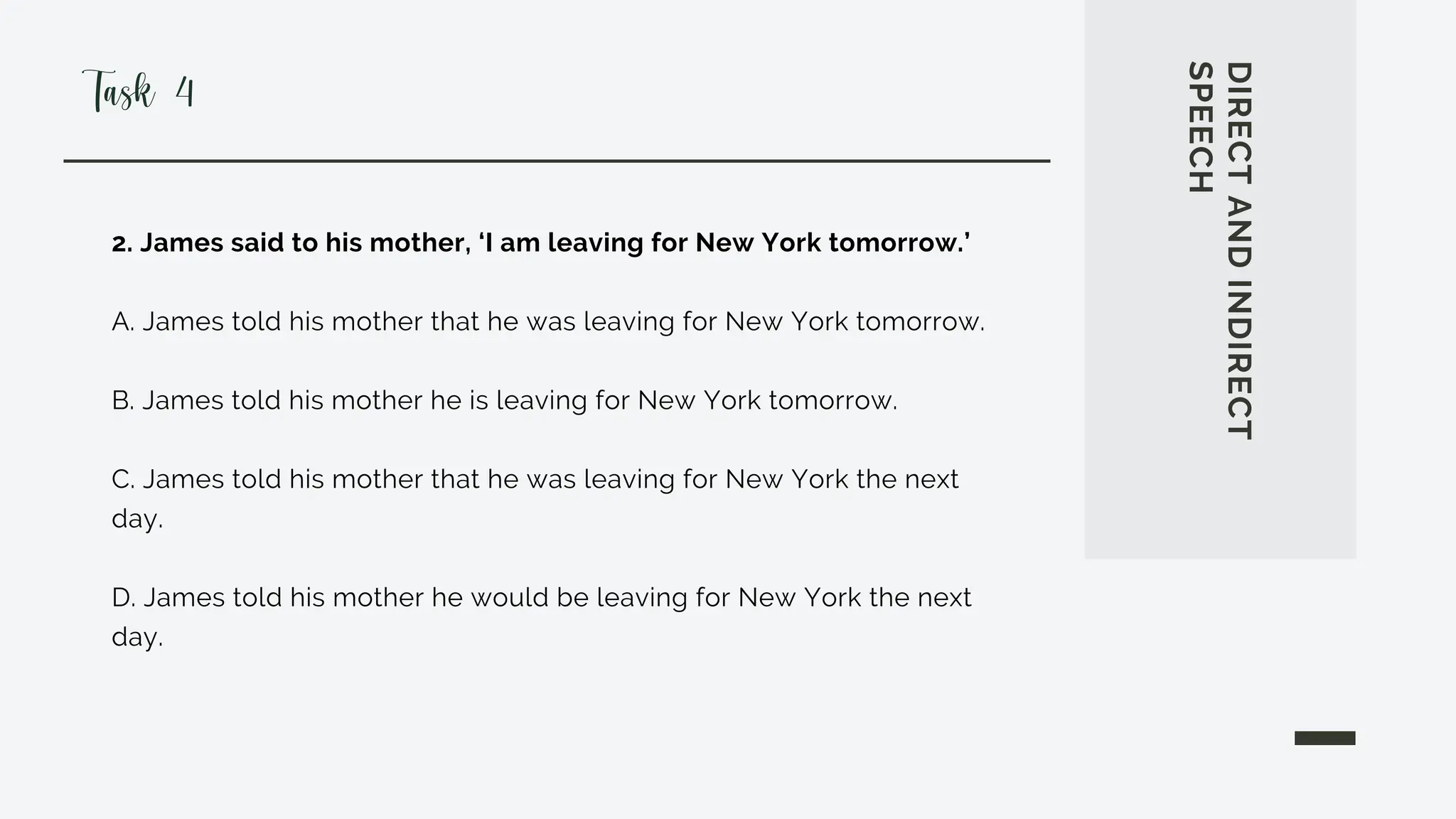
2. James said to his mother, ‘I am leaving for New York tomorrow.’
A. James told his mother that he was leaving for New York tomorrow.
B. James told his mother he is leaving for New York tomorrow.
C. James told his mother that he was leaving for New York the next
day.
D. James told his mother he would be leaving for New York the next
day.
DIRECT
AND
INDIRECT
SPEECH
Task 4
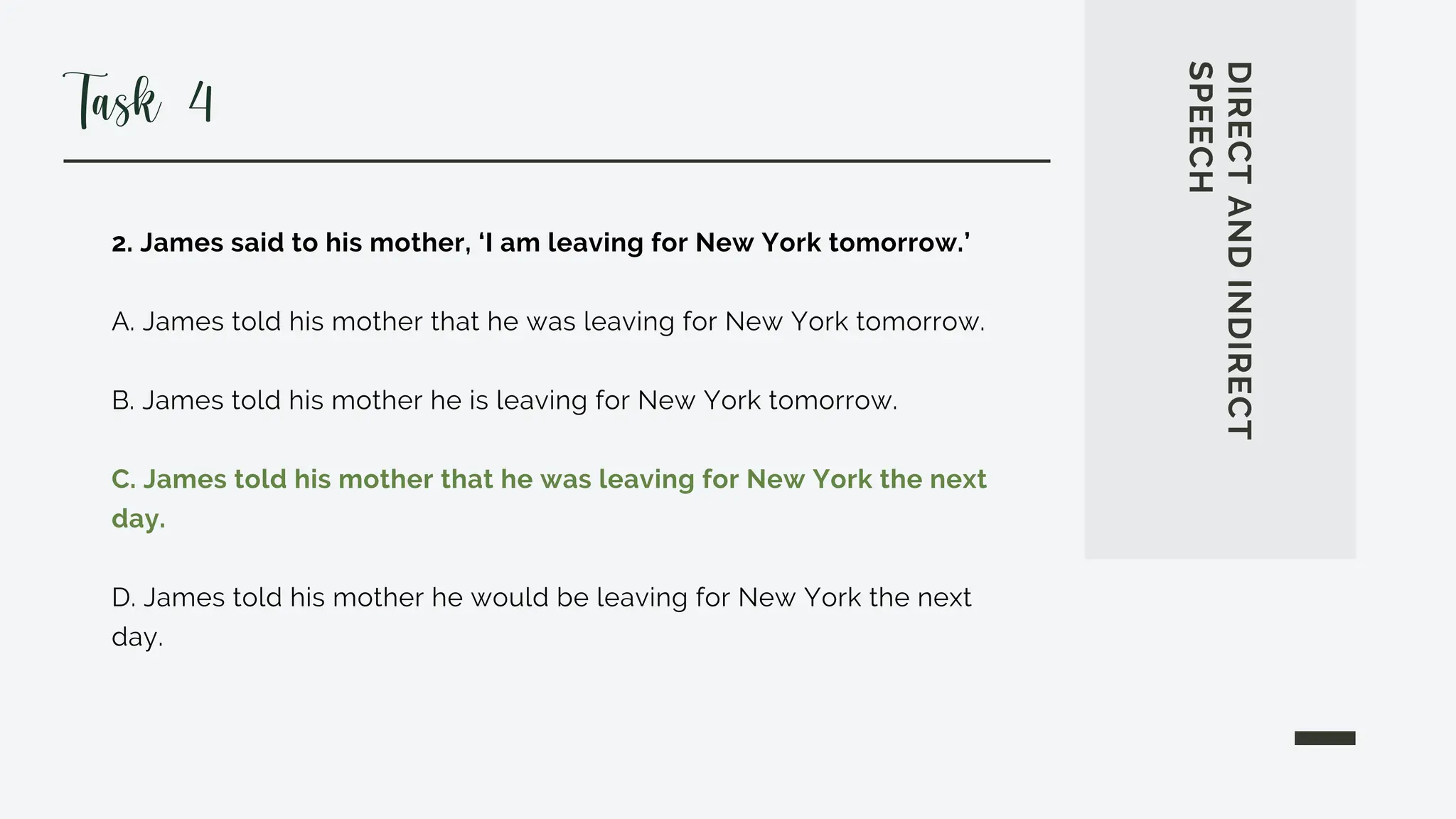
2. James said to his mother, ‘I am leaving for New York tomorrow.’
A. James told his mother that he was leaving for New York tomorrow.
B. James told his mother he is leaving for New York tomorrow.
C. James told his mother that he was leaving for New York the next
day.
D. James told his mother he would be leaving for New York the next
day.
DIRECT
AND
INDIRECT
SPEECH
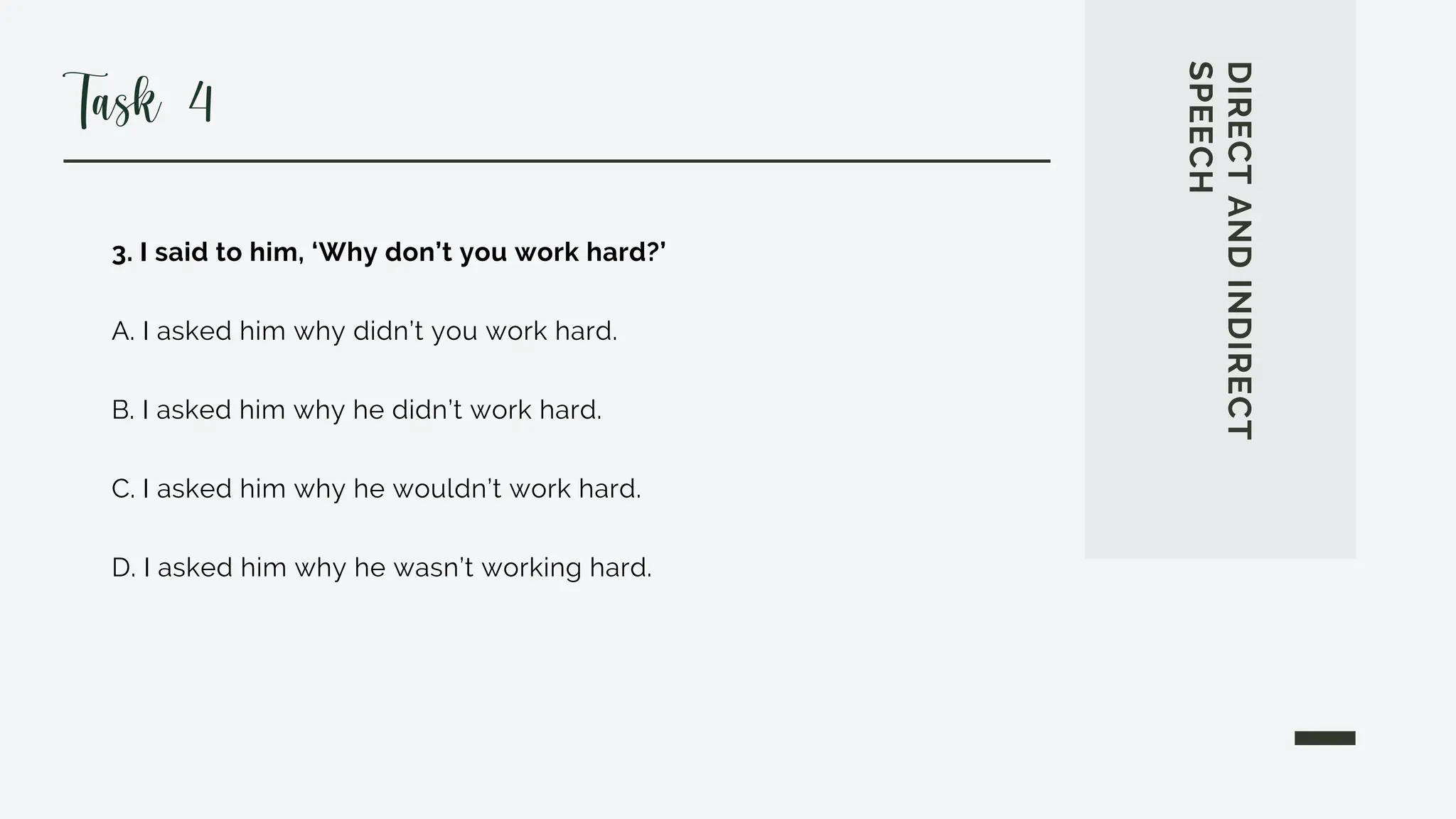
Task 4
3. I said to him, ‘Why don’t you work hard?’
A. I asked him why didn’t you work hard.
B. I asked him why he didn’t work hard.
C. I asked him why he wouldn’t work hard.
D. I asked him why he wasn’t working hard.
DIRECT
AND
INDIRECT
SPEECH
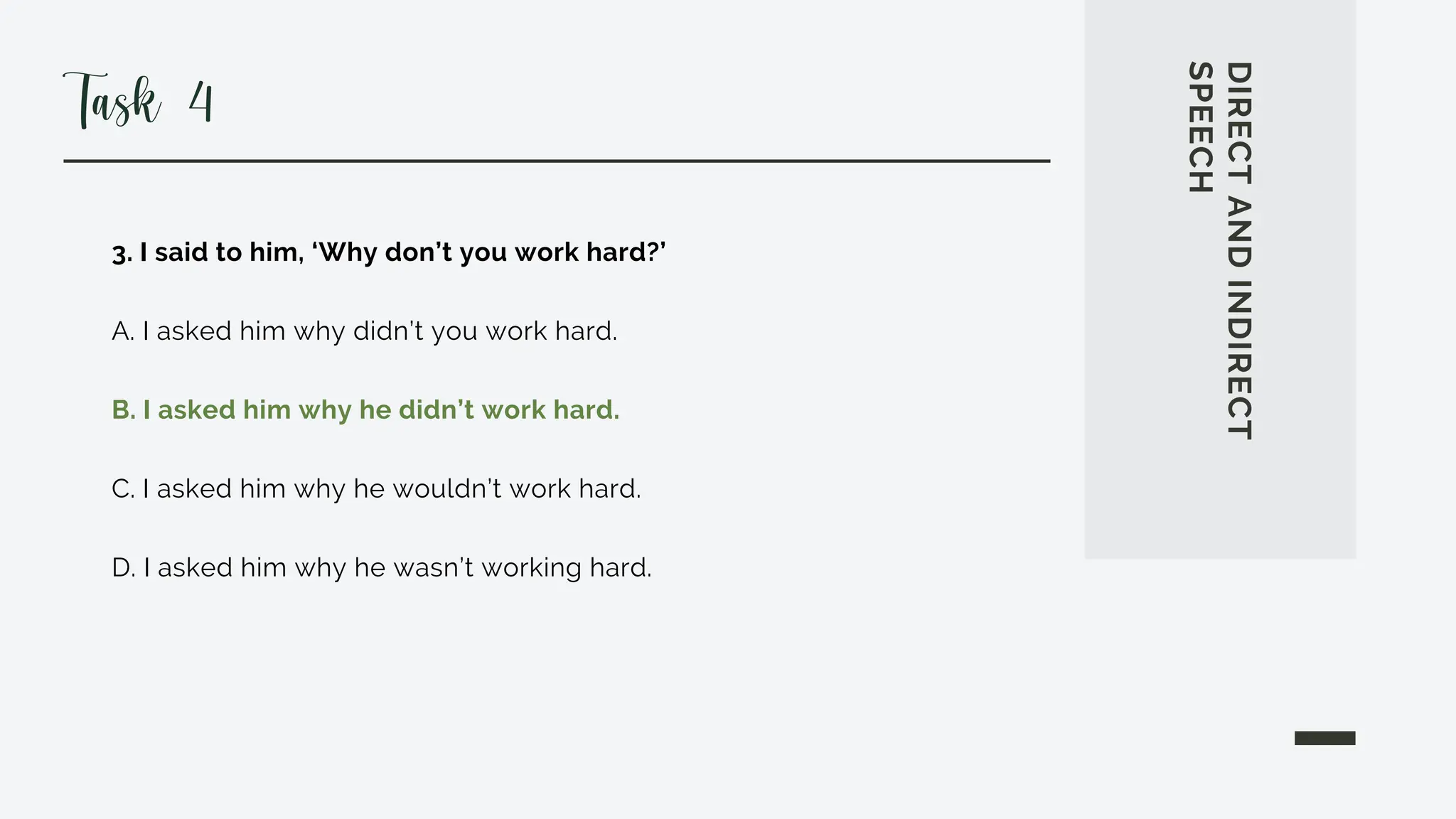
Task 4
3. I said to him, ‘Why don’t you work hard?’
A. I asked him why didn’t you work hard.
B. I asked him why he didn’t work hard.
C. I asked him why he wouldn’t work hard.
D. I asked him why he wasn’t working hard.
DIRECT
AND
INDIRECT
SPEECH
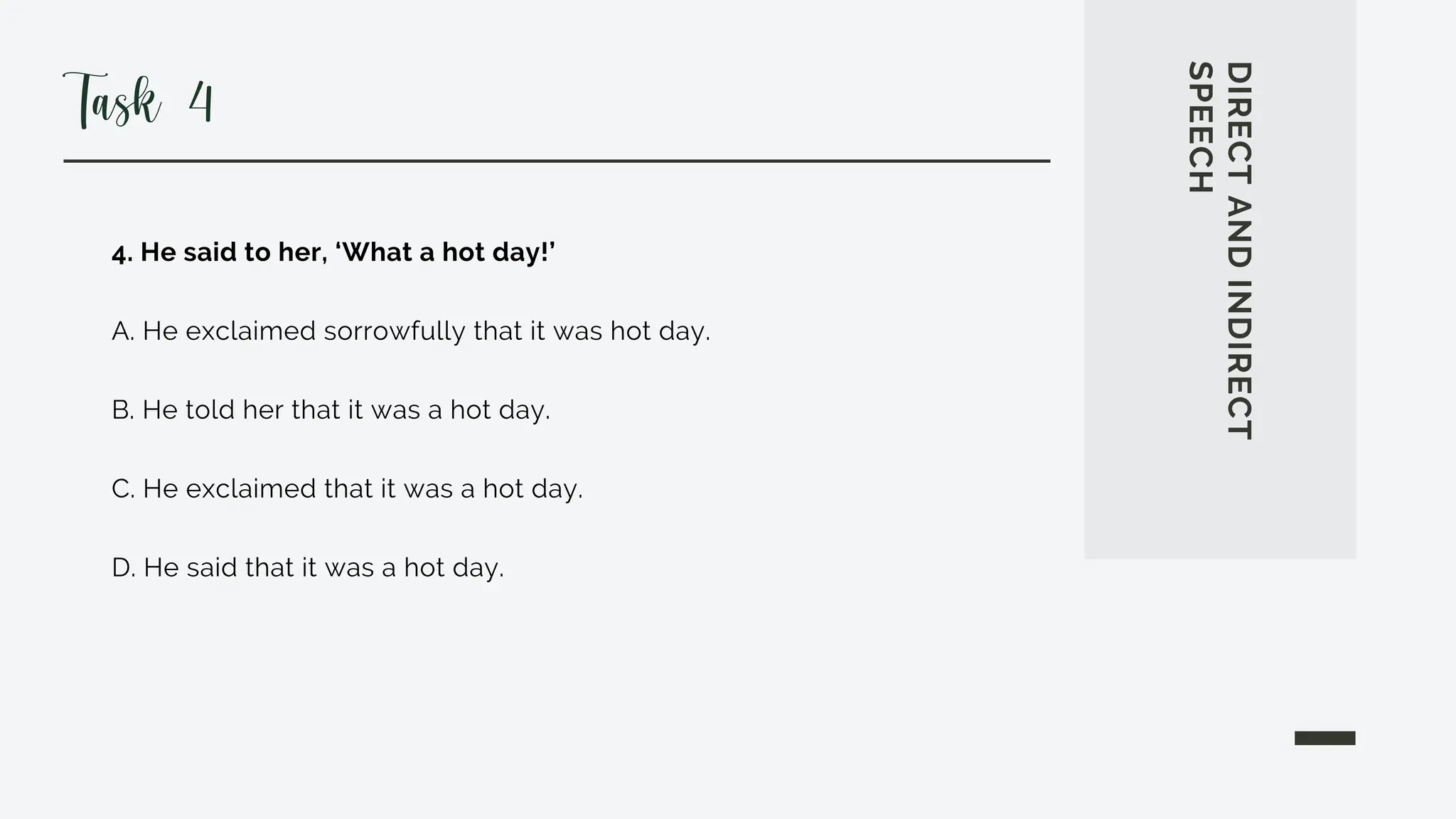
Task 4
4. He said to her, ‘What a hot day!’
A. He exclaimed sorrowfully that it was hot day.
B. He told her that it was a hot day.
C. He exclaimed that it was a hot day.
D. He said that it was a hot day.
DIRECT
AND
INDIRECT
SPEECH
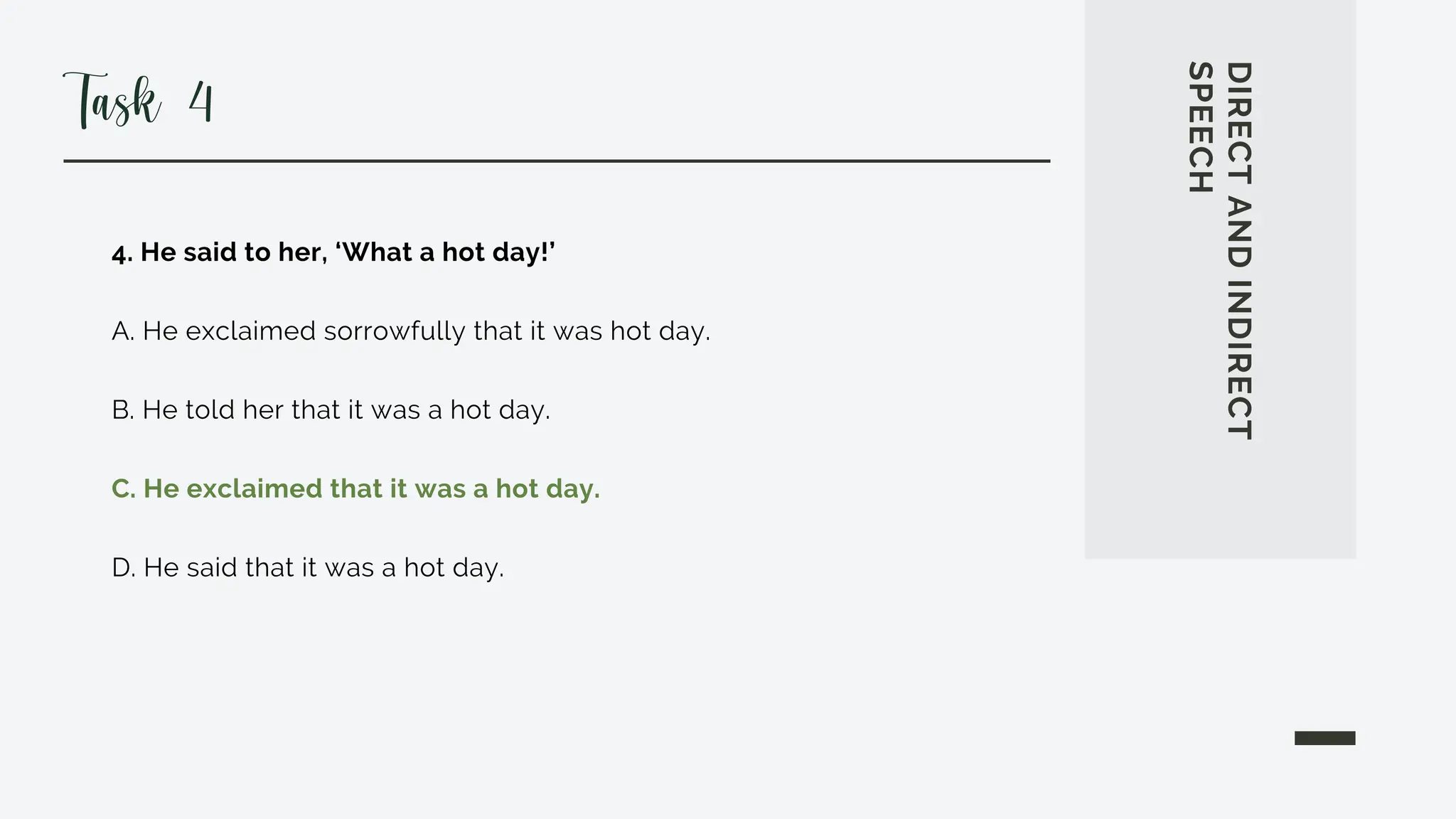
Task 4
4. He said to her, ‘What a hot day!’
A. He exclaimed sorrowfully that it was hot day.
B. He told her that it was a hot day.
C. He exclaimed that it was a hot day.
D. He said that it was a hot day.
DIRECT
AND
INDIRECT
SPEECH
Task 4
Questions?
karla.tembrevilla@depedmakati.ph

ENG7-QTR1-MODULE5-DIRECT-INDIRECT-SPEECH.pdf

  • 1.
    -Dr. Seuss YOU WILL AND YOU CAN. “There areso many things “There are so many things you can learn about, but you can learn about, but You’ll miss the best things You’ll miss the best things if you keep your eyes shut.” if you keep your eyes shut.”
  • 2.
    RIDDLE TIME! I’M TALL WHENI’M YOUNG, AND I’M SHORT WHEN I’M OLD. WHAT AM I?
  • 3.
    RIDDLE TIME! I’M TALL WHENI’M YOUNG, AND I’M SHORT WHEN I’M OLD. WHAT AM I? CANDLE
  • 4.
    RIDDLE TIME! WHAT GOES UPBUT NEVER COMES DOWN?
  • 5.
    RIDDLE TIME! WHAT GOES UPBUT NEVER COMES DOWN? AGE
  • 6.
    RIDDLE TIME! IT BELONGS TOYOU, BUT OTHER PEOPLE USE IT MORE THAN YOU DO. WHAT IS IT?
  • 7.
    RIDDLE TIME! IT BELONGS TOYOU, BUT OTHER PEOPLE USE IT MORE THAN YOU DO. WHAT IS IT? YOUR NAME!
  • 8.
    RIDDLE TIME! I HAVE BRANCHES,BUT NO FRUIT, TRUNK OR LEAVES. WHAT AM I?
  • 9.
    RIDDLE TIME! I HAVE BRANCHES,BUT NO FRUIT, TRUNK OR LEAVES. WHAT AM I? A BANK
  • 10.
  • 11.
    RIDDLE TIME! WHAT HAS HANDS,BUT CAN’T CLAP? A CLOCK
  • 12.
    WEEK 6 |GRAMMAR DIRECT & REPORTED SPEECH Grade 7 | Module 5 Ms. Karla Tembrevilla Teacher
  • 13.
    1. transform directspeech to indirect speech and indirect to direct with the correct use of pronouns, verb tense, connectors and adverbs Objectives: 2. use direct and indirect speech in expressing ideas
  • 14.
  • 15.
    PRONOUNS Pronouns are wordsthat are substitutes for nouns. We use them to avoid repetitions of these nouns when we write a paragraph. Since they serve as replacements, they have the same functions as nouns. There are different types of pronouns. One of them is what we call personal pronouns.
  • 16.
  • 17.
  • 18.
  • 19.
  • 20.
  • 21.
    Pronouns DIRECT AND INDIRECT SPEECH Rahul asks me,“When are you leaving?” “Where do you live?” the stranger asked Aladdin. They said, “We shall do the work.”
  • 22.
    Pronouns DIRECT AND INDIRECT SPEECH Rahul asked me,“When are you leaving?” “Where do you live?” the stranger asked Aladdin. They said, “We shall do the work.” Rahul asks me when I am leaving. The stranger asked aladdin where did he live. They said that they should do the work.
  • 23.
    Pronouns DIRECT AND INDIRECT SPEECH "She sings well",The teacher says. Paul said, " We will go to the cinemas tomorrow" "I bought a gift for Tony", Jeffrey said.
  • 24.
    Pronouns DIRECT AND INDIRECT SPEECH "She sings well",The teacher said. Paul said, " We will go to the cinema tomorrow" "I bought a gift for Tony", Jeffrey said. The teacher says that she sings well. Paul said that they would go to the cinema tomorrow. Jeffrey said that he had bought a gift for Tony.
  • 25.
    CONNECTOR Connectors -also called conjunctive words - are words that link two similar elements in a sentence. The four categories of connector , which are explained below, - coordinating conjunctions, such as and or or, - subordinating conjunctions such as if, so that, because or while. and - correlating conjunctions such as neither... nor, either... or The fourth group of connectors consists of conjunctive adverbs such as therefore or however
  • 26.
    Connectors DIRECT AND INDIRECT SPEECH WH QUESTIONS -wh word CONDITION OR EMOTIONAL STATE - if Ana asks her, " Are you okay?" Ana asks her if she is okay. "When is Martha coming home?" My mother asked. My mother asked when was Martha coming home. link two similar elements in a sentence.. introductory part + quoted part
  • 27.
    Connectors DIRECT AND INDIRECT SPEECH COMMAND OR REQUEST- to DECLARATIVE STATEMENT - that "Go to your bed early", Mom told Diego. Mom told Diego to go to bed early. "We are getting late for the class", We told her. We told her that we were getting late for the class.
  • 28.
  • 29.
  • 30.
    Connectors DIRECT AND INDIRECT SPEECH WH QUESTIONS -wh word CONDITION OR EMOTIONAL STATE - if Ana asks her, " Are you okay?" Ana asks her if she is okay. "When is Martha coming home?" My mother asked. My mother asked when was Martha coming home. link two similar elements in a sentence.. introductory part + quoted part Both introductory and quoted parts are in the PRESENT TENSE. Introductory part - simple past , Quoted part - simple present
  • 31.
    Connectors DIRECT AND INDIRECT SPEECH COMMAND OR REQUEST- to DECLARATIVE STATEMENT - that "Go to your bed early", Mom says to Diego. Mom says to Diego to go to bed early. "We ate the food last night", We told her. We told her that we had eaten the food last night. Introductory part - simple present , Quoted part - simple present Introductory part - simple past , Quoted part - simple past
  • 32.
    Dhronacharya said toArjun, “Shoot the fish’s eye.” “Call the first convict,” said the jury. “Call the ambulance,” said the man. Bruce said to me, “I shall do the work.” My mother said to me, “You are wrong.” Convert the sentences into INDIRECT SPEECH. 1. 2. 3. 4. 5. DIRECT AND INDIRECT SPEECH Independent Practice
  • 33.
    6. Mr. Richardsaid to me, “Please wait here till I return.” 7. The captain said to me, “You have played well.” 8. Raj said, “My pet died.” 9. Ruchi said, “I go there.” 10. Bucky asked Steve, “Are you sick?” DIRECT AND INDIRECT SPEECH Independent Practice
  • 34.
  • 35.
    LET'S TRY THIS! Write the correctpronoun form in the reported speech: 1. “Are you willing to join us?” Joan asked me. Joan asked me if _____ was willing to join ______ 2. “My friend left the country last year, “Ernie told Ana. Ernie told Ana that ____ friend had left the country the previous year. Task 1
  • 36.
    Write the correctpronoun form in the reported speech: 3. “Life is what makes me going,” Brenna says. Brenna says that life is what makes ______ going. 4. “Where do we start?” the people asked him. The people asked him where ____ would start.
  • 37.
    LET'S TRY THIS! Write the correctpronoun form in the reported speech: 1. “Are you willing to join us?” Joan asked me. Joan asked me if I was willing to join them. 2. “My friend left the country last year, “Ernie told Ana. Ernie told Ana that his friend had left the country the previous year. Task 1
  • 38.
    Write the correctpronoun form in the reported speech: 3. “Life is what makes me going,” Brenna says. Brenna says that life is what makes her going. 4. “Where do we start?” the people asked him. The people asked him where they would start.
  • 39.
    Write the correctconnector to complete the indirect speech: 5. “Don’t talk to strangers,” Leni said to her young daughter. Leni told her young daughter not ________ talk to strangers. 6. “We don’t have enough supplies for this month,” the team leader informed the group. The team leader informed the group ________ they don’t have enough supplies for this month. Task 2
  • 40.
    Write the correctconnector to complete the indirect speech: 7. “Where will you go after this?” Andres asked his friend. Andres asked his friend ________he would go after this. 8. “You help those who are in need,” Grandfather told us. Grandfather told us _______ help those who are in need.
  • 41.
    Write the correctform of verb in the indirect speech: 9. Emma said, “my mother told me to be careful with people I meet.” Emma said that her mother ____________her to be careful with people she meets. 10. The preacher said, “you need to trust God in times of trials.” The preacher said that we ____________ to trust God in times of trials. 11.The man said,” I saw the car accident yesterday.” The man said that he ___________ the car accident yesterday. Task 3
  • 42.
    Write the correctconnector to complete the indirect speech: 5. “Don’t talk to strangers,” Leni said to her young daughter. Leni told her young daughter not to talk to strangers. 6. “We don’t have enough supplies for this month,” the team leader informed the group. The team leader informed the group that they don’t have enough supplies for this month. Task 2
  • 43.
    Write the correctconnector to complete the indirect speech: 7. “Where will you go after this?” Andres asked his friend. Andres asked his friend where he would go after this. 8. “You help those who are in need,” Grandfather told us. Grandfather told us to help those who are in need.
  • 44.
    Write the correctform of verb in the indirect speech: 9. Emma said, “my mother told me to be careful with people I meet.” Emma said that her mother had told her to be careful with people she meets. 10. The preacher said, “you need to trust God in times of trials.” The preacher said that we needed to trust God in times of trials. 11.The man said,” I saw the car accident yesterday.” The man said that he had seen the car accident yesterday. Task 3
  • 45.
    A sentence hasbeen given in direct speech. Out of the four alternatives, select the one which best expresses the same sentence in indirect speech. 1. Rahul asked me, ‘Did you see the cricket match on TV last night?’ A. Rahul asked me if I had seen the cricket match on TV the previous night. B. Rahul asked me if I saw the cricket match on TV the previous night. C. Rahul asked me did I see the cricket match on TV last night. D. Rahul asked me whether I had seen the cricket match on TV last night. DIRECT AND INDIRECT SPEECH Task 4
  • 46.
    A sentence hasbeen given in direct speech. Out of the four alternatives, select the one which best expresses the same sentence in indirect speech. 1. Rahul asked me, ‘Did you see the cricket match on TV last night?’ A. Rahul asked me if I had seen the cricket match on TV the previous night. B. Rahul asked me if I saw the cricket match on TV the previous night. C. Rahul asked me did I see the cricket match on TV last night. D. Rahul asked me whether I had seen the cricket match on TV last night. DIRECT AND INDIRECT SPEECH Task 4
  • 47.
    2. James saidto his mother, ‘I am leaving for New York tomorrow.’ A. James told his mother that he was leaving for New York tomorrow. B. James told his mother he is leaving for New York tomorrow. C. James told his mother that he was leaving for New York the next day. D. James told his mother he would be leaving for New York the next day. DIRECT AND INDIRECT SPEECH Task 4
  • 48.
    2. James saidto his mother, ‘I am leaving for New York tomorrow.’ A. James told his mother that he was leaving for New York tomorrow. B. James told his mother he is leaving for New York tomorrow. C. James told his mother that he was leaving for New York the next day. D. James told his mother he would be leaving for New York the next day. DIRECT AND INDIRECT SPEECH Task 4
  • 49.
    3. I saidto him, ‘Why don’t you work hard?’ A. I asked him why didn’t you work hard. B. I asked him why he didn’t work hard. C. I asked him why he wouldn’t work hard. D. I asked him why he wasn’t working hard. DIRECT AND INDIRECT SPEECH Task 4
  • 50.
    3. I saidto him, ‘Why don’t you work hard?’ A. I asked him why didn’t you work hard. B. I asked him why he didn’t work hard. C. I asked him why he wouldn’t work hard. D. I asked him why he wasn’t working hard. DIRECT AND INDIRECT SPEECH Task 4
  • 51.
    4. He saidto her, ‘What a hot day!’ A. He exclaimed sorrowfully that it was hot day. B. He told her that it was a hot day. C. He exclaimed that it was a hot day. D. He said that it was a hot day. DIRECT AND INDIRECT SPEECH Task 4
  • 52.
    4. He saidto her, ‘What a hot day!’ A. He exclaimed sorrowfully that it was hot day. B. He told her that it was a hot day. C. He exclaimed that it was a hot day. D. He said that it was a hot day. DIRECT AND INDIRECT SPEECH Task 4
  • 53.