



Faculty of Engineering

ENG1040
Engineering Dynamics
Pulley Systems,
Free Body Diagrams : Example Questions
Dr Lau Ee Von – Sunway

Lecture 6

ENG1040 – Engineering Dynamics
Past exam question
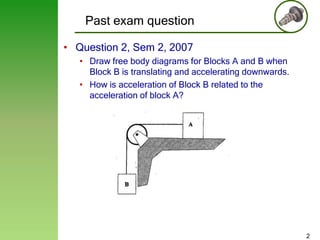
• Question 2, Sem 2, 2007
• Draw free body diagrams for Blocks A and B when
Block B is translating and accelerating downwards.
• How is acceleration of Block B related to the
acceleration of block A?

2
Past exam question
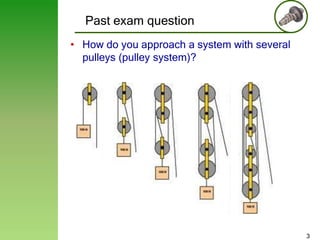
• How do you approach a system with several
pulleys (pulley system)?

3
Lecture Outline
• Pulley systems:
• How to gain mechanical leverage
• Example Questions: FBD

4
Pulley systems
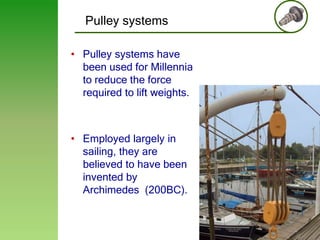
• Pulley systems have
been used for Millennia
to reduce the force
required to lift weights.

• Employed largely in
sailing, they are
believed to have been
invented by
Archimedes (200BC).

5
Pulley systems
• Pulleys in everyday life:

6
The Simplest Pulley system
The simplest type of pulley system is
shown here.
A free-body diagram of this pulley
system shows that the total load is split
into half on either pulley rope to
maintain equilibrium.

But there must be a trade-off...
... The amount of work applied
does not change.

Energy

F d

7
Kinematics of Pulleys
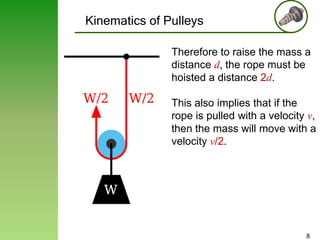
Therefore to raise the mass a
distance d, the rope must be
hoisted a distance 2d.
This also implies that if the
rope is pulled with a velocity v,
then the mass will move with a
velocity v/2.

8
Further improvements
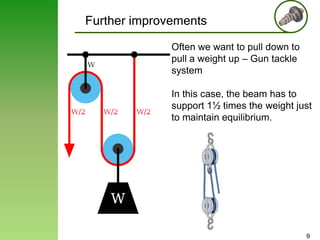
Often we want to pull down to
pull a weight up – Gun tackle
system
In this case, the beam has to
support 1½ times the weight just
to maintain equilibrium.

9
Pulley systems
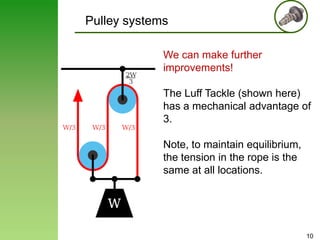
We can make further
improvements!
The Luff Tackle (shown here)
has a mechanical advantage of
3.

Note, to maintain equilibrium,
the tension in the rope is the
same at all locations.

10
Pulley systems
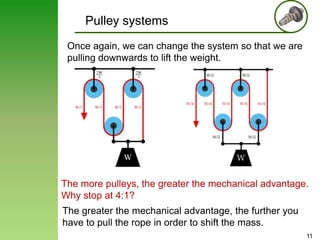
Once again, we can change the system so that we are
pulling downwards to lift the weight.

The more pulleys, the greater the mechanical advantage.
Why stop at 4:1?
The greater the mechanical advantage, the further you
have to pull the rope in order to shift the mass.
11
Pulley systems
• Note: the analysis described on the previous
slides assumes that the pulleys are massless...

12
Kinetics/Kinematics problems...
Analysis procedure
1. Establish a coordinate system
2. Draw Free Body Diagram(s)
•

Graphical representation of all forces acting on
the system.

3. Establish known & unknown quantities
4. Apply Equation(s) of Motion in each direction
5. Evaluate kinematics to solve problem
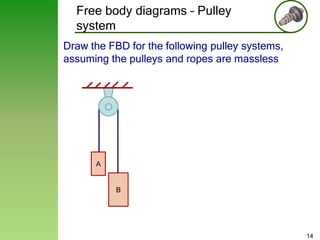
Free body diagrams – Pulley
system
Draw the FBD for the following pulley systems,
assuming the pulleys and ropes are massless

A

B

14
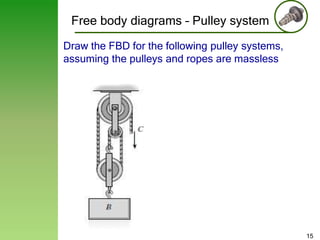
Free body diagrams – Pulley system
Draw the FBD for the following pulley systems,
assuming the pulleys and ropes are massless

15
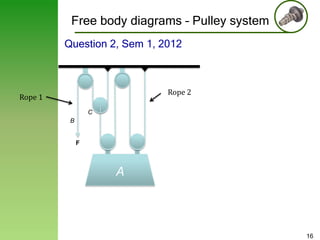
Free body diagrams – Pulley system
Question 2, Sem 1, 2012

Rope 2

Rope 1
C
B

F

A

16
Free body diagrams – Pulley system
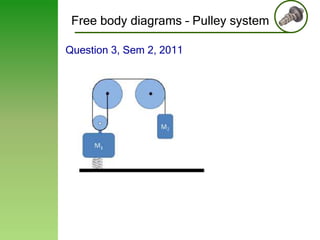
Question 3, Sem 2, 2011
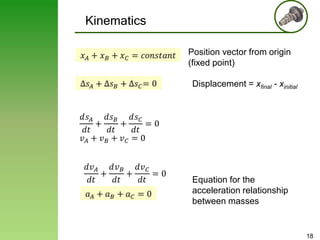
Kinematics
Position vector from origin
(fixed point)
Displacement = xfinal - xinitial

Equation for the
acceleration relationship
between masses

18
Example Question
• Question 12.12 [Kinetics]
(MECHANICS FOR ENGINEERS: DYNAMICS by Ferdinand P. Beer)

The two blocks shown are originally at rest. Neglecting the
masses of the pulleys and the effect of friction in the pulleys
and between the blocks and the incline, determine
a) The acceleration of each block
b) The tension in the cable

y

x
19
Example Question
• Question 12.12 [Kinetics]
The two blocks shown are originally at rest. Neglecting the
masses of the pulleys and the effect of friction in the pulleys
and between the blocks and the incline, determine
a) The acceleration of each block
b) The tension in the cable
y

x

20
Example Question
• Question 12.12 [Kinetics]
The two blocks shown are originally at rest. Neglecting the
masses of the pulleys and the effect of friction in the pulleys
and between the blocks and the incline, determine
a) The acceleration of each block
b) The tension in the cable
y

T

x

FN
mA g

Fx

T mA g sin 30o

mAaA( x)

21
Example Question
• Question 12.12 [Kinetics]
The two blocks shown are originally at rest. Neglecting the
masses of the pulleys and the effect of friction in the pulleys
and between the blocks and the incline, determine
a) The acceleration of each block
b) The tension in the cable
y

x

22
Example Question
• Question 12.12 [Kinetics]
The two blocks shown are originally at rest. Neglecting the
masses of the pulleys and the effect of friction in the pulleys
and between the blocks and the incline, determine
a) The acceleration of each block
b) The tension in the cable

3T

y

x

FN

mB g

Fx

3T mB g sin 30o

mB aB( x)

23
Example Question
• Question 12.12 [Kinetics]
The two blocks shown are originally at rest. Neglecting the
masses of the pulleys and the effect of friction in the pulleys
and between the blocks and the incline, determine
a) The acceleration of each block
b) The tension in the cable

o

mAaA( x)

o

mB aB( x)

T mA g sin 30
3T mB g sin 30

How many unknowns do I have?
Do I have enough equations?

24
Example Question
• Question 12.12 [Kinetics]
The two blocks shown are originally at rest. Neglecting the
masses of the pulleys and the effect of friction in the pulleys
and between the blocks and the incline, determine
a) The acceleration of each block
b) The tension in the cable

0
If we consider the kinematics of the
problem we can relate the
acceleration of block A with the
acceleration of block B:

x A 3x B constant
a A( x ) 3a B ( x ) 0
25
Example Question
• Question 12.12 [Kinetics]
The two blocks shown are originally at rest. Neglecting the
masses of the pulleys and the effect of friction in the pulleys
and between the blocks and the incline, determine
a) The acceleration of each block
b) The tension in the cable

o

mAaA( x)

o

mB aB( x)

T mA g sin 30
3T mB g sin 30
a A( x )

3a B ( x )

aA = -3.30 m/s2
aB = 1.10 m/s2
T = 16 N

26
Example Question
• Question 12.32 [kinetics]
The weight of blocks A, B, and C are wa = wc = 20 lb, and
wb=10 lb. Knowing that P = 50 lb and neglecting the masses
of the pulleys and the effect of friction, determine
a) The acceleration of each block
b) The tension in the cable.

1st step: Convert to SI units (see back of text book)
1 lb of force = 4.448 N of force

27
Example Question
• Question 12.32 [kinetics]
The weight of blocks A, B, and C are wa = wc = 20 lb, and
wb=10 lb. Knowing that P = 50 lb and neglecting the masses
of the pulleys and the effect of friction, determine
a) The acceleration of each block
b) The tension in the cable.

mAg = mCg = 88.96 N
mBg = 44.48 N

mA = mC = 9.07 kg

mB = 4.54 kg

P = 222.4 N

28
Example Question
• Question 12.32 [kinetics]
The weight of blocks A, B, and C are wa = wc = 20 lb, and
wb=10 lb. Knowing that P = 50 lb and neglecting the masses
of the pulleys and the effect of friction, determine
a) The acceleration of each block
b) The tension in the cable.

y
x

A

29
Example Question
• Question 12.32 [kinetics]
The weight of blocks A, B, and C are wa = wc = 20 lb, and
wb=10 lb. Knowing that P = 50 lb and neglecting the masses
of the pulleys and the effect of friction, determine
a) The acceleration of each block
b) The tension in the cable.

A

x

Fx

3T

mA a A( x)

30
Example Question
• Question 12.32 [kinetics]
The weight of blocks A, B, and C are wa = wc = 20 lb, and
wb=10 lb. Knowing that P = 50 lb and neglecting the masses
of the pulleys and the effect of friction, determine
a) The acceleration of each block
b) The tension in the cable.

B

x

Fx

2T

mB aB( x)

31
Example Question
• Question 12.32 [kinetics]
The weight of blocks A, B, and C are wa = wc = 20 lb, and
wb=10 lb. Knowing that P = 50 lb and neglecting the masses
of the pulleys and the effect of friction, determine
a) The acceleration of each block
b) The tension in the cable.

C

x

Fx

P 4T

mC aC ( x)

32
Example Question
• Question 12.32 [kinetics]
The weight of blocks A, B, and C are wa = wc = 20 lb, and
wb=10 lb. Knowing that P = 50 lb and neglecting the masses
of the pulleys and the effect of friction, determine
a) The acceleration of each block
b) The tension in the cable.

3T

m A a A( x )

2T

mB a B( x)

P

4T

mC a C ( x )

How many unknowns do I have?
Do I have enough equations?

33
Example Question
• Question 12.32 [kinetics]
The weight of blocks A, B, and C are wa = wc = 20 lb, and
wb=10 lb. Knowing that P = 50 lb and neglecting the masses
of the pulleys and the effect of friction, determine
a) The acceleration of each block
b) The tension in the cable.

If we consider the kinematics of the
problem we can relate the three
acceleration terms.

0
First, we note that the pulley
system is attached to the
ground at this point.
We will measure the length of
rope from this point.
34
Example Question
• Question 12.32 [kinetics]
The weight of blocks A, B, and C are wa = wc = 20 lb, and
wb=10 lb. Knowing that P = 50 lb and neglecting the masses
of the pulleys and the effect of friction, determine
a) The acceleration of each block
b) The tension in the cable.

If we consider the
kinematics of the
problem we can relate
the three acceleration
terms.

0

We notice that two lengths
of rope connect mass B to
the fixed point.
Therefore, part of the rope’s
length is defined as:

2 xb
This is two times the
distance from mass B to the
fixed point.
35
Example Question
• Question 12.32 [kinetics]
The weight of blocks A, B, and C are wa = wc = 20 lb, and
wb=10 lb. Knowing that P = 50 lb and neglecting the masses
of the pulleys and the effect of friction, determine
a) The acceleration of each block
b) The tension in the cable.

If we consider the
kinematics of the problem
we can relate the three
acceleration terms.

0

We notice that three lengths
of rope connect mass A to
the fixed point.

Therefore, part of the rope’s
length is defined as:

3 xa
This is three times the
distance from mass A to the
fixed point.
36
Example Question
• Question 12.32 [kinetics]
The weight of blocks A, B, and C are wa = wc = 20 lb, and
wb=10 lb. Knowing that P = 50 lb and neglecting the masses
of the pulleys and the effect of friction, determine
a) The acceleration of each block
b) The tension in the cable.

If we consider the
kinematics of the problem
we can relate the three
acceleration terms.

0

Finally, we notice that four
lengths of rope connect mass C
to the fixed point.

Therefore, part of the rope’s
length is defined as:

4 xc
This is four times the distance
from mass C to the fixed point.
37
Example Question
• Question 12.32 [kinetics]
The weight of blocks A, B, and C are wa = wc = 20 lb, and
wb=10 lb. Knowing that P = 50 lb and neglecting the masses
of the pulleys and the effect of friction, determine
a) The acceleration of each block
b) The tension in the cable.

I can then sum all these lengths of rope together to form:

3 xa

2 xb

4 xc

constant

From this equation, I can determine an equation for
velocity and acceleration...

38
Example Question
• Question 12.32 [kinetics]
The weight of blocks A, B, and C are wa = wc = 20 lb, and
wb=10 lb. Knowing that P = 50 lb and neglecting the masses
of the pulleys and the effect of friction, determine
a) The acceleration of each block
b) The tension in the cable.

First the velocity:

dxa
3
dt

dx
dt
v

3va

dxb
2
dt
2vb

dxc
4
dt
4vc

0

0

39
Example Question
• Question 12.32 [kinetics]
The weight of blocks A, B, and C are wa = wc = 20 lb, and
wb=10 lb. Knowing that P = 50 lb and neglecting the masses
of the pulleys and the effect of friction, determine
a) The acceleration of each block
b) The tension in the cable.

Then the acceleration:

dva
3
dt

dv
dt
a

3aa

dvb
2
dt
2ab

dvc
4
dt
4ac

0
0

I now have an equation
relating the acceleration
of the three weights.
40
Example Question
• Question 12.32 [kinetics]
The weight of blocks A, B, and C are wa = wc = 20 lb, and
wb=10 lb. Knowing that P = 50 lb and neglecting the masses
of the pulleys and the effect of friction, determine
a) The acceleration of each block
b) The tension in the cable.

3T

m A a A( x )

2T

Using these equations,
I can solve the problem.
Note that I have four
equations and four
unknowns.

mB a B( x)

P

3aa

4T

mC a C ( x )

2ab

4ac

0

aA = 8.9 m/s2
aB = 11.9 m/s2
aC = 12.6 m/s2
T = 27 N

41

ENG1040 Lec06

  • 1.
    Faculty of Engineering ENG1040 EngineeringDynamics Pulley Systems, Free Body Diagrams : Example Questions Dr Lau Ee Von – Sunway Lecture 6 ENG1040 – Engineering Dynamics
  • 2.
    Past exam question •Question 2, Sem 2, 2007 • Draw free body diagrams for Blocks A and B when Block B is translating and accelerating downwards. • How is acceleration of Block B related to the acceleration of block A? 2
  • 3.
    Past exam question •How do you approach a system with several pulleys (pulley system)? 3
  • 4.
    Lecture Outline • Pulleysystems: • How to gain mechanical leverage • Example Questions: FBD 4
  • 5.
    Pulley systems • Pulleysystems have been used for Millennia to reduce the force required to lift weights. • Employed largely in sailing, they are believed to have been invented by Archimedes (200BC). 5
  • 6.
    Pulley systems • Pulleysin everyday life: 6
  • 7.
    The Simplest Pulleysystem The simplest type of pulley system is shown here. A free-body diagram of this pulley system shows that the total load is split into half on either pulley rope to maintain equilibrium. But there must be a trade-off... ... The amount of work applied does not change. Energy F d 7
  • 8.
    Kinematics of Pulleys Thereforeto raise the mass a distance d, the rope must be hoisted a distance 2d. This also implies that if the rope is pulled with a velocity v, then the mass will move with a velocity v/2. 8
  • 9.
    Further improvements Often wewant to pull down to pull a weight up – Gun tackle system In this case, the beam has to support 1½ times the weight just to maintain equilibrium. 9
  • 10.
    Pulley systems We canmake further improvements! The Luff Tackle (shown here) has a mechanical advantage of 3. Note, to maintain equilibrium, the tension in the rope is the same at all locations. 10
  • 11.
    Pulley systems Once again,we can change the system so that we are pulling downwards to lift the weight. The more pulleys, the greater the mechanical advantage. Why stop at 4:1? The greater the mechanical advantage, the further you have to pull the rope in order to shift the mass. 11
  • 12.
    Pulley systems • Note:the analysis described on the previous slides assumes that the pulleys are massless... 12
  • 13.
    Kinetics/Kinematics problems... Analysis procedure 1.Establish a coordinate system 2. Draw Free Body Diagram(s) • Graphical representation of all forces acting on the system. 3. Establish known & unknown quantities 4. Apply Equation(s) of Motion in each direction 5. Evaluate kinematics to solve problem
  • 14.
    Free body diagrams– Pulley system Draw the FBD for the following pulley systems, assuming the pulleys and ropes are massless A B 14
  • 15.
    Free body diagrams– Pulley system Draw the FBD for the following pulley systems, assuming the pulleys and ropes are massless 15
  • 16.
    Free body diagrams– Pulley system Question 2, Sem 1, 2012 Rope 2 Rope 1 C B F A 16
  • 17.
    Free body diagrams– Pulley system Question 3, Sem 2, 2011
  • 18.
    Kinematics Position vector fromorigin (fixed point) Displacement = xfinal - xinitial Equation for the acceleration relationship between masses 18
  • 19.
    Example Question • Question12.12 [Kinetics] (MECHANICS FOR ENGINEERS: DYNAMICS by Ferdinand P. Beer) The two blocks shown are originally at rest. Neglecting the masses of the pulleys and the effect of friction in the pulleys and between the blocks and the incline, determine a) The acceleration of each block b) The tension in the cable y x 19
  • 20.
    Example Question • Question12.12 [Kinetics] The two blocks shown are originally at rest. Neglecting the masses of the pulleys and the effect of friction in the pulleys and between the blocks and the incline, determine a) The acceleration of each block b) The tension in the cable y x 20
  • 21.
    Example Question • Question12.12 [Kinetics] The two blocks shown are originally at rest. Neglecting the masses of the pulleys and the effect of friction in the pulleys and between the blocks and the incline, determine a) The acceleration of each block b) The tension in the cable y T x FN mA g Fx T mA g sin 30o mAaA( x) 21
  • 22.
    Example Question • Question12.12 [Kinetics] The two blocks shown are originally at rest. Neglecting the masses of the pulleys and the effect of friction in the pulleys and between the blocks and the incline, determine a) The acceleration of each block b) The tension in the cable y x 22
  • 23.
    Example Question • Question12.12 [Kinetics] The two blocks shown are originally at rest. Neglecting the masses of the pulleys and the effect of friction in the pulleys and between the blocks and the incline, determine a) The acceleration of each block b) The tension in the cable 3T y x FN mB g Fx 3T mB g sin 30o mB aB( x) 23
  • 24.
    Example Question • Question12.12 [Kinetics] The two blocks shown are originally at rest. Neglecting the masses of the pulleys and the effect of friction in the pulleys and between the blocks and the incline, determine a) The acceleration of each block b) The tension in the cable o mAaA( x) o mB aB( x) T mA g sin 30 3T mB g sin 30 How many unknowns do I have? Do I have enough equations? 24
  • 25.
    Example Question • Question12.12 [Kinetics] The two blocks shown are originally at rest. Neglecting the masses of the pulleys and the effect of friction in the pulleys and between the blocks and the incline, determine a) The acceleration of each block b) The tension in the cable 0 If we consider the kinematics of the problem we can relate the acceleration of block A with the acceleration of block B: x A 3x B constant a A( x ) 3a B ( x ) 0 25
  • 26.
    Example Question • Question12.12 [Kinetics] The two blocks shown are originally at rest. Neglecting the masses of the pulleys and the effect of friction in the pulleys and between the blocks and the incline, determine a) The acceleration of each block b) The tension in the cable o mAaA( x) o mB aB( x) T mA g sin 30 3T mB g sin 30 a A( x ) 3a B ( x ) aA = -3.30 m/s2 aB = 1.10 m/s2 T = 16 N 26
  • 27.
    Example Question • Question12.32 [kinetics] The weight of blocks A, B, and C are wa = wc = 20 lb, and wb=10 lb. Knowing that P = 50 lb and neglecting the masses of the pulleys and the effect of friction, determine a) The acceleration of each block b) The tension in the cable. 1st step: Convert to SI units (see back of text book) 1 lb of force = 4.448 N of force 27
  • 28.
    Example Question • Question12.32 [kinetics] The weight of blocks A, B, and C are wa = wc = 20 lb, and wb=10 lb. Knowing that P = 50 lb and neglecting the masses of the pulleys and the effect of friction, determine a) The acceleration of each block b) The tension in the cable. mAg = mCg = 88.96 N mBg = 44.48 N mA = mC = 9.07 kg mB = 4.54 kg P = 222.4 N 28
  • 29.
    Example Question • Question12.32 [kinetics] The weight of blocks A, B, and C are wa = wc = 20 lb, and wb=10 lb. Knowing that P = 50 lb and neglecting the masses of the pulleys and the effect of friction, determine a) The acceleration of each block b) The tension in the cable. y x A 29
  • 30.
    Example Question • Question12.32 [kinetics] The weight of blocks A, B, and C are wa = wc = 20 lb, and wb=10 lb. Knowing that P = 50 lb and neglecting the masses of the pulleys and the effect of friction, determine a) The acceleration of each block b) The tension in the cable. A x Fx 3T mA a A( x) 30
  • 31.
    Example Question • Question12.32 [kinetics] The weight of blocks A, B, and C are wa = wc = 20 lb, and wb=10 lb. Knowing that P = 50 lb and neglecting the masses of the pulleys and the effect of friction, determine a) The acceleration of each block b) The tension in the cable. B x Fx 2T mB aB( x) 31
  • 32.
    Example Question • Question12.32 [kinetics] The weight of blocks A, B, and C are wa = wc = 20 lb, and wb=10 lb. Knowing that P = 50 lb and neglecting the masses of the pulleys and the effect of friction, determine a) The acceleration of each block b) The tension in the cable. C x Fx P 4T mC aC ( x) 32
  • 33.
    Example Question • Question12.32 [kinetics] The weight of blocks A, B, and C are wa = wc = 20 lb, and wb=10 lb. Knowing that P = 50 lb and neglecting the masses of the pulleys and the effect of friction, determine a) The acceleration of each block b) The tension in the cable. 3T m A a A( x ) 2T mB a B( x) P 4T mC a C ( x ) How many unknowns do I have? Do I have enough equations? 33
  • 34.
    Example Question • Question12.32 [kinetics] The weight of blocks A, B, and C are wa = wc = 20 lb, and wb=10 lb. Knowing that P = 50 lb and neglecting the masses of the pulleys and the effect of friction, determine a) The acceleration of each block b) The tension in the cable. If we consider the kinematics of the problem we can relate the three acceleration terms. 0 First, we note that the pulley system is attached to the ground at this point. We will measure the length of rope from this point. 34
  • 35.
    Example Question • Question12.32 [kinetics] The weight of blocks A, B, and C are wa = wc = 20 lb, and wb=10 lb. Knowing that P = 50 lb and neglecting the masses of the pulleys and the effect of friction, determine a) The acceleration of each block b) The tension in the cable. If we consider the kinematics of the problem we can relate the three acceleration terms. 0 We notice that two lengths of rope connect mass B to the fixed point. Therefore, part of the rope’s length is defined as: 2 xb This is two times the distance from mass B to the fixed point. 35
  • 36.
    Example Question • Question12.32 [kinetics] The weight of blocks A, B, and C are wa = wc = 20 lb, and wb=10 lb. Knowing that P = 50 lb and neglecting the masses of the pulleys and the effect of friction, determine a) The acceleration of each block b) The tension in the cable. If we consider the kinematics of the problem we can relate the three acceleration terms. 0 We notice that three lengths of rope connect mass A to the fixed point. Therefore, part of the rope’s length is defined as: 3 xa This is three times the distance from mass A to the fixed point. 36
  • 37.
    Example Question • Question12.32 [kinetics] The weight of blocks A, B, and C are wa = wc = 20 lb, and wb=10 lb. Knowing that P = 50 lb and neglecting the masses of the pulleys and the effect of friction, determine a) The acceleration of each block b) The tension in the cable. If we consider the kinematics of the problem we can relate the three acceleration terms. 0 Finally, we notice that four lengths of rope connect mass C to the fixed point. Therefore, part of the rope’s length is defined as: 4 xc This is four times the distance from mass C to the fixed point. 37
  • 38.
    Example Question • Question12.32 [kinetics] The weight of blocks A, B, and C are wa = wc = 20 lb, and wb=10 lb. Knowing that P = 50 lb and neglecting the masses of the pulleys and the effect of friction, determine a) The acceleration of each block b) The tension in the cable. I can then sum all these lengths of rope together to form: 3 xa 2 xb 4 xc constant From this equation, I can determine an equation for velocity and acceleration... 38
  • 39.
    Example Question • Question12.32 [kinetics] The weight of blocks A, B, and C are wa = wc = 20 lb, and wb=10 lb. Knowing that P = 50 lb and neglecting the masses of the pulleys and the effect of friction, determine a) The acceleration of each block b) The tension in the cable. First the velocity: dxa 3 dt dx dt v 3va dxb 2 dt 2vb dxc 4 dt 4vc 0 0 39
  • 40.
    Example Question • Question12.32 [kinetics] The weight of blocks A, B, and C are wa = wc = 20 lb, and wb=10 lb. Knowing that P = 50 lb and neglecting the masses of the pulleys and the effect of friction, determine a) The acceleration of each block b) The tension in the cable. Then the acceleration: dva 3 dt dv dt a 3aa dvb 2 dt 2ab dvc 4 dt 4ac 0 0 I now have an equation relating the acceleration of the three weights. 40
  • 41.
    Example Question • Question12.32 [kinetics] The weight of blocks A, B, and C are wa = wc = 20 lb, and wb=10 lb. Knowing that P = 50 lb and neglecting the masses of the pulleys and the effect of friction, determine a) The acceleration of each block b) The tension in the cable. 3T m A a A( x ) 2T Using these equations, I can solve the problem. Note that I have four equations and four unknowns. mB a B( x) P 3aa 4T mC a C ( x ) 2ab 4ac 0 aA = 8.9 m/s2 aB = 11.9 m/s2 aC = 12.6 m/s2 T = 27 N 41