Learning Targets
• Define formalist approach.
• Explain literature using the overall artistic
value of the structure and elements of the
selection.
• Explain how elements specific to genre
contribute to the theme of a particular literary
selection.
Literacy Criticism
✓ is the evaluation, analysis, description,
or interpretation of a literary work.
Critic
✓ Is a person who judges, evaluates, or
analyzes a literary piece.
Critique (v)
✓ Means to critically evaluate, analyze, or
give careful judgment in which you
give your opinion about a literary work.
Critique (n)
✓ Is a detailed evaluation or analysis of a
literary piece.
Understanding a literary work
can be difficult if one does not
know how to interpret meanings
behind the words used by the
author.
FORMALISM OR
FORMALIST APPROACH
Formalist approach it
discovers the true meaning of
work by giving attention to
the form or structure,
elements and literary devices
operating in it.
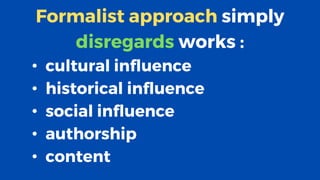
Formalist approach simply
disregards works :
• cultural influence
• historical influence
• social influence
• authorship
• content
Formalist approach focused
on how the elements of a
certain text work together in
order to develop a certain
effect.
A literary work can be
understood only through
reference to literary features
which are found in the text.
ELEMENTS OF THE
STORY
The basic element of a story
is the character.
• A protagonist is a central
character in a story.
• The antagonist is usually the
enemy of the central
character.
• A dynamic character is one
that changes the story.
• A static character remains the
same or does not undergo
changes during the story
Another important element of a
story is the setting.
Setting tells the readers where
(place) and when (time, weather
condition) the story happened.
• The setting allows the readers
to picture the characters' daily
lives (social condition).
• The readers' feelings (mood or
atmosphere) felt as they read
the story are also part of the
setting.
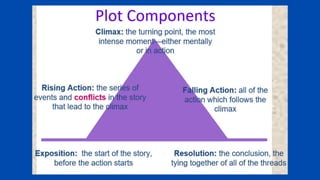
The plot is the main structure of a
story because it details how the
series of events are presented.
A story usually has problems or
complications, generally called
conflict.
When a character conflicts with
oneself, the complication
happens within the character,
thus called internal conflict.
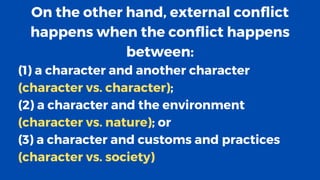
On the other hand, external conflict
happens when the conflict happens
between:
(1) a character and another character
(character vs. character);
(2) a character and the environment
(character vs. nature); or
(3) a character and customs and practices
(character vs. society)
The central message or the lesson
in a story is called a theme.
It should be remembered that a
theme is a message from the
author and not the subject or
topic of a story.
Other elements of the story are:
• Point of view
• Tone
• Mood
• Style
• Imagery
Literary devices
✓ Are tools used by writers to
hint at larger themes, ideas,
and meaning in a story or
piece of writing.
Simile
✓ Two unrelated objects are
being compared to each other
with the use of the words “like”
or “as”.
Example: You are as brave as a
lion.
Metaphor
✓ A statement in which two
objects, often unrelated, are
compared to each other.
Example: The tree is the god of
the forest.
Imagery
✓ It engages the senses to deepen
the reader’s comprehension of
what is happening and how to
feel about it.
Example: The tree spread its
gigantic, sun-flecked shoulders.
Symbolism
✓ Uses symbols which can be
words, people, marks, locations,
or abstract ideas to represent
something beyond the literal
meaning.
Example: rainbow – symbolizes
hope or promise.
Personification
✓ Giving human attributes to
nonhuman objects.
Example:
The car needs a cold shower.
Sound devices
✓ Are special tools the poet can use
to create certain effects in the
poem to convey and reinforce
meaning through sound.
Rhyme
✓ Is the matching vowel sounds at
the end of words or lines.
Example:
Out of the night that covers me
Black as the pit from pole to pole.
I thank whatever gods may be
For my unconquerable soul.
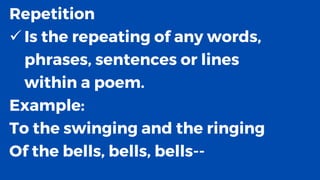
Repetition
✓ Is the repeating of any words,
phrases, sentences or lines
within a poem.
Example:
To the swinging and the ringing
Of the bells, bells, bells--
Assonance
✓ Is repetition of vowel sounds
within words.
Example:
I like to decline an offer of wine to
define my style.
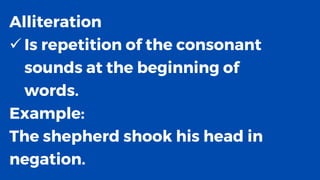
Alliteration
✓ Is repetition of the consonant
sounds at the beginning of
words.
Example:
The shepherd shook his head in
negation.
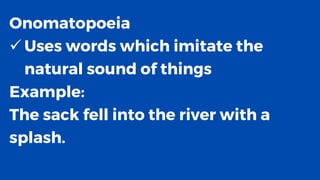
Onomatopoeia
✓ Uses words which imitate the
natural sound of things
Example:
The sack fell into the river with a
splash.
HOW DO YOU USE
FORMALIST APPROACH IN
READING LITERATURE?
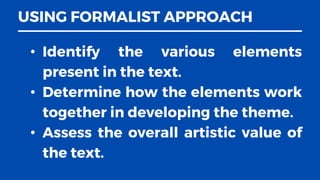
USING FORMALIST APPROACH
• Identify the various elements
present in the text.
• Determine how the elements work
together in developing the theme.
• Assess the overall artistic value of
the text.
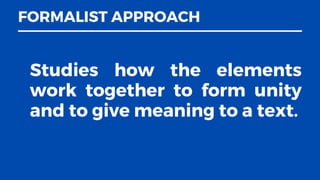
FORMALIST APPROACH
Studies how the elements
work together to form unity
and to give meaning to a text.
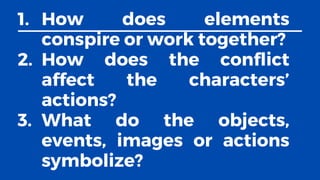
1. How does elements
conspire or work together?
2. How does the conflict
affect the characters’
actions?
3. What do the objects,
events, images or actions
symbolize?
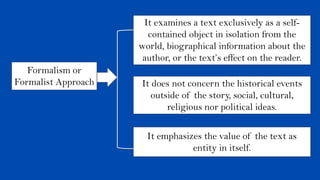
Formalism or
Formalist Approach
It examines a text exclusively as a self-
contained object in isolation from the
world, biographical information about the
author, or the text’s effect on the reader.
It does not concern the historical events
outside of the story, social, cultural,
religious nor political ideas.
It emphasizes the value of the text as
entity in itself.
If You Forget Me
PABLO NERUDA
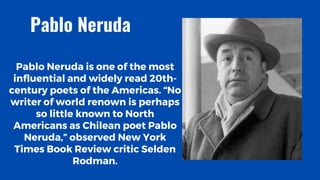
Pablo Neruda
Pablo Neruda is one of the most
influential and widely read 20th-
century poets of the Americas. “No
writer of world renown is perhaps
so little known to North
Americans as Chilean poet Pablo
Neruda,” observed New York
Times Book Review critic Selden
Rodman.
I want you to know
one thing.
You know how this is:
if I look
at the crystal moon, at the red branch
of the slow autumn at my window,
if I touch
near the fire
the impalpable ash
or the wrinkled body of the log,
everything carries me to you,
as if everything that exists,
aromas, light, metals,
were little boats
that sail
toward those isles of yours that wait for me.
Well, now,
if little by little you stop loving me
I shall stop loving you little by little.
If suddenly
you forget me
do not look for me,
for I shall already have forgotten you.
If you think it long and mad,
the wind of banners
that passes through my life,
and you decide
to leave me at the shore
of the heart where I have roots,
remember
that on that day,
at that hour,
I shall lift my arms
and my roots will set off
to seek another land.
But
if each day,
each hour,
you feel that you are destined for me
with implacable sweetness,
if each day a flower
climbs up to your lips to seek me,
ah my love, ah my own,
in me all that fire is repeated,
in me nothing is extinguished or forgotten,
my love feeds on your love, beloved,
and as long as you live it will be in your arms
without leaving mine.
The Road Not Taken
Robert Frost
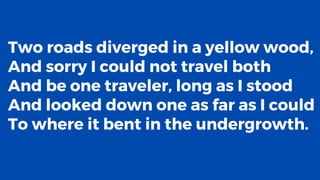
Two roads diverged in a yellow wood,
And sorry I could not travel both
And be one traveler, long as I stood
And looked down one as far as I could
To where it bent in the undergrowth.
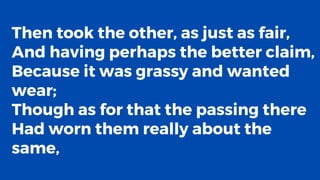
Then took the other, as just as fair,
And having perhaps the better claim,
Because it was grassy and wanted
wear;
Though as for that the passing there
Had worn them really about the
same,
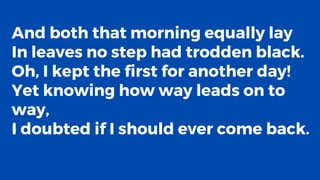
And both that morning equally lay
In leaves no step had trodden black.
Oh, I kept the first for another day!
Yet knowing how way leads on to
way,
I doubted if I should ever come back.
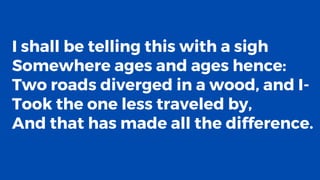
I shall be telling this with a sigh
Somewhere ages and ages hence:
Two roads diverged in a wood, and I-
Took the one less traveled by,
And that has made all the difference.
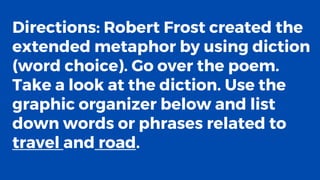
Directions: Robert Frost created the
extended metaphor by using diction
(word choice). Go over the poem.
Take a look at the diction. Use the
graphic organizer below and list
down words or phrases related to
travel and road.
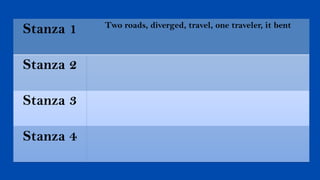
Stanza 1 Two roads, diverged, travel, one traveler, it bent
Stanza 2
Stanza 3
Stanza 4
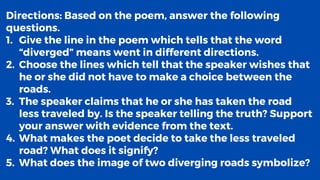
Directions: Based on the poem, answer the following
questions.
1. Give the line in the poem which tells that the word
“diverged” means went in different directions.
2. Choose the lines which tell that the speaker wishes that
he or she did not have to make a choice between the
roads.
3. The speaker claims that he or she has taken the road
less traveled by. Is the speaker telling the truth? Support
your answer with evidence from the text.
4. What makes the poet decide to take the less traveled
road? What does it signify?
5. What does the image of two diverging roads symbolize?
Poetry Foundation. (n.d.-a). Pablo Neruda.
https://www.poetryfoundation.org/poets/pablo-neruda
If You Forget Me. (n.d.). All Poetry. Retrieved January 9, 2023, from
https://allpoetry.com/if-you-forget-me
Jean Charlene Cariaga. (2021, January 31). The Formalist Approach
[Video]. YouTube. https://www.youtube.com/watch?v=XT5_Fr4rErc
World Literature 10. (2016). The Library Publishing House, Inc.
REFERENCES:

Quarter 3-Lesson2-FORMALIST APPROACH.pdf

  • 1.
    Learning Targets • Defineformalist approach. • Explain literature using the overall artistic value of the structure and elements of the selection. • Explain how elements specific to genre contribute to the theme of a particular literary selection.
  • 2.
    Literacy Criticism ✓ isthe evaluation, analysis, description, or interpretation of a literary work. Critic ✓ Is a person who judges, evaluates, or analyzes a literary piece.
  • 3.
    Critique (v) ✓ Meansto critically evaluate, analyze, or give careful judgment in which you give your opinion about a literary work. Critique (n) ✓ Is a detailed evaluation or analysis of a literary piece.
  • 4.
    Understanding a literarywork can be difficult if one does not know how to interpret meanings behind the words used by the author.
  • 5.
  • 6.
    Formalist approach it discoversthe true meaning of work by giving attention to the form or structure, elements and literary devices operating in it.
  • 7.
    Formalist approach simply disregardsworks : • cultural influence • historical influence • social influence • authorship • content
  • 8.
    Formalist approach focused onhow the elements of a certain text work together in order to develop a certain effect.
  • 9.
    A literary workcan be understood only through reference to literary features which are found in the text.
  • 10.
  • 11.
    The basic elementof a story is the character.
  • 12.
    • A protagonistis a central character in a story. • The antagonist is usually the enemy of the central character.
  • 13.
    • A dynamiccharacter is one that changes the story. • A static character remains the same or does not undergo changes during the story
  • 14.
    Another important elementof a story is the setting.
  • 15.
    Setting tells thereaders where (place) and when (time, weather condition) the story happened.
  • 16.
    • The settingallows the readers to picture the characters' daily lives (social condition). • The readers' feelings (mood or atmosphere) felt as they read the story are also part of the setting.
  • 17.
    The plot isthe main structure of a story because it details how the series of events are presented.
  • 19.
    A story usuallyhas problems or complications, generally called conflict.
  • 20.
    When a characterconflicts with oneself, the complication happens within the character, thus called internal conflict.
  • 21.
    On the otherhand, external conflict happens when the conflict happens between: (1) a character and another character (character vs. character); (2) a character and the environment (character vs. nature); or (3) a character and customs and practices (character vs. society)
  • 22.
    The central messageor the lesson in a story is called a theme.
  • 23.
    It should beremembered that a theme is a message from the author and not the subject or topic of a story.
  • 24.
    Other elements ofthe story are: • Point of view • Tone • Mood • Style • Imagery
  • 25.
    Literary devices ✓ Aretools used by writers to hint at larger themes, ideas, and meaning in a story or piece of writing.
  • 26.
    Simile ✓ Two unrelatedobjects are being compared to each other with the use of the words “like” or “as”. Example: You are as brave as a lion.
  • 27.
    Metaphor ✓ A statementin which two objects, often unrelated, are compared to each other. Example: The tree is the god of the forest.
  • 28.
    Imagery ✓ It engagesthe senses to deepen the reader’s comprehension of what is happening and how to feel about it. Example: The tree spread its gigantic, sun-flecked shoulders.
  • 29.
    Symbolism ✓ Uses symbolswhich can be words, people, marks, locations, or abstract ideas to represent something beyond the literal meaning. Example: rainbow – symbolizes hope or promise.
  • 30.
    Personification ✓ Giving humanattributes to nonhuman objects. Example: The car needs a cold shower.
  • 31.
    Sound devices ✓ Arespecial tools the poet can use to create certain effects in the poem to convey and reinforce meaning through sound.
  • 32.
    Rhyme ✓ Is thematching vowel sounds at the end of words or lines. Example: Out of the night that covers me Black as the pit from pole to pole. I thank whatever gods may be For my unconquerable soul.
  • 33.
    Repetition ✓ Is therepeating of any words, phrases, sentences or lines within a poem. Example: To the swinging and the ringing Of the bells, bells, bells--
  • 34.
    Assonance ✓ Is repetitionof vowel sounds within words. Example: I like to decline an offer of wine to define my style.
  • 35.
    Alliteration ✓ Is repetitionof the consonant sounds at the beginning of words. Example: The shepherd shook his head in negation.
  • 36.
    Onomatopoeia ✓ Uses wordswhich imitate the natural sound of things Example: The sack fell into the river with a splash.
  • 37.
    HOW DO YOUUSE FORMALIST APPROACH IN READING LITERATURE?
  • 38.
    USING FORMALIST APPROACH •Identify the various elements present in the text. • Determine how the elements work together in developing the theme. • Assess the overall artistic value of the text.
  • 39.
    FORMALIST APPROACH Studies howthe elements work together to form unity and to give meaning to a text.
  • 40.
    1. How doeselements conspire or work together? 2. How does the conflict affect the characters’ actions? 3. What do the objects, events, images or actions symbolize?
  • 41.
    Formalism or Formalist Approach Itexamines a text exclusively as a self- contained object in isolation from the world, biographical information about the author, or the text’s effect on the reader. It does not concern the historical events outside of the story, social, cultural, religious nor political ideas. It emphasizes the value of the text as entity in itself.
  • 42.
    If You ForgetMe PABLO NERUDA
  • 43.
    Pablo Neruda Pablo Nerudais one of the most influential and widely read 20th- century poets of the Americas. “No writer of world renown is perhaps so little known to North Americans as Chilean poet Pablo Neruda,” observed New York Times Book Review critic Selden Rodman.
  • 44.
    I want youto know one thing.
  • 45.
    You know howthis is: if I look at the crystal moon, at the red branch of the slow autumn at my window, if I touch near the fire the impalpable ash or the wrinkled body of the log, everything carries me to you, as if everything that exists, aromas, light, metals, were little boats that sail toward those isles of yours that wait for me.
  • 46.
    Well, now, if littleby little you stop loving me I shall stop loving you little by little.
  • 47.
    If suddenly you forgetme do not look for me, for I shall already have forgotten you.
  • 48.
    If you thinkit long and mad, the wind of banners that passes through my life, and you decide to leave me at the shore of the heart where I have roots, remember that on that day, at that hour, I shall lift my arms and my roots will set off to seek another land.
  • 49.
    But if each day, eachhour, you feel that you are destined for me with implacable sweetness, if each day a flower climbs up to your lips to seek me, ah my love, ah my own, in me all that fire is repeated, in me nothing is extinguished or forgotten, my love feeds on your love, beloved, and as long as you live it will be in your arms without leaving mine.
  • 50.
    The Road NotTaken Robert Frost
  • 51.
    Two roads divergedin a yellow wood, And sorry I could not travel both And be one traveler, long as I stood And looked down one as far as I could To where it bent in the undergrowth.
  • 52.
    Then took theother, as just as fair, And having perhaps the better claim, Because it was grassy and wanted wear; Though as for that the passing there Had worn them really about the same,
  • 53.
    And both thatmorning equally lay In leaves no step had trodden black. Oh, I kept the first for another day! Yet knowing how way leads on to way, I doubted if I should ever come back.
  • 54.
    I shall betelling this with a sigh Somewhere ages and ages hence: Two roads diverged in a wood, and I- Took the one less traveled by, And that has made all the difference.
  • 55.
    Directions: Robert Frostcreated the extended metaphor by using diction (word choice). Go over the poem. Take a look at the diction. Use the graphic organizer below and list down words or phrases related to travel and road.
  • 56.
    Stanza 1 Tworoads, diverged, travel, one traveler, it bent Stanza 2 Stanza 3 Stanza 4
  • 57.
    Directions: Based onthe poem, answer the following questions. 1. Give the line in the poem which tells that the word “diverged” means went in different directions. 2. Choose the lines which tell that the speaker wishes that he or she did not have to make a choice between the roads. 3. The speaker claims that he or she has taken the road less traveled by. Is the speaker telling the truth? Support your answer with evidence from the text. 4. What makes the poet decide to take the less traveled road? What does it signify? 5. What does the image of two diverging roads symbolize?
  • 58.
    Poetry Foundation. (n.d.-a).Pablo Neruda. https://www.poetryfoundation.org/poets/pablo-neruda If You Forget Me. (n.d.). All Poetry. Retrieved January 9, 2023, from https://allpoetry.com/if-you-forget-me Jean Charlene Cariaga. (2021, January 31). The Formalist Approach [Video]. YouTube. https://www.youtube.com/watch?v=XT5_Fr4rErc World Literature 10. (2016). The Library Publishing House, Inc. REFERENCES: