Critiquing a Literary Selection:
Formalist Approach
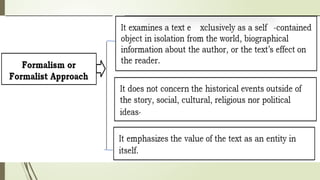
This approach analyzes the structure or
form of each individual element of a
story. It provides readers with a way to
understand and enjoy a work for its own
inherent value as a literary art.
It uses close reading of the text to analyze
the deeper meaning of the words
individually and collectively. It also
focuses only on the text itself.
FORMALIST APPROACH
In using the formalist approach, what
literary elements and devices are you going
to analyze? Figure them out!
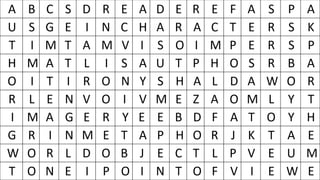
Activity 1: I Finally Found You!
Directions: Search for the 10 literary devices and
elements analyzed in a short
story based on the formalist approach. Write them
on your answer sheet.
Clue: The words were formed horizontally, vertically,
and diagonally.
A B C S D R E A D E R E F A S P A
U S G E I N C H A R A C T E R S K
T I M T A M V I S O I M P E R S P
H M A T L I S A U T P H O S R B A
O I T I R O N Y S H A L D A W O R
R L E N V O I V M E Z A O M L Y T
I M A G E R Y E E B D F A T O Y H
G R I N M E T A P H O R J K T A E
W O R L D O B J E C T L P V E U M
T O N E I P O I N T O F V I E W E
Vocabulary Development
The word ‘formalism’ derived from
the word ‘form’ or structure. The ‘ism’
is a belief or an approach of looking at
things.
Vocabulary Development
Literary Criticism is the evaluation,
analysis, description, or interpretation
of literary works.
Vocabulary Development
Critique (verb) means to critically evaluate,
analyze or give careful judgment in which you
give your opinion about a literary work.
Critique /Critic is a person who judges,
evaluates, or analyzes a literary piece.
It analyzes the work as a whole, the form of
each individual part of the text from the
individual scenes and chapters, the
characters, the settings, the tone, the point of
view, the theme, and all other literary
elements and devices such as imagery .
Character- It is a person, animal, being ,
creature or anything personified in a story.
Setting-It is not only the place and time a story
takes place but also includes the atmosphere.
Tone- It is the overall emotion conveyed by
both the choices of words, theme, sensory
images, symbolism and the narrator of the
story such as scared, excited, worried,
happy or sad.
Theme- It is the author’s message to the
readers.
Imagery-It consists of descriptive language
to create images in the mind of the readers
through their senses.
Example :
The lake was left shivering by the
touch of morning wind.
Point of View- It answers the question “Who is
telling the story?”
First person- It uses either of the two pronouns “I” or
“We”. The narrator is a participant in the story relating his
or her own experiences directly or an observer.
Example: “I was standing in the dark. I was scared and cold.
Then, I felt something on my shoulder, and it was a hand. I
was trying to get away, but it wouldn’t let me go. I
screamed as loud as I could, but no one heard me.” – In the
Dark
Third person- It uses pronouns “They”, “She”,
“He”, “It” or a name. The narrator may be
omniscient (all- knowing) or has a full access to
the thoughts and experiences of all characters
in the story or may be a limited omniscient
who usually cannot see into minds or know the
future, etc.
Second person- The story is told to “You”.
Activity 2: I’m the One!
Direction: Write True if the sentence is correct and False if
otherwise.
____1. formalist must be a close or careful reader who examines all the
elements of a text individually to discover how they form an organic
unity.
____2. Literary Criticism is the evaluation, analysis, description, or
interpretation of literary works.
____3. formalist looks beyond the work by reading the author’s life, or
literary style.
____4. formalist examines the work’s historical background and
condition of the society.
____5. formalist allows the text to reveal itself.
____6. formalist analyzes how the elements work together to
form the unity of structure and to give meaning to the
text.
____7. formalist achieves understanding of the text by
looking inside it, not outside nor beyond.
____8. formalist studies how the text’s influences or figures
out similarity with other works.
____9. Critique (verb) is a person who judges, evaluates, or
analyzes a literary piece.
____10. formalist does not concern the historical events
outside of the story, social, cultural, religious nor
political ideas.
Activity : Read and Critique!
Trivia: Did you know that Benguet is a native term
which refers to a lake where water does not drain?
The name “Benguet” was once limited to the area of
what is now the La Trinidad Valley, which was well-
cultivated with rice, sweet potatoes, gabi, and sugar
cane by its original settlers. The natives there were
generally Ibaloys.

Cccccccccccccccccccccccritiquing a Literary Selection.pptx

  • 1.
    Critiquing a LiterarySelection: Formalist Approach
  • 2.
    This approach analyzesthe structure or form of each individual element of a story. It provides readers with a way to understand and enjoy a work for its own inherent value as a literary art.
  • 3.
    It uses closereading of the text to analyze the deeper meaning of the words individually and collectively. It also focuses only on the text itself.
  • 4.
  • 5.
    In using theformalist approach, what literary elements and devices are you going to analyze? Figure them out!
  • 6.
    Activity 1: IFinally Found You! Directions: Search for the 10 literary devices and elements analyzed in a short story based on the formalist approach. Write them on your answer sheet. Clue: The words were formed horizontally, vertically, and diagonally.
  • 7.
    A B CS D R E A D E R E F A S P A U S G E I N C H A R A C T E R S K T I M T A M V I S O I M P E R S P H M A T L I S A U T P H O S R B A O I T I R O N Y S H A L D A W O R R L E N V O I V M E Z A O M L Y T I M A G E R Y E E B D F A T O Y H G R I N M E T A P H O R J K T A E W O R L D O B J E C T L P V E U M T O N E I P O I N T O F V I E W E
  • 8.
    Vocabulary Development The word‘formalism’ derived from the word ‘form’ or structure. The ‘ism’ is a belief or an approach of looking at things.
  • 9.
    Vocabulary Development Literary Criticismis the evaluation, analysis, description, or interpretation of literary works.
  • 10.
    Vocabulary Development Critique (verb)means to critically evaluate, analyze or give careful judgment in which you give your opinion about a literary work. Critique /Critic is a person who judges, evaluates, or analyzes a literary piece.
  • 11.
    It analyzes thework as a whole, the form of each individual part of the text from the individual scenes and chapters, the characters, the settings, the tone, the point of view, the theme, and all other literary elements and devices such as imagery .
  • 13.
    Character- It isa person, animal, being , creature or anything personified in a story. Setting-It is not only the place and time a story takes place but also includes the atmosphere.
  • 14.
    Tone- It isthe overall emotion conveyed by both the choices of words, theme, sensory images, symbolism and the narrator of the story such as scared, excited, worried, happy or sad.
  • 15.
    Theme- It isthe author’s message to the readers. Imagery-It consists of descriptive language to create images in the mind of the readers through their senses.
  • 16.
    Example : The lakewas left shivering by the touch of morning wind.
  • 17.
    Point of View-It answers the question “Who is telling the story?” First person- It uses either of the two pronouns “I” or “We”. The narrator is a participant in the story relating his or her own experiences directly or an observer. Example: “I was standing in the dark. I was scared and cold. Then, I felt something on my shoulder, and it was a hand. I was trying to get away, but it wouldn’t let me go. I screamed as loud as I could, but no one heard me.” – In the Dark
  • 18.
    Third person- Ituses pronouns “They”, “She”, “He”, “It” or a name. The narrator may be omniscient (all- knowing) or has a full access to the thoughts and experiences of all characters in the story or may be a limited omniscient who usually cannot see into minds or know the future, etc. Second person- The story is told to “You”.
  • 19.
    Activity 2: I’mthe One! Direction: Write True if the sentence is correct and False if otherwise. ____1. formalist must be a close or careful reader who examines all the elements of a text individually to discover how they form an organic unity. ____2. Literary Criticism is the evaluation, analysis, description, or interpretation of literary works. ____3. formalist looks beyond the work by reading the author’s life, or literary style. ____4. formalist examines the work’s historical background and condition of the society. ____5. formalist allows the text to reveal itself.
  • 20.
    ____6. formalist analyzeshow the elements work together to form the unity of structure and to give meaning to the text. ____7. formalist achieves understanding of the text by looking inside it, not outside nor beyond. ____8. formalist studies how the text’s influences or figures out similarity with other works. ____9. Critique (verb) is a person who judges, evaluates, or analyzes a literary piece. ____10. formalist does not concern the historical events outside of the story, social, cultural, religious nor political ideas.
  • 21.
    Activity : Readand Critique! Trivia: Did you know that Benguet is a native term which refers to a lake where water does not drain? The name “Benguet” was once limited to the area of what is now the La Trinidad Valley, which was well- cultivated with rice, sweet potatoes, gabi, and sugar cane by its original settlers. The natives there were generally Ibaloys.