The Power Debate:
A UK Generation Game

Welcome
19 November 2013
The UK Power Mix
Andrew Poyner
Watson Burton
Agenda
• Generation through to sales
• The current generation split

• Sustainability and emissions
• Generation methods: the headlines
• Questions and Voting
Power Generation: Overview of the market
• Generation
• Transmission and Distribution

• Supply and Sales
• Regulation
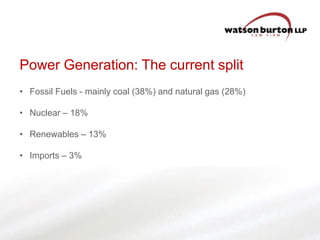
Power Generation: The current split
• Fossil Fuels - mainly coal (38%) and natural gas (28%)
• Nuclear – 18%

• Renewables – 13%
• Imports – 3%
Power Generation: Sustainability
• £17billion investment (2007-2010)
• 45,000 new jobs
• Carbon emissions
• Zero carbon technologies (40% generated by 2020)
1. Is there any point in
reducing UK emissions
when the likes of Brazil,
Russia, India and China
are not reducing in the
same way?
Coal: The headlines
• Supply
• Price

• Environmental
• Resources
• Employment
2. Coal continues to be
one of the most
significant players in the
UK energy mix, is the
Government being short
sighted to turn its back
on coal?
Oil and gas: The headlines
• Supply: North and Irish Sea, pipelines, LNG shipping
• Price

• Resources
• Storage
• Employment
3. Given dwindling
supplies of North Sea
oil and gas, should
we focus on this as
part of a long term
energy solution for
the UK?
Nuclear: The headlines
• Supply
• Price

• Resources
• Employment
• Safety / Risk
4. Is the Government
right in proposing that
nuclear should play a
larger role in our energy
mix in the future?
Wind Power: The headlines
• Supply
• Price
• Resources
• Employment

• Safety / Risk
5. Given the continuing
public resistance to
onshore wind farms, is
there a real future for
wind power in the UK?
Solar: The headlines
• Supply
• Price

• Resources
• Employment
• Safety / Risk
6. Is solar as reliable
as a British summer?
Thank you
for your participation
The panel perspective
Martin Needham, CNG
Barnaby Pilgrim, Banks Group
Andrew Mill, NAREC
Colin Henry, Siemens
James Poyner, Miller Argent
The panel perspective
Andrew Mills, Narec
Andrew Mill
Chief Executive
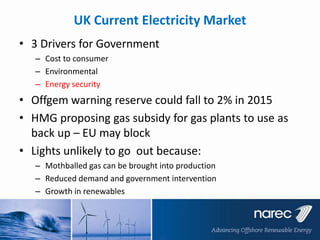
UK Current Electricity Market
• 3 Drivers for Government
– Cost to consumer
– Environmental
– Energy security

• Offgem warning reserve could fall to 2% in 2015
• HMG proposing gas subsidy for gas plants to use as
back up – EU may block
• Lights unlikely to go out because:
– Mothballed gas can be brought into production
– Reduced demand and government intervention
– Growth in renewables
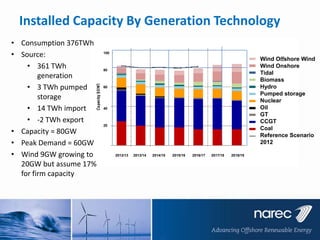
Installed Capacity By Generation Technology
• Consumption 376TWh
• Source:
• 361 TWh
generation
• 3 TWh pumped
storage
• 14 TWh import
• -2 TWh export
• Capacity = 80GW
• Peak Demand = 60GW
• Wind 9GW growing to
20GW but assume 17%
for firm capacity

100

Wind Offshore Wind
Wind Onshore
Tidal
Biomass
Hydro
Pumped storage
Nuclear
Oil
GT
CCGT
Coal
Reference Scenario
2012

80

60

40

20

2012/13

2013/14

2014/15

2015/16

2016/17

2017/18

2018/19
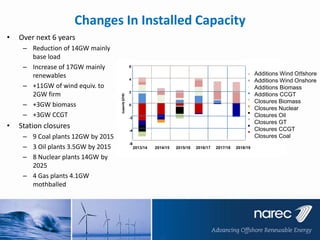
Changes In Installed Capacity
•

Over next 6 years
– Reduction of 14GW mainly
base load
– Increase of 17GW mainly
renewables
– +11GW of wind equiv. to
2GW firm
– +3GW biomass
– +3GW CCGT

•

Station closures
– 9 Coal plants 12GW by 2015
– 3 Oil plants 3.5GW by 2015
– 8 Nuclear plants 14GW by
2025
– 4 Gas plants 4.1GW
mothballed

6

Additions Wind Offshore
Additions Wind Onshore
Additions Biomass
Additions CCGT
Closures Biomass
Closures Nuclear
Closures Oil
Closures GT
Closures CCGT
Closures Coal

4

2

0

-2

-4

-6

2013/14

2014/15

2015/16

2016/17

2017/18

2018/19
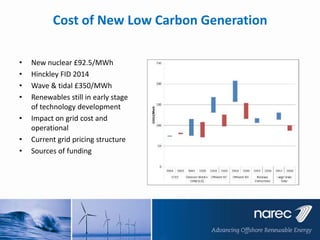
Cost of New Low Carbon Generation
•
•
•
•
•

•
•

New nuclear £92.5/MWh
Hinckley FID 2014
Wave & tidal £350/MWh
Renewables still in early stage
of technology development
Impact on grid cost and
operational
Current grid pricing structure
Sources of funding
World Factors
•
•
•
•
•
•
•
•

China key driver of global oil demand
By 2025 China will be 2X USA oil consumption
Vehicles 2009 China 13.6M – USA 10M
China investing in Future Energy Supplies
China currently consumes 45% of world coal
China only one of a number of growth areas
Kyoto China & India no imposed limits
No. countries have opted out USA, Canada, Russia &
Japan
Future UK Power Industry Factors
• Government Electricity Market Reform
• Prediction that UK demand will require capacity of 112GW by
2030
• Capital required £260bn this decade for new capacity and grid
• Renewable energy technologies still early stage
• Smart grids
– 200,000 X 40kW cars = 8GW storage
– Timing of appliances
– Micro-renewables

• New technologies required CCS & shale gas
The panel perspective
Colin Henry, Siemens
The Power Debate:
Transition to a low carbon energy mix –
balancing the system
19th Nov 2013
Colin Henry - Infrastructure and Cities Sector, Smart Grid

Restricted © Siemens AG 20XX All rights reserved.

Answers for infrastructure and
cities.
For internal use only © Siemens AG 2010. All rights reserved.

The big “themes”

•

Global race: Climate change or creation of new high skilled jobs?

•

The Energy Trilemma: Security, Sustainability, Affordability

•

Backing winners: EMR, a level playing field?

Some considerations:
• Cities today consume 75% of all the world’s energy and emit around
80% of all greenhouse gases. The fight against climate change will be
won or lost in cities!
•

The UK will need a diverse mix of energy sources and systems by 2050,
to ensure that supplies remain affordable, resilient and flexible. Local
energy systems will play an important part, and technologies are
required for generating, harvesting, distributing, storing, and using
energy at this scale. (Technology Strategy Board – Localised Energy Systems)

https://www.innovateuk.org/competition-display-page/-/asset_publisher/RqEt2AKmEBhi/content/localised-energy-systems-across-sector-approach
For internal use only © Siemens AG 2010. All rights reserved.

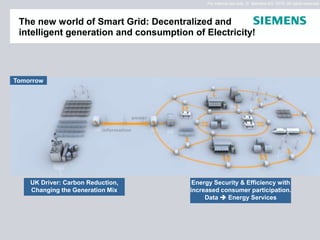
The new world of Smart Grid: Decentralized and
intelligent generation and consumption of Electricity!

Tomorrow

power
information

UK Driver: Carbon Reduction,
Changing the Generation Mix

Energy Security & Efficiency with
increased consumer participation.
Data  Energy Services
For internal use only © Siemens AG 2010. All rights reserved.

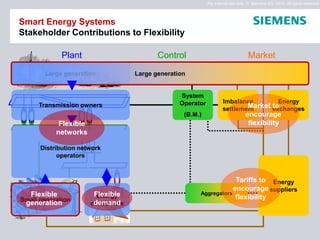
Smart Energy Systems
Stakeholder Contributions to Flexibility
Plant

Control

Large generation

Transmission owners

Market

Large generation

System
Operator
(B.M.)

Flexible
networks

Imbalance
Energy
Market exchanges
to
settlement

encourage
flexibility

Distribution network
operators

Flexible
generation

Small generation

Flexible
Energy
demand
consumers

Tariffs to Energy
encourage suppliers
Aggregators
flexibility
For internal use only © Siemens AG 2010. All rights reserved.

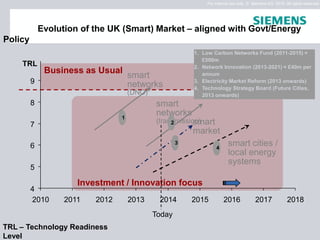
Evolution of the UK (Smart) Market – aligned with Govt/Energy
Policy
TRL

Business as Usual

9

1. Low Carbon Networks Fund (2011-2015) =
£500m
2. Network Innovation (2013-2021) = £40m per
annum
3. Electricity Market Reform (2013 onwards)
4. Technology Strategy Board (Future Cities,
2013 onwards)

smart
networks
(DNO)

8

smart
networks

1

(transmission)
2
smart

7

market
3

6

4

5
4
2010

smart cities /
local energy
systems

Investment / Innovation focus
2011

2012

2013

2014
Today

TRL – Technology Readiness
Level

2015

2016

2017

2018
For internal use only © Siemens AG 2010. All rights reserved.

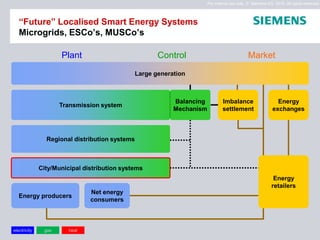
“Future” Localised Smart Energy Systems
Microgrids, ESCo’s, MUSCo’s
Plant

Control

Market

Large generation

Transmission system

Balancing
Mechanism

Imbalance
settlement

Energy
exchanges

Regional distribution systems

City/Municipal distribution systems
Energy
retailers
Energy producers

electricity

gas

heat

Net energy
consumers
For internal use only © Siemens AG 2010. All rights reserved.

Food for thought.......other market entrants??
Some key figures for China:•
•
•

•
•

•

Population – over 1.3 billion (20% of world;1 in 5 Chinese)
most populous country in world
State Grid Corporation of China (SGCC), covers 88 per cent of
China and serves over 1 billion customers
26.53% electricity generated in China from clean energy in
2010. Carbon intensity of China‘s economy to be reduced by
40-45% by 2020, [against baseline 2005]
Smart Grid market size $22.3bn in 2011 rising to $61.4bn in
2015, largest element T&D Eqpt (at 35%)
SGCC released in June 2010, industry rules, standards and
favoured technologies for domestic and international
manufacturers of smart grid equipment
And .......Chinese domestic firms serving the smart grid market
will expand their footprint beyond their nation‘s borders as their
technologies and their services will become increasingly
competitive with their foreign counterparts

Source: China: Rise of the Smart Grid, January 2011, www.Zpryme.com, Research and Consulting
The panel perspective
James T. Poyner, Miller Argent
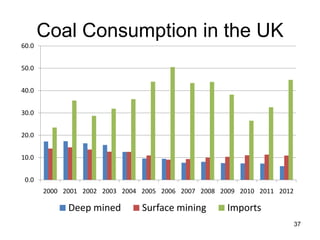
Coal Consumption in the UK
60.0
50.0
40.0
30.0
20.0
10.0
0.0
2000 2001 2002 2003 2004 2005 2006 2007 2008 2009 2010 2011 2012

Deep mined

Surface mining

Imports
37
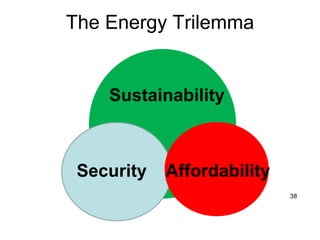
The Energy Trilemma

Sustainability

Security

Affordability
38
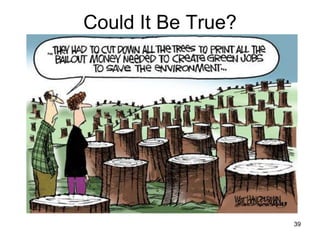
Could It Be True?

39
Refreshment break
See you at 10.45am
The Debate
Martin Needham, CNG
Barnaby Pilgrim, Banks Group
Andrew Mill, NAREC
Colin Henry, Siemens
James Poyner, Miller Argent
Closing remarks
If you would like to contribute your views to our report
on the sector, please contact me:
richard.palmer@watsonburton.com
Thank you
Please leave your feedback forms on the table

Energy Debate

  • 1.
    The Power Debate: AUK Generation Game Welcome 19 November 2013
  • 2.
    The UK PowerMix Andrew Poyner Watson Burton
  • 3.
    Agenda • Generation throughto sales • The current generation split • Sustainability and emissions • Generation methods: the headlines • Questions and Voting
  • 4.
    Power Generation: Overviewof the market • Generation • Transmission and Distribution • Supply and Sales • Regulation
  • 5.
    Power Generation: Thecurrent split • Fossil Fuels - mainly coal (38%) and natural gas (28%) • Nuclear – 18% • Renewables – 13% • Imports – 3%
  • 6.
    Power Generation: Sustainability •£17billion investment (2007-2010) • 45,000 new jobs • Carbon emissions • Zero carbon technologies (40% generated by 2020)
  • 7.
    1. Is thereany point in reducing UK emissions when the likes of Brazil, Russia, India and China are not reducing in the same way?
  • 8.
    Coal: The headlines •Supply • Price • Environmental • Resources • Employment
  • 9.
    2. Coal continuesto be one of the most significant players in the UK energy mix, is the Government being short sighted to turn its back on coal?
  • 10.
    Oil and gas:The headlines • Supply: North and Irish Sea, pipelines, LNG shipping • Price • Resources • Storage • Employment
  • 11.
    3. Given dwindling suppliesof North Sea oil and gas, should we focus on this as part of a long term energy solution for the UK?
  • 12.
    Nuclear: The headlines •Supply • Price • Resources • Employment • Safety / Risk
  • 13.
    4. Is theGovernment right in proposing that nuclear should play a larger role in our energy mix in the future?
  • 14.
    Wind Power: Theheadlines • Supply • Price • Resources • Employment • Safety / Risk
  • 15.
    5. Given thecontinuing public resistance to onshore wind farms, is there a real future for wind power in the UK?
  • 16.
    Solar: The headlines •Supply • Price • Resources • Employment • Safety / Risk
  • 17.
    6. Is solaras reliable as a British summer?
  • 18.
    Thank you for yourparticipation
  • 19.
    The panel perspective MartinNeedham, CNG Barnaby Pilgrim, Banks Group Andrew Mill, NAREC Colin Henry, Siemens James Poyner, Miller Argent
  • 20.
  • 21.
  • 22.
    UK Current ElectricityMarket • 3 Drivers for Government – Cost to consumer – Environmental – Energy security • Offgem warning reserve could fall to 2% in 2015 • HMG proposing gas subsidy for gas plants to use as back up – EU may block • Lights unlikely to go out because: – Mothballed gas can be brought into production – Reduced demand and government intervention – Growth in renewables
  • 23.
    Installed Capacity ByGeneration Technology • Consumption 376TWh • Source: • 361 TWh generation • 3 TWh pumped storage • 14 TWh import • -2 TWh export • Capacity = 80GW • Peak Demand = 60GW • Wind 9GW growing to 20GW but assume 17% for firm capacity 100 Wind Offshore Wind Wind Onshore Tidal Biomass Hydro Pumped storage Nuclear Oil GT CCGT Coal Reference Scenario 2012 80 60 40 20 2012/13 2013/14 2014/15 2015/16 2016/17 2017/18 2018/19
  • 24.
    Changes In InstalledCapacity • Over next 6 years – Reduction of 14GW mainly base load – Increase of 17GW mainly renewables – +11GW of wind equiv. to 2GW firm – +3GW biomass – +3GW CCGT • Station closures – 9 Coal plants 12GW by 2015 – 3 Oil plants 3.5GW by 2015 – 8 Nuclear plants 14GW by 2025 – 4 Gas plants 4.1GW mothballed 6 Additions Wind Offshore Additions Wind Onshore Additions Biomass Additions CCGT Closures Biomass Closures Nuclear Closures Oil Closures GT Closures CCGT Closures Coal 4 2 0 -2 -4 -6 2013/14 2014/15 2015/16 2016/17 2017/18 2018/19
  • 25.
    Cost of NewLow Carbon Generation • • • • • • • New nuclear £92.5/MWh Hinckley FID 2014 Wave & tidal £350/MWh Renewables still in early stage of technology development Impact on grid cost and operational Current grid pricing structure Sources of funding
  • 26.
    World Factors • • • • • • • • China keydriver of global oil demand By 2025 China will be 2X USA oil consumption Vehicles 2009 China 13.6M – USA 10M China investing in Future Energy Supplies China currently consumes 45% of world coal China only one of a number of growth areas Kyoto China & India no imposed limits No. countries have opted out USA, Canada, Russia & Japan
  • 27.
    Future UK PowerIndustry Factors • Government Electricity Market Reform • Prediction that UK demand will require capacity of 112GW by 2030 • Capital required £260bn this decade for new capacity and grid • Renewable energy technologies still early stage • Smart grids – 200,000 X 40kW cars = 8GW storage – Timing of appliances – Micro-renewables • New technologies required CCS & shale gas
  • 28.
  • 29.
    The Power Debate: Transitionto a low carbon energy mix – balancing the system 19th Nov 2013 Colin Henry - Infrastructure and Cities Sector, Smart Grid Restricted © Siemens AG 20XX All rights reserved. Answers for infrastructure and cities.
  • 30.
    For internal useonly © Siemens AG 2010. All rights reserved. The big “themes” • Global race: Climate change or creation of new high skilled jobs? • The Energy Trilemma: Security, Sustainability, Affordability • Backing winners: EMR, a level playing field? Some considerations: • Cities today consume 75% of all the world’s energy and emit around 80% of all greenhouse gases. The fight against climate change will be won or lost in cities! • The UK will need a diverse mix of energy sources and systems by 2050, to ensure that supplies remain affordable, resilient and flexible. Local energy systems will play an important part, and technologies are required for generating, harvesting, distributing, storing, and using energy at this scale. (Technology Strategy Board – Localised Energy Systems) https://www.innovateuk.org/competition-display-page/-/asset_publisher/RqEt2AKmEBhi/content/localised-energy-systems-across-sector-approach
  • 31.
    For internal useonly © Siemens AG 2010. All rights reserved. The new world of Smart Grid: Decentralized and intelligent generation and consumption of Electricity! Tomorrow power information UK Driver: Carbon Reduction, Changing the Generation Mix Energy Security & Efficiency with increased consumer participation. Data  Energy Services
  • 32.
    For internal useonly © Siemens AG 2010. All rights reserved. Smart Energy Systems Stakeholder Contributions to Flexibility Plant Control Large generation Transmission owners Market Large generation System Operator (B.M.) Flexible networks Imbalance Energy Market exchanges to settlement encourage flexibility Distribution network operators Flexible generation Small generation Flexible Energy demand consumers Tariffs to Energy encourage suppliers Aggregators flexibility
  • 33.
    For internal useonly © Siemens AG 2010. All rights reserved. Evolution of the UK (Smart) Market – aligned with Govt/Energy Policy TRL Business as Usual 9 1. Low Carbon Networks Fund (2011-2015) = £500m 2. Network Innovation (2013-2021) = £40m per annum 3. Electricity Market Reform (2013 onwards) 4. Technology Strategy Board (Future Cities, 2013 onwards) smart networks (DNO) 8 smart networks 1 (transmission) 2 smart 7 market 3 6 4 5 4 2010 smart cities / local energy systems Investment / Innovation focus 2011 2012 2013 2014 Today TRL – Technology Readiness Level 2015 2016 2017 2018
  • 34.
    For internal useonly © Siemens AG 2010. All rights reserved. “Future” Localised Smart Energy Systems Microgrids, ESCo’s, MUSCo’s Plant Control Market Large generation Transmission system Balancing Mechanism Imbalance settlement Energy exchanges Regional distribution systems City/Municipal distribution systems Energy retailers Energy producers electricity gas heat Net energy consumers
  • 35.
    For internal useonly © Siemens AG 2010. All rights reserved. Food for thought.......other market entrants?? Some key figures for China:• • • • • • Population – over 1.3 billion (20% of world;1 in 5 Chinese) most populous country in world State Grid Corporation of China (SGCC), covers 88 per cent of China and serves over 1 billion customers 26.53% electricity generated in China from clean energy in 2010. Carbon intensity of China‘s economy to be reduced by 40-45% by 2020, [against baseline 2005] Smart Grid market size $22.3bn in 2011 rising to $61.4bn in 2015, largest element T&D Eqpt (at 35%) SGCC released in June 2010, industry rules, standards and favoured technologies for domestic and international manufacturers of smart grid equipment And .......Chinese domestic firms serving the smart grid market will expand their footprint beyond their nation‘s borders as their technologies and their services will become increasingly competitive with their foreign counterparts Source: China: Rise of the Smart Grid, January 2011, www.Zpryme.com, Research and Consulting
  • 36.
    The panel perspective JamesT. Poyner, Miller Argent
  • 37.
    Coal Consumption inthe UK 60.0 50.0 40.0 30.0 20.0 10.0 0.0 2000 2001 2002 2003 2004 2005 2006 2007 2008 2009 2010 2011 2012 Deep mined Surface mining Imports 37
  • 38.
  • 39.
    Could It BeTrue? 39
  • 40.
  • 41.
    The Debate Martin Needham,CNG Barnaby Pilgrim, Banks Group Andrew Mill, NAREC Colin Henry, Siemens James Poyner, Miller Argent
  • 42.
    Closing remarks If youwould like to contribute your views to our report on the sector, please contact me: richard.palmer@watsonburton.com
  • 43.
    Thank you Please leaveyour feedback forms on the table

Editor's Notes

  • #2 Good morning everybodyThis section of the event is going to provide a brief context of the energy market in the UK and provide an introduction to some of the topics to be covered by our speakers in the next session – this may be covering familiar ground for you, but will hopefully serve as a useful refresher.In terms of an agenda:We’ll look briefly at the energy process from generation through to sales;Then we’ll look at the current split between generation methods, establishing where our current supplies are coming from;We’ll touch briefly on sustainability and emissions (but will not go into too much detail as I know this is a topic some of our speakers will want to comment on);and then finally, we’ll look at some headline points concerning each generation methodThere will also be an opportunity for you to have your say and we’ll be asking you to vote on a series of questions relating to energy generation in this session – and you should have in your packs a voting card with one side coloured green for a “yes” answer and one side coloured red for a “no” answer.
  • #3 OK, so turning to GENERATION,Most electricity is generated at power stations connected to the national transmission network. However, electricity can also be generated in smaller scale power stations which are connected to the regional distribution networks. The number and type  of power stations built are the decision of each individual company based on market signals and government policy at the time. It’s important to note at this point that electricity cannot be stored - it is used as it is generated or it is lost.A further essential point to appreciate is that demand for electricity is not constant – demand varies significantly through the day,the week and seasonally.Therefore the system has to be in a position where it can react almost immediately to changes in demand. Not all electricity generating systems are able to react quickly. For example Nuclear is either on or its off and wind power can only generate in the correct weather conditions. On the other hand, coal and gas can react quickly and are used to meet demand over and above base needs. This all goes to highlight that a diverse and flexible fuel mix is essential in the UK.Turning to TRANSMISSION and DISTRIBUTION:There are two types of electricity network: transmission and distribution. Transmission networks carry electricity long distances around the country at high voltages. Distribution networks run at lower voltages and take electricity from the transmission system into homes and businesses.The transmission system is run by National Grid, which is responsible for balancing the system and making sure that the supply of electricity meets the demand on a second-by-second basis. Similar infrastructure exists for the transmission and distribution of gas.In relation to SUPPLY and SALES:96% of the UK’s electricity is generated by 6 companies (who you will have seen featured in the news recently) – the ownership of the Big 6 as they have become known rests in four countries: the UK, Germany, France and Spain.No doubt we will be dealing with questions about the operation of the big 6 later in the morning, so we won’t go into too much detail in this session.Finally, there is the issue of REGULATION:The electricity and gas markets are regulated by the Gas and Electricity Markets Authority, operating through the Office of Gas and Electricity Markets (Ofgem). Ofgem's role is to protect the interest of consumers by promoting competition where appropriate, and Ofgem issues companies with licences to carry out activities in the electricity and gas sectors, it sets the levels of return which the monopoly networks companies can make, and decides on changes to market rules.
  • #4 In the UK energy is generated in a number of different ways. As we noted, it is important to have a mix of fuel sources and technologies so that there is not an over reliance on one particular form of generation.The main fuel source used in the UK is FOSSIL FUELS, mainly coal and natural gas. As of today, Coal is accounting for 38% of generation and natural gas is accounting for 28%.Second in generation capacity to fossil fuels is NUCLEAR, accounting for 18% of demand, and whilst the programme for closing down historic nuclear power stations continues, the Government has significant plans for nuclear power and has announced its intention to build a new £16bn plant at Hinckley (with the investment from France and China).RENEWABLES:Renewable Fuel sources include wind, wave, marine, hydro, biomass and solar. Renewablesmade up 7% of electricity generated in 2010 and has grown to 13% in 2013 - this is expected to rise as the UK aims to meet its EU target of generating 30% of its electricity from renewable sources by 2020.Finally, it is worth mentioning briefly the energy which the UK IMPORTS.The UK electricity network is connected to systems in France and Ireland, and the UK uses these to import or export electricity when it is most economical, and in 2010, the UK imported just under 1% of its energy
  • #5 OK, now turning to the issue of SUSTAINABILITY:The energy industry is an important player in the UK economy. Between 2008 and 2010, £17 billion was invested in theUK economy and 45,000 new jobs were created in the energy sector.The issue of CARBON EMISSIONS is at the forefront of energy generation in the UK, and energy companies are committed to cutting their carbon emissions and have pledged to become carbon neutral by 2050.These commitments will help to meet the UK's climate change targets, but a large amount of investment in new, low carbon power stations will also be needed. Emissions from the electricity sector have fallen by 16% since 1990 and are expected to continue to fall. By 2020, zero carbon technologies are expected to produce 40% of our electricity.
  • #8 GREEN = OK, so there is a majority in favour of committing to reducing emissionsRED = OK, so there is a majority against reducing emissions until other countries commit at the same levels as the UKSPLIT = OK, so there is mixed opinion as to whether we should be reducing emissions until other countries commit at the same level as the UK
  • #9 WE ARE NOW GOING TO TAKE A VERY QUICK LOOK AT SOME HEADLINE ISSUES ON THE VARIOUS TYPES OF ENERGY PRODUCTION IN THE UK, STARTING WITH COAL.With regard to supply, Coal accounted for 38% of electricity generation in the UK in 2012 - this is up from 29% in 2011, primarily as the price of coal was more stable in relation to gas.Presently, around 41% of electricity in the UK comes from coal-burning power stations. However, a third of these power stations are expected to close by 2016 so that they meet EU air quality legislation. This means that the UK will become less reliant on coal as a source of energy and will need to look at alternative energy sources.In terms of our export and import mix, the UK import more than twice the amount of coal we mine in the UK, and around 7.1 billion tonnes of coal were used worldwide last year, and since 2000, global coal consumption has grown faster than any other fuel.So as to address environmental issues, a new technology called Carbon Capture and Storage (CCS) is being developed to remove carbon dioxide from power station emissions and store it underground - the Government has announced £1bnof funding will be made available for the first CCS demonstration project.
  • #10 GREEN = OK, so there is a majority in favour of continuing to use coal as part of the energy mixRED = OK, so there is a majority in favour of taking coal out of the UK energy mixSPLIT = OK, so there is mixed opinion as to whether we should be taking coal out of the UK energy mix
  • #11 OK, now turning to look at headline points concerning OIL and GAS generation.The UK obtains its gas from three main sources: North and Irish Sea, pipelines from continental Europe and Norway, and by shipments of Liquefied Natural Gas from around the world.Gas from fields in the North and Irish Sea typically provide around 40% of gas supplies. However production from these fields is now in decline and the UK is importing increasing amounts of gas from abroad.With regard to price, gas is currently costing twice as much as coal, and the issue of security of supply is likely to affect the price further.Storage is an import issue when considering gas generation. Currently, the UK has over 4billion cubic metres of storage capacity that can be called upon to deliver over one quarter of national gas demand on any day. With regard to employment, over 400,000 people are employed in the oil and gas industry in the UK, which is obviously a major national employer.
  • #12 GREEN = OK, so there is a majority in favour of continuing to focus on oil and gas as part of a long term energy solution for the UKRED = OK, so there is a majority against oil and gas forming any long term energy solution for the UKSPLIT = OK, so there is mixed opinion as to whether oil and gas should form part of the long term energy solution for the UK
  • #13 Supply: Around 20% of UK energy is being generated by nuclear power, across 19 reactors located on 10 different sites £930bn worldwide investment in nuclear powerEmployment: 40,000Risk / SafetyNew nuclear plant at Hinckley – will cost around £14bn, to be operational in 2023 and to have a life of 60 years.
  • #14 GREEN = OK, so there is a majority in favour of Government’s plans to have 25% of energy generation from nuclear sourcesRED = OK, so there is a majority against nuclear playing a significant part of energy generation in the UKSPLIT = OK, so there is mixed opinion as to whether nuclear should form 25% of the UK’s energy requirement
  • #15 The UK’s location, with shallow seas and strong winds, makes offshore wind an ideal technology for generating power and an important part of the mix helping Britain to meet its 2020 renewable energy target. OFFSHOREOffshore wind also supports a UK supply chain and exports expertise all over the world. During construction over 75 organisations with 6700 individuals were involved. The EMR delivery plan shows that offshore wind has the potential to deliver 16GW by 2020 and up to 39GW by 2030The UK is the world leader in offshore wind, and is likely to remain as such until 2020One of the key factors in the development of UK Offshore Wind will be bringing down cost of the technologyLatest large projects include the London Array, with a 630MW capacity and a 1.9bn investment. DONG Energy, E.On and Masdar have built the world’s largest offshore wind farmONSHOREPlagued by planning objections and contentious with the public Recent large projects include Tallentire Wind Farm nr Cockermouth with a capacity of 12MW, costing 2.1MWind farms dent house prices (Daily Telegraph, October 31, 2013)Britain can't afford to throw money at wind power (Sunday Telegraph June 30, 2013)Currently 4,000 jobs in sector, expected to grow to 30,000 by 2020.
  • #16 GREEN = OK, so there is a majority in favour of onshore wind powerRED = OK, so there is a majority against onshore wind powerSPLIT = OK, so there is mixed opinion as to the use of onshore wind power
  • #17 Bentley– The UKs largest rooftop solar PV array was completed. It creates a 5MW installation that can supply 40% of Bentley’s power requirement at peak times.Bridge creates 1.1MW at a cost of 7.3M, but will supply 50% of Blackfriars station’s energy needs.Solar PV has a number of advantages;• Versatile and scalable – can be developed in a wide range of locations including domestic and commercial buildings• Can be developed and installed very quickly• Sun is free!Key to the increase will be the reduction in costs and perhaps consistency in schemes such as FITS. Current capacity is 2.4GW with potential for 7-20GW by 2020.Accounts for about 3% of renewable electricity generation, with the majority being used in domestic applications Recent large schemes include Bentley Motor factory and the world’s largest solar bridge was created across the ThamesIn the Roadmap 2012 (DECC) solar PV was included as one of the key renewable energy technologies that can help to create a balanced UK energy mix. Solar farms are a shining example of renewable energy (The Journal October 30, 2013)
  • #18 GREEN = OK, so there is a majority in favour of continuing to develop solar energy productionRED = OK, so there is a majority against the use of solar energySPLIT = OK, so there is mixed opinion as to whether solar energy has a future in the UK