
Energy Efficiency Indicators in
Morocco

Dr Salama JAOUHARI
NEEAP Workshop Algiers Nov 10-11 2013
Summary

I.
II.
III.
IV.
V.

The aim of the project IEE MOR
The framework of the project
Energy Environment
Energy efficiency trends by sectors
How the project can be sustainable
I - The Aim of the Project

➔

➔

➔

To develop common indicators for the whole
countries of the Medener network accessible to all
partners and stakeholders The project is coordinated by ADEME and ANME,
with the technical support of Enerdata (France) and
Alcor (Tunisia)
The project team in Aderee is composed of Mrs
Salama Jaouhari-Doctor - and Mr Mohamed Jelaidi
& Mr Rachid Nassir El-Hak Chief Engineers -.
➔

➔

➔

This project has enabled the Implementation of a
major decision-making tool for policy decision
makers and for all energy sector stakeholders
This tool is based on an information system,
developed online www.ee-indicators-aderee.ma
This website includes disaggregated data and
provides energy efficiency indicators for the macro
level and for industry, transport, residential,
commercial and agriculture sectors
II - The framework of the project

➔

➔

➔

➔

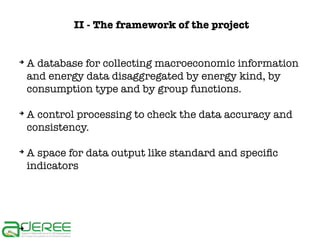
A database for collecting macroeconomic information
and energy data disaggregated by energy kind, by
consumption type and by group functions.
A control processing to check the data accuracy and
consistency.
A space for data output like standard and specific
indicators
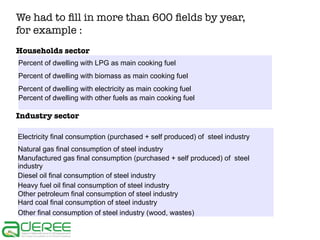
We had to fill in more than 600 fields by year,
for example :
Households sector
Percent of dwelling with LPG as main cooking fuel
Percent of dwelling with biomass as main cooking fuel
Percent of dwelling with electricity as main cooking fuel
Percent of dwelling with other fuels as main cooking fuel

Industry sector
Electricity final consumption (purchased + self produced) of steel industry
Natural gas final consumption of steel industry
Manufactured gas final consumption (purchased + self produced) of steel
industry
Diesel oil final consumption of steel industry
Heavy fuel oil final consumption of steel industry
Other petroleum final consumption of steel industry
Hard coal final consumption of steel industry
Other final consumption of steel industry (wood, wastes)
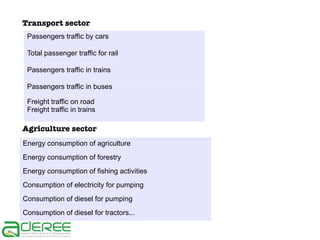
Transport sector
Passengers traffic by cars
Total passenger traffic for rail
Passengers traffic in trains
Passengers traffic in buses
Freight traffic on road
Freight traffic in trains

Agriculture sector
Energy consumption of agriculture
Energy consumption of forestry
Energy consumption of fishing activities
Consumption of electricity for pumping
Consumption of diesel for pumping
Consumption of diesel for tractors...
➔

➔

➔

➔

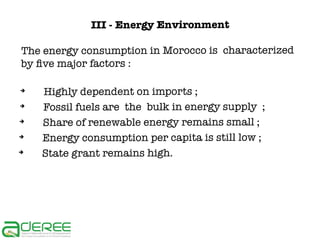
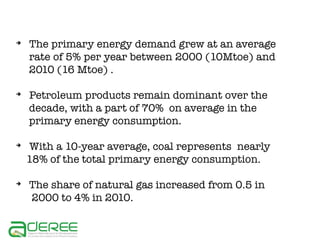
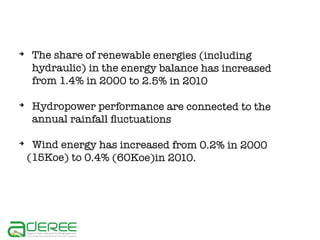
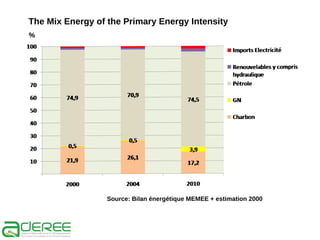
The primary energy demand grew at an average
rate of 5% per year between 2000 (10Mtoe) and
2010 (16 Mtoe) .
Petroleum products remain dominant over the
decade, with a part of 70% on average in the
primary energy consumption.
With a 10-year average, coal represents nearly
18% of the total primary energy consumption.
The share of natural gas increased from 0.5 in
2000 to 4% in 2010.
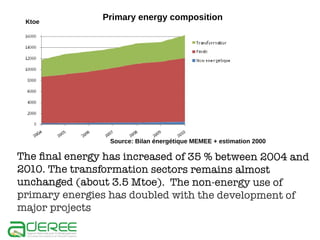
Ktoe

Primary energy composition

Source: Bilan énergétique MEMEE + estimation 2000
The Mix Energy of the Primary Energy Intensity
%

Source: Bilan énergétique MEMEE + estimation 2000
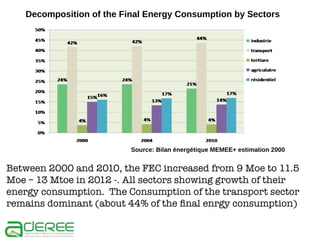
Decomposition of the Final Energy Consumption by Sectors

Source: Bilan énergétique MEMEE+ estimation 2000

Between 2000 and 2010, the FEC increased from 9 Moe to 11.5
Moe – 13 Mtoe in 2012 -. All sectors showing growth of their
energy consumption. The Consumption of the transport sector
remains dominant (about 44% of the final enrgy consumption)
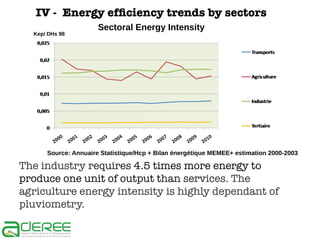
IV - Energy efficiency trends by sectors
Kep/ DHs 98

Sectoral Energy Intensity

Source: Annuaire Statistique/Hcp + Bilan énergétique MEMEE+ estimation 2000-2003

The industry requires 4.5 times more energy to
produce one unit of output than services. The
agriculture energy intensity is highly dependant of
pluviometry.
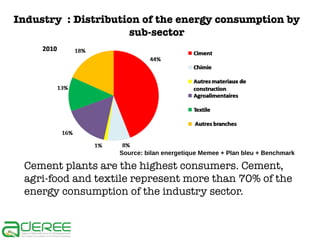
Industry : Distribution of the energy consumption by
sub-sector

Source: bilan energetique Memee + Plan bleu + Benchmark

Cement plants are the highest consumers. Cement,
agri-food and textile represent more than 70% of the
energy consumption of the industry sector.
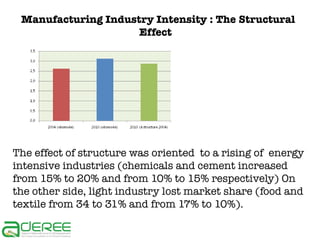
Manufacturing Industry Intensity : The Structural
Effect

The effect of structure was oriented to a rising of energy
intensive industries (chemicals and cement increased
from 15% to 20% and from 10% to 15% respectively) On
the other side, light industry lost market share (food and
textile from 34 to 31% and from 17% to 10%).
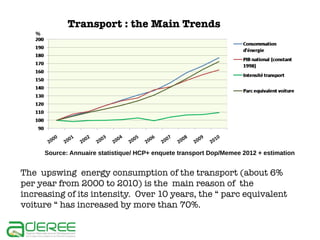
Transport : the Main Trends
%

Source: Annuaire statistique/ HCP+ enquete transport Dop/Memee 2012 + estimation

The upswing energy consumption of the transport (about 6%
per year from 2000 to 2010) is the main reason of the
increasing of its intensity. Over 10 years, the “ parc equivalent
voiture “ has increased by more than 70%.
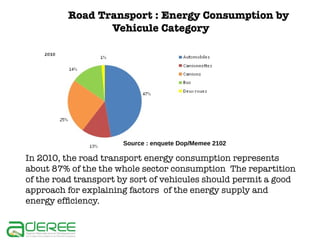
Road Transport : Energy Consumption by
Vehicule Category

Source : enquete Dop/Memee 2102

In 2010, the road transport energy consumption represents
about 87% of the the whole sector consumption The repartition
of the road transport by sort of vehicules should permit a good
approach for explaining factors of the energy supply and
energy efficiency.
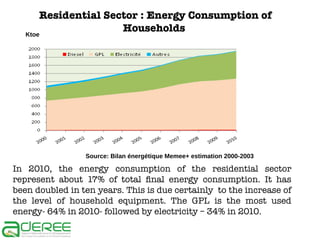
Residential Sector : Energy Consumption of
Households
Ktoe

Source: Bilan énergétique Memee+ estimation 2000-2003

In 2010, the energy consumption of the residential sector
represent about 17% of total final energy consumption. It has
been doubled in ten years. This is due certainly to the increase of
the level of household equipment. The GPL is the most used
energy- 64% in 2010- followed by electricity – 34% in 2010.
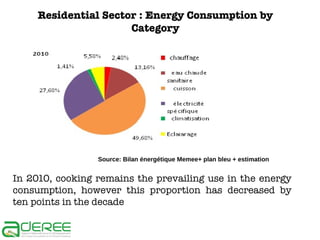
Residential Sector : Energy Consumption by
Category

Source: Bilan énergétique Memee+ plan bleu + estimation

In 2010, cooking remains the prevailing use in the energy
consumption, however this proportion has decreased by
ten points in the decade
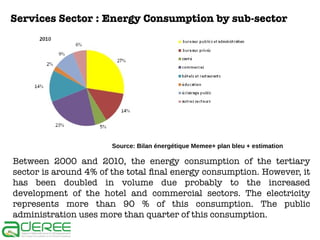
Services Sector : Energy Consumption by sub-sector

Source: Bilan énergétique Memee+ plan bleu + estimation

Between 2000 and 2010, the energy consumption of the tertiary
sector is around 4% of the total final energy consumption. However, it
has been doubled in volume due probably to the increased
development of the hotel and commercial sectors. The electricity
represents more than 90 % of this consumption. The public
administration uses more than quarter of this consumption.
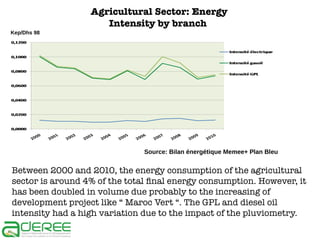
Agricultural Sector: Energy
Intensity by branch
Kep/Dhs 98

Source: Bilan énergétique Memee+ Plan Bleu

Between 2000 and 2010, the energy consumption of the agricultural
sector is around 4% of the total final energy consumption. However, it
has been doubled in volume due probably to the increasing of
development project like “ Maroc Vert “. The GPL and diesel oil
intensity had a high variation due to the impact of the pluviometry.
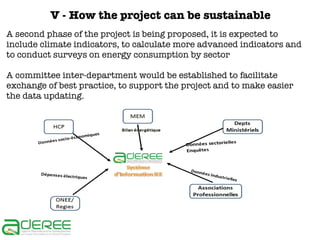
V - How the project can be sustainable
A second phase of the project is being proposed, it is expected to
include climate indicators, to calculate more advanced indicators and
to conduct surveys on energy consumption by sector
A committee inter-department would be established to facilitate
exchange of best practice, to support the project and to make easier
the data updating.
Thanks for your attention

Energy efficiency indicators in morocco aderee

  • 1.
    Energy Efficiency Indicatorsin Morocco Dr Salama JAOUHARI NEEAP Workshop Algiers Nov 10-11 2013
  • 2.
    Summary I. II. III. IV. V. The aim ofthe project IEE MOR The framework of the project Energy Environment Energy efficiency trends by sectors How the project can be sustainable
  • 3.
    I - TheAim of the Project ➔ ➔ ➔ To develop common indicators for the whole countries of the Medener network accessible to all partners and stakeholders The project is coordinated by ADEME and ANME, with the technical support of Enerdata (France) and Alcor (Tunisia) The project team in Aderee is composed of Mrs Salama Jaouhari-Doctor - and Mr Mohamed Jelaidi & Mr Rachid Nassir El-Hak Chief Engineers -.
  • 4.
    ➔ ➔ ➔ This project hasenabled the Implementation of a major decision-making tool for policy decision makers and for all energy sector stakeholders This tool is based on an information system, developed online www.ee-indicators-aderee.ma This website includes disaggregated data and provides energy efficiency indicators for the macro level and for industry, transport, residential, commercial and agriculture sectors
  • 5.
    II - Theframework of the project ➔ ➔ ➔ ➔ A database for collecting macroeconomic information and energy data disaggregated by energy kind, by consumption type and by group functions. A control processing to check the data accuracy and consistency. A space for data output like standard and specific indicators
  • 6.
    We had tofill in more than 600 fields by year, for example : Households sector Percent of dwelling with LPG as main cooking fuel Percent of dwelling with biomass as main cooking fuel Percent of dwelling with electricity as main cooking fuel Percent of dwelling with other fuels as main cooking fuel Industry sector Electricity final consumption (purchased + self produced) of steel industry Natural gas final consumption of steel industry Manufactured gas final consumption (purchased + self produced) of steel industry Diesel oil final consumption of steel industry Heavy fuel oil final consumption of steel industry Other petroleum final consumption of steel industry Hard coal final consumption of steel industry Other final consumption of steel industry (wood, wastes)
  • 7.
    Transport sector Passengers trafficby cars Total passenger traffic for rail Passengers traffic in trains Passengers traffic in buses Freight traffic on road Freight traffic in trains Agriculture sector Energy consumption of agriculture Energy consumption of forestry Energy consumption of fishing activities Consumption of electricity for pumping Consumption of diesel for pumping Consumption of diesel for tractors...
  • 9.
    ➔ ➔ ➔ ➔ The primary energydemand grew at an average rate of 5% per year between 2000 (10Mtoe) and 2010 (16 Mtoe) . Petroleum products remain dominant over the decade, with a part of 70% on average in the primary energy consumption. With a 10-year average, coal represents nearly 18% of the total primary energy consumption. The share of natural gas increased from 0.5 in 2000 to 4% in 2010.
  • 11.
    Ktoe Primary energy composition Source:Bilan énergétique MEMEE + estimation 2000
  • 12.
    The Mix Energyof the Primary Energy Intensity % Source: Bilan énergétique MEMEE + estimation 2000
  • 13.
    Decomposition of theFinal Energy Consumption by Sectors Source: Bilan énergétique MEMEE+ estimation 2000 Between 2000 and 2010, the FEC increased from 9 Moe to 11.5 Moe – 13 Mtoe in 2012 -. All sectors showing growth of their energy consumption. The Consumption of the transport sector remains dominant (about 44% of the final enrgy consumption)
  • 14.
    IV - Energyefficiency trends by sectors Kep/ DHs 98 Sectoral Energy Intensity Source: Annuaire Statistique/Hcp + Bilan énergétique MEMEE+ estimation 2000-2003 The industry requires 4.5 times more energy to produce one unit of output than services. The agriculture energy intensity is highly dependant of pluviometry.
  • 15.
    Industry : Distributionof the energy consumption by sub-sector Source: bilan energetique Memee + Plan bleu + Benchmark Cement plants are the highest consumers. Cement, agri-food and textile represent more than 70% of the energy consumption of the industry sector.
  • 16.
    Manufacturing Industry Intensity :The Structural Effect The effect of structure was oriented to a rising of energy intensive industries (chemicals and cement increased from 15% to 20% and from 10% to 15% respectively) On the other side, light industry lost market share (food and textile from 34 to 31% and from 17% to 10%).
  • 17.
    Transport : theMain Trends % Source: Annuaire statistique/ HCP+ enquete transport Dop/Memee 2012 + estimation The upswing energy consumption of the transport (about 6% per year from 2000 to 2010) is the main reason of the increasing of its intensity. Over 10 years, the “ parc equivalent voiture “ has increased by more than 70%.
  • 18.
    Road Transport :Energy Consumption by Vehicule Category Source : enquete Dop/Memee 2102 In 2010, the road transport energy consumption represents about 87% of the the whole sector consumption The repartition of the road transport by sort of vehicules should permit a good approach for explaining factors of the energy supply and energy efficiency.
  • 19.
    Residential Sector :Energy Consumption of Households Ktoe Source: Bilan énergétique Memee+ estimation 2000-2003 In 2010, the energy consumption of the residential sector represent about 17% of total final energy consumption. It has been doubled in ten years. This is due certainly to the increase of the level of household equipment. The GPL is the most used energy- 64% in 2010- followed by electricity – 34% in 2010.
  • 20.
    Residential Sector :Energy Consumption by Category Source: Bilan énergétique Memee+ plan bleu + estimation In 2010, cooking remains the prevailing use in the energy consumption, however this proportion has decreased by ten points in the decade
  • 21.
    Services Sector :Energy Consumption by sub-sector Source: Bilan énergétique Memee+ plan bleu + estimation Between 2000 and 2010, the energy consumption of the tertiary sector is around 4% of the total final energy consumption. However, it has been doubled in volume due probably to the increased development of the hotel and commercial sectors. The electricity represents more than 90 % of this consumption. The public administration uses more than quarter of this consumption.
  • 22.
    Agricultural Sector: Energy Intensityby branch Kep/Dhs 98 Source: Bilan énergétique Memee+ Plan Bleu Between 2000 and 2010, the energy consumption of the agricultural sector is around 4% of the total final energy consumption. However, it has been doubled in volume due probably to the increasing of development project like “ Maroc Vert “. The GPL and diesel oil intensity had a high variation due to the impact of the pluviometry.
  • 23.
    V - Howthe project can be sustainable A second phase of the project is being proposed, it is expected to include climate indicators, to calculate more advanced indicators and to conduct surveys on energy consumption by sector A committee inter-department would be established to facilitate exchange of best practice, to support the project and to make easier the data updating.
  • 24.
    Thanks for yourattention