Commercial Disputes – Have you
got them covered?
Lockton & Watson Burton

Tuesday 2 July 2013
clear pr acti cal advi ce

Richard Palmer & Bal Manak - Watson Burton LLP
Michael Farrell & Anthony Place - Lockton Companies LLP
Getting Contract Terms Right
A Broker’s Perspective
•
•

•
•
•
•

Important part of a broker’s service, whether awarding or tendering
for contracts
Times are tough so many businesses are passing off liabilities onto
others and more onerous limits and requirements are becoming the
norm
Approach by clients ranges from full involvement, no involvement,
involvement after contract won, involvement before tender submitted
Ideally, before tender submitted or before tender published
Don’t assume insurance programme is fit for purpose
More than 30% of contracts vetted by Lockton result in the need for
amendments to insurance programme – can become very
expensive if insurers cannot / will not accommodate the
amendments!
Contract Features To Look Out For
• Contracts with non-UK companies using different jargon
and terminology
• PFI type contracts or drafted using similar language
• Joint Names / Additional Insured
• Cancellation / amendment clauses
• Professional Indemnity ‘any one loss’
• Subrogation clauses
• Payment clauses (Loss Payee)
• Primary Insurance clauses
• Non-vitiation clauses
• Brokers Letters of Undertaking
Information Required
•
•
•
•
•

What is the contract?
When is it starting, duration?
Contract Value?
Is this an existing, prospective or recently won contract?
Who are you in relation to the contract – supplier,
principal, contractor?
• Have you forwarded all relevant sections?
• Is agreement to the terms a ‘deal-breaker’ or is
negotiation possible?
• What is your deadline?
A Lawyer’s Perspective

•
•
•
•

Fitness for Purpose v Reasonable Skill and Care
Indemnities v Reasonably Foreseeable Losses
Net Contribution Clauses
Limits of Liability
Fitness for Purpose v Reasonable Skill and
Care
• In English Law if there is no express or implied fitness for
purpose obligation then a designer must exercise
reasonable skill and care in its design
• This means the design must meet the standard expected
of a competent designer
– objective standard

• Contracts often include RSC as an express obligation
• NB: Be wary of ‘diligence’
Fitness for
Purpose v
Reasonable
Skill and Care

Fitness for
purpose

Unlikely to be
covered
under
Insurance
Policy

Reasonable
skill and care
Covered by
Insurance
Policy
Fitness for Purpose v Reasonable Skill and
Care
• A fitness for purpose obligation is much stricter and
tougher
• It means that the professional is guaranteeing the result
of their work
• Professionals should never agree to a fitness for
purpose obligation or expressly exclude any fitness for
purpose guarantee
Fitness for Purpose v Reasonable Care and
Skill
Reasonable Skill and Care

Fitness for purpose

An employer must prove that the The contractor is guaranteeing that the
designer has been negligent, i.e. that design will meet the employer’s
the design failed to measure up to the requirements
standard of a competent professional
designer
Indemnities v Reasonably Foreseeable Losses

Policies will exclude cover for:“Contractual Liability arising directly or indirectly from any
breach or alleged breach of any contractual duty of care
alleged to have been owed by Insured to any third party
and which is more onerous to any duty which would
otherwise be implied by common law or statute”.
Indemnities v Reasonably Foreseeable
Losses
• Indemnities mean you must compensate the employer if
due to any act, omission or negligence you cause the
employer to suffer losses, expense or damage
• This is wider than reasonably foreseeable losses
• For example, if you cause the employer to be in breach
of a third party agreement
• No duty on Claimant to mitigate loss
Example of an Indemnity
• “The Architect agrees to indemnify the Client against
each and every liability which the Client may incur to any
person whatsoever and against any claims, demands,
proceedings, damages, costs and/or expenses
sustained, incurred or payable by the Client to the extent
that the same arises by reason of any negligence,
omission, or default, by the Architect in the performance
of his obligations under and in connection with this
Deed.”
Indemnities v Reasonably Foreseeable
Losses
• Ideally indemnities should be avoided because it means
it extends your liability beyond that which you would
ordinarily have at law
• If they are insisted on one way to reduce your liability is
to indemnify the employer for losses it suffers but only to
the extent those losses are reasonably foreseeable and
fully mitigated
• Check with your broker
Net Contribution Clauses
“Without prejudice to any other exclusion or limitation of
liability, damages, loss, expense, or costs in this
Agreement, the Consultant’s liability for any claim or
claims under or in connection with this Agreement shall
not exceed such sum as it would be just and equitable
for the Consultant to pay having regard to the extent of
the Consultant’s responsibility for the loss or damage
giving rise to such claim or claims (‘the Loss and
Damage’)….
Net Contribution Clauses
• At common law, a consultant might be 100% liable for
damages whatever their share of the blame
– E.g. even if fault is attributable to a engineer at 60% and an
contractor at 40%

• A net contribution clause restricts the employer to
recovering only 60% from the engineer and 40% from
the contractor
• Without a net contribution clause, the engineer could be
100% liable and could bear the risk of the contractor’s
insolvency or inability to pay
Limits of Liability
• There are various clauses that can be inserted into your
contracts to try and limit liability
• This includes
– Limiting your liability to the Contract Sum/Fee/Price
– Limiting your liability to an aggregate amount
– Limiting your liability to the level of PI insurance
required
– Net contribution clauses
Limits of Liability
– Excluding liability for terrorism, asbestos, mould,
nuclear risk or radiation or other uninsured risks
– Excluding liability for consequential loss
– Limiting the limitation period under the contract
• Deed – 12 years from completion of your services
• Underhand – 6 years
– ‘No greater liability’ clause
– ‘Reasonable Endeavours’ proviso
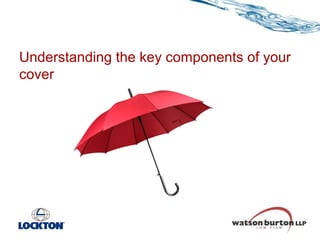
Understanding the key components of your
cover
Policy Schedule
Certificate Number: XYZ 1234
Insured:
Prism Architects
Period of Insurance: 01/01/2013 – 31/12/2013
Excess:
£50,000 each and every
claim, does not apply to Defence
costs.
Indemnity Limit:
GBP £2.5 million in any one claim.
The Insuring Clause
“If during the period of insurance and as a result of your
business activity within the geographical limits for
clients, any party brings a claim against you for any civil
liability, we will indemnify you against the sums you have
to pay as compensation.”
•“Claims made” basis
Defective Workmanship
“We will not make a payment for any claim or cost
directly or indirectly due to:
(a) Your or your sub-contractor’s defective
workmanship, or any defective materials you, your
subcontractor or a third party supplied, or your or your
subcontractors’ failure to supervise or inspect the
work you or your sub-contractor have carried out.”
Obligations
• Condition Precedent
– Compliance so important that breach = automatic right to avoid
– Avoidance = as if policy never existed

• Simple Condition
– Insurers must show prejudice
– Quantify and set off against indemnity provided
Notifying Claims – The Principles
•
•
•
•
•

Key obligation under insurance contract
Allows insurers control
Notify what?
Notify who?
Claim / Circumstances
Claim / Notice of Claim
“The Insured shall inform underwriters as soon as
possible and in any event within 10 working days of
the receipt, awareness or discovery of;
(a) Any claim made against them;
(b) Any notice of intention to make a claim against them;
(c) Any circumstance
• “Claim” often defined in Policy
• Could include PAP Letter of Claim
• No claim? Not the end of the story…..
Circumstances
“We will not make any payment under this policy unless
you give us prompt notice of anything which is likely to
give rise to a claim under this policy…”
•Not a claim
•“Likely” to lead to a claim – more than 50% likely
•“May” lead to a claim – wide scope
•“Prompt notice” – late notification?
•Example of Condition Precedent (could be either)
Adjudication
“The Insured undertakes to immediately notify the
Insurers within 48 hours of any notice of intention to
adjudicate or of the service by the Insured of any
notice of intention to adjudicate in circumstances which
will lead or are likely to lead to a claim against the
Insured being dealt with as part of the adjudication”
Continuing Duties – Co-operation
“We will not make any payment under this Policy unless
you:
• Example of Condition Precedent (could be either).
• Give us, at your expense, any information which we
may reasonably require and co-operate fully in the
investigation of any claim under this Policy.
Continuing Duties - Mitigation
“We will not make any payment under this Policy unless
you:
• Make every reasonable effort to minimise any loss,
damage or liability and take appropriate emergency
measures immediately if they are required to reduce any
claim.
• Condition Precedent
Admissions / Settlement
“In the event of a claim, or the discovery of information
which may give rise to a claim, the Insured shall not admit
liability for or settle any claim, incur any costs or expenses
in connection therewith, without the written consent of
Underwriters.”
Continuing Duties – Change of
Circumstances
• You must tell us as soon as reasonably possible of any
change in circumstances during the period of insurance
which may materially affect this policy. (A material fact
or circumstance is one which might affect our decision to
provide insurance or the conditions of that insurance.)
We may then change the terms and conditions of this
policy.
Key Components of PL Policies
• More similarities than differences in relation to terms and
conditions
• Injury or damage to third parties and/or their property
• Claims Occurring
• Any one loss
What to Do When Something Goes Wrong
Insurer / Broker Perspective
• Inform your broker / insurer as soon as possible –
notification of circumstances which don’t lead to claims
won’t affect insurance premiums!
• Don’t admit liability
• Don’t try to sort it out on your own
• Don’t offer to make any form of payment
• Major Losses – crisis management plan
Legal Perspective – The Information
Required
•
•
•
•
•
•
•

Factual Summary
Assessment of Liability / Quantum
Continuing co-operation
Share the good and bad!
Preserve the evidence
Advice in writing?
Sub-contractors / Sub-consultants
Best Practice for Buying Insurance
Best Practice Guide for Buying Insurance
•
•
•
•
•

Technical purchase first and foremost, then price
The experience and capability of your advisors
The financial security and credentials of your insurers
Form a relationship with your broker & insurers
Agree lawyers and loss adjusters in advance and spend
time with them so they understand your business
• Have an open culture within your organisation in relation
to claims or problem contracts
Best Practice Guide for Buying Insurance
• Read the policy / understand the key elements
– Conditions precedent
– Claims reporting
– Onerous clauses

• Act on the terms and ensure these are shared with
relevant people within your organisation
• If in doubt, be cautious and engage with your broker /
legal advisers
• Ideally place your Public/Products Liability and
Professional Indemnity Insurance with the same insurer.
Tips for Businesses
•
•
•
•
•
•
•

Get your contract terms right
Beware onerous clauses
Record your advice in writing
Read your policy and share its terms
Involve your broker early
Small matters turn big
If in doubt, be cautious
Commercial Disputes – Have you
got them covered?
Lockton & Watson Burton

Tuesday 2 July 2013
clear pr acti cal advi ce

Richard Palmer & Bal Manak - Watson Burton LLP
Michael Farrell & Anthony Place - Lockton Companies LLP

Commercial Disputes – Have you got them covered?

  • 1.
    Commercial Disputes –Have you got them covered? Lockton & Watson Burton Tuesday 2 July 2013 clear pr acti cal advi ce Richard Palmer & Bal Manak - Watson Burton LLP Michael Farrell & Anthony Place - Lockton Companies LLP
  • 2.
  • 3.
    A Broker’s Perspective • • • • • • Importantpart of a broker’s service, whether awarding or tendering for contracts Times are tough so many businesses are passing off liabilities onto others and more onerous limits and requirements are becoming the norm Approach by clients ranges from full involvement, no involvement, involvement after contract won, involvement before tender submitted Ideally, before tender submitted or before tender published Don’t assume insurance programme is fit for purpose More than 30% of contracts vetted by Lockton result in the need for amendments to insurance programme – can become very expensive if insurers cannot / will not accommodate the amendments!
  • 4.
    Contract Features ToLook Out For • Contracts with non-UK companies using different jargon and terminology • PFI type contracts or drafted using similar language • Joint Names / Additional Insured • Cancellation / amendment clauses • Professional Indemnity ‘any one loss’ • Subrogation clauses • Payment clauses (Loss Payee) • Primary Insurance clauses • Non-vitiation clauses • Brokers Letters of Undertaking
  • 5.
    Information Required • • • • • What isthe contract? When is it starting, duration? Contract Value? Is this an existing, prospective or recently won contract? Who are you in relation to the contract – supplier, principal, contractor? • Have you forwarded all relevant sections? • Is agreement to the terms a ‘deal-breaker’ or is negotiation possible? • What is your deadline?
  • 6.
    A Lawyer’s Perspective • • • • Fitnessfor Purpose v Reasonable Skill and Care Indemnities v Reasonably Foreseeable Losses Net Contribution Clauses Limits of Liability
  • 7.
    Fitness for Purposev Reasonable Skill and Care • In English Law if there is no express or implied fitness for purpose obligation then a designer must exercise reasonable skill and care in its design • This means the design must meet the standard expected of a competent designer – objective standard • Contracts often include RSC as an express obligation • NB: Be wary of ‘diligence’
  • 8.
    Fitness for Purpose v Reasonable Skilland Care Fitness for purpose Unlikely to be covered under Insurance Policy Reasonable skill and care Covered by Insurance Policy
  • 9.
    Fitness for Purposev Reasonable Skill and Care • A fitness for purpose obligation is much stricter and tougher • It means that the professional is guaranteeing the result of their work • Professionals should never agree to a fitness for purpose obligation or expressly exclude any fitness for purpose guarantee
  • 10.
    Fitness for Purposev Reasonable Care and Skill Reasonable Skill and Care Fitness for purpose An employer must prove that the The contractor is guaranteeing that the designer has been negligent, i.e. that design will meet the employer’s the design failed to measure up to the requirements standard of a competent professional designer
  • 11.
    Indemnities v ReasonablyForeseeable Losses Policies will exclude cover for:“Contractual Liability arising directly or indirectly from any breach or alleged breach of any contractual duty of care alleged to have been owed by Insured to any third party and which is more onerous to any duty which would otherwise be implied by common law or statute”.
  • 12.
    Indemnities v ReasonablyForeseeable Losses • Indemnities mean you must compensate the employer if due to any act, omission or negligence you cause the employer to suffer losses, expense or damage • This is wider than reasonably foreseeable losses • For example, if you cause the employer to be in breach of a third party agreement • No duty on Claimant to mitigate loss
  • 13.
    Example of anIndemnity • “The Architect agrees to indemnify the Client against each and every liability which the Client may incur to any person whatsoever and against any claims, demands, proceedings, damages, costs and/or expenses sustained, incurred or payable by the Client to the extent that the same arises by reason of any negligence, omission, or default, by the Architect in the performance of his obligations under and in connection with this Deed.”
  • 14.
    Indemnities v ReasonablyForeseeable Losses • Ideally indemnities should be avoided because it means it extends your liability beyond that which you would ordinarily have at law • If they are insisted on one way to reduce your liability is to indemnify the employer for losses it suffers but only to the extent those losses are reasonably foreseeable and fully mitigated • Check with your broker
  • 15.
    Net Contribution Clauses “Withoutprejudice to any other exclusion or limitation of liability, damages, loss, expense, or costs in this Agreement, the Consultant’s liability for any claim or claims under or in connection with this Agreement shall not exceed such sum as it would be just and equitable for the Consultant to pay having regard to the extent of the Consultant’s responsibility for the loss or damage giving rise to such claim or claims (‘the Loss and Damage’)….
  • 16.
    Net Contribution Clauses •At common law, a consultant might be 100% liable for damages whatever their share of the blame – E.g. even if fault is attributable to a engineer at 60% and an contractor at 40% • A net contribution clause restricts the employer to recovering only 60% from the engineer and 40% from the contractor • Without a net contribution clause, the engineer could be 100% liable and could bear the risk of the contractor’s insolvency or inability to pay
  • 17.
    Limits of Liability •There are various clauses that can be inserted into your contracts to try and limit liability • This includes – Limiting your liability to the Contract Sum/Fee/Price – Limiting your liability to an aggregate amount – Limiting your liability to the level of PI insurance required – Net contribution clauses
  • 18.
    Limits of Liability –Excluding liability for terrorism, asbestos, mould, nuclear risk or radiation or other uninsured risks – Excluding liability for consequential loss – Limiting the limitation period under the contract • Deed – 12 years from completion of your services • Underhand – 6 years – ‘No greater liability’ clause – ‘Reasonable Endeavours’ proviso
  • 19.
    Understanding the keycomponents of your cover
  • 20.
    Policy Schedule Certificate Number:XYZ 1234 Insured: Prism Architects Period of Insurance: 01/01/2013 – 31/12/2013 Excess: £50,000 each and every claim, does not apply to Defence costs. Indemnity Limit: GBP £2.5 million in any one claim.
  • 21.
    The Insuring Clause “Ifduring the period of insurance and as a result of your business activity within the geographical limits for clients, any party brings a claim against you for any civil liability, we will indemnify you against the sums you have to pay as compensation.” •“Claims made” basis
  • 22.
    Defective Workmanship “We willnot make a payment for any claim or cost directly or indirectly due to: (a) Your or your sub-contractor’s defective workmanship, or any defective materials you, your subcontractor or a third party supplied, or your or your subcontractors’ failure to supervise or inspect the work you or your sub-contractor have carried out.”
  • 23.
    Obligations • Condition Precedent –Compliance so important that breach = automatic right to avoid – Avoidance = as if policy never existed • Simple Condition – Insurers must show prejudice – Quantify and set off against indemnity provided
  • 24.
    Notifying Claims –The Principles • • • • • Key obligation under insurance contract Allows insurers control Notify what? Notify who? Claim / Circumstances
  • 25.
    Claim / Noticeof Claim “The Insured shall inform underwriters as soon as possible and in any event within 10 working days of the receipt, awareness or discovery of; (a) Any claim made against them; (b) Any notice of intention to make a claim against them; (c) Any circumstance • “Claim” often defined in Policy • Could include PAP Letter of Claim • No claim? Not the end of the story…..
  • 26.
    Circumstances “We will notmake any payment under this policy unless you give us prompt notice of anything which is likely to give rise to a claim under this policy…” •Not a claim •“Likely” to lead to a claim – more than 50% likely •“May” lead to a claim – wide scope •“Prompt notice” – late notification? •Example of Condition Precedent (could be either)
  • 27.
    Adjudication “The Insured undertakesto immediately notify the Insurers within 48 hours of any notice of intention to adjudicate or of the service by the Insured of any notice of intention to adjudicate in circumstances which will lead or are likely to lead to a claim against the Insured being dealt with as part of the adjudication”
  • 28.
    Continuing Duties –Co-operation “We will not make any payment under this Policy unless you: • Example of Condition Precedent (could be either). • Give us, at your expense, any information which we may reasonably require and co-operate fully in the investigation of any claim under this Policy.
  • 29.
    Continuing Duties -Mitigation “We will not make any payment under this Policy unless you: • Make every reasonable effort to minimise any loss, damage or liability and take appropriate emergency measures immediately if they are required to reduce any claim. • Condition Precedent
  • 30.
    Admissions / Settlement “Inthe event of a claim, or the discovery of information which may give rise to a claim, the Insured shall not admit liability for or settle any claim, incur any costs or expenses in connection therewith, without the written consent of Underwriters.”
  • 31.
    Continuing Duties –Change of Circumstances • You must tell us as soon as reasonably possible of any change in circumstances during the period of insurance which may materially affect this policy. (A material fact or circumstance is one which might affect our decision to provide insurance or the conditions of that insurance.) We may then change the terms and conditions of this policy.
  • 32.
    Key Components ofPL Policies • More similarities than differences in relation to terms and conditions • Injury or damage to third parties and/or their property • Claims Occurring • Any one loss
  • 33.
    What to DoWhen Something Goes Wrong
  • 34.
    Insurer / BrokerPerspective • Inform your broker / insurer as soon as possible – notification of circumstances which don’t lead to claims won’t affect insurance premiums! • Don’t admit liability • Don’t try to sort it out on your own • Don’t offer to make any form of payment • Major Losses – crisis management plan
  • 35.
    Legal Perspective –The Information Required • • • • • • • Factual Summary Assessment of Liability / Quantum Continuing co-operation Share the good and bad! Preserve the evidence Advice in writing? Sub-contractors / Sub-consultants
  • 36.
    Best Practice forBuying Insurance
  • 37.
    Best Practice Guidefor Buying Insurance • • • • • Technical purchase first and foremost, then price The experience and capability of your advisors The financial security and credentials of your insurers Form a relationship with your broker & insurers Agree lawyers and loss adjusters in advance and spend time with them so they understand your business • Have an open culture within your organisation in relation to claims or problem contracts
  • 38.
    Best Practice Guidefor Buying Insurance • Read the policy / understand the key elements – Conditions precedent – Claims reporting – Onerous clauses • Act on the terms and ensure these are shared with relevant people within your organisation • If in doubt, be cautious and engage with your broker / legal advisers • Ideally place your Public/Products Liability and Professional Indemnity Insurance with the same insurer.
  • 39.
    Tips for Businesses • • • • • • • Getyour contract terms right Beware onerous clauses Record your advice in writing Read your policy and share its terms Involve your broker early Small matters turn big If in doubt, be cautious
  • 40.
    Commercial Disputes –Have you got them covered? Lockton & Watson Burton Tuesday 2 July 2013 clear pr acti cal advi ce Richard Palmer & Bal Manak - Watson Burton LLP Michael Farrell & Anthony Place - Lockton Companies LLP