ELECTRICAL AND ELECTRONICS
MEASUREMENTS
Submitted by:
Akkahshh Agarwaal 204115
Sumit Ahirekar 204116
Anirudhda Deore 204118
ENERGY METER
INTRODUCTION
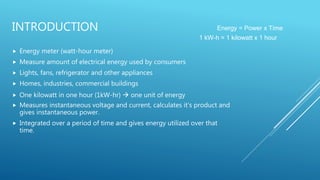
 Energy meter (watt-hour meter)
 Measure amount of electrical energy used by consumers
 Lights, fans, refrigerator and other appliances
 Homes, industries, commercial buildings
 One kilowatt in one hour (1kW-hr)  one unit of energy
 Measures instantaneous voltage and current, calculates it’s product and
gives instantaneous power.
 Integrated over a period of time and gives energy utilized over that
time.
Energy = Power x Time
1 kW-h = 1 kilowatt x 1 hour
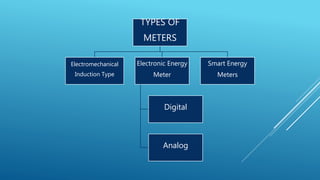
TYPES OF
METERS
Electromechanical
Induction Type
Electronic Energy
Meter
Digital
Analog
Smart Energy
Meters
ELECTROMECHANICAL TYPE
INDUCTION METER
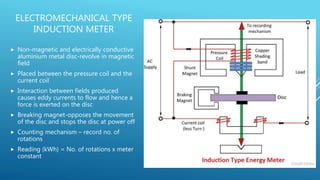
 Non-magnetic and electrically conductive
aluminium metal disc-revolve in magnetic
field
 Placed between the pressure coil and the
current coil
 Interaction between fields produced
causes eddy currents to flow and hence a
force is exerted on the disc
 Breaking magnet-opposes the movement
of the disc and stops the disc at power off
 Counting mechanism – record no. of
rotations
 Reading (kWh) = No. of rotations x meter
constant
ELECTRONIC ENERGY METER
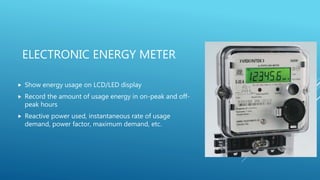
 Show energy usage on LCD/LED display
 Record the amount of usage energy in on-peak and off-
peak hours
 Reactive power used, instantaneous rate of usage
demand, power factor, maximum demand, etc.
SMART ENERGY METERS
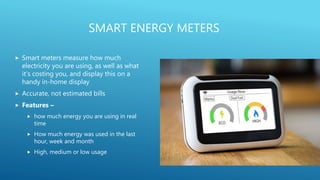
 Smart meters measure how much
electricity you are using, as well as what
it’s costing you, and display this on a
handy in-home display
 Accurate, not estimated bills
 Features –
 how much energy you are using in real
time
 How much energy was used in the last
hour, week and month
 High, medium or low usage
TAMPERING & SECURITY
 Major concern for agencies
 Can be manipulated (stop, under-register)
 Remote-reporting meters
 Common method – attach magnets outside the meter. These magnets
prevent the AC from forming eddy currents in the rotor
 Use of combination of some capacitive and inductive load result in
reduction of rotor speed
 Large portion of country’s revenue is lost – very important to detect
tampering

Energy Meter

  • 1.
    ELECTRICAL AND ELECTRONICS MEASUREMENTS Submittedby: Akkahshh Agarwaal 204115 Sumit Ahirekar 204116 Anirudhda Deore 204118 ENERGY METER
  • 2.
    INTRODUCTION  Energy meter(watt-hour meter)  Measure amount of electrical energy used by consumers  Lights, fans, refrigerator and other appliances  Homes, industries, commercial buildings  One kilowatt in one hour (1kW-hr)  one unit of energy  Measures instantaneous voltage and current, calculates it’s product and gives instantaneous power.  Integrated over a period of time and gives energy utilized over that time. Energy = Power x Time 1 kW-h = 1 kilowatt x 1 hour
  • 3.
    TYPES OF METERS Electromechanical Induction Type ElectronicEnergy Meter Digital Analog Smart Energy Meters
  • 4.
    ELECTROMECHANICAL TYPE INDUCTION METER Non-magnetic and electrically conductive aluminium metal disc-revolve in magnetic field  Placed between the pressure coil and the current coil  Interaction between fields produced causes eddy currents to flow and hence a force is exerted on the disc  Breaking magnet-opposes the movement of the disc and stops the disc at power off  Counting mechanism – record no. of rotations  Reading (kWh) = No. of rotations x meter constant
  • 6.
    ELECTRONIC ENERGY METER Show energy usage on LCD/LED display  Record the amount of usage energy in on-peak and off- peak hours  Reactive power used, instantaneous rate of usage demand, power factor, maximum demand, etc.
  • 7.
    SMART ENERGY METERS Smart meters measure how much electricity you are using, as well as what it’s costing you, and display this on a handy in-home display  Accurate, not estimated bills  Features –  how much energy you are using in real time  How much energy was used in the last hour, week and month  High, medium or low usage
  • 8.
    TAMPERING & SECURITY Major concern for agencies  Can be manipulated (stop, under-register)  Remote-reporting meters  Common method – attach magnets outside the meter. These magnets prevent the AC from forming eddy currents in the rotor  Use of combination of some capacitive and inductive load result in reduction of rotor speed  Large portion of country’s revenue is lost – very important to detect tampering