ENERGY
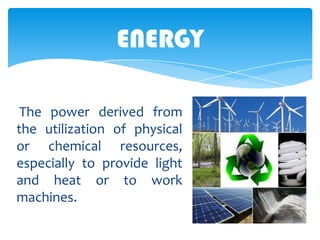
The power derived from
the utilization of physical
or chemical resources,
especially to provide light
and heat or to work
machines.
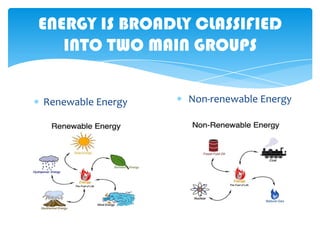
ENERGY IS BROADLY CLASSIFIED
INTO TWO MAIN GROUPS
Renewable Energy

Non-renewable Energy
RENEWABLE ENERGY

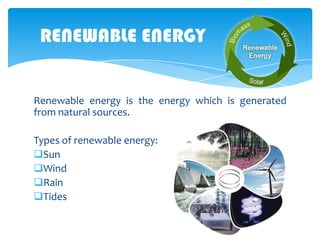
Renewable energy is the energy which is generated
from natural sources.
Types of renewable energy:
Sun
Wind
Rain
Tides
NON- RENEWABLE ENERGY
Non-Renewable energy is the energy which
is taken from the sources that are available
on the earth in limited quantity and will
vanish fifty-sixty years from now.
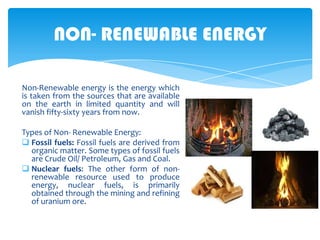
Types of Non- Renewable Energy:
 Fossil fuels: Fossil fuels are derived from
organic matter. Some types of fossil fuels
are Crude Oil/ Petroleum, Gas and Coal.
 Nuclear fuels: The other form of nonrenewable resource used to produce
energy, nuclear fuels, is primarily
obtained through the mining and refining
of uranium ore.
ENERGY CONSERVATION

Energy conservation is the reduction
in the amount of energy consumed in
a process or system, or by
an
organization
or
society,
through rational use and reduction of
waste.
SIGNIFICANCE OF ENERGY CONSERVATION

Our Demand for energy has
been increasing day by day.
We have limited resources
and if the demand keep
increasing at this rate, we
will run out of non
renewable energy and we
will have to find alternate
resources.
MAJOR TECHNIQUES USED GLOBALLY
FOR ENERGY CONSERVATION
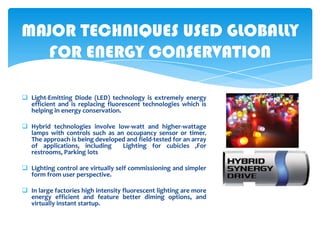
 Light-Emitting Diode (LED) technology is extremely energy
efficient and is replacing fluorescent technologies which is
helping in energy conservation.
 Hybrid technologies involve low-watt and higher-wattage
lamps with controls such as an occupancy sensor or timer.
The approach is being developed and field-tested for an array
of applications, including
Lighting for cubicles ,For
restrooms, Parking lots
 Lighting control are virtually self commissioning and simpler
form from user perspective.

 In large factories high intensity fluorescent lighting are more
energy efficient and feature better diming options, and
virtually instant startup.
PSO TAKES THE LEAD IN
ENERGY CONSERVATION:
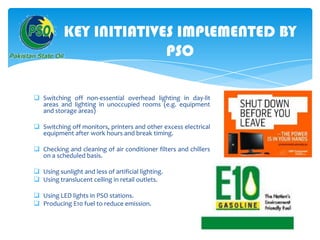
Pakistan
State
Oil
adopted
immediate measures to help control
the alarming energy crisis that mires
the majority of the Pakistani
population. PSO is well aware of the
need
to
implement
energy
conservation measures in its offices
and installations across the country.
KEY INITIATIVES IMPLEMENTED BY
PSO
 Switching off non-essential overhead lighting in day-lit
areas and lighting in unoccupied rooms (e.g. equipment
and storage areas)
 Switching off monitors, printers and other excess electrical
equipment after work hours and break timing.

 Checking and cleaning of air conditioner filters and chillers
on a scheduled basis.
 Using sunlight and less of artificial lighting.
 Using translucent ceiling in retail outlets.
 Using LED lights in PSO stations.
 Producing E10 fuel to reduce emission.
PSO PROJECTS REGARDING
ENERGY CONSERVATION

PSO has been at the forefront of numerous
environmentally and socially-conscious projects:
EARTH HOUR
BIONASS
PSO JOINS WORLD CELEBRATION OF
EARTH HOUR
Earth Hour is the world’s largest global climate change
initiative. It’s a global commitment led by World Wide Fund
(WWF).

Pakistan State Oil joined the Earth Hour awareness on 26th
March 2011 to spread awareness on climate change and
inculcate responsible behavior amongst its employees.
PSO employees also celebrated Earth Hour in their individual
capacity by switching off lights at their homes at 8.30 PM.
PSO BIONASS AGREEMENT

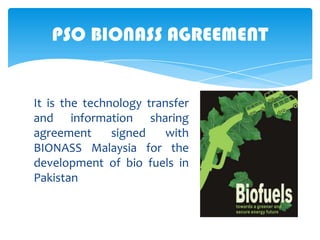
It is the technology transfer
and information sharing
agreement
signed
with
BIONASS Malaysia for the
development of bio fuels in
Pakistan
SIMPLE METHODS BY WHICH ENERGY
COULD BE CONSERVED
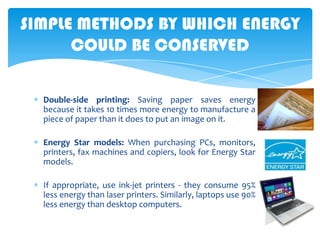
Double-side printing: Saving paper saves energy
because it takes 10 times more energy to manufacture a
piece of paper than it does to put an image on it.
Energy Star models: When purchasing PCs, monitors,
printers, fax machines and copiers, look for Energy Star
models.
If appropriate, use ink-jet printers - they consume 95%
less energy than laser printers. Similarly, laptops use 90%
less energy than desktop computers.
OTHER METHODS PREFERABLE TO
SAVE ENERGY ON ROAD
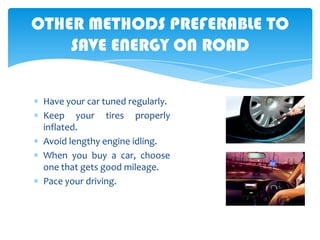
Have your car tuned regularly.
Keep your tires properly
inflated.
Avoid lengthy engine idling.
When you buy a car, choose
one that gets good mileage.
Pace your driving.
ENERGY CONSERVATION TIPS

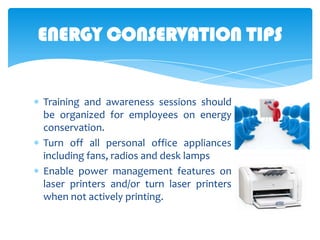
Training and awareness sessions should
be organized for employees on energy
conservation.
Turn off all personal office appliances
including fans, radios and desk lamps
Enable power management features on
laser printers and/or turn laser printers
when not actively printing.
ENERGY CONSERVATION TIPS
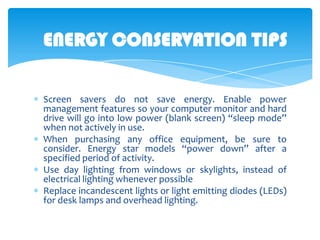
Screen savers do not save energy. Enable power
management features so your computer monitor and hard
drive will go into low power (blank screen) “sleep mode”
when not actively in use.
When purchasing any office equipment, be sure to
consider. Energy star models “power down” after a
specified period of activity.
Use day lighting from windows or skylights, instead of
electrical lighting whenever possible
Replace incandescent lights or light emitting diodes (LEDs)
for desk lamps and overhead lighting.
ENERGY CONSERVATION TIPS

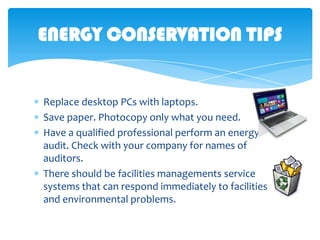
Replace desktop PCs with laptops.
Save paper. Photocopy only what you need.
Have a qualified professional perform an energy
audit. Check with your company for names of
auditors.
There should be facilities managements service
systems that can respond immediately to facilities
and environmental problems.
Energy

Energy

  • 3.
    ENERGY The power derivedfrom the utilization of physical or chemical resources, especially to provide light and heat or to work machines.
  • 4.
    ENERGY IS BROADLYCLASSIFIED INTO TWO MAIN GROUPS Renewable Energy Non-renewable Energy
  • 5.
    RENEWABLE ENERGY Renewable energyis the energy which is generated from natural sources. Types of renewable energy: Sun Wind Rain Tides
  • 6.
    NON- RENEWABLE ENERGY Non-Renewableenergy is the energy which is taken from the sources that are available on the earth in limited quantity and will vanish fifty-sixty years from now. Types of Non- Renewable Energy:  Fossil fuels: Fossil fuels are derived from organic matter. Some types of fossil fuels are Crude Oil/ Petroleum, Gas and Coal.  Nuclear fuels: The other form of nonrenewable resource used to produce energy, nuclear fuels, is primarily obtained through the mining and refining of uranium ore.
  • 7.
    ENERGY CONSERVATION Energy conservationis the reduction in the amount of energy consumed in a process or system, or by an organization or society, through rational use and reduction of waste.
  • 8.
    SIGNIFICANCE OF ENERGYCONSERVATION Our Demand for energy has been increasing day by day. We have limited resources and if the demand keep increasing at this rate, we will run out of non renewable energy and we will have to find alternate resources.
  • 9.
    MAJOR TECHNIQUES USEDGLOBALLY FOR ENERGY CONSERVATION  Light-Emitting Diode (LED) technology is extremely energy efficient and is replacing fluorescent technologies which is helping in energy conservation.  Hybrid technologies involve low-watt and higher-wattage lamps with controls such as an occupancy sensor or timer. The approach is being developed and field-tested for an array of applications, including Lighting for cubicles ,For restrooms, Parking lots  Lighting control are virtually self commissioning and simpler form from user perspective.  In large factories high intensity fluorescent lighting are more energy efficient and feature better diming options, and virtually instant startup.
  • 10.
    PSO TAKES THELEAD IN ENERGY CONSERVATION: Pakistan State Oil adopted immediate measures to help control the alarming energy crisis that mires the majority of the Pakistani population. PSO is well aware of the need to implement energy conservation measures in its offices and installations across the country.
  • 11.
    KEY INITIATIVES IMPLEMENTEDBY PSO  Switching off non-essential overhead lighting in day-lit areas and lighting in unoccupied rooms (e.g. equipment and storage areas)  Switching off monitors, printers and other excess electrical equipment after work hours and break timing.  Checking and cleaning of air conditioner filters and chillers on a scheduled basis.  Using sunlight and less of artificial lighting.  Using translucent ceiling in retail outlets.  Using LED lights in PSO stations.  Producing E10 fuel to reduce emission.
  • 12.
    PSO PROJECTS REGARDING ENERGYCONSERVATION PSO has been at the forefront of numerous environmentally and socially-conscious projects: EARTH HOUR BIONASS
  • 13.
    PSO JOINS WORLDCELEBRATION OF EARTH HOUR Earth Hour is the world’s largest global climate change initiative. It’s a global commitment led by World Wide Fund (WWF). Pakistan State Oil joined the Earth Hour awareness on 26th March 2011 to spread awareness on climate change and inculcate responsible behavior amongst its employees. PSO employees also celebrated Earth Hour in their individual capacity by switching off lights at their homes at 8.30 PM.
  • 14.
    PSO BIONASS AGREEMENT Itis the technology transfer and information sharing agreement signed with BIONASS Malaysia for the development of bio fuels in Pakistan
  • 15.
    SIMPLE METHODS BYWHICH ENERGY COULD BE CONSERVED Double-side printing: Saving paper saves energy because it takes 10 times more energy to manufacture a piece of paper than it does to put an image on it. Energy Star models: When purchasing PCs, monitors, printers, fax machines and copiers, look for Energy Star models. If appropriate, use ink-jet printers - they consume 95% less energy than laser printers. Similarly, laptops use 90% less energy than desktop computers.
  • 16.
    OTHER METHODS PREFERABLETO SAVE ENERGY ON ROAD Have your car tuned regularly. Keep your tires properly inflated. Avoid lengthy engine idling. When you buy a car, choose one that gets good mileage. Pace your driving.
  • 17.
    ENERGY CONSERVATION TIPS Trainingand awareness sessions should be organized for employees on energy conservation. Turn off all personal office appliances including fans, radios and desk lamps Enable power management features on laser printers and/or turn laser printers when not actively printing.
  • 18.
    ENERGY CONSERVATION TIPS Screensavers do not save energy. Enable power management features so your computer monitor and hard drive will go into low power (blank screen) “sleep mode” when not actively in use. When purchasing any office equipment, be sure to consider. Energy star models “power down” after a specified period of activity. Use day lighting from windows or skylights, instead of electrical lighting whenever possible Replace incandescent lights or light emitting diodes (LEDs) for desk lamps and overhead lighting.
  • 19.
    ENERGY CONSERVATION TIPS Replacedesktop PCs with laptops. Save paper. Photocopy only what you need. Have a qualified professional perform an energy audit. Check with your company for names of auditors. There should be facilities managements service systems that can respond immediately to facilities and environmental problems.