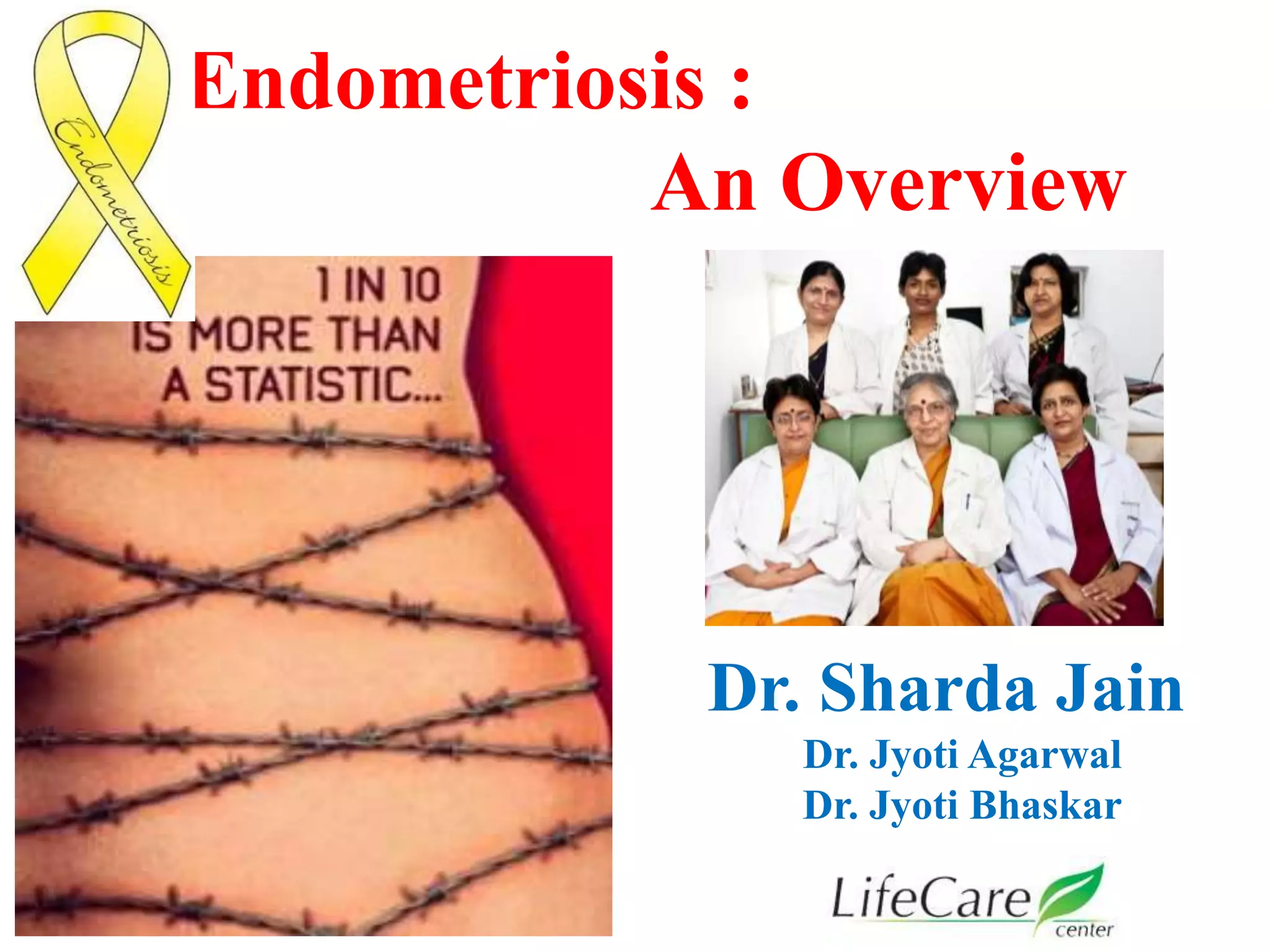
Endometriosis :
An Overview
Dr. Sharda Jain
Dr. Jyoti Agarwal
Dr. Jyoti Bhaskar
Presented in Endometriosis update
in Delhi June (2016) Hotel Leela
EB Guidelines
1. RCOG: Evidence-based Clinical, 1999
2. Endometriosis and infertility. ASRM, 2004.
3. ACOG. Endometriosis in adolescents, 2005.
4. ESHRE guideline for the diagnosis and treatment of endometriosis,
2005.
5. Endometriosis and infertility. ASRM, 2006.
6. Endometriosis: diagnosis and management.
7. Fertility: Assessment and Treatment for People with Fertility
Problems. NICE, 2013.
8. ESHRE guideline: management of women with
endometriosis,2014.
March
is
Endometriosis
Awareness
Month
”
Definition
“Presence of endometrial tissue outside the lining of the uterine cavity
or
“Proliferation of endometrium in any site other than the uterine mucosa’’
• Age: common in reproductive period
• True Incidence Unknown: ?
• Does NOT Discriminate by Race.
• Histology: Endometrial Glands with Stroma
+/- Inflammatory Reaction.
• Heriditary (↑↑ among sisters).
Epidemiology
SITES
Pelvic
UTERINE
- Adenomyosis (50%)
EXTRAUTERINE:
- Ovary 30%
- Pelvic peritoneum 10%.
- F. tube.
- Vagina.
- Bladder & rectum.
- Pelvic colon.
- Ligaments
EXTRA PELVIC
• Umbilicus.
• Scars (Lap.).
• Lungs &
• pleura.
• Others. Sites
•Diagnostic Dilemma
•Debilitating Disease
•Progressive Disease
•Disease with “No Cure”
•H/O Multiple Operations
• A Gynaecologist’s dilemma
Delay to Diagnosis of
8 to 10 years is the RULE
Delay of
• 10 years in Germany and Austria
• 8 years in the UK and Spain,
• 7 years in Norway, Italy
• 4–5 years in Ireland and Belgium
INDIA--- ?
PREVALENCE
•10%
Prevalence is higher in women with
• Dysmenorrhea : upto 60%
• Dyspareunia : upto 44%
• Pelvic Pain : upto 80%
AGE AT DIAGNOSIS
RISK FACTORS (Odukoya & Cooke, 1996)
I- ASSOCIATED:
First or second degree
relation.
Menstrual cycle < 27 days.
Menstrual duration > 7 days.
Genital outflow obstruction.
II- INCONCLUSIVE:
Obesity,
Exercise,
Age at menarche,
uterine retroversion.
III- NOT ASSOCIATED:
Age
Race
Social class
duration of marriage
ICUD
Miscarriage
Predisposing Factors
1. Hyperoestrinism:
a) Fibroid & metropathia hemorrhagica.
b) Delayed marriage, infertility.
c) Oestrogen secreting tumours of the ovary e.g. granulosa
& theca cell tumours, or with prolonged oestrogen therapy.
2. Cervical Stenosis.
3. Insufflation ?
4. Curettage ?
Pathogenesis
I- Endometrial
implantation: Retrograde.
II Vascular & lymphatic.
Mechanical.
III- In situ development:
Coelomic metaplasia.
Induction.
IV- Immunological.
V- Composite.
Endometriosis is said to be
Estrogen dependent .
It is one of the major causative
factors in the development of
endometriosis.
Pathogenesis ??
Excess Estrogen stimulates
Inflammation
Invasion
Angiogenesis
Cell Proliferation
Adhesions Pain
DONNEZ ET AL (2003)
• Red lesions = Early endometriosis
• Black lesions = Advanced endometriosis
• White = Lesions are believed to be
- Healed endometriosis or
- Quiescent or latent lesions.
ASRM classification (1996)
• The only difference between the 1985 rAFS classification &
1996 ASRM classification is that the latter includes
information on the morphologic appearance of the disease.
• Red: red, red-pink & clear lesions
• White: white, yellow-brown, peritoneal defects, subovarian
adhesion
• Black: black & blue lesions.
• Denote percent of total described as
• R ….%, W ….% and B ….%.
• Total should equal 100%.
CLASSIFICATION
• The revised American Fertility Society (rAFS)
(1985)was produced to standardize the
documentation of findings in patients who
have pelvic pain & endometriosis.
• Staging Involves:
• 1. Location
• 2. Depth of Disease,
• 3. Extent of Adhesions.
P
E
R
I
T
O
N
E
U
M
ENDOMETRIOSIS < 1cm 1-3cm >3cm
SUPERFICIAL 1 2 4
DEEP 2 4 6
O
V
A
R
y
R SUPERFICIAL 1 2 4
DEEP 4 16 20
L SUPERFICIAL 1 2 4
DEEP 4 16 20
POSTERIOR
CULDESAC
OBLTTERATION
Partial Complete
4 40
O
V
A
R
Y
Adhesions <1/3 Enclosure 1/3 – 2/3
Enclosure
> 2/3 Enclosure
R Filmy 1 2 4
Dense 4 8 16
L Filmy 1 2 4
Dense 4 8 16
T
U
B
E
R Filmy 1 2 4
Dense 4◦ 8◦ 16
L Filmy 1 2 4
Dense 4◦ 8◦ 16
REVISED AFS (1985)
• Stage I (minimal) 1 – 5.
• Stage II (mild) 6 – 15.
• Stage III (moderate) 16 – 40.
• Stage IV (severe) > 40.
• Symptoms (history).
• Signs (Exam).
• Investigations.
• DD.
Diagnosis
Adenomyosis Extra uterine
endometriosis
Age About 40
years
About 30 years
Parity Multipara nullipara
Socioeconomic Low high
Diagnosis cont…
Symptoms
Infertility 40 % Dysmenorrhoea 60 %
Chronic
Pelvic
Pain 80%
Pain
Premenstrual
Intramenstrual
Postmenstrual
100%
Dyspareunia 45 %
IN WOMEN OF REPRODUCTIVE AGE WITH
NON-GYNAECOLOGICAL CYCLICAL SYMPTOMS
• Dyschezia
• Dysuria
• Haematuria
• Rectal bleeding
• Shoulder pain.
Pelvic examination may reveal:
1. Pelvic tenderness.
2. Fixed retroverted uterus.
3. Nodularity of the Douglas pouch and
uterosacral ligaments.
4. Ovaries may be enlarged and tender .
5.Ovarian cyst may be detected.
Signs
• It should include both-
• Per Abdomen
• Per Speculum
• Per Vaginum
• Highest predictive value
• -- Menstruation
In all women suspected of
endometriosis
For adolescents and/or women without
previous sexual intercourse
• Rectal examination can be helpful for the
diagnosis of endometriosis.
• Only after Counselling and Verbal
Consent
Suspect Deep Endometriosis
• Women with (painful) induration and/or
nodules of the Rectovaginal wall found
during clinical examination or
• Visible vaginal nodules in the posterior
vaginal fornix
Consider Ovarian Endometriosis
Adnexal Masses
detected during clinical examination
Be Obsessed with Endometriosis
• In women suspected of the disease
even if the clinical examination is
NORMAL
INVESTIGATIONS:
INVASIVE DIAGNOSIS
I. Laparoscopy
II. Microlaparoscopy.
NON INVASIVE DIAGNOSIS.
• Imaging:
• U/S,
• MRI
III. Endometrial nerve fibers
IV. CA 125
V. Other.
LAPAROSCOPY
• GOLD STANDARD'
DIAGNOSTIC TEST
ADVANTAGES
(RCOG Grade B evidence)
1.Excludes other conditions e.g. ovarian cancer
2.Treatment of Endometriosis can be done at the
same time
Laproscopy & Histology– Gold
Standard
• Perform a laparoscopy to diagnose endometriosis
• Confirm a positive laparoscopy by histology, since positive
histology confirms the diagnosis of endometriosis even
though negative histology does not exclude it.
• Clinicians should obtain tissue for histology to exclude rare
instances of malignancy.
Transvaginal Ultrasound
• First-line investigational tool for suspected E
• Help diagnose
endometriomas,
bladder lesions, and
deep nodules such as those in the rectovaginal septum.
• Findings:
1.Anechoic to echogenic cysts
2.Masses containing multiple septations & solid tissue (Morane
&Older, 1996)
3.Cysts with low-level echoes: The commonest finding (95%)
Ovarian Endometrioma
Perform TVS
diagnose or to exclude an ovaria Endometrioma
Ultrasound features
• Ultrasound
characteristics in
premenopausal women
1.Ground Glass
echogenicity
2.one to four
compartments
3. NO PAPILLARY STRUCTURES
with detectable blood
flow
ULTRASOUND FOR RECTAL
ENDOMETRIOSIS
• TVS is highly operator dependent, and
experience is often lacking
• TVS is not recommended for diagnosis of
rectal endometriosis
• 3D ultrasound to diagnose rectovaginal
endometriosis is not well established
• Clinicians should assess ureter, bladder and
bowel involvement by additional imaging if
there is a suspicion based on
history or physical examination of deep
endometriosis.
• Barium enema, Transvaginal sonography
(TVS), Transrectal sonography and MRI
DEEP ENDOMETRIOSIS
Magnetic Resonance Imaging
????
• Clinicians should be aware that the
usefulness of magnetic resonance
imaging (MRI)
to diagnose Peritoneal Endometriosis
is not well established
Biomarkers ????
Clinicians are recommended not to use
biomarkers to diagnose endometriosis in
• endometrial tissue,
• menstrual or uterine fluids
• and/or immunological biomarkers, including
CA-125, in plasma, urine or serum
CA - 125
• No Serum Cancer Market has been studied in
greater detail than CA – 125
• It is identified in FT epithelium , Endometrium,
Endocervix, Pleura & Peritoneum
• Used to woman Cancer Evaluation & surveillance
Mild endometriosis
• sENSIVITY28%
Specificity90%
Stage III of IV Endometriosis ..S/S 90%
TREATMENT
• REVIEW
ESRH : 2014 EB Guidelines
Litereture : 2015 and 2016
• TREATMENT
1. Hormonal
2. Nutritional supplements, Complementary and alternative
treatments
3. Surgery
4. IUI and COS
5. ART
• Conclusion
Treatment : Consideration
• Age.
• Symptoms.
• Stage.
• Infertility.
Treatment (Rationale)
• Recognize Goals:
– Pain Management
– Preservation / Restoration of Fertility
• Discuss with Patient:
– Disease may be Chronic and Not Curable
– Optimal Treatment Unproven or Nonexistent
Current Treatment Options
SURGICAL MEDICAL
Removal of
Superfical and
Deep lesions
Adhesiolysis
To destroy or
prevent the lesions
( Not Possible)
Removal of
Chocolate cysts
When is Medical Treatment
Required ?
• First line treatment with chocolate cyst?
• First line treatment with superficial / deep
nodules?
• Role before surgery ?
• After surgery to prevent recurrence ?
• When surgery is not possible or refused ?
Full of
controversies
ESHRE
guidelines
2014
Best so far
For Treatment
Will answer all your queries
Laparoscopy
• Value:
It permits a “see and treat”
approach, although its
effectiveness may be limited by
the nature of the disease and the
surgeon's skill.
Limitations of surgery
Skill / Recurrence
LONG LEARNING CURVE
High risk of recurrence after surgery
25 % recurrence after 2 years
50 % at 5 years
40 – 80 % women have PAIN again
within 2 years of surgery
Medication Limitation
NSAIDs Lack of supporting evidence from controlled trials
GI side effects
Risk of gastric ulceration
Anti-ovulatory effect, when taken at mid cycle
Combined Oral Not approved for endomteriosis in most countries
Contraceptives Break through bleeding
GnRH Agonist Causes hot flushes, vaginal dryness and decreased libido
(Leuprolide) Acceleration of bone mass loss; increased risk of
osteoporosis
Use is limited upto 6 months
Androgens Adverse effect on lipid metabolism
(Danazol) Causes acne, Hirsuitism, vaginal dryness, edema, hot
flushes.
Associated with liver toxicity and breast atrophy
Progestins Lack of supporting evidence from controlled trials
Lack of dose finding data
Adverse impact on BMD
Aim of the hormonal therapy
(A) Pseudopregnancy :
1. Combined low - dose contraceptive pills(6 - 18
months to inhibit ovulation and menstruation and
induce decidualization to endometriosis tissues).
or
2. Progestins (to avoid oestrogen's side effects medroxy
progesterone acetate Depo medroxy progesterone
acetate (DMPA) can be given in a dose of 150 mg IM
every I - 3 months .
Aim of the hormonal therapy
(B) Pseudo menopause (induction of
amenorrhoea) by:
1. Danazol…Not used
2. Gn RH analogues.
GnRH-a
• Initially Stimulate FSH / LH Release.
• Down-Regulates GnRH Receptors–”Pseudo
menopause”.
• Long-Term Success Varies.
• Expensive.
• Use Limited by Hypo estrogenic Effects.
• May be Combined with Add-Back (? >1 Year ),
using E2/progesterone preparation.
GnRH-a
Add back (E2/progesterone preparation) :
• Reduce effect on bone mineral
density.
• Relieve hot flushes.
Endometriosis & IVF
• The presence of endometriosis does
not generally impair the results of IVF
but it increases the risk of infection.
• It is preferable not to cauterize
ovarian endometrium if IVF or ICSI is
indicated for fear of destruction of
ovarian tissues.
•Enigmatic Diseases
•Diagnostic Dilemma
•Debilitating Disease
•Progressive Disease
•Disease with “No Cure”
•H/O Multiple Operations
TAKE HOME MESSAGE
ADDRESS
11 Gagan Vihar, Near Karkari
Morh Flyover, Delhi - 51
Helpline
9650588339,
011-22414049, 011-22058865
WEBSITE :
www.lifecarecentre.in
www.drshardajain.com
www.lifecareivf.com
E-MAIL ID
Sharda.lifecare@gmail.com
Lifecarecentre21@gmail.com
info@lifecareivf.com
&

Endometriosis an overview by dr. sharda Jain, Dr. Jyoti Agarwal , Dr. Jyoti Bhaskar Lifecare Centre

  • 1.
    Endometriosis : An Overview Dr.Sharda Jain Dr. Jyoti Agarwal Dr. Jyoti Bhaskar
  • 2.
    Presented in Endometriosisupdate in Delhi June (2016) Hotel Leela
  • 3.
    EB Guidelines 1. RCOG:Evidence-based Clinical, 1999 2. Endometriosis and infertility. ASRM, 2004. 3. ACOG. Endometriosis in adolescents, 2005. 4. ESHRE guideline for the diagnosis and treatment of endometriosis, 2005. 5. Endometriosis and infertility. ASRM, 2006. 6. Endometriosis: diagnosis and management. 7. Fertility: Assessment and Treatment for People with Fertility Problems. NICE, 2013. 8. ESHRE guideline: management of women with endometriosis,2014.
  • 4.
  • 5.
    ” Definition “Presence of endometrialtissue outside the lining of the uterine cavity or “Proliferation of endometrium in any site other than the uterine mucosa’’
  • 6.
    • Age: commonin reproductive period • True Incidence Unknown: ? • Does NOT Discriminate by Race. • Histology: Endometrial Glands with Stroma +/- Inflammatory Reaction. • Heriditary (↑↑ among sisters). Epidemiology
  • 7.
    SITES Pelvic UTERINE - Adenomyosis (50%) EXTRAUTERINE: -Ovary 30% - Pelvic peritoneum 10%. - F. tube. - Vagina. - Bladder & rectum. - Pelvic colon. - Ligaments EXTRA PELVIC • Umbilicus. • Scars (Lap.). • Lungs & • pleura. • Others. Sites
  • 8.
    •Diagnostic Dilemma •Debilitating Disease •ProgressiveDisease •Disease with “No Cure” •H/O Multiple Operations • A Gynaecologist’s dilemma
  • 9.
    Delay to Diagnosisof 8 to 10 years is the RULE Delay of • 10 years in Germany and Austria • 8 years in the UK and Spain, • 7 years in Norway, Italy • 4–5 years in Ireland and Belgium INDIA--- ?
  • 10.
    PREVALENCE •10% Prevalence is higherin women with • Dysmenorrhea : upto 60% • Dyspareunia : upto 44% • Pelvic Pain : upto 80%
  • 11.
  • 12.
    RISK FACTORS (Odukoya& Cooke, 1996) I- ASSOCIATED: First or second degree relation. Menstrual cycle < 27 days. Menstrual duration > 7 days. Genital outflow obstruction. II- INCONCLUSIVE: Obesity, Exercise, Age at menarche, uterine retroversion. III- NOT ASSOCIATED: Age Race Social class duration of marriage ICUD Miscarriage
  • 13.
    Predisposing Factors 1. Hyperoestrinism: a)Fibroid & metropathia hemorrhagica. b) Delayed marriage, infertility. c) Oestrogen secreting tumours of the ovary e.g. granulosa & theca cell tumours, or with prolonged oestrogen therapy. 2. Cervical Stenosis. 3. Insufflation ? 4. Curettage ?
  • 14.
    Pathogenesis I- Endometrial implantation: Retrograde. IIVascular & lymphatic. Mechanical. III- In situ development: Coelomic metaplasia. Induction. IV- Immunological. V- Composite.
  • 15.
    Endometriosis is saidto be Estrogen dependent . It is one of the major causative factors in the development of endometriosis. Pathogenesis ??
  • 16.
  • 17.
    DONNEZ ET AL(2003) • Red lesions = Early endometriosis • Black lesions = Advanced endometriosis • White = Lesions are believed to be - Healed endometriosis or - Quiescent or latent lesions.
  • 19.
    ASRM classification (1996) •The only difference between the 1985 rAFS classification & 1996 ASRM classification is that the latter includes information on the morphologic appearance of the disease. • Red: red, red-pink & clear lesions • White: white, yellow-brown, peritoneal defects, subovarian adhesion • Black: black & blue lesions. • Denote percent of total described as • R ….%, W ….% and B ….%. • Total should equal 100%.
  • 20.
    CLASSIFICATION • The revisedAmerican Fertility Society (rAFS) (1985)was produced to standardize the documentation of findings in patients who have pelvic pain & endometriosis. • Staging Involves: • 1. Location • 2. Depth of Disease, • 3. Extent of Adhesions.
  • 22.
    P E R I T O N E U M ENDOMETRIOSIS < 1cm1-3cm >3cm SUPERFICIAL 1 2 4 DEEP 2 4 6 O V A R y R SUPERFICIAL 1 2 4 DEEP 4 16 20 L SUPERFICIAL 1 2 4 DEEP 4 16 20
  • 23.
    POSTERIOR CULDESAC OBLTTERATION Partial Complete 4 40 O V A R Y Adhesions<1/3 Enclosure 1/3 – 2/3 Enclosure > 2/3 Enclosure R Filmy 1 2 4 Dense 4 8 16 L Filmy 1 2 4 Dense 4 8 16 T U B E R Filmy 1 2 4 Dense 4◦ 8◦ 16 L Filmy 1 2 4 Dense 4◦ 8◦ 16
  • 24.
    REVISED AFS (1985) •Stage I (minimal) 1 – 5. • Stage II (mild) 6 – 15. • Stage III (moderate) 16 – 40. • Stage IV (severe) > 40.
  • 25.
    • Symptoms (history). •Signs (Exam). • Investigations. • DD. Diagnosis
  • 26.
    Adenomyosis Extra uterine endometriosis AgeAbout 40 years About 30 years Parity Multipara nullipara Socioeconomic Low high Diagnosis cont…
  • 27.
    Symptoms Infertility 40 %Dysmenorrhoea 60 % Chronic Pelvic Pain 80% Pain Premenstrual Intramenstrual Postmenstrual 100% Dyspareunia 45 %
  • 28.
    IN WOMEN OFREPRODUCTIVE AGE WITH NON-GYNAECOLOGICAL CYCLICAL SYMPTOMS • Dyschezia • Dysuria • Haematuria • Rectal bleeding • Shoulder pain.
  • 29.
    Pelvic examination mayreveal: 1. Pelvic tenderness. 2. Fixed retroverted uterus. 3. Nodularity of the Douglas pouch and uterosacral ligaments. 4. Ovaries may be enlarged and tender . 5.Ovarian cyst may be detected. Signs
  • 30.
    • It shouldinclude both- • Per Abdomen • Per Speculum • Per Vaginum • Highest predictive value • -- Menstruation In all women suspected of endometriosis
  • 31.
    For adolescents and/orwomen without previous sexual intercourse • Rectal examination can be helpful for the diagnosis of endometriosis. • Only after Counselling and Verbal Consent
  • 32.
    Suspect Deep Endometriosis •Women with (painful) induration and/or nodules of the Rectovaginal wall found during clinical examination or • Visible vaginal nodules in the posterior vaginal fornix
  • 33.
    Consider Ovarian Endometriosis AdnexalMasses detected during clinical examination
  • 34.
    Be Obsessed withEndometriosis • In women suspected of the disease even if the clinical examination is NORMAL
  • 35.
    INVESTIGATIONS: INVASIVE DIAGNOSIS I. Laparoscopy II.Microlaparoscopy. NON INVASIVE DIAGNOSIS. • Imaging: • U/S, • MRI III. Endometrial nerve fibers IV. CA 125 V. Other.
  • 36.
    LAPAROSCOPY • GOLD STANDARD' DIAGNOSTICTEST ADVANTAGES (RCOG Grade B evidence) 1.Excludes other conditions e.g. ovarian cancer 2.Treatment of Endometriosis can be done at the same time
  • 37.
    Laproscopy & Histology–Gold Standard • Perform a laparoscopy to diagnose endometriosis • Confirm a positive laparoscopy by histology, since positive histology confirms the diagnosis of endometriosis even though negative histology does not exclude it. • Clinicians should obtain tissue for histology to exclude rare instances of malignancy.
  • 38.
    Transvaginal Ultrasound • First-lineinvestigational tool for suspected E • Help diagnose endometriomas, bladder lesions, and deep nodules such as those in the rectovaginal septum. • Findings: 1.Anechoic to echogenic cysts 2.Masses containing multiple septations & solid tissue (Morane &Older, 1996) 3.Cysts with low-level echoes: The commonest finding (95%)
  • 39.
    Ovarian Endometrioma Perform TVS diagnoseor to exclude an ovaria Endometrioma
  • 40.
    Ultrasound features • Ultrasound characteristicsin premenopausal women 1.Ground Glass echogenicity 2.one to four compartments 3. NO PAPILLARY STRUCTURES with detectable blood flow
  • 41.
    ULTRASOUND FOR RECTAL ENDOMETRIOSIS •TVS is highly operator dependent, and experience is often lacking • TVS is not recommended for diagnosis of rectal endometriosis • 3D ultrasound to diagnose rectovaginal endometriosis is not well established
  • 42.
    • Clinicians shouldassess ureter, bladder and bowel involvement by additional imaging if there is a suspicion based on history or physical examination of deep endometriosis. • Barium enema, Transvaginal sonography (TVS), Transrectal sonography and MRI DEEP ENDOMETRIOSIS
  • 43.
    Magnetic Resonance Imaging ???? •Clinicians should be aware that the usefulness of magnetic resonance imaging (MRI) to diagnose Peritoneal Endometriosis is not well established
  • 44.
    Biomarkers ???? Clinicians arerecommended not to use biomarkers to diagnose endometriosis in • endometrial tissue, • menstrual or uterine fluids • and/or immunological biomarkers, including CA-125, in plasma, urine or serum
  • 45.
    CA - 125 •No Serum Cancer Market has been studied in greater detail than CA – 125 • It is identified in FT epithelium , Endometrium, Endocervix, Pleura & Peritoneum • Used to woman Cancer Evaluation & surveillance Mild endometriosis • sENSIVITY28% Specificity90% Stage III of IV Endometriosis ..S/S 90%
  • 46.
    TREATMENT • REVIEW ESRH :2014 EB Guidelines Litereture : 2015 and 2016 • TREATMENT 1. Hormonal 2. Nutritional supplements, Complementary and alternative treatments 3. Surgery 4. IUI and COS 5. ART • Conclusion
  • 47.
    Treatment : Consideration •Age. • Symptoms. • Stage. • Infertility.
  • 48.
    Treatment (Rationale) • RecognizeGoals: – Pain Management – Preservation / Restoration of Fertility • Discuss with Patient: – Disease may be Chronic and Not Curable – Optimal Treatment Unproven or Nonexistent
  • 49.
    Current Treatment Options SURGICALMEDICAL Removal of Superfical and Deep lesions Adhesiolysis To destroy or prevent the lesions ( Not Possible) Removal of Chocolate cysts
  • 50.
    When is MedicalTreatment Required ? • First line treatment with chocolate cyst? • First line treatment with superficial / deep nodules? • Role before surgery ? • After surgery to prevent recurrence ? • When surgery is not possible or refused ? Full of controversies
  • 51.
    ESHRE guidelines 2014 Best so far ForTreatment Will answer all your queries
  • 52.
    Laparoscopy • Value: It permitsa “see and treat” approach, although its effectiveness may be limited by the nature of the disease and the surgeon's skill.
  • 53.
    Limitations of surgery Skill/ Recurrence LONG LEARNING CURVE High risk of recurrence after surgery 25 % recurrence after 2 years 50 % at 5 years 40 – 80 % women have PAIN again within 2 years of surgery
  • 54.
    Medication Limitation NSAIDs Lackof supporting evidence from controlled trials GI side effects Risk of gastric ulceration Anti-ovulatory effect, when taken at mid cycle Combined Oral Not approved for endomteriosis in most countries Contraceptives Break through bleeding GnRH Agonist Causes hot flushes, vaginal dryness and decreased libido (Leuprolide) Acceleration of bone mass loss; increased risk of osteoporosis Use is limited upto 6 months Androgens Adverse effect on lipid metabolism (Danazol) Causes acne, Hirsuitism, vaginal dryness, edema, hot flushes. Associated with liver toxicity and breast atrophy Progestins Lack of supporting evidence from controlled trials Lack of dose finding data Adverse impact on BMD
  • 55.
    Aim of thehormonal therapy (A) Pseudopregnancy : 1. Combined low - dose contraceptive pills(6 - 18 months to inhibit ovulation and menstruation and induce decidualization to endometriosis tissues). or 2. Progestins (to avoid oestrogen's side effects medroxy progesterone acetate Depo medroxy progesterone acetate (DMPA) can be given in a dose of 150 mg IM every I - 3 months .
  • 56.
    Aim of thehormonal therapy (B) Pseudo menopause (induction of amenorrhoea) by: 1. Danazol…Not used 2. Gn RH analogues.
  • 57.
    GnRH-a • Initially StimulateFSH / LH Release. • Down-Regulates GnRH Receptors–”Pseudo menopause”. • Long-Term Success Varies. • Expensive. • Use Limited by Hypo estrogenic Effects. • May be Combined with Add-Back (? >1 Year ), using E2/progesterone preparation.
  • 58.
    GnRH-a Add back (E2/progesteronepreparation) : • Reduce effect on bone mineral density. • Relieve hot flushes.
  • 59.
    Endometriosis & IVF •The presence of endometriosis does not generally impair the results of IVF but it increases the risk of infection. • It is preferable not to cauterize ovarian endometrium if IVF or ICSI is indicated for fear of destruction of ovarian tissues.
  • 60.
    •Enigmatic Diseases •Diagnostic Dilemma •DebilitatingDisease •Progressive Disease •Disease with “No Cure” •H/O Multiple Operations TAKE HOME MESSAGE
  • 61.
    ADDRESS 11 Gagan Vihar,Near Karkari Morh Flyover, Delhi - 51 Helpline 9650588339, 011-22414049, 011-22058865 WEBSITE : www.lifecarecentre.in www.drshardajain.com www.lifecareivf.com E-MAIL ID Sharda.lifecare@gmail.com Lifecarecentre21@gmail.com info@lifecareivf.com &