DAY 1
What are the major challenges facing the food industry in the
Philippines?
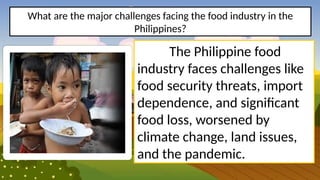
The Philippine food
industry faces challenges like
food security threats, import
dependence, and significant
food loss, worsened by
climate change, land issues,
and the pandemic.
Short Review
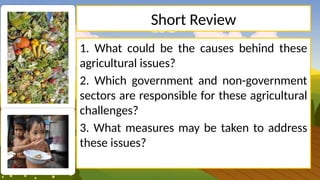
1. What could be the causes behind these
agricultural issues?
2. Which government and non-government
sectors are responsible for these agricultural
challenges?
3. What measures may be taken to address
these issues?
Content Vocabulary
Agriculture - It is the science, art or practice of soil
cultivation through crop production and livestock raising
that involves varying degrees of preparation that may result
in selling and marketing of the end products.
Content Vocabulary
Agricultural Careers - They are professional paths related to farming,
cultivation and animal husbandry. These career paths involve
everything from growing crops and nurturing the soil to raising
livestock like cattle, pigs and chickens.
Content Vocabulary
Agri-business - It encompasses the economic sectors for
farming and farming- related commerce. It involves all the
steps for getting agricultural goods to the market, including
production, processing, and distribution.
Let’s think about it!
1. Why did the Department of Agriculture launch
the grant program for starting an agribusiness?
2. Which featured agribusinesses would you
consider trying?
3. Would a career in agriculture be rewarding? Why
or why not?
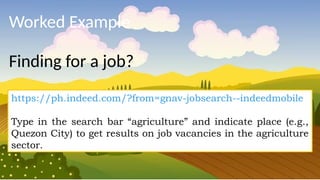
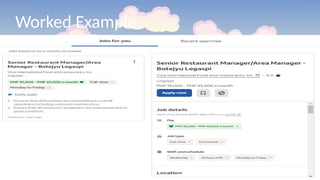
Worked Example
Finding for a job?
https://ph.indeed.com/?from=gnav-jobsearch--indeedmobile
Type in the search bar “agriculture” and indicate place (e.g.,
Quezon City) to get results on job vacancies in the agriculture
sector.
Worked Example
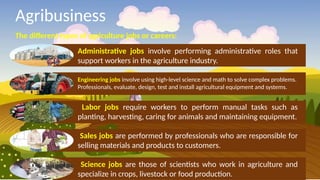
Agribusiness
Administrative jobs involve performing administrative roles that
support workers in the agriculture industry.
Engineering jobs involve using high-level science and math to solve complex problems.
Professionals, evaluate, design, test and install agricultural equipment and systems.
Labor jobs require workers to perform manual tasks such as
planting, harvesting, caring for animals and maintaining equipment.
Sales jobs are performed by professionals who are responsible for
selling materials and products to customers.
Science jobs are those of scientists who work in agriculture and
specialize in crops, livestock or food production.
The different types of agriculture jobs or careers:
Agribusiness
Agricultural Jobs
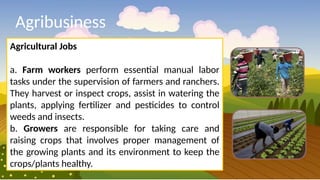
a. Farm workers perform essential manual labor
tasks under the supervision of farmers and ranchers.
They harvest or inspect crops, assist in watering the
plants, applying fertilizer and pesticides to control
weeds and insects.
b. Growers are responsible for taking care and
raising crops that involves proper management of
the growing plants and its environment to keep the
crops/plants healthy.
Agribusiness
Agricultural Jobs
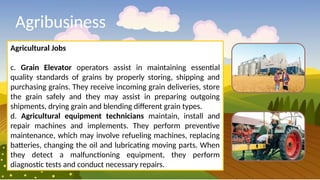
c. Grain Elevator operators assist in maintaining essential
quality standards of grains by properly storing, shipping and
purchasing grains. They receive incoming grain deliveries, store
the grain safely and they may assist in preparing outgoing
shipments, drying grain and blending different grain types.
d. Agricultural equipment technicians maintain, install and
repair machines and implements. They perform preventive
maintenance, which may involve refueling machines, replacing
batteries, changing the oil and lubricating moving parts. When
they detect a malfunctioning equipment, they perform
diagnostic tests and conduct necessary repairs.
Agribusiness
Agricultural Jobs
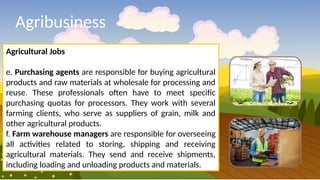
e. Purchasing agents are responsible for buying agricultural
products and raw materials at wholesale for processing and
reuse. These professionals often have to meet specific
purchasing quotas for processors. They work with several
farming clients, who serve as suppliers of grain, milk and
other agricultural products.
f. Farm warehouse managers are responsible for overseeing
all activities related to storing, shipping and receiving
agricultural materials. They send and receive shipments,
including loading and unloading products and materials.
Agribusiness
Agricultural Jobs
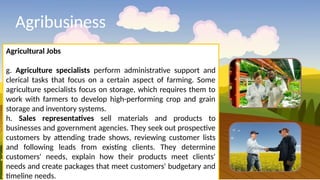
g. Agriculture specialists perform administrative support and
clerical tasks that focus on a certain aspect of farming. Some
agriculture specialists focus on storage, which requires them to
work with farmers to develop high-performing crop and grain
storage and inventory systems.
h. Sales representatives sell materials and products to
businesses and government agencies. They seek out prospective
customers by attending trade shows, reviewing customer lists
and following leads from existing clients. They determine
customers' needs, explain how their products meet clients'
needs and create packages that meet customers' budgetary and
timeline needs.
Agribusiness
Agricultural Jobs
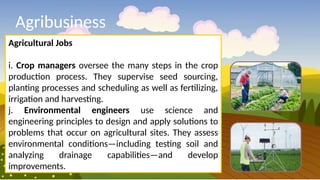
i. Crop managers oversee the many steps in the crop
production process. They supervise seed sourcing,
planting processes and scheduling as well as fertilizing,
irrigation and harvesting.
j. Environmental engineers use science and
engineering principles to design and apply solutions to
problems that occur on agricultural sites. They assess
environmental conditions—including testing soil and
analyzing drainage capabilities—and develop
improvements.
Agribusiness
Agricultural Jobs
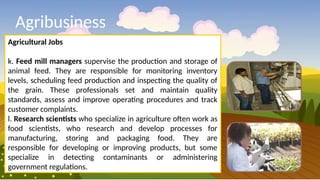
k. Feed mill managers supervise the production and storage of
animal feed. They are responsible for monitoring inventory
levels, scheduling feed production and inspecting the quality of
the grain. These professionals set and maintain quality
standards, assess and improve operating procedures and track
customer complaints.
l. Research scientists who specialize in agriculture often work as
food scientists, who research and develop processes for
manufacturing, storing and packaging food. They are
responsible for developing or improving products, but some
specialize in detecting contaminants or administering
government regulations.
Lesson Activity
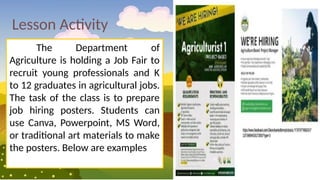
The Department of
Agriculture is holding a Job Fair to
recruit young professionals and K
to 12 graduates in agricultural jobs.
The task of the class is to prepare
job hiring posters. Students can
use Canva, Powerpoint, MS Word,
or traditional art materials to make
the posters. Below are examples
DAY 2
Learners’ Takeaways
1. How important are
agricultural jobs?
2. How can we encourage
more young people to join
the agricultural industry?
Reflection on Learning
Which agricultural
job would you
include as one of
your career
options? Why?
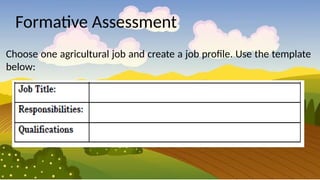
Formative Assessment
Choose one agricultural job and create a job profile. Use the template
below: