



KAZIM HUSSAIN
BS-IT-15-102
PRESENTED TO: DR. AMIR HUSSAIN
•Data Encoding is a method to convert the data into
signal form because we cannot transmit data until it is
converted into signal.
•Whenever we transmit a data it is always in the form
of a signal. It can be in digital or analog form.
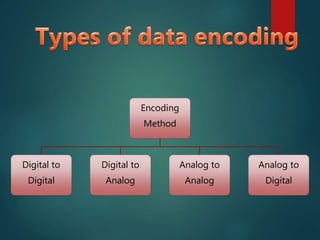
Encoding
Method
Digital to
Digital
Digital to
Analog
Analog to
Analog
Analog to
Digital
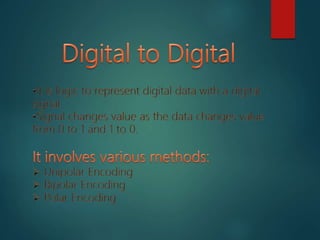
•It uses only one polarity. The polarity of the pulse
shows whether it is positive or negative logic.
•Positive logic refers to binary 1.
•Negative logic refers to binary 0.
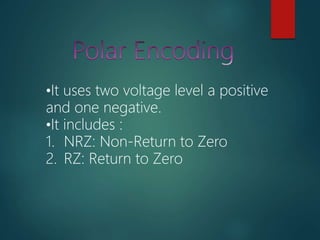
•It uses two voltage level a positive
and one negative.
•It includes :
1. NRZ: Non-Return to Zero
2. RZ: Return to Zero
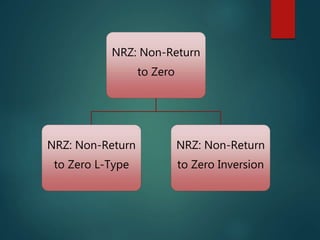
NRZ: Non-Return
to Zero
NRZ: Non-Return
to Zero L-Type
NRZ: Non-Return
to Zero Inversion
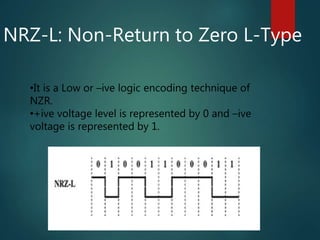
NRZ-L: Non-Return to Zero L-Type
•It is a Low or –ive logic encoding technique of
NZR.
•+ive voltage level is represented by 0 and –ive
voltage is represented by 1.
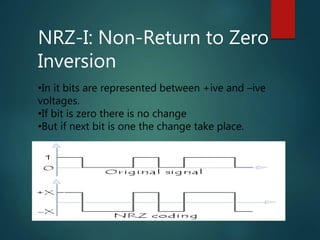
NRZ-I: Non-Return to Zero
Inversion
•In it bits are represented between +ive and –ive
voltages.
•If bit is zero there is no change
•But if next bit is one the change take place.
0 1 0 0 0 1 1 1 0 0
1
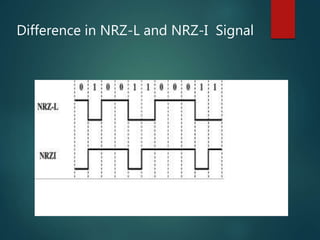
Difference in NRZ-L and NRZ-I Signal
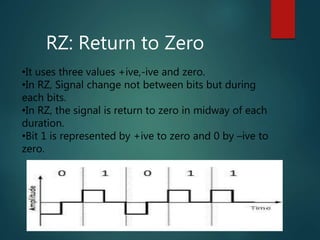
RZ: Return to Zero
•It uses three values +ive,-ive and zero.
•In RZ, Signal change not between bits but during
each bits.
•In RZ, the signal is return to zero in midway of each
duration.
•Bit 1 is represented by +ive to zero and 0 by –ive to
zero.
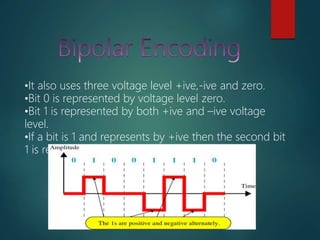
•It also uses three voltage level +ive,-ive and zero.
•Bit 0 is represented by voltage level zero.
•Bit 1 is represented by both +ive and –ive voltage
level.
•If a bit is 1 and represents by +ive then the second bit
1 is represents by –ive voltage level
•These are nothing but analog modulation techniques such
as:
1. Amplitude Modulation
2. Frequency Modulation
3. Phase Modulation
Any Question???

Encoding techniques

  • 1.
  • 2.
    •Data Encoding isa method to convert the data into signal form because we cannot transmit data until it is converted into signal. •Whenever we transmit a data it is always in the form of a signal. It can be in digital or analog form.
  • 3.
  • 5.
    •It uses onlyone polarity. The polarity of the pulse shows whether it is positive or negative logic. •Positive logic refers to binary 1. •Negative logic refers to binary 0.
  • 6.
    •It uses twovoltage level a positive and one negative. •It includes : 1. NRZ: Non-Return to Zero 2. RZ: Return to Zero
  • 7.
    NRZ: Non-Return to Zero NRZ:Non-Return to Zero L-Type NRZ: Non-Return to Zero Inversion
  • 8.
    NRZ-L: Non-Return toZero L-Type •It is a Low or –ive logic encoding technique of NZR. •+ive voltage level is represented by 0 and –ive voltage is represented by 1.
  • 9.
    NRZ-I: Non-Return toZero Inversion •In it bits are represented between +ive and –ive voltages. •If bit is zero there is no change •But if next bit is one the change take place. 0 1 0 0 0 1 1 1 0 0 1
  • 10.
    Difference in NRZ-Land NRZ-I Signal
  • 11.
    RZ: Return toZero •It uses three values +ive,-ive and zero. •In RZ, Signal change not between bits but during each bits. •In RZ, the signal is return to zero in midway of each duration. •Bit 1 is represented by +ive to zero and 0 by –ive to zero.
  • 12.
    •It also usesthree voltage level +ive,-ive and zero. •Bit 0 is represented by voltage level zero. •Bit 1 is represented by both +ive and –ive voltage level. •If a bit is 1 and represents by +ive then the second bit 1 is represents by –ive voltage level
  • 13.
    •These are nothingbut analog modulation techniques such as: 1. Amplitude Modulation 2. Frequency Modulation 3. Phase Modulation
  • 14.

Editor's Notes

  • #3 Need of data encoding……….