ENABLING INNOVATIVE WIRELESS SOLUTIONS
CROPS – WIRELESS SENSOR NETWORKS FOR
SPECTRUM SENSING AND COGNITIVE
COMMUNICATION


Viktoria Fodor, Mikael Skoglund (KTH)
Geir Øien (NTNU)

Jussi Ryynänen (Aalto)


http://www.ee.kth.se/commth/projects/CROPS/
The design of spectrum sensing WSNs
           • To enable new and innovative wireless solutions

           • Challenge:
             - The large part of the radio spectrum is assigned to traditional
               technologies/services (like mobile networks)
             - Small IMF band can not accommodate all new solutions (WiFi,
               personal networks, sensor networks, device to device communication)

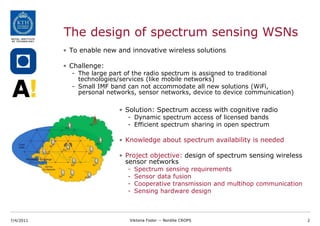
                           • Solution: Spectrum access with cognitive radio
                              - Dynamic spectrum access of licensed bands
                              - Efficient spectrum sharing in open spectrum

                           • Knowledge about spectrum availability is needed

                           • Project objective: design of spectrum sensing wireless
                             sensor networks
                              -   Spectrum sensing requirements
                              -   Sensor data fusion
                              -   Cooperative transmission and multihop communication
                              -   Sensing hardware design


7/4/2011                       Viktoria Fodor -- Nordite CROPS                          2
Spectrum sensing requirements
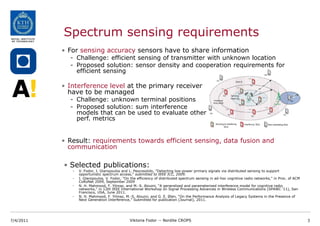
           • For sensing accuracy sensors have to share information
             - Challenge: efficient sensing of transmitter with unknown location
             - Proposed solution: sensor density and cooperation requirements for
               efficient sensing

           • Interference level at the primary receiver
             have to be managed
             - Challenge: unknown terminal positions
             - Proposed solution: sum interference
               models that can be used to evaluate other
               perf. metrics


           • Result: requirements towards efficient sensing, data fusion and
             communication

           • Selected publications:
              -   V. Fodor, I. Glaropoulos and L. Pescosolido, "Detecting low-power primary signals via distributed sensing to support
                  opportunistic spectrum access," submitted to IEEE ICC, 2009.
              -   I. Glaropoulos, V. Fodor, "On the efficiency of distributed spectrum sensing in ad-hoc cognitive radio networks," in Proc. of ACM
                  CoRoNet 2009, September 2009
              -   N. H. Mahmood, F. Yilmaz, and M.-S. Alouini, “A generalized and parameterized interference model for cognitive radio
                  networks,” in 12th IEEE International Workshop on Signal Processing Advances in Wireless Communications (SPAWC ’11), San
                  Francisco, USA, June 2011.
              -   N. H. Mahmood, F. Yilmaz, M.-S. Alouini, and G. E. Øien, “On the Performance Analysis of Legacy Systems in the Presence of
                  Next Generation Interference,” Submitted for publication (Journal), 2011.


7/4/2011                                       Viktoria Fodor -- Nordite CROPS                                                                        3
Sensor data fusion
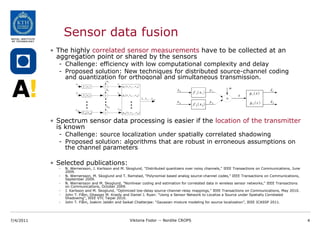
           • The highly correlated sensor measurements have to be collected at an
             aggregation point or shared by the sensors
             - Challenge: efficiency with low computational complexity and delay
             - Proposed solution: New techniques for distributed source-channel coding
               and quantization for orthogonal and simultaneous transmission.


           • Spectrum sensor data processing is easier if the location of the transmitter
             is known
             - Challenge: source localization under spatially correlated shadowing
             - Proposed solution: algorithms that are robust in erroneous assumptions on
               the channel parameters

           • Selected publications:
             -   N. Wernersson, J. Karlsson and M. Skoglund, "Distributed quantizers over noisy channels," IEEE Transactions on Communications, June
                 2009.
             -   N. Wernersson, M. Skoglund and T. Ramstad, "Polynomial based analog source-channel codes," IEEE Transactions on Communications,
                 September 2009.
             -   N. Wernersson and M. Skoglund, "Nonlinear coding and estimation for correlated data in wireless sensor networks," IEEE Transactions
                 on Communications, October 2009.
             -   J. Karlsson and M. Skoglund, "Optimized low-delay source-channel-relay mappings," IEEE Transactions on Communications, May 2010.
             -   John T. Flåm, Ghassan M. Kraidy and Daniel J. Ryan: “Using a Sensor Network to Localize a Source under Spatially Correlated
                 Shadowing”, IEEE VTC Taipei 2010.
             -   John T. Flåm, Joakim Jaldén and Saikat Chatterjee: “Gaussian mixture modeling for source localization”, IEEE ICASSP 2011.


7/4/2011                                             Viktoria Fodor -- Nordite CROPS                                                                   4
Cooperative transmission
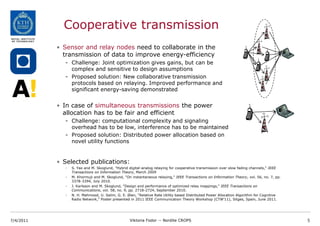
           • Sensor and relay nodes need to collaborate in the
             transmission of data to improve energy-efficiency
             - Challenge: Joint optimization gives gains, but can be
               complex and sensitive to design assumptions
             - Proposed solution: New collaborative transmission
               protocols based on relaying. Improved performance and
               significant energy-saving demonstrated


           • In case of simultaneous transmissions the power
             allocation has to be fair and efficient
             - Challenge: computational complexity and signaling
               overhead has to be low, interference has to be maintained
             - Proposed solution: Distributed power allocation based on
               novel utility functions


           • Selected publications:
             -   S. Yao and M. Skoglund, "Hybrid digital-analog relaying for cooperative transmission over slow fading channels," IEEE
                 Transactions on Information Theory, March 2009
             -   M. Khormuji and M. Skoglund, "On instantaneous relaying," IEEE Transactions on Information Theory, vol. 56, no. 7, pp.
                 3378-3394, July 2010.
             -   J. Karlsson and M. Skoglund, "Design and performance of optimized relay mappings," IEEE Transactions on
                 Communications, vol. 58, no. 9, pp. 2718-2724, September 2010.
             -   N. H. Mahmood, U. Salim, G. E. Øien, “Relative Rate Utility based Distributed Power Allocation Algorithm for Cognitive
                 Radio Network,” Poster presented in 2011 IEEE Communication Theory Workshop (CTW’11), Sitges, Spain, June 2011.


7/4/2011                                         Viktoria Fodor -- Nordite CROPS                                                          5
Networking for spectrum sensing

           • Routing for optimum overall energy efficiency to increase network
             lifetime
             - Challenge: existing solutions are too complex (NP-hard)
             - Proposed solution: adaptive routing and transmission control heuristics
               based on novel utility function

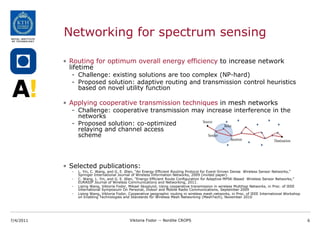
           • Applying cooperative transmission techniques in mesh networks
             - Challenge: cooperative transmission may increase interference in the
               networks
             - Proposed solution: co-optimized
               relaying and channel access
               scheme


           • Selected publications:
             -   L. Yin, C. Wang, and G. E. Øien, “An Energy-Efficient Routing Protocol for Event-Driven Dense Wireless Sensor Networks,”
                 Springer International Journal of Wireless Information Networks, 2009 (invited paper).
             -   C. Wang, L. Yin, and G. E. Øien, "Energy-Efficient Route Configuration for Adaptive MPSK-Based Wireless Sensor Networks,”
                 EURASIP Journal of Wireless Communications and Networking, 2011.
             -   Liping Wang, Viktoria Fodor, Mikael Skoglund, Using cooperative transmission in wireless Multihop Networks, in Proc. of IEEE
                 International Symposium On Personal, Indoor and Mobile Radio Communications, September 2009
             -   Liping Wang, Viktoria Fodor, Cooperative geographic routing in wireless mesh networks, in Proc. of IEEE International Workshop
                 on Enabling Technologies and Standards for Wireless Mesh Networking (MeshTech), November 2010


7/4/2011                                      Viktoria Fodor -- Nordite CROPS                                                                     6
Sensing radio HW design
• Sensing HW needs to be able to sense narrow band channels over a wide
  spectrum range
   - Challenge:
       •   Radio HW capable of receiving in broad frequency range does not exist
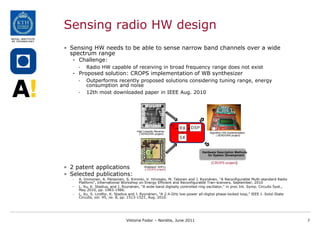
   - Proposed solution: CROPS implementation of WB synthesizer
       •   Outperforms recently proposed solutions considering tuning range, energy
           consumption and noise
       •   12th most downloaded paper in IEEE Aug. 2010


                                         High Linearity Receiver
                                           ( SENDORA project)                      Algorithm HW Implementation
                                                                                        ( SENDORA project)


                                                                               Hardware Description Methods
                                                                                  for System Development

                                                                                    (CROPS project)
• 2 patent applications                        Wideband ADPLL
                                               ( CROPS project)

• Selected publications:
   -   A. Immonen, A. Pärssinen, S. Kiminki, V. Hirvisalo, M. Talonen and J. Ryynänen, "A Reconfigurable Multi-standard Radio
       Platform", International Workshop on Energy Efficient and Reconfigurable Tran-sceivers, September, 2010
   -   L. Xu, K. Stadius, and J. Ryynänen, "A wide-band digitally controlled ring oscillator," in proc Int. Symp. Circuits Syst.,
       May 2010, pp. 1983-1986.
   -   L. Xu, S. Lindfor, K. Stadius and J. Ryynänen, "A 2.4-GHz low-power all-digital phase-locked loop," IEEE J. Solid-State
       Circuits, vol. 45, no. 8, pp. 1513-1521, Aug. 2010.


                                  Viktoria Fodor – Nordite, June 2011                                                               7
Relevance
           • Scientific content
             - New insights into the design of energy-efficient wireless
               sensor networks
             - With application to spectrum sensing
           • Collaboration
             - New highly successful Nordic research collaboration that
               would not have happened otherwise
              • High volume of research results and publications
              • Visits and co-authored papers
              • Several graduated PhD’s
              • Spin-off projects, e.g. the EU/Fp7 projects “SENDORA”


7/4/2011                     Viktoria Fodor -- Nordite CROPS               8
Exploitation
           • What could be exploited by industry now?
             - The concepts of cooperative sensing and transmission
             - New wireless sensor network design principles and applications
             - Improved spectrum sensing HW for opportunistic spectrum
               sharing (2 patent applications)

           • What steps are missing to make the results available for the
             industry?
             - Some of our results need to be tested in more realistic practical
               scenarios
             - Some of our suggested schemes do not fit present standards

           • What kind of partners would we need for this?
             - Telecom (Ericsson, Telenor)
             - Industrial automation (ABB)
             - System integrators and sensor developers


7/4/2011                        Viktoria Fodor -- Nordite CROPS                    9

Wireless Sensor Networks for Spectrum sensing and Cognitive Communication, Viktoria Fodor, Royal Institute of Technology

  • 1.
    ENABLING INNOVATIVE WIRELESSSOLUTIONS CROPS – WIRELESS SENSOR NETWORKS FOR SPECTRUM SENSING AND COGNITIVE COMMUNICATION Viktoria Fodor, Mikael Skoglund (KTH) Geir Øien (NTNU) Jussi Ryynänen (Aalto) http://www.ee.kth.se/commth/projects/CROPS/
  • 2.
    The design ofspectrum sensing WSNs • To enable new and innovative wireless solutions • Challenge: - The large part of the radio spectrum is assigned to traditional technologies/services (like mobile networks) - Small IMF band can not accommodate all new solutions (WiFi, personal networks, sensor networks, device to device communication) • Solution: Spectrum access with cognitive radio - Dynamic spectrum access of licensed bands - Efficient spectrum sharing in open spectrum • Knowledge about spectrum availability is needed • Project objective: design of spectrum sensing wireless sensor networks - Spectrum sensing requirements - Sensor data fusion - Cooperative transmission and multihop communication - Sensing hardware design 7/4/2011 Viktoria Fodor -- Nordite CROPS 2
  • 3.
    Spectrum sensing requirements • For sensing accuracy sensors have to share information - Challenge: efficient sensing of transmitter with unknown location - Proposed solution: sensor density and cooperation requirements for efficient sensing • Interference level at the primary receiver have to be managed - Challenge: unknown terminal positions - Proposed solution: sum interference models that can be used to evaluate other perf. metrics • Result: requirements towards efficient sensing, data fusion and communication • Selected publications: - V. Fodor, I. Glaropoulos and L. Pescosolido, "Detecting low-power primary signals via distributed sensing to support opportunistic spectrum access," submitted to IEEE ICC, 2009. - I. Glaropoulos, V. Fodor, "On the efficiency of distributed spectrum sensing in ad-hoc cognitive radio networks," in Proc. of ACM CoRoNet 2009, September 2009 - N. H. Mahmood, F. Yilmaz, and M.-S. Alouini, “A generalized and parameterized interference model for cognitive radio networks,” in 12th IEEE International Workshop on Signal Processing Advances in Wireless Communications (SPAWC ’11), San Francisco, USA, June 2011. - N. H. Mahmood, F. Yilmaz, M.-S. Alouini, and G. E. Øien, “On the Performance Analysis of Legacy Systems in the Presence of Next Generation Interference,” Submitted for publication (Journal), 2011. 7/4/2011 Viktoria Fodor -- Nordite CROPS 3
  • 4.
    Sensor data fusion • The highly correlated sensor measurements have to be collected at an aggregation point or shared by the sensors - Challenge: efficiency with low computational complexity and delay - Proposed solution: New techniques for distributed source-channel coding and quantization for orthogonal and simultaneous transmission. • Spectrum sensor data processing is easier if the location of the transmitter is known - Challenge: source localization under spatially correlated shadowing - Proposed solution: algorithms that are robust in erroneous assumptions on the channel parameters • Selected publications: - N. Wernersson, J. Karlsson and M. Skoglund, "Distributed quantizers over noisy channels," IEEE Transactions on Communications, June 2009. - N. Wernersson, M. Skoglund and T. Ramstad, "Polynomial based analog source-channel codes," IEEE Transactions on Communications, September 2009. - N. Wernersson and M. Skoglund, "Nonlinear coding and estimation for correlated data in wireless sensor networks," IEEE Transactions on Communications, October 2009. - J. Karlsson and M. Skoglund, "Optimized low-delay source-channel-relay mappings," IEEE Transactions on Communications, May 2010. - John T. Flåm, Ghassan M. Kraidy and Daniel J. Ryan: “Using a Sensor Network to Localize a Source under Spatially Correlated Shadowing”, IEEE VTC Taipei 2010. - John T. Flåm, Joakim Jaldén and Saikat Chatterjee: “Gaussian mixture modeling for source localization”, IEEE ICASSP 2011. 7/4/2011 Viktoria Fodor -- Nordite CROPS 4
  • 5.
    Cooperative transmission • Sensor and relay nodes need to collaborate in the transmission of data to improve energy-efficiency - Challenge: Joint optimization gives gains, but can be complex and sensitive to design assumptions - Proposed solution: New collaborative transmission protocols based on relaying. Improved performance and significant energy-saving demonstrated • In case of simultaneous transmissions the power allocation has to be fair and efficient - Challenge: computational complexity and signaling overhead has to be low, interference has to be maintained - Proposed solution: Distributed power allocation based on novel utility functions • Selected publications: - S. Yao and M. Skoglund, "Hybrid digital-analog relaying for cooperative transmission over slow fading channels," IEEE Transactions on Information Theory, March 2009 - M. Khormuji and M. Skoglund, "On instantaneous relaying," IEEE Transactions on Information Theory, vol. 56, no. 7, pp. 3378-3394, July 2010. - J. Karlsson and M. Skoglund, "Design and performance of optimized relay mappings," IEEE Transactions on Communications, vol. 58, no. 9, pp. 2718-2724, September 2010. - N. H. Mahmood, U. Salim, G. E. Øien, “Relative Rate Utility based Distributed Power Allocation Algorithm for Cognitive Radio Network,” Poster presented in 2011 IEEE Communication Theory Workshop (CTW’11), Sitges, Spain, June 2011. 7/4/2011 Viktoria Fodor -- Nordite CROPS 5
  • 6.
    Networking for spectrumsensing • Routing for optimum overall energy efficiency to increase network lifetime - Challenge: existing solutions are too complex (NP-hard) - Proposed solution: adaptive routing and transmission control heuristics based on novel utility function • Applying cooperative transmission techniques in mesh networks - Challenge: cooperative transmission may increase interference in the networks - Proposed solution: co-optimized relaying and channel access scheme • Selected publications: - L. Yin, C. Wang, and G. E. Øien, “An Energy-Efficient Routing Protocol for Event-Driven Dense Wireless Sensor Networks,” Springer International Journal of Wireless Information Networks, 2009 (invited paper). - C. Wang, L. Yin, and G. E. Øien, "Energy-Efficient Route Configuration for Adaptive MPSK-Based Wireless Sensor Networks,” EURASIP Journal of Wireless Communications and Networking, 2011. - Liping Wang, Viktoria Fodor, Mikael Skoglund, Using cooperative transmission in wireless Multihop Networks, in Proc. of IEEE International Symposium On Personal, Indoor and Mobile Radio Communications, September 2009 - Liping Wang, Viktoria Fodor, Cooperative geographic routing in wireless mesh networks, in Proc. of IEEE International Workshop on Enabling Technologies and Standards for Wireless Mesh Networking (MeshTech), November 2010 7/4/2011 Viktoria Fodor -- Nordite CROPS 6
  • 7.
    Sensing radio HWdesign • Sensing HW needs to be able to sense narrow band channels over a wide spectrum range - Challenge: • Radio HW capable of receiving in broad frequency range does not exist - Proposed solution: CROPS implementation of WB synthesizer • Outperforms recently proposed solutions considering tuning range, energy consumption and noise • 12th most downloaded paper in IEEE Aug. 2010 High Linearity Receiver ( SENDORA project) Algorithm HW Implementation ( SENDORA project) Hardware Description Methods for System Development (CROPS project) • 2 patent applications Wideband ADPLL ( CROPS project) • Selected publications: - A. Immonen, A. Pärssinen, S. Kiminki, V. Hirvisalo, M. Talonen and J. Ryynänen, "A Reconfigurable Multi-standard Radio Platform", International Workshop on Energy Efficient and Reconfigurable Tran-sceivers, September, 2010 - L. Xu, K. Stadius, and J. Ryynänen, "A wide-band digitally controlled ring oscillator," in proc Int. Symp. Circuits Syst., May 2010, pp. 1983-1986. - L. Xu, S. Lindfor, K. Stadius and J. Ryynänen, "A 2.4-GHz low-power all-digital phase-locked loop," IEEE J. Solid-State Circuits, vol. 45, no. 8, pp. 1513-1521, Aug. 2010. Viktoria Fodor – Nordite, June 2011 7
  • 8.
    Relevance • Scientific content - New insights into the design of energy-efficient wireless sensor networks - With application to spectrum sensing • Collaboration - New highly successful Nordic research collaboration that would not have happened otherwise • High volume of research results and publications • Visits and co-authored papers • Several graduated PhD’s • Spin-off projects, e.g. the EU/Fp7 projects “SENDORA” 7/4/2011 Viktoria Fodor -- Nordite CROPS 8
  • 9.
    Exploitation • What could be exploited by industry now? - The concepts of cooperative sensing and transmission - New wireless sensor network design principles and applications - Improved spectrum sensing HW for opportunistic spectrum sharing (2 patent applications) • What steps are missing to make the results available for the industry? - Some of our results need to be tested in more realistic practical scenarios - Some of our suggested schemes do not fit present standards • What kind of partners would we need for this? - Telecom (Ericsson, Telenor) - Industrial automation (ABB) - System integrators and sensor developers 7/4/2011 Viktoria Fodor -- Nordite CROPS 9