“ I. y.. c..  t…. t……..,  y.. c.. t…. a…..!” (Michael Grinder)
  “ If you can  teach teenagers,  you can teach anyone!”
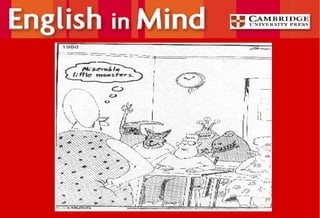
Teenage students often... are angels when you first meet them... and gradually turn into   MONSTERS WHY???
 
W…  E…… i. M… Y.. c..!
 
Teaching Large Multilevel Classes with English in Mind
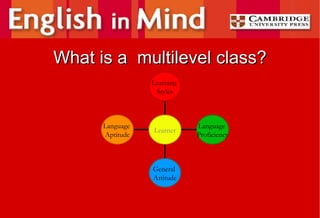
What is a  multilevel class? Learning  Styles Language  Proficiency General  Attitude Language  Aptitude Learner
Eleven principles of coping in  multilevel classes with English in Mind.
Scarlett O’Hara 1 “  I will think about it tomorrow” This philosophy may prove helpful in teaching. No matter how good we get to be, we will always have challenges.
Variety Extremely important in provoking interest and reaching all learners 2
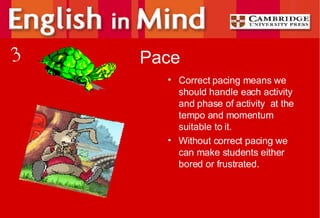
Pace Correct pacing means we should handle each activity and phase of activity  at the tempo and momentum suitable to it. Without correct pacing we can make students either bored or frustrated. 3
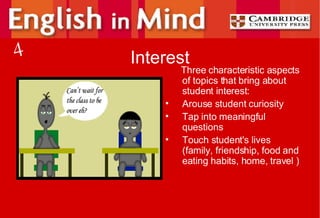
Interest Three characteristic aspects of topics that bring about student interest: Arouse student curiosity Tap into meaningful questions Touch student's lives (family, friendship, food and eating habits, home, travel ) 4
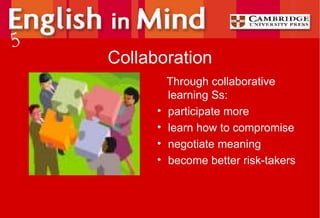
Collaboration Through collaborative learning Ss: participate more learn how to compromise negotiate meaning become better risk-takers 5
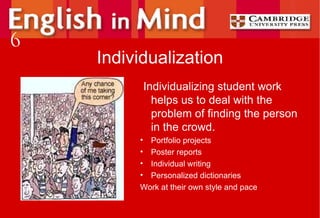
Individualization Individualizing student work helps us to deal with the problem of finding the person in the crowd. Portfolio projects Poster reports Individual writing Personalized dictionaries Work at their own style and pace 6
Personalization Ss need to: relate the activity to their own life explore their ideas apply their knowledge express their opinions 7
Choice and open-endedness Open-ended exercises, allow Ss many possibilities for choosing appropriate language items and gearing the exercise to their own level of competence. 8
Setting up routines The class operates much more smoothly if early in the term certain conventions are established: the way attendance is checked the way Ss are notified of test dates and deadlines the way Ss move from a group or pair work strategy to a teacher-fronted framework or vice versa 9
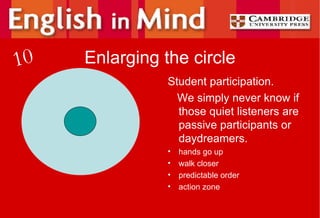
Enlarging the circle Student participation. We simply never know if those quiet listeners are passive participants or daydreamers. hands go up walk closer predictable order action zone 10
Question the kind of questioning we use Ask the kind of questions that arouse interest  and create maximum student involvement. 11
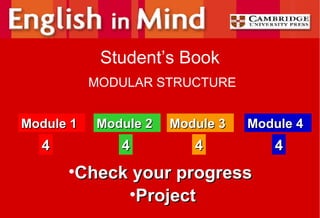
Student’s Book MODULAR STRUCTURE Module 1 Module 2 Module 3 Module 4 4 4 4 4 Check your progress Project
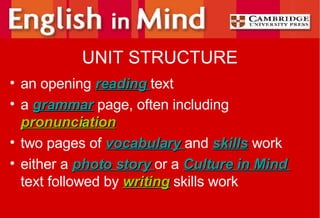
UNIT STRUCTURE an opening  reading   text a  grammar  page, often including  pronunciation two pages of  vocabulary   and  skills  work either a  photo story   or a  Culture in Mind   text followed by  writing  skills work
Reading
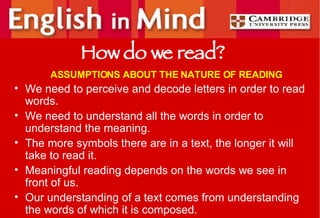
How do we read? ASSUMPTIONS ABOUT THE NATURE OF READING We need to perceive and decode letters in order to read words. We need to understand all the words in order to understand the meaning. The more symbols there are in a text, the longer it will take to read it. Meaningful reading depends on the words we see in front of us. Our understanding of a text comes from understanding the words of which it is composed.
Grammar and pronunciation
“ Tell me and I forget, teach me and I remember involve me and I learn.”
Vocabulary
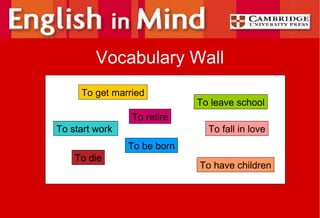
Vocabulary Wall To get married To retire To start work  To fall in love To leave school To be born To die To have children
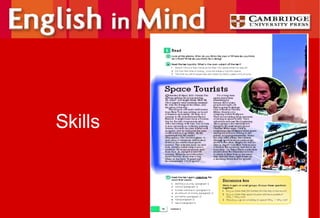
Skills
Listening and Writing Listening and Reading Listening and Speaking
Listening Recognition Name TASKS ASSIGNED TO EACH GROUP : Group 1 –Listen for examples of the present tenses (simple and continuous). Group 2 –Listen for examples of the past simple tense. Group 3 –Listen for examples of the future continuous tense.
Running Dictation readers runners writers
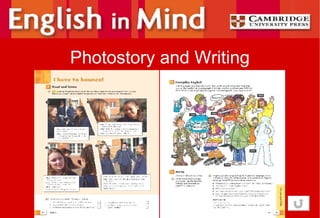
Photostory and Writing
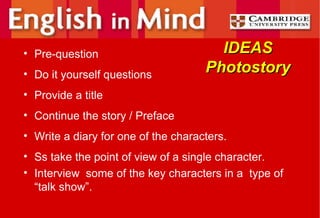
IDEAS Photostory Pre-question Do it yourself questions Provide a title Continue the story / Preface Write a diary for one of the characters. Ss take the point of view of a single character. Interview  some of the key characters in a  type of “talk show”.
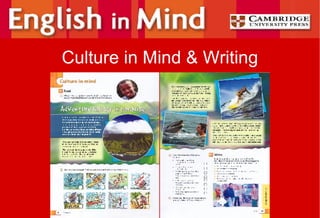
Culture in Mind & Writing
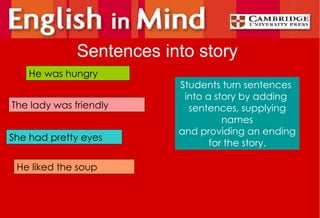
Sentences into story He was hungry The lady was friendly She had pretty eyes He liked the soup Students turn sentences  into a story by adding  sentences, supplying names and providing an ending for the story.
Samples of genres that can be switched Newspaper Article Children’s story Diaries  Interview Poem
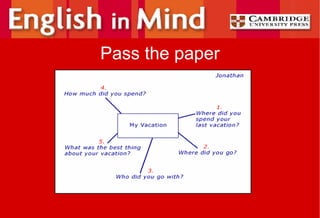
Pass the paper
Cloud Story
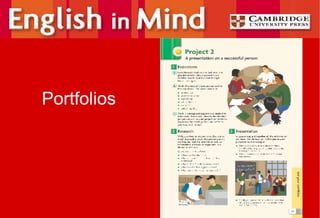
Portfolios
WORKBOOK &  CD ROM/CD AUDIO AUTONOMOUS LEARNING
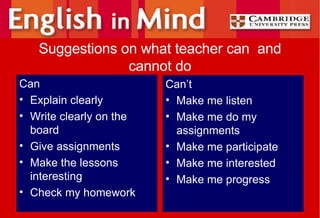
Suggestions on what teacher can  and cannot do Can Explain clearly Write clearly on the board Give assignments Make the lessons interesting Check my homework Can’t Make me listen Make me do my assignments Make me participate Make me interested Make me progress
Create a CAN DO spirit in the classroom CD ROM – immediate positive feedback / patient trainer Solid writing syllabus
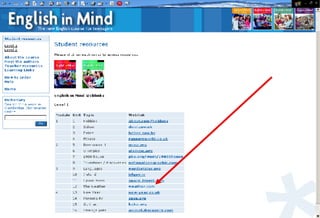
http://uk.cambridge.org/elt/englishinmind/


English in Mind is in line with international exams ( Cambridge ESOL Exams  / STANDARDS)
English in Mind has  a Portfolio BUILDER
W…  E…… i. M… Y.. c..!
Emt

  • 1.
  • 2.
    I. y.. c.. t…. t…….., y.. c.. t…. a…..!” (Michael Grinder)
  • 3.
    If you can teach teenagers, you can teach anyone!”
  • 4.
    Teenage students often...are angels when you first meet them... and gradually turn into MONSTERS WHY???
  • 5.
  • 6.
    W… E……i. M… Y.. c..!
  • 7.
  • 8.
    Teaching Large MultilevelClasses with English in Mind
  • 9.
    What is a multilevel class? Learning Styles Language Proficiency General Attitude Language Aptitude Learner
  • 10.
    Eleven principles ofcoping in multilevel classes with English in Mind.
  • 11.
    Scarlett O’Hara 1“ I will think about it tomorrow” This philosophy may prove helpful in teaching. No matter how good we get to be, we will always have challenges.
  • 12.
    Variety Extremely importantin provoking interest and reaching all learners 2
  • 13.
    Pace Correct pacingmeans we should handle each activity and phase of activity at the tempo and momentum suitable to it. Without correct pacing we can make students either bored or frustrated. 3
  • 14.
    Interest Three characteristicaspects of topics that bring about student interest: Arouse student curiosity Tap into meaningful questions Touch student's lives (family, friendship, food and eating habits, home, travel ) 4
  • 15.
    Collaboration Through collaborativelearning Ss: participate more learn how to compromise negotiate meaning become better risk-takers 5
  • 16.
    Individualization Individualizing studentwork helps us to deal with the problem of finding the person in the crowd. Portfolio projects Poster reports Individual writing Personalized dictionaries Work at their own style and pace 6
  • 17.
    Personalization Ss needto: relate the activity to their own life explore their ideas apply their knowledge express their opinions 7
  • 18.
    Choice and open-endednessOpen-ended exercises, allow Ss many possibilities for choosing appropriate language items and gearing the exercise to their own level of competence. 8
  • 19.
    Setting up routinesThe class operates much more smoothly if early in the term certain conventions are established: the way attendance is checked the way Ss are notified of test dates and deadlines the way Ss move from a group or pair work strategy to a teacher-fronted framework or vice versa 9
  • 20.
    Enlarging the circleStudent participation. We simply never know if those quiet listeners are passive participants or daydreamers. hands go up walk closer predictable order action zone 10
  • 21.
    Question the kindof questioning we use Ask the kind of questions that arouse interest and create maximum student involvement. 11
  • 22.
    Student’s Book MODULARSTRUCTURE Module 1 Module 2 Module 3 Module 4 4 4 4 4 Check your progress Project
  • 23.
    UNIT STRUCTURE anopening reading text a grammar page, often including pronunciation two pages of vocabulary and skills work either a photo story or a Culture in Mind text followed by writing skills work
  • 24.
  • 25.
    How do weread? ASSUMPTIONS ABOUT THE NATURE OF READING We need to perceive and decode letters in order to read words. We need to understand all the words in order to understand the meaning. The more symbols there are in a text, the longer it will take to read it. Meaningful reading depends on the words we see in front of us. Our understanding of a text comes from understanding the words of which it is composed.
  • 26.
  • 27.
    “ Tell meand I forget, teach me and I remember involve me and I learn.”
  • 28.
  • 29.
    Vocabulary Wall Toget married To retire To start work To fall in love To leave school To be born To die To have children
  • 30.
  • 31.
    Listening and WritingListening and Reading Listening and Speaking
  • 32.
    Listening Recognition NameTASKS ASSIGNED TO EACH GROUP : Group 1 –Listen for examples of the present tenses (simple and continuous). Group 2 –Listen for examples of the past simple tense. Group 3 –Listen for examples of the future continuous tense.
  • 33.
  • 34.
  • 35.
    IDEAS Photostory Pre-questionDo it yourself questions Provide a title Continue the story / Preface Write a diary for one of the characters. Ss take the point of view of a single character. Interview some of the key characters in a type of “talk show”.
  • 36.
    Culture in Mind& Writing
  • 37.
    Sentences into storyHe was hungry The lady was friendly She had pretty eyes He liked the soup Students turn sentences into a story by adding sentences, supplying names and providing an ending for the story.
  • 38.
    Samples of genresthat can be switched Newspaper Article Children’s story Diaries Interview Poem
  • 39.
  • 40.
  • 41.
  • 42.
    WORKBOOK & CD ROM/CD AUDIO AUTONOMOUS LEARNING
  • 43.
    Suggestions on whatteacher can and cannot do Can Explain clearly Write clearly on the board Give assignments Make the lessons interesting Check my homework Can’t Make me listen Make me do my assignments Make me participate Make me interested Make me progress
  • 44.
    Create a CANDO spirit in the classroom CD ROM – immediate positive feedback / patient trainer Solid writing syllabus
  • 45.
  • 46.
  • 47.
  • 48.
  • 49.
  • 50.
  • 51.
  • 52.
    English in Mindis in line with international exams ( Cambridge ESOL Exams / STANDARDS)
  • 53.
    English in Mindhas a Portfolio BUILDER
  • 54.
    W… E……i. M… Y.. c..!