ESTABLISHING
ROUTINES
Review and Routines (5 min.)
Day 2, Part I
OBJECTIVES
▪ Students will:
▪ Transition efficiently between mini-lessons
▪ Review the skills needed and expected during Reader’s
Workshop.
SMOOTH TRANSITIONS
Remember, when I shake the West African gourd
shaker, it means that it is time to transition to a new
online station.
Why do you think it’s important to transition efficiently?
Getting Ready for Whole-Group Instruction: Creating a
Collaborative Atmosphere with Reader’s Workshop
Let’s take this time to review the Reader’s Workshop
activities that we’ll be completing this school year.
▪ practice reading
▪ write about reading
▪ talk about reading
▪ work independently
▪ work with a partner
▪ work in small groups
▪ work with the teacher
Getting Ready for Whole-Group Instruction: Creating a
Collaborative Atmosphere with Reader’s Workshop
Let’s take this time to review the Reader’s Workshop
skills that you will need to master this school year.
▪ be able to follow directions
▪ be able to listen actively
▪ be able to talk about my reading
▪ be able to write about my reading
▪ be responsible for my learning
▪ be responsible for others
▪ be responsible for classroom materials
Establishing Routines
▪ Today we are going
to focus on the skill
of listening.
Most of the
successful people I
know are the ones
who do more listening
than talking.
-- Bernard Baruch
Read-Aloud and
Book Discussion
Review and Routines (40 min.)
Day 2, Part II
OBJECTIVES
▪ Students will:
▪ Listen and respond to a story.
▪ Discuss and practice how to be active listeners.
Read-Aloud: Build Good
Listening Skills
Today we are going to read a book. As I read,
think about what it means to be a listener.
What did you notice about being a listener?
Your ideas make me think of a skill called
ACTIVE LISTENING.
Let’s review the skills needed to be an active
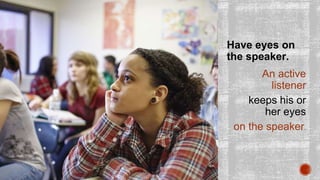
Have eyes on
the speaker.
An active
listener
keeps his or
her eyes
on the speaker.
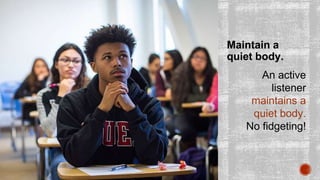
Maintain a
quiet body.
An active
listener
maintains a
quiet body.
No fidgeting!
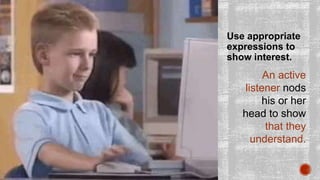
Use appropriate
expressions to
show interest.
An active
listener nods
his or her
head to show
that they
understand.
Be patient while
the speaker
chooses what to
stay. Give
enough wait
time.
An active
listener waits
for a speaker
to finish their
thought.
They don’t
interrupt!
Think carefully
about what the
speaker is
saying.
An active listener
does their best
to understand
the speaker.
They think about
what the
speaker is
saying.
Read-Aloud: Build Good
Listening Habits
We will now play a few games to practice active
listening skills. All of you will participate.
You are going to tell us your birth month and
what city you were born. For example, I would
say…
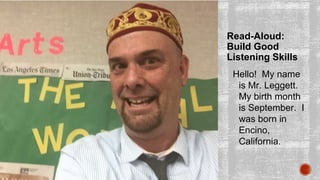
Read-Aloud:
Build Good
Listening Skills
Hello! My name
is Mr. Leggett.
My birth month
is September. I
was born in
Encino,
California.
Read-Aloud: Build Good
Listening Habits
Go ask your parents if you don’t know your birth month or what city you
were born.
Now, when I call your name, remember to tell us your birth name and
the city you were born like this…
Hello! My name is ______. My birth month is _____. I was born in
_____.
When everyone has told us their birth month and where they were born,
we will try to remember when and where!
(use equity cards to randomly call students)
Read-Aloud: Build Good
Listening Habits
We will now listen to a very boring story from
Princess Yvonne. She will speak in a
monotone voice. Our job is to actively listen so
that we can answer questions about the story.
The only way we will remember all the details is
to actively listen!
Read-Aloud: Build Good
Listening Habits
How did it feel to practice active listening? What
was hard? What was easy? What questions do you
have about how we are expected to listen while we
are together online?
We will now play a game of kahoots based on
Princess Yvonne’s story.
(log-in to kahoot; search “Princess Yvonne’s Boring
Story”)

Grade 4, day 2, parta i abd ii

  • 1.
  • 2.
    OBJECTIVES ▪ Students will: ▪Transition efficiently between mini-lessons ▪ Review the skills needed and expected during Reader’s Workshop.
  • 3.
    SMOOTH TRANSITIONS Remember, whenI shake the West African gourd shaker, it means that it is time to transition to a new online station. Why do you think it’s important to transition efficiently?
  • 4.
    Getting Ready forWhole-Group Instruction: Creating a Collaborative Atmosphere with Reader’s Workshop Let’s take this time to review the Reader’s Workshop activities that we’ll be completing this school year. ▪ practice reading ▪ write about reading ▪ talk about reading ▪ work independently ▪ work with a partner ▪ work in small groups ▪ work with the teacher
  • 5.
    Getting Ready forWhole-Group Instruction: Creating a Collaborative Atmosphere with Reader’s Workshop Let’s take this time to review the Reader’s Workshop skills that you will need to master this school year. ▪ be able to follow directions ▪ be able to listen actively ▪ be able to talk about my reading ▪ be able to write about my reading ▪ be responsible for my learning ▪ be responsible for others ▪ be responsible for classroom materials
  • 6.
    Establishing Routines ▪ Todaywe are going to focus on the skill of listening. Most of the successful people I know are the ones who do more listening than talking. -- Bernard Baruch
  • 7.
    Read-Aloud and Book Discussion Reviewand Routines (40 min.) Day 2, Part II
  • 8.
    OBJECTIVES ▪ Students will: ▪Listen and respond to a story. ▪ Discuss and practice how to be active listeners.
  • 9.
    Read-Aloud: Build Good ListeningSkills Today we are going to read a book. As I read, think about what it means to be a listener. What did you notice about being a listener? Your ideas make me think of a skill called ACTIVE LISTENING. Let’s review the skills needed to be an active
  • 10.
    Have eyes on thespeaker. An active listener keeps his or her eyes on the speaker.
  • 11.
    Maintain a quiet body. Anactive listener maintains a quiet body. No fidgeting!
  • 12.
    Use appropriate expressions to showinterest. An active listener nods his or her head to show that they understand.
  • 13.
    Be patient while thespeaker chooses what to stay. Give enough wait time. An active listener waits for a speaker to finish their thought. They don’t interrupt!
  • 14.
    Think carefully about whatthe speaker is saying. An active listener does their best to understand the speaker. They think about what the speaker is saying.
  • 15.
    Read-Aloud: Build Good ListeningHabits We will now play a few games to practice active listening skills. All of you will participate. You are going to tell us your birth month and what city you were born. For example, I would say…
  • 16.
    Read-Aloud: Build Good Listening Skills Hello!My name is Mr. Leggett. My birth month is September. I was born in Encino, California.
  • 17.
    Read-Aloud: Build Good ListeningHabits Go ask your parents if you don’t know your birth month or what city you were born. Now, when I call your name, remember to tell us your birth name and the city you were born like this… Hello! My name is ______. My birth month is _____. I was born in _____. When everyone has told us their birth month and where they were born, we will try to remember when and where! (use equity cards to randomly call students)
  • 18.
    Read-Aloud: Build Good ListeningHabits We will now listen to a very boring story from Princess Yvonne. She will speak in a monotone voice. Our job is to actively listen so that we can answer questions about the story. The only way we will remember all the details is to actively listen!
  • 20.
    Read-Aloud: Build Good ListeningHabits How did it feel to practice active listening? What was hard? What was easy? What questions do you have about how we are expected to listen while we are together online? We will now play a game of kahoots based on Princess Yvonne’s story. (log-in to kahoot; search “Princess Yvonne’s Boring Story”)