Reading comprehension
Acknowledgements
• Almasi and Fullerton 2012 Teaching Strategic Processes in Reading
• Kucan and Beck 1997 Thinking Aloud and reading comprehension research,
inquiry, instruction and social interaction. Review of educational research,
67 (3) 271-299
• Ellin Keene and Susan Zimmerman 2007 Mosaic of Thought Heineman
• Cris Tovani 2000 I read but I Don’t Get It Stenhouse
• Yuill and Oakhill 2009 Children’s Problems in Text Comprehension
2
Permission Microsoft/Fotolia.com
Four key aspects of reading
• Word recognition
• Reading fluency
• Using strategies when reading texts
• Reading comprehension and enjoyment
Fluency and reading comprehension..
• Even if we read accurately, we will have problems beyond the early
years if we fail to read in phrases so that reading sounds like talking.
• Word by word reading often means the start of a sentence can’t be
integrated with the end.
• Some pupils read too quickly so that comprehension suffers
In many pupils’ minds, decoding seems to have a
much bigger profile than comprehension.
• Many pupils (especially younger and poorer older readers) think that
decoding rather than comprehension is the main point of reading.
• A range of studies indicate that around 10-15 % of pupils who decode
adequately experience comprehension problems when reading texts.
• They often emerge around the age of 8 when language demands
begin to become significant.
• So we need to ensure a balance in the teaching of reading
Implications of poor comprehension
• Inclined to be less motivated readers so read less and therefore have
weaker vocabulary and text knowledge.
• Listening comprehension likely to be weak.
• Attainment in tests at 11 and 16 lower because effective reading is
denied.
• A severe obstacle to educational attainment.
• Invariably shows in writing.
Reading is an action sport. The action takes
place in our minds.
When we read its not enough to read the
words correctly (decode). As we read the
words, the meaning does not automatically
jump into our heads!!
We have to read the words and build
meaning, a bit like constructing a model.
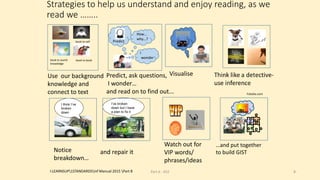
Strategies to help us understand and enjoy reading, as we
read we ……..
Fotolia.com
book to self
book to world
knowledge
book to book
Use our background
knowledge and
connect to text
I think I’ve
broken
down
I’ve broken
down but I have
a plan to fix it
Visualise
Notice
breakdown…
and repair it
Watch out for
VIP words/
phrases/ideas
…and put together
to build GIST
I:LEARNSUP1STANDARDSInf Manual 2015 Part 8
Predict
How…
why…?
I
wonder
Predict, ask questions,
I wonder…
and read on to find out...
Part 6 - KS2 8
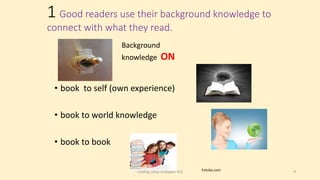
1 Good readers use their background knowledge to
connect with what they read.
• book to self (own experience)
• book to world knowledge
• book to book
Background
knowledge ON
9Fotolia.comreading comp strategies KS2
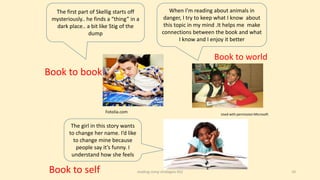
The first part of Skellig starts off
mysteriously.. he finds a “thing” in a
dark place.. a bit like Stig of the
dump
When I’m reading about animals in
danger, I try to keep what I know about
this topic in my mind .It helps me make
connections between the book and what
I know and I enjoy it better
Book to world
10
Used with permission Microsoft
Book to book
The girl in this story wants
to change her name. I’d like
to change mine because
people say it’s funny. I
understand how she feels
Book to self
Fotolia.com
reading comp strategies KS2
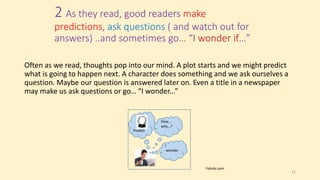
2 As they read, good readers make
predictions, ask questions ( and watch out for
answers) ..and sometimes go… “I wonder if…”
Often as we read, thoughts pop into our mind. A plot starts and we might predict
what is going to happen next. A character does something and we ask ourselves a
question. Maybe our question is answered later on. Even a title in a newspaper
may make us ask questions or go… “I wonder...”
11
Fotola.com
Predict
How…
why…?
I
wonder
reading comp strategies KS2 12
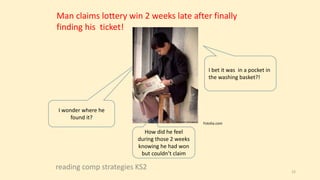
I wonder where he
found it?
How did he feel
during those 2 weeks
knowing he had won
but couldn’t claim
I bet it was in a pocket in
the washing basket?!
Man claims lottery win 2 weeks late after finally
finding his ticket!
Fotolia.com
As we read, we ask questions, make
predictions and watch out if we are
right or whether we have to change
our views….
reading comp strategies KS2 13
Predict
How…
why…?
I
wonder
3 As they read, good readers visualise (make
mind pictures) about some of the things that
happen
• Often as we read, a picture will sometimes just pop into
our mind by itself. .. we may see a “picture” of a
character, or a “place”.
14
Fotolia.com
reading comp strategies KS2
4 Good readers identify what is really important …key
words… phrases… sentences… ideas
• If you Google the word sport, you will get 3 million
sites! So as we read, trying to sort out what is
important and what is not is… well it’s important!
• As we read we come across… words… phrases…
sentences… or ideas. Not everything in a book has
equal value. We have to puzzle out what are the key
words and pay special attention to them
reading comp strategies KS2 15Permission of Microsoft
5 Think like a detective… use inference
• Authors do not provide all the information you need
to understand what’s happening. If they did books
would be long and boring. So you have to be a
detective. Authors leave clues!
16reading comp strategies KS2
The writer leaves us clues to find so try your detective skills….
reading comp strategies KS2 17
1 At first I wasn’t afraid of the humming noise..
2 The surprise letter arrived for James, covered with
strange stamps
3 When friends came round Dilip was careful to hide
the book under his pillow
4 At the end of the day, Jack shuffled towards the
hostel
5 The playground was a sea of strange faces
6 Just as Jade thought things could not get any
worse..
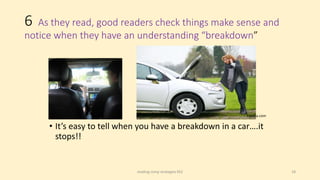
6 As they read, good readers check things make sense and
notice when they have an understanding “breakdown”
• It’s easy to tell when you have a breakdown in a car….it
stops!!
18
Fotolia.com
reading comp strategies KS2
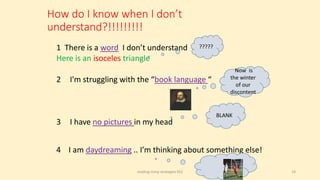
How do I know when I don’t
understand?!!!!!!!!!
1 There is a word I don’t understand
Here is an isoceles triangle
2 I'm struggling with the “book language “
3 I have no pictures in my head
4 I am daydreaming .. I’m thinking about something else!
?????
Now is
the winter
of our
discontent
BLANK
19reading comp strategies KS2
5 I’ve stopped asking questions or predicting
6 I've not got a summary (gist)of what I've just read
7 This bit I've just read doesn’t connect with the last
part??? OR This part
contradicts what I've just read
8 I’ve stopped thinking like a detective
NIL
NIL
20reading comp strategies KS2
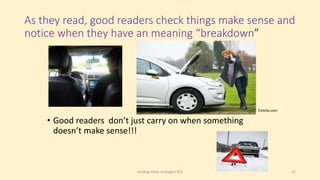
As they read, good readers check things make sense and
notice when they have an meaning “breakdown”
• Good readers don’t just carry on when something
doesn’t make sense!!!
21
Fotolia.com
reading comp strategies KS2
7 Good readers have breakdown strategies to get them
understanding again
Here’s 4 things you could
try when things don’t’
make sense.
22
I have a plan
to fix the
breakdown
reading comp strategies KS2
Good readers spot meaning breakdown and try to fix it
1. Go back 2 or 3 sentences and re- read and collect clues from the words
around. Try to connect the hard part to the bit that came before. Use
background knowledge and think like a detective.
2. Make pictures in your mind and re- read the hard bit. Your mind pictures
may make things clear.
3. Look at the key words in the sentence to help you understand. The key
words will be packed with meaning.
23
Here’s 4 things to try…
Inf Train Folder part 3
24
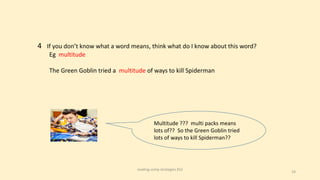
4 If you don’t know what a word means, think what do I know about this word?
Eg multitude
The Green Goblin tried a multitude of ways to kill Spiderman
Multitude ??? multi packs means
lots of?? So the Green Goblin tried
lots of ways to kill Spiderman??
reading comp strategies KS2
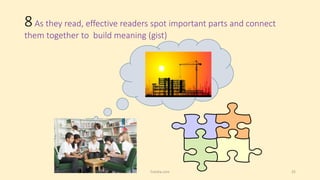
8As they read, effective readers spot important parts and connect
them together to build meaning (gist)
25Fotolia.com
26
If the book is well matched you will…..
• Be able to read new words no-one has ever taught you before
…. because there will be clues in the sentence to work out hard
words and you will be able to use words you know to work out
any new ones…. the level is just right!
• Learn the meanings of new words…. and expand your
vocabulary.… because you will get clues from the sentence
about what the unusual words mean… if the level is just right
for you, there won’t be too many words you have to work out
what they mean
• Enjoy reading….. because it’s something you are interested in
and the level is just right… you will probably read most days
reading comp strategies KS2
When you are choosing a book, check it’s one you will enjoy and feel
successful reading
• Is it the correct book band colour ?
• Read the blurb… does it seem a book you would enjoy?
• Try reading the first paragraph…can you read about 19 out of
20 words… or 38 out of 40 words?
• Read the first page or first few pages…. can you understand
what’s going on? Does it seem like a book you’d enjoy?
• Has a friend read this book? Do your class have a list of
recommended books and is it on the list?
• If your school has multiple copies of books, why not read the
same one as some of your friends?! You could make your own
book club!
• If you are reading a book you don’t enjoy, talk to your teacher!
27reading comp strategies KS2

Reading comprehension ppt for website

  • 1.
  • 2.
    Acknowledgements • Almasi andFullerton 2012 Teaching Strategic Processes in Reading • Kucan and Beck 1997 Thinking Aloud and reading comprehension research, inquiry, instruction and social interaction. Review of educational research, 67 (3) 271-299 • Ellin Keene and Susan Zimmerman 2007 Mosaic of Thought Heineman • Cris Tovani 2000 I read but I Don’t Get It Stenhouse • Yuill and Oakhill 2009 Children’s Problems in Text Comprehension 2 Permission Microsoft/Fotolia.com
  • 3.
    Four key aspectsof reading • Word recognition • Reading fluency • Using strategies when reading texts • Reading comprehension and enjoyment
  • 4.
    Fluency and readingcomprehension.. • Even if we read accurately, we will have problems beyond the early years if we fail to read in phrases so that reading sounds like talking. • Word by word reading often means the start of a sentence can’t be integrated with the end. • Some pupils read too quickly so that comprehension suffers
  • 5.
    In many pupils’minds, decoding seems to have a much bigger profile than comprehension. • Many pupils (especially younger and poorer older readers) think that decoding rather than comprehension is the main point of reading. • A range of studies indicate that around 10-15 % of pupils who decode adequately experience comprehension problems when reading texts. • They often emerge around the age of 8 when language demands begin to become significant. • So we need to ensure a balance in the teaching of reading
  • 6.
    Implications of poorcomprehension • Inclined to be less motivated readers so read less and therefore have weaker vocabulary and text knowledge. • Listening comprehension likely to be weak. • Attainment in tests at 11 and 16 lower because effective reading is denied. • A severe obstacle to educational attainment. • Invariably shows in writing.
  • 7.
    Reading is anaction sport. The action takes place in our minds. When we read its not enough to read the words correctly (decode). As we read the words, the meaning does not automatically jump into our heads!! We have to read the words and build meaning, a bit like constructing a model.
  • 8.
    Strategies to helpus understand and enjoy reading, as we read we …….. Fotolia.com book to self book to world knowledge book to book Use our background knowledge and connect to text I think I’ve broken down I’ve broken down but I have a plan to fix it Visualise Notice breakdown… and repair it Watch out for VIP words/ phrases/ideas …and put together to build GIST I:LEARNSUP1STANDARDSInf Manual 2015 Part 8 Predict How… why…? I wonder Predict, ask questions, I wonder… and read on to find out... Part 6 - KS2 8
  • 9.
    1 Good readersuse their background knowledge to connect with what they read. • book to self (own experience) • book to world knowledge • book to book Background knowledge ON 9Fotolia.comreading comp strategies KS2
  • 10.
    The first partof Skellig starts off mysteriously.. he finds a “thing” in a dark place.. a bit like Stig of the dump When I’m reading about animals in danger, I try to keep what I know about this topic in my mind .It helps me make connections between the book and what I know and I enjoy it better Book to world 10 Used with permission Microsoft Book to book The girl in this story wants to change her name. I’d like to change mine because people say it’s funny. I understand how she feels Book to self Fotolia.com reading comp strategies KS2
  • 11.
    2 As theyread, good readers make predictions, ask questions ( and watch out for answers) ..and sometimes go… “I wonder if…” Often as we read, thoughts pop into our mind. A plot starts and we might predict what is going to happen next. A character does something and we ask ourselves a question. Maybe our question is answered later on. Even a title in a newspaper may make us ask questions or go… “I wonder...” 11 Fotola.com Predict How… why…? I wonder
  • 12.
    reading comp strategiesKS2 12 I wonder where he found it? How did he feel during those 2 weeks knowing he had won but couldn’t claim I bet it was in a pocket in the washing basket?! Man claims lottery win 2 weeks late after finally finding his ticket! Fotolia.com
  • 13.
    As we read,we ask questions, make predictions and watch out if we are right or whether we have to change our views…. reading comp strategies KS2 13 Predict How… why…? I wonder
  • 14.
    3 As theyread, good readers visualise (make mind pictures) about some of the things that happen • Often as we read, a picture will sometimes just pop into our mind by itself. .. we may see a “picture” of a character, or a “place”. 14 Fotolia.com reading comp strategies KS2
  • 15.
    4 Good readersidentify what is really important …key words… phrases… sentences… ideas • If you Google the word sport, you will get 3 million sites! So as we read, trying to sort out what is important and what is not is… well it’s important! • As we read we come across… words… phrases… sentences… or ideas. Not everything in a book has equal value. We have to puzzle out what are the key words and pay special attention to them reading comp strategies KS2 15Permission of Microsoft
  • 16.
    5 Think likea detective… use inference • Authors do not provide all the information you need to understand what’s happening. If they did books would be long and boring. So you have to be a detective. Authors leave clues! 16reading comp strategies KS2
  • 17.
    The writer leavesus clues to find so try your detective skills…. reading comp strategies KS2 17 1 At first I wasn’t afraid of the humming noise.. 2 The surprise letter arrived for James, covered with strange stamps 3 When friends came round Dilip was careful to hide the book under his pillow 4 At the end of the day, Jack shuffled towards the hostel 5 The playground was a sea of strange faces 6 Just as Jade thought things could not get any worse..
  • 18.
    6 As theyread, good readers check things make sense and notice when they have an understanding “breakdown” • It’s easy to tell when you have a breakdown in a car….it stops!! 18 Fotolia.com reading comp strategies KS2
  • 19.
    How do Iknow when I don’t understand?!!!!!!!!! 1 There is a word I don’t understand Here is an isoceles triangle 2 I'm struggling with the “book language “ 3 I have no pictures in my head 4 I am daydreaming .. I’m thinking about something else! ????? Now is the winter of our discontent BLANK 19reading comp strategies KS2
  • 20.
    5 I’ve stoppedasking questions or predicting 6 I've not got a summary (gist)of what I've just read 7 This bit I've just read doesn’t connect with the last part??? OR This part contradicts what I've just read 8 I’ve stopped thinking like a detective NIL NIL 20reading comp strategies KS2
  • 21.
    As they read,good readers check things make sense and notice when they have an meaning “breakdown” • Good readers don’t just carry on when something doesn’t make sense!!! 21 Fotolia.com reading comp strategies KS2
  • 22.
    7 Good readershave breakdown strategies to get them understanding again Here’s 4 things you could try when things don’t’ make sense. 22 I have a plan to fix the breakdown reading comp strategies KS2
  • 23.
    Good readers spotmeaning breakdown and try to fix it 1. Go back 2 or 3 sentences and re- read and collect clues from the words around. Try to connect the hard part to the bit that came before. Use background knowledge and think like a detective. 2. Make pictures in your mind and re- read the hard bit. Your mind pictures may make things clear. 3. Look at the key words in the sentence to help you understand. The key words will be packed with meaning. 23 Here’s 4 things to try… Inf Train Folder part 3
  • 24.
    24 4 If youdon’t know what a word means, think what do I know about this word? Eg multitude The Green Goblin tried a multitude of ways to kill Spiderman Multitude ??? multi packs means lots of?? So the Green Goblin tried lots of ways to kill Spiderman?? reading comp strategies KS2
  • 25.
    8As they read,effective readers spot important parts and connect them together to build meaning (gist) 25Fotolia.com
  • 26.
    26 If the bookis well matched you will….. • Be able to read new words no-one has ever taught you before …. because there will be clues in the sentence to work out hard words and you will be able to use words you know to work out any new ones…. the level is just right! • Learn the meanings of new words…. and expand your vocabulary.… because you will get clues from the sentence about what the unusual words mean… if the level is just right for you, there won’t be too many words you have to work out what they mean • Enjoy reading….. because it’s something you are interested in and the level is just right… you will probably read most days reading comp strategies KS2
  • 27.
    When you arechoosing a book, check it’s one you will enjoy and feel successful reading • Is it the correct book band colour ? • Read the blurb… does it seem a book you would enjoy? • Try reading the first paragraph…can you read about 19 out of 20 words… or 38 out of 40 words? • Read the first page or first few pages…. can you understand what’s going on? Does it seem like a book you’d enjoy? • Has a friend read this book? Do your class have a list of recommended books and is it on the list? • If your school has multiple copies of books, why not read the same one as some of your friends?! You could make your own book club! • If you are reading a book you don’t enjoy, talk to your teacher! 27reading comp strategies KS2

Editor's Notes

  • #10 Introduction slides to get over strategy…..
  • #18 1 At first…….so the noise will get scary Surprise letter….James wasn’t expecting it…strange stamps…it came from another country Careful to hide it…for some reason Dilip kept book secret Shuffled and end of day suggest he’s exhausted Playground/sea of strange faces….maybe person is new at school? Could not get worse….they will do!
  • #24 These resources are initially for the adults to help demonstrate strategies in this part of lesson…they can be made into posters and used in class