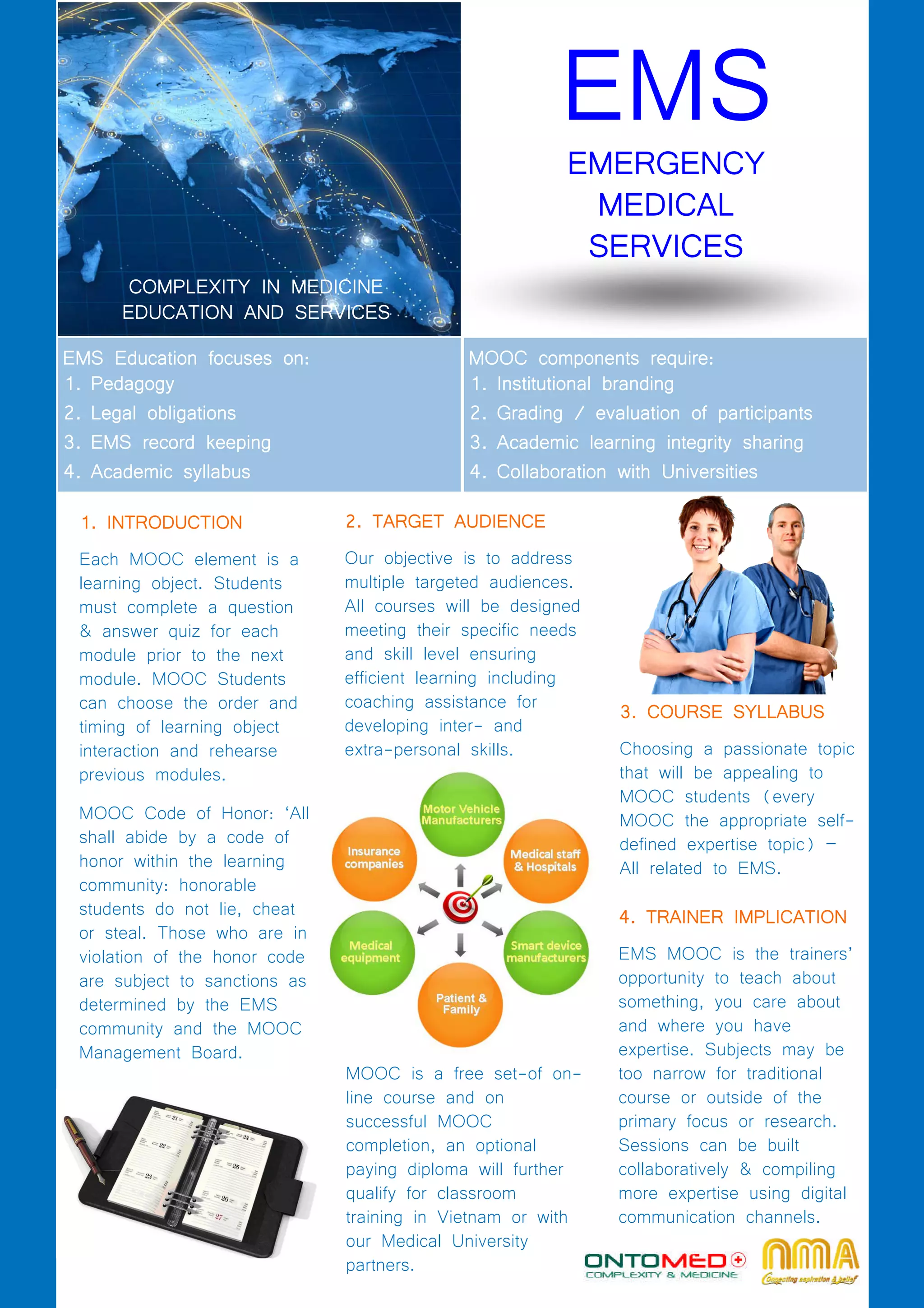
EMS Education focuses on:
1. Pedagogy
2. Legal obligations
3. EMS record keeping
4. Academic syllabus
1. INTRODUCTION
Each MOOC element is a
learning object. Students
must complete a question
& answer quiz for each
module prior to the next
module. MOOC Students
can choose the order and
timing of learning object
interaction and rehearse
previous modules.
MOOC Code of Honor: ‘All
shall abide by a code of
honor within the learning
community: honorable
students do not lie, cheat
or steal. Those who are in
violation of the honor code
are subject to sanctions as
determined by the EMS
community and the MOOC
Management Board.
3. COURSE SYLLABUS
Choosing a passionate topic
that will be appealing to
MOOC students (every
MOOC the appropriate self-
defined expertise topic) –
All related to EMS.
4. TRAINER IMPLICATION
EMS MOOC is the trainers’
opportunity to teach about
something, you care about
and where you have
expertise. Subjects may be
too narrow for traditional
course or outside of the
primary focus or research.
Sessions can be built
collaboratively & compiling
more expertise using digital
communication channels.
MOOC is a free set-of on-
line course and on
successful MOOC
completion, an optional
paying diploma will further
qualify for classroom
training in Vietnam or with
our Medical University
partners.
MOOC components require:
1. Institutional branding
2. Grading / evaluation of participants
3. Academic learning integrity sharing
4. Collaboration with Universities
2. TARGET AUDIENCE
Our objective is to address
multiple targeted audiences.
All courses will be designed
meeting their specific needs
and skill level ensuring
efficient learning including
coaching assistance for
developing inter- and
extra-personal skills.
EMERGENCY
MEDICAL
SERVICES
COMPLEXITY IN MEDICINE
EDUCATION AND SERVICES
5. TRAIN THE TRAINER
(TTT)
Building MOOC content
creation TTT teams – most
academic education faculties
are using a team approach
for design, development,
and delivery.
We will build a joint
business-academic-medical
experts team (TTT Group)
to work on the EMS
MOOC designs.
6. CONTENT IS “KING”
A requisite is to foster a
MOOC collaboration spirit
where students and medical
trainers co-develop “open
course content”.
Content improvement via
dynamic learning and feed-
back loops – where
“sharing is learning more
while taking less risks”
encourage a strong
awareness shared with all
EMS stakeholders.
7. Q&A EXCELLENCE
GOAL
Identifying a Q&A function
to test courses before
students take the program.
Even after official course
release a student-teacher
Designing MOOC training
demands familiarity with the
MOOC environment, how to
stimulate feedback and not
to discourage failure as a
fatal “flaw” of the student:
1. How to design the
course development
choreographic process
with feed-back loops.
2. Establishing learning
outcomes for the course
before we begin
selecting or creating
materials.
Our EMS Education Initiative program is the
logical extension of our EMS infrastructure.
An
Education & Training is short in supply in Lower
Middle Income Countries by reducing the EMS
Education gap to improve healthcare outcomes.
3. Design communication
plan and community
4. Development strategies
5. Create assessments for
a massive audience
6. Other considerations:
 Certification diploma
 OJT (On-the-Job
Training)
MOOC must discourage
contact by e-mail preferring
discussion forums and
social media platforms.
Furthermore the MOOC
team must monitor all
community activities and
have moderators responding
to all participants.
Therefore QCM analytics
must be applied to measure
community activity and
recommend appropriate
reactions.
As MOOC communities can
grow over time this is a
potentially time consuming
person-to-person (P2P)
communication activity.
Therefore, we must
encourage discussion and
social community
development between
students and trainers so as
to avoid occupying a
central course patriarch
expert “bottle neck”.
8. FUNDING &
SPONSORING
MOOC classes can be
delivered to students without
major financial investment
besides content creation
and quality review to
release.
7. SOCIAL NETWORKING
The process of MOOC and
content creation demands
e-business processes and
content management
principles to be applied
(c.f. ISO…) for which a
tool from Net Reporting
(one of the EMS Strategic
technology partners) will be
used.
Traditionally, education
courses follow the academic
calendar; however that is
not necessary for an EMS
MOOC curriculum.
Courses can begin and end
at any time. Currently,
there is no research into
the ideal length of a
MOOC, most durations are
between 4 and 8 weeks
long, some as long as 10
to 12 weeks, in that case
they are divided into Part 1
and Part 2 of the same
MOOC for instance.
Nghiem Minh Association (NMA), an
NGO specializing on education and
healthcare is retained for deployment
validation and market acceptance testing in
Vietnam prior to ASEAN and other
developing countries.
9. MOOC BUDGET
Most MOOC classes cost
estimates are USD 50.000
each from design to
delivery.
Intellectual property rights
must be protected which is
why content must come
from the field and from
people who work in EMS,
on live medical trauma
cases and academic
medical research.
Annual operating budget
estimate: 1M USD
 Producing 12 MOOC
Classes/ year.
 General Services and
Administration cost.
 Technical
infrastructure costs.
 Student’s grants.
EMS Education will exploit Massive, Open, Online Courses (MOOC) & hands
on medical training & workshops with local and foreign universities who have
chosen to cooperate as strategic education partners for the EMS Pilot Project
in Vietnam.
For more information, please contact:
Mr. Kevin Loc Tran, MBA
Vice President/CEO
Nghiem Minh Association
kevinloctran@nmavn.org
Class course coaches can
be located anywhere. Set-
up requires special
technology and additional
services, therefore funding
for development or delivery
is necessary as most cost
are related to human
capital investment.
Mr. Alexander Kopriwa
VP Global Business Development
ONTONIX Srl.
alexander@ontonix.com
Copyright 2015 Ontomed LLC. No part of this document may be reproduced in any form without the written permission of Ontomed LLC
ONTOMED LLC
1201 Orange Street, Suite 600 PO Box 511 - Wilmington, DE 19899-0511, USA
www.ontomeds.com
Strategic partners:
Legal advisors:
Member of WTS Network &
Lorenz & Partners group
ASSIST DEVELOPING NATIONS TO BENEFIT FROM MODERN EMS
EDUCATION OVER SMART CONNECTED DEVICES.
BEST EMS EDUCATION AT LEAST COST IS NOW POSSIBLE
Commercial sponsors

EMS Education 2015

  • 1.
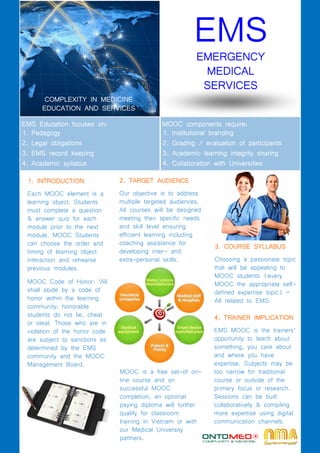
    EMS Education focuseson: 1. Pedagogy 2. Legal obligations 3. EMS record keeping 4. Academic syllabus 1. INTRODUCTION Each MOOC element is a learning object. Students must complete a question & answer quiz for each module prior to the next module. MOOC Students can choose the order and timing of learning object interaction and rehearse previous modules. MOOC Code of Honor: ‘All shall abide by a code of honor within the learning community: honorable students do not lie, cheat or steal. Those who are in violation of the honor code are subject to sanctions as determined by the EMS community and the MOOC Management Board. 3. COURSE SYLLABUS Choosing a passionate topic that will be appealing to MOOC students (every MOOC the appropriate self- defined expertise topic) – All related to EMS. 4. TRAINER IMPLICATION EMS MOOC is the trainers’ opportunity to teach about something, you care about and where you have expertise. Subjects may be too narrow for traditional course or outside of the primary focus or research. Sessions can be built collaboratively & compiling more expertise using digital communication channels. MOOC is a free set-of on- line course and on successful MOOC completion, an optional paying diploma will further qualify for classroom training in Vietnam or with our Medical University partners. MOOC components require: 1. Institutional branding 2. Grading / evaluation of participants 3. Academic learning integrity sharing 4. Collaboration with Universities 2. TARGET AUDIENCE Our objective is to address multiple targeted audiences. All courses will be designed meeting their specific needs and skill level ensuring efficient learning including coaching assistance for developing inter- and extra-personal skills. EMERGENCY MEDICAL SERVICES COMPLEXITY IN MEDICINE EDUCATION AND SERVICES
  • 2.
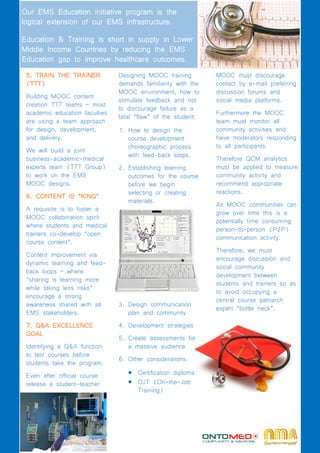
    5. TRAIN THETRAINER (TTT) Building MOOC content creation TTT teams – most academic education faculties are using a team approach for design, development, and delivery. We will build a joint business-academic-medical experts team (TTT Group) to work on the EMS MOOC designs. 6. CONTENT IS “KING” A requisite is to foster a MOOC collaboration spirit where students and medical trainers co-develop “open course content”. Content improvement via dynamic learning and feed- back loops – where “sharing is learning more while taking less risks” encourage a strong awareness shared with all EMS stakeholders. 7. Q&A EXCELLENCE GOAL Identifying a Q&A function to test courses before students take the program. Even after official course release a student-teacher Designing MOOC training demands familiarity with the MOOC environment, how to stimulate feedback and not to discourage failure as a fatal “flaw” of the student: 1. How to design the course development choreographic process with feed-back loops. 2. Establishing learning outcomes for the course before we begin selecting or creating materials. Our EMS Education Initiative program is the logical extension of our EMS infrastructure. An Education & Training is short in supply in Lower Middle Income Countries by reducing the EMS Education gap to improve healthcare outcomes. 3. Design communication plan and community 4. Development strategies 5. Create assessments for a massive audience 6. Other considerations:  Certification diploma  OJT (On-the-Job Training) MOOC must discourage contact by e-mail preferring discussion forums and social media platforms. Furthermore the MOOC team must monitor all community activities and have moderators responding to all participants. Therefore QCM analytics must be applied to measure community activity and recommend appropriate reactions. As MOOC communities can grow over time this is a potentially time consuming person-to-person (P2P) communication activity. Therefore, we must encourage discussion and social community development between students and trainers so as to avoid occupying a central course patriarch expert “bottle neck”.
  • 3.
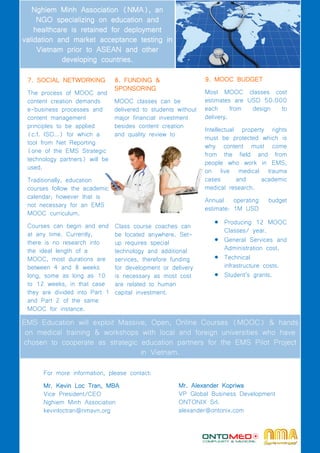
    8. FUNDING & SPONSORING MOOCclasses can be delivered to students without major financial investment besides content creation and quality review to release. 7. SOCIAL NETWORKING The process of MOOC and content creation demands e-business processes and content management principles to be applied (c.f. ISO…) for which a tool from Net Reporting (one of the EMS Strategic technology partners) will be used. Traditionally, education courses follow the academic calendar; however that is not necessary for an EMS MOOC curriculum. Courses can begin and end at any time. Currently, there is no research into the ideal length of a MOOC, most durations are between 4 and 8 weeks long, some as long as 10 to 12 weeks, in that case they are divided into Part 1 and Part 2 of the same MOOC for instance. Nghiem Minh Association (NMA), an NGO specializing on education and healthcare is retained for deployment validation and market acceptance testing in Vietnam prior to ASEAN and other developing countries. 9. MOOC BUDGET Most MOOC classes cost estimates are USD 50.000 each from design to delivery. Intellectual property rights must be protected which is why content must come from the field and from people who work in EMS, on live medical trauma cases and academic medical research. Annual operating budget estimate: 1M USD  Producing 12 MOOC Classes/ year.  General Services and Administration cost.  Technical infrastructure costs.  Student’s grants. EMS Education will exploit Massive, Open, Online Courses (MOOC) & hands on medical training & workshops with local and foreign universities who have chosen to cooperate as strategic education partners for the EMS Pilot Project in Vietnam. For more information, please contact: Mr. Kevin Loc Tran, MBA Vice President/CEO Nghiem Minh Association kevinloctran@nmavn.org Class course coaches can be located anywhere. Set- up requires special technology and additional services, therefore funding for development or delivery is necessary as most cost are related to human capital investment. Mr. Alexander Kopriwa VP Global Business Development ONTONIX Srl. alexander@ontonix.com
  • 4.
    Copyright 2015 OntomedLLC. No part of this document may be reproduced in any form without the written permission of Ontomed LLC ONTOMED LLC 1201 Orange Street, Suite 600 PO Box 511 - Wilmington, DE 19899-0511, USA www.ontomeds.com Strategic partners: Legal advisors: Member of WTS Network & Lorenz & Partners group ASSIST DEVELOPING NATIONS TO BENEFIT FROM MODERN EMS EDUCATION OVER SMART CONNECTED DEVICES. BEST EMS EDUCATION AT LEAST COST IS NOW POSSIBLE Commercial sponsors