Health IT Programmes – lifting
performance across the sector
Graeme Osborne
Health IT Programme 2015 – 2020
A uniform, standards-based,
health information environment
for New Zealanders
Update from the National Health IT Board
Chair, Dr Murray Milner
Director, Graeme Osborne
20 October 2015
Community
ePrescribing
and Aged Care
eSchedules
Patient Portal
‘….approaching
100,000
consumers’
Transformational
Shared Care
Plans
20,000+
electronic plans
National
Infrastructure
Platform (NIP)
Sustainable
Maternity
5 DHBs ‘Live’
Comprehensive
Assessments
(interRAI)
30,000+
Hospital
ePrescribing
5 DHBs ‘Live’
Professional
Clinical
Workstation &
Legacy PAS
Clinical
Data
Repository
Clinical
Data
Repository
Clinical
Data
Repository
Clinical
Data
Repository
P
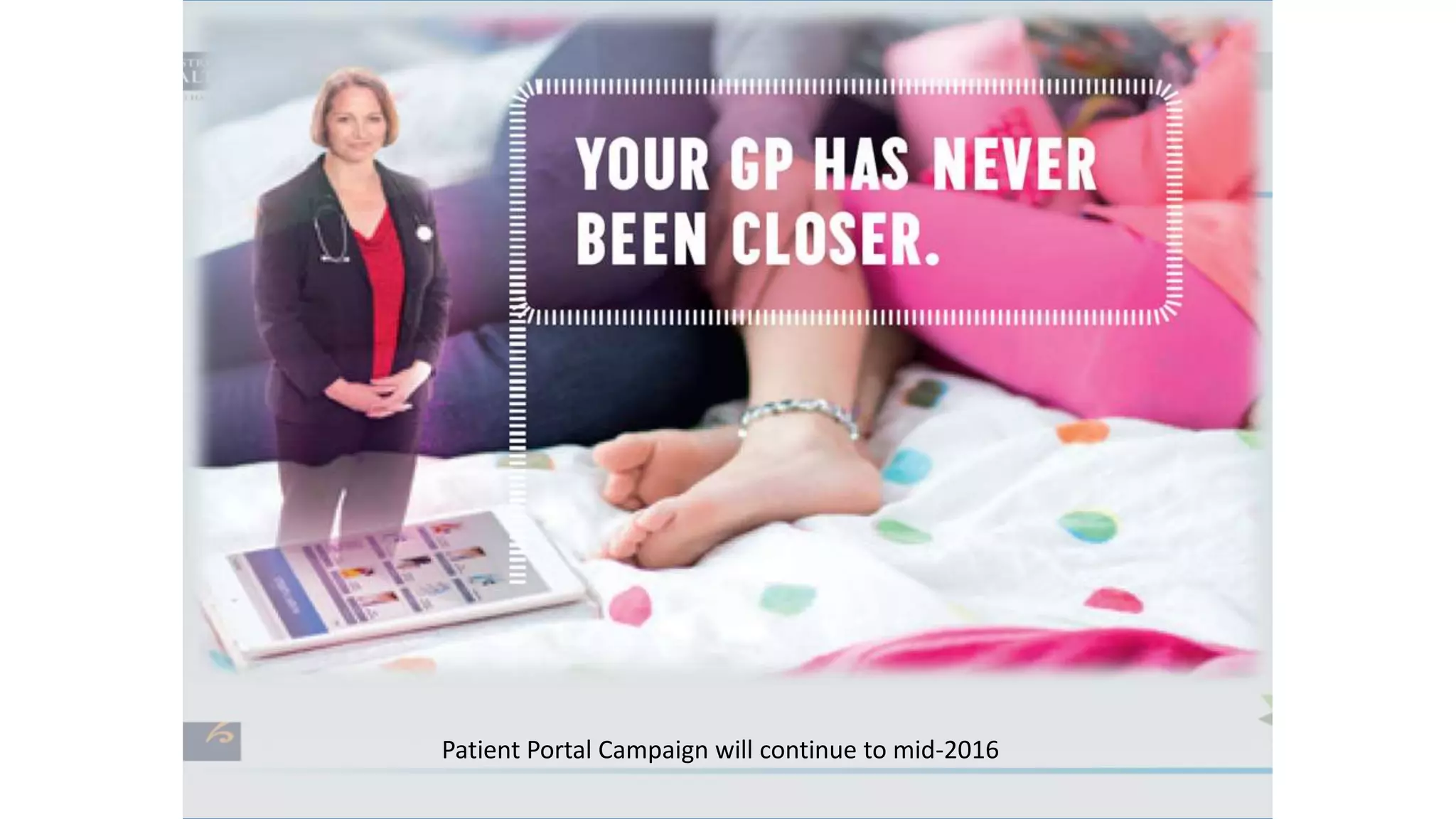
Patient Portal Campaign will continue to mid-2016
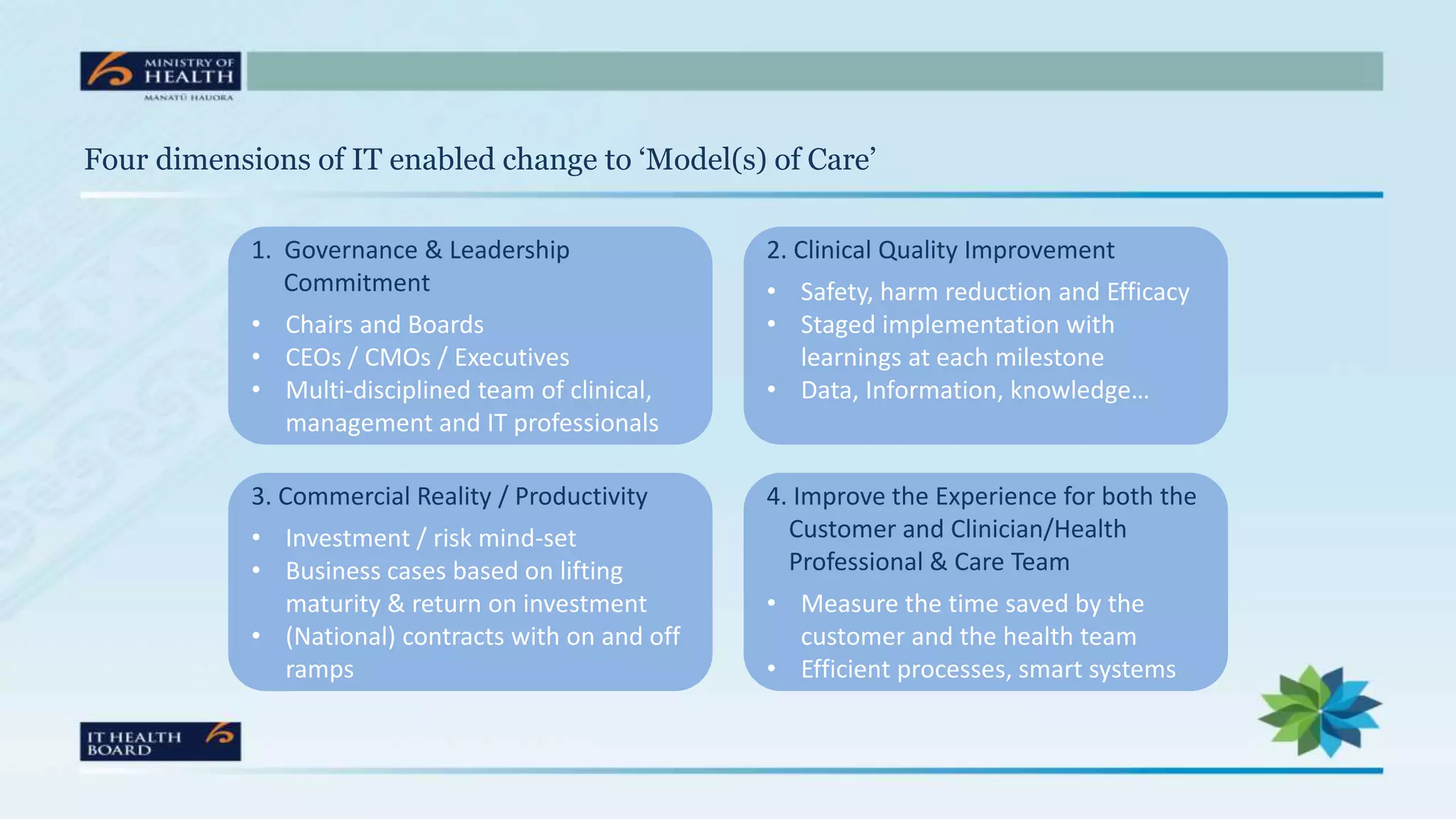
Four dimensions of IT enabled change to ‘Model(s) of Care’
3. Commercial Reality / Productivity
• Investment / risk mind-set
• Business cases based on lifting
maturity & return on investment
• (National) contracts with on and off
ramps
4. Improve the Experience for both the
Customer and Clinician/Health
Professional & Care Team
• Measure the time saved by the
customer and the health team
• Efficient processes, smart systems
1. Governance & Leadership
Commitment
• Chairs and Boards
• CEOs / CMOs / Executives
• Multi-disciplined team of clinical,
management and IT professionals
2. Clinical Quality Improvement
• Safety, harm reduction and Efficacy
• Staged implementation with
learnings at each milestone
• Data, Information, knowledge…
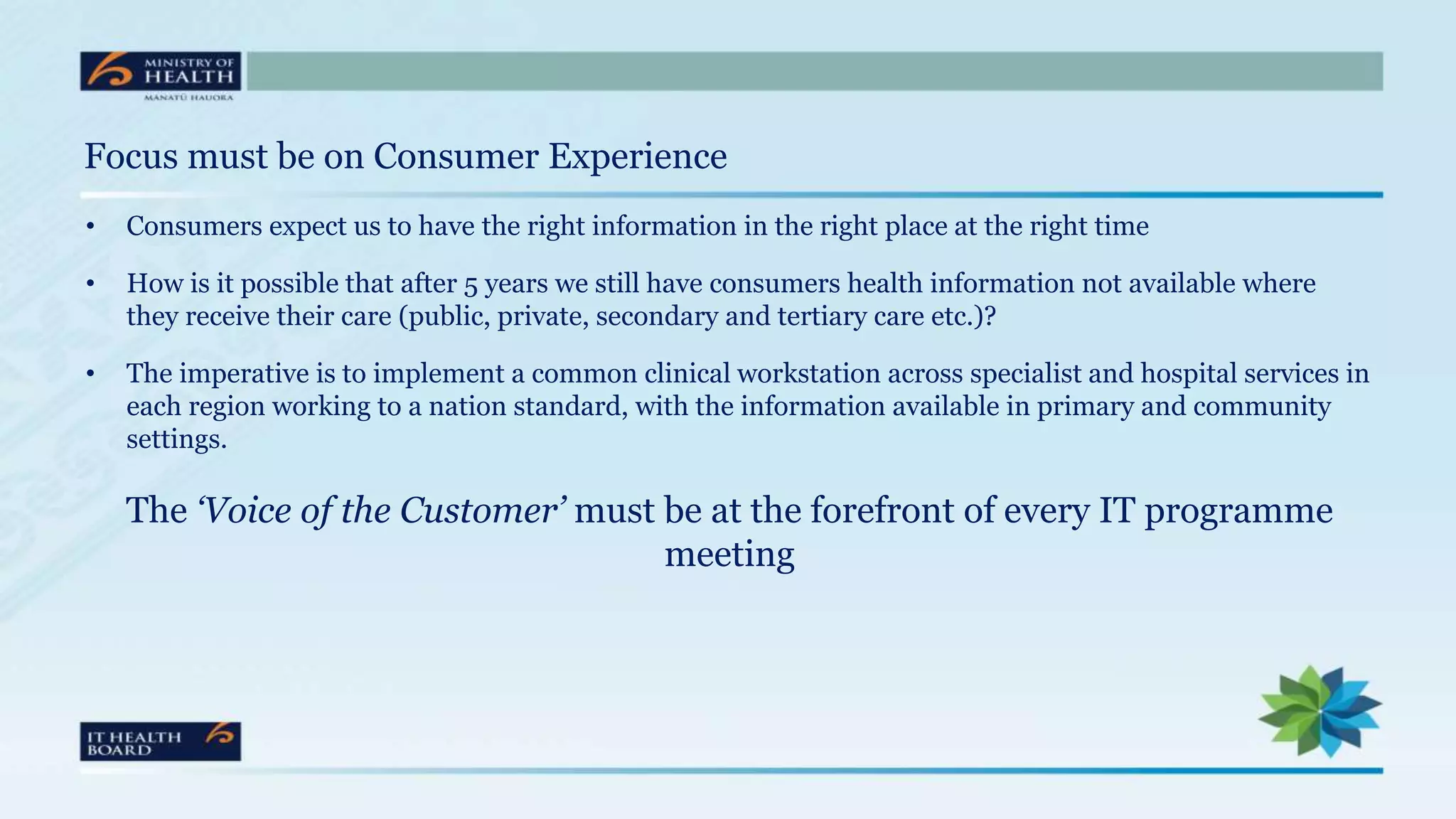
Focus must be on Consumer Experience
• Consumers expect us to have the right information in the right place at the right time
• How is it possible that after 5 years we still have consumers health information not available where
they receive their care (public, private, secondary and tertiary care etc.)?
• The imperative is to implement a common clinical workstation across specialist and hospital services in
each region working to a nation standard, with the information available in primary and community
settings.
The ‘Voice of the Customer’ must be at the forefront of every IT programme
meeting
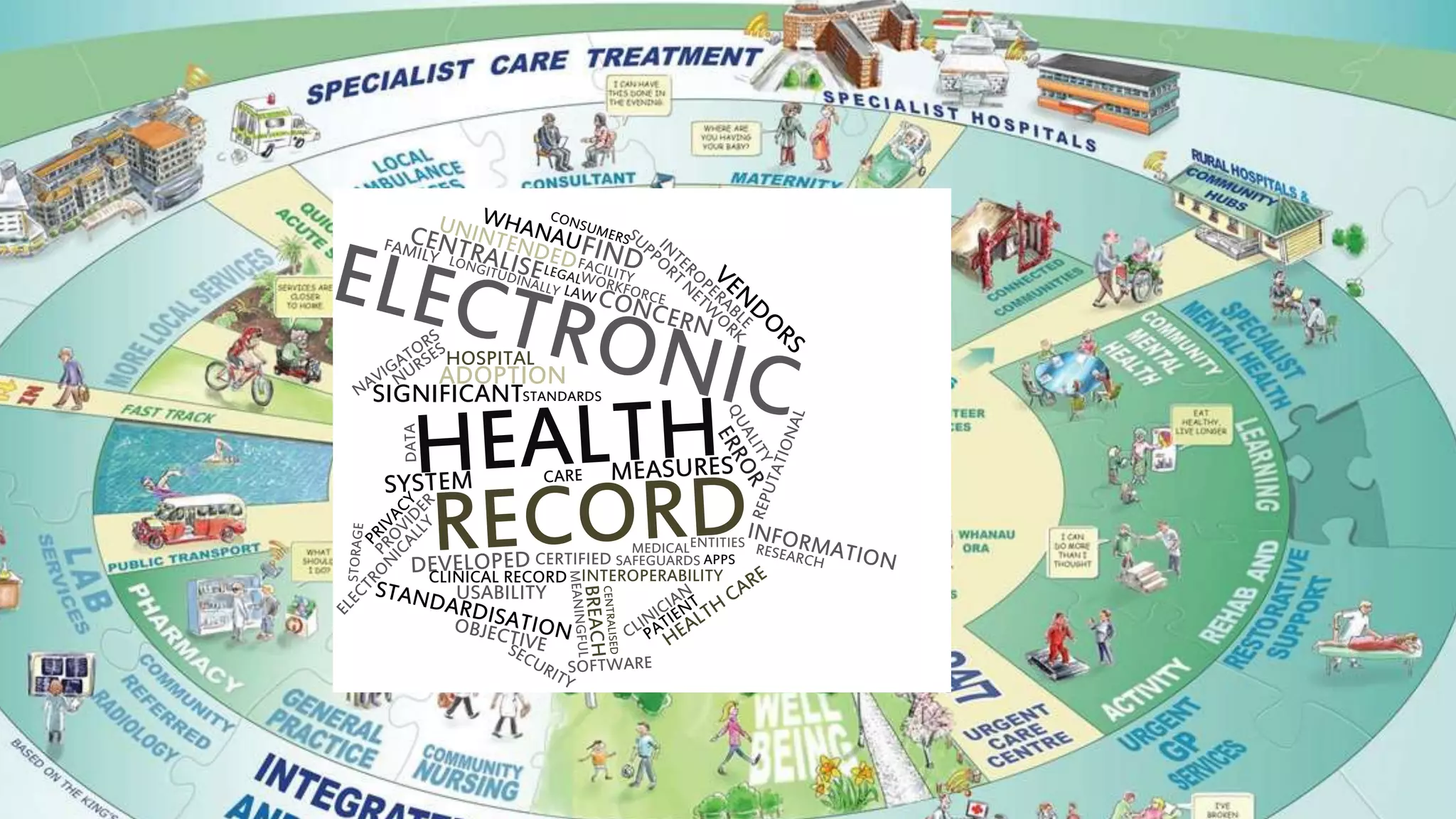
HOSPITAL
ADOPTION
SIGNIFICANTSTANDARDS
CLINICAL RECORD
USABILITY
CERTIFIED
INTEROPERABILITY
SAFEGUARDS
MEDICALENTITIES
APPS
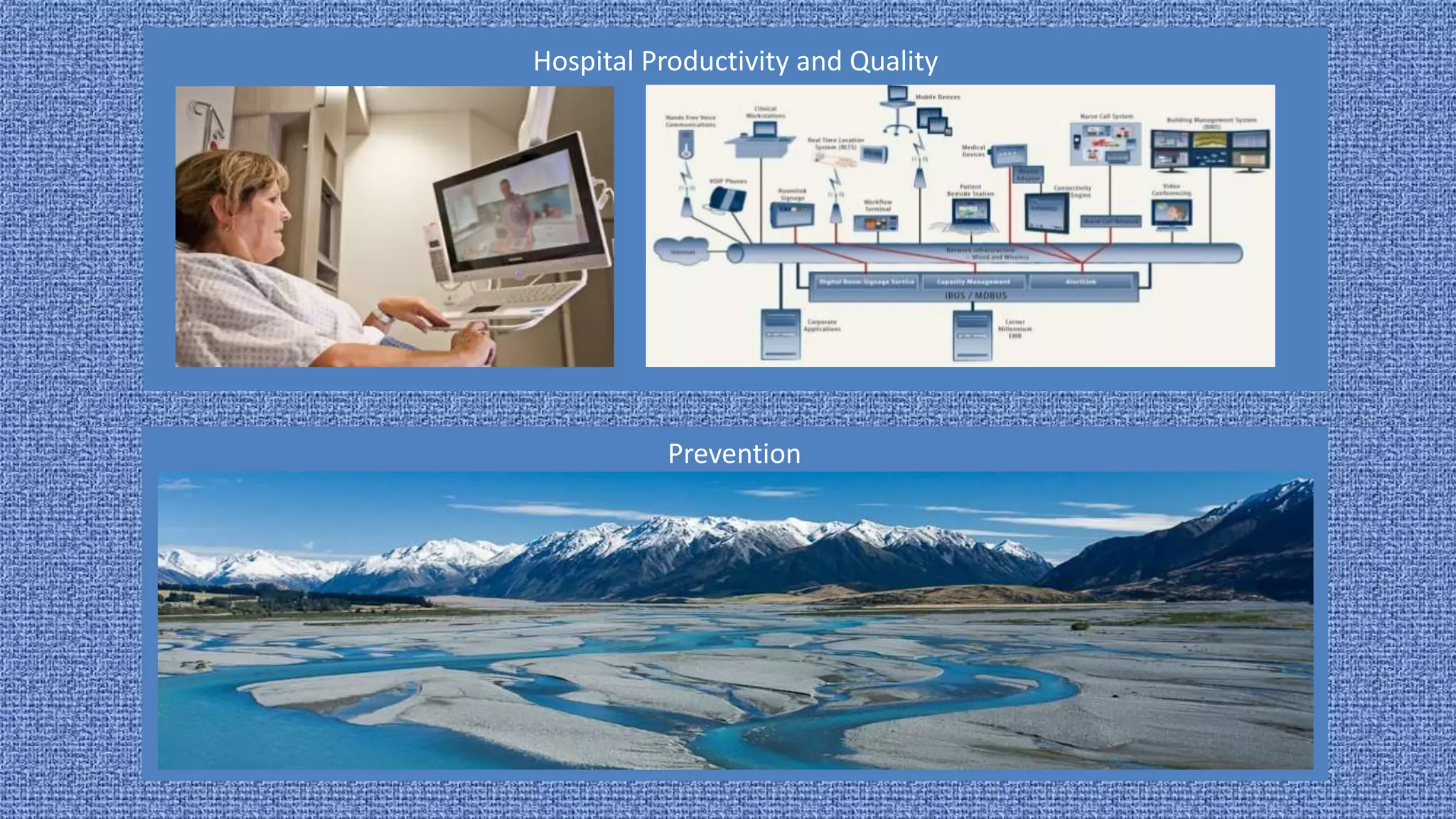
Hospital Productivity and Quality
Prevention
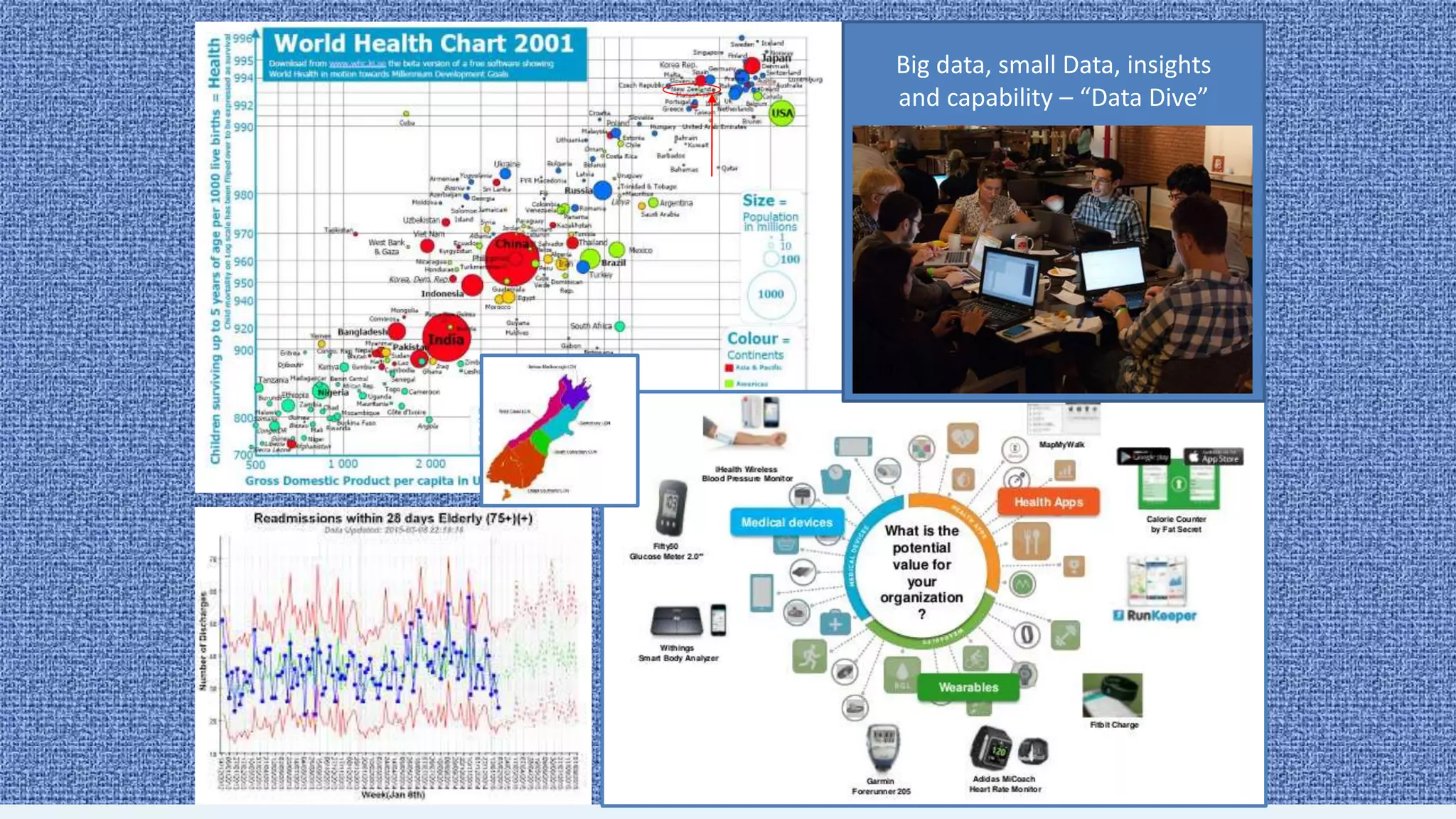
Big data, small Data, insights
and capability – “Data Dive”
Health IT Programme 2015 - 2020
The work programme for health IT over the next 5 years is focused on four inter-related areas:
1. Single EHR
• Establishing a single longitudinal electronic health record for New Zealanders (single
EHR).
2. Digital Hospital ‘Blueprint’
• Creating a common hospital (and specialist) digital hospital ‘blueprint’
• Measuring all hospitals and specialist services against the HIMSS EMR Maturity Model.
Health IT Programme 2015 - 2020
The work programme for health IT over the next 5 years is focused on
four inter-related areas:
3. IT Prevention Platform
• Take the opportunity to design and implement a common IT prevention
platform as reinvestment in immunisation and screening systems occur
to support government priorities.
4. Data to support Health and Social Investments
• Create a health and wellness dataset to support government, health care
organisations and individuals to make evidence based decisions
• Build the capability of, and networks for, researchers, analysts and other
health informatics professionals.
Health IT Programme 2015 - 2020
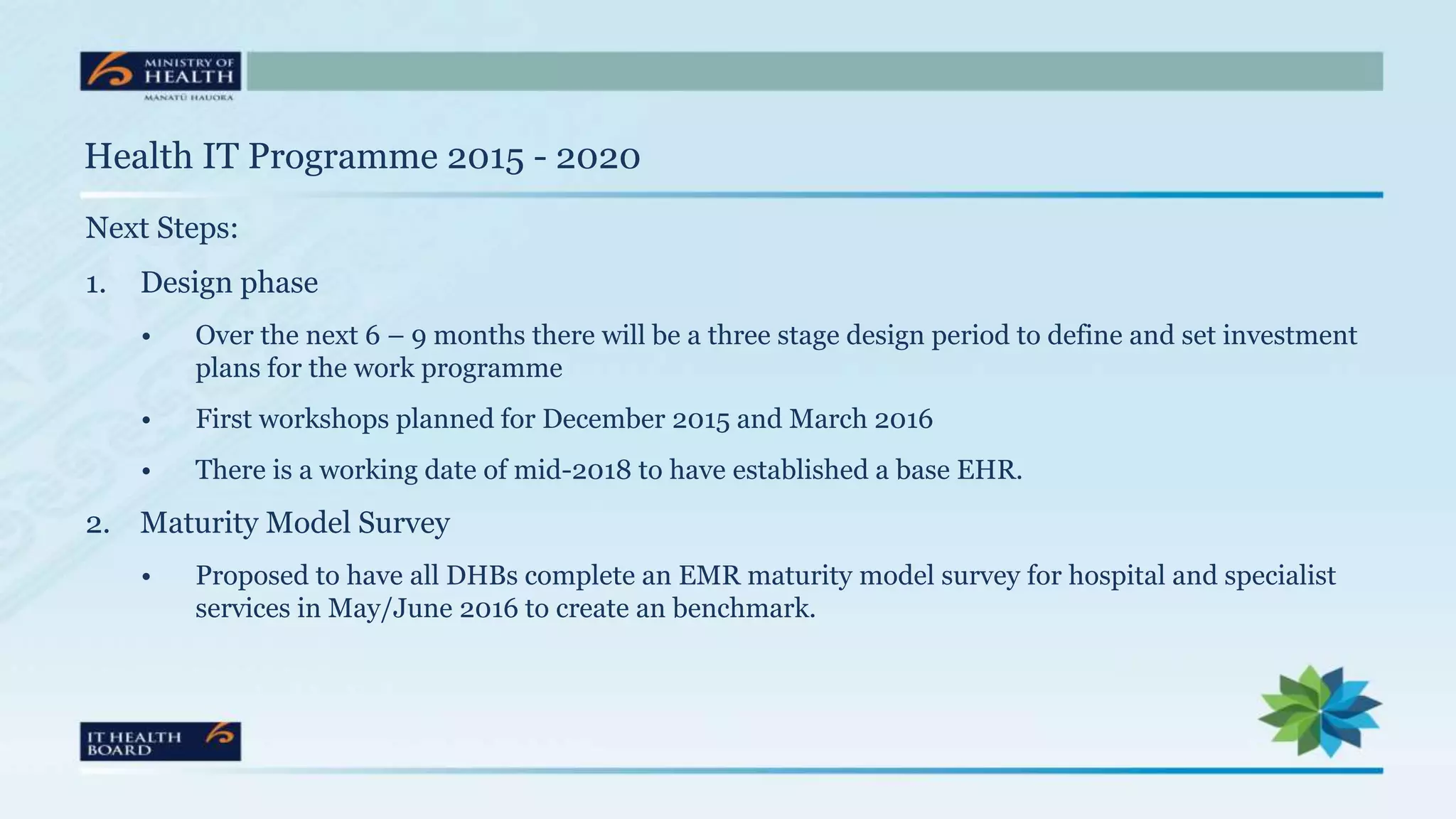
Next Steps:
1. Design phase
• Over the next 6 – 9 months there will be a three stage design period to define and set investment
plans for the work programme
• First workshops planned for December 2015 and March 2016
• There is a working date of mid-2018 to have established a base EHR.
2. Maturity Model Survey
• Proposed to have all DHBs complete an EMR maturity model survey for hospital and specialist
services in May/June 2016 to create an benchmark.
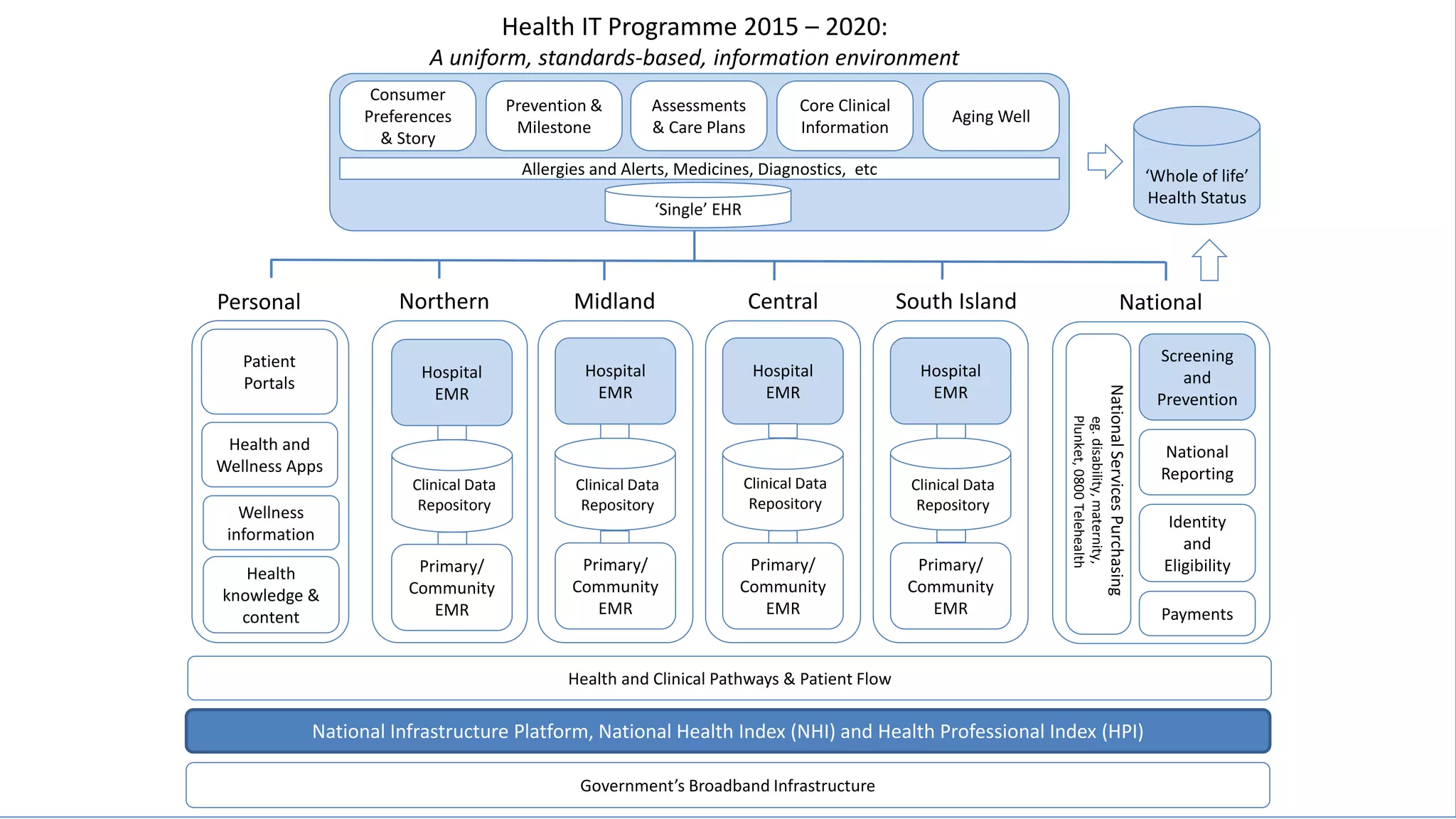
‘Single’ EHR
Allergies and Alerts, Medicines, Diagnostics, etc
Consumer
Preferences
& Story
Prevention &
Milestone
Assessments
& Care Plans
Core Clinical
Information
Aging Well
Government’s Broadband Infrastructure
National Infrastructure Platform, National Health Index (NHI) and Health Professional Index (HPI)
Health IT Programme 2015 – 2020:
A uniform, standards-based, information environment
Personal
Patient
Portals
Health
knowledge &
content
Health and
Wellness Apps
Wellness
information
‘Whole of life’
Health Status
National
Payments
Screening
and
Prevention
Identity
and
Eligibility
National
Reporting
NationalServicesPurchasing
eg.disability,maternity,
Plunket,0800Telehealth
Hospital
EMR
Hospital
EMR
Primary/
Community
EMR
Primary/
Community
EMR
Primary/
Community
EMR
Primary/
Community
EMR
Hospital
EMR
Northern Midland Central South Island
Clinical Data
Repository
Clinical Data
Repository
Clinical Data
Repository
Clinical Data
Repository
Hospital
EMR
Health and Clinical Pathways & Patient Flow
Health IT Programme 2015 – 2020
A uniform, standards-based,
health information environment
for New Zealanders
Questions?
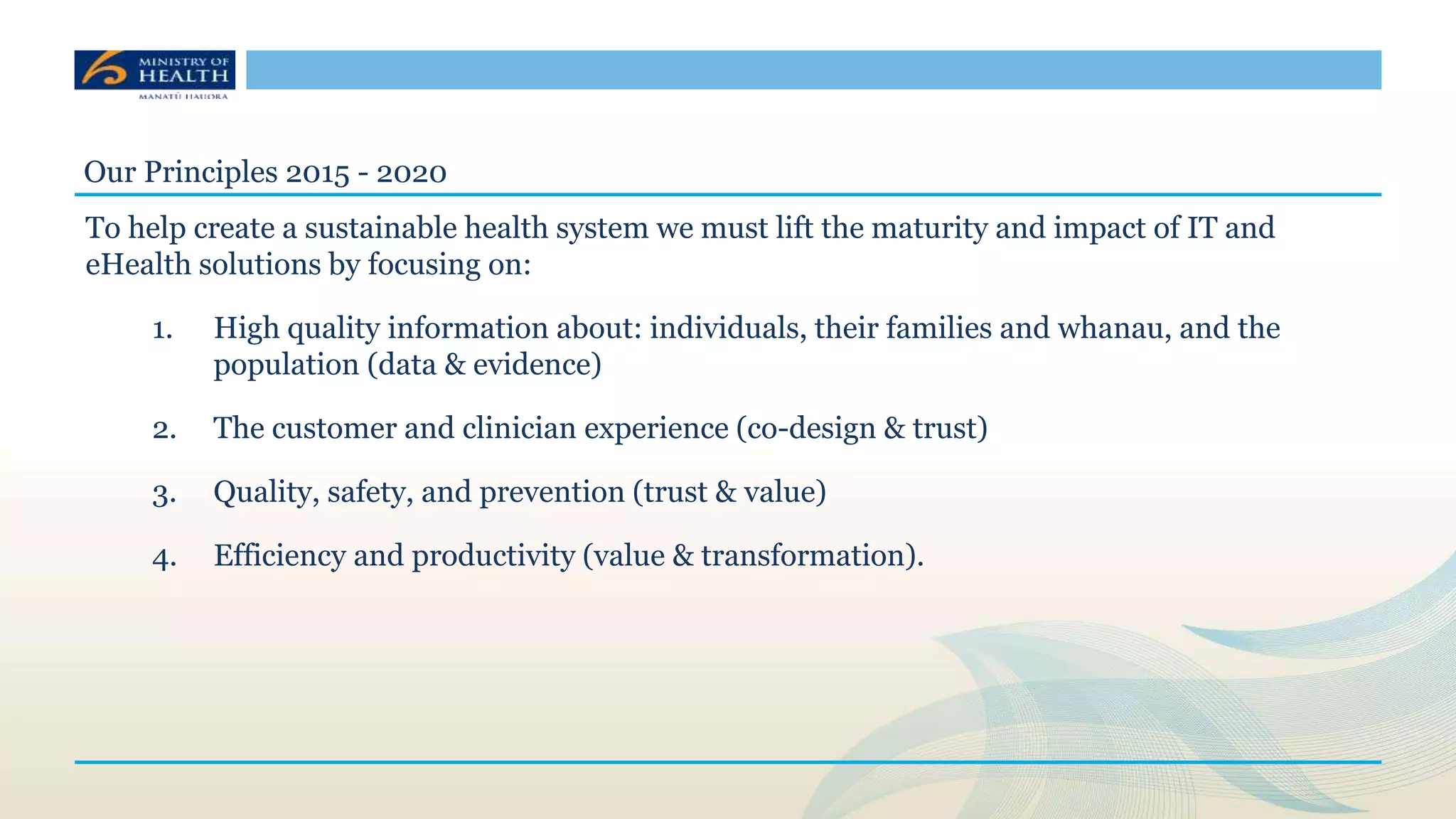
Our Principles 2015 - 2020
To help create a sustainable health system we must lift the maturity and impact of IT and
eHealth solutions by focusing on:
1. High quality information about: individuals, their families and whanau, and the
population (data & evidence)
2. The customer and clinician experience (co-design & trust)
3. Quality, safety, and prevention (trust & value)
4. Efficiency and productivity (value & transformation).
Health IT Programmes - lifting performance across the sector

Health IT Programmes - lifting performance across the sector

  • 2.
    Health IT Programmes– lifting performance across the sector Graeme Osborne
  • 3.
    Health IT Programme2015 – 2020 A uniform, standards-based, health information environment for New Zealanders Update from the National Health IT Board Chair, Dr Murray Milner Director, Graeme Osborne 20 October 2015
  • 4.
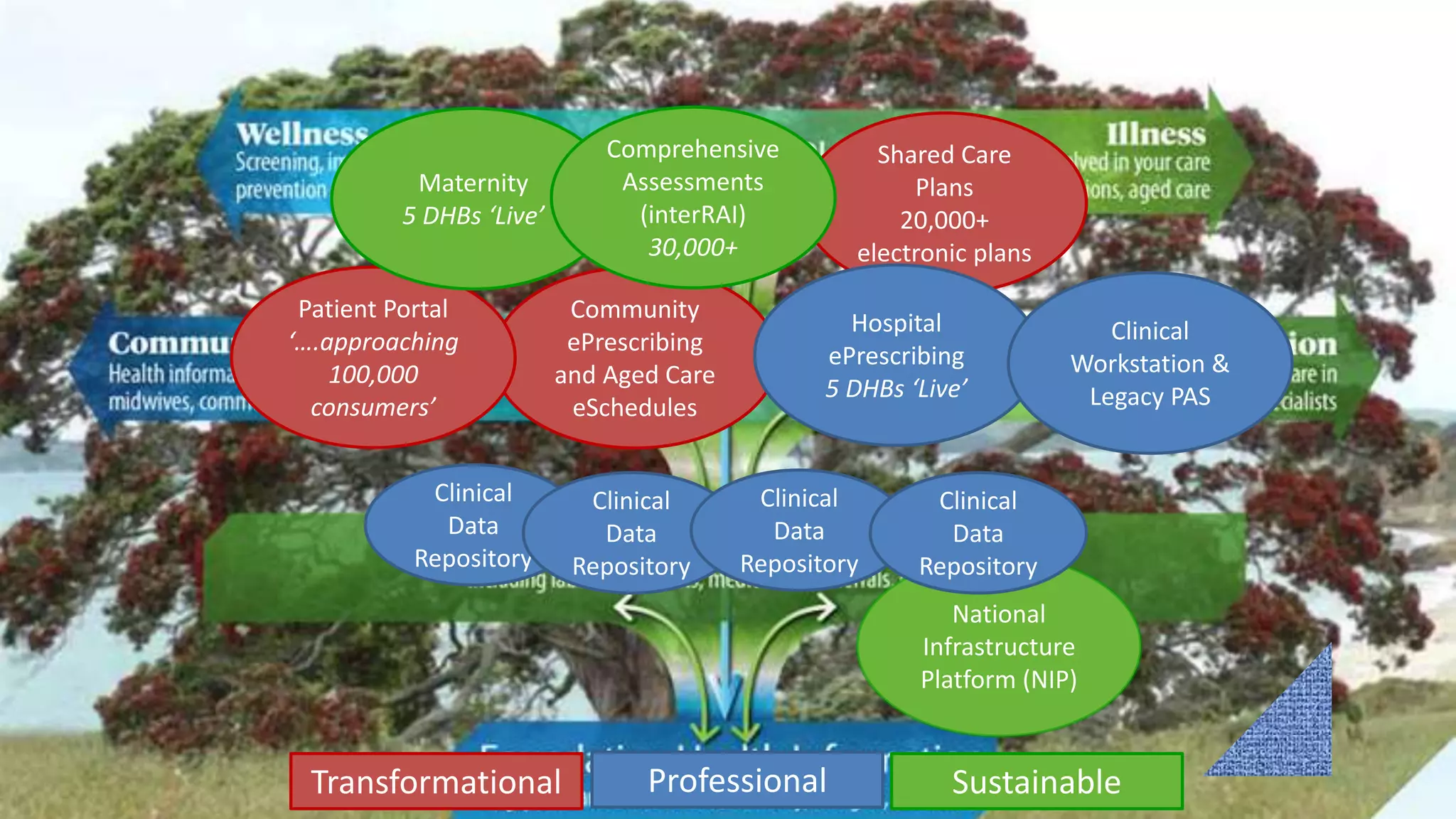
    Community ePrescribing and Aged Care eSchedules PatientPortal ‘….approaching 100,000 consumers’ Transformational Shared Care Plans 20,000+ electronic plans National Infrastructure Platform (NIP) Sustainable Maternity 5 DHBs ‘Live’ Comprehensive Assessments (interRAI) 30,000+ Hospital ePrescribing 5 DHBs ‘Live’ Professional Clinical Workstation & Legacy PAS Clinical Data Repository Clinical Data Repository Clinical Data Repository Clinical Data Repository
  • 5.
    P Patient Portal Campaignwill continue to mid-2016
  • 6.
    Four dimensions ofIT enabled change to ‘Model(s) of Care’ 3. Commercial Reality / Productivity • Investment / risk mind-set • Business cases based on lifting maturity & return on investment • (National) contracts with on and off ramps 4. Improve the Experience for both the Customer and Clinician/Health Professional & Care Team • Measure the time saved by the customer and the health team • Efficient processes, smart systems 1. Governance & Leadership Commitment • Chairs and Boards • CEOs / CMOs / Executives • Multi-disciplined team of clinical, management and IT professionals 2. Clinical Quality Improvement • Safety, harm reduction and Efficacy • Staged implementation with learnings at each milestone • Data, Information, knowledge…
  • 7.
    Focus must beon Consumer Experience • Consumers expect us to have the right information in the right place at the right time • How is it possible that after 5 years we still have consumers health information not available where they receive their care (public, private, secondary and tertiary care etc.)? • The imperative is to implement a common clinical workstation across specialist and hospital services in each region working to a nation standard, with the information available in primary and community settings. The ‘Voice of the Customer’ must be at the forefront of every IT programme meeting
  • 8.
  • 9.
    Hospital Productivity andQuality Prevention
  • 10.
    Big data, smallData, insights and capability – “Data Dive”
  • 11.
    Health IT Programme2015 - 2020 The work programme for health IT over the next 5 years is focused on four inter-related areas: 1. Single EHR • Establishing a single longitudinal electronic health record for New Zealanders (single EHR). 2. Digital Hospital ‘Blueprint’ • Creating a common hospital (and specialist) digital hospital ‘blueprint’ • Measuring all hospitals and specialist services against the HIMSS EMR Maturity Model.
  • 12.
    Health IT Programme2015 - 2020 The work programme for health IT over the next 5 years is focused on four inter-related areas: 3. IT Prevention Platform • Take the opportunity to design and implement a common IT prevention platform as reinvestment in immunisation and screening systems occur to support government priorities. 4. Data to support Health and Social Investments • Create a health and wellness dataset to support government, health care organisations and individuals to make evidence based decisions • Build the capability of, and networks for, researchers, analysts and other health informatics professionals.
  • 13.
    Health IT Programme2015 - 2020 Next Steps: 1. Design phase • Over the next 6 – 9 months there will be a three stage design period to define and set investment plans for the work programme • First workshops planned for December 2015 and March 2016 • There is a working date of mid-2018 to have established a base EHR. 2. Maturity Model Survey • Proposed to have all DHBs complete an EMR maturity model survey for hospital and specialist services in May/June 2016 to create an benchmark.
  • 14.
    ‘Single’ EHR Allergies andAlerts, Medicines, Diagnostics, etc Consumer Preferences & Story Prevention & Milestone Assessments & Care Plans Core Clinical Information Aging Well Government’s Broadband Infrastructure National Infrastructure Platform, National Health Index (NHI) and Health Professional Index (HPI) Health IT Programme 2015 – 2020: A uniform, standards-based, information environment Personal Patient Portals Health knowledge & content Health and Wellness Apps Wellness information ‘Whole of life’ Health Status National Payments Screening and Prevention Identity and Eligibility National Reporting NationalServicesPurchasing eg.disability,maternity, Plunket,0800Telehealth Hospital EMR Hospital EMR Primary/ Community EMR Primary/ Community EMR Primary/ Community EMR Primary/ Community EMR Hospital EMR Northern Midland Central South Island Clinical Data Repository Clinical Data Repository Clinical Data Repository Clinical Data Repository Hospital EMR Health and Clinical Pathways & Patient Flow
  • 15.
    Health IT Programme2015 – 2020 A uniform, standards-based, health information environment for New Zealanders Questions?
  • 16.
    Our Principles 2015- 2020 To help create a sustainable health system we must lift the maturity and impact of IT and eHealth solutions by focusing on: 1. High quality information about: individuals, their families and whanau, and the population (data & evidence) 2. The customer and clinician experience (co-design & trust) 3. Quality, safety, and prevention (trust & value) 4. Efficiency and productivity (value & transformation).

Editor's Notes

  • #4 Thank you to the Minister for a fine speech, you have certainly set the IT Board and the Sector some tough challenges. While we have a come a long way over the last 5 years, to meet the requirements of the NZ Health Strategy, we are going to need to make a step change. It is exactly 5 years from when the inaugural National Health IT Plan was officially launched. It is important to reflect on how far we have come over that period and I will cover some key points of progress soon. Before I do, and following on from the Ministers challenges, the sector is at a pivotal point. While we have made real progress over the last period, in the next 5 years we need to take deliberate steps to create a uniform, standards-based health information environment that the Minister and many us aspire to. One based on maturity models and real impact on the bottom line, so we can measure progress to making the System more sustainable overall. After reviewing our progress, I will be sharing the factors that the IT Board will be reviewing in future health IT business cases. I will also share a new set of principles to underpin the next 5 year period. Graeme will then cover more detail about the Health IT Programme 2015 – 2020. The next 5 years will be an exciting time. We are moving away from a plan to an integrated programme of Health IT Investments.
  • #5 You will be pleased to know we are staying with the tree over the next 5 years. We believe it still represents the right end point to aim for…. Before I do I would like to congratulate St Johns on starting the roll out of their ePRF mobile/ambulance based electronic record solution. I will be watching with interest as this solution rolls out linked to GPs, Hospitals and the new 0800 Health Line. The highlights from the last period start with DHB lead investments. There are clinical data repository solutions in place or close to deployment in all four regions. Hospital eprescribing is now in 5 DHBs, with South Canterbury implementing across over 100 beds in 2 weeks. Now that sets a challenge for DHBs who have not yet moved on eprescribing. Clinical workstations and legacy PAS’ are finally getting addressed – we must continue this important work. Every Nzer over 65 years who requires home help or residential care now completes a comprehensive clinical assessment – over 30,ooo at last count. The national Maternity system is live in 5 DHBs. This system will go through a consolidation period for 6 months before further rollout from Mid 2016. There are over 20,000 electronic shared care plans in action with multidiscipline care teams working together transparently. And finally, the patient portal campaign is gaining real moment with over 280 General Practices offering patient portal experiences for almost 100,000 consumers.
  • #6 I mentioned the Patient Portal campaign. Consumers and general practitioners are being encouraged to take up patient portals. There are real benefits for consumers and improving the working of the general practice. A session on this topic is on tomorrow morning if people are interested in understanding more about the approach and the benefits that are accruing to the general practice teams.
  • #7 So what is going to be different moving forward. Well, firstly, we are going to be more deliberate in achieving a well engineered health information environment. As recommended in the independent report from Deloitte, there will be more design-thinking put in up front, with the outcome being a more uniform set of integrated health information solutions. The Minister wants to see greater team work and that starts from the very top. Chairs and Boards needs to commit to achieving a common health information platform across their region connected real time with the national systems. They must insure that their DHBs do not opt-out either directly or indirectly. The deliver of health and wellness services requires an ongoing focus on continuous quality improvement, and when IT systems are implemented they must be safe, evidence based, and create an data set as a by-product that is valuable for further quality analysis. The third area is about the financial impact. We cannot ask executives to invest in IT solutions without a line of sight to the bottom line benefits. And finally, business cases must explain what the outcome is going to be from the customers point of view and from the clinicians / health professionals point of view. Both groups need to see the benefit of IT enabled change. They need this information as we require them to invest their valuable time and effort to change their practices. We need to be generous explaining what the benefits will be and when.
  • #8 In other Boards I am a member, it is unacceptable to cause employees or customers harm. There new health and safety legislation is unequivocal. How is it possible we are allowing clinicians to practice without access to health information captured in another part of the health system? There is no excuse, customer expect their information to be shared.
  • #9 The key finding of the Deloittes report was that there is real benefits from having a longitudinal record over the lifetime of a consumer.
  • #10 Hospitals and specialist services are still where the majority of expenditure is consumed. It is important to ensure that these services are efficient and effective. There is an opportunity to benchmark against international best practice.
  • #11 We need to lift our capability to use data on real cases to build better evidence of what is happening in our health system, what is working and what needs to be improved. Information needs to be the underpinning of a health App strategy.
  • #17 To reinforce those factors the IT Board has committed to a revised set of principles as follows. In short it is about the data, the customer and clinical experience, a focus on quality, safety and continuous improvement, and finally we need to have an impact on the bottom line. I wish you well as you complete your current projects and engage on new investment challenges.