Employment equity encourages the establishment of working
conditions that are free of barriers, corrects the conditions of
disadvantage in employment and promotes the principle that
employment equity requires special measures and the accommodation
of differences for the designated groups in South Africa.
Submission of Employment Equity reports and related record keeping
is done to:
•Avoid huge fines for non-compliance (ranging between 2% and 10% of
the company’s annual turnover or from 1.5 million to 2.7 million)
•Up to R30 000 fines for responsible person – HR Manager/EE Manager
•Ensure points on BBBEE (Black Based Broad Economic
Empowerment) scorecard for Employment Equity as well as
Management and Control.
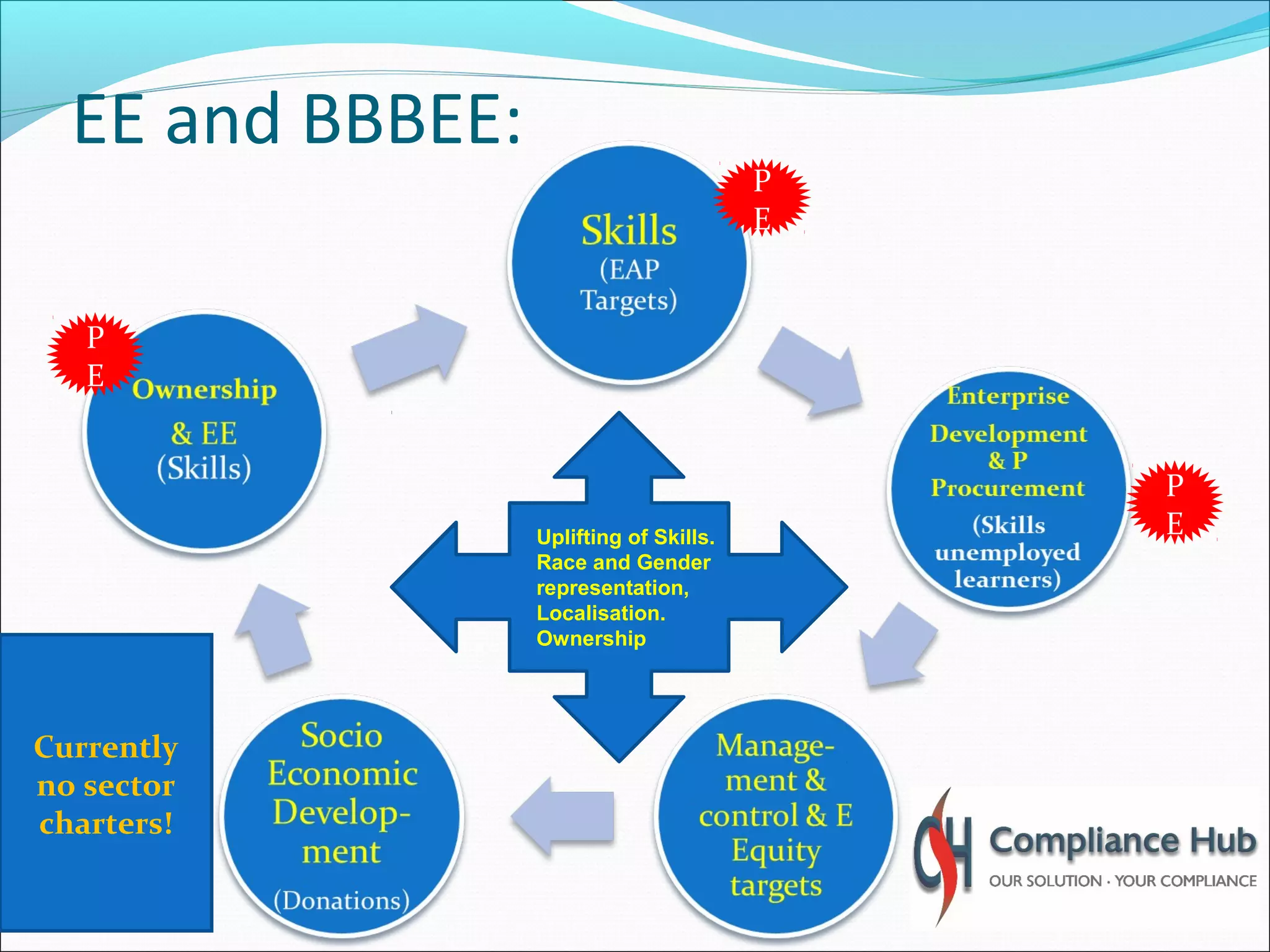
EE and BBBEE:
Uplifting of Skills.
Race and Gender
representation,
Localisation.
Ownership
P
E
P
E
P
E
Currently
no sector
charters!
A representative workforce of the Economically Active Population
(EAP):
NATIONAL EAP:
The requirement in practical terms:
African Male 40.7 AF African Female 34.2
Coloured Male 5.8 CF Coloured Flemale 5.0
Indian Male 1.9 IF Indian Female 1.1
White Male 6.4 WF White Female 4.9
54.8% 45.2
MALE FEMALE
TOTAL TOTAL
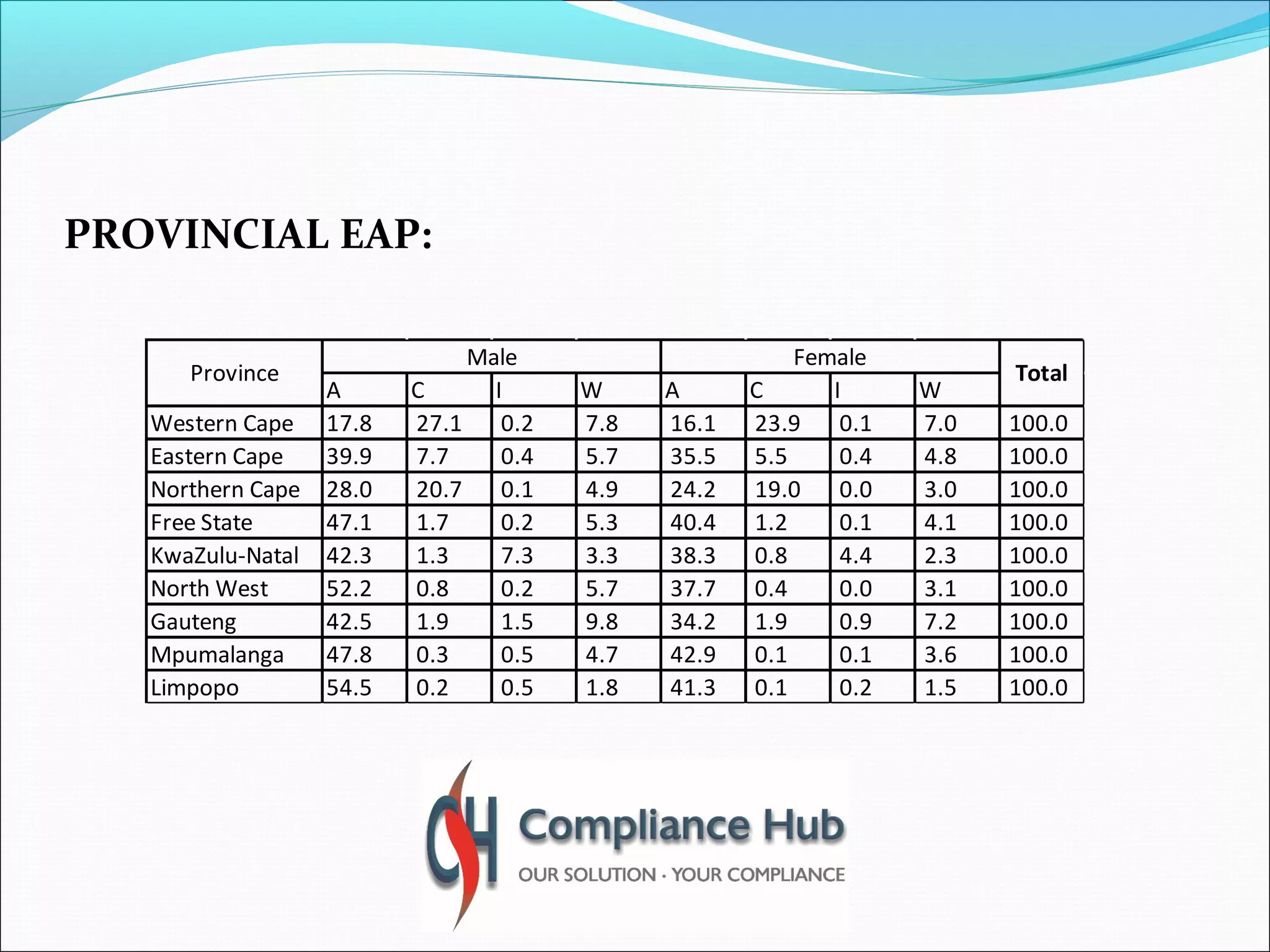
PROVINCIAL EAP:
A C I W A C I W
Western Cape 17.8 27.1 0.2 7.8 16.1 23.9 0.1 7.0 100.0
Eastern Cape 39.9 7.7 0.4 5.7 35.5 5.5 0.4 4.8 100.0
Northern Cape 28.0 20.7 0.1 4.9 24.2 19.0 0.0 3.0 100.0
Free State 47.1 1.7 0.2 5.3 40.4 1.2 0.1 4.1 100.0
KwaZulu-Natal 42.3 1.3 7.3 3.3 38.3 0.8 4.4 2.3 100.0
North West 52.2 0.8 0.2 5.7 37.7 0.4 0.0 3.1 100.0
Gauteng 42.5 1.9 1.5 9.8 34.2 1.9 0.9 7.2 100.0
Mpumalanga 47.8 0.3 0.5 4.7 42.9 0.1 0.1 3.6 100.0
Limpopo 54.5 0.2 0.5 1.8 41.3 0.1 0.2 1.5 100.0
Male Female
Province Total
Designated employers:
"designated employer" means-
(a) an employer who employs 50 or more employees;
(b) an employer who employs fewer that 50 employees, but has a total
annual turnover that is equal to or above the applicable annual turnover
of a small business in terms of the schedule 4 of the Act:
Designated Employers:
Turnover threshold:
Sector or subsectors Total annual turnover
Agriculture R6,00 m
Mining and Quarrying R22,50 m
Manufacturing R30,00 m
Electricity, Gas and Water R30,00 m
Construction R15,00 m
Retail and Motor Trade and Repair Services R45,00 m
Wholesale Trade, Commercial Agents and Allied Services R75,00 m
Catering, Accommodation and other Trade R15,00 m
Transport, Storage and Communications R30,00 m
Finance and Business Services R30,00 m
Community, Social and Personal Services R15,00 m
Designated groups:
This means black people, women and people with disabilities who are
citizens of South Africa by birth or descent or became citizens of South
Africa by naturalization –
 Before 27 April 1994 or
 After 26 April 1994 who would have been entitled to acquire citizenship by
naturalization prior to that date but were precluded due to Apartheid
policies
‘Black people’ is a generic term which means, Africans, Coloureds
(Chinese) and Indians.
Designated Groups
Assigning responsibility – senior manager
Consultation – communication and awareness
Planning – numerical goals, succession planning to achieve
management and control representation. A representative committee
of the organization should be involved and devising and monitoring
the EE plan.
EE Plan – EEA13:
Section 19(1) of the EEA requires a designated employer to conduct an
analysis as prescribed, of its employment policies, practices,
procedures and the working environment in order to identify
employment barriers which adversely affect people from designated
groups.
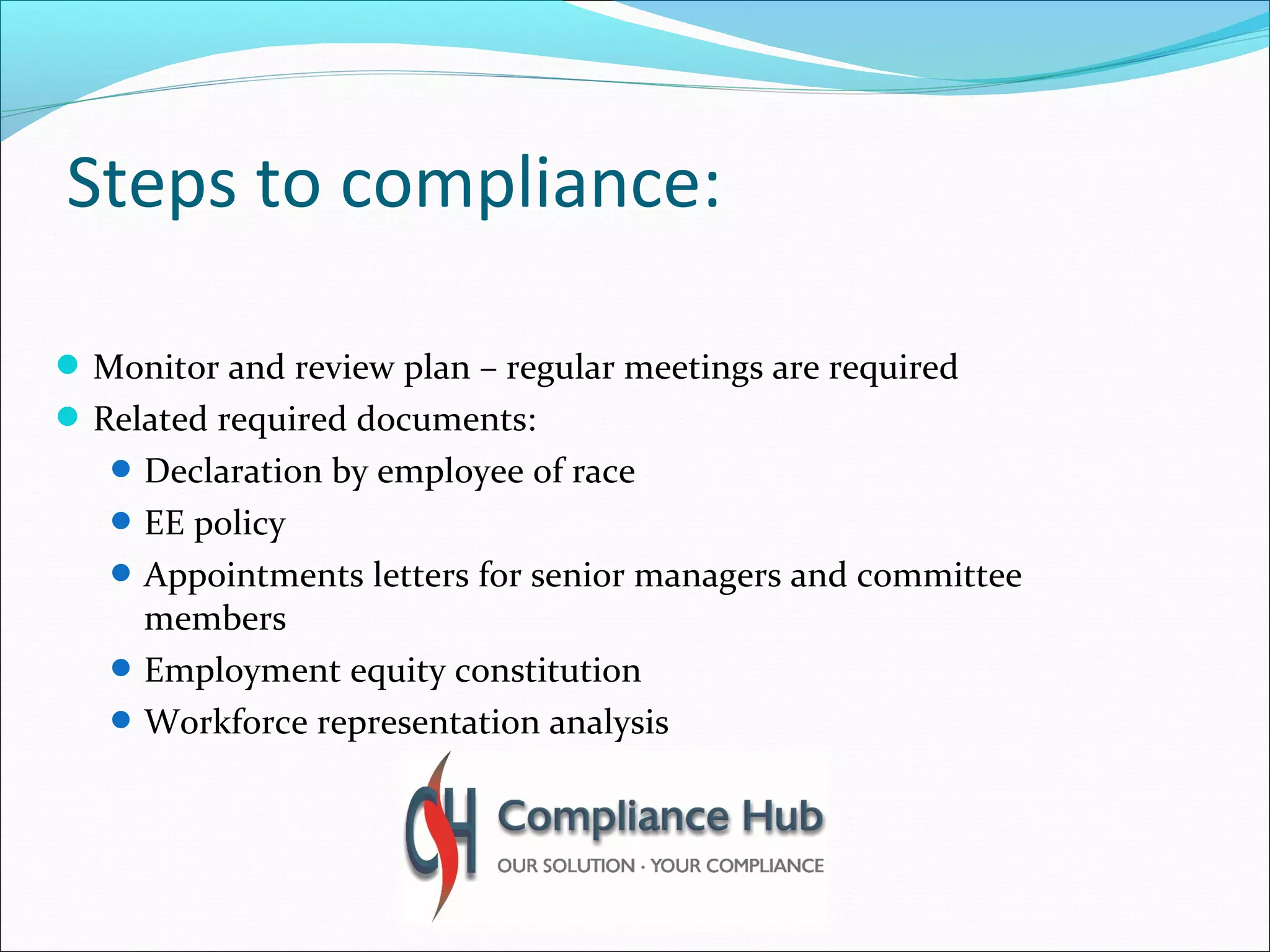
Steps to compliance:
Required reports for submission:
EEA2 – Report on current workforce and numerical goals
EEA4 – Income differentials between occupational levels
System opens for submission 1 September
Deadlines:
 Manual submission 1 October
 Online submission 15 January
Steps to compliance:
Monitor and review plan – regular meetings are required
Related required documents:
Declaration by employee of race
EE policy
Appointments letters for senior managers and committee
members
Employment equity constitution
Workforce representation analysis
Steps to compliance:
Best practice policies
 Code of good practice
 Disability in the workplace
 Performance management and job grading
 Equal work for equal pay
 Skills development
 Recruitment and selection
 Assessments and testing
Thank youwww.compliancehub.co.za
Tel o12 460 1337
Cell – Cindy Jordaan 072 106 1324
cindy@compliancehub.co.za

Employment Equity Presentation

  • 1.
    Employment equity encouragesthe establishment of working conditions that are free of barriers, corrects the conditions of disadvantage in employment and promotes the principle that employment equity requires special measures and the accommodation of differences for the designated groups in South Africa.
  • 2.
    Submission of EmploymentEquity reports and related record keeping is done to: •Avoid huge fines for non-compliance (ranging between 2% and 10% of the company’s annual turnover or from 1.5 million to 2.7 million) •Up to R30 000 fines for responsible person – HR Manager/EE Manager •Ensure points on BBBEE (Black Based Broad Economic Empowerment) scorecard for Employment Equity as well as Management and Control.
  • 3.
    EE and BBBEE: Upliftingof Skills. Race and Gender representation, Localisation. Ownership P E P E P E Currently no sector charters!
  • 4.
    A representative workforceof the Economically Active Population (EAP): NATIONAL EAP: The requirement in practical terms: African Male 40.7 AF African Female 34.2 Coloured Male 5.8 CF Coloured Flemale 5.0 Indian Male 1.9 IF Indian Female 1.1 White Male 6.4 WF White Female 4.9 54.8% 45.2 MALE FEMALE TOTAL TOTAL
  • 5.
    PROVINCIAL EAP: A CI W A C I W Western Cape 17.8 27.1 0.2 7.8 16.1 23.9 0.1 7.0 100.0 Eastern Cape 39.9 7.7 0.4 5.7 35.5 5.5 0.4 4.8 100.0 Northern Cape 28.0 20.7 0.1 4.9 24.2 19.0 0.0 3.0 100.0 Free State 47.1 1.7 0.2 5.3 40.4 1.2 0.1 4.1 100.0 KwaZulu-Natal 42.3 1.3 7.3 3.3 38.3 0.8 4.4 2.3 100.0 North West 52.2 0.8 0.2 5.7 37.7 0.4 0.0 3.1 100.0 Gauteng 42.5 1.9 1.5 9.8 34.2 1.9 0.9 7.2 100.0 Mpumalanga 47.8 0.3 0.5 4.7 42.9 0.1 0.1 3.6 100.0 Limpopo 54.5 0.2 0.5 1.8 41.3 0.1 0.2 1.5 100.0 Male Female Province Total
  • 6.
    Designated employers: "designated employer"means- (a) an employer who employs 50 or more employees; (b) an employer who employs fewer that 50 employees, but has a total annual turnover that is equal to or above the applicable annual turnover of a small business in terms of the schedule 4 of the Act: Designated Employers:
  • 7.
    Turnover threshold: Sector orsubsectors Total annual turnover Agriculture R6,00 m Mining and Quarrying R22,50 m Manufacturing R30,00 m Electricity, Gas and Water R30,00 m Construction R15,00 m Retail and Motor Trade and Repair Services R45,00 m Wholesale Trade, Commercial Agents and Allied Services R75,00 m Catering, Accommodation and other Trade R15,00 m Transport, Storage and Communications R30,00 m Finance and Business Services R30,00 m Community, Social and Personal Services R15,00 m
  • 8.
    Designated groups: This meansblack people, women and people with disabilities who are citizens of South Africa by birth or descent or became citizens of South Africa by naturalization –  Before 27 April 1994 or  After 26 April 1994 who would have been entitled to acquire citizenship by naturalization prior to that date but were precluded due to Apartheid policies ‘Black people’ is a generic term which means, Africans, Coloureds (Chinese) and Indians. Designated Groups
  • 9.
    Assigning responsibility –senior manager Consultation – communication and awareness Planning – numerical goals, succession planning to achieve management and control representation. A representative committee of the organization should be involved and devising and monitoring the EE plan. EE Plan – EEA13: Section 19(1) of the EEA requires a designated employer to conduct an analysis as prescribed, of its employment policies, practices, procedures and the working environment in order to identify employment barriers which adversely affect people from designated groups. Steps to compliance:
  • 10.
    Required reports forsubmission: EEA2 – Report on current workforce and numerical goals EEA4 – Income differentials between occupational levels System opens for submission 1 September Deadlines:  Manual submission 1 October  Online submission 15 January Steps to compliance:
  • 11.
    Monitor and reviewplan – regular meetings are required Related required documents: Declaration by employee of race EE policy Appointments letters for senior managers and committee members Employment equity constitution Workforce representation analysis Steps to compliance:
  • 12.
    Steps to compliance: Bestpractice policies  Code of good practice  Disability in the workplace  Performance management and job grading  Equal work for equal pay  Skills development  Recruitment and selection  Assessments and testing
  • 13.
    Thank youwww.compliancehub.co.za Tel o12460 1337 Cell – Cindy Jordaan 072 106 1324 cindy@compliancehub.co.za