Developing Talent in Racially Diverse
Workplaces:
A South African Perspective
Nischal Srikais Khandai
World HRD Congress
Mumbai, India
February 2009
Talent Development - Setting the
Framework
 What
What is it? We explore the definition.
is it? We explore the definition.
 Why
Why the need?
the need?
1.Generic Need
2.Affirmative Action need
 What
What can be done to develop talent?
can be done to develop talent?
 How?
How? We explore recommendations.
We explore recommendations.
What is Talent Development?
 It is a
It is a Focus
Focus involving the identification and development of a pool of
involving the identification and development of a pool of
high performing individuals to fill key roles or to lead in key strategic
roles if already filled.
 Development
Development looks at the individual as a whole. It does not focus on
looks at the individual as a whole. It does not focus on
the individual’s current job but is concerned with preparing the
individual for a future role or a more senior role.
 In
In South Africa
South Africa it is intended that organisations meet their
it is intended that organisations meet their
employment equity aspirations, as well as motivate and develop
people with the aptitude and abilities to meet current and future
needs.
needs.
Why Develop Talent?
1.
1. Manpower planning;
Manpower planning;
2.
2. Succession planning;
Succession planning;
3.
3. Transformation in South African industries;
Transformation in South African industries;
4.
4. Creation of a representative and diverse workforce;
Creation of a representative and diverse workforce;
5.
5. Address issues of past discrimination;
Address issues of past discrimination;
6.
6. Reduce attrition rate;
Reduce attrition rate;
7.
7. Retain talent for growth and competitive advantage.
Retain talent for growth and competitive advantage.
Challenges Facing South African
Organisations
1.
1. Double digit attrition, e.g. in the Banking Sector;
Double digit attrition, e.g. in the Banking Sector;
2.
2. Talent circulating within the same sectors;
Talent circulating within the same sectors;
3.
3. Lack of new talent, or insufficient supply;
Lack of new talent, or insufficient supply;
4.
4. Employee dissatisfaction;
Employee dissatisfaction;
5.
5. High direct and indirect cost of recruiting new talent;
High direct and indirect cost of recruiting new talent;
6.
6. Loss of productivity;
Loss of productivity;
7.
7. Little or no recognition of employees.
Little or no recognition of employees.
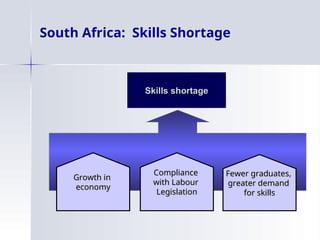
South Africa: Skills Shortage
Skills shortage
Skills shortage
Fewer graduates,
Fewer graduates,
greater demand
greater demand
for skills
for skills
Growth in
Growth in
economy
economy
Compliance
Compliance
with Labour
with Labour
Legislation
Legislation
What Factors are Retaining Employees?
Top 10 reasons cited by 16 000 respondents to an on-line
survey conducted by Career Systems International:
1.
1. Exciting and challenging work.
Exciting and challenging work.
2.
2. Career growth – learning and development.
Career growth – learning and development.
3.
3. Working with good people.
Working with good people.
4.
4. Fair pay.
Fair pay.
5.
5. Supportive management.
Supportive management.
6.
6. Recognition, value and respect.
Recognition, value and respect.
7.
7. Company benefits.
Company benefits.
8.
8. Meaningful work and making a difference.
Meaningful work and making a difference.
9.
9. Pride in the organisation and its products.
Pride in the organisation and its products.
10.
10. Great work environment and culture.
Great work environment and culture.
Research: South African Context
(Source: Deloitte Management Survey, April 2008)
1.
1. A feeling of exclusion and marginality: the company or department
A feeling of exclusion and marginality: the company or department
culture is perceived as exclusive and non-supportive and the
perception exists that diversity is poorly managed;
2.
2. A lack of clear individual development opportunities or career
A lack of clear individual development opportunities or career
paths;
paths;
3.
3. Management style.
Management style.
Note
Note:
:Lack of career advancement, management style and issues
Lack of career advancement, management style and issues around
around
organisational culture and the management of diversity
organisational culture and the management of diversity account
account
for 68% vs. 15% remuneration as the reasons for
for 68% vs. 15% remuneration as the reasons for resignations.
resignations.
Turnover and Retention study in South African companies,
amongst Managers and Professionals, found three dominant
reasons for voluntary resignation amongst both Blacks and
Whites:
Whites:
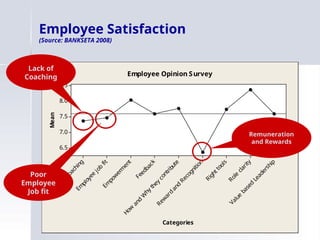
Employee Satisfaction
(Source: BANKSETA 2008)
Value
based
Leadership
Role
clarity
Righttools
Rew
ard
and
Recognition
How
and
W
hy
they
contribute
Feedback
Em
pow
erm
ent
Em
ployee
job
fit
Coaching
8.5
8.0
7.5
7.0
6.5
Categories
Mean
Employee Opinion Survey
Remuneration
and Rewards
Poor
Employee
Job fit
Lack of
Coaching
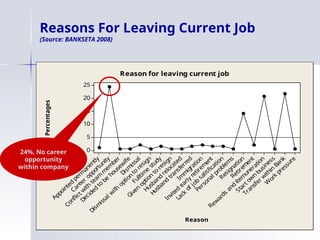
10
25
20
15
10
5
0
Reason
Percentages
Reason for leaving current job
Reasons For Leaving Current Job
(Source: BANKSETA 2008)
24%, No career
opportunity
within company
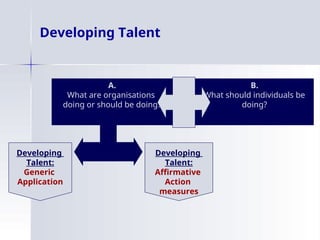
A.
What are organisations
doing or should be doing?
B.
What should individuals be
doing?
Developing Talent
Developing
Talent:
Generic
Application
Developing
Talent:
Affirmative
Action
measures
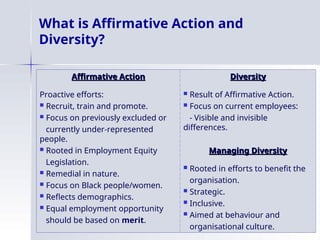
What is Affirmative Action and
Diversity?
Affirmative Action
Affirmative Action
Proactive efforts:
 Recruit, train and promote.
 Focus on previously excluded or
currently under-represented
people.
 Rooted in Employment Equity
Legislation.
 Remedial in nature.
 Focus on Black people/women.
 Reflects demographics.
 Equal employment opportunity
should be based on merit.
Diversity
Diversity
 Result of Affirmative Action.
 Focus on current employees:
- Visible and invisible
differences.
Managing Diversity
Managing Diversity
 Rooted in efforts to benefit the
organisation.
 Strategic.
 Inclusive.
 Aimed at behaviour and
organisational culture.
Legislation - Governing Affirmative
Action (AA) in South Africa
1.
1. Constitution of South Africa;
Constitution of South Africa;
2.
2. Employment Equity Act;
Employment Equity Act;
3.
3. Skills Development Act;
Skills Development Act;
4.
4. Skills Development Levies Act;
Skills Development Levies Act;
5.
5. Promotion of Equality & Prevention of Unfair Discrimination Act;
Promotion of Equality & Prevention of Unfair Discrimination Act;
6.
6. Financial Sector Charter Guidelines;
Financial Sector Charter Guidelines;
7.
7. Broad-Based Black Economic Empowerment Codes.
Broad-Based Black Economic Empowerment Codes.
Objective: To ensure equitable and racially diverse workforces
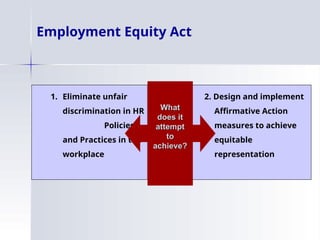
Employment Equity Act
1. Eliminate unfair
discrimination in HR
Policies
and Practices in the
workplace
2. Design and implement
Affirmative Action
measures to achieve
equitable
representation
What
What
does it
does it
attempt
attempt
to
to
achieve?
achieve?
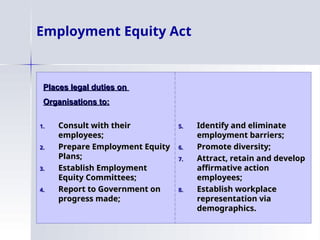
Employment Equity Act
1.
1. Consult with their
Consult with their
employees;
employees;
2.
2. Prepare Employment Equity
Prepare Employment Equity
Plans;
Plans;
3.
3. Establish Employment
Establish Employment
Equity Committees;
Equity Committees;
4.
4. Report to Government on
Report to Government on
progress made;
progress made;
5.
5. Identify and eliminate
Identify and eliminate
employment barriers;
6.
6. Promote diversity;
Promote diversity;
7.
7. Attract, retain and develop
Attract, retain and develop
affirmative action
affirmative action
employees;
employees;
8.
8. Establish workplace
Establish workplace
representation via
representation via
demographics.
demographics.
Places legal duties on
Organisations to:
Organisations to:
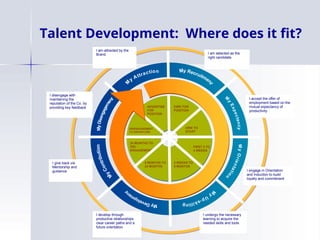
Talent Development: Where does it fit?
I am attracted by the
Brand. I am selected as the
right candidate.
I accept the offer of
employment based on the
mutual expectancy of
productivity
I engage in Orientation
and Induction to build
loyalty and commitment
I undergo the necessary
learning to acquire the
needed skills and tools
I develop through
productive relationships
clear career paths and a
future orientation
I give back via
Mentorship and
guidance
I disengage with
maintaining the
reputation of the Co. by
providing key feedback HIRE FOR
POSITION
HIRE TO
START
FIRST 2 TO
4 WEEKS
2 WEEKS TO
6 MONTHS
6 MONTHS TO
24 MONTHS
24 MONTHS TO
DIS-
ENGAGEMENT
DISENGAGEMENT
TO DEPARTURE
ADVERTISE
FOR
POSITION
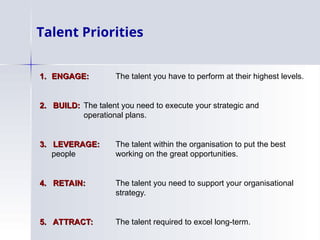
Talent Priorities
1.
1. ENGAGE:
ENGAGE: The talent you have to perform at their highest levels.
2. BUILD:
2. BUILD: The talent you need to execute your strategic and
operational plans.
3. LEVERAGE:
3. LEVERAGE: The talent within the organisation to put the best
people working on the great opportunities.
4. RETAIN:
4. RETAIN: The talent you need to support your organisational
strategy.
5. ATTRACT:
5. ATTRACT: The talent required to excel long-term.
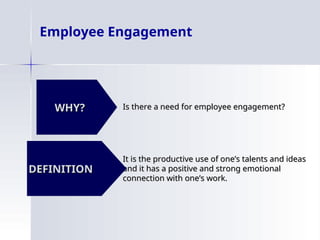
Employee Engagement
WHY?
Is there a need for employee engagement?
It is the productive use of one’s talents and ideas
and it has a positive and strong emotional
connection with one’s work.
DEFINITION
DEFINITION
WHY?
WHY?
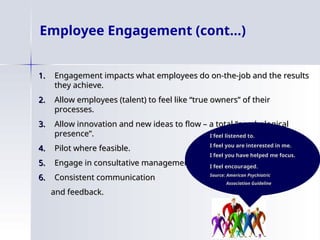
Employee Engagement (cont…)
1.
1. Engagement impacts what employees do on-the-job and the results
Engagement impacts what employees do on-the-job and the results
they achieve.
they achieve.
2.
2. Allow employees (talent) to feel like “true owners” of their
Allow employees (talent) to feel like “true owners” of their
processes.
processes.
3.
3. Allow innovation and new ideas to flow – a total “psychological
Allow innovation and new ideas to flow – a total “psychological
presence”.
presence”.
4.
4. Pilot where feasible.
Pilot where feasible.
5.
5. Engage in consultative management.
Engage in consultative management.
6.
6. Consistent communication
Consistent communication
and feedback.
and feedback.
I feel listened to.
I feel listened to.
I feel you are interested in me.
I feel you have helped me focus.
I feel encouraged
I feel encouraged.
.
Source: American Psychiatric
Association Guideline
Why the special need to focus on Employee Engagement in South
Africa?
Africa?
 The feeling of appreciation and inclusion in the decision-making
The feeling of appreciation and inclusion in the decision-making
process amongst:
process amongst:

racial minorities;
racial minorities;

previously disadvantaged females;

historically disadvantaged employees (African
employees);
employees);

crossing the divide of language barriers in the
workplace.
workplace.
 Resulting in trust, respect and a level of comfort towards the
Resulting in trust, respect and a level of comfort towards the
Employee Engagement (cont…)
Learning is rarely experienced
without emotion
without emotion
(Stephen Brookfield)
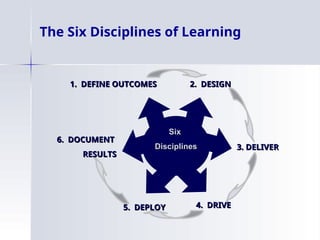
The Six Disciplines of Learning
Six
Six
Disciplines
Disciplines
1. DEFINE OUTCOMES
1. DEFINE OUTCOMES
6. DOCUMENT
6. DOCUMENT
RESULTS
RESULTS
5. DEPLOY
5. DEPLOY
2. DESIGN
2. DESIGN
3. DELIVER
3. DELIVER
4. DRIVE
4. DRIVE
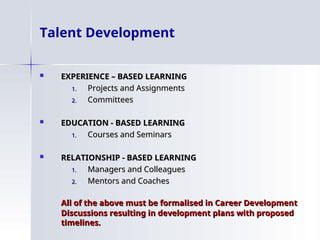
Talent Development
 EXPERIENCE – BASED LEARNING
EXPERIENCE – BASED LEARNING
1.
1. Projects and Assignments
Projects and Assignments
2.
2. Committees
Committees
 EDUCATION - BASED LEARNING
EDUCATION - BASED LEARNING
1.
1. Courses and Seminars
Courses and Seminars
 RELATIONSHIP - BASED LEARNING
RELATIONSHIP - BASED LEARNING
1.
1. Managers and Colleagues
Managers and Colleagues
2.
2. Mentors and Coaches
Mentors and Coaches
All of the above must be formalised in Career Development
Discussions resulting in development plans with proposed
timelines.
timelines.
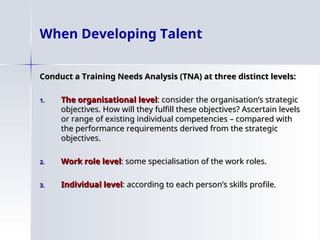
When Developing Talent
Conduct a Training Needs Analysis (TNA) at three distinct levels:
1.
1. The organisational level
The organisational level: consider the organisation’s strategic
: consider the organisation’s strategic
objectives. How will they fulfill these objectives? Ascertain levels
or range of existing individual competencies – compared with
the performance requirements derived from the strategic
objectives.
objectives.
2.
2. Work role level
Work role level: some specialisation of the work roles.
: some specialisation of the work roles.
3.
3. Individual level
Individual level: according to each person’s skills profile.
: according to each person’s skills profile.
Methods on Training Needs and
Priorities
 Isolate into skill base;
Isolate into skill base;
 Use individual questionnaires with small groups or questionnaire
Use individual questionnaires with small groups or questionnaire
surveys with larger groups;
 Gap analysis: determine the size of the gap between the desired
Gap analysis: determine the size of the gap between the desired
level of performance and the actual level. The greater the
disparity between the two, the higher priority should be allocated
to the training in the area in question.
 Ascertain the training content:
Ascertain the training content:

Break the content into components;

Use the Hierarchical Task Analysis (HTA) which begins by
describing the main operations involved in the tasks;

It involves dissecting the task into smaller units of behaviour
in a hierarchical fashion.
 The more a task is broken down into fine detail the more the
The more a task is broken down into fine detail the more the
training can be focused on those particular aspects of the tasks.
Methods of Employee Development
1.
1. Development Centres
Development Centres:
: in which individuals are given a
in which individuals are given a
series of tests and exercises
designed to assess competencies.
2.
2. Self Development
Self Development:
: use of SWOT analysis.
use of SWOT analysis.
3.
3. The Learning Contract
The Learning Contract:
: usually a Personal Development
usually a Personal Development
Plan.
Plan.
4.
4. Planned Work Experience
Planned Work Experience:
: this is on the job
this is on the job
development
development activity, planned
activity, planned
and systematic.
and systematic.
5.
5. Action Learning
Action Learning:
: where managers learn a great deal
where managers learn a great deal
through problem solving.
6.
6. Coaching and Mentoring
Coaching and Mentoring:
: one of the hallmarks of a good
one of the hallmarks of a good
manager is the extent to which
manager is the extent to which he/she adopts an active coaching
he/she adopts an active coaching
role as an aid to management
role as an aid to management development.
development.
7.
7. Development for
Development for
Employment
Employment:
: the notion here is to provide the
the notion here is to provide the employee with a
employee with a
wide range of
wide range of transferable skills which would
transferable skills which would enhance the
enhance the
person’s marketability
person’s marketability as a means of motivation.
as a means of motivation.
Methods of Employee Development
(cont…)
When Developing Talent: Consider
The
The Types of Learners
Types of Learners – identified by HONEY and MUMFORD IN 1989:
– identified by HONEY and MUMFORD IN 1989:
1.
1. Activists
Activists:
: where the person learns by doing.
where the person learns by doing.
2.
2. Reflectors
Reflectors:
: prefer to learn by observing and listening
prefer to learn by observing and listening
and
and analyzing rather than by doing.
analyzing rather than by doing.
3.
3. Theorists
Theorists:
: are good at constructing theories and
are good at constructing theories and
concepts
concepts based on analysis and evaluation
based on analysis and evaluation
of
of information.
information.
4.
4. Pragmatists
Pragmatists:
: are characterized by their desire to apply what
are characterized by their desire to apply what
they have learnt to real world situations.
They do not respond well to concepts and
theories which have little direct practical
application.
application.
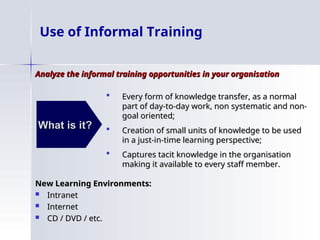
Use of Informal Training
Analyze the informal training opportunities in your organisation
New Learning Environments:
 Intranet
Intranet
 Internet
Internet
 CD / DVD / etc.
CD / DVD / etc.
What is it?
What is it?
 Every form of knowledge transfer, as a normal
Every form of knowledge transfer, as a normal
part of day-to-day work, non systematic and non-
goal oriented;
goal oriented;
 Creation of small units of knowledge to be used
Creation of small units of knowledge to be used
in a just-in-time learning perspective;
 Captures tacit knowledge in the organisation
Captures tacit knowledge in the organisation
making it available to every staff member.
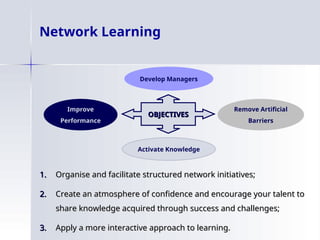
Network Learning
1.
1. Organise and facilitate structured network initiatives;
Organise and facilitate structured network initiatives;
2.
2. Create an atmosphere of confidence and encourage your talent to
Create an atmosphere of confidence and encourage your talent to
share knowledge acquired through success and challenges;
3.
3. Apply a more interactive approach to learning.
Apply a more interactive approach to learning.
OBJECTIVES
OBJECTIVES
Develop Managers
Improve
Performance
Remove Artificial
Barriers
Activate Knowledge
1.
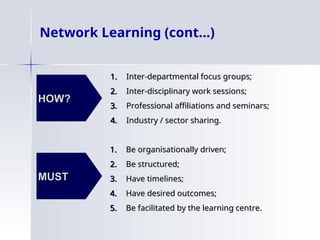
1. Inter-departmental focus groups;
Inter-departmental focus groups;
2.
2. Inter-disciplinary work sessions;
Inter-disciplinary work sessions;
3.
3. Professional affiliations and seminars;
Professional affiliations and seminars;
4.
4. Industry / sector sharing.
Industry / sector sharing.
Network Learning (cont…)
HOW?
HOW?
MUST
MUST
1.
1. Be organisationally driven;
Be organisationally driven;
2.
2. Be structured;
Be structured;
3.
3. Have timelines;
Have timelines;
4.
4. Have desired outcomes;
Have desired outcomes;
5.
5. Be facilitated by the learning centre.
Be facilitated by the learning centre.
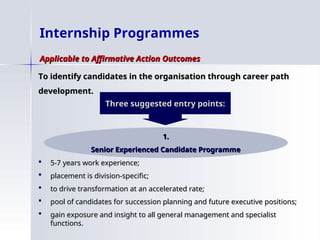
Internship Programmes
Applicable to Affirmative Action Outcomes
To identify candidates in the organisation through career path
development.
development.
 5-7 years work experience;
5-7 years work experience;
 placement is division-specific;
placement is division-specific;
 to drive transformation at an accelerated rate;
to drive transformation at an accelerated rate;
 pool of candidates for succession planning and future executive positions;
pool of candidates for succession planning and future executive positions;
 gain exposure and insight to all general management and specialist
gain exposure and insight to all general management and specialist
functions.
functions.
Three suggested entry points:
1.
1.
Senior Experienced Candidate Programme
 to identify, recruit and fast track graduated and experienced (3-5 years) talent
to identify, recruit and fast track graduated and experienced (3-5 years) talent
to accelerate transformation;
 place candidates in meaningful roles immediately or within 12 months of
place candidates in meaningful roles immediately or within 12 months of
commencement of the programme;
 exposure to all functional departments;
exposure to all functional departments;
 gain general management and specialist skills;
gain general management and specialist skills;
 tap into educational opportunities that offer new courses coupled with
tap into educational opportunities that offer new courses coupled with
academic theory and management expertise on a project basis;
 partner with local university or business school to accredit academic modules
partner with local university or business school to accredit academic modules
and assist to facilitate mentorship programme;
 programme is sponsored by Executives responsible for recruitment and
programme is sponsored by Executives responsible for recruitment and
succession planning;
 the HR Practitioner and direct Supervisor is responsible for the management
the HR Practitioner and direct Supervisor is responsible for the management
of the designated individual through their programmes.
Internship Programmes (cont…)
2.
2.
Graduate Experienced Candidate Programme
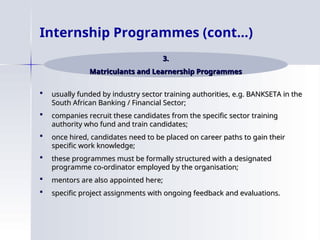
 usually funded by industry sector training authorities, e.g. BANKSETA in the
usually funded by industry sector training authorities, e.g. BANKSETA in the
South African Banking / Financial Sector;
 companies recruit these candidates from the specific sector training
companies recruit these candidates from the specific sector training
authority who fund and train candidates;
 once hired, candidates need to be placed on career paths to gain their
once hired, candidates need to be placed on career paths to gain their
specific work knowledge;
 these programmes must be formally structured with a designated
these programmes must be formally structured with a designated
programme co-ordinator employed by the organisation;
 mentors are also appointed here;
mentors are also appointed here;
 specific project assignments with ongoing feedback and evaluations.
specific project assignments with ongoing feedback and evaluations.
Internship Programmes (cont…)
3.
3.
Matriculants and Learnership Programmes
How has the Government of South Africa
Intervened?
The Introduction of Learnerships:
 A Learnership is defined as a work-based route for learning and
A Learnership is defined as a work-based route for learning and
gaining qualifications. It includes both structured work experience
(practical) and structured institutional learning (theory). Has both
on-the-job and academic components.
 It does offer a very specific work-orientated method for young
It does offer a very specific work-orientated method for young
people – especially from previously disadvantaged background – to
acquire qualifications as well as preparation for the workplace.
 Managed by BANKSETA: i.e.
Managed by BANKSETA: i.e. Banking Sector Education Training
Banking Sector Education Training
Authority
Authority
Talent Development: Affirmative
Action
New AA Manager
New AA Manager
Affirmative Action
Affirmative Action
Exiting Manager
Executive Manager
Executive Manager
New AA Manager
Process : Develop & Mentor
New AA Manager
Executive Manager
Executive Manager
to
to
Process
:
Monitor
and
Review
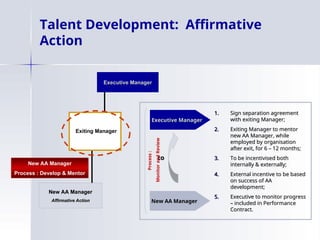
1.
1. Sign separation agreement
Sign separation agreement
with exiting Manager;
2.
2. Exiting Manager to mentor
Exiting Manager to mentor
new AA Manager, while
employed by organisation
after exit, for 6 – 12 months;
3.
3. To be incentivised both
To be incentivised both
internally & externally;
4.
4. External incentive to be based
External incentive to be based
on success of AA
on success of AA
development;
development;
5.
5. Executive to monitor progress
Executive to monitor progress
– included in Performance
Contract.
Contract.
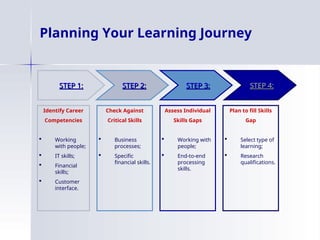
Planning Your Learning Journey
STEP 1:
STEP 1: STEP 3:
STEP 3: STEP 4:
STEP 4:
STEP 2:
STEP 2:
Identify Career
Competencies
 Working
with people;
 IT skills;
 Financial
skills;
 Customer
interface.
Check Against
Critical Skills
 Business
processes;
 Specific
financial skills.
Assess Individual
Skills Gaps
 Working with
people;
 End-to-end
processing
skills.
Plan to fill Skills
Gap
 Select type of
learning;
 Research
qualifications.
What Can Affirmative Action
Candidates Do?
 Form a Voluntary Association for Affirmative Action similar to the American
Form a Voluntary Association for Affirmative Action similar to the American
Association for Affirmative Action (est. in 1974)
 An Association of professionals managing affirmative action, equal opportunity,
An Association of professionals managing affirmative action, equal opportunity,
diversity and other HR programmes.
 On a non-profit basis, assist members to be more successful and productive in
On a non-profit basis, assist members to be more successful and productive in
their careers.
their careers.
 Promote understanding and to enhance access and equality in employment,
Promote understanding and to enhance access and equality in employment,
economic and educational opportunities.
 Identify and remove employment barriers to entry, promotion and sustainability.
Identify and remove employment barriers to entry, promotion and sustainability.
 To sponsor and conduct research in education and training programmes for
To sponsor and conduct research in education and training programmes for
individual members and organisations.
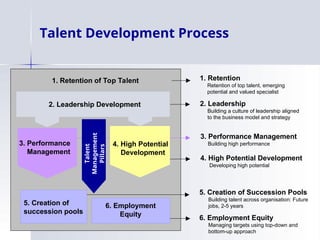
Talent Development Process
1. Retention of Top Talent
2. Leadership
Building a culture of leadership aligned
to the business model and strategy
3. Performance Management
Building high performance
3. Performance
Management
4. High Potential
Development
4. High Potential Development
Developing high potential
5. Creation of
succession pools
6. Employment
Equity
5. Creation of Succession Pools
Building talent across organisation: Future
jobs, 2-5 years
1. Retention
Retention of top talent, emerging
potential and valued specialist
Talent
Manageme
nt
Pillars
6. Employment Equity
Managing targets using top-down and
bottom-up approach
2. Leadership Development
Organisation
Organisation
The right talent
The right talent
pipeline to meet
pipeline to meet
business needs
business needs
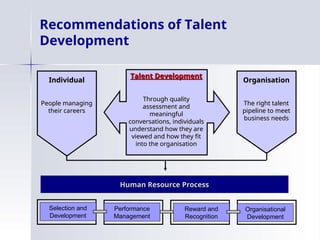
Individual
Individual
People managing
People managing
their careers
their careers
Talent Development
Talent Development
Through quality
Through quality
assessment and
assessment and
meaningful
meaningful
conversations, individuals
understand how they are
viewed and how they fit
into the organisation
Selection and
Development
Performance
Management
Reward and
Recognition
Organisational
Development
Human Resource Process
Recommendations of Talent
Development
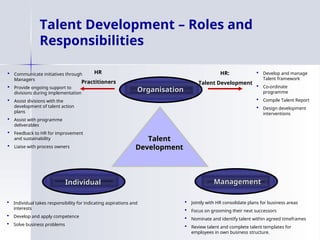
 Jointly with HR consolidate plans for business areas
 Focus on grooming their next successors
 Nominate and identify talent within agreed timeframes
 Review talent and complete talent templates for
employees in own business structure.
 Individual takes responsibility for indicating aspirations and
interests
 Develop and apply competence
 Solve business problems
 Communicate initiatives through
Managers
 Provide ongoing support to
divisions during implementation
 Assist divisions with the
development of talent action
plans
 Assist with programme
deliverables
 Feedback to HR for improvement
and sustainability
 Liaise with process owners
 Develop and manage
Talent framework
 Co-ordinate
programme
 Compile Talent Report
 Design development
interventions
Organisation
Organisation
Individual
Individual Management
Management
Talent
Talent
Development
Development
HR:
Talent Development
HR
Practitioners
Talent Development – Roles and
Responsibilities
Talent
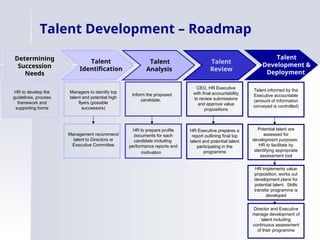
Analysis
Talent
Review
Talent
Development &
Deployment
Management recommend
talent to Directors or
Executive Committee
Inform the proposed
candidate.
HR to prepare profile
documents for each
candidate including
performance reports and
motivation
CEO, HR Executive
with final accountability
to review submissions
and approve value
propositions
HR Executive prepares a
report outlining final top
talent and potential talent
participating in the
programme
HR implements value
proposition, works out
development plans for
potential talent. Skills
transfer programme is
developed
Potential talent are
assessed for
development purposes.
HR to facilitate by
identifying appropriate
assessment tool
Managers to identify top
talent and potential high
flyers (possible
successors)
Talent informed by the
Executive accountable
(amount of information
conveyed is controlled)
Director and Executive
manage development of
talent including
continuous assessment
of their programme
Talent
Identification
Determining
Succession
Needs
HR to develop the
guidelines, process
framework and
supporting forms
Talent Development – Roadmap
Some additional
Some additional Pointers
Pointers to be
to be
considered when developing
talent:
talent:
When Appointing:
Be it for a new appointee, succession or promotion, consider
Personality Types
Personality Types:
:
PERSONALITY TYPES:
PERSONALITY TYPES: tend to reflect both what a person
tend to reflect both what a person
will
will enjoy and also what he will be good
enjoy and also what he will be good
at.
at.
Examples include
Examples include:
:
 Investigative;
Investigative;
 Artistic;
Artistic;
 Social;
Social;
 Enterprising;
Enterprising;
 Conventional, rules and procedures
Conventional, rules and procedures
oriented – highly administrative.
Consider Career Stages
GREENHAUS AND CALLANAN’S (1993) PROPOSED A FIVE
STAGE MODEL OF CAREERS:
1.
1. Occupational Choice
Occupational Choice: the explorative phase up to the age of around
: the explorative phase up to the age of around
25.
25.
2.
2. Organisational Entry
Organisational Entry: what kind of work and which type of
: what kind of work and which type of
organisation. This is usually an uncertain period.
3.
3. Early Career
Early Career: usually ages between 25 – 40 years. Learns about the
: usually ages between 25 – 40 years. Learns about the
organisational culture. This is a period of achievement, where the
individual develops various organisational competencies. Assistance
with career management is important here.
Career Stages (cont…)
4.
4. Mid-career
Mid-career: ages 40-55. While for some this is a time of
: ages 40-55. While for some this is a time of
continued advancement, for others their career will plateau,
with little prospect of further promotion. Major challenge for
career management and development.
5.
5. Late Career
Late Career: after 55. Career plateau effects will be
: after 55. Career plateau effects will be
experienced even more. Performance is likely to be an even
greater challenge for organisations. Look at inherent deficits
due to ageing – low motivation, etc.
Career Anchors
Relating to experience and
Relating to experience and development. This
development. This
consists of self-
consists of self- perceived abilities, motives, attitudes
perceived abilities, motives, attitudes
and values. According to Schein’s
and values. According to Schein’s theory when individuals
theory when individuals
make
make occupational choices they do so in
occupational choices they do so in
accordance with their dominant
accordance with their dominant career anchor. The
career anchor. The
knowledge of a
knowledge of a person’s career anchor can be a
person’s career anchor can be a useful
useful
aid to career decision making.
Schein’s Theory
Schein’s Theory
of Career Anchors:
of Career Anchors:
Career Anchors Include:
1.
1. Technical or Functional Competence;
Technical or Functional Competence;
2.
2. Managerial Competence;
Managerial Competence;
3.
3. Security;
Security;
4.
4. Creativity – an entrepreneur;
Creativity – an entrepreneur;
5.
5. Autonomy;
Autonomy;
6.
6. Pure Challenge;
Pure Challenge;
7.
7. Dedication – values are of paramount importance;
Dedication – values are of paramount importance;
8.
8. Life-style integration – equilibrium between work and non-work
Life-style integration – equilibrium between work and non-work
activities, so that a balanced life-style is maintained.
What Tools Can We Use?
1.
1. Assessments;
Assessments;
2.
2. Questionnaires;
Questionnaires;
3.
3. Observation;
Observation;
4.
4. One-on-one interviews;
One-on-one interviews;
5.
5. Group interviews;
Group interviews;
6.
6. Brainstorming with experts;
Brainstorming with experts;
7.
7. Work participation: actual work done by analyst;
Work participation: actual work done by analyst;
8.
8. Work diaries;
Work diaries;
9.
9. Critical incidents: description of specific behavioural events.
Critical incidents: description of specific behavioural events.
Reference Websites
 Career Information, Assessment Technologies - Services:
Career Information, Assessment Technologies - Services:
www.careers.co.za
 MAPP Assessment, USA:
MAPP Assessment, USA: www.assessment.com
 Personality 100, USA:
Personality 100, USA: www.personality100.com
 The Princeton Review, USA:
The Princeton Review, USA: www.princetonreview.com
 BANKSETA:
BANKSETA: www.bankseta.org.za
 Career Development,
Career Development, www.ched.uct.ac.za
 Career Orientation Inventory, Red Point Coaching:
Career Orientation Inventory, Red Point Coaching:
www.redpointcoaching.com
 Council for Higher Education, South Africa:
Council for Higher Education, South Africa: www.che.org.za
 Creating your Career Path, Ready minds:
Creating your Career Path, Ready minds: www.princetonreview.com
 Managing your career, Career Orientation:
Managing your career, Career Orientation: www.ched.uct.ac.za
References and Notes
1.
1. BANKSETA International Conferences: 2006 and 2008
BANKSETA International Conferences: 2006 and 2008
2.
2. ASTD International Conference, Atlanta, USA, 2007
ASTD International Conference, Atlanta, USA, 2007
3.
3. BANKSETA – ASTD Work study, USA 2007
BANKSETA – ASTD Work study, USA 2007
4.
4. BANKSETA – International Program, Canada, 2008
BANKSETA – International Program, Canada, 2008
5.
5. Banking Association of South Africa, HR Committee Participation Sessio
Banking Association of South Africa, HR Committee Participation Sessio
6.
6. Asia Pacific HRM Congress, Mumbai, India, 2008
Asia Pacific HRM Congress, Mumbai, India, 2008
7.
7. Financial Sector Charter Council: Annual Review, 2006
Financial Sector Charter Council: Annual Review, 2006
8.
8. The American Association for Affirmative Action
The American Association for Affirmative Action
9.
9. HR Future Publications: 2005 to 2008
HR Future Publications: 2005 to 2008
10.
10. Standard Bank Graduate Program
Standard Bank Graduate Program
11.
11. Literature Surveys: USA,UK, Canada, Singapore, Malaysia & India
Literature Surveys: USA,UK, Canada, Singapore, Malaysia & India
References and Notes (cont…)
12.
12. First Rand Bank: Remuneration Policy
First Rand Bank: Remuneration Policy
13.
13. African Bank: Employment Equity Framework, 2008
African Bank: Employment Equity Framework, 2008
14.
14. African Bank: Draft Talent Management Philosophy
African Bank: Draft Talent Management Philosophy
15.
15. Deloitte & Touché Multi-cultural Development Programme
Deloitte & Touché Multi-cultural Development Programme
16.
16. Department of Trade and Industry of South Africa: DTI
Department of Trade and Industry of South Africa: DTI
17.
17. South African Best Companies to Work for Surveys: 2002 to 2007
South African Best Companies to Work for Surveys: 2002 to 2007
18.
18. Employment Equity Commission of South Africa: Annual Reports
Employment Equity Commission of South Africa: Annual Reports
19.
19. Sanlam Insurance (South Africa): Employment Equity Philosophy
Sanlam Insurance (South Africa): Employment Equity Philosophy
20.
20. Shell (Southern Africa): Empowering its people
Shell (Southern Africa): Empowering its people
21.
21. McCarthy Motor Holdings: South Africa – Review on People Practices
McCarthy Motor Holdings: South Africa – Review on People Practices
22.
22. International Labour Organisation (ILO): First Global Report on Discrimination: 2003
International Labour Organisation (ILO): First Global Report on Discrimination: 2003
Thank you
Thank you

Developing_Talent.pptDeveloping_Talent.ppt

  • 1.
    Developing Talent inRacially Diverse Workplaces: A South African Perspective Nischal Srikais Khandai World HRD Congress Mumbai, India February 2009
  • 2.
    Talent Development -Setting the Framework  What What is it? We explore the definition. is it? We explore the definition.  Why Why the need? the need? 1.Generic Need 2.Affirmative Action need  What What can be done to develop talent? can be done to develop talent?  How? How? We explore recommendations. We explore recommendations.
  • 3.
    What is TalentDevelopment?  It is a It is a Focus Focus involving the identification and development of a pool of involving the identification and development of a pool of high performing individuals to fill key roles or to lead in key strategic high performing individuals to fill key roles or to lead in key strategic roles if already filled. roles if already filled.  Development Development looks at the individual as a whole. It does not focus on looks at the individual as a whole. It does not focus on the individual’s current job but is concerned with preparing the the individual’s current job but is concerned with preparing the individual for a future role or a more senior role. individual for a future role or a more senior role.  In In South Africa South Africa it is intended that organisations meet their it is intended that organisations meet their employment equity aspirations, as well as motivate and develop employment equity aspirations, as well as motivate and develop people with the aptitude and abilities to meet current and future people with the aptitude and abilities to meet current and future needs. needs.
  • 4.
    Why Develop Talent? 1. 1.Manpower planning; Manpower planning; 2. 2. Succession planning; Succession planning; 3. 3. Transformation in South African industries; Transformation in South African industries; 4. 4. Creation of a representative and diverse workforce; Creation of a representative and diverse workforce; 5. 5. Address issues of past discrimination; Address issues of past discrimination; 6. 6. Reduce attrition rate; Reduce attrition rate; 7. 7. Retain talent for growth and competitive advantage. Retain talent for growth and competitive advantage.
  • 5.
    Challenges Facing SouthAfrican Organisations 1. 1. Double digit attrition, e.g. in the Banking Sector; Double digit attrition, e.g. in the Banking Sector; 2. 2. Talent circulating within the same sectors; Talent circulating within the same sectors; 3. 3. Lack of new talent, or insufficient supply; Lack of new talent, or insufficient supply; 4. 4. Employee dissatisfaction; Employee dissatisfaction; 5. 5. High direct and indirect cost of recruiting new talent; High direct and indirect cost of recruiting new talent; 6. 6. Loss of productivity; Loss of productivity; 7. 7. Little or no recognition of employees. Little or no recognition of employees.
  • 6.
    South Africa: SkillsShortage Skills shortage Skills shortage Fewer graduates, Fewer graduates, greater demand greater demand for skills for skills Growth in Growth in economy economy Compliance Compliance with Labour with Labour Legislation Legislation
  • 7.
    What Factors areRetaining Employees? Top 10 reasons cited by 16 000 respondents to an on-line Top 10 reasons cited by 16 000 respondents to an on-line survey conducted by Career Systems International: survey conducted by Career Systems International: 1. 1. Exciting and challenging work. Exciting and challenging work. 2. 2. Career growth – learning and development. Career growth – learning and development. 3. 3. Working with good people. Working with good people. 4. 4. Fair pay. Fair pay. 5. 5. Supportive management. Supportive management. 6. 6. Recognition, value and respect. Recognition, value and respect. 7. 7. Company benefits. Company benefits. 8. 8. Meaningful work and making a difference. Meaningful work and making a difference. 9. 9. Pride in the organisation and its products. Pride in the organisation and its products. 10. 10. Great work environment and culture. Great work environment and culture.
  • 8.
    Research: South AfricanContext (Source: Deloitte Management Survey, April 2008) 1. 1. A feeling of exclusion and marginality: the company or department A feeling of exclusion and marginality: the company or department culture is perceived as exclusive and non-supportive and the culture is perceived as exclusive and non-supportive and the perception exists that diversity is poorly managed; perception exists that diversity is poorly managed; 2. 2. A lack of clear individual development opportunities or career A lack of clear individual development opportunities or career paths; paths; 3. 3. Management style. Management style. Note Note: :Lack of career advancement, management style and issues Lack of career advancement, management style and issues around around organisational culture and the management of diversity organisational culture and the management of diversity account account for 68% vs. 15% remuneration as the reasons for for 68% vs. 15% remuneration as the reasons for resignations. resignations. Turnover and Retention study in South African companies, Turnover and Retention study in South African companies, amongst Managers and Professionals, found three dominant amongst Managers and Professionals, found three dominant reasons for voluntary resignation amongst both Blacks and reasons for voluntary resignation amongst both Blacks and Whites: Whites:
  • 9.
    Employee Satisfaction (Source: BANKSETA2008) Value based Leadership Role clarity Righttools Rew ard and Recognition How and W hy they contribute Feedback Em pow erm ent Em ployee job fit Coaching 8.5 8.0 7.5 7.0 6.5 Categories Mean Employee Opinion Survey Remuneration and Rewards Poor Employee Job fit Lack of Coaching
  • 10.
    10 25 20 15 10 5 0 Reason Percentages Reason for leavingcurrent job Reasons For Leaving Current Job (Source: BANKSETA 2008) 24%, No career opportunity within company
  • 11.
    A. What are organisations doingor should be doing? B. What should individuals be doing? Developing Talent Developing Talent: Generic Application Developing Talent: Affirmative Action measures
  • 12.
    What is AffirmativeAction and Diversity? Affirmative Action Affirmative Action Proactive efforts:  Recruit, train and promote.  Focus on previously excluded or currently under-represented people.  Rooted in Employment Equity Legislation.  Remedial in nature.  Focus on Black people/women.  Reflects demographics.  Equal employment opportunity should be based on merit. Diversity Diversity  Result of Affirmative Action.  Focus on current employees: - Visible and invisible differences. Managing Diversity Managing Diversity  Rooted in efforts to benefit the organisation.  Strategic.  Inclusive.  Aimed at behaviour and organisational culture.
  • 13.
    Legislation - GoverningAffirmative Action (AA) in South Africa 1. 1. Constitution of South Africa; Constitution of South Africa; 2. 2. Employment Equity Act; Employment Equity Act; 3. 3. Skills Development Act; Skills Development Act; 4. 4. Skills Development Levies Act; Skills Development Levies Act; 5. 5. Promotion of Equality & Prevention of Unfair Discrimination Act; Promotion of Equality & Prevention of Unfair Discrimination Act; 6. 6. Financial Sector Charter Guidelines; Financial Sector Charter Guidelines; 7. 7. Broad-Based Black Economic Empowerment Codes. Broad-Based Black Economic Empowerment Codes. Objective: To ensure equitable and racially diverse workforces Objective: To ensure equitable and racially diverse workforces
  • 14.
    Employment Equity Act 1.Eliminate unfair discrimination in HR Policies and Practices in the workplace 2. Design and implement Affirmative Action measures to achieve equitable representation What What does it does it attempt attempt to to achieve? achieve?
  • 15.
    Employment Equity Act 1. 1.Consult with their Consult with their employees; employees; 2. 2. Prepare Employment Equity Prepare Employment Equity Plans; Plans; 3. 3. Establish Employment Establish Employment Equity Committees; Equity Committees; 4. 4. Report to Government on Report to Government on progress made; progress made; 5. 5. Identify and eliminate Identify and eliminate employment barriers; employment barriers; 6. 6. Promote diversity; Promote diversity; 7. 7. Attract, retain and develop Attract, retain and develop affirmative action affirmative action employees; employees; 8. 8. Establish workplace Establish workplace representation via representation via demographics. demographics. Places legal duties on Places legal duties on Organisations to: Organisations to:
  • 16.
    Talent Development: Wheredoes it fit? I am attracted by the Brand. I am selected as the right candidate. I accept the offer of employment based on the mutual expectancy of productivity I engage in Orientation and Induction to build loyalty and commitment I undergo the necessary learning to acquire the needed skills and tools I develop through productive relationships clear career paths and a future orientation I give back via Mentorship and guidance I disengage with maintaining the reputation of the Co. by providing key feedback HIRE FOR POSITION HIRE TO START FIRST 2 TO 4 WEEKS 2 WEEKS TO 6 MONTHS 6 MONTHS TO 24 MONTHS 24 MONTHS TO DIS- ENGAGEMENT DISENGAGEMENT TO DEPARTURE ADVERTISE FOR POSITION
  • 17.
    Talent Priorities 1. 1. ENGAGE: ENGAGE:The talent you have to perform at their highest levels. 2. BUILD: 2. BUILD: The talent you need to execute your strategic and operational plans. 3. LEVERAGE: 3. LEVERAGE: The talent within the organisation to put the best people working on the great opportunities. 4. RETAIN: 4. RETAIN: The talent you need to support your organisational strategy. 5. ATTRACT: 5. ATTRACT: The talent required to excel long-term.
  • 18.
    Employee Engagement WHY? Is therea need for employee engagement? Is there a need for employee engagement? It is the productive use of one’s talents and ideas It is the productive use of one’s talents and ideas and it has a positive and strong emotional and it has a positive and strong emotional connection with one’s work. connection with one’s work. DEFINITION DEFINITION WHY? WHY?
  • 19.
    Employee Engagement (cont…) 1. 1.Engagement impacts what employees do on-the-job and the results Engagement impacts what employees do on-the-job and the results they achieve. they achieve. 2. 2. Allow employees (talent) to feel like “true owners” of their Allow employees (talent) to feel like “true owners” of their processes. processes. 3. 3. Allow innovation and new ideas to flow – a total “psychological Allow innovation and new ideas to flow – a total “psychological presence”. presence”. 4. 4. Pilot where feasible. Pilot where feasible. 5. 5. Engage in consultative management. Engage in consultative management. 6. 6. Consistent communication Consistent communication and feedback. and feedback. I feel listened to. I feel listened to. I feel you are interested in me. I feel you are interested in me. I feel you have helped me focus. I feel you have helped me focus. I feel encouraged I feel encouraged. . Source: American Psychiatric Source: American Psychiatric Association Guideline Association Guideline
  • 20.
    Why the specialneed to focus on Employee Engagement in South Why the special need to focus on Employee Engagement in South Africa? Africa?  The feeling of appreciation and inclusion in the decision-making The feeling of appreciation and inclusion in the decision-making process amongst: process amongst:  racial minorities; racial minorities;  previously disadvantaged females; previously disadvantaged females;  historically disadvantaged employees (African historically disadvantaged employees (African employees); employees);  crossing the divide of language barriers in the crossing the divide of language barriers in the workplace. workplace.  Resulting in trust, respect and a level of comfort towards the Resulting in trust, respect and a level of comfort towards the Employee Engagement (cont…)
  • 21.
    Learning is rarelyexperienced Learning is rarely experienced without emotion without emotion (Stephen Brookfield) (Stephen Brookfield)
  • 22.
    The Six Disciplinesof Learning Six Six Disciplines Disciplines 1. DEFINE OUTCOMES 1. DEFINE OUTCOMES 6. DOCUMENT 6. DOCUMENT RESULTS RESULTS 5. DEPLOY 5. DEPLOY 2. DESIGN 2. DESIGN 3. DELIVER 3. DELIVER 4. DRIVE 4. DRIVE
  • 23.
    Talent Development  EXPERIENCE– BASED LEARNING EXPERIENCE – BASED LEARNING 1. 1. Projects and Assignments Projects and Assignments 2. 2. Committees Committees  EDUCATION - BASED LEARNING EDUCATION - BASED LEARNING 1. 1. Courses and Seminars Courses and Seminars  RELATIONSHIP - BASED LEARNING RELATIONSHIP - BASED LEARNING 1. 1. Managers and Colleagues Managers and Colleagues 2. 2. Mentors and Coaches Mentors and Coaches All of the above must be formalised in Career Development All of the above must be formalised in Career Development Discussions resulting in development plans with proposed Discussions resulting in development plans with proposed timelines. timelines.
  • 24.
    When Developing Talent Conducta Training Needs Analysis (TNA) at three distinct levels: Conduct a Training Needs Analysis (TNA) at three distinct levels: 1. 1. The organisational level The organisational level: consider the organisation’s strategic : consider the organisation’s strategic objectives. How will they fulfill these objectives? Ascertain levels objectives. How will they fulfill these objectives? Ascertain levels or range of existing individual competencies – compared with or range of existing individual competencies – compared with the performance requirements derived from the strategic the performance requirements derived from the strategic objectives. objectives. 2. 2. Work role level Work role level: some specialisation of the work roles. : some specialisation of the work roles. 3. 3. Individual level Individual level: according to each person’s skills profile. : according to each person’s skills profile.
  • 25.
    Methods on TrainingNeeds and Priorities  Isolate into skill base; Isolate into skill base;  Use individual questionnaires with small groups or questionnaire Use individual questionnaires with small groups or questionnaire surveys with larger groups; surveys with larger groups;  Gap analysis: determine the size of the gap between the desired Gap analysis: determine the size of the gap between the desired level of performance and the actual level. The greater the level of performance and the actual level. The greater the disparity between the two, the higher priority should be allocated disparity between the two, the higher priority should be allocated to the training in the area in question. to the training in the area in question.  Ascertain the training content: Ascertain the training content:  Break the content into components; Break the content into components;  Use the Hierarchical Task Analysis (HTA) which begins by Use the Hierarchical Task Analysis (HTA) which begins by describing the main operations involved in the tasks; describing the main operations involved in the tasks;  It involves dissecting the task into smaller units of behaviour It involves dissecting the task into smaller units of behaviour in a hierarchical fashion. in a hierarchical fashion.  The more a task is broken down into fine detail the more the The more a task is broken down into fine detail the more the training can be focused on those particular aspects of the tasks. training can be focused on those particular aspects of the tasks.
  • 26.
    Methods of EmployeeDevelopment 1. 1. Development Centres Development Centres: : in which individuals are given a in which individuals are given a series of tests and exercises series of tests and exercises designed to assess competencies. designed to assess competencies. 2. 2. Self Development Self Development: : use of SWOT analysis. use of SWOT analysis. 3. 3. The Learning Contract The Learning Contract: : usually a Personal Development usually a Personal Development Plan. Plan. 4. 4. Planned Work Experience Planned Work Experience: : this is on the job this is on the job development development activity, planned activity, planned and systematic. and systematic.
  • 27.
    5. 5. Action Learning ActionLearning: : where managers learn a great deal where managers learn a great deal through problem solving. through problem solving. 6. 6. Coaching and Mentoring Coaching and Mentoring: : one of the hallmarks of a good one of the hallmarks of a good manager is the extent to which manager is the extent to which he/she adopts an active coaching he/she adopts an active coaching role as an aid to management role as an aid to management development. development. 7. 7. Development for Development for Employment Employment: : the notion here is to provide the the notion here is to provide the employee with a employee with a wide range of wide range of transferable skills which would transferable skills which would enhance the enhance the person’s marketability person’s marketability as a means of motivation. as a means of motivation. Methods of Employee Development (cont…)
  • 28.
    When Developing Talent:Consider The The Types of Learners Types of Learners – identified by HONEY and MUMFORD IN 1989: – identified by HONEY and MUMFORD IN 1989: 1. 1. Activists Activists: : where the person learns by doing. where the person learns by doing. 2. 2. Reflectors Reflectors: : prefer to learn by observing and listening prefer to learn by observing and listening and and analyzing rather than by doing. analyzing rather than by doing. 3. 3. Theorists Theorists: : are good at constructing theories and are good at constructing theories and concepts concepts based on analysis and evaluation based on analysis and evaluation of of information. information. 4. 4. Pragmatists Pragmatists: : are characterized by their desire to apply what are characterized by their desire to apply what they have learnt to real world situations. they have learnt to real world situations. They do not respond well to concepts and They do not respond well to concepts and theories which have little direct practical theories which have little direct practical application. application.
  • 29.
    Use of InformalTraining Analyze the informal training opportunities in your organisation Analyze the informal training opportunities in your organisation New Learning Environments: New Learning Environments:  Intranet Intranet  Internet Internet  CD / DVD / etc. CD / DVD / etc. What is it? What is it?  Every form of knowledge transfer, as a normal Every form of knowledge transfer, as a normal part of day-to-day work, non systematic and non- part of day-to-day work, non systematic and non- goal oriented; goal oriented;  Creation of small units of knowledge to be used Creation of small units of knowledge to be used in a just-in-time learning perspective; in a just-in-time learning perspective;  Captures tacit knowledge in the organisation Captures tacit knowledge in the organisation making it available to every staff member. making it available to every staff member.
  • 30.
    Network Learning 1. 1. Organiseand facilitate structured network initiatives; Organise and facilitate structured network initiatives; 2. 2. Create an atmosphere of confidence and encourage your talent to Create an atmosphere of confidence and encourage your talent to share knowledge acquired through success and challenges; share knowledge acquired through success and challenges; 3. 3. Apply a more interactive approach to learning. Apply a more interactive approach to learning. OBJECTIVES OBJECTIVES Develop Managers Improve Performance Remove Artificial Barriers Activate Knowledge
  • 31.
    1. 1. Inter-departmental focusgroups; Inter-departmental focus groups; 2. 2. Inter-disciplinary work sessions; Inter-disciplinary work sessions; 3. 3. Professional affiliations and seminars; Professional affiliations and seminars; 4. 4. Industry / sector sharing. Industry / sector sharing. Network Learning (cont…) HOW? HOW? MUST MUST 1. 1. Be organisationally driven; Be organisationally driven; 2. 2. Be structured; Be structured; 3. 3. Have timelines; Have timelines; 4. 4. Have desired outcomes; Have desired outcomes; 5. 5. Be facilitated by the learning centre. Be facilitated by the learning centre.
  • 32.
    Internship Programmes Applicable toAffirmative Action Outcomes Applicable to Affirmative Action Outcomes To identify candidates in the organisation through career path To identify candidates in the organisation through career path development. development.  5-7 years work experience; 5-7 years work experience;  placement is division-specific; placement is division-specific;  to drive transformation at an accelerated rate; to drive transformation at an accelerated rate;  pool of candidates for succession planning and future executive positions; pool of candidates for succession planning and future executive positions;  gain exposure and insight to all general management and specialist gain exposure and insight to all general management and specialist functions. functions. Three suggested entry points: Three suggested entry points: 1. 1. Senior Experienced Candidate Programme Senior Experienced Candidate Programme
  • 33.
     to identify,recruit and fast track graduated and experienced (3-5 years) talent to identify, recruit and fast track graduated and experienced (3-5 years) talent to accelerate transformation; to accelerate transformation;  place candidates in meaningful roles immediately or within 12 months of place candidates in meaningful roles immediately or within 12 months of commencement of the programme; commencement of the programme;  exposure to all functional departments; exposure to all functional departments;  gain general management and specialist skills; gain general management and specialist skills;  tap into educational opportunities that offer new courses coupled with tap into educational opportunities that offer new courses coupled with academic theory and management expertise on a project basis; academic theory and management expertise on a project basis;  partner with local university or business school to accredit academic modules partner with local university or business school to accredit academic modules and assist to facilitate mentorship programme; and assist to facilitate mentorship programme;  programme is sponsored by Executives responsible for recruitment and programme is sponsored by Executives responsible for recruitment and succession planning; succession planning;  the HR Practitioner and direct Supervisor is responsible for the management the HR Practitioner and direct Supervisor is responsible for the management of the designated individual through their programmes. of the designated individual through their programmes. Internship Programmes (cont…) 2. 2. Graduate Experienced Candidate Programme Graduate Experienced Candidate Programme
  • 34.
     usually fundedby industry sector training authorities, e.g. BANKSETA in the usually funded by industry sector training authorities, e.g. BANKSETA in the South African Banking / Financial Sector; South African Banking / Financial Sector;  companies recruit these candidates from the specific sector training companies recruit these candidates from the specific sector training authority who fund and train candidates; authority who fund and train candidates;  once hired, candidates need to be placed on career paths to gain their once hired, candidates need to be placed on career paths to gain their specific work knowledge; specific work knowledge;  these programmes must be formally structured with a designated these programmes must be formally structured with a designated programme co-ordinator employed by the organisation; programme co-ordinator employed by the organisation;  mentors are also appointed here; mentors are also appointed here;  specific project assignments with ongoing feedback and evaluations. specific project assignments with ongoing feedback and evaluations. Internship Programmes (cont…) 3. 3. Matriculants and Learnership Programmes Matriculants and Learnership Programmes
  • 35.
    How has theGovernment of South Africa Intervened? The Introduction of Learnerships:  A Learnership is defined as a work-based route for learning and A Learnership is defined as a work-based route for learning and gaining qualifications. It includes both structured work experience gaining qualifications. It includes both structured work experience (practical) and structured institutional learning (theory). Has both (practical) and structured institutional learning (theory). Has both on-the-job and academic components. on-the-job and academic components.  It does offer a very specific work-orientated method for young It does offer a very specific work-orientated method for young people – especially from previously disadvantaged background – to people – especially from previously disadvantaged background – to acquire qualifications as well as preparation for the workplace. acquire qualifications as well as preparation for the workplace.  Managed by BANKSETA: i.e. Managed by BANKSETA: i.e. Banking Sector Education Training Banking Sector Education Training Authority Authority
  • 36.
    Talent Development: Affirmative Action NewAA Manager New AA Manager Affirmative Action Affirmative Action Exiting Manager Executive Manager Executive Manager New AA Manager Process : Develop & Mentor New AA Manager Executive Manager Executive Manager to to Process : Monitor and Review 1. 1. Sign separation agreement Sign separation agreement with exiting Manager; with exiting Manager; 2. 2. Exiting Manager to mentor Exiting Manager to mentor new AA Manager, while new AA Manager, while employed by organisation employed by organisation after exit, for 6 – 12 months; after exit, for 6 – 12 months; 3. 3. To be incentivised both To be incentivised both internally & externally; internally & externally; 4. 4. External incentive to be based External incentive to be based on success of AA on success of AA development; development; 5. 5. Executive to monitor progress Executive to monitor progress – included in Performance – included in Performance Contract. Contract.
  • 37.
    Planning Your LearningJourney STEP 1: STEP 1: STEP 3: STEP 3: STEP 4: STEP 4: STEP 2: STEP 2: Identify Career Competencies  Working with people;  IT skills;  Financial skills;  Customer interface. Check Against Critical Skills  Business processes;  Specific financial skills. Assess Individual Skills Gaps  Working with people;  End-to-end processing skills. Plan to fill Skills Gap  Select type of learning;  Research qualifications.
  • 38.
    What Can AffirmativeAction Candidates Do?  Form a Voluntary Association for Affirmative Action similar to the American Form a Voluntary Association for Affirmative Action similar to the American Association for Affirmative Action (est. in 1974) Association for Affirmative Action (est. in 1974)  An Association of professionals managing affirmative action, equal opportunity, An Association of professionals managing affirmative action, equal opportunity, diversity and other HR programmes. diversity and other HR programmes.  On a non-profit basis, assist members to be more successful and productive in On a non-profit basis, assist members to be more successful and productive in their careers. their careers.  Promote understanding and to enhance access and equality in employment, Promote understanding and to enhance access and equality in employment, economic and educational opportunities. economic and educational opportunities.  Identify and remove employment barriers to entry, promotion and sustainability. Identify and remove employment barriers to entry, promotion and sustainability.  To sponsor and conduct research in education and training programmes for To sponsor and conduct research in education and training programmes for individual members and organisations. individual members and organisations.
  • 39.
    Talent Development Process 1.Retention of Top Talent 2. Leadership Building a culture of leadership aligned to the business model and strategy 3. Performance Management Building high performance 3. Performance Management 4. High Potential Development 4. High Potential Development Developing high potential 5. Creation of succession pools 6. Employment Equity 5. Creation of Succession Pools Building talent across organisation: Future jobs, 2-5 years 1. Retention Retention of top talent, emerging potential and valued specialist Talent Manageme nt Pillars 6. Employment Equity Managing targets using top-down and bottom-up approach 2. Leadership Development
  • 40.
    Organisation Organisation The right talent Theright talent pipeline to meet pipeline to meet business needs business needs Individual Individual People managing People managing their careers their careers Talent Development Talent Development Through quality Through quality assessment and assessment and meaningful meaningful conversations, individuals conversations, individuals understand how they are understand how they are viewed and how they fit viewed and how they fit into the organisation into the organisation Selection and Development Performance Management Reward and Recognition Organisational Development Human Resource Process Human Resource Process Recommendations of Talent Development
  • 41.
     Jointly withHR consolidate plans for business areas  Focus on grooming their next successors  Nominate and identify talent within agreed timeframes  Review talent and complete talent templates for employees in own business structure.  Individual takes responsibility for indicating aspirations and interests  Develop and apply competence  Solve business problems  Communicate initiatives through Managers  Provide ongoing support to divisions during implementation  Assist divisions with the development of talent action plans  Assist with programme deliverables  Feedback to HR for improvement and sustainability  Liaise with process owners  Develop and manage Talent framework  Co-ordinate programme  Compile Talent Report  Design development interventions Organisation Organisation Individual Individual Management Management Talent Talent Development Development HR: Talent Development HR Practitioners Talent Development – Roles and Responsibilities
  • 42.
    Talent Analysis Talent Review Talent Development & Deployment Management recommend talentto Directors or Executive Committee Inform the proposed candidate. HR to prepare profile documents for each candidate including performance reports and motivation CEO, HR Executive with final accountability to review submissions and approve value propositions HR Executive prepares a report outlining final top talent and potential talent participating in the programme HR implements value proposition, works out development plans for potential talent. Skills transfer programme is developed Potential talent are assessed for development purposes. HR to facilitate by identifying appropriate assessment tool Managers to identify top talent and potential high flyers (possible successors) Talent informed by the Executive accountable (amount of information conveyed is controlled) Director and Executive manage development of talent including continuous assessment of their programme Talent Identification Determining Succession Needs HR to develop the guidelines, process framework and supporting forms Talent Development – Roadmap
  • 43.
    Some additional Some additionalPointers Pointers to be to be considered when developing considered when developing talent: talent:
  • 44.
    When Appointing: Be itfor a new appointee, succession or promotion, consider Be it for a new appointee, succession or promotion, consider Personality Types Personality Types: : PERSONALITY TYPES: PERSONALITY TYPES: tend to reflect both what a person tend to reflect both what a person will will enjoy and also what he will be good enjoy and also what he will be good at. at. Examples include Examples include: :  Investigative; Investigative;  Artistic; Artistic;  Social; Social;  Enterprising; Enterprising;  Conventional, rules and procedures Conventional, rules and procedures oriented – highly administrative. oriented – highly administrative.
  • 45.
    Consider Career Stages GREENHAUSAND CALLANAN’S (1993) PROPOSED A FIVE GREENHAUS AND CALLANAN’S (1993) PROPOSED A FIVE STAGE MODEL OF CAREERS: STAGE MODEL OF CAREERS: 1. 1. Occupational Choice Occupational Choice: the explorative phase up to the age of around : the explorative phase up to the age of around 25. 25. 2. 2. Organisational Entry Organisational Entry: what kind of work and which type of : what kind of work and which type of organisation. This is usually an uncertain period. organisation. This is usually an uncertain period. 3. 3. Early Career Early Career: usually ages between 25 – 40 years. Learns about the : usually ages between 25 – 40 years. Learns about the organisational culture. This is a period of achievement, where the organisational culture. This is a period of achievement, where the individual develops various organisational competencies. Assistance individual develops various organisational competencies. Assistance with career management is important here. with career management is important here.
  • 46.
    Career Stages (cont…) 4. 4.Mid-career Mid-career: ages 40-55. While for some this is a time of : ages 40-55. While for some this is a time of continued advancement, for others their career will plateau, continued advancement, for others their career will plateau, with little prospect of further promotion. Major challenge for with little prospect of further promotion. Major challenge for career management and development. career management and development. 5. 5. Late Career Late Career: after 55. Career plateau effects will be : after 55. Career plateau effects will be experienced even more. Performance is likely to be an even experienced even more. Performance is likely to be an even greater challenge for organisations. Look at inherent deficits greater challenge for organisations. Look at inherent deficits due to ageing – low motivation, etc. due to ageing – low motivation, etc.
  • 47.
    Career Anchors Relating toexperience and Relating to experience and development. This development. This consists of self- consists of self- perceived abilities, motives, attitudes perceived abilities, motives, attitudes and values. According to Schein’s and values. According to Schein’s theory when individuals theory when individuals make make occupational choices they do so in occupational choices they do so in accordance with their dominant accordance with their dominant career anchor. The career anchor. The knowledge of a knowledge of a person’s career anchor can be a person’s career anchor can be a useful useful aid to career decision making. aid to career decision making. Schein’s Theory Schein’s Theory of Career Anchors: of Career Anchors:
  • 48.
    Career Anchors Include: 1. 1.Technical or Functional Competence; Technical or Functional Competence; 2. 2. Managerial Competence; Managerial Competence; 3. 3. Security; Security; 4. 4. Creativity – an entrepreneur; Creativity – an entrepreneur; 5. 5. Autonomy; Autonomy; 6. 6. Pure Challenge; Pure Challenge; 7. 7. Dedication – values are of paramount importance; Dedication – values are of paramount importance; 8. 8. Life-style integration – equilibrium between work and non-work Life-style integration – equilibrium between work and non-work activities, so that a balanced life-style is maintained. activities, so that a balanced life-style is maintained.
  • 49.
    What Tools CanWe Use? 1. 1. Assessments; Assessments; 2. 2. Questionnaires; Questionnaires; 3. 3. Observation; Observation; 4. 4. One-on-one interviews; One-on-one interviews; 5. 5. Group interviews; Group interviews; 6. 6. Brainstorming with experts; Brainstorming with experts; 7. 7. Work participation: actual work done by analyst; Work participation: actual work done by analyst; 8. 8. Work diaries; Work diaries; 9. 9. Critical incidents: description of specific behavioural events. Critical incidents: description of specific behavioural events.
  • 50.
    Reference Websites  CareerInformation, Assessment Technologies - Services: Career Information, Assessment Technologies - Services: www.careers.co.za  MAPP Assessment, USA: MAPP Assessment, USA: www.assessment.com  Personality 100, USA: Personality 100, USA: www.personality100.com  The Princeton Review, USA: The Princeton Review, USA: www.princetonreview.com  BANKSETA: BANKSETA: www.bankseta.org.za  Career Development, Career Development, www.ched.uct.ac.za  Career Orientation Inventory, Red Point Coaching: Career Orientation Inventory, Red Point Coaching: www.redpointcoaching.com  Council for Higher Education, South Africa: Council for Higher Education, South Africa: www.che.org.za  Creating your Career Path, Ready minds: Creating your Career Path, Ready minds: www.princetonreview.com  Managing your career, Career Orientation: Managing your career, Career Orientation: www.ched.uct.ac.za
  • 51.
    References and Notes 1. 1.BANKSETA International Conferences: 2006 and 2008 BANKSETA International Conferences: 2006 and 2008 2. 2. ASTD International Conference, Atlanta, USA, 2007 ASTD International Conference, Atlanta, USA, 2007 3. 3. BANKSETA – ASTD Work study, USA 2007 BANKSETA – ASTD Work study, USA 2007 4. 4. BANKSETA – International Program, Canada, 2008 BANKSETA – International Program, Canada, 2008 5. 5. Banking Association of South Africa, HR Committee Participation Sessio Banking Association of South Africa, HR Committee Participation Sessio 6. 6. Asia Pacific HRM Congress, Mumbai, India, 2008 Asia Pacific HRM Congress, Mumbai, India, 2008 7. 7. Financial Sector Charter Council: Annual Review, 2006 Financial Sector Charter Council: Annual Review, 2006 8. 8. The American Association for Affirmative Action The American Association for Affirmative Action 9. 9. HR Future Publications: 2005 to 2008 HR Future Publications: 2005 to 2008 10. 10. Standard Bank Graduate Program Standard Bank Graduate Program 11. 11. Literature Surveys: USA,UK, Canada, Singapore, Malaysia & India Literature Surveys: USA,UK, Canada, Singapore, Malaysia & India
  • 52.
    References and Notes(cont…) 12. 12. First Rand Bank: Remuneration Policy First Rand Bank: Remuneration Policy 13. 13. African Bank: Employment Equity Framework, 2008 African Bank: Employment Equity Framework, 2008 14. 14. African Bank: Draft Talent Management Philosophy African Bank: Draft Talent Management Philosophy 15. 15. Deloitte & Touché Multi-cultural Development Programme Deloitte & Touché Multi-cultural Development Programme 16. 16. Department of Trade and Industry of South Africa: DTI Department of Trade and Industry of South Africa: DTI 17. 17. South African Best Companies to Work for Surveys: 2002 to 2007 South African Best Companies to Work for Surveys: 2002 to 2007 18. 18. Employment Equity Commission of South Africa: Annual Reports Employment Equity Commission of South Africa: Annual Reports 19. 19. Sanlam Insurance (South Africa): Employment Equity Philosophy Sanlam Insurance (South Africa): Employment Equity Philosophy 20. 20. Shell (Southern Africa): Empowering its people Shell (Southern Africa): Empowering its people 21. 21. McCarthy Motor Holdings: South Africa – Review on People Practices McCarthy Motor Holdings: South Africa – Review on People Practices 22. 22. International Labour Organisation (ILO): First Global Report on Discrimination: 2003 International Labour Organisation (ILO): First Global Report on Discrimination: 2003
  • 53.

Editor's Notes

  • #6 Focus is not on skills shortage, because it is a problem that exist in every bank Solve the problem in your own way Key is not to lose your existing skill
  • #9 Employees are unhappy with the lack of coaching Mismatch between your skills and the role that you perform Also it seems that they are also unhappy with remuneration and rewards
  • #30 This proposal pertains only to the Strategy and Conceptual Design phase, which will have the following deliverables: Summary of the “As-Is” analysis that will include a baseline analysis of costs, benchmarking information and customer satisfaction levels per process. The key findings document summarising the HR value drivers, desired outcomes and scope of HR delivery model, as well as any improvements that can be made to the current HR delivery model for quick wins. The recommended HR delivery model, associated risk analysis, cost benefit information and feasibility of the recommended model in the Ernst & Young environment. A high-level design document including the high-level services (in terms of what are the services, who is the customer and what role/skills do I need?), roles and no of people, with proposed skill profiles and internal structures. Proposed project plan including activities, timeframes and costing for the Blueprint phase of the project. The detail design phase includes the following: Design detailed HR Delivery Model including SSC services, customers, roles, skills and/or job profiles. Define detail organisational structure, layout and location. Design new processes and linking with technology and new organisational structures. Development and sign-off of detailed Service Level Agreements. Review of possible pricing models. Decide project implementation approach – big bang or phased.
  • #32 This proposal pertains only to the Strategy and Conceptual Design phase, which will have the following deliverables: Summary of the “As-Is” analysis that will include a baseline analysis of costs, benchmarking information and customer satisfaction levels per process. The key findings document summarising the HR value drivers, desired outcomes and scope of HR delivery model, as well as any improvements that can be made to the current HR delivery model for quick wins. The recommended HR delivery model, associated risk analysis, cost benefit information and feasibility of the recommended model in the Ernst & Young environment. A high-level design document including the high-level services (in terms of what are the services, who is the customer and what role/skills do I need?), roles and no of people, with proposed skill profiles and internal structures. Proposed project plan including activities, timeframes and costing for the Blueprint phase of the project. The detail design phase includes the following: Design detailed HR Delivery Model including SSC services, customers, roles, skills and/or job profiles. Define detail organisational structure, layout and location. Design new processes and linking with technology and new organisational structures. Development and sign-off of detailed Service Level Agreements. Review of possible pricing models. Decide project implementation approach – big bang or phased.
  • #35 Link back here to drivers for HR strategy in terms of Business partner, thought leader and enabler. Re-iterate that the focus of HR (i.t.o effort and time spent) will be 60% on transactional (not to be confused with administrative) and 40% on transformational;