How to develop a motivated workplace
Dr. Craig Nathanson
1
Motivation Productivity
Low SkillsHigh Skills
High ChallengeAnxietyFlow!
Low ChallengeApathyBoredom
drcraignathanson.com
Motivating Workers
?
2
Abilities
Interests
Fulfillment
Meaning
Happiness
Is what you are doing ecologically sound?
drcraignathanson.com
Key factors to consider
3
Content theories- Individual needs and What motivates people
Maslow- Hierarchy of needs (1950’s)
Alder- ERG theory (1970’s)
Existence, relatedness, growth (all can regress)
McClellend Achievement
Herzberg- Two factor theory
drcraignathanson.com
The Theories of Motivation
4
Process theories- Deal with HOW people are motivated
B.F Skinner-Reinforcement theory- Behaviorism- Punishment
and reward
Vroom- Expectancy (will my effort pay off?)
Adam Equity Theory (motivation changes based on fairness)
Locke- Goal setting
drcraignathanson.com
The Theories of Motivation-cont.
5
The last talk by B.F Skinner- 8 days before he died:
https://www.youtube.com/watch?reload=9&v=V0fsgcRvfnQ
Cognitive Rebuttal to Behaviorism by Noam Chomsky
(Cognitive psychology deals with internal mental processes)
https://www.youtube.com/watch?v=zobBTuX03D8
Behavioral vs. Cognitive Psychology debate
Must be empirical or just experience that it works?
Recent work in Cognitive neuroscience suggests a strong
correlation between the brain and mental states
drcraignathanson.com
Theories of Motivation cont.
6
Existential Theory
Personal responsibility for living the life you want
Existential anxiety due to awareness of life’s finitude
Positive mental health is based on the meaning we give to our
lives
Carl Rodgers believed in:
Direct experience
Congruence
Unconditional positive regard
Empathic understanding
Necessary and sufficient for personal growth
drcraignathanson.com
The theories
7
Rogers: “All I know is it works for me.”
Optimism is dangerous
A cult of self-worship
Kierkegaard
Dostoevsky
Nietzsche
Kafka
Hegel
Husserl
drcraignathanson.com
The critics of Existential theory
8
Roots in psychology
Maslow
Hierarchy of needs
Physiological
Security and safety
Love and feelings of belonging
Competence and self-esteem
Self-fulfillment
Curiosity and the need to understand
drcraignathanson.com
Motivational theory
9
Four dimensions of motivation
Interest
Relevance
Expectancy
Satisfaction
Motivational theory deals with the processes and structures that
cause us to want to learn
drcraignathanson.com
Motivational Theory cont.
10
Motivation and the workplace
Two needs at work
Avoid pain and gain pleasure
Develop
“hygiene” factors: workers unhappy without them
Salary, status, good boss, security
Once reached, satisfaction is temporary
Personal growth becomes more important
drcraignathanson.com
Herzberg
Satisfaction and dissatisfaction at work
11
Similar to Herzberg
Achievement
Authority and power
Affiliation
drcraignathanson.com
McClelland
12
Behaviorism focuses on change in behavior
Pavlov - Classical conditioning
Dog and bell
Watson - Emotional reactions
Baby and rat
https://www.youtube.com/watch?v=CYGXMXGkxtc
Thorndike - Association theory
Animals and escape
B.F Skinner - Operant conditioning
Stimulus and response
https://www.youtube.com/watch?v=D-RS80DVvrg
drcraignathanson.com
Behaviorist Theories
13
Much of the theory tested only on animals
Doesn’t take human language into account
Many agree it can be successful in helping people resolve issues
For example, as a therapeutic process
drcraignathanson.com
Critics of Behaviorism
14
Lao-Tzu
It is better not to make merit a matter of reward lest people
conspire and contend
Alfie Kohn
Rewards do motivate people; they motivate people to want more
rewards!
Kurt Lewin (1930)
Rewards motivate us to not succeed at the task but to succeed at
getting the award!
drcraignathanson.com
Rewards to motivate??
15
B.F Skinner and Behaviorist theory
Dominant in most companies today
An individual or group is not meeting their objectives
Solution
:
If you meet your objectives, you’ll get your bonus
If you don’t meet your objectives, you’ll have a bad
performance review
A non-behaviorist would ask why objectives were not being met
drcraignathanson.com
Rewards (continued)
16
Student in class who has missed two straight classes
Be here or risk a poor grade
Come to the rest of the classes and your grade will not suffer
Fact: Student has missed class because her father, who she was
very close to, died of a massive heart attack.
The teacher never asked why she missed class.
drcraignathanson.com
Rewards to motivate?
17
Boss to group:
Meet this project deadline and we’ll have a pizza party
Later, when progress is not getting made
Meet this deadline or you will not have a vacation day next
month
drcraignathanson.com
Reward to motivate?
18
Rewards can discourage risk-taking
Reward is the goal and the focus becomes very narrow
Being creative takes a back seat
We get exactly what the reward called for and not much more
Research has shown:
When a reward is at stake, the easiest route is selected
This becomes a habit later when rewards are dropped
drcraignathanson.com
Some challenges with rewards
19
When you are rewarded or measured for something you love to
do, your performance drops!
https://www.youtube.com/watch?v=u6XAPnuFjJc
drcraignathanson.com
Some challenges with rewards
20
Cash vs. non-cash rewards
Performance management or goal setting
Carrot and stick
Would you rather work at a place that offers
goodies and pats on the back
OR
interesting work, a sense of community, and an opportunity to
contribute and make decisions?
drcraignathanson.com
Dangers of workplace incentives
21
No specific studies show long term improvement in quality as a
result of any reward system (Kohn)
Many studies have shown that rewards are ineffective and
counterproductive
Amazing fact: Organizations and schools continue to use
external rewards as motivation
drcraignathanson.com
Dangers of workplace incentives
22
Kohn
Short term vs. long term focus
Secrecy
Too big vs. too small
Nathanson
The desire is collaboration; the result is competition
Performance is largely a result of the system
https://www.youtube.com/watch?v=OLLjV5O6Jx4
Deming
The system of merit is the most powerful inhibitor to quality
and productivity in the western world
drcraignathanson.com
Potential problems with Performance Management
23
Probably not…
But you can damage motivation with:
Rewards
Competition
Threats or bribes
If you do this, …
If you don’t do this, …
drcraignathanson.com
As a manager, can you motivate someone?
24
If you were in charge of a new company, what would you do to
help people develop internal motivation if you could not reward
and could not punish?
drcraignathanson.com
What would you do?
25
You will pay competitive salaries and benefits
You can reward teams but not individuals
You can give on-going benefits as long as they are available to
everyone, e.g free lunch, flexible schedules.
You will emphasize collaboration over competition
drcraignathanson.com
Case Assumptions
26
Establish a system that is :
Fair
Matches high challenges and skills
Treats everyone EQUALLY
Encourages collaboration
Eliminates competition, e.g. no ranking or rating
Eliminates fear
Provides job security
Fosters trust
Open
drcraignathanson.com
What can you do?
27
drcraignathanson.com
What motivates you and why?
28
Just give money to the winners
Provide lots of competition between people
Provide too much praise and recognition
Provide lots of negative discipline and performance reviews
Misalign abilities and interests
Micro-manage
Assign non-valued added work
drcraignathanson.com
How to de-motivate the workforce:
A typical approach
29
Build a culture of respect
Match high skills and high challenges
Build a culture of productive relationships
Role model a culture of coaching
Teach workers how to motivate themselves
drcraignathanson.com
New approaches to worker motivation
30
Have an inspiring business vision
Insist on individual decision making and autonomy
Let workers work in ways that best fit them
Provide the tools for each person to be successful
drcraignathanson.com
New approaches to worker motivation
31
Boomers (53 and older)
33 million
Privilege
Active and fit
Wealthiest
Improve the world
Some reject traditional values
drcraignathanson.com
The generational challenges for leaders
32
Gen X ( 38 and up)
41 million
What’s in it for me
Skepticism
The age of divorce and single parent households
MTV generation
Entrepreneurial
In mid-life seek work-life balance
drcraignathanson.com
Generations cont.
33
Gen Y-Millennials (24 and up)
71 million
Promotion-moving forward
Immediate satisfaction
Focus in the moment
Participation
Groups
Need regular feedback
drcraignathanson.com
Generations cont.
34
Gen Z ( Ages 7-23)
65 million and growing
Entrepreneurial
Co-create
Want cool products and experiences
Independent and mobile (always on)
Understand technology intuitively
Seek work/life balance
Want stability and collaboration
drcraignathanson.com
Generations cont.
35
Each generation has different expectations
Leaders will need to adapt
Become more coach oriented
More people focused vs. just profit focused
More people are seeking meaning and joy in their work
Communication is key
Variety is key
Inclusion and appreciation
Personal development is key
drcraignathanson.com
Impact to leadership ?
36
Service roles
Medical fields
New, small, start-up businesses
Contract roles
The virtual employee
drcraignathanson.com
New types of work is emerging
37
Jeremy Rifkin (The end of work, 1995) computers replacing
people
Knowledge workers vs. displaced workers
Redefining the nature of work
https://www.youtube.com/watch?v=65zSO0iLHAo
drcraignathanson.com
A new phase in history!
38
People want:
to grow and develop
to match high challenges and high skills
opportunities to contribute
People become more motivated as they become more self-aware
drcraignathanson.com
A call to action and summary
39
Provide opportunities for self-assessment
Provide clear opportunities for contributions
Enable matching of
high challenges and high skills
abilities and interests
Teach people how to motivate themselves
drcraignathanson.com
Next steps for organizations and leaders
40
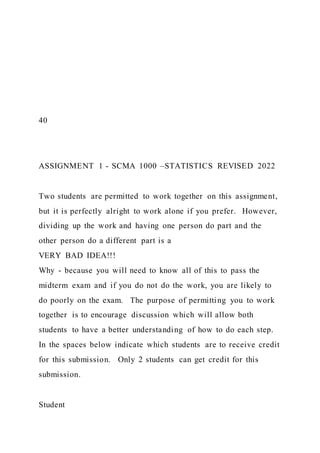
ASSIGNMENT 1 - SCMA 1000 –STATISTICS REVISED 2022
Two students are permitted to work together on this assignment,
but it is perfectly alright to work alone if you prefer. However,
dividing up the work and having one person do part and the
other person do a different part is a
VERY BAD IDEA!!!
Why - because you will need to know all of this to pass the
midterm exam and if you do not do the work, you are likely to
do poorly on the exam. The purpose of permitting you to work
together is to encourage discussion which will allow both
students to have a better understanding of how to do each step.
In the spaces below indicate which students are to receive credit
for this submission. Only 2 students can get credit for this
submission.
Student
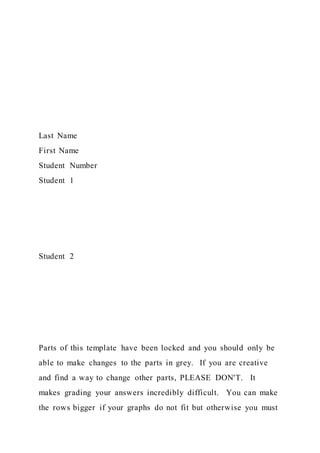
Last Name
First Name
Student Number
Student 1
Student 2
Parts of this template have been locked and you should only be
able to make changes to the parts in grey. If you are creative
and find a way to change other parts, PLEASE DON'T. It
makes grading your answers incredibly difficult. You can make
the rows bigger if your graphs do not fit but otherwise you must
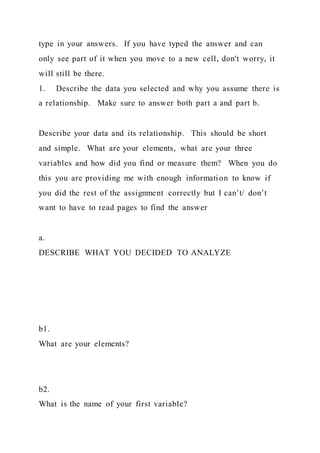
type in your answers. If you have typed the answer and can
only see part of it when you move to a new cell, don't worry, it
will still be there.
1. Describe the data you selected and why you assume there is
a relationship. Make sure to answer both part a and part b.
Describe your data and its relationship. This should be short
and simple. What are your elements, what are your three
variables and how did you find or measure them? When you do
this you are providing me with enough information to know if
you did the rest of the assignment correctly but I can’t/ don’t
want to have to read pages to find the answer
a.
DESCRIBE WHAT YOU DECIDED TO ANALYZE
b1.
What are your elements?
b2.
What is the name of your first variable?
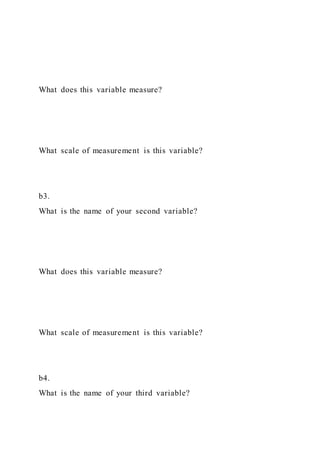
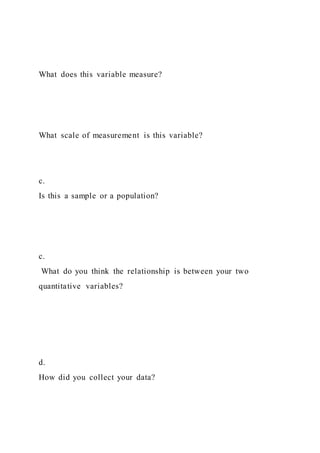
What does this variable measure?
What scale of measurement is this variable?
b3.
What is the name of your second variable?
What does this variable measure?
What scale of measurement is this variable?
b4.
What is the name of your third variable?
What does this variable measure?
What scale of measurement is this variable?
c.
Is this a sample or a population?
c.
What do you think the relationship is between your two
quantitative variables?
d.
How did you collect your data?
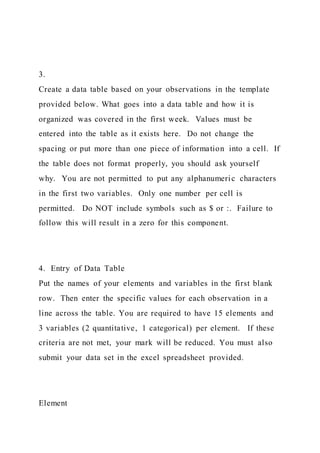
3.
Create a data table based on your observations in the template
provided below. What goes into a data table and how it is
organized was covered in the first week. Values must be
entered into the table as it exists here. Do not change the
spacing or put more than one piece of information into a cell. If
the table does not format properly, you should ask yourself
why. You are not permitted to put any alphanumeric characters
in the first two variables. Only one number per cell is
permitted. Do NOT include symbols such as $ or :. Failure to
follow this will result in a zero for this component.
4. Entry of Data Table
Put the names of your elements and variables in the first blank
row. Then enter the specific values for each observation in a
line across the table. You are required to have 15 elements and
3 variables (2 quantitative, 1 categorical) per element. If these
criteria are not met, your mark will be reduced. You must also
submit your data set in the excel spreadsheet provided.
Element
Values for Variable 1
(Quantitative)
Values for Variable 2
(Quantitative)
Values for Variable 3
(Categorical)
1
2
3
4
5
6
7
8
9
10
11
12
13
14
15
4
Using techniques introduced in Chapter 2 – create graphical
analyses (charts) of your three variables. At least one must be a
histogram, and one must be a bar chart. What you do with the
third variable is up to you as long as it is appropriate for the
kind of variable that it is. Please realize that a chart with 15
points on it is NOT a histogram. You must decide how to group
the data into classes before you can make a histogram. Again,
refer to Chapter 2 for instructions.
Note: To create a histogram, you will have to create a
classification table in addition to the raw data table.
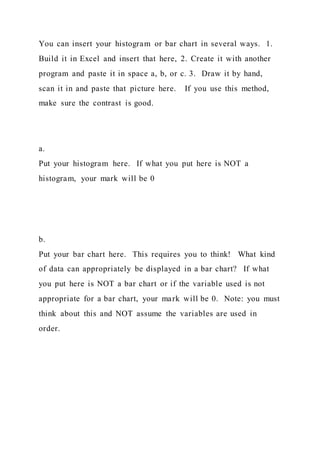
You can insert your histogram or bar chart in several ways. 1.
Build it in Excel and insert that here, 2. Create it with another
program and paste it in space a, b, or c. 3. Draw it by hand,
scan it in and paste that picture here. If you use this method,
make sure the contrast is good.
a.
Put your histogram here. If what you put here is NOT a
histogram, your mark will be 0
b.
Put your bar chart here. This requires you to think! What kind
of data can appropriately be displayed in a bar chart? If what
you put here is NOT a bar chart or if the variable used is not
appropriate for a bar chart, your mark will be 0. Note: you must
think about this and NOT assume the variables are used in
order.
c.
Put your graphic analysis of your remaining variable in the
space below. Make sure to use one of the techniques discussed
in class. It is acceptable to use one of the graphic analyses you
have already used for this variable, if you choose to.
5.
Prepare a set of descriptive statistics. Note that each section
has more slots than there are statistics. It is up to you to decide
how many you should include. Also, if you use a type of
statistic that is not appropriate to the overall description, you
will not receive any points.
a.
Statistics that tell you about the center of the distribution. You
must name the statistic and show the appropriate values for each
variable. If the measure is not related to the centre of the
distribution, it will not count.
Name of Statistic
Value for Variable 1
Value for Variable 2
b.
Statistics that tell you about the variability of the distr ibution.
Only statistics described in the text as showing shape will get
credit here. If the measure is not related to the shape of the
distribution, it will not count.
Name of Statistic
Value for Variable 1
Value for Variable 2
c.
Statistics that tell you about the shape of the distribution. What
are the key variables that provide information about shape? Are
there any other variables that describe the distribution that you
would include.
Name of Statistic
Value for Variable 1
Value for Variable 2
6
Create a box and whisker plot for your first variable. You only
have space to do one because you cannot change this template.
Creating this data representation for the categorical variable
will result in an immediate 0 for this section.
THIS MUST BE DONE USING VARIABLE 1!
a
What are the values you need to create your box and whisker
plot?
Name of Value
Value
b
What is the whisker length for your box and whisker plot?
c
Are there any outliers? Yes or No
Yes ☐ No ☐
d
Put plot here.
7
a
Use statistical techniques to determine whether or not a linear
relationship exists between your two quantitative variables and
how strong that relationship is. The correct answers are two
related numbers. Do not type words in the value space. Again,
this is Chapter 3 and you been doing this type of calculation
since Grade 7 but you must think about what I am asking for.
Name of Statistic
Value
b
Show the relationship between the two variables graphically.
Then show the two calculated numbers that describe the
relationship between the two variables. What conclusions can
you draw from this? Does it give the same result as Question 7?
Put chart here.

8
a
What is the probability for each condition of your categorical
variable? This is Chapter 4. You must build a frequency table
for your variable. Please try to limit this to two to three
categories and do NOT fill up all the rows in this table unless
you cannot avoid it.
Groups
Frequency
Relative Frequency
b
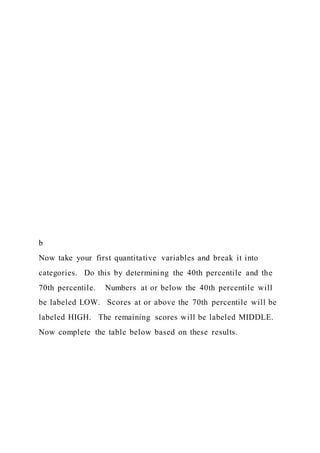
Now take your first quantitative variables and break it into
categories. Do this by determining the 40th percentile and the
70th percentile. Numbers at or below the 40th percentile will
be labeled LOW. Scores at or above the 70th percentile will be
labeled HIGH. The remaining scores will be labeled MIDDLE.
Now complete the table below based on these results.
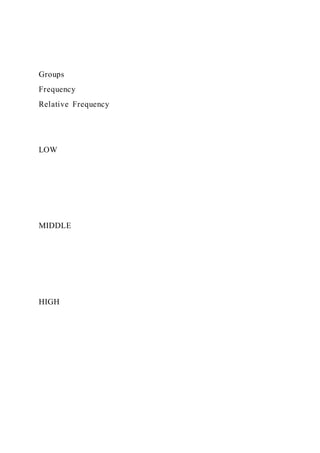
Groups
Frequency
Relative Frequency
LOW
MIDDLE
HIGH
9
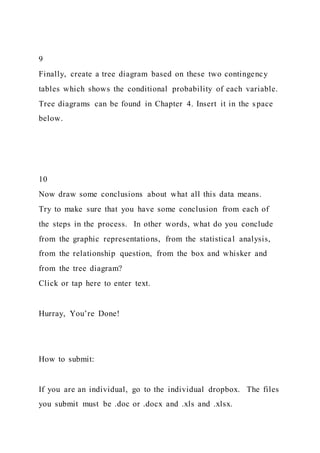
Finally, create a tree diagram based on these two contingency
tables which shows the conditional probability of each variable.
Tree diagrams can be found in Chapter 4. Insert it in the space
below.
10
Now draw some conclusions about what all this data means.
Try to make sure that you have some conclusion from each of
the steps in the process. In other words, what do you conclude
from the graphic representations, from the statistical analysis,
from the relationship question, from the box and whisker and
from the tree diagram?
Click or tap here to enter text.
Hurray, You’re Done!
How to submit:
If you are an individual, go to the individual dropbox. The files
you submit must be .doc or .docx and .xls and .xlsx.
If you are a group, go to the group tab and create a group. Then
go to the group dropbox. Only 1 person needs to submit but
both students will get credit. The files you submit must be .doc
or .docx and .xls and .xlsx.
Sheet1ElementValues for Variable 1Values for Variable
2Values for Variable
3(Quantitative)(Quantitative)(Categorical)123456789101112131
415000You must have exactly 15 elements. Any more or any
less will reduce your mark!The cell above must have a number
in it. If it does not, you have used an improper format.The cell
above must have a number in it. If it does not, you have used
an improper format.The cell above must NOT have a number
other than zero in it. If it does, you have used the wrong
format.

How to develop a motivated workplaceDr. Craig Nathanson

  • 1.
    How to developa motivated workplace Dr. Craig Nathanson 1 Motivation Productivity Low SkillsHigh Skills High ChallengeAnxietyFlow! Low ChallengeApathyBoredom drcraignathanson.com Motivating Workers ? 2
  • 2.
    Abilities Interests Fulfillment Meaning Happiness Is what youare doing ecologically sound? drcraignathanson.com Key factors to consider 3 Content theories- Individual needs and What motivates people Maslow- Hierarchy of needs (1950’s) Alder- ERG theory (1970’s) Existence, relatedness, growth (all can regress) McClellend Achievement Herzberg- Two factor theory drcraignathanson.com The Theories of Motivation 4 Process theories- Deal with HOW people are motivated B.F Skinner-Reinforcement theory- Behaviorism- Punishment and reward
  • 3.
    Vroom- Expectancy (willmy effort pay off?) Adam Equity Theory (motivation changes based on fairness) Locke- Goal setting drcraignathanson.com The Theories of Motivation-cont. 5 The last talk by B.F Skinner- 8 days before he died: https://www.youtube.com/watch?reload=9&v=V0fsgcRvfnQ Cognitive Rebuttal to Behaviorism by Noam Chomsky (Cognitive psychology deals with internal mental processes) https://www.youtube.com/watch?v=zobBTuX03D8 Behavioral vs. Cognitive Psychology debate Must be empirical or just experience that it works? Recent work in Cognitive neuroscience suggests a strong correlation between the brain and mental states drcraignathanson.com Theories of Motivation cont. 6 Existential Theory Personal responsibility for living the life you want Existential anxiety due to awareness of life’s finitude Positive mental health is based on the meaning we give to our
  • 4.
    lives Carl Rodgers believedin: Direct experience Congruence Unconditional positive regard Empathic understanding Necessary and sufficient for personal growth drcraignathanson.com The theories 7 Rogers: “All I know is it works for me.” Optimism is dangerous A cult of self-worship Kierkegaard Dostoevsky Nietzsche Kafka Hegel Husserl drcraignathanson.com The critics of Existential theory
  • 5.
    8 Roots in psychology Maslow Hierarchyof needs Physiological Security and safety Love and feelings of belonging Competence and self-esteem Self-fulfillment Curiosity and the need to understand drcraignathanson.com Motivational theory 9 Four dimensions of motivation Interest Relevance Expectancy Satisfaction Motivational theory deals with the processes and structures that cause us to want to learn drcraignathanson.com Motivational Theory cont.
  • 6.
    10 Motivation and theworkplace Two needs at work Avoid pain and gain pleasure Develop “hygiene” factors: workers unhappy without them Salary, status, good boss, security Once reached, satisfaction is temporary Personal growth becomes more important drcraignathanson.com Herzberg Satisfaction and dissatisfaction at work 11 Similar to Herzberg Achievement Authority and power Affiliation drcraignathanson.com McClelland
  • 7.
    12 Behaviorism focuses onchange in behavior Pavlov - Classical conditioning Dog and bell Watson - Emotional reactions Baby and rat https://www.youtube.com/watch?v=CYGXMXGkxtc Thorndike - Association theory Animals and escape B.F Skinner - Operant conditioning Stimulus and response https://www.youtube.com/watch?v=D-RS80DVvrg drcraignathanson.com Behaviorist Theories 13 Much of the theory tested only on animals Doesn’t take human language into account Many agree it can be successful in helping people resolve issues For example, as a therapeutic process drcraignathanson.com Critics of Behaviorism
  • 8.
    14 Lao-Tzu It is betternot to make merit a matter of reward lest people conspire and contend Alfie Kohn Rewards do motivate people; they motivate people to want more rewards! Kurt Lewin (1930) Rewards motivate us to not succeed at the task but to succeed at getting the award! drcraignathanson.com Rewards to motivate?? 15 B.F Skinner and Behaviorist theory Dominant in most companies today An individual or group is not meeting their objectives Solution : If you meet your objectives, you’ll get your bonus If you don’t meet your objectives, you’ll have a bad
  • 9.
    performance review A non-behavioristwould ask why objectives were not being met drcraignathanson.com Rewards (continued) 16 Student in class who has missed two straight classes Be here or risk a poor grade Come to the rest of the classes and your grade will not suffer Fact: Student has missed class because her father, who she was very close to, died of a massive heart attack. The teacher never asked why she missed class. drcraignathanson.com Rewards to motivate?
  • 10.
    17 Boss to group: Meetthis project deadline and we’ll have a pizza party Later, when progress is not getting made Meet this deadline or you will not have a vacation day next month drcraignathanson.com Reward to motivate? 18 Rewards can discourage risk-taking Reward is the goal and the focus becomes very narrow Being creative takes a back seat We get exactly what the reward called for and not much more Research has shown:
  • 11.
    When a rewardis at stake, the easiest route is selected This becomes a habit later when rewards are dropped drcraignathanson.com Some challenges with rewards 19 When you are rewarded or measured for something you love to do, your performance drops! https://www.youtube.com/watch?v=u6XAPnuFjJc drcraignathanson.com Some challenges with rewards
  • 12.
    20 Cash vs. non-cashrewards Performance management or goal setting Carrot and stick Would you rather work at a place that offers goodies and pats on the back OR interesting work, a sense of community, and an opportunity to contribute and make decisions? drcraignathanson.com Dangers of workplace incentives 21 No specific studies show long term improvement in quality as a result of any reward system (Kohn) Many studies have shown that rewards are ineffective and counterproductive
  • 13.
    Amazing fact: Organizationsand schools continue to use external rewards as motivation drcraignathanson.com Dangers of workplace incentives 22 Kohn Short term vs. long term focus Secrecy Too big vs. too small Nathanson The desire is collaboration; the result is competition Performance is largely a result of the system https://www.youtube.com/watch?v=OLLjV5O6Jx4 Deming The system of merit is the most powerful inhibitor to quality and productivity in the western world drcraignathanson.com
  • 14.
    Potential problems withPerformance Management 23 Probably not… But you can damage motivation with: Rewards Competition Threats or bribes If you do this, … If you don’t do this, … drcraignathanson.com As a manager, can you motivate someone?
  • 15.
    24 If you werein charge of a new company, what would you do to help people develop internal motivation if you could not reward and could not punish? drcraignathanson.com What would you do? 25 You will pay competitive salaries and benefits You can reward teams but not individuals You can give on-going benefits as long as they are available to everyone, e.g free lunch, flexible schedules. You will emphasize collaboration over competition drcraignathanson.com Case Assumptions
  • 16.
    26 Establish a systemthat is : Fair Matches high challenges and skills Treats everyone EQUALLY Encourages collaboration Eliminates competition, e.g. no ranking or rating Eliminates fear Provides job security Fosters trust Open drcraignathanson.com What can you do?
  • 17.
    27 drcraignathanson.com What motivates youand why? 28 Just give money to the winners Provide lots of competition between people Provide too much praise and recognition Provide lots of negative discipline and performance reviews Misalign abilities and interests Micro-manage Assign non-valued added work drcraignathanson.com How to de-motivate the workforce: A typical approach
  • 18.
    29 Build a cultureof respect Match high skills and high challenges Build a culture of productive relationships Role model a culture of coaching Teach workers how to motivate themselves drcraignathanson.com New approaches to worker motivation 30
  • 19.
    Have an inspiringbusiness vision Insist on individual decision making and autonomy Let workers work in ways that best fit them Provide the tools for each person to be successful drcraignathanson.com New approaches to worker motivation 31 Boomers (53 and older) 33 million Privilege Active and fit Wealthiest Improve the world Some reject traditional values drcraignathanson.com
  • 20.
    The generational challengesfor leaders 32 Gen X ( 38 and up) 41 million What’s in it for me Skepticism The age of divorce and single parent households MTV generation Entrepreneurial In mid-life seek work-life balance drcraignathanson.com Generations cont.
  • 21.
    33 Gen Y-Millennials (24and up) 71 million Promotion-moving forward Immediate satisfaction Focus in the moment Participation Groups Need regular feedback drcraignathanson.com Generations cont. 34
  • 22.
    Gen Z (Ages 7-23) 65 million and growing Entrepreneurial Co-create Want cool products and experiences Independent and mobile (always on) Understand technology intuitively Seek work/life balance Want stability and collaboration drcraignathanson.com Generations cont. 35 Each generation has different expectations Leaders will need to adapt Become more coach oriented More people focused vs. just profit focused
  • 23.
    More people areseeking meaning and joy in their work Communication is key Variety is key Inclusion and appreciation Personal development is key drcraignathanson.com Impact to leadership ? 36 Service roles Medical fields New, small, start-up businesses Contract roles The virtual employee drcraignathanson.com New types of work is emerging
  • 24.
    37 Jeremy Rifkin (Theend of work, 1995) computers replacing people Knowledge workers vs. displaced workers Redefining the nature of work https://www.youtube.com/watch?v=65zSO0iLHAo drcraignathanson.com A new phase in history! 38 People want:
  • 25.
    to grow anddevelop to match high challenges and high skills opportunities to contribute People become more motivated as they become more self-aware drcraignathanson.com A call to action and summary 39 Provide opportunities for self-assessment Provide clear opportunities for contributions Enable matching of high challenges and high skills abilities and interests Teach people how to motivate themselves drcraignathanson.com Next steps for organizations and leaders
  • 26.
    40 ASSIGNMENT 1 -SCMA 1000 –STATISTICS REVISED 2022 Two students are permitted to work together on this assignment, but it is perfectly alright to work alone if you prefer. However, dividing up the work and having one person do part and the other person do a different part is a VERY BAD IDEA!!! Why - because you will need to know all of this to pass the midterm exam and if you do not do the work, you are likely to do poorly on the exam. The purpose of permitting you to work together is to encourage discussion which will allow both students to have a better understanding of how to do each step. In the spaces below indicate which students are to receive credit for this submission. Only 2 students can get credit for this submission. Student
  • 27.
    Last Name First Name StudentNumber Student 1 Student 2 Parts of this template have been locked and you should only be able to make changes to the parts in grey. If you are creative and find a way to change other parts, PLEASE DON'T. It makes grading your answers incredibly difficult. You can make the rows bigger if your graphs do not fit but otherwise you must
  • 28.
    type in youranswers. If you have typed the answer and can only see part of it when you move to a new cell, don't worry, it will still be there. 1. Describe the data you selected and why you assume there is a relationship. Make sure to answer both part a and part b. Describe your data and its relationship. This should be short and simple. What are your elements, what are your three variables and how did you find or measure them? When you do this you are providing me with enough information to know if you did the rest of the assignment correctly but I can’t/ don’t want to have to read pages to find the answer a. DESCRIBE WHAT YOU DECIDED TO ANALYZE b1. What are your elements? b2. What is the name of your first variable?
  • 29.
    What does thisvariable measure? What scale of measurement is this variable? b3. What is the name of your second variable? What does this variable measure? What scale of measurement is this variable? b4. What is the name of your third variable?
  • 30.
    What does thisvariable measure? What scale of measurement is this variable? c. Is this a sample or a population? c. What do you think the relationship is between your two quantitative variables? d. How did you collect your data?
  • 31.
    3. Create a datatable based on your observations in the template provided below. What goes into a data table and how it is organized was covered in the first week. Values must be entered into the table as it exists here. Do not change the spacing or put more than one piece of information into a cell. If the table does not format properly, you should ask yourself why. You are not permitted to put any alphanumeric characters in the first two variables. Only one number per cell is permitted. Do NOT include symbols such as $ or :. Failure to follow this will result in a zero for this component. 4. Entry of Data Table Put the names of your elements and variables in the first blank row. Then enter the specific values for each observation in a line across the table. You are required to have 15 elements and 3 variables (2 quantitative, 1 categorical) per element. If these criteria are not met, your mark will be reduced. You must also submit your data set in the excel spreadsheet provided. Element
  • 32.
    Values for Variable1 (Quantitative) Values for Variable 2 (Quantitative) Values for Variable 3 (Categorical) 1 2 3
  • 33.
  • 34.
  • 35.
    14 15 4 Using techniques introducedin Chapter 2 – create graphical analyses (charts) of your three variables. At least one must be a histogram, and one must be a bar chart. What you do with the third variable is up to you as long as it is appropriate for the kind of variable that it is. Please realize that a chart with 15 points on it is NOT a histogram. You must decide how to group the data into classes before you can make a histogram. Again, refer to Chapter 2 for instructions. Note: To create a histogram, you will have to create a classification table in addition to the raw data table.
  • 36.
    You can insertyour histogram or bar chart in several ways. 1. Build it in Excel and insert that here, 2. Create it with another program and paste it in space a, b, or c. 3. Draw it by hand, scan it in and paste that picture here. If you use this method, make sure the contrast is good. a. Put your histogram here. If what you put here is NOT a histogram, your mark will be 0 b. Put your bar chart here. This requires you to think! What kind of data can appropriately be displayed in a bar chart? If what you put here is NOT a bar chart or if the variable used is not appropriate for a bar chart, your mark will be 0. Note: you must think about this and NOT assume the variables are used in order.
  • 37.
    c. Put your graphicanalysis of your remaining variable in the space below. Make sure to use one of the techniques discussed in class. It is acceptable to use one of the graphic analyses you have already used for this variable, if you choose to. 5. Prepare a set of descriptive statistics. Note that each section has more slots than there are statistics. It is up to you to decide how many you should include. Also, if you use a type of statistic that is not appropriate to the overall description, you will not receive any points. a. Statistics that tell you about the center of the distribution. You must name the statistic and show the appropriate values for each variable. If the measure is not related to the centre of the distribution, it will not count. Name of Statistic
  • 38.
    Value for Variable1 Value for Variable 2 b.
  • 39.
    Statistics that tellyou about the variability of the distr ibution. Only statistics described in the text as showing shape will get credit here. If the measure is not related to the shape of the distribution, it will not count. Name of Statistic Value for Variable 1 Value for Variable 2
  • 40.
    c. Statistics that tellyou about the shape of the distribution. What are the key variables that provide information about shape? Are there any other variables that describe the distribution that you would include.
  • 41.
    Name of Statistic Valuefor Variable 1 Value for Variable 2
  • 42.
    6 Create a boxand whisker plot for your first variable. You only have space to do one because you cannot change this template. Creating this data representation for the categorical variable will result in an immediate 0 for this section. THIS MUST BE DONE USING VARIABLE 1! a What are the values you need to create your box and whisker plot? Name of Value Value
  • 44.
    b What is thewhisker length for your box and whisker plot? c Are there any outliers? Yes or No Yes ☐ No ☐ d Put plot here. 7 a Use statistical techniques to determine whether or not a linear relationship exists between your two quantitative variables and how strong that relationship is. The correct answers are two related numbers. Do not type words in the value space. Again, this is Chapter 3 and you been doing this type of calculation since Grade 7 but you must think about what I am asking for.
  • 45.
  • 46.
    b Show the relationshipbetween the two variables graphically. Then show the two calculated numbers that describe the relationship between the two variables. What conclusions can you draw from this? Does it give the same result as Question 7? Put chart here. 8 a What is the probability for each condition of your categorical variable? This is Chapter 4. You must build a frequency table for your variable. Please try to limit this to two to three categories and do NOT fill up all the rows in this table unless you cannot avoid it.
  • 47.
  • 48.
    b Now take yourfirst quantitative variables and break it into categories. Do this by determining the 40th percentile and the 70th percentile. Numbers at or below the 40th percentile will be labeled LOW. Scores at or above the 70th percentile will be labeled HIGH. The remaining scores will be labeled MIDDLE. Now complete the table below based on these results.
  • 49.
  • 50.
    9 Finally, create atree diagram based on these two contingency tables which shows the conditional probability of each variable. Tree diagrams can be found in Chapter 4. Insert it in the space below. 10 Now draw some conclusions about what all this data means. Try to make sure that you have some conclusion from each of the steps in the process. In other words, what do you conclude from the graphic representations, from the statistical analysis, from the relationship question, from the box and whisker and from the tree diagram? Click or tap here to enter text. Hurray, You’re Done! How to submit: If you are an individual, go to the individual dropbox. The files you submit must be .doc or .docx and .xls and .xlsx.
  • 51.
    If you area group, go to the group tab and create a group. Then go to the group dropbox. Only 1 person needs to submit but both students will get credit. The files you submit must be .doc or .docx and .xls and .xlsx. Sheet1ElementValues for Variable 1Values for Variable 2Values for Variable 3(Quantitative)(Quantitative)(Categorical)123456789101112131 415000You must have exactly 15 elements. Any more or any less will reduce your mark!The cell above must have a number in it. If it does not, you have used an improper format.The cell above must have a number in it. If it does not, you have used an improper format.The cell above must NOT have a number other than zero in it. If it does, you have used the wrong format.