Employee Knowledge Management
Process
2/28/2021 1
Dr. Latha Venkatesan
Professor cum Principal
College of Nursing, AIIMS,
New Delhi
Email:
drlathavenkatesan@aiims.edu
KNOWLEDGE MANAGEMENT
• American Productivity & Quality Center (APQC) defines knowledge
management as a collection of systematic approaches to help information
and knowledge flow to and between the right people at the right time (in
the right format at the right cost) so they can act more efficiently and
effectively to create value for the organization
2/28/2021 2
The key takeaway from this definition is the use of the word ‘right‘. Only when
an employee has the right knowledge available to them at the right time, can
they act immediately and provide maximum output towards their work.
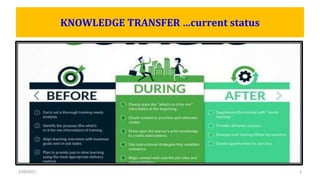
KNOWLEDGE TRANSFER …current status
2/28/2021 3
2/28/2021 4
INFORMATION MANAGEMENT Vs
KNOWLEDGE MANAGEMENT
2/28/2021 5
WHAT ARE WE TODAY?
2/28/2021 6
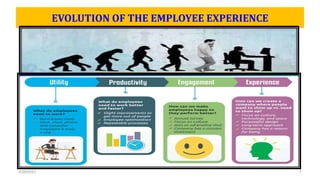
EVOLUTION OF THE EMPLOYEE EXPERIENCE
2/28/2021 7
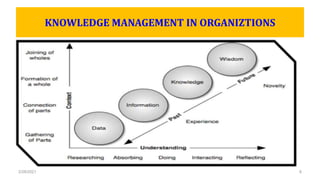
KNOWLEDGE MANAGEMENT IN ORGANIZTIONS
2/28/2021 8
GLOBAL SCENERIO
• Statistics show that as many as 40% of employees do not utilize proper
knowledge management solutions, and between 7-20% of their time is
spent figuring out a problem from scratch when the solution already exists
somewhere in the company.
2/28/2021 9
KNOWLEDGE MANAGEMENT SYSTEM-CURRENT SCENERIO
How Knowledge Management
Plays a Life-Saving Role in the
Corona virus Epidemic?
Knowledge management
technologies deliver accurate,
real-time information and
prevent future infections in
this healthcare crisis
2/28/2021 10
Employee Knowledge Management
Evidence Based Practices-Global
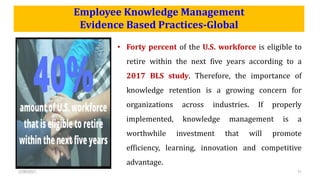
• Forty percent of the U.S. workforce is eligible to
retire within the next five years according to a
2017 BLS study. Therefore, the importance of
knowledge retention is a growing concern for
organizations across industries. If properly
implemented, knowledge management is a
worthwhile investment that will promote
efficiency, learning, innovation and competitive
advantage.
2/28/2021 11
Employee Knowledge Management
Evidence Based Practices -National
“Empirical study of employee perception regarding knowledge
management (KM) in India”(April, 2018)
2/28/2021 12
This survey and facts about Indian Organizations‟ knowledge
management implementation shows that employees have positive
attitude towards KM. Although, KM is still in its infancy but from
the survey, it is seen that employees are willing to share their
expertise, provided there is a proper platform and recognition
system existent in the process. It is interesting to see that people
don't consider knowledge sharing as an additional responsibility
and time consuming activity which is a sign of acceptance of KM.
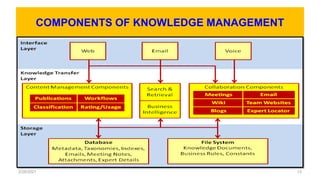
COMPONENTS OF KNOWLEDGE MANAGEMENT
2/28/2021 13
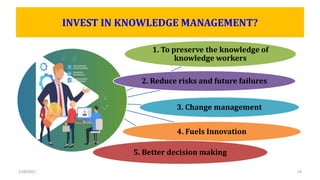
INVEST IN KNOWLEDGE MANAGEMENT?
1. To preserve the knowledge of
knowledge workers
2. Reduce risks and future failures
3. Change management
4. Fuels Innovation
5. Better decision making
2/28/2021 14
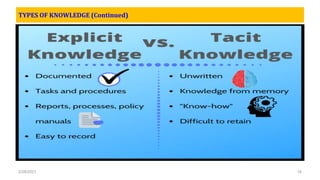
TYPES OF KNOWLEDGE
• When it comes to knowledge in the workplace, there are two
types: explicit and tacit.
• Understanding these two main types of knowledge will be crucial as
you learn how to navigate the process of gathering and
implementing knowledge as it relates to company’s hiring, training
and retention efforts.
2/28/2021 15
TYPES OF KNOWLEDGE (Continued)
2/28/2021 16
FACTORS INFLUENCING KNOWLEDGE MANAGEMENT
Each organization has unique ways of handling explicit and tacit knowledge.
Many factors affect how knowledge is used, including:
2/28/2021 17
1.where organizations are in their life cycle ?
2. type of business
3. core competencies
4. leadership, culture
5. infrastructure
6. marketplace competition
FACTORS INFLUENCING KNOWLEDGE MANAGEMENT (Continued)
• Effective knowledge management initiatives are designed to take
critical tacit knowledge that is unseen and known by only one or a
few individuals and turn it into explicit knowledge to be
transferred to many.
2/28/2021 18
2/28/2021 19
KNOWLEDGE MANAGEMENT PROGRAM
2/28/2021 20
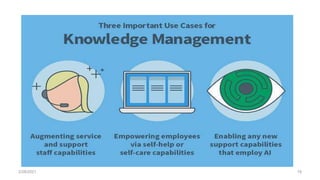
Where it is needed?
KNOWLEDGE MANAGEMENT PROGRAM(CONTINUED)
Knowledge management program is the act of recording, sharing,
and constructively applying knowledge.
2/28/2021 21
5 Core Considerations for a Knowledge Management
Program
2/28/2021 22
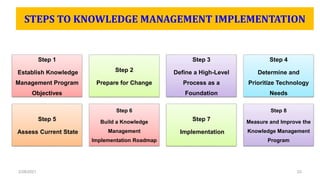
STEPS TO KNOWLEDGE MANAGEMENT IMPLEMENTATION
Step 1
Establish Knowledge
Management Program
Objectives
Step 2
Prepare for Change
Step 3
Define a High-Level
Process as a
Foundation
Step 4
Determine and
Prioritize Technology
Needs
Step 5
Assess Current State
Step 6
Build a Knowledge
Management
Implementation Roadmap
Step 7
Implementation
Step 8
Measure and Improve the
Knowledge Management
Program
2/28/2021 23
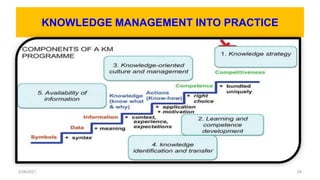
KNOWLEDGE MANAGEMENT INTO PRACTICE
2/28/2021 24
ADVANCED KNOWLEDGE MANAGEMENT WITHIN
CORPORATIONS
2/28/2021 25
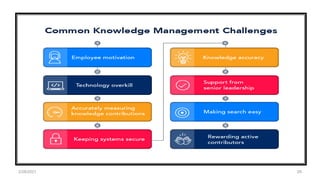
KNOWLEDGE MANAGEMENT IN ORGANIZTIONS (CONTINUED)
2/28/2021 26
KNOWLEDGE MANAGEMENT IN HEALTH CARE
2/28/2021 27
2/28/2021 28
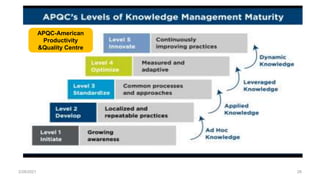
APQC-American
Productivity
&Quality Centre
2/28/2021 29
2/28/2021 30
Thank you!
2/28/2021 31

Employee knowledge management process

  • 1.
    Employee Knowledge Management Process 2/28/20211 Dr. Latha Venkatesan Professor cum Principal College of Nursing, AIIMS, New Delhi Email: drlathavenkatesan@aiims.edu
  • 2.
    KNOWLEDGE MANAGEMENT • AmericanProductivity & Quality Center (APQC) defines knowledge management as a collection of systematic approaches to help information and knowledge flow to and between the right people at the right time (in the right format at the right cost) so they can act more efficiently and effectively to create value for the organization 2/28/2021 2 The key takeaway from this definition is the use of the word ‘right‘. Only when an employee has the right knowledge available to them at the right time, can they act immediately and provide maximum output towards their work.
  • 3.
  • 4.
  • 5.
  • 6.
    WHAT ARE WETODAY? 2/28/2021 6
  • 7.
    EVOLUTION OF THEEMPLOYEE EXPERIENCE 2/28/2021 7
  • 8.
    KNOWLEDGE MANAGEMENT INORGANIZTIONS 2/28/2021 8
  • 9.
    GLOBAL SCENERIO • Statisticsshow that as many as 40% of employees do not utilize proper knowledge management solutions, and between 7-20% of their time is spent figuring out a problem from scratch when the solution already exists somewhere in the company. 2/28/2021 9
  • 10.
    KNOWLEDGE MANAGEMENT SYSTEM-CURRENTSCENERIO How Knowledge Management Plays a Life-Saving Role in the Corona virus Epidemic? Knowledge management technologies deliver accurate, real-time information and prevent future infections in this healthcare crisis 2/28/2021 10
  • 11.
    Employee Knowledge Management EvidenceBased Practices-Global • Forty percent of the U.S. workforce is eligible to retire within the next five years according to a 2017 BLS study. Therefore, the importance of knowledge retention is a growing concern for organizations across industries. If properly implemented, knowledge management is a worthwhile investment that will promote efficiency, learning, innovation and competitive advantage. 2/28/2021 11
  • 12.
    Employee Knowledge Management EvidenceBased Practices -National “Empirical study of employee perception regarding knowledge management (KM) in India”(April, 2018) 2/28/2021 12 This survey and facts about Indian Organizations‟ knowledge management implementation shows that employees have positive attitude towards KM. Although, KM is still in its infancy but from the survey, it is seen that employees are willing to share their expertise, provided there is a proper platform and recognition system existent in the process. It is interesting to see that people don't consider knowledge sharing as an additional responsibility and time consuming activity which is a sign of acceptance of KM.
  • 13.
    COMPONENTS OF KNOWLEDGEMANAGEMENT 2/28/2021 13
  • 14.
    INVEST IN KNOWLEDGEMANAGEMENT? 1. To preserve the knowledge of knowledge workers 2. Reduce risks and future failures 3. Change management 4. Fuels Innovation 5. Better decision making 2/28/2021 14
  • 15.
    TYPES OF KNOWLEDGE •When it comes to knowledge in the workplace, there are two types: explicit and tacit. • Understanding these two main types of knowledge will be crucial as you learn how to navigate the process of gathering and implementing knowledge as it relates to company’s hiring, training and retention efforts. 2/28/2021 15
  • 16.
    TYPES OF KNOWLEDGE(Continued) 2/28/2021 16
  • 17.
    FACTORS INFLUENCING KNOWLEDGEMANAGEMENT Each organization has unique ways of handling explicit and tacit knowledge. Many factors affect how knowledge is used, including: 2/28/2021 17 1.where organizations are in their life cycle ? 2. type of business 3. core competencies 4. leadership, culture 5. infrastructure 6. marketplace competition
  • 18.
    FACTORS INFLUENCING KNOWLEDGEMANAGEMENT (Continued) • Effective knowledge management initiatives are designed to take critical tacit knowledge that is unseen and known by only one or a few individuals and turn it into explicit knowledge to be transferred to many. 2/28/2021 18
  • 19.
  • 20.
  • 21.
    KNOWLEDGE MANAGEMENT PROGRAM(CONTINUED) Knowledgemanagement program is the act of recording, sharing, and constructively applying knowledge. 2/28/2021 21
  • 22.
    5 Core Considerationsfor a Knowledge Management Program 2/28/2021 22
  • 23.
    STEPS TO KNOWLEDGEMANAGEMENT IMPLEMENTATION Step 1 Establish Knowledge Management Program Objectives Step 2 Prepare for Change Step 3 Define a High-Level Process as a Foundation Step 4 Determine and Prioritize Technology Needs Step 5 Assess Current State Step 6 Build a Knowledge Management Implementation Roadmap Step 7 Implementation Step 8 Measure and Improve the Knowledge Management Program 2/28/2021 23
  • 24.
    KNOWLEDGE MANAGEMENT INTOPRACTICE 2/28/2021 24
  • 25.
    ADVANCED KNOWLEDGE MANAGEMENTWITHIN CORPORATIONS 2/28/2021 25
  • 26.
    KNOWLEDGE MANAGEMENT INORGANIZTIONS (CONTINUED) 2/28/2021 26
  • 27.
    KNOWLEDGE MANAGEMENT INHEALTH CARE 2/28/2021 27
  • 28.
  • 29.
  • 30.
  • 31.