BAHIR DAR UNIVERSITY (BDU)
BAHIR DAR INSTITUTE OF TECHNOLOGY (BIT)
FACULTY OF CIVIL AND WATER RESOURCES ENGINEERING
(FCWRE)
MSc in Construction Technology and Management
Organizational and Labour Management
Presentation on Grievance and Grievance Handling
By
1. Mikiyas Amsalu
2. Saleamlak Gedefaw
3. Tigist Kibrie
Contents
• Introduction
• Types of Grievance
• Causes of Grievance
• Methods of Understanding employee grievances
• Grievance Handling (Redressal) procedures
• Small Scale Construction Companies with Informal Grievance
Handling Procedures in Central Province, Sri Lanka
• Major effects of Grievance
• Benefits of a grievance redressal procedure
• Conclusion
Introduction
• A grievance is a sign of employee’s discontent with job
and its nature.
• When the organization fails to satisfy the employee
needs, he develops a feeling of discontent or
dissatisfaction. It can be related to wages, conditions of
work, leave, transfer, overtime, promotion, seniority, job
assignment and termination of service.
Let us consider some important definitions of ‘grievance’
given by some behavioral scientists.
 According to Dale Yoder “A grievance is a written complaint
filed by an employee and claiming unfair treatment.”
 Keith Davis defines it as “any real or imagined feeling of
personal injustice which an employee has concerning his
employment relationship.”
 According to J.M. Jucius “A grievance is any discontent or
dissatisfaction whether expressed or not, whether valid or not,
arising out of anything connected with the company which an
employee thinks, believes or even feels to be unfair, unjust or
inequitable”
• To distinguish between dissatisfaction, complaint, and grievance;
dissatisfaction is any state or feeling of dissatisfaction which is
orally made known by one employee to another known as a
complaint. A complaint becomes a grievance when this
dissatisfaction, which is mostly related to work, is brought to the
notice of the management(Law & Handbook, n.d.)..
Grievance has the following characteristics:
 Grievance reflects dissatisfaction or discontent experienced by
employees.
 It is a sense of injustice to one’s job meted out by the employer.
 It may be expressed or implied.
 It may be verbal or written.
 It may be real or imaginary.
 It may be valid and legitimate or may not be so.
 Grievance may arise out of something related to employee’s
service contract.
 Grievance, not addressed in time, gives rise to discontent,
frustration, poor morale and low productivity.
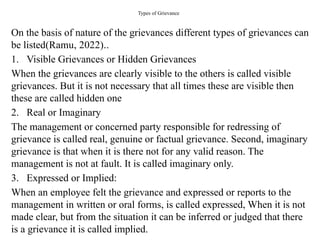
Types of Grievance
On the basis of nature of the grievances different types of grievances can
be listed(Ramu, 2022)..
1. Visible Grievances or Hidden Grievances
When the grievances are clearly visible to the others is called visible
grievances. But it is not necessary that all times these are visible then
these are called hidden one
2. Real or Imaginary
The management or concerned party responsible for redressing of
grievance is called real, genuine or factual grievance. Second, imaginary
grievance is that when it is there not for any valid reason. The
management is not at fault. It is called imaginary only.
3. Expressed or Implied:
When an employee felt the grievance and expressed or reports to the
management in written or oral forms, is called expressed, When it is not
made clear, but from the situation it can be inferred or judged that there
is a grievance it is called implied.
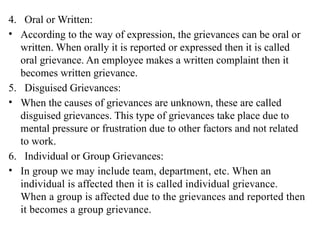
4. Oral or Written:
• According to the way of expression, the grievances can be oral or
written. When orally it is reported or expressed then it is called
oral grievance. An employee makes a written complaint then it
becomes written grievance.
5. Disguised Grievances:
• When the causes of grievances are unknown, these are called
disguised grievances. This type of grievances take place due to
mental pressure or frustration due to other factors and not related
to work.
6. Individual or Group Grievances:
• In group we may include team, department, etc. When an
individual is affected then it is called individual grievance.
When a group is affected due to the grievances and reported then
it becomes a group grievance.
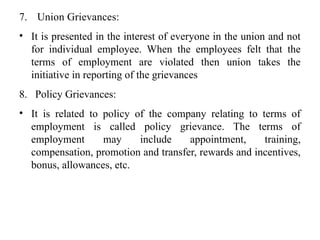
7. Union Grievances:
• It is presented in the interest of everyone in the union and not
for individual employee. When the employees felt that the
terms of employment are violated then union takes the
initiative in reporting of the grievances
8. Policy Grievances:
• It is related to policy of the company relating to terms of
employment is called policy grievance. The terms of
employment may include appointment, training,
compensation, promotion and transfer, rewards and incentives,
bonus, allowances, etc.
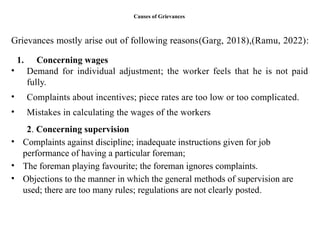
Causes of Grievances
Grievances mostly arise out of following reasons(Garg, 2018),(Ramu, 2022):
1. Concerning wages
• Demand for individual adjustment; the worker feels that he is not paid
fully.
• Complaints about incentives; piece rates are too low or too complicated.
• Mistakes in calculating the wages of the workers
2. Concerning supervision
• Complaints against discipline; inadequate instructions given for job
performance of having a particular foreman;
• The foreman playing favourite; the foreman ignores complaints.
• Objections to the manner in which the general methods of supervision are
used; there are too many rules; regulations are not clearly posted.
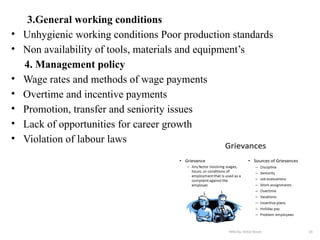
3.General working conditions
• Unhygienic working conditions Poor production standards
• Non availability of tools, materials and equipment’s
4. Management policy
• Wage rates and methods of wage payments
• Overtime and incentive payments
• Promotion, transfer and seniority issues
• Lack of opportunities for career growth
• Violation of labour laws
Methods of Understanding employee
grievances
• Grievances should be redressed by adopting proactive approach
rather than waiting for the grievances to be brought to the notice
of management
• The management can go through four methods for identifying
grievances(Handling et al., n.d.):
1. Exit Interview:
• An employee may leave the organization either because of his
dissatisfaction with the organization.
•Exist interview, if conducted properly, elicits important
information about the various aspects of the organizational
functioning relevant to employees.
2. Gripe Box System:
• This method is more appropriate in those organizations where
there is lack of trust and understanding between employees and
their supervisors.
3. Opinion Surveys:
• Opinion surveys, conducted periodically on the employee-
related issues, provide relevant information about the state of
grievances among them.
• Such surveys may be in the form of morale survey, attitude
survey, job satisfaction survey, and grievance survey.
4. Open-Door Policy:
• Open-door policy implies that the employees are invited to
discuss their problems freely and frankly at any time, or drop
their complaints to the relevant managers’ rooms at any time.
• The basic objective of an open-door policy is to encourage
upward communication.
Grievance Handling (Redressal) procedures
•A grievance procedure is a formal process which is preliminary to an
arbritration, which enables the parties involved to attempt to resolve their
differences in a peaceful manner(Ramu, 2022), (Compass et al., n.d.).
The following points are relevant to be kept in mind during handling
a grievance:
1. Every grievance must be given due respect and considered
important.
2. A grievance should not be postponed with hope that people will
“see the light” themselves.
3. A grievance should be put in writing.
4. A relevant facts about a grievance should be gathered by
management and their proper records should be maintained.
5. The employee should be given free time off to pursue his
grievance.
6. Management should take a list of all solutions and later
evaluate them one by one in term of their total effect on the
organization.
7. Decision once reached should be communicated to the
employee and acted upon by the management.
8. Follow-up must be done by the management to determine
whether action taken by it has favourably changed the
employee’s attitude or not.
A good grievance handling (redressal) system should
accommodate the following essentials(Garg, 2018):
1. Timely Action – Management should ventilate the grievances as
and when they arise. They should be nipped in the bud. For this
purpose, supervisors should be trained in recognizing and handling
the grievances promptly.
2. Acknowledgement of Grievance – Once the grievance is filed,
management should register it and grievant should be assured that
it would be attended to.
3. Identifying the Problem – The supervisor has to diagnose the
problem.
4. Collecting Facts – Once the problem is figured out, the
supervisor should collect all relevant facts and profile relating to
the grievance.
5. Analyzing the Cause – Supervisor has to get to the root of the
problem. It involves studying various aspects of grievance like
employee’s past history, frequencies of occurrence, management
practices, union practices etc. Thus, identification of the cause helps
the management to take remedial actions.
6. Taking Decision – Various alternative courses of action are worked
out. These are evaluated in view of their consequences on the
aggrieved employee, the union and the management. Final decision
suited to a given situation is arrived at.
7. Implementing the Decision – The decision taken should be
communicated to the grievant and implemented by the authority.
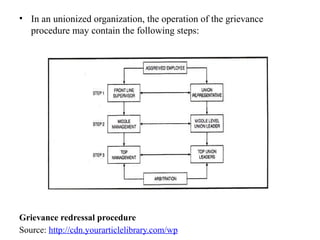
• In an unionized organization, the operation of the grievance
procedure may contain the following steps:
Grievance redressal procedure
Source: http://cdn.yourarticlelibrary.com/wp
Small Scale Construction Companies with
Informal Grievance Handling
Procedures in Central Province, Sri Lanka
•The study mainly focused on identifying the nature of
grievances, reasons for the grievances and the possible redressing
methods for the identified grievances of Construction workers.
•Grievances typically cover the following areas: Pay and working
conditions, Terms of employment and workplace rules,
Disagreements with co-workers, and Allegations of unfair
treatment at work(Dharmapala et al., 2017).
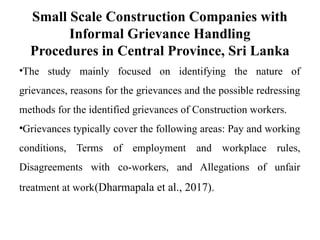
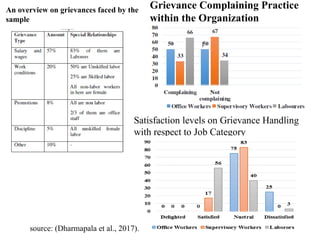
An overview on grievances faced by the
sample
Grievance Complaining Practice
within the Organization
Satisfaction levels on Grievance Handling
with respect to Job Category
source: (Dharmapala et al., 2017).
Major effects of Grievance
1. On Production:
Production may be affected as under(Handling et al., n.d.):
(i) Increase in the cost of production per unit.
(ii) Low quality of productivity.
(iii) Increase in the wastage of material, spoilage/leakage of machinery.
(iv) Low quality of production.
2. On the Employees:
The Grievance if unaddressed tend to affect the employees in the
following conditions:
(i) Reduction in the level of employee morale.
(ii) Reduction the level of commitment, sincerity and punctuality.
(iii) Increased in the number of accidents.
(iv) Increased rate of absenteeism and turnover.
(v) Increase in resignation of employees.
3. On the Managers:
Grievances when unaddressed affect the managers as under:
(i) Stain in the superior-subordinate relations.
(ii) Rise in indiscipline cases.
(iii) Rise in unrest and thereby machinery to maintain industrial
peace.
(iv) Rise in the degree of supervision, control and follow-up.
Benefits of a grievance redressal procedure
The following are the benefits of an adequate grievance
procedure(Law & Handbook, n.d.),(Compass et al., n.d.):
1. Bringing to light – It brings grievances into the open so that
management can learn about them and try corrective action.
2. Preventing the grievance from growing to dispute – It helps in
preventing grievances from assuming big proportions. The
management catches and solves a grievance before it becomes a
massive dispute.
3. The way to improvement – It enables the management to know
the attitudes and feelings of employee concerning the policies, rules
and practices of the organization. With such knowledge necessary
improvements in policies and rules can be made.
• 4. Check on management – It acts as a check upon arbitrary and
capricious management action. When a manager knows that his
actions are subject to challenge and review in a grievance system
he becomes more careful in taking his decisions.
• 5. Emotional release – It provides employees a formalized means
of emotional release for their dissatisfactions. Even if a worker
does not use the grievance system for his own emotional release in
a particular situation, he feels better because he knows the system
is there to use if he wants to do so. It creates a sense of emotional
security for them.
• 6. Maintenance of work culture – It helps in establishing and
maintaining a work culture or way of life. As problems are
interpreted in the grievance procedure, the group learns how it is
expected to respond to the policies that have been set up.
Conclusion
•A grievance is any discontent or dissatisfaction, whether expressed or
not, whether valid or not arising out of anything connected with the
company which an employee thinks believes or feels to be unfair,
unjust or inequitable.
•Grievances may arise due to problems related to wages, general
working conditions or due to problems relating to supervision.
•Grievances redressal procedure gives an assurance to the employees
about the existence of a mechanism for the prompt redressal of their
grievance.
•There are few grievance identification techniques like open door
policy, exit interviews, opinion surveys and gripe boxes.
Thank You

Grievance handling -construction Technology and managment

  • 1.
    BAHIR DAR UNIVERSITY(BDU) BAHIR DAR INSTITUTE OF TECHNOLOGY (BIT) FACULTY OF CIVIL AND WATER RESOURCES ENGINEERING (FCWRE) MSc in Construction Technology and Management Organizational and Labour Management Presentation on Grievance and Grievance Handling By 1. Mikiyas Amsalu 2. Saleamlak Gedefaw 3. Tigist Kibrie
  • 2.
    Contents • Introduction • Typesof Grievance • Causes of Grievance • Methods of Understanding employee grievances • Grievance Handling (Redressal) procedures • Small Scale Construction Companies with Informal Grievance Handling Procedures in Central Province, Sri Lanka • Major effects of Grievance • Benefits of a grievance redressal procedure • Conclusion
  • 3.
    Introduction • A grievanceis a sign of employee’s discontent with job and its nature. • When the organization fails to satisfy the employee needs, he develops a feeling of discontent or dissatisfaction. It can be related to wages, conditions of work, leave, transfer, overtime, promotion, seniority, job assignment and termination of service. Let us consider some important definitions of ‘grievance’ given by some behavioral scientists.  According to Dale Yoder “A grievance is a written complaint filed by an employee and claiming unfair treatment.”
  • 4.
     Keith Davisdefines it as “any real or imagined feeling of personal injustice which an employee has concerning his employment relationship.”  According to J.M. Jucius “A grievance is any discontent or dissatisfaction whether expressed or not, whether valid or not, arising out of anything connected with the company which an employee thinks, believes or even feels to be unfair, unjust or inequitable” • To distinguish between dissatisfaction, complaint, and grievance; dissatisfaction is any state or feeling of dissatisfaction which is orally made known by one employee to another known as a complaint. A complaint becomes a grievance when this dissatisfaction, which is mostly related to work, is brought to the notice of the management(Law & Handbook, n.d.)..
  • 5.
    Grievance has thefollowing characteristics:  Grievance reflects dissatisfaction or discontent experienced by employees.  It is a sense of injustice to one’s job meted out by the employer.  It may be expressed or implied.  It may be verbal or written.  It may be real or imaginary.  It may be valid and legitimate or may not be so.  Grievance may arise out of something related to employee’s service contract.  Grievance, not addressed in time, gives rise to discontent, frustration, poor morale and low productivity.
  • 6.
    Types of Grievance Onthe basis of nature of the grievances different types of grievances can be listed(Ramu, 2022).. 1. Visible Grievances or Hidden Grievances When the grievances are clearly visible to the others is called visible grievances. But it is not necessary that all times these are visible then these are called hidden one 2. Real or Imaginary The management or concerned party responsible for redressing of grievance is called real, genuine or factual grievance. Second, imaginary grievance is that when it is there not for any valid reason. The management is not at fault. It is called imaginary only. 3. Expressed or Implied: When an employee felt the grievance and expressed or reports to the management in written or oral forms, is called expressed, When it is not made clear, but from the situation it can be inferred or judged that there is a grievance it is called implied.
  • 7.
    4. Oral orWritten: • According to the way of expression, the grievances can be oral or written. When orally it is reported or expressed then it is called oral grievance. An employee makes a written complaint then it becomes written grievance. 5. Disguised Grievances: • When the causes of grievances are unknown, these are called disguised grievances. This type of grievances take place due to mental pressure or frustration due to other factors and not related to work. 6. Individual or Group Grievances: • In group we may include team, department, etc. When an individual is affected then it is called individual grievance. When a group is affected due to the grievances and reported then it becomes a group grievance.
  • 8.
    7. Union Grievances: •It is presented in the interest of everyone in the union and not for individual employee. When the employees felt that the terms of employment are violated then union takes the initiative in reporting of the grievances 8. Policy Grievances: • It is related to policy of the company relating to terms of employment is called policy grievance. The terms of employment may include appointment, training, compensation, promotion and transfer, rewards and incentives, bonus, allowances, etc.
  • 9.
    Causes of Grievances Grievancesmostly arise out of following reasons(Garg, 2018),(Ramu, 2022): 1. Concerning wages • Demand for individual adjustment; the worker feels that he is not paid fully. • Complaints about incentives; piece rates are too low or too complicated. • Mistakes in calculating the wages of the workers 2. Concerning supervision • Complaints against discipline; inadequate instructions given for job performance of having a particular foreman; • The foreman playing favourite; the foreman ignores complaints. • Objections to the manner in which the general methods of supervision are used; there are too many rules; regulations are not clearly posted.
  • 10.
    3.General working conditions •Unhygienic working conditions Poor production standards • Non availability of tools, materials and equipment’s 4. Management policy • Wage rates and methods of wage payments • Overtime and incentive payments • Promotion, transfer and seniority issues • Lack of opportunities for career growth • Violation of labour laws
  • 11.
    Methods of Understandingemployee grievances • Grievances should be redressed by adopting proactive approach rather than waiting for the grievances to be brought to the notice of management • The management can go through four methods for identifying grievances(Handling et al., n.d.):
  • 12.
    1. Exit Interview: •An employee may leave the organization either because of his dissatisfaction with the organization. •Exist interview, if conducted properly, elicits important information about the various aspects of the organizational functioning relevant to employees. 2. Gripe Box System: • This method is more appropriate in those organizations where there is lack of trust and understanding between employees and their supervisors.
  • 13.
    3. Opinion Surveys: •Opinion surveys, conducted periodically on the employee- related issues, provide relevant information about the state of grievances among them. • Such surveys may be in the form of morale survey, attitude survey, job satisfaction survey, and grievance survey. 4. Open-Door Policy: • Open-door policy implies that the employees are invited to discuss their problems freely and frankly at any time, or drop their complaints to the relevant managers’ rooms at any time. • The basic objective of an open-door policy is to encourage upward communication.
  • 14.
    Grievance Handling (Redressal)procedures •A grievance procedure is a formal process which is preliminary to an arbritration, which enables the parties involved to attempt to resolve their differences in a peaceful manner(Ramu, 2022), (Compass et al., n.d.). The following points are relevant to be kept in mind during handling a grievance: 1. Every grievance must be given due respect and considered important. 2. A grievance should not be postponed with hope that people will “see the light” themselves. 3. A grievance should be put in writing. 4. A relevant facts about a grievance should be gathered by management and their proper records should be maintained.
  • 15.
    5. The employeeshould be given free time off to pursue his grievance. 6. Management should take a list of all solutions and later evaluate them one by one in term of their total effect on the organization. 7. Decision once reached should be communicated to the employee and acted upon by the management. 8. Follow-up must be done by the management to determine whether action taken by it has favourably changed the employee’s attitude or not.
  • 16.
    A good grievancehandling (redressal) system should accommodate the following essentials(Garg, 2018): 1. Timely Action – Management should ventilate the grievances as and when they arise. They should be nipped in the bud. For this purpose, supervisors should be trained in recognizing and handling the grievances promptly. 2. Acknowledgement of Grievance – Once the grievance is filed, management should register it and grievant should be assured that it would be attended to. 3. Identifying the Problem – The supervisor has to diagnose the problem. 4. Collecting Facts – Once the problem is figured out, the supervisor should collect all relevant facts and profile relating to the grievance.
  • 17.
    5. Analyzing theCause – Supervisor has to get to the root of the problem. It involves studying various aspects of grievance like employee’s past history, frequencies of occurrence, management practices, union practices etc. Thus, identification of the cause helps the management to take remedial actions. 6. Taking Decision – Various alternative courses of action are worked out. These are evaluated in view of their consequences on the aggrieved employee, the union and the management. Final decision suited to a given situation is arrived at. 7. Implementing the Decision – The decision taken should be communicated to the grievant and implemented by the authority.
  • 18.
    • In anunionized organization, the operation of the grievance procedure may contain the following steps: Grievance redressal procedure Source: http://cdn.yourarticlelibrary.com/wp
  • 19.
    Small Scale ConstructionCompanies with Informal Grievance Handling Procedures in Central Province, Sri Lanka •The study mainly focused on identifying the nature of grievances, reasons for the grievances and the possible redressing methods for the identified grievances of Construction workers. •Grievances typically cover the following areas: Pay and working conditions, Terms of employment and workplace rules, Disagreements with co-workers, and Allegations of unfair treatment at work(Dharmapala et al., 2017).
  • 20.
    An overview ongrievances faced by the sample Grievance Complaining Practice within the Organization Satisfaction levels on Grievance Handling with respect to Job Category source: (Dharmapala et al., 2017).
  • 21.
    Major effects ofGrievance 1. On Production: Production may be affected as under(Handling et al., n.d.): (i) Increase in the cost of production per unit. (ii) Low quality of productivity. (iii) Increase in the wastage of material, spoilage/leakage of machinery. (iv) Low quality of production. 2. On the Employees: The Grievance if unaddressed tend to affect the employees in the following conditions: (i) Reduction in the level of employee morale. (ii) Reduction the level of commitment, sincerity and punctuality. (iii) Increased in the number of accidents. (iv) Increased rate of absenteeism and turnover. (v) Increase in resignation of employees.
  • 22.
    3. On theManagers: Grievances when unaddressed affect the managers as under: (i) Stain in the superior-subordinate relations. (ii) Rise in indiscipline cases. (iii) Rise in unrest and thereby machinery to maintain industrial peace. (iv) Rise in the degree of supervision, control and follow-up.
  • 23.
    Benefits of agrievance redressal procedure The following are the benefits of an adequate grievance procedure(Law & Handbook, n.d.),(Compass et al., n.d.): 1. Bringing to light – It brings grievances into the open so that management can learn about them and try corrective action. 2. Preventing the grievance from growing to dispute – It helps in preventing grievances from assuming big proportions. The management catches and solves a grievance before it becomes a massive dispute. 3. The way to improvement – It enables the management to know the attitudes and feelings of employee concerning the policies, rules and practices of the organization. With such knowledge necessary improvements in policies and rules can be made.
  • 24.
    • 4. Checkon management – It acts as a check upon arbitrary and capricious management action. When a manager knows that his actions are subject to challenge and review in a grievance system he becomes more careful in taking his decisions. • 5. Emotional release – It provides employees a formalized means of emotional release for their dissatisfactions. Even if a worker does not use the grievance system for his own emotional release in a particular situation, he feels better because he knows the system is there to use if he wants to do so. It creates a sense of emotional security for them. • 6. Maintenance of work culture – It helps in establishing and maintaining a work culture or way of life. As problems are interpreted in the grievance procedure, the group learns how it is expected to respond to the policies that have been set up.
  • 25.
    Conclusion •A grievance isany discontent or dissatisfaction, whether expressed or not, whether valid or not arising out of anything connected with the company which an employee thinks believes or feels to be unfair, unjust or inequitable. •Grievances may arise due to problems related to wages, general working conditions or due to problems relating to supervision. •Grievances redressal procedure gives an assurance to the employees about the existence of a mechanism for the prompt redressal of their grievance. •There are few grievance identification techniques like open door policy, exit interviews, opinion surveys and gripe boxes.
  • 26.