Enhancing Mobile Populations’ Access to HIV & AIDS Services, Information, and Support  (EMPHASIS) CARE New Delhi  01 Sep 2010
Enhancing Mobile Populations’ Access to HIV & AIDS Services, Information, and Support  (EMPHASIS) BACKGROUND
What is EMPHASIS ? EMPHASIS is a 5-year initiative funded by the Big Lottery Fund, UK The programme aims to  reduce the vulnerability of key mobile populations to HIV & AIDS along two mobility routes between Bangladesh/India and Nepal/India by delivering focused interventions at source, transit and destination points   influence national and regional policies relating to safe mobility through evidence generated regionally.
Rationale for the Project –  Mobility between the three countries   High mobility exists between Bangladesh, Nepal and India   Poverty high unemployment political instability differential economic opportunities  Mobility has been necessary for the economic survival of families in both urban and rural communities of Nepal and Bangladesh
Rationale for the Project –  Mobility and HIV   Social, economic and political factors in origin and destination countries influence the risk of HIV infection separation from spouses and families unfamiliar social and cultural norms language barriers substandard living conditions exploitative working conditions sexual violence isolation and stress These may lead mobile people to engage in behaviours, e.g. unsafe casual or commercial sex, which increase HIV risk.
Rationale for the Project –  Mobility and HIV   This risk is exacerbated by inadequate access to HIV services and fear of being stigmatised   HIV prevalence is low in Bangladesh and Nepal Vulnerable mobile populations form a bridge with high prevalence areas of India 66% of those tested positive in a Bangladesh centre were returnees migrants
Rationale for the Project –  Vulnerability of Women   Women migrant workers  employed in unskilled jobs domestic service or entertainment sectors often without legal status little access to health services susceptible to exploitation and/or physical and sexual violence Women left behind at source sites Face severe economic challenges food insecurity may be forced to exchange sex for food or money At risk if their husbands return infected with HIV
Rationale for the Project –  Existing responses of the Govts.   Bangladesh recognises mobility as a major risk factor for the spread of HIV&AIDS. However, there is no programming for the mobile population in the government’s major national HIV Prevention Programmes   In Nepal, although legislation is in place, there is a severe lack of cohesive response to address mobility and HIV systematically and comprehensively.  In India, national programmes are constrained by the mandate to use national resources for the welfare of their own citizens, and do not address the vulnerabilities of citizens of other countries
What is EMPHASIS trying to achieve? Programme Goal:  To reduce the vulnerability to HIV&AIDS of populations mobile across borders of Bangladesh, India and Nepal and to mitigate the impact on affected communities, with a specific focus on women. Programme Objectives  To demonstrate effective good practice models for HIV prevention, care and support for mobile populations vulnerable to HIV&AIDS across India, Bangladesh and Nepal – for replication and scaling-up. To enhance capacity and contribute to government/civil society institutions and communities’ efforts to reduce the vulnerability of mobile populations and their families to HIV and to mitigate the impact of AIDS. To develop evidence-based advocacy and the creation of an enabling environment supportive of reducing vulnerabilities of mobile populations to HIV&AIDS
How will EMPHASIS do it? Programme Approach:  The programme approach will aim to answer the question: “What approaches work with cross-border mobile populations and their families to reduce vulnerability to HIV infection?”  The four areas of intervention will be: Test a model of cross-border services.  Build knowledge about the mobile populations and their families and their vulnerability to HIV infection  Build capacity of partners in the programme approach  Influence changes in relevant laws, policies, practices, beliefs, attitudes, knowledge and behaviours
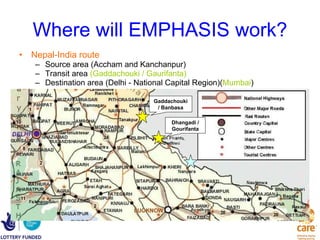
Where will EMPHASIS work? Nepal-India route Source area (Accham and Kanchanpur) Transit area  (Gaddachouki / Gaurifanta) Destination area (Delhi - National Capital Region)( Mumbai ) Gaddachouki / Banbasa Dhangadi / Gourifanta
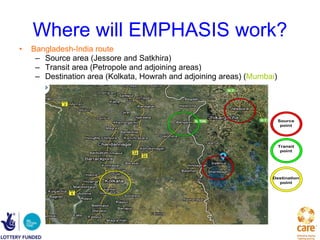
Where will EMPHASIS work? Bangladesh-India route Source area (Jessore and Satkhira) Transit area (Petropole and adjoining areas)  Destination area (Kolkata, Howrah and adjoining areas) ( Mumbai )
First Year of the Programme Knowledge Building Phase Build knowledge, information, and analysis while supporting existing services for the target group. Using analysis, clarify assumptions about services for each of the two migration routes: Inputs -> Outputs -> Outcomes -> Impact
What has happened till now?
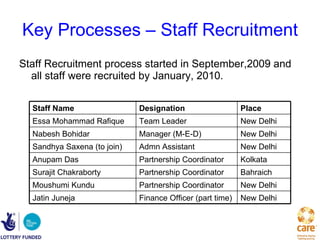
Key Processes – Staff Recruitment Staff Recruitment process started in September,2009 and all staff were recruited by January, 2010. New Delhi Finance Officer (part time) Jatin Juneja New Delhi Partnership Coordinator Moushumi Kundu Bahraich Partnership Coordinator Surajit Chakraborty Kolkata Partnership Coordinator Anupam Das New Delhi Admn Assistant Sandhya Saxena (to join) New Delhi Manager (M-E-D) Nabesh Bohidar New Delhi Team Leader Essa Mohammad Rafique Place Designation Staff Name
Key Processes – Common Understanding Induction Workshop (New Delhi-October 2009) Facilitators Audrey Swift Andy Melendez Key Outcomes: Common understanding of the Programme Goals Understanding of the key challenges in the programme
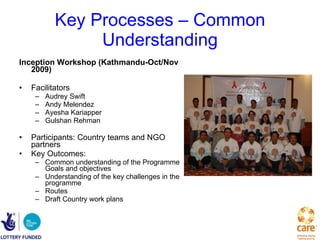
Key Processes – Common Understanding Inception Workshop (Kathmandu-Oct/Nov 2009) Facilitators Audrey Swift Andy Melendez Ayesha Kariapper Gulshan Rehman Participants: Country teams and NGO partners Key Outcomes: Common understanding of the Programme Goals and objectives Understanding of the key challenges in the programme Routes Draft Country work plans
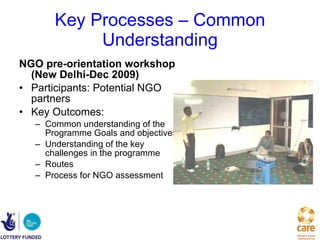
Key Processes – Common Understanding NGO pre-orientation workshop (New Delhi-Dec 2009) Participants: Potential NGO partners Key Outcomes: Common understanding of the Programme Goals and objectives Understanding of the key challenges in the programme Routes Process for NGO assessment
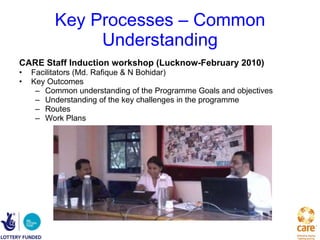
Key Processes – Common Understanding CARE Staff Induction workshop (Lucknow-February 2010) Facilitators (Md. Rafique & N Bohidar) Key Outcomes Common understanding of the Programme Goals and objectives Understanding of the key challenges in the programme Routes Work Plans
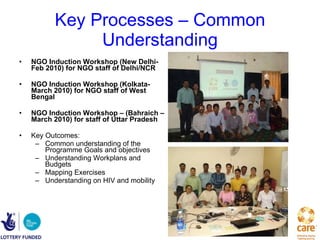
Key Processes – Common Understanding NGO Induction Workshop (New Delhi-Feb 2010) for NGO staff of Delhi/NCR NGO Induction Workshop (Kolkata-March 2010) for NGO staff of West Bengal NGO Induction Workshop – (Bahraich – March 2010) for staff of Uttar Pradesh Key Outcomes: Common understanding of the Programme Goals and objectives Understanding Workplans and Budgets Mapping Exercises Understanding on HIV and mobility
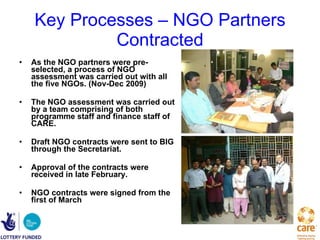
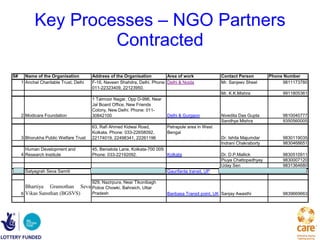
Key Processes – NGO Partners Contracted As the NGO partners were pre-selected, a process of NGO assessment was carried out with all the five NGOs. (Nov-Dec 2009) The NGO assessment was carried out by a team comprising of both programme staff and finance staff of CARE.  Draft NGO contracts were sent to BIG through the Secretariat. Approval of the contracts were received in late February. NGO contracts were signed from the first of March
Key Processes – NGO Partners Contracted
Key Processes – Current activities of the NGO partners Mapping / Stakeholder analysis / Line Listing  Developed a common methodology, tools and required outputs through a consultative process for destination and transit sites. Status: Mapping completed. Stakeholder Analysis Completed Line Listing Continuing
Mapping Data - Snapshots
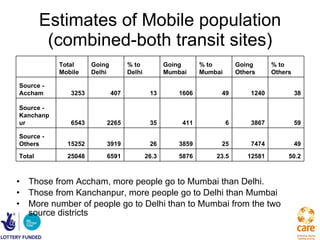
Estimates of Mobile population (combined-both transit sites) Those from Accham, more people go to Mumbai than Delhi. Those from Kanchanpur, more people go to Delhi than Mumbai More number of people go to Delhi than to Mumbai from the two source districts 50.2 12581 23.5 5876 26.3 6591 25048 Total 49 7474 25 3859 26 3919 15252 Source - Others 59 3867 6 411 35 2265 6543 Source - Kanchanpur 38 1240 49 1606 13 407 3253 Source - Accham % to Others Going Others % to Mumbai Going Mumbai % to Delhi Going Delhi Total Mobile  
Projection Analysis at Transit Points - Nepal Approximately, 100,000 Nepali Mobile population cross over into India in a year through the two transit points [1]  Out of that, approximately 11000 come to Delhi as destination and 8500 come to Mumbai.
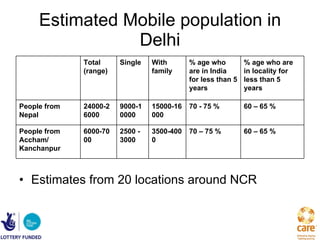
Estimated Mobile population in Delhi Estimates from 20 locations around NCR 60 – 65 % 70 – 75 % 3500-4000 2500 - 3000 6000-7000 People from Accham/ Kanchanpur  60 – 65 % 70 - 75 % 15000-16000 9000-10000 24000-26000 People from Nepal % age who are in locality for less than 5 years % age who are in India for less than 5 years With family Single Total (range)  
Estimated Mobile population - Mumbai The Reaching Across Border Project carried out by FHI reached approximately 40,000 Nepali Population in Mumbai (3 years). The project worked with all Nepalis at certain specified areas (did not curtail impact population by source districts).  The project worked at 4 districts of Nepal as source sites
Estimated Mobile population – West Bengal Approximately 7000 people cross over the border undocumented. Approximately 65000 people from Bangladesh are found in the locations mapped. Approximate number of people who have come from Jessore and Satkhira is 9750
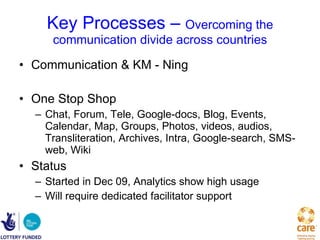
Key Processes –  Overcoming the communication divide across countries Communication & KM - Ning One Stop Shop Chat, Forum, Tele, Google-docs, Blog, Events, Calendar, Map, Groups, Photos, videos, audios, Transliteration, Archives, Intra, Google-search, SMS-web, Wiki Status Started in Dec 09, Analytics show high usage Will require dedicated facilitator support
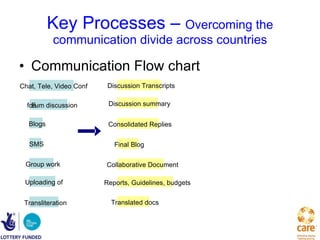
Key Processes –  Overcoming the communication divide across countries Communication Flow chart E - forum discussion Blogs Chat, Tele, Video Conf SMS Discussion summary Discussion Transcripts Consolidated Replies Final Blog Group work Collaborative Document Reports, Guidelines, budgets Uploading of Transliteration Translated docs
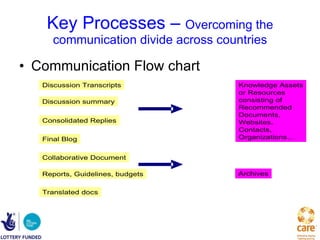
Key Processes –  Overcoming the communication divide across countries Communication Flow chart
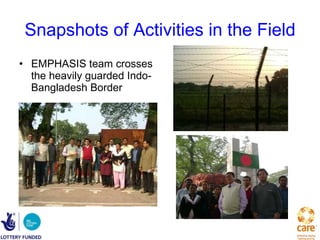
Snapshots of Activities in the Field EMPHASIS team crosses the heavily guarded Indo-Bangladesh Border
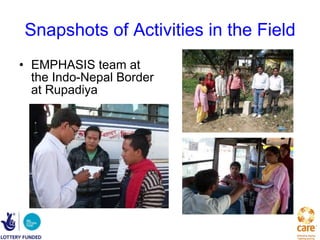
Snapshots of Activities in the Field EMPHASIS team at the Indo-Nepal Border at Rupadiya
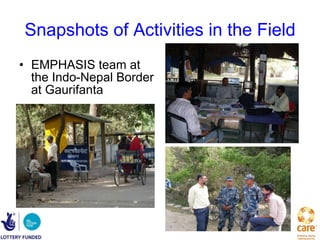
Snapshots of Activities in the Field EMPHASIS team at the Indo-Nepal Border at Gaurifanta
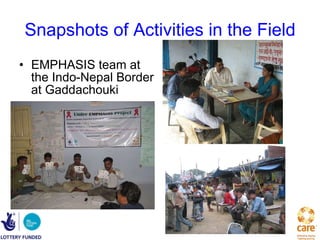
Snapshots of Activities in the Field EMPHASIS team at the Indo-Nepal Border at Gaddachouki
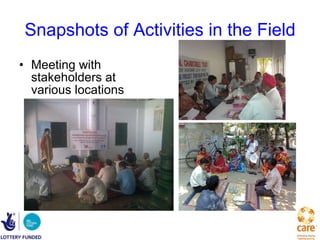
Snapshots of Activities in the Field Meeting with stakeholders at various locations
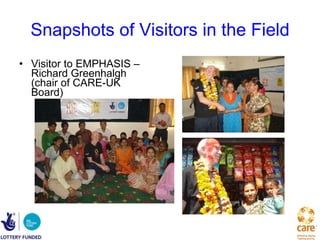
Snapshots of Visitors in the Field Visitor to EMPHASIS – Richard Greenhalgh (chair of CARE-UK Board)
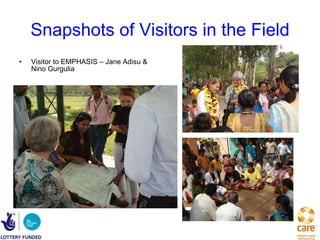
Snapshots of Visitors in the Field Visitor to EMPHASIS – Jane Adisu & Nino Gurgulia
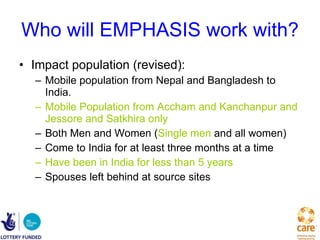
Who will EMPHASIS work with? Impact population (revised): Mobile population from Nepal and Bangladesh to India. Mobile Population from Accham and Kanchanpur and Jessore and Satkhira only Both Men and Women ( Single men  and all women) Come to India for at least three months at a time Have been in India for less than 5 years Spouses left behind at source sites
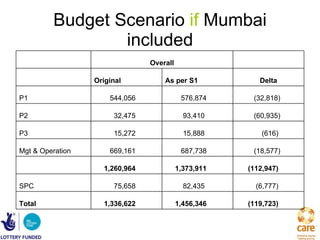
Budget Scenario  if  Mumbai included (119,723) 1,456,346 1,336,622  Total (6,777) 82,435 75,658  SPC (112,947) 1,373,911 1,260,964    (18,577) 687,738 669,161  Mgt & Operation (616) 15,888  15,272  P3 (60,935) 93,410  32,475  P2 (32,818) 576,874 544,056  P1 Delta As per S1 Original     Overall  
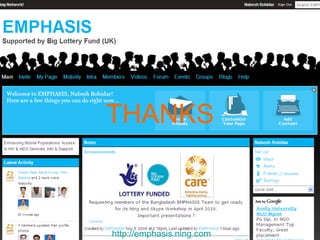
THANKS http://emphasis.ning.com

Emphasis pres-sep 1-2010-12

  • 1.
    Enhancing Mobile Populations’Access to HIV & AIDS Services, Information, and Support (EMPHASIS) CARE New Delhi 01 Sep 2010
  • 2.
    Enhancing Mobile Populations’Access to HIV & AIDS Services, Information, and Support (EMPHASIS) BACKGROUND
  • 3.
    What is EMPHASIS? EMPHASIS is a 5-year initiative funded by the Big Lottery Fund, UK The programme aims to reduce the vulnerability of key mobile populations to HIV & AIDS along two mobility routes between Bangladesh/India and Nepal/India by delivering focused interventions at source, transit and destination points influence national and regional policies relating to safe mobility through evidence generated regionally.
  • 4.
    Rationale for theProject – Mobility between the three countries High mobility exists between Bangladesh, Nepal and India Poverty high unemployment political instability differential economic opportunities Mobility has been necessary for the economic survival of families in both urban and rural communities of Nepal and Bangladesh
  • 5.
    Rationale for theProject – Mobility and HIV Social, economic and political factors in origin and destination countries influence the risk of HIV infection separation from spouses and families unfamiliar social and cultural norms language barriers substandard living conditions exploitative working conditions sexual violence isolation and stress These may lead mobile people to engage in behaviours, e.g. unsafe casual or commercial sex, which increase HIV risk.
  • 6.
    Rationale for theProject – Mobility and HIV This risk is exacerbated by inadequate access to HIV services and fear of being stigmatised HIV prevalence is low in Bangladesh and Nepal Vulnerable mobile populations form a bridge with high prevalence areas of India 66% of those tested positive in a Bangladesh centre were returnees migrants
  • 7.
    Rationale for theProject – Vulnerability of Women Women migrant workers employed in unskilled jobs domestic service or entertainment sectors often without legal status little access to health services susceptible to exploitation and/or physical and sexual violence Women left behind at source sites Face severe economic challenges food insecurity may be forced to exchange sex for food or money At risk if their husbands return infected with HIV
  • 8.
    Rationale for theProject – Existing responses of the Govts. Bangladesh recognises mobility as a major risk factor for the spread of HIV&AIDS. However, there is no programming for the mobile population in the government’s major national HIV Prevention Programmes In Nepal, although legislation is in place, there is a severe lack of cohesive response to address mobility and HIV systematically and comprehensively. In India, national programmes are constrained by the mandate to use national resources for the welfare of their own citizens, and do not address the vulnerabilities of citizens of other countries
  • 9.
    What is EMPHASIStrying to achieve? Programme Goal: To reduce the vulnerability to HIV&AIDS of populations mobile across borders of Bangladesh, India and Nepal and to mitigate the impact on affected communities, with a specific focus on women. Programme Objectives To demonstrate effective good practice models for HIV prevention, care and support for mobile populations vulnerable to HIV&AIDS across India, Bangladesh and Nepal – for replication and scaling-up. To enhance capacity and contribute to government/civil society institutions and communities’ efforts to reduce the vulnerability of mobile populations and their families to HIV and to mitigate the impact of AIDS. To develop evidence-based advocacy and the creation of an enabling environment supportive of reducing vulnerabilities of mobile populations to HIV&AIDS
  • 10.
    How will EMPHASISdo it? Programme Approach: The programme approach will aim to answer the question: “What approaches work with cross-border mobile populations and their families to reduce vulnerability to HIV infection?” The four areas of intervention will be: Test a model of cross-border services. Build knowledge about the mobile populations and their families and their vulnerability to HIV infection Build capacity of partners in the programme approach Influence changes in relevant laws, policies, practices, beliefs, attitudes, knowledge and behaviours
  • 11.
    Where will EMPHASISwork? Nepal-India route Source area (Accham and Kanchanpur) Transit area (Gaddachouki / Gaurifanta) Destination area (Delhi - National Capital Region)( Mumbai ) Gaddachouki / Banbasa Dhangadi / Gourifanta
  • 12.
    Where will EMPHASISwork? Bangladesh-India route Source area (Jessore and Satkhira) Transit area (Petropole and adjoining areas) Destination area (Kolkata, Howrah and adjoining areas) ( Mumbai )
  • 13.
    First Year ofthe Programme Knowledge Building Phase Build knowledge, information, and analysis while supporting existing services for the target group. Using analysis, clarify assumptions about services for each of the two migration routes: Inputs -> Outputs -> Outcomes -> Impact
  • 14.
  • 15.
    Key Processes –Staff Recruitment Staff Recruitment process started in September,2009 and all staff were recruited by January, 2010. New Delhi Finance Officer (part time) Jatin Juneja New Delhi Partnership Coordinator Moushumi Kundu Bahraich Partnership Coordinator Surajit Chakraborty Kolkata Partnership Coordinator Anupam Das New Delhi Admn Assistant Sandhya Saxena (to join) New Delhi Manager (M-E-D) Nabesh Bohidar New Delhi Team Leader Essa Mohammad Rafique Place Designation Staff Name
  • 16.
    Key Processes –Common Understanding Induction Workshop (New Delhi-October 2009) Facilitators Audrey Swift Andy Melendez Key Outcomes: Common understanding of the Programme Goals Understanding of the key challenges in the programme
  • 17.
    Key Processes –Common Understanding Inception Workshop (Kathmandu-Oct/Nov 2009) Facilitators Audrey Swift Andy Melendez Ayesha Kariapper Gulshan Rehman Participants: Country teams and NGO partners Key Outcomes: Common understanding of the Programme Goals and objectives Understanding of the key challenges in the programme Routes Draft Country work plans
  • 18.
    Key Processes –Common Understanding NGO pre-orientation workshop (New Delhi-Dec 2009) Participants: Potential NGO partners Key Outcomes: Common understanding of the Programme Goals and objectives Understanding of the key challenges in the programme Routes Process for NGO assessment
  • 19.
    Key Processes –Common Understanding CARE Staff Induction workshop (Lucknow-February 2010) Facilitators (Md. Rafique & N Bohidar) Key Outcomes Common understanding of the Programme Goals and objectives Understanding of the key challenges in the programme Routes Work Plans
  • 20.
    Key Processes –Common Understanding NGO Induction Workshop (New Delhi-Feb 2010) for NGO staff of Delhi/NCR NGO Induction Workshop (Kolkata-March 2010) for NGO staff of West Bengal NGO Induction Workshop – (Bahraich – March 2010) for staff of Uttar Pradesh Key Outcomes: Common understanding of the Programme Goals and objectives Understanding Workplans and Budgets Mapping Exercises Understanding on HIV and mobility
  • 21.
    Key Processes –NGO Partners Contracted As the NGO partners were pre-selected, a process of NGO assessment was carried out with all the five NGOs. (Nov-Dec 2009) The NGO assessment was carried out by a team comprising of both programme staff and finance staff of CARE. Draft NGO contracts were sent to BIG through the Secretariat. Approval of the contracts were received in late February. NGO contracts were signed from the first of March
  • 22.
    Key Processes –NGO Partners Contracted
  • 23.
    Key Processes –Current activities of the NGO partners Mapping / Stakeholder analysis / Line Listing Developed a common methodology, tools and required outputs through a consultative process for destination and transit sites. Status: Mapping completed. Stakeholder Analysis Completed Line Listing Continuing
  • 24.
    Mapping Data -Snapshots
  • 25.
    Estimates of Mobilepopulation (combined-both transit sites) Those from Accham, more people go to Mumbai than Delhi. Those from Kanchanpur, more people go to Delhi than Mumbai More number of people go to Delhi than to Mumbai from the two source districts 50.2 12581 23.5 5876 26.3 6591 25048 Total 49 7474 25 3859 26 3919 15252 Source - Others 59 3867 6 411 35 2265 6543 Source - Kanchanpur 38 1240 49 1606 13 407 3253 Source - Accham % to Others Going Others % to Mumbai Going Mumbai % to Delhi Going Delhi Total Mobile  
  • 26.
    Projection Analysis atTransit Points - Nepal Approximately, 100,000 Nepali Mobile population cross over into India in a year through the two transit points [1] Out of that, approximately 11000 come to Delhi as destination and 8500 come to Mumbai.
  • 27.
    Estimated Mobile populationin Delhi Estimates from 20 locations around NCR 60 – 65 % 70 – 75 % 3500-4000 2500 - 3000 6000-7000 People from Accham/ Kanchanpur 60 – 65 % 70 - 75 % 15000-16000 9000-10000 24000-26000 People from Nepal % age who are in locality for less than 5 years % age who are in India for less than 5 years With family Single Total (range)  
  • 28.
    Estimated Mobile population- Mumbai The Reaching Across Border Project carried out by FHI reached approximately 40,000 Nepali Population in Mumbai (3 years). The project worked with all Nepalis at certain specified areas (did not curtail impact population by source districts). The project worked at 4 districts of Nepal as source sites
  • 29.
    Estimated Mobile population– West Bengal Approximately 7000 people cross over the border undocumented. Approximately 65000 people from Bangladesh are found in the locations mapped. Approximate number of people who have come from Jessore and Satkhira is 9750
  • 30.
    Key Processes – Overcoming the communication divide across countries Communication & KM - Ning One Stop Shop Chat, Forum, Tele, Google-docs, Blog, Events, Calendar, Map, Groups, Photos, videos, audios, Transliteration, Archives, Intra, Google-search, SMS-web, Wiki Status Started in Dec 09, Analytics show high usage Will require dedicated facilitator support
  • 31.
    Key Processes – Overcoming the communication divide across countries Communication Flow chart E - forum discussion Blogs Chat, Tele, Video Conf SMS Discussion summary Discussion Transcripts Consolidated Replies Final Blog Group work Collaborative Document Reports, Guidelines, budgets Uploading of Transliteration Translated docs
  • 32.
    Key Processes – Overcoming the communication divide across countries Communication Flow chart
  • 33.
    Snapshots of Activitiesin the Field EMPHASIS team crosses the heavily guarded Indo-Bangladesh Border
  • 34.
    Snapshots of Activitiesin the Field EMPHASIS team at the Indo-Nepal Border at Rupadiya
  • 35.
    Snapshots of Activitiesin the Field EMPHASIS team at the Indo-Nepal Border at Gaurifanta
  • 36.
    Snapshots of Activitiesin the Field EMPHASIS team at the Indo-Nepal Border at Gaddachouki
  • 37.
    Snapshots of Activitiesin the Field Meeting with stakeholders at various locations
  • 38.
    Snapshots of Visitorsin the Field Visitor to EMPHASIS – Richard Greenhalgh (chair of CARE-UK Board)
  • 39.
    Snapshots of Visitorsin the Field Visitor to EMPHASIS – Jane Adisu & Nino Gurgulia
  • 40.
    Who will EMPHASISwork with? Impact population (revised): Mobile population from Nepal and Bangladesh to India. Mobile Population from Accham and Kanchanpur and Jessore and Satkhira only Both Men and Women ( Single men and all women) Come to India for at least three months at a time Have been in India for less than 5 years Spouses left behind at source sites
  • 41.
    Budget Scenario if Mumbai included (119,723) 1,456,346 1,336,622 Total (6,777) 82,435 75,658 SPC (112,947) 1,373,911 1,260,964   (18,577) 687,738 669,161 Mgt & Operation (616) 15,888 15,272 P3 (60,935) 93,410 32,475 P2 (32,818) 576,874 544,056 P1 Delta As per S1 Original     Overall  
  • 42.