Welcome Delegates   Ashok Raisinghani State Mainstreaming Unit. RSACS
Some Rationales Vulnerable Factors HIV already exists large population of Rajasthan (56.4 million) HIV and AIDS is equally as rural as an urban epidemic Out-migration  Rajasthan accounts for 19 percent of all mines in India 25,000 trucks travel daily on NH 8 alone Tourist Destination Where is the epidemic Numbers – 2.5 million Women – 38.4% Rural – 57% The South Africa Experience 15-20  years back --- Denial --- Now 20%  Where India is today
Mainstreaming   is “ the concept of addressing HIV & AIDS both internally and externally in all sectors, at all levels, particularly where the pandemic might not ordinarily be addressed.”
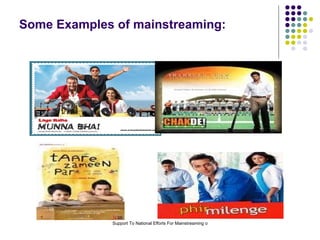
Some Examples of mainstreaming:
Mainstreaming Pr o ject: UNDP is supporting the government’s efforts in mainstreaming HIV/AIDS in five low prevalence states through  System strengthening Capacity development Building synergy & alliances
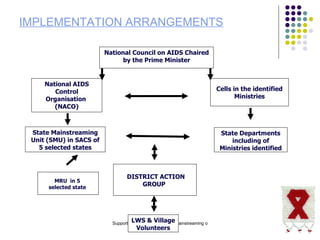
IMPLEMENTATION ARRANGEMENTS National Council on AIDS Chaired by the Prime Minister National AIDS Control Organisation  (NACO) ‏ Cells in the identified Ministries State Mainstreaming Unit (SMU) in SACS of 5 selected states State Departments including of Ministries identified MRU  in 5  selected state  DISTRICT ACTION GROUP   LWS & Village Volunteers
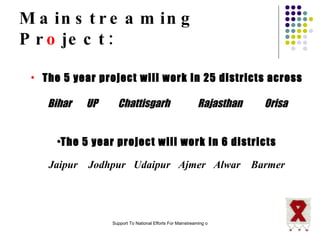
Mainstreaming Pr o ject: The 5 year project will work in 25 districts across Bihar  UP  Chattisgarh  Rajasthan  Orisa The 5 year project will work in 6 districts Jaipur  Jodhpur  Udaipur  Ajmer  Alwar  Barmer
Focused Sectors  Corporate (organized, Unorganized) NGOs/CSOs (INGOs, CBOs, FBOs, Societies, Associations) Govt. Dept.   (Panchayti Raj, Rural Development, Urban Development, Tribal development, Tourist Development and Railway)
MAINSTREAMING HIV/AIDS As the epidemic in India  spreads from urban to rural areas , from pockets of  high prevalence to generalized population , HIV can no more be the sole agenda of one organization or department. There is a need to move towards an integrated, inclusive multi-sectoral approach that will transfer the ownership of HIV/AIDS issues.
WHY MAINSTREAMING  HIV/AIDS IN INDIA? Key strategy to implement a multi-sectoral response to  expand coverage of prevention, care and treatment information and services. It is a  cost effective approach  for a systematic and sustained response that includes health and non-health partners. Early mainstreaming action may prevent concentrated epidemics from becoming generalized .
It will provide additional support to the development process as HIV and AIDS is closely linked to poverty, gender inequality and social welfare.  Mainstreaming addresses both the direct and indirect aspects of HIV/AIDS.  It makes national responses sustainable in the long-term.  Cont..
There are various ways to integrate HIV in their programmes and policies. Some are illustrated below  : Identify programmes which can have the largest reach, cutting across gender, caste and hierarchical boundaries Sensitize key stakeholders on HIV/AIDS Set up an internal committee /nodal person to develop HIV/AIDS workplace policy. Work place policy  for prevention, care and treatment for staff members and spouses INTERVENTIONS IN MAINSTREAMING
Cont.. Orientation on HIV should be part of all technical and management training institutes’ programmes  HIV integrated in existing  training programmes and  refresher courses Policy  for non-discrimination on basis of HIV status Condom corners  at all locations HIV / AIDS to be incorporated  induction and service  teaching programmes Prevention messaging
Modes of Main Streaming Through Programmes Through Policies Different levels of Mainstreaming Departmental Level (Officers & Staff) ‏ Organizations ( Partner NGOs) ‏ Communities / People / Networks
HOW CAN IT SUPPORT? Makes HIV/AIDS response a multi sectoral effort. Expands coverage of HIV prevention programmes by integrating HIV/AIDS within existing activities and schemes.  Ensures that prevention messages reach people and thereby helps protect and save many lives. Is cost effective and sustainable in the long term, since it builds on existing programmes. Prevents aggravation of poverty, gender inequality and discrimination. Avoids duplication, overlap and allows greater scope for collaborative efforts.
ROLE OF GOVT. DEPARTMENTS/ NGOS/ PRIVATE SECTOR:   Govt. Departments, NGOs & Private sectors have their own reach and target groups. They can either work in a collaborative manner or they can focus on their special groups for mainstreaming HIV.  Mainstreaming HIV in these sectors is therefore an effective strategy to ensure that both direct and indirect causes are addressed.
EXAMPLES  OF  MAIN STREAMING
GOVT. DEPARTMENTS/Corporate/non HIV NGOs WHY?   HIV/AIDS prevalence in rural areas fast increasing (57%) ‏ Weak infrastructure in rural areas to address the challenge Greater stigma and discrimination due to lack of awareness and close social networks Poverty and distress rural-urban migration - one of the key underlying causes of vulnerability to HIV/AIDS  STRATEGIC STRENGTHS Wide outreach of  development programmes to the very last person in the village  Multiplier effect of integrating HIV within existing infrastructure  Department officials at the community level have trust of communities as they help generate livelihoods and fight poverty   
DEPARTMENT OF RURAL DEVELOPMENT POSSIBLE ACTIVITIES Large scale coverage of rural populations through integration within Women Self Help Groups Watershed Committees Employment Guarantee Programmes Incorporate HIV/AIDS in all the Rural Development training programmes. Capacity strengthening of SIRDs in HIV/AIDS to train PRIs on an ongoing basis Implementation of development schemes Economic support to PLHA and vulnerable populations on priority. Review poverty alleviation programmes and strengthen activities in highly vulnerable districts
RAILWAYS Possible Activities: Awareness campaign Incorporate HIV/AIDS in all training programmes as ongoing basis Sensitization  of staff at all level  Sensitization of MO,s and Para  Medical staff on stigma & discrimination and prevention  Setting up Migration Information Centre
DEPARTMENT OF  TOURISM Possible Activities: Work place policy for prevention, care and treatment for staff members and spouses HIV integrated in existing training programmes and refresher courses Policy for non-discrimination on basis of HIV status Condom corners  at all locations HIV/AIDS to be incorporated in pre-induction, induction and service teaching programmes
DEPARTMENT OF TOURISM Possible Activities: Orientation on HIV should be part of all technical and management training institutes’ programmes  Enforce HIV/AIDS code of conduct within  workplaces Sensitive messages on display boards at tourist entry and exit points  Include HIV prevention and care in Workplace policies of all hotels within Ministry’s purview Prevention messaging at tourism facilities Ensuring availability of condoms at all tourist places, pubs, bars and hotels Advocate with private sector employers in tourism and hotel industries to include HIV in their work/ for their staff
DEPARTMENT OF PANCHYATI RAJ Possible Activities: Awareness campaign Incorporate HIV/AIDS topic in all training programmes. Sensitization  of staff on  HIV/AIDS at all level Setting up Migration Information Centre
DEPARTMENT OF PANCHAYTI RAJ Possible Activities  : Organize IEC activity through Panchayts  Include HIV/AIDS issues as an agenda point  in monthly meetings  Social marketing for condom  Use BRGF for HIV/AIDS affected & infected people
DEPARTMENT OF URBAN DEVELOPMENT   Possible Activities: Awareness campaign Incorporate HIV/AIDS topic in all training programmes. Sensitization  of staff on  HIV/AIDS at all level Incorporate HIV/AIDS in ongoing schemes/Programs
Other Deptt./private sectors/NGOs,CSOs Possible Activities Nodal officers can be appointed Committee can be formed to deal with HIV/AIDS issues Financial support for awareness and prevention programmes of  HIV/AIDS. HIV messages in monthly magazines/souvenirs  training programmes. Organise events like World AIDS Day, Blood Donation Day  Display IEC Material at their office  Lay special focus on Orphan/Vulnerable Children Step up nutrition support for PLHA with focus on Orphan/ Vulnerable Children. Support for employment
And All These Will be Possible Through  Continued political commitment Participation by all stakeholders Coordination and implementation of the shared vision Shared accountability
THANK YOU

Ppt For Master Trainners

  • 1.
    Welcome Delegates Ashok Raisinghani State Mainstreaming Unit. RSACS
  • 2.
    Some Rationales VulnerableFactors HIV already exists large population of Rajasthan (56.4 million) HIV and AIDS is equally as rural as an urban epidemic Out-migration Rajasthan accounts for 19 percent of all mines in India 25,000 trucks travel daily on NH 8 alone Tourist Destination Where is the epidemic Numbers – 2.5 million Women – 38.4% Rural – 57% The South Africa Experience 15-20 years back --- Denial --- Now 20% Where India is today
  • 3.
    Mainstreaming is “ the concept of addressing HIV & AIDS both internally and externally in all sectors, at all levels, particularly where the pandemic might not ordinarily be addressed.”
  • 4.
    Some Examples ofmainstreaming:
  • 5.
    Mainstreaming Pr oject: UNDP is supporting the government’s efforts in mainstreaming HIV/AIDS in five low prevalence states through System strengthening Capacity development Building synergy & alliances
  • 6.
    IMPLEMENTATION ARRANGEMENTS NationalCouncil on AIDS Chaired by the Prime Minister National AIDS Control Organisation (NACO) ‏ Cells in the identified Ministries State Mainstreaming Unit (SMU) in SACS of 5 selected states State Departments including of Ministries identified MRU in 5 selected state DISTRICT ACTION GROUP LWS & Village Volunteers
  • 7.
    Mainstreaming Pr oject: The 5 year project will work in 25 districts across Bihar UP Chattisgarh Rajasthan Orisa The 5 year project will work in 6 districts Jaipur Jodhpur Udaipur Ajmer Alwar Barmer
  • 8.
    Focused Sectors Corporate (organized, Unorganized) NGOs/CSOs (INGOs, CBOs, FBOs, Societies, Associations) Govt. Dept. (Panchayti Raj, Rural Development, Urban Development, Tribal development, Tourist Development and Railway)
  • 9.
    MAINSTREAMING HIV/AIDS Asthe epidemic in India spreads from urban to rural areas , from pockets of high prevalence to generalized population , HIV can no more be the sole agenda of one organization or department. There is a need to move towards an integrated, inclusive multi-sectoral approach that will transfer the ownership of HIV/AIDS issues.
  • 10.
    WHY MAINSTREAMING HIV/AIDS IN INDIA? Key strategy to implement a multi-sectoral response to expand coverage of prevention, care and treatment information and services. It is a cost effective approach for a systematic and sustained response that includes health and non-health partners. Early mainstreaming action may prevent concentrated epidemics from becoming generalized .
  • 11.
    It will provideadditional support to the development process as HIV and AIDS is closely linked to poverty, gender inequality and social welfare. Mainstreaming addresses both the direct and indirect aspects of HIV/AIDS. It makes national responses sustainable in the long-term. Cont..
  • 12.
    There are variousways to integrate HIV in their programmes and policies. Some are illustrated below : Identify programmes which can have the largest reach, cutting across gender, caste and hierarchical boundaries Sensitize key stakeholders on HIV/AIDS Set up an internal committee /nodal person to develop HIV/AIDS workplace policy. Work place policy for prevention, care and treatment for staff members and spouses INTERVENTIONS IN MAINSTREAMING
  • 13.
    Cont.. Orientation onHIV should be part of all technical and management training institutes’ programmes HIV integrated in existing training programmes and refresher courses Policy for non-discrimination on basis of HIV status Condom corners at all locations HIV / AIDS to be incorporated induction and service teaching programmes Prevention messaging
  • 14.
    Modes of MainStreaming Through Programmes Through Policies Different levels of Mainstreaming Departmental Level (Officers & Staff) ‏ Organizations ( Partner NGOs) ‏ Communities / People / Networks
  • 15.
    HOW CAN ITSUPPORT? Makes HIV/AIDS response a multi sectoral effort. Expands coverage of HIV prevention programmes by integrating HIV/AIDS within existing activities and schemes. Ensures that prevention messages reach people and thereby helps protect and save many lives. Is cost effective and sustainable in the long term, since it builds on existing programmes. Prevents aggravation of poverty, gender inequality and discrimination. Avoids duplication, overlap and allows greater scope for collaborative efforts.
  • 16.
    ROLE OF GOVT.DEPARTMENTS/ NGOS/ PRIVATE SECTOR: Govt. Departments, NGOs & Private sectors have their own reach and target groups. They can either work in a collaborative manner or they can focus on their special groups for mainstreaming HIV. Mainstreaming HIV in these sectors is therefore an effective strategy to ensure that both direct and indirect causes are addressed.
  • 17.
    EXAMPLES OF MAIN STREAMING
  • 18.
    GOVT. DEPARTMENTS/Corporate/non HIVNGOs WHY? HIV/AIDS prevalence in rural areas fast increasing (57%) ‏ Weak infrastructure in rural areas to address the challenge Greater stigma and discrimination due to lack of awareness and close social networks Poverty and distress rural-urban migration - one of the key underlying causes of vulnerability to HIV/AIDS STRATEGIC STRENGTHS Wide outreach of development programmes to the very last person in the village Multiplier effect of integrating HIV within existing infrastructure Department officials at the community level have trust of communities as they help generate livelihoods and fight poverty  
  • 19.
    DEPARTMENT OF RURALDEVELOPMENT POSSIBLE ACTIVITIES Large scale coverage of rural populations through integration within Women Self Help Groups Watershed Committees Employment Guarantee Programmes Incorporate HIV/AIDS in all the Rural Development training programmes. Capacity strengthening of SIRDs in HIV/AIDS to train PRIs on an ongoing basis Implementation of development schemes Economic support to PLHA and vulnerable populations on priority. Review poverty alleviation programmes and strengthen activities in highly vulnerable districts
  • 20.
    RAILWAYS Possible Activities:Awareness campaign Incorporate HIV/AIDS in all training programmes as ongoing basis Sensitization of staff at all level Sensitization of MO,s and Para Medical staff on stigma & discrimination and prevention Setting up Migration Information Centre
  • 21.
    DEPARTMENT OF TOURISM Possible Activities: Work place policy for prevention, care and treatment for staff members and spouses HIV integrated in existing training programmes and refresher courses Policy for non-discrimination on basis of HIV status Condom corners at all locations HIV/AIDS to be incorporated in pre-induction, induction and service teaching programmes
  • 22.
    DEPARTMENT OF TOURISMPossible Activities: Orientation on HIV should be part of all technical and management training institutes’ programmes Enforce HIV/AIDS code of conduct within workplaces Sensitive messages on display boards at tourist entry and exit points Include HIV prevention and care in Workplace policies of all hotels within Ministry’s purview Prevention messaging at tourism facilities Ensuring availability of condoms at all tourist places, pubs, bars and hotels Advocate with private sector employers in tourism and hotel industries to include HIV in their work/ for their staff
  • 23.
    DEPARTMENT OF PANCHYATIRAJ Possible Activities: Awareness campaign Incorporate HIV/AIDS topic in all training programmes. Sensitization of staff on HIV/AIDS at all level Setting up Migration Information Centre
  • 24.
    DEPARTMENT OF PANCHAYTIRAJ Possible Activities : Organize IEC activity through Panchayts Include HIV/AIDS issues as an agenda point in monthly meetings Social marketing for condom Use BRGF for HIV/AIDS affected & infected people
  • 25.
    DEPARTMENT OF URBANDEVELOPMENT Possible Activities: Awareness campaign Incorporate HIV/AIDS topic in all training programmes. Sensitization of staff on HIV/AIDS at all level Incorporate HIV/AIDS in ongoing schemes/Programs
  • 26.
    Other Deptt./private sectors/NGOs,CSOsPossible Activities Nodal officers can be appointed Committee can be formed to deal with HIV/AIDS issues Financial support for awareness and prevention programmes of HIV/AIDS. HIV messages in monthly magazines/souvenirs training programmes. Organise events like World AIDS Day, Blood Donation Day Display IEC Material at their office Lay special focus on Orphan/Vulnerable Children Step up nutrition support for PLHA with focus on Orphan/ Vulnerable Children. Support for employment
  • 27.
    And All TheseWill be Possible Through Continued political commitment Participation by all stakeholders Coordination and implementation of the shared vision Shared accountability
  • 28.