Empathy Map and Problem
Statement
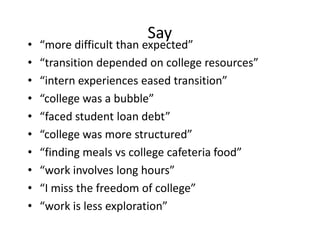
Say
• “more difficult than expected”
• “transition depended on college resources”
• “intern experiences eased transition”
• “college was a bubble”
• “faced student loan debt”
• “college was more structured”
• “finding meals vs college cafeteria food”
• “work involves long hours”
• “I miss the freedom of college”
• “work is less exploration”
Say Continued
• “missed seeing my friends on a daily basis”
• “have not yet applied the theories I learned”
• “a lot of on the job training”
• “social life limited to weekends”
• “maintain personal budget”
• “entering the real world”
• “sleep schedule reversed”
• “wake up much earlier in the morning”
• “first year of work is freshman year in college”
• “work is more rigorous … and demanding”
Do
• Relaxed when talking about school
• Serious facial expression when talking about work
• Lots of gestures and hand motions
• Used casual language to describe school
• Talked at length about school
• Fewer things to say about work
• Smiled and laughed as reminisced about school
• Leaned back in chair when talking about school
• Sat up straight to talk about work
• Overall enthusiastic
Think
• College is less rigorous than work
• Transition from college to work is challenging for most
• College debt prevented choice of more enjoyable career
• Thinks college prepared academically but not as well for
real world, practical problems
• Post-college does not provide a safety net
• Thinks not alone in the struggle to transition
• Can adapt after a few more months
• Transition is no more different than other life transitions
• College does not emotionally prepare someone for work
• Jump between college and work is significant
Feel
• Misses college and its freedoms
• Desires more time with friends
• Does not enjoy work as much
• Likes the challenges work presents
• Feels there is a significant difference between college
and work
• Feels a bit lonely and isolated from work
• Feels slightly intimidated by work schedules
• Regret for not enjoying college more
• Feels nostalgic
• Feels more adjusted than before
Description of the Stakeholder
• A Chinese-American who immigrated to
American in her high school years, has just
graduated from college in the United States,
and has begun work for six months
Problem Statement
• STAKEHOLDER: A social, responsible, degree-
holding financial analyst, who is open to new
ideas, perceptive, and diligent
• NEEDS A WAY TO: achieve a balance between
her work life and her personal life
• BECAUSE: she is currently overwhelmed with
her job responsibilities and does not have
enough social contact

Empathy map and problem statement

  • 1.
    Empathy Map andProblem Statement
  • 2.
    Say • “more difficultthan expected” • “transition depended on college resources” • “intern experiences eased transition” • “college was a bubble” • “faced student loan debt” • “college was more structured” • “finding meals vs college cafeteria food” • “work involves long hours” • “I miss the freedom of college” • “work is less exploration”
  • 3.
    Say Continued • “missedseeing my friends on a daily basis” • “have not yet applied the theories I learned” • “a lot of on the job training” • “social life limited to weekends” • “maintain personal budget” • “entering the real world” • “sleep schedule reversed” • “wake up much earlier in the morning” • “first year of work is freshman year in college” • “work is more rigorous … and demanding”
  • 4.
    Do • Relaxed whentalking about school • Serious facial expression when talking about work • Lots of gestures and hand motions • Used casual language to describe school • Talked at length about school • Fewer things to say about work • Smiled and laughed as reminisced about school • Leaned back in chair when talking about school • Sat up straight to talk about work • Overall enthusiastic
  • 5.
    Think • College isless rigorous than work • Transition from college to work is challenging for most • College debt prevented choice of more enjoyable career • Thinks college prepared academically but not as well for real world, practical problems • Post-college does not provide a safety net • Thinks not alone in the struggle to transition • Can adapt after a few more months • Transition is no more different than other life transitions • College does not emotionally prepare someone for work • Jump between college and work is significant
  • 6.
    Feel • Misses collegeand its freedoms • Desires more time with friends • Does not enjoy work as much • Likes the challenges work presents • Feels there is a significant difference between college and work • Feels a bit lonely and isolated from work • Feels slightly intimidated by work schedules • Regret for not enjoying college more • Feels nostalgic • Feels more adjusted than before
  • 7.
    Description of theStakeholder • A Chinese-American who immigrated to American in her high school years, has just graduated from college in the United States, and has begun work for six months
  • 8.
    Problem Statement • STAKEHOLDER:A social, responsible, degree- holding financial analyst, who is open to new ideas, perceptive, and diligent • NEEDS A WAY TO: achieve a balance between her work life and her personal life • BECAUSE: she is currently overwhelmed with her job responsibilities and does not have enough social contact