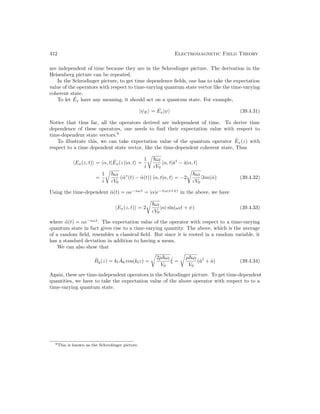
Lectures on
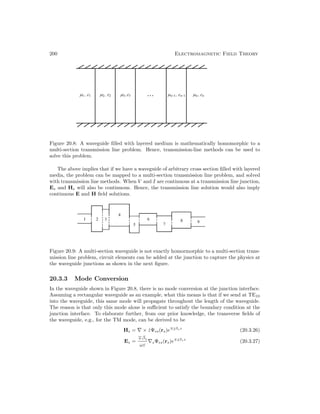
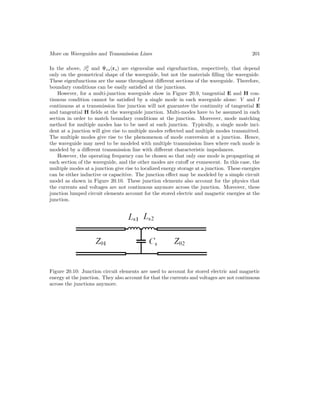
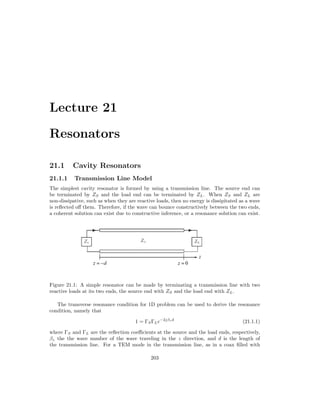
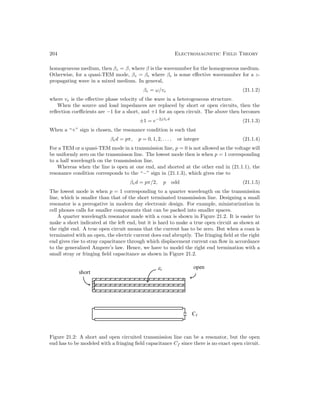
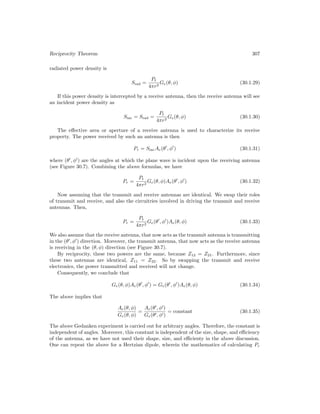
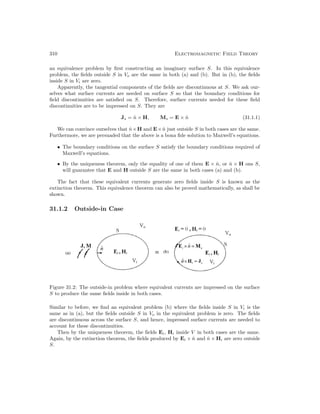
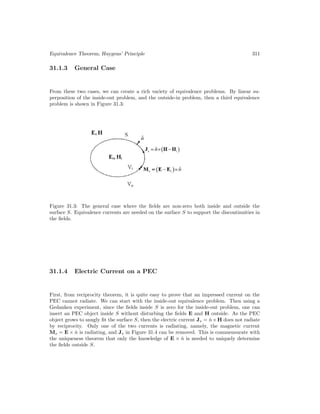
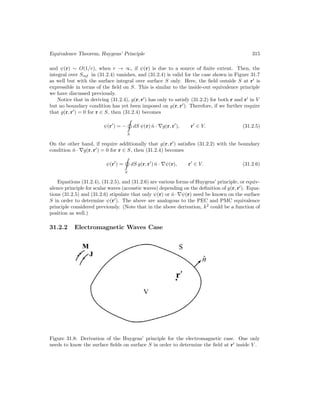
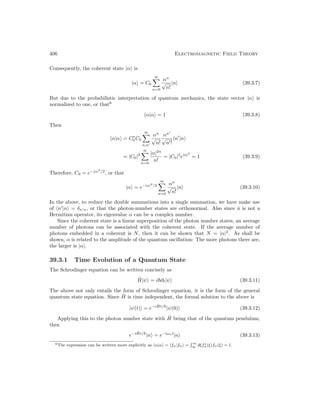
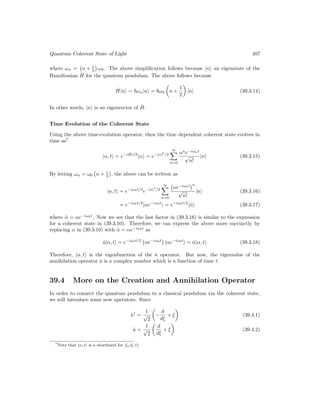
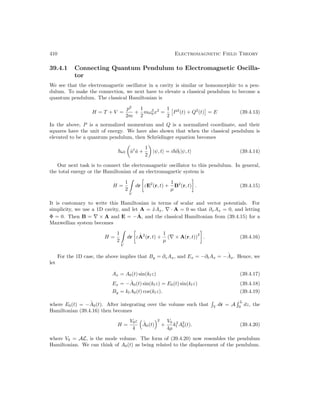
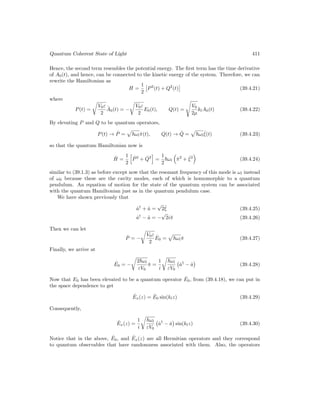
Electromagnetic Field Theory
Weng Cho CHEW1
Fall 2019, Purdue University
1
Updated: December 4, 2019
Contents
Preface xi
Acknowledgements xii
1 Introduction, Maxwell’s Equations 1
1.1 Importance of Electromagnetics . . . . . . . . . . . . . . . . . . . . . . . . . . 1
1.1.1 A Brief History of Electromagnetics . . . . . . . . . . . . . . . . . . . 3
1.2 Maxwell’s Equations in Integral Form . . . . . . . . . . . . . . . . . . . . . . 5
1.3 Static Electromagnetics . . . . . . . . . . . . . . . . . . . . . . . . . . . . . . 5
1.3.1 Coulomb’s Law (Statics) . . . . . . . . . . . . . . . . . . . . . . . . . . 5
1.3.2 Electric Field E (Statics) . . . . . . . . . . . . . . . . . . . . . . . . . 6
1.3.3 Gauss’s Law (Statics) . . . . . . . . . . . . . . . . . . . . . . . . . . . 9
1.3.4 Derivation of Gauss’s Law from Coulomb’s Law (Statics) . . . . . . . 9
2 Maxwell’s Equations, Differential Operator Form 15
2.1 Gauss’s Divergence Theorem . . . . . . . . . . . . . . . . . . . . . . . . . . . 15
2.1.1 Gauss’s Law in Differential Operator Form . . . . . . . . . . . . . . . 18
2.1.2 Physical Meaning of Divergence Operator . . . . . . . . . . . . . . . . 19
2.1.3 Example . . . . . . . . . . . . . . . . . . . . . . . . . . . . . . . . . . . 19
2.2 Stokes’s Theorem . . . . . . . . . . . . . . . . . . . . . . . . . . . . . . . . . . 20
2.2.1 Faraday’s Law in Differential Operator Form . . . . . . . . . . . . . . 22
2.2.2 Physical Meaning of Curl Operator . . . . . . . . . . . . . . . . . . . . 23
2.2.3 Example . . . . . . . . . . . . . . . . . . . . . . . . . . . . . . . . . . . 23
2.3 Maxwell’s Equations in Differential Operator Form . . . . . . . . . . . . . . . 24
3 Constitutive Relations, Wave Equation, Electrostatics, and Static Green’s
Function 25
3.1 Simple Constitutive Relations . . . . . . . . . . . . . . . . . . . . . . . . . . . 25
3.2 Emergence of Wave Phenomenon, Triumph of Maxwell’s Equations . . . . . 26
3.3 Static Electromagnetics–Revisted . . . . . . . . . . . . . . . . . . . . . . . . . 29
3.3.1 Electrostatics . . . . . . . . . . . . . . . . . . . . . . . . . . . . . . . . 29
3.3.2 Poisson’s Equation . . . . . . . . . . . . . . . . . . . . . . . . . . . . . 30
3.3.3 Static Green’s Function . . . . . . . . . . . . . . . . . . . . . . . . . . 31
3.3.4 Laplace’s Equation . . . . . . . . . . . . . . . . . . . . . . . . . . . . . 32
i
ii Electromagnetic Field Theory
4 Magnetostatics, Boundary Conditions, and Jump Conditions 35
4.1 Magnetostatics . . . . . . . . . . . . . . . . . . . . . . . . . . . . . . . . . . . 35
4.1.1 More on Coulomb’s Gauge . . . . . . . . . . . . . . . . . . . . . . . . 36
4.2 Boundary Conditions–1D Poisson’s Equation . . . . . . . . . . . . . . . . . . 37
4.3 Boundary Conditions–Maxwell’s Equations . . . . . . . . . . . . . . . . . . . 39
4.3.1 Faraday’s Law . . . . . . . . . . . . . . . . . . . . . . . . . . . . . . . 39
4.3.2 Gauss’s Law . . . . . . . . . . . . . . . . . . . . . . . . . . . . . . . . 40
4.3.3 Ampere’s Law . . . . . . . . . . . . . . . . . . . . . . . . . . . . . . . 42
4.3.4 Gauss’s Law for Magnetic Flux . . . . . . . . . . . . . . . . . . . . . . 44
5 Biot-Savart law, Conductive Media Interface, Instantaneous Poynting’s
Theorem 45
5.1 Derivation of Biot-Savart Law . . . . . . . . . . . . . . . . . . . . . . . . . . . 45
5.2 Boundary Conditions–Conductive Media Case . . . . . . . . . . . . . . . . . . 47
5.2.1 Electric Field Inside a Conductor . . . . . . . . . . . . . . . . . . . . . 47
5.2.2 Magnetic Field Inside a Conductor . . . . . . . . . . . . . . . . . . . . 49
5.3 Instantaneous Poynting’s Theorem . . . . . . . . . . . . . . . . . . . . . . . . 50
6 Time-Harmonic Fields, Complex Power 55
6.1 Time-Harmonic Fields—Linear Systems . . . . . . . . . . . . . . . . . . . . . 55
6.2 Fourier Transform Technique . . . . . . . . . . . . . . . . . . . . . . . . . . . 57
6.3 Complex Power . . . . . . . . . . . . . . . . . . . . . . . . . . . . . . . . . . . 59
7 More on Constitute Relations, Uniform Plane Wave 63
7.1 More on Constitutive Relations . . . . . . . . . . . . . . . . . . . . . . . . . . 63
7.1.1 Isotropic Frequency Dispersive Media . . . . . . . . . . . . . . . . . . 63
7.1.2 Anisotropic Media . . . . . . . . . . . . . . . . . . . . . . . . . . . . . 64
7.1.3 Bi-anisotropic Media . . . . . . . . . . . . . . . . . . . . . . . . . . . . 66
7.1.4 Inhomogeneous Media . . . . . . . . . . . . . . . . . . . . . . . . . . . 66
7.1.5 Uniaxial and Biaxial Media . . . . . . . . . . . . . . . . . . . . . . . . 66
7.1.6 Nonlinear Media . . . . . . . . . . . . . . . . . . . . . . . . . . . . . . 66
7.2 Wave Phenomenon in the Frequency Domain . . . . . . . . . . . . . . . . . . 67
7.3 Uniform Plane Waves in 3D . . . . . . . . . . . . . . . . . . . . . . . . . . . . 68
8 Lossy Media, Lorentz Force Law, Drude-Lorentz-Sommerfeld Model 73
8.1 Plane Waves in Lossy Conductive Media . . . . . . . . . . . . . . . . . . . . . 73
8.2 Lorentz Force Law . . . . . . . . . . . . . . . . . . . . . . . . . . . . . . . . . 75
8.3 Drude-Lorentz-Sommerfeld Model . . . . . . . . . . . . . . . . . . . . . . . . 75
8.3.1 Frequency Dispersive Media . . . . . . . . . . . . . . . . . . . . . . . . 80
8.3.2 Plasmonic Nanoparticles . . . . . . . . . . . . . . . . . . . . . . . . . . 81
9 Waves in Gyrotropic Media, Polarization 83
9.1 Gyrotropic Media . . . . . . . . . . . . . . . . . . . . . . . . . . . . . . . . . . 83
9.2 Wave Polarization . . . . . . . . . . . . . . . . . . . . . . . . . . . . . . . . . 85
9.2.1 Arbitrary Polarization Case and Axial Ratio . . . . . . . . . . . . . . 89
9.3 Polarization and Power Flow . . . . . . . . . . . . . . . . . . . . . . . . . . . 91
Contents iii
10 Spin Angular Momentum, Complex Poynting’s Theorem, Lossless Condi-
tion, Energy Density 93
10.1 Spin Angular Momentum and Cylindrical Vector Beam . . . . . . . . . . . . 93
10.2 Complex Poynting’s Theorem and Lossless Conditions . . . . . . . . . . . . . 95
10.2.1 Complex Poynting’s Theorem . . . . . . . . . . . . . . . . . . . . . . . 95
10.2.2 Lossless Conditions . . . . . . . . . . . . . . . . . . . . . . . . . . . . 96
10.3 Energy Density in Dispersive Media . . . . . . . . . . . . . . . . . . . . . . . 97
11 Transmission Lines 101
11.1 Transmission Line Theory . . . . . . . . . . . . . . . . . . . . . . . . . . . . . 101
11.1.1 Time-Domain Analysis . . . . . . . . . . . . . . . . . . . . . . . . . . . 102
11.1.2 Frequency-Domain Analysis . . . . . . . . . . . . . . . . . . . . . . . . 105
11.2 Lossy Transmission Line . . . . . . . . . . . . . . . . . . . . . . . . . . . . . . 106
12 More on Transmission Lines 109
12.1 Terminated Transmission Lines . . . . . . . . . . . . . . . . . . . . . . . . . . 109
12.1.1 Shorted Terminations . . . . . . . . . . . . . . . . . . . . . . . . . . . 112
12.1.2 Open terminations . . . . . . . . . . . . . . . . . . . . . . . . . . . . . 113
12.2 Smith Chart . . . . . . . . . . . . . . . . . . . . . . . . . . . . . . . . . . . . . 114
12.3 VSWR (Voltage Standing Wave Ratio) . . . . . . . . . . . . . . . . . . . . . . 116
13 Multi-Junction Transmission Lines, Duality Principle 121
13.1 Multi-Junction Transmission Lines . . . . . . . . . . . . . . . . . . . . . . . . 121
13.1.1 Single-Junction Transmission Lines . . . . . . . . . . . . . . . . . . . . 121
13.1.2 Two-Junction Transmission Lines . . . . . . . . . . . . . . . . . . . . . 122
13.1.3 Stray Capacitance and Inductance . . . . . . . . . . . . . . . . . . . . 126
13.2 Duality Principle . . . . . . . . . . . . . . . . . . . . . . . . . . . . . . . . . . 128
13.2.1 Unusual Swaps . . . . . . . . . . . . . . . . . . . . . . . . . . . . . . . 129
13.2.2 Fictitious Magnetic Currents . . . . . . . . . . . . . . . . . . . . . . . 129
14 Reflection and Transmission, Interesting Physical Phenomena 133
14.1 Reflection and Transmission—Single Interface Case . . . . . . . . . . . . . . . 133
14.1.1 TE Polarization (Perpendicular or E Polarization)1
. . . . . . . . . . . 134
14.1.2 TM Polarization (Parallel or H Polarization) . . . . . . . . . . . . . . 136
14.2 Interesting Physical Phenomena . . . . . . . . . . . . . . . . . . . . . . . . . . 136
14.2.1 Total Internal Reflection . . . . . . . . . . . . . . . . . . . . . . . . . . 137
15 Interesting Physical Phenomena 143
15.1 More on Interesting Physical Phenomena, Homomorphism, Plane Waves, Trans-
mission Lines . . . . . . . . . . . . . . . . . . . . . . . . . . . . . . . . . . . . 143
15.1.1 Brewster Angle . . . . . . . . . . . . . . . . . . . . . . . . . . . . . . . 143
15.1.2 Surface Plasmon Polariton . . . . . . . . . . . . . . . . . . . . . . . . . 146
15.2 Homomorphism of Uniform Plane Waves and Transmission Lines Equations . 148
1These polarizations are also variously know as the s and p polarizations, a descendent from the notations
for acoustic waves where s and p stand for shear and pressure waves respectively.
iv Electromagnetic Field Theory
15.2.1 TE or TEz Waves . . . . . . . . . . . . . . . . . . . . . . . . . . . . . 148
15.2.2 TM or TMz Waves . . . . . . . . . . . . . . . . . . . . . . . . . . . . . 150
16 Waves in Layered Media 151
16.1 Waves in Layered Media . . . . . . . . . . . . . . . . . . . . . . . . . . . . . . 151
16.1.1 Generalized Reflection Coefficient for Layered Media . . . . . . . . . . 151
16.2 Phase Velocity and Group Velocity . . . . . . . . . . . . . . . . . . . . . . . . 154
16.2.1 Phase Velocity . . . . . . . . . . . . . . . . . . . . . . . . . . . . . . . 154
16.2.2 Group Velocity . . . . . . . . . . . . . . . . . . . . . . . . . . . . . . . 155
16.3 Wave Guidance in a Layered Media . . . . . . . . . . . . . . . . . . . . . . . . 158
16.3.1 Transverse Resonance Condition . . . . . . . . . . . . . . . . . . . . . 158
17 Dielectric Waveguides 161
17.1 Generalized Transverse Resonance Condition . . . . . . . . . . . . . . . . . . 161
17.2 Dielectric Waveguide . . . . . . . . . . . . . . . . . . . . . . . . . . . . . . . . 162
17.2.1 TE Case . . . . . . . . . . . . . . . . . . . . . . . . . . . . . . . . . . . 163
17.2.2 TM Case . . . . . . . . . . . . . . . . . . . . . . . . . . . . . . . . . . 168
17.2.3 A Note on Cut-Off of Dielectric Waveguides . . . . . . . . . . . . . . . 169
18 Hollow Waveguides 171
18.1 Hollow Waveguides . . . . . . . . . . . . . . . . . . . . . . . . . . . . . . . . . 172
18.1.1 Absence of TEM Mode in a Hollow Waveguide . . . . . . . . . . . . . 172
18.1.2 TE Case (Ez = 0, Hz 6= 0) . . . . . . . . . . . . . . . . . . . . . . . . 173
18.1.3 TM Case (Ez 6= 0, Hz = 0) . . . . . . . . . . . . . . . . . . . . . . . . 175
18.2 Rectangular Waveguides . . . . . . . . . . . . . . . . . . . . . . . . . . . . . . 176
18.2.1 TE Modes (H Mode or Hz 6= 0 Mode) . . . . . . . . . . . . . . . . . . 176
19 More on Hollow Waveguides 179
19.1 Rectangular Waveguides, Contd. . . . . . . . . . . . . . . . . . . . . . . . . . 179
19.1.1 TM Modes (E Modes or Ez 6= 0 Modes) . . . . . . . . . . . . . . . . . 179
19.1.2 Bouncing Wave Picture . . . . . . . . . . . . . . . . . . . . . . . . . . 180
19.1.3 Field Plots . . . . . . . . . . . . . . . . . . . . . . . . . . . . . . . . . 181
19.2 Circular Waveguides . . . . . . . . . . . . . . . . . . . . . . . . . . . . . . . . 182
19.2.1 TE Case . . . . . . . . . . . . . . . . . . . . . . . . . . . . . . . . . . . 182
19.2.2 TM Case . . . . . . . . . . . . . . . . . . . . . . . . . . . . . . . . . . 185
20 More on Waveguides and Transmission Lines 189
20.1 Circular Waveguides, Contd. . . . . . . . . . . . . . . . . . . . . . . . . . . . 189
20.1.1 An Application of Circular Waveguide . . . . . . . . . . . . . . . . . . 189
20.2 Remarks on Quasi-TEM Modes, Hybrid Modes, and Surface Plasmonic Modes 194
20.2.1 Quasi-TEM Modes . . . . . . . . . . . . . . . . . . . . . . . . . . . . . 194
20.2.2 Hybrid Modes–Inhomogeneously-Filled Waveguides . . . . . . . . . . . 195
20.2.3 Guidance of Modes . . . . . . . . . . . . . . . . . . . . . . . . . . . . . 196
20.3 Homomorphism of Waveguides and Transmission Lines . . . . . . . . . . . . . 196
20.3.1 TE Case . . . . . . . . . . . . . . . . . . . . . . . . . . . . . . . . . . . 197
20.3.2 TM Case . . . . . . . . . . . . . . . . . . . . . . . . . . . . . . . . . . 199
Contents v
20.3.3 Mode Conversion . . . . . . . . . . . . . . . . . . . . . . . . . . . . . . 200
21 Resonators 203
21.1 Cavity Resonators . . . . . . . . . . . . . . . . . . . . . . . . . . . . . . . . . 203
21.1.1 Transmission Line Model . . . . . . . . . . . . . . . . . . . . . . . . . 203
21.1.2 Cylindrical Waveguide Resonators . . . . . . . . . . . . . . . . . . . . 205
21.2 Some Applications of Resonators . . . . . . . . . . . . . . . . . . . . . . . . . 208
21.2.1 Filters . . . . . . . . . . . . . . . . . . . . . . . . . . . . . . . . . . . . 209
21.2.2 Electromagnetic Sources . . . . . . . . . . . . . . . . . . . . . . . . . . 210
21.2.3 Frequency Sensor . . . . . . . . . . . . . . . . . . . . . . . . . . . . . . 213
22 Quality Factor of Cavities, Mode Orthogonality 215
22.1 The Quality Factor of a Cavity . . . . . . . . . . . . . . . . . . . . . . . . . . 215
22.1.1 General Concepts . . . . . . . . . . . . . . . . . . . . . . . . . . . . . . 215
22.1.2 Relation to the Pole Location . . . . . . . . . . . . . . . . . . . . . . . 216
22.1.3 Some Formulas for Q for a Metallic Cavity . . . . . . . . . . . . . . . 218
22.1.4 Example: The Q of TM110 Mode . . . . . . . . . . . . . . . . . . . . . 219
22.2 Mode Orthogonality and Matrix Eigenvalue Problem . . . . . . . . . . . . . . 220
22.2.1 Matrix Eigenvalue Problem (EVP) . . . . . . . . . . . . . . . . . . . . 220
22.2.2 Homomorphism with the Waveguide Mode Problem . . . . . . . . . . 221
22.2.3 Proof of Orthogonality of Waveguide Modes . . . . . . . . . . . . . . . 222
23 Scalar and Vector Potentials 225
23.1 Scalar and Vector Potentials for Time-Harmonic Fields . . . . . . . . . . . . . 225
23.1.1 Introduction . . . . . . . . . . . . . . . . . . . . . . . . . . . . . . . . 225
23.1.2 Scalar and Vector Potentials for Statics, A Review . . . . . . . . . . . 225
23.1.3 Scalar and Vector Potentials for Electrodynamics . . . . . . . . . . . . 226
23.1.4 More on Scalar and Vector Potentials . . . . . . . . . . . . . . . . . . 228
23.2 When is Static Electromagnetic Theory Valid? . . . . . . . . . . . . . . . . . 229
23.2.1 Quasi-Static Electromagnetic Theory . . . . . . . . . . . . . . . . . . . 234
24 Circuit Theory Revisited 237
24.1 Circuit Theory Revisited . . . . . . . . . . . . . . . . . . . . . . . . . . . . . . 237
24.1.1 Kirchhoff Current Law . . . . . . . . . . . . . . . . . . . . . . . . . . . 237
24.1.2 Kirchhoff Voltage Law . . . . . . . . . . . . . . . . . . . . . . . . . . . 238
24.1.3 Inductor . . . . . . . . . . . . . . . . . . . . . . . . . . . . . . . . . . . 241
24.1.4 Capacitance . . . . . . . . . . . . . . . . . . . . . . . . . . . . . . . . . 242
24.1.5 Resistor . . . . . . . . . . . . . . . . . . . . . . . . . . . . . . . . . . . 243
24.2 Some Remarks . . . . . . . . . . . . . . . . . . . . . . . . . . . . . . . . . . . 243
24.2.1 Energy Storage Method for Inductor and Capacitor . . . . . . . . . . 244
24.2.2 Finding Closed-Form Formulas for Inductance and Capacitance . . . . 244
24.3 Importance of Circuit Theory in IC Design . . . . . . . . . . . . . . . . . . . 246
24.3.1 Decoupling Capacitors and Spiral Inductors . . . . . . . . . . . . . . . 249
vi Electromagnetic Field Theory
25 Radiation by a Hertzian Dipole 251
25.1 Radiation by a Hertzian Dipole . . . . . . . . . . . . . . . . . . . . . . . . . . 251
25.1.1 History . . . . . . . . . . . . . . . . . . . . . . . . . . . . . . . . . . . 251
25.1.2 Approximation by a Point Source . . . . . . . . . . . . . . . . . . . . . 252
25.1.3 Case I. Near Field, βr  1 . . . . . . . . . . . . . . . . . . . . . . . . 254
25.1.4 Case II. Far Field (Radiation Field), βr  1 . . . . . . . . . . . . . . 255
25.1.5 Radiation, Power, and Directive Gain Patterns . . . . . . . . . . . . . 255
25.1.6 Radiation Resistance . . . . . . . . . . . . . . . . . . . . . . . . . . . . 258
26 Radiation Fields, Far Fields 261
26.1 Radiation Fields or Far-Field Approximation . . . . . . . . . . . . . . . . . . 261
26.1.1 Far-Field Approximation . . . . . . . . . . . . . . . . . . . . . . . . . 262
26.1.2 Locally Plane Wave Approximation . . . . . . . . . . . . . . . . . . . 263
26.1.3 Directive Gain Pattern Revisited . . . . . . . . . . . . . . . . . . . . . 265
27 Array Antennas, Fresnel Zone, Rayleigh Distance 269
27.1 Linear Array of Dipole Antennas . . . . . . . . . . . . . . . . . . . . . . . . . 269
27.1.1 Far-Field Approximation . . . . . . . . . . . . . . . . . . . . . . . . . 270
27.1.2 Radiation Pattern of an Array . . . . . . . . . . . . . . . . . . . . . . 270
27.2 When is Far-Field Approximation Valid? . . . . . . . . . . . . . . . . . . . . . 273
27.2.1 Rayleigh Distance . . . . . . . . . . . . . . . . . . . . . . . . . . . . . 275
27.2.2 Near Zone, Fresnel Zone, and Far Zone . . . . . . . . . . . . . . . . . 276
28 Different Types of Antennas–Heuristics 277
28.1 Types of Antennas . . . . . . . . . . . . . . . . . . . . . . . . . . . . . . . . . 277
28.1.1 Resonance Tunneling in Antenna . . . . . . . . . . . . . . . . . . . . . 277
28.1.2 Horn Antennas . . . . . . . . . . . . . . . . . . . . . . . . . . . . . . . 281
28.1.3 Quasi-Optical Antennas . . . . . . . . . . . . . . . . . . . . . . . . . . 283
28.1.4 Small Antennas . . . . . . . . . . . . . . . . . . . . . . . . . . . . . . . 286
29 Uniqueness Theorem 291
29.1 Uniqueness Theorem . . . . . . . . . . . . . . . . . . . . . . . . . . . . . . . . 291
29.1.1 Isotropic Case . . . . . . . . . . . . . . . . . . . . . . . . . . . . . . . . 294
29.1.2 General Anisotropic Case . . . . . . . . . . . . . . . . . . . . . . . . . 294
29.1.3 Hind Sight . . . . . . . . . . . . . . . . . . . . . . . . . . . . . . . . . 295
29.1.4 Connection to Poles of a Linear System . . . . . . . . . . . . . . . . . 296
29.1.5 Radiation from Antenna Sources . . . . . . . . . . . . . . . . . . . . . 297
30 Reciprocity Theorem 299
30.1 Reciprocity Theorem . . . . . . . . . . . . . . . . . . . . . . . . . . . . . . . . 299
30.1.1 Conditions for Reciprocity . . . . . . . . . . . . . . . . . . . . . . . . . 302
30.1.2 Application to a Two-Port Network . . . . . . . . . . . . . . . . . . . 303
30.1.3 Voltage Sources in Electromagnetics . . . . . . . . . . . . . . . . . . . 304
30.1.4 Hind Sight . . . . . . . . . . . . . . . . . . . . . . . . . . . . . . . . . 305
30.1.5 Transmit and Receive Patterns of an Antennna . . . . . . . . . . . . . 306
Contents vii
31 Equivalence Theorem, Huygens’ Principle 309
31.1 Equivalence Theorem or Equivalence Principle . . . . . . . . . . . . . . . . . 309
31.1.1 Inside-Out Case . . . . . . . . . . . . . . . . . . . . . . . . . . . . . . 309
31.1.2 Outside-in Case . . . . . . . . . . . . . . . . . . . . . . . . . . . . . . . 310
31.1.3 General Case . . . . . . . . . . . . . . . . . . . . . . . . . . . . . . . . 311
31.1.4 Electric Current on a PEC . . . . . . . . . . . . . . . . . . . . . . . . 311
31.1.5 Magnetic Current on a PMC . . . . . . . . . . . . . . . . . . . . . . . 312
31.2 Huygens’ Principle and Green’s Theorem . . . . . . . . . . . . . . . . . . . . 312
31.2.1 Scalar Waves Case . . . . . . . . . . . . . . . . . . . . . . . . . . . . . 313
31.2.2 Electromagnetic Waves Case . . . . . . . . . . . . . . . . . . . . . . . 315
32 Shielding, Image Theory 319
32.1 Shielding . . . . . . . . . . . . . . . . . . . . . . . . . . . . . . . . . . . . . . 319
32.1.1 A Note on Electrostatic Shielding . . . . . . . . . . . . . . . . . . . . . 319
32.1.2 Relaxation Time . . . . . . . . . . . . . . . . . . . . . . . . . . . . . . 319
32.2 Image Theory . . . . . . . . . . . . . . . . . . . . . . . . . . . . . . . . . . . . 322
32.2.1 Electric Charges and Electric Dipoles . . . . . . . . . . . . . . . . . . 322
32.2.2 Magnetic Charges and Magnetic Dipoles . . . . . . . . . . . . . . . . . 325
32.2.3 Perfect Magnetic Conductor (PMC) Surfaces . . . . . . . . . . . . . . 327
32.2.4 Multiple Images . . . . . . . . . . . . . . . . . . . . . . . . . . . . . . 329
32.2.5 Some Special Cases . . . . . . . . . . . . . . . . . . . . . . . . . . . . . 330
33 High Frequency Solutions, Gaussian Beams 331
33.1 High Frequency Solutions . . . . . . . . . . . . . . . . . . . . . . . . . . . . . 331
33.1.1 Tangent Plane Approximations . . . . . . . . . . . . . . . . . . . . . . 331
33.1.2 Fermat’s Principle . . . . . . . . . . . . . . . . . . . . . . . . . . . . . 332
33.1.3 Generalized Snell’s Law . . . . . . . . . . . . . . . . . . . . . . . . . . 334
33.2 Gaussian Beam . . . . . . . . . . . . . . . . . . . . . . . . . . . . . . . . . . . 335
33.2.1 Derivation of the Paraxial/Parabolic Wave Equation . . . . . . . . . . 335
33.2.2 Finding a Closed Form Solution . . . . . . . . . . . . . . . . . . . . . 336
33.2.3 Other solutions . . . . . . . . . . . . . . . . . . . . . . . . . . . . . . . 337
34 Rayleigh Scattering, Mie Scattering 339
34.1 Rayleigh Scattering . . . . . . . . . . . . . . . . . . . . . . . . . . . . . . . . . 339
34.1.1 Scattering by a Small Spherical Particle . . . . . . . . . . . . . . . . . 341
34.1.2 Scattering Cross Section . . . . . . . . . . . . . . . . . . . . . . . . . . 342
34.1.3 Small Conductive Particle . . . . . . . . . . . . . . . . . . . . . . . . . 344
34.2 Mie Scattering . . . . . . . . . . . . . . . . . . . . . . . . . . . . . . . . . . . 345
34.2.1 Optical Theorem . . . . . . . . . . . . . . . . . . . . . . . . . . . . . . 346
34.2.2 Mie Scattering by Spherical Harmonic Expansions . . . . . . . . . . . 347
34.2.3 Separation of Variables in Spherical Coordinates . . . . . . . . . . . . 347
viii Electromagnetic Field Theory
35 Sommerfeld Integral, Weyl Identity 349
35.1 Spectral Representations of Sources . . . . . . . . . . . . . . . . . . . . . . . . 349
35.1.1 A Point Source . . . . . . . . . . . . . . . . . . . . . . . . . . . . . . . 349
35.1.2 Riemann Sheets and Branch Cuts . . . . . . . . . . . . . . . . . . . . 354
35.2 A Source on Top of a Layered Medium . . . . . . . . . . . . . . . . . . . . . . 354
35.2.1 Electric Dipole Fields . . . . . . . . . . . . . . . . . . . . . . . . . . . 355
35.2.2 Some Remarks . . . . . . . . . . . . . . . . . . . . . . . . . . . . . . . 358
36 Computational Electromagnetics, Finite Difference Method, Yee Algorithm359
36.1 Introduction to Computational Electromagnetics . . . . . . . . . . . . . . . . 359
36.2 Finite-Difference Method . . . . . . . . . . . . . . . . . . . . . . . . . . . . . 360
36.2.1 The Finite-Difference Approximation . . . . . . . . . . . . . . . . . . . 360
36.2.2 Time Stepping or Time Marching . . . . . . . . . . . . . . . . . . . . . 362
36.2.3 Stability Analysis . . . . . . . . . . . . . . . . . . . . . . . . . . . . . . 364
36.2.4 Grid-Dispersion Error . . . . . . . . . . . . . . . . . . . . . . . . . . . 366
36.3 The Yee Algorithm . . . . . . . . . . . . . . . . . . . . . . . . . . . . . . . . . 368
36.3.1 Finite-Difference Frequency Domain Method . . . . . . . . . . . . . . 370
36.4 Absorbing Boundary Conditions . . . . . . . . . . . . . . . . . . . . . . . . . 371
37 Computational Electromagnetics, Numerical Methods 373
37.1 Computational Electromagnetics and Numerical Methods . . . . . . . . . . . 373
37.1.1 Examples of Differential Equations . . . . . . . . . . . . . . . . . . . . 373
37.1.2 Examples of Integral Equations . . . . . . . . . . . . . . . . . . . . . . 374
37.2 Subspace Projection Methods . . . . . . . . . . . . . . . . . . . . . . . . . . . 378
37.2.1 Function as a Vector . . . . . . . . . . . . . . . . . . . . . . . . . . . . 378
37.2.2 Operator as a Map . . . . . . . . . . . . . . . . . . . . . . . . . . . . . 379
37.2.3 Approximating Operator Equations with Matrix Equations . . . . . . 379
37.2.4 Mesh Generation . . . . . . . . . . . . . . . . . . . . . . . . . . . . . . 381
37.3 Solving Matrix Equation by Optimization . . . . . . . . . . . . . . . . . . . . 382
37.3.1 Gradient of a Functional . . . . . . . . . . . . . . . . . . . . . . . . . . 383
38 Quantum Theory of Light 387
38.1 Quantum Theory of Light . . . . . . . . . . . . . . . . . . . . . . . . . . . . . 387
38.1.1 Historical Background . . . . . . . . . . . . . . . . . . . . . . . . . . . 387
38.1.2 Connecting Electromagnetic Oscillation to Simple Pendulum . . . . . 389
38.2 Hamiltonian Mechanics . . . . . . . . . . . . . . . . . . . . . . . . . . . . . . 393
38.3 Schrodinger Equation (1925) . . . . . . . . . . . . . . . . . . . . . . . . . . . 395
38.4 Some Quantum Interpretations–A Preview . . . . . . . . . . . . . . . . . . . . 398
38.5 Bizarre Nature of the Photon Number States . . . . . . . . . . . . . . . . . . 399
39 Quantum Coherent State of Light 401
39.1 Quantum Coherent State of Light . . . . . . . . . . . . . . . . . . . . . . . . . 401
39.1.1 Quantum Harmonic Oscillator Revisited . . . . . . . . . . . . . . . . . 401
39.2 Some Words on Quantum Randomness and Quantum Observables . . . . . . 404
39.3 Derivation of the Coherent States . . . . . . . . . . . . . . . . . . . . . . . . . 405
Contents ix
39.3.1 Time Evolution of a Quantum State . . . . . . . . . . . . . . . . . . . 406
39.4 More on the Creation and Annihilation Operator . . . . . . . . . . . . . . . . 407
39.4.1 Connecting Quantum Pendulum to Electromagnetic Oscillator . . . . 410
x Electromagnetic Field Theory
Preface
This set of lecture notes is from my teaching of ECE 604, Electromagnetic Field Theory, at
ECE, Purdue University, West Lafayette. It is intended for entry level graduate students.
Because different universities have different undergraduate requirements in electromagnetic
field theory, this is a course intended to “level the playing field”. From this point onward,
hopefully, all students will have the fundamental background in electromagnetic field theory
needed to take advance level courses at Purdue.
In developing this course, I have drawn heavily upon knowledge of our predecessors in this
area. Many of the textbooks and papers used, I have listed them in the reference list. Being
a practitioner in this field for over 40 years, I have seen electromagnetic theory impacting
modern technology development unabated. Despite its age, the set of Maxwell’s equations
has continued to be important, from statics to optics, from classical to quantum, and from
nanometer lengthscales to galactic lengthscales. The applications of electromagnetic tech-
nologies have also been tremendous and wide-ranging: from geophysical exploration, remote
sensing, bio-sensing, electrical machinery, renewable and clean energy, biomedical engineering,
optics and photonics, computer chip and computer system designs and many more. Electro-
magnetic field theory is not everything, but is remains an important component of modern
technology developments.
The challenge in teaching this course is on how to teach over 150 years of knowledge in
one semester: Of course this is mission impossible! To do this, we use the traditional wisdom
of engineering education: Distill the knowledge, make it as simple as possible, and teach the
fundamental big ideas in one short semester. Because of this, you may find the flow of the
lectures erratic. Some times, I feel the need to touch on certain big ideas before moving on,
resulting in the choppiness of the curriculum.
Also, in this course, I exploit mathematical homomorphism as much as possible to simplify
the teaching. After years of practising in this area, I find that some advanced concepts, which
may become very complex, if one delves into the details, become simpler if mathematical
homomorphism is exploited between the advanced concepts and simpler ones. An example
of this is on waves in layered media. The problem is homomorphic to the transmission line
problem: Hence, using transmission line theory, one can simplify the derivations of some
complicated formulas.
A large part of modern electromagnetic technologies is based on heuristics. This is some-
thing difficult to teach, as it relies on physical insight and experience. Modern commercial
software has reshaped this landscape, as the field of mathematical modeling through numer-
ical simulations, known as computational electromagnetic (CEM), has made rapid advances
xi
xii Lectures on Electromagnetic Field Theory
in recent years. Many cut-and-try laboratory experiments, based on heuristics, have been
replaced by cut-and-try computer experiments, which are a lot cheaper.
An exciting modern development is the role of electromagnetics and Maxwell’s equations
in quantum technologies. We will connect Maxwell’s equations toward the end of this course.
This is a challenge, as it has never been done before to my knowledge.
Weng Cho CHEW
December 4, 2019 Purdue University
Acknowledgements
I like to thank Dan Jiao for sharing her lecture notes in this course, as well as Andy Weiner
for sharing his experience in teaching this course. Also, I am thankful to Dr. Na for helping
teach part of this course.
Lecture 1
Introduction, Maxwell’s
Equations
1.1 Importance of Electromagnetics
We will explain why electromagnetics is so important, and its impact on very many different
areas. Then we will give a brief history of electromagnetics, and how it has evolved in the
modern world. Then we will go briefly over Maxwell’s equations in their full glory. But we
will begin the study of electromagnetics by focussing on static problems.
The discipline of electromagnetic field theory and its pertinent technologies is also known
as electromagnetics. It has been based on Maxwell’s equations, which are the result of the
seminal work of James Clerk Maxwell completed in 1865, after his presentation to the British
Royal Society in 1864. It has been over 150 years ago now, and this is a long time compared
to the leaps and bounds progress we have made in technological advancements. But despite,
research in electromagnetics has continued unabated despite its age. The reason is that
electromagnetics is extremely useful, and has impacted a large sector of modern technologies.
To understand why electromagnetics is so useful, we have to understand a few points
about Maxwell’s equations.
• First, Maxwell’s equations are valid over a vast length scale from subatomic dimensions
to galactic dimensions. Hence, these equations are valid over a vast range of wavelengths,
going from static to ultra-violet wavelengths.1
• Maxwell’s equations are relativistic invariant in the parlance of special relativity [1]. In
fact, Einstein was motivated with the theory of special relativity in 1905 by Maxwell’s
equations [2]. These equations look the same, irrespective of what inertial reference
frame one is in.
• Maxwell’s equations are valid in the quantum regime, as it was demonstrated by Paul
Dirac in 1927 [3]. Hence, many methods of calculating the response of a medium to
1Current lithography process is working with using ultra-violet light with a wavelength of 193 nm.
1
2 Electromagnetic Field Theory
classical field can be applied in the quantum regime also. When electromagnetic theory
is combined with quantum theory, the field of quantum optics came about. Roy Glauber
won a Nobel prize in 2005 because of his work in this area [4].
• Maxwell’s equations and the pertinent gauge theory has inspired Yang-Mills theory
(1954) [5], which is also known as a generalized electromagnetic theory. Yang-Mills
theory is motivated by differential forms in differential geometry [6]. To quote from
Misner, Thorne, and Wheeler, “Differential forms illuminate electromagnetic theory,
and electromagnetic theory illuminates differential forms.” [7,8]
• Maxwell’s equations are some of the most accurate physical equations that have been
validated by experiments. In 1985, Richard Feynman wrote that electromagnetic theory
has been validated to one part in a billion.2
Now, it has been validated to one part in
a trillion (Aoyama et al, Styer, 2012).3
• As a consequence, electromagnetics has had a tremendous impact in science and tech-
nology. This is manifested in electrical engineering, optics, wireless and optical commu-
nications, computers, remote sensing, bio-medical engineering etc.
Figure 1.1: The impact of electromagnetics in many technologies. The areas in blue are
prevalent areas impacted by electromagnetics some 20 years ago [9], and the areas in red are
modern emerging areas impacted by electromagnetics.
2This means that if a jet is to fly from New York to Los Angeles, an error of one part in a billion means
an error of a few millmeters.
3This means an error of a hairline, if one were to fly from the earth to the moon.
Introduction, Maxwell’s Equations 3
1.1.1 A Brief History of Electromagnetics
Electricity and magnetism have been known to humans for a long time. Also, the physical
properties of light has been known. But electricity and magnetism, now termed electromag-
netics in the modern world, has been thought to be governed by different physical laws as
opposed to optics. This is understandable as the physics of electricity and magnetism is quite
different of the physics of optics as they were known to humans.
For example, lode stone was known to the ancient Greek and Chinese around 600 BC
to 400 BC. Compass was used in China since 200 BC. Static electricity was reported by
the Greek as early as 400 BC. But these curiosities did not make an impact until the age
of telegraphy. The coming about of telegraphy was due to the invention of the voltaic cell
or the galvanic cell in the late 1700’s, by Luigi Galvani and Alesandro Volta [10]. It was
soon discovered that two pieces of wire, connected to a voltaic cell, can be used to transmit
information.
So by the early 1800’s this possibility had spurred the development of telegraphy. Both
André-Marie Ampére (1823) [11, 12] and Michael Faraday (1838) [13] did experiments to
better understand the properties of electricity and magnetism. And hence, Ampere’s law and
Faraday law are named after them. Kirchhoff voltage and current laws were also developed
in 1845 to help better understand telegraphy [14, 15]. Despite these laws, the technology of
telegraphy was poorly understood. It was not known as to why the telegraphy signal was
distorted. Ideally, the signal should be a digital signal switching between one’s and zero’s,
but the digital signal lost its shape rapidly along a telegraphy line.4
It was not until 1865 that James Clerk Maxwell [17] put in the missing term in Ampere’s
law, the term that involves displacement current, only then the mathematical theory for
electricity and magnetism was complete. Ampere’s law is now known as generalized Ampere’s
law. The complete set of equations are now named Maxwell’s equations in honor of James
Clerk Maxwell.
The rousing success of Maxwell’s theory was that it predicted wave phenomena, as they
have been observed along telegraphy lines. Heinrich Hertz in 1888 [18] did experiment to
proof that electromagnetic field can propagate through space across a room. Moreover, from
experimental measurement of the permittivity and permeability of matter, it was decided
that electromagnetic wave moves at a tremendous speed. But the velocity of light has been
known for a long while from astronomical observations (Roemer, 1676) [19]. The observation
of interference phenomena in light has been known as well. When these pieces of information
were pieced together, it was decided that electricity and magnetism, and optics, are actually
governed by the same physical law or Maxwell’s equations. And optics and electromagnetics
are unified into one field.
4As a side note, in 1837, Morse invented the Morse code for telegraphy [16]. There were cross pollination
of ideas across the Atlantic ocean despite the distance. In fact, Benjamin Franklin associated lightning with
electricity in the latter part of the 18-th century. Also, notice that electrical machinery was invented in 1832
even though electromagnetic theory was not fully understood.
4 Electromagnetic Field Theory
Figure 1.2: A brief history of electromagnetics and optics as depicted in this figure.
In Figure 1.2, a brief history of electromagnetics and optics is depicted. In the beginning,
it was thought that electricity and magnetism, and optics were governed by different physical
laws. Low frequency electromagnetics was governed by the understanding of fields and their
interaction with media. Optical phenomena were governed by ray optics, reflection and
refraction of light. But the advent of Maxwell’s equations in 1865 reveal that they can be
unified by electromagnetic theory. Then solving Maxwell’s equations becomes a mathematical
endeavor.
The photo-electric effect [20, 21], and Planck radiation law [22] point to the fact that
electromagnetic energy is manifested in terms of packets of energy. Each unit of this energy
is now known as the photon. A photon carries an energy packet equal to ω, where ω is the
angular frequency of the photon and  = 6.626 × 10⁻³⁴
J s, the Planck constant, which is
a very small constant. Hence, the higher the frequency, the easier it is to detect this packet
of energy, or feel the graininess of electromagnetic energy. Eventually, in 1927 [3], quantum
theory was incorporated into electromagnetics, and the quantum nature of light gives rise to
the field of quantum optics. Recently, even microwave photons have been measured [23]. It
is a difficult measurement because of the low frequency of microwave (109
Hz) compared to
optics (1015
Hz): microwave photon has a packet of energy about a million times smaller than
that of optical photon.
The progress in nano-fabrication [24] allows one to make optical components that are
subwavelength as the wavelength of blue light is about 450 nm. As a result, interaction of
light with nano-scale optical components requires the solution of Maxwell’s equations in its
full glory.
Introduction, Maxwell’s Equations 5
In 1980s, Bell’s theorem (by John Steward Bell) [25] was experimentally verified in favor of
the Copenhagen school of quantum interpretation (led by Niel Bohr) [26]. This interpretation
says that a quantum state is in a linear superposition of states before a measurement. But
after a measurement, a quantum state collapses to the state that is measured. This implies
that quantum information can be hidden in a quantum state. Hence, a quantum particle,
such as a photon, its state can remain incognito until after its measurement. In other words,
quantum theory is “spooky”. This leads to growing interest in quantum information and
quantum communication using photons. Quantum technology with the use of photons, an
electromagnetic quantum particle, is a subject of growing interest.
1.2 Maxwell’s Equations in Integral Form
Maxwell’s equations can be presented as fundamental postulates.5
We will present them in
their integral forms, but will not belabor them until later.
C
E · dl = −
d
dt

S
B · dS Faraday’s Law (1.2.1)
C
H · dl =
d
dt

S
D · dS + I Ampere’s Law (1.2.2)

S
D · dS = Q Gauss’s or Coulomb’s Law (1.2.3)

S
B · dS = 0 Gauss’s Law (1.2.4)
The units of the basic quantities above are given as:
E: V/m H: A/m
D: C/m2
B: Webers/m2
I: A Q: Coulombs
1.3 Static Electromagnetics
1.3.1 Coulomb’s Law (Statics)
This law, developed in 1785 [27], expresses the force between two charges q1 and q2. If these
charges are positive, the force is repulsive and it is given by
f1→2 =
q1q2
4πεr2
r̂12 (1.3.1)
5Postulates in physics are similar to axioms in mathematics. They are assumptions that need not be
proved.
6 Electromagnetic Field Theory
Figure 1.3: The force between two charges q1 and q2. The force is repulsive if the two charges
have the same sign.
f (force): newton
q (charge): coulombs
ε (permittivity): farads/meter
r (distance between q1 and q2): m
r̂12= unit vector pointing from charge 1 to charge 2
r̂12 =
r2 − r1
|r2 − r1|
, r = |r2 − r1| (1.3.2)
Since the unit vector can be defined in the above, the force between two charges can also be
rewritten as
f1→2 =
q1q2(r2 − r1)
4πε|r2 − r1|3
, (r1, r2 are position vectors) (1.3.3)
1.3.2 Electric Field E (Statics)
The electric field E is defined as the force per unit charge [28]. For two charges, one of charge
q and the other one of incremental charge ∆q, the force between the two charges, according
to Coulomb’s law (1.3.1), is
f =
q∆q
4πεr2
r̂ (1.3.4)
where r̂ is a unit vector pointing from charge q to the incremental charge ∆q. Then the force
per unit charge is given by
E =
f
q
, (V/m) (1.3.5)
This electric field E from a point charge q at the orgin is hence
E =
q
4πεr2
r̂ (1.3.6)
Introduction, Maxwell’s Equations 7
Therefore, in general, the electric field E(r) from a point charge q at r
is given by
E(r) =
q(r − r
)
4πε|r − r|3
(1.3.7)
where
r̂ =
r − r
|r − r|
(1.3.8)
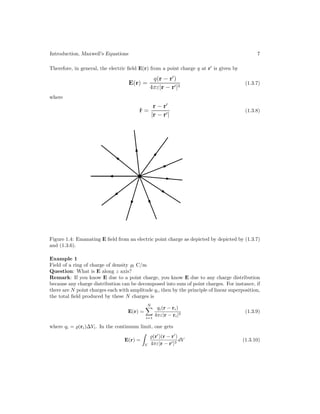
Figure 1.4: Emanating E field from an electric point charge as depicted by depicted by (1.3.7)
and (1.3.6).
Example 1
Field of a ring of charge of density l C/m
Question: What is E along z axis?
Remark: If you know E due to a point charge, you know E due to any charge distribution
because any charge distribution can be decomposed into sum of point charges. For instance, if
there are N point charges each with amplitude qi, then by the principle of linear superposition,
the total field produced by these N charges is
E(r) =
N

i=1
qi(r − ri)
4πε|r − ri|3
(1.3.9)
where qi = (ri)∆Vi. In the continuum limit, one gets
E(r) =
V
(r
)(r − r
)
4πε|r − r|3
dV (1.3.10)
8 Electromagnetic Field Theory
Figure 1.5: Electric field of a ring of charge (Courtesy of Ramo, Whinnery, and Van Duzer)
[29].
In other words, the total field, by the principle of linear superposition, is the integral sum-
mation of the contributions from the distributed charge density (r).
Introduction, Maxwell’s Equations 9
1.3.3 Gauss’s Law (Statics)
This law is also known as Coulomb’s law as they are closely related to each other. Apparently,
this simple law was first expressed by Joseph Louis Lagrange [30] and later, reexpressed by
Gauss in 1813 (wikipedia).
This law can be expressed as
S
D · dS = Q (1.3.11)
D: electric flux density C/m2
D = εE.
dS: an incremental surface at the point on S given by dSn̂ where n̂ is the unit normal
pointing outward away from the surface.
Q: total charge enclosed by the surface S.
Figure 1.6: Electric flux (Courtesy of Ramo, Whinnery, and Van Duzer) [29]
The left-hand side of (1.3.11) represents a surface integral over a closed surface S. To
understand it, one can break the surface into a sum of incremental surfaces ∆Si, with a
local unit normal n̂i associated with it. The surface integral can then be approximated by a
summation
S
D · dS ≈

i
Di · n̂i∆Si =

i
Di · ∆Si (1.3.12)
where one has defined ∆Si = n̂i∆Si. In the limit when ∆Si becomes infinitesimally small,
the summation becomes a surface integral.
1.3.4 Derivation of Gauss’s Law from Coulomb’s Law (Statics)
From Coulomb’s law and the ensuing electric field due to a point charge, the electric flux is
D = εE =
q
4πr2
r̂ (1.3.13)
10 Electromagnetic Field Theory
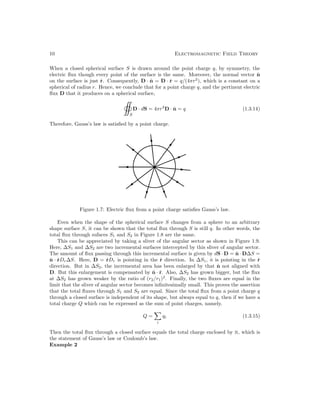
When a closed spherical surface S is drawn around the point charge q, by symmetry, the
electric flux though every point of the surface is the same. Moreover, the normal vector n̂
on the surface is just r̂. Consequently, D · n̂ = D · r̂ = q/(4πr2
), which is a constant on a
spherical of radius r. Hence, we conclude that for a point charge q, and the pertinent electric
flux D that it produces on a spherical surface,
S
D · dS = 4πr2
D · n̂ = q (1.3.14)
Therefore, Gauss’s law is satisfied by a point charge.
Figure 1.7: Electric flux from a point charge satisfies Gauss’s law.
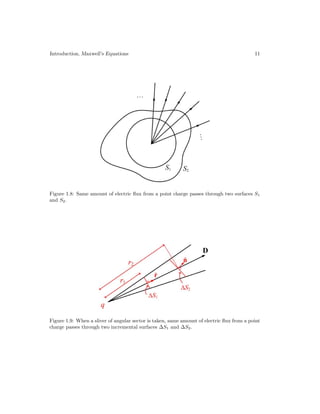
Even when the shape of the spherical surface S changes from a sphere to an arbitrary
shape surface S, it can be shown that the total flux through S is still q. In other words, the
total flux through sufaces S1 and S2 in Figure 1.8 are the same.
This can be appreciated by taking a sliver of the angular sector as shown in Figure 1.9.
Here, ∆S1 and ∆S2 are two incremental surfaces intercepted by this sliver of angular sector.
The amount of flux passing through this incremental surface is given by dS · D = n̂ · D∆S =
n̂ · r̂Dr∆S. Here, D = r̂Dr is pointing in the r̂ direction. In ∆S1, n̂ is pointing in the r̂
direction. But in ∆S2, the incremental area has been enlarged by that n̂ not aligned with
D. But this enlargement is compensated by n̂ · r̂. Also, ∆S2 has grown bigger, but the flux
at ∆S2 has grown weaker by the ratio of (r2/r1)2
. Finally, the two fluxes are equal in the
limit that the sliver of angular sector becomes infinitesimally small. This proves the assertion
that the total fluxes through S1 and S2 are equal. Since the total flux from a point charge q
through a closed surface is independent of its shape, but always equal to q, then if we have a
total charge Q which can be expressed as the sum of point charges, namely.
Q =

i
qi (1.3.15)
Then the total flux through a closed surface equals the total charge enclosed by it, which is
the statement of Gauss’s law or Coulomb’s law.
Example 2
Introduction, Maxwell’s Equations 11
Figure 1.8: Same amount of electric flux from a point charge passes through two surfaces S1
and S2.
Figure 1.9: When a sliver of angular sector is taken, same amount of electric flux from a point
charge passes through two incremental surfaces ∆S1 and ∆S2.
12 Electromagnetic Field Theory
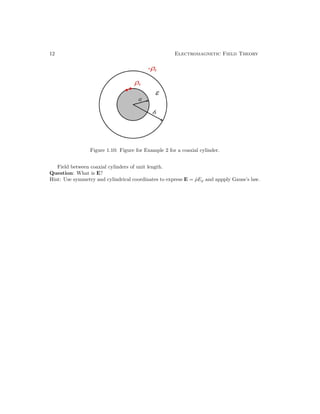
Figure 1.10: Figure for Example 2 for a coaxial cylinder.
Field between coaxial cylinders of unit length.
Question: What is E?
Hint: Use symmetry and cylindrical coordinates to express E = ρ̂Eρ and appply Gauss’s law.
Introduction, Maxwell’s Equations 13
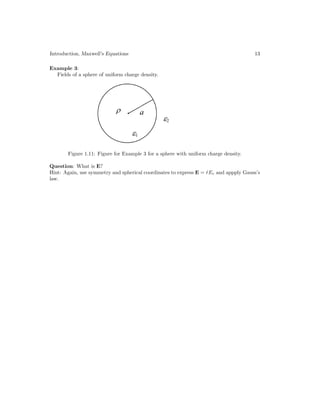
Example 3:
Fields of a sphere of uniform charge density.
Figure 1.11: Figure for Example 3 for a sphere with uniform charge density.
Question: What is E?
Hint: Again, use symmetry and spherical coordinates to express E = r̂Er and appply Gauss’s
law.
14 Electromagnetic Field Theory
Lecture 2
Maxwell’s Equations,
Differential Operator Form
2.1 Gauss’s Divergence Theorem
The divergence theorem is one of the most important theorems in vector calculus [29,31–33]
First, we will need to prove Gauss’s divergence theorem, namely, that:

V
dV ∇ · D =

S
D · dS (2.1.1)
In the above, ∇ · D is defined as
∇ · D = lim
∆V →0

∆S
D · dS
∆V
(2.1.2)
and eventually, we will find an expression for it. We know that if ∆V ≈ 0 or small, then the
above,
∆V ∇ · D ≈

∆S
D · dS (2.1.3)
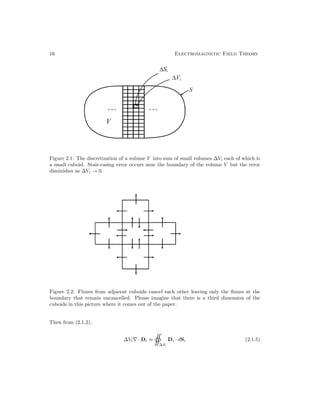
First, we assume that a volume V has been discretized1
into a sum of small cuboids, where
the i-th cuboid has a volume of ∆Vi as shown in Figure 2.1. Then
V ≈
N
X
i=1
∆Vi (2.1.4)
1Other terms are “tesselated”, “meshed”, or “gridded”.
15
16 Electromagnetic Field Theory
Figure 2.1: The discretization of a volume V into sum of small volumes ∆Vi each of which is
a small cuboid. Stair-casing error occurs near the boundary of the volume V but the error
diminishes as ∆Vi → 0.
Figure 2.2: Fluxes from adjacent cuboids cancel each other leaving only the fluxes at the
boundary that remain uncancelled. Please imagine that there is a third dimension of the
cuboids in this picture where it comes out of the paper.
Then from (2.1.2),
∆Vi∇ · Di ≈
∆Si
Di · dSi (2.1.5)
Maxwell’s Equations, Differential Operator Form 17
By summing the above over all the cuboids, or over i, one gets

i
∆Vi∇ · Di ≈

i ∆Si
Di · dSi ≈
S
D · dS (2.1.6)
It is easily seen the the fluxes out of the inner surfaces of the cuboids cancel each other,
leaving only the fluxes flowing out of the cuboids at the edge of the volume V as explained
in Figure 2.2. The right-hand side of the above equation (2.1.6) becomes a surface integral
over the surface S except for the stair-casing approximation (see Figure 2.1). Moreover, this
approximation becomes increasingly good as ∆Vi → 0, or that the left-hand side becomes a
volume integral, and we have
V
dV∇ · D =
S
D · dS (2.1.7)
The above is Gauss’s divergence theorem.
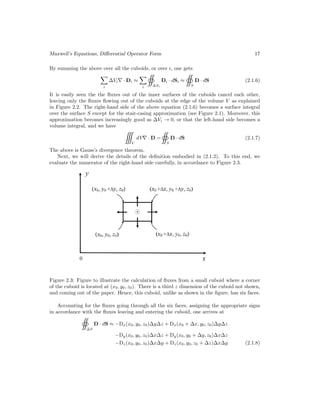
Next, we will derive the details of the definition embodied in (2.1.2). To this end, we
evaluate the numerator of the right-hand side carefully, in accordance to Figure 2.3.
Figure 2.3: Figure to illustrate the calculation of fluxes from a small cuboid where a corner
of the cuboid is located at (x0, y0, z0). There is a third z dimension of the cuboid not shown,
and coming out of the paper. Hence, this cuboid, unlike as shown in the figure, has six faces.
Accounting for the fluxes going through all the six faces, assigning the appropriate signs
in accordance with the fluxes leaving and entering the cuboid, one arrives at
∆S
D · dS ≈ −Dx(x0, y0, z0)∆y∆z + Dx(x0 + ∆x, y0, z0)∆y∆z
−Dy(x0, y0, z0)∆x∆z + Dy(x0, y0 + ∆y, z0)∆x∆z
−Dz(x0, y0, z0)∆x∆y + Dz(x0, y0, z0 + ∆z)∆x∆y (2.1.8)
18 Electromagnetic Field Theory
Factoring out the volume of the cuboid ∆V = ∆x∆y∆z in the above, one gets

∆S
D · dS ≈ ∆V {[Dx(x0 + ∆x, . . .) − Dx(x0, . . .)] /∆x
+ [Dy(. . . , y0 + ∆y, . . .) − Dy(. . . , y0, . . .)] /∆y
+ [Dz(. . . , z0 + ∆z) − Dz(. . . , z0)] /∆z} (2.1.9)
Or that
D · dS
∆V
≈
∂Dx
∂x
+
∂Dy
∂y
+
∂Dz
∂z
(2.1.10)
In the limit when ∆V → 0, then
lim
∆V →0
D · dS
∆V
=
∂Dx
∂x
+
∂Dy
∂y
+
∂Dz
∂z
= ∇ · D (2.1.11)
where
∇ = x̂
∂
∂x
+ ŷ
∂
∂y
+ ẑ
∂
∂z
(2.1.12)
D = x̂Dx + ŷDy + ẑDz (2.1.13)
The divergence operator ∇· has its complicated representations in cylindrical and spherical
coordinates, a subject that we would not delve into in this course. But they are best looked
up at the back of some textbooks on electromagnetics.
Consequently, one gets Gauss’s divergence theorem given by

V
dV ∇ · D =

S
D · dS (2.1.14)
2.1.1 Gauss’s Law in Differential Operator Form
By further using Gauss’s or Coulomb’s law implies that

S
D · dS = Q =

dV % (2.1.15)
which is equivalent to

V
dV ∇ · D =

V
dV % (2.1.16)
When V → 0, we arrive at the pointwise relationship, a relationship at a point in space:
∇ · D = % (2.1.17)
Maxwell’s Equations, Differential Operator Form 19
2.1.2 Physical Meaning of Divergence Operator
The physical meaning of divergence is that if ∇·D = 0 at a point in space, it implies that there
are fluxes oozing or exuding from that point in space [34]. On the other hand, if ∇ · D = 0,
if implies no flux oozing out from that point in space. In other words, whatever flux that
goes into the point must come out of it. The flux is termed divergence free. Thus, ∇ · D is a
measure of how much sources or sinks exists for the flux at a point. The sum of these sources
or sinks gives the amount of flux leaving or entering the surface that surrounds the sources
or sinks.
Moreover, if one were to integrate a divergence-free flux over a volume V , and invoking
Gauss’s divergence theorem, one gets
S
D · dS = 0 (2.1.18)
In such a scenerio, whatever flux that enters the surface S must leave it. In other words, what
comes in must go out of the volume V , or that flux is conserved. This is true of incompressible
fluid flow, electric flux flow in a source free region, as well as magnetic flux flow, where the
flux is conserved.
Figure 2.4: In an incompressible flux flow, flux is conserved: whatever flux that enters a
volume V must leave the volume V .
2.1.3 Example
If D = (2y2
+ z)x̂ + 4xyŷ + xẑ, find:
1. Volume charge density ρv at (−1, 0, 3).
2. Electric flux through the cube defined by
0 ≤ x ≤ 1, 0 ≤ y ≤ 1, 0 ≤ z ≤ 1.
3. Total charge enclosed by the cube.
20 Electromagnetic Field Theory
2.2 Stokes’s Theorem
The mathematical description of fluid flow was well established before the establishment of
electromagnetic theory [35]. Hence, much mathematical description of electromagnetic theory
uses the language of fluid. In mathematical notations, Stokes’s theorem is
C
E · dl =
S
∇ × E · dS (2.2.1)
In the above, the contour C is a closed contour, whereas the surface S is not closed.2
First, applying Stokes’s theorem to a small surface ∆S, we define a curl operator 3
∇×
at a point to be
∇ × E · n̂ = lim
∆S→0
∆C
E · dl
∆S
(2.2.2)
Figure 2.5: In proving Stokes’s theorem, a closed contour C is assumed to enclose an open
surface S. Then the surface S is tessellated into sum of small rects as shown. Stair-casing
error vanishes in the limit when the rects are made vanishingly small.
First, the surface S enclosed by C is tessellated into sum of small rects (rectangles).
Stokes’s theorem is then applied to one of these small rects to arrive at
∆Ci
Ei · dli = (∇ × Ei) · ∆Si (2.2.3)
2In other words, C has no boundary whereas S has boundary. A closed surface S has no boundary like
when we were proving Gauss’s divergence theorem previously.
3Sometimes called a rotation operator.
Maxwell’s Equations, Differential Operator Form 21
Next, we sum the above equation over i or over all the small rects to arrive at

i ∆Ci
Ei · dli =

i
∇ × Ei · ∆Si (2.2.4)
Again, on the left-hand side of the above, all the contour integrals over the small rects cancel
each other internal to S save for those on the boundary. In the limit when ∆Si → 0, the
left-hand side becomes a contour integral over the larger contour C, and the right-hand side
becomes a surface integral over S. One arrives at Stokes’s theorem, which is
C
E · dl =
S
(∇ × E) · dS (2.2.5)
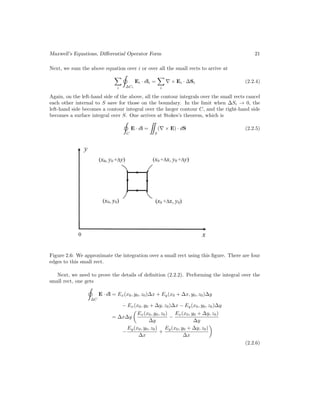
Figure 2.6: We approximate the integration over a small rect using this figure. There are four
edges to this small rect.
Next, we need to prove the details of definition (2.2.2). Performing the integral over the
small rect, one gets
∆C
E · dl = Ex(x0, y0, z0)∆x + Ey(x0 + ∆x, y0, z0)∆y
− Ex(x0, y0 + ∆y, z0)∆x − Ey(x0, y0, z0)∆y
= ∆x∆y

Ex(x0, y0, z0)
∆y
−
Ex(x0, y0 + ∆y, z0)
∆y
−
Ey(x0, y0, z0)
∆x
+
Ey(x0, y0 + ∆y, z0)
∆x

(2.2.6)
22 Electromagnetic Field Theory
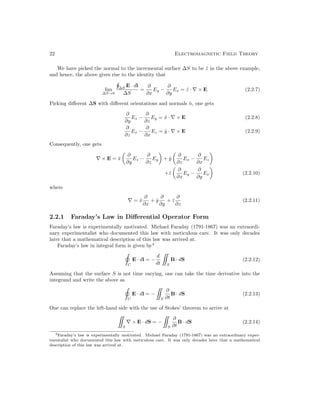
We have picked the normal to the incremental surface ∆S to be ẑ in the above example,
and hence, the above gives rise to the identity that
lim
∆S→0
∆S
E · dl
∆S
=
∂
∂x
Ey −
∂
∂y
Ex = ẑ · ∇ × E (2.2.7)
Picking different ∆S with different orientations and normals n̂, one gets
∂
∂y
Ez −
∂
∂z
Ey = x̂ · ∇ × E (2.2.8)
∂
∂z
Ex −
∂
∂x
Ez = ŷ · ∇ × E (2.2.9)
Consequently, one gets
∇ × E = x̂

∂
∂y
Ez −
∂
∂z
Ey

+ ŷ

∂
∂z
Ex −
∂
∂x
Ez

+ẑ

∂
∂x
Ey −
∂
∂y
Ex

(2.2.10)
where
∇ = x̂
∂
∂x
+ ŷ
∂
∂y
+ ẑ
∂
∂z
(2.2.11)
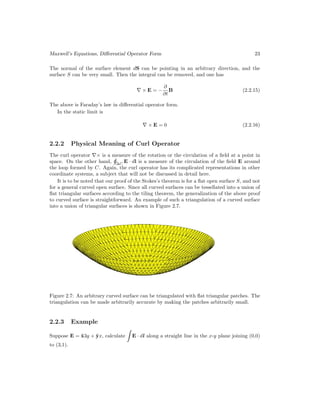
2.2.1 Faraday’s Law in Differential Operator Form
Faraday’s law is experimentally motivated. Michael Faraday (1791-1867) was an extraordi-
nary experimentalist who documented this law with meticulous care. It was only decades
later that a mathematical description of this law was arrived at.
Faraday’s law in integral form is given by4
C
E · dl = −
d
dt

S
B · dS (2.2.12)
Assuming that the surface S is not time varying, one can take the time derivative into the
integrand and write the above as
C
E · dl = −

S
∂
∂t
B · dS (2.2.13)
One can replace the left-hand side with the use of Stokes’ theorem to arrive at

S
∇ × E · dS = −

S
∂
∂t
B · dS (2.2.14)
4Faraday’s law is experimentally motivated. Michael Faraday (1791-1867) was an extraordinary exper-
imentalist who documented this law with meticulous care. It was only decades later that a mathematical
description of this law was arrived at.
Maxwell’s Equations, Differential Operator Form 23
The normal of the surface element dS can be pointing in an arbitrary direction, and the
surface S can be very small. Then the integral can be removed, and one has
∇ × E = −
∂
∂t
B (2.2.15)
The above is Faraday’s law in differential operator form.
In the static limit is
∇ × E = 0 (2.2.16)
2.2.2 Physical Meaning of Curl Operator
The curl operator ∇× is a measure of the rotation or the circulation of a field at a point in
space. On the other hand, ∆C
E · dl is a measure of the circulation of the field E around
the loop formed by C. Again, the curl operator has its complicated representations in other
coordinate systems, a subject that will not be discussed in detail here.
It is to be noted that our proof of the Stokes’s theorem is for a flat open surface S, and not
for a general curved open surface. Since all curved surfaces can be tessellated into a union of
flat triangular surfaces according to the tiling theorem, the generalization of the above proof
to curved surface is straightforward. An example of such a triangulation of a curved surface
into a union of triangular surfaces is shown in Figure 2.7.
Figure 2.7: An arbitrary curved surface can be triangulated with flat triangular patches. The
triangulation can be made arbitrarily accurate by making the patches arbitrarily small.
2.2.3 Example
Suppose E = x̂3y + ŷx, calculate E · dl along a straight line in the x-y plane joining (0,0)
to (3,1).
24 Electromagnetic Field Theory
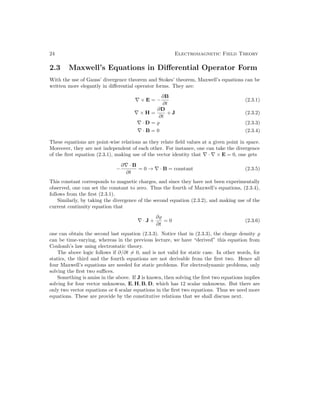
2.3 Maxwell’s Equations in Differential Operator Form
With the use of Gauss’ divergence theorem and Stokes’ theorem, Maxwell’s equations can be
written more elegantly in differential operator forms. They are:
∇ × E = −
∂B
∂t
(2.3.1)
∇ × H =
∂D
∂t
+ J (2.3.2)
∇ · D = % (2.3.3)
∇ · B = 0 (2.3.4)
These equations are point-wise relations as they relate field values at a given point in space.
Moreover, they are not independent of each other. For instance, one can take the divergence
of the first equation (2.3.1), making use of the vector identity that ∇ · ∇ × E = 0, one gets
−
∂∇ · B
∂t
= 0 → ∇ · B = constant (2.3.5)
This constant corresponds to magnetic charges, and since they have not been experimentally
observed, one can set the constant to zero. Thus the fourth of Maxwell’s equations, (2.3.4),
follows from the first (2.3.1).
Similarly, by taking the divergence of the second equation (2.3.2), and making use of the
current continuity equation that
∇ · J +
∂%
∂t
= 0 (2.3.6)
one can obtain the second last equation (2.3.3). Notice that in (2.3.3), the charge density %
can be time-varying, whereas in the previous lecture, we have “derived” this equation from
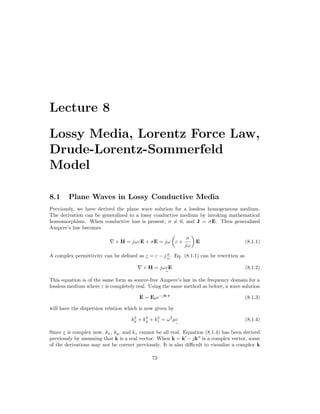
Coulomb’s law using electrostatic theory.
The above logic follows if ∂/∂t 6= 0, and is not valid for static case. In other words, for
statics, the third and the fourth equations are not derivable from the first two. Hence all
four Maxwell’s equations are needed for static problems. For electrodynamic problems, only
solving the first two suffices.
Something is amiss in the above. If J is known, then solving the first two equations implies
solving for four vector unknowns, E, H, B, D, which has 12 scalar unknowns. But there are
only two vector equations or 6 scalar equations in the first two equations. Thus we need more
equations. These are provide by the constitutive relations that we shall discuss next.
Lecture 3
Constitutive Relations, Wave
Equation, Electrostatics, and
Static Green’s Function
3.1 Simple Constitutive Relations
The constitution relation between D and E in free space is
D = ε0E (3.1.1)
When material medium is present, one has to add the contribution to D by the polarization
density P which is a dipole density.1
Then [29,31,36]
D = ε0E + P (3.1.2)
The second term above is the contribution to the electric flux due to the polarization density
of the medium. It is due to the little dipole contribution due to the polar nature of the atoms
or molecules that make up a medium.
By the same token, the first term ε0E can be thought of as the polarization density
contribution of vacuum. Vacuum, though represents nothingness, has electrons and positrons,
or electron-positron pairs lurking in it [37]. Electron is matter, whereas positron is anti-
matter. In the quiescent state, they represent nothingness, but they can be polarized by an
electric field E. That also explains why electromagnetic wave can propagate through vacuum.
For many media, it can be assumed to be a linear media. Then P = ε0χ0E
D = ε0E + ε0χ0E
= ε0(1 + χ0)E = εE (3.1.3)
1Note that a dipole moment is given by Q` where Q is its charge in coulomb and ` is its length in m. Hence,
dipole density, or polarization density as dimension of coulomb/m2, which is the same as that of electric flux
D.
25
26 Electromagnetic Field Theory
where χ0 is the electric susceptibility. In other words, for linear material media, one can
replace the vacuum permittivity ε0 with an effective permittivity ε.
In free space:
ε = ε0 = 8.854 × 10⁻¹²
≈
10−8
36π
F/m (3.1.4)
The constitutive relation between magnetic flux B and magnetic field H is given as
B = µH, µ = permeability H/m (3.1.5)
In free space,
µ = µ0 = 4π × 10−7
H/m (3.1.6)
As shall be explained later, this is an assigned value. In other materials, the permeability can
be written as
µ = µ0µr (3.1.7)
Similarly, the permittivity for electric field can be written as
ε = ε0εr (3.1.8)
In the above, µr and εr are relative permeability and relative permeability.
3.2 Emergence of Wave Phenomenon, Triumph of Maxwell’s
Equations
One of the major triumphs of Maxwell’s equations is the prediction of the wave phenomenon.
This was experimentally verified by Heinrich Hertz in 1888 [18], some 23 years after the com-
pletion of Maxwell’s theory [17]. Then it was realized that electromagnetic wave propagates
at a tremendous velocity which is the velocity of light. This was also the defining moment
which revealed that the field of electricity and magnetism and the field of optics were both
described by Maxwell’s equations or electromagnetic theory.
To see this, we consider the first two Maxwell’s equations for time-varying fields in vacuum
or a source-free medium.2
They are
∇ × E = −µ0
∂H
∂t
(3.2.1)
∇ × H = −ε0
∂E
∂t
(3.2.2)
Taking the curl of (3.2.1), we have
∇ × ∇ × E = −µ0
∂
∂t
∇ × H (3.2.3)
2Since the third and the fourth Maxwell’s equations are derivable from the first two.
Constitutive Relations, Wave Equation, Electrostatics, and Static Green’s Function 27
It is understood that in the above, the double curl operator implies ∇×(∇×E). Substituting
(3.2.2) into (3.2.3), we have
∇ × ∇ × E = −µ0ε0
∂2
∂t2
E (3.2.4)
In the above, the left-hand side can be simplified by using the identity that a × (b × c) =
b(a · c) − c(a · b),3
but be mindful that the operator ∇ has to operate on a function to its
right. Therefore, we arrive at the identity that
∇ × ∇ × E = ∇∇ · E − ∇2
E (3.2.5)
and that ∇ · E = 0 in a source-free medium, we have
∇2
E − µ0ε0
∂2
∂t2
E = 0 (3.2.6)
where
∇2
= ∇ · ∇ =
∂2
∂x2
∂2
∂x2
+
∂2
∂y2
+
∂2
∂z2
Here, (3.2.6) is the wave equation in three space dimensions [31,38].
To see the simplest form of wave emerging in the above, we can let E = x̂Ex(z, t) so that
∇ · E = 0 satisfying the source-free condition. Then (3.2.6) becomes
∂2
∂z2
Ex(z, t) − µ0ε0
∂2
∂t2
Ex(z, t) = 0 (3.2.7)
Eq. (3.2.7) is known mathematically as the wave equation in one space dimension. It can
also be written as
∂2
∂z2
f(z, t) −
1
c2
0
∂2
∂t2
f(z, t) = 0 (3.2.8)
where c2
0 = (µ0ε0)−1
. Eq. (3.2.8) can also be factorized as

∂
∂z
−
1
c0
∂
∂t
 
∂
∂z
+
1
c0
∂
∂t

f(z, t) = 0 (3.2.9)
or

∂
∂z
+
1
c0
∂
∂t
 
∂
∂z
−
1
c0
∂
∂t

f(z, t) = 0 (3.2.10)
The above implies that we have

∂
∂z
+
1
c0
∂
∂t

f+(z, t) = 0 (3.2.11)
3For mnemonics, this formula is also known as the “back-of-the-cab” formula.
28 Electromagnetic Field Theory
or

∂
∂z
−
1
c0
∂
∂t

f−(z, t) = 0 (3.2.12)
Equation (3.2.11) and (3.2.12) are known as the one-way wave equations or advective equa-
tions [39]. From the above factorization, it is seen that the solutions of these one-way wave
equations are also the solutions of the original wave equation given by (3.2.8). Their general
solutions are then
f+(z, t) = F+(z − c0t) (3.2.13)
f−(z, t) = F−(z + c0t) (3.2.14)
Eq. (3.2.13) constitutes a right-traveling wave function of any shape while (3.2.14) constitutes
a left-traveling wave function of any shape. Since Eqs. (3.2.13) and (3.2.14) are also solutions
to (3.2.8), we can write the general solution to the wave equation as
f(z, t) = F+(z − c0t) + F−(z + c0t) (3.2.15)
This is a wonderful result since F+ and F− are arbitrary functions of any shape (see Figure
3.1); they can be used to encode information for communication!
Figure 3.1: Solutions of the wave equation can be a single-valued function of any shape. In
the above, F+ travels in the positive z direction, while F− travels in the negative z direction
as t increases.
Constitutive Relations, Wave Equation, Electrostatics, and Static Green’s Function 29
Furthermore, one can calculate the velocity of this wave to be
c0 = 299, 792, 458m/s ' 3 × 10⁸
m/s (3.2.16)
where c0 =
p
1/µ0ε0.
Maxwell’s equations (3.2.1) implies that E and H are linearly proportional to each other.
Thus, there is only one independent constant in the wave equation, and the value of µ0 is
defined to be 4π × 10−7
henry m−1
, while the value of ε0 has been measured to be about
8.854 × 10⁻¹²
farad m−1
. Now it has been decided that the velocity of light is defined to
be the integer given in (3.2.16). A meter is defined to be the distance traveled by light
in 1/(299792458) seconds. Hence, the more accurate that unit of time or second can be
calibrated, the more accurate can we calibrate the unit of length or meter.
3.3 Static Electromagnetics–Revisted
We have seen static electromagnetics previously in integral form. Now we look at them in
differential operator form. When the fields and sources are not time varying, namely that
∂/∂t = 0, we arrive at the static Maxwell’s equations for electrostatics and magnetostatics,
namely [29,31,40]
∇ × E = 0 (3.3.1)
∇ × H = J (3.3.2)
∇ · D = % (3.3.3)
∇ · B = 0 (3.3.4)
Notice the the electrostatic field system is decoupled from the magnetostatic field system.
However, in a resistive system where
J = σE (3.3.5)
the two systems are coupled again. This is known as resistive coupling between them. But if
σ → ∞, in the case of a perfect conductor, or superconductor, then for a finite J, E has to
be zero. The two systems are decoupled again.
Also, one can arrive at the equations above by letting µ0 → 0 and 0 → 0. In this case,
the velocity of light becomes infinite, or retardation effect is negligible. In other words, there
is no time delay for signal propagation through the system in the static approximation.
3.3.1 Electrostatics
We see that Faraday’s law in the static limit is
∇ × E = 0 (3.3.6)
One way to satisfy the above is to let E = −∇Φ because of the identity ∇ × ∇ = 0.4
Alternatively, one can assume that E is a constant. But we usually are interested in solutions
4One an easily go through the algebra to convince oneself of this.
30 Electromagnetic Field Theory
that vanish at infinity, and hence, the latter is not a viable solution. Therefore, we let
E = −∇Φ (3.3.7)
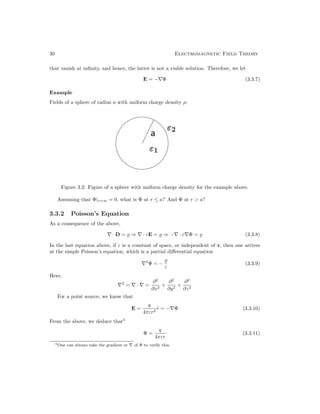
Example
Fields of a sphere of radius a with uniform charge density ρ:
Figure 3.2: Figure of a sphere with uniform charge density for the example above.
Assuming that Φ|r=∞ = 0, what is Φ at r ≤ a? And Φ at r  a?
3.3.2 Poisson’s Equation
As a consequence of the above,
∇ · D =  ⇒ ∇ · εE =  ⇒ −∇ · ε∇Φ =  (3.3.8)
In the last equation above, if ε is a constant of space, or independent of r, then one arrives
at the simple Poisson’s equation, which is a partial differential equation
∇2
Φ = −

ε
(3.3.9)
Here,
∇2
= ∇ · ∇ =
∂2
∂x2
+
∂2
∂y2
+
∂2
∂z2
For a point source, we know that
E =
q
4πεr2
r̂ = −∇Φ (3.3.10)
From the above, we deduce that5
Φ =
q
4πεr
(3.3.11)
5One can always take the gradient or ∇ of Φ to verify this.
Constitutive Relations, Wave Equation, Electrostatics, and Static Green’s Function 31
Therefore, we know the solution to Poisson’s equation (3.3.9) when the source % represents a
point source. Since this is a linear equation, we can use the principle of linear superposition
to find the solution when % is arbitrary.
A point source located at r0
is described by a charge density as
%(r) = qδ(r − r0
) (3.3.12)
where δ(r−r0
) is a short-hand notation for δ(x−x0
)δ(y−y0
)δ(z−z0
). Therefore, from (3.3.9),
the corresponding partial differential equation for a point source is
∇2
Φ(r) = −
qδ(r − r0
)
ε
(3.3.13)
The solution to the above equation, from Coulomb’s law, has to be
Φ(r) =
q
4πε|r − r0|
(3.3.14)
where (3.3.11) is for a point source at the origin, but (3.3.14) is for a point source located
and translated to r0
.
3.3.3 Static Green’s Function
Let us define a partial differential equation given by
∇2
g(r − r0
) = −δ(r − r0
) (3.3.15)
The above is similar to Poisson’s equation with a point source on the right-hand side as in
(3.3.13). But such a solution, a response to a point source, is called the Green’s function.6
By comparing equations (3.3.13) and (3.3.15), then making use of (3.3.14), it is deduced that
the static Green’s function is
g(r − r0
) =
1
4π|r − r0|
(3.3.16)
An arbitrary source can be expressed as
%(r) =

V
dV 0
%(r0
)δ(r − r0
) (3.3.17)
The above is just the statement that an arbitrary charge distribution %(r) can be expressed
as a linear superposition of point sources δ(r − r0
). Using the above in (3.3.9), we have
∇2
Φ(r) = −
1
ε

V
dV 0
%(r0
)δ(r − r0
) (3.3.18)
We can let
Φ(r) =
1
ε

V
dV 0
g(r − r0
)%(r0
) (3.3.19)
6George Green (1793-1841), the son of a Nottingham miller, was self-taught, but his work has a profound
impact in our world.
32 Electromagnetic Field Theory
By substituting the above into the left-hand side of (3.3.18), exchanging order of integration
and differentiation, and then making use of equation (3.3.9), it can be shown that (3.3.19)
indeed satisfies (3.3.11). The above is just a convolutional integral. Hence, the potential Φ(r)
due to an arbitrary source distribution (r) can be found by using convolution, namely,
Φ(r) =
1
4πε V
(r
)
|r − r|
dV 
(3.3.20)
In a nutshell, the solution of Poisson’s equation when it is driven by an arbitrary source , is
the convolution of the source with the static Green’s function, a point source response.
3.3.4 Laplace’s Equation
If  = 0, or if we are in a source-free region,
∇2
Φ =0 (3.3.21)
which is the Laplace’s equation. Laplace’s equation is usually solved as a boundary value
problem. In such a problem, the potential Φ is stipulated on the boundary of a region, and
then the solution is sought in the intermediate region so as to match the boundary condition.
Examples of such boundary value problems are given below.
Example 1
A capacitor has two parallel plates attached to a battery, what is E field inside the capacitor?
First, one guess the electric field between the two parallel plates. Then one arrive at a
potential Φ in between the plates so as to produce the field. Then the potential is found so
as to match the boundary conditions of Φ = V in the upper plate, and Φ = 0 in the lower
plate. What is the Φ that will satisfy the requisite boundary condition?
Figure 3.3: Figure of a parallel plate capacitor. The field in between can be found by solving
Laplace’s equation as a boundary value problem [29].
Example 2
A coaxial cable has two conductors. The outer conductor is grounded and hence is at zero
potential. The inner conductor is at voltage V . What is the solution?
Constitutive Relations, Wave Equation, Electrostatics, and Static Green’s Function 33
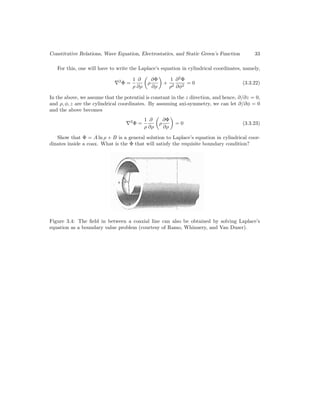
For this, one will have to write the Laplace’s equation in cylindrical coordinates, namely,
∇2
Φ =
1
ρ
∂
∂ρ

ρ
∂Φ
∂ρ

+
1
ρ2
∂2
Φ
∂φ2
= 0 (3.3.22)
In the above, we assume that the potential is constant in the z direction, and hence, ∂/∂z = 0,
and ρ, φ, z are the cylindrical coordinates. By assuming axi-symmetry, we can let ∂/∂φ = 0
and the above becomes
∇2
Φ =
1
ρ
∂
∂ρ

ρ
∂Φ
∂ρ

= 0 (3.3.23)
Show that Φ = A ln ρ + B is a general solution to Laplace’s equation in cylindrical coor-
dinates inside a coax. What is the Φ that will satisfy the requisite boundary condition?
Figure 3.4: The field in between a coaxial line can also be obtained by solving Laplace’s
equation as a boundary value problem (courtesy of Ramo, Whinnery, and Van Duzer).
34 Electromagnetic Field Theory
Lecture 4
Magnetostatics, Boundary
Conditions, and Jump
Conditions
4.1 Magnetostatics
The magnetostatic equations where ∂/∂t = 0 are [29,31,40]
∇ × H = J (4.1.1)
∇ · B = 0 (4.1.2)
One way to satisfy the second equation is to let
B = ∇ × A (4.1.3)
because
∇ · (∇ × A) = 0 (4.1.4)
The above is zero for the same reason that a · (a × b) = 0. In this manner, Gauss’s law is
automatically satisfied.
From (4.1.1), we have
∇ ×

B
µ

= J (4.1.5)
Then using (4.1.3)
∇ ×

1
µ
∇ × A

= J (4.1.6)
35
36 Electromagnetic Field Theory
In a homogeneous medium, µ is a constant and hence
∇ × (∇ × A) = µJ (4.1.7)
We use the vector identity that (see previous lecture)
∇ × (∇ × A) = ∇(∇ · A) − (∇ · ∇)A
= ∇(∇ · A) − ∇2
A (4.1.8)
As a result, we arrive at [41]
∇(∇ · A) − ∇2
A = µJ (4.1.9)
By imposing the Coulomb’s gauge that ∇·A = 0, which will be elaborated in the next section,
we arrive at
∇2
A = −µJ (4.1.10)
The above is also known as the vector Poisson’s equation. In cartesian coordinates, the above
can be viewed as three scalar Poisson’s equations. Each of the Poisson’s equation can be
solved using the Green’s function method previously described. Consequently, in free space
A(r) =
µ
4π

V
J(r0
)
R
dV 0
(4.1.11)
where
R = |r − r0
| (4.1.12)
and dV 0
= dx0
dy0
dz0
. It is also variously written as dr0
or d3
r0
.
4.1.1 More on Coulomb’s Gauge
Gauge is a very important concept in physics [42], and we will further elaborate it here. First,
notice that A in (4.1.3) is not unique because one can always define
A0
= A − ∇Ψ (4.1.13)
Then
∇ × A0
= ∇ × (A − ∇Ψ) = ∇ × A = B (4.1.14)
where we have made use of that ∇ × ∇Ψ = 0. Hence, the ∇× of both A and A0
produce the
same B.
To find A uniquely, we have to define or set the divergence of A or provide a gauge
condition. One way is to set the divergence of A to be zero, namely
∇ · A = 0 (4.1.15)
Magnetostatics, Boundary Conditions, and Jump Conditions 37
Then
∇ · A0
= ∇ · A − ∇2
Ψ 6= ∇ · A (4.1.16)
The last non-equal sign follows if ∇2
Ψ 6= 0. However, if we further stipulate that ∇ · A0
=
∇ · A = 0, then −∇2
Ψ = 0. This does not necessary imply that Ψ = 0, but if we impose that
condition that Ψ → 0 when r → ∞, then Ψ = 0 everywhere.1
By so doing, A and A0
are
equal to each other, and we obtain (4.1.10) and (4.1.11).
4.2 Boundary Conditions–1D Poisson’s Equation
Boundary conditions are embedded in the partial differential equations that the potential or
the field satisfy. Two important concepts to keep in mind are:
• Differentiation of a function with discontinuous slope will give rise to step discontinuity.
• Differentiation of a function with step discontinuity will give rise to a Dirac delta func-
tion. This is also called the jump condition, a term often used by the mathematics
community [43].
Take for example a one dimensional Poisson’s equation that
d
dx
ε(x)
d
dx
Φ(x) = −%(x) (4.2.1)
where ε(x) represents material property that has the form given in Figure 4.1. One can
actually say a lot about Φ(x) given %(x) on the right-hand side. If %(x) has a delta function
singularity, it implies that ε(x) d
dx Φ(x) has a step discontinuity. If %(x) is finite everywhere,
then ε(x) d
dx Φ(x) must be continuous everywhere.
Furthermore, if ε(x) d
dx Φ(x) is finite everywhere, it implies that Φ(x) must be continuous
everywhere.
1It is a property of the Laplace boundary value problem that if Ψ = 0 on a closed surface S, then Ψ = 0
everywhere inside S. Earnshaw’s theorem is useful for proving this assertion.
38 Electromagnetic Field Theory
Figure 4.1: A figure showing a charge sheet at the interface between two dielectric media.
Because it is a surface charge sheet, the volume charge density (x) is infinite at the sheet
location x0.
To see this in greater detail, we illustrate it with the following example. In the above,
(x) represents a charge distribution given by (x) = sδ(x − x0). In this case, the charge
distribution is everywhere zero except at the location of the surface charge sheet, where the
charge density is infinite: it is represented mathematically by a delta function2
in space.
To find the boundary condition of the potential Φ(x) at x0 , we integrate (4.2.1) over an
infinitesimal width around x0, the location of the charge sheet, namely
x0+∆
x0−∆
dx
d
dx
ε(x)
d
dx
Φ(x) = −
x0+∆
x0−∆
dx(x) (4.2.2)
or on the left-hand side, we get
ε(x)
d
dx
Φ(x)


x0+∆
x0−∆
∼
= −s (4.2.3)
whereas on the right-hand side, we pick up the contribution from the delta function. Evalu-
ating the left-hand side at their limits, one arrives at
lim
∆→0
ε(x+
0 )
d
dx
Φ(x+
0 ) − ε(x−
0 )
d
dx
Φ(x−
0 ) ∼
= −s, (4.2.4)
In other words, the jump discontinuity is in ε(x) d
dx Φ(x) and the amplitude of the jump
discontinuity is proportional to the amplitude of the delta function.
Since E = ∇Φ, or
Ex(x) = −
d
dx
Φ(x), (4.2.5)
2This function has been attributed to Dirac who used in pervasively, but Cauchy was aware of such a
function.
Magnetostatics, Boundary Conditions, and Jump Conditions 39
The above implies that
ε(x+
0 )Ex(x+
0 ) − ε(x−
0 )Ex(x−
0 ) = s (4.2.6)
or
Dx(x+
0 ) − Dx(x−
0 ) = s (4.2.7)
where
Dx(x) = ε(x)Ex(x) (4.2.8)
The lesson learned from above is that boundary condition is obtained by integrating the
pertinent differential equation over an infinitesimal small segment. In this mathematical
way of looking at the boundary condition, one can also eyeball the differential equation and
ascertain the terms that will have the jump discontinuity that will yield the delta function
on the right-hand side.
4.3 Boundary Conditions–Maxwell’s Equations
As seen previously, boundary conditions for a field is embedded in the differential equation
that the field satisfies. Hence, boundary conditions can be derived from the differential
operator forms of Maxwell’s equations. In most textbooks, boundary conditions are obtained
by integrating Maxwell’s equations over a small pill box [29,31,41]. To derive these boundary
conditions, we will take an unconventional view: namely to see what sources can induce jump
conditions on the pertinent fields. Boundary conditions are needed at media interfaces, as
well as across current or charge sheets.
4.3.1 Faraday’s Law
Figure 4.2: This figure is for the derivation of Faraday’s law. A local coordinate system can be
used to see the boundary condition more lucidly. Here, the normal n̂ = ŷ and the tangential
component t̂ = x̂.
40 Electromagnetic Field Theory
For this, we start with Faraday’s law, which implies that
∇ × E = −
∂B
∂t
(4.3.1)
One quick answer we could have is that if the right-hand side of the above equation is every-
where finite, then there could not be any jump discontinuity on the field E on the left hand
side. To see this quickly, one can project the tangential field component and normal field
component to a local coordinate system. In other words, one can think of t̂ and n̂ as the local
x̂ and ŷ coordinates. Then writing the curl operator in this local coordinates, one gets
∇ × E =

x̂
∂
∂x
+ ŷ
∂
∂y

× (x̂Ex + ŷEy) (4.3.2)
= ẑ
∂
∂x
Ey − ẑ
∂
∂y
Ex (4.3.3)
In simplifying the above, we have used the distributive property of cross product, and evalu-
ating the cross product in cartesian coordinates. The cross product produces four terms, but
only two of the four terms are non-zero as shown above.
Since the right-hand side of (4.3.1) is finite, the above implies that ∂
∂x Ey and ∂
∂y Ex have
to be finite. In order words, Ex is continuous in the y direction and Ey is continuous in the
x direction. Since in the local coordinate system, Ex = Et, then Et is continuous across the
boundary. The above implies that
E1t = E2t (4.3.4)
or
n̂ × E1 = n̂ × E2 (4.3.5)
where n̂ is the unit normal at the interface, and n̂ × E always bring out the tangential
component of a vector E (convince yourself).
4.3.2 Gauss’s Law
From Gauss’s law, we have
∇ · D = % (4.3.6)
where % is the volume charge density.
Magnetostatics, Boundary Conditions, and Jump Conditions 41
Figure 4.3: A figure showing the derivation of boundary condition for Gauss’s law. Again, a
local coordinate system can be introduced for convenience.
Expressing the above in local coordinates, then
∇ · D =
∂
∂x
Dx +
∂
∂y
Dy +
∂
∂z
Dz =  (4.3.7)
If there is a surface layer charge at the interface, then the volume charge density must be
infinitely large, and can be expressed in terms of a delta function, or  = sδ(z) in local
coordinates. By looking at the above expression, the only term that can produce a δ(z) is
from ∂
∂z Dz. In other words, Dz has a jump discontinuity at z = 0; the other terms do not.
Then
∂
∂z
Dz = sδ(z) (4.3.8)
Integrating the above from 0 − ∆ to 0 + ∆, we get
Dz(z)


0+∆
0−∆
= s (4.3.9)
or
Dz(0+
) − Dz(0−
) = s (4.3.10)
where 0+
= lim∆→0 0 + ∆, 0−
= lim∆→0 0 − ∆. Since Dz(0+
) = D2n, Dz(0−
) = D1n, the
above becomes
D2n − D1n = s (4.3.11)
or that
n̂ · (D2 − D1) = s (4.3.12)
42 Electromagnetic Field Theory
In other words, a charge sheet s can give rise to a jump discontinuity in the normal component
of the electric flux D. Figure 4.4 shows an intuitive sketch as to why a charge sheet gives rise
to a discontinuous normal component of the electric flux D.
Figure 4.4: A figure intuitively showing why a sheet of charge gives rise to a jump discontinuiy
in the normal component of the electric flux D.
4.3.3 Ampere’s Law
Ampere’s law, or the generalized one, stipulates that
∇ × H = J +
∂D
∂t
(4.3.13)
Again if the right-hand side is everywhere finite, then H is a continuous field everywhere.
However, if the right-hand side has a delta function singularity, then this is not so. For
instance, we can project the above equation onto a local coordinates just as we did for
Faraday’s law.
Magnetostatics, Boundary Conditions, and Jump Conditions 43
Figure 4.5: A figure showing the derivation of boundary condition for Ampere’s law. A local
coordinate system is used for simplicity.
To be general, we also include the presence of a current sheet at the interface. A current
sheet, or a surface current density becomes a delta function singularity when expressed as a
volume current density; Thus, rewriting (4.3.13) in a local coordinate system, assuming that
J = x̂Jsxδ(z), then
∇ × H = x̂

∂
∂y
Hz −
∂
∂z
Hy

= x̂Jsxδ(z) (4.3.14)
The displacement current term on the right-hand side is ignored since it is regular or finite,
and will not induce a jump discontinuity on the field; hence, we have the form of the right-
hand side of the above equation. From the above, the only term that can produce a δ(z)
singularity on the left-hand side is the − ∂
∂z Hy term. Therefore, we conclude that
−
∂
∂z
Hy = Jsxδ(z) (4.3.15)
In other words, Hy has to have a jump discontinuity at the interface where the current
sheet resides. Or that
Hy(z = 0+
) − Hy(z = 0−
) = −Jsx (4.3.16)
The above implies that
H2y − H1y = −Jsx (4.3.17)
But Hy is just the tangential component of the H field. Now if we repeat the same exercise
with J = ŷJsyδ(z), at the interface, we have
H2x − H1x = Jsy (4.3.18)
Now, (4.3.17) and (4.3.18) can be rewritten using a cross product as
ẑ × (ŷH2y − ŷH1y) = x̂Jsx (4.3.19)
ẑ × (x̂H2x − x̂H1x) = ŷJsy (4.3.20)
44 Electromagnetic Field Theory
The above two equations can be combined as one to give
ẑ × (H2 − H1) = Js (4.3.21)
Taking ẑ = n̂ in general, we have
n̂ × (H2 − H1) = Js (4.3.22)
In other words, a current sheet Js can give rise to a jump discontinuity in the tangential
components of the magnetic field, n̂ × H. This is illustrated intuitively in Figure 4.6
Figure 4.6: A figure intuitively showing that with the understanding of how a single line
current source generates a magnetic field (right), a cluster of them forming a current sheet
will generate a jump discontinuity in the tangential component of the magnetic field H (left).
4.3.4 Gauss’s Law for Magnetic Flux
Similarly, from Gauss’s law for magnetic flux, or that
∇ · B = 0 (4.3.23)
one deduces that
n̂ · (B2 − B1) = 0 (4.3.24)
or that the normal magnetic fluxes are continuous at an interface. In other words, since mag-
netic charges do not exist, the normal component of the magnetic flux has to be continuous.
Lecture 5
Biot-Savart law, Conductive
Media Interface, Instantaneous
Poynting’s Theorem
5.1 Derivation of Biot-Savart Law
Figure 5.1: A current element used to illustrate the derivation of Biot-Savart law. The current
element generates a magnetic field due to Ampere’s law in the static limit.
Biot-Savart law, like Ampere’s law was experimentally determined in around 1820 and it
is discussed in a number of textbooks [29, 31, 42]. This is the cumulative work of Ampere,
Oersted, Biot, and Savart. Nowadays, we have the mathematical tool to derive this law from
Ampere’s law and Gauss’s law for magnetostatics.
45
46 Electromagnetic Field Theory
From Gauss’ law and Ampere’s law in the static limit, we have derived that
A(r) =
µ
4π

V
J(r0
)
R
dV 0
(5.1.1)
When the current element is small, and is carried by a wire of cross sectional area ∆a as
shown in Figure 5.1, we can approximate the integrand as
J(r0
)dV 0
≈ J(r0
)∆V 0
= (∆a)∆l
| {z }
∆V
ˆ
lI/∆a
| {z }
J(r0)
(5.1.2)
In the above, ∆V = (∆a)∆l and ˆ
lI/∆a = J(r0
) since J has the unit of amperes/m2
. Here, ˆ
l
is a unit vector pointing in the direction of the current flow. Hence, we can let the current
element
J(r0
)dV 0
≈ I∆l (5.1.3)
where the vector ∆l = ∆lˆ
l. Therefore, the incremental vector potential due to an incremental
current element is
∆A(r) ≈
µ
4π

J(r0
)∆V 0
R

=
µ
4π
I∆l0
R
(5.1.4)
where R = |r − r0
|. Since B = ∇ × A, we derive that the incremental B flux is
∆B = ∇ × ∆A(r) ∼
=
µI
4π
∇ ×
∆l0
R
=
−µI
4π
∆l0
× ∇
1
R
(5.1.5)
where we have made use of the fact that ∇×af(r) = −a×∇f(r) when a is a constant vector.
The above can be simplified further making use of the fact that
∇
1
R
= −
1
R2
R̂ (5.1.6)
where R̂ is a unit vector pointing in the r − r0
direction. We have also made use of the fact
that R =
p
(x − x0)2 + (y − y0)2 + (z − z0)2. Consequently, assuming that the incremental
length becomes very small, or ∆l → dl, we have, after using (5.1.6) in (5.1.5), that
dB =
µI
4π
dl0
×
1
R2
R̂ (5.1.7)
=
µIdl0
× R̂
4πR2
(5.1.8)
Since B = µH, we have
dH =
Idl0
× R̂
4πR2
(5.1.9)
or
H(r) =

I(r0
)dl0
× R̂
4πR2
(5.1.10)
which is Biot-Savart law
Biot-Savart law, Conductive Media Interface, Instantaneous Poynting’s Theorem 47
5.2 Boundary Conditions–Conductive Media Case
Figure 5.2: The schematics for deriving the boundary condition for the current density J at
the interface of two conductive media.
From the current continuity equation, one gets
∇ · J = −
∂
∂t
(5.2.1)
If the right-hand side is everywhere finite, it will not induce a jump discontinuity in the
current. Moreover, it is zero for static limit. Hence, just like the Gauss’s law case, the above
implies that the normal component of the current Jn is continuous, or that J1n = J2n in the
static limit. In other words,
n̂ · (J2 − J1) = 0 (5.2.2)
Hence, using J = σE, we have
σ2E2n − σ1E1n = 0 (5.2.3)
The above has to be always true in the static limit irrespective of the values of σ1 and σ2.
But Gauss’s law implies the boundary condition that
ε2E2n − ε1E1n = s (5.2.4)
The above equation is incompatible with (5.2.3) unless s = 0. Hence, surface charge density
or charge accumulation is necessary at the interface, unless σ2/σ1 = ε2/ε1.
5.2.1 Electric Field Inside a Conductor
The electric field inside a perfect electric conductor (PEC) has to be zero. If medium 1 is a
perfect electric conductor, then σ → ∞ but J1 = σE1. An infinitesimal E1 will give rise to
48 Electromagnetic Field Theory
an infinite current J1. To avoid this ludicrous situation, thus E1 = 0. This implies that D1
= 0 as well.
Figure 5.3: The behavior of the electric field and electric flux at the interface of a perfect
electric conductor and free space.
Since tangential E is continuous, from Faraday’s law, it is still true that
E2t = E1t = 0 (5.2.5)
But since
n̂ · (D2 − D1) = s (5.2.6)
and that D1 = 0, then
n̂ · D2 = s (5.2.7)
So surface charge density has to be nonzero at a PEC/air interface for instance. Moreover,
normal D2 = 0, tangential E2 = 0. The sketch of the electric field in the vicinity of a perfect
conducting surface is shown in Figure 5.3.
The above argument for zero electric field inside a perfect conductor is true for electro-
dynamic problems. However, one does not need the above argument regarding the shielding
of the static electric field from a conducting region. In the situation of the two conducting
objects example below, as long as the electric fields are non-zero in the objects, currents will
keep flowing. They flow until the charges in the two objects orient themselves so that electric
current cannot flow anymore. This happens when the charges produce internal fields that
cancel each other giving rise to zero field inside the two objects. Faraday’s law still applies
Biot-Savart law, Conductive Media Interface, Instantaneous Poynting’s Theorem 49
which means that tangental E field has to be continuous. Therefore, the boundary condition
that the fields have to be normal to the conducting object surface is still true for elecrostatics.
A sketch of the electric field between two conducting spheres is show in Figure 5.4.
Figure 5.4: The behavior of the electric field and flux outside two conductors in the static
limit. The two conductors need not be PEC and yet, the fields are normal to the interface.
5.2.2 Magnetic Field Inside a Conductor
We have seen that for a finite conductor, as long as σ = 0, the charges will re-orient themselves
until the electric field is expelled from the conductor; otherwise, the current will keep flowing.
But there are no magnetic charges nor magnetic conductors in this world. So this physical
phenomenon does not happen for magnetic field: in other words, magnetic field cannot be
expelled from an electric conductor. However, a magnetic field is expelled from a perfect
conductor or a superconductor. You can only fully understand this physical phenomenon if
we study the time-varying form Maxwell’s equations.
In a perfect conductor where σ → ∞, it is unstable for the magnetic field B to be
nonzero. As time varying magnetic field gives rise to an electric field by the time-varying
form of Faraday’s law, a small time variation of the B field will give rise to infinite current
flow in a perfect conductor. Therefore to avoid this ludicrous situation, and to be stable,
B = 0 in a perfect conductor or a superconductor.
So if medium 1 is a perfect electric conductor (PEC), then B1 = H1 = 0. The boundary
conditions from Ampere’s law and Gauss’ law for magnetic flux give rise to
n̂ × H2 = Js (5.2.8)
which is the jump condition for the magnetic field. The magnetic flux B is expelled from
the perfect conductor, and there is no normal component of the B field as there cannot be
50 Electromagnetic Field Theory
magnetic charges. Therefore, the boundary condition becomes, for a PEC,
n̂ · B2 = 0 (5.2.9)
The B field in the vicinity of a conductor surface is as shown in Figure 5.5.
Figure 5.5:
When a superconductor cube is placed next to a static magnetic field near a permanent
magnet, eddy current will be induced on the superconductor. The eddy current will expel the
static magnetic field from the permanent magnet, or it will produce a magnetic dipole on the
superconducting cube that repels the static magnetic field. This causes the superconducting
cube to levitate on the static magnetic field as shown in Figure 5.6.
Figure 5.6: Levitation of a superconducting disk on top of a static magnetic field due to
expulsion of the magnetic field from the superconductor.. This is also known as the Meissner
effect (figure courtesy of Wikimedia).
5.3 Instantaneous Poynting’s Theorem
Before we proceed further with studying energy and power, it is habitual to add fictitious
magnetic current M and fictitious magnetic charge m to Maxwell’s equations to make them
Biot-Savart law, Conductive Media Interface, Instantaneous Poynting’s Theorem 51
mathematically symmetrical. To this end, we have
∇ × E = −
∂B
∂t
− M (5.3.1)
∇ × H =
∂D
∂t
+ J (5.3.2)
∇ · D = % (5.3.3)
∇ · B = %m (5.3.4)
Consider the first two of Maxwell’s equations where fictitious magnetic current is included
and that the medium is isotropic such that B = µH and D = εE. Next, we need to consider
only the first two equations since in electrodynamics, by invoking charge conservation, the
third and the fourth equations are derivable from the first two. They are
∇ × E = −
∂B
∂t
− Mi = −µ
∂H
∂t
− Mi (5.3.5)
∇ × H =
∂D
∂t
+ J = ε
∂E
∂t
+ Ji + σE (5.3.6)
where Mi and Ji are impressed current sources. They are sources that are impressed into
the system, and they cannot be changed by their interaction with the environment.
Also, for a conductive medium, a conduction current or induced current flows in addition
to impressed current. Here, J = σE is the induced current source. Moreover, J = σE is
similar to ohm’s law. We can show from (5.3.5) and (5.3.6) that
H · ∇ × E = −µH ·
∂H
∂t
− H · Mi (5.3.7)
E · ∇ × H = εE ·
∂E
∂t
+ E · Ji + σE · E (5.3.8)
Using the identity, which is the same as the product rule for derivatives, we have1
∇ · (E × H) = H · (∇ × E) − E · (∇ × H) (5.3.9)
Therefore, from (5.3.7), (5.3.8), and (5.3.9) we have
∇ · (E × H) = −

µH ·
∂H
∂t
+ εE ·
∂E
∂t
+ σE · E + H · Mi + E · Ji

(5.3.10)
The physical meaning of the above is more lucid if we first consider σ = 0, and Mi =
Ji = 0, or the absence of conductive loss and the impressed current sources. Then the above
becomes
∇ · (E × H) = −

µH ·
∂H
∂t
+ εE ·
∂E
∂t

(5.3.11)
1The identity that a · (b × c) = c · (a × b) = b · (c × a) is useful for the derivation.
52 Electromagnetic Field Theory
Rewriting each term on the right-hand side of the above, we have
µH ·
∂H
∂t
=
1
2
µ
∂
∂t
H · H =
∂
∂t

1
2
µ|H|2

=
∂
∂t
Wm (5.3.12)
εE ·
∂E
∂t
=
1
2
ε
∂
∂t
E · E =
∂
∂t

1
2
ε|E|2

=
∂
∂t
We (5.3.13)
Then (5.3.11) becomes
∇ · (E × H) = −
∂
∂t
(Wm + We) (5.3.14)
where
Wm =
1
2
µ|H|2
, We =
1
2
ε|E|2
(5.3.15)
Equation (5.3.14) is reminiscent of the current continuity equation, namely,
∇ · J = −
∂%
∂t
(5.3.16)
which is a statement of charge conservation. In other words, time variation of current density
at a point is due to charge density flow into or out of the point.
Hence, E × H has the meaning of power density, and Wm and We are the energy density
stored in the magnetic field and electric field, respectively. In fact, one can show that E × H
has the unit of V m−1
times A m−1
which is W m−2
, where V is volt, A is ampere, and W
is watt, which is joule s−1
. Hence, it has the unit of power density.
Similarly, Wm = 1
2 µ|H|2
where µ has unit of H m−1
. Hence, Wm has the unit of H m−1
times A2
m−2
= J m−3
, where H is henry, A is ampere, and J is joule. Therefore, it has the
unit of energy density. We can also ascertain the unit of 1
2 µ|H|2
easily by noticing that the
energy stored in an inductor is 1
2 LI2
which is in terms of joules, and is due to henry times
A2
.
Also We = 1
2 ε|E|2
where ε has the unit of F m−1
. Hence, We has the unit of F m−1
times V2
m−2
= J m−3
where F is farad, V is voltage, and J is joule, which is energy density
again. We can also ascertain the unit of 1
2 ε|E|2
easily by noticing that the energy stored in
a capacitor is 1
2 CV 2
which has the unit of joules, and is due to farad times V2
.
The vector quantity
Sp = E × H (5.3.17)
is called the Poynting’s vector, and (5.3.14) becomes
∇ · Sp = −
∂
∂t
Wt (5.3.18)
where Wt = We + Wm is the total energy density stored. The above is similar to the current
continuity equation mentioned above. Analogous to that current density is charge density
flow, power density is energy density flow.
Biot-Savart law, Conductive Media Interface, Instantaneous Poynting’s Theorem 53
Now, if we let σ 6= 0, then the term to be included is then σE · E = σ|E|2
which has the
unit of S m−1
times V2
m−2
, or W m−3
where S is siemens. We gather this unit by noticing
that 1
2
V 2
R is the power dissipated in a resistor of R ohms with a unit of watts. The reciprocal
unit of ohms, which used to be mhos is now siemens. With σ 6= 0, (5.3.18) becomes
∇ · Sp = −
∂
∂t
Wt − σ|E|2
= −
∂
∂t
We − Pd (5.3.19)
Here, ∇·Sp has physical meaning of power density oozing out from a point, and −Pd = −σ|E|2
has the physical meaning of power density dissipated (siphoned) at a point by the conductive
loss in the medium which is proportional to −σ|E|2
.
Now if we set Ji and Mi to be nonzero, (5.3.19) is augmented by the last two terms in
(5.3.10), or
∇ · Sp = −
∂
∂t
Wt − Pd − H · Mi − E · Ji (5.3.20)
The last two terms can be interpreted as the power density supplied by the impressed currents
Mi and Ji. Hence, (5.3.20) becomes
∇ · Sp = −
∂
∂t
Wt − Pd + Ps (5.3.21)
where
Ps = −H · Mi − E · Ji (5.3.22)
where Ps is the power supplied by the impressed current sources. These terms are positive if
H and Mi have opposite signs, or if E and Ji have opposite signs. The last terms reminds us
of what happens in a negative resistance device or a battery.2
In a battery, positive charges
move from a region of lower potential to a region of higher potential (see Figure 5.7). The
positive charges move from one end of a battery to the other end of the battery. Hence, they
are doing an “uphill climb” due to chemical processes within the battery.
2A negative resistance has been made by Leo Esaki [44], winning him a share in the Nobel prize.
54 Electromagnetic Field Theory
Figure 5.7: Figure showing the dissipation of energy as the current flows around a loop. A
battery can be viewed as having negative resistance.
In the above, one can easily work out that Ps has the unit of W m−3
which is power
supplied density. One can also choose to rewrite (5.3.21) in integral form by integrating it
over a volume V and invoking the divergence theorem yielding
S
dS · Sp = −
d
dt V
WtdV −
V
PddV +
V
PsdV (5.3.23)
The left-hand side is
S
dS · (E × H) (5.3.24)
which represents the power flowing out of the surface S.
Lecture 6
Time-Harmonic Fields, Complex
Power
6.1 Time-Harmonic Fields—Linear Systems
The analysis of Maxwell’s equations can be greatly simplified by assuming the fields to be
time harmonic, or sinusoidal (cosinusoidal). Electrical engineers use a method called phasor
technique [31,45], to simplify equations involving time-harmonic signals. This is also a poor-
man’s Fourier transform [46]. That is one begets the benefits of Fourier transform technique
without knowledge of Fourier transform. Since only one time-harmonic frequency is involved,
this is also called frequency domain analysis.1
Figure 6.1: Courtesy of Wikipedia and Pinterest.
1It is simple only for linear systems: for nonlinear systems, such analysis can be quite unwieldy. But rest
assured, as we will not discuss nonlinear systems in this course.
55
56 Electromagnetic Field Theory
To learn phasor techniques, one makes use the formula due to Euler (1707–1783) (Wikipedia)
ejα
= cos α + j sin α (6.1.1)
where j =
√
−1 is an imaginary number. But lo and behold, in other disciplines,
√
−1 is
denoted by “i”, but “i” is too close to the symbol for current. So the preferred symbol for
electrical engineering for an imaginary number is j: a quirkness of convention, just as positive
charges do not carry current in a wire.
From Euler’s formula one gets
cos α = e(ejα
) (6.1.2)
Hence, all time harmonic quantity can be written as
V (x, y, z, t) = V 0
(x, y, z) cos(ωt + α) (6.1.3)
= V 0
(r)e(ej(ωt+α)
) (6.1.4)
= e V 0
(r)ejα
ejωt

(6.1.5)
= e

V
e
(r)ejωt

(6.1.6)
Now V
e
(r) = V 0
(r)ejα
is a complex number called the phasor representation or phasor of
V (r, t) a time-harmonic quantity.2
Here, the phase α = α(r) can also be a function of
position r, or x, y, z. Consequently, any component of a field can be expressed as
Ex(x, y, z, t) = Ex(r, t) = e[E
e
x(r)ejωt
] (6.1.7)
The above can be repeated for y and z components. Compactly, one can write
E(r, t) = e[E
e
(r)ejωt
] (6.1.8)
H(r, t) = e[H
e
(r)ejωt
] (6.1.9)
where E
e
and H
e
are complex vector fields. Such phasor representations of time-harmonic fields
simplify Maxwell’s equations. For instance, if one writes
B(r, t) = e

B
e
(r)ejωt

(6.1.10)
then
∂
∂t
B(r, t) =
∂
∂t
e[B
e
(r)ejωt
]
= e

∂
∂t
B
e
(r)jωejωt

= e

B
e
(r)jωejωt

(6.1.11)
2We will use under tilde to denote a complex number or a phasor here, but this notation will be dropped
later. Whether a variable is complex or real is clear from the context.
Time-Harmonic Fields, Complex Power 57
Therefore, a time derivative can be effected very simply for a time-harmonic field. One just
needs to multiply jω to the phasor representation of a field or a signal. Therefore, given
Faraday’s law that
∇ × E = −
∂B
∂t
− M (6.1.12)
assuming that all quantities are time harmonic, then
E(r, t) = e[E
e
(r)ejωt
] (6.1.13)
M(r, t) = e[M
f
(r)ejωt
] (6.1.14)
using (6.1.11), and (6.1.14), into (6.1.12), one gets
∇ × E(r, t) = e[∇ × E
e
(r)ejωt
] (6.1.15)
and that
e[∇ × E
e
(r)ejωt
] = −e[B
e
(r)jωejωt
] − e[M
f
(r)ejωt
] (6.1.16)
Since if
e[Aejωt
] = e[B(r)ejωt
], ∀t (6.1.17)
then A = B, it must be true from (6.1.16) that
∇ × E
e
(r) = −jωB
e
(r) − M
f
(r) (6.1.18)
Hence, finding the phasor representation of an equation is clear: whenever we have ∂
∂t , we
replace it by jω. Applying this methodically to the other Maxwell’s equations, we have
∇ × H
e
(r) = jωD
e
(r) + J
e
(r) (6.1.19)
∇ · D
e
(r) = %
e
e(r) (6.1.20)
∇ · B
e
(r) = %
e
m(r) (6.1.21)
In the above, the phasors are functions of frequency. For instance, H
e
(r) should rightly be
written as H
e
(r, ω), but the ω dependence is implied.
6.2 Fourier Transform Technique
In the phasor representation, Maxwell’s equations has no time derivatives; hence the equations
are simplified. We can also arrive at the above simplified equations using Fourier transform
58 Electromagnetic Field Theory
technique. To this end, we use Faraday’s law as an example. By letting
E(r, t) =
1
2π
∞

−∞
E(r, ω)ejωt
dω (6.2.1)
B(r, t) =
1
2π
∞

−∞
B(r, ω)ejωt
dω (6.2.2)
M(r, t) =
1
2π
∞

−∞
M(r, ω)ejωt
dω (6.2.3)
Substituting the above into Faraday’s law given by (6.1.12), we get
∇ ×
∞

−∞
dωejωt
E(r, ω) = −
∂
∂t
∞

−∞
dωejωt
B(r, ω) −
∞

−∞
dωejωt
M(r, ω) (6.2.4)
Using the fact that
∂
∂t
∞

−∞
dωejωt
B(r, ω) =
∞

−∞
dω
∂
∂t
ejωt
B(r, ω) =
∞

−∞
dωejωt
jωB(r, ω) (6.2.5)
and that
∇ ×
∞

−∞
dωejωt
E(r, ω) =
∞

−∞
dωejωt
∇ × E(r, ω) (6.2.6)
Furthermore, using the fact that
∞

−∞
dωejωt
A(ω) =
∞

−∞
dωejωt
B(ω), ∀t (6.2.7)
implies that A(ω) = B(ω), and using (6.2.5) and (6.2.6) in (6.2.4), and the property (6.2.7),
one gets
∇ × E(r, ω) = −jωB(r, ω) − M(r, ω) (6.2.8)
These equations look exactly like the phasor equations we have derived previously, save
that the field E(r, ω), B(r, ω), and M(r, ω) are now the Fourier transforms of the field E(r, t),
B(r, t), and M(r, t). Moreover, the Fourier transform variables can be complex just like
phasors. Repeating the exercise above for the other Maxwell’s equations, we obtain equations
that look similar to those for their phasor representations. Hence, Maxwell’s equations can
be simplified either by using phasor technique or Fourier transform technique. However, the
dimensions of the phasors are different from the dimensions of the Fourier-transformed fields:
E
e
(r) and E(r, ω) do not have the same dimension on closer examination.
Time-Harmonic Fields, Complex Power 59
6.3 Complex Power
Consider now that in the phasor representations, E
e
(r) and H
e
(r) are complex vectors, and
their cross product, E
e
(r) × H
e
∗
(r), which still has the unit of power density, has a different
physical meaning. First, consider the instantaneous Poynting’s vector
S(r, t) = E(r, t) × H(r, t) (6.3.1)
where all the quantities are real valued. Now, we can use phasor technique to analyze the
above. Assuming time-harmonic fields, the above can be rewritten as
S(r, t) = e[E
e
(r)ejωt
] × e[H
e
(r)ejωt
]
=
1
2
[E
e
ejωt
+ (E
e
ejωt
)∗
] ×
1
2
[H
e
ejωt
+ (H
e
ejωt
)∗
] (6.3.2)
where we have made use of the formula that
e(Z) =
1
2
(Z + Z∗
) (6.3.3)
Then more elaborately, on expanding (6.3.2), we get
S(r, t) =
1
4
E
e
× H
e
e2jωt
+
1
4
E
e
× H
e
∗
+
1
4
E
e
∗
× H
e
+
1
4
E
e
∗
× H
e
∗
e−2jωt
(6.3.4)
Then rearranging terms and using (6.3.3) yield
S(r, t) =
1
2
e[E
e
× H
e
∗
] +
1
2
e[E
e
× H
e
e2jωt
] (6.3.5)
where the first term is independent of time, while the second term is sinusoidal in time. If we
define a time-average quantity such that
Sav = hS(r, t)i = lim
T →∞
1
T
 T
0
S(r, t)dt (6.3.6)
then it is quite clear that the second term of (6.3.5) time averages to zero, and
Sav = hS(r, t)i =
1
2
e[E
e
× H
e
∗
] (6.3.7)
Hence, in the phasor representation, the quantity
S
e
= E
e
× H
e
(6.3.8)
is termed the complex Poynting’s vector. The power flow associated with it is termed complex
power.
60 Electromagnetic Field Theory
Figure 6.2:
To understand what complex power is , it is fruitful if we revisit complex power [47, 48]
in our circuit theory course. The circuit in Figure 6.2 can be easily solved by using phasor
technique. The impedance of the circuit is Z = R + jωL. Hence,
V

= (R + jωL)I

(6.3.9)
where V

and I

are the phasors of the voltage and current for time-harmonic signals. Just as
in the electromagnetic case, the complex power is taken to be
P

= V

I

∗
(6.3.10)
But the instantaneous power is given by
Pinst(t) = V (t)I(t) (6.3.11)
where V (t) = e{V

ejωt
} and I(t) = e{I

ejωt
}. As shall be shown below,
Pav = Pinst(t) =
1
2
e[P

] (6.3.12)
It is clear that if V (t) is sinusoidal, it can be written as
V (t) = V0 cos(ωt) = e[V

ejωt
] (6.3.13)
where, without loss of generality, we assume that V

= V0. Then from (6.3.9), it is clear that
V (t) and I(t) are not in phase. Namely that
I(t) = I0 cos(ωt + α) = e[I

ejωt
] (6.3.14)
where I

= I0ejα
. Then
Pinst(t) = V0I0 cos(ωt) cos(ωt + α)
= V0I0 cos(ωt)[cos(ωt) cos(α) − sin(ωt) sin α]
= V0I0 cos2
(ωt) cos α − V0I0 cos(ωt) sin(ωt) sin α (6.3.15)
Time-Harmonic Fields, Complex Power 61
It can be seen that the first term does not time-average to zero, but the second term does.
Now taking the time average of (6.3.15), we get
Pav = Pinst =
1
2
V0I0 cos α =
1
2
e[V

I

∗
] (6.3.16)
=
1
2
e[P

] (6.3.17)
On the other hand, the reactive power
Preactive =
1
2
m[P

] =
1
2
m[V

I

∗
] =
1
2
m[V0I0e−jα
] = −
1
2
V0I0 sin α (6.3.18)
One sees that amplitude of the time-varying term in (6.3.15) is precisely proportional to
m[P

].3
The reason for the existence of imaginary part of P

is because V (t) and I(t) are out of
phase or V

= V0, but I

= I0ejα
. The reason why they are out of phase is because the circuit
has a reactive part to it. Hence the imaginary part of complex power is also called the reactive
power [34,47,48]. In a reactive circuit, the plot of the instantaneous power is shown in Figure
6.3. The reactive power corresponds to part of the instantaneous power that time averages
to zero. This part is there when α = 0 or when a reactive component like an inductor or
capacitor exists in the circuit. When a power company delivers power to our home, the power
is complex because the current and voltage are not in phase. Even though the reactive power
time averages to zero, the power company still needs to deliver it to our home to run our
washing machine, dish washer, fans, and air conditioner etc, and hence, charges us for it.
Figure 6.3:
3Because that complex power is proportional to V

I

∗, it is the relative phase between V

and I

that matters.
Therefore, α above is the relative phase between the phasor current and phasor voltage.
62 Electromagnetic Field Theory
Lecture 7
More on Constitute Relations,
Uniform Plane Wave
7.1 More on Constitutive Relations
As have been seen, Maxwell’s equations are not solvable until the constitutive relations are
included. Here, we will look into depth more into various kinds of constitutive relations.
7.1.1 Isotropic Frequency Dispersive Media
First let us look at the simple linear constitutive relation previously discussed for dielectric
media where [29], [31][p. 82], [42]
D = ε0E + P (7.1.1)
We have a simple model where
P = ε0χ0E (7.1.2)
where χ0 is the electric susceptibility. When used in the generalized Ampere’s law, P, the
polarization density, plays an important role for the flow of the displacement current through
space. The polarization density is due to the presence of polar atoms or molecules that
become little dipoles in the presence of an electric field. For instance, water, which is H2O,
is a polar molecule that becomes a small dipole when an electric field is applied.
We can think of displacement current flow as capacitive coupling yielding polarization
current flow through space. Namely, for a source-free medium,
∇ × H =
∂D
∂t
= ε0
∂E
∂t
+
∂P
∂t
(7.1.3)
63
64 Electromagnetic Field Theory
Figure 7.1: As a series of dipoles line up end to end, one can see a current flowing through
the line of dipoles as they oscillate back and forth in their polarity. This is similar to how
displacement current flows through a capacitor.
For example, for a sinusoidal oscillating field, the dipoles will flip back and forth giving rise
to flow of displacement current just as how time-harmonic electric current can flow through
a capacitor as shown in Figure 7.1.
The linear relationship above can be generalized to that of a linear time-invariant system,
or that at any given r [34][p. 212], [42][p. 330].
P(r, t) = ε0χe(r, t)  E(r, t) (7.1.4)
where  here implies a convolution. In the frequency domain or the Fourier space, the above
linear relationship becomes
P(r, ω) = ε0χ0(r, ω)E(r, ω), (7.1.5)
D(r, ω) = ε0(1 + χ0(r, ω))E(r, ω) = ε(r, ω)E(r, ω) (7.1.6)
where ε(r, ω) = ε0(1 + χ0(r, ω)) at any point r in space. There is a rich variety of ways
at which χ0(ω) can manifest itself. Such a permittivity ε(r, ω) is often called the effective
permittivity. Such media where the effective permittivity is a function of frequency is termed
dispersive media, or frequency dispersive media.
7.1.2 Anisotropic Media
For anisotropic media [31][p. 83]
D = ε0E + ε0χ0(ω) · E
= ε0(I + χ0(ω)) · E = ε(ω) · E (7.1.7)
In the above, ε is a 3×3 matrix also known as a tensor in electromagnetics. The above implies
that D and E do not necessary point in the same direction, the meaning of anisotropy. (A
tensor is often associated with a physical notion, whereas a matrix is not.)
Previously, we have assume that χ0 to be frequency independent. This is not usually the
case as all materials have χ0’s that are frequency dependent. This will become clear later.
Also, since ε(ω) is frequency dependent, we should view it as a transfer function where the
input is E, and the output D. This implies that in the time-domain, the above relation
becomes a time-convolution relation as in (7.1.4).
Similarly for conductive media,
J = σE, (7.1.8)
More on Constitute Relations, Uniform Plane Wave 65
This can be used in Maxwell’s equations in the frequency domain to yield the definition of
complex permittivity. Using the above in Ampere’s law in the frequency domain, we have
∇ × H(r) = jωεE(r) + σE(r) = jωε
e
(ω)E(r) (7.1.9)
where the complex permittivity ε
e
(ω) = ε − jσ/ω.
For anisotropic conductive media, one can have
J = σ(ω) · E, (7.1.10)
Here, again, due to the tensorial nature of the conductivity σ, the electric current J and
electric field E do not necessary point in the same direction.
The above assumes a local or point-wise relationship between the input and the output
of a linear system. This need not be so. In fact, the most general linear relationship between
P(r, t) and E(r, t) is
P(r, t) =
 ∞
−∞
χ(r − r0
, t − t0
) · E(r0
, t0
)dr0
dt0
(7.1.11)
In the Fourier transform space, the above becomes
P(k, ω) = χ(k, ω) · E(k, ω) (7.1.12)
where
χ(k, ω) =
 ∞
−∞
χ(r, t) exp(jk · r − jωt)drdt (7.1.13)
(The dr integral above is actually a three-fold integral.) Such a medium is termed spatially
dispersive as well as frequency dispersive [34][p. 6], [49]. In general
ε(k, ω) = 1 + χ(k, ω) (7.1.14)
where
D(k, ω) = ε(k, ω) · E(k, ω) (7.1.15)
The above can be extended to magnetic field and magnetic flux yielding
B(k, ω) = µ(k, ω) · H(k, ω) (7.1.16)
for a general spatial and frequency dispersive magnetic material. In optics, most materials
are non-magnetic, and hence, µ = µ0, whereas it is quite easy to make anisotropic magnetic
materials in radio and microwave frequencies, such as ferrites.
66 Electromagnetic Field Theory
7.1.3 Bi-anisotropic Media
In the previous section, the electric flux D depends on the electric field E and the magnetic
flux B depends on the magnetic field H. The concept of constitutive relation can be extended
to where D and B depend on both E and H. In general, one can write
D = ε(ω) · E + ξ(ω) · H (7.1.17)
B = ζ(ω) · E + µ(ω) · H (7.1.18)
A medium where the electric flux or the magnetic flux is dependent on both E and H is
known as a bi-anisotropic medium [31][p. 81].
7.1.4 Inhomogeneous Media
If any of the ε, ξ, ζ, or µ is a function of position r, the medium is known as an inhomogeneous
medium or a heterogeneous medium. There are usually no simple solutions to problems
associated with such media [34].
7.1.5 Uniaxial and Biaxial Media
Anisotropic optical materials are often encountered in optics. Examples of them are the
biaxial and uniaxial media, and discussions of them are often found in optics books [50–52].
They are optical materials where the permittivity tensor can be written as
ε =


ε1 0 0
0 ε2 0
0 0 ε3

 (7.1.19)
When ε1 6= ε2 6= ε3, the medium is known as a biaxial medium. But when ε1 = ε2 6= ε3, then
the medium is a uniaxial medium.
In the biaxial medium, all three components of the electric field feel different permittivity
constants. But in the uniaxial medium, the electric field in the xy plane feels the same
permittivity constant, but the electric field in the z direction feels a different permittivity
constant. As shall be shown, different light polarization will propagate with different behavior
through such a medium.
7.1.6 Nonlinear Media
In the previous cases, we have assumed that χ0 is independent of the field E. The relationships
between P and E can be written more generally as
P = ε0χ0(E) (7.1.20)
where the relationship can appear in many different forms. For nonlinear media, the relation-
ship can be nonlinear as indicated in the above. Nonlinear permittivity effect is important
in optics. Here, the wavelength is short, and a small change in the permittivity or refractive
index can give rise to cumulative phase delay as the wave propagates through a nonlinear
More on Constitute Relations, Uniform Plane Wave 67
optical medium [53–55]. Kerr optical nonlinearity, discovered in 1875, was one of the earliest
nonlinear phenomena observed [31,50,53].
For magnetic materials, nonlinearity can occur in the effective permeability of the medium.
In other words,
B = µ(H) (7.1.21)
This nonlinearity is important even at low frequencies, and in electric machinery designs
[56, 57], and magnetic resonance imaging systems [58]. The large permeability in magnetic
materials is usually due to the formation of magnetic domains which can only happen at low
frequencies.
7.2 Wave Phenomenon in the Frequency Domain
We have seen the emergence of wave phenomenon in the time domain. Given the simplicity of
the frequency domain method, it will be interesting to ask how this phenomenon presents itself
for time-harmonic field or in the frequency domain. In the frequency domain, the source-free
Maxwell’s equations are [31][p. 429], [59][p. 107]
∇ × E(r) = −jωµ0H(r) (7.2.1)
∇ × H(r) = jωε0E(r) (7.2.2)
Taking the curl of (7.2.1) and then substituting (7.2.2) into its right-hand side, one obtains
∇ × ∇ × E(r) = −jωµ0∇ × H(r) = ω2
µ0ε0E(r) (7.2.3)
Again, using the identity that
∇ × ∇ × E = ∇(∇ · E) − ∇ · ∇E = ∇(∇ · E) − ∇2
E (7.2.4)
and that ∇ · E = 0 in a source-free medium, (7.2.3) becomes
(∇2
+ ω2
µ0ε0)E(r) = 0 (7.2.5)
This is known as the Helmholtz wave equation or just the Helmholtz equation.1
For simplicity of seeing the wave phenomenon, we let E = x̂Ex(z), a field pointing in the
x direction, but varies only in the z direction. Evidently, ∇ · E(r) = ∂Ex(z)/∂x = 0. Then
(7.2.5) simplifies to

d2
dz2
+ k2
0

Ex(z) = 0 (7.2.6)
where k2
0 = ω2
µ0ε0 = ω2
/c2
0 where c0 is the velocity of light. The general solution to (7.2.6)
is of the form
Ex(z) = E0+e−jk0z
+ E0−ejk0z
(7.2.7)
1For a comprehensive review of this topic, one may read the lecture notes [38].
68 Electromagnetic Field Theory
One can convert the above back to the time domain using phasor technique, or by using that
Ex(z, t) = e[Ex(z, ω)ejωt
], yielding
Ex(z, t) = |E0+| cos(ωt − k0z + α+) + |E0−| cos(ωt + k0z + α−) (7.2.8)
where we have assumed that
E0± = |E0±|ejα±
(7.2.9)
The physical picture of the above expressions can be appreciated by rewriting
cos(ωt ∓ k0z + α±) = cos

ω
c0
(c0t ∓ z) + α±

(7.2.10)
where we have used the fact that k0 = ω
c0
. One can see that the first term on the right-hand
side of (7.2.8) is a sinusoidal plane wave traveling to the right, while the second term is a
sinusoidal plane wave traveling to the left, with velocity c0. The above plane wave is uniform
and a constant in the xy plane and propagating in the z direction. Hence, it is also called a
uniform plane wave in 1D.
Moreover, for a fixed t or at t = 0, the sinusoidal functions are proportional to cos(∓k0z +
α±). This is a periodic function in z with period 2π/k0 which is the wavelength λ0, or that
k0 =
2π
λ0
=
ω
c0
=
2πf
c0
(7.2.11)
One can see that because c0 is a humongous number, λ0 can be very large. You can plug in
the frequency of your local AM station to see how big λ0 is.
7.3 Uniform Plane Waves in 3D
By repeating the previous derivation for a homogeneous lossless medium, the vector Helmholtz
equation for a source-free medium is given by [38]
∇ × ∇ × E − ω2
µεE = 0 (7.3.1)
By the same derivation as before for the free-space case, one has
∇2
E + ω2
µεE = 0 (7.3.2)
if ∇ · E = 0.
The general solution to (7.3.2) is hence
E = E0e−jkxx−jkyy−jkzz
= E0e−jk·r
(7.3.3)
where k = x̂kx + ŷky + ẑkz, r = x̂x + ŷy + ẑz and E0 is a constant vector. And upon
substituting (7.3.3) into (7.3.2), it is seen that
k2
x + k2
y + k2
z = ω2
µε (7.3.4)
More on Constitute Relations, Uniform Plane Wave 69
This is called the dispersion relation for a plane wave.
In general, kx, ky, and kz can be arbitrary and even complex numbers as long as this
relation is satisfied. To simplify the discussion, we will focus on the case where kx, ky, and
kz are all real. When this is the case, the vector function represents a uniform plane wave
propagating in the k direction. As can be seen, when k · r = constant, it is represented
by all points of r that represents a flat plane (see Figure 7.2). This flat plane represents
the constant phase wave front. By increasing the constant, we obtain different planes for
progressively changing phase fronts.2
Figure 7.2: A figure showing what the meaning of k · r equal to a constant means. It is a flat
plane that defines the wavefront of a plane wave.
Further, since ∇ · E = 0, we have
∇ · E = ∇ · E0e−jkxx−jkyy−jkzz
= ∇ · E0e−jk·r
= (−x̂jkx − ŷjky − ẑjkz) · E0e−jk·r
= −j(x̂kx + ŷky + ẑkz) · E = 0 (7.3.5)
or that
k · E0 = k · E = 0 (7.3.6)
Thus, E is orthogonal to k for a uniform plane wave.
The above exercise shows that whenever E is a plane wave, and when the ∇ operator
operates on such a vector function, one can do the substitution that ∇ → −jk. Hence, in a
source-free homogenous medium,
∇ × E = −jωµH (7.3.7)
the above equation simplifies to
−jk × E = −jωµH (7.3.8)
2In the exp(jωt) time convention, this phase front is decreasing, whereas in the exp(−iωt) time convention,
this phase front is increasing.
70 Electromagnetic Field Theory
or that
H =
k × E
ωµ
(7.3.9)
Similar to (7.3.3), we can define
H = H0e−jkxx−jkyy−jkzz
= H0e−jk·r
(7.3.10)
Then it is clear that
H0 =
k × E0
ωµ
(7.3.11)
We can assume that E0 and H0 are real vectors. Then E0, H0 and k form a right-handed
system, or that E0 ×H0 point in the direction of k. (This also implies that E, H and k form a
right-handed system.) Such a wave, where the electric field and magnetic field are transverse
to the direction of propagation, is called a transverse electromagnetic (TEM) wave.
Figure 7.3: The E, H, and k together form a right-hand coordinate system, obeying the
right-hand rule. Namely, E × H points in the direction of k.
Figure 7.3 shows that k · E = 0, and that k × E points in the direction of H as shown in
(7.3.9). Figure 7.3 also shows, as k, E, and H are orthogonal to each other.
Since in general, E0 and H0 can be complex vectors, because they are phasors, we need
to show the more general case. From (7.3.9), one can show that
E × H∗
= E · E∗ k
ωµ
= |E|2 k
ωµ
(7.3.12)
But E × H∗
is the direction of power flow, and it is in fact in the k direction. This is also
required by the Poynting’s theorem.
Furthermore, we can show in general that
|H| =
|k||E|
ωµ
=

ε
µ
|E| =
1
η
|E| (7.3.13)
More on Constitute Relations, Uniform Plane Wave 71
where the quantity
η =
r
µ
ε
(7.3.14)
is call the intrinsic impedance. For vacuum or free-space, it is about 377 Ω ≈ 120π Ω.
In the above, when kx, ky, and kz are not all real, the wave is known as an inhomogeneous
wave.3
3The term inhomogeneous plane wave is used sometimes, but it is a misnomer since there is no more a
planar wave front in this case.
72 Electromagnetic Field Theory
Lecture 8
Lossy Media, Lorentz Force Law,
Drude-Lorentz-Sommerfeld
Model
8.1 Plane Waves in Lossy Conductive Media
Previously, we have derived the plane wave solution for a lossless homogeneous medium.
The derivation can be generalized to a lossy conductive medium by invoking mathematical
homomorphism. When conductive loss is present, σ 6= 0, and J = σE. Then generalized
Ampere’s law becomes
∇ × H = jωεE + σE = jω

ε +
σ
jω

E (8.1.1)
A complex permittivity can be defined as ε
e
= ε − j σ
ω . Eq. (8.1.1) can be rewritten as
∇ × H = jωε
e
E (8.1.2)
This equation is of the same form as source-free Ampere’s law in the frequency domain for a
lossless medium where ε is completely real. Using the same method as before, a wave solution
E = E0e−jk·r
(8.1.3)
will have the dispersion relation which is now given by
k2
y + k2
y + k2
z = ω2
µε
e
(8.1.4)
Since ε
e
is complex now, kx, ky, and kz cannot be all real. Equation (8.1.4) has been derived
previously by assuming that k is a real vector. When k = k0
− jk00
is a complex vector, some
of the derivations may not be correct previously. It is also difficult to visualize a complex k
73
74 Electromagnetic Field Theory
vector that is suppose to indicate the direciton with which the wave is propagating. Here,
the wave can decay and oscillate in different directions.
So again, we look at the simplified case where
E = x̂Ex(z) (8.1.5)
so that ∇ · E = ∂xEx(z) = 0, and let k = ẑk = ẑω
√
µε
e
. This wave is constant in the xy
plane, and hence, is a plane wave. Furthermore, in this manner, we are requiring that the
wave decays and propagates (or oscillates) only in the z direction. For such a simple plane
wave,
E = x̂Ex(z) = x̂E0e−jkz
(8.1.6)
where k = ω
√
µε
e
, since k · k = k2
= ω2
µε
e
is still true.
Faraday’s law gives rise to
H =
k × E
ωµ
= ŷ
kEx(z)
ωµ
= ŷ
s
ε
e
µ
Ex(z) (8.1.7)
or by letting k = ω
√
µε
e
, then
Ex/Hy =
s
µ
ε
e
(8.1.8)
When the medium is highly conductive, σ → ∞, and ε
e
≈ −j σ
ω . Thus, the following
approximation can be made, namely,
k = ω
q
µε
e
' ω
r
−µ
jσ
ω
=
p
−jωµσ (8.1.9)
Taking
√
−j = 1
√
2
(1 − j), we have
k = (1 − j)
r
ωµσ
2
= k0
− jk00
(8.1.10)
For a plane wave, e−jkz
, and then it becomes
e−jkz
= e−jk0
z−k00
z
(8.1.11)
This plane wave decays exponentially in the z direction. The penetration depth of this wave
is then
δ =
1
k00
=
r
2
ωµσ
(8.1.12)
This distance δ, the penetration depth, is called the skin depth of a plane wave propagating
in a highly lossy conductive medium where conduction current dominates over displacement
Lossy Media, Lorentz Force Law, Drude-Lorentz-Sommerfeld Model 75
current, or that σ  ωε. This happens for radio wave propagating in the saline solution of
the ocean, the Earth, or wave propagating in highly conductive metal, like your induction
cooker.
When the conductivity is low, namely, when the displacement current is larger than the
conduction current, then σ
ωε  1, we have
k = ω
r
µ

ε − j
σ
ω

= ω
s
µε

1 −
jσ
ωε

≈ ω
√
µε

1 − j
1
2
σ
ωε

= k0
− jk00
(8.1.13)
The term σ
ωε is called the loss tangent of a lossy medium.
In general, in a lossy medium ε = ε0
− jε00
, ε00
/ε0
is called the loss tangent of the medium.
It is to be noted that in the optics and physics community, e−iωt
time convention is preferred.
In that case, we need to do the switch j → −i, and a loss medium is denoted by ε = ε0
+ iε00
.
8.2 Lorentz Force Law
The Lorentz force law is the generalization of the Coulomb’s law for forces between two
charges. Lorentz force law includes the presence of a magnetic field. The Lorentz force law
is given by
F = qE + qv × B (8.2.1)
The first term electric force similar to the statement of Coulomb’s law, while the second term
is the magnetic force called the v × B force. This law can be also written in terms of the
force density f which is the force on the charge density, instead of force on a single charge.
By so doing, we arrive at
f = %E + %v × B = %E + J × B (8.2.2)
where % is the charge density, and one can identified the current J = %v.
Lorentz force law can also be derived from the integral form of Faraday’s law, if one
assumes that the law is applied to a moving loop intercepting a magnetic flux [60]. In other
words, Lorentz force law and Faraday’s law are commensurate with each other.
8.3 Drude-Lorentz-Sommerfeld Model
In the previous lecture, we have seen how loss can be introduced by having a conduction
current flowing in a medium. Now that we have learnt the versatility of the frequency domain
method, other loss mechanism can be easily introduced with the frequency-domain method.
First, let us look at the simple constitutive relation where
D = ε0E + P (8.3.1)
76 Electromagnetic Field Theory
We have a simple model where
P = ε0χ0E (8.3.2)
where χ0 is the electric susceptibility. To see how χ0(ω) can be derived, we will study the
Drude-Lorentz-Sommerfeld model. This is usually just known as the Drude model or the
Lorentz model in many textbooks although Sommerfeld also contributed to it. This model
can be unified in one equation as shall be shown.
We can first start with a simple electron driven by an electric field E in the absence of a
magnetic field B. If the electron is free to move, then the force acting on it, from the Lorentz
force law, is −eE where e is the charge of the electron. Then from Newton’s law, assuming a
one dimensional case, it follows that
me
d2
x
dt2
= −eE (8.3.3)
where the left-hand side is due to the inertial force of the mass of the electron, and the right-
hand side is the electric force acting on a charge of −e coulomb. Here, we assume that E
points in the x-direction, and we neglect the vector nature of the electric field. Writing the
above in the frequency domain for time-harmonic fields, and using phasor technique, one gets
−ω2
mex = −eE (8.3.4)
From this, we have
x =
e
ω2me
E (8.3.5)
This for instance, can happen in a plasma medium where the atoms are ionized, and the
electrons are free to roam [61]. Hence, we assume that the positive ions are more massive,
and move very little compared to the electrons when an electric field is applied.
Figure 8.1: Polarization of an atom in the presence of an electric field. Here, it is assumed
that the electron is weakly bound or unbound to the nucleus of the atom.
The dipole moment formed by the displaced electron away from the ion due to the electric
field is
p = −ex = −
e2
ω2me
E (8.3.6)
Lossy Media, Lorentz Force Law, Drude-Lorentz-Sommerfeld Model 77
for one electron. When there are N electrons per unit volume, the dipole density is then
given by
P = Np = −
Ne2
ω2me
E (8.3.7)
In general, P and E point in the same direction, and we can write
P = −
Ne2
ω2me
E = −
ωp
2
ω2
ε0E (8.3.8)
where we have defined ωp
2
= Ne2
/(meε0). Then,
D = ε0E + P = ε0

1 −
ωp
2
ω2

E (8.3.9)
In this manner, we see that the effective permittivity is
ε(ω) = ε0

1 −
ωp
2
ω2

(8.3.10)
This gives the interesting result that in the frequency domain, ε  0 if
ω  ωp =

N/(meε0)e
Here, ωp is the plasma frequency. Since k = ω
√
µε, if ε is negative, k = −jα becomes pure
imaginary, and a wave such as e−jkz
decays exponentially as e−αz
. This is also known as
an evanescent wave. In other words, the wave cannot propagate through such a medium:
Our ionosphere is such a medium. So it was extremely fortuitous that Marconi, in 1901, was
able to send a radio signal from Cornwall, England, to Newfoundland, Canada. Nay sayers
thought his experiment would never succeed as the radio signal would propagate to outer
space and never return. It is the presence of the ionosphere that bounces the radio wave
back to Earth, making his experiment a resounding success and a very historic one! The
experiment also heralds in the age of wireless communications.
Figure 8.2: The electron is bound to the ion by an attractive force. This can be approximately
modeled by a spring providing a restoring force to the electron.
78 Electromagnetic Field Theory
The above model can be generalized to the case where the electron is bound to the ion,
but the ion now provides a restoring force similar to that of a spring, namely,
me
d2
x
dt2
+ κx = −eE (8.3.11)
We assume that the ion provides a restoring force just like Hooke’s law. Again, for a time-
harmonic field, (8.3.11) can be solved easily in the frequency domain to yield
x =
e
(ω2me − κ)
E ==
e
(ω2 − ω0
2)me
E (8.3.12)
where we have defined ω0
2
me = κ. The above is the typical solution of a lossless harmonic
oscillator (pendulum) driven by an external force, in this case the electric field.
Equation (8.3.11) can be generalized to the case when frictional or damping forces are
involved, or that
me
d2
x
dt2
+ meΓ
dx
dt
+ κx = −eE (8.3.13)
The second term on the left-hand side is a force that is proportional to the velocity dx/dt of
the electron. This is the hall-mark of a frictional force. Frictional force is due to the collision
of the electrons with the background ions or lattice. It is proportional to the destruction (or
change) of momentum of an electron. The momentum of the electron is given by me
dx
dt . In
the average sense, the destruction of the momentum is given by the product of the collision
frequency and the momentum. In the above, Γ has the unit of frequency, and for plasma,
and conductor, it can be regarded as a collision frequency.
Solving the above in the frequency domain, one gets
x =
e
(ω2 − jωΓ − ω0
2)me
E (8.3.14)
Following the same procedure in arriving at (8.3.7), we get
P =
−Ne2
(ω2 − jωΓ − ω0
2)me
E (8.3.15)
In this, one can identify that
χ0(ω) =
−Ne2
(ω2 − jωΓ − ω0
2)meε0
= −
ωp
2
ω2 − jωΓ − ω0
2
(8.3.16)
where ωp is as defined before. A function with the above frequency dependence is also called
a Lorentzian function. It is the hallmark of a damped harmonic oscillator.
If Γ = 0, then when ω = ω0, one sees an infinite resonance peak exhibited by the DLS
model. But in the real world, Γ 6= 0, and when Γ is small, but ω ≈ ω0, then the peak value
of χ0 is
χ0 ≈ +
ωp
2
jωΓ
= −j
ωp
2
ωΓ
(8.3.17)
Lossy Media, Lorentz Force Law, Drude-Lorentz-Sommerfeld Model 79
χ0 exhibits a large negative imaginary part, the hallmark of a dissipative medium, as in the
conducting medium we have previously studied.
The DLS model is a wonderful model because it can capture phenomenologically the
essence of the physics of many electromagnetic media, even though it is a purely classical
model.1
It captures the resonance behavior of an atom absorbing energy from light excitation.
When the light wave comes in at the correct frequency, it will excite electronic transition
within an atom which can be approximately modeled as a resonator with behavior similar to
that of a pendulum oscillator. This electronic resonances will be radiationally damped [33],
and the damped oscillation can be modeled by Γ 6= 0.
Moreover, the above model can also be used to model molecular vibrations. In this case,
the mass of the electron will be replaced by the mass of the atom involved. The damping of
the molecular vibration is caused by the hindered vibration of the molecule due to interaction
with other molecules [62]. The hindered rotation or vibration of water molecules when excited
by microwave is the source of heat in microwave heating.
In the case of plasma, Γ 6= 0 represents the collision frequency between the free electrons
and the ions, giving rise to loss. In the case of a conductor, Γ represents the collision frequency
between the conduction electrons in the conduction band with the lattice of the material.2
Also, if there is no restoring force, then ω0 = 0. This is true for sea of electron moving in the
conduction band of a medium. Also, for sufficiently low frequency, the inertial force can be
ignored. Thus, from (8.3.16)
χ0 ≈ −j
ωp
2
ωΓ
(8.3.18)
and
ε = ε0(1 + χ0) = ε0

1 − j
ωp
2
ωΓ

(8.3.19)
We recall that for a conductive medium, we define a complex permittivity to be
ε = ε0

1 − j
σ
ωε0

(8.3.20)
Comparing (8.3.19) and (8.3.20), we see that
σ = ε0
ωp
2
Γ
(8.3.21)
The above formula for conductivity can be arrived at using collision frequency argument as
is done in some textbooks [65].
Because the DLS is so powerful, it can be used to explain a wide range of phenomena
from very low frequency to optical frequency.
1What we mean here is that only Newton’s law has been used, and no quantum theory as yet.
2It is to be noted that electron has a different effective mass in a crystal lattice [63, 64], and hence, the
electron mass has to be changed accordingly in the DLS model.
80 Electromagnetic Field Theory
The fact that ε  0 can be used to explain many phenomena. The ionosphere is essentially
a plasma medium described by
ε = ε0

1 −
ωp
2
ω2

(8.3.22)
Radio wave or microwave can only penetrate through this ionosphere when ω  ωp, so that
ε  0.
8.3.1 Frequency Dispersive Media
The DLS model shows that, except for vacuum, all media are frequency dispersive. It is
prudent to digress to discuss more on the physical meaning of a frequency dispersive medium.
The relationship between electric flux and electric field, in the frequency domain, still follows
the formula
D(ω) = ε(ω)E(ω) (8.3.23)
When the effective permittivity, ε(ω), is a function of frequency, it implies that the above
relationship in the time domain is via convolution, viz.,
D(t) = ε(t) ~ E(t) (8.3.24)
Since the above represents a linear time-invariant system, it implies that an input is not
followed by an instantaneous output. In other words, there is a delay between the input and
the output. The reason is because an electron has a mass, and it cannot respond immediately
to an applied force: or it has inertial. In other words, the system has memory of what it was
before when you try to move it.
When the effective permittivity is a function of frequency, it also implies that different
frequency components will propagate with different velocities through such a medium. Hence,
a narrow pulse will spread in its width because different frequency components are not in phase
after a short distance of travel.
Also, the Lorentz function is great for data fitting, as many experimentally observed
resonances have finite Q and a line width. The Lorentz function models that well. If multiple
resonances occur in a medium or an atom, then multi-species DLS model can be used. It
is now clear that all media have to be frequency dispersive because of the finite mass of
the electron and the inertial it has. In other words, there is no instantaneous response in a
dielectric medium due to the finiteness of the electron mass.
Even at optical frequency, many metals, which has a sea of freely moving electrons in the
conduction band, can be modeled approximately as a plasma. A metal consists of a sea of
electrons in the conduction band which are not tightly bound to the ions or the lattice. Also,
in optics, the inertial force due to the finiteness of the electron mass (in this case effective
mass) can be sizeable compared to other forces. Then, ω0  ω or that the restoring force is
much smaller than the inertial force, in (8.3.16), and if Γ is small, χ0(ω) resembles that of a
plasma, and ε of a metal can be negative.
Lossy Media, Lorentz Force Law, Drude-Lorentz-Sommerfeld Model 81
8.3.2 Plasmonic Nanoparticles
When a plasmonic nanoparticle made of gold is excited by light, its response is given by (see
homework assignment)
ΦR = E0
a3
cos θ
r2
εs − ε0
εs + 2ε0
(8.3.25)
In a plasma, εs can be negative, and thus, at certain frequency, if εs = −2ε0, then ΦR → ∞.
Therefore, when light interacts with such a particle, it can sparkle brighter than normal. This
reminds us of the saying “All that glitters is not gold!” even though this saying has a different
intended meaning.
Ancient Romans apparently knew about the potent effect of using gold and silver nanopar-
ticles to enhance the reflection of light. These nanoparticles were impregnated in the glass
or lacquer ware. By impregnating these particles in different media, the color of light will
sparkle at different frequencies, and hence, the color of the glass emulsion can be changed
(see website [66]).
Figure 8.3: Ancient Roman goblets whose laquer coating glisten better due to the presence
of gold nanoparticles (courtesy of Smithsonian.com).
82 Electromagnetic Field Theory
Lecture 9
Waves in Gyrotropic Media,
Polarization
9.1 Gyrotropic Media
This section presents deriving the permittivity tensor of a gyrotropic medium in the ionsphere.
Our ionosphere is always biased by a static magnetic field due to the Earth’s magnetic field
[67]. But in this derivation, one assumes that the ionosphere has a static magnetic field
polarized in the z direction, namely that B = ẑB0. Now, the equation of motion from the
Lorentz force law for an electron with q = −e, in accordance with Newton’s law, becomes
me
dv
dt
= −e(E + v × B) (9.1.1)
Next, let us assume that the electric field is polarized in the xy plane. The derivative of v
is the acceleration of the electron, and also, v = dr/dt. And in the frequency domain, the
above equation becomes
meω2
x = e(Ex + jωB0y) (9.1.2)
meω2
y = e(Ey − jωB0x) (9.1.3)
The above equations cannot be solved easily for x and y in terms of the electric field
because they correspond to a two-by-two matrix system with cross coupling between the
unknowns x and y. But they can be simplified as follows: We can multiply (9.1.3) by ±j and
add it to (9.1.2) to get two decoupled equations [68]:
meω2
(x + jy) = e[(Ex + jEy) + ωB0(x + jy)] (9.1.4)
meω2
(x − jy) = e[(Ex − jEy) − ωB0(x − jy)] (9.1.5)
Defining new variables such that
s± = x ± jy (9.1.6)
E± = Ex ± jEy (9.1.7)
83
84 Electromagnetic Field Theory
then (9.1.4) and (9.1.5) become
meω2
s± = e(E± ± ωB0s±) (9.1.8)
Thus, solving the above yields
s± =
e
meω2 ∓ eB0ω
E± = C±E± (9.1.9)
where
C± =
e
meω2 ∓ eB0ω
(9.1.10)
By this manipulation, the above equations (9.1.2) and (9.1.3) transform to new equations
where there is no cross coupling between s± and E±. The mathematical parlance for this is
the diagnolization of a matrix equation [69]. Thus, the new equation can be solved easily.
Next, one can define Px = −Nex, Py = −Ney, and that P± = Px ± jPy = −Nes±. Then
it can be shown that
P± = ε0χ±E± (9.1.11)
The expression for χ± can be derived, and they are given as
χ± = −
NeC±
ε0
= −
Ne
ε0
e
meω2 ∓ eBoω
= −
ωp
2
ω2 ∓ Ωω
(9.1.12)
where Ω and ωp are the cyclotron frequency1
and plasma frequency, respectively.
Ω =
eB0
me
, ωp
2
=
Ne2
meε0
(9.1.13)
At the cyclotron frequency, a solution exists to the equation of motion (9.1.1) without a
forcing term, which in this case is the electric field E = 0. Thus, at this frequency, the
solution blows up if the forcing term, E± is not zero. This is like what happens to an LC
tank circuit at resonance whose current or voltage tends to infinity when the forcing term,
like the voltage or current is nonzero.
Now, one can rewrite (9.1.11) in terms of the original variables Px, Py, Ex, Ey, or
Px =
P+ + P−
2
=
ε0
2
(χ+E+ + χ−E−) =
ε0
2
[χ+(Ex + jEy) + χ−(Ex − jEy)]
=
ε0
2
[(χ+ + χ−)Ex + j(χ+ − χ−)Ey] (9.1.14)
Py =
P+ − P−
2j
=
ε0
2j
(χ+E+ − χ−E−) =
ε0
2j
[χ+(Ex + jEy) − χ−(Ex − jEy)]
=
ε0
2j
[(χ+ − χ−)Ex + j(χ+ + χ−)Ey] (9.1.15)
1This is also called the gyrofrequency.
Waves in Gyrotropic Media, Polarization 85
The above relationship can be expressed using a tensor where
P = ε0χ
χ
χ · E (9.1.16)
where P = [Px, Py], and E = [Ex, Ey]. From the above, χ is of the form
χ =
1
2

(χ+ + χ−) j(χ+ − χ−)
−j(χ+ − χ−) (χ+ + χ−)

=
−
ωp
2
ω2−Ω2 −j
ωp
2
Ω
ω(ω2−Ω2)
j
ωp
2
Ω
ω(ω2−Ω2) −
ωp
2
ω2−Ω2
!
(9.1.17)
Notice that in the above, when the B field is turned off or Ω = 0, the above resembles the
solution of a collisionless, cold plasma.
For the electric field in the z direction, it will drive a motion of the electron to be in the
z direction. In this case, v × B term is zero, and the electron motion is unaffected by the
magnetic field as can be seen from the Lorentz force law or (9.1.1). Hence, it behaves like a
simple collisionless plasma without a biasing magnetic field. Consequently, the above can be
generalized to 3D to give
χ =


χ0 jχ1 0
−jχ1 χ0 0
0 0 χp

 (9.1.18)
where χp = −ω2
p/ω2
.
Using the fact that D = ε0E + P = ε0(I + χ) · E = ε · E, the above implies that
ε = ε0


1 + χ0 jχ1 0
−jχ1 1 + χ0 0
0 0 1 + χp

 (9.1.19)
Please notice that the above tensor is a hermitian tensor. We shall learn later that this is the
hallmark of a lossless medium.
Another characteristic of a gyrotropic medium is that a linearly polarized wave will rotate
when passing through it. This is the Faraday rotation effect [68], which we shall learn later.
This phenomenon poses a severe problem to Earth-to-satellite communication, using linearly
polarized wave as it requires the alignment of the Earth-to-satellite antennas. This can be
avoided using a rotatingly polarized wave, called a circularly polarized wave that we shall learn
in the next section. Also, the ionosphere of the Earth is highly dependent on temperature, and
the effect of the Sun. The fluctuation of particles in the ionosphere gives rise to scintillation
effects that affect radio wave communication systems [70].
9.2 Wave Polarization
Studying wave polarization is very important for communication purposes [31]. A wave whose
electric field is pointing in the x direction while propagating in the z direction is a linearly
polarized (LP) wave. The same can be said of one with electric field polarized in the y
direction. It turns out that a linearly polarized wave suffers from Faraday rotation when
86 Electromagnetic Field Theory
it propagates through the ionosphere. For instance, an x polarized wave can become a y
polarized due to Faraday rotation. So its polarization becomes ambiguous: to overcome this,
Earth to satellite communication is done with circularly polarized (CP) waves [71]. So even
if the electric field vector is rotated by Faraday’s rotation, it remains to be a CP wave. We
will study these polarized waves next.
We can write a general uniform plane wave propagating in the z direction as
E = x̂Ex(z, t) + ŷEy(z, t) (9.2.1)
Clearly, ∇ · E = 0, and Ex(z, t) and Ey(z, t) are solutions to the one-dimensional wave
equation. For a time harmonic field, the two components may not be in phase, and we have
in general
Ex(z, t) = E1 cos(ωt − βz) (9.2.2)
Ey(z, t) = E2 cos(ωt − βz + α) (9.2.3)
where α denotes the phase difference between these two wave components. We shall study
how the linear superposition of these two components behaves for different α’s. First, we set
z = 0 to observe this field. Then
E = x̂E1 cos(ωt) + ŷE2 cos(ωt + α) (9.2.4)
For α = π
2
Ex = E1 cos(ωt), Ey = Ez cos(ωt + π/2) (9.2.5)
Next, we evaluate the above for different ωt’s
ωt = 0, Ex = E1, Ey = 0 (9.2.6)
ωt = π/4, Ex = E1/
√
2, Ey = −E2/
√
2 (9.2.7)
ωt = π/2, Ex = 0, Ey = −E2 (9.2.8)
ωt = 3π/4, Ex = −E1/
√
2, Ey = −E2/
√
2 (9.2.9)
ωt = π, Ex = −E1, Ey = 0 (9.2.10)
The tip of the vector field E traces out an ellipse as show in Figure 9.1. With the thumb
pointing in the z direction, and the wave rotating in the direction of the fingers, such a wave
is called left-hand elliptically polarized (LHEP) wave.
Waves in Gyrotropic Media, Polarization 87
Figure 9.1: If one follows the tip of the electric field vector, it traces out an ellipse as a
function of time t.
When E1 = E2, the ellipse becomes a circle, and we have a left-hand circularly polarized
(LHCP) wave. When α = −π/2, the wave rotates in the counter-clockwise direction, and
the wave is either right-hand elliptically polarized (RHEP), or right-hand circularly polarized
(RHCP) wave depending on the ratio of E1/E2. Figure 9.2 shows the different polarizations
of the wave wave for different phase differences and amplitude ratio.
88 Electromagnetic Field Theory
Figure 9.2: Due to different phase difference between the Ex and Ey components of the
field, and their relative amplitudes E2/E1, different polarizations will ensure. The arrow
indicates the direction of rotation of the field vector. In this figure, ψ = −α in our notes, and
A = E2/E1 (Courtesy of J.A. Kong, Electromagnetic Wave Theory [31]).
Figure 9.3 shows a graphic picture of a CP wave propagating through space.
Waves in Gyrotropic Media, Polarization 89
Figure 9.3: The rotation of the field vector of a right-hand circular polarization wave as it
propagates in the right direction [72] (Courtesy of Wikipedia).
9.2.1 Arbitrary Polarization Case and Axial Ratio
The axial ratio (AR) is an important figure of merit for designing CP antennas (antennas
that will radiate CP or circularly polarized waves). The closer is this ratio to 1, the better
the antenna design. We will discuss the general polarization and the axial ratio of a wave.
For the general case for arbitrary α, we let
Ex = E1 cos ωt, Ey = E2 cos(ωt + α) = E2(cos ωt cos α − sin ωt sin α) (9.2.11)
Then from the above, expressing Ey in terms of Ex, one gets
Ey =
E2
E1
Ex cos α − E2

1 −

Ex
E1
2
1/2
sin α (9.2.12)
Rearranging and squaring, we get
aEx
2
− bExEy + cEy
2
= 1 (9.2.13)
where
a =
1
E1
2
sin2
α
, b =
2 cos α
E1E2 sin2
α
, c =
1
E2
2
sin2
α
(9.2.14)
After letting Ex → x, and Ey → y, equation (9.2.13) is of the form,
ax2
− bxy + cy2
= 1 (9.2.15)
90 Electromagnetic Field Theory
The equation of an ellipse in its self coordinates is

x0
A
2
+

y0
B
2
= 1 (9.2.16)
where A and B are axes of the ellipse as shown in Figure 9.4. We can transform the above
back to the (x, y) coordinates by letting
x0
= x cos θ − y sin θ (9.2.17)
y0
= x sin θ + y cos θ (9.2.18)
to get
x2

cos2
θ
A2
+
sin2
θ
B2

− xy sin 2θ

1
A2
−
1
B2

+ y2

sin2
θ
A2
+
cos2
θ
B2

= 1 (9.2.19)
Comparing (9.2.13) and (9.2.19), one gets
θ =
1
2
tan−1

2 cos αE1E2
E2
2
− E1
2

(9.2.20)
AR =

1 + ∆
1 − ∆
1/2
 1 (9.2.21)
where AR is the axial ratio where
∆ = 1 −
4E1
2
E2
2
sin2
α
E1
2
+ E2
2
2
!1/2
(9.2.22)
Waves in Gyrotropic Media, Polarization 91
Figure 9.4: This figure shows the parameters used to derive the axial ratio (AR) of an
elliptically polarized wave.
9.3 Polarization and Power Flow
For a linearly polarized wave,
E = x̂E0 cos(ωt − βz), H = ŷ
E0
η
cos(ωt − βz) (9.3.1)
Hence, the instantaneous power becomes
S(t) = E(t) × H(t) = ẑ
E0
2
η
cos2
(ωt − βz) (9.3.2)
indicating that for a linearly polarized wave, the instantaneous power is function of both time
and space. It travels as lumps of energy through space. In the above E0 is the amplitude of
the linearly polarized wave.
Next, we look at power flow for for elliptically and circularly polarized waves. It is to be
noted that in the phasor world or frequency domain, (9.2.1) becomes
E(z, ω) = x̂E1e−jβz
+ ŷE2e−jβz+jα
(9.3.3)
92 Electromagnetic Field Theory
For LHEP,
E(z, ω) = e−jβz
(x̂E1 + jŷE2) (9.3.4)
whereas for LHCP
E(z, ω) = e−jβz
E1(x̂ + jŷ) (9.3.5)
For RHEP, the above becomes
E(z, ω) = e−jβz
(x̂E1 − jŷE2) (9.3.6)
whereas for RHCP, it is
E(z, ω) = e−jβz
E1(x̂ − jŷ) (9.3.7)
Focussing on the circularly polarized wave,
E = (x̂ ± jŷ)E0e−jβz
(9.3.8)
Using that
H =
β × E
ωµ
,
then
H = (∓x̂ − jŷ)j
E0
η
e−jβz
(9.3.9)
Therefore,
E(t) = x̂E0 cos(ωt − βz) ± ŷE0 sin(ωt − βz) (9.3.10)
H(t) = ∓x̂
E0
η
sin(ωt − βz) + ŷ
E0
η
cos(ωt − βz) (9.3.11)
Then the instantaneous power becomes
S(t) = E(t) × H(t) = ẑ
E0
2
η
cos2
(ωt − βz) + ẑ
E0
2
η
sin2
(ωt − βz) = ẑ
E0
2
η
(9.3.12)
In other words, a CP wave delivers constant power independent of space and time.
It is to be noted that the complex Poynting vector
S = E × H∗
(9.3.13)
are real both for linearly, circularly, and elliptically polarized waves. This is because there is
no reactive power in a plane wave of any polarization: the stored energy in the plane wave
cannot be returned to the source!
Lecture 10
Spin Angular Momentum,
Complex Poynting’s Theorem,
Lossless Condition, Energy
Density
Figure 10.1: The local coordinates used to describe a circularly polarized wave: In cartesian
and polar coordinates.
10.1 Spin Angular Momentum and Cylindrical Vector
Beam
In this section, we will study the spin angular momentum of a circularly polarized (CP) wave.
It is to be noted that in cylindrical coordinates, as shown in Figure 10.1, x̂ = ρ̂ cos φ−φ̂ sin φ,
93
94 Electromagnetic Field Theory
ŷ = ρ̂ sin φ + φ̂ cos φ, then a CP field is proportional to
(x̂ ± jŷ) = ρ̂e±jφ
± jφ̂e±jφ
= e±jφ
(ρ̂ ± φ̂) (10.1.1)
Therefore, the ρ̂ and φ̂ of a CP is also an azimuthal traveling wave in the φ̂ direction in
addition to being a traveling wave e−jβz
in the ẑ direction. This is obviated by writing
e−jφ
= e−jkφρφ
(10.1.2)
where kφ = 1/ρ is the azimuthal wave number, and ρφ is the arc length traversed by the
azimuthal wave. Notice that the wavenumber kφ is dependent on ρ: the larger the ρ, the
larger the azimuthal wavelength.
Thus, the wave possesses angular momentum called the spin angular momentum (SAM),
just as a traveling wave e−jβz
possesses linear angular momentum in the ẑ direction.
In optics research, the generation of cylindrical vector beam is in vogue. Figure 10.2 shows
a method to generate such a beam. A CP light passes through a radial analyzer that will only
allow the radial component of (10.1.1) to be transmitted. Then a spiral phase element (SPE)
compensates for the exp(±jφ) phase shift in the azimuthal direction. Finally, the light is a
cylindrical vector beam which is radially polarized without spin angular momentum. Such
a beam has been found to have nice focussing property, and hence, has aroused researchers’
interest in the optics community [73].
Figure 10.2: A cylindrical vector beam can be generated experimentally (courtesy of Zhan,
Q. [73]).
Spin Angular Momentum, Complex Poynting’s Theorem, Lossless Condition, Energy Density95
10.2 Complex Poynting’s Theorem and Lossless Condi-
tions
10.2.1 Complex Poynting’s Theorem
It has been previously shown that the vector E(r, t) × H(r, t) has a dimension of watts/m2
which is that of power density. Therefore, it is associated with the direction of power flow
[31, 42]. As has been shown for time-harmonic field, a time average of this vector can be
defined as
hE(r, t) × H(r, t)i = lim
T →∞
1
T
T

0
E(r, t) × H(r, t) dt. (10.2.1)
Given the phasors of time harmonic fields E(r, t) and H(r, t), namely, E(r, ω) and H(r, ω)
respectively, we can show that
hE(r, t) × H(r, t)i =
1
2
e{E(r, ω) × H∗
(r, ω)}. (10.2.2)
Here, the vector E(r, ω) × H∗
(r, ω), as previously discussed, is also known as the complex
Poynting vector. Moreover, because of its aforementioned property, and its dimension of
power density, we will study its conservative property. To do so, we take its divergence and
use the appropriate vector identity to obtain1
∇ · (E × H∗
) = H∗
· ∇ × E − E · ∇ × H∗
. (10.2.3)
Next, using Maxwell’s equations for ∇ × E and ∇ × H∗
, namely
∇ × E = −jωB (10.2.4)
∇ × H∗
= −jωD∗
+ J∗
(10.2.5)
and the constitutive relations for anisotropic media that
B = µ · H, D∗
= ε∗
· E∗
(10.2.6)
we have
∇ · (E × H∗
) = −jω H∗
· B + jω E · D∗
− E · J∗
(10.2.7)
= −jω H∗
· µ · H + jω E · ε∗
· E∗
− E · J∗
. (10.2.8)
The above is also known as the complex Poynting’s theorem. It can also be written in an
integral form using Gauss’ divergence theorem, namely,

S
dS · (E × H∗
) = −jω

V
dV (H∗
· µ · H − E · ε∗
· E∗
) −

V
dV E · J∗
. (10.2.9)
where S is the surface bounding the volume V .
1We will drop the argument r, ω for the phasors in our discussion next as they will be implied.
96 Electromagnetic Field Theory
10.2.2 Lossless Conditions
For a region V that is lossless and source-free, J = 0. There should be no net time-averaged
power-flow out of or into this region V . Therefore,
e

S
dS · (E × H∗
) = 0, (10.2.10)
Because of energy conservation, the real part of the right-hand side of (10.2.8), without the
E · J∗
term, must be zero. In other words, the right-hand side of (10.2.8) should be purely
imaginary. Thus

V
dV (H∗
· µ · H − E · ε∗
· E∗
) (10.2.11)
must be a real quantity.
Other than the possibility that the above is zero, the general requirement for (10.2.11) to
be real for arbitrary E and H, is that H∗
· µ · H and E · ε∗
· E∗
are real quantities. Notice
that they are also scalar numbers. But since the conjugate transpose of a real scalar number
is itself, we have, if
H∗
· µ · H
is real, then
(H∗
· µ · H)†
= H∗
· µ · H
where † implies conjugate transpose. The above, in detail, using the rule of matrix algebra
that (A · B · C)t
= C
t
· B
t
· A
t
, implies that2
(H∗
· µ · H)†
= (H · µ∗
· H∗
)t
= H∗
· µ†
· H = H∗
· µ · H. (10.2.12)
The last equality in the above is possible only if µ = µ†
or that µ is hermitian. Therefore,
the conditions for anisotropic media to be lossless are
µ = µ†
, ε = ε†
, (10.2.13)
requiring the permittivity and permeability tensors to be hermitian. If this is the case,
(10.2.11) is always real for arbitraty E and H, and (10.2.10) is true, implying a lossless
region V . Notice that for an isotropic medium, this lossless conditions reduce simply to that
=m(µ) = 0 and =m(ε) = 0, or that µ and ε are pure real quantities. Hence, many of the
effective permittivities or dielectric constants that we have derived using the Drude-Lorentz-
Sommerfeld model cannot be lossless when the friction term is involved.
If a medium is source-free, but lossy, then e

dS · (E × H∗
)  0. In other words, time-
average power must flow inward to the volume V . Consequently, from (10.2.9) without the
source term J, this implies
=m

V
dV (H∗
· µ · H − E · ε∗
· E∗
)  0. (10.2.14)
2In physics notation, the transpose of a vector is implied in a dot product.
Spin Angular Momentum, Complex Poynting’s Theorem, Lossless Condition, Energy Density97
But the above, using that =m(Z) = 1/(2j)(Z − Z∗
), is the same as
−j

V
dV [H∗
· (µ†
− µ) · H + E∗
· (ε†
− ε) · E]  0. (10.2.15)
Therefore, for a medium to be lossy, −j(µ†
− µ) and −j(ε†
− ε) must be hermitian, positive
definite matrices, to ensure the inequality in (10.2.15). Similarly, for an active medium,
−j(µ†
− µ) and −j(ε†
− ε) must be hermitian, negative definite matrices.
For a lossy medium which is conductive, we may define J = σ · E where σ is a general
conductivity tensor. In this case, equation (10.2.9), after combining the last two terms, may
be written as

S
dS · (E × H∗
) = −jω

V
dV

H∗
· µ · H − E ·

ε∗
+
jσ∗
ω

· E∗

(10.2.16)
= −jω

dV [H∗
· µ · H − E · ε̃
∗
· E∗
], (10.2.17)
where ε̃ = ε − jσ
ω which, in general, is the complex permittivity tensor. In this manner,
(10.2.17) has the same structure as the source-free Poynting’s theorem. Notice here that the
complex permittivity tensor ε̃ is clearly non-hermitian corresponding to a lossy medium.
For a lossless medium without the source term, by taking the imaginary part of (10.2.9),
we arrive at
=m

S
dS · (E × H∗
) = −ω

V
dV (H∗
· µ · H − E · ε∗
· E∗
), (10.2.18)
The left-hand side of the above is the reactive power coming out of the volume V , and hence,
the right-hand side can be interpreted as reactive power as well. It is to be noted that
H∗
· µ · H and E · ε∗
· E∗
are not to be interpreted as stored energy density when the medium
is dispersive. The correct expressions for stored energy density will be derived in the next
section.
But, the quantity H∗
· µ · H for lossless, dispersionless media is associated with the time-
averaged energy density stored in the magnetic field, while the quantity E · ε∗
· E∗
for lossless
dispersionless media is associated with the time-averaged energy density stored in the electric
field. Then, for lossless, dispersionless, source-free media, then the right-hand side of the
above can be interpreted as stored energy density. Hence, the reactive power is proportional
to the time rate of change of the difference of the time-averaged energy stored in the magnetic
field and the electric field.
10.3 Energy Density in Dispersive Media
A dispersive medium alters our concept of what energy density is.3
To this end, we assume
that the field has complex ω dependence in ejωt
, where ω = ω0
− jω00
, rather than real ω de-
3The derivation here is inspired by H.A. Haus, Electromagnetic Noise and Quantum Optical Measurements
[74]. Generalization to anisotropic media is given by W.C. Chew, Lectures on Theory of Microwave and Optical
Waveguides [75].
98 Electromagnetic Field Theory
pendence. We take the divergence of the complex power for fields with such time dependence,
and let ejωt
be attached to the field. So E(t) and H(t) are complex field but not exactly like
phasors since they are not truly time harmonic. In other words, we let
E(r, t) = E
e
(r, ω)ejωt
, H(r, t) = H
e
(r, ω)ejωt
(10.3.1)
The above, just like phasors, can be made to satisfy Maxwell’s equations where the time
derivative becomes jω. We can study the quantity E(r, t) × H∗
(r, t) which has the unit of
power density. In the real ω case, their time dependence will exactly cancel each other and
this quantity becomes complex power again, but not in the complex ω case. Hence,
∇ · [E(t) × H∗
(t)] = H∗
(t) · ∇ × E(t) − E(t) · ∇ × H∗
(t)
= −H∗
(t) · jωµH(t) + E(t) · jω∗
ε∗
E∗
(10.3.2)
where Maxwell’s equations have been used to substitute for ∇ × E(t) and ∇ × H∗
(t). The
space dependence of the field is implied, and we assure a source-free medium so that J = 0.
If E(t) ∼ ejωt
, then, due to ω being complex, now H∗
(t) ∼ e−jω∗
t
, and the term like
E(t) × H∗
(t) is not truly time independent,
E(t) × H∗
(t) ∼ ej(ω−ω∗
)t
= e2ω00
t
(10.3.3)
And each of the term above will have similar time dependence. Writing (10.3.2) more explic-
itly, by letting ω = ω0
− jω00
, we have
∇ · [E(t) × H∗
(t)] = −j(ω0
− jω00
)µ(ω)|H(t)|2
+ j(ω0
+ jω00
)ε∗
(ω)|E(t)|2
(10.3.4)
Assuming that ω00
 ω0
, or that the field is quasi-time-harmonic, we can let, after using
Taylor series approximation, that
µ(ω0
− jω00
) ∼
= µ(ω0
) − jω00 ∂µ(ω0
)
∂ω0
, ε(ω0
− jω00
) ∼
= ε(ω0
) − jω00 ∂ε(ω0
)
∂ω0
(10.3.5)
Using (10.3.5) in (10.3.4), and collecting terms of the same order, and ignoring (ω00
)2
terms,
gives
∇ · [E(t) × H∗
(t)] ∼
= − jω0
µ(ω0
)|H(t)|2
+ jω0
ε∗
(ω0
)|E(t)|2
− ω00
µ(ω0
)|H(t)|2
− ω0
ω00 ∂µ
∂ω0
|H(t)|2
− ω00
ε∗
(ω0
)|E(t)|2
− ω0
ω00 ∂ε∗
∂ω0
|E(t)|2
(10.3.6)
The above can be rewritten as
∇ · [E(t) × H∗
(t)] ∼
= −jω0

µ(ω0
)|H(t)|2
− ε∗
(ω0
)|E(t)|2

− ω00

∂ω0
µ(ω0
)
∂ω0
|H(t)|2
+
∂ω0
ε∗
(ω0
)
∂ω0
|E(t)|2

(10.3.7)
Spin Angular Momentum, Complex Poynting’s Theorem, Lossless Condition, Energy Density99
The above approximation is extremely good when ω00
 ω0
. For a lossless medium, ε(ω0
) and
µ(ω0
) are purely real, and the first term of the right-hand side is purely imaginary while the
second term is purely real. In the limit when ω00
→ 0, when we take half the imaginary part
of the above equation, we have
∇ ·
1
2
=m [E × H∗
] = −ω0

1
2
µ|H|2
−
1
2
ε|E|2

(10.3.8)
which has the physical interpretation of reactive power as has been previously discussed.
When we take half the real part of (10.3.7), we obtain
∇ ·
1
2
e[E × H∗
] = −
ω00
2

∂ω0
µ
∂ω0
|H|2
+
∂ω0
ε
∂ω0
|E|2

(10.3.9)
Since the right-hand side has time dependence of e2ω00
t
, it can be written as
∇ ·
1
2
e[E × H∗
] = −
∂
∂t
1
4

∂ω0
µ
∂ω0
|H|2
+
∂ω0
ε
∂ω0
|E|2

= −
∂
∂t
hWT i (10.3.10)
Therefore, the time-average stored energy density can be identified as
hWT i =
1
4

∂ω0
µ
∂ω0
|H|2
+
∂ω0
ε
∂ω0
|E|2

(10.3.11)
For a non-dispersive medium, the above reduces to
hWT i =
1
4

µ|H|2
+ ε|E|2

(10.3.12)
which is what we have derived before. In the above analysis, we have used a quasi-time-
harmonic signal with exp(jωt) dependence. In the limit when ω00
→ 0, this signal reverts
back to a time-harmonic signal, and to our usual interpretation of complex power. However,
by assuming the frequency ω to have a small imaginary part ω00
, it forces the stored energy
to grow very slightly, and hence, power has to be supplied to maintain the growth of this
stored energy. By so doing, it allows us to identify the expression for energy density for a
dispersive medium. These expressions for energy density were not discovered until 1960 by
Brillouin [76], as energy density times group velocity should be power flow. More discussion
on this topic can be found in Jackson [42].
It is to be noted that if the same analysis is used to study the energy storage in a capacitor
or an inductor, the energy storage formulas have to be accordingly modified if the capacitor
or inductor is frequency dependent.
100 Electromagnetic Field Theory
Lecture 11
Transmission Lines
11.1 Transmission Line Theory
Figure 11.1:
Transmission lines were the first electromagnetic waveguides ever invented. The were driven
by the needs in telegraphy technology. It is best to introduce transmission line theory from
the viewpoint of circuit theory. This theory is also discussed in many textbooks and lecture
101
102 Electromagnetic Field Theory
notes. Transmission lines are so important in modern day electromagnetic engineering, that
most engineering electromagnetics textbooks would be incomplete without introducing the
topic [29,31,38,47,48,59,71,75,77,78].
Circuit theory is robust and is not sensitive to the detail shapes of the components in-
volved such as capacitors or inductors. Moreover, many transmission line problems cannot
be analyzed with the full form of Maxwell’s equations,1
but approximate solutions can be
obtained using circuit theory in the long-wavelength limit. We shall show that circuit theory
is an approximation of electromagnetic field theory when the wavelength is very long: the
longer the wavelength, the better is the approximation [47].
Examples of transmission lines are shown in Figure 11.1. The symbol for a transmission
line is usually represented by two pieces of parallel wires, but in practice, these wires need
not be parallel.
Figure 11.2: Courtesy of slides by A. Wadhwa, A.L. Dal, N. Malhotra [79].
Circuit theory also explains why waveguides can be made sloppily when wavelength is long
or the frequency low. For instance, in the long-wavelength limit, we can make twisted-pair
waveguides with abandon, and they still work well (see Figure 11.2). Hence, we shall first
explain the propagation of electromagnetic signal on a transmission line using circuit analysis.
11.1.1 Time-Domain Analysis
We will start with performing the time-domain analysis of a simple, infinitely long trans-
mission line. Remember that two pieces of metal can accumulate attractive charges between
them, giving rise to capacitive coupling, electric field, and hence stored energy in the electric
field. Moreover, a piece of wire carrying a current generates a magnetic field, and hence,
yielding stored energy in the magnetic field. These stored energies are the sources of the
capacitive and inductive effects. But these capacitive and inductive effects are distributed
over the spatial dimension of the transmission line. Therefore, it is helpful to think of the
two pieces of metal as consisting of small segments of metal concatenated together. Each of
these segments will have a small inductance, as well as a small capacitive coupling between
them. Hence, we can model two pieces of metal with a distributed lumped element model as
shown in Figure 11.3. For simplicity, we assume the other conductor to be a ground plane,
so that it need not be approximated with lumped elements.
1Usually called full-wave analysis.
Transmission Lines 103
In the transmission line, the voltage V (z, t) and I(z, t) are functions of both space z and
time t, but we will model the space variation of the voltage and current with discrete step
approximation. The voltage varies from node to node while the current varies from branch
to branch of the lump-element model.
Figure 11.3:
First, we recall that the V-I relation of an inductor is
V0 = L0
dI0
dt
(11.1.1)
where L0 is the inductor, V0 is the time-varying voltage drop across the inductor, and I0 is
the current through the inductor. Then using this relation between node 1 and node 2, we
have
V − (V + ∆V ) = L∆z
∂I
∂t
(11.1.2)
The left-hand side is the voltage drop across the inductor, while the right-hand side follows
from the aforementioned V-I relation of an inductor, but we have replaced L0 = L∆z. Here,
L is the inductance per unit length (line inductance) of the transmission line. And L∆z is
the incremental inductance due to the small segment of metal of length ∆z. Then the above
can be simplified to
∆V = −L∆z
∂I
∂t
(11.1.3)
Next, we make use of the V-I relation for a capacitor, which is
I0 = C0
dV0
dt
(11.1.4)
where C0 is the capacitor, I0 is the current through the capacitor, and V0 is a time-varying
voltage drop across the capacitor. Thus, applying this relation at node 2 gives
−∆I = C∆z
∂
∂t
(V + ∆V ) ≈ C∆z
∂V
∂t
(11.1.5)
104 Electromagnetic Field Theory
where C is the capacitance per unit length, and C∆z is the incremental capacitance between
the small piece of metal and the ground plane. In the above, we have used Kirchhoff current
law to surmise that the current through the capacitor is −∆I, where ∆I = I(z+∆z, t)−I(z, t).
In the last approximation in (11.1.5), we have dropped a term involving the product of ∆z
and ∆V , since it will be very small or second order in magnitude.
In the limit when ∆z → 0, one gets from (11.1.3) and (11.1.5) that
∂V (z, t)
∂z
= −L
∂I(z, t)
∂t
(11.1.6)
∂I(z, t)
∂z
= −C
∂V (z, t)
∂t
(11.1.7)
The above are the telegrapher’s equations.2
They are two coupled first-order equations, and
can be converted into second-order equations easily. Therefore,
∂2
V
∂z2
− LC
∂2
V
∂t2
= 0 (11.1.8)
∂2
I
∂z2
− LC
∂2
I
∂t2
= 0 (11.1.9)
The above are wave equations that we have previously studied, where the velocity of the wave
is given by
v =
1
√
LC
(11.1.10)
Furthermore, if we assume that
V (z, t) = f+(z − vt) (11.1.11)
a right-traveling wave, and substituting it into (11.1.6) yields
−L
∂I
∂t
= f0
+(z − vt) (11.1.12)
Substituting V (z, t) into (11.1.7) yields
∂I
∂z
= Cvf0
+(z − vt) (11.1.13)
The above implies that
I =
r
C
L
f+(z − vt) (11.1.14)
Consequently,
V (z, t)
I(z, t)
=
r
L
C
= Z0 (11.1.15)
2They can be thought of as the distillation of the Faraday’s law and Ampere’s law from Maxwell’s equaitons
without the source term. Their simplicity gives them an important role in engineering electromagnetics.
Transmission Lines 105
where Z0 is the characteristic impedance of the transmission line. The above ratio is only
true for one-way traveling wave, in this case, one that propagates in the +z direction.
For a wave that travels in the negative z direction, i.e.,
V (z, t) = f−(z + vt) (11.1.16)
with the corresponding I(z, t) derived, one can show that
V (z, t)
I(z, t)
= −
r
L
C
= −Z0 (11.1.17)
Time-domain analysis is very useful for transient analysis of transmission lines, especially
when nonlinear elements are coupled to the transmission line. Another major strength of
transmission line model is that it is a simple way to introduce time-delay in a circuit. Time
delay is a wave propagation effect, and it is harder to incorporate into circuit theory or a
pure circuit model consisting of R, L, and C. In circuit theory, Laplace’s equation is usually
solved, which is equivalent to Helmholtz equation with infinite wave velocity, namely,
lim
c→∞
∇2
Φ(r) +
ω2
c2
Φ(r) = 0 =⇒ ∇2
Φ(r) = 0 (11.1.18)
Hence, events in Laplace’s equation happen instantaneously.
11.1.2 Frequency-Domain Analysis
Frequency domain analysis is very popular as it makes the transmission line equations very
simple. Moreover, generalization to a lossy system is quite straight forward. Furthermore, for
linear time invariant systems, the time-domain signals can be obtained from the frequency-
domain data by performing a Fourier inverse transform.
For a time-harmonic signal on a transmission line, one can analyze the problem in the
frequency domain using phasor technique. A phasor variable is linearly proportional to a
Fourier transform variable. The telegrapher’s equations (11.1.6) and (11.1.7) then become
d
dz
V (z, ω) = −jωLI(z, ω) (11.1.19)
d
dz
I(z, ω) = −jωCV (z, ω) (11.1.20)
The corresponding Helmholtz equations are then
d2
V
dz2
+ ω2
LCV = 0 (11.1.21)
d2
I
dz2
+ ω2
LCI = 0 (11.1.22)
The general solutions to the above are
V (z) = V+e−jβz
+ V−ejβz
(11.1.23)
I(z) = I+e−jβz
+ I−ejβz
(11.1.24)
106 Electromagnetic Field Theory
where β = ω
√
LC. This is similar to what we have seen previously for plane waves in the
one-dimensional wave equation in free space, where
Ex(z) = E0+e−jk0z
+ E0−ejk0z
(11.1.25)
where k0 = ω
√
µ0–0. We see a much similarity between (11.1.23), (11.1.24), and (11.1.25).
To see the solution in the time domain, we let V± = |V±|ejφ±
, and the voltage signal
above can be converted back to the time domain as
V (z, t) = e{V (z, ω)ejωt
} (11.1.26)
= |V+| cos(ωt − βz + φ+) + |V−| cos(ωt + βz + φ−) (11.1.27)
As can be seen, the first term corresponds to a right-traveling wave, while the second term is
a left-traveling wave.
Furthermore, if we assume only a one-way traveling wave to the right by letting V− =
I− = 0, then it can be shown that, for a right-traveling wave
V (z)
I(z)
=
V+
I+
=

L
C
= Z0 (11.1.28)
In the above, the telegrapher’s equations, (11.1.19) or (11.1.20) have been used to find a
relationship between I+ and V+.
Similarly, applying the same process for a left-traveling wave only, by letting V+ = I+ = 0,
then
V (z)
I(z)
=
V−
I−
= −

L
C
= −Z0 (11.1.29)
11.2 Lossy Transmission Line
Figure 11.4:
The strength of frequency domain analysis is demonstrated in the study of lossy transmission
lines. The previous analysis, which is valid for lossless transmission line, can be easily gen-
eralized to the lossy case. In using frequency domain and phasor technique, impedances will
become complex numbers as shall be shown.
Transmission Lines 107
To include loss, we use the lumped-element model as shown in Figure 11.4. One thing
to note is that jωL is actually the series line impedance of the transmission line, while
jωC is the shunt line admittance of the line. First, we can rewrite the expressions for the
telegrapher’s equations in (11.1.19) and (11.1.20) in terms of series line impedance and shunt
line admittance to arrive at
d
dz
V = −ZI (11.2.1)
d
dz
I = −Y V (11.2.2)
where Z = jωL and Y = jωC. The above can be generalized to the lossy case as shall be
shown.
The geometry in Figure 11.4 is homomorphic3
to the lossless case in Figure 11.3. Hence,
when lossy elements are added in the geometry, we can surmise that the corresponding tele-
grapher’s equations are similar to those above. But to include loss, we generalize the series
line impedance and shunt admittance from the lossless case to lossy case as follows:
Z = jωL → Z = jωL + R (11.2.3)
Y = jωC → Y = jωC + G (11.2.4)
where R is the series line resistance, and G is the shunt line conductance, and now Z and
Y are the series impedance and shunt admittance, respectively. Then, the corresponding
Helmholtz equations are
d2
V
dz2
− ZY V = 0 (11.2.5)
d2
I
dz2
− ZY I = 0 (11.2.6)
or
d2
V
dz2
− γ2
V = 0 (11.2.7)
d2
I
dz2
− γ2
I = 0 (11.2.8)
where γ2
= ZY , or that one can also think of γ2
= −β2
. Then the above is homomorphic to
the lossless case except that now, β is a complex number, indicating that the field is decaying
as it propagates. As before, the above are second order one-dimensional Helmholtz equations
where the general solutions are
V (z) = V+e−γz
+ V−eγz
(11.2.9)
I(z) = I+e−γz
+ I−eγz
(11.2.10)
3A math term for “similar in structure”. The term is even used in computer science describing a emerging
field of homomorphic computing.
108 Electromagnetic Field Theory
and
γ =
√
ZY =
p
(jωL + R)(jωC + G) = jβ (11.2.11)
Hence, β = β0
− jβ00
is now a complex number. In other words,
e−γz
= e−jβ0
z−β00
z
is an oscillatory and decaying wave. Or focusing on the voltage case,
V (z) = V+e−β00
z−jβ0
z
+ V−eβ00
z+jβ0
z
(11.2.12)
Again, letting V± = |V±|ejφ±
, the above can be converted back to the time domain as
V (z, t) = e{V (z, ω)ejωt
} (11.2.13)
= |V+|e−β00
z
cos(ωt − β0
z + φ+) + |V−|eβ00
z
cos(ωt + β0
z + φ−) (11.2.14)
The first term corresponds to a decaying wave moving to the right while the second term is
also a decaying wave moving to the left. When there is no loss, or R = G = 0, and from
(11.2.11), we retrieve the lossless case where β00
= 0 and γ = jβ = jω
√
LC.
Notice that for the lossy case, the characteristic impedance, which is the ratio of the
voltage to the current for a one-way wave, can similarly be derived using homomorphism:
Z0 =
V+
I+
= −
V−
I−
=
r
L
C
=
s
jωL
jωC
→ Z0 =
r
Z
Y
=
s
jωL + R
jωC + G
(11.2.15)
The above Z0 is manifestly a complex number. Here, Z0 is the ratio of the phasors of the
one-way traveling waves, and apparently, their current phasor and the voltage phasor will not
be in phase for lossy transmission line.
In the absence of loss, the above again becomes
Z0 =
r
L
C
(11.2.16)
the characteristic impedance for the lossless case previously derived.
Lecture 12
More on Transmission Lines
12.1 Terminated Transmission Lines
Figure 12.1: A schematic for a transmission line terminated with an impedance load ZL at
z = 0.
As mentioned before, transmission line theory is indispensable in electromagnetic engineer-
ing. It is similar to one-dimensional form of Maxwell’s equations, and can be thought of as
Maxwell’s equations in its simplest form. Therefore, it entails a subset of the physics seen in
the full Maxwell’s equations.
For an infinitely long transmission line, the solution consists of the linear superposition
of a wave traveling to the right plus a wave traveling to the left. If transmission line is
terminated by a load as shown in Figure 12.1, a right-traveling wave will be reflected by the
load, and in general, the wave on the transmission line will be a linear superposition of the
left and right traveling waves. We will assume that the line is lossy first and specialize it to
the lossless case later. Thus,
V (z) = a+e−γz
+ a−eγz
= V+(z) + V−(z) (12.1.1)
This is a linear system; hence, we can define the right-going wave V+(z) to be the input, and
that the left-going wave V−(z) to be the output as due to the reflection of the right-going
109
110 Electromagnetic Field Theory
wave V+(z). Or we can define the amplitude of the left-going reflected wave a− to be linearly
related to the amplitude of the right-going or incident wave a+. In other words, at z = 0, we
can let
V−(z = 0) = ΓLV+(z = 0) (12.1.2)
thus, using the definition of V+(z) and V−(z) as implied in (12.1.1), we have
a− = ΓLa+ (12.1.3)
where ΓL is the termed the reflection coefficient. Hence, (12.1.1) becomes
V (z) = a+e−γz
+ ΓLa+eγz
= a+ e−γz
+ ΓLeγz

(12.1.4)
The corresponding current I(z) on the transmission line is given by using the telegrapher’s
equations as previously defined, namely that
I(z) = −
1
Z
dV
dz
=
a+
Z
γ(e−γz
− ΓLeγz
) (12.1.5)
where γ =
√
ZY =
p
(jωL + R)(jωC + G), and
Z = jωL + R, Y = jωC + G
In the lossless case when R = G = 0, γ = jβ. Hence, Z/γ =
p
Z/Y = Z0, the characteristic
impedance of the transmission line. Thus, from (12.1.5),
I(z) =
a+
Z0
e−γz
− ΓLeγz

(12.1.6)
Notice the sign change in the second term of the above expression.
Similar to ΓL, a general reflection coefficient (which is a function of z) relating the left-
traveling and right-traveling wave at location z can be defined such that
Γ(z) =
V−(z) = a−eγz
V+(z) = a+e−γz
=
a−eγz
a+e−γz
= ΓLe2γz
(12.1.7)
Of course, Γ(z = 0) = ΓL. Furthermore, due to the V-I relation at an impedance load, we
must have1
V (z = 0)
I(z = 0)
= ZL (12.1.8)
or that using (12.1.4) and (12.1.5) with z = 0, the left-hand side of the above can be rewritten,
and we have
1 + ΓL
1 − ΓL
Z0 = ZL (12.1.9)
1One can also look at this from a differential equation viewpoint that this is a boundary condition.
More on Transmission Lines 111
From the above, we can solve for ΓL in terms of ZL/Z0 to get
ΓL =
ZL/Z0 − 1
ZL/Z0 + 1
=
ZL − Z0
ZL + Z0
(12.1.10)
Thus, given the termination load ZL and the characteristic impednace Z0, the reflection
coefficient ΓL can be found, or vice versa. Or that given ΓL, the normalized load impedance,
ZL/Z0, can be found. It is seen that ΓL = 0 if ZL = Z0. Thus a right-traveling wave will not
be reflected and the left-traveling is absent. This is the case of a matched load. When there
is no reflection, all energy of the right-traveling wave will be totally absorbed by the load.
In general, we can define a generalized impedance at z 6= 0 to be
Z(z) =
V (z)
I(z)
=
a+(e−γz
+ ΓLeγz
)
1
Z0
a+(e−γz − ΓLeγz)
= Z0
1 + ΓLe2γz
1 − ΓLe2γz
= Z0
1 + Γ(z)
1 − Γ(z)
(12.1.11)
or
Z(z)/Z0 =
1 + Γ(z)
1 − Γ(z)
(12.1.12)
where Γ(z) is as defined in (12.1.7). Conversely, one can write the above as
Γ(z) =
Z(z)/Z0 − 1
Z(z)/Z0 + 1
=
Z(z) − Z0
Z(z) + Z0
(12.1.13)
Usually, a transmission line is lossless or has very low loss, and for most practical purpose,
γ = jβ. In this case, (12.1.11) becomes
Z(z) = Z0
1 + ΓLe2jβz
1 − ΓLe2jβz
(12.1.14)
From the above, one can show that by setting z = −l, using (12.1.10), and after some algebra,
Z(−l) = Z0
ZL + jZ0 tan βl
Z0 + jZL tan βl
(12.1.15)
112 Electromagnetic Field Theory
12.1.1 Shorted Terminations
Figure 12.2: The input reactance (X) of a shorted transmission line as a function of its length
l.
From (12.1.15) above, when we have a short such that ZL = 0, then
Z(−l) = jZ0 tan(βl) = jX (12.1.16)
Hence, the impedance remains reactive (pure imaginary) for all l, and can swing over all
positive and negative imaginary values. One way to understand this is that when the trans-
mission line is shorted, the right and left traveling wave set up a standing wave with nodes
and anti-nodes. At the nodes, the voltage is zero while the current is maximum. At the
anti-nodes, the current is zero while the voltage is maximum. Hence, a node resembles a
short while an anti-node resembles an open circuit. Therefore, at z = −l, different reactive
values can be observed as shown in Figure 12.2.
When β l, then tan βl ≈ βl, and (12.1.16) becomes
Z(−l) ∼
= jZ0βl (12.1.17)
After using that Z0 =

L/C and that β = ω
√
LC, (12.1.17) becomes
Z(−l) ∼
= jωLl (12.1.18)
The above implies that a short length of transmission line connected to a short as a
load looks like an inductor with Leff = Ll, since much current will pass through this short
producing a strong magnetic field with stored magnetic energy. Remember here that L is the
line inductance, or inductance per unit length.
More on Transmission Lines 113
12.1.2 Open terminations
Figure 12.3: The input reactance (X) of an open transmission line as a function of its length
l.
When we have an open circuit such that ZL = ∞, then from (12.1.15) above
Z(−l) = −jZ0 cot(βl) = jX (12.1.19)
Again, as shown in Figure 12.3, the impedance at z = −l is purely reactive, and goes through
positive and negative values due to the standing wave set up on the transmission line.
Then, when βl l, cot(βl) ≈ 1/βl
Z(−l) ≈ −j
Z0
βl
(12.1.20)
And then, again using β = ω
√
LC, Z0 =

L/C
Z(−l) ≈
1
jωCl
(12.1.21)
Hence, an open-circuited terminated short length of transmission line appears like an effective
capacitor with Ceff = Cl. Again, remember here that C is line capacitance or capacitance
per unit length.
But the changing length of l, one can make a shorted or an open terminated line look
like an inductor or a capacitor depending on its length l. This effect is shown in Figures 12.2
and 12.3. Moreover, the reactance X becomes infinite or zero with the proper choice of the
length l. These are resonances or anti-resonances of the transmission line, very much like an
LC tank circuit. An LC circuit can look like an open or a short circuit at resonances and
depending on if they are connected in parallel or in series.
114 Electromagnetic Field Theory
12.2 Smith Chart
In general, from (12.1.14) and (12.1.15), a length of transmission line can transform a load ZL
to a range of possible complex values Z(−l). To understand this range of values better, we
can use the Smith chart (invented by P.H. Smith 1939 before the advent of the computer) [80].
The Smith chart is essentially a graphical calculator for solving transmission line problems.
Equation (12.1.13) indicates that there is a unique map between the normalized impedance
Z(z)/Z0 and reflection coefficient Γ(z). In the normalized impedance form where Zn = Z/Z0,
from (12.1.11) and (12.1.13)
Γ =
Zn − 1
Zn + 1
, Zn =
1 + Γ
1 − Γ
(12.2.1)
Equations in (12.2.1) are related to a bilinear transform in complex variables [81]. It is a kind
of conformal map that maps circles to circles. Such a map is shown in Figure 12.4, where lines
on the right-half of the complex Zn plane are mapped to the circles on the complex Γ plane.
Since straight lines on the complex Zn plane are circles with infinite radii, they are mapped
to circles on the complex Γ plane. The Smith chart allows one to obtain the corresponding Γ
given Zn and vice versa as indicated in (12.2.1), but using a graphical calculator.
Notice that the imaginary axis on the complex Zn plane maps to the circle of unit radius on
the complex Γ plane. All points on the right-half plane are mapped to within the unit circle.
The reason being that the right-half plane of the complex Zn plane corresponds to passive
impedances that will absorb energy. Hence, such an impedance load will have reflection
coefficient with amplitude less than one, which are points within the unit circle.
On the other hand, the left-half of the complex Zn plane corresponds to impedances with
negative resistances. These will be active elements that can generate energy, and hence,
yielding |Γ|  1, and will be outside the unit circle on the complex Γ plane.
Another point to note is that points at infinity on the complex Zn plane map to the point
at Γ = 1 on the complex Γ plane, while the point zero on the complex Zn plane maps to
Γ = −1 on the complex Γ plane. These are the reflection coefficients of an open-circuit load
and a short-circuit load, respectively. For a matched load, Zn = 1, and it maps to the zero
point on the complex Γ plane implying no reflection.
More on Transmission Lines 115
Figure 12.4: Bilinear map of the formulae Γ = Zn−1
Zn+1 , and Zn = 1+Γ
1−Γ . The chart on the right,
called the Smith chart, allows the values of Zn to be determined quickly given Γ, and vice
versa.
The Smith chart also allows one to quickly evaluate the expression
Γ(−l) = ΓLe−2jβl
(12.2.2)
and its corresponding Zn. Since β = 2π/λ, it is more convenient to write βl = 2πl/λ, and
measure the length of the transmission line in terms of wavelength. To this end, the above
becomes
Γ(−l) = ΓLe−4jπl/λ
(12.2.3)
For increasing l, one moves away from the load to the generator, l increases, and the phase
is decreasing because of the negative sign. So given a point for ΓL on the Smith chart, one
has negative phase or decreasing phase by rotating the point clockwise. Also, due to the
exp(−4jπl/λ) dependence of the phase, when l = λ/4, the reflection coefficient rotates a half
circle around the chart. And when l = λ/2, the reflection coefficient will rotate a full circle,
or back to the original point.
Also, for two points diametrically opposite to each other on the Smith chart, Γ changes
sign, and it can be shown easily that the normalized impedances are reciprocal of each other.
Hence, the Smith chart can also be used to find the reciprocal of a complex number quickly.
A full blown Smith chart is shown in Figure 12.5.
116 Electromagnetic Field Theory
Figure 12.5: The Smith chart in its full glory. It was invented in 1939 before the age of digital
computers, but it still allows engineers to do mental estimations and rough calculations with
it, because of its simplicity.
12.3 VSWR (Voltage Standing Wave Ratio)
The standing wave V (z) is a function of position z on a terminated transmission line and it
is given as
V (z) = V0e−jβz
+ V0ejβz
ΓL
= V0e−jβz

1 + ΓLe2jβz

= V0e−jβz
(1 + Γ(z)) (12.3.1)
More on Transmission Lines 117
where we have used (12.1.7) for Γ(z) with γ = jβ. Hence, V (z) is not a constant or indepen-
dent of z, but
|V (z)| = |V0||1 + Γ(z)| (12.3.2)
In Figure 12.6, the relationship variation of 1 + Γ(z) as z varies is shown.
Figure 12.6: The voltage amplitude on a transmission line depends on |V (z)|, which is pro-
portional to |1 + Γ(z)| per equation (12.3.2). This figure shows how |1 + Γ(z)| varies as z
varies on a transmission line.
Using the triangular inequality, one gets
|V0|(1 − |Γ(z)|) ≤ |V (z)| ≤ |V0|(1 + |Γ(z)|) (12.3.3)
But from (12.1.7) and that γ = jβ, |Γ(z)| = |ΓL|; hence
Vmin = |V0|(1 − |ΓL|) ≤ |V (z)| ≤ |V0|(1 + |ΓL|) = Vmax (12.3.4)
The voltage standing wave ratio, VSWR is defined to be
VSWR =
Vmax
Vmin
=
1 + |ΓL|
1 − |ΓL|
(12.3.5)
Conversely,one can invert the above to get
|ΓL| =
VSWR − 1
VSWR + 1
(12.3.6)
Hence, the knowledge of voltage standing wave pattern, as shown in Figure 12.7, yields the
knowledge of |ΓL|. Notice that the relations between VSWR and |ΓL| are homomorphic to
those between Zn and Γ. Therefore, the Smith chart can also be used to evaluate the above
equations.
118 Electromagnetic Field Theory
Figure 12.7: The voltage standing wave pattern as a function of z on a load-terminated
transmission line.
The phase of ΓL can also be determined from the measurement of the voltage standing
wave pattern. The location of ΓL in Figure 12.6 is determined by the phase of ΓL. Hence,
the value of d1 in Figure 12.6 is determined by the phase of ΓL as well. The length of the
transmission line waveguide needed to null the original phase of ΓL to bring the voltage
standing wave pattern to a maximum value at z = −d1 is shown in Figure 12.7. Hence, d1 is
the value where the following equation is satisfied:
|ΓL|ejφL
e−4πj(d1/λ)
= |ΓL| (12.3.7)
Thus, by measuring the voltage standing wave pattern, one deduces both the amplitude and
phase of ΓL. From the complex value ΓL, one can determine ZL, the load impedance.
From the above, one surmises that measuring the impedance of a device at microwave
frequency is a tricky business. At low frequency, one can use an ohm meter with two wire
probes to do such a measurement. But at microwave frequency, two pieces of wire become
inductors, and two pieces of metal become capacitors. More sophisticated ways to measure
the impedance need to be designed as described above.
In the old days, the voltage standing wave pattern was measured by a slotted-line equip-
ment which consists of a coaxial waveguide with a slot opening as shown in Figure 12.8. A
field probe can be put into the slotted line to determine the strength of the electric field inside
the coax waveguide.
More on Transmission Lines 119
Figure 12.8: A slotted-line equipment which consists of a coaxial waveguide with a slot
opening at the top to allow the measurement of the field strength and hence, the voltage
standing wave pattern in the waveguide (courtesy of Microwave101.com).
A typical experimental setup for a slotted line measurement is shown in Figure 12.9. A
generator source, with low frequency modulation, feeds microwave energy into the coaxial
waveguide. The isolator, allowing only the unidirectional propagation of microwave energy,
protects the generator. The attenuator protects the slotted line equipment. The wavemeter
is an adjustable resonant cavity. When the wavemeter is tuned to the frequency of the
microwave, it siphons off some energy from the source, giving rise to a dip in the signal of the
SWR meter (a short for voltage-standing-wave-ratio meter). Hence, the wavemeter measures
the frequency of the microwave.
The slotted line probe is usually connected to a square law detector that converts the
microwave signal to a low-frequency signal. In this manner, the amplitude of the voltage
in the slotted line can be measured with some low-frequency equipment, such as the SWR
meter. Low-frequency equipment is a lot cheaper to make and maintain. That is also the
reason why the source is modulated with a low-frequency signal. At low frequencies, circuit
theory prevails, engineering and design are a lot simpler.
The above describes how the impedance of the device-under-test (DUT) can be measured
at microwave frequencies. Nowadays, automated network analyzers make these measurements
a lot simpler in a microwave laboratory. More resource on microwave measurements can be
found on the web, such as in [82].
Notice that the above is based on the interference of the two traveling wave on a ter-
minated transmission line. Such interference experiments are increasingly difficult in optical
frequencies because of the much shorter wavelengths. Hence, many experiments are easier to
perform at microwave frequencies rather than at optical frequencies.
Many technologies are first developed at microwave frequency, and later developed at
optical frequency. Examples are phase imaging, optical coherence tomography, and beam
steering with phase array sources. Another example is that quantum information and quan-
tum computing can be done at optical frequency, but the recent trend is to use artificial atoms
working at microwave frequencies. Engineering with longer wavelength and larger component
is easier; and hence, microwave engineering.
Another new frontier in the electromagnetic spectrum is in the terahertz range. Due to
120 Electromagnetic Field Theory
the dearth of sources in the terahertz range, and the added difficulty in having to engineer
smaller components, this is an exciting and a largely untapped frontier in electromagnetic
technology.
Figure 12.9: An experimental setup for a slotted line measurement (courtesy of Pozar and
Knapp, U. Mass [83]).
Lecture 13
Multi-Junction Transmission
Lines, Duality Principle
13.1 Multi-Junction Transmission Lines
By concatenating sections of transmission lines of different characteristic impedances, a large
variety of devices such as resonators, filters, radiators, and matching networks can be formed.
We will start with a single junction transmission line first. A good reference for such problem
is the book by Collin [84], but much of the treatment here is not found in any textbooks.
13.1.1 Single-Junction Transmission Lines
Consider two transmission line connected at a single junction as shown in Figure 13.1. For
simplicity, we assume that the transmission line to the right is infinitely long so that there is no
reflected wave. And that the two transmission lines have different characteristic impedances,
Z01 and Z02.
121
122 Electromagnetic Field Theory
Figure 13.1: A single junction transmission line can be modeled by a equivalent transmission
line terminated in a load Zin2.
The impedance of the transmission line at junction 1 looking to the right,using the formula
from previously derived,1
is
Zin2 = Z02
1 + ΓL,∞e−2jβ2l2
1 − ΓL,∞e−2jβ2l2
= Z02 (13.1.1)
since no reflected wave exists, ΓL,∞ = 0, the above is just Z02. Transmission line 1 sees a
load of ZL = Zin2 = Z02 hooked to its end. The equivalent circuit is shown in Figure 13.1 as
well. Hence, we deduce that the reflection coefficient at junction 1 between line 1 and line 2,
using the knowledge from the previous lecture, is Γ12, and is given by
Γ12 =
ZL − Z01
ZL + Z01
=
Zin2 − Z01
Zin2 + Z01
=
Z02 − Z01
Z02 + Z01
(13.1.2)
13.1.2 Two-Junction Transmission Lines
Now, we look at the two-junction case. To this end, we first look at when line 2 is terminated
by a load ZL at its end as shown in Figure 13.2
1We should always remember that the relations between the reflection coefficient Γ and the normalized
impedance Zn are Γ = Zn−1
Zn+1
and Zn = 1+Γ
1−Γ
.
Multi-Junction Transmission Lines, Duality Principle 123
Figure 13.2: A single-junction transmission line with a load ZL at the far end of the second
line.
Then, using the formula derived in the previous lecture,
Zin2 = Z02
1 + Γ(−l2)
1 − Γ(−l2)
= Z02
1 + ΓL2e−2jβ2l2
1 − ΓL2e−2jβ2l2
(13.1.3)
where we have used the fact that Γ(−l2) = ΓL2e−2jβ2l2
. It is to be noted that here, using
knowledge from the previous lecture, that
ΓL2 =
ZL − Z02
ZL + Z02
(13.1.4)
Now, line 1 sees a load of Zin2 hooked at its end. The equivalent circuit is the same as
that shown in Figure 13.1. The generalized reflection coefficient at junction 1, which includes
all the reflection of waves from its right, is now
Γ̃12 =
Zin2 − Z01
Zin2 + Z01
(13.1.5)
Substituting (13.1.3) into (13.1.5), we have
Γ̃12 =
Z02(1+Γ
1−Γ ) − Z01
Z02(1+Γ
1−Γ ) + Z01
(13.1.6)
where Γ = ΓL2e−2jβ2l2
. The above can be rearranged to give
Γ̃12 =
Z02(1 + Γ) − Z01(1 − Γ)
Z02(1 + Γ) + Z01(1 − Γ)
(13.1.7)
Finally, by further rearranging terms, it can be shown that the above becomes
Γ̃12 =
Γ12 + Γ
1 + Γ12Γ
=
Γ12 + ΓL2e−2jβ2l2
1 + Γ12ΓL2e−2jβ2l2
(13.1.8)
124 Electromagnetic Field Theory
where Γ12, the local reflection coefficient, is given by (13.1.2), and Γ = ΓL2e−2jβ2l2
is the
general reflection coefficient2
at z = −l2 due to the load ZL. In other words,
ΓL2 =
ZL − Z02
ZL + Z02
(13.1.9)
Figure 13.3: A two-junction transmission line with a load ZL at the far end. The input
impedance looking in from the far left can be found recursively.
Figure 13.4: Different kinds of waveguides operating in different frequencies in power lines,
RF, microwave, and optics. (courtesy of Owen Casha.)
2We will use the term “general reflection coefficient” to mean the ratio between the amplitudes of the
left-traveling wave and the right-traveling wave on a transmission line.
Multi-Junction Transmission Lines, Duality Principle 125
Equation (13.1.8) is a powerful formula for multi-junction transmission lines. Imagine
now that we add another section of transmission line as shown in Figure 13.3. We can use
the aforementioned method to first find Γ̃23, the generalized reflection coefficient at junction
2. Using formula (13.1.8), it is given by
Γ̃23 =
Γ23 + ΓL3e−2jβ3l3
1 + Γ23ΓL3e−2jβ3l3
(13.1.10)
where ΓL3 is the load reflection coefficient due to the load ZL hooked to the end of transmission
line 3 as shown in Figure 13.3. Here, it is given as
ΓL3 =
ZL − Z03
ZL + Z03
(13.1.11)
Given the knowledge of Γ̃23, we can use (13.1.8) again to find the new Γ̃12 at junction 1.
It is now
Γ̃12 =
Γ12 + Γ̃23e−2jβ2l2
1 + Γ12Γ̃23e−2jβ2l2
(13.1.12)
The equivalent circuit is again that shown in Figure 13.1. Therefore, we can use (13.1.8)
recursively to find the generalized reflection coefficient for a multi-junction transmission line.
Once the reflection coefficient is known, the impedance at that location can also be found.
For instance, at junction 1, the impedance is now given by
Zin2 = Z01
1 + Γ̃12
1 − Γ̃12
(13.1.13)
instead of (13.1.3). In the above, Z01 is used because the generalized reflection coefficient
Γ̃12 is the total reflection coefficient for an incident wave from transmission line 1 that is sent
toward the junction 1. Previously, Z02 was used in (13.1.3) because the reflection coefficients
in that equation was for an incident wave sent from transmission line 2.
If the incident wave were to have come from line 2, then one can write Zin2 as
Zin2 = Z02
1 + Γ̃23e−2jβ2l2
1 − Γ̃23e−2jβ2l2
(13.1.14)
With some algebraic manipulation, it can be shown that (13.1.13) are (13.1.14) identical. But
(13.1.13) is closer to an experimental scenario where one measures the reflection coefficient
by sending a wave from line 1 with no knowledge of what is to the right of junction 1.
Transmission lines can be made easily in microwave integrated circuit (MIC) by etching
or milling. A picture of a microstrip line waveguide or transmission line is shown in Figure
13.5.
126 Electromagnetic Field Theory
Figure 13.5: Schematic of a microstrip line with the signal line above, and a ground plane
below (left). A strip line with each strip carrying currents of opposite polarity (right). A
ground plane is not needed in this case.
13.1.3 Stray Capacitance and Inductance
Figure 13.6: A general microwave integrated circuit with different kinds of elements.
Multi-Junction Transmission Lines, Duality Principle 127
Figure 13.7: A generic microwave integrated circuit.
The junction between two transmission lines is not as simple as we have assumed. In the real
world, or in MIC, the waveguide junction has discontinuities in line width, or shape. This
can give rise to excess charge cumulation. Excess charge gives rise to excess electric field
which corresponds to excess electric stored energy. This can be modeled by stray or parasitic
capacitances.
Alternatively, there could be excess current flow that give rise to excess magnetic field.
Excess magnetic field gives rise to excess magnetic stored energy. This can be modeled by
stray or parasitic inductances. Hence, a junction can be approximated by a circuit model as
shown in Figure 13.8 to account for these effects. The Smith chart or the method we have
outlined above can still be used to solve for the input impedances of a transmission circuit
when these parasitic circuit elements are added.
Notice that when the frequency is zero or low, these stray capacitances and inductances
are negligible. But they are instrumental in modeling high frequency circuits.
128 Electromagnetic Field Theory
Figure 13.8: A junction between two microstrip lines can be modeled with a stray junction
capacitance and stray inductances. The capacitance is used to account for excess charges at
the junction, while the inductances model the excess current at the junction.
13.2 Duality Principle
Duality principle exploits the inherent symmetry of Maxwell’s equations. Once a set of E
and H has been found to solve Maxwell’s equations for a certain geometry, another set for a
similar geometry can be found by invoking this principle. Maxwell’s equations in the frequency
domain, including the fictitious magnetic sources, are
∇ × E(r, ω) = −jωB(r, ω) − M(r, ω) (13.2.1)
∇ × H(r, ω) = jωD(r, ω) + J(r, ω) (13.2.2)
∇ · B(r, ω) = %m(r, ω) (13.2.3)
∇ · D(r, ω) = %(r, ω) (13.2.4)
One way to make Maxwell’s equations invariant is to do the following substitution.
E → H, H → −E, D → B, B → −D (13.2.5)
M → −J, J → M, %m → %, % → %m (13.2.6)
The above swaps retain the right-hand rule for plane waves. When material media is included,
such that D = ε · E, B = µ · H, for anisotropic media, Maxwell’s equations become
∇ × E = −jωµ · H − M (13.2.7)
∇ × H = jωε · E + J (13.2.8)
∇ · µ · H = %m (13.2.9)
∇ · ε · E = % (13.2.10)
In addition to the above swaps, one need further to swap for material parameters, namely,
µ → ε, ε → µ (13.2.11)
Multi-Junction Transmission Lines, Duality Principle 129
13.2.1 Unusual Swaps
If one adopts swaps where seemingly the right-hand rule is not preserved, e.g.,
E → H, H → E, M → −J, J → −M, (13.2.12)
%m → −%, % → −%m, µ → −ε, ε → −µ (13.2.13)
The above swaps will leave Maxwell’s equations invariant, but when applied to a plane wave,
the right-hand rule seems violated.
The deeper reason is that solutions to Maxwell’s equations are not unique, since there is
a time-forward as well as a time-reverse solution. In the frequency domain, this shows up in
the choice of the sign of the k vector where in a plane wave k = ±ω
√
µε. When one does
a swap of µ → −ε and ε → −µ, k is still indeterminate, and one can always choose a root
where the right-hand rule is retained.
13.2.2 Fictitious Magnetic Currents
Even though magnetic charges or monopoles do not exist, magnetic dipoles do. For instance,
a magnet can be regarded as a magnetic dipole. Also, it is believed that electrons have spins,
and these spins make electrons behave like tiny magnetic dipoles in the presence of a magnetic
field.
Also if we form electric current into a loop, it produces a magnetic field that looks like the
electric field of an electric dipole. This resembles a magnetic dipole field. Hence, a magnetic
dipole can be made using a small electric current loop (see Figure 13.9).
130 Electromagnetic Field Theory
Figure 13.9: Sketches of the electric field due to an electric dipole and the magnetic field due
to a electric current loop. The E and H fields have the same pattern, and can be described
by the same formula.
Because of these similarities, it is common to introduce fictitious magnetic charges and
magnetic currents into Maxwell’s equations. One can think that these magnetic charges
always occur in pair and together. Thus, they do not contradict the absence of magnetic
monopole.
The electric current loops can be connected in series to make a toroidal antenna as shown
in Figure 13.10. The toroidal antenna is used to drive a current in an electric dipole. Notice
that the toroidal antenna acts as the primary winding of a transformer circuit.
Multi-Junction Transmission Lines, Duality Principle 131
Figure 13.10: A toroidal antenna used to drive an electric current through a conducting cylin-
der of a dipole. One can think of them as the primary and secondary turns of a transformer
(courtesy of Q. S. Liu [85]).
132 Electromagnetic Field Theory
Lecture 14
Reflection and Transmission,
Interesting Physical Phenomena
Much of the contents of this lecture can be found in Kong, and also the ECE 350X lecture
notes. They can be found in many textbooks, even though the notations can be slightly
different [29,31,38,47,48,59,71,75,77,78].
14.1 Reflection and Transmission—Single Interface Case
We will derive the reflection coefficients for the single interface case. These reflection co-
efficients are also called the Fresnel reflection coefficients because they were first derived by
Austin-Jean Fresnel (1788-1827). Note that he lived before the completion of Maxwell’s equa-
tions in 1865. But when Fresnel derived the reflection coefficients in 1823, they were based
on the elastic theory of light; and hence, the formulas are not exactly the same as what we
are going to derive (see Born and Wolf, Principles of Optics, p. 40 [52]).
The single-interface reflection and transmission problem is homomorphic to the transmis-
sion line problem, albeit with complicated mathematics, as we have to keep track of the 3D
polarizations of the electromagnetic fields in this case. We shall learn later that the mathe-
matical homomorphism can be used to exploit the simplicity of transmission line theory in
seeking the solutions to the multiple interface problems.
133
134 Electromagnetic Field Theory
14.1.1 TE Polarization (Perpendicular or E Polarization)1
Figure 14.1: A schematic showing the reflection of the TE polarization wave impinging on a
dielectric interface.
To set up the above problem, the wave in Region 1 can be written as Ei+Er. We assume plane
wave polarized in the y direction where the wave vectors are βi = x̂βix+ẑβiz, βr = x̂βrx−ẑβrz,
βt = x̂βtx + ẑβtz, respectively for the incident, reflected, and transmitted waves. Then
Ei = ŷE0e−jβi·r
= ŷE0e−jβixx−jβizz
(14.1.1)
and
Er = ŷRT E
E0e−jβr·r
= ŷRT E
E0e−jβrxx+jβrzz
(14.1.2)
In Region 2, we only have transmitted wave; hence
Et = ŷTT E
E0e−jβt·r
= ŷTT E
E0e−jβtxx−jβtzz
(14.1.3)
In the above, the incident wave is known and hence, E0 is known. From (14.1.2) and (14.1.3),
RT E
and TT E
are unknowns yet to be sought. To find them, we need two boundary conditions
to yield two equations.2
These are tangential E continuous and tangential H continuous,
which are n̂ × E continuous and n̂ × H continuous conditions at the interface.
Imposing n̂ × E continuous at z = 0, we get
E0e−jβixx
+ RT E
E0e−jβrxx
= TT E
E0e−jβtxx
, ∀x (14.1.4)
1These polarizations are also variously know as the s and p polarizations, a descendent from the notations
for acoustic waves where s and p stand for shear and pressure waves respectively.
2Here, we will treat this problem as a boundary value problem where the unknowns are sought from
equations obtained from boundary conditions.
Reflection and Transmission, Interesting Physical Phenomena 135
In order for the above to be valid for all x, it is necessary that βix = βrx = βtx, which is also
known as the phase matching condition.3
From the above, by letting βix = βrx = β1 sin θi =
β1 sin θr, we obtain that θr = θi or that the law of reflection that the angle of reflection is
equal to the angle of incidence. By letting βtx = β2 sin θt = βix = β1 sin θi, we obtain Snell’s
law that β1 sin θi = β2 sin θt. (This law of refraction that was also known in the Islamic world
in the 900 AD. [86]). Now, canceling common terms on both sides of the equation (14.1.4),
the above simplifies to
1 + RT E
= TT E
(14.1.5)
To impose n̂ × H continuous, one needs to find the H field using ∇ × E = −jωµH, or
that H = −jβ × E/(−jωµ) = β × E/(ωµ). By so doing
Hi =
βi × Ei
ωµ1
=
βi × ŷ
ωµ1
E0e−jβi·r
=
ẑβix − x̂βiz
ωµ1
E0e−jβi·r
(14.1.6)
Hr =
βr × Er
ωµ1
=
βr × ŷ
ωµ1
RT E
E0e−jβr·r
=
ẑβrx + x̂βrz
ωµ2
RT E
E0e−jβr·r
(14.1.7)
Ht =
βt × Et
ωµ2
=
βt × ŷ
ωµ2
TT E
E0e−jβt·r
=
ẑβtx − x̂βtz
ωµ2
TT E
E0e−jβt·r
(14.1.8)
Imposing n̂ × H continuous or Hx continuous at z = 0, we have
βiz
ωµ1
E0e−jβixx
−
βrz
ωµ1
RT E
E0e−jβrxx
=
βtz
ωµ2
TT E
E0e−jβtxx
(14.1.9)
As mentioned before, the phase-matching condition requires that βix = βrx = βtx. The
dispersion relation for plane waves requires that
β2
ix + β2
iz = β2
rx + β2
rz = ω2
µ1ε1 = β2
1 (14.1.10)
β2
tx + β2
tz = ω2
µ2ε2 = β2
2 (14.1.11)
Since βix = βrx = βtx = βx, the above implies that βiz = βrz = β1z. Moreover, βtz = β2z 6=
β1z usually since β1 6= β2. Then (14.1.9) simplifies to
β1z
µ1
(1 − RT E
) =
β2z
µ2
TT E
(14.1.12)
where β1z =
p
β2
1 − β2
x, and β2z =
p
β2
2 − β2
x.
Solving (14.1.5) and (14.1.12) yields
RT E
=

β1z
µ1
−
β2z
µ2
 , 
β1z
µ1
+
β2z
µ2

(14.1.13)
TT E
= 2

β1z
µ1
 , 
β1z
µ1
+
β2z
µ2

(14.1.14)
3The phase-matching condition can also be proved by taking the Fourier transform of the equation with
respect to x. Among the physics community, this is also known as momentum matching, as the wavenumber
of a wave is related to the momentum of the particle.
136 Electromagnetic Field Theory
14.1.2 TM Polarization (Parallel or H Polarization)
Figure 14.2: A similar schematic showing the reflection of the TM polarization wave impinging
on a dielectric interface. The solution to this problem can be easily obtained by invoking
duality principle.
The solution to the TM polarization case can be obtained by invoking duality principle where
we do the substitution E → H, H → −E, and µ  ε as shown in Figure 14.2. The reflection
coefficient for the TM magnetic field is then
RT M
=

β1z
ε1
−
β2z
ε2
  
β1z
ε1
+
β2z
ε2

(14.1.15)
TT M
= 2

β1z
ε1
  
β1z
ε1
+
β2z
ε2

(14.1.16)
Please remember that RT M
and TT M
are reflection and transmission coefficients for the
magnetic fields, whereas RT E
and TT E
are those for the electric fields. Some textbooks may
define these reflection coefficients based on electric field only, and they will look different, and
duality principle cannot be applied.
14.2 Interesting Physical Phenomena
Three interesting physical phenomena emerge from the solutions of the single-interface prob-
lem. They are total internal reflection, Brewster angle effect, and surface plasmonic resonance.
We will look at them next.
Reflection and Transmission, Interesting Physical Phenomena 137
14.2.1 Total Internal Reflection
Total internal reflection comes about because of phase matching (also called momentum
matching). This phase-matching condition can be illustrated using β-surfaces (same as k-
surfaces in some literature), as shown in Figure 14.3. It turns out that because of phase
matching, for certain interfaces, β2z becomes pure imaginary.
Figure 14.3: Courtesy of J.A. Kong, Electromagnetic Wave Theory [31]. Here, k is synony-
mous with β. Also, the x axis is equivalent to the z axis in the previous figure.
138 Electromagnetic Field Theory
Figure 14.4: Courtesy of J.A. Kong, Electromagnetic Wave Theory. Here, k is synonymous
with β, and x axis is the same as our z axis.
As shown in Figures 14.3 and 14.4, because of the dispersion relation that β2
rx + β2
rz =
β2
ix + β2
iz = β2
1, β2
tx + β2
tz = β2
2, they are equations of two circles in 2D whose radii are β1
and β2, respectively. (The tips of the β vectors for Regions 1 and 2 have to be on a spherical
surface in the βx, βy, and βz space in the general 3D case, but in this figure, we only show a
cross section of the sphere assuming that βy = 0.)
Phase matching implies that the x-component of the β vectors are equal to each other
as shown. One sees that θi = θr in Figure 14.4, and also as θi increases, θt increases. For
an optically less dense medium where β2  β1, according to the Snell’s law of refraction, the
transmitted β will refract away from the normal, as seen in the figure. Therefore, eventually
the vector βt becomes parallel to the x axis when βix = βrx = β2 = ω
√
µ2ε2 and θt = π/2.
The incident angle at which this happens is termed the critical angle θc.
Since βix = β1 sin θi = βrx = β1 sin θr = β2, or
sin θr = sin θi = sin θc =
β2
β1
=
√
µ2ε2
√
µ1ε1
=
n2
n1
(14.2.1)
where n1 is the reflective index defined as c0/vi =
√
µiεi/
√
µ0ε0 where vi is the phase velocity
of the wave in Region i. Hence,
θc = sin−1
(n2/n1) (14.2.2)
When θi  θc. βx  β2 and β2z =

β2
2
− βx
2
becomes pure imaginary. When β2z
becomes pure imaginary, the wave cannot propagate in Region 2, or β2z = −jα2z, and the
Reflection and Transmission, Interesting Physical Phenomena 139
wave becomes evanescent. The reflection coefficient (14.1.13) becomes of the form
RT E
= (A − jB)/(A + jB) (14.2.3)
It is clear that |RT E
| = 1 and that RT E
= ejθT E
. Therefore, a total internally reflected wave
suffers a phase shift. A phase shift in the frequency domain corresponds to a time delay in
the time domain. Such a time delay is achieved by the wave traveling laterally in Region 2
before being refracted back to Region 1. Such a lateral shift is called the Goos-Hanschen shift
as shown in Figure 14.5 [52]. A wave that travels laterally along the surface of two media is
also known as lateral waves [87,88].
Please be reminded that total internal reflection comes about entirely due to the phase-
matching condition when Region 2 is a faster medium than Region 1. Hence, it will occur
with all manner of waves, such as elastic waves, sound waves, seismic waves, quantum waves
etc.
Figure 14.5: Goos-Hanschen Shift. A phase delay is equivalent to a time delay (courtesy of
Paul R. Berman (2012), Scholarpedia, 7(3):11584 [89]).
The guidance of a wave in a dielectric slab is due to total internal reflection at the dielectric-
to-air interface. The wave bounces between the two interfaces of the slab, and creates evanes-
cent waves outside, as shown in Figure 14.6. The guidance of waves in an optical fiber works
by similar mechanism of total internal reflection, as shown in Figure 14.7. Due to the tremen-
dous impact the optical fiber has on modern-day communications, Charles Kao, the father of
the optical fiber, was awarded the Nobel Prize in 2009. His work was first published in [90].
140 Electromagnetic Field Theory
Figure 14.6: Courtesy of E.N. Glytsis, NTUA, Greece [91].
Figure 14.7: Courtesy of Wikepedia [92].
Waveguides have affected international communications for over a hundred year now.
Since telegraphy was in place before the full advent of Maxwell’s equations, submarine cables
for global communications were laid as early as 1850’s. Figure 14.8 shows a submarine cable
from 1869 using coaxial cable,, and one used in the modern world using optical fiber.
Reflection and Transmission, Interesting Physical Phenomena 141
Figure 14.8: The picture of an old 1869 submarine cable made of coaxial cables (left), and
modern submarine cable made of optical fibers (right) (courtesy of Atlantic-Cable [93], and
Wikipedia [94].
142 Electromagnetic Field Theory
Lecture 15
Interesting Physical Phenomena
Though simple that it looks, embedded in the TM Fresnel reflection coefficient are a few more
interesting physical phenomena. These are the phenomena of Brewster’s angle [95, 96] and
the phenomena of surface plasmon resonance, or polariton [97,98].
15.1 More on Interesting Physical Phenomena, Homo-
morphism, Plane Waves, Transmission Lines
We will continue with understanding some interesting phenomena associated with the single-
interface problem. Albeit rather simple, embedded in the equations lie deep interesting phe-
nomena that we shall see.
15.1.1 Brewster Angle
Brewster angle was discovered in 1815 [95, 96]. Furthermore, most materials at optical fre-
quencies have ε2 6= ε1, but µ2 ≈ µ1. In other words, it is hard to obtain magnetic materials
at optical frequencies. Therefore, the TM polarization for light behaves differently from TE
polarization. Hence, we shall focus on the reflection and transmission of the TM polarization
of light, and we reproduce the TM reflection coefficient here:
RT M
=

β1z
ε1
−
β2z
ε2
  
β1z
ε1
+
β2z
ε2

(15.1.1)
The transmission coefficient is easily gotten by the formula TT M
= 1 + RT M
. Observe that
for RT M
, it is possible that RT M
= 0 if
ε2β1z = ε1β2z (15.1.2)
Squaring the above, making the note that βiz =
p
β2
i − β2
x, one gets
ε2
2
(β1
2
− βx
2
) = ε1
2
(β2
2
− βx
2
) (15.1.3)
143
144 Electromagnetic Field Theory
Solving the above, assuming µ1 = µ2 = µ, gives
βx = ω
√
µ
r
ε1ε2
ε1 + ε2
= β1 sin θ1 = β2 sin θ2 (15.1.4)
The latter two equations come from phase matching at the interface. Therefore,
sin θ1 =
r
ε2
ε1 + ε2
, sin θ2 =
r
ε1
ε1 + ε2
(15.1.5)
or that
sin2
θ1 + sin2
θ2 = 1, (15.1.6)
Then, assuming that θ1 and θ2 are less than π/2, and using the identity that cos2
θ1+sin2
θ1 =
1, then it can be shown that
sin θ2 = cos θ1 (15.1.7)
or that
θ1 + θ2 = π/2 (15.1.8)
This is used to explain why at Brewster angle, no light is reflected back to Region 1. Figure
15.1 shows that the induced polarization dipoles in Region 2 always have their axes aligned in
the direction of reflected wave. A dipole does not radiate along its axis, which can be verified
heuristically by field sketch and looking at the Poynting vector. Therefore, these induced
dipoles in Region 2 do not radiate in the direction of the reflected wave. Notice that when
the contrast is very weak meaning that ε1
∼
= ε2, then θ1
∼
= θ2
∼
= π/4, and (15.1.8) is satisfied.
Interesting Physical Phenomena 145
Figure 15.1: A figure showing a plane wave being reflected and transmitted at the Brewster’s
angle. In Region t, the polarization current or dipoles are all pointing in the kr direction, and
hence, there is no radiation in that direction (courtesy of J.A. Kong, EM Wave Theory [31]).
Because of the Brewster angle effect for TM polarization when ε2 = ε1, |RT M
| has to
go through a null when θi = θb. Therefore, |RT M
| ≤ |RT E
| as shown in Figure 15.2. Then
when a randomly polarized light is incident on a surface, the polarization where the electric
field is parallel to the surface (TE polarization) is reflected more than the polarization where
the magnetic field is parallel to the surface (TM polarization). This phenomenon is used to
design sun glasses to reduce road glare for drivers. For light reflected off a road surface, they
are predominantly horizontally polarized with respect to the surface of the road. When sun
glasses are made with vertical polarizers, they will filter out and mitigate the reflected rays
from the road surface to reduce road glare. This phenomenon can also be used to improve
the quality of photography by using a polarizer filter as shown in Figure 15.3.
146 Electromagnetic Field Theory
Figure 15.2: Because |RT M
| has to through a null when θi = θb, therefore, |RT M
| ≤ |RT E
|
for all θi as shown above.
Figure 15.3: Because the TM and TE lights will be reflected differently, polarizer filter can
produce remarkable effects on the quality of the photograph [96].
15.1.2 Surface Plasmon Polariton
Surface plasmon polariton occurs for the same mathematical reason for the Brewster angle
effect but the physical mechanism is quite different. Many papers and textbooks will introduce
this phenomenon from a different angle. But here, we will introduce it from the Fresnel
reflection coefficient for the TM waves.
The reflection coefficient RT M
can become infinite if ε2  0, which is possible in a plasma
medium. In this case, the criterion for the denominator to be zero is
−ε2β1z = ε1β2z (15.1.9)
When the above is satisfied, RT M
becomes infinite. This implies that a reflected wave exists
when there is no incident wave. Or Href = HincRT M
, and when RT M
= ∞, Hinc can be
Interesting Physical Phenomena 147
zero, and Href can assume any value.1
Hence, there is a plasmonic resonance or guided mode
existing at the interface without the presence of an incident wave. It is a self-sustaining wave
propagating in the x direction, and hence, is a guided mode propagating in the x direction.
Solving (15.1.9) after squaring it, as in the Brewster angle case, yields
βx = ω
√
µ
r
ε1ε2
ε1 + ε2
(15.1.10)
This is the same equation for the Brewster angle except now that ε2 is negative. Even if
ε2  0, but ε1 + ε2  0 is still possible so that the expression under the square root sign
(15.1.10) is positive. Thus, βx can be pure real. The corresponding β1z and β2z in (15.1.9)
can be pure imaginary, and (15.1.9) can still be satisfied.
This corresponds to a guided wave propagating in the x direction. When this happens,
β1z =
q
β1
2
− βx
2
= ω
√
µ

ε1

1 −
ε2
ε1 + ε2
1/2
(15.1.11)
Since ε2  0, ε2/(ε1+ε2)  1, then β1z becomes pure imaginary. Moreover, β2z =
p
β2
2
− βx
2
and β2
2
 0 making β2z becomes even a larger imaginary number. This corresponds to a
trapped wave (or a bound state) at the interface. The wave decays exponentially in both
directions away from the interface and they are evanescent waves. This mode is shown in
Figure 15.4, and is the only case in electromagnetics where a single interface can guide a
surface wave, while such phenomenon abounds for elastic waves.
When one operates close to the resonance of the mode so that the denominator in (15.1.10)
is almost zero, then βx can be very large. The wavelength becomes very short in this case,
and since βiz =
p
β2
i − β2
x, then β1z and β2z become even larger imaginary numbers. Hence,
the mode becomes tightly confined or bound to the surface, making the confinement of the
mode very tight. This evanescent wave is much more rapidly decaying than that offered by
the total internal reflection. It portends use in tightly packed optical components, and has
caused some excitement in the optics community.
1This is often encountered in a resonance system like an LC tank circuit. Current flows in the tank circuit
despite the absence of an exciting voltage.
148 Electromagnetic Field Theory
Figure 15.4: Figure showing a surface plasmonic mode propagating at an air-plasma interface.
As in all resonant systems, a resonant mode entails the exchange of energies. In the case
of surface plasmonic resonance, the energy is exchanged between the kinetic energy of the
electrons and the energy store in the electic field (courtesy of Wikipedia [99]).
15.2 Homomorphism of Uniform Plane Waves and Trans-
mission Lines Equations
It turns out that the plane waves through layered medium can be mapped into the multi-
section transmission line problem due to mathematical homomorphism between the two prob-
lems. Hence, we can kill two birds with one stone: apply all the transmission line techniques
and equations that we have learnt to solve for the solutions of waves through layered medium
problems.2
For uniform plane waves, since they are proportional to exp(−jβ · r), we know that with
∇ → −jβ, Maxwell’s equations becomes
β × E = ωµH (15.2.1)
β × H = −ωεE (15.2.2)
for a general isotropic homogeneous medium. We will specialize these equations for different
polarizations.
15.2.1 TE or TEz Waves
For this, one assumes a TE wave traveling in z direction with electric field polarized in the y
direction, or E = ŷEy, H = x̂Hx + ẑHz, then we have from (15.2.1)
βzEy = −ωµHx (15.2.3)
βxEy = ωµHz (15.2.4)
2This treatment is not found elsewhere, and is peculiar to these lecture notes.
Interesting Physical Phenomena 149
From (15.2.2), we have
βzHx − βxHz = −ωεEy (15.2.5)
Then, expressing Hz in terms of Ey from (15.2.4), we can show from (15.2.5) that
βzHx = −ωεEy + βxHx = −ωεEy +
β2
x
ωµ
Ey
= −ωε(1 − β2
x/β2
)Ey = −ωε cos2
θEy (15.2.6)
where βx = β sin θ has been used.
Eqns. (15.2.3) and (15.2.6) can be written to look like the telegrapher’s equations by
letting −jβz → d/dz to get
d
dz
Ey = jωµHx (15.2.7)
d
dz
Hx = jωε cos2
θEy (15.2.8)
If we let Ey → V , Hx → −I, µ → L, ε cos2
θ → C, the above is exactly analogous to the
telegrapher’s equations. The equivalent characteristic impedance of these equations above is
then
Z0 =
r
L
C
=
r
µ
ε
1
cos θ
=
r
µ
ε
β
βz
=
ωµ
βz
(15.2.9)
The above is the wave impedance for a propagating plane wave with propagation direction
or the β inclined with an angle θ respect to the z axis. When θ = 0, the wave impedance
becomes the intrinsic impedance of space.
A two region, single-interface reflection problem can then be mathematically mapped to
a single-junction two-transmission-line problem discussed in Section 13.1.1. The equivalent
characteristic impedances of these two regions are then
Z01 =
ωµ1
β1z
, Z02 =
ωµ2
β2z
(15.2.10)
We can use the above to find Γ12 as given by
Γ12 =
Z02 − Z01
Z02 + Z01
=
(µ2/β2z) − (µ1/β1z)
(µ2/β2z) + (µ1/β1z)
(15.2.11)
The above is the same as the Fresnel reflection coefficient found earlier for TE waves or RT E
after some simple re-arrangement.
Assuming that we have a single junction transmission line, one can define a transmission
coefficient given by
T12 = 1 + Γ12 =
2Z02
Z02 + Z01
=
2(µ2/β2z)
(µ2/β2z) + (µ1/β1z)
(15.2.12)
The above is similar to the continuity of the voltage across the junction, which is the same
as the continuity of the tangential electric field across the interface. It is also the same as the
Fresnel transmission coefficient TT E
.
150 Electromagnetic Field Theory
15.2.2 TM or TMz Waves
For the TM polarization, by invoking duality principle, the corresponding equations are, from
(15.2.7) and (15.2.8),
d
dz
Hy = −jωεEx (15.2.13)
d
dz
Ex = −jωµ cos2
θHy (15.2.14)
Just for consistency of units, since electric field is in V m−1
, and magnetic field is in A m−1
we may chose the following map to convert the above into the telegrapher’s equations, viz;
Ey → V, Hy → I, µ cos2
θ → L, ε → C (15.2.15)
Then, the equivalent characteristic impedance is now
Z0 =
r
L
C
=
r
µ
ε
cos θ =
r
µ
ε
βz
β
=
βz
ωε
(15.2.16)
The above is also termed the wave impedance of a TM propagating wave making an inclined
angle θ with respect to the z axis. Notice again that this wave impedance becomes the
intrinsic impedance of space when θ = 0.
Now, using the reflection coefficient for a single-junction transmission line, and the appro-
priate characteristic impedances for the two lines as given in (15.2.16), we arrive at
Γ12 =
(β2z/ε2) − (β1z/ε1)
(β2z/ε2) + (β1z/ε1)
(15.2.17)
Notice that (15.2.17) has a sign difference from the definition of RT M
derived earlier in the
last lecture. The reason is that RT M
is for the reflection coefficient of magnetic field while
Γ12 above is for the reflection coefficient of the voltage or the electric field. This difference
is also seen in the definition for transmission coefficients.3
A voltage transmission coefficient
can be defined to be
T12 = 1 + Γ12 =
2(β2z/ε2)
(β2z/ε2) + (β1z/ε1)
(15.2.18)
But this will be the transmission coefficient for the voltage, which is not the same as TT M
which is the transmission coefficient for the magnetic field or the current. Different textbooks
may define different transmission coefficients for this polarization.
3This is often the source of confusion for these reflection and transmission coefficients.
Lecture 16
Waves in Layered Media
16.1 Waves in Layered Media
Because of the homomorphism between the transmission line problem and the plane-wave
reflection by interfaces, we will exploit the simplicity of the transmission line theory to arrive
a formulas for plane wave reflection by layered media. This treatment is not found in any
other textbooks.
16.1.1 Generalized Reflection Coefficient for Layered Media
Because of the homomorphism between transmission line problems and plane waves in layered
medium problems, one can capitalize on using the multi-section transmission line formulas
for generalized reflection coefficient, which is
Γ̃12 =
Γ12 + Γ̃23e−2jβ2l2
1 + Γ12Γ̃23e−2jβ2l2
(16.1.1)
This reflection coefficient includes multiple reflections from the right of the 12 junction. It
can be used to study electromagnetic waves in layered media shown in Figures 16.1 and 16.2.
Using the result from the multi-junction transmission line, we can write down the gener-
alized reflection coefficient for a layered medium with an incident wave at the 12 interface,
including multiple reflections from the right. It is given by
R̃12 =
R12 + R̃23e−2jβ2zl2
1 + R12R̃23e−2jβ2z2l2
(16.1.2)
where l2 is now the thickness of the region 2. In the above, we assume that the wave is incident
from medium 1 which is semi-infinite, the generalized reflection coefficient above is defined at
the media 1 and 2 interface.1
It is assumed that there are multiple reflection coming from the
23 interface, so that the 23 reflection coefficient is the generalized reflection coefficient R̃23.
1We have borrowed Figure 16.1 from Kong’s book, where the first region is Region 0. But in our lecture,
the first region is Region 1.
151
152 Electromagnetic Field Theory
Figure 16.1: Figure for layered media borrowed from Kong’s book. Please note that in our
notes, the first region is Region 1. We shall also, replace x with z and vice versa (courtesy of
J.A. Kong, Electromagnetic Wave Theory).
Figure 16.2 shows the case of a normally incident wave into a layered media. For this
case, the wave impedance becomes the intrinsic impedance.
Waves in Layered Media 153
Figure 16.2: The equivalence of a layered medium problem to a transmission line prob-
lem. This equivalence is possible even for oblique incidence. For normal incidence, the wave
impedance becomes intrinsic impedances (courtesy of J.A. Kong, Electromagnetic Wave The-
ory).
We shall discuss finding guided waves in a layered medium next using the generalized
reflection coefficient. For a general guided wave along the longitudinal direction parallel to
the interfaces (x direction in our notation), the wave will propagate in the manner of
e−jβxx
For instance, the surface plasmon mode that we found previously can be thought of as a
wave propagating in the x direction. This wave has very interesting phase and group velocity.
Hence, it is prudent to understand phase and group velocity better before doing this.
154 Electromagnetic Field Theory
16.2 Phase Velocity and Group Velocity
Now that we know how a medium can be frequency dispersive in the Drude-Lorentz-Sommerfeld
(DLS) model, we are ready to distinguish the difference between the phase velocity and the
group velocity
16.2.1 Phase Velocity
The phase velocity is the velocity of the phase of a wave. It is only defined for a mono-
chromatic signal (also called time-harmonic, CW (constant wave), or sinusoidal signal) at one
given frequency. A sinusoidal wave signal, e.g., the voltage signal on a transmission line, can
take the form
V (z, t) = V0 cos(ωt − kz + α) (16.2.1)
This sinusoidal signal moves with a velocity
vph =
ω
k
(16.2.2)
where, for example, k = ω
√
µε, inside a simple coax. Hence,
vph = 1/
√
µε (16.2.3)
But a dielectric medium can be frequency dispersive, or ε(ω) is not a constant but a function
of ω as has been shown with the Drude-Lorentz-Sommerfeld model. Therefore, signals with
different ω’s will travel with different phase velocity.
More bizarre still, what if the coax is filled with a plasma medium where
ε = ε0

1 −
ωp
2
ω2

(16.2.4)
Then, ε  ε0 always meaning that the phase velocity given by (16.2.3) can be larger than
the velocity of light in vacuum (assuming µ = µ0). Also, ε = 0 when ω = ωp, implying that
k = 0; then in accordance to (16.2.2), vph = ∞. These ludicrous observations can be justified
or understood only if we can show that information can only be sent by using a wave packet.2
The same goes for energy which can only be sent by wave packets, but not by CW signal;
only in this manner can a finite amount of energy be sent. These wave packets can only travel
at the group velocity as shall be shown, which is always less than the velocity of light.
2In information theory, according to Shannon, the basic unit of information is a bit, which can only be
sent by a digital signal, or a wave packet.
Waves in Layered Media 155
16.2.2 Group Velocity
Figure 16.3: A Gaussian wave packet can be thought of as a linear superposition of monochro-
matic waves of slightly different frequencies. If one Fourier transforms the above signal, it
will be a narrow-band signal centered about certain ω0 (courtesy of Wikimedia [100]).
Now, consider a narrow band wave packet as shown in Figure 16.3. It cannot be mono-
chromatic, but can be written as a linear superposition of many frequencies. One way to
express this is to write this wave packet as an integral in terms of Fourier transform, or a
summation over many frequencies, namely
V (z, t) =
∞
−∞
dωV (z, ω)ejωt
(16.2.5)
Assume that V (z, t) is the solution to the dispersive transmission line equations with ε(ω),
then it can be shown that V (z, ω) is the solution to the one-dimensional Helmholtz equation3
d2
dz2
V (z, ω) + k2
(ω)V (z, ω) = 0 (16.2.6)
3In this notes, we will use k and β interchangeably for wavenumber. The transmission line community
tends to use β while the optics community uses k.
156 Electromagnetic Field Theory
When the dispersive transmission line is filled with dispersive material, then k2
= ω2
µ0ε(ω).
Thus, upon solving the above equation, one obtains that V (z, ω) = V0(ω)e−jkz
, and
V (z, t) =
∞

−∞
dωV0(ω)ej(ωt−kz)
(16.2.7)
In the general case, k is a complicated function of ω as shown in Figure 16.4.
Figure 16.4: A typical frequency dependent k(ω) albeit the frequency dependence can be
more complicated than shown.
Since this is a wave packet, we assume that V0(ω) is narrow band centered about a
frequency ω0, the carrier frequency as shown in Figure 16.5. Therefore, when the integral
in (16.2.7) is performed, it needs only be summed over a narrow range of frequencies in the
vicinity of ω0.
Waves in Layered Media 157
Figure 16.5: The frequency spectrum of V0(ω).
Thus, we can approximate the integrand in the vicinity of ω = ω0, and let
k(ω) ∼
= k(ω0) + (ω − ω0)
dk(ω0)
dω
+
1
2
(ω − ω0)2 d2
k(ω0)
dω2
+ · · · (16.2.8)
To ensure the real-valuedness of (16.2.5), one ensures that −ω part of the integrand is exactly
the complex conjugate of the +ω part. Another way is to sum over only the +ω part of the
integral and take twice the real part of the integral. So, for simplicity, we write (16.2.5) as
V (z, t) = 2e
∞

0
dωV0(ω)ej(ωt−kz)
(16.2.9)
Since we need to integrate over ω ≈ ω0, we can substitute (16.2.8) into (16.2.9) and rewrite
it as
V (z, t) ∼
= 2e








ej[ω0t−k(ω0)z]
∞

0
dωV0(ω)ej(ω−ω0)t
e−j(ω−ω0) dk
dω z
| {z }
F (t− dk
dω z)








(16.2.10)
where more specifically,
F

t −
dk
dω
z

=
∞

0
dωV0(ω)ej(ω−ω0)t
e−j(ω−ω0) dk
dω z
(16.2.11)
158 Electromagnetic Field Theory
It can be seen that the above integral now involves the integral summation over a small range
of ω in the vicinity of ω0. By a change of variable by letting Ω = ω − ω0, it becomes
F

t −
dk
dω
z

=
 +∆
−∆
dΩV0(Ω + ω0)ejΩ(t− dk
dω z) (16.2.12)
When Ω ranges from −∆ to +∆ in the above integral, the value of ω ranges from ω0 − ∆ to
ω0 + ∆. It is assumed that outside this range of ω, V0(ω) is sufficiently small so that its value
can be ignored.
The above itself is a Fourier transform integral that involves only the low frequencies of
the Fourier spectrum. Hence, F is a slowly varying function. Moreover, this function F moves
with a velocity
vg =
dω
dk
(16.2.13)
Here, F(t− z
vg
) in fact is the velocity of the envelope in Figure 16.3. In (16.2.10), the envelope
function F(t − z
vg
) is multiplied by the rapidly varying function
ej[ω0t−k(ω0)z]
(16.2.14)
before one takes the real part of the entire function. Hence, this rapidly varying part represents
the rapidly varying carrier frequency shown in Figure 16.3. More importantly, this carrier,
the rapidly varying part of the signal, moves with the velocity
vph =
ω0
k(ω0)
(16.2.15)
which is the phase velocity.
16.3 Wave Guidance in a Layered Media
Now that we have understood phase and group velocity, we are at ease with studying the
We have seen that in the case of a surface plasmonic resonance, the wave is guided by an
interface because the Fresnel reflection coefficient becomes infinite. This physically means that
a reflected wave exists even if an incident wave is absent or vanishingly small. This condition
can be used to find a guided mode in a layered medium, namely, to find the condition under
which the generalized reflection coefficient (16.1.2) will become infinite.
16.3.1 Transverse Resonance Condition
Therefore, to have a guided mode exist in a layered medium, the denominator of (16.1.2) is
zero, or that
1 + R12R̃23e−2jβ2zl2
= 0 (16.3.1)
Waves in Layered Media 159
where t is the thickness of the dielectric slab. Since R12 = −R21, the above can be written as
1 = R21R̃23e−2jβ2zl2
(16.3.2)
The above has the physical meaning that the wave, after going through two reflections at
the two interfaces, 21, and 23 interfaces, which are R21 and R23, plus a phase delay given
by e−2jβ2zl2
, becomes itself again. This is also known as the transverse resonance condition.
When specialized to the case of a dielectric slab with two interfaces and three regions, the
above becomes
1 = R21R23e−2jβ2zl2
(16.3.3)
The above can be generalized to finding the guided mode in a general layered medium. It
can also be specialized to finding the guided mode of a dielectric slab.
160 Electromagnetic Field Theory
Lecture 17
Dielectric Waveguides
Before we embark on the study of dielectric waveguides, we will revisit the transverse reso-
nance again. The transverse resonance condition allows one to derive the guidance conditions
for a dielectric waveguide easily without having to match the boundary conditions at the
interface again: The boundary conditions are already used when deriving the Fresnel reflec-
tion coefficients, and hence they are embedded in these reflection coefficients. Much of the
materials in this lecture can be found in [31,38,75].
17.1 Generalized Transverse Resonance Condition
The guidance conditions, the transverse resonance condition given previously, can also be
derived for the more general case. The generalized transverse resonance condition is a powerful
condition that can be used to derive the guidance condition of a mode in a layered medium.
To derive this condition, we first have to realize that a guided mode in a waveguide is due
to the coherent or constructive interference of the waves. This implies that if a plane wave
starts at position 1 (see Figure 17.1)1
and is multiply reflected as shown, it will regain its
original phase in the x direction at position 5. Since this mode progresses in the z direction,
all these waves (also known as partial waves) are in phase in the z direction by the phase
matching condition. Otherwise, the boundary conditions cannot be satisfied. That is, waves
at 1 and 5 will gain the same phase in the z direction. But, for them to add coherently or
interfere coherently in the x direction, the transverse phase at 5 must be the same as 1.
Assuming that the wave starts with amplitude 1 at position 1, it will gain a transverse
phase of e−jβ0xt
when it reaches position 2. Upon reflection at x = x2, at position 3, the wave
becomes R̃+e−jβ0xt
where R̃+ is the generalized reflection coefficient at the right interface
of Region 0. Finally, at position 5, it becomes R̃−R̃+e−2jβ0xt
where R̃− is the generalized
reflection coefficient at the left interface of Region 0. For constructive interference to occur
1The waveguide convention is to assume the direction of propagation to be z. Since we are analyzing a
guided mode in a layered medium, z axis is as shown in this figure.
161
162 Electromagnetic Field Theory
Figure 17.1: The transverse resonance condition for a layered medium. The phase of the wave
at position 5 should be equal to the transverse phase at position 1.
or for the mode to exist, we require that
R̃−R̃+e−2jβ0xt
= 1 (17.1.1)
The above is the generalized transverse resonance condition for the guidance condition for a
plane wave mode traveling in a layered medium.
In (17.1.1), a metallic wall has a reflection coefficient of 1 for a TM wave, hence if R̃+ is
1, Equation (17.1.1) becomes
1 − R̃−e2−jβ0xt
= 0. (17.1.2)
On the other hand, in (17.1.1), a metallic wall has a reflection coefficient of −1, for TE wave,
and Equation (17.1.1) becomes
1 + R̃−e2−jβ0xt
= 0. (17.1.3)
17.2 Dielectric Waveguide
The most important dielectric waveguide of the modern world is the optical fiber, whose
invention was credited to Charles Kao [90]. He was awarded the Nobel prize in 2009 [101].
However, the analysis of the optical fiber requires analysis in cylindrical coordinates and the
use of special functions such as Bessel functions. In order to capture the essence of dielectric
waveguides, one can study the slab dielectric waveguide, which shares many salient features
with the optical fiber. This waveguide is also used as thin-film optical waveguides (see Figure
17.2). We start with analyzing the TE modes in this waveguide.
Dielectric Waveguides 163
Figure 17.2: An optical thin-film waveguide is made by coating a thin dielectric film or sheet
on a metallic surface. The wave is guided by total internal reflection at the top interface, and
by metallic reflection at the bottom interface.
17.2.1 TE Case
Figure 17.3: Schematic for the analysis of a guided mode in the dielectric waveguide. Total
internal reflection occurs at the top and bottom interfaces. If the waves add coherently, the
wave is guided along the dielectric slab.
We shall look at the application of the transverse resonance condition to a TE wave guided
in a dielectric waveguide. Again, we assume the direction of propagation of the guided mode
to be in the z direciton in accordance to convention. Specializing the above equation to the
dielectric waveguide shown in Figure 17.3, we have the guidance condition as
1 = R10R12e−2jβ1xd
(17.2.1)
where d is the thickness of the dielectric slab. Guidance of a mode is due to total internal
reflection, and hence, we expect Region 1 to be optically more dense (in terms of optical
refractive indices)2
than region 0 and 2.
To simplify the analysis further, we assume Region 2 to be the same as Region 0. The
new guidance condition is then
1 = R2
10e−2jβ1xd
(17.2.2)
2Optically more dense means higher optical refractive index, or higher dielectric constant.
164 Electromagnetic Field Theory
Also, we assume that ε1  ε0 so that total internal reflection occurs at both interfaces as
the wave bounces around so that β0x = −jα0x. Therefore, for TE polarization, the single-
interface reflection coefficient is
R10 =
µ0β1x − µ1β0x
µ0β1x + µ1β0x
=
µ0β1x + jµ1α0x
µ0β1x − jµ1α0x
= ejθT E
(17.2.3)
where θT E is the Goos-Hanschen shift for total internal reflection. It is given by
θT E = 2 tan−1

µ1α0x
µ0β1x

(17.2.4)
The guidance condition for constructive interference according to (17.2.1) is such that
2θT E − 2β1xd = 2nπ (17.2.5)
From the above, dividing it by four, and taking its tangent, we get
tan

θT E
2

= tan

nπ
2
+
β1xd
2

(17.2.6)
or
µ1α0x
µ0β1x
= tan

nπ
2
+
β1xd
2

(17.2.7)
The above gives rise to
µ1α0x = µ0β1x tan

β1xd
2

, n even (17.2.8)
−µ1α0x = µ0β1x cot

β1xd
2

, n odd (17.2.9)
It can be shown that when n is even, the mode profile is even, whereas when n is odd, the
mode profile is odd. The above can also be rewritten as
µ0
µ1
β1xd
2
tan

β1xd
2

=
α0xd
2
, even modes (17.2.10)
−
µ0
µ1
β1xd
2
cot

β1xd
2

=
α0xd
2
, odd modes (17.2.11)
Using the fact that −α2
0x = β2
0 − β2
z , and that β2
1x = β2
1 − β2
z , eliminating βz from these two
equations, one can show that
α0x = [ω2
(µ11 − µ00) − β2
1x]
1
2 (17.2.12)
Dielectric Waveguides 165
and (17.2.10) and (17.2.11) become
µ0
µ1
β1xd
2
tan

β1xd
2

=
α0xd
2
=

ω2(µ1–1 − µ0–0)
d2
4
−

β1xd
2
2
, even modes (17.2.13)
−
µ0
µ1
β1xd
2
cot

β1xd
2

=
α0xd
2
=

ω2(µ1–1 − µ0–0)
d2
4
−

β1xd
2
2
, odd modes (17.2.14)
We can solve the above graphically by plotting
y1 =
µ0
µ1
β1xd
2
tan

β1xd
2

even modes (17.2.15)
y2 = −
µ0
µ1
β1xd
2
cot

β1x
d
2

odd modes (17.2.16)
y3 =

ω2
(µ1–1 − µ0–0)
d2
4
−

β1xd
2
2
1
2
=
α0xd
2
(17.2.17)
Figure 17.4: A way to solve (17.2.13) and (17.2.13) is via a graphical method. In this method,
both the right-hand side and the left-hand side of the equations are plotted on the same plot.
The solutions are the points of intersection of these plots.
166 Electromagnetic Field Theory
In the above, y3 is the equation of a circle; the radius of the circle is given by
ω(µ1–1 − µ0–0)
1
2
d
2
. (17.2.18)
The solutions to (17.2.13) and (17.2.14) are given by the intersections of y3 with y1 and
y2. We note from (17.2.1) that the radius of the circle can be increased in three ways: (i)
by increasing the frequency, (ii) by increasing the contrast µ1„1
µ0„0
, and (iii) by increasing the
thickness d of the slab.3
The mode profiles of the first two modes are shown in Figure 17.5.
Figure 17.5: Mode profiles of the TE0 and TE1 modes of a dielectric slab waveguide (courtesy
of J.A. Kong [31]).
When β0x = −jα0x, the reflection coefficient for total internal reflection is
RT E
10 =
µ0β1x + jµ1α0x
µ0β1x − jµ1α0x
= exp

+2j tan−1

µ1α0x
µ0β1x

(17.2.19)
and

RT E
10

 = 1. Hence, the wave is guided by total internal reflections.
Cut-off occurs when the total internal reflection ceases to occur, i.e. when the frequency
decreases such that α0x = 0.
From Figure 17.4, we see that α0x = 0 when
ω(µ1–1 − µ0–0)
1
2
d
2
=
mπ
2
, m = 0, 1, 2, 3, . . . (17.2.20)
3These features are also shared by the optical fiber.
Dielectric Waveguides 167
or
ωmc =
mπ
d(µ1–1 − µ0–0)
1
2
, m = 0, 1, 2, 3, . . . (17.2.21)
The mode that corresponds to the m-th cut-off frequency above is labeled the TEm mode.
Thus TE0 mode is the mode that has no cut-off or propagates at all frequencies. This is
shown in Figure 17.6 where the TE mode profiles are similar since they are dual to each
other. The boundary conditions at the dielectric interface is that the field and its normal
derivative have to be continuous. The TE0 or TM0 mode can satisfy this boundary condition
at all frequencies, but not the TE1 or TM1 mode. At the cut-off frequency, the field outside
the slab has to become flat implying the α0x = 0 implying no guidance.
Figure 17.6: The TE modes are dual to the TM modes and have similar mode profiles.
At cut-off, α0x = 0, and from the dispersion relation that α2
0x = β2
z − β2
0,
βz = ω
√
µ0–0,
for all the modes. Hence, both the group and the phase velocities are that of the outer region.
This is because when α0x = 0, the wave is not evanescent outside, and most of the energy of
the mode is carried by the exterior field.
When ω → ∞, the radius of the circle in the plot of y3 becomes increasingly larger. As
seen from Figure 17.4, the solution for β1x → nπ
d for all the modes. From the dispersion
relation for Region 1,
βz =

ω2µ1–1 − β2
1x ≈ ω
√
µ1–1, ω → ∞ (17.2.22)
168 Electromagnetic Field Theory
Hence the group and phase velocities approach that of the dielectric slab. This is because
when ω → ∞, α0x → ∞, implying that the fields are trapped or confined in the slab and
propagating within it. Because of this, the dispersion diagram of the different modes appear
as shown in Figure 17.7. In this figure,4
kc1, kc2, and kc3 are the cut-off wave number or
frequency of the first three modes. Close to cut-off, the field is traveling mostly outside
the waveguide, and kz ≈ ω
√
µ0ε0, and both the phase and group velocities approach that
of the outer medium as shown in the figure. When the frequency increases, the mode is
tightly confined in the dielectric slab, and kz ≈ ω
√
µ1ε1. Both the phase and group velocities
approach that of Region 1 as shown.
Figure 17.7: Here, we have kz versus k1 plot for dielectric slab waveguide. Near its cut-off,
the energy of the mode is in the outer region, and hence, its group velocity is close to that of
the outer region. At high frequencies, the mode is tightly bound to the slab, and its group
velocity approaches that of the dielectric slab (courtesy of J.A. Kong [31]).
17.2.2 TM Case
For the TM case, a similar guidance condition analogous to (17.2.1) can be derived but with
the understanding that the reflection coefficients in (17.2.1) are now TM reflection coefficients.
4Please note again that in this course, we will use β and k interchangeably for wavenumbers.
Dielectric Waveguides 169
Similar derivations show that the above guidance condition, for 2 = 0, µ2 = µ0, reduces to
0
1
β1x
d
2
tan β1x
d
2
=
s
ω2(µ11 − µ00)
d2
4
−

β1x
d
2
2
, even modes (17.2.23)
−
0
1
β1x
d
2
cot β1x
d
2
=
s
ω2(µ11 − µ00)
d2
4
−

β1x
d
2
2
, odd modes (17.2.24)
Note that for equation (17.2.1), when we have two parallel metallic plates, RT M
= 1, and
RT E
= −1, and the guidance condition becomes
1 = e−2jβ1xd
⇒ β1x =
mπ
d
, m = 0, 1, 2, . . . , (17.2.25)
17.2.3 A Note on Cut-Off of Dielectric Waveguides
The concept of cut-off in dielectric waveguides is quite different from that of hollow waveguides
that we shall learn next. A mode is guided in a dielectric waveguide if the wave is trapped
inside, in this case, the dielectric slab. The trapping is due to the total internal reflections at
the top and the bottom interface of the waveguide. WShen total internal reflection ceases to
occur at any of the two interfaces, the wave is not guided or trapped inside the dielectric slab
anymore. This happens when αix = 0 where i can indicate the top-most or the bottom-most
region. In other words, the wave ceases to be evanescent in Region i.
170 Electromagnetic Field Theory
Lecture 18
Hollow Waveguides
Hollow waveguides are useful for high-power microwaves. Air has a higher breakdown voltage
compared to most materials, and hence, could be a good medium for propagating high power
microwave. Also, hollow waveguides are sufficiently shielded from the rest of the world so
that interference from other sources is minimized. Furthermore, for radio astronomy, they
can provide a low-noise system immune to interference. Air generally has less loss than
materials, and loss is often the source of thermal noise. A low loss waveguide is also a low
noise waveguide.1
Many waveguide problems can be solved in closed form. An example is the coaxial waveg-
uide previously discussed. But there are many other waveguide problems that have closed
form solutions. Closed form solutions to Laplace and Helmholtz equations are obtained by the
separation of variables method. The separation of variables method works only for separable
coordinate systems. (There are 11 separable coordinates for Helmholtz equations, but 13 for
Laplace equation.) Some examples of separable coordinate systems are cartesian, cylindrical,
and spherical coordinates. But these three coordinates are about all we need to know for
solving many engineering problems. More complicated cases are now handled with numerical
methods using computers.
When a waveguide has a center conductor or two conductors like a coaxial cable, it can
support a TEM wave where both the electric field and the magnetic field are orthogonal to
the direction of propagation. The uniform plane wave is an example of a TEM wave, for
instance.
However, when the waveguide is hollow or is filled completely with a homogeneous medium,
without a center conductor, it cannot support a TEM mode as we shall prove next. Much of
the materials of this lecture can be found in [31,75,84].
1There is a fluctuation dissipation theorem [102, 103] that says that when a system loses energy to the
environment, it also receives the same amount of energy from the environment in order to conserve energy.
Hence, a lossy system loses energy to its environment, but it receives energy back from the environment in
terms of thermal noise.
171
172 Electromagnetic Field Theory
18.1 Hollow Waveguides
18.1.1 Absence of TEM Mode in a Hollow Waveguide
Figure 18.1: Absence of TEM mode in a hollow waveguide enclosed by a PEC wall. The
magnetic field lines form a closed loop due to the absence of magnetic charges.
We would like to prove by contradiction (reductio ad absurdum) that a hollow waveguide
as shown in Figure 18.1 (i.e. without a center conductor) cannot support a TEM mode as
follows. If we assume that TEM mode does exist, then the magnetic field has to end on itself
due to the absence of magnetic charges. It is clear that C
Hs · dl = 0 about any closed
contour following the magnetic field lines. But Ampere’s law states that the above is equal
to
C
Hs · dl = jω
S
D · dS +
S
J · dS (18.1.1)
Hence, this equation cannot be satisfied unless there are Ez = 0 component, or that Jz = 0
inside the waveguide. The right-hand side of the above cannot be entirely zero, or this implies
that Ez = 0 unless a center conductor carrying a current J is there. This implies that a TEM
mode in a hollow waveguide without a center conductor cannot exist.
Therefore, in a hollow waveguide filled with homogeneous medium, only TEz or TMz
modes can exist like the case of a layered medium. For a TEz wave (or TE wave), Ez = 0,
Hz = 0 while for a TMz wave (or TM wave), Hz = 0, Ez = 0. These classes of problems
can be decomposed into two scalar problems like the layerd medium case, by using the pilot
potential method. However, when the hollow waveguide is filled with a center conductor, the
TEM mode can exist in addition to TE and TM modes.
We will also study some closed form solutions to hollow waveguides, such as the rectan-
gular waveguides. These closed form solutions offer us physical insight into the propagation
of waves in a hollow waveguide. Another waveguide where closed form solutions can be ob-
tained is the circular hollow waveguide. The solutions need to be sought in terms of Bessel
functions. Another waveguide with closed form solutions is the elliptical waveguide. However,
the solutions are too complicated to be considered.
Hollow Waveguides 173
18.1.2 TE Case (Ez = 0, Hz 6= 0)
In this case, the field inside the waveguide is TE to z or TEz. To ensure a TE field, we can
write the E field as
E(r) = ∇ × ẑΨh(r) (18.1.2)
Equation (18.1.2) will guarantee that Ez = 0 due to its construction. Here, Ψh(r) is a scalar
potential and ẑ is called the pilot vector.2
The waveguide is assumed source free and filled with a lossless, homogeneous material.
Eq. (18.1.2) also satisfies the source-free condition since ∇·E = 0. And hence, from Maxwell’s
equations, it can be shown that the electric field E(r) satisfies the following Helmholtz wave
equation, or partial differential equation that
(∇2
+ β2
)E(r) = 0 (18.1.3)
where β2
= ω2
µε. Substituting (18.1.2) into (18.1.3), we get
(∇2
+ β2
)∇ × ẑΨh(r) = 0 (18.1.4)
In the above, we assume that ∇2
∇ × ẑΨ = ∇ × ẑ(∇2
Ψ), or that these operators commute.3
Then it follows that
∇ × ẑ(∇2
+ β2
)Ψh(r) = 0 (18.1.5)
Thus, if Ψh(r) satisfies the following Helmholtz wave equation of partial differential equa-
tion
(∇2
+ β2
)Ψh(r) = 0 (18.1.6)
then (18.1.5) is satisfied, and so is (18.1.3). Hence, the E field constructed with (18.1.2)
satisfies Maxwell’s equations, if Ψh(r) satisfies (18.1.6).
2It “pilots” the field so that it is transverse to z.
3This is a mathematical parlance, and a commutator is defined to be [A, B] = AB − BA for two operators
A and B. If these two operators commute, then [A, B] = 0.
174 Electromagnetic Field Theory
Figure 18.2: A hollow metallic waveguide with a center conductor (left), and without a center
conductor (right).
Next, we look at the boundary condition for Ψh(r) which is derivable from the boundary
condition for E. The boundary condition for E is that n̂ × E = 0 on C, the PEC wall of the
waveguide. But from (18.1.2), using the back-of-the-cab (BOTC) formula,
n̂ × E = n̂ × (∇ × ẑΨh) = −n̂ · ∇Ψh = 0 (18.1.7)
In applying the BOTC formula, one has to be mindful that ∇ operates on a function to its
right, and the function Ψh should be placed to the right of the ∇ operator.
In the above n̂ · ∇ = n̂ · ∇s where ∇s = x̂ ∂
∂x + ŷ ∂
∂y since n̂ has no z component. The
boundary condition (18.1.7) then becomes
n̂ · ∇sΨh = ∂nΨh = 0 on C (18.1.8)
which is also known as the homogeneous Neumann boundary condition.
Furthermore, in a waveguide, just as in a transmission line case, we are looking for traveling
solutions of the form exp(∓jβzz) for (18.1.6), or that
Ψh(r) = Ψhs(rs)e∓jβz
z
(18.1.9)
where rs = x̂x+ŷy, or in short, Ψhs(rs) = Ψhs(x, y). Thus, ∂nΨh = 0 implies that ∂nΨhs = 0.
With this assumption, ∂2
∂z2 → −βz
2
, and (18.1.6) becomes even simpler, namely,
(∇s
2
+ β2
− βz
2
)Ψhs(rs) = (∇s
2
+ β2
s )Ψhs(rs) = 0 , ∂nΨhs(rs) = 0, on C (18.1.10)
where β2
s = β2
− β2
z . The above is a boundary value problem for a 2D waveguide problem.
The above 2D wave equation is also called the reduced wave equation.
Hollow Waveguides 175
18.1.3 TM Case (Ez 6= 0, Hz = 0)
Repeating similar treatment for TM waves, the TM magnetic field is then
H = ∇ × ẑΨe(r) (18.1.11)
where
(∇2
+ β2
)Ψe(r) = 0 (18.1.12)
We need to derive the boundary condition for Ψe(r) when we know that n̂ × E = 0 on the
waveguide wall. To this end, we find the corresponding E field by taking the curl of the
magnetic field in (18.1.11), and thus the E field is proportional to
E ∼ ∇ × ∇ × ẑΨe(r) = ∇∇ · (ẑΨe) − ∇2
ẑΨe = ∇
∂
∂z
Ψe + ẑβ2
Ψe (18.1.13)
where we have used the BOTC formula to simplify the above. Taking the z component of
the above, we get
Ez ∼
∂2
∂z2
Ψe + β2
Ψe (18.1.14)
Assuming that we have a propagating mode inside the waveguide so that
Ψe ∼ e∓jβz
z
(18.1.15)
then in (18.1.14), ∂2
/∂z2
→ −β2
z , and
Ez ∼ (β2
− β2
z )Ψe (18.1.16)
Therefore, if
Ψe(r) = 0 on C, (18.1.17)
then,
Ez(r) = 0 on C (18.1.18)
Equation (18.1.16) is also called the homogeneous Dirichlet boundary condition. One can
further show from (18.1.13) that the homogeneous Dirichlet boundary condition also implies
that the other components of tangential E are zero, namely n̂ × E = 0 on the waveguide wall
C.
Thus, with some manipulation, the boundary value problem related to equation (18.1.12)
reduces to a simpler 2D problem, i.e.,
(∇s
2
+ β2
s )Ψes(rs) = 0 (18.1.19)
with the homogeneous Dirichlet boundary condition that
Ψes(rs) = 0, rs on C (18.1.20)
In the above, we have assumed that
Ψe(r) = Ψes(rs)e∓jβz
z
(18.1.21)
To illustrate the above theory, we can solve some simple waveguides problems.
176 Electromagnetic Field Theory
18.2 Rectangular Waveguides
Rectangular waveguides are among the simplest waveguides to analyze because closed form
solutions exist in cartesian coordinates. One can imagine traveling waves in the xy directions
bouncing off the walls of the waveguide causing standing waves to exist inside the waveguide.
As shall be shown, it turns out that not all electromagnetic waves can be guided by
a hollow waveguide. Only when the wavelength is short enough, or the frequency is high
enough that an electromagnetic wave can be guided by a waveguide. When a waveguide
mode cannot propagate in a waveguide, that mode is known to be cut-off. The concept of
cut-off for hollow waveguide is quite different from that of a dielectric waveguide we have
learned previously.
18.2.1 TE Modes (H Mode or Hz = 0 Mode)
For this mode, the scalar potential Ψhs(rs) satisfies
(∇s
2
+ βs
2
)Ψhs(rs) = 0,
∂
∂n
Ψhs(rs) = 0 on C (18.2.1)
where βs
2
= β2
− βz
2
. A viable solution using separation of variables4
for Ψhs(x, y) is then
Ψhs(x, y) = A cos(βxx) cos(βyy) (18.2.2)
where βx
2
+ β2
y = β2
s . One can see that the above is the representation of standing waves
in the xy directions. It is quite clear that Ψhs(x, y) satisfies equation (18.2.1). Furthermore,
cosine functions, rather than sine functions are chosen with the hindsight that the above
satisfies the homogenous Neumann boundary condition at x = 0, and y = 0 surfaces.
Figure 18.3: The schematic of a rectangular waveguide. By convention, the length of the
longer side is usually named a.
4For those who are not familiar with this topic, please consult p. 385 of Kong [31].
Hollow Waveguides 177
To further satisfy the boundary condition at x = a, and y = b surfaces, it is necessary
that the boundary condition for eq. (18.1.8) is satisfied or that
∂xΨhs(x, y)|x=a ∼ sin(βxa) cos(βyy) = 0, (18.2.3)
∂yΨhs(x, y)|y=b ∼ cos(βxx) sin(βyb) = 0, (18.2.4)
The above puts constraints on βx and βy, implying that βxa = mπ, βyb = nπ where m and
n are integers. Hence (18.2.2) becomes
Ψhs(x, y) = A cos
mπ
a
x

cos
nπ
b
y

(18.2.5)
where
β2
x + β2
y =
mπ
a
2
+
nπ
b
2
= β2
s = β2
− βz
2
(18.2.6)
Clearly, (18.2.5) satisfies the requisite homogeneous Neumann boundary condition at the
entire waveguide wall.
At this point, it is prudent to stop and ponder on what we have done. Equation (18.2.1)
is homomorphic to a matrix eigenvalue problem
A · xi = λixi (18.2.7)
where xi is the eigenvector and λi is the eigenvalue. Therefore, β2
s is actually an eigenvalue,
and Ψhs(rs) is an eigenfunction (or an eigenmode), which is analogous to an eigenvector. Here,
the eigenvalue β2
s is indexed by m, n, so is the eigenfunction in (18.2.5). The corresponding
eigenmode is also called the TEmn mode.
The above condition on β2
s is also known as the guidance condition for the modes in the
waveguide. Furthermore, from (18.2.6),
βz =
p
β2 − β2
s =
r
β2 −
mπ
a
2
−
nπ
b
2
(18.2.8)
And from (18.2.8), when the frequency is low enough, then
β2
s =
mπ
a
2
+
nπ
b
2
 β2
= ω2
µε (18.2.9)
and βz becomes pure imaginary and the mode cannot propagate or become evanescent in the
z direction.5
For fixed m and n, the frequency at which the above happens is called the cutoff
frequency of the TEmn mode of the waveguide. It is given by
ωmn,c =
1
√
µε
rmπ
a
2
+
nπ
b
2
(18.2.10)
5We have seen this happening in a plasma medium earlier and also in total internal reflection.
178 Electromagnetic Field Theory
When ω  ωmn,c, the TEmn mode is evanescent and cannot propagate inside the waveguide.
A corresponding cutoff wavelength is then
λmn,c =
2
[ m
a
2
+ n
b
2
]1/2
(18.2.11)
So when λ  λmn,c, the mode cannot propagate inside the waveguide.
When m = n = 0, then Ψh(r) = Ψhs(x, y) exp(∓jβzz) is a function independent of x and
y. Then E(r) = ∇ × ẑΨh(r) = ∇s × ẑΨh(r) = 0. It turns out the only way for Hz 6= 0 is for
H(r) = ẑH0 which is a static field in the waveguide. This is not a very interesting mode, and
thus TE00 propagating mode is assumed not to exist and not useful. So the TEmn modes
cannot have both m = n = 0. As such, the TE10 mode, when a  b, is the mode with the
lowest cutoff frequency or longest cutoff wavelength.
For the TE10 mode, for the mode to propagate, from (18.2.11), it is needed that
λ  λ10,c = 2a (18.2.12)
The above has the nice physical meaning that the wavelength has to be smaller than 2a in
order for the mode to fit into the waveguide. As a mnemonic, we can think that photons have
“sizes”, corresponding to its wavelength. Only when its wavelength is small enough can the
photons go into (or be guided by) the waveguide. The TE10 mode, when a  b, is also the
mode with the lowest cutoff frequency or longest cutoff wavelength.
It is seen with the above analysis, when the wavelength is short enough, or frequency is
high enough, many modes can be guided. Each of these modes has a different group and
phase velocity. But for most applications, a single guided mode only is desirable. Hence,
the knowledge of the cutoff frequencies of the fundamental mode (the mode with the lowest
cutoff frequency) and the next higher mode is important. This allows one to pick a frequency
window within which only a single mode can propagate in the waveguide.
It is to be noted that when a mode is cutoff, the field is evanescent, and there is no real
power flow down the waveguide: Only reactive power is conveyed by such a mode.
Lecture 19
More on Hollow Waveguides
19.1 Rectangular Waveguides, Contd.
19.1.1 TM Modes (E Modes or Ez 6= 0 Modes)
The above exercise for TE modes can be repeated for the TM modes. The scalar wave function
(or eigenfunction/eigenmode) for the TM modes is
Ψes(x, y) = A sin
mπ
a
x

sin
nπ
b
y

(19.1.1)
Here, sine functions are chosen for the standing waves, and the chosen values of βx and βy
ensure that the homogeneous Dirichlet boundary condition is satisfied on the entire waveguide
wall. Neither of the m and n can be zero, lest the field is zero. In this case, both m  0,
and n  0 are needed. Thus, the lowest TM mode is the TM11 mode. Notice here that the
eigenvalue is
β2
s = β2
x + β2
y =
mπ
a
2
+
nπ
b
2
(19.1.2)
Therefore, the corresponding cutoff frequencies and cutoff wavelengths for the TMmn modes
are the same as the TEmn modes. These modes are degenerate in this case. For the lowest
modes, TE11 and TM11 modes have the same cutoff frequency. Figure 19.1 shows the disper-
sion curves for different modes of a rectangular waveguide. Notice that the group velocities of
all the modes are zero at cutoff, and then the group velocities approach that of the waveguide
medium as frequency becomes large. These observations can be explained physically.
179
180 Electromagnetic Field Theory
Figure 19.1: Dispersion curves for a rectangular waveguide. Notice that the lowest TM mode
is the TM11 mode, and k is equivalent to β in this course (courtesy of J.A. Kong [31]).
19.1.2 Bouncing Wave Picture
We have seen that the transverse variation of a mode in a rectangular waveguide can be
expanded in terms of sine and cosine functions which represent standing waves, or that they
are
[exp(−jβxx) ± exp(jβxx)] [exp(−jβyy) ± exp(jβyy)]
When the above is expanded and together with the exp(−jβzz) the mode propagating in the
z direction, we see four waves bouncing around in the xy directions and propagating in the z
direction. The picture of this bouncing wave can be depicted in Figure 19.2.
Figure 19.2: The waves in a rectangular waveguide can be thought of as bouncing waves off
the four walls as they propagate in the z direction.
More on Hollow Waveguides 181
19.1.3 Field Plots
Plots of the fields of different rectangular waveguide modes are shown in Figure 19.3. Higher
frequencies are needed to propagate the higher order modes or the high m and n modes.
Notice that for higher m’s and n’s, the transverse wavelengths are getting shorter, implying
that βx and βy are getting larger because of the higher frequencies involved.
Notice also how the electric field and magnetic field curl around each other. Since ∇×H =
jωεE and ∇ × E = −jωµH, they do not curl around each other “immediately” but with a
π/2 phase delay due to the jω factor. Therefore, the E and H fields do not curl around each
other at one location, but at a displaced location due to the π/2 phase difference. This is
shown in Figure 19.4.
Figure 19.3: Transverse field plots of different modes in a rectangular waveguide (courtesy
of Andy Greenwood. Original plots published in Lee, Lee, and Chuang, IEEE T-MTT, 33.3
(1985): pp. 271-274. [104]).
182 Electromagnetic Field Theory
Figure 19.4: Field plot of a mode propagating in the z direction of a rectangular waveguide.
Notice that the E and H fields do not exactly curl around each other.
19.2 Circular Waveguides
Another waveguide where closed-form solutions can be easily obtained is the circular hollow
waveguide as shown in Figure 19.5.
Figure 19.5: Schematic of a circular waveguide.
19.2.1 TE Case
For a circular waveguide, it is best first to express the Laplacian operator, ∇s
2
= ∇s · ∇s, in
cylindrical coordinates. Such formulas are given in [31, 105]. Doing a table lookup, ∇sΨ =
More on Hollow Waveguides 183
ρ̂ ∂
∂ρ Ψ + φ̂1
ρ
∂
∂φ , ∇s · A = 1
ρ
∂
∂ρ ρAρ + 1
ρ
∂
∂φ Aφ. Then
∇s
2
+ βs
2

Ψhs =

1
ρ
∂
∂ρ
ρ
∂
∂ρ
+
1
ρ2
∂2
∂φ2
+ βs
2

Ψhs(ρ, φ) = 0 (19.2.1)
The above is the partial differential equation for field in a circular waveguide. Using separation
of variables, we let
Ψhs(ρ, φ) = Bn(βsρ)e±jnφ
(19.2.2)
Then ∂2
∂φ2 → −n2
, and (19.2.1) becomes an ordinary differential equation which is

1
ρ
d
dρ
ρ
d
dρ
−
n2
ρ2
+ βs
2

Bn(βsρ) = 0 (19.2.3)
Here, we can let βsρ in (19.2.2) and (19.2.3) be x. Then the above can be rewritten as

1
x
d
dx
x
d
dx
−
n2
x2
+ 1

Bn(x) = 0 (19.2.4)
The above is known as the Bessel equation whose solutions are special functions denoted as
Bn(x).
These special functions are Jn(x), Nn(x), H
(1)
n (x), and H
(2)
n (x) which are called Bessel,
Neumann, Hankel function of the first kind, and Hankel function of the second kind, respec-
tively, where n is the order, and x is the argument.1
Since this is a second order ordinary
differential equation, it has only two independent solutions. Therefore, two of the four com-
monly encountered solutions of Bessel equation are independent. Therefore, they can be
expressed then in term of each other. Their relationships are shown below:2
Bessel, Jn(x) =
1
2
[Hn
(1)
(x) + Hn
(2)
(x)] (19.2.5)
Neumann, Nn(x) =
1
2j
[Hn
(1)
(x) − Hn
(2)
(x)] (19.2.6)
Hankel–First kind, Hn
(1)
(x) = Jn(x) + jNn(x) (19.2.7)
Hankel–Second kind, Hn
(2)
(x) = Jn(x) − jNn(x) (19.2.8)
It can be shown that
Hn
(1)
(x) ∼
r
2
πx
ejx−j(n+ 1
2 ) π
2 , x → ∞ (19.2.9)
Hn
(2)
(x) ∼
r
2
πx
e−jx+j(n+ 1
2 ) π
2 , x → ∞ (19.2.10)
They correspond to traveling wave solutions when x = βsρ → ∞. Since Jn(x) and Nn(x)
are linear superpositions of these traveling wave solutions, they correspond to standing wave
1Some textbooks use Yn(x) for Neumann functions.
2Their relations with each other are similar to those between exp(−jx), sin(x), and cos(x).
184 Electromagnetic Field Theory
solutions. Moreover, Nn(x), Hn
(1)
(x), and Hn
(2)
(x) → ∞ when x → 0. Since the field has to
be regular when ρ → 0 at the center of the waveguide shown in Figure 19.5, the only viable
solution for the waveguide is that Bn(βsρ) = AJn(βsρ). Thus for a circular hollow waveguide,
the eigenfunction or mode is of the form
Ψhs(ρ, φ) = AJn(βsρ)e±jnφ
(19.2.11)
To ensure that the eigenfunction and the eigenvalue are unique, boundary condition for the
partial differential equation is needed. The homogeneous Neumann boundary condition on
the PEC waveguide wall then translates to
d
dρ
Jn(βsρ) = 0, ρ = a (19.2.12)
Defining Jn
0
(x) = d
dx Jn(x), the above is the same as
Jn
0
(βsa) = 0 (19.2.13)
Plots of Bessel functions and their derivatives are shown in Figure 19.6. The above are the
zeros of the derivative of Bessel function and they are tabulated in many textbooks. The
m-th zero of Jn
0
(x) is denoted to be βnm in many books,3
and some of them are also shown
in Figure 19.7; and hence, the guidance condition for a waveguide mode is then
βs = βnm/a (19.2.14)
for the TEnm mode. From the above, β2
s can be obtained which is the eigenvalue of (19.2.1)
and (19.2.3). Using the fact that βz =
p
β2 − β2
s , then βz will become pure imaginary if β2
is small enough so that β2
 β2
s or β  βs. From this, the corresponding cutoff frequency of
the TEnm mode is
ωnm,c =
1
√
µε
βnm
a
(19.2.15)
When ω  ωnm,c, the corresponding mode cannot propagate in the waveguide as βz becomes
pure imaginary. The corresponding cutoff wavelength is
λnm,c =
2π
βnm
a (19.2.16)
By the same token, when λ  λnm,c, the corresponding mode cannot be guided by the
waveguide. It is not exactly precise to say this, but this gives us the heuristic notion that if
wavelength or “size” of the wave or photon is too big, it cannot fit inside the waveguide.
3Notably, Abramowitz and Stegun, Handbook of Mathematical Functions [106]. An online version is
available at [107].
More on Hollow Waveguides 185
19.2.2 TM Case
The corresponding partial differential equation and boundary value problem for this case is

1
ρ
∂
∂ρ
ρ
∂
∂ρ
+
1
ρ2
∂2
∂φ2
+ βs
2

Ψes(ρ, φ) = 0 (19.2.17)
with the homogeneous Dirichlet boundary condition, Ψes(a, φ) = 0, on the waveguide wall.
The eigenfunction solution is
Ψes(ρ, φ) = AJn(βsρ)e±jnφ
(19.2.18)
with the boundary condition that Jn(βsa) = 0. The zeros of Jn(x) are labeled as αnm is
many textbooks, as well as in Figure 19.7; and hence, the guidance condition is that for the
TMnm mode is that
βs =
αnm
a
(19.2.19)
where the eigenvalue for (19.2.17) is β2
s . With βz =
p
β2 − β2
s , the corresponding cutoff
frequency is
ωnm,c =
1
√
µε
αnm
a
(19.2.20)
or when ω  ωnm,c, the mode cannot be guided. The cutoff wavelength is
λnm,c =
2π
αnm
a (19.2.21)
with the notion that when λ  λnm,c, the mode cannot be guided.
It turns out that the lowest mode in a circular waveguide is the TE11 mode. It is actually a
close cousin of the TE10 mode of a rectangular waveguide. This can be gathered by comparing
their field plots: these modes morph into each other as we deform the shape of a rectangular
waveguide into a circular waveguide. Figure 19.6 shows the plot of Bessel function Jn(x)
and its derivative J0
n(x). Tables in Figure 19.7 show the roots of J0
n(x) and Jn(x) which
are important for determining the cutoff frequencies of the TE and TM modes of circular
waveguides.
186 Electromagnetic Field Theory
Figure 19.6: Plots of the Bessel function, Jn(x), and its derivatives J
n(x).
Figure 19.7: Table 2.3.1 shows the zeros of J
n(x), which are useful for determining the
guidance conditions of the TEmn mode of a circular waveguide. On the other hand, Table
2.3.2 shows the zeros of Jn(x), which are useful for determining the guidance conditions of
the TMmn mode of a circular waveguide.
More on Hollow Waveguides 187
Figure 19.8: Transverse field plots of different modes in a circular waveguide (courtesy of
Andy Greenwood. Original plots published in Lee, Lee, and Chuang [104]).
188 Electromagnetic Field Theory
Lecture 20
More on Waveguides and
Transmission Lines
20.1 Circular Waveguides, Contd.
As in the rectangular waveguide case, the guidance of the wave in a circular waveguide can
be viewed as bouncing waves in the radial direction. But these bouncing waves give rise
to standing waves expressible in terms of Bessel functions. The scalar potential (or pilot
potential) for the modes in the waveguide is expressible as
Ψαs(ρ, φ) = AJn(βsρ)e±jnφ
(20.1.1)
where α = h for TE waves and α = e for TM waves. The Bessel function or wave is expressible
in terms of Hankel functions as in (19.2.5). Since Hankel functions are traveling waves, Bessel
functions represent standing waves. Therefore, the Bessel waves can be thought of as bouncing
traveling waves as in the rectangular waveguide case. In the azimuthal direction, one can
express e±jnφ
as traveling waves in the φ direction, or they can be expressed as cos(nφ) and
sin(nφ) which are standing waves in the φ direction.
20.1.1 An Application of Circular Waveguide
When a real-world waveguide is made, the wall of the metal waveguide is not made of perfect
electric conductor, but with some metal of finite conductivity. Hence, tangential E field is
not zero on the wall, and energy can dissipate into the waveguide wall. It turns out that due
to symmetry, the TE01 mode of a circular waveguide has the lowest loss of all the waveguide
modes including rectangular waveguide modes. Hence, this waveguide mode is of interest to
astronomers who are interested in building low-loss and low-noise systems.1
The TE01 mode has electric field given by E = φ̂Eφ. Furthermore, looking at the magnetic
field, the current is mainly circumferential flowing in the φ direction. Moreover, by looking
1Low-loss systems are also low-noise due to energy conservation and the fluctuation dissipation theorem
[102,103,108].
189
190 Electromagnetic Field Theory
at a bouncing wave picture of the guided waveguide mode, this mode has a small component
of tangential magnetic field on a waveguide wall: It becomes increasingly smaller as the
frequency increases (see Figure 20.1).
Figure 20.1: Bouncing wave picture of the Bessel wave inside a circular waveguide for the
TE01 mode.
The tangential magnetic field needs to be supported by a surface current on the waveguide
wall. This implies that the surface current on the waveguide wall becomes smaller as the
frequency increases. The wall loss (or copper loss or eddy current loss) of the waveguide,
hence, becomes smaller for higher frequencies. In fact, for high frequencies, the TE01 mode
has the smallest copper loss of the waveguide modes: It becomes the mode of choice (see
Figure 20.2). Waveguides supporting the TE01 modes are used to connect the antennas of
the very large array (VLA) for detecting extra-terrestrial signals in radio astronomy [109] as
shown in Figure 20.3.
More on Waveguides and Transmission Lines 191
Figure 20.2: Losses of different modes in a circular waveguide . It is seen that at high
frequencies, the TE01 mode has the lowest loss (courtesy of [110]).
192 Electromagnetic Field Theory
Figure 20.3: Picture of the Very Large Array (courtesy of [109]).
Figure 20.4 shows two ways of engineering a circular waveguide so that the TE01 mode
is enhanced: (i) by using a mode filter that discourages the guidance of other modes but
not the TE01 mode, and (ii), by designing ridged waveguide wall to discourage the flow of
axial current and hence, the propagation of the non-TE01 mode. More details of circular
waveguides can be found in [110]. Typical loss of a circular waveguide can be as low as 2
dB/km.
As shall be learnt later, an open circular waveguide can be made into an aperture antenna
quite easily, because the fields of the aperture are axially symmetric. Such antenna is called a
horn antenna. Because of this, the radiation pattern of such an antenna is axially symmetric,
which can be used to produce axially symmetric circularly polarized (CP) waves. Ways to
enhance the TE01 mode are also desirable [111] as shown in Figure 20.5.
More on Waveguides and Transmission Lines 193
Figure 20.4: Ways to enhance the TE01 mode in a circular waveguide. Such waveguide is
used in astronomy such as designing the communication between antennas in a very large
array (VLA [109]), or it is used in a circular horn antenna [111].
194 Electromagnetic Field Theory
Figure 20.5: Picture of a circular horn antenna where corrugated wall is used to enhance the
TE01 mode (courtesy of [112]).
20.2 Remarks on Quasi-TEM Modes, Hybrid Modes,
and Surface Plasmonic Modes
We have analyzed some simple structures where closed form solutions are available. These
solutions offer physical insight into how waves are guided, and how they are cutoff from
guidance. As has been shown, for some simple waveguides, the modes can be divided into
TEM, TE, and TM modes. However, most waveguides are not simple. We will remark on
various complexities that arise in real world applications.
20.2.1 Quasi-TEM Modes
Figure 20.6: Some examples of practical coaxial-like waveguides (left), and the optical fiber
(right). The environment of these waveguides is an inhomogeneous medium, and hence, a
pure TEM mode cannot propagate on these waveguides.
More on Waveguides and Transmission Lines 195
Many waveguides cannot support a pure TEM mode even when two conductors are present.
For example, two pieces of metal make a transmission line, and in the case of a circular coax,
a TEM mode can propagate in the waveguide. But most two-metal transmission lines do not
support a pure TEM mode: Instead, they support a quasi-TEM mode. In the optical fiber
case, when the index contrast of the fiber is very small, the mode is quasi-TEM as it has to
degenerate to the TEM case when the contrast is absent.
When a wave is TEM, it is necessary that the wave propagates with the phase velocity
of the medium. But when a uniform waveguide has inhomogeneity in between, as shown
in Figure 20.6, this is not possible anymore. We can prove this assertion by reductio ad
absurdum. From eq. (18.1.16) of the previous lecture, we have shown that for a TM mode,
Ez is given by
Ez =
1
jωεi
(β2
i − β2
z )Ψe (20.2.1)
The above derivation is valid in a piecewise homogeneous region. If this mode becomes TEM,
then Ez = 0 and this is possible only if βz = βi. In other words, the phase velocity of the
waveguide mode is the same as a plane TEM wave in the same medium.
Now assume that a TEM wave exists in both inhomogeneous regions of the microstrip line
or all three dielectric regions of the optical fiber in Figure 20.6. Then the phase velocities
in the z direction, determined by ω/βz of each region will be ω/βi of the respective region
where βi is the wavenumber of the i-th region. Hence, phase matching is not possible, and the
boundary condition cannot be satisfied at the dielectric interfaces. Nevertheless, the lumped
element circuit model of the transmission line is still a very good model for such a waveguide.
If the line capacitance and line inductances of such lines can be estimated, βz can still be
estimated. As shall be shown later, circuit theory is valid when the frequency is low, or the
wavelength is large compared to the size of the structures.
20.2.2 Hybrid Modes–Inhomogeneously-Filled Waveguides
For most inhomogeneously filled waveguides, the modes (eigenmodes or eigenfunctions) inside
are not cleanly classed into TE and TM modes, but with some modes that are the hybrid of
TE and TM modes. If the inhomogeneity is piecewise constant, some of the equations we have
derived before are still valid: In other words, in the homogeneous part (or constant part) of the
waveguide filled with piecewise constant inhomogeneity, the fields can still be decomposed into
TE and TM fields. But these fields are coupled to each other by the presence of inhomogeneity,
i.e., by the boundary conditions requisite at the interface between the piecewise homogeneous
regions. Or both TE and TM waves are coupled together and are present simultaneously, and
both Ez 6= 0 and Hz 6= 0. Some examples of inhomogeneously-filled waveguides where hybrid
modes exist are shown in Figure 20.7.
Sometimes, the hybrid modes are called EH or HE modes, as in an optical fiber. Never-
theless, the guidance is via a bouncing wave picture, where the bouncing waves are reflected
off the boundaries of the waveguides. In the case of an optical fiber or a dielectric waveguide,
the reflection is due to total internal reflection. But in the case of metalic waveguides, the
reflection is due to the metal walls.
196 Electromagnetic Field Theory
Figure 20.7: Some examples of inhomogeneously filled waveguides where hybrid modes exist:
(top-left) A general inhomogeneously filled waveguide, (top-right) slab-loaded rectangular
waveguides, and (bottom) an optical fiber with core and cladding.
20.2.3 Guidance of Modes
Propagation of a plane wave in free space is by the exchange of electric stored energy and
magnetic stored energy. So the same thing happens in a waveguide. For example. in the
transmission line, the guidance is by the exchange of electric and magnetic stored energy
via the coupling between the capacitance and the inductance of the line. In this case, the
waveguide size, like the cross-section of a coaxial cable, can be made much smaller than the
wavelength.
In the case of hollow waveguides, the E and H fields are coupled through their space and
time variations. Hence, the exchange of the energy stored is via the space that stores these
energies, like that of a plane wave. These waveguides work only when these plane waves can
“enter” the waveguide. Hence, the size of these waveguides has to be about half a wavelength.
The surface plasmonic waveguide is an exception in that the exchange is between the
electric field energy stored with the kinetic energy stored in the moving electrons in the
plasma instead of magnetic energy stored. This form of energy stored is sometimes referred
to as coming from kinetic inductance. Therefore, the dimension of the waveguide can be very
small compared to wavelength, and yet the surface plasmonic mode can be guided.
20.3 Homomorphism of Waveguides and Transmission
Lines
Previously, we have demonstrated mathematical homomorphism between plane waves in lay-
ered medium and transmission lines. Such homomorphism can be further extended to waveg-
More on Waveguides and Transmission Lines 197
uides and transmission lines. We can show this first for TE modes in a hallow waveguide,
and the case for TM modes can be established by invoking duality principle.2
20.3.1 TE Case
For this case, Ez = 0, and from Maxwell’s equations
∇ × H = jωεE (20.3.1)
By letting ∇ = ∇s + ∇z, H = Hs + Hz where ∇z = ẑ ∂
∂z , and Hz = ẑHz, and the subscript
s implies transverse to z components, then
(∇s + ∇z) × (Hs + Hz) = ∇s × Hs + ∇z × Hs + ∇s × Hz (20.3.2)
where it is understood that ∇z × Hz = 0. Notice that the first term on the right-hand side
of the above is pointing in the z direction. Therefore, by letting E = Es + Ez, and equating
transverse components in (20.3.1), we have3
∇z × Hs + ∇s × Hz = jωεEs (20.3.3)
To simplify the above equation, we shall remove Hz from above. Next, from Faraday’s law,
we have
∇ × E = −jωµH (20.3.4)
Again, by letting E = Es + Ez, we can show that (20.3.4) can be written as
∇s × Es + ∇z × Es + ∇s × Ez = −jωµ(Hs + Hz) (20.3.5)
Equating z components of the above, we have
∇s × Es = −jωµHz (20.3.6)
Using (20.3.6), Eq.(20.3.3) can be rewritten as
∇z × Hs + ∇s ×
1
−jωµ
∇s × Es = +jωεEs (20.3.7)
The above can be further simplified by noting that
∇s × ∇s × Es = ∇s(∇s · Es) − ∇s · ∇sEs (20.3.8)
But since ∇ · E = 0, and Ez = 0 for TE modes, it implies that ∇s · Es = 0. Also, from
Maxwell’s equations, we have previously shown that for a homogeneous source-free medium,
(∇2
+ β2
)E = 0 (20.3.9)
2I have not seen exposition of such mathematical homomorphism elsewhere except in very simple cases [31].
3And from the above, it is obvious that ∇s × Hs = jωεEz, but this equation will not be used in the
subsequent derivation.
198 Electromagnetic Field Theory
or that
(∇2
+ β2
)Es = 0 (20.3.10)
Assuming that we have a guided mode, then
Es ∼ e∓jβzz
,
∂2
∂z2
Es = −βz
2
Es (20.3.11)
Therefore, (20.3.10) becomes
(∇s
2
+ β2
− βz
2
)Es = 0 (20.3.12)
or that
(∇s
2
+ βs
2
)Es = 0 (20.3.13)
where β2
s = β2
− β2
z is the transverse wave number. Consequently, from (20.3.8)
∇s × ∇s × Es = −∇2
sEs = β2
s Es (20.3.14)
As such, (20.3.7) becomes
∇z × Hs = jωεEs +
1
jωµ
∇s × ∇s × Es
= jωεEs +
1
jωµ
βs
2
Es
= jωε

1 −
βs
2
β2

= jωε
βz
2
β2
Es (20.3.15)
Letting βz = β cos θ, then the above can be written as
∇z × Hs = jωε cos2
θEs (20.3.16)
The above now resembles one of the two telegrapher’s equations that we seek. Now looking
at (20.3.4) again, assuming Ez = 0, equating transverse components, we have
∇z × Es = −jωµHs (20.3.17)
More explicitly, we can rewrite (20.3.16) and (20.3.17) in the above as
∂
∂z
ẑ × Hs = jωε cos2
θEs (20.3.18)
∂
∂z
ẑ × Es = −jωµHs (20.3.19)
More on Waveguides and Transmission Lines 199
The above now resembles the telegrapher’s equations. We can multiply (20.3.19) by ẑ× to
get
∂
∂z
Es = jωµẑ × Hs (20.3.20)
Now (20.3.18) and (20.3.20) look even more like the telegrapher’s equations. We can have
Es → V , ẑ × Hs → −I. µ → L, ε cos2
θ → C, and the above resembles the telegrapher’s
equations, or that the waveguide problem is homomorphic to the transmission line problem.
The characteristic impedance of this line is then
Z0 =
r
L
C
=
r
µ
ε cos2 θ
=
r
µ
ε
1
cos θ
=
ωµ
βz
(20.3.21)
Therefore, the TE modes of a waveguide can be mapped into a transmission problem. This
can be done, for instance, for the TEmn mode of a rectangular waveguide. Then, in the above
βz =
r
β2 −
mπ
a
2
−
nπ
b
2
(20.3.22)
Therefore, each TEmn mode will be represented by a different characteristic impedance Z0,
since βz is different for different TEmn modes.
20.3.2 TM Case
This case can be derived using duality principle. Invoking duality, and after some algebra,
then the equivalence of (20.3.18) and (20.3.20) become
∂
∂z
Es = jωµ cos2
θẑ × Hs (20.3.23)
∂
∂z
ẑ × Hs = jωεEs (20.3.24)
To keep the dimensions commensurate, we can let Es → V , ẑ × Hs → −I, µ cos2
θ → L,
ε → C, then the above resembles the telegrapher’s equations. We can thus let
Z0 =
r
L
C
=
r
µ cos2 θ
ε
=
r
µ
ε
cos θ =
βz
ωε
(20.3.25)
Please note that (20.3.21) and (20.3.25) are very similar to that for the plane wave case, which
are the wave impedance for the TE and TM modes, respectively.
200 Electromagnetic Field Theory
Figure 20.8: A waveguide filled with layered medium is mathematically homomorphic to a
multi-section transmission line problem. Hence, transmission-line methods can be used to
solve this problem.
The above implies that if we have a waveguide of arbitrary cross section filled with layered
media, the problem can be mapped to a multi-section transmission line problem, and solved
with transmission line methods. When V and I are continuous at a transmission line junction,
Es and Hs will also be continuous. Hence, the transmission line solution would also imply
continuous E and H field solutions.
Figure 20.9: A multi-section waveguide is not exactly homormorphic to a multi-section trans-
mission line problem, circuit elements can be added at the junction to capture the physics at
the waveguide junctions as shown in the next figure.
20.3.3 Mode Conversion
In the waveguide shown in Figure 20.8, there is no mode conversion at the junction interface.
Assuming a rectangular waveguide as an example, what this means is that if we send at TE10
into the waveguide, this same mode will propagate throughout the length of the waveguide.
The reason is that only this mode alone is sufficient to satisfy the boundary condition at the
junction interface. To elaborate further, from our prior knowledge, the transverse fields of
the waveguide, e.g., for the TM mode, can be derived to be
Hs = ∇ × ẑΨes(rs)e∓jβzz
(20.3.26)
Es =
∓βz
ωε
∇sΨes(rs)e∓jβzz
(20.3.27)
More on Waveguides and Transmission Lines 201
In the above, β2
s and Ψes(rs) are eigenvalue and eigenfunction, respectively, that depend
only on the geometrical shape of the waveguide, but not the materials filling the waveguide.
These eigenfunctions are the same throughout different sections of the waveguide. Therefore,
boundary conditions can be easily satisfied at the junctions.
However, for a multi-junction waveguide show in Figure 20.9, tangential E and H con-
tinuous condition cannot be satisfied by a single mode in each waveguide alone: V and I
continuous at a transmission line junction will not guarantee the continuity of tangential E
and tangential H fields at the waveguide junction. Multi-modes have to be assumed in each
section in order to match boundary conditions at the junction. Moreover, mode matching
method for multiple modes has to be used at each junction. Typically, a single mode inci-
dent at a junction will give rise to multiple modes reflected and multiple modes transmitted.
The multiple modes give rise to the phenomenon of mode conversion at a junction. Hence,
the waveguide may need to be modeled with multiple transmission lines where each mode is
modeled by a different transmission line with different characteristic impedances.
However, the operating frequency can be chosen so that only one mode is propagating at
each section of the waveguide, and the other modes are cutoff or evanescent. In this case, the
multiple modes at a junction give rise to localized energy storage at a junction. These energies
can be either inductive or capacitive. The junction effect may be modeled by a simple circuit
model as shown in Figure 20.10. These junction elements also account for the physics that
the currents and voltages are not continuous anymore across the junction. Moreover, these
junction lumped circuit elements account for the stored electric and magnetic energies at the
junction.
Figure 20.10: Junction circuit elements are used to account for stored electric and magnetic
energy at the junction. They also account for that the currents and voltages are not continuous
across the junctions anymore.
202 Electromagnetic Field Theory
Lecture 21
Resonators
21.1 Cavity Resonators
21.1.1 Transmission Line Model
The simplest cavity resonator is formed by using a transmission line. The source end can
be terminated by ZS and the load end can be terminated by ZL. When ZS and ZL are
non-dissipative, such as when they are reactive loads, then no energy is dissipitated as a wave
is reflected off them. Therefore, if the wave can bounce constructively between the two ends,
a coherent solution can exist due to constructive inference, or a resonance solution can exist.
Figure 21.1: A simple resonator can be made by terminating a transmission line with two
reactive loads at its two ends, the source end with ZS and the load end with ZL.
The transverse resonance condition for 1D problem can be used to derive the resonance
condition, namely that
1 = ΓSΓLe−2jβzd
(21.1.1)
where ΓS and ΓL are the reflection coefficients at the source and the load ends, respectively,
βz the the wave number of the wave traveling in the z direction, and d is the length of
the transmission line. For a TEM mode in the transmission line, as in a coax filled with
203
204 Electromagnetic Field Theory
homogeneous medium, then βz = β, where β is the wavenumber for the homogeneous medium.
Otherwise, for a quasi-TEM mode, βz = βe where βe is some effective wavenumber for a z-
propagating wave in a mixed medium. In general,
βe = ω/ve (21.1.2)
where ve is the effective phase velocity of the wave in a heterogeneous structure.
When the source and load impedances are replaced by short or open circuits, then the
reflection coefficients are −1 for a short, and +1 for an open circuit. The above then becomes
±1 = e−2jβed
(21.1.3)
When a “+” sign is chosen, the resonance condition is such that
βed = pπ, p = 0, 1, 2, . . . , or integer (21.1.4)
For a TEM or a quasi-TEM mode in a transmission line, p = 0 is not allowed as the voltage will
be uniformly zero on the transmisson line. The lowest mode then is when p = 1 corresponding
to a half wavelength on the transmission line.
Whereas when the line is open at one end, and shorted at the other end in (21.1.1), the
resonance condition corresponds to the “−” sign in (21.1.3), which gives rise to
βed = pπ/2, p odd (21.1.5)
The lowest mode is when p = 1 corresponding to a quarter wavelength on the transmission
line, which is smaller than that of the short terminated transmission line. Designing a small
resonator is a prerogative in modern day electronic design. For example, miniaturization in
cell phones calls for smaller components that can be packed into smaller spaces.
A quarter wavelength resonator made with a coax is shown in Figure 21.2. It is easier to
make a short indicated at the left end, but it is hard to make a true open circuit as shown at
the right end. A true open circuit means that the current has to be zero. But when a coax is
terminated with an open, the electric current does end abruptly. The fringing field at the right
end gives rise to stray capacitance through which displacement current can flow in accordance
to the generalized Ampere’s law. Hence, we have to model the right end termination with a
small stray or fringing field capacitance as shown in Figure 21.2.
Figure 21.2: A short and open circuited transmission line can be a resonator, but the open
end has to be modeled with a fringing field capacitance Cf since there is no exact open circuit.
Resonators 205
21.1.2 Cylindrical Waveguide Resonators
Since a cylindrical waveguide is homomorphic to a transmission line, we can model a mode
in this waveguide as a transmission line. Then the termination of the waveguide with either
a short or an open circuit at its end makes it into a resonator.
Again, there is no true open circuit in an open ended waveguide, as there will be fringing
fields at its open ends. If the aperture is large enough, the open end of the waveguide radiates
and may be used as an antenna as shown in Figure 21.3.
Figure 21.3: A rectangular waveguide terminated with a short at one end, and an open circuit
at the other end. The open end can also act as an antenna as it also radiates (courtesy of
RFcurrent.com).
As previously shown, single-section waveguide resonators can be modeled with a transmis-
sion line model using homomorphism with the appropriately chosen βz. Then, βz =

β2 − β2
s
where βs can be found by first solving a 2D waveguide problem corresponding to the reduced-
wave equation.
For a rectangular waveguide, for example,
βz =

β2 −
mπ
a
2
−
nπ
b
2
(21.1.6)
If the waveguide is terminated with two shorts (which is easy to make) at its ends, then the
resonance condition is that
βz = pπ/d, p integer (21.1.7)
Together, using (21.1.6), we have the condition that
β2
=
ω2
c2
=
mπ
a
2
+
nπ
b
2
+
pπ
d
2
(21.1.8)
206 Electromagnetic Field Theory
The above can only be satisfied by certain select frequencies, and these frequencies are the
resonant frequencies of the cavity. The corresponding mode is called the TEmnp mode or the
TMmnp mode depending on if these modes are TE to z or TM to z.
The entire electromagnetic fields of the cavity can be found from the scalar potentials
previously defined, namely that
E = ∇ × ẑΨh, H = ∇ × E/(−jωµH) (21.1.9)
H = ∇ × ẑΨe, E = ∇ × H/(jωεH) (21.1.10)
Figure 21.4: A waveguide filled with layered dielectrics can also become a resonator. The
transverse resonance condition can be used to find the resonant modes.
Since the layered medium problem in a waveguide is the same as the layered medium
problem in open space, we can use the generalized transverse resonance condition to find the
resonant modes of a waveguide cavity loaded with layered medium as shown in Figure 21.4.
This condition is repeated below as:
R̃−R̃+e−2jβzd
= 1 (21.1.11)
where d is the length of the waveguide section where the above is applied, and R̃− and R̃+ are
the generalized reflection coefficient to the left and right of the waveguide section. The above
is similar to the resonant condition using the transmission line model in (21.1.1), except that
now, we have replaced the transmission line reflection coefficient with TE or TM generalized
reflection coefficients.
Consider now a single section waveguide terminated with metallic shorts at its two ends.
Then RT E
= −1 and RT M
= 1. Right at cutoff of the cylindrical waveguide, βz = 0 implying
no z variation in the field. When the two ends of the waveguide is terminated with shorts
implying that RT E
= −1, even though (21.1.11) is satisfied, the electric field is uniformly zero
in the waveguide, so is the magnetic field. Thus this mode is not interesting. But for TM
modes in the waveguide, RT M
= 1, and the magnetic field is not zeroed out in the waveguide,
when βz = 0.
The lowest TM mode in a rectanglar waveguide is the TM11 mode. At the cutoff of this
mode, the βz = 0 or p = 0, implying no variation of the field in the z direction. When the
two ends are terminated with metallic shorts, the tangential magnetic field is not shorted
out. Even though the tangential electric field is shorted to zero in the entire cavity but the
longitudinal electric still exists (see Figures 21.5 and 21.6). As such, for the TM mode, m = 1,
n = 1 and p = 0 is possible giving a non-zero field in the cavity. This is the TM110 mode
of the resonant cavity, which is the lowest mode in the cavity if a  b  d. The top and
Resonators 207
side views of the fields of this mode is shown in Figures 21.5 and 21.6. The corresponding
resonant frequency of this mode satisfies the equation
ω2
110
c2
=
π
a
2
+
π
b
2
(21.1.12)
Figure 21.5: The top view of the E and H fields of a rectangular resonant cavity.
Figure 21.6: The side view of the E and H fields of a rectangular resonant cavity (courtesy
of J.A. Kong [31]).
For the TE modes, it is required that p = 0, otherwise, the field is zero in the cavity. For
example, it is possible to have the TE101 mode.
ω2
101
c2
=
π
a
2
+
π
d
2
(21.1.13)
Clearly, this mode has a higher resonant frequency compared to the TM110 mode if d  b.
208 Electromagnetic Field Theory
The above analysis can be applied to circular and other cylindrical waveguides with βs
determined differently. For instance, for a circular waveguide, βs is determined differently
using Bessel functions, and for a general arbitrarily shaped waveguide, βs may be determined
numerically.
Figure 21.7: A circular resonant cavity made by terminating a circular waveguide (courtesy
of Kong [31]).
For a spherical cavity, one would have to analyze the problem in spherical coordinates.
The equations will have to be solved by separation of variables using spherical harmonics.
Details are given on p. 468 of Kong [31].
21.2 Some Applications of Resonators
Resonators in microwaves and optics can be used for designing filters, energy trapping devices,
and antennas. As filters, they are used like LC resonators in circuit theory. A concatenation
of them can be used to narrow or broaden the bandwidth of a filter. As an energy trapping
device, a resonator can build up a strong field inside the cavity if it is excited with energy
close to its resonance frequency. They can be used in klystrons and magnetrons as microwave
sources, a laser cavity for optical sources, or as a wavemeter to measure the frequency of
the electromagnetic field at microwave frequencies. An antenna is a radiator that we will
discuss more fully later. The use of a resonator can help in resonance tunneling to enhance
the radiation efficiency of an antenna.
Resonators 209
21.2.1 Filters
Microstrip line resonators are often used to make filters. Transmission lines are often used to
model microstrip lines in a microwave integrated circuits (MIC). In MIC, due to the etching
process, it is a lot easier to make an open circuit rather than a short circuit. But a true open
circuit is hard to make as an open ended microstrip line has fringing field at its end as shown
in Figure 21.8 [113, 114]. The fringing field gives rise to fringing field capacitance as shown
in Figure 21.2. Then the appropriate ΓS and ΓL can be used to model the effect of fringing
field capacitance. Figure 21.9 shows a concatenation of two microstrip resonators to make
a microstrip filter. This is like using a concatenation of LC tank circuits to design filters in
circuit theory.
Figure 21.8: End effects and junction effects in a microwave integrated circuit [113, 114]
(courtesy of Microwave Journal).
Figure 21.9: A microstrip filter designed using concatenated resonators. The connectors to
the coax cable are the SMA (sub-miniature type A) connectors (courtesy of aginas.fe.up.pt).
210 Electromagnetic Field Theory
Optical filters can be made with optical etalon as in a Fabry-Perot resonator, or concate-
nation of them. This is shown in Figure 21.10.
Figure 21.10: Design of a Fabry-Perot resonator [50,75,115,116].
21.2.2 Electromagnetic Sources
Microwave sources are often made by transferring kinetic energy from an electron beam
to microwave energy. Klystrons, magnetrons, and traveling wave tubes are such devices.
However, the cavity resonator in a klystron enhances the interaction of the electrons with the
microwave field, causing the field to grow in amplitude as shown in Figure 21.11.
Resonators 211
Figure 21.11: A klystron works by converting the kinetic energy of an electron beam into the
energy of a traveling microwave next to the beam (courtesy of Wiki [117]).
Magnetron cavity works also by transferring the kinetic energy of the electron into the
microwave energy. By injecting hot electrons into the magnetron cavity, the cavity resonance
is magnified by the kinetic energy from the hot electrons, giving rise to microwave energy.
Figure 21.12: A magnetron works by having a high-Q microwave cavity resonator. When the
cavity is injected with energetic electrons from the cathode to the anode, the kinetic energy
of the electron feeds into the energy of the microwave (courtesy of Wiki [118]).
Figure 21.13 shows laser cavity resonator to enhance of light wave interaction with material
212 Electromagnetic Field Theory
media. By using stimulated emission of electronic transition, light energy can be produced.
Figure 21.13: A simple view of the physical principle behind the working of the laser (courtesy
of www.optique-ingenieur.org).
Energy trapping of a waveguide or a resonator can be used to enhance the efficiency of
a semiconductor laser as shown in Figure 21.14. The trapping of the light energy by the
heterojunctions as well as the index profile allows the light to interact more strongly with
the lasing medium or the active medium of the laser. This enables a semiconductor laser
to work at room temperature. In 2000, Z. I. Alferov and H. Kroemer, together with J.S.
Kilby, were awarded the Nobel Prize for information and communication technology. Alferov
and Kroemer for the invention of room-temperature semiconductor laser, and Kilby for the
invention of electronic integrated circuit (IC) or the chip.
Figure 21.14: A semiconductor laser at work. Room temperature lasing is possible due to
both the tight confinement of light and carriers (courtesy of Photonics.com).
Resonators 213
21.2.3 Frequency Sensor
Because a cavity resonator can be used as an energy trap, it will siphon off energy from
a microwave waveguide when it hits the resonance frequency of the passing wave in the
waveguide. This can be used to determine the frequency of the passing wave. Wavemeters
are shown in Figure 21.15 and 21.16.
Figure 21.15: An absorption wave meter can be used to measure the frequency of microwave
(courtesy of Wiki [119]).
214 Electromagnetic Field Theory
Figure 21.16: The innards of a wavemeter (courtesy of eeeguide.com).
Lecture 22
Quality Factor of Cavities, Mode
Orthogonality
22.1 The Quality Factor of a Cavity
22.1.1 General Concepts
The quality factor of a cavity or its Q measures how ideal or lossless a cavity resonator is.
An ideal lossless cavity resonator will sustain free oscillations forever, while most resonators
sustain free oscillations for a finite time due to losses coming from radiation, or dissipation in
the dielectric material filling the cavity, or resistive loss of the metallic part of the cavity. Be-
cause of losses, the free oscillation in a cavity has electromagnetic field with time dependence
as follows:
E ∝ e−αt
cos(ωt + φ1), H ∝ e−αt
cos(ωt + φ2) (22.1.1)
The total time-average stored energy, which is proportional to 1
4  |E|
2
+ 1
4 µ |H|
2
is of the form
hWT i = hWEi + hWHi = W0e−2αt
(22.1.2)
If there is no loss, hWT i will remain constant. However, with loss, the average stored energy
will decrease to e−1
of its original value at t = 1
2α . The Q of a cavity is a measure of the
number of free oscillations the field would have before the energy stored decreases to e−1
of
its original value (see Figure 22.1). In a time interval t = 1
2α , the number of free oscillations
in radians is ωt or ω
2α ; hence, the Q is defined to be [31]
Q =
ω
2α
(22.1.3)
215
216 Electromagnetic Field Theory
Figure 22.1: A typical time domain response of a high Q system (courtesy of Wikipedia).
Furthermore, by energy conservation, the decrease in stored energy per unit time must be
equal to the total power dissipated in the losses of a cavity, in other words,
PD = −
dWT
dt
(22.1.4)
By further assuming that WT has to be of the form in (22.1.2), then
−
dWT
dt
= 2αW0e−2αt
= 2αWt (22.1.5)
Hence, we can write equation (22.1.3) as
Q =
ωWT
PD
(22.1.6)
By further letting ω = 2π/T, we lent further physical interpretation to express Q as
Q = 2π
WT
PD T
= 2π
total energy stored
Energy dissipated/cycle
(22.1.7)
In a cavity, the energy can dissipate in either the dielectric loss or the wall loss of the
cavity due to the finiteness of the conductivity.
22.1.2 Relation to the Pole Location
The resonance of a system is related to the pole of the transfer function. For instance, in our
previous examples, the reflection coefficient can be thought of as a transfer function in linear
Quality Factor of Cavities, Mode Orthogonality 217
system theory: The input is the incident wave, while the output is the reflected wave. If
we encounter the resonance of the system at a particular frequency, the reflection coefficient
becomes infinite. This infinite value can be modeled by a pole of the transfer function in the
complex ω plane. In other words, in the vicinity of the pole in the frequency domain,
R(ω) ∼
A
ω − ωp
(22.1.8)
In principle, when ω = ωp, the reflection coefficient becomes infinite, but this does not
happen in practice due to loss in the system. In other words, ωp is not a real number and the
pole does not lie on the real ω axis; the pole is displaced slightly off the real axis to account
for loss. In fact, it is quite easy to show that the pole is at ωp = ω0 +jα.1
Then the full-width
half maximum (FWHM) bandwidth is ∆ω = 2α, and the Q can be written as
Q = ω0/∆ω (22.1.9)
Typical plots of transfer function versus frequency for a system with different Q’s are shown
in Figure 22.2.
Figure 22.2: A typical system response versus frequency for different Q’s (courtesy of al-
laboutcircuits.com).
1It is quite easy to show that the Fourier inverse transform of the above corresponds to a decaying sinusoid
[45].
218 Electromagnetic Field Theory
22.1.3 Some Formulas for Q for a Metallic Cavity
If the cavity is filled with air, then, the loss comes mainly from the metallic loss or copper-loss
from the cavity wall. In this case, the power dissipated on the wall is given by [31]
hPDi =
1
2
e
S
(E × H∗
) · n̂ dS =
1
2
e
S
(n̂ × E) · H∗
dS (22.1.10)
where S is the surface of the cavity wall.2
Here, (n̂ × E) is the tangential component of the
electric field which would have been zero if the cavity wall is made of ideal PEC. Also, n̂
is taken to be the outward pointing normal at the surface S. However, for metallic walls,
n̂ × E = HtZm where Zm is the intrinsic impedance for the metallic conductor, viz., Zm =
q
µ
εm
≈
q
µ
−j σ
ω
=
pωµ
2σ (1 + j),3
where we have assumed that εm ≈ −jσ
ω , and Ht is the
tangential magnetic field. This relation between E and H will ensure that power is flowing
into the metallic surface. Hence,
hPDi =
1
2
e
S
r
ωµ
2σ
(1 + j) |Ht|
2
dS =
1
2
r
ωµ
2σ S
|Ht|
2
dS (22.1.11)
By further assuming that the stored electric and magnetic energies of a cavity are equal
to each other at resonance, the stored energy can be obtained by
hWT i =
1
2
µ

V
|H|2
dV (22.1.12)
Written explicitly, the Q becomes
Q =
p
2ωµσ

V
|H|
2
dV
S
|Ht|
2
dS
=
2
δ

V
|H|
2
dV
S
|Ht|
2
dS
(22.1.13)
In the above, δ is the skin depth of the metallic wall. Hence, the more energy stored we can
have with respect to the power dissipated, the higher the Q of a resonating system. The lower
the metal loss, or the smaller the skin depth, the higher the Q would be.
Notice that in (22.1.13), the numerator is a volume integral and hence, is proportional to
volume, while the denominator is a surface integral and is proportional to surface. Thus, the
Q, a dimensionless quantity, is roughly proportional to
Q ∼
V
Sδ
(22.1.14)
where V is the volume of the cavity, while S is its surface area. From the above, it is noted
that a large cavity compared to its skin depth has a larger Q than an small cavity.
2We have used the cyclic identity that a · (b × c) = b · (c × a) = c · (a × b) in the above (see Some Useful
Mathematical Formulas).
3When an electromagnetic wave enters a conductive region with a large β, it can be shown that the wave
is refracted to propagate normally to the surface, and hence, this formula can be applied.
Quality Factor of Cavities, Mode Orthogonality 219
22.1.4 Example: The Q of TM110 Mode
For the TM110 mode, as can be seen from the previous lecture, the only electric field is
E = ẑEz, where
Ez = E0 sin
πx
a

sin
πy
b

(22.1.15)
The magnetic field can be derived from the electric field using Maxwell’s equation or Faraday’s
law, and
Hx =
jω
ω2µ
∂
∂y
EZ =
j π
b

ωµ
E0 sin
πx
a
cos
 πy
b

(22.1.16)
Hy =
−jω
ω2µ
∂
∂x
EZ = −
j π
a

ωµ
E0 cos
πx
a

sin
πy
b

(22.1.17)
Therefore
V
|H|
2
dV =
 0
−d
 b
0
 a
0
dx dy dz
h
|Hx|
2
+ |Hy|
2
i
=
|E0|
2
ω2µ2
 0
−d
 b
0
 a
0
dx dy dz
π
b
2
sin2
πx
a

cos2
πy
b

+
π
a
2
cos2
πx
a

sin2
πy
b

=
|E0|
2
ω2µ2
π2
4

a
b
+
b
a

d (22.1.18)
A cavity has six faces, finding the tangential exponent at each face and integrate
S
|Ht| dS = 2
 b
0
 a
0
dx dy
h
|Hx|
2
+ |Hy|
2
i
+ 2
 0
−d
 a
0
dx dz |Hx(y = 0)|
2
+ 2
 0
−d
 b
0
dy dz |Hy(x = 0)|
2
=
2 |E0|
2
ω2µ2
π2
ab
4

1
a2
+
1
b2

+
2 π
b
2
ω2µ2
|E0|
2 ad
2
+
2 π
a
2
ω2µ2
|E0|
2 bd
2
=
π2
|E0|
2
ω2µ2

b
2a
+
a
2b
+
ad
b2
+
bd
a2

(22.1.19)
Hence the Q is
Q =
2
δ
ad
b + bd
a

b
2a + a
2b + ad
b2 + bd
a2
 (22.1.20)
The result shows that the larger the cavity, the higher the Q. This is because the Q, as
mentioned before, is the ratio of the energy stored in a volume to the energy dissipated over
the surface of the cavity.
220 Electromagnetic Field Theory
22.2 Mode Orthogonality and Matrix Eigenvalue Prob-
lem
It turns out that the modes of a waveguide or a resonator are orthogonal to each other. This
is intimately related to the orthogonality of eigenvectors of a matrix operator.4
Thus, it is
best to understand this by the homomorphism between the electromagnetic mode problem
and the matrix eigenvalue problem. Because of this similarity, electromagnetic modes are also
called eigenmodes. Thus it is prudent that we revisit the matrix eigenvalue problem (EVP).
22.2.1 Matrix Eigenvalue Problem (EVP)
It is known in matrix theory that if a matrix is hermitian, then its eigenvalues are all real.
Furthermore, their eigenvectors with distinct eigenvalues are orthogonal to each other [69].
Assume that an eigenvalue and an eigenvector exists for the hermitian matrix A. Then
A · vi = λivi (22.2.1)
Dot multiplying the above from the left by v†
i where † indicates conjugate transpose, then
the above becomes
v†
i · A · vi = λiv†
i · vi (22.2.2)
Since A is hermitian, then the quantity v†
i ·A·vi is purely real. Moreover, the quantity v†
i ·vi
is positive real. So in order for the above to be satisfied, λi has to be real.
To prove orthogonality of eigenvectors, now, assume that A has two eigenvectors with
distinct eigenvalues such that
A · vi = λivi (22.2.3)
A · vj = λjvj (22.2.4)
Left dot multiply the first equation with v†
j and do the same to the second equation with v†
i ,
one gets
v†
j · A · vi = λiv†
j · vi (22.2.5)
v†
i · A · vj = λjv†
i · vj (22.2.6)
Taking the conjugate transpose of (22.2.5) in the above, and since A is hermitian, their left-
hand sides (22.2.5) and (22.2.6) become the same. Subtracting the two equations, we arrive
at
0 = (λi − λj)v†
j · vi (22.2.7)
For distinct eigenvalues, λi 6= λj, the only way for the above to be satisfied is that
v†
j · vi = Ciδij (22.2.8)
Hence, eigenvectors of a hermitian matrix with distinct eigenvalues are orthogonal to each
other. The eigenvalues are also real.
4This mathematical homomorphism is not discussed in any other electromagnetic textbooks.
Quality Factor of Cavities, Mode Orthogonality 221
22.2.2 Homomorphism with the Waveguide Mode Problem
We shall next show that the problem for finding the waveguide modes or eigenmodes is
analogous to the matrix eigenvalue problem. The governing equation for a waveguide mode
is BVP involving the reduced wave equation previously derived, or
∇2
sψi(rs) + β2
isψi(rs) = 0 (22.2.9)
with the pertinent homogeneous Dirichlet or Neumann boundary condition,F depending on
if TE or TM modes are considered. In the above, the differential operator ∇2
s is analogous to
the matrix operator A, the eigenfunction ψi(rs) is analogous to the eigenvector vi, and β2
is
is analogous to the eigenvalue λi.
Discussion on Functional Space
To think of a function ψ(rs) as a vector, one has to think in the discrete world.5
If one needs
to display the function ψ(rs), on a computer, one will evaluate the function ψ(rs) at discrete
N locations rls, where l = 1, 2, 3, . . . , N. For every rls or every l, there is a scalar number
ψ(rls). These scalar numbers can be stored in a column vector in a computer indexed by l.
The larger N is, the better is the discrete approximation of ψ(rs). In theory, one needs N to
be infinite to describe this function exactly.6
From the above discussion, a function is analogous to a vector and a functional space
is analogous to a vector space. However, a functional space is infinite dimensional. But in
order to compute on a computer with finite resource, such functions are approximated with
vectors. Infinite dimensional vector spaces are replaced with finite dimensional ones to make
the problem computable. Such infinite dimensional functional space is also called Hilbert
space.
It is also necessary to define the inner product between two vectors in a functional space
just as inner product between two vectors in an matrix vector space. The inner product (or
dot product) between two vectors in matrix vector space is
vt
i · vj =
N
X
l=1
vi,lvj,l (22.2.10)
The analogous inner product between two vectors in function space is7
hψi, ψji =

S
drsψi(rs)ψj(rs) (22.2.11)
where S denotes the cross-sectional area of the waveguide over which the integration is per-
formed. The left-hand side is the shorthand notation for inner product in functional space or
the infinite dimensional Hilbert space.
5Some of these concepts are discussed in [34,120].
6In mathematical parlance, the index for ψ(rs) is uncountably infinite or nondenumerable.
7In many math books, the conjugation of the first function ψi is implied, but here, we follow the electro-
magnetic convention that the conjugation of ψi is not implied unless explicitly stated.
222 Electromagnetic Field Theory
Another requirement for a vector in a functional Hilbert space is that it contains finite
energy or that
Ef =

S
drs|ψi(rs)|2
(22.2.12)
is finite. The above is analogous to that for a matrix vector v as
Em =
N
X
l=1
|vl|2
(22.2.13)
The square root of the above is often used to denote the “length” or the “metric” of the
vector. Finite energy also implies that the vectors are of finite length. This length is also
called the “norm” of a vector.
22.2.3 Proof of Orthogonality of Waveguide Modes
Because of the aforementioned discussion, we see the similarity between a function Hilbert
space, and the matrix vector space. In order to use the result of the matrix EVP, one key
step is to prove that the operator ∇2
s is hermitian. In matrix algebra, a matrix operator is
hermitian if
x†
i · A · xj =

x†
j · A
†
· xi
†
=

x†
j · A · xi
†
=

x†
j · A · xi
∗
(22.2.14)
The first equality follows from standard matrix algebra,8
the second equality follows if A =
A
†
, or that A is hermitian. The last equality follows because the quantity in the parenthesis
is a scalar, and hence, its conjugate transpose is just its conjugate.
By the same token, a functional operator ∇2
s is hermitian if
hψ∗
i , ∇2
sψji =

S
drsψ∗
i (rs)∇2
sψj(rs) = (hψ∗
j , ∇2
sψii)∗
=

S
drsψj(rs)∇2
sψ∗
i (rs) (22.2.15)
Using integration by parts for higher dimensions and with the appropriate boundary condition
for the function ψ(rs), the above equality can be proved.
To this end, one uses the identity that
∇s · [ψ∗
i (rs)∇sψj(rs)] = ψ∗
i (rs)∇2
sψj(rs) + ∇sψ∗
i (rs) · ∇sψj(rs) (22.2.16)
Integrating the above over the cross sectional area S, and invoking Gauss divergence theorem
in 2D, one gets that

C
dln̂ · (ψ∗
i (rs)∇sψj(rs)) =

S
drs ψ∗
i (rs)∇2
sψj(rs)

+

S
drs (∇ψ∗
i (rs) · ∇sψj(rs)) (22.2.17)
8(A · B · C)† = C
†
· B
†
· A
†
[69].
Quality Factor of Cavities, Mode Orthogonality 223
where C the the contour bounding S or the waveguide wall. By applying the boundary
condition that ψi(rs) = 0 or that n̂ · ∇sψj(rs) = 0, or a mixture thereof, then the left-hand
side of the above is zero. This will be the case be it TE or TM modes.
0 =

S
drs ψ∗
i (rs)∇2
sψj(rs)

+

S
drs (∇ψ∗
i (rs) · ∇sψj(rs)) (22.2.18)
Applying the same treatment to the last term (22.2.15), we get
0 =

S
drs ψj(rs)∇2
sψ∗
i (rs)

+

S
drs (∇ψ∗
i (rs) · ∇sψj(rs)) (22.2.19)
The above indicates that
hψ∗
i , ∇2
sψji = (hψ∗
j , ∇2
sψii)∗
(22.2.20)
proving that the operator ∇2
s is hermitian. One can then use the above property to prove the
orthogonality of the eigenmodes when they have distinct eigenvalues, the same way we have
proved the orthogonality of eigenvectors. The above proof can be extended to the case of a
resonant cavity. The orthogonality of resonant cavity modes is analogous to the orthogonality
of eigenvectors of a hermitian operator.
224 Electromagnetic Field Theory
Lecture 23
Scalar and Vector Potentials
23.1 Scalar and Vector Potentials for Time-Harmonic
Fields
23.1.1 Introduction
Previously, we have studied the use of scalar potential Φ for electrostatic problems. Then
we learnt the use of vector potential A for magnetostatic problems. Now, we will study
the combined use of scalar and vector potential for solving time-harmonic (electrodynamic)
problems.
This is important for bridging the gap between static regime where the frequency is zero
or low, and dynamic regime where the frequency is not low. For the dynamic regime, it
is important to understand the radiation of electromagnetic fields. Electrodynamic regime
is important for studying antennas, communications, sensing, wireless power transfer ap-
plications, and many more. Hence, it is imperative that we understand how time-varying
electromagnetic fields radiate from sources.
It is also important to understand when static or circuit (quasi-static) regimes are impor-
tant. The circuit regime solves problems that have fueled the microchip industry, and it is
hence imperative to understand when electromagnetic problems can be approximated with
simple circuit problems and solved using simple laws such as KCL an KVL.
23.1.2 Scalar and Vector Potentials for Statics, A Review
Previously, we have studied scalar and vector potentials for electrostatics and magnetostatics
where the frequency ω is identically zero. The four Maxwell’s equations for a homogeneous
225
226 Electromagnetic Field Theory
medium are then
∇ × E = 0 (23.1.1)
∇ × H = J (23.1.2)
∇ · εE = % (23.1.3)
∇ · µH = 0 (23.1.4)
Using the knowledge that ∇ × ∇Φ = 0, we can construct a solution to (23.1.1) easily. Thus,
in order to satisfy the first of Maxwell’s equations or Faraday’s law above, we let
E = −∇Φ (23.1.5)
Using the above in (23.1.3), we get, for a homogeneous medium, that
∇2
Φ = −
%
ε
(23.1.6)
which is the Poisson’s equation for electrostatics.
By letting
µH = ∇ × A (23.1.7)
since ∇ · (∇ × A) = 0, the last of Maxwell’s equations above will be automatically satisfied.
And using the above in the second of Maxwell’s equations above, we get
∇ × ∇ × A = µJ (23.1.8)
Now, using the fact that ∇×∇×A = ∇(∇·A)−∇2
A, and Coulomb’s gauge that ∇·A = 0,
we arrive at
∇2
A = −µJ (23.1.9)
which is the vector Poisson’s equation. Next, we will repeat the above derivation when ω 6= 0.
23.1.3 Scalar and Vector Potentials for Electrodynamics
To this end, we will start with frequency domain Maxwell’s equations with sources J and %
included, and later see how these sources J and % can radiate electromagnetic fields. Maxwell’s
equations in the frequency domain are
∇ × E = −jωµH (23.1.10)
∇ × H = jωεE + J (23.1.11)
∇ · µH = 0 (23.1.12)
∇ · εE = % (23.1.13)
In order to satisfy the third Maxwell’s equation, as before, we let
µH = ∇ × A (23.1.14)
Scalar and Vector Potentials 227
Now, using (23.1.14) in (23.1.10), we have
∇ × (E + jωA) = 0 (23.1.15)
Since ∇ × (∇Φ) = 0, the above implies that
E = −∇Φ − jωA (23.1.16)
The above implies that the electrostatic theory of E = −∇Φ is not exactly correct when
ω 6= 0. The second term above, in accordance to Faraday’s law, is the contribution to the
electric field from the time-varying magnetic field, and hence, is the induction term.1
Furthermore, the above shows that given A and Φ, one can determine the fields H and
E. To this end, we will derive equations for A and Φ in terms of the sources J and % which
are given. Substituting (23.1.14) and (23.1.16) into (23.1.11) gives
∇ × ∇ × A = −jωµε(−jωA − ∇Φ) + µJ (23.1.17)
Or upon rearrangement, after using that ∇ × ∇ × A = ∇∇ · A − ∇ · ∇A, we have
∇2
A + ω2
µεA = −µJ + jωµε∇Φ + ∇∇ · A (23.1.18)
Moreover, using (23.1.16) in (23.1.13), we have
∇ · (jωA + ∇Φ) = −
%
ε
(23.1.19)
In the above, (23.1.18) and (23.1.19) represent two equations for the two unknowns A and Φ,
expressed in terms of the known quantities, the sources J and % which are given. But these
equations are coupled to each other. They look complicated and are rather difficult to solve
at this point.
As in the magnetostatic case, the vector potential A is not unique. One can always
construct a new A0
= A+∇Ψ that produces the same magnetic field µH, since ∇×∇Ψ = 0.
It is quite clear that µH = ∇ × A = ∇ × A0
. This implies that A is not unique, and one can
further show that Φ is also non-unique.
To make them unique, in addition to specifying what ∇ × A should be in (23.1.14), we
need to specify its divergence or ∇ · A as in the electrostatic case.2
A clever way to specify
the divergence of A is to make it simplify the complicated equations above in (23.1.18). We
choose a gauge so that the last two terms in the equation will cancel each other. Therefore,
we specify
∇ · A = −jωµεΦ (23.1.20)
The above is judiciously chosen so that the pertinent equations (23.1.18) and (23.1.19) will
be simplified and decoupled. Then they become
∇2
A + ω2
µεA = −µJ (23.1.21)
∇2
Φ + ω2
µεΦ = −
%
ε
(23.1.22)
1Notice that in electrical engineering, most concepts related to magnetic fields are inductive!
2This is akin to that given a vector A, and an arbitrary vector k, in addition to specifying what k × A is,
it is also necessary to specify what k · A is to uniquely specify A.
228 Electromagnetic Field Theory
Equation (23.1.20) is known as the Lorenz gauge3
and the above equations are Helmholtz
equations with source terms. Not only are these equations simplified, they can be solved
independently of each other since they are decoupled from each other.
Equations (23.1.21) and (23.1.22) can be solved using the Green’s function method. Equa-
tion (23.1.21) actually implies three scalar equations for the three x, y, z components, namely
that
∇2
Ai + ω2
µεAi = −µJi (23.1.23)
where i above can be x, y, or z. Therefore, (23.1.21) and (23.1.22) together constitute
four scalar equations similar to each other. Hence, we need only to solve their point-source
response, or the Green’s function of these equations by solving
∇2
g(r, r0
) + β2
g(r, r0
) = −δ(r − r0
) (23.1.24)
where β2
= ω2
µε.
Previously, we have shown that when β = 0,
g(r, r0
) = g(|r − r0
|) =
1
4π|r − r0|
When β 6= 0, the correct solution is
g(r, r0
) = g(|r − r0
|) =
e−jβ|r−r0
|
4π|r − r0|
(23.1.25)
which can be verified by back substitution.
By using the principle of linear superposition, or convolution, the solutions to (23.1.21)
and (23.1.22) are then
A(r) = µ

dr0
J(r0
)
e−jβ|r−r0
|
4π|r − r0|
(23.1.26)
Φ(r) =
1
ε

dr0
%(r0
)
e−jβ|r−r0
|
4π|r − r0|
(23.1.27)
In the above dr0
is the shorthand notation for dx dy dz and hence, they are still volume
integrals.
23.1.4 More on Scalar and Vector Potentials
It is to be noted that Maxwell’s equations are symmetrical and this is especially so when we
add a magnetic current M to Maxwell’s equations and magnetic charge %m to Gauss’s law.4
Then the equations become
∇ × E = −jωµH − M (23.1.28)
∇ × H = jωεE + J (23.1.29)
∇ · µH = %m (23.1.30)
∇ · εE = % (23.1.31)
3Please note that this Lorenz is not the same as Lorentz.
4In fact, Maxwell exploited this symmetry [121].
Scalar and Vector Potentials 229
The above can be solved in two stages, using the principle of linear superposition. First, we
can set M = 0 and %m = 0 and solve for the fields as we have done. Second, we can set J = 0
and % = 0 and solve for the fields next. Then the total general solution is just the linear
superposition of these two solutions.
For the second case, we can define an electric vector potential F such that
D = −∇ × F (23.1.32)
and a magnetic scalar potential Φm such that
H = −∇Φm − jωF (23.1.33)
By invoking duality principle, one can gather that [41]
F(r) = ε

dr0
M(r0
)
e−jβ|r−r0
|
4π|r − r0|
(23.1.34)
Φm(r) =
1
µ

dr0
%m(r0
)
e−jβ|r−r0
|
4π|r − r0|
(23.1.35)
As mentioned before, even though magnetic sources do not exist, they can be engineered.
In many engineering designs, it is more expeditious to think magnetic sources to enrich the
diversity of electromagnetic technologies.
23.2 When is Static Electromagnetic Theory Valid?
We have learnt in the previous section that for electrodynamics,
E = −∇Φ − jωA (23.2.1)
where the second term above on the right-hand side is due to induction, or the contribution
to the electric field from the time-varying magnetic filed. Hence, much things we learn in
potential theory that E = −∇Φ is not exactly valid. But simple potential theory that E =
−∇Φ is very useful because of its simplicity. We will study when static electromagnetic theory
can be used to model electromagnetic systems. Since the third and the fourth Maxwell’s
equations are derivable from the first two, let us first study when we can ignore the time
derivative terms in the first two of Maxwell’s equations, which, in the frequency domain, are
∇ × E = −jωµH (23.2.2)
∇ × H = jωεE + J (23.2.3)
When the terms multiplied by jω above can be ignored, then electrodynamics can be replaced
with static electromagnetics, which are much simpler. That is why Ampere’s law, Coulomb’s
law, and Gauss’ law were discovered first. Quasi-static electromagnetic theory eventually
gave rise to circuit theory and telegraphy technology. Circuit theory consists of elements like
resistors, capacitors, and inductors. Given that we have now seen electromagnetic theory in
230 Electromagnetic Field Theory
its full form, we like to ponder when we can use simple static electromagnetics to describe
electromagnetic phenomena.
Figure 23.1: The electric and magnetic fields are great contortionists around a conducting
particle deforming themselves to satisfy the boundary conditions even when the particle is
very small. Hence, ∇ ∼ 1/L.
To see this lucidly, it is best to write Maxwell’s equations in dimensionless units or the
same units. Say if we want to solve Maxwell’s equations for the fields close to an object of
size L as shown in Figure 23.1. This object can be a small particle like the sphere, or it could
be a capacitor, or an inductor, which are small; but how small should it be before we can
apply static electromagnetics?
It is clear that these E and H fields will have to satisfy boundary conditions, which is de
rigueur in the vicinity of the object as shown in Figure 23.1 even when the frequency is low or
the wavelength long. The fields become great contortionists in order to do so. Hence, we do
not expect a constant field around the object but that the field will vary on the length scale
of L. So we renormalize our length scale by this length L by defining a new dimensionless
coordinate system such that.
x0
=
x
L
, y0
=
y
L
, z0
=
z
L
(23.2.4)
Scalar and Vector Potentials 231
In other words, by so doing, then Ldx0
= dx, Ldy0
= dy, and Ldz0
= dz, and
∂
∂x
=
1
L
∂
∂x0
,
∂
∂y
=
1
L
∂
∂y0
,
∂
∂z
=
1
L
∂
∂z0
(23.2.5)
In this manner, ∇ = 1
L ∇0
where ∇0
is dimensionless; or ∇ will be very large when it operates
on fields that vary on the length scale of very small L, where ∇0
will not be large because it
is in coordinates normalized with respect to L.
Then, the first two of Maxwell’s equations become
1
L
∇0
× E = −jωµ0H (23.2.6)
1
L
∇0
× H = jωε0E + J (23.2.7)
Here, we still have apples and oranges to compare with since E and H have different units;
we cannot compare quantities if they have different units. For instance, the ratio of E to the
H field has a dimension of impedance. To bring them to the same unit, we define a new E0
such that
η0E0
= E (23.2.8)
where η0 =
p
µ0/ε0
∼
= 377 ohms in vacuum. In this manner, the new E0
has the same unit
as the H field. Then, (23.2.6) and (23.2.7) become
η0
L
∇0
× E0
= −jωµ0H (23.2.9)
1
L
∇0
× H = jωε0η0E0
+ J (23.2.10)
With this change, the above can be rearranged to become
∇0
× E0
= −jωµ0
L
η0
H (23.2.11)
∇0
× H = jωε0η0LE0
+ LJ (23.2.12)
By letting η0 =
p
µ0/ε0, the above can be further simplified to become
∇0
× E0
= −j
ω
c0
LH (23.2.13)
∇0
× H = j
ω
c0
LE0
+ LJ (23.2.14)
Notice now that in the above, H, E0
, and LJ have the same unit, and ∇0
is dimensionless
and is of order one, and ωL/c0 is also dimensionless.
Therefore, one can compare terms, and ignore the frequency dependent jω term when
ω
c0
L  1 (23.2.15)
232 Electromagnetic Field Theory
or when
2π
L
λ0
 1 (23.2.16)
Consequently, the above criteria are for the validity of the static approximation when the time-
derivative terms in Maxwell’s equations can be ignored. When these criteria are satisfied, then
Maxwell’s equations can be simplified to and approximated by the following equations
∇0
× E0
= 0 (23.2.17)
∇0
× H = LJ (23.2.18)
which are the static equations, Faraday’s law and Ampere’s law of electromagnetic theory.
They can be solved together with Gauss’ laws.
In other words, one can solve, even in optics, where ω is humongous or the wavelength
very short, using static analysis if the size of the object L is much smaller than the optical
wavelength. This is illustrated in the field of nano-optics with a plasmonic nanoparticle. If
the particle is small enough compared to wavelength of the light, electrostatic analysis can be
used. For instance, the wavelength of blue light is about 400 nm, and 10 nm nano-particles can
be made. (Even the ancient Romans could make them!) And hence, static electromagnetic
theory can be used to analyze the wave-particle interaction. This was done in one of the
homeworks. Figure 23.2 shows an incident light whose wavelength is much longer than the
size of the particle. The incident field induces an electric dipole moment on the particle,
whose external field can be written as
Es = (r̂2 cos θ + θ̂ sin θ)
a
r
3
Es (23.2.19)
while the incident field and the interior field to the particle can be expressed as
E0 = ẑE0 = (r̂ cos θ − θ̂ sin θ)E0 (23.2.20)
Ei = ẑEi = (r̂ cos θ − θ̂ sin θ)Ei (23.2.21)
By matching boundary conditions, as was done in the homework, it can be shown that
Es =
εs − ε
εs + 2ε
E0 (23.2.22)
Ei =
3ε
εs + 2ε
E0 (23.2.23)
For a plasmonic nano-particle, the particle medium behaves like a plasma, and εs in the above
can be negative, making the denominators of the above expression close to zero. Therefore,
the amplitude of the internal and scattered fields can be very large when this happens, and
the nano-particles will glitter in the presence of light.
Figure 23.3 shows a nano-particle induced in plasmonic oscillation by a light wave. Figure
23.4 shows that different color fluids can be obtained by immersing nano-particles in fluids
with different background permittivity causing the plasmonic particles to resonate at different
frequencies.
Scalar and Vector Potentials 233
Figure 23.2: A plane electromagnetic wave incident on a particle. When the particle size is
small compared to wavelength, static analysis can be used to solve this problem (courtesy of
Kong [31]).
Figure 23.3: A nano-particle undergoing electromagnetic oscillation when an electromagnetic
wave impinges on it (courtesy of sigmaaldric.com).
234 Electromagnetic Field Theory
Figure 23.4: Different color fluids containing nano-particles can be obtained by changing the
permittivity of the background fluids (courtesy of nanocomposix.com).
In (23.2.16), this criterion has been expressed in terms of the dimension of the object
L compared to the wavelength λ0. Alternatively, we can express this criterion in terms of
transit time. The transit time for an electromagnetic wave to traverse an object of size L
is τ = L/c0 and ω = 2π/T where T is the period of one time-harmonic oscillation. Hence,
(23.2.15) can be re-expressed as
2πτ
T
1 (23.2.24)
The above implies that if the transit time τ needed for the electromagnetic field to traverse
the object of length L is much small than the period of oscillation of the electromagnetic
field, then static theory can be used.
The finite speed of light gives rise to delay or retardation of electromagnetic signal when
it propagates through space. When this retardation effect can be ignored, then static elec-
tromagnetic theory can be used. In other words, if the speed of light had been infinite, then
there would be no retardation effect, and static electromagnetic theory could always be used.
Alternatively, the infinite speed of light will give rise to infinite wavelength, and criterion
(23.2.16) will always be satisfied, and static theory prevails.
23.2.1 Quasi-Static Electromagnetic Theory
In closing, we would like to make one more remark. The right-hand side of (23.2.11), which
is Faraday’s law, is essential for capturing the physical mechanism of an inductor and flux
linkage. And yet, if we drop it, there will be no inductor in this world. To understand this
dilemma, let us rewrite (23.2.11) in integral form, namely,
C
E
· dl = −jωµ0
L
η0 S
dS · H (23.2.25)
Scalar and Vector Potentials 235
In the inductor, the right-hand side has been amplified by multiple turns, effectively increasing
S, the flux linkage area. Or one can think of an inductor as having a much longer effective
length Leff when untwined so as to compensate for decreasing frequency ω. Hence, the
importance of flux linkage or the inductor in circuit theory is not diminished unless ω = 0.
By the same token, displacement current can be enlarged by using capacitors. In this
case, even when no electric current J flows through the capacitor, displacement current flows
and the generalized Ampere’s law becomes
C
H · dl = jωεη0L

S
dS · E0
(23.2.26)
The displacement in a capacitor cannot be ignored unless ω = 0. Therefore, when ω 6= 0,
or in quasi-static case, inductors and capacitors in circuit theory are important as we shall
study next. In summary, the full physics of Maxwell’s equations is not lost in circuit theory:
the induction term in Faraday’s law, and the displacement current in Ampere’s law are still
retained. That explains the success of circuit theory in electromagnetic engineering!
236 Electromagnetic Field Theory
Lecture 24
Circuit Theory Revisited
24.1 Circuit Theory Revisited
Circuit theory is one of the most successful and often used theories in electrical engineering.
Its success is mainly due to its simplicity: it can capture the physics of highly complex
circuits and structures, which is very important in the computer and micro-chip industry.
Now, having understood electromagnetic theory in its full glory, it is prudent to revisit circuit
theory and study its relationship to electromagnetic theory [29,31,48,59].
The two most important laws in circuit theory are Kirchoff current law (KCL) and Kirch-
hoff voltage law (KVL) [14, 45]. These two laws are derivable from the current continuity
equation and from Faraday’s law.
24.1.1 Kirchhoff Current Law
Figure 24.1: Schematics showing the derivation of Kirchhoff current law. All currents flowing
into a node must add up to zero.
237
238 Electromagnetic Field Theory
Kirchhoff current law (KCL) is a consequence of the current continuity equation, or that
∇ · J = −jω% (24.1.1)
It is a consequence of charge conservation. But it is also derivable from generalized Ampere’s
law and Gauss’ law for charge.1
First, we assume that all currents are flowing into a node as shown in Figure 24.1, and
that the node is non-charge accumulating with ω → 0. Then the charge continuity equation
becomes
∇ · J = 0 (24.1.2)
By integrating the above current continuity equation over a volume containing the node, it
is easy to show that
N
X
i
Ii = 0 (24.1.3)
which is the statement of KCL. This is shown for the schematics of Figure 24.1.
24.1.2 Kirchhoff Voltage Law
Kirchhoff voltage law is the consequence of Faraday’s law. For the truly static case when
ω = 0, it is
∇ × E = 0 (24.1.4)
The above implies that E = −∇Φ, from which we can deduce that
−
C
E · dl = 0 (24.1.5)
For statics, the statement that E = −∇Φ also implies that we can define a voltage drop
between two points, a and b to be
Vba = −
 b
a
E · dl =
 b
a
∇Φ · dl = Φ(rb) − Φ(ra) = Vb − Va (24.1.6)
As has been shown before, to be exact, E = −∇Φ−∂/∂tA, but we have ignored the induction
effect. Therefore, this concept is only valid in the low frequency or long wavelength limit, or
that the dimension over which the above is applied is very small so that retardation effect
can be ignored.
A good way to remember the above formula is that if Vb  Va, then the electric field
points from point a to point b. Electric field always points from the point of higher potential
1Some authors will say that charge conservation is more fundamental, and that Gauss’ law and Ampere’s
law are consistent with charge conservation and the current continuity equation.
Circuit Theory Revisited 239
to point of lower potential. Faraday’s law when applied to the static case for a closed loop of
resistors shown in Figure 24.2 gives Kirchhoff voltage law (KVL), or that
N

i
Vj = 0 (24.1.7)
Notice that the voltage drop across a resistor is always positive, since the voltages to the left
of the resistors in Figure 24.2 are always higher than the voltages to the right of the resistors.
This implies that internal to the resistor, there is always an electric field that points from the
left to the right.
If one of the voltage drops is due to a voltage source, it can be modeled by a negative
resistor as shown in Figure 24.3. The voltage drop across a negative resistor is opposite to
that of a positive resistor. As we have learn from the Poynting’s theorem, negative resistor
gives out energy instead of dissipates energy.
Figure 24.2: Kichhoff voltage law where the sum of all voltages around a loop is zero, which
is the consequence of static Faraday’s law.
Figure 24.3: A voltage source can also be modeled by a negative resistor.
240 Electromagnetic Field Theory
Faraday’s law for the time-varying case is
∇ × E = −
∂B
∂t
(24.1.8)
Writing the above in integral form, one gets
−
C
E · dl =
d
dt s
B · dS (24.1.9)
We can apply the above to a loop shown in Figure 24.4, or a loop C that goes from a to b to
c to d to a. We can further assume that this loop is very small compared to wavelength so
that potential theory that E = −∇Φ can be applied. Furthermore, we assume that this loop
C does not have any magnetic flux through it so that the right-hand side of the above can be
set to zero, or
−
C
E · dl = 0 (24.1.10)
Figure 24.4: The Kirchhoff voltage law for a circuit loop consisting of resistor, inductor, and
capacitor can also be derived from Faraday’s law at low frequency.
Circuit Theory Revisited 241
Figure 24.5: The voltage-current relation of an inductor can be obtained by unwrapping an
inductor coil, and then calculate its flux linkage.
Notice that this loop does not go through the inductor, but goes directly from c to d.
Then there is no flux linkage in this loop and thus
−
b
a
E · dl −
c
b
E · dl −
d
c
E · dl −
a
d
E · dl = 0 (24.1.11)
Inside the source or the battery, it is assumed that the electric field points opposite to the
direction of integration dl, and hence the first term on the left-hand side of the above is
positive while the other terms are negative. Writing out the above more explicitly, we have
V0(t) + Vcb + Vdc + Vad = 0 (24.1.12)
Notice that in the above, in accordance to (24.1.6), Vb  Vc, Vc  Vd, and Va  Va. Therefore,
Vcb, Vdc, and Vad are all negative quantities but V0(t)  0. We will study the contributions
to each of the terms, the inductor, the capacitor, and the resistor more carefully next.
24.1.3 Inductor
To find the voltage current relation of an inductor, we apply Faraday’s law to a closed loop
C
formed by dc and the inductor coil shown in the Figure 24.5 where we have unwrapped the
solenoid into a larger loop. Assume that the inductor is made of a very good conductor, so
that the electric field in the wire is small or zero. Then the only contribution to the left-hand
side of Faraday’s law is the integration from point d to point c. We assume that outside the
loop in the region between c and d, potential theory applies, and hence, E = −∇Φ. Now,
we can connect Vdc in the previous equation to the flux linkage to the inductor. When the
voltage source attempts to drive an electric current into the loop, Lenz’s law (1834)2
comes
into effect, essentially, generating an opposing voltage. The opposing voltage gives rise to
charge accumulation at d and c, and hence, a low frequency electric field at the gap.
To this end, we form a new C
that goes from d to c, and then continue onto the wire that
leads to the inductor. But this new loop will contain the flux B generated by the inductor
2Lenz’s law can also be explained from Faraday’s law (1831).
242 Electromagnetic Field Theory
current. Thus
C0
E · dl =
 c
d
E · dl = −Vdc = −
d
dt

S0
B · dS (24.1.13)
The inductance L is defined as the flux linkage per unit current, or
L =

S0
B · dS

/I (24.1.14)
So the voltage in (24.1.13) is then
Vdc =
d
dt
(LI) = L
dI
dt
(24.1.15)
Had there been a finite resistance in the wire of the inductor, then the electric field is
non-zero inside the wire. Taking this into account, we have
E · dl = RLI − Vdc = −
d
dt

S
B · dS (24.1.16)
Consequently,
Vdc = RLI + L
dI
dt
(24.1.17)
Thus, to account for the loss of the coil, we add a resistor in the equation. The above becomes
simpler in the frequency domain, namely
Vdc = RLI + jωLI (24.1.18)
24.1.4 Capacitance
The capacitance is the proportionality constant between the charge Q stored in the capacitor,
and the voltage V applied across the capacitor, or Q = CV . Then
C =
Q
V
(24.1.19)
From the current continuity equation, one can easily show that in Figure 24.6,
I =
dQ
dt
=
d
dt
(CVda) = C
dVda
dt
(24.1.20)
Integrating the above equation, one gets
Vda(t) =
1
C
 t
−∞
Idt0
(24.1.21)
The above looks quite cumbersome in the time domain, but in the frequency domain, it
becomes
I = jωCVda (24.1.22)
Circuit Theory Revisited 243
Figure 24.6: Schematics showing the calculation of the capacitance of a capacitor.
24.1.5 Resistor
The electric field is not zero inside the resistor as electric field is needed to push electrons
through it. As is well known,
J = σE (24.1.23)
From this, we deduce that Vcb = Vc − Vb is a negative number given by
Vcb = −
 c
b
E · dl = −
 c
b
J
σ
· dl (24.1.24)
where we assume a uniform current J = ˆ
lI/A in the resistor where ˆ
l is a unit vector pointing
in the direction of current flow in the resistor. We can assumed that I is a constant along the
length of the resistor, and thus,
Vcb = −
 c
b
Idl
σA
= −I
 c
b
dl
σA
= −IR (24.1.25)
and
R =
 c
b
dl
σA
(24.1.26)
Again, for simplicity, we assume long wavelength or low frequency in the above derivation.
24.2 Some Remarks
In this course, we have learnt that given the sources % and J of an electromagnetic system,
one can find Φ and A, from which we can find E and H. This is even true at DC or statics.
We have also looked at the definition of inductor L and capacitor C. But clever engineering
244 Electromagnetic Field Theory
is driven by heuristics: it is better, at times, to look at inductors and capacitors as energy
storage devices, rather than flux linkage and charge storage devices.
Another important remark is that even though circuit theory is simpler that Maxwell’s
equations in its full glory, not all the physics is lost in it. The physics of the induction
term in Faraday’s law and the displacement current term in generalized Ampere’s law are
still retained. In fact, wave physics is still retained in circuit theory: one can make slow
wave structure out a series of inductors and capacitors. The lumped-element model of a
transmission line is an example of a slow-wave structure design. Since the wave is slow, it has
a smaller wavelength, and resonators can be made smaller: We see this in the LC tank circuit
which is a much smaller resonator in wavelength compared to a microwave cavity resonator
for instance. The only short coming is that inductors and capacitors generally have higher
losses than air or vacuum.
24.2.1 Energy Storage Method for Inductor and Capacitor
Often time, it is more expedient to think of inductors and capacitors as energy storage devices.
This enables us to identify stray (also called parasitic) inductances and capacitances more
easily. This manner of thinking allows for an alternative way of calculating inductances and
capacitances as well [29].
The energy stored in an inductor is due to its energy storage in the magnetic field, and it
is alternatively written, according to circuit theory, as
Wm =
1
2
LI2
(24.2.1)
Therefore, it is simpler to think that an inductance exists whenever there is stray magnetic
field to store magnetic energy. A piece of wire carries a current that produces a magnetic
field enabling energy storage in the magnetic field. Hence, a piece of wire in fact behaves
like a small inductor, and it is non-negligible at high frequencies: Stray inductances occur
whenever there are stray magnetic fields.
By the same token, a capacitor can be thought of as an electric energy storage device
rather than a charge storage device. The energy stored in a capacitor, from circuit theory, is
We =
1
2
CV 2
(24.2.2)
Therefore, whenever stray electric field exists, one can think of stray capacitances as we have
seen in the case of fringing field capacitances in a microstrip line.
24.2.2 Finding Closed-Form Formulas for Inductance and Capaci-
tance
Finding closed form solutions for inductors and capacitors is a difficult endeavor. Only certain
geometries are amenable to closed form solutions. Even a simple circular loop does not have
a closed form solution for its inductance L. If we assume a uniform current on a circular
loop, in theory, the magnetic field can be calculated using Bio-Savart law that we have learnt
Circuit Theory Revisited 245
before, namely that
H(r) =
I(r
)dl
× R̂
4πR2
(24.2.3)
But the above cannot be evaluated in closed form save in terms of complicate elliptic integrals.
However, if we have a solenoid as shown in Figure 24.7, an approximate formula for the
inductance L can be found if the fringing field at the end of the solenoid can be ignored.
The inductance can be found using the flux linkage method [28, 29]. Figure 24.8 shows the
schematics used to find the approximate inductance of this inductor.
Figure 24.7: The flux-linkage method is used to estimate the inductor of a solenoid (courtesy
of SolenoidSupplier.Com).
Figure 24.8: Finding the inductor flux linkage by assuming the magnetic field is uniform
inside a long solenoid.
The capacitance of a parallel plate capacitor can be found by solving a boundary value
problem (BVP) for electrostatics. The electrostatic BVP for capacitor involves Poisson’s
equation and Laplace equation which are scalar equations [42][Thomson’s theorem].
246 Electromagnetic Field Theory
Figure 24.9: The capacitance between two charged conductors can be found by solving a
boundary value problem (BVP).
Assume a geometry of two conductors charged to +V and −V volts as shown in Figure
24.9. Surface charges will accumulate on the surfaces of the conductors. Using Poisson’s
equations, and Green’s function for Poisson’s equation, one can express the potential in
between the two conductors as due to the surface charges density σ(r). It can be expressed
as
Φ(r) =
1
ε

S
dS0 σ(r0
)
4π|r − r0|
(24.2.4)
where S is the union of two surfaces S1 and S2. Since Φ has values of +V and −V on the
two conductors, we require that
Φ(r) =
1
ε

S
dS0 σ(r0
)
4π|r − r0|
=
(
+V, r ∈ S1
−V, r ∈ S2
(24.2.5)
In the above, σ(r0
), the surface charge density, is the unknown yet to be sought and it is
embedded in an integral. But the right-hand side of the equation is known. Hence, this
equation is also known as an integral equation. The integral equation can be solved by
numerical methods.
Having found σ(r), then it can be integrated to find Q, the total charge on one of the
conductors. Since the voltage difference between the two conductors is known, the capacitance
can be found as C = Q/(2V ).
24.3 Importance of Circuit Theory in IC Design
The clock rate of computer circuits has peaked at about 3 GHz due to the resistive loss, or
the I2
R loss. At this frequency, the wavelength is about 10 cm. Since transistors and circuit
components are shrinking due to the compounding effect of Moore’s law, most components,
which are of nanometer dimensions, are much smaller than the wavelength. Thus, most of
the physics of electromagnetic signal in a circuit can be captured using circuit theory.
Circuit Theory Revisited 247
Figure 24.10 shows the schematics and the cross section of a computer chip at different
levels: the transistor level at the bottom-most. The signals are taken out of a transistor by
XY lines at the middle level that are linked to the ball-grid array at the top-most level of
the chip. And then, the signal leaves the chip via a package. Since these nanometer-size
structures are much smaller than the wavelength, they are usually modeled by lumped R,
L, and C elements if retardation effect can be ignored. If retardation effect is needed, it is
usually modeled by a transmission line. This is important at the package level where the
dimensions of the components are larger.
A process of parameter extraction where computer software or field solvers (software that
solve Maxwell’s equations numerically) are used to extract these lumped-element parameters.
Finally, a computer chip is modeled as a network involving a large number of transistors,
diodes, and R, L, and C elements. Subsequently, a very useful commercial software called
SPICE (Simulation Program with Integrated-Circuit Emphasis) [122], which is a computer-
aided software, solves for the voltages and currents in this network.
248 Electromagnetic Field Theory
Figure 24.10: Courtesy of Wikipedia and Intel.
The SPICE software has many capabilities, including modeling of transmission lines for
microwave engineering. Figure 24.11 shows an interface of an RF-SPICE that allows the
modeling of transmission line with a Smith chart interface.
Circuit Theory Revisited 249
Figure 24.11: SPICE is also used to solve RF problems (courtesy of EMAG Technologies
Inc.).
24.3.1 Decoupling Capacitors and Spiral Inductors
Decoupling capacitors are an important part of modern computer chip design. They can
regulate voltage supply on the power delivery network of the chip as they can remove high-
frequency noise and voltage fluctuation from a circuit as shown in Figure 24.12. Figure 24.13
shows a 3D IC computer chip where decoupling capacitors are integrated into its design.
Figure 24.12: A decoupling capacitor is essentially a low-pass filter allowing low-frequency
signal to pass through, while high-frequency signal is short-circuited (courtesy learningabout-
electronics.com).
250 Electromagnetic Field Theory
Figure 24.13: Modern computer chip design is 3D and is like a jungle. There are different
levels in the chip and they are connected by through silicon vias (TSV). IMD stands for inter-
metal dielectrics. One can see different XY lines serving as power and ground lines (courtesy
of Semantic Scholars).
Inductors are also indispensable in IC design, as they can be used as a high frequency
choke. However, designing compact inductor is still a challenge. Spiral inductors are used
because of their planar structure and ease of fabrication.
Figure 24.14: Spiral inductors are difficult to build on a chip, but by using laminal structure,
it can be integrated into the IC fabrication process (courtesy of Quan Yuan, Research Gate).
Lecture 25
Radiation by a Hertzian Dipole
25.1 Radiation by a Hertzian Dipole
Radiation by arbitrary sources is an important problem for antennas and wireless communi-
cations. We will start with studying the Hertzian dipole which is the simplest of a radiation
source we can think of.
25.1.1 History
The original historic Hertzian dipole experiment is shown in Figure 25.1. It was done in 1887
by Heinrich Hertz [18]. The schematics for the original experiment is also shown in Figure
25.2.
A metallic sphere has a capacitance in closed form with respect to infinity or a ground
plane. Hertz could use those knowledge to estimate the capacitance of the sphere, and also,
he could estimate the inductance of the leads that are attached to the dipole, and hence, the
resonance frequency of his antenna. The large sphere is needed to have a large capacitance,
so that current can be driven through the wires. As we shall see, the radiation strength of
the dipole is proportional to p = ql the dipole moment. To get a large dipole moment, the
current flowing in the lead should be large.
251
252 Electromagnetic Field Theory
Figure 25.1: Hertz’s original experiment on a small dipole (courtesy of Wikipedia [18]).
Figure 25.2: More on Hertz’s original experiment on a small dipole (courtesy of Wikipedia [18]
25.1.2 Approximation by a Point Source
A Hertzian dipole is a dipole which is much smaller than the wavelength under consideration
so that we can approximate it by a point current distribution, mathematically given by [31,38]
J(r) = ẑIlδ(r) (25.1.1)
The dipole may look like the following schematically. As long as we are not too close to the
dipole so that it does not look like a point source anymore, the above is a good model for a
Radiation by a Hertzian Dipole 253
Hertzian dipole.
Figure 25.3: Schematics of a small Hertzian dipole.
In (25.1.1), l is the effective length of the dipole so that the dipole moment p = ql. The
charge q is varying in time harmonically because it is driven by the generator. Since
dq
dt
= I,
we have
Il =
dq
dt
l = jωql = jωp (25.1.2)
for a Hertzian dipole. We have learnt previously that the vector potential is related to the
current as follows:
A(r) = µ dr
J(r
)
e−jβ|r−r
|
4π|r − r|
(25.1.3)
Therefore, the corresponding vector potential is given by
A(r) = ẑ
µIl
4πr
e−jβr
(25.1.4)
The magnetic field is obtained, using cylindrical coordinates, as
H =
1
µ
∇ × A =
1
µ

ρ̂
1
ρ
∂
∂φ
Az − φ̂
∂
∂ρ
Az

(25.1.5)
where ∂
∂φ = 0, r =

ρ2 + z2. In the above,
∂
∂ρ
=
∂r
∂ρ
∂
∂r
=
ρ

ρ2 + z2
∂
∂r
=
ρ
r
∂
∂r
.
254 Electromagnetic Field Theory
Hence,
H = −φ̂
ρ
r
Il
4π

−
1
r2
− jβ
1
r

e−jβr
(25.1.6)
Figure 25.4: Spherical coordinates are used to calculate the fields of a Hertzian dipole.
In spherical coordinates, ρ
r = sin θ, and (25.1.6) becomes [31]
H = φ̂
Il
4πr2
(1 + jβr)e−jβr
sin θ (25.1.7)
The electric field can be derived using Maxwell’s equations.
E =
1
jω–
∇ × H =
1
jω–

r̂
1
r sin θ
∂
∂θ
sin θHφ − θ̂
1
r
∂
∂r
rHφ

(25.1.8)
=
Ile−jβr
jω–4πr3
r̂2 cos θ(1 + jβr) + θ̂ sin θ(1 + jβr − β2
r2
) (25.1.9)
25.1.3 Case I. Near Field, βr 1
E ∼
=
p
4π–r3
(r̂2 cos θ + θ̂ sin θ), βr 1 (25.1.10)
H E, when βr 1 (25.1.11)
where p = ql is the dipole moment, and βr could be made very small by making r
λ small or
by making ω → 0. The above is like the static field of a dipole. The reason being that in
Radiation by a Hertzian Dipole 255
the near field, the field varies rapidly, and space derivatives are much larger than the time
derivative.1
For instance,
∂
∂x

∂
c∂t
Alternatively, we can say that the above is equivalent to
∂
∂x

ω
c
or that
∇2
−
1
c2
∂2
∂t2
≈ ∇2
In other words, static theory prevails over dynamic theory.
25.1.4 Case II. Far Field (Radiation Field), βr  1
In this case,
E ∼
= θ̂jωµ
Il
4πr
e−jβr
sin θ (25.1.12)
and
H ∼
= φ̂jβ
Il
4πr
e−jβr
sin θ (25.1.13)
Note that Eθ
Hφ
= ωµ
β =
pµ
 = η0. Here, E and H are orthogonal to each other and are both
orthogonal to the direction of propagation, as in the case of a plane wave. A spherical wave
resembles a plane wave in the far field approximation.
25.1.5 Radiation, Power, and Directive Gain Patterns
The time average power flow is given by
hSi =
1
2
e[E × H∗
] = r̂
1
2
η0 |Hφ|
2
= r̂
η0
2

βIl
4πr
2
sin2
θ (25.1.14)
The radiation field pattern of a Hertzian dipole is the plot of |E| as a function of θ at a
constant r. Hence, it is proportional to sin θ, and it can be proved that it is a circle.
1This is in agreement with our observation that electromagnetic fields are great contortionists: They will
deform themselves to match the boundary first before satisfying Maxwell’s equations. Since the source point
is very small, the fields will deform themselves so as to satisfy the boundary conditions near to the source
region. If this region is small compared to wavelength, the fields will vary rapidly over a small lengthscale
compared to wavelength.
256 Electromagnetic Field Theory
Figure 25.5: Radiation field pattern of a Hertzian dipole.
The radiation power pattern is the plot of Sr at a constant r.
Figure 25.6: Radiation power pattern of a Hertzian dipole which is also the same as the
directive gain pattern.
Radiation by a Hertzian Dipole 257
The total power radiated by a Hertzian dipole is given by
P =
 2π
0
dφ
 π
0
dθr2
sin θhSri = 2π
 π
0
dθ
η0
2

βIl
4π
2
sin3
θ (25.1.15)
Since
 π
0
dθ sin3
θ = −
 −1
1
(d cos θ)[1 − cos2
θ] =
 1
−1
dx(1 − x2
) =
4
3
(25.1.16)
then
P =
4
3
πη0

βIl
4π
2
(25.1.17)
The directive gain of an antenna, G(θ, φ), is defined as [31]
G(θ, φ) =
hSri
P
4πr2
(25.1.18)
where
P
4πr2
is the power density if the power P were uniformly distributed over a sphere of radius r.
Substituting (25.1.14) and (25.1.17) into the above, we have
G(θ, φ) =
η0
2

βIl
4πr
2
sin2
θ
1
4πr2
4
3 η0π

βIl
4π
2 =
3
2
sin2
θ (25.1.19)
The peak of G(θ, φ) is known as the directivity of an antenna. It is 1.5 in the case of a
Hertzian dipole. If an antenna is radiating isotropically, its directivity is 1. Therefore, the
lowest possible values for the directivity of an antenna is 1, whereas it can be over 100 for
some antennas like reflector antennas (see Figure 25.7). A directive gain pattern is a plot
of the above function G(θ, φ) and it resembles the radiation power pattern.
258 Electromagnetic Field Theory
Figure 25.7: The gain of a reflector antenna can be increased by deflecting the power radiated
in the desired direction by the use of a reflector (courtesy of racom.eu).
If the total power fed into the antenna instead of the total radiated power is used in the
denominator of (25.1.18), the ratio is known as the power gain or just gain. The total
power fed into the antenna is not equal to the total radiated power because there could be
some loss in the antenna system like metallic loss.
25.1.6 Radiation Resistance
Defining a radiation resistance Rr by P = 1
2 I2
Rr, we have [31]
Rr =
2P
I2
= η0
(βl)2
6π
≈ 20(βl)2
, where η0 = 377 ≈ 120π Ω (25.1.20)
For example, for a Hertzian dipole with l = 0.1λ, Rr ≈ 8Ω.
The above assumes that the current is uniformly distributed over the length of the Hertzian
dipole. This is true if there are two charge reservoirs at its two ends. For a small dipole with
no charge reservoir at the two ends, the currents have to vanish at the tip of the dipole as
shown in Figure 25.8.
Radiation by a Hertzian Dipole 259
Figure 25.8: The current pattern on a short dipole can be approximated by a triangle since
the current has to be zero at the end points of the short dipole.
The effective length of the dipole is half of its actual length due to the manner the currents
are distributed. For example, for a half-wave dipole, a = λ
2 , and if we use leff = λ
4 in (25.1.20),
we have
Rr ≈ 50Ω (25.1.21)
However, a half-wave dipole is not much smaller than a wavelength and does not qualify to
be a Hertzian dipole. Furthermore, the current distribution on the half-wave dipole is not
triangular in shape as above. A more precise calculation shows that Rr = 73Ω for a half-wave
dipole [48].
The true current distribution on a half-wave dipole resembles that shown in Figure 25.9.
The current is zero at the end points, but the current has a more sinusoidal-like distribution
like that in a transmission line. In fact, one can think of a half-wave dipole as a flared,
open transmission line. In the beginning, this flared open transmission line came in the
form of biconical antennas which are shown in Figure 25.10 [123]. If we recall that the
characteristic impedance of a transmission line is

L/C, then as the spacing of the two
metal pieces becomes bigger, the equivalent characteristic impedance gets bigger. Therefore,
the impedance can gradually transform from a small impedance like 50 Ω to that of free
space, which is 377 Ω. This impedance matching helps mitigate reflection from the ends of
the flared transmission line, and enhances radiation.
Because of the matching nature of bicone antennas, they tend to have a broader band-
width, and are important in UWB (ultra-wide band) antennas [124].
260 Electromagnetic Field Theory
Figure 25.9: A current distribution on a half-wave dipole (courtesy of electronics-notes.co).
Figure 25.10: A bicone antenna can be thought of as a transmission line with gradually
changing characteristic impedance. This enhances impedance matching and the radiation of
the antenna (courtesy of antennasproduct.com).
Lecture 26
Radiation Fields, Far Fields
26.1 Radiation Fields or Far-Field Approximation
Figure 26.1:
In the previous lecture, we have derived the relation of the vector and scalar potentials to the
sources J and .1
They are given by
A(r) = µ
V
dr
J(r
)
e−jβ|r−r
|
4π|r − r|
(26.1.1)
Φ(r) =
1
ε V
dr
(r
)
e−jβ|r−r
|
4π|r − r|
(26.1.2)
1This topic is found in many standard textbooks in electromagnetics [31, 41, 48]. They are also found in
lecture notes [38,125].
261
262 Electromagnetic Field Theory
The integrals in (26.1.1) and (26.1.2) are normally untenable, but when the observation point
is far from the source, approximation to the integrals can be made giving them a nice physical
interpretation.
Figure 26.2:
26.1.1 Far-Field Approximation
When |r|  |r0
|, then |r − r0
| ≈ r − r0
· r̂, where r = |r| and r0
= |r0
|. This approximation can
be shown algebraically or by geometrical argument as shown in Figure 26.2. Thus (26.1.1)
above becomes
A(r) ≈
µ
4π

V
dr0 µJ(r0
)
r − r0 · r̂
e−jβr+jβr0
·r̂
≈
µe−jβr
4πr

V
dr0
J(r0
)ejβr0
·r̂
(26.1.3)
In the above we have made used of that 1/(1 − ∆) ≈ 1 when ∆ is small, but ejβ∆
6= 1, unless
jβ∆  1. Hence, we keep the exponential term in (26.1.3) but simplify the denominator to
arrive at the last expression above.
If we let β
β
β = βr̂, and r0
= x̂x0
+ ŷy0
+ ẑz0
, then
ejβr0
·r̂
= ejβ
β
β·r0
= ejβxx0
+jβyy0
+jβzz0
(26.1.4)
Therefore (26.1.3) resembles a 3D Fourier transform integral, namely
A(r) ≈
µe−jβr
4πr

V
dr0
J(r0
)ejβ·r0
(26.1.5)
and (26.1.5) can be rewritten as
A(r) ∼
=
µe−jβr
4πr
F(β
β
β) (26.1.6)
Radiation Fields, Far Fields 263
where
F(β
β
β) =

V
dr0
J(r0
)ejβ·r0
(26.1.7)
is the 3D Fourier transform of J(r0
) with β = r̂β.
It is to be noted that this is not a normal 3D Fourier transform because |β|2
= βx
2
+βy
2
+
βz
2
= β2
. In other words, the length of the vector β is fixed to be β. In a normal 3D Fourier
transform, βx, βy, and βz are independent variables, with values in the range [−∞, ∞], and
βx
2
+ βy
2
+ βz
2
ranges from zero to infinity.
The above is the 3D “Fourier transform” of the current source J(r0
) with Fourier variables,
βx, βy, βz lying on a sphere of radius β and β
β
β = βr̂. This spherical surface in the Fourier
space is also called the Ewald’s sphere.
26.1.2 Locally Plane Wave Approximation
We can write r̂ or β
β
β in terms of direction cosines in spherical coordinates or that
r̂ = x̂ cos φ sin θ + ŷ sin φ sin θ + ẑ cos θ (26.1.8)
Hence,
F(β
β
β) = F(βr̂) = F(β, θ, φ) (26.1.9)
It is not truly a 3D function, since β is fixed. It is a 3D Fourier transform with data restricted
on a spherical surface.
Also in (26.1.6), when r  r0
· r̂, e−jβr
is now a rapidly varying function of r while, F(β
β
β)
is only a slowly varying function of θ and φ, the observation angles. In other words, the
prefactor in (26.1.6), exp(−jβr)/r, can be thought of as resembling a spherical wave. Hence,
if one follows a ray of this spherical wave and moves in the r direction, the predominant
variation of the field is due to e−jβr
, whereas the direction of the vector β changes little, and
hence F(β) changes little. Furthermore, r0
in (26.1.7) are restricted to small or finite number,
making F(β) a weak function of β.
The above shows that in the far field, the wave radiated by a finite source resembles a
spherical wave. Moreover, a spherical wave resembles a plane wave when one is sufficiently
far from the source. Hence, we can write e−jβr
= e−jβ
β
β·r
where β
β
β = r̂β and r = r̂r so that a
spherical wave resembles a plane wave locally. This phenomenon is shown in Figure 26.3.
264 Electromagnetic Field Theory
Figure 26.3: A spherical wave emanating from a source becomes locally a plane wave in the
far field.
Then, it is clear that with the plane-wave approximation, ∇ → −jβ
β
β = −jβr̂, and
H =
1
µ
∇ × A ≈ −j
β
µ
r̂ × (θ̂Aθ + φ̂Aφ) = j
β
µ
(θ̂Aφ − φ̂Aθ) (26.1.10)
Similarly [38,125],
E =
1
jωε
∇ × H ∼
= −j
β
ω
r̂ × H ∼
= −jω(θ̂Aθ + φ̂Aφ) (26.1.11)
Notice that β = βr̂ is orthogonal to E and H in the far field, a property of a plane wave.
Moreover, there are more than one way to derive the electric field E. Using (26.1.10) for the
magnetic field, the electric field can also be written as
E =
1
jωµε
∇ × ∇ × A (26.1.12)
Using the formula for the double-curl operator, the above can be rewritten as
E =
1
jωµε
∇∇ · A − ∇2
A

=
1
jωµε
−ββ + β2
I

· A (26.1.13)
where we have used that ∇2
A = −β2
A. Alternatively, we can factor β2
= ω2
µ and rewrite
the above as
E = −jω

−β̂β̂ + I

· A = −jω −r̂r̂ + I

· A (26.1.14)
Radiation Fields, Far Fields 265
Since I = r̂r̂ + θ̂θ̂ + φ̂φ̂, then the above becomes
E = −jω

θ̂θ̂ + φ̂φ̂

· A = −jω(θ̂Aθ + φ̂Aφ) (26.1.15)
which is the same as previously derived. It also shows that the electric field is transverse to
the β vector. We can also arrive at the above by lettering E = −jωA − ∇Φ, and using the
appropriate formula for the scalar potential.
Furthermore, it can be shown that in the far field, using the plane-wave approximation,
|E|/|H| ≈ η (26.1.16)
where η is the intrinsic impedance of free space, which is a property of a plane wave. Moreover,
one can show that the time average Poynting’s vector in the far field is
hSi ≈
1
2η
|E|2
r̂ (26.1.17)
which resembles also the property of a plane wave. Since the radiated field is a spherical
wave, the Poynting’s vector is radial. Therefore,
hSi = r̂Sr(θ, φ) (26.1.18)
The plot of |E(θ, φ)| is termed the far-field pattern or the radiation pattern of an antenna or
the source, while the plot of |E(θ, φ)|2
is its far-field power pattern.
26.1.3 Directive Gain Pattern Revisited
Once the far-field power pattern Sr is known, the total power radiated by the antenna can
be found by
PT =
 π
0
 2π
0
r2
sin θdθdφSr(θ, φ) (26.1.19)
The above evaluates to a constant independent of r due to energy conservation. Now assume
that this same antenna is radiating isotropically in all directions, then the average power
density of this fictitious isotropic radiator as r → ∞ is
Sav =
PT
4πr2
(26.1.20)
A dimensionless directive gain pattern can be defined such that [31,125]
G(θ, φ) =
Sr(θ, φ)
Sav
=
4πr2
Sr(θ, φ)
PT
(26.1.21)
The above function is independent of r in the far field since Sr ∼ 1/r2
in the far field. As in
the Hertzian dipole case, the directivity of an antenna D = max(G(θ, φ)), is the maximum
value of the directive gain. It is to be noted that by its mere definition,

dΩG(θ, φ) = 4π (26.1.22)
266 Electromagnetic Field Theory
where

dΩ =
 2π
0
 π
0
sin θdθdφ. It is seen that since the directive gain pattern is normalized,
when the radiation power is directed to the main lobe of the antenna, the corresponding side
lobes and back lobes will be diminished.
An antenna also has an effective area or aperture, such that if a plane wave carrying power
density denoted by Sinc impinges on the antenna, then the power received by the antenna,
Preceived is given by
Preceived = SincAe (26.1.23)
A wonderful relationship exists between the directive gain pattern G(θ, φ) and the effective
aperture, namely that2
Ae =
λ2
4π
G(θ, φ) (26.1.24)
Therefore, the effective aperture of an antenna is also direction dependent. The above implies
that the radiation property of an antenna is related to its receiving property. This is a
consequence of reciprocity theorem that we will study later. The constant of proportionality,
λ2
/(4π) is a universal constant that is valid for all antennas satisfying reciprocity theorem.
The derivation of this constant for a Hertzian dipole is given in Kong [31], and using blackbody
radiation law [125,126].
The directivity and the effective aperture can be enhanced by designing antennas with
different gain pattern. When the radiative power of the antenna can be directed to be in a
certain direction, then the directive gain and the effective aperture (for that given direction)
of the antenna is improved. This is shown in Figure 26.4. Such focussing of the radiation fields
of the antenna can be achieved using reflector antennas or array antennas. Array antennas,
as shall be shown, work by constructive and destructive wave field of the antenna.
Being able to do point-to-point communications at high data rate is an important modern
application of antenna array. Figure 26.5 the gain pattern of a sophisticated antenna array
design for 5G applications.
2The proof of this formula is beyond the scope of this lecture, but we will elaborate on it when we discuss
reciprocity theorem.
Radiation Fields, Far Fields 267
Figure 26.4: The directive gain pattern of an array antenna. The directivity is increased by
constructive interference (courtesy of Wikepedia).
268 Electromagnetic Field Theory
Figure 26.5: The directive gain pattern of a sophisticated array antenna for 5G applications
(courtesy of Ozeninc.com).
Lecture 27
Array Antennas, Fresnel Zone,
Rayleigh Distance
27.1 Linear Array of Dipole Antennas
Antenna array can be designed so that the constructive and destructive interference in the far
field can be used to steer the direction of radiation of the antenna, or the far-field radiation
pattern of an antenna array. The relative phases of the array elements can be changed in
time so that the beam of an array antenna can be steered in real time. This has important
applications in, for example, air-traffic control. A simple linear dipole array is shown in Figure
27.1.
Figure 27.1: Schematics of a dipole array. To simplify the math, the far-field approximation
can be used to find its far field.
First, without loss of generality, we assume that this is a linear array of Hertzian dipoles
269
270 Electromagnetic Field Theory
aligned on the x axis. The current can then be described mathematically as follows:
J(r0
) = ẑIl[A0δ(x0
) + A1δ(x0
− d1) + A2δ(x0
− d2) + · · ·
+ AN−1δ(x0
− dN−1)]δ(y0
)δ(z0
) (27.1.1)
27.1.1 Far-Field Approximation
The vector potential on the xy-plane in the far field, using the sifting property of delta
function, yield the following equation, to be
A(r) ∼
= ẑ
µIl
4πr
e−jβr

dr0
[A0δ(x0
) + A1δ(x0
− d1) + · · · ]δ(y0
)δ(z0
)ejβr0
·r̂
= ẑ
µIl
4πr
e−jβr
[A0 + A1ejβd1 cos φ
+ A2ejβd2 cos φ
+ · · · + AN−1ejβdN−1 cos φ
] (27.1.2)
In the above, we have assumed that the observation point is on the xy plane, or that r = ρ =
x̂x + ŷy. Thus, r̂ = x̂ cos φ + ŷ sin φ. Also, since the sources are aligned on the x axis, then
r0
= x̂x0
, and r0
· r̂ = x0
cos φ. Consequently, ejβr0
·r̂
= ejβx0
cos φ
.
If dn = nd, and An = ejnψ
, then the antenna array, which assumes a progressively
increasing phase shift between different elements, is called a linear phase array. Thus, (27.1.2)
in the above becomes
A(r) ∼
= ẑ
µIl
4πr
e−jβr
[1 + ej(βd cos φ+ψ)
+ ej2(βd cos φ+ψ)
+ · · ·
+ej(N−1)(βd cos φ+ψ)
] (27.1.3)
27.1.2 Radiation Pattern of an Array
The above(27.1.3) can be summed in closed form using
N−1
X
n=0
xn
=
1 − xN
1 − x
(27.1.4)
Then in the far field,
A(r) ∼
= ẑ
µIl
4πr
e−jβr 1 − ejN(βd cos φ+ψ)
1 − ej(βd cos φ+ψ)
(27.1.5)
Ordinarily, as shown previously, E ≈ −jω(θ̂Aθ + φ̂Aφ). But since A is ẑ directed, Aφ = 0.
Furthermore, on the xy plane, Eθ ≈ −jωAθ = jωAz. Therefore,
|Eθ| = |E0|
1 − ejN(βd cos φ+ψ)
1 − ej(βd cos φ+ψ)
, r → ∞
= |E0|
sin N
2 (βd cos φ + ψ)
sin 1
2 (βd cos φ + ψ)
, r → ∞ (27.1.6)
Array Antennas, Fresnel Zone, Rayleigh Distance 271
The factor multiplying |E0| above is also called the array factor. The above can be used to
plot the far-field pattern of an antenna array.
Equation (27.1.6) has an array factor that is of the form |sin Nx|
|sin x| . This function appears in
digital signal processing frequently, and is known as the digital sinc function. The reason why
this is so is because the far field is proportional to the Fourier transform of the current. The
current in this case a finite array of Hertzian dipole, which is a product of a box function and
infinite array of Hertzian dipole. The Fourier transform of such a current, as is well known
in digital signal processing, is the digital sinc.
Plots of |sin 3x| and |sin x| are shown as an example and the resulting |sin 3x|
|sin x| is also shown
in Figure 27.2. The function peaks when both the numerator and the denominator of the
digital sinc vanish. This happens when x = nπ for integer n.
Figure 27.2: Plot of the digital sinc, |sin 3x|
|sin x| .
In equation (27.1.6), x = 1
2 (βd cos φ+ψ). We notice that the maximum in (27.1.6) would
occur if x = nπ, or if
βd cos φ + ψ = 2nπ, n = 0, ±1, ±2, ±3, · · · (27.1.7)
The zeros or nulls will occur at Nx = nπ, or
βd cos φ + ψ =
2nπ
N
, n = ±1, ±2, ±3, · · · , n = mN (27.1.8)
For example,
Case I. ψ = 0, βd = π, principal maximum is at φ = ±π
2 . If N = 5, nulls are at
φ = ± cos−1
2n
5

, or φ = ±66.4◦
, ±36.9◦
, ±113.6◦
, ±143.1◦
. The radiation pattern is seen
to form lopes. Since ψ = 0, the radiated fields in the y direction are in phase and the peak
of the radiation lope is in the y direction or the broadside direction. Hence, this is called a
broadside array.
272 Electromagnetic Field Theory
Figure 27.3: The radiation pattern of a three-element array. The broadside and endfire
directions of the array is also labeled
Case II. ψ = π, βd = π, principal maximum is at φ = 0, π. If N = 4, nulls are at
φ = ± cos−1
n
2 − 1

, or φ = ±120◦
, ±90◦
, ±60◦
. Since the sources are out of phase by 180◦
,
and N = 4 is even, the radiation fields cancel each other in the broadside, but add in the x
direction or the end-fire direction.
Array Antennas, Fresnel Zone, Rayleigh Distance 273
Figure 27.4: By changing the phase of the linear array, the radiation pattern of the antenna
array can be changed.
From the above examples, it is seen that the interference effects between the different
antenna elements of a linear array focus the power in a given direction. We can use linear
array to increase the directivity of antennas. Moreover, it is shown that the radiation patterns
can be changed by adjusting the spacings of the elements as well as the phase shift between
them. The idea of antenna array design is to make the main lobe of the pattern to be much
higher than the side lobes so that the radiated power of the antenna is directed along the main
lobe or lobes rather than the side lobes. So side-lobe level suppression is an important goal
of designing a highly directive antenna design. Also, by changing the phase of the antenna
elements in real time, the beam of the antenna can be steered in real time with no moving
parts.
27.2 When is Far-Field Approximation Valid?
In making the far-field approximation in (27.1.2), it will be interesting to ponder when the
far-field approximation is valid? That is, when we can approximate
e−jβ|r−r
|
≈ e−jβr+jβr
·r̂
(27.2.1)
to arrive at (27.1.2). This is especially important because when we integrate over r
, it can
range over large values especially for a large array. In this case, r
can be as large as (N −1)d.
To answer this question, we need to study the approximation in (27.2.1) more carefully.
First, we have
|r − r
|2
= (r − r
) · (r − r
) = r2
− 2r · r
+ r2
(27.2.2)
274 Electromagnetic Field Theory
We can take the square root of the above to get
|r − r0
| = r 1 −
2r · r0
r2
+
r02
r2
!1/2
(27.2.3)
Next, we use the Taylor series expansion to get, for small x, that
(1 + x)n
≈ 1 + nx +
n(n − 1)
2!
x2
+ · · · (27.2.4)
or that
(1 + x)1/2
≈ 1 +
1
2
x −
1
8
x2
+ · · · (27.2.5)
We can apply this approximation by letting
x
.
= −
2r · r0
r2
+
r02
r2
To this end, we arrive at
|r − r0
| ≈ r

1 −
r · r0
r2
+
1
2
r02
r2
−
1
2

r · r0
r2
2
+ · · ·
#
(27.2.6)
In the above, we have not kept every terms of the x2
term by assuming that r02
 r0
· r, and
terms much smaller than the last term in (27.2.6) can be neglected.
We can multiply out the right-hand side of the above to further arrive at
|r − r0
| ≈ r −
r · r0
r
+
1
2
r02
r
−
1
2
(r · r0
)2
r3
+ · · ·
= r − r̂ · r0
+
1
2
r02
r
−
1
2r
(r̂ · r0
)2
+ · · · (27.2.7)
The last two terms in the last line of (27.2.3) are of the same order. Moreover, their sum is
bounded by r02
/(2r) since r̂ · r0
is always less than r0
. Hence, the far field approximation is
valid if
β
r02
2r
 1 (27.2.8)
In the above, β is involved because the approximation has to be valid in the exponent, namely
exp(−jβ|r − r0
|). If (27.2.7) is valid, then
ejβ r02
2r ≈ 1
and then, the first two terms on the right-hand side of (27.2.7) suffice to approximate the
left-hand side.
Array Antennas, Fresnel Zone, Rayleigh Distance 275
27.2.1 Rayleigh Distance
Figure 27.5: The right half of a Gaussian beam [74] displays the physics of the near field, the
Fresnel zone, and the far zone. In the far zone, the field behaves like a spherical wave.
When a wave field leaves an aperture antenna, it can be approximately described by a Gaus-
sian beam [74] (see Figure 27.5). Near to the antenna aperture, or the near zone, it is
approximately a plane wave with wave fronts parallel to the aperture surface. Far from the
antenna aperture, or in the far zone, the field behaves like a spherical wave, with its typical
wave front. In between is the Fresnel zone.
Consequently, after using that β = 2π/λ, for the far-field approximation to be valid, we
need (27.2.8), or that
r 
π
λ
r2
(27.2.9)
If the aperture of the antenna is of radius W, then r
 rmax
 ∼
= W and the far field approxi-
mation is valid if
r 
π
λ
W2
= rR (27.2.10)
If r is larger than this distance, then an antenna beam behaves like a spherical wave and starts
to diverge. This distance rR is also known as the Rayleigh distance. After this distance, the
wave from a finite size source resembles a spherical wave which is diverging in all directions.
Also, notice that the shorter the wavelength λ, the larger is this distance. This also explains
why a laser pointer works. A laser pointer light can be thought of radiation from a finite size
source located at the aperture of the laser pointer. The laser pointer beam remains collimated
for quite a distance, before it becomes a divergent beam or a beam with a spherical wave
front.
276 Electromagnetic Field Theory
In some textbooks [31], it is common to define acceptable phase error to be π/8. The
Rayleigh distance is the distance beyond which the phase error is below this value. When the
phase error of π/8 is put on the right-hand side of (27.2.8), one gets
β
r02
2r
≈
π
8
(27.2.11)
Using the approximation, the Rayleigh distance is defined to be
rR =
2D2
λ
(27.2.12)
where D = 2W is the diameter of the antenna aperture.
27.2.2 Near Zone, Fresnel Zone, and Far Zone
Therefore, when a source radiates, the radiation field is divided into the near zone, the Fresnel
zone, and the far zone (also known as the radiation zone, or the Fraunhofer zone in optics).
The Rayleigh distance is the demarcation boundary between the Fresnel zone and the far
zone. The larger the aperture of an antenna array is, the further one has to be to reach the
far zone of an antenna. This distance becomes larger too when the wavelength is short. In the
far zone, the far field behaves like a spherical wave, and its radiation pattern is proportional
to the Fourier transform of the current.
In some sources, like the Hertzian dipole, in the near zone, much reactive energy is stored
in the electric field or the magnetic field near to the source. This near zone receives reactive
power from the source, which corresponds to instantaneous power that flows from the source,
but is return to the source after one time harmonic cycle. Hence, a Hertzian dipole has input
impedance that looks like that of a capacitor, because much of the near field of this dipole is
in the electric field.
The field in the far zone carries power that radiates to infinity. As a result, the field in the
near zone decays rapidly, but the field in the far zone decays as 1/r for energy conservation.
Lecture 28
Different Types of
Antennas–Heuristics
28.1 Types of Antennas
There are different types of antennas for different applications [127]. We will discuss their
functions heuristically in the following discussions.
28.1.1 Resonance Tunneling in Antenna
A simple antenna like a short dipole behaves like a Hertzian dipole with an effective length.
A short dipole has an input impedance resembling that of a capacitor. Hence, it is difficult
to drive current into the antenna unless other elements are added. Hertz used two metallic
spheres to increase the current flow. When a large current flows on the stem of the Hertzian
dipole, the stem starts to act like inductor. Thus, the end cap capacitances and the stem
inductance together can act like a resonator enhancing the current flow on the antenna.
Some antennas are deliberately built to resonate with its structure to enhance its radiation.
A half-wave dipole is such an antenna as shown in Figure 28.1 [123]. One can think that these
antennas are using resonance tunneling to enhance their radiation efficiencies. A half-wave
dipole can also be thought of as a flared open transmission line in order to make it radiate.
It can be gradually morphed from a quarter-wavelength transmission line as shown in Figure
28.1. A transmission is a poor radiator, because the electromagnetic energy is trapped between
two pieces of metal. But a flared transmission line can radiate its field to free space. The
dipole antenna, though a simple device, has been extensively studied by King [128]. He has
reputed to have produced over 100 PhD students studying the dipole antenna.
277
278 Electromagnetic Field Theory
Figure 28.1: A half-wave dipole can be thought of as a resonator. It can be thought of as
a quarter-wavelength transmission line that is gradually opened up (courtesy of electronics-
notes.com).
The disadvantage of a half-wave dipole is that it has to be at least about half a wavelength
before it radiates well. Engineers are creative, and they invent the folded dipole. For antennas
of the same size, a folded dipole can resonate at a lower frequency because the current does
not stop abruptly at its two ends. Figure 28.2 shows a Yagi-Uda antenna driven by a folded
dipole.
Different Types of Antennas–Heuristics 279
Figure 28.2: In a Yagi-Uda antenna, when a wire antenna is less than half a wavelength,
it acts as a waveguide, or a director. Then the wire antenna is slightly more than half a
wavelength, it acts as a reflector [129]. Therefore, the antenna radiates predominantly in one
direction (courtesy of Wikipedia [130]).
A Yagi-Uda antenna is also another interesting invention. It was invented in 1926 by
Yagi and Uda in Japan by plainly using physical intuition [129]. Physical intuition was a
tool of engineers of yesteryears while modern engineers tend to use sophisticated computer
design software. Surprisingly, the elements of dipoles in front of the driver element are acting
like a waveguide in space, while the element at the back acts like a reflector. Therefore, the
field radiated by the driver element will be directed toward the front of the antenna. Thus,
this antenna has higher directivity than just a stand alone dipole. Due to its simplicity, this
antenna has been made into nano-antennas which can radiate at optical frequencies.
280 Electromagnetic Field Theory
Figure 28.3: A cavity-backed slot antenna radiates well because when the small dipole radiates
close to the resonant frequency of the cavity, the field strength is strong inside the cavity, and
hence around the slot (courtesy of antenna-theory.com).
Slot antenna is a simple antenna to make [131]. To improve the radiation efficiency of
slot antenna, it is made to radiate via a cavity. A cavity-backed slot antenna that uses such
a concept and this is shown in Figure 28.3. A small dipole with poor radiation efficiency is
places inside the cavity. When the operating frequency is close to the resonant frequency of
the cavity, the field strength inside the cavity becomes strong, and much of the energy can
leak from the cavity via the slot on its side. This makes the antenna radiate more efficiently
into free space compared to just the small dipole alone.
Another antenna that resembles a cavity backed slot antenna is the patch antenna, or
microstrip patch antenna. This is shown in in Figure 28.4. This antenna also radiates
efficiently by resonant tunneling. The resonant frequency of the patch antenna (top of Figure
28.4) is roughly when L is half a wavelength. This is similar to the resonant frequency of a
transmission line with open circuit at both ends. The current sloshes back and forth across
the length of the patch antenna along the L direction. The second design (bottom of Figure
28.4) has an inset feed. This allows the antenna to resonate at a lower frequency because the
current has a longer path to slosh through when it is at resonance.
Different Types of Antennas–Heuristics 281
Figure 28.4: A patch antenna also radiates well when it resonates. The patch antenna
resembles a cavity resonator with magnetic wall (courtesy of emtalk.com).
28.1.2 Horn Antennas
The impedance of space is 377 ohms while that of most transmission line is 50 ohms. This
mismatch can be mitigated by using a flared horn (see Figure 28.5) [132].
One can think that the characteristic impedance of a transmission line made of two pieces
of metal as Z0 =

L/C. As the horn flares, C becomes smaller, increasing its characteristic
impedance to get close to that of free space. This allows for better impedance matching from
the source to free space.
A corrugated horn, as we have discussed previously in a circular waveguide, discourages
current flows in the non-axial symmetric mode. It encourages the propagation of the TE01
mode in the circular waveguide and hence, the circular horn antenna. This mode is axially
symmetric. Hence, this antenna can radiate fields that are axially symmetric [133,134].
282 Electromagnetic Field Theory
Figure 28.5: A horn antenna works with the same principle as the biconical antenna. Its
flared horn changes the waveguide impedance so as to match from that of a waveguide to
that of free space. The lower figure is that of a corrugated circular horn antenna. The
corrugation enhances the propagation of the TE01 mode in the circular waveguide, and hence,
the cylindrical symmetry of the mode (courtesy of tutorialpoints.com and comsol.com).
A Vivaldi antenna (invented by P. Gibson in 1978 [135]), is shown in Figure 28.6. It is also
called a notch antenna. It works by the same principle to gradually match the impedance of
the source to that of free space. But such a gradually flared horn has the element of a frequency
independent antenna. The low frequency component of the signal will radiate from the wide
end of the flared notch, while the high frequency component will radiate from the narrow end
of the notch. Thus, this antenna can radiate well over a broad range of frequencies, and this
gives the antenna a broad bandwidth performance. It is good for transmitting a pulsed signal
which has a broad frequency spectrum.
Different Types of Antennas–Heuristics 283
Figure 28.6: A Vivaldi antenna works iike a horn antenna, but uses very little metal. Hence,
it is cheap to build (courtesy of Wikipedia [136]).
28.1.3 Quasi-Optical Antennas
High-frequency or short wavelength electromagnetic field behaves like light ray as in optics.
Therefore, many high-frequency antennas are designed based on the principle of ray optics.
A reflector antenna is such an antenna as shown in Figure 28.7. The reflector antenna in this
case is a Cassegrain design [137]1
where a sub-reflector is present. This allows the antenna
to be fed from behind the parabolic dish where the electronics can be stored and isolated as
well. Reflector antennas [139] is used a lot in radio astronomy and space exploration due to
their high directivity and sensitivity.
1The name came from an optical telescope of similar design [138]
284 Electromagnetic Field Theory
Figure 28.7: The top picture of an NRAO radio telescope antenna of Cassegrain design
(courtesy of Britannica.com). The bottom is the detail of the Cassegrain design (courtesy of
rev.com).
Another recent invention is the reflectarray antenna [140,141] which is very popular. One
of them is as shown in Figure 28.8. Due to recent advent in simulation technology, complicated
structures can be simulated on a computer, including one with a complicated surface design.
Patch elements can be etched onto a flat surface as shown, giving it effective impedance that
is spatially varying, making it reflect like a curved surface. Such a surface is known as a
meta-surface [142,143]. It can greatly economize on the space of a reflector antenna.
Different Types of Antennas–Heuristics 285
Figure 28.8: A reflectarray where the reflector is a flat surface. Patches are unequally spaced
to give the array the focussing effect (courtesy of antenna-theory.com).
Another quasi-optical antenna is the lens antenna as shown in Figure 28.9 [144]. The
design of this antenna follows lens optics, and is only valid when the wavelength is very short
compared to the curvature of the surfaces. In this case, reflection and transmission at a curve
surface is similar to that of a flat surface. This is called the tangent-plane approximation of
a curve surface, and is valid at high frequencies.
286 Electromagnetic Field Theory
Figure 28.9: The top figure shows a lens antenna where the lens is made of artificial dielectrics
made from metallic strips (courtesy of electriciantutoring.tpub.com). The bottom figure shows
some dielectric lens at the aperture of an open waveguide to focus the microwave exiting from
the waveguide opening (courtesy of micro-radar.de).
28.1.4 Small Antennas
Small antennas are in vogue these days due to the advent of the cell phone, and the importance
of economizing on the antenna size. Also, the antennas should have enough bandwidth to
accommodate the signals from different cell phone companies, which use different carrier
frequencies. An interesting small antenna is the PIFA (planar inverted F antenna) shown in
Figure 28.10 [145]. Because it is shorted at one end and open circuit at the other end, it acts
like a quarter wavelength resonator, making it substantially smaller. But the resonator is low
Q because of the “slots” around it from whom energy can leak. The low Q gives this antenna
a broader bandwidth.
Different Types of Antennas–Heuristics 287
Figure 28.10: A PIFA (planar inverted F antenna) is compact, broadband, and easy to
fabricate. It is good for cell phone antennas due to its small size (courtesy of Mathworks).
An interesting small antenna is the U-slot antenna shown in Figure 28.11 [146,147]. Be-
cause the current is forced to follow a longer path by the U-slot, it has a lower resonant
frequency and hence, can be made smaller. In order to give the antenna a larger bandwidth,
its Q is made smaller by etching it on a thick dielectric substrate (shown as the dielectric
material region in the figure). But feeding it with a longer probe will make the bandwidth
of the antenna smaller, due to the larger inductance of the probe. An ingenious invention
is to use an L probe [148]. The L probe has an inductive part as well as a capacitive part.
Their reactance cancel each other, allowing the electromagnetic energy to tunnel through the
antenna, making it a better radiator.
288 Electromagnetic Field Theory
Figure 28.11: The top figure shows a U slot patch antenna design. The bottom figure shows
a patch antenna fed by an L probe with significant increase in bandwidth (courtesy of K.M.
Luk) [148].
Another area where small antennas are needed is in RFID (radio frequency identification)
tag [149]. Since tags are placed outside the packages of products, an RFID tag has a transmit-
receive antenna which can talk to a small computer chip where data about the package can be
stored. An RFID reader can quickly communicate with the RFID tag to retrieve information
about the package. Such a small antenna design for RFID tag is shown in Figure 28.12. It
uses image theorem so that the antenna can be made half as small. Then slots are cut into the
radiating patch, so that the current follows a longer path. This lowers the resonant frequency
of the antenna, allowing it to be made smaller.
Different Types of Antennas–Heuristics 289
Figure 28.12: Some RFID antennas designed at The University of Hong Kong (courtesy of P.
Yang, Y. Li, J. Huang, L.J. Jiang, S.Q. He, T. Ye, and W.C. Chew).
An RFID reader can be designed to read the information from a batch of vials or tubes
containing different chemicals. Hence, a large loop antenna is needed at a sufficiently high
frequency (for large bandwidth). However, driving a loop antenna at a sufficiently high
frequency will result in a non-constant current around the loop. (Fundamentally, this comes
from the retardation effect of electromagnetic field.) This will result in a non-uniform field
inside the loop defeating the design of the RFID reader.
One way to view how the non-uniform current come about is that a piece of wire becomes
a tiny inductor. Across an inductor, V = jωLI, implying a 90◦
phase shift between the
voltage and the current. In other words, the voltage drop is always nonzero, and hence, the
voltage cannot be constant around the loop. Since the voltage and current are locally related
by the local inductance, the current cannot be constant also.
To solve the problem of the current and voltage being non-constant around the loop, the
local inductor is connected in series with a capacitor [150]. This causes them to resonate.
At resonance, the current-voltage relationship across the tank circuit is such that there is no
voltage drop across the tank circuit. In this case, the voltage becomes uniform across the
loop so is the current. Therefore, one way to enable a uniform current in a large loop is
to capacitively load the loop. This will ensure a constant phase, or a more uniform current
around the loop, and hence, a more efficient reader. Such a design is shown in Figure 28.13.
290 Electromagnetic Field Theory
Figure 28.13: The top figure shows a RFID reader designed by [151]. The bottom figure
shows simulation and measurement done at The University of Hong Kong (courtesy of Z.N.
Chen [151] and P. Yang, Y. Li, J. Huang, L.J. Jiang, S.Q. He, T. Ye, and W.C. Chew).
Lecture 29
Uniqueness Theorem
29.1 Uniqueness Theorem
The uniqueness of a solution to a linear system of equations is an important concept in
mathematics. Under certain conditions, ordinary differential equation partial differential
equation and matrix equations will have unique solutions. But uniqueness is not always
guaranteed as we shall see. This issue is discussed in many math books and linear algebra
books [69, 81]. The prove of uniqueness for Laplace and Poisson equations are given in
[29,48] which is slightly different for electrodynamic problems. In this section, we will prove
uniqueness theorem for electrodynamic problems [31,34,47,59,75]. First, let us assume that
there exist two solutions in the presence of one set of common impressed sources Ji and Mi.
Namely, these two solutions are Ea
, Ha
, Eb
, Hb
. Both of them satisfy Maxwell’s equations
and the same boundary conditions. Are Ea
= Eb
, Ha
= Hb
?
To study the uniqueness theorem, we consider general linear anisotropic inhomogeneous
media, where the tensors µ and ε can be complex so that lossy media can be included, it
follows that
∇ × Ea
= −jωµ · Ha
− Mi (29.1.1)
∇ × Eb
= −jωµ · Hb
− Mi (29.1.2)
∇ × Ha
= jωε · Ea
+ Ji (29.1.3)
∇ × Hb
= jωε · Eb
+ Ji (29.1.4)
By taking the difference of these two solutions, we have
∇ × (Ea
− Eb
) = −jωµ · (Ha
− Hb
) (29.1.5)
∇ × (Ha
− Hb
) = jωε · (Ea
− Eb
) (29.1.6)
Or alternatively, defining δE = Ea
− Eb
and δH = Ha
− Hb
, we have
∇ × δE = −jωµ · δH (29.1.7)
∇ × δH = jωε · δE (29.1.8)
291
292 Electromagnetic Field Theory
The difference solutions satisfy the original source-free Maxwell’s equations.
By taking the left dot product of δH∗
with (29.1.7), and then the left dot product of δE∗
with the complex conjugation of (29.1.8), we obtain
δH∗
· ∇ × δE = −jωδH∗
· µ · δH
δE · ∇ × δH∗
= −jωδE · ε∗
· δE∗
(29.1.9)
Now, taking the difference of the above, we get
δH∗
· ∇ × δE − δE · ∇ × δH∗
= ∇ · (δE × δH∗
)
= −jωδH∗
· µ · δH + jωδE · ε∗
· δE∗
(29.1.10)
Figure 29.1: Geometry for proving the uniqueness theorem. We like to know the boundary
conditions needed on S in order to guarantee the uniqueness of the solution in V .
Next, integrating the above equation over a volume V bounded by a surface S as shown
in Figure 29.1. Two scenarios are possible: one that the volume V contains the impressed
sources, and two, that the sources are outside the volume V . After making use of Gauss’
divergence theorem, we arrive at

V
∇ · (δE × δH∗
)dV =

S
(δE × δH∗
) · dS
=

V
[−jωδH∗
· µ · δH + jωδE · ε∗
· δE∗
]dV (29.1.11)
And next, we would like to know the kind of boundary conditions that would make the
left-hand side equal to zero. It is seen that the surface integral on the left-hand side will be
Uniqueness Theorem 293
zero if:1
1. If n̂×E is specified over S so that n̂×Ea = n̂×Eb, then n̂×δE = 0 or the PEC boundary
condition for δE, and then2
S
(δE × δH∗
) · n̂dS = S
(n̂ × δE) · δH∗
dS = 0.
2. If n̂ × H is specified over S so that n̂ × Ha = n̂ × Hb, then n̂ × δH = 0 or the PMC
boundary condition for δH, and then
S
(δE × δH∗
) · n̂dS = − S
(n̂ × δH∗
) · δEdS = 0.
3. If n̂ × E is specified over S1, and n̂ × H is specified over S2 (where S1 ∪ S2 = S), then
n̂ × δE = 0 (PEC boundary condition) on S1, and n̂ × δH = 0 (PMC boundary condition)
on S2, then the left-hand side becomes
S
(δE × δH∗
) · n̂dS =

S1
+

S2
=

S1
(n̂ × δE) · δH∗
dS
−

S2
(n̂ × δH∗
) · δEdS = 0.
Thus, under the above three scenarios, the left-hand side of (29.1.11) is zero, and then
the right-hand side of (29.1.11) becomes

V
[−jωδH∗
· µ · δH + jωδE · ε∗
· δE∗
]dV = 0 (29.1.12)
For lossless media, µ and ε are hermitian tensors (or matrices3
), then it can be seen, using
the properties of hermitian matrices or tensors, that δH∗
· µ · δH and δE · ε∗
· δE∗
are purely
real. Taking the imaginary part of the above equation yields

V
[−δH∗
· µ · δH + δE · ε∗
· δE∗
]dV = 0 (29.1.13)
The above two terms correspond to stored magnetic field energy and stored electric field
energy in the difference solutions δH and δE, respectively. The above being zero does not
imply that δH and δE are zero.
For resonance solutions, the stored electric energy can balance the stored magnetic energy.
The above resonance solutions are those of the difference solutions satisfying PEC or PMC
boundary condition or mixture thereof. Therefore, δH and δE need not be zero, even though
(29.1.13) is zero. This happens when we encounter solutions that are the resonant modes of
the volume V bounded by surface S.
Uniqueness can only be guaranteed if the medium is lossy as shall be shown later. It is
also guaranteed if lossy impedance boundary conditions are imposed.4
First we begin with
the isotropic case.
1In the following, please be reminded that PEC stands for “perfect electric conductor”, while PMC stands
for “perfect magnetic conductor”. PMC is the dual of PEC. Also, a fourth case of impedance boundary
condition is possible, which is beyond the scope of this course. Interested readers may consult Chew, Theory
of Microwave and Optical Waveguides [75].
2Using the vector identity that a · (b × c) = c · (a × b) = b · (c × a).
3Tensors are a special kind of matrices.
4See Chew, Theory of Microwave and Optical Waveguides.
294 Electromagnetic Field Theory
29.1.1 Isotropic Case
It is easier to see this for lossy isotropic media. Then (29.1.12) simplifies to

V
[−jωµ|δH|2
+ jωε∗
|δE|2
]dV = 0 (29.1.14)
For isotropic lossy media, µ = µ0
− jµ00
and ε = ε0
− jε00
. Taking the real part of the above,
we have from (29.1.14) that

V
[−ωµ00
|δH|2
− ωε00
|δE|2
]dV = 0 (29.1.15)
Since the integrand in the above is always negative definite, the integral can be zero only if
δE = 0, δH = 0 (29.1.16)
everywhere in V , implying that Ea = Eb, and that Ha = Hb. Hence, it is seen that uniqueness
is guaranteed only if the medium is lossy. The physical reason is that when the medium is
lossy, a pure time-harmonic solution cannot exist due to loss. The modes, which are the
source-free solutions of Maxwell’s equations, are decaying sinusoids.
Notice that the same conclusion can be drawn if we make µ00
and ε00
negative. This
corresponds to active media, and uniqueness can be guaranteed for a time-harmonic solution.
In this case, no time-harmonic solution exists, and the resonant solution is a growing sinusoid.
29.1.2 General Anisotropic Case
The proof for general anisotropic media is more complicated. For the lossless anisotropic
media, we see that (29.1.12) is purely imaginary. However, when the medium is lossy, this
same equation will have a real part. Hence, we need to find the real part of (29.1.12) for the
general lossy case.
About taking the Real and Imaginary Parts of a Complex Expression
To this end, we digress on taking the real and imaginary parts of a complex expression. Here,
we need to find the complex conjugate5
of (29.1.12), which is scalar, and add it to itself to
get its real part. The complex conjugate of the scalar
c = δH∗
· µ · δH
is6
c∗
= δH · µ∗
· δH∗
= δH∗
· µ†
· δH
5Also called hermitian conjugate.
6To arrive at these expressions, one makes use of the matrix algebra rule that if D = A · B · C, then
D
t
= C
t
· B
t
· A
t
. This is true even for non-square matrices. But for our case here, A is a 1 × 3 row vector,
and C is a 3×1 column vector, and B is a 3×3 matrix. In vector algebra, the transpose of a vector is implied.
Also, in our case here, D is a scalar, and hence, its transpose is itself.
Uniqueness Theorem 295
Similarly, the complex conjugate of the scalar
d = δE · ε∗
· δE∗
= δE∗
· ε†
· δE
is
d∗
= δE∗
· ε†
· δE
Therefore,
=m (δH∗
· µ · δH) =
1
2j
δH∗
· (µ − µ†
) · δH
=m (δE · ε · δE∗
) =
1
2j
δE∗
· (ε − ε†
) · δE
and similarly for the real part.
Finally, after taking the complex conjugate of the scalar quantity (29.1.12) and adding it
to itself, we have

V
[−jωδH∗
· (µ − µ†
) · δH − jωδE∗
· (ε − ε†
) · δE]dV = 0 (29.1.17)
For lossy media, −j(µ − µ†
) and −j(ε − ε†
) are hermitian negative matrices. Hence the
integrand is always negative definite, and the above equation cannot be satisfied unless δH =
δE = 0 everywhere in V . Thus, uniqueness is guaranteed in a lossy anisotropic medium.
Similar statement can be made as the isotropic case if the medium is active. Then the
integrand is positive definite, and the above equation cannot be satisfied unless δH = δE = 0
everywhere in V and hence, uniqueness is satisfied.
29.1.3 Hind Sight
The proof of uniqueness for Maxwell’s equations is very similar to the proof of uniqueness for
a matrix equation [69]
A · x = b (29.1.18)
If a solution to a matrix equation exists without excitation, namely, when b = 0, then the
solution is the null space solution [69], namely, x = xN . In other words,
A · xN = 0 (29.1.19)
These null space solutions exist without a “driving term” b on the right-hand side. For
Maxwell’s Equations, b corresponds to the source terms. They are like the homogeneous
solution of an ordinary differential equation or a partial differential equation [81]. In an
enclosed region of volume V bounded by a surface S, homogeneous solutions are the resonant
solutions of this Maxwellian system. When these solutions exist, they give rise to non-
uniqueness.
Also, notice that (29.1.7) and (29.1.8) are Maxwell’s equations without the source terms.
In a closed region V bounded by a surface S, only resonance solutions for δE and δH with
the relevant boundary conditions can exist when there are no source terms.
296 Electromagnetic Field Theory
As previoulsy mentioned, one way to ensure that these resonant solutions are eliminated
is to put in loss or gain. When loss or gain is present, then the resonant solutions are decaying
sinusoids or growing sinusoids. Since we are looking for solutions in the frequency domain,
or time harmonic solutions, we are only looking for the solution on the real ω axis on the
complex ω plane. These non-sinusoidal solutions are outside the solution space: They are
not part of the time-harmonic solutions we are looking for. Therefore, there are no resonant
null-space solutions.
29.1.4 Connection to Poles of a Linear System
The output to input of a linear system can be represented by a transfer function H(ω) [45,152].
If H(ω) has poles, and if the system is lossless, the poles are on the real axis. Therefore, when
ω = ωpole, the function H(ω) becomes undefined. This also gives rise to non-uniqueness of the
output with respect to the input. Poles usually correspond to resonant solutions, and hence,
the non-uniqueness of the solution is intimately related to the non-uniqueness of Maxwell’s
equations at the resonant frequencies of a structure. This is illustrated in the upper part of
Figure 29.2.
Figure 29.2: The non-uniqueness problem is intimately related to the locations of the poles
of a transfer function being on the real axis.
Uniqueness Theorem 297
If the input function is f(t), with Fourier transform F(ω), then the output y(t) is given
by the following Fourier integral, viz.,
y(t) =
1
2π
 ∞
−∞
dωejωt
H(ω)F(ω) (29.1.20)
where the Fourier inversion integral path is on the real axis on the complex ω plane. The
Fourier inversion integral is undefined or non-unique.
However, if loss is introduced, these poles will move away from the real axis as shown
in the lower part of Figure 29.2. Then the transfer function is uniquely determined for all
frequencies on the real axis. In this way, the Fourier inversion integral in (29.1.20) is well
defined, and uniqueness of the solution is guaranteed.
29.1.5 Radiation from Antenna Sources
The above uniqueness theorem guarantees that if we have some antennas with prescribed
current sources on them, the radiated field from these antennas are unique. To see how this
can come about, we first study the radiation of sources into a region V bounded by a large
surface Sinf as shown in Figure 29.3 [34].
Even when n̂ × E or n̂ × H are specified on the surface at Sinf, the solution is nonunique
because the volume V bounded by Sinf, can have many resonant solutions. In fact, the
region will be replete with resonant solutions as one makes Sinf become very large. The way
to remove these resonant solutions is to introduce an infinitesimal amount of loss in region
V . Then these resonant solutions will disappear. Now we can take Sinf to infinity, and the
solution will always be unique.
Notice that if Sinf → ∞, the waves that leave the sources will never be reflected back
because of the small amount of loss. The radiated field will just disappear into infinity. This
is just what radiation loss is: power that propagate to infinity, but never to return. In fact,
one way of guaranteeing the uniqueness of the solution in region V when Sinf is infinitely large,
or that V is infinitely large is to impose the radiation condition: the waves that radiate to
infinity are outgoing waves only, and never do they return. This is also called the Sommerfeld
radiation condition [153]. Uniqueness of the field outside the sources is always guaranteed if
we assume that the field radiates to infinity and never to return. This is equivalent to solving
the cavity solutions with an infinitesimal loss, and then letting the size of the cavity become
infinitely large.
298 Electromagnetic Field Theory
Figure 29.3: The solution for antenna radiation is unique because we impose the Sommerfeld
radiation condition when seeking the solution. This is equivalent to assuming an infinitesimal
loss when seeking the solution in V .
Lecture 30
Reciprocity Theorem
30.1 Reciprocity Theorem
Figure 30.1: The geometry for proving reciprocity theorem. We perform two experiments:
With sources J1 and M1 turned on, generating fields E1 and H1, and J2 and M2 turned off,
and vice versa.
Reciprocity theorem is one of the most important theorems in electromagnetics. With it we
can develop physical intuition to ascertain if a certain design or experiment is wrong. It
also tells us what is possible and what is impossible in design of many systems. Reciprocity
theorem is like “tit-for-tat” relationship in humans: Good-will is reciprocated with good will
while ill-will is reciprocated with ill-will. Not exactly: In in electromagnetics, this relationship
can be expressed precisely and succinctly using mathematics. We shall see how this is done.
Consider a general anisotropic inhomogeneous medium where both µ(r) and ε(r) are
described by permeability tensor and permittivity tensor over a finite part of space as shown in
Figure 30.1. This representation of the medium is quite general, and it can include conductive
299
300 Electromagnetic Field Theory
media as well. It can represent complex terrain as well as complicated electronic circuit
structures in circuit boards or microchips, and complicated antenna structures.
When only J1 and M1 are turned on, they generate fields E1 and H1 in this medium.
On the other hand, when only J2 and M2 are turned on, they generate E2 and H2 in this
medium. Therefore, the pertinent equations, for linear time-invariant systems, for these two
cases are1
∇ × E1 = −jωµ · H1 − M1 (30.1.1)
∇ × H1 = jωε · E1 + J1 (30.1.2)
∇ × E2 = −jωµ · H2 − M2 (30.1.3)
∇ × H2 = jωε · E2 + J2 (30.1.4)
From the above, we can show that (after left dot-multiply (30.1.1) with H2 and (30.1.4) with
E1),
H2 · ∇ × E1 = −jωH2 · µ · H1 − H2 · M1 (30.1.5)
E1 · ∇ × H2 = jωE1 · ε · E2 + E1 · J2 (30.1.6)
Then, using the above, and the following identity, we get the second equality in the following
expression:
∇ · (E1 × H2) = H2 · ∇ × E1 − E1 · ∇ · H2
= −jωH2 · µ · H1 − jωE1 · ε · E2 − H2 · M1 − E1 · J2 (30.1.7)
By the same token,
∇ · (E2 × H1) = −jωH1 · µ · H2 − jωE2 · ε · E1 − H1 · M2 − E2 · J1 (30.1.8)
If one assumes that
µ = µt
, ε = εt
(30.1.9)
or when the tensors are symmetric, then H1 ·µ·H2 = H2 ·µ·H1 and E1 ·ε·E2 = E2 ·ε·E1.2
Upon subtracting (30.1.7) and (30.1.8), one gets
∇ · (E1 × H2 − E2 × H1) = −H2 · M1 − E1 · J2 + H1 · M2 + E2 · J1 (30.1.10)
1The current sources are impressed currents so that they are immutable, and not changed by the environ-
ment they are immersed in [47].
2It is to be noted that in matrix algebra, the dot product between two vectors are often written as at · b,
but in the physics literature, the transpose on a is implied. Therefore, the dot product between two vectors
is just written as a · b.
Reciprocity Theorem 301
Figure 30.2: The geometry for proving reciprocity theorem when the surface S does not
enclose the sources.
Figure 30.3: The geometry for proving reciprocity theorem when the surface S encloses the
sources.
Now, integrating (30.1.10) over a volume V bounded by a surface S, and invoking Gauss’
divergence theorem, we have the reciprocity theorem that

S
dS · (E1 × H2 − E2 × H1)
= −

V
dV [H2 · M1 + E1 · J2 − H1 · M2 − E2 · J1] (30.1.11)
When the volume V contains no sources (see Figure 30.2), the reciprocity theorem reduces to

S
dS · (E1 × H2 − E2 × H1) = 0 (30.1.12)
The above is also called Lorentz reciprocity theorem by some authors.3
Next, when the surface S contains all the sources (see Figure 30.3), then the right-hand
side of (30.1.11) will not be zero. On the other hand, when the surface S → ∞, E1 and
3Harrington, Time-Harmonic Electric Field [47].
302 Electromagnetic Field Theory
H2 becomes spherical waves which can be approximated by plane waves sharing the same β
vector. Moreover, under the plane-wave approximation, ωµ0H2 = β × E2, ωµ0H1 = β × E1,
then
E1 × H2 ∼ E1 × (β × E2) = E1(β · E2) − β(E1 · E2) (30.1.13)
E2 × H1 ∼ E2 × (β × E1) = E2(β · E1) − β(E2 · E1) (30.1.14)
But β ·E2 = β ·E1 = 0 in the far field and the β vectors are parallel to each other. Therefore,
the two terms on the left-hand side of (30.1.11) cancel each other, and it vanishes when
S → ∞. (Furthermore, they cancel each other so that the remnant field vanishes faster than
1/r2
. This is necessary as the surface area S is growing larger and proportional to r2
.)
As a result, (30.1.11) can be rewritten simply as

V
dV [E2 · J1 − H2 · M1] =

V
dV [E1 · J2 − H1 · M2] (30.1.15)
The inner product symbol is often used to rewrite the above as
hE2, J1i − hH2, M1i = hE1, J2i − hH1, M2i (30.1.16)
where the inner product hA, Bi =

V
dV A(r) · B(r).
The above inner product is also called reaction, a concept introduced by Rumsey. There-
fore, the above is rewritten more succinctly as
h2, 1i = h1, 2i (30.1.17)
where
h2, 1i = hE2, J1i − hH2, M1i (30.1.18)
The concept of inner product or reaction can be thought of as a kind of “measurement”. The
reciprocity theorem can be stated as that the fields generated by sources 2 as “measured”
by sources 1 is equal to fields generated by sources 1 as “measured” by sources 2. This
measurement concept is more lucid if we think of these sources as Hertzian dipoles.
30.1.1 Conditions for Reciprocity
It is seen that the above proof hinges on (30.1.9). In other words, the anisotropic medium has
to be described by symmetric tensors. They include conductive media, but not gyrotropic
media. A ferrite biased by a magnetic field is often used in electronic circuits, and it cor-
responds to a gyrotropic, non-reciprocal medium.4
Also, our starting equations (30.1.1) to
(30.1.4) assume that the medium and the equations are linear time invariant so that Maxwell’s
equations can be written down in the frequency domain easily.
4Non-reciprocal media are important for making isolators in microwave. Microwave signals can travel from
Port 1 to Port 2, but not vice versa.
Reciprocity Theorem 303
30.1.2 Application to a Two-Port Network
Figure 30.4: A geometry for proving the circuit relationship between two antennas using
reciprocity theorem. Circuit relationship is possible when the ports of the antennas are small
compared to wavelength.
The reciprocity theorem can be used to distill and condense the interaction between two
antennas over a complex terrain as long as the terrain comprises reciprocal media. In Figure
30.4, we assume that antenna 1 is driven by current J1 while antenna 2 is driven by current
J2. Since the system is linear time invariant, it can be written as the interaction between
two ports as in circuit theory as shown in Figure 30.5. Assuming that these two ports are
small compared to wavelengths, then we can apply circuit concepts like potential theory at
the ports.
Figure 30.5: The interaction between two antennas in the far field of each other can be
reduced to a circuit theory description since the input and output ports of the antennas are
small compared to wavelength.
Focusing on a two-port network as shown in Figure 30.5, we have

V1
V2

=

Z11 Z12
Z21 Z22
 
I1
I2

(30.1.19)
Then assuming that the port 2 is turned on with J2 6= 0, while port 1 is turned off with
J1 = 0. In other words, port 1 is open circuit, and the source J2 will produce an electric field
304 Electromagnetic Field Theory
E2 at port 1. Consequently,
E2, J1 =
V
dV (E2 · J1) = I1
Port 1
E2 · dl = −I1V oc
1 (30.1.20)
Even though port 1 is assumed to be off, the J1 to be used above is the J1 when port 1
is turned on. Given that the port is in the circuit physics regime, then the current J1 is a
constant current at the port when it is turned on. The current J1 = ˆ
lI1/A where A is the
cross-sectional area of the wire, and ˆ
l is a unit vector aligned with the axis of the wire. The
volume integral dV = Adl, and hence the second equality follows above, where dl = ˆ
ldl. Since
Port 1
E2 · dl = −V oc
1 , we have the last equality above.
We can repeat the derivation with port 2 to arrive at
E1, J2 = I2
Port 2
E1 · dl = −I2V oc
2 (30.1.21)
But from (30.1.19), we can set the pertinent currents to zero to find these open circuit
voltages. Therefore, V oc
1 = Z12I2, V oc
2 = Z21I1. Since I1V oc
1 = I2V oc
2 by the reaction concept
or by reciprocity, then Z12 = Z21. The above analysis can be easily generalized to an N-port
network.
The simplicity of the above belies its importance. The above shows that the reciprocity
concept in circuit theory is a special case of reciprocity theorem for electromagnetic theory.
The terrain can also be replaced by complex circuits as in a circuit board, as long as the
materials are reciprocal, linear and time invariant. The complex terrain can also be replaced
by complex antenna structures.
30.1.3 Voltage Sources in Electromagnetics
Figure 30.6: Two ways to model voltage sources: (i) A current source Ja driving a very
short antenna, and (ii) A magnetic frill source (loop source) Ma driving a very short antenna
(courtesy of Kong, ELectromagnetic Wave Theory [31]).
Reciprocity Theorem 305
In the above discussions, we have used current sources in reciprocity theorem to derive certain
circuit concepts. Before we end this section, it is prudent to mention how voltage sources are
modeled in electromagnetic theory. The use of the impressed currents so that circuit concepts
can be applied is shown in Figure 30.6. The antenna in (a) is driven by a current source.
But a magnetic current can be used as a voltage source in circuit theory as shown by Figure
30.6b. By using duality concept, an electric field has to curl around a magnetic current just
in Ampere’s law where magnetic field curls around an electric current. This electric field will
cause a voltage drop between the metal above and below the magnetic current loop making
it behave like a voltage source.5
30.1.4 Hind Sight
The proof of reciprocity theorem for Maxwell’s equations is very deeply related to the sym-
metry of the operator involved. We can see this from linear algebra. Given a matrix equation
driven by two different sources, they can be written succinctly as
A · x1 = b1 (30.1.22)
A · x2 = b2 (30.1.23)
We can left dot multiply the first equation with x2 and do the same with the second equation
with x1 to arrive at
xt
2 · A · x1 = xt
2 · b1 (30.1.24)
xt
1 · A · x2 = xt
1 · b2 (30.1.25)
If A is symmetric, the left-hand side of both equations are equal to each other. Subtracting
the two equations, we arrive at
xt
2 · b1 = xt
1 · b2 (30.1.26)
The above is analogous to the statement of the reciprocity theorem. The above inner product
is that of dot product in matrix theory, but the inner product for reciprocity is that for
infinite dimensional space. So if the operators in Maxwell’s equations are symmetrical, then
reciprocity theorem applies.
5More can be found in Jordain and Balmain, Electromagnetic Waves and Radiation Systems [48].
306 Electromagnetic Field Theory
30.1.5 Transmit and Receive Patterns of an Antennna
Figure 30.7: The schematic diagram for studying the transmit and receive properties of
antennas.
Reciprocity also implies that the transmit and receive properties of an antenna is similar to
each other. Consider an antenna in the transmit mode. Then the radiation power density
that it will yield around the antenna is6
Srad =
Pt
4πr2
G(θ, φ) (30.1.27)
where Pt is the total power radiated by the transmit antenna, and G(θ, φ) is its directive gain
function. It is to be noted that in the above

4π
dΩG(θ, φ) = 4π.
Effective Gain versus Directive Gain
At this juncture, it is important to introduce the concept of effective gain versus directive
gain. The effective gain, also called the power gain, is
Ge(θ, φ) = feG(θ, φ) (30.1.28)
where fe is the efficiency of the antenna, a factor less than 1. It accounts for the fact that
not all power pumped into the antenna is delivered as radiated power. For instance, power
can be lost in the circuits and mismatch of the antenna. Therefore, the correct formula the
6The author is indebted to inspiration from E. Kudeki of UIUC for this part of the lecture notes [125].
Reciprocity Theorem 307
radiated power density is
Srad =
Pt
4πr2
Ge(θ, φ) (30.1.29)
If this power density is intercepted by a receive antenna, then the receive antenna will see
an incident power density as
Sinc = Srad =
Pt
4πr2
Ge(θ, φ) (30.1.30)
The effective area or aperture of a receive antenna is used to characterize its receive
property. The power received by such an antenna is then
Pr = SincAe(θ0
, φ0
) (30.1.31)
where (θ0
, φ0
) are the angles at which the plane wave is incident upon the receiving antenna
(see Figure 30.7). Combining the above formulas, we have
Pr =
Pt
4πr2
Ge(θ, φ)Ae(θ0
, φ0
) (30.1.32)
Now assuming that the transmit and receive antennas are identical. We swap their roles
of transmit and receive, and also the circuitries involved in driving the transmit and receive
antennas. Then,
Pr =
Pt
4πr2
Ge(θ0
, φ0
)Ae(θ, φ) (30.1.33)
We also assume that the receive antenna, that now acts as the transmit antenna is transmitting
in the (θ0
, φ0
) direction. Moreover, the transmit antenna, that now acts as the receive antenna
is receiving in the (θ, φ) direction (see Figure 30.7).
By reciprocity, these two powers are the same, because Z12 = Z21. Furthermore, since
these two antennas are identical, Z11 = Z22. So by swapping the transmit and receive
electronics, the power transmitted and received will not change.
Consequently, we conclude that
Ge(θ, φ)Ae(θ0
, φ0
) = Ge(θ0
, φ0
)Ae(θ, φ) (30.1.34)
The above implies that
Ae(θ, φ)
Ge(θ, φ)
=
Ae(θ0
, φ0
)
Ge(θ0, φ0)
= constant (30.1.35)
The above Gedanken experiment is carried out for arbitrary angles. Therefore, the constant is
independent of angles. Moreover, this constant is independent of the size, shape, and efficiency
of the antenna, as we have not used their shape, size, and efficienty in the above discussion.
One can repeat the above for a Hertzian dipole, wherein the mathematics of calculating Pr
308 Electromagnetic Field Theory
and Pt is a lot simpler. This constant is found to be λ2
/(4π).7
Therefore, an interesting
relationship between the effective aperture (or area) and the directive gain function is that
Ae(θ, φ) =
λ2
4π
Ge(θ, φ) (30.1.36)
One amusing point about the above formula is that the effective aperture, say of a Hertzian
dipole, becomes very large when the frequency is low, or the wavelength is very long. Of
course, this cannot be physically true, and I will let you meditate on this paradox and muse
over this point.
7See Kong [31][p. 700]. The derivation is for 100% efficient antenna. A thermal equilibrium argument is
used in [125] and Wikipedia [126] as well.
Lecture 31
Equivalence Theorem, Huygens’
Principle
31.1 Equivalence Theorem or Equivalence Principle
Another theorem that is closely related to uniqueness theorem is the equivalence theorem or
equivalence principle. This theorem is discussed in many textbooks [31,47,48,59,154]. Some
authors also call it Love’s equivalence principle [155].
We can consider three cases: (1) The inside out case. (2) The outside in case. (3) The
general case.
31.1.1 Inside-Out Case
Figure 31.1: The inside-out problem where equivalent currents are impressed on the surface
S to produce the same fields outside in Vo in both cases.
In this case, we let J and M be the time-harmonic radiating sources inside a surface S
radiating into a region V = Vo ∪ Vi. They produce E and H everywhere. We can construct
309
310 Electromagnetic Field Theory
an equivalence problem by first constructing an imaginary surface S. In this equivalence
problem, the fields outside S in Vo are the same in both (a) and (b). But in (b), the fields
inside S in Vi are zero.
Apparently, the tangential components of the fields are discontinuous at S. We ask our-
selves what surface currents are needed on surface S so that the boundary conditions for
field discontinuities are satisfied on S. Therefore, surface currents needed for these field
discontinuities are to be impressed on S. They are
Js = n̂ × H, Ms = E × n̂ (31.1.1)
We can convince ourselves that n̂×H and E×n̂ just outside S in both cases are the same.
Furthermore, we are persuaded that the above is a bona fide solution to Maxwell’s equations.
• The boundary conditions on the surface S satisfy the boundary conditions required of
Maxwell’s equations.
• By the uniqueness theorem, only the equality of one of them E × n̂, or n̂ × H ons S,
will guarantee that E and H outside S are the same in both cases (a) and (b).
The fact that these equivalent currents generate zero fields inside S is known as the
extinction theorem. This equivalence theorem can also be proved mathematically, as shall be
shown.
31.1.2 Outside-in Case
Figure 31.2: The outside-in problem where equivalent currents are impressed on the surface
S to produce the same fields inside in both cases.
Similar to before, we find an equivalent problem (b) where the fields inside S in Vi is the
same as in (a), but the fields outside S in Vo in the equivalent problem is zero. The fields
are discontinuous across the surface S, and hence, impressed surface currents are needed to
account for these discontinuities.
Then by the uniqueness theorem, the fields Ei, Hi inside V in both cases are the same.
Again, by the extinction theorem, the fields produced by Ei × n̂ and n̂ × Hi are zero outside
S.
Equivalence Theorem, Huygens’ Principle 311
31.1.3 General Case
From these two cases, we can create a rich variety of equivalence problems. By linear su-
perposition of the inside-out problem, and the outside-in problem, then a third equivalence
problem is shown in Figure 31.3:
Figure 31.3: The general case where the fields are non-zero both inside and outside the
surface S. Equivalence currents are needed on the surface S to support the discontinuities in
the fields.
31.1.4 Electric Current on a PEC
First, from reciprocity theorem, it is quite easy to prove that an impressed current on the
PEC cannot radiate. We can start with the inside-out equivalence problem. Then using a
Gedanken experiment, since the fields inside S is zero for the inside-out problem, one can
insert an PEC object inside S without disturbing the fields E and H outside. As the PEC
object grows to snugly fit the surface S, then the electric current Js = n̂×H does not radiate
by reciprocity. Only one of the two currents is radiating, namely, the magnetic current
Ms = E × n̂ is radiating, and Js in Figure 31.4 can be removed. This is commensurate with
the uniqueness theorem that only the knowledge of E × n̂ is needed to uniquely determine
the fields outside S.
312 Electromagnetic Field Theory
Figure 31.4: On a PEC surface, only one of the two currents is needed since an electric current
does not radiate on a PEC surface.
31.1.5 Magnetic Current on a PMC
Again, from reciprocity, an impressed magnetic current on a PMC cannot radiate. By the
same token, we can perform the Gedanken experiment as before by inserting a PMC object
inside S. It will not alter the fields outside S, as the fields inside S is zero. As the PMC
object grows to snugly fit the surface S, only the electric current Js = n̂ × H radiates, and
the magnetic current Ms = E × n̂ does not radiate and it can be removed. This is again
commensurate with the uniqueness theorem that only the knowledge of the n̂ × H is needed
to uniquely determine the fields outside S.
Figure 31.5: Similarly, on a PMC, only an electric current is needed to produce the field
outside the surface S.
31.2 Huygens’ Principle and Green’s Theorem
Huygens’ principle shows how a wave field on a surface S determines the wave field outside the
surface S. This concept was expressed by Huygens in the 1600s [156]. But the mathematical
expression of this idea was due to George Green1
in the 1800s. This concept can be expressed
1George Green (1793-1841) was self educated and the son of a miller in Nottingham, England [157].
Equivalence Theorem, Huygens’ Principle 313
mathematically for both scalar and vector waves. The derivation for the vector wave case is
homomorphic to the scalar wave case. But the algebra in the scalar wave case is much simpler.
Therefore, we shall first discuss the scalar wave case first, followed by the electromagnetic
vector wave case.
31.2.1 Scalar Waves Case
Figure 31.6: The geometry for deriving Huygens’ principle for scalar wave equation.
For a ψ(r) that satisfies the scalar wave equation
(∇2
+ k2
) ψ(r) = 0, (31.2.1)
the corresponding scalar Green’s function g(r, r0
) satisfies
(∇2
+ k2
) g(r, r0
) = −δ(r − r0
). (31.2.2)
Next, we multiply (31.2.1) by g(r, r0
) and (31.2.2) by ψ(r). And then, we subtract the
resultant equations and integrating over a volume V as shown in Figure 31.6. There are two
cases to consider: when r0
is in V , or when r0
is outside V . Thus, we have
if r0
∈ V , ψ(r0
)
if r0
6∈ V , 0

=

V
dr [g(r, r0
)∇2
ψ(r) − ψ(r)∇2
g(r, r0
)], (31.2.3)
The left-hand side evaluates to different values depending on where r0
is due to the sifting
property of the delta function δ(r−r0
). Since g∇2
ψ−ψ∇2
g = ∇·(g∇ψ−ψ∇g), the left-hand
314 Electromagnetic Field Theory
side of (31.2.3) can be rewritten using Gauss’ divergence theorem, giving2
if r
∈ V , ψ(r
)
if r
∈ V , 0
=
S
dS n̂ · [g(r, r
)∇ψ(r) − ψ(r)∇g(r, r
)], (31.2.4)
where S is the surface bounding V . The above is the mathematical expression that once ψ(r)
and n̂ · ∇ψ(r) are known on S, then ψ(r
) away from S could be found. This is similar to the
expression of equivalence principle where n̂ · ∇ψ(r) and ψ(r) are equivalence sources on the
surface S. In acoustics, these are known as single layer and double layer sources, respectively.
The above is also the mathematical expression of the extinction theorem that says if r
is
outside V , the left-hand side evaluates to zero.
In (31.2.4), the surface integral on the right-hand side can be thought of as contributions
from surface sources. Since g(r, r
) is a monopole Green’s function, the first term can be
thought of as radiation from single layer sources on the surface S. Also, since n̂ · ∇g(r, r
)
is the field due to a dipole, the second term is thought of as contributions from double layer
sources.
Figure 31.7: The geometry for deriving Huygens’ principle. The radiation from the source can
be replaced by equivalent sources on the surface S, and the field outside S can be calculated
using (31.2.4).
If the volume V is bounded by S and Sinf as shown in Figure 31.7, then the surface
integral in (31.2.4) should include an integral over Sinf . But when Sinf → ∞, all fields look
like plane wave, and ∇ → −r̂jk on Sinf . Furthermore, g(r − r
) ∼ O(1/r),3
when r → ∞,
2The equivalence of the volume integral in (31.2.3) to the surface integral in (31.2.4) is also known as
Green’s theorem [81].
3The symbol “O” means “of the order.”
Equivalence Theorem, Huygens’ Principle 315
and ψ(r) ∼ O(1/r), when r → ∞, if ψ(r) is due to a source of finite extent. Then, the
integral over Sinf in (31.2.4) vanishes, and (31.2.4) is valid for the case shown in Figure 31.7
as well but with the surface integral over surface S only. Here, the field outside S at r0
is
expressible in terms of the field on S. This is similar to the inside-out equivalence principle
we have discussed previously.
Notice that in deriving (31.2.4), g(r, r0
) has only to satisfy (31.2.2) for both r and r0
in V
but no boundary condition has yet been imposed on g(r, r0
). Therefore, if we further require
that g(r, r0
) = 0 for r ∈ S, then (31.2.4) becomes
ψ(r0
) = −
S
dS ψ(r) n̂ · ∇g(r, r0
), r0
∈ V. (31.2.5)
On the other hand, if require additionally that g(r, r0
) satisfies (31.2.2) with the boundary
condition n̂ · ∇g(r, r0
) = 0 for r ∈ S, then (31.2.4) becomes
ψ(r0
) =
S
dS g(r, r0
) n̂ · ∇ψ(r), r0
∈ V. (31.2.6)
Equations (31.2.4), (31.2.5), and (31.2.6) are various forms of Huygens’ principle, or equiv-
alence principle for scalar waves (acoustic waves) depending on the definition of g(r, r0
). Equa-
tions (31.2.5) and (31.2.6) stipulate that only ψ(r) or n̂·∇ψ(r) need be known on the surface
S in order to determine ψ(r0
). The above are analogous to the PEC and PMC equivalence
principle considered previously. (Note that in the above derivation, k2
could be a function of
position as well.)
31.2.2 Electromagnetic Waves Case
Figure 31.8: Derivation of the Huygens’ principle for the electromagnetic case. One only
needs to know the surface fields on surface S in order to determine the field at r0
inside V .
316 Electromagnetic Field Theory
In a source-free region, an electromagnetic wave satisfies the vector wave equation
∇ × ∇ × E(r) − k2
E(r) = 0. (31.2.7)
The analogue of the scalar Green’s function for the scalar wave equation is the dyadic Green’s
function for the electromagnetic wave case [1, 31, 158, 159]. Moreover, the dyadic Green’s
function satisfies the equation4
∇ × ∇ × G(r, r0
) − k2
G(r, r0
) = I δ(r − r0
). (31.2.8)
It can be shown by direct back substitution that the dyadic Green’s function in free space
is [159]
G(r, r0
) =

I +
∇∇
k2

g(r − r0
) (31.2.9)
The above allows us to derive the vector Green’s theorem [1,31,158].
Then, after post-multiplying (31.2.7) by G(r, r0
), pre-multiplying (31.2.8) by E(r), sub-
tracting the resultant equations and integrating the difference over volume V , considering
two cases as we did for the scalar wave case, we have
if r0
∈ V , E(r0
)
if r0
6∈ V , 0

=

V
dV

E(r) · ∇ × ∇ × G(r, r0
)
−∇ × ∇ × E(r) · G(r, r0
)

. (31.2.10)
Next, using the vector identity that5
−∇ ·

E(r) × ∇ × G(r, r0
) + ∇ × E(r) × G(r, r0
)

= E(r) · ∇ × ∇ × G(r, r0
) − ∇ × ∇ × E(r) · G(r, r0
), (31.2.11)
Equation (31.2.10), with the help of Gauss’ divergence theorem, can be written as
if r0
∈ V , E(r0
)
if r0
6∈ V , 0

= −
S
dS n̂ ·

E(r) × ∇ × G(r, r0
) + ∇ × E(r) × G(r, r0
)

= −
S
dS

n̂ × E(r) · ∇ × G(r, r0
) + iωµ n̂ × H(r) · G(r, r0
)

. (31.2.12)
The above is just the vector analogue of (31.2.4). Since E × n̂ and n̂ × H are associated
with surface magnetic current and surface electric current, respectively, the above can be
4A dyad is an outer product between two vectors, and it behaves like a tensor, except that a tensor is more
general than a dyad. A purist will call the above a tensor Green’s function, as the above is not a dyad in its
strictest definition.
5This identity can be established by using the identity ∇ · (A × B) = B · ∇ × A − A · ∇ × B. We will have
to let (31.2.11) act on a constant vector to convert the dyad into a vector before we can apply this identity.
The equality of the volume integral in (31.2.10) to the surface integral in (31.2.12) is also known as vector
Green’s theorem [31,158]. Earlier form of this theorem was known as Franz formula [160].
Equivalence Theorem, Huygens’ Principle 317
thought of having these equivalent surface currents radiating via the dyadic Green’s function.
Again, notice that (31.2.12) is derived via the use of (31.2.8), but no boundary condition has
yet been imposed on G(r, r0
) on S even though we have given a closed form solution for the
free-space case.
Now, if we require the addition boundary condition that n̂ × G(r, r0
) = 0 for r ∈ S. This
corresponds to a point source radiating in the presence of a PEC surface. Then (31.2.12)
becomes
E(r0
) = −
S
dS n̂ × E(r) · ∇ × G(r, r0
), r0
∈ V (31.2.13)
for it could be shown that n̂ × H · G = H · n̂ × G implying that the second term in (31.2.12)
is zero. On the other hand, if we require that n̂ × ∇ × G(r, r0
) = 0 for r ∈ S, then (31.2.12)
becomes
E(r0
) = −iωµ
S
dS n̂ × H(r) · G(r, r0
), r0
∈ V (31.2.14)
Equations (31.2.13) and (31.2.14) state that E(r0
) is determined if either n̂×E(r) or n̂×H(r) is
specified on S. This is in agreement with the uniqueness theorem. These are the mathematical
expressions of the PEC and PMC equivalence problems we have considered in the previous
sections.
The dyadic Green’s functions in (31.2.13) and (31.2.14) are for a closed cavity since bound-
ary conditions are imposed on S for them. But the dyadic Green’s function for an unbounded,
homogeneous medium, given in (31.2.10) can be written as
G(r, r0
) =
1
k2
[∇ × ∇ × I g(r − r0
) − I δ(r − r0
)], (31.2.15)
∇ × G(r, r0
) = ∇ × I g(r − r0
). (31.2.16)
Then, (31.2.12), for r0
∈ V and r0
6= r, becomes
E(r0
) = −∇0
×
S
dS g(r − r0
) n̂×E(r) +
1
iω
∇0
×∇0
×
S
dS g(r − r0
) n̂×H(r). (31.2.17)
The above can be applied to the geometry in Figure 31.7 where r0
is enclosed in S and Sinf .
However, the integral over Sinf vanishes by virtue of the radiation condition as for (31.2.4).
Then, (31.2.17) relates the field outside S at r0
in terms of only the field on S. This is similar
to the inside-out problem in the equivalence theorem. It is also related to the fact that if the
radiation condition is satisfied, then the field outside of the source region is uniquely satisfied.
Hence, this is also related to the uniqueness theorem.
318 Electromagnetic Field Theory
Lecture 32
Shielding, Image Theory
32.1 Shielding
We can understand shielding by understand how charges move around in a conductive medium.
These charges move around to shield out the electric field. So it is imperative to understand
how charges are shielded in an electrostatic problems.
32.1.1 A Note on Electrostatic Shielding
For electrostatic problems, a conductive medium suffices to produce surface charges that
shield out the electric field from the conductive medium. If the electric field is not zero,
then since J = σE, the electric current inside the conductor will keep flowing until inside the
conductive medium E = 0, and no electric current can flow in the conductor. In other words,
when the field reaches the quiescent state, the charges redistribute themselves so as to shield
out the electric field, and that the total internal electric field, E = 0. And from Faraday’s
law that tangential E field is continuous, then n̂ × E = 0 on the conductor surface since
n̂ × E = 0 inside the conductor. Figure 32.1 shows the static electric field, in the quiescent
state, between two conductors (even though they are not PEC), and the electric field has to
be normal to the conductor surfaces.
32.1.2 Relaxation Time
The time it takes for the charges to move around until they reach their quiescent distribution
is called the relaxation time. It is very much similar to the RC time constant of an RC circuit
consisting of a resistor in series with a capacitor. It can be proven that this relaxation time
is related to ε/σ, but the proof is beyond the scope of this course. Note that when σ → ∞,
the relaxation time is zero. In other words, in a perfect conductor or a superconductor, the
charges can reorient themselves instantaneously if the external field is time-varying.
Electrostatic shielding or low-frequency shielding is important at low frequencies. The
Faraday cage is an important application of such a shielding.
319
320 Electromagnetic Field Theory
Figure 32.1: The objects can just be conductors, and in the quiescent state (static state), the
tangential electric field will be zero on their surfaces.
However, if the conductor charges are induced by an external electric field that is time
varying, then the charges have to constantly redistribute/re-orient themselves to try to shield
out the incident time-varying electric field. Currents have to constantly flow around the
conductor. Then the electric field cannot be zero inside the conductors as shown in Figure
32.2. In other words, a finite conductor cannot shield out completely a time-varying electric
field.
Shielding, Image Theory 321
Figure 32.2: If the source that induces the charges on the conductor is time varying, the
current in the conductor is always nonzero so that the charges can move around to respond
to the external time-varying charges.
For a perfect electric conductor (PEC), E = 0 inside with the following argument: Because
J = σE where σ → ∞, let us assume an infinitesimally time-varying electric field in the PEC
to begin with. It will yield an infinite electric current, and hence an infinite time-varying
magnetic field. A infinite time-varying magnetic field in turn yields an infinite electric field
that will drive an electric current, and these fields and current will be infinitely large. This is
an unstable sequence of events if it is true. Hence, the only possibility is for the time-varying
electromagnetic fields to be zero inside a PEC.
Thus, for the PEC, the charges can re-orient themselves instantaneously on surface when
the inducing electric fields from outside are time varying. In other words, the relaxation time
ε/σ is zero. As a consequence, the time-varying electric field E is always zero inside PEC,
and hence n̂ × E = 0 on the surface of the PEC.
322 Electromagnetic Field Theory
32.2 Image Theory
Image theory can be used to derived closed form solution to boundary value problems when
the geometry is simple and has a lot of symmetry. The closed form solutions in turn offer
physical insight into the problems. This theory or method is also discussed in many textbooks
[1,48,59,71,154,161,162].
32.2.1 Electric Charges and Electric Dipoles
Image theory for a flat conductor surface or a half-space is quite easy to derive. To see that,
we can start with electro-static theory of putting a positive charge above a flat plane. As
mentioned before, for electrostatics, the plane or half-space does not have to be a perfect
conductor, but only a conductor (or a metal). The tangential static electric field on the
surface of the conductor has to be zero.
The tangential static electric field can be canceled by putting an image charge of opposite
sign at the mirror location of the original charge. This is shown in Figure 32.3. Now we can
mentally add the total field due to these two charges. When the total static electric field due
to the original charge and image charge is sketched, it will look like that in Figure 32.4. It
is seen that the static electric field satisfies the boundary condition that n̂ × E = 0 at the
conductor interface due to symmetry.
Shielding, Image Theory 323
Figure 32.3: The use of image theory to solve the BVP of a point charge on top of a conductor.
The boundary condition is that n̂ × E = 0 on the conductor surface.
324 Electromagnetic Field Theory
Figure 32.4: The total electric of the original problem and the equivalent problem when we
add the total electric field due to the original charge and the image charge.
An electric dipole is made from a positive charge placed in close proximity to a negative
charge. Using that an electric charge reflects to an electric charge of opposite polarity above
a conductor, one can easily see that a static horizontal electric dipole reflects to a static
horizontal electric dipole of opposite polarity. By the same token, a static vertical electric
dipole reflects to static vertical electric dipole of the same polarity as shown in Figure 32.5.
Shielding, Image Theory 325
Figure 32.5: On a conductor surface, a horizontal static dipole reflects to one of opposite
polarity, while a static vertical dipole reflects to one of the same polarity. If the dipoles are
time-varying, then a PEC will have a same reflection rule.
If this electric dipole is a Hertzian dipole whose field is time-varying, then one needs
a PEC half-space to shield out the electric field. Also, the image charges will follow the
original dipole charges instantaneously. Then the image theory for static electric dipoles over
a half-space still holds true if the dipoles now become Hertzian dipoles.
32.2.2 Magnetic Charges and Magnetic Dipoles
A static magnetic field can penetrate a conductive medium. This is apparent from our
experience when we play with a bar magnet over a copper sheet: the magnetic field from the
magnet can still be experienced by iron filings put on the other side of the copper sheet.
However, this is not the case for a time-varying magnetic field. Inside a conductive
medium, a time-varying magnetic field will produce a time-varying electric field, which in
turn produces the conduction current via J = σE. This is termed eddy current, which by
Lenz’s law, repels the magnetic field from the conductive medium.1
Now, consider a static magnetic field penetrating into a perfect electric conductor, an
minute amount of time variation will produce an electric field, which in turn produces an
infinitely large eddy current. So the stable state for a static magnetic field inside a PEC is
for it to be expelled from the perfect electric conductor. This in fact is what we observe when
a magnetic field is brought near a superconductor. Therefore, for the static magnetic field,
where B = 0 inside the PEC, then n̂ · B = 0 on the PEC surface.
Now, assuming a magnetic monopole exists, it will reflect to itself on a PEC surface so
that n̂ · B = 0 as shown in Figure 32.6. Therefore, a magnetic charge reflects to a charge of
similar polarity on the PEC surface.
1The repulsive force occurs by virtue of energy conservation. Since “work done” is needed to set the eddy
current in motion, or to impart kinetic energy to the electrons forming the eddy current, a repulsive force is
felt in Lenz’s law so that work is done in pushing the magnetic field into the conductive medium.
326 Electromagnetic Field Theory
Figure 32.6: On a PEC surface, n̂ · B = 0. Hence, a magnetic monopole on top of a PEC
surface will have magnetic field distributed as shown.
By extrapolating this to magnetic dipoles, they will reflect themselves to the magnetic
dipoles as shown in Figure 32.7. A horizontal magnetic dipole reflects to a horizontal magnetic
dipole of the same polarity, and a vertical magnetic dipole reflects to a vertical magnetic dipole
of opposite polarity. Hence, a dipolar bar magnet can be levitated by a superconductor when
this magnet is placed closed to it. This is also known as the Meissner effect [163], which is
shown in Figure 32.8.
A time-varying magnetic dipole can be made from a electric current loop. Over a PEC, a
time-varying magnetic dipole will reflect the same way as a static magnetic dipole as shown
in Figure 32.7.
Shielding, Image Theory 327
Figure 32.7: Using the rule of how magnetic monopole reflects itself on a PEC surface, the
reflection rules for magnetic dipoles can be ascertained.
Figure 32.8: On a PEC (superconducting) surface, a vertical magnetic dipole reflects to one
of opposite polarity. Hence, the dipoles repel each other displaying the Meissner effect. The
magnet, because of the repulsive force from its image, levitates above the superconductor
(courtesy of Wikipedia [164]).
32.2.3 Perfect Magnetic Conductor (PMC) Surfaces
Magnetic conductor does not come naturally in this world since there are no free-moving
magnetic charges around. Magnetic monopoles are yet to be discovered. On a PMC surface,
328 Electromagnetic Field Theory
by duality, n̂ × H = 0. At low frequency, it can be mimicked by a high µ material. One can
see that for magnetostatics, at the interface of a high µ material and air, the magnetic flux is
approximately normal to the surface, resembling a PMC surface. High µ materials are hard
to find at higher frequencies. Since n̂ × H = 0 on such a surface, no electric current can flow
on such a surface. Hence, a PMC can be mimicked by a surface where no surface electric
current can flow. This has been achieved in microwave engineering with a mushroom surface
as shown in Figure 32.9 [165]. The mushroom structure consisting of a wire and an end-cap,
can be thought of as forming an LC tank circuit. Close to the resonance frequency of this
tank circuit, the surface of mushroom structures essentially becomes open circuits resembling
a PMC. Therefore, there is no surface electric current on this surface, and the tangential
magnetic field is small, the hallmark of a good magnetic conductor.
Figure 32.9: A mushroom structure operates like an LC tank circuit. At the right frequency,
the surface resembles an open-circuit surface where no current can flow. Hence, tangential
magnetic field is zero resembling perfect magnetic conductor (courtesy of Sievenpiper [165]).
Mathematically, a surface that is dual to the PEC surface is the perfect magnetic conductor
(PMC) surface. The magnetic dipole is also dual to the electric dipole. Thus, over a PMC
surface, these electric and magnetic dipoles will reflect differently as shown in Figure 32.10.
One can go through Gedanken experiments and verify that the reflection rules are as shown
in the figure.
Shielding, Image Theory 329
Figure 32.10: Reflection rules for electric and magnetic dipoles over a PMC surface.
Figure 32.11: Image theory for multiple images [29].
32.2.4 Multiple Images
For the geometry shown in Figure 32.11, one can start with electrostatic theory, and convince
oneself that n̂ × E = 0 on the metal surface with the placement of charges as shown. For
conducting media, they charges will relax to the quiescent distribution after the relaxation
time. For PEC surfaces, one can extend these cases to time-varying dipoles because the
charges in the PEC medium can re-orient instantaneously (i.e. with zero relaxation time) to
shield out or expel the E and H fields. Again, one can repeat the above exercise for magnetic
charges, magnetic dipoles, and PMC surfaces.
330 Electromagnetic Field Theory
Figure 32.12: Image theory for a point charge near a cylinder or a sphere can be found in
closed form [29].
32.2.5 Some Special Cases
One curious case is for a static charge placed near a conductive sphere (or cylinder) as shown in
Figure 32.12.2
A charge of +Q reflects to a charge of −QI inside the sphere. For electrostatics,
the sphere (or cylinder) need only be a conductor. However, this cannot be generalized to
electrodynamics or a time-varying problem, because of the retardation effect: A time-varying
dipole or charge will be felt at different points asymmetrically on the surface of the sphere
from the original and image charges. Exact cancelation of the tangential electric field cannot
occur for time-varying field.
Figure 32.13: A static charge over a dielectric interface can be found in closed form.
When a static charge is placed over a dielectric interface, image theory can be used to
find the closed form solution. This solution can be derived using Fourier transform technique
which we shall learn later [34]. It can also be extended to multiple interfaces. But image
theory cannot be used for the electrodynamic case due to the different speed of light in
different media, giving rise to different retardation effects.
2This is worked out in p. 48 and p. 49, Ramo et al [29].
Lecture 33
High Frequency Solutions,
Gaussian Beams
33.1 High Frequency Solutions
High frequency solutions are important in many real-world applications. This occurs when the
wavelength is much smaller than the size of the structure. This can occur even in microwave
interacting with reflector antennas for instance. It is also the transition from waves regime
to the optics regime in the solutions of Maxwell’s equations. Often times, the term “quasi-
optical” is used to describe the solutions in this regime.
33.1.1 Tangent Plane Approximations
We have learnt that reflection and transmission of waves at a flat surface can be solved in
closed form. The important point here is the physics of phase matching. Due to phase
matching, we have the law of reflection, transmission and Snell’s law [52].1
When a surface is not flat anymore, there is no closed form solution. But when a surface is
curved, an approximate solution can be found. This is obtained by using a local tangent-plane
approximation when the radius of curvature is much larger than the wavelength. Hence, this
is a good approximation when the frequency is high or the wavelength is short. This is similar
in spirit that we can approximate a spherical wave by a local plane wave at the spherical wave
front when the wavelength is short.
When the wavelength is short, phase matching happens locally, and the law of reflection,
transmission, and Snell’s law are satisfied approximately as shown in Figure 33.1. The tangent
plane approximation is the basis for the geometrical optics (GO) approximation [31,167]. In
GO, light waves are replaced by light rays. The reflection and transmission of these rays at
an interface is estimated with the tangent plane approximation. This is also the basis for lens
or ray optics from which lens technology is derived. It is also the basis for ray tracing for
high-frequency solutions [168,169].
1This law is also known in the Islamic world in 984 [166].
331
332 Electromagnetic Field Theory
Most of these problems do not have closed-form solutions, and have to be treated with ap-
proximate methods. In addition to geometrical approximations mentioned above, asymptotic
methods are also used to find approximate solutions. Asymptotic methods implies finding
a solution when there is a large parameter in the problem. In this case, it is usually the
frequency. Such high-frequency approximate methods are discussed in [170–174].
Figure 33.1: In the tangent plane approximation, the surface where reflection and refraction
occur is assumed to be locally flat. Hence, phase-matching is approximately satisfied, and
hence, the law of reflection, transmittion, and Snell’s law.
33.1.2 Fermat’s Principle
Fermat’s principle (1600s) [52,175] says that a light ray follows the path that takes the shortest
time between two points.2
Since time delay is related to the phase delay, and that a light ray
can be locally approximated by a plane wave, this can be stated that a plane wave follows the
path that has a minimal phase delay. This principle can be used to derive law of reflection,
transmission, and refraction for light rays. It can be used as the guiding principle for ray
tracing.
2This eventually give rise to the principle of least action.
High Frequency Solutions, Gaussian Beams 333
Figure 33.2: In Fermat’s principle, a light ray, when propagating from point A to point C,
takes the path of least delay.
Given two points A and C in two different half spaces as shown in Figure 33.2. Then the
phase delay between the two points, per Figure 33.2, can be written as
P = ki · ri + kt · rt (33.1.1)
As this is the shortest path according to Fermat’s principle, another other path will be longer.
In other words, if B were to move to another point, a longer path will ensue, or that B is the
stationary point of the path length or phase delay. Specializing (33.1.1) to a 2D picture, then
the phase delay as a function of xi is stationary. In this Figure 33.2, we have xi + xt = const.
Therefore, taking the derivative of (33.1.1) with respect to xi, one gets
∂P
∂xi
= 0 = ki − kt (33.1.2)
The above yields the law of refraction that ki = kt, which is just Snell’s law. It can also be
334 Electromagnetic Field Theory
obtained by phase matching. Notice that in the above, only xi is varied to find the stationary
point and ki and kt remain constant.
33.1.3 Generalized Snell’s Law
Figure 33.3: A phase screen which is position dependent can be made. In such a case, one
can derive a generalized Snell’s law to describe the diffraction of a wave by such a surface
(courtesy of Capasso’s group [176]).
Metasurfaces are prevalent these days due to our ability for nano-fabrication and numerical
simulation. One of them is shown in Figure 33.3. Such a metasurface can be thought of as a
phase screen, providing additional phase shift for the light as it passes through it. Moreover,
the added phase shift can be controlled to be a function of position due to advent in fabrication
technology and commercial software for numerical simulation.
To model this phase screen, we can add an additional function Φ(x, y) to (33.1.1), namely
that
P = ki · ri + kt · rt − Φ(xi, yi) (33.1.3)
Now applying Fermat’s principle that there should be minimal phase delay, and taking the
derivative of the above with respect to xi, one gets
∂P
∂xi
= ki − kt −
∂Φ(xi, yi)
∂xi
= 0 (33.1.4)
The above yields that the generalized Snell’s law [176] that
ki − kt =
∂Φ(xi, yi)
∂xi
(33.1.5)
It yields the fact that the transmitted light can be directed to other angles due to the
additional phase screen.
High Frequency Solutions, Gaussian Beams 335
33.2 Gaussian Beam
We have seen previously that in a source free space
∇2
A + ω2
µεA = 0 (33.2.1)
∇2
Φ + ω2
µεΦ = 0 (33.2.2)
The above are four scalar equations with the Lorenz gauge
∇ · A = −jωµεΦ (33.2.3)
connecting A and Φ. We can examine the solution of A such that
A(r) = A0(r)e−jβz
(33.2.4)
where A0(r) is a slowly varying function while e−jβz
is rapidly varying in the z direction.
(Here, β = ω
√
µ.) This is primarily a quasi-plane wave propagating predominantly in the
z-direction. We know this to be the case in the far field of a source, but let us assume that
this form persists less than the far field, namely, in the Fresnel as well.
Taking the x component of (33.2.4), we have3
Ax(r) = Ψ(r)e−jβz
(33.2.5)
where Ψ(r) = Ψ(x, y, z) is a slowly varying envelope function of x, y, and z.
33.2.1 Derivation of the Paraxial/Parabolic Wave Equation
Substituting (33.2.5) into (33.2.1), and taking the double z derivative first, we arrive at
∂2
∂z2

Ψ(x, y, z)e−jβz

=

∂2
∂z2
Ψ(x, y, z) − 2jβ
∂
∂z
Ψ(x, y, z) − β2
Ψ(x, y, z)

e−jβz
(33.2.6)
Consequently, after substituting the above into the x component of (33.2.1), we obtain an
equation for Ψ(r), the slowly varying envelope as
∂2
∂x2
Ψ +
∂2
∂y2
Ψ − 2jβ
∂
∂z
Ψ +
∂2
∂z2
Ψ = 0 (33.2.7)
When β → ∞ , or in the high frequency limit,
2jβ
∂
∂z
Ψ 
∂2
∂z2
Ψ (33.2.8)
In the above, we assume the envelope to be slowly varying and β large, so that |βΨ| 
|∂/∂zΨ|. And then (33.2.7) can be approximated by
∂2
Ψ
∂x2
+
∂2
Ψ
∂y2
− 2jβ
∂Ψ
∂z
≈ 0 (33.2.9)
3Also, the wave becomes a transverse wave in the far field, and keeping the transverse component suffices.
336 Electromagnetic Field Theory
The above is called the paraxial wave equation. It is also called the parabolic wave equation.4
It implies that the β vector of the wave is approximately parallel to the z axis, and hence,
the name.
33.2.2 Finding a Closed Form Solution
A closed form solution to the paraxial wave equation can be obtained by a simple trick5
. It
is known that
Ax(r) =
e−jβ|r−r0
|
4π|r − r0|
(33.2.10)
is the solution to
∇2
Ax + β2
Ax = 0 (33.2.11)
if r 6= r0
. If we make r0
= −ẑjb, a complex number, then (33.2.10) is always a solution to
(33.2.10) for all r, because |r − r0
| 6= 0 always. Then
|r − r0
| =
p
x2 + y2 + (z + jb)2
≈ (z + jb)

1 +
x2
+ y2
(z + jb)2
+ . . .
1/2
≈ (z + jb) +
x2
+ y2
2(z + jb)
+ . . . , |z + jb| → ∞ (33.2.12)
And then
Ax(r) ≈
e−jβ(z+jb)
4π(z + jb)
e−jβ x2+y2
2(z+jb) (33.2.13)
By comparing the above with (33.2.5), we can identify
Ψ(x, y, z) = A0
jb
z + jb
e−jβ x2+y2
2(z+jb) (33.2.14)
By separating the exponential part into the real part and the imaginary part, and writing
the prefactor in terms of amplitude and phase, we have
Ψ(x, y, z) =
A0
p
1 + z2/b2
ej tan−1
( z
b )
e
−jβ x2+y2
2(z2+b2)
z
e
−bβ x2+y2
2(z2+b2) (33.2.15)
The above can be rewritten as
Ψ(x, y, z) =
A0
p
1 + z2/b2
e−jβ x2+y2
2R e− x2+y2
w2
ejψ
(33.2.16)
4The paraxial wave equation, the diffusion equation and the Schrodinger equation are all classified as
parabolic equations in mathematical parlance [34,43,177,178].
5Introduced by Georges A. Deschamps of UIUC [179].
High Frequency Solutions, Gaussian Beams 337
where A0 is a new constant introduced to absorb undesirable constants arising out of the
algebra, and
w2
=
2b
β

1 +
z2
b2

, R =
z2
+ b2
z
, ψ = tan−1
z
b

(33.2.17)
For a fixed z, the parameters w, R, and ψ are constants. Here, w is the beam waist which
varies with z, and it is smallest when z = 0, or w = w0 =

2b
β . And R is the radius of
curvature of the constant phase front. This can be appreciated by studying a spherical wave
front e−jβR
, and make a paraxial wave approximation, namely, x2
+ y2
z2
to get
e−jβR
= e−jβ(x2
+y2
+z2
)1/2
= e
−jβz

1+ x2+y2
z2
1/2
≈ e−jβz−jβ x2+y2
2z ≈ e−jβz−jβ x2+y2
2R (33.2.18)
In the last approximation, we assume that z ≈ R in the paraxial approximation. The phase
ψ changes rapidly with z.
A cross section of the electric field due to a Gaussian beam is shown in Figure 33.4.
Figure 33.4: Electric field of a Gaussian beam in the x − z plane frozen in time. The wave
moves to the right as time increases; b/λ = 10/6 (courtesy of Haus, Electromagnetic Noise
and Quantum Optical Measurements [74]).
33.2.3 Other solutions
In general, the paraxial wave equation has solution of the form6
Ψnm(x, y, z) =

2
πn!m!
1/2
2−N/2

1
w

e−(x2
+y2
)/w2
e−j β
2R (x2
+y2
)
ej(m+n+1)Ψ
·Hn

x
√
2/w

Hm

y
√
2/w

(33.2.19)
6See F. Pampaloni and J. Enderlein [180].
338 Electromagnetic Field Theory
where Hn(ξ) is a Hermite polynomial of order n. The solution can also be express in terms
of Laguere polynomials, namely,
Ψnm(x, y, z) =

2
πn!m!
1/2
min(n, m)!
1
w
e−j β
2R ρ2
− e−ρ2
/w2
e+j(n+m+1)Ψ
ejlφ
(−1)min(n,m)
√
2ρ
w
Ln−m
min(n,m)

2ρ2
w2

(33.2.20)
where Lk
n(ξ) is the associated Laguerre polynomial.
These gaussian beams have rekindled recent excitement in the community because, in
addition to carrying spin angular momentum as in a plane wave, they can carry orbital
angular momentum due to the complex transverse field distribution of the beams.7
They
harbor potential for optical communications as well as optical tweezers to manipulate trapped
nano-particles. Figure 33.5 shows some examples of the cross section (xy plane) field plots
for some of these beams.
Figure 33.5: Examples of structured light. It can be used in encoding more information in
optical communications (courtesy of L. Allen and M. Padgett’s chapter in J.L. Andrew’s book
on structured light [181].
7See D.L. Andrew, Structured Light and Its Applications and articles therein [181].
Lecture 34
Rayleigh Scattering, Mie
Scattering
34.1 Rayleigh Scattering
Rayleigh scattering is a solution to the scattering of light by small particles. These particles
are assumed to be much smaller than wavelength of light. Then a simple solution can be found
by the method of asymptotic matching. This single scattering solution can be used to explain
a number of physical phenomena in nature. For instance, why the sky is blue, the sunset so
magnificently beautiful, how birds and insects can navigate without the help of a compass.
By the same token, it can also be used to explain why the Vikings, as a seafaring people,
could cross the Atlantic Ocean over to Iceland without the help of a magnetic compass.
339
340 Electromagnetic Field Theory
Figure 34.1: The magnificent beauty of nature can be partly explained by Rayleigh scattering
[182,183].
When a ray of light impinges on an object, we model the incident light as a plane elec-
tromagnetic wave (see Figure 34.2). Without loss of generality, we can assume that the
electromagnetic wave is polarized in the z direction and propagating in the x direction. We
assume the particle to be a small spherical particle with permittivity εs and radius a. Essen-
tially, the particle sees a constant field as the plane wave impinges on it. In other words, the
particle feels an almost electrostatic field in the incident field.
Figure 34.2: Geometry for studying the Rayleigh scattering problem.
Rayleigh Scattering, Mie Scattering 341
34.1.1 Scattering by a Small Spherical Particle
The incident field polarizes the particle making it look like an electric dipole. Since the
incident field is time harmonic, the small electric dipole will oscillate and radiate like a
Hertzian dipole in the far field. First, we will look at the solution in the vicinity of the
scatter, namely, in the near field. Then we will motivate the form of the solution in the far
field of the scatterer. Solving a boundary value problem by looking at the solutions in two
different physical regimes, and then matching the solutions together is known as asymptotic
matching.
A Hertzian dipole can be approximated by a small current source so that
J(r) = ẑIlδ(r) (34.1.1)
In the above, we can let the time-harmonic current I = dq/dt = jωq
Il = jωql = jωp (34.1.2)
where the dipole moment p = ql. The vector potential A due to a Hertzian dipole, after
substituting (34.1.1), is
A(r) =
µ
4π

V
dr0 J(r0
)
|r − r0|
e−jβ|r−r0
|
= ẑ
µIl
4πr
e−jβr
(34.1.3)
Near Field
From prior knowledge, we know that the electric field is given by E = −jωA − ∇Φ. From a
dimensional analysis, the scalar potential term dominates over the vector potential term in
the near field of the scatterer. Hence, we need to derive the corresponding scalar potential.
The scalar potential Φ(r) is obtained from the Lorenz gauge that ∇ · A = −jωµεΦ.
Therefore,
Φ(r) =
−1
jωµε
∇ · A = −
Il
jωε4π
∂
∂z
1
r
e−jβr
(34.1.4)
When we are close to the dipole, by assuming that βr  1, we can use a quasi-static approx-
imation about the potential.1
Then
∂
∂z
1
r
e−jβr
≈
∂
∂z
1
r
=
∂r
∂z
∂
∂r
1
r
= −
z
r
1
r2
(34.1.5)
or after using that z/r = cos θ,
Φ(r) ≈
ql
4πεr2
cos θ (34.1.6)
1This is the same as ignoring retardation effect.
342 Electromagnetic Field Theory
This dipole induced in the small particle is formed in response to the incident field. The
incident field can be approximated by a constant local static electric field,
Einc = ẑEi (34.1.7)
The corresponding electrostatic potential for the incident field is then2
Φinc = −zEi (34.1.8)
so that Einc ≈ −∇Φinc = ẑEi, as ω → 0. The scattered dipole potential from the spherical
particle in the vicinity of it is given by
Φsca = Es
a3
r2
cos θ (34.1.9)
The electrostatic boundary value problem (BVP) has been previously solved and3
Es =
εs − ε
εs + 2ε
Ei (34.1.10)
Using (34.1.10) in (34.1.9), and comparing with(34.1.6), one can see that the dipole moment
induced by the incident field is that
p = ql = 4πε
εs − ε
εs + 2ε
a3
Ei (34.1.11)
Far Field
In the far field of the Hertzian dipole, we can start with
E = −jωA − ∇Φ = −jωA −
1
jωµε
∇∇ · A (34.1.12)
But when we are in the far field, A behaves like a spherical wave which in turn behaves
like a local plane wave if one goes far enough. Therefore, ∇ → −jβ = −jβr̂. Using this
approximation in (34.1.12), we arrive at
E = −jω

A −
ββ
β2
· A

= −jω(A − r̂r̂ · A) = −jω(θ̂Aθ + φ̂Aφ) (34.1.13)
where we have used r̂ = β/β.
34.1.2 Scattering Cross Section
From (34.1.3), we see that Aφ = 0 while
Aθ = −
jωµql
4πr
e−jβr
sin θ (34.1.14)
2It is not easier to get here from electrodynamics. One needs vector spherical harmonics [184].
3It was one of the homework problems.
Rayleigh Scattering, Mie Scattering 343
Consequently, using (34.1.11) for ql, we have in the far field that4
Eθ
∼
= −jωAθ = −
ω2
µql
4πr
e−jβr
sin θ = −ω2
µε

εs − ε
εs + 2ε

a3
r
Eie−jβr
sin θ (34.1.15)
Hφ
∼
=
r
ε
µ
Eθ =
1
η
Eθ (34.1.16)
where η =
p
µ/ε. The time-averaged Poynting vector is given by hSi = 1/2e {E × H∗
}.
Therefore, the total scattered power is
Ps =
1
2
 π
0
r2
sin θdθ
 2π
0
dφEθH∗
φ (34.1.17)
=
1
2η
β4

εs − ε
εs + 2ε
2
a6
r2
|Ei|2
r2
 π
0
sin3
θdθ

2π (34.1.18)
But
 π
0
sin3
θdθ = −
 π
0
sin2
θd cos θ = −
 π
0
(1 − cos2
θ)d cos θ
= −
 −1
1
(1 − x2
)dx =
4
3
(34.1.19)
Therefore
Ps =
4π
3η

εs − ε
εs + 2εs
2
β4
a6
|Ei|2
(34.1.20)
The scattering cross section is the effective area of a scatterer such that the total scattered
power is proportional to the incident power density times the scattering cross section. As
such it is defined as
Σs =
Ps
1
2η |Ei|2
=
8πa2
3

εs − ε
εs + 2ε
2
(βa)4
(34.1.21)
In other words,
Ps = hSinci × Σs
It is seen that the scattering cross section grows as the fourth power of frequency since
β = ω/c. The radiated field grows as the second power because it is proportional to the
acceleration of the charges on the particle. The higher the frequency, the more the scattered
power. this mechanism can be used to explain why the sky is blue. It also can be used to
explain why sunset has a brilliant hue of red and orange. The above also explain the brilliant
glitter of gold plasmonic nano-particles as discovered by ancient Roman artisans. For gold,
4The ω2 dependence of the following function implies that the radiated electric field in the far zone is
proportional to the acceleration of the charges on the dipole.
344 Electromagnetic Field Theory
the medium resembles a plasma, and hence, we can have εs  0, and the denominator can be
very small.
Furthermore, since the far field scattered power density of this particle is
S =
1
2η
EθH∗
φ ∼ sin2
θ (34.1.22)
the scattering pattern of this small particle is not isotropic. In other words, these dipoles ra-
diate predominantly in the broadside direction but not in their end-fire directions. Therefore,
insects and sailors can use this to figure out where the sun is even in a cloudy day. In fact,
it is like a rainbow: If the sun is rising or setting in the horizon, there will be a bow across
the sky where the scattered field is predominantly linearly polarized.5
Such a “sunstone” is
shown in Figure 34.3.
Figure 34.3: A sunstone can indicate the polarization of the scattered light. From that, one
can deduce where the sun is located (courtesy of Wikipedia).
34.1.3 Small Conductive Particle
The above analysis is for a small dielectric particle. The quasi-static analysis may not be
valid for when the conductivity of the particle becomes very large. For instance, for a perfect
electric conductor immersed in a time varying electromagnetic field, the magnetic field in the
long wavelength limit induces eddy current in PEC sphere. Hence, in addition to an electric
dipole component, a PEC sphere has a magnetic dipole component. The scattered field due
to a tiny PEC sphere is a linear superposition of an electric and magnetic dipole components.
5You can go through a Gedanken experiment to convince yourself of such.
Rayleigh Scattering, Mie Scattering 345
These two dipolar components have electric fields that cancel precisely at certain observation
angle. This gives rise to deep null in the bi-static radar scattering cross-section (RCS)6
of a
PEC sphere as illustrated in Figure 34.4.
Figure 34.4: RCS (radar scattering cross section) of a small PEC scatterer (courtesy of Sheng
et al. [185]).
34.2 Mie Scattering
When the size of the dipole becomes larger, quasi-static approximation is insufficient to
approximate the solution. Then one has to solve the boundary value problem in its full glory
usually called the full-wave theory or Mie theory [186,187]. With this theory, the scattering
cross section does not grow indefinitely with frequency. For a sphere of radius a, the scattering
cross section becomes πa2
in the high-frequency limit. This physical feature of this plot is
shown in Figure 34.5, and it also explains why the sky is not purple.
6Scattering cross section in microwave range is called an RCS due to its prevalent use in radar technology.
346 Electromagnetic Field Theory
Figure 34.5: Radar cross section (RCS) calculated using Mie scattering theory [187].
34.2.1 Optical Theorem
Before we discuss Mie scattering solutions, let us discuss an amazing theorem called the
optical theorem. This theorem says that the scattering cross section of a scatterer depends
only on the forward scattering power density of the scatterer. In other words, if a plane wave
is incident on a scatterer, the scatterer will scatter the incident power in all directions. But
the total power scattered by the object is only dependent on the forward scattering power
density of the object or scatterer. This amazing theorem is called the optical theorem, and
the proof of this is given in J.D. Jackson’s book [42].
The true physical reason for this is power orthogonality. Two plane waves can interact or
exchange power with each other unless they share the same k or β vector. This happens in
orthogonal modes in waveguides [75,188].
The scattering pattern of a scatterer for increasing frequency is shown in Figure 34.6. For
Rayleigh scattering where the wavelength is long, the scattered power is distributed isotrop-
ically save for the doughnut shape of the radiation pattern, namely, the sin2
(θ) dependence.
As the frequency increases, the power is scattered increasingly in the forward direction. The
reason being that for very short wavelength, the scatterer looks like a disc to the incident
wave, casting a shadow in the forward direction. Hence, there has to be scattered field in the
forward direction to cancel the incident wave to cast this shadow.
Rayleigh Scattering, Mie Scattering 347
In a nutshell, the scattering theorem is intuitively obvious for high-frequency scattering.
The amazing part about this theorem is that it is true for all frequencies.
Figure 34.6: A particle scatters increasingly more in the forward direction as the frequency
increases.Courtesy of hyperphysics.phy-astr.gsu.edu.
34.2.2 Mie Scattering by Spherical Harmonic Expansions
As mentioned before, as the wavelength becomes shorter, we need to solve the boundary
value problem in its full glory without making any approximations. This can be done by
using separation of variables and spherical harmonic expansions that will be discussed in the
section.
The Mie scattering solution by a sphere is beyond the scope of this course.7
This problem
have to solved by the separation of variables in spherical coordinates. The separation of
variables in spherical coordinates is not the only useful for Mie scattering, it is also useful for
analyzing spherical cavity. So we will present the precursor knowledge so that you can read
further into Mie scattering theory if you need to in the future.
34.2.3 Separation of Variables in Spherical Coordinates
To this end, we look at the scalar wave equation (∇2
+β2
)Ψ(r) = 0 in spherical coordinates. A
lookup table can be used to evaluate ∇·∇, or divergence of a gradient in spherical coordinates.
Hence, the Helmholtz wave equation becomes8

1
r2
∂
∂r
r2 ∂
∂r
+
1
r2 sin θ
∂
∂θ
sin θ
∂
∂θ
+
1
r2 sin2
θ
∂2
∂φ2
+ β2

Ψ(r) = 0 (34.2.1)
Noting the ∂2
/∂φ2
derivative, by using separation of variables technique, we assume Ψ(r) to
be
Ψ(r) = F(r, θ)ejmφ
(34.2.2)
7But it is treated in J.A. Kong’s book [31] and Chapter 3 of W.C. Chew, Waves and Fields in Inhomogeneous
Media [34] and many other textbooks [42,59,154].
8By quirk of mathematics, it turns out that the first term on the right-hand side below can be simplified
by observing that 1
r2
∂
∂r
r2 = 1
r
∂
∂r
r.
348 Electromagnetic Field Theory
where ∂2
∂φ2 ejmφ
= −m2
ejmφ
. Then (34.2.1) becomes

1
r2
∂
∂r
r2 ∂
∂r
+
1
r2 sin θ
∂
∂θ
sin θ
∂
∂θ
−
m2
r2 sin2
θ
+ β2

F(r, θ) = 0 (34.2.3)
Again, by using the separation of variables, and letting further that
F(r, θ) = bn(βr)Pm
n (cos θ) (34.2.4)
where we require that

1
sin θ
d
dθ
sin θ
d
dθ
+

n(n + 1) −
m2
sin2
θ

Pm
n (cos θ) = 0 (34.2.5)
when Pm
n (cos θ) is the associate Legendre polynomial. Note that (34.2.5) is an eigenvalue
problem, and |m| ≤ |n|.
Consequently, bn(kr) satisfies

1
r2
d
dr
r2 d
dr
−
n(n + 1)
r2
+ β2

bn(βr) = 0 (34.2.6)
The above is the spherical Bessel equation where bn(βr) is either the spherical Bessel function
jn(βr), spherical Neumann function nn(βr), or the spherical Hankel functions, h
(1)
n (βr) and
h
(2)
n (βr). The spherical functions are related to the cylindrical functions via [34,43] 9
bn(βr) =
r
π
2βr
Bn+ 1
2
(βr) (34.2.7)
It is customary to define the spherical harmonic as
Ynm(θ, φ) =
s
2n + 1
4π
(n − m)!
(n + m)!
Pm
n (cos θ)ejmφ
(34.2.8)
The above is normalized such that
Yn,−m(θ, φ) = (−1)m
Y ∗
nm(θ, φ) (34.2.9)
and that
 2π
0
dφ
 π
0
sin θdθY ∗
n0m0 (θ, φ)Ynm(θ, φ) = δn0nδm0m (34.2.10)
These functions are also complete10
if like Fourier series, so that
∞
X
n=0
n
X
m=−n
Y ∗
nm(θ0
, φ0
)Ynm(θ, φ) = δ(φ − φ
0
)δ(cos θ − cos θ
0
) (34.2.11)
9By a quirk of nature, the spherical Bessel functions needed for 3D wave equations are in fact simpler than
cylindrical Bessel functions needed for 2D wave equation. One can say that 3D is real, but 2D is surreal.
10In a nutshell, a set of basis functions is complete in a subspace if any function in the same subspace can
be expanded as a sum of these basis functions.
Lecture 35
Sommerfeld Integral, Weyl
Identity
35.1 Spectral Representations of Sources
A plane wave is a mathematical idealization that does not exist in the real world. In practice,
waves are nonplanar in nature as they are generated by finite sources, such as antennas
and scatterers. For example, a point source generates a spherical wave which is nonplanar.
Fortunately, these waves can be expanded in terms of sum of plane waves. Once this is done,
then the study of non-plane-wave reflections from a layered medium becomes routine. In the
following, we shall show how waves resulting from a point source can be expanded in terms of
plane waves summation. This topic is found in many textbooks [1,31,34,87,88,154,177,189].
35.1.1 A Point Source
From this point onward, we will adopt the exp(−iωt) time convention to be commensurate
with the optics and physics literatures.
There are a number of ways to derive the plane wave expansion of a point source. We will
illustrate one of the ways. The spectral decomposition or the plane-wave expansion of the
field due to a point source could be derived using Fourier transform technique. First, notice
that the scalar wave equation with a point source is

∂2
∂x2
+
∂2
∂y2
+
∂2
∂z2
+ k2
0

φ(x, y, z) = −δ(x) δ(y) δ(z). (35.1.1)
The above equation could then be solved in the spherical coordinates, yielding the solution
φ(r) =
eik0r
4πr
. (35.1.2)
349
350 Electromagnetic Field Theory
Next, assuming that the Fourier transform of φ(x, y, z) exists, we can write
φ(x, y, z) =
1
(2π)3
∞

−∞
dkxdkydkz φ̃(kx, ky, kz)eikxx+ikyy+ikzz
. (35.1.3)
Then we substitute the above into (35.1.1), after exchanging the order of differentiation and
integration, one can convert
∂2
∂x2
+
∂2
∂y2
+
∂2
∂z2
= −k2
x − k2
y − k2
z
Then, together with the Fourier representation of the delta function, which is
δ(x) δ(y) δ(z) =
1
(2π)3
∞

−∞
dkxdkydkz eikxx+ikyy+ikzz
(35.1.4)
we convert (35.1.1) into
∞

−∞
dkxdkydkz [k2
0 − k2
x − k2
y − k2
z]φ̃(kx, ky, kz)eikxx+ikyy+ikzz
(35.1.5)
= −
∞

−∞
dkxdkydkz eikxx+ikyy+ikzz
. (35.1.6)
Since the above is equal for all x, y, and z, we can Fourier inverse transform the above to get
φ̃(kx, ky, kz) =
−1
k2
0 − k2
x − k2
y − k2
z
. (35.1.7)
Consequently, we have
φ(x, y, z) =
−1
(2π)3
∞

−∞
dk
eikxx+ikyy+ikzz
k2
0 − k2
x − k2
y − k2
z
. (35.1.8)
Sommerfeld Integral, Weyl Identity 351
C
Re [kz]
– k2
0 – k2
x – k2
y
⊗
Fourier Inversion Contour
Im [kz]
k2
0 – k2
x – k2
y
×
Figure 35.1: The integration along the real axis is equal to the integration along C plus the
residue of the pole at (k2
0 − k2
x − k2
y)1/2
, by invoking Jordan’s lemma.
In the above, if we examine the kz integral first, then the integrand has poles at kz =
±(k2
0 − k2
x − k2
y)1/2
.1
Moreover, for real k0, and real values of kx and ky, these two poles
lie on the real axis, rendering the integral in (35.1.8) undefined. However, if a small loss is
assumed in k0 such that k0 = k
0 + ik
0 , then the poles are off the real axis (see Figure 35.1),
and the integrals in (35.1.8) are well-defined. As we shall see, this is intimately related to
the uniqueness principle we have studied before. First, the reason is that φ(x, y, z) is not
strictly absolutely integrable for a lossless medium, and hence, its Fourier transform may not
exist [45]. Second, the introduction of a small loss also guarantees the radiation condition
and the uniqueness of the solution to (35.1.1), and therefore, the equality of (35.1.2) and
(35.1.8) [34].
Observe that in (35.1.8), when z  0, the integrand is exponentially small when m[kz] →
∞. Therefore, by Jordan’s lemma, the integration for kz over the contour C as shown in Figure
35.1 vanishes. Then, by Cauchy’s theorem, the integration over the Fourier inversion contour
on the real axis is the same as integrating over the pole singularity located at (k2
0 −k2
x −k2
y)1/2
,
yielding the residue of the pole (see Figure 35.1). Consequently, after doing the residue
evaluation, we have
φ(x, y, z) =
i
2(2π)2
∞
−∞
dkxdky
eikxx+ikyy+ik
zz
k
z
, z  0, (35.1.9)
where k
z = (k2
0 − k2
x − k2
y)1/2
.
1In (35.1.8), the pole is located at k2
x + k2
y + k2
z = k2
0. This equation describes a sphere in k space, known
as the Ewald’s sphere [190].
352 Electromagnetic Field Theory
Similarly, for z  0, we can add a contour C in the lower-half plane that contributes to
zero to the integral, one can deform the contour to pick up the pole contribution. Hence, the
integral is equal to the pole contribution at k0
z = −(k2
0 − k2
x − k2
y)1/2
(see Figure 35.1). As
such, the result for all z can be written as
φ(x, y, z) =
i
2(2π)2
∞

−∞
dkxdky
eikxx+ikyy+ik0
z|z|
k0
z
, all z. (35.1.10)
By the uniqueness of the solution to the partial differential equation (35.1.1) satisfying
radiation condition at infinity, we can equate (35.1.2) and (35.1.10), yielding the identity
eik0r
r
=
i
2π
∞

−∞
dkxdky
eikxx+ikyy+ikz|z|
kz
, (35.1.11)
where k2
x +k2
y +k2
z = k2
0, or kz = (k2
0 −k2
x −k2
y)1/2
. The above is known as the Weyl identity
(Weyl 1919). To ensure the radiation condition, we require that =m[kz]  0 and e[kz]  0
over all values of kx and ky in the integration. Furthermore, Equation (35.1.11) could be
interpreted as an integral summation of plane waves propagating in all directions, including
evanescent waves. It is the plane-wave expansion of a spherical wave.
Figure 35.2: The wave is propagating for kρ vectors inside the disk, while the wave is evanes-
cent for kρ outside the disk.
One can also interpret the above as a 2D surface integral in the Fourier space over the kx
and ky variables. When k2
x +k2
y  k2
0, or inside a disk of radius k0, the waves are propagating
Sommerfeld Integral, Weyl Identity 353
waves. But for contributions outside this disk, the waves are evanescent (see Figure 35.2).
And the high Fourier (or spectral) components of the Fourier spectrum correspond to evanes-
cent waves. Since high spectral components, which are related to the evanescent waves, are
important for reconstructing the singularity of the Green’s function.
y
kρ
a
φ x
ρ
Figure 35.3: The kρ and the ρ vector on the xy plane.
In (35.1.11), we can write kρ = x̂kρ cos α + ŷkρ sin α, ρ = x̂ρ cos φ + ŷρ sin φ (see Figure
35.3), and dkxdky = kρdkρ dα. Then, kxx + kyy = kρ · ρ = kρ cos(α − φ), and we have
eik0r
r
=
i
2π
∞
0
kρdkρ
2π
0
dα
eikρρ cos(α−φ)+ikz|z|
kz
, (35.1.12)
where kz = (k2
0 −k2
x −k2
y)1/2
= (k2
0 −k2
ρ)1/2
, where in cylindrical coordinates, in the kρ-space,
or the Fourier space, k2
ρ = k2
x + k2
y. Then, using the integral identity for Bessel functions
given by2
J0(kρρ) =
1
2π
2π
0
dα eikρρ cos(α−φ)
, (35.1.13)
(35.1.12) becomes
eik0r
r
= i
∞
0
dkρ
kρ
kz
J0(kρρ)eikz|z|
. (35.1.14)
The above is also known as the Sommerfeld identity (Sommerfeld 1909 [192]; [177][p. 242]).
Its physical interpretation is that a spherical wave can be expanded as an integral summation
of conical waves or cylindrical waves in the ρ direction, times a plane wave in the z direction
over all wave numbers kρ. This wave is evanescent in the ±z direction when kρ  k0.
2See Chew [34], or Whitaker and Watson(1927) [191].
354 Electromagnetic Field Theory
By using the fact that J0(kρρ) = 1/2[H
(1)
0 (kρρ) + H
(2)
0 (kρρ)], and the reflection formula
that H
(1)
0 (eiπ
x) = −H
(2)
0 (x), a variation of the above identity can be derived as
eik0r
r
=
i
2
∞
−∞
dkρ
kρ
kz
H
(1)
0 (kρρ)eikz|z|
. (35.1.15)
–k0
•
Im [kρ]
• +k0
Sommerfeld
Integration Path
Re [kρ]
Figure 35.4: Sommerfeld integration path.
Since H
(1)
0 (x) has a logarithmic branch-point singularity at x = 0,3
and kz = (k2
0 − k2
ρ)1/2
has algebraic branch-point singularities at kρ = ±k0, the integral in Equation (35.1.15) is
undefined unless we stipulate also the path of integration. Hence, a path of integration
adopted by Sommerfeld, which is even good for a lossless medium, is shown in Figure 35.4.
Because of the manner in which we have selected the reflection formula for Hankel functions,
i.e., H
(1)
0 (eiπ
x) = −H
(2)
0 (x), the path of integration should be above the logarithmic branch-
point singularity at the origin.
35.1.2 Riemann Sheets and Branch Cuts
The function kz = (k2
0 − k2
ρ)1/2
in (35.1.14) and (35.1.15) are double-value functions because,
in taking the square root of a number, two values are possible. In particular, kz is a double-
value function of kρ. Consequently, for every point on a complex kρ plane in Figure 35.4,
there are two possible values of kz. Therefore, the integral (35.1.10) is undefined unless we
stipulate which of the two values of kz is adopted in performing the integration.
A multivalue function is denoted on a complex plane with the help of Riemann sheets
[34,81]. For instance, a double-value function such as kz is assigned two Riemann sheets to
a single complex plane. On one of these Riemann sheets, kz assumes a value just opposite in
sign to the value on the other Riemann sheet. The correct sign for kz is to pick the square
root solution so that m(kz)  0. This will ensure a decaying wave from the source.
35.2 A Source on Top of a Layered Medium
It can be shown that plane waves reflecting from a layered medium can be decomposed into
TE-type plane waves, where Ez = 0, Hz = 0, and TM-type plane waves, where Hz = 0,
3H
(1)
0 (x) ∼ 2i
π
ln(x), see Chew [34][p. 14], or Abromawitz or Stegun [106].
Sommerfeld Integral, Weyl Identity 355
Ez 6= 0.4
One also sees how the field due to a point source can be expanded into plane waves
in Section 35.1.
In view of the above observations, when a point source is on top of a layered medium,
it is then best to decompose its field in terms of waves of TE-type and TM-type. Then,
the nonzero component of Ez characterizes TM waves, while the nonzero component of Hz
characterizes TE waves. Hence, given a field, its TM and TE components can be extracted
readily. Furthermore, if these TM and TE components are expanded in terms of plane waves,
their propagations in a layered medium can be studied easily.
The problem of a vertical electric dipole on top of a half space was first solved by Som-
merfeld (1909) [192] using Hertzian potentials, which are related to the z components of the
electromagnetic field. The work is later generalized to layered media, as discussed in the liter-
ature. Later, Kong (1972) [193] suggested the use of the z components of the electromagnetic
field instead of the Hertzian potentials.
35.2.1 Electric Dipole Fields
The E field in a homogeneous medium due to a point current source or a Hertzian dipole
directed in the α̂ direction, J = α̂I` δ(r), is derivable via the vector potential method or the
dyadic Green’s function approach. Then, using the dyadic Green’s function approach, or the
vector/scalar potential approach, the field due to a Hertzian dipole is given by
E(r) = iωµ

I +
∇∇
k2

· α̂I`
eikr
4πr
, (35.2.1)
where I` is the current moment and k = ω
√
µ , the wave number of the homogeneous
medium. Furthermore, from ∇ × E = iωµH, the magnetic field due to a Hertzian dipole is
given by
H(r) = ∇ × α̂I`
eikr
4πr
. (35.2.2)
With the above fields, their TM and TE components can be extracted easily.
4Chew, Waves and Fields in Inhomogeneous Media [34]; Kong, Electromagnetic Wave Theory [31].
356 Electromagnetic Field Theory
(a) Vertical Electric Dipole (VED)
Region 1
Region i
z
x
–d1
–di
Figure 35.5: A vertical electric dipole over a layered medium.
A vertical electric dipole shown in Figure 35.5 has α̂ = ẑ; hence, the TM component of the
field is characterized by
Ez =
iωµI¤
4πk2

k2
+
∂2
∂z2

eikr
r
, (35.2.3)
and the TE component of the field is characterized by
Hz = 0, (35.2.4)
implying the absence of the TE field.
Next, using the Sommerfeld identity (35.1.15) in the above, and after exchanging the order
of integration and differentiation, we have5
Ez =
−I¤
8πω–
∞
−∞
dkρ
k3
ρ
kz
H
(1)
0 (kρρ)eikz|z|
, (35.2.5)
after noting that k2
ρ + k2
z = k2
. Notice that now Equation (35.2.5) expands the z component
of the electric field in terms of cylindrical waves in the ρ direction and a plane wave in the z
direction. Since cylindrical waves actually are linear superpositions of plane waves, because
we can work backward from (35.1.15) to (35.1.11) to see this. As such, the integrand in
(35.2.5) in fact consists of a linear superposition of TM-type plane waves. The above is also
the primary field generated by the source.
Consequently, for a VED on top of a stratified medium as shown, the downgoing plane
wave from the point source will be reflected like TM waves with the generalized reflection
5By using (35.1.15) in (35.2.3), the ∂2/∂z2 operating on eikz|z| produces a Dirac delta function singularity.
Detail discussion on this can be found in the chapter on dyadic Green’s function in Chew, Waves and Fields
in Inhomogeneous Media [34].
Sommerfeld Integral, Weyl Identity 357
coefficient R̃T M
12 . Hence, over a stratified medium, the field in region 1 can be written as
E1z =
−I`
8πω1
∞

−∞
dkρ
k3
ρ
k1z
H
(1)
0 (kρρ)
h
eik1z|z|
+ R̃T M
12 eik1zz+2ik1zd1
i
, (35.2.6)
where k1z = (k2
1 − k2
ρ)
1
2 , and k2
1 = ω2
µ11, the wave number in region 1.
The phase-matching condition dictates that the transverse variation of the field in all the
regions must be the same. Consequently, in the i-th region, the solution becomes
iEiz =
−I`
8πω
∞

−∞
dkρ
k3
ρ
k1z
H
(1)
0 (kρρ)Ai
h
e−ikizz
+ R̃T M
i,i+1eikizz+2ikizdi
i
. (35.2.7)
Notice that Equation (35.2.7) is now expressed in terms of iEiz because iEiz reflects and
transmits like Hiy, the transverse component of the magnetic field or TM waves.6
Therefore,
R̃T M
i,i+1 and Ai could be obtained using the methods discussed in Chew, Waves and Fields in
Inhomogeneous Media.
This completes the derivation of the integral representation of the electric field everywhere
in the stratified medium. These integrals are known as Sommerfeld integrals. The case
when the source is embedded in a layered medium can be derived similarly
(b) Horizontal Electric Dipole (HED)
For a horizontal electric dipole pointing in the x direction, α̂ = x̂; hence, (35.2.1) and (35.2.2)
give the TM and the TE components as
Ez =
iI`
4πω
∂2
∂z∂x
eikr
r
, (35.2.8)
Hz = −
I`
4π
∂
∂y
eikr
r
. (35.2.9)
Then, with the Sommerfeld identity (35.1.15), we can expand the above as
Ez = ±
iI`
8πω
cos φ
∞

−∞
dkρ k2
ρH
(1)
1 (kρρ)eikz|z|
(35.2.10)
Hz = i
I`
8π
sin φ
∞

−∞
dkρ
k2
ρ
kz
H
(1)
1 (kρρ)eikz|z|
. (35.2.11)
Now, Equation (35.2.10) represents the wave expansion of the TM field, while (35.2.11) rep-
resents the wave expansion of the TE field. Observe that because Ez is odd about z = 0 in
(35.2.10), the downgoing wave has an opposite sign from the upgoing wave. At this point,
the above are just the primary field generated by the source.
6See Chew, Waves and Fields in Inhomogeneous Media [34], p. 46, (2.1.6) and (2.1.7)
358 Electromagnetic Field Theory
On top of a stratified medium, the downgoing wave is reflected accordingly, depending on
its wave type. Consequently, we have
E1z =
iI`
8πω1
cos φ
∞

−∞
dkρ k2
ρH
(1)
1 (kρρ)
h
±eik1z|z|
− R̃T M
12 eik1z(z+2d1)
i
, (35.2.12)
H1z =
iI`
8π
sin φ
∞

−∞
dkρ
k2
ρ
k1z
H
(1)
1 (kρρ)
h
eik1z|z|
+ R̃T E
12 eik1z(z+2d1)
i
. (35.2.13)
Notice that the negative sign in front of R̃T M
12 in (35.2.12) follows because the downgoing
wave in the primary field has a negative sign.
35.2.2 Some Remarks
Even though we have arrived at the solutions of a point source on top of a layered medium
by heuristic arguments of plane waves propagating through layered media, they can also
be derived more rigorously. For example, Equation (35.2.6) can be arrived at by matching
boundary conditions at every interface. The reason why a more heuristic argument is still
valid is due to the completeness of Fourier transforms. It is best explained by putting a source
over a half space and a scalar problem.
We can expand the scalar field in the upper region as
Φ1(x, y, z) =
∞

−∞
dkxdkyΦ̃1(kx, ky, z)eikxx+ikyy
(35.2.14)
and the scalar field in the lower region as
Φ2(x, y, z) =
∞

−∞
dkxdkyΦ̃2(kx, ky, z)eikxx+ikyy
(35.2.15)
If we require that the two fields be equal to each other at z = 0, then we have
∞

−∞
dkxdkyΦ̃1(kx, ky, z = 0)eikxx+ikyy
=
∞

−∞
dkxdkyΦ̃2(kx, ky, z = 0)eikxx+ikyy
(35.2.16)
In order to remove the integral, and replace it with a simple scalar problem, one has to impose
the above equation for all x and y. Then the completeness of Fourier transform implies that7
Φ̃1(kx, ky, z = 0) = Φ̃2(kx, ky, z = 0) (35.2.17)
The above equation is much simpler than that in (35.2.16). In other words, due to the
completeness of Fourier transform, one can match a boundary condition spectral-component
by spectral-component. If the boundary condition is matched for all spectral components,
than (35.2.16) is also true.
7Or that we can perform a Fourier inversion on the above integrals.
Lecture 36
Computational
Electromagnetics, Finite
Difference Method, Yee
Algorithm
36.1 Introduction to Computational Electromagnetics
Due to the advent of digital computers, numerical methods to seek solutions of Maxwell’s
equations have become vastly popular. Due to the high fidelity of Maxwell’s equations in
describing electromagnetic physics in nature, often time, a numerical solution obtained by
solving Maxwell’s equations are more reliable than laboratory experiments. This field is also
known as computational electromagnetics.
Computational electromagnetics consists mainly of two kinds of numerical solvers: one
that solves the differential equations directly, the differential-equation solvers; and one that
solves the integral equations which are derived from Maxwell’s equations.
Differential equation solvers are generally easier to implement, but they solve for the
fields directly. The fields permeate all of space, and hence, the unknowns are volumetrically
distributed. When the fields are digitized by representing them by their point values in space,
they require a large number of unknowns to represent.
On the other hand, the derivation of integral equations require the use of the Green’s
functions. Green’s functions are in general singular when r = r0
, or when the observation
point (observation point) r and the source point r0
coincide. Care has to be taken to discretize
the integral equations. However, because the unnknowns are current sources or equivalent
sources rather the fields, the unknowns needed are greatly reduced.
There are differences between differential equation solvers and differential equation solvers
that will become clearer as we delve into this topic.
359
360 Electromagnetic Field Theory
36.2 Finite-Difference Method
To obtain the transient (time-domain) solution of the wave equation for a more general,
inhomogeneous medium, a numerical method has to be used. The finite-difference time-
domain (FDTD) method, a numerical method, is particularly suitable for solving transient
problems. Moreover, it is quite versatile, and given the present computer technology, it has
been used with great success in solving many practical problems. This method is based on a
simple Yee algorithm [194] and has been vastly popularized by Taflove [195,196].
In the finite-difference method, continuous space-time is replaced with a discrete space-
time. Then, in the discrete space-time, partial differential equations are replaced with differ-
ence equations. These difference equations are readily implemented on a digital computer.
Furthermore, an iterative or time-stepping scheme can be implemented without having to
solve large matrices, resulting in a great savings in computer time.1
More recently, the
development of parallel processor architectures in computers has also further enhanced the
efficiency of the finite-difference scheme [197].
This method is also described in numerous works (see, for example, Potter 1973 [198];
Taflove 1988 [195]; Ames 2014 [199]; Morton 2019 [200].
36.2.1 The Finite-Difference Approximation
Consider first a scalar wave equation of the form
1
c2(r)
∂2
∂t2
φ(r, t) = µ(r)∇ · µ−1
(r)∇φ(r, t). (36.2.1)
The above equation appears in scalar acoustic waves in inhomogeneous media [34,201].
To convert the above into a form that can be solved by a digital computer, one needs to
find finite-difference approximations to the time derivatives. Then, the time derivative can
be approximated in many ways. For example,
Forward difference:
∂φ(r, t)
∂t
≈
φ(r, t + ∆t) − φ(r, t)
∆t
, (36.2.2)
Backward difference:
∂φ(r, t)
∂t
≈
φ(r, t) − φ(r, t − ∆t)
∆t
, (36.2.3)
Central difference:
∂φ(r, t)
∂t
≈
φ(r, t + ∆t
2 ) − φ(r, t − ∆t
2 )
∆t
, (36.2.4)
1We shall learn later that most computational electromagnetics methods convert Maxwell’s equations into
a matrix equation. Then numerical linear algebra methods are used to solve the ensuing matrix equation.
Methods where such a matrix is not generated is called a matrix-free method, resulting in great savings in
memory.
Computational Electromagnetics, Finite Difference Method, Yee Algorithm 361
Figure 36.1: Different finite-difference approximations for the time derivative.
where ∆t is a small number. Of the three methods of approximating the time derivative, the
central-difference scheme is the best approximation, as is evident in Figure 36.1. The errors in
the forward and backward differences are O(∆t) (first-order error) while the central-difference
approximation has an error O[(∆t)2
] (second-order error). This can be easily illustrated by
Taylor series expanding the right-hand sides of (36.2.2) to (36.2.4).
Consequently, using the central-difference formula twice, we arrive at
∂2
∂t2
φ(r, t) ≈
∂
∂t

φ(r, t + ∆t
2 ) − φ(r, t − ∆t
2 )
∆t

(36.2.5)
≈
φ(r, t + ∆t) − 2φ(r, t) + φ(r, t − ∆t)
(∆t)2
. (36.2.6)
Next, if the function φ(r, t) is indexed on discrete time steps on the t axis, such that for
t = lδt, then φ(r, t) = φ(r, l∆t) = φl
(r), where l is an integer. Using this notation, Equation
362 Electromagnetic Field Theory
(36.2.6) then becomes
∂2
∂t2
φ(r, t) ≈
φl+1
(r) − 2φl
(r) + φl−1
(r)
(∆t)2
. (36.2.7)
36.2.2 Time Stepping or Time Marching
With this notation and approximations, Equation (36.2.1) becomes a time-stepping (or time-
marching) formula, namely,
φl+1
(r) = c2
(r)(∆t)2
µ(r)∇ · µ−1
(r)∇φl
(r) + 2φl
(r) − φl−1
(r). (36.2.8)
Therefore, given the knowledge of φ(r, t) at t = l∆t and t = (l−1)∆t for all r, one can deduce
φ(r, t) at t = (l+1)∆t. In other words, given the initial values of φ(r, t) at, for example, t = 0
and t = ∆t, φ(r, t) can be deduced for all subsequent times, provided that the time-stepping
formula is stable.
At this point, the right-hand side of (36.2.8) involves the space derivatives. There exist
a plethora of ways to approximate and calculate the right-hand side of (36.2.8) numerically.
Here, we shall illustrate the use of the finite-difference method to calculate the right-hand
side of (36.2.8). Before proceeding further, note that the space derivatives on the right-hand
side in Cartesian coordinates are
µ(r)∇ · µ−1
(r)∇φ(r) = µ
∂
∂x
µ−1 ∂
∂x
φ + µ
∂
∂y
µ−1 ∂
∂y
φ + µ
∂
∂z
µ−1 ∂
∂z
φ. (36.2.9)
Then, one can approximate, using central differencing that
∂
∂z
φ(x, y, z) ≈
1
∆z

φ

x, y, z +
∆z
2

− φ

x, y, z −
∆z
2

, (36.2.10)
Consequently, using central differencing two times,
∂
∂z
µ−1 ∂
∂z
φ(x, y, z) ≈
1
(∆z)2

µ−1

z +
∆z
2

φ(x, y, z + ∆z)
−

µ−1

z +
∆z
2

+ µ−1

z −
∆z
2

φ(x, y, z)
+µ−1

z −
∆z
2

φ(x, y, z − ∆z)

. (36.2.11)
Furthermore, after denoting φ(x, y, z) = φm,n,p, µ(x, y, z) = µm,n,p, on a discretized grid
point at x = m∆x, y = n∆y, z = p∆z, we have (x, y, z) = (m∆x, n∆y, p∆z), and then
∂
∂z
µ−1 ∂
∂z
φ(x, y, z) ≈
1
(∆z)2
h
µ−1
m,n,p+ 1
2
φm,n,p+1
−

µ−1
m,n,p+ 1
2
+ µ−1
m,n,p− 1
2

φm,n,p + µ−1
m,n,p− 1
2
φm,n,p−1
i
. (36.2.12)
Computational Electromagnetics, Finite Difference Method, Yee Algorithm 363
This cumbersome equation can be abbreviated if we define a central difference operator
as2
¯
∂zφm =
1
∆z

φm+ 1
2
− φm− 1
2

(36.2.13)
Then the right-hand side of the (36.2.12) can be written succinctly as
∂
∂z
µ−1 ∂
∂z
φ(x, y, z) ≈ ¯
∂zµm,n,p
¯
∂zφm,n,p (36.2.14)
With similar approximations to the other terms in (36.2.9), Equation (36.2.8) becomes
φl+1
m,n,p = (∆t)2
c2
m,n,pµm,n,p

¯
∂xµm,n,p
¯
∂x + ¯
∂yµm,n,p
¯
∂y + ¯
∂zµm,n,p
¯
∂z

φm,n,p
+ 2φl
m,n,p − φl−1
m,n,p. (36.2.15)
The above can be readily implemented on a computer for time stepping. Notice however,
that the use of central differencing results in the evaluation of medium property µ at half
grid points. This is inconvenient, as the introduction of half grid points increases computer
memory requirements. Hence, it is customary to the medium property at the integer grid
points, and to approximate
µm+ 1
2 ,n,p '
1
2
(µm+1,n,p + µm,n,p), (36.2.16)
µm+ 1
2 ,n,p + µm− 1
2 ,n,p ' 2µm,n,p, (36.2.17)
and so on. Moreover, if µ is a smooth function of space, it is easy to show that the errors in
the above approximations are of second order by Taylor series expansions.
For a homogeneous medium, with ∆x = ∆y = ∆z = ∆s, (36.2.15) becomes
φl+1
m,n,p =

∆t
∆s
2
c2

φl
m+1,n,p + φl
m−1,n,p + φl
m,n+1,p + φl
m,n−1,p + φl
m,n,p+1
+ φl
m,n,p−1 − 6φl
m,n,p

+ 2φl
m,n,p − φl−1
m,n,p. (36.2.18)
Notice then that with the central-difference approximation, the value of φl+1
m,n,p is dependent
only on φl
m,n,p, and its nearest neighbors, φl
m±1,n,p, φl
m,n±1,p, φl
m,n,p±1, and φl−1
m,n,p, its value
at the previous time step. Moreover, in the finite-difference scheme outlined above, no matrix
inversion is required at each time step. Such a scheme is also known as an explicit scheme.
The use of an explicit scheme is a major advantage of the finite-difference method compared
to the finite-element methods. Consequently, in order to update N grid points using (36.2.15)
or (36.2.18), O(N) multiplications are required for each time step. In comparison, O(N3
)
multiplications are required to invert an N × N full matrix, e.g., using Gaussian elimination.
The simplicity and efficiency of these algorithms have made them very popular.
2This is in the spirit of [202].
364 Electromagnetic Field Theory
36.2.3 Stability Analysis
The implementation of the finite-difference scheme does not always lead to a stable scheme.
Hence, in order for the solution to converge, the time-stepping scheme must at least be stable.
Consequently, it is useful to find the condition under which a numerical finite-difference
scheme is stable. To do this, one performs the von Neumann stability analysis (von Neumann
1943 [203]) on Equation (36.2.18). We will assume the medium to be homogeneous to simplify
the analysis.
As shown previously, any wave can be expanded in terms of sum of plane waves in different
directions. So if a scheme is not stable for a plane wave, it would not be stable for any wave.
Consequently, to perform the stability analysis, we assume a propagating plane wave as a
trial solution
φ(x, y, z, t) = A(t)eikxx+ikyy+ikzz
, (36.2.19)
In discretized form, it is just
φl
m,n,p = Al
eikxm∆s+ikyn∆s+ikzp∆s
. (36.2.20)
Using (36.2.20), it is easy to show that for the x space derivative,
φl
m+1,n,p − 2φl
m,n,p + φl
m−1,n,p = 2[cos(kx∆s) − 1]φl
m,n,p
= −4 sin2

kx∆s
2

φl
m,n,p. (36.2.21)
The space derivatives in y and z directions can be similarly derived.
The time derivative can be treated and it is proportional to
∂2
∂t2
φ(r, t)(∆t)2
≈ φl+1
m,n,p − 2φl
m,n,p + φl−1
m,n,p. (36.2.22)
Substituting (36.2.20) into the above, we have the second time derivative being proportional
to
∂2
∂t2
φ(r, t)(∆t)2
≈ (Al+1
− 2Al
+ Al−1
)eikxm∆s+ikyn∆s+ikzp∆s
(36.2.23)
To simplify further, one can assume that
Al+1
= gAl
. (36.2.24)
This is commensurate with assuming that
A(t) = A0e−iωt
(36.2.25)
where ω can be complex. In other words, our trial solution (36.2.19) is also a time-harmonic
signal. If the finite-difference scheme is unstable for such a signal, it is unstable for all signals.
Consequently, the time derivative is proportional to
∂2
∂t2
φ(r, t)(∆t)2
≈ (g − 2 + g−1
)φl
m,n,p (36.2.26)
Computational Electromagnetics, Finite Difference Method, Yee Algorithm 365
We need to find the value of g such that the solution (36.2.20) satisfies (36.2.18). To this
end, one uses (36.2.21) and (36.2.24) in (36.2.18), and repeating (36.2.21) for the n and p
variables, one obtains
(g − 2 + g−1
)φl
m,n,p = −4

∆t
∆s
2
c2

sin2

kx∆s
2

+ sin2

ky∆s
2

+ sin2

kz∆s
2

φl
m,n,p
= −4r2
s2
φl
m,n,p, (36.2.27)
where
r =

∆t
∆s

c, s2
= sin2

kx∆s
2

+ sin2

ky∆s
2

+ sin2

kz∆s
2

. (36.2.28)
Equation (16) implies that, for nonzero φl
m,n,p,
g2
− 2g + 4r2
s2
g + 1 = 0, (36.2.29)
or that
g = (1 − 2r2
s2
) ± 2rs
p
(r2s2 − 1) . (36.2.30)
In order for the solution to be stable, it is necessary that |g| ≤ 1. But if
r2
s2
 1, (36.2.31)
the second term in (36.2.30) is pure imaginary, and
|g|2
= (1 − 2r2
s2
)2
+ 4r2
s2
(1 − r2
s2
) = 1, (36.2.32)
or stability is ensured. Since s2
≤ 3 for all kx, ky, and kz, from (36.2.31), one concludes that
the general condition for stability is
r 
1
√
3
, or ∆t 
∆s
c
√
3
. (36.2.33)
It is clear from the above analysis that for an n-dimensional problem,
∆t 
∆s
c
√
n
. (36.2.34)
One may ponder on the meaning of this inequality further: but it is only natural that
the time step ∆t has to be bounded from above. Otherwise, one arrives at the ludicrous
notion that the time step can be arbitrarily large thus violating causality. Moreover, if the
grid points of the finite-difference scheme are regarded as a simple cubic lattice, then the
distance ∆s/
√
n is also the distance between the closest lattice planes through the simple
cubic lattice. Notice that the time for the wave to travel between these two lattice planes is
366 Electromagnetic Field Theory
∆s/(c
√
n ). Consequently, the stability criterion (36.2.34) implies that the time step ∆t has to
be less than the shortest travel time for the wave between the lattice planes in order to satisfy
causality. In other words, if the wave is time-stepped ahead of the time on the right-hand side
of (36.2.34), instability ensues. The above is also known as the CFL (Courant, Friedrichs,
and Lewy 1928 [204]) stability criterion. It could be easily modified for ∆x 6= ∆y 6= ∆z.
The above analysis implies that we can pick a larger time step if the space steps are
larger. A larger time step will allow one to complete generating a time-domain response
rapidly. However, one cannot arbitrary make the space step large due to grid-dispersion
error, as shall be discussed next.
36.2.4 Grid-Dispersion Error
When a finite-difference scheme is stable, it still may not produce good results because of
the errors in the scheme. Hence, it is useful to ascertain the errors in terms of the size of
the grid and the time step. An easy error to analyze is the grid-dispersion error. In a
homogeneous, dispersionless medium, all plane waves propagate with the same phase velocity.
However, in the finite-difference approximation, all plane waves will not propagate at the same
phase velocity due to the grid-dispersion error.
As a consequence, a pulse in the time domain, which is a linear superposition of plane waves
with different frequencies, will be distorted if the dispersion introduced by the finite-difference
scheme is intolerable. Therefore, to make things simpler, we will analyze the grid-dispersion
error in a homogeneous free space medium.
To ascertain the grid-dispersion error, we assume the solution is time-harmonic, or that
Al
= e−iωl∆t
in (36.2.20). In this case, the left-hand side of (36.2.27) becomes
e−iω∆t
− 2 + e+iω∆t

φl
m,n,p = −4 sin2

ω∆t
2

φl
m,n,p. (36.2.35)
Then, from Equation (36.2.27), it follows that
sin

ω∆t
2

= rs, (36.2.36)
where r and s are given in (36.2.28). Now, Equation (36.2.36) governs the relationship between
ω and kx, ky, and kz in the finite-difference scheme, and hence, is a dispersion relation.
But if a medium is homogeneous, it is well known that (36.2.1) has a plane-wave solution
of the type given by (36.2.19) where
ω = c
q
k2
x + k2
y + k2
z = c|k| = ck. (36.2.37)
where k = x̂kx + ŷky + ẑkz is the direction of propagation of the plane wave. Defining the
phase velocity to be ω/k = c, this phase velocity is isotropic, or the same in all directions.
Moreover, it is independent of frequency. But in (36.2.36), because of the definition of s as
given by (36.2.28), the dispersion relation between ω and k is not isotropic. This implies that
plane waves propagating in different directions will have different phase velocities.
Computational Electromagnetics, Finite Difference Method, Yee Algorithm 367
Equation (36.2.36) departs from Equation (36.2.37) as a consequence of the finite-difference
approximation. This departure gives rise to errors, which are the consequence of grid disper-
sion. For example, when c is a constant, (36.2.37) states that the phase velocities of plane
waves of different wavelengths and directions are the same. However, this is not true for
(36.2.36), as shall be shown.
Assuming s small, (36.2.36), after using Taylor series expansion, can be written as
ω∆t
2
= sin−1
rs ∼
= rs +
r3
s3
6
. (36.2.38)
When ∆s is small, using the small argument approximation for the sine function, one obtains
from (36.2.28)
s '
∆s
2
(k2
x + k2
y + k2
z)1/2
(36.2.39)
Equation (36.2.38), by taking the higher-order Taylor expansion of (36.2.38), then becomes
ω∆t
2
' r
∆s
2
(k2
x + k2
y + k2
z)1/2
[1 − δ] (36.2.40)
where (see [34])
δ =
∆s2
24
k4
x + k4
y + k4
z
k2
x + k2
y + k2
z
+
r2
∆s2
24
(k2
x + k2
y + k2
z) (36.2.41)
Since k is inversely proportional to wavelength λ, then δ in the correction to the above
equation is proportional to ∆s2
/λ2
. Therefore, to reduce the grid dispersion error, it is
necessary to have

∆s
λ
2
 1. (36.2.42)
When this is true, using the fact that r = c∆t/∆s, then (36.2.40) becomes
ω
c
≈
q
k2
x + k2
y + k2
z . (36.2.43)
which is close to the dispersion relation of free space. Consequently, in order for the finite-
difference scheme to propagate a certain frequency content accurately, the grid size must be
much less than the wavelength of the corresponding frequency. Furthermore, ∆t must be
chosen so that the CFL stability criterion is met. Hence, the rule of thumb is to choose about
10 to 20 grid points per wavelength. Also, for a plane wave propagating as eik·r
, an error
δk in the vector k gives rise to cumulative error eiδk·r
. The larger the distance traveled, the
larger the cumulative phase error, and hence the grid size must be smaller in order to arrest
such phase error due to the grid dispersion.
368 Electromagnetic Field Theory
36.3 The Yee Algorithm
The Yee algorithm (Yee 1966 [194]) is specially designed to solve vector electromagnetic field
problems on a rectilinear grid. The finite-difference time-domain (FDTD) method (Taflov
1988) when applied to solving electromagnetics problems, usually uses this method. To derive
it, Maxwell’s equations are first written in Cartesian coordinates:
−
∂Bx
∂t
=
∂Ez
∂y
−
∂Ey
∂z
, (36.3.1)
−
∂By
∂t
=
∂Ex
∂z
−
∂Ez
∂x
, (36.3.2)
−
∂Bz
∂t
=
∂Ey
∂x
−
∂Ex
∂y
, (36.3.3)
∂Dx
∂t
=
∂Hz
∂y
−
∂Hy
∂z
− Jx, (36.3.4)
∂Dy
∂t
=
∂Hx
∂z
−
∂Hz
∂x
− Jy, (36.3.5)
∂Dz
∂t
=
∂Hy
∂x
−
∂Hx
∂y
− Jz. (36.3.6)
Figure 36.2: The assignment of fields on a grid in the Yee algorithm.
After denoting f(n∆x, m∆y, p∆z, l∆t) = fl
m,n,p, and replacing derivatives with central
finite-differences in accordance with Figure 36.2, (36.3.1) becomes
1
∆t
B
l+ 1
2
x,m,n+ 1
2 ,p+ 1
2
− B
l− 1
2
x,m,n+ 1
2 ,p+ 1
2
=
1
∆z
El
y,m,n+ 1
2 ,p+1 − El
y,m,n+ 1
2 ,p
−
1
∆y
El
z,m,n+1,p+ 1
2
− El
z,m,n,p+ 1
2
. (36.3.7)
Computational Electromagnetics, Finite Difference Method, Yee Algorithm 369
Moreover, the above can be repeated for (36.3.2) and (36.3.3). Notice that in Figure 36.2,
the electric field is always assigned to the edge center of a cube, whereas the magnetic field
is always assigned to the face center of a cube.
In fact, after multiplying (36.3.7) by ∆z∆y, (36.3.7) is also the approximation of the
integral forms of Maxwell’s equations when applied at a face of a cube. By doing so, the
left-hand side of (36.3.7) becomes
(∆y∆z/∆t)
h
B
l+ 1
2
x,m,n+ 1
2 ,p+ 1
2
− B
l− 1
2
x,m,n+ 1
2 ,p+ 1
2
i
, (36.3.8)
which is the time variation of the total flux through an elemental area ∆y∆z. Moreover, by
summing this flux on the six faces of the cube shown in Figure 36.2, and using the right-
hand side of (36.3.7) and its equivalent, it can be shown that the magnetic flux adds up to
zero. Hence, ∂
∂t ∇ · B = 0 condition is satisfied within the numerical approximations of Yee’s
algorithm.
Furthermore, a similar approximation of (36.3.4) leads to
1
∆t
h
Dl
x,m+ 1
2 ,n,p − Dl−1
x,m+ 1
2 ,n,p
i
=
1
∆y
h
H
l− 1
2
z,m+ 1
2 ,n+ 1
2 ,p
− H
l− 1
2
z,m+ 1
2 ,n− 1
2 ,p
i
−
1
∆z
h
H
l− 1
2
y,m+ 1
2 ,n,p+ 1
2
− H
l− 1
2
y,m+ 1
2 ,n,p− 1
2
i
− J
l− 1
2
x,m+ 1
2 ,n,p
. (36.3.9)
Also, similar approximations apply for (36.3.5) and (36.3.6). In addition, the above has an
interpretation similar to (36.3.7) if one thinks in terms of a cube that is shifted by half a grid
point in each direction. Hence, the approximations of (36.3.4) to (36.3.6) are consistent with
the approximation of ∂
∂t ∇ · D = −∇ · J. This way of alternatively solving for the B and D
fields in tandem while the fields are placed on a staggered grid is also called the leap-frog
scheme.
In the above, D = E and B = µH. Since the magnetic field and the electric field are
assigned on staggered grids, µ and  may have to be assigned on staggered grids. This does
not usually lead to serious problems if the grid size is small. Alternatively, (36.2.16) and
(36.2.17) can be used to remove this problem.
By eliminating the E or the H field from the Yee algorithm, it can be shown that the Yee
algorithm is equivalent to finite differencing the vector wave equation directly. Hence, the
Yee algorithm is also constrained by the CFL stability criterion.
The following figures show some results of FDTD simulations. Because the answers are
in the time-domain, beautiful animations of the fields are also available online:
https://www.remcom.com/xfdtd-3d-em-simulation-software
370 Electromagnetic Field Theory
Figure 36.3: The 2D FDTD simulation of complicated optical waveguides (courtesy of Math-
works).
Figure 36.4: FDTD simulation of human head in a squirrel cage of an MRI (magnetic reso-
nance imaging) system (courtesy of REMCOM).
36.3.1 Finite-Difference Frequency Domain Method
Unlike electrical engineering, in many fields, nonlinear problems are prevalent. But when
we have a linear time-invariant problem, it is simpler to solve the problem in the frequency
domain. This is analogous to perform a time Fourier transform of the pertinent linear equa-
tions.
Consequently, one can write (36.3.1) to (36.3.6) in the frequency domain to remove the
time derivatives. Then one can apply the finite difference approximation to the space deriva-
tives using the Yee grid. As a result, one arrives at a matrix equation
A · x = b (36.3.10)
where x is an unknown vector containing E and H fields, and b is a source vector that
drives the system containing J. Due to the near-neighbor interactions of the fields on the Yee
Computational Electromagnetics, Finite Difference Method, Yee Algorithm 371
grid, the matrix A is highly sparse and contains O(N) non-zero elements. When an iterative
method is used to solve the above equation, the major cost is in performing a matrix-vector
product A · x. However, in practice, the matrix A is never generated nor stored. Because of
the simplicity of the Yee algorithm, a code can be written to produce the action of A on x.
This can greatly result in memory savings: such methods are called matrix-free methods.
36.4 Absorbing Boundary Conditions
It will not be complete to close this lecture without mentioning absorbing boundary condi-
tions. As computer has finite memory, space of infinitely large extend cannot be simulated
with finite computer memory. Hence, it is important to design absorbing boundary conditions
at the walls of the simulation domain or box, so that waves impinging on it are not reflected.
This mimicks the physics of an infinitely large box.
This is analogous to experments in microwave engineering. In order to perform experi-
ments in an infinite space, such experiments are usually done in an anechoic (non-echoing or
non-reflecting) chamber. An anechoic chamber has its walls padded with absorbing materials
or microwave absorbers as to minimize the reflections off its walls (see Figure 36.5). Figure
36.6 shows an acoustic version of anechoic chamber.
Figure 36.5: An anechoic chamber for radio frequency. In such an electromagnetically quiet
chamber, interference from other RF equipment is minimized (courtesy of Panasonic).
372 Electromagnetic Field Theory
Figure 36.6: An acoustic anechoic chamber. In such a chamber, even the breast-feeding sound
of a baby can be heard clearly (courtesy of AGH University, Poland).
By the same token, in order to simulate an infinite box with a finite-size box, absorbing
boundary conditions (ABCs) are designed at its walls. The simplest of such ABCs is the
impedance boundary condition. (A transmission line terminated with an impedance reflects
less than one terminated with an open or a short circuit.) Another simple ABC is to mimick
the Sommerfeld radiation condition (much of this is reviewed in [34].
A recently invented ABC is the perfectly matched layers (PML) [205]. Also, another
similar ABC is the stretched coordinates PML [206]. Figure 36.7 shows simulation results
with and without stretched coordinates PMLs on the walls of the simulation domain [207].
Figure 36.7: Simulation of a source on top of a half-space (left) without stretched coordinates
PML; and (right) with stretched coordinats PML [207].
Lecture 37
Computational
Electromagnetics, Numerical
Methods
37.1 Computational Electromagnetics and Numerical Meth-
ods
Numerical methods exploit the blinding speed of modern digital computers to perform calcu-
lations, and hence to solve large system of equations. These equations are partial differential
equations or integral equations. When these methods are applied to solving Maxwell’s equa-
tions and related equations, the field is known as computational electromagnetics.
Maxwell’s equations are a form of partial differential equations (PDE). Boundary con-
ditions have to be stipulated for these PDE’s, and the solution can be sought by solving a
boundary value problem (BVP). In solving PDE’s the field in every point in space is solved
for.
On the other hand, the Green’s function method can be used to convert a PDE into an
integral equation (IE). Then the fields are expressed in terms of the sources, and the sources
are the unknowns to be solved. Sources in IEs are supported by a finite part of space, for
instance on the surface of the scatterer, whereas fields from PDEs permeate all of space.
Therefore, sources in IEs can be represented by a smaller set of unknowns, and therefore, are
easier to solve for compared to fields in PDEs.
37.1.1 Examples of Differential Equations
An example of differential equations written in terms of sources are the scalar wave equation:
(∇2
+ k2
) φ(r) = Q(r), (37.1.1)
373
374 Electromagnetic Field Theory
An example of vector differential equation for vector electromagnetic field is
∇ × µ−1
· ∇ × E(r) − ω2
 · E(r) = iωJ(r) (37.1.2)
These equations are linear equations. They have one commonality, i.e., they can be
abstractly written as
L f = g (37.1.3)
where L is the differential operator which is linear, and f is the unknown, and g is the
driving source. Differential equations, or partial differential equations, as mentioned before,
have to be solved with boundary conditions. Otherwise, there is no unique solution to these
equations.
In the case of the scalar wave equation (37.1.1), L = (∇2
+ k2
) is a differential operator.
In the case of the electromagnetic vector wave equation (37.1.2), L = (∇×µ−1
·∇×)−ω2
·.
Furthermore, f will be φ(r) for the scalar wave equation (37.1.1), while it will be E(r) in the
case of vector wave equation for an electromagnetic system (37.1.2). The g on the right-hand
side can represent Q in (37.1.1) or iωJ(r) in (37.1.2).
37.1.2 Examples of Integral Equations
This course is replete with PDE’s, but we have not come across too many integral equations.
Therefore, we shall illustrate the derivation of some integral equations. Since the acoustic
wave problem is homomorphic to the electromagnetic wave problem, we will illustrate the
derivation of integral equation of scattering using acoustic wave equation.1
The surface integral equation method is rather popular in a number of applications, be-
cause it employs a homogeneous-medium Green’s function which is simple in form, and the
unknowns reside on a surface rather than in a volume. In this section, the surface integral
equations2
for scalar and will be studied first. Then, the volume integral equation will be
discussed next.
Surface Integral Equations
In an integral equation, the unknown to be sought is embedded in an integral. An integral
equation can be viewed as an operator equation as well, just as are differential equations. We
shall see how such integral equations with only surface integrals are derived, using the scalar
wave equation.
1The cases of electromagnetic wave equations can be found in Chew, Waves and Fields in Inhomogeneous
Media [34].
2These are sometimes called boundary integral equations [208,209].
Computational Electromagnetics, Numerical Methods 375
Figure 37.1: A two-region problem can be solved with a surface integral equation.
Consider a scalar wave equation for a two-region problem as shown in Figure 37.1. In
region 1, the governing equation for the total field is
(∇2
+ k2
1) φ1(r) = Q(r), (37.1.4)
For simplicity, we will assume that the scatterer is impenetrable, meaning that the field in
region 2 is zero. Therefore, we need only define Green’s functions for regions 1 to satisfy the
following equations:
(∇2
+ k2
1) g1(r, r
) = −δ(r − r
), (37.1.5)
The derivation here is similar to the that of Huygens’ principle. On multiplying Equation
(37.1.1) by g1(r, r
) and Equation (37.1.5) by φ1(r), subtracting the two resultant equations,
and integrating over region 1, we have, for r
∈ V1,
V1
dV [g1(r, r
)∇2
φ1(r) − φ1(r)∇2
g1(r, r
)]
=
V1
dV g1(r, r
)Q(r) + φ1(r
), r
∈ V1. (37.1.6)
Since ∇ · (g∇φ − φ∇g) = g∇2
φ − φ∇2
g, by applying Gauss’ theorem, the volume integral
on the left-hand side of (37.1.6) becomes a surface integral over the surface bounding V1.
Consequently,3
−
S+Sinf
dS n̂ · [g1(r, r
)∇φ1(r) − φ1(r)∇g1(r, r
)]
= −φinc(r
) + φ1(r
), r
∈ V1. (37.1.7)
3The equality of the volume integral on the left-hand side of (37.1.6) and the surface integral on the
left-hand side of (37.1.7) is also known as Green’s theorem.
376 Electromagnetic Field Theory
In the above, we have let
φinc(r0
) = −

V1
dV g1(r, r0
)Q(r), (37.1.8)
since it is the incident field generated by the source Q(r).
Note that up to this point, g1(r, r0
) is not explicitly specified, as long as it is a solution of
(37.1.5). A simple choice for g1(r, r0
) that satisfies the radiation condition is
g1(r, r0
) =
eik1|r−r0
|
4π|r − r0|
, (37.1.9)
It is the unbounded, homogeneous medium scalar Green’s function. In this case, φinc(r) is
the incident field generated by the source Q(r) in the absence of the scatterer. Moreover, the
integral over Sinf vanishes when Sinf → ∞ by virtue of the radiation condition. Then, after
swapping r and r0
, we have
φ1(r) = φinc(r) −

S
dS0
n̂0
· [g1(r, r0
)∇0
φ1(r0
) − φ1(r0
)∇0
g1(r, r0
)], r ∈ V1. (37.1.10)
But if r0
/
∈ V1 in (37.1.6), the second term, φ1(r), on the right-hand side of (37.1.6) would be
zero, for r0
would be in V2 where the integration is not performed. Therefore, we can write
(37.1.10) as
if r ∈ V1, φ1(r)
if r ∈ V2, 0

= φinc(r) −

S
dS0
n̂0
· [g1(r, r0
)∇0
φ1(r0
) − φ1(r0
)∇0
g1(r, r0
)]. (37.1.11)
The above equation is evocative of Huygens’ principle. It says that when the observation
point r is in V1, then the total field φ1(r) consists of the incident field, φinc(r), and the
contribution of field due to surface sources on S, which is the second term on the right-hand
side of (37.1.11). But if the observation point is in V2, then the surface sources on S generate
a field that exactly cancels the incident field φinc(r), making the total field in region 2 zero.
This fact is the core of the extinction theorem as shown in Figure 37.2 (see Born and Wolf
1980).
In (37.1.11), n̂ · ∇φ1(r) and φ1(r) act as surface sources. Moreover, they are impressed on
S, creating a field in region 2 that cancels exactly the incident field in region 2 (see Figure
37.2).
Computational Electromagnetics, Numerical Methods 377
Figure 37.2: The illustration of the extinction theorem.
Applying the extinction theorem, integral equations can now be derived. So, using the
lower parts of Equations (37.1.11), we have
φinc(r) =
S
dS
n̂
· [g1(r, r
)∇
φ1(r
) − φ1(r
)∇
g1(r, r
)], r ∈ V2, (37.1.12)
The integral equations above still has two independent unknowns, φ1 and n̂ · ∇φ1. Next,
boundary conditions can be used to eliminate one of these two unknowns.
An acoustic scatterer which is impenetrable either has a hard surface boundary condition
where normal velocity is zero, or it has soft surface where the pressure is zero (also called a
pressure release surface). Since the force or the velocity of the particle is proportional to the
∇φ, a hard surface will have n̂ · ∇φ1 = 0, or a homogeneous Neumann boundary condition,
while a soft surface will have φ1 = 0, a homogeneous Dirichlet boundary condition.
φinc(r) =
S
dS
n̂
· [g1(r, r
)∇
φ1(r
)], r ∈ V2, soft boundary condition
(37.1.13)
φinc(r) = −
S
dS
φ1(r
)∇
g1(r, r
], r ∈ V2, hard boundary condition
(37.1.14)
More complicated surface integral equations (SIEs) for penetrable scatterers, as well as
vector surface integral equations for the electromagnetics cases are derived in Chew, Waves
and Fields in Inhomogeneous Media [34,210]. Also, there is another class of integral equations
called volume integral equations (VIEs) [211]. They are also derived in [34].
Nevertheless, all the linear integral equations can be unified under one notation:
L f = g (37.1.15)
where L is a linear operator. This is similar to the differential equation case. The difference
is that the unknown f represents the source of the problem, while g is the incident field
impinging on the scatterer or object. Furthermore, f does not need to satisfy any boundary
condition, since the field radiated via the Green’s function satisfies the radiation condition.
378 Electromagnetic Field Theory
37.2 Subspace Projection Methods
Several operator equations have been derived in the previous sections. They are all of the
form
L f = g (37.2.1)
37.2.1 Function as a Vector
In the above, f is a functional vector which is the analogy of the vector f in matrix theory
or linear algebra. In linear algebra, the vector f is of length N in an N dimensional space. It
can be indexed by a set of countable index, say i, and we can described such a vector with
N numbers such as fi, i = 1, . . . , N explicitly. This is shown in Figure 37.3(a).
A function f(x), however, can be thought of as being indexed by x in the 1D case.
However, the index in this case is a continuum, and countably infinite. Hence, it corresponds
to a vector of infinite dimension and it lives in an infinite dimensional space.4
To make such functions economical in storage, for instance, we replace the function f(x)
by its sampled values at N locations, such that f(xi), i = 1, . . . , N. Then the values of the
function in between the stored points f(xi) can be obtained by interpolation. Therefore, a
function vector f(x), even though it is infinite dimensional, can be approximated by a finite
length vector, f. This concept is illustrated in Figure 37.3(b) and (c). This concept can be
generalized to a function of 3D space f(r). If r is sampled over a 3D volume, it can provide
an index to a vector fi = f(ri), and hence, f(r) can be thought of as a vector as well.
4When these functions are square integrable implying finite “energy”, these infinite dimensional spaces are
called Hilbert spaces.
Computational Electromagnetics, Numerical Methods 379
Figure 37.3: A function can be thought of as a vector.
37.2.2 Operator as a Map
An operator like L above can be thought of as a map or a transformation. It maps a function
f defined in a Hilbert space V to g defined in another Hilbert space W. Mathematically, this
is written as
L : V → W (37.2.2)
Indicating that L is a map of vectors in the space V to the space W. Here, V is also called
the domain space (or domain) of L while W is the range space (or range) of L .
37.2.3 Approximating Operator Equations with Matrix Equations
One main task of numerical method is first to approximate an operator equation L f = g by
a matrix equation L · f = g. To convert the above, we first let
f ∼
=
N
X
n=1
anfn = g (37.2.3)
380 Electromagnetic Field Theory
In the above, fn, n, . . . , N are known functions called basis functions. Now, an’s are the
new unknowns to be sought. Also the above is an approximation, and the accuracy of the
approximation depends very much on the original function f. A set of very popular basis
functions are functions that form a piece-wise linear interpolation of the function from its
nodes. These basis functions are shown in Figure 37.4.
Figure 37.4: Examples of basis function in (a) one dimension, (b) two dimension. Each of
these functions are define over a finite domain. Hence, they are also called sub-domain basis
functions.
Upon substituting (37.2.3) into (37.2.1), we obtain
N

n=1
anL fn = g (37.2.4)
Then, multiplying (37.2.4) by wm and integrate over the space that wm(r) is defined, then
we have
N

n=1
an wm, L fn = wm, g , m = 1, . . . , N (37.2.5)
In the above, the inner product is defined as
f1, f2 = drf1(r)f2(r) (37.2.6)
where the integration is over the support of the functions, or the space over which the functions
are defined.5
For PDEs these functions are defined over a 3D space, while in SIEs, these
5This is known as the reaction inner product [34,47,120]. As oppose to most math and physics literature,
the energy inner product is used [120].
Computational Electromagnetics, Numerical Methods 381
functions are defined over a surface. In a 1D problems, these functions are defined over a 1D
space.
The functions wm, m = 1, . . . , N is known as the weighting functions or testing functions.
The testing functions should be chosen so that they can approximate well a function that
lives in the range space W of the operator L . Such set of testing functions lives in the dual
space of the range space. For example, if fr lives in the range space of the operator L , the
set of function fd, such that the inner product hfd, fri exists, forms the dual space of W.
The above is a matrix equation of the form
L · a = g (37.2.7)
where

L

mn
= hwm, L fni
[a]n = an, [g]m = hwm, gi
(37.2.8)
What has effectively happened here is that given an operator L that maps a function that lives
in an infinite dimensional Hilbert space V , to another function that lives in another infinite
dimensional Hilbert space W, via the operator equation L f = g, we have approximated
the Hilbert spaces with finite dimensional spaces (subspaces), and finally, obtain a finite
dimensional matrix equation that is the representation of the original infinite dimensional
operator equation.
In the above, L is the matrix representation of the operator L in the subspaces, and a
and g are the vector representations of f and g, respectively, in their respective subspaces.
When such a method is applied to integral equations, it is usually called the method
of moments (MOM). (Surface integral equations are also called boundary integral equations
(BIEs) in other fields [209]. When finite discrete basis are used to represent the surface
unknowns, it is also called the boundary element method (BEM) [212]. But when this method
is applied to solve PDEs, it is called the finite element method (FEM) [213–216], which is a
rather popular method due to its simplicity.
37.2.4 Mesh Generation
In order to approximate a function defined on an arbitrary shaped surface or volume by
sum of basis functions, it is best to mesh (tessellate or discretize) the surface and volume by
meshes. In 2D, all shapes can be tessellated by unions of triangles, while a 3D volume can be
meshed (tessellated) by unions of tetrahedrons. Such meshes are used not only in CEM, but
in other fields such as solid mechanics. Hence, there are many commercial software available
to generate sophisticated meshes.
When a surface is curved, or of arbitrary shape, it can be meshed by union of triangles as
shown in Figure 37.5. When a volume is of arbitrary shape of a volume is around an arbitrary
shape object, it can be meshed by tetrahedrons as shown in Figure 37.6. Then basis functions
are defined to interpolate the field between nodal values or values defined on the edges of a
triangle or a tetrahedron.
382 Electromagnetic Field Theory
Figure 37.5: An arbitrary surface can be meshed by a union of triangles.
Figure 37.6: A volume region can be meshed by a union of tetrahedra. But the surface of the
aircraft is meshed with a union of trianlges (courtesy of gmsh.info).
37.3 Solving Matrix Equation by Optimization
When a matrix system get exceedingly large, it is preferable that a direct inversion of the
matrix equation not performed. Direct inversions (e.g., using Gaussian elimination [217]
or Kramer’s rule [218]) have computational complexity6
of O(N3
), and requiring storage of
O(N2
). Hence, when N is large, other methods have to be sought.
To this end, it is better to convert the solving of a matrix equation into an optimiza-
tion problem. These methods can be designed so that a much larger system can be solved
with a digital computer. Optimization problem results in finding the stationary point of a
functional.7
First, we will figure out how to find such a functional.
Consider a matrix equation given by
L · f = g (37.3.1)
6The scaling of computer time with respect to the number of unknowns (degrees of freedom) is known in
the computer parlance as computational complexity.
7Functional is usually defined as a function of a function [34, 43]. Here, we include a function of a vector
to be a functional as well.
Computational Electromagnetics, Numerical Methods 383
For simplicity, we consider L as a symmetric matrix.8
Then one can define a functional
I = ft
· L · f − 2ft
· g (37.3.2)
Such a functional is called a quadratic functional because it is analogous to I = Lx2
− 2xg,
which is quadratic, in its simplest 1D rendition.
Taking the first variation with respect to f, namely, we let f = fo +δf, and find the leading
order approximation of the functional. Therefore, one gets
δI = δft
· L · fo + ft
o · L · δf − 2δft
· g (37.3.3)
If L is symmetric, the first two terms are the same, and the above becomes
δI = 2δft
· L · fo − 2δft
· g (37.3.4)
For fo to be the optimal point or the stationary point, then its first variation has to be zero,
or that δI = 0. Thus we conclude that
L · fo = g (37.3.5)
Hence, the optimal point to the functional I in (37.3.2) is the solution to (37.3.1).
Such method, when applied to an infinite dimensional Hilbert space problem, is called
variational method, but the main ideas are similar. The wonderful idea about such a method
is that instead of doing direct inversion, one can search for the optimal point or stationary
point of the quadratic functional using gradient search or gradient descent methods or some
optimization method.
37.3.1 Gradient of a Functional
It turns out that the gradient of a quadratic functional can be found quite easily. Also it
is cheaper to computer the gradient of a functional than to find the inverse of a matrix
operator. To do this, it is better to write out functional using index (or indicial, or Einstein)
notation [219]. In this notation, the functional first variation δI in (37.3.4) becomes
δI = 2δfjLijfi − 2δfjgj (37.3.6)
In the above, we neglect to distinguish between fo and f and f represents the optimal point
is implied. Also, in this notation, the summation symbol is dropped, and summations over
repeated indices are implied. In this notation, it is easier to see what a functional derivative
is. We can differentiate the above with respect to fj easily to arrive at
∂I
∂fj
= 2Lijfi − 2gj (37.3.7)
8Functional for the asymmetric case can be found in Chew, Waves and Fields in Inhomogeneous Media,
Chapter 5 [34].
384 Electromagnetic Field Theory
Notice that the remaining equation has one index j remaining in index notation, meaning
that it is a vector equation. We can reconstitute the above using our more familiar matrix
notation that
∇f I = 2L · f − 2g (37.3.8)
The left-hand side is a notation for the gradient of a functional in a multi-dimensional space
defined by f, and the right-hand side is the expression for calculating this gradient. One needs
only to perform a matrix-vector product to find this gradient. Hence, the computational
complexity of finding this gradient is O(N2
) at worst, and O(N) for many sparse matrices.
In a gradient search method, such a gradient is calculated repeated until the optimal point is
found. Such methods are called iterative methods.
If the optimal point can be found in Niter iterations, then the CPU time scales as NiterNα
where 1  α  2. There is a clever gradient search algorithm, called the conjugate gradient
method that can find the optimal point in Niter in exact arithmetics. In many gradient search
methods, Niter  N resulting in great savings in computer time.
What is more important is that this method does not require the storage of the matrix L,
but a computer code that produces the vector go = L · f as an output, with f as an input.
Both f and go require only O(N) memory storage. Such methods are called matrix-free
methods. Even when L is a dense matrix, but is the matrix representation of some Green’s
function, fast methods now exist to perform the dense matrix-vector product in O(N log N)
operations.9
The value I is also called the cost function, and its minimum is sought in the seeking of
the solution by gradient search methods. Detail discussion of these methods is given in [220].
Figure 37.7 shows the contour plot of a cost function in 2D. When the condition number10
of the matrix L is large (implying that the matrix is ill-conditioned), the contour plot will
resemble a deep valley. And hence, the gradient search method will tend to zig-zag along the
way as it finds the solution. Therefore, convergence is slow for matrices with large condition
numbers
9Chew et al, Fast and Efficient Algorithms in CEM [9].
10This is the ratio of the largest eigenvalue of the matrix to its smallest eigenvalue.
Computational Electromagnetics, Numerical Methods 385
Figure 37.7: Plot of a 2D cost function for an ill-conditioned system (courtesy of Numerical
Recipe [220]).
Figure 37.8 shows a cartoon picture in 2D of the histories of different search paths from a
machine-learning example where a cost functional similar to I has to be minimized. Finding
the optimal point or the minimum point of a general functional is still a hot topic of research:
it is important in artificial intelligence.
Figure 37.8: Gradient search or gradient descent method is finding an optimal point (courtesy
of Y. Ioannou: https://blog.yani.io/sgd/).
386 Electromagnetic Field Theory
Lecture 38
Quantum Theory of Light
38.1 Quantum Theory of Light
38.1.1 Historical Background
Quantum theory is a major intellectual achievement of the twentieth century, even though
we are still discovering new knowledge in it. Several major experimental findings led to the
revelation of quantum theory or quantum mechanics of nature. In nature, we know that
many things are not infinitely divisible. Matter is not infinitely divisible as vindicated by the
atomic theory of John Dalton (1766-1844) [221]. So fluid is not infinitely divisible: as when
water is divided into smaller pieces, we will eventually arrive at water molecule, H2O, which
is the fundamental building block of water.
In turns out that electromagnetic energy is not infinitely divisible either. The electromag-
netic radiation out of a heated cavity would obey a very different spectrum if electromagnetic
energy is infinitely divisible. In order to fit experimental observation of radiation from a
heated electromagnetic cavity, Max Planck (1900s) [222] proposed that electromagnetic en-
ergy comes in packets or is quantized. Each packet of energy or a quantum of energy E is
associated with the frequency of electromagnetic wave, namely
E = ~ω = ~2πf = hf (38.1.1)
where ~ is now known as the Planck constant and ~ = h/2π = 6.626 × 10⁻³⁴
J·s (Joule-
second). Since ~ is very small, this packet of energy is very small unless ω is large. So it
is no surprise that the quantization of electromagnetic field is first associated with light, a
very high frequency electromagnetic radiation. A red-light photon at a wavelength of 700
nm corresponds to an energy of approximately 2 eV ≈ 3 × 10⁻¹⁹
J ≈ 75 kBT, where kBT
denotes the thermal energy. A microwave photon has approximately 1 × 10⁻⁵
eV.
The second experimental evidence that light is quantized is the photo-electric effect [223].
It was found that matter emitted electrons when light shined on it. First, the light frequency
has to correspond to the “resonant” frequency of the atom. Second, the number of electrons
emitted is proportional to the number of packets of energy ~ω that the light carries. This
387
388 Electromagnetic Field Theory
was a clear indication that light energy traveled in packets or quanta as posited by Einstein
in 1905.
That light is a wave has been demonstrated by Newton’s ring effect [224] in the eighteenth
century (1717) (see Figure 38.1). In 1801, Thomas Young demonstrated the double slit
experiment [225] that further confirmed the wave nature of light (see Figure 38.2). But by
the beginning of the 20-th century, one has to accept that light is both a particle, called a
photon, carrying a quantum of energy with momentum, as well as a particle endowed with
wave-like behavior. This is called wave-particle duality.
Figure 38.1: A Newton’s rings experiment (courtesy of [224]).
Quantum Theory of Light 389
Figure 38.2: A Young’s double-slit experiment (courtesy of [226]).
This concept was not new to quantum theory as electrons were known to behave both like
a particle and a wave. The particle nature of an electron was confirmed by the measurement
of its charge by Millikan in 1913 in his oil-drop experiment. (The double slit experiment for
electron was done in 1927 by Davison and Germer, indicating that an electron has a wave
nature [225].) In 1924, De Broglie [227] suggested that there is a wave associated with an
electron with momentum p such that
p = k (38.1.2)
where k = 2π/λ, the wavenumber. All this knowledge gave hint to the quantum theorists of
that era to come up with a new way to describe nature.
Classically, particles like an electron moves through space obeying Newton’s laws of mo-
tion first established in 1687 [228]. Old ways of describing particle motion were known as
classical mechanics, and the new way of describing particle motion is known as quantum
mechanics. Quantum mechanics is very much motivated by a branch of classical mechanics
called Hamiltonian mechanics. We will first use Hamiltonian mechanics to study a simple
pendulum and connect it with electromagnetic oscillations.
38.1.2 Connecting Electromagnetic Oscillation to Simple Pendulum
The quantization of electromagnetic field theory was started by Dirac in 1927 [3]. In the be-
ginning, it was called quantum electrodynamics important for understanding particle physics
390 Electromagnetic Field Theory
phenomena and light-matter interactions [229]. Later on, it became important in quantum
optics where quantum effects in electromagnetics technologies first emerged. Now, microwave
photons are measurable and are important in quantum computers. Hence, quantum effects
are important in the microwave regime as well.
Maxwell’s equations can be regarded as for describing an infinite set of coupled harmonic
oscillators. In one dimension, when a wave propagates on a string, or an electromagnetic
wave propagating on a transmission line, they can be regarded as propagating on a set of
coupled harmonic oscillators as shown in Figure 38.3. Maxwell’s equations describe the waves
travelling in 3D space due to the coupling between an infinite set of harmonic oscillators.
In fact, methods have been developed to solve Maxwell’s equations using transmission-line-
matrix (TLM) method [230], or the partial element equivalent circuit (PEEC) method [231].
Figure 38.3: Maxwell’s equations describe the coupling of harmonic oscillators in a 3D space.
This is similar to waves propagating on a string or a 1D transmission line, or a 2D array of
coupled oscillators. The saw-tooth symbol in the figure represents a spring.
The cavity modes in electromagnetics are similar to the oscillation of a pendulum. To
understand the quantization of electromagnetic field, we start by connecting these cavity
modes oscillations to the oscillations of a simple pendulum. It is to be noted that funda-
mentally, electromagnetic oscillation exists because of displacement current. Displacement
current exists even in vacuum because vacuum is polarizable, namely that D = εE. Further-
more, displacement current exists because of the ∂D/∂t term in the generalized Ampere’s
law added by Maxwell, namely,
∇ × H =
∂D
∂t
+ J (38.1.3)
Quantum Theory of Light 391
Together with Faraday’s law that
∇ × E = −
∂B
∂t
(38.1.4)
(38.1.3) and (38.1.4) together allow for the existence of wave. The coupling between the two
equations gives rise to the “springiness” of electromagnetic fields.
Wave exists due to the existence of coupled harmonic oscillators, and at a fundamental
level, these harmonic oscillators are electron-positron (e-p) pairs. The fact that they are
coupled allows waves to propagate through space, and even in vacuum.
Figure 38.4: A one-dimensional cavity solution to Maxwell’s equations is one of the simplest
way to solve Maxwell’s equations.
To make life simpler, we can start by looking at a one dimensional cavity formed by
two PEC (perfect electric conductor) plates as shown in Figure 38.4. Assume source-free
Maxwell’s equations in between the plates and letting E = x̂Ex, H = ŷHy, then (38.1.3) and
(38.1.4) become
∂
∂z
Hy = −ε
∂
∂t
Ex (38.1.5)
∂
∂z
Ex = −µ
∂
∂t
Hy (38.1.6)
The above are similar to the telegrapher’s equations. We can combine them to arrive at
∂2
∂z2
Ex = µε
∂2
∂t2
Ex (38.1.7)
There are infinitely many ways to solve the above partial differential equation. But here, we
use separation of variables to solve the above by letting Ex(z, t) = E0(t)f(z). Then we arrive
392 Electromagnetic Field Theory
at two separate equations that
d2
E0(t)
dt2
= −ω2
l E0(t) (38.1.8)
and
d2
f(z)
dz2
= −ω2
l µεf(z) (38.1.9)
where ω2
l is the separation constant. There are infinitely many ways to solve the above
equations which are also eigenvalue equations where ω2
l and ω2
l µε are eigenvalues for the first
and the second equations, respectively. The general solution for (38.1.9) is that
E0(t) = E0 cos(ωlt + ψ) (38.1.10)
In the above, ωl, which is related to the separation constant, is yet indeterminate. To make ω2
l
determinate, we need to impose boundary conditions. A simple way is to impose homogeneous
Dirchlet boundary conditions thatf(z) = 0 at z = 0 and z = L. This implies that f(z) =
sin(klz). In order to satisfy the boundary conditions at z = 0 and z = L, one deduces that
kl =
lπ
L
, l = 1, 2, 3, . . . (38.1.11)
Then,
∂2
f(z)
∂z2
= −k2
l f(z) (38.1.12)
where k2
l = ω2
l µ. Hence, kl = ωl/c, and the above solution can only exist for discrete
frequencies or that
ωl =
lπ
L
c, l = 1, 2, 3, . . . (38.1.13)
These are the discrete resonant frequencies ωl of the modes of the 1D cavity.
The above solutions for Ex(z, t) can be thought of as the collective oscillations of coupled
harmonic oscillators forming the modes of the cavity. At the fundamental level, these oscil-
lations are oscillators made by electron-positron pairs. But macroscopically, their collective
resonances manifest themselves as giving rise to infinitely many electromagnetic cavity modes.
The amplitudes of these modes, E0(t) are simple harmonic oscillations.
The resonance between two parallel PEC plates is similar to the resonance of a trans-
mission line of length L shorted at both ends. One can see that the resonance of a shorted
transmission line is similar to the coupling of infnitely many LC tank circuits. To see this, as
shown in Figure 38.3, we start with a single LC tank circuit as a simple harmonic oscillator
with only one resonant frequency. When two LC tank circuits are coupled to each other, they
will have two resonant frequencies. For N of them, they will have N resonant frequencies. For
a continuum of them, they will be infinitely many resonant frequencies or modes as indicated
by (38.1.11).
Quantum Theory of Light 393
What is more important is that the resonance of each of these modes is similar or ho-
momorphic to the resonance of a simple pendulum or a simple harmonic oscillator. For a
fixed point in space, the field due to this oscillation is similar to the oscillation of a simple
pendulum.
As we have seen in the Drude-Lorentz-Sommerfeld mode, for a particle of mass m attached
to a spring connected to a wall, where the restoring force is like Hooke’s law, the equation of
motion of a pendulum by Newton’s law is
m
d2
x
dt2
+ κx = 0 (38.1.14)
where κ is the spring constant, and we assume that the oscillator is not driven by an external
force, but is in natural or free oscillation. By letting1
x = x0e−iωt
(38.1.15)
the above becomes
−mω2
x0 + κx0 = 0 (38.1.16)
Again, a non-trivial solution is possible only at the resonant frequency of the oscillator or
that when ω = ω0 where
ω0 =
r
κ
m
(38.1.17)
38.2 Hamiltonian Mechanics
Equation (38.1.14) can be derived by Newton’s law but it can also be derived via Hamiltonian
mechanics. Since Hamiltonian mechanics motivates quantum mechanics, we will look at the
Hamiltonian mechanics view of the equation of motion (EOM) of a simple pendulum given
by (38.1.14).
Hamiltonian mechanics, developed by Hamilton (1805-1865) [232], is motivated by energy
conservation. The Hamiltonian H of a system is given by its total energy, namely that
H = T + V (38.2.1)
where T is the kinetic energy and V is the potential energy of the system.
For a simple pendulum, the kinetic energy is given by
T =
1
2
mv2
=
1
2m
m2
v2
=
p2
2m
(38.2.2)
where p = mv is the momentum of the particle. The potential energy, assuming that the
particle is attached to a spring with spring constant κ, is given by
V =
1
2
κx2
=
1
2
mω2
0x2
(38.2.3)
1For this part of the lecture, we will switch to using exp(−iωt) time convention as is commonly used in
optics and physics literatures.
394 Electromagnetic Field Theory
Hence, the Hamiltonian is given by
H = T + V =
p2
2m
+
1
2
mω2
0x2
(38.2.4)
At any instant of time t, we assume that p(t) = mv(t) = m d
dt x(t) is independent of x(t).2
In other words, they can vary independently of each other. But p(t) and x(t) have to time
evolve to conserve energy to keep H, the total energy, constant or independent of time. In
other words,
d
dt
H [p(t), x(t)] = 0 =
dp
dt
∂H
∂p
+
dx
dt
∂H
∂x
(38.2.5)
Therefore, the Hamilton equations of motion are derived to be3
dp
dt
= −
∂H
∂x
,
dx
dt
=
∂H
∂p
(38.2.6)
From (38.2.4), we gather that
∂H
∂x
= mω2
0x,
∂H
∂p
=
p
m
(38.2.7)
Applying (38.2.6), we have4
dx
dt
=
p
m
,
dp
dt
= −mω2
0x (38.2.8)
Combining the two equations in (38.2.8) above, we have
m
d2
x
dt2
= −mω2
0x = −κx (38.2.9)
which is also derivable by Newton’s law.
A typical harmonic oscillator solution to (38.2.9) is
x(t) = x0 cos(ω0t + ψ) (38.2.10)
The corresponding p(t) = mdx
dt is
p(t) = −mx0ω0 sin(ω0t + ψ) (38.2.11)
Hence
H =
1
2
mω2
0x2
0 sin2
(ω0t + ψ) +
1
2
mω2
0x2
0 cos2
(ω0t + ψ)
=
1
2
mω2
0x2
0 = E (38.2.12)
And the total energy E very much depends on the amplitude x0 of the oscillation.
2p(t) and x(t) are termed conjugate variables in many textbooks.
3Note that the Hamilton equations are determined to within a multiplicative constant, because one has
not stipulated the connection between space and time, or we have not calibrated our clock [233].
4We can also calibrate our clock here so that it agrees with our definition of momentum in the ensuing
equation.
Quantum Theory of Light 395
38.3 Schrodinger Equation (1925)
Having seen the Hamiltonian mechanics for describing a simple pendulum which is homomor-
phic to a cavity resonator, we shall next see the quantum mechanics description of the same
simple pendulum: In other words, we will look at a quantum pendulum. To this end, we will
invoke Schrodinger equation.
Schrodinger equation cannot be derived just as in the case Maxwell’s equations. It is
a wonderful result of a postulate and a guessing game based on experimental observations
[63,64],. Hamiltonian mechanics says that
H =
p2
2m
+
1
2
mω2
0x2
= E (38.3.1)
where E is the total energy of the oscillator, or pendulum. In classical mechanics, the position
x of the particle associated with the pendulum is known with great certainty. But in the
quantum world, this position x of the quantum particle is uncertain and is fuzzy.
To build this uncertainty into a quantum harmonic oscillator, we have to look at it from
the quantum world. The position of the particle is described by a wave function,5
which
makes the location of the particle uncertain. To this end, Schrodinger proposed his equation
which is a partial differential equation. He was very much motivated by the experimental
revelation then that p = ~k from De Broglie and that E = ~ω from Planck’s law. Equation
(38.3.1) can be written more suggestively as
~2
k2
2m
+
1
2
mω2
0x2
= ~ω (38.3.2)
To add more depth to the above equation, one lets the above become an operator equation
that operates on a wave function ψ(x, t) so that
−
~2
2m
∂2
∂x2
ψ(x, t) +
1
2
mω2
0x2
ψ(x, t) = i~
∂
∂t
ψ(x, t) (38.3.3)
If the wave function is of the form
ψ(x, t) ∼ eikx−iωt
(38.3.4)
then upon substituting (38.3.4) into (38.3.3), we retrieve (38.3.2).
Equation (38.3.3) is Schrodinger equation in one dimension for the quantum version of
the simple harmonic oscillator. In Schrodinger equation, we can further posit that the wave
function has the general form
ψ(x, t) = eikx−iωt
A(x, t) (38.3.5)
where A(x, t) is a slowly varying function of x and t, compared to eikx−iωt
.6
In other words,
this is the expression for a wave packet. With this wave packet, the ∂2
/∂x2
can be again
5Since a function is equivalent to a vector, and this wave function describes the state of the quantum
system, this is also called a state vector.
6This is similar in spirit when we study high frequency solutions of Maxwell’s equations and paraxial wave
approximation.
396 Electromagnetic Field Theory
approximated by −k2
as has been done in the paraxial wave approximation. Furthermore, if
the signal is assumed to be quasi-monochromatic, then i~∂/∂tψ(x, t) ≈ ~ω, we again retrieve
the classical equation in (38.3.2) from (38.3.3). Hence, the classical equation (38.3.2) is a
short wavelength, monochromatic approximation of Schrodinger equation. However, as we
shall see, the solutions to Schrodinger equation are not limited to just wave packets described
by (38.3.5).
For this course, we need only to study the one-dimensional Schrodinger equation. The
above can be converted into eigenvalue problem, just as in waveguide and cavity problems,
using separation of variables, by letting7
ψ(x, t) = ψn(x)e−iωnt
(38.3.6)
By so doing, (38.3.3) becomes

−
~2
2m
d2
dx2
+
1
2
mω2
0x2

ψn(x) = Enψn(x) (38.3.7)
where En = ~ωn is the eigenvalue of the problem while ψn(x) is the eigenfunction.
The parabolic x2
potential profile is also known as a potential well as it can provide the
restoring force to keep the particle bound to the well classically. The above equation is also
similar to the electromagnetic equation for a dielectric slab waveguide, where the second term
is a dielectric profile (mind you, varying in the x direction) that can trap a waveguide mode.
Therefore, the potential well is a trap for the particle both in classical mechanics or wave
physics.
The above equation (38.3.7) can be solved in closed form in terms of Hermite-Gaussian
functions (1864) [234], or that
ψn(x) =
s
1
2nn!
r
mω0
π~
e−
mω0
2~ x2
Hn
r
mω0
~
x

(38.3.8)
where Hn(y) is a Hermite polynomial, and the eigenvalues are
En =

n +
1
2

~ω0 (38.3.9)
Here, the eigenfunction or eigenstate ψn(x) is known as the photon number state (or just
a number state) of the solution. It corresponds to having n photons in the oscillation. If
this is conceived as the collective oscillation of the e-p pairs in a cavity, there are n photons
corresponding to energy of n~ω0 embedded in the collective oscillation. The larger En is,
the larger the number of photons there is. However, there is a curious mode at n = 0. This
corresponds to no photon, and yet, there is a wave function ψ0(x). This is the zero-point
energy state. This state is there even if the system is at its lowest energy state.
It is to be noted that in the quantum world, the position x of the pendulum is random.
Moreover, this position x(t) is mapped to the amplitude E0(t) of the field. Hence, it is the
7Mind you, the following is ωn, not ω0.
Quantum Theory of Light 397
amplitude of an electromagnetic oscillation that becomes uncertain and fuzzy as shown in
Figure 38.5.
Figure 38.5: Schematic representation of the randomness of measured electric field. The elec-
tric field amplitude maps to the displacement (position) of the quantum harmonic oscillator,
which is a random variable (courtesy of Kira and Koch [235]).
398 Electromagnetic Field Theory
Figure 38.6: Plots of the eigensolutions of the quantum harmonic oscillator (courtesy of
Wiki [236]).
38.4 Some Quantum Interpretations–A Preview
Schrodinger used this equation with resounding success. He derived a three-dimensional ver-
sion of this to study the wave function and eigenvalues of a hydrogen atom. These eigenvalues
En for a hydrogen atom agreed well with experimental observations that had eluded scientists
for decades. Schrodinger did not actually understand what this wave function meant. It was
Max Born (1926) who gave a physical interpretation of this wave function.
Given a wave function ψ(x, t), then |ψ(x, t)|2
∆x is the probability of finding the particle
in the interval [x, x + ∆x]. Therefore, |ψ(x, t)|2
is a probability density function (PDF), and
it is necessary that
∞
−∞
dx|ψ(x, t)|2
= 1 (38.4.1)
The position x of the particle is uncertain and is now a random variable. The average value
or expectation value of x is given by
∞
−∞
dxx|ψ(x, t)|2
= x(t) = x̄(t) (38.4.2)
This is not the most ideal notation, since although x is not a function of time, its expectation
value with respect to a time-varying function, ψ(x, t), can be time-varying.
Quantum Theory of Light 399
Notice that in going from (38.3.1) to (38.3.3), or from a classical picture to a quantum
picture, we have let the momentum become p, originally a scalar number in the classical
world, become a differential operator, namely that
p → p̂ = −i~
∂
∂x
(38.4.3)
The momentum of a particle also becomes uncertain, and its expectation value is given by
 ∞
∞
dxψ∗
(x, t)p̂ψ(x, t) = −i~
 ∞
−∞
dxψ∗
(x, t)
∂
∂x
ψ(x, t) = hp̂(t)i = p̄(t) (38.4.4)
The expectation values of position x and the momentum operator p̂ are measurable in the
laboratory. Hence, they are also called observables.
One more very important aspect of quantum theory is that since p → p̂ = −i~ ∂
∂x , p̂ and
x do not commute. In other words, it can be shown that
[p̂, x] =

−i~
∂
∂x
, x

= −i~ (38.4.5)
In the classical world, [p, x] = 0, but not in the quantum world. In the equation above, we
can elevate x to become an operator by letting x̂ = xˆ
I, where ˆ
I is the identity operator. Then
both p̂ and x̂ are now operators, and are on the same footing. In this manner, we can rewrite
equation (38.4.5) above as
[p̂, x̂] = −i~ˆ
I (38.4.6)
It can be shown easily that when two operators share the same set of eigenfunctions,
they commute. When two operators p̂ and x̂ do not commute, it means that the expectation
values of quantities associated with the operators, hp̂i and hx̂i, cannot be determined to
arbitrary precision simultaneously. For instance, p̂ and x̂ correspond to random variables,
then the standard deviation of their measurable values, or their expectation values, obey the
uncertainty principle relationship that8
∆p∆x ≥ ~/2 (38.4.7)
where ∆p and ∆x are the standard deviation of the random variables p and x.
38.5 Bizarre Nature of the Photon Number States
The photon number states are successful in predicting that the collective e-p oscillations are
associated with n photons embedded in the energy of the oscillating modes. However, these
number states are bizarre: The expectation values of the position of the quantum pendulum
associated these states are always zero. To illustrate further, we form the wave function with
a photon-number state
ψ(x, t) = ψn(x)e−iωnt
8The proof of this is quite straightforward but is outside the scope of this course.
400 Electromagnetic Field Theory
Previously, since the ψn(x) are eigenfunctions, they are mutually orthogonal and they can be
orthonormalized meaning that
 ∞
−∞
dxψ∗
n(x)ψn0 (x) = δnn0 (38.5.1)
Then one can easily show that the expectation value of the position of the quantum pendulum
in a photon number state is
hx(t)i = x̄(t) =
 ∞
−∞
dxx|ψ(x, t)|2
=
 ∞
−∞
dxx|ψn(x)|2
= 0 (38.5.2)
because the integrand is always odd symmetric. In other words, the expectation value of the
position x of the pendulum is always zero. It can also be shown that the expectation value
of the momentum operator p̂ is also zero for these photon number states. Hence, there are
no classical oscillations that resemble them. Therefore, one has to form new wave functions
by linear superposing these photon number states into a coherent state. This will be the
discussion next.
Lecture 39
Quantum Coherent State of
Light
39.1 Quantum Coherent State of Light
We have seen that a photon number states1
of a quantum pendulum do not have a classical
correspondence as the average or expectation values of the position and momentum of the
pendulum are always zero for all time for this state. Therefore, we have to seek a time-
dependent quantum state that has the classical equivalence of a pendulum. This is the
coherent state, which is the contribution of many researchers, most notably, George Sudarshan
(1931–2018) [237] and Roy Glauber (1925–2018) [238] in 1963. Glauber was awarded the
Nobel prize in 2005.
We like to emphasize again that the modes of an electromagnetic cavity oscillation are
homomorphic to the oscillation of classical pendulum. Hence, we first connect the oscillation
of a quantum pendulum to a classical pendulum. Then we can connect the oscillation of
a quantum electromagnetic mode to the classical electromagnetic mode and then to the
quantum pendulum.
39.1.1 Quantum Harmonic Oscillator Revisited
To this end, we revisit the quantum harmonic oscillator or the quantum pendulum with more
mathematical depth. Rewriting Schrödinger equation as the eigenequation for the photon
number state for the quantum harmonic oscillator, we have
Ĥψn(x) =

−
~2
2m
d2
dx2
+
1
2
mω2
0x2

ψn(x) = Enψn(x). (39.1.1)
where ψn(x) is the eigenfunction, and En is the eigenvalue. The above can be changed into
a dimensionless form first by dividing ~ω0, and then let ξ =
pmω0
~ x be a dimensionless
1In quantum theory, a “state” is synonymous with a state vector or a function.
401
402 Electromagnetic Field Theory
variable. The above then becomes
1
2

−
d2
dξ2
+ ξ2

ψ(ξ) =
E
~ω0
ψ(ξ) (39.1.2)
We can define π̂ = −i d
dξ and ˆ
ξ = ˆ
Iξ to rewrite the Hamiltonian as
Ĥ =
1
2
~ω0(π̂2
+ ˆ
ξ2
) (39.1.3)
Furthermore, the Hamiltonian in (39.1.2) looks almost like A2
− B2
, and hence motivates
its factorization. To this end, we first show that
1
√
2

−
d
dξ
+ ξ

1
√
2

d
dξ
+ ξ

=
1
2

−
d2
dξ2
+ ξ2

−
1
2

d
dξ
ξ − ξ
d
dξ

(39.1.4)
It can be shown easily that as operators (meaning that they will act on a function to their
right), the last term on the right-hand side is an identity operator, namely that

d
dξ
ξ − ξ
d
dξ

= ˆ
I (39.1.5)
Therefore
1
2

−
d2
dξ2
+ ξ2

=
1
√
2

−
d
dξ
+ ξ

1
√
2

d
dξ
+ ξ

+
1
2
(39.1.6)
We define the operator
â†
=
1
√
2

−
d
dξ
+ ξ

(39.1.7)
The above is the creations, or raising operator and the reason for its name is obviated later.
Moreover, we define
â =
1
√
2

d
dξ
+ ξ

(39.1.8)
which represents the annihilation or lowering operator. With the above definitions of the
raising and lowering operators, it is easy to show that by straightforward substitution that

â, â†

= ââ†
− â†
â = ˆ
I (39.1.9)
Therefore, Schrödinger equation (39.1.2) for quantum harmonic oscillator can be rewritten
more concisely as
1
2
â†
â + ââ†

ψ =

â†
â +
1
2

ψ =
E
~ω0
ψ (39.1.10)
Quantum Coherent State of Light 403
In mathematics, a function is analogous to a vector. So ψ is the implicit representation of a
vector. The operator 
â†
â +
1
2

is an implicit2
representation of an operator, and in this case, a differential operator. So in
the above, (39.1.10), is analogous to the matrix eigenvalue equation A · x = λx.
Consequently, the Hamiltonian operator can be expressed concisely as
Ĥ = ~ω0

â†
â +
1
2

(39.1.11)
Equation (39.1.10) above is in implicit math notation. In implicit Dirac notation, it is

â†
â +
1
2

|ψi =
E
~ω0
|ψi (39.1.12)
In the above, ψ(ξ) is a function which is a vector in a functional space. It is denoted as ψ
in math notation and |ψi in Dirac notation. This is also known as the “ket”. The conjugate
transpose of a vector in Dirac notation is called a “bra” which is denoted as hψ|. Hence, the
inner product between two vectors is denoted as hψ1|ψ2i in Dirac notation.3
If we denote a photon number state by ψn(x) in explicit notation, ψn in math notation
or |ψni in Dirac notation, then we have

â†
â +
1
2

|ψni =
En
~ω0
|ψni =

n +
1
2

|ψni (39.1.13)
where we have used the fact that En = (n + 1/2)~ω0. Therefore, by comparing terms in the
above, we have
â†
â|ψni = n|ψni (39.1.14)
and the operator â†
â is also known as the number operator because of the above. It is often
denoted as
n̂ = â†
â (39.1.15)
and |ψni is an eigenvector of n̂ = â†
â operator with eigenvalue n. It can be further shown by
direct substitution that
â|ψni =
√
n|ψn−1i ⇔ â|ni =
√
n|n − 1i (39.1.16)
â†
|ψni =
√
n + 1|ψn+1i ⇔ â†
|ni =
√
n + 1|n + 1i (39.1.17)
hence their names as lowering and raising operator.4
2A notation like A · x, we will call implicit, while a notation
P
i,j Aijxj, we will call explicit.
3There is a one-to-one correspondence of Dirac notation to matrix algebra notation. Â|xi ↔ A·x, hx| ↔
x† hx1|x2i ↔ x†
1 · x2.
4The above notation for a vector could appear cryptic or too terse to the uninitiated. To parse it, one can
always down-convert from an abstract notation to a more explicit notation. Namely, |ni → |ψni → ψn(ξ).
404 Electromagnetic Field Theory
39.2 Some Words on Quantum Randomness and Quan-
tum Observables
We saw previously that in classical mechanics, the conjugate variables p and x are determin-
istic variables. But in the quantum world, they become random variables with means and
variance. It was quite easy to see that x is a random variable in the quantum world. But the
momentum p is elevated to become a differential operator p̂, and it is not clear that it is a
random variable anymore.
Quantum theory is a lot richer in content than classical theory. Hence, in quantum theory,
conjugate variables like p and x are observables endowed with the properties of mean and
variance. For them to be endowed with these properties, they are elevated to become quantum
operators, which are the representations of these observables. To be meaningful, a quantum
state |ψi has to be defined for a quantum system, and these operators represent observables
act on the quantum state.
Henceforth, we have to extend the concept of the average of a random variable to the
“average” of a quantum operator. Now that we know Dirac notation, we can write the
expectation value of the operator p̂ with respect to a quantum state ψ as
hp̂i = hψ|p̂|ψi = p̄ (39.2.1)
The above is the elevated way of taking the “average” of an operator which is related to the
mean of the random variable p.
As mentioned before, Dirac notation is homomorphic to matrix algebra notation. The
above is similar to ψ†
· P · ψ = p̄. This quantity p̄ is always real if P is a Hermitian matrix.
Hence, in (39.2.1), the expectation value p̄ is always real if p̂ is Hermitian. In fact, it can be
proved that p̂ is Hermitian in the function space that it is defined.
Furthermore, the variance of the random variable p can be derived from the quantum
operator p̂ with respect to to a quantum state |ψi. It is defined as
σ2
p = hp̂2
i − hp̂i2
(39.2.2)
where σp is the standard deviation of the random variable p and σ2
p is its variance.
The above implies that the definition of the quantum operators and the quantum states
is not unique. One can define a unitary matrix or operator U such that U
†
· U = I. Then
the new quantum state is now given by the unitary transform ψ0
= U · ψ. With this, we can
easily show that
p̄ = ψ†
· P · ψ = ψ†
· U
†
· U · P · U
†
· U · ψ
= ψ0†
· P
0
· ψ0
(39.2.3)
where P
0
= U·P·U
†
via unitary transform. Now, P
0
is the new quantum operator representing
the observable p and ψ0
is the new quantum state vector.
In the previous section, we have elevated the position variable ξ to become an operator
ˆ
ξ = ξ ˆ
I. This operator is clearly Hermitian, and hence, the expectation value of this position
operator is always real. Here, ˆ
ξ is diagonal in the coordinate representation, but it need not
be in other representations.
Quantum Coherent State of Light 405
39.3 Derivation of the Coherent States
As one cannot see the characteristics of a classical pendulum emerging from the photon
number states, one needs another way of bridging the quantum world with the classical
world. This is the role of the coherent state: It will show the correspondence principle, with a
classical pendulum emerging from a quantum pendulum when the energy of the pendulum is
large. Hence, it will be interesting to see how the coherent state is derived. The derivation of
the coherent state is more math than physics. Nevertheless, the derivation is interesting. We
are going to present it according to the simplest way presented in the literature. There are
deeper mathematical methods to derive this coherent state like Bogoliubov transform which
is outside the scope of this course.
Now, endowed with the needed mathematical tools, we can derive the coherent state. To
say succinctly, the coherent state is the eigenstate of the annihilation operator, namely that
â|αi = α|αi (39.3.1)
Here, we use α as an eigenvalue as well as an index or identifier of the state |αi.5
Since the
number state |ni is complete, the coherent state |αi can be expanded in terms of the number
state |ni. Or that
|αi =
∞
X
n=0
Cn|ni (39.3.2)
When the annihilation operator is applied to the above, we have
â|αi =
∞
X
n=0
Cnâ|ni =
∞
X
n=1
Cnâ|ni =
∞
X
n=1
Cn
√
n|n − 1i
=
∞
X
n=0
Cn+1
√
n + 1|ni (39.3.3)
Equating the above with α|αi, then
∞
X
n=0
Cn+1
√
n + 1|ni = α
∞
X
n=0
Cn|ni (39.3.4)
By the orthonormality of the number states |ni, then we can take the inner product of the
above with hn| and making use of the orthonormal relation that hn0
|ni = δn0n to remove the
summation sign. Then we arrive at
Cn+1 = αCn/
√
n + 1 (39.3.5)
Or recursively
Cn = Cn−1α/
√
n = Cn−2α2
/
p
n(n − 1) = . . . = C0αn
/
√
n! (39.3.6)
5This notation is cryptic and terse, but one can always down-convert it as |αi → |fαi → fα(ξ) to get a
more explicit notation.
406 Electromagnetic Field Theory
Consequently, the coherent state |αi is
|αi = C0
∞
X
n=0
αn
√
n!
|ni (39.3.7)
But due to the probabilistic interpretation of quantum mechanics, the state vector |αi is
normalized to one, or that6
hα|αi = 1 (39.3.8)
Then
hα|αi = C∗
0 C0
∞
X
n,n0
αn
√
n!
αn0
√
n0!
hn0
|ni
= |C0|2
∞
X
n=0
|α|2n
n!
= |C0|2
e|α|2
= 1 (39.3.9)
Therefore, C0 = e−|α|2
/2
, or that
|αi = e−|α|2
/2
∞
X
n=0
αn
√
n!
|ni (39.3.10)
In the above, to reduce the double summations into a single summation, we have make use
of hn0
|ni = δn0n, or that the photon-number states are orthonormal. Also since â is not a
Hermitian operator, its eigenvalue α can be a complex number.
Since the coherent state is a linear superposition of the photon number states, an average
number of photons can be associated with the coherent state. If the average number of
photons embedded in a coherent is N, then it can be shown that N = |α|2
. As shall be
shown, α is related to the amplitude of the quantum oscillation: The more photons there are,
the larger is |α|.
39.3.1 Time Evolution of a Quantum State
The Schrodinger equation can be written concisely as
Ĥ|ψi = i~∂t|ψi (39.3.11)
The above not only entails the form of Schrodinger equation, it is the form of the general
quantum state equation. Since Ĥ is time independent, the formal solution to the above is
|ψ(t)i = e−iĤt/~
|ψ(0)i (39.3.12)
Applying this to the photon number state with Ĥ being that of the quantum pendulum,
then
e−iĤt/~
|ni = e−iωnt
|ni (39.3.13)
6The expression can be written more explicitly as hα|αi = hfα|fαi =
 ∞
∞ dξf∗
α(ξ)fα(ξ) = 1.
Quantum Coherent State of Light 407
where ωn = n + 1
2

ω0. The above simplification follows because |ni an eigenstate of the
Hamiltonian Ĥ for the quantum pendulum. The above follows because
Ĥ|ni = ~ωn|ni = ~ω0

n +
1
2

|ni (39.3.14)
In other words, |ni is an eigenvector of Ĥ.
Time Evolution of the Coherent State
Using the above time-evolution operator, then the time dependent coherent state evolves in
time as7
|α, ti = e−iĤt/~
|αi = e−|α|2
/2
∞
X
n=0
αn
e−iωnt
√
n!
|ni (39.3.15)
By letting ωn = ω0 n + 1
2

, the above can be written as
|α, ti = e−iω0t/2
e−|α|2
/2
∞
X
n=0
αe−iω0t
n
√
n!
|ni (39.3.16)
= e−iω0t/2
|αe−iω0t
i = e−iω0t/2
|α̃i (39.3.17)
where α̃ = αe−iω0t
. Now we see that the last factor in (39.3.16) is similar to the expression
for a coherent state in (39.3.10). Therefore, we can express the above more succinctly by
replacing α in (39.3.10) with α̃ = αe−iω0t
as
â|α, ti = e−iω0t/2
αe−iω0t

|αe−iω0t
i = α̃|α, ti (39.3.18)
Therefore, |α, ti is the eigenfunction of the â operator. But now, the eigenvalue of the
annihilation operator â is a complex number which is a function of time t.
39.4 More on the Creation and Annihilation Operator
In order to connect the quantum pendulum to a classical pendulum via the coherent state,
we will introduce some new operators. Since
â†
=
1
√
2

−
d
dξ
+ ξ

(39.4.1)
â =
1
√
2

d
dξ
+ ξ

(39.4.2)
7Note that |α, ti is a shorthand for fα(ξ, t).
408 Electromagnetic Field Theory
We can relate â†
and â, which are non-hermitian, to the momentum operator π̂ and position
operator ˆ
ξ previously defined which are hermitian. Then
â†
=
1
√
2

−iπ̂ + ˆ
ξ

(39.4.3)
â =
1
√
2

iπ̂ + ˆ
ξ

(39.4.4)
We also notice that
ˆ
ξ =
1
√
2
â†
+ â

= ξ ˆ
I (39.4.5)
π̂ =
i
√
2
â†
− â

= −i
d
dξ
(39.4.6)
Notice that both ˆ
ξ and π̂ are Hermitian operators in the above, with real expectation values.
With this, the average or expectation value of the position of the pendulum in normalized
coordinate, ξ, can be found by taking expectation with respect to the coherent state, or
hα|ˆ
ξ|αi =
1
√
2
hα|â†
+ â|αi (39.4.7)
Since by taking the complex conjugation transpose of (39.3.1)8
hα|â†
= hα|α∗
(39.4.8)
and (39.4.7) becomes
¯
ξ = hˆ
ξi = hα|ˆ
ξ|αi =
1
√
2
(α∗
+ α) hα|αi =
√
2e[α] 6= 0 (39.4.9)
Repeating the exercise for time-dependent case, when we let α → α̃(t) = αe−iω0t
, then,
letting α = |α|e−iψ
, then
hˆ
ξ(t)i =
√
2|α| cos(ω0t + ψ) (39.4.10)
By the same token,
π̄ = hπ̂i = hα|π̂|αi =
i
√
2
(α∗
− α) hα|αi =
√
2=m[α] 6= 0 (39.4.11)
For the time-dependent case, we let α → α̃(t) = αe−iω0t
,
hπ̂(t)i = −
√
2|α| sin(ω0t + ψ) (39.4.12)
Hence, we see that the expectation values of the normalized coordinate and momentum just
behave like a classical pendulum. There is however a marked difference: These values have
8Dirac notation is homomorphic with matrix algebra notation. (a · x)† = x† · (a)†.
Quantum Coherent State of Light 409
standard deviations or variances that are non-zero. Thus, they have quantum fluctuation or
quantum noise associated with them. Since the quantum pendulum is homomorphic with the
oscillation of a quantum electromagnetic mode, the amplitude of a quantum electromagnetic
mode will have a mean and a fluctuation as well.
Figure 39.1: The time evolution of the coherent state. It follows the motion of a classical
pendulum or harmonic oscillator (courtesy of Gerry and Knight [239]).
.
Figure 39.2: The time evolution of the coherent state for different α’s. The left figure is for
α = 5 while the right figure is for α = 10. Recall that N = |α|2
.
.
410 Electromagnetic Field Theory
39.4.1 Connecting Quantum Pendulum to Electromagnetic Oscilla-
tor
We see that the electromagnetic oscillator in a cavity is similar or homomorphic to a pen-
dulum. To make the connection, we next have to elevate a classical pendulum to become a
quantum pendulum. The classical Hamiltonian is
H = T + V =
p2
2m
+
1
2
mω2
0x2
=
1
2

P2
(t) + Q2
(t)

= E (39.4.13)
In the above, P is a normalized momentum and Q is a normalized coordinate, and their
squares have the unit of energy. We have also shown that when the classical pendulum is
elevated to be a quantum pendulum, then Schrödinger equation becomes
~ωl

â†
â +
1
2

|ψ, ti = i~∂t|ψ, ti (39.4.14)
Our next task is to connect the electromagnetic oscillator to this pendulum. In general,
the total energy or the Hamiltonian of an electromagnetic system is
H =
1
2

V
dr

εE2
(r, t) +
1
µ
B2
(r, t)

. (39.4.15)
It is customary to write this Hamiltonian in terms of scalar and vector potentials. For
simplicity, we use a 1D cavity, and let A = x̂Ax, ∇ · A = 0 so that ∂xAx = 0, and letting
Φ = 0. Then B = ∇ × A and E = −
.
A, and the classical Hamiltonian from (39.4.15) for a
Maxwellian system becomes
H =
1
2

V
dr

ε
.
A2
(r, t) +
1
µ
(∇ × A(r, t))
2

. (39.4.16)
For the 1D case, the above implies that By = ∂zAx, and Ex = −∂tAx = −
.
Ax. Hence, we
let
Ax = A0(t) sin(klz) (39.4.17)
Ex = −
.
A0(t) sin(klz) = E0(t) sin(klz) (39.4.18)
By = klA0(t) cos(klz). (39.4.19)
where E0(t) = −
.
A0(t). After integrating over the volume such that

V
dr = A
 L
0
dz, the
Hamiltonian (39.4.16) then becomes
H =
V0ε
4
 .
A0(t)
2
+
V0
4µ
k2
l A2
0(t). (39.4.20)
where V0 = AL, is the mode volume. The form of (39.4.20) now resembles the pendulum
Hamiltonian. We can think of A0(t) as being related to the displacement of the pendulum.
Quantum Coherent State of Light 411
Hence, the second term resembles the potential energy. The first term has the time derivative
of A0(t), and hence, can be connected to the kinetic energy of the system. Therefore, we can
rewrite the Hamiltonian as
H =
1
2

P2
(t) + Q2
(t)

(39.4.21)
where
P(t) =
r
V0ε
2
.
A0(t) = −
r
V0ε
2
E0(t), Q(t) =
s
V0
2µ
klA0(t) (39.4.22)
By elevating P and Q to be quantum operators,
P(t) → P̂ =
p
~ωlπ̂(t), Q(t) → Q̂ =
p
~ωl
ˆ
ξ(t) (39.4.23)
so that the quantum Hamiltonian now is
Ĥ =
1
2
h
P̂2
+ Q̂2
i
=
1
2
~ωl

π̂2
+ ˆ
ξ2

(39.4.24)
similar to (39.1.3) as before except now that the resonant frequency of this mode is ωl instead
of ω0 because these are the cavity modes, each of which is homomorphic to a quantum
pendulum. An equation of motion for the state of the quantum system can be associated
with the quantum Hamiltonian just as in the quantum pendulum case.
We have shown previously that
â†
+ â =
√
2ˆ
ξ (39.4.25)
â†
− â = −
√
2iπ̂ (39.4.26)
Then we can let
P̂ = −
r
V0ε
2
Ê0 =
p
~ωlπ̂ (39.4.27)
Finally, we arrive at
ˆ
E0 = −
r
2~ωl
εV0
π̂ =
1
i
r
~ωl
εV0
â†
− â

(39.4.28)
Now that E0 has been elevated to be a quantum operator Ê0, from (39.4.18), we can put in
the space dependence to get
Êx(z) = Ê0 sin(klz) (39.4.29)
Consequently,
Êx(z) =
1
i
r
~ωl
εV0
â†
− â

sin(klz) (39.4.30)
Notice that in the above, Ê0, and Êx(z) are all Hermitian operators and they correspond
to quantum observables that have randomness associated with them. Also, the operators
412 Electromagnetic Field Theory
are independent of time because they are in the Schrodinger picture. The derivation in the
Heisenberg picture can be repeated.
In the Schrodinger picture, to get time dependence fields, one has to take the expectation
value of the operators with respect to time-varying quantum state vector like the time-varying
coherent state.
To let ˆ
Ex have any meaning, it should act on a quantum state. For example,
|ψEi = ˆ
Ex|ψi (39.4.31)
Notice that thus far, all the operators derived are independent of time. To derive time
dependence of these operators, one needs to find their expectation value with respect to
time-dependent state vectors.9
To illustrate this, we can take expectation value of the quantum operator Êx(z) with
respect to a time dependent state vector, like the time-dependent coherent state, Thus
hEx(z, t)i = hα, t|Êx(z)|α, ti =
1
i
r
~ωl
εV0
hα, t|â†
− â|α, ti
=
1
i
r
~ωl
εV0
(α̃∗
(t) − α̃(t)) hα, t|α, ti = −2
r
~ωl
εV0
=m(α̃) (39.4.32)
Using the time-dependent α̃(t) = αe−iωlt
= |α|e−i(ωlt+ψ)
in the above, we have
hEx(z, t)i = 2
r
~ωl
εV0
|α| sin(ωlt + ψ) (39.4.33)
where α̃(t) = αe−iωlt
. The expectation value of the operator with respect to a time-varying
quantum state in fact gives rise to a time-varying quantity. The above, which is the average
of a random field, resembles a classical field. But since it is rooted in a random variable, it
has a standard deviation in addition to having a mean.
We can also show that
B̂y(z) = klÂ0 cos(klz) =
r
2µ~ωl
V0
ˆ
ξ =
r
µ~ωl
V0
(â†
+ â) (39.4.34)
Again, these are time-independent operators in the Schrodinger picture. To get time-dependent
quantities, we have to take the expectation value of the above operator with respect to to a
time-varying quantum state.
9This is known as the Schrodinger picture.
Bibliography
[1] J. A. Kong, Theory of electromagnetic waves. New York, Wiley-Interscience, 1975.
[2] A. Einstein et al., “On the electrodynamics of moving bodies,” Annalen der Physik,
vol. 17, no. 891, p. 50, 1905.
[3] P. A. M. Dirac, “The quantum theory of the emission and absorption of radiation,” Pro-
ceedings of the Royal Society of London. Series A, Containing Papers of a Mathematical
and Physical Character, vol. 114, no. 767, pp. 243–265, 1927.
[4] R. J. Glauber, “Coherent and incoherent states of the radiation field,” Physical Review,
vol. 131, no. 6, p. 2766, 1963.
[5] C.-N. Yang and R. L. Mills, “Conservation of isotopic spin and isotopic gauge invari-
ance,” Physical review, vol. 96, no. 1, p. 191, 1954.
[6] G. t’Hooft, 50 years of Yang-Mills theory. World Scientific, 2005.
[7] C. W. Misner, K. S. Thorne, and J. A. Wheeler, Gravitation. Princeton University
Press, 2017.
[8] F. Teixeira and W. C. Chew, “Differential forms, metrics, and the reflectionless absorp-
tion of electromagnetic waves,” Journal of Electromagnetic Waves and Applications,
vol. 13, no. 5, pp. 665–686, 1999.
[9] W. C. Chew, E. Michielssen, J.-M. Jin, and J. Song, Fast and efficient algorithms in
computational electromagnetics. Artech House, Inc., 2001.
[10] A. Volta, “On the electricity excited by the mere contact of conducting substances
of different kinds. in a letter from Mr. Alexander Volta, FRS Professor of Natural
Philosophy in the University of Pavia, to the Rt. Hon. Sir Joseph Banks, Bart. KBPR
S,” Philosophical transactions of the Royal Society of London, no. 90, pp. 403–431, 1800.
[11] A.-M. Ampère, Exposé méthodique des phénomènes électro-dynamiques, et des lois de
ces phénomènes. Bachelier, 1823.
[12] ——, Mémoire sur la théorie mathématique des phénomènes électro-dynamiques unique-
ment déduite de l’expérience: dans lequel se trouvent réunis les Mémoires que M.
Ampère a communiqués à l’Académie royale des Sciences, dans les séances des 4 et
413
414 Electromagnetic Field Theory
26 décembre 1820, 10 juin 1822, 22 décembre 1823, 12 septembre et 21 novembre 1825.
Bachelier, 1825.
[13] B. Jones and M. Faraday, The life and letters of Faraday. Cambridge University Press,
2010, vol. 2.
[14] G. Kirchhoff, “Ueber die auflösung der gleichungen, auf welche man bei der unter-
suchung der linearen vertheilung galvanischer ströme geführt wird,” Annalen der Physik,
vol. 148, no. 12, pp. 497–508, 1847.
[15] L. Weinberg, “Kirchhoff’s’ third and fourth laws’,” IRE Transactions on Circuit Theory,
vol. 5, no. 1, pp. 8–30, 1958.
[16] T. Standage, The Victorian Internet: The remarkable story of the telegraph and the
nineteenth century’s online pioneers. Phoenix, 1998.
[17] J. C. Maxwell, “A dynamical theory of the electromagnetic field,” Philosophical trans-
actions of the Royal Society of London, no. 155, pp. 459–512, 1865.
[18] H. Hertz, “On the finite velocity of propagation of electromagnetic actions,” Electric
Waves, vol. 110, 1888.
[19] M. Romer and I. B. Cohen, “Roemer and the first determination of the velocity of light
(1676),” Isis, vol. 31, no. 2, pp. 327–379, 1940.
[20] A. Arons and M. Peppard, “Einstein’s proposal of the photon concept–a translation of
the Annalen der Physik paper of 1905,” American Journal of Physics, vol. 33, no. 5,
pp. 367–374, 1965.
[21] A. Pais, “Einstein and the quantum theory,” Reviews of Modern Physics, vol. 51, no. 4,
p. 863, 1979.
[22] M. Planck, “On the law of distribution of energy in the normal spectrum,” Annalen der
physik, vol. 4, no. 553, p. 1, 1901.
[23] Z. Peng, S. De Graaf, J. Tsai, and O. Astafiev, “Tuneable on-demand single-photon
source in the microwave range,” Nature communications, vol. 7, p. 12588, 2016.
[24] B. D. Gates, Q. Xu, M. Stewart, D. Ryan, C. G. Willson, and G. M. Whitesides, “New
approaches to nanofabrication: molding, printing, and other techniques,” Chemical
reviews, vol. 105, no. 4, pp. 1171–1196, 2005.
[25] J. S. Bell, “The debate on the significance of his contributions to the foundations of
quantum mechanics, Bells Theorem and the Foundations of Modern Physics (A. van
der Merwe, F. Selleri, and G. Tarozzi, eds.),” 1992.
[26] D. J. Griffiths and D. F. Schroeter, Introduction to quantum mechanics. Cambridge
University Press, 2018.
[27] C. Pickover, Archimedes to Hawking: Laws of science and the great minds behind them.
Oxford University Press, 2008.
Quantum Coherent State of Light 415
[28] R. Resnick, J. Walker, and D. Halliday, Fundamentals of physics. John Wiley, 1988.
[29] S. Ramo, J. R. Whinnery, and T. Duzer van, Fields and waves in communication
electronics, Third Edition. John Wiley  Sons, Inc., 1995, also 1965, 1984.
[30] J. L. De Lagrange, “Recherches d’arithmétique,” Nouveaux Mémoires de l’Académie de
Berlin, 1773.
[31] J. A. Kong, Electromagnetic Wave Theory. EMW Publishing, 2008, also 1985.
[32] H. M. Schey, Div, grad, curl, and all that: an informal text on vector calculus. WW
Norton New York, 2005.
[33] R. P. Feynman, R. B. Leighton, and M. Sands, The Feynman lectures on physics, Vols.
I, II,  III: The new millennium edition. Basic books, 2011, also 1963, 2006, vol. 1,2,3.
[34] W. C. Chew, Waves and fields in inhomogeneous media. IEEE Press, 1995, also 1990.
[35] V. J. Katz, “The history of Stokes’ theorem,” Mathematics Magazine, vol. 52, no. 3,
pp. 146–156, 1979.
[36] W. K. Panofsky and M. Phillips, Classical electricity and magnetism. Courier Corpo-
ration, 2005.
[37] T. Lancaster and S. J. Blundell, Quantum field theory for the gifted amateur. OUP
Oxford, 2014.
[38] W. C. Chew, “Fields and waves: Lecture notes for ECE 350 at UIUC,”
https://engineering.purdue.edu/wcchew/ece350.html, 1990.
[39] C. M. Bender and S. A. Orszag, Advanced mathematical methods for scientists and
engineers I: Asymptotic methods and perturbation theory. Springer Science  Business
Media, 2013.
[40] J. M. Crowley, Fundamentals of applied electrostatics. Krieger Publishing Company,
1986.
[41] C. Balanis, Advanced Engineering Electromagnetics. Hoboken, NJ, USA: Wiley, 2012.
[42] J. D. Jackson, Classical electrodynamics. John Wiley  Sons, 1999.
[43] R. Courant and D. Hilbert, Methods of Mathematical Physics, Volumes 1 and 2. In-
terscience Publ., 1962.
[44] L. Esaki and R. Tsu, “Superlattice and negative differential conductivity in semicon-
ductors,” IBM Journal of Research and Development, vol. 14, no. 1, pp. 61–65, 1970.
[45] E. Kudeki and D. C. Munson, Analog Signals and Systems. Upper Saddle River, NJ,
USA: Pearson Prentice Hall, 2009.
[46] A. V. Oppenheim and R. W. Schafer, Discrete-time signal processing. Pearson Edu-
cation, 2014.
416 Electromagnetic Field Theory
[47] R. F. Harrington, Time-harmonic electromagnetic fields. McGraw-Hill, 1961.
[48] E. C. Jordan and K. G. Balmain, Electromagnetic waves and radiating systems.
Prentice-Hall, 1968.
[49] G. Agarwal, D. Pattanayak, and E. Wolf, “Electromagnetic fields in spatially dispersive
media,” Physical Review B, vol. 10, no. 4, p. 1447, 1974.
[50] S. L. Chuang, Physics of photonic devices. John Wiley  Sons, 2012, vol. 80.
[51] B. E. Saleh and M. C. Teich, Fundamentals of photonics. John Wiley  Sons, 2019.
[52] M. Born and E. Wolf, Principles of optics: electromagnetic theory of propagation, in-
terference and diffraction of light. Elsevier, 2013, also 1959 to 1986.
[53] R. W. Boyd, Nonlinear optics. Elsevier, 2003.
[54] Y.-R. Shen, The principles of nonlinear optics. New York, Wiley-Interscience, 1984.
[55] N. Bloembergen, Nonlinear optics. World Scientific, 1996.
[56] P. C. Krause, O. Wasynczuk, and S. D. Sudhoff, Analysis of electric machinery.
McGraw-Hill New York, 1986.
[57] A. E. Fitzgerald, C. Kingsley, S. D. Umans, and B. James, Electric machinery.
McGraw-Hill New York, 2003, vol. 5.
[58] M. A. Brown and R. C. Semelka, MRI.: Basic Principles and Applications. John
Wiley  Sons, 2011.
[59] C. A. Balanis, Advanced engineering electromagnetics. John Wiley  Sons, 1999, also
1989.
[60] Wikipedia, “Lorentz force,” https://en.wikipedia.org/wiki/Lorentz force/, accessed:
2019-09-06.
[61] R. O. Dendy, Plasma physics: an introductory course. Cambridge University Press,
1995.
[62] P. Sen and W. C. Chew, “The frequency dependent dielectric and conductivity response
of sedimentary rocks,” Journal of microwave power, vol. 18, no. 1, pp. 95–105, 1983.
[63] D. A. Miller, Quantum Mechanics for Scientists and Engineers. Cambridge, UK:
Cambridge University Press, 2008.
[64] W. C. Chew, “Quantum mechanics made simple: Lecture notes for ECE 487 at UIUC,”
http://wcchew.ece.illinois.edu/chew/course/QMAll20161206.pdf, 2016.
[65] B. G. Streetman and S. Banerjee, Solid state electronic devices. Prentice hall Englewood
Cliffs, NJ, 1995.
Quantum Coherent State of Light 417
[66] Smithsonian, “This 1600-year-old goblet shows that the romans were
nanotechnology pioneers,” https://www.smithsonianmag.com/history/
this-1600-year-old-goblet-shows-that-the-romans-were-nanotechnology-pioneers-787224/,
accessed: 2019-09-06.
[67] K. G. Budden, Radio waves in the ionosphere. Cambridge University Press, 2009.
[68] R. Fitzpatrick, Plasma physics: an introduction. CRC Press, 2014.
[69] G. Strang, Introduction to linear algebra. Wellesley-Cambridge Press Wellesley, MA,
1993, vol. 3.
[70] K. C. Yeh and C.-H. Liu, “Radio wave scintillations in the ionosphere,” Proceedings of
the IEEE, vol. 70, no. 4, pp. 324–360, 1982.
[71] J. Kraus, Electromagnetics. McGraw-Hill, 1984, also 1953, 1973, 1981.
[72] Wikipedia, “Circular polarization,” https://en.wikipedia.org/wiki/Circular
polarization.
[73] Q. Zhan, “Cylindrical vector beams: from mathematical concepts to applications,”
Advances in Optics and Photonics, vol. 1, no. 1, pp. 1–57, 2009.
[74] H. Haus, Electromagnetic Noise and Quantum Optical Measurements, ser. Advanced
Texts in Physics. Springer Berlin Heidelberg, 2000.
[75] W. C. Chew, “Lectures on theory of microwave and optical waveguides, for ECE 531
at UIUC,” https://engineering.purdue.edu/wcchew/course/tgwAll20160215.pdf, 2016.
[76] L. Brillouin, Wave propagation and group velocity. Academic Press, 1960.
[77] R. Plonsey and R. E. Collin, Principles and applications of electromagnetic fields.
McGraw-Hill, 1961.
[78] M. N. Sadiku, Elements of electromagnetics. Oxford University Press, 2014.
[79] A. Wadhwa, A. L. Dal, and N. Malhotra, “Transmission media,” https://www.
slideshare.net/abhishekwadhwa786/transmission-media-9416228.
[80] P. H. Smith, “Transmission line calculator,” Electronics, vol. 12, no. 1, pp. 29–31, 1939.
[81] F. B. Hildebrand, Advanced calculus for applications. Prentice-Hall, 1962.
[82] J. Schutt-Aine, “Experiment02-coaxial transmission line measurement using slotted
line,” http://emlab.uiuc.edu/ece451/ECE451Lab02.pdf.
[83] D. M. Pozar, E. J. K. Knapp, and J. B. Mead, “ECE 584 microwave engineering labora-
tory notebook,” http://www.ecs.umass.edu/ece/ece584/ECE584 lab manual.pdf, 2004.
[84] R. E. Collin, Field theory of guided waves. McGraw-Hill, 1960.
418 Electromagnetic Field Theory
[85] Q. S. Liu, S. Sun, and W. C. Chew, “A potential-based integral equation method for
low-frequency electromagnetic problems,” IEEE Transactions on Antennas and Propa-
gation, vol. 66, no. 3, pp. 1413–1426, 2018.
[86] Wikipedia, “Snell’s law,” https://en.wikipedia.org/wiki/Snell’s law.
[87] G. Tyras, Radiation and propagation of electromagnetic waves. Academic Press, 1969.
[88] L. Brekhovskikh, Waves in layered media. Academic Press, 1980.
[89] Scholarpedia, “Goos-hanchen effect,” http://www.scholarpedia.org/article/
Goos-Hanchen effect.
[90] K. Kao and G. A. Hockham, “Dielectric-fibre surface waveguides for optical frequen-
cies,” in Proceedings of the Institution of Electrical Engineers, vol. 113, no. 7. IET,
1966, pp. 1151–1158.
[91] E. Glytsis, “Slab waveguide fundamentals,” http://users.ntua.gr/eglytsis/IO/Slab
Waveguides p.pdf, 2018.
[92] Wikipedia, “Optical fiber,” https://en.wikipedia.org/wiki/Optical fiber.
[93] Atlantic Cable, “1869 indo-european cable,” https://atlantic-cable.com/Cables/
1869IndoEur/index.htm.
[94] Wikipedia, “Submarine communications cable,” https://en.wikipedia.org/wiki/
Submarine communications cable.
[95] D. Brewster, “On the laws which regulate the polarisation of light by reflexion from
transparent bodies,” Philosophical Transactions of the Royal Society of London, vol.
105, pp. 125–159, 1815.
[96] Wikipedia, “Brewster’s angle,” https://en.wikipedia.org/wiki/Brewster’s angle.
[97] H. Raether, “Surface plasmons on smooth surfaces,” in Surface plasmons on smooth
and rough surfaces and on gratings. Springer, 1988, pp. 4–39.
[98] E. Kretschmann and H. Raether, “Radiative decay of non radiative surface plasmons
excited by light,” Zeitschrift für Naturforschung A, vol. 23, no. 12, pp. 2135–2136, 1968.
[99] Wikipedia, “Surface plasmon,” https://en.wikipedia.org/wiki/Surface plasmon.
[100] Wikimedia, “Gaussian wave packet,” https://commons.wikimedia.org/wiki/File:
Gaussian wave packet.svg.
[101] Wikipedia, “Charles K. Kao,” https://en.wikipedia.org/wiki/Charles K. Kao.
[102] H. B. Callen and T. A. Welton, “Irreversibility and generalized noise,” Physical Review,
vol. 83, no. 1, p. 34, 1951.
[103] R. Kubo, “The fluctuation-dissipation theorem,” Reports on progress in physics, vol. 29,
no. 1, p. 255, 1966.
Quantum Coherent State of Light 419
[104] C. Lee, S. Lee, and S. Chuang, “Plot of modal field distribution in rectangular and
circular waveguides,” IEEE transactions on microwave theory and techniques, vol. 33,
no. 3, pp. 271–274, 1985.
[105] W. C. Chew, Waves and Fields in Inhomogeneous Media. IEEE Press, 1996.
[106] M. Abramowitz and I. A. Stegun, Handbook of mathematical functions: with formulas,
graphs, and mathematical tables. Courier Corporation, 1965, vol. 55.
[107] ——, “Handbook of mathematical functions: with formulas, graphs, and mathematical
tables,” http://people.math.sfu.ca/∼cbm/aands/index.htm.
[108] W. C. Chew, W. Sha, and Q. I. Dai, “Green’s dyadic, spectral function, local density
of states, and fluctuation dissipation theorem,” arXiv preprint arXiv:1505.01586, 2015.
[109] Wikipedia, “Very Large Array,” https://en.wikipedia.org/wiki/Very Large Array.
[110] C. A. Balanis and E. Holzman, “Circular waveguides,” Encyclopedia of RF and Mi-
crowave Engineering, 2005.
[111] M. Al-Hakkak and Y. Lo, “Circular waveguides with anisotropic walls,” Electronics
Letters, vol. 6, no. 24, pp. 786–789, 1970.
[112] Wikipedia, “Horn Antenna,” https://en.wikipedia.org/wiki/Horn antenna.
[113] P. Silvester and P. Benedek, “Microstrip discontinuity capacitances for right-angle
bends, t junctions, and crossings,” IEEE Transactions on Microwave Theory and Tech-
niques, vol. 21, no. 5, pp. 341–346, 1973.
[114] R. Garg and I. Bahl, “Microstrip discontinuities,” International Journal of Electronics
Theoretical and Experimental, vol. 45, no. 1, pp. 81–87, 1978.
[115] P. Smith and E. Turner, “A bistable fabry-perot resonator,” Applied Physics Letters,
vol. 30, no. 6, pp. 280–281, 1977.
[116] A. Yariv, Optical electronics. Saunders College Publ., 1991.
[117] Wikipedia, “Klystron,” https://en.wikipedia.org/wiki/Klystron.
[118] ——, “Magnetron,” https://en.wikipedia.org/wiki/Cavity magnetron.
[119] ——, “Absorption Wavemeter,” https://en.wikipedia.org/wiki/Absorption wavemeter.
[120] W. C. Chew, M. S. Tong, and B. Hu, “Integral equation methods for electromagnetic
and elastic waves,” Synthesis Lectures on Computational Electromagnetics, vol. 3, no. 1,
pp. 1–241, 2008.
[121] A. D. Yaghjian, “Reflections on Maxwell’s treatise,” Progress In Electromagnetics Re-
search, vol. 149, pp. 217–249, 2014.
[122] L. Nagel and D. Pederson, “Simulation program with integrated circuit emphasis,” in
Midwest Symposium on Circuit Theory, 1973.
420 Electromagnetic Field Theory
[123] S. A. Schelkunoff and H. T. Friis, Antennas: theory and practice. Wiley New York,
1952, vol. 639.
[124] H. G. Schantz, “A brief history of uwb antennas,” IEEE Aerospace and Electronic
Systems Magazine, vol. 19, no. 4, pp. 22–26, 2004.
[125] E. Kudeki, “Fields and Waves,” http://remote2.ece.illinois.edu/∼erhan/FieldsWaves/
ECE350lectures.html.
[126] Wikipedia, “Antenna Aperture,” https://en.wikipedia.org/wiki/Antenna aperture.
[127] C. A. Balanis, Antenna theory: analysis and design. John Wiley  Sons, 2016.
[128] R. W. P. King, G. S. Smith, M. Owens, and T. Wu, “Antennas in matter: Fundamentals,
theory, and applications,” NASA STI/Recon Technical Report A, vol. 81, 1981.
[129] H. Yagi and S. Uda, “Projector of the sharpest beam of electric waves,” Proceedings of
the Imperial Academy, vol. 2, no. 2, pp. 49–52, 1926.
[130] Wikipedia, “Yagi-Uda Antenna,” https://en.wikipedia.org/wiki/Yagi-Uda antenna.
[131] Antenna-theory.com, “Slot Antenna,” http://www.antenna-theory.com/antennas/
aperture/slot.php.
[132] A. D. Olver and P. J. Clarricoats, Microwave horns and feeds. IET, 1994, vol. 39.
[133] B. Thomas, “Design of corrugated conical horns,” IEEE Transactions on Antennas and
Propagation, vol. 26, no. 2, pp. 367–372, 1978.
[134] P. J. B. Clarricoats and A. D. Olver, Corrugated horns for microwave antennas. IET,
1984, no. 18.
[135] P. Gibson, “The vivaldi aerial,” in 1979 9th European Microwave Conference. IEEE,
1979, pp. 101–105.
[136] Wikipedia, “Vivaldi Antenna,” https://en.wikipedia.org/wiki/Vivaldi antenna.
[137] ——, “Cassegrain Antenna,” https://en.wikipedia.org/wiki/Cassegrain antenna.
[138] ——, “Cassegrain Reflector,” https://en.wikipedia.org/wiki/Cassegrain reflector.
[139] W. A. Imbriale, S. S. Gao, and L. Boccia, Space antenna handbook. John Wiley 
Sons, 2012.
[140] J. A. Encinar, “Design of two-layer printed reflectarrays using patches of variable size,”
IEEE Transactions on Antennas and Propagation, vol. 49, no. 10, pp. 1403–1410, 2001.
[141] D.-C. Chang and M.-C. Huang, “Microstrip reflectarray antenna with offset feed,” Elec-
tronics Letters, vol. 28, no. 16, pp. 1489–1491, 1992.
Quantum Coherent State of Light 421
[142] G. Minatti, M. Faenzi, E. Martini, F. Caminita, P. De Vita, D. González-Ovejero,
M. Sabbadini, and S. Maci, “Modulated metasurface antennas for space: Synthesis,
analysis and realizations,” IEEE Transactions on Antennas and Propagation, vol. 63,
no. 4, pp. 1288–1300, 2014.
[143] X. Gao, X. Han, W.-P. Cao, H. O. Li, H. F. Ma, and T. J. Cui, “Ultrawideband and
high-efficiency linear polarization converter based on double v-shaped metasurface,”
IEEE Transactions on Antennas and Propagation, vol. 63, no. 8, pp. 3522–3530, 2015.
[144] D. De Schweinitz and T. L. Frey Jr, “Artificial dielectric lens antenna,” Nov. 13 2001,
US Patent 6,317,092.
[145] K.-L. Wong, “Planar antennas for wireless communications,” Microwave Journal,
vol. 46, no. 10, pp. 144–145, 2003.
[146] H. Nakano, M. Yamazaki, and J. Yamauchi, “Electromagnetically coupled curl an-
tenna,” Electronics Letters, vol. 33, no. 12, pp. 1003–1004, 1997.
[147] K. Lee, K. Luk, K.-F. Tong, S. Shum, T. Huynh, and R. Lee, “Experimental and simu-
lation studies of the coaxially fed U-slot rectangular patch antenna,” IEE Proceedings-
Microwaves, Antennas and Propagation, vol. 144, no. 5, pp. 354–358, 1997.
[148] K. Luk, C. Mak, Y. Chow, and K. Lee, “Broadband microstrip patch antenna,” Elec-
tronics letters, vol. 34, no. 15, pp. 1442–1443, 1998.
[149] M. Bolic, D. Simplot-Ryl, and I. Stojmenovic, RFID systems: research trends and
challenges. John Wiley  Sons, 2010.
[150] D. M. Dobkin, S. M. Weigand, and N. Iyer, “Segmented magnetic antennas for near-field
UHF RFID,” Microwave Journal, vol. 50, no. 6, p. 96, 2007.
[151] Z. N. Chen, X. Qing, and H. L. Chung, “A universal UHF RFID reader antenna,” IEEE
transactions on microwave theory and techniques, vol. 57, no. 5, pp. 1275–1282, 2009.
[152] C.-T. Chen, Linear system theory and design. Oxford University Press, Inc., 1998.
[153] S. H. Schot, “Eighty years of Sommerfeld’s radiation condition,” Historia mathematica,
vol. 19, no. 4, pp. 385–401, 1992.
[154] A. Ishimaru, Electromagnetic wave propagation, radiation, and scattering from funda-
mentals to applications. Wiley Online Library, 2017, also 1991.
[155] A. E. H. Love, “I. the integration of the equations of propagation of electric waves,”
Philosophical Transactions of the Royal Society of London. Series A, Containing Papers
of a Mathematical or Physical Character, vol. 197, no. 287-299, pp. 1–45, 1901.
[156] Wikipedia, “Christiaan Huygens,” https://en.wikipedia.org/wiki/Christiaan Huygens.
[157] ——, “George Green (mathematician),” https://en.wikipedia.org/wiki/George Green
(mathematician).
422 Electromagnetic Field Theory
[158] C.-T. Tai, Dyadic Greens Functions in Electromagnetic Theory. PA: International
Textbook, Scranton, 1971.
[159] ——, Dyadic Green functions in electromagnetic theory. Institute of Electrical 
Electronics Engineers (IEEE), 1994.
[160] W. Franz, “Zur formulierung des huygensschen prinzips,” Zeitschrift für Naturforschung
A, vol. 3, no. 8-11, pp. 500–506, 1948.
[161] J. A. Stratton, Electromagnetic Theory. McGraw-Hill Book Company, Inc., 1941.
[162] J. D. Jackson, Classical Electrodynamics. John Wiley  Sons, 1962.
[163] W. Meissner and R. Ochsenfeld, “Ein neuer effekt bei eintritt der supraleitfähigkeit,”
Naturwissenschaften, vol. 21, no. 44, pp. 787–788, 1933.
[164] Wikipedia, “Superconductivity,” https://en.wikipedia.org/wiki/Superconductivity.
[165] D. Sievenpiper, L. Zhang, R. F. Broas, N. G. Alexopolous, and E. Yablonovitch, “High-
impedance electromagnetic surfaces with a forbidden frequency band,” IEEE Transac-
tions on Microwave Theory and techniques, vol. 47, no. 11, pp. 2059–2074, 1999.
[166] Wikipedia, “Snell’s law,” https://en.wikipedia.org/wiki/Snell’s law.
[167] H. Lamb, “On sommerfeld’s diffraction problem; and on reflection by a parabolic mir-
ror,” Proceedings of the London Mathematical Society, vol. 2, no. 1, pp. 190–203, 1907.
[168] W. J. Smith, Modern optical engineering. McGraw-Hill New York, 1966, vol. 3.
[169] D. C. O’Shea, T. J. Suleski, A. D. Kathman, and D. W. Prather, Diffractive optics:
design, fabrication, and test. Spie Press Bellingham, WA, 2004, vol. 62.
[170] J. B. Keller and H. B. Keller, “Determination of reflected and transmitted fields by
geometrical optics,” JOSA, vol. 40, no. 1, pp. 48–52, 1950.
[171] G. A. Deschamps, “Ray techniques in electromagnetics,” Proceedings of the IEEE,
vol. 60, no. 9, pp. 1022–1035, 1972.
[172] R. G. Kouyoumjian and P. H. Pathak, “A uniform geometrical theory of diffraction for
an edge in a perfectly conducting surface,” Proceedings of the IEEE, vol. 62, no. 11, pp.
1448–1461, 1974.
[173] R. Kouyoumjian, “The geometrical theory of diffraction and its application,” in Nu-
merical and Asymptotic Techniques in Electromagnetics. Springer, 1975, pp. 165–215.
[174] S.-W. Lee and G. Deschamps, “A uniform asymptotic theory of electromagnetic diffrac-
tion by a curved wedge,” IEEE Transactions on Antennas and Propagation, vol. 24,
no. 1, pp. 25–34, 1976.
[175] Wikipedia, “Fermat’s principle,” https://en.wikipedia.org/wiki/Fermat’s principle.
Quantum Coherent State of Light 423
[176] N. Yu, P. Genevet, M. A. Kats, F. Aieta, J.-P. Tetienne, F. Capasso, and Z. Gaburro,
“Light propagation with phase discontinuities: generalized laws of reflection and refrac-
tion,” Science, vol. 334, no. 6054, pp. 333–337, 2011.
[177] A. Sommerfeld, Partial differential equations in physics. Academic Press, 1949, vol. 1.
[178] R. Haberman, Elementary applied partial differential equations. Prentice Hall Engle-
wood Cliffs, NJ, 1983, vol. 987.
[179] G. A. Deschamps, “Gaussian beam as a bundle of complex rays,” Electronics letters,
vol. 7, no. 23, pp. 684–685, 1971.
[180] J. Enderlein and F. Pampaloni, “Unified operator approach for deriving hermite–
gaussian and laguerre–gaussian laser modes,” JOSA A, vol. 21, no. 8, pp. 1553–1558,
2004.
[181] D. L. Andrews, Structured light and its applications: An introduction to phase-structured
beams and nanoscale optical forces. Academic Press, 2011.
[182] J. W. Strutt, “Xv. on the light from the sky, its polarization and colour,” The London,
Edinburgh, and Dublin Philosophical Magazine and Journal of Science, vol. 41, no. 271,
pp. 107–120, 1871.
[183] L. Rayleigh, “X. on the electromagnetic theory of light,” The London, Edinburgh, and
Dublin Philosophical Magazine and Journal of Science, vol. 12, no. 73, pp. 81–101, 1881.
[184] R. C. Wittmann, “Spherical wave operators and the translation formulas,” IEEE Trans-
actions on Antennas and Propagation, vol. 36, no. 8, pp. 1078–1087, 1988.
[185] S. Sun, Y. G. Liu, W. C. Chew, and Z. Ma, “Calderón multiplicative preconditioned efie
with perturbation method,” IEEE Transactions on Antennas and Propagation, vol. 61,
no. 1, pp. 247–255, 2012.
[186] G. Mie, “Beiträge zur optik trüber medien, speziell kolloidaler metallösungen,” Annalen
der physik, vol. 330, no. 3, pp. 377–445, 1908.
[187] Wikipedia, “Mie scattering,” https://en.wikipedia.org/wiki/Mie scattering.
[188] R. E. Collin, Foundations for microwave engineering. John Wiley  Sons, 2007, also
1966.
[189] L. B. Felsen and N. Marcuvitz, Radiation and scattering of waves. John Wiley  Sons,
1994, also 1973, vol. 31.
[190] P. P. Ewald, “Die berechnung optischer und elektrostatischer gitterpotentiale,” Annalen
der physik, vol. 369, no. 3, pp. 253–287, 1921.
[191] E. Whitaker and G. Watson, A Course of Modern Analysis. Cambridge Mathematical
Library, 1927.
424 Electromagnetic Field Theory
[192] A. Sommerfeld, Über die Ausbreitung der Wellen in der drahtlosen Telegraphie. Verlag
der Königlich Bayerischen Akademie der Wissenschaften, 1909.
[193] J. Kong, “Electromagnetic fields due to dipole antennas over stratified anisotropic me-
dia,” Geophysics, vol. 37, no. 6, pp. 985–996, 1972.
[194] K. Yee, “Numerical solution of initial boundary value problems involving maxwell’s
equations in isotropic media,” IEEE Transactions on Antennas and Propagation,
vol. 14, no. 3, pp. 302–307, 1966.
[195] A. Taflove, “Review of the formulation and applications of the finite-difference time-
domain method for numerical modeling of electromagnetic wave interactions with arbi-
trary structures,” Wave Motion, vol. 10, no. 6, pp. 547–582, 1988.
[196] A. Taflove and S. C. Hagness, Computational electrodynamics: the finite-difference time-
domain method. Artech house, 2005, also 1995.
[197] W. Yu, R. Mittra, T. Su, Y. Liu, and X. Yang, Parallel finite-difference time-domain
method. Artech House Norwood, 2006.
[198] D. Potter, “Computational physics,” 1973.
[199] W. F. Ames, Numerical methods for partial differential equations. Academic press,
2014, also 1977.
[200] K. W. Morton, Revival: Numerical Solution Of Convection-Diffusion Problems (1996).
CRC Press, 2019.
[201] K. Aki and P. G. Richards, Quantitative seismology, 2002.
[202] W. C. Chew, “Electromagnetic theory on a lattice,” Journal of Applied Physics, vol. 75,
no. 10, pp. 4843–4850, 1994.
[203] J. v. Neumann, Mathematische Grundlagen der Quantenmechanik, Berlın. Springer,
New York, Dover Publications, 1943.
[204] R. Courant, K. Friedrichs, and H. Lewy, “Über die partiellen differenzengleichungen der
mathematischen physik,” Mathematische annalen, vol. 100, no. 1, pp. 32–74, 1928.
[205] J.-P. Berenger, “A perfectly matched layer for the absorption of electromagnetic waves,”
Journal of computational physics, vol. 114, no. 2, pp. 185–200, 1994.
[206] W. C. Chew and W. H. Weedon, “A 3d perfectly matched medium from modified
maxwell’s equations with stretched coordinates,” Microwave and optical technology let-
ters, vol. 7, no. 13, pp. 599–604, 1994.
[207] W. C. Chew, J. Jin, and E. Michielssen, “Complex coordinate system as a generalized
absorbing boundary condition,” in IEEE Antennas and Propagation Society Interna-
tional Symposium 1997. Digest, vol. 3. IEEE, 1997, pp. 2060–2063.
Quantum Coherent State of Light 425
[208] W. C. H. McLean, Strongly elliptic systems and boundary integral equations. Cambridge
University Press, 2000.
[209] G. C. Hsiao and W. L. Wendland, Boundary integral equations. Springer, 2008.
[210] K. F. Warnick, Numerical analysis for electromagnetic integral equations. Artech
House, 2008.
[211] M. M. Botha, “Solving the volume integral equations of electromagnetic scattering,”
Journal of Computational Physics, vol. 218, no. 1, pp. 141–158, 2006.
[212] P. K. Banerjee and R. Butterfield, Boundary element methods in engineering science.
McGraw-Hill London, 1981, vol. 17.
[213] O. C. Zienkiewicz, R. L. Taylor, P. Nithiarasu, and J. Zhu, The finite element method.
McGraw-Hill London, 1977, vol. 3.
[214] J.-F. Lee, R. Lee, and A. Cangellaris, “Time-domain finite-element methods,” IEEE
Transactions on Antennas and Propagation, vol. 45, no. 3, pp. 430–442, 1997.
[215] J. L. Volakis, A. Chatterjee, and L. C. Kempel, Finite element method electromagnetics:
antennas, microwave circuits, and scattering applications. John Wiley  Sons, 1998,
vol. 6.
[216] J.-M. Jin, The finite element method in electromagnetics. John Wiley  Sons, 2015.
[217] G. Strang, Linear algebra and its applications. Academic Press, 1976.
[218] Cramer and Gabriel, Introduction a l’analyse des lignes courbes algebriques par Gabriel
Cramer... chez les freres Cramer  Cl. Philibert, 1750.
[219] J. A. Schouten, Tensor analysis for physicists. Courier Corporation, 1989.
[220] W. H. Press, S. A. Teukolsky, W. T. Vetterling, and B. P. Flannery, Numerical recipes
3rd edition: The art of scientific computing. Cambridge University Press, 2007.
[221] Wikipedia, “John Dalton,” https://en.wikipedia.org/wiki/John Dalton.
[222] ——, “Max Planck,” https://en.wikipedia.org/wiki/Max Planck.
[223] ——, “Photoelectric effect,” https://en.wikipedia.org/wiki/Photoelectric effect.
[224] B. Bapat, “Newton’s rings,” http://www.iiserpune.ac.in/∼bhasbapat/phy221 files/
NewtonsRing.pdf.
[225] Wikipedia, “Double-slit experiment,” https://en.wikipedia.org/wiki/Double-slit
experiment.
[226] Shmoop.Com, “Young’s double-slit,” https://www.shmoop.com/optics/
young-double-slit.html.
[227] Wikipedia, “Louis de Broglie,” https://en.wikipedia.org/wiki/Louis de Broglie.
426 Electromagnetic Field Theory
[228] ——, “Newton’s laws of motion,” https://en.wikipedia.org/wiki/Newton’s laws of
motion.
[229] ——, “Quantum electrodynamics,” https://en.wikipedia.org/wiki/Quantum
electrodynamics.
[230] C. Christopoulos, The transmission-line modeling method: TLM. IEEE New York,
1995, vol. 221.
[231] A. E. Ruehli, G. Antonini, and L. Jiang, Circuit oriented electromagnetic modeling
using the PEEC techniques. Wiley Online Library, 2017.
[232] Wikipedia, “William Rowan Hamilton,” https://en.wikipedia.org/wiki/William
Rowan Hamilton.
[233] W. C. Chew, A. Y. Liu, C. Salazar-Lazaro, D. Na, and W. E. I. Sha, “Hamilton equation,
commutator, and energy conservation,” Quantum Report, in press, 2019.
[234] Wikipedia, “Gaussian beam,” https://en.wikipedia.org/wiki/Gaussian beam.
[235] M. Kira and S. W. Koch, Semiconductor quantum optics. Cambridge University Press,
2011.
[236] Wikipedia, “Quantum harmonic oscillator,” https://en.wikipedia.org/wiki/Quantum
harmonic oscillator.
[237] ——, “E.C. George Sudarshan,” https://en.wikipedia.org/wiki/E. C. George
Sudarshan.
[238] ——, “Roy J. Glauber,” https://en.wikipedia.org/wiki/Roy J. Glauber.
[239] C. Gerry, P. Knight, and P. L. Knight, Introductory quantum optics. Cambridge
University Press, 2005.

EMFTAll2

  • 1.
    Lectures on Electromagnetic FieldTheory Weng Cho CHEW1 Fall 2019, Purdue University 1 Updated: December 4, 2019
  • 3.
    Contents Preface xi Acknowledgements xii 1Introduction, Maxwell’s Equations 1 1.1 Importance of Electromagnetics . . . . . . . . . . . . . . . . . . . . . . . . . . 1 1.1.1 A Brief History of Electromagnetics . . . . . . . . . . . . . . . . . . . 3 1.2 Maxwell’s Equations in Integral Form . . . . . . . . . . . . . . . . . . . . . . 5 1.3 Static Electromagnetics . . . . . . . . . . . . . . . . . . . . . . . . . . . . . . 5 1.3.1 Coulomb’s Law (Statics) . . . . . . . . . . . . . . . . . . . . . . . . . . 5 1.3.2 Electric Field E (Statics) . . . . . . . . . . . . . . . . . . . . . . . . . 6 1.3.3 Gauss’s Law (Statics) . . . . . . . . . . . . . . . . . . . . . . . . . . . 9 1.3.4 Derivation of Gauss’s Law from Coulomb’s Law (Statics) . . . . . . . 9 2 Maxwell’s Equations, Differential Operator Form 15 2.1 Gauss’s Divergence Theorem . . . . . . . . . . . . . . . . . . . . . . . . . . . 15 2.1.1 Gauss’s Law in Differential Operator Form . . . . . . . . . . . . . . . 18 2.1.2 Physical Meaning of Divergence Operator . . . . . . . . . . . . . . . . 19 2.1.3 Example . . . . . . . . . . . . . . . . . . . . . . . . . . . . . . . . . . . 19 2.2 Stokes’s Theorem . . . . . . . . . . . . . . . . . . . . . . . . . . . . . . . . . . 20 2.2.1 Faraday’s Law in Differential Operator Form . . . . . . . . . . . . . . 22 2.2.2 Physical Meaning of Curl Operator . . . . . . . . . . . . . . . . . . . . 23 2.2.3 Example . . . . . . . . . . . . . . . . . . . . . . . . . . . . . . . . . . . 23 2.3 Maxwell’s Equations in Differential Operator Form . . . . . . . . . . . . . . . 24 3 Constitutive Relations, Wave Equation, Electrostatics, and Static Green’s Function 25 3.1 Simple Constitutive Relations . . . . . . . . . . . . . . . . . . . . . . . . . . . 25 3.2 Emergence of Wave Phenomenon, Triumph of Maxwell’s Equations . . . . . 26 3.3 Static Electromagnetics–Revisted . . . . . . . . . . . . . . . . . . . . . . . . . 29 3.3.1 Electrostatics . . . . . . . . . . . . . . . . . . . . . . . . . . . . . . . . 29 3.3.2 Poisson’s Equation . . . . . . . . . . . . . . . . . . . . . . . . . . . . . 30 3.3.3 Static Green’s Function . . . . . . . . . . . . . . . . . . . . . . . . . . 31 3.3.4 Laplace’s Equation . . . . . . . . . . . . . . . . . . . . . . . . . . . . . 32 i
  • 4.
    ii Electromagnetic FieldTheory 4 Magnetostatics, Boundary Conditions, and Jump Conditions 35 4.1 Magnetostatics . . . . . . . . . . . . . . . . . . . . . . . . . . . . . . . . . . . 35 4.1.1 More on Coulomb’s Gauge . . . . . . . . . . . . . . . . . . . . . . . . 36 4.2 Boundary Conditions–1D Poisson’s Equation . . . . . . . . . . . . . . . . . . 37 4.3 Boundary Conditions–Maxwell’s Equations . . . . . . . . . . . . . . . . . . . 39 4.3.1 Faraday’s Law . . . . . . . . . . . . . . . . . . . . . . . . . . . . . . . 39 4.3.2 Gauss’s Law . . . . . . . . . . . . . . . . . . . . . . . . . . . . . . . . 40 4.3.3 Ampere’s Law . . . . . . . . . . . . . . . . . . . . . . . . . . . . . . . 42 4.3.4 Gauss’s Law for Magnetic Flux . . . . . . . . . . . . . . . . . . . . . . 44 5 Biot-Savart law, Conductive Media Interface, Instantaneous Poynting’s Theorem 45 5.1 Derivation of Biot-Savart Law . . . . . . . . . . . . . . . . . . . . . . . . . . . 45 5.2 Boundary Conditions–Conductive Media Case . . . . . . . . . . . . . . . . . . 47 5.2.1 Electric Field Inside a Conductor . . . . . . . . . . . . . . . . . . . . . 47 5.2.2 Magnetic Field Inside a Conductor . . . . . . . . . . . . . . . . . . . . 49 5.3 Instantaneous Poynting’s Theorem . . . . . . . . . . . . . . . . . . . . . . . . 50 6 Time-Harmonic Fields, Complex Power 55 6.1 Time-Harmonic Fields—Linear Systems . . . . . . . . . . . . . . . . . . . . . 55 6.2 Fourier Transform Technique . . . . . . . . . . . . . . . . . . . . . . . . . . . 57 6.3 Complex Power . . . . . . . . . . . . . . . . . . . . . . . . . . . . . . . . . . . 59 7 More on Constitute Relations, Uniform Plane Wave 63 7.1 More on Constitutive Relations . . . . . . . . . . . . . . . . . . . . . . . . . . 63 7.1.1 Isotropic Frequency Dispersive Media . . . . . . . . . . . . . . . . . . 63 7.1.2 Anisotropic Media . . . . . . . . . . . . . . . . . . . . . . . . . . . . . 64 7.1.3 Bi-anisotropic Media . . . . . . . . . . . . . . . . . . . . . . . . . . . . 66 7.1.4 Inhomogeneous Media . . . . . . . . . . . . . . . . . . . . . . . . . . . 66 7.1.5 Uniaxial and Biaxial Media . . . . . . . . . . . . . . . . . . . . . . . . 66 7.1.6 Nonlinear Media . . . . . . . . . . . . . . . . . . . . . . . . . . . . . . 66 7.2 Wave Phenomenon in the Frequency Domain . . . . . . . . . . . . . . . . . . 67 7.3 Uniform Plane Waves in 3D . . . . . . . . . . . . . . . . . . . . . . . . . . . . 68 8 Lossy Media, Lorentz Force Law, Drude-Lorentz-Sommerfeld Model 73 8.1 Plane Waves in Lossy Conductive Media . . . . . . . . . . . . . . . . . . . . . 73 8.2 Lorentz Force Law . . . . . . . . . . . . . . . . . . . . . . . . . . . . . . . . . 75 8.3 Drude-Lorentz-Sommerfeld Model . . . . . . . . . . . . . . . . . . . . . . . . 75 8.3.1 Frequency Dispersive Media . . . . . . . . . . . . . . . . . . . . . . . . 80 8.3.2 Plasmonic Nanoparticles . . . . . . . . . . . . . . . . . . . . . . . . . . 81 9 Waves in Gyrotropic Media, Polarization 83 9.1 Gyrotropic Media . . . . . . . . . . . . . . . . . . . . . . . . . . . . . . . . . . 83 9.2 Wave Polarization . . . . . . . . . . . . . . . . . . . . . . . . . . . . . . . . . 85 9.2.1 Arbitrary Polarization Case and Axial Ratio . . . . . . . . . . . . . . 89 9.3 Polarization and Power Flow . . . . . . . . . . . . . . . . . . . . . . . . . . . 91
  • 5.
    Contents iii 10 SpinAngular Momentum, Complex Poynting’s Theorem, Lossless Condi- tion, Energy Density 93 10.1 Spin Angular Momentum and Cylindrical Vector Beam . . . . . . . . . . . . 93 10.2 Complex Poynting’s Theorem and Lossless Conditions . . . . . . . . . . . . . 95 10.2.1 Complex Poynting’s Theorem . . . . . . . . . . . . . . . . . . . . . . . 95 10.2.2 Lossless Conditions . . . . . . . . . . . . . . . . . . . . . . . . . . . . 96 10.3 Energy Density in Dispersive Media . . . . . . . . . . . . . . . . . . . . . . . 97 11 Transmission Lines 101 11.1 Transmission Line Theory . . . . . . . . . . . . . . . . . . . . . . . . . . . . . 101 11.1.1 Time-Domain Analysis . . . . . . . . . . . . . . . . . . . . . . . . . . . 102 11.1.2 Frequency-Domain Analysis . . . . . . . . . . . . . . . . . . . . . . . . 105 11.2 Lossy Transmission Line . . . . . . . . . . . . . . . . . . . . . . . . . . . . . . 106 12 More on Transmission Lines 109 12.1 Terminated Transmission Lines . . . . . . . . . . . . . . . . . . . . . . . . . . 109 12.1.1 Shorted Terminations . . . . . . . . . . . . . . . . . . . . . . . . . . . 112 12.1.2 Open terminations . . . . . . . . . . . . . . . . . . . . . . . . . . . . . 113 12.2 Smith Chart . . . . . . . . . . . . . . . . . . . . . . . . . . . . . . . . . . . . . 114 12.3 VSWR (Voltage Standing Wave Ratio) . . . . . . . . . . . . . . . . . . . . . . 116 13 Multi-Junction Transmission Lines, Duality Principle 121 13.1 Multi-Junction Transmission Lines . . . . . . . . . . . . . . . . . . . . . . . . 121 13.1.1 Single-Junction Transmission Lines . . . . . . . . . . . . . . . . . . . . 121 13.1.2 Two-Junction Transmission Lines . . . . . . . . . . . . . . . . . . . . . 122 13.1.3 Stray Capacitance and Inductance . . . . . . . . . . . . . . . . . . . . 126 13.2 Duality Principle . . . . . . . . . . . . . . . . . . . . . . . . . . . . . . . . . . 128 13.2.1 Unusual Swaps . . . . . . . . . . . . . . . . . . . . . . . . . . . . . . . 129 13.2.2 Fictitious Magnetic Currents . . . . . . . . . . . . . . . . . . . . . . . 129 14 Reflection and Transmission, Interesting Physical Phenomena 133 14.1 Reflection and Transmission—Single Interface Case . . . . . . . . . . . . . . . 133 14.1.1 TE Polarization (Perpendicular or E Polarization)1 . . . . . . . . . . . 134 14.1.2 TM Polarization (Parallel or H Polarization) . . . . . . . . . . . . . . 136 14.2 Interesting Physical Phenomena . . . . . . . . . . . . . . . . . . . . . . . . . . 136 14.2.1 Total Internal Reflection . . . . . . . . . . . . . . . . . . . . . . . . . . 137 15 Interesting Physical Phenomena 143 15.1 More on Interesting Physical Phenomena, Homomorphism, Plane Waves, Trans- mission Lines . . . . . . . . . . . . . . . . . . . . . . . . . . . . . . . . . . . . 143 15.1.1 Brewster Angle . . . . . . . . . . . . . . . . . . . . . . . . . . . . . . . 143 15.1.2 Surface Plasmon Polariton . . . . . . . . . . . . . . . . . . . . . . . . . 146 15.2 Homomorphism of Uniform Plane Waves and Transmission Lines Equations . 148 1These polarizations are also variously know as the s and p polarizations, a descendent from the notations for acoustic waves where s and p stand for shear and pressure waves respectively.
  • 6.
    iv Electromagnetic FieldTheory 15.2.1 TE or TEz Waves . . . . . . . . . . . . . . . . . . . . . . . . . . . . . 148 15.2.2 TM or TMz Waves . . . . . . . . . . . . . . . . . . . . . . . . . . . . . 150 16 Waves in Layered Media 151 16.1 Waves in Layered Media . . . . . . . . . . . . . . . . . . . . . . . . . . . . . . 151 16.1.1 Generalized Reflection Coefficient for Layered Media . . . . . . . . . . 151 16.2 Phase Velocity and Group Velocity . . . . . . . . . . . . . . . . . . . . . . . . 154 16.2.1 Phase Velocity . . . . . . . . . . . . . . . . . . . . . . . . . . . . . . . 154 16.2.2 Group Velocity . . . . . . . . . . . . . . . . . . . . . . . . . . . . . . . 155 16.3 Wave Guidance in a Layered Media . . . . . . . . . . . . . . . . . . . . . . . . 158 16.3.1 Transverse Resonance Condition . . . . . . . . . . . . . . . . . . . . . 158 17 Dielectric Waveguides 161 17.1 Generalized Transverse Resonance Condition . . . . . . . . . . . . . . . . . . 161 17.2 Dielectric Waveguide . . . . . . . . . . . . . . . . . . . . . . . . . . . . . . . . 162 17.2.1 TE Case . . . . . . . . . . . . . . . . . . . . . . . . . . . . . . . . . . . 163 17.2.2 TM Case . . . . . . . . . . . . . . . . . . . . . . . . . . . . . . . . . . 168 17.2.3 A Note on Cut-Off of Dielectric Waveguides . . . . . . . . . . . . . . . 169 18 Hollow Waveguides 171 18.1 Hollow Waveguides . . . . . . . . . . . . . . . . . . . . . . . . . . . . . . . . . 172 18.1.1 Absence of TEM Mode in a Hollow Waveguide . . . . . . . . . . . . . 172 18.1.2 TE Case (Ez = 0, Hz 6= 0) . . . . . . . . . . . . . . . . . . . . . . . . 173 18.1.3 TM Case (Ez 6= 0, Hz = 0) . . . . . . . . . . . . . . . . . . . . . . . . 175 18.2 Rectangular Waveguides . . . . . . . . . . . . . . . . . . . . . . . . . . . . . . 176 18.2.1 TE Modes (H Mode or Hz 6= 0 Mode) . . . . . . . . . . . . . . . . . . 176 19 More on Hollow Waveguides 179 19.1 Rectangular Waveguides, Contd. . . . . . . . . . . . . . . . . . . . . . . . . . 179 19.1.1 TM Modes (E Modes or Ez 6= 0 Modes) . . . . . . . . . . . . . . . . . 179 19.1.2 Bouncing Wave Picture . . . . . . . . . . . . . . . . . . . . . . . . . . 180 19.1.3 Field Plots . . . . . . . . . . . . . . . . . . . . . . . . . . . . . . . . . 181 19.2 Circular Waveguides . . . . . . . . . . . . . . . . . . . . . . . . . . . . . . . . 182 19.2.1 TE Case . . . . . . . . . . . . . . . . . . . . . . . . . . . . . . . . . . . 182 19.2.2 TM Case . . . . . . . . . . . . . . . . . . . . . . . . . . . . . . . . . . 185 20 More on Waveguides and Transmission Lines 189 20.1 Circular Waveguides, Contd. . . . . . . . . . . . . . . . . . . . . . . . . . . . 189 20.1.1 An Application of Circular Waveguide . . . . . . . . . . . . . . . . . . 189 20.2 Remarks on Quasi-TEM Modes, Hybrid Modes, and Surface Plasmonic Modes 194 20.2.1 Quasi-TEM Modes . . . . . . . . . . . . . . . . . . . . . . . . . . . . . 194 20.2.2 Hybrid Modes–Inhomogeneously-Filled Waveguides . . . . . . . . . . . 195 20.2.3 Guidance of Modes . . . . . . . . . . . . . . . . . . . . . . . . . . . . . 196 20.3 Homomorphism of Waveguides and Transmission Lines . . . . . . . . . . . . . 196 20.3.1 TE Case . . . . . . . . . . . . . . . . . . . . . . . . . . . . . . . . . . . 197 20.3.2 TM Case . . . . . . . . . . . . . . . . . . . . . . . . . . . . . . . . . . 199
  • 7.
    Contents v 20.3.3 ModeConversion . . . . . . . . . . . . . . . . . . . . . . . . . . . . . . 200 21 Resonators 203 21.1 Cavity Resonators . . . . . . . . . . . . . . . . . . . . . . . . . . . . . . . . . 203 21.1.1 Transmission Line Model . . . . . . . . . . . . . . . . . . . . . . . . . 203 21.1.2 Cylindrical Waveguide Resonators . . . . . . . . . . . . . . . . . . . . 205 21.2 Some Applications of Resonators . . . . . . . . . . . . . . . . . . . . . . . . . 208 21.2.1 Filters . . . . . . . . . . . . . . . . . . . . . . . . . . . . . . . . . . . . 209 21.2.2 Electromagnetic Sources . . . . . . . . . . . . . . . . . . . . . . . . . . 210 21.2.3 Frequency Sensor . . . . . . . . . . . . . . . . . . . . . . . . . . . . . . 213 22 Quality Factor of Cavities, Mode Orthogonality 215 22.1 The Quality Factor of a Cavity . . . . . . . . . . . . . . . . . . . . . . . . . . 215 22.1.1 General Concepts . . . . . . . . . . . . . . . . . . . . . . . . . . . . . . 215 22.1.2 Relation to the Pole Location . . . . . . . . . . . . . . . . . . . . . . . 216 22.1.3 Some Formulas for Q for a Metallic Cavity . . . . . . . . . . . . . . . 218 22.1.4 Example: The Q of TM110 Mode . . . . . . . . . . . . . . . . . . . . . 219 22.2 Mode Orthogonality and Matrix Eigenvalue Problem . . . . . . . . . . . . . . 220 22.2.1 Matrix Eigenvalue Problem (EVP) . . . . . . . . . . . . . . . . . . . . 220 22.2.2 Homomorphism with the Waveguide Mode Problem . . . . . . . . . . 221 22.2.3 Proof of Orthogonality of Waveguide Modes . . . . . . . . . . . . . . . 222 23 Scalar and Vector Potentials 225 23.1 Scalar and Vector Potentials for Time-Harmonic Fields . . . . . . . . . . . . . 225 23.1.1 Introduction . . . . . . . . . . . . . . . . . . . . . . . . . . . . . . . . 225 23.1.2 Scalar and Vector Potentials for Statics, A Review . . . . . . . . . . . 225 23.1.3 Scalar and Vector Potentials for Electrodynamics . . . . . . . . . . . . 226 23.1.4 More on Scalar and Vector Potentials . . . . . . . . . . . . . . . . . . 228 23.2 When is Static Electromagnetic Theory Valid? . . . . . . . . . . . . . . . . . 229 23.2.1 Quasi-Static Electromagnetic Theory . . . . . . . . . . . . . . . . . . . 234 24 Circuit Theory Revisited 237 24.1 Circuit Theory Revisited . . . . . . . . . . . . . . . . . . . . . . . . . . . . . . 237 24.1.1 Kirchhoff Current Law . . . . . . . . . . . . . . . . . . . . . . . . . . . 237 24.1.2 Kirchhoff Voltage Law . . . . . . . . . . . . . . . . . . . . . . . . . . . 238 24.1.3 Inductor . . . . . . . . . . . . . . . . . . . . . . . . . . . . . . . . . . . 241 24.1.4 Capacitance . . . . . . . . . . . . . . . . . . . . . . . . . . . . . . . . . 242 24.1.5 Resistor . . . . . . . . . . . . . . . . . . . . . . . . . . . . . . . . . . . 243 24.2 Some Remarks . . . . . . . . . . . . . . . . . . . . . . . . . . . . . . . . . . . 243 24.2.1 Energy Storage Method for Inductor and Capacitor . . . . . . . . . . 244 24.2.2 Finding Closed-Form Formulas for Inductance and Capacitance . . . . 244 24.3 Importance of Circuit Theory in IC Design . . . . . . . . . . . . . . . . . . . 246 24.3.1 Decoupling Capacitors and Spiral Inductors . . . . . . . . . . . . . . . 249
  • 8.
    vi Electromagnetic FieldTheory 25 Radiation by a Hertzian Dipole 251 25.1 Radiation by a Hertzian Dipole . . . . . . . . . . . . . . . . . . . . . . . . . . 251 25.1.1 History . . . . . . . . . . . . . . . . . . . . . . . . . . . . . . . . . . . 251 25.1.2 Approximation by a Point Source . . . . . . . . . . . . . . . . . . . . . 252 25.1.3 Case I. Near Field, βr 1 . . . . . . . . . . . . . . . . . . . . . . . . 254 25.1.4 Case II. Far Field (Radiation Field), βr 1 . . . . . . . . . . . . . . 255 25.1.5 Radiation, Power, and Directive Gain Patterns . . . . . . . . . . . . . 255 25.1.6 Radiation Resistance . . . . . . . . . . . . . . . . . . . . . . . . . . . . 258 26 Radiation Fields, Far Fields 261 26.1 Radiation Fields or Far-Field Approximation . . . . . . . . . . . . . . . . . . 261 26.1.1 Far-Field Approximation . . . . . . . . . . . . . . . . . . . . . . . . . 262 26.1.2 Locally Plane Wave Approximation . . . . . . . . . . . . . . . . . . . 263 26.1.3 Directive Gain Pattern Revisited . . . . . . . . . . . . . . . . . . . . . 265 27 Array Antennas, Fresnel Zone, Rayleigh Distance 269 27.1 Linear Array of Dipole Antennas . . . . . . . . . . . . . . . . . . . . . . . . . 269 27.1.1 Far-Field Approximation . . . . . . . . . . . . . . . . . . . . . . . . . 270 27.1.2 Radiation Pattern of an Array . . . . . . . . . . . . . . . . . . . . . . 270 27.2 When is Far-Field Approximation Valid? . . . . . . . . . . . . . . . . . . . . . 273 27.2.1 Rayleigh Distance . . . . . . . . . . . . . . . . . . . . . . . . . . . . . 275 27.2.2 Near Zone, Fresnel Zone, and Far Zone . . . . . . . . . . . . . . . . . 276 28 Different Types of Antennas–Heuristics 277 28.1 Types of Antennas . . . . . . . . . . . . . . . . . . . . . . . . . . . . . . . . . 277 28.1.1 Resonance Tunneling in Antenna . . . . . . . . . . . . . . . . . . . . . 277 28.1.2 Horn Antennas . . . . . . . . . . . . . . . . . . . . . . . . . . . . . . . 281 28.1.3 Quasi-Optical Antennas . . . . . . . . . . . . . . . . . . . . . . . . . . 283 28.1.4 Small Antennas . . . . . . . . . . . . . . . . . . . . . . . . . . . . . . . 286 29 Uniqueness Theorem 291 29.1 Uniqueness Theorem . . . . . . . . . . . . . . . . . . . . . . . . . . . . . . . . 291 29.1.1 Isotropic Case . . . . . . . . . . . . . . . . . . . . . . . . . . . . . . . . 294 29.1.2 General Anisotropic Case . . . . . . . . . . . . . . . . . . . . . . . . . 294 29.1.3 Hind Sight . . . . . . . . . . . . . . . . . . . . . . . . . . . . . . . . . 295 29.1.4 Connection to Poles of a Linear System . . . . . . . . . . . . . . . . . 296 29.1.5 Radiation from Antenna Sources . . . . . . . . . . . . . . . . . . . . . 297 30 Reciprocity Theorem 299 30.1 Reciprocity Theorem . . . . . . . . . . . . . . . . . . . . . . . . . . . . . . . . 299 30.1.1 Conditions for Reciprocity . . . . . . . . . . . . . . . . . . . . . . . . . 302 30.1.2 Application to a Two-Port Network . . . . . . . . . . . . . . . . . . . 303 30.1.3 Voltage Sources in Electromagnetics . . . . . . . . . . . . . . . . . . . 304 30.1.4 Hind Sight . . . . . . . . . . . . . . . . . . . . . . . . . . . . . . . . . 305 30.1.5 Transmit and Receive Patterns of an Antennna . . . . . . . . . . . . . 306
  • 9.
    Contents vii 31 EquivalenceTheorem, Huygens’ Principle 309 31.1 Equivalence Theorem or Equivalence Principle . . . . . . . . . . . . . . . . . 309 31.1.1 Inside-Out Case . . . . . . . . . . . . . . . . . . . . . . . . . . . . . . 309 31.1.2 Outside-in Case . . . . . . . . . . . . . . . . . . . . . . . . . . . . . . . 310 31.1.3 General Case . . . . . . . . . . . . . . . . . . . . . . . . . . . . . . . . 311 31.1.4 Electric Current on a PEC . . . . . . . . . . . . . . . . . . . . . . . . 311 31.1.5 Magnetic Current on a PMC . . . . . . . . . . . . . . . . . . . . . . . 312 31.2 Huygens’ Principle and Green’s Theorem . . . . . . . . . . . . . . . . . . . . 312 31.2.1 Scalar Waves Case . . . . . . . . . . . . . . . . . . . . . . . . . . . . . 313 31.2.2 Electromagnetic Waves Case . . . . . . . . . . . . . . . . . . . . . . . 315 32 Shielding, Image Theory 319 32.1 Shielding . . . . . . . . . . . . . . . . . . . . . . . . . . . . . . . . . . . . . . 319 32.1.1 A Note on Electrostatic Shielding . . . . . . . . . . . . . . . . . . . . . 319 32.1.2 Relaxation Time . . . . . . . . . . . . . . . . . . . . . . . . . . . . . . 319 32.2 Image Theory . . . . . . . . . . . . . . . . . . . . . . . . . . . . . . . . . . . . 322 32.2.1 Electric Charges and Electric Dipoles . . . . . . . . . . . . . . . . . . 322 32.2.2 Magnetic Charges and Magnetic Dipoles . . . . . . . . . . . . . . . . . 325 32.2.3 Perfect Magnetic Conductor (PMC) Surfaces . . . . . . . . . . . . . . 327 32.2.4 Multiple Images . . . . . . . . . . . . . . . . . . . . . . . . . . . . . . 329 32.2.5 Some Special Cases . . . . . . . . . . . . . . . . . . . . . . . . . . . . . 330 33 High Frequency Solutions, Gaussian Beams 331 33.1 High Frequency Solutions . . . . . . . . . . . . . . . . . . . . . . . . . . . . . 331 33.1.1 Tangent Plane Approximations . . . . . . . . . . . . . . . . . . . . . . 331 33.1.2 Fermat’s Principle . . . . . . . . . . . . . . . . . . . . . . . . . . . . . 332 33.1.3 Generalized Snell’s Law . . . . . . . . . . . . . . . . . . . . . . . . . . 334 33.2 Gaussian Beam . . . . . . . . . . . . . . . . . . . . . . . . . . . . . . . . . . . 335 33.2.1 Derivation of the Paraxial/Parabolic Wave Equation . . . . . . . . . . 335 33.2.2 Finding a Closed Form Solution . . . . . . . . . . . . . . . . . . . . . 336 33.2.3 Other solutions . . . . . . . . . . . . . . . . . . . . . . . . . . . . . . . 337 34 Rayleigh Scattering, Mie Scattering 339 34.1 Rayleigh Scattering . . . . . . . . . . . . . . . . . . . . . . . . . . . . . . . . . 339 34.1.1 Scattering by a Small Spherical Particle . . . . . . . . . . . . . . . . . 341 34.1.2 Scattering Cross Section . . . . . . . . . . . . . . . . . . . . . . . . . . 342 34.1.3 Small Conductive Particle . . . . . . . . . . . . . . . . . . . . . . . . . 344 34.2 Mie Scattering . . . . . . . . . . . . . . . . . . . . . . . . . . . . . . . . . . . 345 34.2.1 Optical Theorem . . . . . . . . . . . . . . . . . . . . . . . . . . . . . . 346 34.2.2 Mie Scattering by Spherical Harmonic Expansions . . . . . . . . . . . 347 34.2.3 Separation of Variables in Spherical Coordinates . . . . . . . . . . . . 347
  • 10.
    viii Electromagnetic FieldTheory 35 Sommerfeld Integral, Weyl Identity 349 35.1 Spectral Representations of Sources . . . . . . . . . . . . . . . . . . . . . . . . 349 35.1.1 A Point Source . . . . . . . . . . . . . . . . . . . . . . . . . . . . . . . 349 35.1.2 Riemann Sheets and Branch Cuts . . . . . . . . . . . . . . . . . . . . 354 35.2 A Source on Top of a Layered Medium . . . . . . . . . . . . . . . . . . . . . . 354 35.2.1 Electric Dipole Fields . . . . . . . . . . . . . . . . . . . . . . . . . . . 355 35.2.2 Some Remarks . . . . . . . . . . . . . . . . . . . . . . . . . . . . . . . 358 36 Computational Electromagnetics, Finite Difference Method, Yee Algorithm359 36.1 Introduction to Computational Electromagnetics . . . . . . . . . . . . . . . . 359 36.2 Finite-Difference Method . . . . . . . . . . . . . . . . . . . . . . . . . . . . . 360 36.2.1 The Finite-Difference Approximation . . . . . . . . . . . . . . . . . . . 360 36.2.2 Time Stepping or Time Marching . . . . . . . . . . . . . . . . . . . . . 362 36.2.3 Stability Analysis . . . . . . . . . . . . . . . . . . . . . . . . . . . . . . 364 36.2.4 Grid-Dispersion Error . . . . . . . . . . . . . . . . . . . . . . . . . . . 366 36.3 The Yee Algorithm . . . . . . . . . . . . . . . . . . . . . . . . . . . . . . . . . 368 36.3.1 Finite-Difference Frequency Domain Method . . . . . . . . . . . . . . 370 36.4 Absorbing Boundary Conditions . . . . . . . . . . . . . . . . . . . . . . . . . 371 37 Computational Electromagnetics, Numerical Methods 373 37.1 Computational Electromagnetics and Numerical Methods . . . . . . . . . . . 373 37.1.1 Examples of Differential Equations . . . . . . . . . . . . . . . . . . . . 373 37.1.2 Examples of Integral Equations . . . . . . . . . . . . . . . . . . . . . . 374 37.2 Subspace Projection Methods . . . . . . . . . . . . . . . . . . . . . . . . . . . 378 37.2.1 Function as a Vector . . . . . . . . . . . . . . . . . . . . . . . . . . . . 378 37.2.2 Operator as a Map . . . . . . . . . . . . . . . . . . . . . . . . . . . . . 379 37.2.3 Approximating Operator Equations with Matrix Equations . . . . . . 379 37.2.4 Mesh Generation . . . . . . . . . . . . . . . . . . . . . . . . . . . . . . 381 37.3 Solving Matrix Equation by Optimization . . . . . . . . . . . . . . . . . . . . 382 37.3.1 Gradient of a Functional . . . . . . . . . . . . . . . . . . . . . . . . . . 383 38 Quantum Theory of Light 387 38.1 Quantum Theory of Light . . . . . . . . . . . . . . . . . . . . . . . . . . . . . 387 38.1.1 Historical Background . . . . . . . . . . . . . . . . . . . . . . . . . . . 387 38.1.2 Connecting Electromagnetic Oscillation to Simple Pendulum . . . . . 389 38.2 Hamiltonian Mechanics . . . . . . . . . . . . . . . . . . . . . . . . . . . . . . 393 38.3 Schrodinger Equation (1925) . . . . . . . . . . . . . . . . . . . . . . . . . . . 395 38.4 Some Quantum Interpretations–A Preview . . . . . . . . . . . . . . . . . . . . 398 38.5 Bizarre Nature of the Photon Number States . . . . . . . . . . . . . . . . . . 399 39 Quantum Coherent State of Light 401 39.1 Quantum Coherent State of Light . . . . . . . . . . . . . . . . . . . . . . . . . 401 39.1.1 Quantum Harmonic Oscillator Revisited . . . . . . . . . . . . . . . . . 401 39.2 Some Words on Quantum Randomness and Quantum Observables . . . . . . 404 39.3 Derivation of the Coherent States . . . . . . . . . . . . . . . . . . . . . . . . . 405
  • 11.
    Contents ix 39.3.1 TimeEvolution of a Quantum State . . . . . . . . . . . . . . . . . . . 406 39.4 More on the Creation and Annihilation Operator . . . . . . . . . . . . . . . . 407 39.4.1 Connecting Quantum Pendulum to Electromagnetic Oscillator . . . . 410
  • 12.
  • 13.
    Preface This set oflecture notes is from my teaching of ECE 604, Electromagnetic Field Theory, at ECE, Purdue University, West Lafayette. It is intended for entry level graduate students. Because different universities have different undergraduate requirements in electromagnetic field theory, this is a course intended to “level the playing field”. From this point onward, hopefully, all students will have the fundamental background in electromagnetic field theory needed to take advance level courses at Purdue. In developing this course, I have drawn heavily upon knowledge of our predecessors in this area. Many of the textbooks and papers used, I have listed them in the reference list. Being a practitioner in this field for over 40 years, I have seen electromagnetic theory impacting modern technology development unabated. Despite its age, the set of Maxwell’s equations has continued to be important, from statics to optics, from classical to quantum, and from nanometer lengthscales to galactic lengthscales. The applications of electromagnetic tech- nologies have also been tremendous and wide-ranging: from geophysical exploration, remote sensing, bio-sensing, electrical machinery, renewable and clean energy, biomedical engineering, optics and photonics, computer chip and computer system designs and many more. Electro- magnetic field theory is not everything, but is remains an important component of modern technology developments. The challenge in teaching this course is on how to teach over 150 years of knowledge in one semester: Of course this is mission impossible! To do this, we use the traditional wisdom of engineering education: Distill the knowledge, make it as simple as possible, and teach the fundamental big ideas in one short semester. Because of this, you may find the flow of the lectures erratic. Some times, I feel the need to touch on certain big ideas before moving on, resulting in the choppiness of the curriculum. Also, in this course, I exploit mathematical homomorphism as much as possible to simplify the teaching. After years of practising in this area, I find that some advanced concepts, which may become very complex, if one delves into the details, become simpler if mathematical homomorphism is exploited between the advanced concepts and simpler ones. An example of this is on waves in layered media. The problem is homomorphic to the transmission line problem: Hence, using transmission line theory, one can simplify the derivations of some complicated formulas. A large part of modern electromagnetic technologies is based on heuristics. This is some- thing difficult to teach, as it relies on physical insight and experience. Modern commercial software has reshaped this landscape, as the field of mathematical modeling through numer- ical simulations, known as computational electromagnetic (CEM), has made rapid advances xi
  • 14.
    xii Lectures onElectromagnetic Field Theory in recent years. Many cut-and-try laboratory experiments, based on heuristics, have been replaced by cut-and-try computer experiments, which are a lot cheaper. An exciting modern development is the role of electromagnetics and Maxwell’s equations in quantum technologies. We will connect Maxwell’s equations toward the end of this course. This is a challenge, as it has never been done before to my knowledge. Weng Cho CHEW December 4, 2019 Purdue University Acknowledgements I like to thank Dan Jiao for sharing her lecture notes in this course, as well as Andy Weiner for sharing his experience in teaching this course. Also, I am thankful to Dr. Na for helping teach part of this course.
  • 15.
    Lecture 1 Introduction, Maxwell’s Equations 1.1Importance of Electromagnetics We will explain why electromagnetics is so important, and its impact on very many different areas. Then we will give a brief history of electromagnetics, and how it has evolved in the modern world. Then we will go briefly over Maxwell’s equations in their full glory. But we will begin the study of electromagnetics by focussing on static problems. The discipline of electromagnetic field theory and its pertinent technologies is also known as electromagnetics. It has been based on Maxwell’s equations, which are the result of the seminal work of James Clerk Maxwell completed in 1865, after his presentation to the British Royal Society in 1864. It has been over 150 years ago now, and this is a long time compared to the leaps and bounds progress we have made in technological advancements. But despite, research in electromagnetics has continued unabated despite its age. The reason is that electromagnetics is extremely useful, and has impacted a large sector of modern technologies. To understand why electromagnetics is so useful, we have to understand a few points about Maxwell’s equations. • First, Maxwell’s equations are valid over a vast length scale from subatomic dimensions to galactic dimensions. Hence, these equations are valid over a vast range of wavelengths, going from static to ultra-violet wavelengths.1 • Maxwell’s equations are relativistic invariant in the parlance of special relativity [1]. In fact, Einstein was motivated with the theory of special relativity in 1905 by Maxwell’s equations [2]. These equations look the same, irrespective of what inertial reference frame one is in. • Maxwell’s equations are valid in the quantum regime, as it was demonstrated by Paul Dirac in 1927 [3]. Hence, many methods of calculating the response of a medium to 1Current lithography process is working with using ultra-violet light with a wavelength of 193 nm. 1
  • 16.
    2 Electromagnetic FieldTheory classical field can be applied in the quantum regime also. When electromagnetic theory is combined with quantum theory, the field of quantum optics came about. Roy Glauber won a Nobel prize in 2005 because of his work in this area [4]. • Maxwell’s equations and the pertinent gauge theory has inspired Yang-Mills theory (1954) [5], which is also known as a generalized electromagnetic theory. Yang-Mills theory is motivated by differential forms in differential geometry [6]. To quote from Misner, Thorne, and Wheeler, “Differential forms illuminate electromagnetic theory, and electromagnetic theory illuminates differential forms.” [7,8] • Maxwell’s equations are some of the most accurate physical equations that have been validated by experiments. In 1985, Richard Feynman wrote that electromagnetic theory has been validated to one part in a billion.2 Now, it has been validated to one part in a trillion (Aoyama et al, Styer, 2012).3 • As a consequence, electromagnetics has had a tremendous impact in science and tech- nology. This is manifested in electrical engineering, optics, wireless and optical commu- nications, computers, remote sensing, bio-medical engineering etc. Figure 1.1: The impact of electromagnetics in many technologies. The areas in blue are prevalent areas impacted by electromagnetics some 20 years ago [9], and the areas in red are modern emerging areas impacted by electromagnetics. 2This means that if a jet is to fly from New York to Los Angeles, an error of one part in a billion means an error of a few millmeters. 3This means an error of a hairline, if one were to fly from the earth to the moon.
  • 17.
    Introduction, Maxwell’s Equations3 1.1.1 A Brief History of Electromagnetics Electricity and magnetism have been known to humans for a long time. Also, the physical properties of light has been known. But electricity and magnetism, now termed electromag- netics in the modern world, has been thought to be governed by different physical laws as opposed to optics. This is understandable as the physics of electricity and magnetism is quite different of the physics of optics as they were known to humans. For example, lode stone was known to the ancient Greek and Chinese around 600 BC to 400 BC. Compass was used in China since 200 BC. Static electricity was reported by the Greek as early as 400 BC. But these curiosities did not make an impact until the age of telegraphy. The coming about of telegraphy was due to the invention of the voltaic cell or the galvanic cell in the late 1700’s, by Luigi Galvani and Alesandro Volta [10]. It was soon discovered that two pieces of wire, connected to a voltaic cell, can be used to transmit information. So by the early 1800’s this possibility had spurred the development of telegraphy. Both André-Marie Ampére (1823) [11, 12] and Michael Faraday (1838) [13] did experiments to better understand the properties of electricity and magnetism. And hence, Ampere’s law and Faraday law are named after them. Kirchhoff voltage and current laws were also developed in 1845 to help better understand telegraphy [14, 15]. Despite these laws, the technology of telegraphy was poorly understood. It was not known as to why the telegraphy signal was distorted. Ideally, the signal should be a digital signal switching between one’s and zero’s, but the digital signal lost its shape rapidly along a telegraphy line.4 It was not until 1865 that James Clerk Maxwell [17] put in the missing term in Ampere’s law, the term that involves displacement current, only then the mathematical theory for electricity and magnetism was complete. Ampere’s law is now known as generalized Ampere’s law. The complete set of equations are now named Maxwell’s equations in honor of James Clerk Maxwell. The rousing success of Maxwell’s theory was that it predicted wave phenomena, as they have been observed along telegraphy lines. Heinrich Hertz in 1888 [18] did experiment to proof that electromagnetic field can propagate through space across a room. Moreover, from experimental measurement of the permittivity and permeability of matter, it was decided that electromagnetic wave moves at a tremendous speed. But the velocity of light has been known for a long while from astronomical observations (Roemer, 1676) [19]. The observation of interference phenomena in light has been known as well. When these pieces of information were pieced together, it was decided that electricity and magnetism, and optics, are actually governed by the same physical law or Maxwell’s equations. And optics and electromagnetics are unified into one field. 4As a side note, in 1837, Morse invented the Morse code for telegraphy [16]. There were cross pollination of ideas across the Atlantic ocean despite the distance. In fact, Benjamin Franklin associated lightning with electricity in the latter part of the 18-th century. Also, notice that electrical machinery was invented in 1832 even though electromagnetic theory was not fully understood.
  • 18.
    4 Electromagnetic FieldTheory Figure 1.2: A brief history of electromagnetics and optics as depicted in this figure. In Figure 1.2, a brief history of electromagnetics and optics is depicted. In the beginning, it was thought that electricity and magnetism, and optics were governed by different physical laws. Low frequency electromagnetics was governed by the understanding of fields and their interaction with media. Optical phenomena were governed by ray optics, reflection and refraction of light. But the advent of Maxwell’s equations in 1865 reveal that they can be unified by electromagnetic theory. Then solving Maxwell’s equations becomes a mathematical endeavor. The photo-electric effect [20, 21], and Planck radiation law [22] point to the fact that electromagnetic energy is manifested in terms of packets of energy. Each unit of this energy is now known as the photon. A photon carries an energy packet equal to ω, where ω is the angular frequency of the photon and = 6.626 × 10⁻³⁴ J s, the Planck constant, which is a very small constant. Hence, the higher the frequency, the easier it is to detect this packet of energy, or feel the graininess of electromagnetic energy. Eventually, in 1927 [3], quantum theory was incorporated into electromagnetics, and the quantum nature of light gives rise to the field of quantum optics. Recently, even microwave photons have been measured [23]. It is a difficult measurement because of the low frequency of microwave (109 Hz) compared to optics (1015 Hz): microwave photon has a packet of energy about a million times smaller than that of optical photon. The progress in nano-fabrication [24] allows one to make optical components that are subwavelength as the wavelength of blue light is about 450 nm. As a result, interaction of light with nano-scale optical components requires the solution of Maxwell’s equations in its full glory.
  • 19.
    Introduction, Maxwell’s Equations5 In 1980s, Bell’s theorem (by John Steward Bell) [25] was experimentally verified in favor of the Copenhagen school of quantum interpretation (led by Niel Bohr) [26]. This interpretation says that a quantum state is in a linear superposition of states before a measurement. But after a measurement, a quantum state collapses to the state that is measured. This implies that quantum information can be hidden in a quantum state. Hence, a quantum particle, such as a photon, its state can remain incognito until after its measurement. In other words, quantum theory is “spooky”. This leads to growing interest in quantum information and quantum communication using photons. Quantum technology with the use of photons, an electromagnetic quantum particle, is a subject of growing interest. 1.2 Maxwell’s Equations in Integral Form Maxwell’s equations can be presented as fundamental postulates.5 We will present them in their integral forms, but will not belabor them until later. C E · dl = − d dt S B · dS Faraday’s Law (1.2.1) C H · dl = d dt S D · dS + I Ampere’s Law (1.2.2) S D · dS = Q Gauss’s or Coulomb’s Law (1.2.3) S B · dS = 0 Gauss’s Law (1.2.4) The units of the basic quantities above are given as: E: V/m H: A/m D: C/m2 B: Webers/m2 I: A Q: Coulombs 1.3 Static Electromagnetics 1.3.1 Coulomb’s Law (Statics) This law, developed in 1785 [27], expresses the force between two charges q1 and q2. If these charges are positive, the force is repulsive and it is given by f1→2 = q1q2 4πεr2 r̂12 (1.3.1) 5Postulates in physics are similar to axioms in mathematics. They are assumptions that need not be proved.
  • 20.
    6 Electromagnetic FieldTheory Figure 1.3: The force between two charges q1 and q2. The force is repulsive if the two charges have the same sign. f (force): newton q (charge): coulombs ε (permittivity): farads/meter r (distance between q1 and q2): m r̂12= unit vector pointing from charge 1 to charge 2 r̂12 = r2 − r1 |r2 − r1| , r = |r2 − r1| (1.3.2) Since the unit vector can be defined in the above, the force between two charges can also be rewritten as f1→2 = q1q2(r2 − r1) 4πε|r2 − r1|3 , (r1, r2 are position vectors) (1.3.3) 1.3.2 Electric Field E (Statics) The electric field E is defined as the force per unit charge [28]. For two charges, one of charge q and the other one of incremental charge ∆q, the force between the two charges, according to Coulomb’s law (1.3.1), is f = q∆q 4πεr2 r̂ (1.3.4) where r̂ is a unit vector pointing from charge q to the incremental charge ∆q. Then the force per unit charge is given by E = f q , (V/m) (1.3.5) This electric field E from a point charge q at the orgin is hence E = q 4πεr2 r̂ (1.3.6)
  • 21.
    Introduction, Maxwell’s Equations7 Therefore, in general, the electric field E(r) from a point charge q at r is given by E(r) = q(r − r ) 4πε|r − r|3 (1.3.7) where r̂ = r − r |r − r| (1.3.8) Figure 1.4: Emanating E field from an electric point charge as depicted by depicted by (1.3.7) and (1.3.6). Example 1 Field of a ring of charge of density l C/m Question: What is E along z axis? Remark: If you know E due to a point charge, you know E due to any charge distribution because any charge distribution can be decomposed into sum of point charges. For instance, if there are N point charges each with amplitude qi, then by the principle of linear superposition, the total field produced by these N charges is E(r) = N i=1 qi(r − ri) 4πε|r − ri|3 (1.3.9) where qi = (ri)∆Vi. In the continuum limit, one gets E(r) = V (r )(r − r ) 4πε|r − r|3 dV (1.3.10)
  • 22.
    8 Electromagnetic FieldTheory Figure 1.5: Electric field of a ring of charge (Courtesy of Ramo, Whinnery, and Van Duzer) [29]. In other words, the total field, by the principle of linear superposition, is the integral sum- mation of the contributions from the distributed charge density (r).
  • 23.
    Introduction, Maxwell’s Equations9 1.3.3 Gauss’s Law (Statics) This law is also known as Coulomb’s law as they are closely related to each other. Apparently, this simple law was first expressed by Joseph Louis Lagrange [30] and later, reexpressed by Gauss in 1813 (wikipedia). This law can be expressed as S D · dS = Q (1.3.11) D: electric flux density C/m2 D = εE. dS: an incremental surface at the point on S given by dSn̂ where n̂ is the unit normal pointing outward away from the surface. Q: total charge enclosed by the surface S. Figure 1.6: Electric flux (Courtesy of Ramo, Whinnery, and Van Duzer) [29] The left-hand side of (1.3.11) represents a surface integral over a closed surface S. To understand it, one can break the surface into a sum of incremental surfaces ∆Si, with a local unit normal n̂i associated with it. The surface integral can then be approximated by a summation S D · dS ≈ i Di · n̂i∆Si = i Di · ∆Si (1.3.12) where one has defined ∆Si = n̂i∆Si. In the limit when ∆Si becomes infinitesimally small, the summation becomes a surface integral. 1.3.4 Derivation of Gauss’s Law from Coulomb’s Law (Statics) From Coulomb’s law and the ensuing electric field due to a point charge, the electric flux is D = εE = q 4πr2 r̂ (1.3.13)
  • 24.
    10 Electromagnetic FieldTheory When a closed spherical surface S is drawn around the point charge q, by symmetry, the electric flux though every point of the surface is the same. Moreover, the normal vector n̂ on the surface is just r̂. Consequently, D · n̂ = D · r̂ = q/(4πr2 ), which is a constant on a spherical of radius r. Hence, we conclude that for a point charge q, and the pertinent electric flux D that it produces on a spherical surface, S D · dS = 4πr2 D · n̂ = q (1.3.14) Therefore, Gauss’s law is satisfied by a point charge. Figure 1.7: Electric flux from a point charge satisfies Gauss’s law. Even when the shape of the spherical surface S changes from a sphere to an arbitrary shape surface S, it can be shown that the total flux through S is still q. In other words, the total flux through sufaces S1 and S2 in Figure 1.8 are the same. This can be appreciated by taking a sliver of the angular sector as shown in Figure 1.9. Here, ∆S1 and ∆S2 are two incremental surfaces intercepted by this sliver of angular sector. The amount of flux passing through this incremental surface is given by dS · D = n̂ · D∆S = n̂ · r̂Dr∆S. Here, D = r̂Dr is pointing in the r̂ direction. In ∆S1, n̂ is pointing in the r̂ direction. But in ∆S2, the incremental area has been enlarged by that n̂ not aligned with D. But this enlargement is compensated by n̂ · r̂. Also, ∆S2 has grown bigger, but the flux at ∆S2 has grown weaker by the ratio of (r2/r1)2 . Finally, the two fluxes are equal in the limit that the sliver of angular sector becomes infinitesimally small. This proves the assertion that the total fluxes through S1 and S2 are equal. Since the total flux from a point charge q through a closed surface is independent of its shape, but always equal to q, then if we have a total charge Q which can be expressed as the sum of point charges, namely. Q = i qi (1.3.15) Then the total flux through a closed surface equals the total charge enclosed by it, which is the statement of Gauss’s law or Coulomb’s law. Example 2
  • 25.
    Introduction, Maxwell’s Equations11 Figure 1.8: Same amount of electric flux from a point charge passes through two surfaces S1 and S2. Figure 1.9: When a sliver of angular sector is taken, same amount of electric flux from a point charge passes through two incremental surfaces ∆S1 and ∆S2.
  • 26.
    12 Electromagnetic FieldTheory Figure 1.10: Figure for Example 2 for a coaxial cylinder. Field between coaxial cylinders of unit length. Question: What is E? Hint: Use symmetry and cylindrical coordinates to express E = ρ̂Eρ and appply Gauss’s law.
  • 27.
    Introduction, Maxwell’s Equations13 Example 3: Fields of a sphere of uniform charge density. Figure 1.11: Figure for Example 3 for a sphere with uniform charge density. Question: What is E? Hint: Again, use symmetry and spherical coordinates to express E = r̂Er and appply Gauss’s law.
  • 28.
  • 29.
    Lecture 2 Maxwell’s Equations, DifferentialOperator Form 2.1 Gauss’s Divergence Theorem The divergence theorem is one of the most important theorems in vector calculus [29,31–33] First, we will need to prove Gauss’s divergence theorem, namely, that: V dV ∇ · D = S D · dS (2.1.1) In the above, ∇ · D is defined as ∇ · D = lim ∆V →0 ∆S D · dS ∆V (2.1.2) and eventually, we will find an expression for it. We know that if ∆V ≈ 0 or small, then the above, ∆V ∇ · D ≈ ∆S D · dS (2.1.3) First, we assume that a volume V has been discretized1 into a sum of small cuboids, where the i-th cuboid has a volume of ∆Vi as shown in Figure 2.1. Then V ≈ N X i=1 ∆Vi (2.1.4) 1Other terms are “tesselated”, “meshed”, or “gridded”. 15
  • 30.
    16 Electromagnetic FieldTheory Figure 2.1: The discretization of a volume V into sum of small volumes ∆Vi each of which is a small cuboid. Stair-casing error occurs near the boundary of the volume V but the error diminishes as ∆Vi → 0. Figure 2.2: Fluxes from adjacent cuboids cancel each other leaving only the fluxes at the boundary that remain uncancelled. Please imagine that there is a third dimension of the cuboids in this picture where it comes out of the paper. Then from (2.1.2), ∆Vi∇ · Di ≈ ∆Si Di · dSi (2.1.5)
  • 31.
    Maxwell’s Equations, DifferentialOperator Form 17 By summing the above over all the cuboids, or over i, one gets i ∆Vi∇ · Di ≈ i ∆Si Di · dSi ≈ S D · dS (2.1.6) It is easily seen the the fluxes out of the inner surfaces of the cuboids cancel each other, leaving only the fluxes flowing out of the cuboids at the edge of the volume V as explained in Figure 2.2. The right-hand side of the above equation (2.1.6) becomes a surface integral over the surface S except for the stair-casing approximation (see Figure 2.1). Moreover, this approximation becomes increasingly good as ∆Vi → 0, or that the left-hand side becomes a volume integral, and we have V dV∇ · D = S D · dS (2.1.7) The above is Gauss’s divergence theorem. Next, we will derive the details of the definition embodied in (2.1.2). To this end, we evaluate the numerator of the right-hand side carefully, in accordance to Figure 2.3. Figure 2.3: Figure to illustrate the calculation of fluxes from a small cuboid where a corner of the cuboid is located at (x0, y0, z0). There is a third z dimension of the cuboid not shown, and coming out of the paper. Hence, this cuboid, unlike as shown in the figure, has six faces. Accounting for the fluxes going through all the six faces, assigning the appropriate signs in accordance with the fluxes leaving and entering the cuboid, one arrives at ∆S D · dS ≈ −Dx(x0, y0, z0)∆y∆z + Dx(x0 + ∆x, y0, z0)∆y∆z −Dy(x0, y0, z0)∆x∆z + Dy(x0, y0 + ∆y, z0)∆x∆z −Dz(x0, y0, z0)∆x∆y + Dz(x0, y0, z0 + ∆z)∆x∆y (2.1.8)
  • 32.
    18 Electromagnetic FieldTheory Factoring out the volume of the cuboid ∆V = ∆x∆y∆z in the above, one gets ∆S D · dS ≈ ∆V {[Dx(x0 + ∆x, . . .) − Dx(x0, . . .)] /∆x + [Dy(. . . , y0 + ∆y, . . .) − Dy(. . . , y0, . . .)] /∆y + [Dz(. . . , z0 + ∆z) − Dz(. . . , z0)] /∆z} (2.1.9) Or that D · dS ∆V ≈ ∂Dx ∂x + ∂Dy ∂y + ∂Dz ∂z (2.1.10) In the limit when ∆V → 0, then lim ∆V →0 D · dS ∆V = ∂Dx ∂x + ∂Dy ∂y + ∂Dz ∂z = ∇ · D (2.1.11) where ∇ = x̂ ∂ ∂x + ŷ ∂ ∂y + ẑ ∂ ∂z (2.1.12) D = x̂Dx + ŷDy + ẑDz (2.1.13) The divergence operator ∇· has its complicated representations in cylindrical and spherical coordinates, a subject that we would not delve into in this course. But they are best looked up at the back of some textbooks on electromagnetics. Consequently, one gets Gauss’s divergence theorem given by V dV ∇ · D = S D · dS (2.1.14) 2.1.1 Gauss’s Law in Differential Operator Form By further using Gauss’s or Coulomb’s law implies that S D · dS = Q = dV % (2.1.15) which is equivalent to V dV ∇ · D = V dV % (2.1.16) When V → 0, we arrive at the pointwise relationship, a relationship at a point in space: ∇ · D = % (2.1.17)
  • 33.
    Maxwell’s Equations, DifferentialOperator Form 19 2.1.2 Physical Meaning of Divergence Operator The physical meaning of divergence is that if ∇·D = 0 at a point in space, it implies that there are fluxes oozing or exuding from that point in space [34]. On the other hand, if ∇ · D = 0, if implies no flux oozing out from that point in space. In other words, whatever flux that goes into the point must come out of it. The flux is termed divergence free. Thus, ∇ · D is a measure of how much sources or sinks exists for the flux at a point. The sum of these sources or sinks gives the amount of flux leaving or entering the surface that surrounds the sources or sinks. Moreover, if one were to integrate a divergence-free flux over a volume V , and invoking Gauss’s divergence theorem, one gets S D · dS = 0 (2.1.18) In such a scenerio, whatever flux that enters the surface S must leave it. In other words, what comes in must go out of the volume V , or that flux is conserved. This is true of incompressible fluid flow, electric flux flow in a source free region, as well as magnetic flux flow, where the flux is conserved. Figure 2.4: In an incompressible flux flow, flux is conserved: whatever flux that enters a volume V must leave the volume V . 2.1.3 Example If D = (2y2 + z)x̂ + 4xyŷ + xẑ, find: 1. Volume charge density ρv at (−1, 0, 3). 2. Electric flux through the cube defined by 0 ≤ x ≤ 1, 0 ≤ y ≤ 1, 0 ≤ z ≤ 1. 3. Total charge enclosed by the cube.
  • 34.
    20 Electromagnetic FieldTheory 2.2 Stokes’s Theorem The mathematical description of fluid flow was well established before the establishment of electromagnetic theory [35]. Hence, much mathematical description of electromagnetic theory uses the language of fluid. In mathematical notations, Stokes’s theorem is C E · dl = S ∇ × E · dS (2.2.1) In the above, the contour C is a closed contour, whereas the surface S is not closed.2 First, applying Stokes’s theorem to a small surface ∆S, we define a curl operator 3 ∇× at a point to be ∇ × E · n̂ = lim ∆S→0 ∆C E · dl ∆S (2.2.2) Figure 2.5: In proving Stokes’s theorem, a closed contour C is assumed to enclose an open surface S. Then the surface S is tessellated into sum of small rects as shown. Stair-casing error vanishes in the limit when the rects are made vanishingly small. First, the surface S enclosed by C is tessellated into sum of small rects (rectangles). Stokes’s theorem is then applied to one of these small rects to arrive at ∆Ci Ei · dli = (∇ × Ei) · ∆Si (2.2.3) 2In other words, C has no boundary whereas S has boundary. A closed surface S has no boundary like when we were proving Gauss’s divergence theorem previously. 3Sometimes called a rotation operator.
  • 35.
    Maxwell’s Equations, DifferentialOperator Form 21 Next, we sum the above equation over i or over all the small rects to arrive at i ∆Ci Ei · dli = i ∇ × Ei · ∆Si (2.2.4) Again, on the left-hand side of the above, all the contour integrals over the small rects cancel each other internal to S save for those on the boundary. In the limit when ∆Si → 0, the left-hand side becomes a contour integral over the larger contour C, and the right-hand side becomes a surface integral over S. One arrives at Stokes’s theorem, which is C E · dl = S (∇ × E) · dS (2.2.5) Figure 2.6: We approximate the integration over a small rect using this figure. There are four edges to this small rect. Next, we need to prove the details of definition (2.2.2). Performing the integral over the small rect, one gets ∆C E · dl = Ex(x0, y0, z0)∆x + Ey(x0 + ∆x, y0, z0)∆y − Ex(x0, y0 + ∆y, z0)∆x − Ey(x0, y0, z0)∆y = ∆x∆y Ex(x0, y0, z0) ∆y − Ex(x0, y0 + ∆y, z0) ∆y − Ey(x0, y0, z0) ∆x + Ey(x0, y0 + ∆y, z0) ∆x (2.2.6)
  • 36.
    22 Electromagnetic FieldTheory We have picked the normal to the incremental surface ∆S to be ẑ in the above example, and hence, the above gives rise to the identity that lim ∆S→0 ∆S E · dl ∆S = ∂ ∂x Ey − ∂ ∂y Ex = ẑ · ∇ × E (2.2.7) Picking different ∆S with different orientations and normals n̂, one gets ∂ ∂y Ez − ∂ ∂z Ey = x̂ · ∇ × E (2.2.8) ∂ ∂z Ex − ∂ ∂x Ez = ŷ · ∇ × E (2.2.9) Consequently, one gets ∇ × E = x̂ ∂ ∂y Ez − ∂ ∂z Ey + ŷ ∂ ∂z Ex − ∂ ∂x Ez +ẑ ∂ ∂x Ey − ∂ ∂y Ex (2.2.10) where ∇ = x̂ ∂ ∂x + ŷ ∂ ∂y + ẑ ∂ ∂z (2.2.11) 2.2.1 Faraday’s Law in Differential Operator Form Faraday’s law is experimentally motivated. Michael Faraday (1791-1867) was an extraordi- nary experimentalist who documented this law with meticulous care. It was only decades later that a mathematical description of this law was arrived at. Faraday’s law in integral form is given by4 C E · dl = − d dt S B · dS (2.2.12) Assuming that the surface S is not time varying, one can take the time derivative into the integrand and write the above as C E · dl = − S ∂ ∂t B · dS (2.2.13) One can replace the left-hand side with the use of Stokes’ theorem to arrive at S ∇ × E · dS = − S ∂ ∂t B · dS (2.2.14) 4Faraday’s law is experimentally motivated. Michael Faraday (1791-1867) was an extraordinary exper- imentalist who documented this law with meticulous care. It was only decades later that a mathematical description of this law was arrived at.
  • 37.
    Maxwell’s Equations, DifferentialOperator Form 23 The normal of the surface element dS can be pointing in an arbitrary direction, and the surface S can be very small. Then the integral can be removed, and one has ∇ × E = − ∂ ∂t B (2.2.15) The above is Faraday’s law in differential operator form. In the static limit is ∇ × E = 0 (2.2.16) 2.2.2 Physical Meaning of Curl Operator The curl operator ∇× is a measure of the rotation or the circulation of a field at a point in space. On the other hand, ∆C E · dl is a measure of the circulation of the field E around the loop formed by C. Again, the curl operator has its complicated representations in other coordinate systems, a subject that will not be discussed in detail here. It is to be noted that our proof of the Stokes’s theorem is for a flat open surface S, and not for a general curved open surface. Since all curved surfaces can be tessellated into a union of flat triangular surfaces according to the tiling theorem, the generalization of the above proof to curved surface is straightforward. An example of such a triangulation of a curved surface into a union of triangular surfaces is shown in Figure 2.7. Figure 2.7: An arbitrary curved surface can be triangulated with flat triangular patches. The triangulation can be made arbitrarily accurate by making the patches arbitrarily small. 2.2.3 Example Suppose E = x̂3y + ŷx, calculate E · dl along a straight line in the x-y plane joining (0,0) to (3,1).
  • 38.
    24 Electromagnetic FieldTheory 2.3 Maxwell’s Equations in Differential Operator Form With the use of Gauss’ divergence theorem and Stokes’ theorem, Maxwell’s equations can be written more elegantly in differential operator forms. They are: ∇ × E = − ∂B ∂t (2.3.1) ∇ × H = ∂D ∂t + J (2.3.2) ∇ · D = % (2.3.3) ∇ · B = 0 (2.3.4) These equations are point-wise relations as they relate field values at a given point in space. Moreover, they are not independent of each other. For instance, one can take the divergence of the first equation (2.3.1), making use of the vector identity that ∇ · ∇ × E = 0, one gets − ∂∇ · B ∂t = 0 → ∇ · B = constant (2.3.5) This constant corresponds to magnetic charges, and since they have not been experimentally observed, one can set the constant to zero. Thus the fourth of Maxwell’s equations, (2.3.4), follows from the first (2.3.1). Similarly, by taking the divergence of the second equation (2.3.2), and making use of the current continuity equation that ∇ · J + ∂% ∂t = 0 (2.3.6) one can obtain the second last equation (2.3.3). Notice that in (2.3.3), the charge density % can be time-varying, whereas in the previous lecture, we have “derived” this equation from Coulomb’s law using electrostatic theory. The above logic follows if ∂/∂t 6= 0, and is not valid for static case. In other words, for statics, the third and the fourth equations are not derivable from the first two. Hence all four Maxwell’s equations are needed for static problems. For electrodynamic problems, only solving the first two suffices. Something is amiss in the above. If J is known, then solving the first two equations implies solving for four vector unknowns, E, H, B, D, which has 12 scalar unknowns. But there are only two vector equations or 6 scalar equations in the first two equations. Thus we need more equations. These are provide by the constitutive relations that we shall discuss next.
  • 39.
    Lecture 3 Constitutive Relations,Wave Equation, Electrostatics, and Static Green’s Function 3.1 Simple Constitutive Relations The constitution relation between D and E in free space is D = ε0E (3.1.1) When material medium is present, one has to add the contribution to D by the polarization density P which is a dipole density.1 Then [29,31,36] D = ε0E + P (3.1.2) The second term above is the contribution to the electric flux due to the polarization density of the medium. It is due to the little dipole contribution due to the polar nature of the atoms or molecules that make up a medium. By the same token, the first term ε0E can be thought of as the polarization density contribution of vacuum. Vacuum, though represents nothingness, has electrons and positrons, or electron-positron pairs lurking in it [37]. Electron is matter, whereas positron is anti- matter. In the quiescent state, they represent nothingness, but they can be polarized by an electric field E. That also explains why electromagnetic wave can propagate through vacuum. For many media, it can be assumed to be a linear media. Then P = ε0χ0E D = ε0E + ε0χ0E = ε0(1 + χ0)E = εE (3.1.3) 1Note that a dipole moment is given by Q` where Q is its charge in coulomb and ` is its length in m. Hence, dipole density, or polarization density as dimension of coulomb/m2, which is the same as that of electric flux D. 25
  • 40.
    26 Electromagnetic FieldTheory where χ0 is the electric susceptibility. In other words, for linear material media, one can replace the vacuum permittivity ε0 with an effective permittivity ε. In free space: ε = ε0 = 8.854 × 10⁻¹² ≈ 10−8 36π F/m (3.1.4) The constitutive relation between magnetic flux B and magnetic field H is given as B = µH, µ = permeability H/m (3.1.5) In free space, µ = µ0 = 4π × 10−7 H/m (3.1.6) As shall be explained later, this is an assigned value. In other materials, the permeability can be written as µ = µ0µr (3.1.7) Similarly, the permittivity for electric field can be written as ε = ε0εr (3.1.8) In the above, µr and εr are relative permeability and relative permeability. 3.2 Emergence of Wave Phenomenon, Triumph of Maxwell’s Equations One of the major triumphs of Maxwell’s equations is the prediction of the wave phenomenon. This was experimentally verified by Heinrich Hertz in 1888 [18], some 23 years after the com- pletion of Maxwell’s theory [17]. Then it was realized that electromagnetic wave propagates at a tremendous velocity which is the velocity of light. This was also the defining moment which revealed that the field of electricity and magnetism and the field of optics were both described by Maxwell’s equations or electromagnetic theory. To see this, we consider the first two Maxwell’s equations for time-varying fields in vacuum or a source-free medium.2 They are ∇ × E = −µ0 ∂H ∂t (3.2.1) ∇ × H = −ε0 ∂E ∂t (3.2.2) Taking the curl of (3.2.1), we have ∇ × ∇ × E = −µ0 ∂ ∂t ∇ × H (3.2.3) 2Since the third and the fourth Maxwell’s equations are derivable from the first two.
  • 41.
    Constitutive Relations, WaveEquation, Electrostatics, and Static Green’s Function 27 It is understood that in the above, the double curl operator implies ∇×(∇×E). Substituting (3.2.2) into (3.2.3), we have ∇ × ∇ × E = −µ0ε0 ∂2 ∂t2 E (3.2.4) In the above, the left-hand side can be simplified by using the identity that a × (b × c) = b(a · c) − c(a · b),3 but be mindful that the operator ∇ has to operate on a function to its right. Therefore, we arrive at the identity that ∇ × ∇ × E = ∇∇ · E − ∇2 E (3.2.5) and that ∇ · E = 0 in a source-free medium, we have ∇2 E − µ0ε0 ∂2 ∂t2 E = 0 (3.2.6) where ∇2 = ∇ · ∇ = ∂2 ∂x2 ∂2 ∂x2 + ∂2 ∂y2 + ∂2 ∂z2 Here, (3.2.6) is the wave equation in three space dimensions [31,38]. To see the simplest form of wave emerging in the above, we can let E = x̂Ex(z, t) so that ∇ · E = 0 satisfying the source-free condition. Then (3.2.6) becomes ∂2 ∂z2 Ex(z, t) − µ0ε0 ∂2 ∂t2 Ex(z, t) = 0 (3.2.7) Eq. (3.2.7) is known mathematically as the wave equation in one space dimension. It can also be written as ∂2 ∂z2 f(z, t) − 1 c2 0 ∂2 ∂t2 f(z, t) = 0 (3.2.8) where c2 0 = (µ0ε0)−1 . Eq. (3.2.8) can also be factorized as ∂ ∂z − 1 c0 ∂ ∂t ∂ ∂z + 1 c0 ∂ ∂t f(z, t) = 0 (3.2.9) or ∂ ∂z + 1 c0 ∂ ∂t ∂ ∂z − 1 c0 ∂ ∂t f(z, t) = 0 (3.2.10) The above implies that we have ∂ ∂z + 1 c0 ∂ ∂t f+(z, t) = 0 (3.2.11) 3For mnemonics, this formula is also known as the “back-of-the-cab” formula.
  • 42.
    28 Electromagnetic FieldTheory or ∂ ∂z − 1 c0 ∂ ∂t f−(z, t) = 0 (3.2.12) Equation (3.2.11) and (3.2.12) are known as the one-way wave equations or advective equa- tions [39]. From the above factorization, it is seen that the solutions of these one-way wave equations are also the solutions of the original wave equation given by (3.2.8). Their general solutions are then f+(z, t) = F+(z − c0t) (3.2.13) f−(z, t) = F−(z + c0t) (3.2.14) Eq. (3.2.13) constitutes a right-traveling wave function of any shape while (3.2.14) constitutes a left-traveling wave function of any shape. Since Eqs. (3.2.13) and (3.2.14) are also solutions to (3.2.8), we can write the general solution to the wave equation as f(z, t) = F+(z − c0t) + F−(z + c0t) (3.2.15) This is a wonderful result since F+ and F− are arbitrary functions of any shape (see Figure 3.1); they can be used to encode information for communication! Figure 3.1: Solutions of the wave equation can be a single-valued function of any shape. In the above, F+ travels in the positive z direction, while F− travels in the negative z direction as t increases.
  • 43.
    Constitutive Relations, WaveEquation, Electrostatics, and Static Green’s Function 29 Furthermore, one can calculate the velocity of this wave to be c0 = 299, 792, 458m/s ' 3 × 10⁸ m/s (3.2.16) where c0 = p 1/µ0ε0. Maxwell’s equations (3.2.1) implies that E and H are linearly proportional to each other. Thus, there is only one independent constant in the wave equation, and the value of µ0 is defined to be 4π × 10−7 henry m−1 , while the value of ε0 has been measured to be about 8.854 × 10⁻¹² farad m−1 . Now it has been decided that the velocity of light is defined to be the integer given in (3.2.16). A meter is defined to be the distance traveled by light in 1/(299792458) seconds. Hence, the more accurate that unit of time or second can be calibrated, the more accurate can we calibrate the unit of length or meter. 3.3 Static Electromagnetics–Revisted We have seen static electromagnetics previously in integral form. Now we look at them in differential operator form. When the fields and sources are not time varying, namely that ∂/∂t = 0, we arrive at the static Maxwell’s equations for electrostatics and magnetostatics, namely [29,31,40] ∇ × E = 0 (3.3.1) ∇ × H = J (3.3.2) ∇ · D = % (3.3.3) ∇ · B = 0 (3.3.4) Notice the the electrostatic field system is decoupled from the magnetostatic field system. However, in a resistive system where J = σE (3.3.5) the two systems are coupled again. This is known as resistive coupling between them. But if σ → ∞, in the case of a perfect conductor, or superconductor, then for a finite J, E has to be zero. The two systems are decoupled again. Also, one can arrive at the equations above by letting µ0 → 0 and 0 → 0. In this case, the velocity of light becomes infinite, or retardation effect is negligible. In other words, there is no time delay for signal propagation through the system in the static approximation. 3.3.1 Electrostatics We see that Faraday’s law in the static limit is ∇ × E = 0 (3.3.6) One way to satisfy the above is to let E = −∇Φ because of the identity ∇ × ∇ = 0.4 Alternatively, one can assume that E is a constant. But we usually are interested in solutions 4One an easily go through the algebra to convince oneself of this.
  • 44.
    30 Electromagnetic FieldTheory that vanish at infinity, and hence, the latter is not a viable solution. Therefore, we let E = −∇Φ (3.3.7) Example Fields of a sphere of radius a with uniform charge density ρ: Figure 3.2: Figure of a sphere with uniform charge density for the example above. Assuming that Φ|r=∞ = 0, what is Φ at r ≤ a? And Φ at r a? 3.3.2 Poisson’s Equation As a consequence of the above, ∇ · D = ⇒ ∇ · εE = ⇒ −∇ · ε∇Φ = (3.3.8) In the last equation above, if ε is a constant of space, or independent of r, then one arrives at the simple Poisson’s equation, which is a partial differential equation ∇2 Φ = − ε (3.3.9) Here, ∇2 = ∇ · ∇ = ∂2 ∂x2 + ∂2 ∂y2 + ∂2 ∂z2 For a point source, we know that E = q 4πεr2 r̂ = −∇Φ (3.3.10) From the above, we deduce that5 Φ = q 4πεr (3.3.11) 5One can always take the gradient or ∇ of Φ to verify this.
  • 45.
    Constitutive Relations, WaveEquation, Electrostatics, and Static Green’s Function 31 Therefore, we know the solution to Poisson’s equation (3.3.9) when the source % represents a point source. Since this is a linear equation, we can use the principle of linear superposition to find the solution when % is arbitrary. A point source located at r0 is described by a charge density as %(r) = qδ(r − r0 ) (3.3.12) where δ(r−r0 ) is a short-hand notation for δ(x−x0 )δ(y−y0 )δ(z−z0 ). Therefore, from (3.3.9), the corresponding partial differential equation for a point source is ∇2 Φ(r) = − qδ(r − r0 ) ε (3.3.13) The solution to the above equation, from Coulomb’s law, has to be Φ(r) = q 4πε|r − r0| (3.3.14) where (3.3.11) is for a point source at the origin, but (3.3.14) is for a point source located and translated to r0 . 3.3.3 Static Green’s Function Let us define a partial differential equation given by ∇2 g(r − r0 ) = −δ(r − r0 ) (3.3.15) The above is similar to Poisson’s equation with a point source on the right-hand side as in (3.3.13). But such a solution, a response to a point source, is called the Green’s function.6 By comparing equations (3.3.13) and (3.3.15), then making use of (3.3.14), it is deduced that the static Green’s function is g(r − r0 ) = 1 4π|r − r0| (3.3.16) An arbitrary source can be expressed as %(r) = V dV 0 %(r0 )δ(r − r0 ) (3.3.17) The above is just the statement that an arbitrary charge distribution %(r) can be expressed as a linear superposition of point sources δ(r − r0 ). Using the above in (3.3.9), we have ∇2 Φ(r) = − 1 ε V dV 0 %(r0 )δ(r − r0 ) (3.3.18) We can let Φ(r) = 1 ε V dV 0 g(r − r0 )%(r0 ) (3.3.19) 6George Green (1793-1841), the son of a Nottingham miller, was self-taught, but his work has a profound impact in our world.
  • 46.
    32 Electromagnetic FieldTheory By substituting the above into the left-hand side of (3.3.18), exchanging order of integration and differentiation, and then making use of equation (3.3.9), it can be shown that (3.3.19) indeed satisfies (3.3.11). The above is just a convolutional integral. Hence, the potential Φ(r) due to an arbitrary source distribution (r) can be found by using convolution, namely, Φ(r) = 1 4πε V (r ) |r − r| dV (3.3.20) In a nutshell, the solution of Poisson’s equation when it is driven by an arbitrary source , is the convolution of the source with the static Green’s function, a point source response. 3.3.4 Laplace’s Equation If = 0, or if we are in a source-free region, ∇2 Φ =0 (3.3.21) which is the Laplace’s equation. Laplace’s equation is usually solved as a boundary value problem. In such a problem, the potential Φ is stipulated on the boundary of a region, and then the solution is sought in the intermediate region so as to match the boundary condition. Examples of such boundary value problems are given below. Example 1 A capacitor has two parallel plates attached to a battery, what is E field inside the capacitor? First, one guess the electric field between the two parallel plates. Then one arrive at a potential Φ in between the plates so as to produce the field. Then the potential is found so as to match the boundary conditions of Φ = V in the upper plate, and Φ = 0 in the lower plate. What is the Φ that will satisfy the requisite boundary condition? Figure 3.3: Figure of a parallel plate capacitor. The field in between can be found by solving Laplace’s equation as a boundary value problem [29]. Example 2 A coaxial cable has two conductors. The outer conductor is grounded and hence is at zero potential. The inner conductor is at voltage V . What is the solution?
  • 47.
    Constitutive Relations, WaveEquation, Electrostatics, and Static Green’s Function 33 For this, one will have to write the Laplace’s equation in cylindrical coordinates, namely, ∇2 Φ = 1 ρ ∂ ∂ρ ρ ∂Φ ∂ρ + 1 ρ2 ∂2 Φ ∂φ2 = 0 (3.3.22) In the above, we assume that the potential is constant in the z direction, and hence, ∂/∂z = 0, and ρ, φ, z are the cylindrical coordinates. By assuming axi-symmetry, we can let ∂/∂φ = 0 and the above becomes ∇2 Φ = 1 ρ ∂ ∂ρ ρ ∂Φ ∂ρ = 0 (3.3.23) Show that Φ = A ln ρ + B is a general solution to Laplace’s equation in cylindrical coor- dinates inside a coax. What is the Φ that will satisfy the requisite boundary condition? Figure 3.4: The field in between a coaxial line can also be obtained by solving Laplace’s equation as a boundary value problem (courtesy of Ramo, Whinnery, and Van Duzer).
  • 48.
  • 49.
    Lecture 4 Magnetostatics, Boundary Conditions,and Jump Conditions 4.1 Magnetostatics The magnetostatic equations where ∂/∂t = 0 are [29,31,40] ∇ × H = J (4.1.1) ∇ · B = 0 (4.1.2) One way to satisfy the second equation is to let B = ∇ × A (4.1.3) because ∇ · (∇ × A) = 0 (4.1.4) The above is zero for the same reason that a · (a × b) = 0. In this manner, Gauss’s law is automatically satisfied. From (4.1.1), we have ∇ × B µ = J (4.1.5) Then using (4.1.3) ∇ × 1 µ ∇ × A = J (4.1.6) 35
  • 50.
    36 Electromagnetic FieldTheory In a homogeneous medium, µ is a constant and hence ∇ × (∇ × A) = µJ (4.1.7) We use the vector identity that (see previous lecture) ∇ × (∇ × A) = ∇(∇ · A) − (∇ · ∇)A = ∇(∇ · A) − ∇2 A (4.1.8) As a result, we arrive at [41] ∇(∇ · A) − ∇2 A = µJ (4.1.9) By imposing the Coulomb’s gauge that ∇·A = 0, which will be elaborated in the next section, we arrive at ∇2 A = −µJ (4.1.10) The above is also known as the vector Poisson’s equation. In cartesian coordinates, the above can be viewed as three scalar Poisson’s equations. Each of the Poisson’s equation can be solved using the Green’s function method previously described. Consequently, in free space A(r) = µ 4π V J(r0 ) R dV 0 (4.1.11) where R = |r − r0 | (4.1.12) and dV 0 = dx0 dy0 dz0 . It is also variously written as dr0 or d3 r0 . 4.1.1 More on Coulomb’s Gauge Gauge is a very important concept in physics [42], and we will further elaborate it here. First, notice that A in (4.1.3) is not unique because one can always define A0 = A − ∇Ψ (4.1.13) Then ∇ × A0 = ∇ × (A − ∇Ψ) = ∇ × A = B (4.1.14) where we have made use of that ∇ × ∇Ψ = 0. Hence, the ∇× of both A and A0 produce the same B. To find A uniquely, we have to define or set the divergence of A or provide a gauge condition. One way is to set the divergence of A to be zero, namely ∇ · A = 0 (4.1.15)
  • 51.
    Magnetostatics, Boundary Conditions,and Jump Conditions 37 Then ∇ · A0 = ∇ · A − ∇2 Ψ 6= ∇ · A (4.1.16) The last non-equal sign follows if ∇2 Ψ 6= 0. However, if we further stipulate that ∇ · A0 = ∇ · A = 0, then −∇2 Ψ = 0. This does not necessary imply that Ψ = 0, but if we impose that condition that Ψ → 0 when r → ∞, then Ψ = 0 everywhere.1 By so doing, A and A0 are equal to each other, and we obtain (4.1.10) and (4.1.11). 4.2 Boundary Conditions–1D Poisson’s Equation Boundary conditions are embedded in the partial differential equations that the potential or the field satisfy. Two important concepts to keep in mind are: • Differentiation of a function with discontinuous slope will give rise to step discontinuity. • Differentiation of a function with step discontinuity will give rise to a Dirac delta func- tion. This is also called the jump condition, a term often used by the mathematics community [43]. Take for example a one dimensional Poisson’s equation that d dx ε(x) d dx Φ(x) = −%(x) (4.2.1) where ε(x) represents material property that has the form given in Figure 4.1. One can actually say a lot about Φ(x) given %(x) on the right-hand side. If %(x) has a delta function singularity, it implies that ε(x) d dx Φ(x) has a step discontinuity. If %(x) is finite everywhere, then ε(x) d dx Φ(x) must be continuous everywhere. Furthermore, if ε(x) d dx Φ(x) is finite everywhere, it implies that Φ(x) must be continuous everywhere. 1It is a property of the Laplace boundary value problem that if Ψ = 0 on a closed surface S, then Ψ = 0 everywhere inside S. Earnshaw’s theorem is useful for proving this assertion.
  • 52.
    38 Electromagnetic FieldTheory Figure 4.1: A figure showing a charge sheet at the interface between two dielectric media. Because it is a surface charge sheet, the volume charge density (x) is infinite at the sheet location x0. To see this in greater detail, we illustrate it with the following example. In the above, (x) represents a charge distribution given by (x) = sδ(x − x0). In this case, the charge distribution is everywhere zero except at the location of the surface charge sheet, where the charge density is infinite: it is represented mathematically by a delta function2 in space. To find the boundary condition of the potential Φ(x) at x0 , we integrate (4.2.1) over an infinitesimal width around x0, the location of the charge sheet, namely x0+∆ x0−∆ dx d dx ε(x) d dx Φ(x) = − x0+∆ x0−∆ dx(x) (4.2.2) or on the left-hand side, we get ε(x) d dx Φ(x) x0+∆ x0−∆ ∼ = −s (4.2.3) whereas on the right-hand side, we pick up the contribution from the delta function. Evalu- ating the left-hand side at their limits, one arrives at lim ∆→0 ε(x+ 0 ) d dx Φ(x+ 0 ) − ε(x− 0 ) d dx Φ(x− 0 ) ∼ = −s, (4.2.4) In other words, the jump discontinuity is in ε(x) d dx Φ(x) and the amplitude of the jump discontinuity is proportional to the amplitude of the delta function. Since E = ∇Φ, or Ex(x) = − d dx Φ(x), (4.2.5) 2This function has been attributed to Dirac who used in pervasively, but Cauchy was aware of such a function.
  • 53.
    Magnetostatics, Boundary Conditions,and Jump Conditions 39 The above implies that ε(x+ 0 )Ex(x+ 0 ) − ε(x− 0 )Ex(x− 0 ) = s (4.2.6) or Dx(x+ 0 ) − Dx(x− 0 ) = s (4.2.7) where Dx(x) = ε(x)Ex(x) (4.2.8) The lesson learned from above is that boundary condition is obtained by integrating the pertinent differential equation over an infinitesimal small segment. In this mathematical way of looking at the boundary condition, one can also eyeball the differential equation and ascertain the terms that will have the jump discontinuity that will yield the delta function on the right-hand side. 4.3 Boundary Conditions–Maxwell’s Equations As seen previously, boundary conditions for a field is embedded in the differential equation that the field satisfies. Hence, boundary conditions can be derived from the differential operator forms of Maxwell’s equations. In most textbooks, boundary conditions are obtained by integrating Maxwell’s equations over a small pill box [29,31,41]. To derive these boundary conditions, we will take an unconventional view: namely to see what sources can induce jump conditions on the pertinent fields. Boundary conditions are needed at media interfaces, as well as across current or charge sheets. 4.3.1 Faraday’s Law Figure 4.2: This figure is for the derivation of Faraday’s law. A local coordinate system can be used to see the boundary condition more lucidly. Here, the normal n̂ = ŷ and the tangential component t̂ = x̂.
  • 54.
    40 Electromagnetic FieldTheory For this, we start with Faraday’s law, which implies that ∇ × E = − ∂B ∂t (4.3.1) One quick answer we could have is that if the right-hand side of the above equation is every- where finite, then there could not be any jump discontinuity on the field E on the left hand side. To see this quickly, one can project the tangential field component and normal field component to a local coordinate system. In other words, one can think of t̂ and n̂ as the local x̂ and ŷ coordinates. Then writing the curl operator in this local coordinates, one gets ∇ × E = x̂ ∂ ∂x + ŷ ∂ ∂y × (x̂Ex + ŷEy) (4.3.2) = ẑ ∂ ∂x Ey − ẑ ∂ ∂y Ex (4.3.3) In simplifying the above, we have used the distributive property of cross product, and evalu- ating the cross product in cartesian coordinates. The cross product produces four terms, but only two of the four terms are non-zero as shown above. Since the right-hand side of (4.3.1) is finite, the above implies that ∂ ∂x Ey and ∂ ∂y Ex have to be finite. In order words, Ex is continuous in the y direction and Ey is continuous in the x direction. Since in the local coordinate system, Ex = Et, then Et is continuous across the boundary. The above implies that E1t = E2t (4.3.4) or n̂ × E1 = n̂ × E2 (4.3.5) where n̂ is the unit normal at the interface, and n̂ × E always bring out the tangential component of a vector E (convince yourself). 4.3.2 Gauss’s Law From Gauss’s law, we have ∇ · D = % (4.3.6) where % is the volume charge density.
  • 55.
    Magnetostatics, Boundary Conditions,and Jump Conditions 41 Figure 4.3: A figure showing the derivation of boundary condition for Gauss’s law. Again, a local coordinate system can be introduced for convenience. Expressing the above in local coordinates, then ∇ · D = ∂ ∂x Dx + ∂ ∂y Dy + ∂ ∂z Dz = (4.3.7) If there is a surface layer charge at the interface, then the volume charge density must be infinitely large, and can be expressed in terms of a delta function, or = sδ(z) in local coordinates. By looking at the above expression, the only term that can produce a δ(z) is from ∂ ∂z Dz. In other words, Dz has a jump discontinuity at z = 0; the other terms do not. Then ∂ ∂z Dz = sδ(z) (4.3.8) Integrating the above from 0 − ∆ to 0 + ∆, we get Dz(z) 0+∆ 0−∆ = s (4.3.9) or Dz(0+ ) − Dz(0− ) = s (4.3.10) where 0+ = lim∆→0 0 + ∆, 0− = lim∆→0 0 − ∆. Since Dz(0+ ) = D2n, Dz(0− ) = D1n, the above becomes D2n − D1n = s (4.3.11) or that n̂ · (D2 − D1) = s (4.3.12)
  • 56.
    42 Electromagnetic FieldTheory In other words, a charge sheet s can give rise to a jump discontinuity in the normal component of the electric flux D. Figure 4.4 shows an intuitive sketch as to why a charge sheet gives rise to a discontinuous normal component of the electric flux D. Figure 4.4: A figure intuitively showing why a sheet of charge gives rise to a jump discontinuiy in the normal component of the electric flux D. 4.3.3 Ampere’s Law Ampere’s law, or the generalized one, stipulates that ∇ × H = J + ∂D ∂t (4.3.13) Again if the right-hand side is everywhere finite, then H is a continuous field everywhere. However, if the right-hand side has a delta function singularity, then this is not so. For instance, we can project the above equation onto a local coordinates just as we did for Faraday’s law.
  • 57.
    Magnetostatics, Boundary Conditions,and Jump Conditions 43 Figure 4.5: A figure showing the derivation of boundary condition for Ampere’s law. A local coordinate system is used for simplicity. To be general, we also include the presence of a current sheet at the interface. A current sheet, or a surface current density becomes a delta function singularity when expressed as a volume current density; Thus, rewriting (4.3.13) in a local coordinate system, assuming that J = x̂Jsxδ(z), then ∇ × H = x̂ ∂ ∂y Hz − ∂ ∂z Hy = x̂Jsxδ(z) (4.3.14) The displacement current term on the right-hand side is ignored since it is regular or finite, and will not induce a jump discontinuity on the field; hence, we have the form of the right- hand side of the above equation. From the above, the only term that can produce a δ(z) singularity on the left-hand side is the − ∂ ∂z Hy term. Therefore, we conclude that − ∂ ∂z Hy = Jsxδ(z) (4.3.15) In other words, Hy has to have a jump discontinuity at the interface where the current sheet resides. Or that Hy(z = 0+ ) − Hy(z = 0− ) = −Jsx (4.3.16) The above implies that H2y − H1y = −Jsx (4.3.17) But Hy is just the tangential component of the H field. Now if we repeat the same exercise with J = ŷJsyδ(z), at the interface, we have H2x − H1x = Jsy (4.3.18) Now, (4.3.17) and (4.3.18) can be rewritten using a cross product as ẑ × (ŷH2y − ŷH1y) = x̂Jsx (4.3.19) ẑ × (x̂H2x − x̂H1x) = ŷJsy (4.3.20)
  • 58.
    44 Electromagnetic FieldTheory The above two equations can be combined as one to give ẑ × (H2 − H1) = Js (4.3.21) Taking ẑ = n̂ in general, we have n̂ × (H2 − H1) = Js (4.3.22) In other words, a current sheet Js can give rise to a jump discontinuity in the tangential components of the magnetic field, n̂ × H. This is illustrated intuitively in Figure 4.6 Figure 4.6: A figure intuitively showing that with the understanding of how a single line current source generates a magnetic field (right), a cluster of them forming a current sheet will generate a jump discontinuity in the tangential component of the magnetic field H (left). 4.3.4 Gauss’s Law for Magnetic Flux Similarly, from Gauss’s law for magnetic flux, or that ∇ · B = 0 (4.3.23) one deduces that n̂ · (B2 − B1) = 0 (4.3.24) or that the normal magnetic fluxes are continuous at an interface. In other words, since mag- netic charges do not exist, the normal component of the magnetic flux has to be continuous.
  • 59.
    Lecture 5 Biot-Savart law,Conductive Media Interface, Instantaneous Poynting’s Theorem 5.1 Derivation of Biot-Savart Law Figure 5.1: A current element used to illustrate the derivation of Biot-Savart law. The current element generates a magnetic field due to Ampere’s law in the static limit. Biot-Savart law, like Ampere’s law was experimentally determined in around 1820 and it is discussed in a number of textbooks [29, 31, 42]. This is the cumulative work of Ampere, Oersted, Biot, and Savart. Nowadays, we have the mathematical tool to derive this law from Ampere’s law and Gauss’s law for magnetostatics. 45
  • 60.
    46 Electromagnetic FieldTheory From Gauss’ law and Ampere’s law in the static limit, we have derived that A(r) = µ 4π V J(r0 ) R dV 0 (5.1.1) When the current element is small, and is carried by a wire of cross sectional area ∆a as shown in Figure 5.1, we can approximate the integrand as J(r0 )dV 0 ≈ J(r0 )∆V 0 = (∆a)∆l | {z } ∆V ˆ lI/∆a | {z } J(r0) (5.1.2) In the above, ∆V = (∆a)∆l and ˆ lI/∆a = J(r0 ) since J has the unit of amperes/m2 . Here, ˆ l is a unit vector pointing in the direction of the current flow. Hence, we can let the current element J(r0 )dV 0 ≈ I∆l (5.1.3) where the vector ∆l = ∆lˆ l. Therefore, the incremental vector potential due to an incremental current element is ∆A(r) ≈ µ 4π J(r0 )∆V 0 R = µ 4π I∆l0 R (5.1.4) where R = |r − r0 |. Since B = ∇ × A, we derive that the incremental B flux is ∆B = ∇ × ∆A(r) ∼ = µI 4π ∇ × ∆l0 R = −µI 4π ∆l0 × ∇ 1 R (5.1.5) where we have made use of the fact that ∇×af(r) = −a×∇f(r) when a is a constant vector. The above can be simplified further making use of the fact that ∇ 1 R = − 1 R2 R̂ (5.1.6) where R̂ is a unit vector pointing in the r − r0 direction. We have also made use of the fact that R = p (x − x0)2 + (y − y0)2 + (z − z0)2. Consequently, assuming that the incremental length becomes very small, or ∆l → dl, we have, after using (5.1.6) in (5.1.5), that dB = µI 4π dl0 × 1 R2 R̂ (5.1.7) = µIdl0 × R̂ 4πR2 (5.1.8) Since B = µH, we have dH = Idl0 × R̂ 4πR2 (5.1.9) or H(r) = I(r0 )dl0 × R̂ 4πR2 (5.1.10) which is Biot-Savart law
  • 61.
    Biot-Savart law, ConductiveMedia Interface, Instantaneous Poynting’s Theorem 47 5.2 Boundary Conditions–Conductive Media Case Figure 5.2: The schematics for deriving the boundary condition for the current density J at the interface of two conductive media. From the current continuity equation, one gets ∇ · J = − ∂ ∂t (5.2.1) If the right-hand side is everywhere finite, it will not induce a jump discontinuity in the current. Moreover, it is zero for static limit. Hence, just like the Gauss’s law case, the above implies that the normal component of the current Jn is continuous, or that J1n = J2n in the static limit. In other words, n̂ · (J2 − J1) = 0 (5.2.2) Hence, using J = σE, we have σ2E2n − σ1E1n = 0 (5.2.3) The above has to be always true in the static limit irrespective of the values of σ1 and σ2. But Gauss’s law implies the boundary condition that ε2E2n − ε1E1n = s (5.2.4) The above equation is incompatible with (5.2.3) unless s = 0. Hence, surface charge density or charge accumulation is necessary at the interface, unless σ2/σ1 = ε2/ε1. 5.2.1 Electric Field Inside a Conductor The electric field inside a perfect electric conductor (PEC) has to be zero. If medium 1 is a perfect electric conductor, then σ → ∞ but J1 = σE1. An infinitesimal E1 will give rise to
  • 62.
    48 Electromagnetic FieldTheory an infinite current J1. To avoid this ludicrous situation, thus E1 = 0. This implies that D1 = 0 as well. Figure 5.3: The behavior of the electric field and electric flux at the interface of a perfect electric conductor and free space. Since tangential E is continuous, from Faraday’s law, it is still true that E2t = E1t = 0 (5.2.5) But since n̂ · (D2 − D1) = s (5.2.6) and that D1 = 0, then n̂ · D2 = s (5.2.7) So surface charge density has to be nonzero at a PEC/air interface for instance. Moreover, normal D2 = 0, tangential E2 = 0. The sketch of the electric field in the vicinity of a perfect conducting surface is shown in Figure 5.3. The above argument for zero electric field inside a perfect conductor is true for electro- dynamic problems. However, one does not need the above argument regarding the shielding of the static electric field from a conducting region. In the situation of the two conducting objects example below, as long as the electric fields are non-zero in the objects, currents will keep flowing. They flow until the charges in the two objects orient themselves so that electric current cannot flow anymore. This happens when the charges produce internal fields that cancel each other giving rise to zero field inside the two objects. Faraday’s law still applies
  • 63.
    Biot-Savart law, ConductiveMedia Interface, Instantaneous Poynting’s Theorem 49 which means that tangental E field has to be continuous. Therefore, the boundary condition that the fields have to be normal to the conducting object surface is still true for elecrostatics. A sketch of the electric field between two conducting spheres is show in Figure 5.4. Figure 5.4: The behavior of the electric field and flux outside two conductors in the static limit. The two conductors need not be PEC and yet, the fields are normal to the interface. 5.2.2 Magnetic Field Inside a Conductor We have seen that for a finite conductor, as long as σ = 0, the charges will re-orient themselves until the electric field is expelled from the conductor; otherwise, the current will keep flowing. But there are no magnetic charges nor magnetic conductors in this world. So this physical phenomenon does not happen for magnetic field: in other words, magnetic field cannot be expelled from an electric conductor. However, a magnetic field is expelled from a perfect conductor or a superconductor. You can only fully understand this physical phenomenon if we study the time-varying form Maxwell’s equations. In a perfect conductor where σ → ∞, it is unstable for the magnetic field B to be nonzero. As time varying magnetic field gives rise to an electric field by the time-varying form of Faraday’s law, a small time variation of the B field will give rise to infinite current flow in a perfect conductor. Therefore to avoid this ludicrous situation, and to be stable, B = 0 in a perfect conductor or a superconductor. So if medium 1 is a perfect electric conductor (PEC), then B1 = H1 = 0. The boundary conditions from Ampere’s law and Gauss’ law for magnetic flux give rise to n̂ × H2 = Js (5.2.8) which is the jump condition for the magnetic field. The magnetic flux B is expelled from the perfect conductor, and there is no normal component of the B field as there cannot be
  • 64.
    50 Electromagnetic FieldTheory magnetic charges. Therefore, the boundary condition becomes, for a PEC, n̂ · B2 = 0 (5.2.9) The B field in the vicinity of a conductor surface is as shown in Figure 5.5. Figure 5.5: When a superconductor cube is placed next to a static magnetic field near a permanent magnet, eddy current will be induced on the superconductor. The eddy current will expel the static magnetic field from the permanent magnet, or it will produce a magnetic dipole on the superconducting cube that repels the static magnetic field. This causes the superconducting cube to levitate on the static magnetic field as shown in Figure 5.6. Figure 5.6: Levitation of a superconducting disk on top of a static magnetic field due to expulsion of the magnetic field from the superconductor.. This is also known as the Meissner effect (figure courtesy of Wikimedia). 5.3 Instantaneous Poynting’s Theorem Before we proceed further with studying energy and power, it is habitual to add fictitious magnetic current M and fictitious magnetic charge m to Maxwell’s equations to make them
  • 65.
    Biot-Savart law, ConductiveMedia Interface, Instantaneous Poynting’s Theorem 51 mathematically symmetrical. To this end, we have ∇ × E = − ∂B ∂t − M (5.3.1) ∇ × H = ∂D ∂t + J (5.3.2) ∇ · D = % (5.3.3) ∇ · B = %m (5.3.4) Consider the first two of Maxwell’s equations where fictitious magnetic current is included and that the medium is isotropic such that B = µH and D = εE. Next, we need to consider only the first two equations since in electrodynamics, by invoking charge conservation, the third and the fourth equations are derivable from the first two. They are ∇ × E = − ∂B ∂t − Mi = −µ ∂H ∂t − Mi (5.3.5) ∇ × H = ∂D ∂t + J = ε ∂E ∂t + Ji + σE (5.3.6) where Mi and Ji are impressed current sources. They are sources that are impressed into the system, and they cannot be changed by their interaction with the environment. Also, for a conductive medium, a conduction current or induced current flows in addition to impressed current. Here, J = σE is the induced current source. Moreover, J = σE is similar to ohm’s law. We can show from (5.3.5) and (5.3.6) that H · ∇ × E = −µH · ∂H ∂t − H · Mi (5.3.7) E · ∇ × H = εE · ∂E ∂t + E · Ji + σE · E (5.3.8) Using the identity, which is the same as the product rule for derivatives, we have1 ∇ · (E × H) = H · (∇ × E) − E · (∇ × H) (5.3.9) Therefore, from (5.3.7), (5.3.8), and (5.3.9) we have ∇ · (E × H) = − µH · ∂H ∂t + εE · ∂E ∂t + σE · E + H · Mi + E · Ji (5.3.10) The physical meaning of the above is more lucid if we first consider σ = 0, and Mi = Ji = 0, or the absence of conductive loss and the impressed current sources. Then the above becomes ∇ · (E × H) = − µH · ∂H ∂t + εE · ∂E ∂t (5.3.11) 1The identity that a · (b × c) = c · (a × b) = b · (c × a) is useful for the derivation.
  • 66.
    52 Electromagnetic FieldTheory Rewriting each term on the right-hand side of the above, we have µH · ∂H ∂t = 1 2 µ ∂ ∂t H · H = ∂ ∂t 1 2 µ|H|2 = ∂ ∂t Wm (5.3.12) εE · ∂E ∂t = 1 2 ε ∂ ∂t E · E = ∂ ∂t 1 2 ε|E|2 = ∂ ∂t We (5.3.13) Then (5.3.11) becomes ∇ · (E × H) = − ∂ ∂t (Wm + We) (5.3.14) where Wm = 1 2 µ|H|2 , We = 1 2 ε|E|2 (5.3.15) Equation (5.3.14) is reminiscent of the current continuity equation, namely, ∇ · J = − ∂% ∂t (5.3.16) which is a statement of charge conservation. In other words, time variation of current density at a point is due to charge density flow into or out of the point. Hence, E × H has the meaning of power density, and Wm and We are the energy density stored in the magnetic field and electric field, respectively. In fact, one can show that E × H has the unit of V m−1 times A m−1 which is W m−2 , where V is volt, A is ampere, and W is watt, which is joule s−1 . Hence, it has the unit of power density. Similarly, Wm = 1 2 µ|H|2 where µ has unit of H m−1 . Hence, Wm has the unit of H m−1 times A2 m−2 = J m−3 , where H is henry, A is ampere, and J is joule. Therefore, it has the unit of energy density. We can also ascertain the unit of 1 2 µ|H|2 easily by noticing that the energy stored in an inductor is 1 2 LI2 which is in terms of joules, and is due to henry times A2 . Also We = 1 2 ε|E|2 where ε has the unit of F m−1 . Hence, We has the unit of F m−1 times V2 m−2 = J m−3 where F is farad, V is voltage, and J is joule, which is energy density again. We can also ascertain the unit of 1 2 ε|E|2 easily by noticing that the energy stored in a capacitor is 1 2 CV 2 which has the unit of joules, and is due to farad times V2 . The vector quantity Sp = E × H (5.3.17) is called the Poynting’s vector, and (5.3.14) becomes ∇ · Sp = − ∂ ∂t Wt (5.3.18) where Wt = We + Wm is the total energy density stored. The above is similar to the current continuity equation mentioned above. Analogous to that current density is charge density flow, power density is energy density flow.
  • 67.
    Biot-Savart law, ConductiveMedia Interface, Instantaneous Poynting’s Theorem 53 Now, if we let σ 6= 0, then the term to be included is then σE · E = σ|E|2 which has the unit of S m−1 times V2 m−2 , or W m−3 where S is siemens. We gather this unit by noticing that 1 2 V 2 R is the power dissipated in a resistor of R ohms with a unit of watts. The reciprocal unit of ohms, which used to be mhos is now siemens. With σ 6= 0, (5.3.18) becomes ∇ · Sp = − ∂ ∂t Wt − σ|E|2 = − ∂ ∂t We − Pd (5.3.19) Here, ∇·Sp has physical meaning of power density oozing out from a point, and −Pd = −σ|E|2 has the physical meaning of power density dissipated (siphoned) at a point by the conductive loss in the medium which is proportional to −σ|E|2 . Now if we set Ji and Mi to be nonzero, (5.3.19) is augmented by the last two terms in (5.3.10), or ∇ · Sp = − ∂ ∂t Wt − Pd − H · Mi − E · Ji (5.3.20) The last two terms can be interpreted as the power density supplied by the impressed currents Mi and Ji. Hence, (5.3.20) becomes ∇ · Sp = − ∂ ∂t Wt − Pd + Ps (5.3.21) where Ps = −H · Mi − E · Ji (5.3.22) where Ps is the power supplied by the impressed current sources. These terms are positive if H and Mi have opposite signs, or if E and Ji have opposite signs. The last terms reminds us of what happens in a negative resistance device or a battery.2 In a battery, positive charges move from a region of lower potential to a region of higher potential (see Figure 5.7). The positive charges move from one end of a battery to the other end of the battery. Hence, they are doing an “uphill climb” due to chemical processes within the battery. 2A negative resistance has been made by Leo Esaki [44], winning him a share in the Nobel prize.
  • 68.
    54 Electromagnetic FieldTheory Figure 5.7: Figure showing the dissipation of energy as the current flows around a loop. A battery can be viewed as having negative resistance. In the above, one can easily work out that Ps has the unit of W m−3 which is power supplied density. One can also choose to rewrite (5.3.21) in integral form by integrating it over a volume V and invoking the divergence theorem yielding S dS · Sp = − d dt V WtdV − V PddV + V PsdV (5.3.23) The left-hand side is S dS · (E × H) (5.3.24) which represents the power flowing out of the surface S.
  • 69.
    Lecture 6 Time-Harmonic Fields,Complex Power 6.1 Time-Harmonic Fields—Linear Systems The analysis of Maxwell’s equations can be greatly simplified by assuming the fields to be time harmonic, or sinusoidal (cosinusoidal). Electrical engineers use a method called phasor technique [31,45], to simplify equations involving time-harmonic signals. This is also a poor- man’s Fourier transform [46]. That is one begets the benefits of Fourier transform technique without knowledge of Fourier transform. Since only one time-harmonic frequency is involved, this is also called frequency domain analysis.1 Figure 6.1: Courtesy of Wikipedia and Pinterest. 1It is simple only for linear systems: for nonlinear systems, such analysis can be quite unwieldy. But rest assured, as we will not discuss nonlinear systems in this course. 55
  • 70.
    56 Electromagnetic FieldTheory To learn phasor techniques, one makes use the formula due to Euler (1707–1783) (Wikipedia) ejα = cos α + j sin α (6.1.1) where j = √ −1 is an imaginary number. But lo and behold, in other disciplines, √ −1 is denoted by “i”, but “i” is too close to the symbol for current. So the preferred symbol for electrical engineering for an imaginary number is j: a quirkness of convention, just as positive charges do not carry current in a wire. From Euler’s formula one gets cos α = e(ejα ) (6.1.2) Hence, all time harmonic quantity can be written as V (x, y, z, t) = V 0 (x, y, z) cos(ωt + α) (6.1.3) = V 0 (r)e(ej(ωt+α) ) (6.1.4) = e V 0 (r)ejα ejωt (6.1.5) = e V e (r)ejωt (6.1.6) Now V e (r) = V 0 (r)ejα is a complex number called the phasor representation or phasor of V (r, t) a time-harmonic quantity.2 Here, the phase α = α(r) can also be a function of position r, or x, y, z. Consequently, any component of a field can be expressed as Ex(x, y, z, t) = Ex(r, t) = e[E e x(r)ejωt ] (6.1.7) The above can be repeated for y and z components. Compactly, one can write E(r, t) = e[E e (r)ejωt ] (6.1.8) H(r, t) = e[H e (r)ejωt ] (6.1.9) where E e and H e are complex vector fields. Such phasor representations of time-harmonic fields simplify Maxwell’s equations. For instance, if one writes B(r, t) = e B e (r)ejωt (6.1.10) then ∂ ∂t B(r, t) = ∂ ∂t e[B e (r)ejωt ] = e ∂ ∂t B e (r)jωejωt = e B e (r)jωejωt (6.1.11) 2We will use under tilde to denote a complex number or a phasor here, but this notation will be dropped later. Whether a variable is complex or real is clear from the context.
  • 71.
    Time-Harmonic Fields, ComplexPower 57 Therefore, a time derivative can be effected very simply for a time-harmonic field. One just needs to multiply jω to the phasor representation of a field or a signal. Therefore, given Faraday’s law that ∇ × E = − ∂B ∂t − M (6.1.12) assuming that all quantities are time harmonic, then E(r, t) = e[E e (r)ejωt ] (6.1.13) M(r, t) = e[M f (r)ejωt ] (6.1.14) using (6.1.11), and (6.1.14), into (6.1.12), one gets ∇ × E(r, t) = e[∇ × E e (r)ejωt ] (6.1.15) and that e[∇ × E e (r)ejωt ] = −e[B e (r)jωejωt ] − e[M f (r)ejωt ] (6.1.16) Since if e[Aejωt ] = e[B(r)ejωt ], ∀t (6.1.17) then A = B, it must be true from (6.1.16) that ∇ × E e (r) = −jωB e (r) − M f (r) (6.1.18) Hence, finding the phasor representation of an equation is clear: whenever we have ∂ ∂t , we replace it by jω. Applying this methodically to the other Maxwell’s equations, we have ∇ × H e (r) = jωD e (r) + J e (r) (6.1.19) ∇ · D e (r) = % e e(r) (6.1.20) ∇ · B e (r) = % e m(r) (6.1.21) In the above, the phasors are functions of frequency. For instance, H e (r) should rightly be written as H e (r, ω), but the ω dependence is implied. 6.2 Fourier Transform Technique In the phasor representation, Maxwell’s equations has no time derivatives; hence the equations are simplified. We can also arrive at the above simplified equations using Fourier transform
  • 72.
    58 Electromagnetic FieldTheory technique. To this end, we use Faraday’s law as an example. By letting E(r, t) = 1 2π ∞ −∞ E(r, ω)ejωt dω (6.2.1) B(r, t) = 1 2π ∞ −∞ B(r, ω)ejωt dω (6.2.2) M(r, t) = 1 2π ∞ −∞ M(r, ω)ejωt dω (6.2.3) Substituting the above into Faraday’s law given by (6.1.12), we get ∇ × ∞ −∞ dωejωt E(r, ω) = − ∂ ∂t ∞ −∞ dωejωt B(r, ω) − ∞ −∞ dωejωt M(r, ω) (6.2.4) Using the fact that ∂ ∂t ∞ −∞ dωejωt B(r, ω) = ∞ −∞ dω ∂ ∂t ejωt B(r, ω) = ∞ −∞ dωejωt jωB(r, ω) (6.2.5) and that ∇ × ∞ −∞ dωejωt E(r, ω) = ∞ −∞ dωejωt ∇ × E(r, ω) (6.2.6) Furthermore, using the fact that ∞ −∞ dωejωt A(ω) = ∞ −∞ dωejωt B(ω), ∀t (6.2.7) implies that A(ω) = B(ω), and using (6.2.5) and (6.2.6) in (6.2.4), and the property (6.2.7), one gets ∇ × E(r, ω) = −jωB(r, ω) − M(r, ω) (6.2.8) These equations look exactly like the phasor equations we have derived previously, save that the field E(r, ω), B(r, ω), and M(r, ω) are now the Fourier transforms of the field E(r, t), B(r, t), and M(r, t). Moreover, the Fourier transform variables can be complex just like phasors. Repeating the exercise above for the other Maxwell’s equations, we obtain equations that look similar to those for their phasor representations. Hence, Maxwell’s equations can be simplified either by using phasor technique or Fourier transform technique. However, the dimensions of the phasors are different from the dimensions of the Fourier-transformed fields: E e (r) and E(r, ω) do not have the same dimension on closer examination.
  • 73.
    Time-Harmonic Fields, ComplexPower 59 6.3 Complex Power Consider now that in the phasor representations, E e (r) and H e (r) are complex vectors, and their cross product, E e (r) × H e ∗ (r), which still has the unit of power density, has a different physical meaning. First, consider the instantaneous Poynting’s vector S(r, t) = E(r, t) × H(r, t) (6.3.1) where all the quantities are real valued. Now, we can use phasor technique to analyze the above. Assuming time-harmonic fields, the above can be rewritten as S(r, t) = e[E e (r)ejωt ] × e[H e (r)ejωt ] = 1 2 [E e ejωt + (E e ejωt )∗ ] × 1 2 [H e ejωt + (H e ejωt )∗ ] (6.3.2) where we have made use of the formula that e(Z) = 1 2 (Z + Z∗ ) (6.3.3) Then more elaborately, on expanding (6.3.2), we get S(r, t) = 1 4 E e × H e e2jωt + 1 4 E e × H e ∗ + 1 4 E e ∗ × H e + 1 4 E e ∗ × H e ∗ e−2jωt (6.3.4) Then rearranging terms and using (6.3.3) yield S(r, t) = 1 2 e[E e × H e ∗ ] + 1 2 e[E e × H e e2jωt ] (6.3.5) where the first term is independent of time, while the second term is sinusoidal in time. If we define a time-average quantity such that Sav = hS(r, t)i = lim T →∞ 1 T T 0 S(r, t)dt (6.3.6) then it is quite clear that the second term of (6.3.5) time averages to zero, and Sav = hS(r, t)i = 1 2 e[E e × H e ∗ ] (6.3.7) Hence, in the phasor representation, the quantity S e = E e × H e (6.3.8) is termed the complex Poynting’s vector. The power flow associated with it is termed complex power.
  • 74.
    60 Electromagnetic FieldTheory Figure 6.2: To understand what complex power is , it is fruitful if we revisit complex power [47, 48] in our circuit theory course. The circuit in Figure 6.2 can be easily solved by using phasor technique. The impedance of the circuit is Z = R + jωL. Hence, V = (R + jωL)I (6.3.9) where V and I are the phasors of the voltage and current for time-harmonic signals. Just as in the electromagnetic case, the complex power is taken to be P = V I ∗ (6.3.10) But the instantaneous power is given by Pinst(t) = V (t)I(t) (6.3.11) where V (t) = e{V ejωt } and I(t) = e{I ejωt }. As shall be shown below, Pav = Pinst(t) = 1 2 e[P ] (6.3.12) It is clear that if V (t) is sinusoidal, it can be written as V (t) = V0 cos(ωt) = e[V ejωt ] (6.3.13) where, without loss of generality, we assume that V = V0. Then from (6.3.9), it is clear that V (t) and I(t) are not in phase. Namely that I(t) = I0 cos(ωt + α) = e[I ejωt ] (6.3.14) where I = I0ejα . Then Pinst(t) = V0I0 cos(ωt) cos(ωt + α) = V0I0 cos(ωt)[cos(ωt) cos(α) − sin(ωt) sin α] = V0I0 cos2 (ωt) cos α − V0I0 cos(ωt) sin(ωt) sin α (6.3.15)
  • 75.
    Time-Harmonic Fields, ComplexPower 61 It can be seen that the first term does not time-average to zero, but the second term does. Now taking the time average of (6.3.15), we get Pav = Pinst = 1 2 V0I0 cos α = 1 2 e[V I ∗ ] (6.3.16) = 1 2 e[P ] (6.3.17) On the other hand, the reactive power Preactive = 1 2 m[P ] = 1 2 m[V I ∗ ] = 1 2 m[V0I0e−jα ] = − 1 2 V0I0 sin α (6.3.18) One sees that amplitude of the time-varying term in (6.3.15) is precisely proportional to m[P ].3 The reason for the existence of imaginary part of P is because V (t) and I(t) are out of phase or V = V0, but I = I0ejα . The reason why they are out of phase is because the circuit has a reactive part to it. Hence the imaginary part of complex power is also called the reactive power [34,47,48]. In a reactive circuit, the plot of the instantaneous power is shown in Figure 6.3. The reactive power corresponds to part of the instantaneous power that time averages to zero. This part is there when α = 0 or when a reactive component like an inductor or capacitor exists in the circuit. When a power company delivers power to our home, the power is complex because the current and voltage are not in phase. Even though the reactive power time averages to zero, the power company still needs to deliver it to our home to run our washing machine, dish washer, fans, and air conditioner etc, and hence, charges us for it. Figure 6.3: 3Because that complex power is proportional to V I ∗, it is the relative phase between V and I that matters. Therefore, α above is the relative phase between the phasor current and phasor voltage.
  • 76.
  • 77.
    Lecture 7 More onConstitute Relations, Uniform Plane Wave 7.1 More on Constitutive Relations As have been seen, Maxwell’s equations are not solvable until the constitutive relations are included. Here, we will look into depth more into various kinds of constitutive relations. 7.1.1 Isotropic Frequency Dispersive Media First let us look at the simple linear constitutive relation previously discussed for dielectric media where [29], [31][p. 82], [42] D = ε0E + P (7.1.1) We have a simple model where P = ε0χ0E (7.1.2) where χ0 is the electric susceptibility. When used in the generalized Ampere’s law, P, the polarization density, plays an important role for the flow of the displacement current through space. The polarization density is due to the presence of polar atoms or molecules that become little dipoles in the presence of an electric field. For instance, water, which is H2O, is a polar molecule that becomes a small dipole when an electric field is applied. We can think of displacement current flow as capacitive coupling yielding polarization current flow through space. Namely, for a source-free medium, ∇ × H = ∂D ∂t = ε0 ∂E ∂t + ∂P ∂t (7.1.3) 63
  • 78.
    64 Electromagnetic FieldTheory Figure 7.1: As a series of dipoles line up end to end, one can see a current flowing through the line of dipoles as they oscillate back and forth in their polarity. This is similar to how displacement current flows through a capacitor. For example, for a sinusoidal oscillating field, the dipoles will flip back and forth giving rise to flow of displacement current just as how time-harmonic electric current can flow through a capacitor as shown in Figure 7.1. The linear relationship above can be generalized to that of a linear time-invariant system, or that at any given r [34][p. 212], [42][p. 330]. P(r, t) = ε0χe(r, t) E(r, t) (7.1.4) where here implies a convolution. In the frequency domain or the Fourier space, the above linear relationship becomes P(r, ω) = ε0χ0(r, ω)E(r, ω), (7.1.5) D(r, ω) = ε0(1 + χ0(r, ω))E(r, ω) = ε(r, ω)E(r, ω) (7.1.6) where ε(r, ω) = ε0(1 + χ0(r, ω)) at any point r in space. There is a rich variety of ways at which χ0(ω) can manifest itself. Such a permittivity ε(r, ω) is often called the effective permittivity. Such media where the effective permittivity is a function of frequency is termed dispersive media, or frequency dispersive media. 7.1.2 Anisotropic Media For anisotropic media [31][p. 83] D = ε0E + ε0χ0(ω) · E = ε0(I + χ0(ω)) · E = ε(ω) · E (7.1.7) In the above, ε is a 3×3 matrix also known as a tensor in electromagnetics. The above implies that D and E do not necessary point in the same direction, the meaning of anisotropy. (A tensor is often associated with a physical notion, whereas a matrix is not.) Previously, we have assume that χ0 to be frequency independent. This is not usually the case as all materials have χ0’s that are frequency dependent. This will become clear later. Also, since ε(ω) is frequency dependent, we should view it as a transfer function where the input is E, and the output D. This implies that in the time-domain, the above relation becomes a time-convolution relation as in (7.1.4). Similarly for conductive media, J = σE, (7.1.8)
  • 79.
    More on ConstituteRelations, Uniform Plane Wave 65 This can be used in Maxwell’s equations in the frequency domain to yield the definition of complex permittivity. Using the above in Ampere’s law in the frequency domain, we have ∇ × H(r) = jωεE(r) + σE(r) = jωε e (ω)E(r) (7.1.9) where the complex permittivity ε e (ω) = ε − jσ/ω. For anisotropic conductive media, one can have J = σ(ω) · E, (7.1.10) Here, again, due to the tensorial nature of the conductivity σ, the electric current J and electric field E do not necessary point in the same direction. The above assumes a local or point-wise relationship between the input and the output of a linear system. This need not be so. In fact, the most general linear relationship between P(r, t) and E(r, t) is P(r, t) = ∞ −∞ χ(r − r0 , t − t0 ) · E(r0 , t0 )dr0 dt0 (7.1.11) In the Fourier transform space, the above becomes P(k, ω) = χ(k, ω) · E(k, ω) (7.1.12) where χ(k, ω) = ∞ −∞ χ(r, t) exp(jk · r − jωt)drdt (7.1.13) (The dr integral above is actually a three-fold integral.) Such a medium is termed spatially dispersive as well as frequency dispersive [34][p. 6], [49]. In general ε(k, ω) = 1 + χ(k, ω) (7.1.14) where D(k, ω) = ε(k, ω) · E(k, ω) (7.1.15) The above can be extended to magnetic field and magnetic flux yielding B(k, ω) = µ(k, ω) · H(k, ω) (7.1.16) for a general spatial and frequency dispersive magnetic material. In optics, most materials are non-magnetic, and hence, µ = µ0, whereas it is quite easy to make anisotropic magnetic materials in radio and microwave frequencies, such as ferrites.
  • 80.
    66 Electromagnetic FieldTheory 7.1.3 Bi-anisotropic Media In the previous section, the electric flux D depends on the electric field E and the magnetic flux B depends on the magnetic field H. The concept of constitutive relation can be extended to where D and B depend on both E and H. In general, one can write D = ε(ω) · E + ξ(ω) · H (7.1.17) B = ζ(ω) · E + µ(ω) · H (7.1.18) A medium where the electric flux or the magnetic flux is dependent on both E and H is known as a bi-anisotropic medium [31][p. 81]. 7.1.4 Inhomogeneous Media If any of the ε, ξ, ζ, or µ is a function of position r, the medium is known as an inhomogeneous medium or a heterogeneous medium. There are usually no simple solutions to problems associated with such media [34]. 7.1.5 Uniaxial and Biaxial Media Anisotropic optical materials are often encountered in optics. Examples of them are the biaxial and uniaxial media, and discussions of them are often found in optics books [50–52]. They are optical materials where the permittivity tensor can be written as ε =   ε1 0 0 0 ε2 0 0 0 ε3   (7.1.19) When ε1 6= ε2 6= ε3, the medium is known as a biaxial medium. But when ε1 = ε2 6= ε3, then the medium is a uniaxial medium. In the biaxial medium, all three components of the electric field feel different permittivity constants. But in the uniaxial medium, the electric field in the xy plane feels the same permittivity constant, but the electric field in the z direction feels a different permittivity constant. As shall be shown, different light polarization will propagate with different behavior through such a medium. 7.1.6 Nonlinear Media In the previous cases, we have assumed that χ0 is independent of the field E. The relationships between P and E can be written more generally as P = ε0χ0(E) (7.1.20) where the relationship can appear in many different forms. For nonlinear media, the relation- ship can be nonlinear as indicated in the above. Nonlinear permittivity effect is important in optics. Here, the wavelength is short, and a small change in the permittivity or refractive index can give rise to cumulative phase delay as the wave propagates through a nonlinear
  • 81.
    More on ConstituteRelations, Uniform Plane Wave 67 optical medium [53–55]. Kerr optical nonlinearity, discovered in 1875, was one of the earliest nonlinear phenomena observed [31,50,53]. For magnetic materials, nonlinearity can occur in the effective permeability of the medium. In other words, B = µ(H) (7.1.21) This nonlinearity is important even at low frequencies, and in electric machinery designs [56, 57], and magnetic resonance imaging systems [58]. The large permeability in magnetic materials is usually due to the formation of magnetic domains which can only happen at low frequencies. 7.2 Wave Phenomenon in the Frequency Domain We have seen the emergence of wave phenomenon in the time domain. Given the simplicity of the frequency domain method, it will be interesting to ask how this phenomenon presents itself for time-harmonic field or in the frequency domain. In the frequency domain, the source-free Maxwell’s equations are [31][p. 429], [59][p. 107] ∇ × E(r) = −jωµ0H(r) (7.2.1) ∇ × H(r) = jωε0E(r) (7.2.2) Taking the curl of (7.2.1) and then substituting (7.2.2) into its right-hand side, one obtains ∇ × ∇ × E(r) = −jωµ0∇ × H(r) = ω2 µ0ε0E(r) (7.2.3) Again, using the identity that ∇ × ∇ × E = ∇(∇ · E) − ∇ · ∇E = ∇(∇ · E) − ∇2 E (7.2.4) and that ∇ · E = 0 in a source-free medium, (7.2.3) becomes (∇2 + ω2 µ0ε0)E(r) = 0 (7.2.5) This is known as the Helmholtz wave equation or just the Helmholtz equation.1 For simplicity of seeing the wave phenomenon, we let E = x̂Ex(z), a field pointing in the x direction, but varies only in the z direction. Evidently, ∇ · E(r) = ∂Ex(z)/∂x = 0. Then (7.2.5) simplifies to d2 dz2 + k2 0 Ex(z) = 0 (7.2.6) where k2 0 = ω2 µ0ε0 = ω2 /c2 0 where c0 is the velocity of light. The general solution to (7.2.6) is of the form Ex(z) = E0+e−jk0z + E0−ejk0z (7.2.7) 1For a comprehensive review of this topic, one may read the lecture notes [38].
  • 82.
    68 Electromagnetic FieldTheory One can convert the above back to the time domain using phasor technique, or by using that Ex(z, t) = e[Ex(z, ω)ejωt ], yielding Ex(z, t) = |E0+| cos(ωt − k0z + α+) + |E0−| cos(ωt + k0z + α−) (7.2.8) where we have assumed that E0± = |E0±|ejα± (7.2.9) The physical picture of the above expressions can be appreciated by rewriting cos(ωt ∓ k0z + α±) = cos ω c0 (c0t ∓ z) + α± (7.2.10) where we have used the fact that k0 = ω c0 . One can see that the first term on the right-hand side of (7.2.8) is a sinusoidal plane wave traveling to the right, while the second term is a sinusoidal plane wave traveling to the left, with velocity c0. The above plane wave is uniform and a constant in the xy plane and propagating in the z direction. Hence, it is also called a uniform plane wave in 1D. Moreover, for a fixed t or at t = 0, the sinusoidal functions are proportional to cos(∓k0z + α±). This is a periodic function in z with period 2π/k0 which is the wavelength λ0, or that k0 = 2π λ0 = ω c0 = 2πf c0 (7.2.11) One can see that because c0 is a humongous number, λ0 can be very large. You can plug in the frequency of your local AM station to see how big λ0 is. 7.3 Uniform Plane Waves in 3D By repeating the previous derivation for a homogeneous lossless medium, the vector Helmholtz equation for a source-free medium is given by [38] ∇ × ∇ × E − ω2 µεE = 0 (7.3.1) By the same derivation as before for the free-space case, one has ∇2 E + ω2 µεE = 0 (7.3.2) if ∇ · E = 0. The general solution to (7.3.2) is hence E = E0e−jkxx−jkyy−jkzz = E0e−jk·r (7.3.3) where k = x̂kx + ŷky + ẑkz, r = x̂x + ŷy + ẑz and E0 is a constant vector. And upon substituting (7.3.3) into (7.3.2), it is seen that k2 x + k2 y + k2 z = ω2 µε (7.3.4)
  • 83.
    More on ConstituteRelations, Uniform Plane Wave 69 This is called the dispersion relation for a plane wave. In general, kx, ky, and kz can be arbitrary and even complex numbers as long as this relation is satisfied. To simplify the discussion, we will focus on the case where kx, ky, and kz are all real. When this is the case, the vector function represents a uniform plane wave propagating in the k direction. As can be seen, when k · r = constant, it is represented by all points of r that represents a flat plane (see Figure 7.2). This flat plane represents the constant phase wave front. By increasing the constant, we obtain different planes for progressively changing phase fronts.2 Figure 7.2: A figure showing what the meaning of k · r equal to a constant means. It is a flat plane that defines the wavefront of a plane wave. Further, since ∇ · E = 0, we have ∇ · E = ∇ · E0e−jkxx−jkyy−jkzz = ∇ · E0e−jk·r = (−x̂jkx − ŷjky − ẑjkz) · E0e−jk·r = −j(x̂kx + ŷky + ẑkz) · E = 0 (7.3.5) or that k · E0 = k · E = 0 (7.3.6) Thus, E is orthogonal to k for a uniform plane wave. The above exercise shows that whenever E is a plane wave, and when the ∇ operator operates on such a vector function, one can do the substitution that ∇ → −jk. Hence, in a source-free homogenous medium, ∇ × E = −jωµH (7.3.7) the above equation simplifies to −jk × E = −jωµH (7.3.8) 2In the exp(jωt) time convention, this phase front is decreasing, whereas in the exp(−iωt) time convention, this phase front is increasing.
  • 84.
    70 Electromagnetic FieldTheory or that H = k × E ωµ (7.3.9) Similar to (7.3.3), we can define H = H0e−jkxx−jkyy−jkzz = H0e−jk·r (7.3.10) Then it is clear that H0 = k × E0 ωµ (7.3.11) We can assume that E0 and H0 are real vectors. Then E0, H0 and k form a right-handed system, or that E0 ×H0 point in the direction of k. (This also implies that E, H and k form a right-handed system.) Such a wave, where the electric field and magnetic field are transverse to the direction of propagation, is called a transverse electromagnetic (TEM) wave. Figure 7.3: The E, H, and k together form a right-hand coordinate system, obeying the right-hand rule. Namely, E × H points in the direction of k. Figure 7.3 shows that k · E = 0, and that k × E points in the direction of H as shown in (7.3.9). Figure 7.3 also shows, as k, E, and H are orthogonal to each other. Since in general, E0 and H0 can be complex vectors, because they are phasors, we need to show the more general case. From (7.3.9), one can show that E × H∗ = E · E∗ k ωµ = |E|2 k ωµ (7.3.12) But E × H∗ is the direction of power flow, and it is in fact in the k direction. This is also required by the Poynting’s theorem. Furthermore, we can show in general that |H| = |k||E| ωµ = ε µ |E| = 1 η |E| (7.3.13)
  • 85.
    More on ConstituteRelations, Uniform Plane Wave 71 where the quantity η = r µ ε (7.3.14) is call the intrinsic impedance. For vacuum or free-space, it is about 377 Ω ≈ 120π Ω. In the above, when kx, ky, and kz are not all real, the wave is known as an inhomogeneous wave.3 3The term inhomogeneous plane wave is used sometimes, but it is a misnomer since there is no more a planar wave front in this case.
  • 86.
  • 87.
    Lecture 8 Lossy Media,Lorentz Force Law, Drude-Lorentz-Sommerfeld Model 8.1 Plane Waves in Lossy Conductive Media Previously, we have derived the plane wave solution for a lossless homogeneous medium. The derivation can be generalized to a lossy conductive medium by invoking mathematical homomorphism. When conductive loss is present, σ 6= 0, and J = σE. Then generalized Ampere’s law becomes ∇ × H = jωεE + σE = jω ε + σ jω E (8.1.1) A complex permittivity can be defined as ε e = ε − j σ ω . Eq. (8.1.1) can be rewritten as ∇ × H = jωε e E (8.1.2) This equation is of the same form as source-free Ampere’s law in the frequency domain for a lossless medium where ε is completely real. Using the same method as before, a wave solution E = E0e−jk·r (8.1.3) will have the dispersion relation which is now given by k2 y + k2 y + k2 z = ω2 µε e (8.1.4) Since ε e is complex now, kx, ky, and kz cannot be all real. Equation (8.1.4) has been derived previously by assuming that k is a real vector. When k = k0 − jk00 is a complex vector, some of the derivations may not be correct previously. It is also difficult to visualize a complex k 73
  • 88.
    74 Electromagnetic FieldTheory vector that is suppose to indicate the direciton with which the wave is propagating. Here, the wave can decay and oscillate in different directions. So again, we look at the simplified case where E = x̂Ex(z) (8.1.5) so that ∇ · E = ∂xEx(z) = 0, and let k = ẑk = ẑω √ µε e . This wave is constant in the xy plane, and hence, is a plane wave. Furthermore, in this manner, we are requiring that the wave decays and propagates (or oscillates) only in the z direction. For such a simple plane wave, E = x̂Ex(z) = x̂E0e−jkz (8.1.6) where k = ω √ µε e , since k · k = k2 = ω2 µε e is still true. Faraday’s law gives rise to H = k × E ωµ = ŷ kEx(z) ωµ = ŷ s ε e µ Ex(z) (8.1.7) or by letting k = ω √ µε e , then Ex/Hy = s µ ε e (8.1.8) When the medium is highly conductive, σ → ∞, and ε e ≈ −j σ ω . Thus, the following approximation can be made, namely, k = ω q µε e ' ω r −µ jσ ω = p −jωµσ (8.1.9) Taking √ −j = 1 √ 2 (1 − j), we have k = (1 − j) r ωµσ 2 = k0 − jk00 (8.1.10) For a plane wave, e−jkz , and then it becomes e−jkz = e−jk0 z−k00 z (8.1.11) This plane wave decays exponentially in the z direction. The penetration depth of this wave is then δ = 1 k00 = r 2 ωµσ (8.1.12) This distance δ, the penetration depth, is called the skin depth of a plane wave propagating in a highly lossy conductive medium where conduction current dominates over displacement
  • 89.
    Lossy Media, LorentzForce Law, Drude-Lorentz-Sommerfeld Model 75 current, or that σ ωε. This happens for radio wave propagating in the saline solution of the ocean, the Earth, or wave propagating in highly conductive metal, like your induction cooker. When the conductivity is low, namely, when the displacement current is larger than the conduction current, then σ ωε 1, we have k = ω r µ ε − j σ ω = ω s µε 1 − jσ ωε ≈ ω √ µε 1 − j 1 2 σ ωε = k0 − jk00 (8.1.13) The term σ ωε is called the loss tangent of a lossy medium. In general, in a lossy medium ε = ε0 − jε00 , ε00 /ε0 is called the loss tangent of the medium. It is to be noted that in the optics and physics community, e−iωt time convention is preferred. In that case, we need to do the switch j → −i, and a loss medium is denoted by ε = ε0 + iε00 . 8.2 Lorentz Force Law The Lorentz force law is the generalization of the Coulomb’s law for forces between two charges. Lorentz force law includes the presence of a magnetic field. The Lorentz force law is given by F = qE + qv × B (8.2.1) The first term electric force similar to the statement of Coulomb’s law, while the second term is the magnetic force called the v × B force. This law can be also written in terms of the force density f which is the force on the charge density, instead of force on a single charge. By so doing, we arrive at f = %E + %v × B = %E + J × B (8.2.2) where % is the charge density, and one can identified the current J = %v. Lorentz force law can also be derived from the integral form of Faraday’s law, if one assumes that the law is applied to a moving loop intercepting a magnetic flux [60]. In other words, Lorentz force law and Faraday’s law are commensurate with each other. 8.3 Drude-Lorentz-Sommerfeld Model In the previous lecture, we have seen how loss can be introduced by having a conduction current flowing in a medium. Now that we have learnt the versatility of the frequency domain method, other loss mechanism can be easily introduced with the frequency-domain method. First, let us look at the simple constitutive relation where D = ε0E + P (8.3.1)
  • 90.
    76 Electromagnetic FieldTheory We have a simple model where P = ε0χ0E (8.3.2) where χ0 is the electric susceptibility. To see how χ0(ω) can be derived, we will study the Drude-Lorentz-Sommerfeld model. This is usually just known as the Drude model or the Lorentz model in many textbooks although Sommerfeld also contributed to it. This model can be unified in one equation as shall be shown. We can first start with a simple electron driven by an electric field E in the absence of a magnetic field B. If the electron is free to move, then the force acting on it, from the Lorentz force law, is −eE where e is the charge of the electron. Then from Newton’s law, assuming a one dimensional case, it follows that me d2 x dt2 = −eE (8.3.3) where the left-hand side is due to the inertial force of the mass of the electron, and the right- hand side is the electric force acting on a charge of −e coulomb. Here, we assume that E points in the x-direction, and we neglect the vector nature of the electric field. Writing the above in the frequency domain for time-harmonic fields, and using phasor technique, one gets −ω2 mex = −eE (8.3.4) From this, we have x = e ω2me E (8.3.5) This for instance, can happen in a plasma medium where the atoms are ionized, and the electrons are free to roam [61]. Hence, we assume that the positive ions are more massive, and move very little compared to the electrons when an electric field is applied. Figure 8.1: Polarization of an atom in the presence of an electric field. Here, it is assumed that the electron is weakly bound or unbound to the nucleus of the atom. The dipole moment formed by the displaced electron away from the ion due to the electric field is p = −ex = − e2 ω2me E (8.3.6)
  • 91.
    Lossy Media, LorentzForce Law, Drude-Lorentz-Sommerfeld Model 77 for one electron. When there are N electrons per unit volume, the dipole density is then given by P = Np = − Ne2 ω2me E (8.3.7) In general, P and E point in the same direction, and we can write P = − Ne2 ω2me E = − ωp 2 ω2 ε0E (8.3.8) where we have defined ωp 2 = Ne2 /(meε0). Then, D = ε0E + P = ε0 1 − ωp 2 ω2 E (8.3.9) In this manner, we see that the effective permittivity is ε(ω) = ε0 1 − ωp 2 ω2 (8.3.10) This gives the interesting result that in the frequency domain, ε 0 if ω ωp = N/(meε0)e Here, ωp is the plasma frequency. Since k = ω √ µε, if ε is negative, k = −jα becomes pure imaginary, and a wave such as e−jkz decays exponentially as e−αz . This is also known as an evanescent wave. In other words, the wave cannot propagate through such a medium: Our ionosphere is such a medium. So it was extremely fortuitous that Marconi, in 1901, was able to send a radio signal from Cornwall, England, to Newfoundland, Canada. Nay sayers thought his experiment would never succeed as the radio signal would propagate to outer space and never return. It is the presence of the ionosphere that bounces the radio wave back to Earth, making his experiment a resounding success and a very historic one! The experiment also heralds in the age of wireless communications. Figure 8.2: The electron is bound to the ion by an attractive force. This can be approximately modeled by a spring providing a restoring force to the electron.
  • 92.
    78 Electromagnetic FieldTheory The above model can be generalized to the case where the electron is bound to the ion, but the ion now provides a restoring force similar to that of a spring, namely, me d2 x dt2 + κx = −eE (8.3.11) We assume that the ion provides a restoring force just like Hooke’s law. Again, for a time- harmonic field, (8.3.11) can be solved easily in the frequency domain to yield x = e (ω2me − κ) E == e (ω2 − ω0 2)me E (8.3.12) where we have defined ω0 2 me = κ. The above is the typical solution of a lossless harmonic oscillator (pendulum) driven by an external force, in this case the electric field. Equation (8.3.11) can be generalized to the case when frictional or damping forces are involved, or that me d2 x dt2 + meΓ dx dt + κx = −eE (8.3.13) The second term on the left-hand side is a force that is proportional to the velocity dx/dt of the electron. This is the hall-mark of a frictional force. Frictional force is due to the collision of the electrons with the background ions or lattice. It is proportional to the destruction (or change) of momentum of an electron. The momentum of the electron is given by me dx dt . In the average sense, the destruction of the momentum is given by the product of the collision frequency and the momentum. In the above, Γ has the unit of frequency, and for plasma, and conductor, it can be regarded as a collision frequency. Solving the above in the frequency domain, one gets x = e (ω2 − jωΓ − ω0 2)me E (8.3.14) Following the same procedure in arriving at (8.3.7), we get P = −Ne2 (ω2 − jωΓ − ω0 2)me E (8.3.15) In this, one can identify that χ0(ω) = −Ne2 (ω2 − jωΓ − ω0 2)meε0 = − ωp 2 ω2 − jωΓ − ω0 2 (8.3.16) where ωp is as defined before. A function with the above frequency dependence is also called a Lorentzian function. It is the hallmark of a damped harmonic oscillator. If Γ = 0, then when ω = ω0, one sees an infinite resonance peak exhibited by the DLS model. But in the real world, Γ 6= 0, and when Γ is small, but ω ≈ ω0, then the peak value of χ0 is χ0 ≈ + ωp 2 jωΓ = −j ωp 2 ωΓ (8.3.17)
  • 93.
    Lossy Media, LorentzForce Law, Drude-Lorentz-Sommerfeld Model 79 χ0 exhibits a large negative imaginary part, the hallmark of a dissipative medium, as in the conducting medium we have previously studied. The DLS model is a wonderful model because it can capture phenomenologically the essence of the physics of many electromagnetic media, even though it is a purely classical model.1 It captures the resonance behavior of an atom absorbing energy from light excitation. When the light wave comes in at the correct frequency, it will excite electronic transition within an atom which can be approximately modeled as a resonator with behavior similar to that of a pendulum oscillator. This electronic resonances will be radiationally damped [33], and the damped oscillation can be modeled by Γ 6= 0. Moreover, the above model can also be used to model molecular vibrations. In this case, the mass of the electron will be replaced by the mass of the atom involved. The damping of the molecular vibration is caused by the hindered vibration of the molecule due to interaction with other molecules [62]. The hindered rotation or vibration of water molecules when excited by microwave is the source of heat in microwave heating. In the case of plasma, Γ 6= 0 represents the collision frequency between the free electrons and the ions, giving rise to loss. In the case of a conductor, Γ represents the collision frequency between the conduction electrons in the conduction band with the lattice of the material.2 Also, if there is no restoring force, then ω0 = 0. This is true for sea of electron moving in the conduction band of a medium. Also, for sufficiently low frequency, the inertial force can be ignored. Thus, from (8.3.16) χ0 ≈ −j ωp 2 ωΓ (8.3.18) and ε = ε0(1 + χ0) = ε0 1 − j ωp 2 ωΓ (8.3.19) We recall that for a conductive medium, we define a complex permittivity to be ε = ε0 1 − j σ ωε0 (8.3.20) Comparing (8.3.19) and (8.3.20), we see that σ = ε0 ωp 2 Γ (8.3.21) The above formula for conductivity can be arrived at using collision frequency argument as is done in some textbooks [65]. Because the DLS is so powerful, it can be used to explain a wide range of phenomena from very low frequency to optical frequency. 1What we mean here is that only Newton’s law has been used, and no quantum theory as yet. 2It is to be noted that electron has a different effective mass in a crystal lattice [63, 64], and hence, the electron mass has to be changed accordingly in the DLS model.
  • 94.
    80 Electromagnetic FieldTheory The fact that ε 0 can be used to explain many phenomena. The ionosphere is essentially a plasma medium described by ε = ε0 1 − ωp 2 ω2 (8.3.22) Radio wave or microwave can only penetrate through this ionosphere when ω ωp, so that ε 0. 8.3.1 Frequency Dispersive Media The DLS model shows that, except for vacuum, all media are frequency dispersive. It is prudent to digress to discuss more on the physical meaning of a frequency dispersive medium. The relationship between electric flux and electric field, in the frequency domain, still follows the formula D(ω) = ε(ω)E(ω) (8.3.23) When the effective permittivity, ε(ω), is a function of frequency, it implies that the above relationship in the time domain is via convolution, viz., D(t) = ε(t) ~ E(t) (8.3.24) Since the above represents a linear time-invariant system, it implies that an input is not followed by an instantaneous output. In other words, there is a delay between the input and the output. The reason is because an electron has a mass, and it cannot respond immediately to an applied force: or it has inertial. In other words, the system has memory of what it was before when you try to move it. When the effective permittivity is a function of frequency, it also implies that different frequency components will propagate with different velocities through such a medium. Hence, a narrow pulse will spread in its width because different frequency components are not in phase after a short distance of travel. Also, the Lorentz function is great for data fitting, as many experimentally observed resonances have finite Q and a line width. The Lorentz function models that well. If multiple resonances occur in a medium or an atom, then multi-species DLS model can be used. It is now clear that all media have to be frequency dispersive because of the finite mass of the electron and the inertial it has. In other words, there is no instantaneous response in a dielectric medium due to the finiteness of the electron mass. Even at optical frequency, many metals, which has a sea of freely moving electrons in the conduction band, can be modeled approximately as a plasma. A metal consists of a sea of electrons in the conduction band which are not tightly bound to the ions or the lattice. Also, in optics, the inertial force due to the finiteness of the electron mass (in this case effective mass) can be sizeable compared to other forces. Then, ω0 ω or that the restoring force is much smaller than the inertial force, in (8.3.16), and if Γ is small, χ0(ω) resembles that of a plasma, and ε of a metal can be negative.
  • 95.
    Lossy Media, LorentzForce Law, Drude-Lorentz-Sommerfeld Model 81 8.3.2 Plasmonic Nanoparticles When a plasmonic nanoparticle made of gold is excited by light, its response is given by (see homework assignment) ΦR = E0 a3 cos θ r2 εs − ε0 εs + 2ε0 (8.3.25) In a plasma, εs can be negative, and thus, at certain frequency, if εs = −2ε0, then ΦR → ∞. Therefore, when light interacts with such a particle, it can sparkle brighter than normal. This reminds us of the saying “All that glitters is not gold!” even though this saying has a different intended meaning. Ancient Romans apparently knew about the potent effect of using gold and silver nanopar- ticles to enhance the reflection of light. These nanoparticles were impregnated in the glass or lacquer ware. By impregnating these particles in different media, the color of light will sparkle at different frequencies, and hence, the color of the glass emulsion can be changed (see website [66]). Figure 8.3: Ancient Roman goblets whose laquer coating glisten better due to the presence of gold nanoparticles (courtesy of Smithsonian.com).
  • 96.
  • 97.
    Lecture 9 Waves inGyrotropic Media, Polarization 9.1 Gyrotropic Media This section presents deriving the permittivity tensor of a gyrotropic medium in the ionsphere. Our ionosphere is always biased by a static magnetic field due to the Earth’s magnetic field [67]. But in this derivation, one assumes that the ionosphere has a static magnetic field polarized in the z direction, namely that B = ẑB0. Now, the equation of motion from the Lorentz force law for an electron with q = −e, in accordance with Newton’s law, becomes me dv dt = −e(E + v × B) (9.1.1) Next, let us assume that the electric field is polarized in the xy plane. The derivative of v is the acceleration of the electron, and also, v = dr/dt. And in the frequency domain, the above equation becomes meω2 x = e(Ex + jωB0y) (9.1.2) meω2 y = e(Ey − jωB0x) (9.1.3) The above equations cannot be solved easily for x and y in terms of the electric field because they correspond to a two-by-two matrix system with cross coupling between the unknowns x and y. But they can be simplified as follows: We can multiply (9.1.3) by ±j and add it to (9.1.2) to get two decoupled equations [68]: meω2 (x + jy) = e[(Ex + jEy) + ωB0(x + jy)] (9.1.4) meω2 (x − jy) = e[(Ex − jEy) − ωB0(x − jy)] (9.1.5) Defining new variables such that s± = x ± jy (9.1.6) E± = Ex ± jEy (9.1.7) 83
  • 98.
    84 Electromagnetic FieldTheory then (9.1.4) and (9.1.5) become meω2 s± = e(E± ± ωB0s±) (9.1.8) Thus, solving the above yields s± = e meω2 ∓ eB0ω E± = C±E± (9.1.9) where C± = e meω2 ∓ eB0ω (9.1.10) By this manipulation, the above equations (9.1.2) and (9.1.3) transform to new equations where there is no cross coupling between s± and E±. The mathematical parlance for this is the diagnolization of a matrix equation [69]. Thus, the new equation can be solved easily. Next, one can define Px = −Nex, Py = −Ney, and that P± = Px ± jPy = −Nes±. Then it can be shown that P± = ε0χ±E± (9.1.11) The expression for χ± can be derived, and they are given as χ± = − NeC± ε0 = − Ne ε0 e meω2 ∓ eBoω = − ωp 2 ω2 ∓ Ωω (9.1.12) where Ω and ωp are the cyclotron frequency1 and plasma frequency, respectively. Ω = eB0 me , ωp 2 = Ne2 meε0 (9.1.13) At the cyclotron frequency, a solution exists to the equation of motion (9.1.1) without a forcing term, which in this case is the electric field E = 0. Thus, at this frequency, the solution blows up if the forcing term, E± is not zero. This is like what happens to an LC tank circuit at resonance whose current or voltage tends to infinity when the forcing term, like the voltage or current is nonzero. Now, one can rewrite (9.1.11) in terms of the original variables Px, Py, Ex, Ey, or Px = P+ + P− 2 = ε0 2 (χ+E+ + χ−E−) = ε0 2 [χ+(Ex + jEy) + χ−(Ex − jEy)] = ε0 2 [(χ+ + χ−)Ex + j(χ+ − χ−)Ey] (9.1.14) Py = P+ − P− 2j = ε0 2j (χ+E+ − χ−E−) = ε0 2j [χ+(Ex + jEy) − χ−(Ex − jEy)] = ε0 2j [(χ+ − χ−)Ex + j(χ+ + χ−)Ey] (9.1.15) 1This is also called the gyrofrequency.
  • 99.
    Waves in GyrotropicMedia, Polarization 85 The above relationship can be expressed using a tensor where P = ε0χ χ χ · E (9.1.16) where P = [Px, Py], and E = [Ex, Ey]. From the above, χ is of the form χ = 1 2 (χ+ + χ−) j(χ+ − χ−) −j(χ+ − χ−) (χ+ + χ−) = − ωp 2 ω2−Ω2 −j ωp 2 Ω ω(ω2−Ω2) j ωp 2 Ω ω(ω2−Ω2) − ωp 2 ω2−Ω2 ! (9.1.17) Notice that in the above, when the B field is turned off or Ω = 0, the above resembles the solution of a collisionless, cold plasma. For the electric field in the z direction, it will drive a motion of the electron to be in the z direction. In this case, v × B term is zero, and the electron motion is unaffected by the magnetic field as can be seen from the Lorentz force law or (9.1.1). Hence, it behaves like a simple collisionless plasma without a biasing magnetic field. Consequently, the above can be generalized to 3D to give χ =   χ0 jχ1 0 −jχ1 χ0 0 0 0 χp   (9.1.18) where χp = −ω2 p/ω2 . Using the fact that D = ε0E + P = ε0(I + χ) · E = ε · E, the above implies that ε = ε0   1 + χ0 jχ1 0 −jχ1 1 + χ0 0 0 0 1 + χp   (9.1.19) Please notice that the above tensor is a hermitian tensor. We shall learn later that this is the hallmark of a lossless medium. Another characteristic of a gyrotropic medium is that a linearly polarized wave will rotate when passing through it. This is the Faraday rotation effect [68], which we shall learn later. This phenomenon poses a severe problem to Earth-to-satellite communication, using linearly polarized wave as it requires the alignment of the Earth-to-satellite antennas. This can be avoided using a rotatingly polarized wave, called a circularly polarized wave that we shall learn in the next section. Also, the ionosphere of the Earth is highly dependent on temperature, and the effect of the Sun. The fluctuation of particles in the ionosphere gives rise to scintillation effects that affect radio wave communication systems [70]. 9.2 Wave Polarization Studying wave polarization is very important for communication purposes [31]. A wave whose electric field is pointing in the x direction while propagating in the z direction is a linearly polarized (LP) wave. The same can be said of one with electric field polarized in the y direction. It turns out that a linearly polarized wave suffers from Faraday rotation when
  • 100.
    86 Electromagnetic FieldTheory it propagates through the ionosphere. For instance, an x polarized wave can become a y polarized due to Faraday rotation. So its polarization becomes ambiguous: to overcome this, Earth to satellite communication is done with circularly polarized (CP) waves [71]. So even if the electric field vector is rotated by Faraday’s rotation, it remains to be a CP wave. We will study these polarized waves next. We can write a general uniform plane wave propagating in the z direction as E = x̂Ex(z, t) + ŷEy(z, t) (9.2.1) Clearly, ∇ · E = 0, and Ex(z, t) and Ey(z, t) are solutions to the one-dimensional wave equation. For a time harmonic field, the two components may not be in phase, and we have in general Ex(z, t) = E1 cos(ωt − βz) (9.2.2) Ey(z, t) = E2 cos(ωt − βz + α) (9.2.3) where α denotes the phase difference between these two wave components. We shall study how the linear superposition of these two components behaves for different α’s. First, we set z = 0 to observe this field. Then E = x̂E1 cos(ωt) + ŷE2 cos(ωt + α) (9.2.4) For α = π 2 Ex = E1 cos(ωt), Ey = Ez cos(ωt + π/2) (9.2.5) Next, we evaluate the above for different ωt’s ωt = 0, Ex = E1, Ey = 0 (9.2.6) ωt = π/4, Ex = E1/ √ 2, Ey = −E2/ √ 2 (9.2.7) ωt = π/2, Ex = 0, Ey = −E2 (9.2.8) ωt = 3π/4, Ex = −E1/ √ 2, Ey = −E2/ √ 2 (9.2.9) ωt = π, Ex = −E1, Ey = 0 (9.2.10) The tip of the vector field E traces out an ellipse as show in Figure 9.1. With the thumb pointing in the z direction, and the wave rotating in the direction of the fingers, such a wave is called left-hand elliptically polarized (LHEP) wave.
  • 101.
    Waves in GyrotropicMedia, Polarization 87 Figure 9.1: If one follows the tip of the electric field vector, it traces out an ellipse as a function of time t. When E1 = E2, the ellipse becomes a circle, and we have a left-hand circularly polarized (LHCP) wave. When α = −π/2, the wave rotates in the counter-clockwise direction, and the wave is either right-hand elliptically polarized (RHEP), or right-hand circularly polarized (RHCP) wave depending on the ratio of E1/E2. Figure 9.2 shows the different polarizations of the wave wave for different phase differences and amplitude ratio.
  • 102.
    88 Electromagnetic FieldTheory Figure 9.2: Due to different phase difference between the Ex and Ey components of the field, and their relative amplitudes E2/E1, different polarizations will ensure. The arrow indicates the direction of rotation of the field vector. In this figure, ψ = −α in our notes, and A = E2/E1 (Courtesy of J.A. Kong, Electromagnetic Wave Theory [31]). Figure 9.3 shows a graphic picture of a CP wave propagating through space.
  • 103.
    Waves in GyrotropicMedia, Polarization 89 Figure 9.3: The rotation of the field vector of a right-hand circular polarization wave as it propagates in the right direction [72] (Courtesy of Wikipedia). 9.2.1 Arbitrary Polarization Case and Axial Ratio The axial ratio (AR) is an important figure of merit for designing CP antennas (antennas that will radiate CP or circularly polarized waves). The closer is this ratio to 1, the better the antenna design. We will discuss the general polarization and the axial ratio of a wave. For the general case for arbitrary α, we let Ex = E1 cos ωt, Ey = E2 cos(ωt + α) = E2(cos ωt cos α − sin ωt sin α) (9.2.11) Then from the above, expressing Ey in terms of Ex, one gets Ey = E2 E1 Ex cos α − E2 1 − Ex E1 2 1/2 sin α (9.2.12) Rearranging and squaring, we get aEx 2 − bExEy + cEy 2 = 1 (9.2.13) where a = 1 E1 2 sin2 α , b = 2 cos α E1E2 sin2 α , c = 1 E2 2 sin2 α (9.2.14) After letting Ex → x, and Ey → y, equation (9.2.13) is of the form, ax2 − bxy + cy2 = 1 (9.2.15)
  • 104.
    90 Electromagnetic FieldTheory The equation of an ellipse in its self coordinates is x0 A 2 + y0 B 2 = 1 (9.2.16) where A and B are axes of the ellipse as shown in Figure 9.4. We can transform the above back to the (x, y) coordinates by letting x0 = x cos θ − y sin θ (9.2.17) y0 = x sin θ + y cos θ (9.2.18) to get x2 cos2 θ A2 + sin2 θ B2 − xy sin 2θ 1 A2 − 1 B2 + y2 sin2 θ A2 + cos2 θ B2 = 1 (9.2.19) Comparing (9.2.13) and (9.2.19), one gets θ = 1 2 tan−1 2 cos αE1E2 E2 2 − E1 2 (9.2.20) AR = 1 + ∆ 1 − ∆ 1/2 1 (9.2.21) where AR is the axial ratio where ∆ = 1 − 4E1 2 E2 2 sin2 α E1 2 + E2 2 2 !1/2 (9.2.22)
  • 105.
    Waves in GyrotropicMedia, Polarization 91 Figure 9.4: This figure shows the parameters used to derive the axial ratio (AR) of an elliptically polarized wave. 9.3 Polarization and Power Flow For a linearly polarized wave, E = x̂E0 cos(ωt − βz), H = ŷ E0 η cos(ωt − βz) (9.3.1) Hence, the instantaneous power becomes S(t) = E(t) × H(t) = ẑ E0 2 η cos2 (ωt − βz) (9.3.2) indicating that for a linearly polarized wave, the instantaneous power is function of both time and space. It travels as lumps of energy through space. In the above E0 is the amplitude of the linearly polarized wave. Next, we look at power flow for for elliptically and circularly polarized waves. It is to be noted that in the phasor world or frequency domain, (9.2.1) becomes E(z, ω) = x̂E1e−jβz + ŷE2e−jβz+jα (9.3.3)
  • 106.
    92 Electromagnetic FieldTheory For LHEP, E(z, ω) = e−jβz (x̂E1 + jŷE2) (9.3.4) whereas for LHCP E(z, ω) = e−jβz E1(x̂ + jŷ) (9.3.5) For RHEP, the above becomes E(z, ω) = e−jβz (x̂E1 − jŷE2) (9.3.6) whereas for RHCP, it is E(z, ω) = e−jβz E1(x̂ − jŷ) (9.3.7) Focussing on the circularly polarized wave, E = (x̂ ± jŷ)E0e−jβz (9.3.8) Using that H = β × E ωµ , then H = (∓x̂ − jŷ)j E0 η e−jβz (9.3.9) Therefore, E(t) = x̂E0 cos(ωt − βz) ± ŷE0 sin(ωt − βz) (9.3.10) H(t) = ∓x̂ E0 η sin(ωt − βz) + ŷ E0 η cos(ωt − βz) (9.3.11) Then the instantaneous power becomes S(t) = E(t) × H(t) = ẑ E0 2 η cos2 (ωt − βz) + ẑ E0 2 η sin2 (ωt − βz) = ẑ E0 2 η (9.3.12) In other words, a CP wave delivers constant power independent of space and time. It is to be noted that the complex Poynting vector S = E × H∗ (9.3.13) are real both for linearly, circularly, and elliptically polarized waves. This is because there is no reactive power in a plane wave of any polarization: the stored energy in the plane wave cannot be returned to the source!
  • 107.
    Lecture 10 Spin AngularMomentum, Complex Poynting’s Theorem, Lossless Condition, Energy Density Figure 10.1: The local coordinates used to describe a circularly polarized wave: In cartesian and polar coordinates. 10.1 Spin Angular Momentum and Cylindrical Vector Beam In this section, we will study the spin angular momentum of a circularly polarized (CP) wave. It is to be noted that in cylindrical coordinates, as shown in Figure 10.1, x̂ = ρ̂ cos φ−φ̂ sin φ, 93
  • 108.
    94 Electromagnetic FieldTheory ŷ = ρ̂ sin φ + φ̂ cos φ, then a CP field is proportional to (x̂ ± jŷ) = ρ̂e±jφ ± jφ̂e±jφ = e±jφ (ρ̂ ± φ̂) (10.1.1) Therefore, the ρ̂ and φ̂ of a CP is also an azimuthal traveling wave in the φ̂ direction in addition to being a traveling wave e−jβz in the ẑ direction. This is obviated by writing e−jφ = e−jkφρφ (10.1.2) where kφ = 1/ρ is the azimuthal wave number, and ρφ is the arc length traversed by the azimuthal wave. Notice that the wavenumber kφ is dependent on ρ: the larger the ρ, the larger the azimuthal wavelength. Thus, the wave possesses angular momentum called the spin angular momentum (SAM), just as a traveling wave e−jβz possesses linear angular momentum in the ẑ direction. In optics research, the generation of cylindrical vector beam is in vogue. Figure 10.2 shows a method to generate such a beam. A CP light passes through a radial analyzer that will only allow the radial component of (10.1.1) to be transmitted. Then a spiral phase element (SPE) compensates for the exp(±jφ) phase shift in the azimuthal direction. Finally, the light is a cylindrical vector beam which is radially polarized without spin angular momentum. Such a beam has been found to have nice focussing property, and hence, has aroused researchers’ interest in the optics community [73]. Figure 10.2: A cylindrical vector beam can be generated experimentally (courtesy of Zhan, Q. [73]).
  • 109.
    Spin Angular Momentum,Complex Poynting’s Theorem, Lossless Condition, Energy Density95 10.2 Complex Poynting’s Theorem and Lossless Condi- tions 10.2.1 Complex Poynting’s Theorem It has been previously shown that the vector E(r, t) × H(r, t) has a dimension of watts/m2 which is that of power density. Therefore, it is associated with the direction of power flow [31, 42]. As has been shown for time-harmonic field, a time average of this vector can be defined as hE(r, t) × H(r, t)i = lim T →∞ 1 T T 0 E(r, t) × H(r, t) dt. (10.2.1) Given the phasors of time harmonic fields E(r, t) and H(r, t), namely, E(r, ω) and H(r, ω) respectively, we can show that hE(r, t) × H(r, t)i = 1 2 e{E(r, ω) × H∗ (r, ω)}. (10.2.2) Here, the vector E(r, ω) × H∗ (r, ω), as previously discussed, is also known as the complex Poynting vector. Moreover, because of its aforementioned property, and its dimension of power density, we will study its conservative property. To do so, we take its divergence and use the appropriate vector identity to obtain1 ∇ · (E × H∗ ) = H∗ · ∇ × E − E · ∇ × H∗ . (10.2.3) Next, using Maxwell’s equations for ∇ × E and ∇ × H∗ , namely ∇ × E = −jωB (10.2.4) ∇ × H∗ = −jωD∗ + J∗ (10.2.5) and the constitutive relations for anisotropic media that B = µ · H, D∗ = ε∗ · E∗ (10.2.6) we have ∇ · (E × H∗ ) = −jω H∗ · B + jω E · D∗ − E · J∗ (10.2.7) = −jω H∗ · µ · H + jω E · ε∗ · E∗ − E · J∗ . (10.2.8) The above is also known as the complex Poynting’s theorem. It can also be written in an integral form using Gauss’ divergence theorem, namely, S dS · (E × H∗ ) = −jω V dV (H∗ · µ · H − E · ε∗ · E∗ ) − V dV E · J∗ . (10.2.9) where S is the surface bounding the volume V . 1We will drop the argument r, ω for the phasors in our discussion next as they will be implied.
  • 110.
    96 Electromagnetic FieldTheory 10.2.2 Lossless Conditions For a region V that is lossless and source-free, J = 0. There should be no net time-averaged power-flow out of or into this region V . Therefore, e S dS · (E × H∗ ) = 0, (10.2.10) Because of energy conservation, the real part of the right-hand side of (10.2.8), without the E · J∗ term, must be zero. In other words, the right-hand side of (10.2.8) should be purely imaginary. Thus V dV (H∗ · µ · H − E · ε∗ · E∗ ) (10.2.11) must be a real quantity. Other than the possibility that the above is zero, the general requirement for (10.2.11) to be real for arbitrary E and H, is that H∗ · µ · H and E · ε∗ · E∗ are real quantities. Notice that they are also scalar numbers. But since the conjugate transpose of a real scalar number is itself, we have, if H∗ · µ · H is real, then (H∗ · µ · H)† = H∗ · µ · H where † implies conjugate transpose. The above, in detail, using the rule of matrix algebra that (A · B · C)t = C t · B t · A t , implies that2 (H∗ · µ · H)† = (H · µ∗ · H∗ )t = H∗ · µ† · H = H∗ · µ · H. (10.2.12) The last equality in the above is possible only if µ = µ† or that µ is hermitian. Therefore, the conditions for anisotropic media to be lossless are µ = µ† , ε = ε† , (10.2.13) requiring the permittivity and permeability tensors to be hermitian. If this is the case, (10.2.11) is always real for arbitraty E and H, and (10.2.10) is true, implying a lossless region V . Notice that for an isotropic medium, this lossless conditions reduce simply to that =m(µ) = 0 and =m(ε) = 0, or that µ and ε are pure real quantities. Hence, many of the effective permittivities or dielectric constants that we have derived using the Drude-Lorentz- Sommerfeld model cannot be lossless when the friction term is involved. If a medium is source-free, but lossy, then e dS · (E × H∗ ) 0. In other words, time- average power must flow inward to the volume V . Consequently, from (10.2.9) without the source term J, this implies =m V dV (H∗ · µ · H − E · ε∗ · E∗ ) 0. (10.2.14) 2In physics notation, the transpose of a vector is implied in a dot product.
  • 111.
    Spin Angular Momentum,Complex Poynting’s Theorem, Lossless Condition, Energy Density97 But the above, using that =m(Z) = 1/(2j)(Z − Z∗ ), is the same as −j V dV [H∗ · (µ† − µ) · H + E∗ · (ε† − ε) · E] 0. (10.2.15) Therefore, for a medium to be lossy, −j(µ† − µ) and −j(ε† − ε) must be hermitian, positive definite matrices, to ensure the inequality in (10.2.15). Similarly, for an active medium, −j(µ† − µ) and −j(ε† − ε) must be hermitian, negative definite matrices. For a lossy medium which is conductive, we may define J = σ · E where σ is a general conductivity tensor. In this case, equation (10.2.9), after combining the last two terms, may be written as S dS · (E × H∗ ) = −jω V dV H∗ · µ · H − E · ε∗ + jσ∗ ω · E∗ (10.2.16) = −jω dV [H∗ · µ · H − E · ε̃ ∗ · E∗ ], (10.2.17) where ε̃ = ε − jσ ω which, in general, is the complex permittivity tensor. In this manner, (10.2.17) has the same structure as the source-free Poynting’s theorem. Notice here that the complex permittivity tensor ε̃ is clearly non-hermitian corresponding to a lossy medium. For a lossless medium without the source term, by taking the imaginary part of (10.2.9), we arrive at =m S dS · (E × H∗ ) = −ω V dV (H∗ · µ · H − E · ε∗ · E∗ ), (10.2.18) The left-hand side of the above is the reactive power coming out of the volume V , and hence, the right-hand side can be interpreted as reactive power as well. It is to be noted that H∗ · µ · H and E · ε∗ · E∗ are not to be interpreted as stored energy density when the medium is dispersive. The correct expressions for stored energy density will be derived in the next section. But, the quantity H∗ · µ · H for lossless, dispersionless media is associated with the time- averaged energy density stored in the magnetic field, while the quantity E · ε∗ · E∗ for lossless dispersionless media is associated with the time-averaged energy density stored in the electric field. Then, for lossless, dispersionless, source-free media, then the right-hand side of the above can be interpreted as stored energy density. Hence, the reactive power is proportional to the time rate of change of the difference of the time-averaged energy stored in the magnetic field and the electric field. 10.3 Energy Density in Dispersive Media A dispersive medium alters our concept of what energy density is.3 To this end, we assume that the field has complex ω dependence in ejωt , where ω = ω0 − jω00 , rather than real ω de- 3The derivation here is inspired by H.A. Haus, Electromagnetic Noise and Quantum Optical Measurements [74]. Generalization to anisotropic media is given by W.C. Chew, Lectures on Theory of Microwave and Optical Waveguides [75].
  • 112.
    98 Electromagnetic FieldTheory pendence. We take the divergence of the complex power for fields with such time dependence, and let ejωt be attached to the field. So E(t) and H(t) are complex field but not exactly like phasors since they are not truly time harmonic. In other words, we let E(r, t) = E e (r, ω)ejωt , H(r, t) = H e (r, ω)ejωt (10.3.1) The above, just like phasors, can be made to satisfy Maxwell’s equations where the time derivative becomes jω. We can study the quantity E(r, t) × H∗ (r, t) which has the unit of power density. In the real ω case, their time dependence will exactly cancel each other and this quantity becomes complex power again, but not in the complex ω case. Hence, ∇ · [E(t) × H∗ (t)] = H∗ (t) · ∇ × E(t) − E(t) · ∇ × H∗ (t) = −H∗ (t) · jωµH(t) + E(t) · jω∗ ε∗ E∗ (10.3.2) where Maxwell’s equations have been used to substitute for ∇ × E(t) and ∇ × H∗ (t). The space dependence of the field is implied, and we assure a source-free medium so that J = 0. If E(t) ∼ ejωt , then, due to ω being complex, now H∗ (t) ∼ e−jω∗ t , and the term like E(t) × H∗ (t) is not truly time independent, E(t) × H∗ (t) ∼ ej(ω−ω∗ )t = e2ω00 t (10.3.3) And each of the term above will have similar time dependence. Writing (10.3.2) more explic- itly, by letting ω = ω0 − jω00 , we have ∇ · [E(t) × H∗ (t)] = −j(ω0 − jω00 )µ(ω)|H(t)|2 + j(ω0 + jω00 )ε∗ (ω)|E(t)|2 (10.3.4) Assuming that ω00 ω0 , or that the field is quasi-time-harmonic, we can let, after using Taylor series approximation, that µ(ω0 − jω00 ) ∼ = µ(ω0 ) − jω00 ∂µ(ω0 ) ∂ω0 , ε(ω0 − jω00 ) ∼ = ε(ω0 ) − jω00 ∂ε(ω0 ) ∂ω0 (10.3.5) Using (10.3.5) in (10.3.4), and collecting terms of the same order, and ignoring (ω00 )2 terms, gives ∇ · [E(t) × H∗ (t)] ∼ = − jω0 µ(ω0 )|H(t)|2 + jω0 ε∗ (ω0 )|E(t)|2 − ω00 µ(ω0 )|H(t)|2 − ω0 ω00 ∂µ ∂ω0 |H(t)|2 − ω00 ε∗ (ω0 )|E(t)|2 − ω0 ω00 ∂ε∗ ∂ω0 |E(t)|2 (10.3.6) The above can be rewritten as ∇ · [E(t) × H∗ (t)] ∼ = −jω0 µ(ω0 )|H(t)|2 − ε∗ (ω0 )|E(t)|2 − ω00 ∂ω0 µ(ω0 ) ∂ω0 |H(t)|2 + ∂ω0 ε∗ (ω0 ) ∂ω0 |E(t)|2 (10.3.7)
  • 113.
    Spin Angular Momentum,Complex Poynting’s Theorem, Lossless Condition, Energy Density99 The above approximation is extremely good when ω00 ω0 . For a lossless medium, ε(ω0 ) and µ(ω0 ) are purely real, and the first term of the right-hand side is purely imaginary while the second term is purely real. In the limit when ω00 → 0, when we take half the imaginary part of the above equation, we have ∇ · 1 2 =m [E × H∗ ] = −ω0 1 2 µ|H|2 − 1 2 ε|E|2 (10.3.8) which has the physical interpretation of reactive power as has been previously discussed. When we take half the real part of (10.3.7), we obtain ∇ · 1 2 e[E × H∗ ] = − ω00 2 ∂ω0 µ ∂ω0 |H|2 + ∂ω0 ε ∂ω0 |E|2 (10.3.9) Since the right-hand side has time dependence of e2ω00 t , it can be written as ∇ · 1 2 e[E × H∗ ] = − ∂ ∂t 1 4 ∂ω0 µ ∂ω0 |H|2 + ∂ω0 ε ∂ω0 |E|2 = − ∂ ∂t hWT i (10.3.10) Therefore, the time-average stored energy density can be identified as hWT i = 1 4 ∂ω0 µ ∂ω0 |H|2 + ∂ω0 ε ∂ω0 |E|2 (10.3.11) For a non-dispersive medium, the above reduces to hWT i = 1 4 µ|H|2 + ε|E|2 (10.3.12) which is what we have derived before. In the above analysis, we have used a quasi-time- harmonic signal with exp(jωt) dependence. In the limit when ω00 → 0, this signal reverts back to a time-harmonic signal, and to our usual interpretation of complex power. However, by assuming the frequency ω to have a small imaginary part ω00 , it forces the stored energy to grow very slightly, and hence, power has to be supplied to maintain the growth of this stored energy. By so doing, it allows us to identify the expression for energy density for a dispersive medium. These expressions for energy density were not discovered until 1960 by Brillouin [76], as energy density times group velocity should be power flow. More discussion on this topic can be found in Jackson [42]. It is to be noted that if the same analysis is used to study the energy storage in a capacitor or an inductor, the energy storage formulas have to be accordingly modified if the capacitor or inductor is frequency dependent.
  • 114.
  • 115.
    Lecture 11 Transmission Lines 11.1Transmission Line Theory Figure 11.1: Transmission lines were the first electromagnetic waveguides ever invented. The were driven by the needs in telegraphy technology. It is best to introduce transmission line theory from the viewpoint of circuit theory. This theory is also discussed in many textbooks and lecture 101
  • 116.
    102 Electromagnetic FieldTheory notes. Transmission lines are so important in modern day electromagnetic engineering, that most engineering electromagnetics textbooks would be incomplete without introducing the topic [29,31,38,47,48,59,71,75,77,78]. Circuit theory is robust and is not sensitive to the detail shapes of the components in- volved such as capacitors or inductors. Moreover, many transmission line problems cannot be analyzed with the full form of Maxwell’s equations,1 but approximate solutions can be obtained using circuit theory in the long-wavelength limit. We shall show that circuit theory is an approximation of electromagnetic field theory when the wavelength is very long: the longer the wavelength, the better is the approximation [47]. Examples of transmission lines are shown in Figure 11.1. The symbol for a transmission line is usually represented by two pieces of parallel wires, but in practice, these wires need not be parallel. Figure 11.2: Courtesy of slides by A. Wadhwa, A.L. Dal, N. Malhotra [79]. Circuit theory also explains why waveguides can be made sloppily when wavelength is long or the frequency low. For instance, in the long-wavelength limit, we can make twisted-pair waveguides with abandon, and they still work well (see Figure 11.2). Hence, we shall first explain the propagation of electromagnetic signal on a transmission line using circuit analysis. 11.1.1 Time-Domain Analysis We will start with performing the time-domain analysis of a simple, infinitely long trans- mission line. Remember that two pieces of metal can accumulate attractive charges between them, giving rise to capacitive coupling, electric field, and hence stored energy in the electric field. Moreover, a piece of wire carrying a current generates a magnetic field, and hence, yielding stored energy in the magnetic field. These stored energies are the sources of the capacitive and inductive effects. But these capacitive and inductive effects are distributed over the spatial dimension of the transmission line. Therefore, it is helpful to think of the two pieces of metal as consisting of small segments of metal concatenated together. Each of these segments will have a small inductance, as well as a small capacitive coupling between them. Hence, we can model two pieces of metal with a distributed lumped element model as shown in Figure 11.3. For simplicity, we assume the other conductor to be a ground plane, so that it need not be approximated with lumped elements. 1Usually called full-wave analysis.
  • 117.
    Transmission Lines 103 Inthe transmission line, the voltage V (z, t) and I(z, t) are functions of both space z and time t, but we will model the space variation of the voltage and current with discrete step approximation. The voltage varies from node to node while the current varies from branch to branch of the lump-element model. Figure 11.3: First, we recall that the V-I relation of an inductor is V0 = L0 dI0 dt (11.1.1) where L0 is the inductor, V0 is the time-varying voltage drop across the inductor, and I0 is the current through the inductor. Then using this relation between node 1 and node 2, we have V − (V + ∆V ) = L∆z ∂I ∂t (11.1.2) The left-hand side is the voltage drop across the inductor, while the right-hand side follows from the aforementioned V-I relation of an inductor, but we have replaced L0 = L∆z. Here, L is the inductance per unit length (line inductance) of the transmission line. And L∆z is the incremental inductance due to the small segment of metal of length ∆z. Then the above can be simplified to ∆V = −L∆z ∂I ∂t (11.1.3) Next, we make use of the V-I relation for a capacitor, which is I0 = C0 dV0 dt (11.1.4) where C0 is the capacitor, I0 is the current through the capacitor, and V0 is a time-varying voltage drop across the capacitor. Thus, applying this relation at node 2 gives −∆I = C∆z ∂ ∂t (V + ∆V ) ≈ C∆z ∂V ∂t (11.1.5)
  • 118.
    104 Electromagnetic FieldTheory where C is the capacitance per unit length, and C∆z is the incremental capacitance between the small piece of metal and the ground plane. In the above, we have used Kirchhoff current law to surmise that the current through the capacitor is −∆I, where ∆I = I(z+∆z, t)−I(z, t). In the last approximation in (11.1.5), we have dropped a term involving the product of ∆z and ∆V , since it will be very small or second order in magnitude. In the limit when ∆z → 0, one gets from (11.1.3) and (11.1.5) that ∂V (z, t) ∂z = −L ∂I(z, t) ∂t (11.1.6) ∂I(z, t) ∂z = −C ∂V (z, t) ∂t (11.1.7) The above are the telegrapher’s equations.2 They are two coupled first-order equations, and can be converted into second-order equations easily. Therefore, ∂2 V ∂z2 − LC ∂2 V ∂t2 = 0 (11.1.8) ∂2 I ∂z2 − LC ∂2 I ∂t2 = 0 (11.1.9) The above are wave equations that we have previously studied, where the velocity of the wave is given by v = 1 √ LC (11.1.10) Furthermore, if we assume that V (z, t) = f+(z − vt) (11.1.11) a right-traveling wave, and substituting it into (11.1.6) yields −L ∂I ∂t = f0 +(z − vt) (11.1.12) Substituting V (z, t) into (11.1.7) yields ∂I ∂z = Cvf0 +(z − vt) (11.1.13) The above implies that I = r C L f+(z − vt) (11.1.14) Consequently, V (z, t) I(z, t) = r L C = Z0 (11.1.15) 2They can be thought of as the distillation of the Faraday’s law and Ampere’s law from Maxwell’s equaitons without the source term. Their simplicity gives them an important role in engineering electromagnetics.
  • 119.
    Transmission Lines 105 whereZ0 is the characteristic impedance of the transmission line. The above ratio is only true for one-way traveling wave, in this case, one that propagates in the +z direction. For a wave that travels in the negative z direction, i.e., V (z, t) = f−(z + vt) (11.1.16) with the corresponding I(z, t) derived, one can show that V (z, t) I(z, t) = − r L C = −Z0 (11.1.17) Time-domain analysis is very useful for transient analysis of transmission lines, especially when nonlinear elements are coupled to the transmission line. Another major strength of transmission line model is that it is a simple way to introduce time-delay in a circuit. Time delay is a wave propagation effect, and it is harder to incorporate into circuit theory or a pure circuit model consisting of R, L, and C. In circuit theory, Laplace’s equation is usually solved, which is equivalent to Helmholtz equation with infinite wave velocity, namely, lim c→∞ ∇2 Φ(r) + ω2 c2 Φ(r) = 0 =⇒ ∇2 Φ(r) = 0 (11.1.18) Hence, events in Laplace’s equation happen instantaneously. 11.1.2 Frequency-Domain Analysis Frequency domain analysis is very popular as it makes the transmission line equations very simple. Moreover, generalization to a lossy system is quite straight forward. Furthermore, for linear time invariant systems, the time-domain signals can be obtained from the frequency- domain data by performing a Fourier inverse transform. For a time-harmonic signal on a transmission line, one can analyze the problem in the frequency domain using phasor technique. A phasor variable is linearly proportional to a Fourier transform variable. The telegrapher’s equations (11.1.6) and (11.1.7) then become d dz V (z, ω) = −jωLI(z, ω) (11.1.19) d dz I(z, ω) = −jωCV (z, ω) (11.1.20) The corresponding Helmholtz equations are then d2 V dz2 + ω2 LCV = 0 (11.1.21) d2 I dz2 + ω2 LCI = 0 (11.1.22) The general solutions to the above are V (z) = V+e−jβz + V−ejβz (11.1.23) I(z) = I+e−jβz + I−ejβz (11.1.24)
  • 120.
    106 Electromagnetic FieldTheory where β = ω √ LC. This is similar to what we have seen previously for plane waves in the one-dimensional wave equation in free space, where Ex(z) = E0+e−jk0z + E0−ejk0z (11.1.25) where k0 = ω √ µ0–0. We see a much similarity between (11.1.23), (11.1.24), and (11.1.25). To see the solution in the time domain, we let V± = |V±|ejφ± , and the voltage signal above can be converted back to the time domain as V (z, t) = e{V (z, ω)ejωt } (11.1.26) = |V+| cos(ωt − βz + φ+) + |V−| cos(ωt + βz + φ−) (11.1.27) As can be seen, the first term corresponds to a right-traveling wave, while the second term is a left-traveling wave. Furthermore, if we assume only a one-way traveling wave to the right by letting V− = I− = 0, then it can be shown that, for a right-traveling wave V (z) I(z) = V+ I+ = L C = Z0 (11.1.28) In the above, the telegrapher’s equations, (11.1.19) or (11.1.20) have been used to find a relationship between I+ and V+. Similarly, applying the same process for a left-traveling wave only, by letting V+ = I+ = 0, then V (z) I(z) = V− I− = − L C = −Z0 (11.1.29) 11.2 Lossy Transmission Line Figure 11.4: The strength of frequency domain analysis is demonstrated in the study of lossy transmission lines. The previous analysis, which is valid for lossless transmission line, can be easily gen- eralized to the lossy case. In using frequency domain and phasor technique, impedances will become complex numbers as shall be shown.
  • 121.
    Transmission Lines 107 Toinclude loss, we use the lumped-element model as shown in Figure 11.4. One thing to note is that jωL is actually the series line impedance of the transmission line, while jωC is the shunt line admittance of the line. First, we can rewrite the expressions for the telegrapher’s equations in (11.1.19) and (11.1.20) in terms of series line impedance and shunt line admittance to arrive at d dz V = −ZI (11.2.1) d dz I = −Y V (11.2.2) where Z = jωL and Y = jωC. The above can be generalized to the lossy case as shall be shown. The geometry in Figure 11.4 is homomorphic3 to the lossless case in Figure 11.3. Hence, when lossy elements are added in the geometry, we can surmise that the corresponding tele- grapher’s equations are similar to those above. But to include loss, we generalize the series line impedance and shunt admittance from the lossless case to lossy case as follows: Z = jωL → Z = jωL + R (11.2.3) Y = jωC → Y = jωC + G (11.2.4) where R is the series line resistance, and G is the shunt line conductance, and now Z and Y are the series impedance and shunt admittance, respectively. Then, the corresponding Helmholtz equations are d2 V dz2 − ZY V = 0 (11.2.5) d2 I dz2 − ZY I = 0 (11.2.6) or d2 V dz2 − γ2 V = 0 (11.2.7) d2 I dz2 − γ2 I = 0 (11.2.8) where γ2 = ZY , or that one can also think of γ2 = −β2 . Then the above is homomorphic to the lossless case except that now, β is a complex number, indicating that the field is decaying as it propagates. As before, the above are second order one-dimensional Helmholtz equations where the general solutions are V (z) = V+e−γz + V−eγz (11.2.9) I(z) = I+e−γz + I−eγz (11.2.10) 3A math term for “similar in structure”. The term is even used in computer science describing a emerging field of homomorphic computing.
  • 122.
    108 Electromagnetic FieldTheory and γ = √ ZY = p (jωL + R)(jωC + G) = jβ (11.2.11) Hence, β = β0 − jβ00 is now a complex number. In other words, e−γz = e−jβ0 z−β00 z is an oscillatory and decaying wave. Or focusing on the voltage case, V (z) = V+e−β00 z−jβ0 z + V−eβ00 z+jβ0 z (11.2.12) Again, letting V± = |V±|ejφ± , the above can be converted back to the time domain as V (z, t) = e{V (z, ω)ejωt } (11.2.13) = |V+|e−β00 z cos(ωt − β0 z + φ+) + |V−|eβ00 z cos(ωt + β0 z + φ−) (11.2.14) The first term corresponds to a decaying wave moving to the right while the second term is also a decaying wave moving to the left. When there is no loss, or R = G = 0, and from (11.2.11), we retrieve the lossless case where β00 = 0 and γ = jβ = jω √ LC. Notice that for the lossy case, the characteristic impedance, which is the ratio of the voltage to the current for a one-way wave, can similarly be derived using homomorphism: Z0 = V+ I+ = − V− I− = r L C = s jωL jωC → Z0 = r Z Y = s jωL + R jωC + G (11.2.15) The above Z0 is manifestly a complex number. Here, Z0 is the ratio of the phasors of the one-way traveling waves, and apparently, their current phasor and the voltage phasor will not be in phase for lossy transmission line. In the absence of loss, the above again becomes Z0 = r L C (11.2.16) the characteristic impedance for the lossless case previously derived.
  • 123.
    Lecture 12 More onTransmission Lines 12.1 Terminated Transmission Lines Figure 12.1: A schematic for a transmission line terminated with an impedance load ZL at z = 0. As mentioned before, transmission line theory is indispensable in electromagnetic engineer- ing. It is similar to one-dimensional form of Maxwell’s equations, and can be thought of as Maxwell’s equations in its simplest form. Therefore, it entails a subset of the physics seen in the full Maxwell’s equations. For an infinitely long transmission line, the solution consists of the linear superposition of a wave traveling to the right plus a wave traveling to the left. If transmission line is terminated by a load as shown in Figure 12.1, a right-traveling wave will be reflected by the load, and in general, the wave on the transmission line will be a linear superposition of the left and right traveling waves. We will assume that the line is lossy first and specialize it to the lossless case later. Thus, V (z) = a+e−γz + a−eγz = V+(z) + V−(z) (12.1.1) This is a linear system; hence, we can define the right-going wave V+(z) to be the input, and that the left-going wave V−(z) to be the output as due to the reflection of the right-going 109
  • 124.
    110 Electromagnetic FieldTheory wave V+(z). Or we can define the amplitude of the left-going reflected wave a− to be linearly related to the amplitude of the right-going or incident wave a+. In other words, at z = 0, we can let V−(z = 0) = ΓLV+(z = 0) (12.1.2) thus, using the definition of V+(z) and V−(z) as implied in (12.1.1), we have a− = ΓLa+ (12.1.3) where ΓL is the termed the reflection coefficient. Hence, (12.1.1) becomes V (z) = a+e−γz + ΓLa+eγz = a+ e−γz + ΓLeγz (12.1.4) The corresponding current I(z) on the transmission line is given by using the telegrapher’s equations as previously defined, namely that I(z) = − 1 Z dV dz = a+ Z γ(e−γz − ΓLeγz ) (12.1.5) where γ = √ ZY = p (jωL + R)(jωC + G), and Z = jωL + R, Y = jωC + G In the lossless case when R = G = 0, γ = jβ. Hence, Z/γ = p Z/Y = Z0, the characteristic impedance of the transmission line. Thus, from (12.1.5), I(z) = a+ Z0 e−γz − ΓLeγz (12.1.6) Notice the sign change in the second term of the above expression. Similar to ΓL, a general reflection coefficient (which is a function of z) relating the left- traveling and right-traveling wave at location z can be defined such that Γ(z) = V−(z) = a−eγz V+(z) = a+e−γz = a−eγz a+e−γz = ΓLe2γz (12.1.7) Of course, Γ(z = 0) = ΓL. Furthermore, due to the V-I relation at an impedance load, we must have1 V (z = 0) I(z = 0) = ZL (12.1.8) or that using (12.1.4) and (12.1.5) with z = 0, the left-hand side of the above can be rewritten, and we have 1 + ΓL 1 − ΓL Z0 = ZL (12.1.9) 1One can also look at this from a differential equation viewpoint that this is a boundary condition.
  • 125.
    More on TransmissionLines 111 From the above, we can solve for ΓL in terms of ZL/Z0 to get ΓL = ZL/Z0 − 1 ZL/Z0 + 1 = ZL − Z0 ZL + Z0 (12.1.10) Thus, given the termination load ZL and the characteristic impednace Z0, the reflection coefficient ΓL can be found, or vice versa. Or that given ΓL, the normalized load impedance, ZL/Z0, can be found. It is seen that ΓL = 0 if ZL = Z0. Thus a right-traveling wave will not be reflected and the left-traveling is absent. This is the case of a matched load. When there is no reflection, all energy of the right-traveling wave will be totally absorbed by the load. In general, we can define a generalized impedance at z 6= 0 to be Z(z) = V (z) I(z) = a+(e−γz + ΓLeγz ) 1 Z0 a+(e−γz − ΓLeγz) = Z0 1 + ΓLe2γz 1 − ΓLe2γz = Z0 1 + Γ(z) 1 − Γ(z) (12.1.11) or Z(z)/Z0 = 1 + Γ(z) 1 − Γ(z) (12.1.12) where Γ(z) is as defined in (12.1.7). Conversely, one can write the above as Γ(z) = Z(z)/Z0 − 1 Z(z)/Z0 + 1 = Z(z) − Z0 Z(z) + Z0 (12.1.13) Usually, a transmission line is lossless or has very low loss, and for most practical purpose, γ = jβ. In this case, (12.1.11) becomes Z(z) = Z0 1 + ΓLe2jβz 1 − ΓLe2jβz (12.1.14) From the above, one can show that by setting z = −l, using (12.1.10), and after some algebra, Z(−l) = Z0 ZL + jZ0 tan βl Z0 + jZL tan βl (12.1.15)
  • 126.
    112 Electromagnetic FieldTheory 12.1.1 Shorted Terminations Figure 12.2: The input reactance (X) of a shorted transmission line as a function of its length l. From (12.1.15) above, when we have a short such that ZL = 0, then Z(−l) = jZ0 tan(βl) = jX (12.1.16) Hence, the impedance remains reactive (pure imaginary) for all l, and can swing over all positive and negative imaginary values. One way to understand this is that when the trans- mission line is shorted, the right and left traveling wave set up a standing wave with nodes and anti-nodes. At the nodes, the voltage is zero while the current is maximum. At the anti-nodes, the current is zero while the voltage is maximum. Hence, a node resembles a short while an anti-node resembles an open circuit. Therefore, at z = −l, different reactive values can be observed as shown in Figure 12.2. When β l, then tan βl ≈ βl, and (12.1.16) becomes Z(−l) ∼ = jZ0βl (12.1.17) After using that Z0 = L/C and that β = ω √ LC, (12.1.17) becomes Z(−l) ∼ = jωLl (12.1.18) The above implies that a short length of transmission line connected to a short as a load looks like an inductor with Leff = Ll, since much current will pass through this short producing a strong magnetic field with stored magnetic energy. Remember here that L is the line inductance, or inductance per unit length.
  • 127.
    More on TransmissionLines 113 12.1.2 Open terminations Figure 12.3: The input reactance (X) of an open transmission line as a function of its length l. When we have an open circuit such that ZL = ∞, then from (12.1.15) above Z(−l) = −jZ0 cot(βl) = jX (12.1.19) Again, as shown in Figure 12.3, the impedance at z = −l is purely reactive, and goes through positive and negative values due to the standing wave set up on the transmission line. Then, when βl l, cot(βl) ≈ 1/βl Z(−l) ≈ −j Z0 βl (12.1.20) And then, again using β = ω √ LC, Z0 = L/C Z(−l) ≈ 1 jωCl (12.1.21) Hence, an open-circuited terminated short length of transmission line appears like an effective capacitor with Ceff = Cl. Again, remember here that C is line capacitance or capacitance per unit length. But the changing length of l, one can make a shorted or an open terminated line look like an inductor or a capacitor depending on its length l. This effect is shown in Figures 12.2 and 12.3. Moreover, the reactance X becomes infinite or zero with the proper choice of the length l. These are resonances or anti-resonances of the transmission line, very much like an LC tank circuit. An LC circuit can look like an open or a short circuit at resonances and depending on if they are connected in parallel or in series.
  • 128.
    114 Electromagnetic FieldTheory 12.2 Smith Chart In general, from (12.1.14) and (12.1.15), a length of transmission line can transform a load ZL to a range of possible complex values Z(−l). To understand this range of values better, we can use the Smith chart (invented by P.H. Smith 1939 before the advent of the computer) [80]. The Smith chart is essentially a graphical calculator for solving transmission line problems. Equation (12.1.13) indicates that there is a unique map between the normalized impedance Z(z)/Z0 and reflection coefficient Γ(z). In the normalized impedance form where Zn = Z/Z0, from (12.1.11) and (12.1.13) Γ = Zn − 1 Zn + 1 , Zn = 1 + Γ 1 − Γ (12.2.1) Equations in (12.2.1) are related to a bilinear transform in complex variables [81]. It is a kind of conformal map that maps circles to circles. Such a map is shown in Figure 12.4, where lines on the right-half of the complex Zn plane are mapped to the circles on the complex Γ plane. Since straight lines on the complex Zn plane are circles with infinite radii, they are mapped to circles on the complex Γ plane. The Smith chart allows one to obtain the corresponding Γ given Zn and vice versa as indicated in (12.2.1), but using a graphical calculator. Notice that the imaginary axis on the complex Zn plane maps to the circle of unit radius on the complex Γ plane. All points on the right-half plane are mapped to within the unit circle. The reason being that the right-half plane of the complex Zn plane corresponds to passive impedances that will absorb energy. Hence, such an impedance load will have reflection coefficient with amplitude less than one, which are points within the unit circle. On the other hand, the left-half of the complex Zn plane corresponds to impedances with negative resistances. These will be active elements that can generate energy, and hence, yielding |Γ| 1, and will be outside the unit circle on the complex Γ plane. Another point to note is that points at infinity on the complex Zn plane map to the point at Γ = 1 on the complex Γ plane, while the point zero on the complex Zn plane maps to Γ = −1 on the complex Γ plane. These are the reflection coefficients of an open-circuit load and a short-circuit load, respectively. For a matched load, Zn = 1, and it maps to the zero point on the complex Γ plane implying no reflection.
  • 129.
    More on TransmissionLines 115 Figure 12.4: Bilinear map of the formulae Γ = Zn−1 Zn+1 , and Zn = 1+Γ 1−Γ . The chart on the right, called the Smith chart, allows the values of Zn to be determined quickly given Γ, and vice versa. The Smith chart also allows one to quickly evaluate the expression Γ(−l) = ΓLe−2jβl (12.2.2) and its corresponding Zn. Since β = 2π/λ, it is more convenient to write βl = 2πl/λ, and measure the length of the transmission line in terms of wavelength. To this end, the above becomes Γ(−l) = ΓLe−4jπl/λ (12.2.3) For increasing l, one moves away from the load to the generator, l increases, and the phase is decreasing because of the negative sign. So given a point for ΓL on the Smith chart, one has negative phase or decreasing phase by rotating the point clockwise. Also, due to the exp(−4jπl/λ) dependence of the phase, when l = λ/4, the reflection coefficient rotates a half circle around the chart. And when l = λ/2, the reflection coefficient will rotate a full circle, or back to the original point. Also, for two points diametrically opposite to each other on the Smith chart, Γ changes sign, and it can be shown easily that the normalized impedances are reciprocal of each other. Hence, the Smith chart can also be used to find the reciprocal of a complex number quickly. A full blown Smith chart is shown in Figure 12.5.
  • 130.
    116 Electromagnetic FieldTheory Figure 12.5: The Smith chart in its full glory. It was invented in 1939 before the age of digital computers, but it still allows engineers to do mental estimations and rough calculations with it, because of its simplicity. 12.3 VSWR (Voltage Standing Wave Ratio) The standing wave V (z) is a function of position z on a terminated transmission line and it is given as V (z) = V0e−jβz + V0ejβz ΓL = V0e−jβz 1 + ΓLe2jβz = V0e−jβz (1 + Γ(z)) (12.3.1)
  • 131.
    More on TransmissionLines 117 where we have used (12.1.7) for Γ(z) with γ = jβ. Hence, V (z) is not a constant or indepen- dent of z, but |V (z)| = |V0||1 + Γ(z)| (12.3.2) In Figure 12.6, the relationship variation of 1 + Γ(z) as z varies is shown. Figure 12.6: The voltage amplitude on a transmission line depends on |V (z)|, which is pro- portional to |1 + Γ(z)| per equation (12.3.2). This figure shows how |1 + Γ(z)| varies as z varies on a transmission line. Using the triangular inequality, one gets |V0|(1 − |Γ(z)|) ≤ |V (z)| ≤ |V0|(1 + |Γ(z)|) (12.3.3) But from (12.1.7) and that γ = jβ, |Γ(z)| = |ΓL|; hence Vmin = |V0|(1 − |ΓL|) ≤ |V (z)| ≤ |V0|(1 + |ΓL|) = Vmax (12.3.4) The voltage standing wave ratio, VSWR is defined to be VSWR = Vmax Vmin = 1 + |ΓL| 1 − |ΓL| (12.3.5) Conversely,one can invert the above to get |ΓL| = VSWR − 1 VSWR + 1 (12.3.6) Hence, the knowledge of voltage standing wave pattern, as shown in Figure 12.7, yields the knowledge of |ΓL|. Notice that the relations between VSWR and |ΓL| are homomorphic to those between Zn and Γ. Therefore, the Smith chart can also be used to evaluate the above equations.
  • 132.
    118 Electromagnetic FieldTheory Figure 12.7: The voltage standing wave pattern as a function of z on a load-terminated transmission line. The phase of ΓL can also be determined from the measurement of the voltage standing wave pattern. The location of ΓL in Figure 12.6 is determined by the phase of ΓL. Hence, the value of d1 in Figure 12.6 is determined by the phase of ΓL as well. The length of the transmission line waveguide needed to null the original phase of ΓL to bring the voltage standing wave pattern to a maximum value at z = −d1 is shown in Figure 12.7. Hence, d1 is the value where the following equation is satisfied: |ΓL|ejφL e−4πj(d1/λ) = |ΓL| (12.3.7) Thus, by measuring the voltage standing wave pattern, one deduces both the amplitude and phase of ΓL. From the complex value ΓL, one can determine ZL, the load impedance. From the above, one surmises that measuring the impedance of a device at microwave frequency is a tricky business. At low frequency, one can use an ohm meter with two wire probes to do such a measurement. But at microwave frequency, two pieces of wire become inductors, and two pieces of metal become capacitors. More sophisticated ways to measure the impedance need to be designed as described above. In the old days, the voltage standing wave pattern was measured by a slotted-line equip- ment which consists of a coaxial waveguide with a slot opening as shown in Figure 12.8. A field probe can be put into the slotted line to determine the strength of the electric field inside the coax waveguide.
  • 133.
    More on TransmissionLines 119 Figure 12.8: A slotted-line equipment which consists of a coaxial waveguide with a slot opening at the top to allow the measurement of the field strength and hence, the voltage standing wave pattern in the waveguide (courtesy of Microwave101.com). A typical experimental setup for a slotted line measurement is shown in Figure 12.9. A generator source, with low frequency modulation, feeds microwave energy into the coaxial waveguide. The isolator, allowing only the unidirectional propagation of microwave energy, protects the generator. The attenuator protects the slotted line equipment. The wavemeter is an adjustable resonant cavity. When the wavemeter is tuned to the frequency of the microwave, it siphons off some energy from the source, giving rise to a dip in the signal of the SWR meter (a short for voltage-standing-wave-ratio meter). Hence, the wavemeter measures the frequency of the microwave. The slotted line probe is usually connected to a square law detector that converts the microwave signal to a low-frequency signal. In this manner, the amplitude of the voltage in the slotted line can be measured with some low-frequency equipment, such as the SWR meter. Low-frequency equipment is a lot cheaper to make and maintain. That is also the reason why the source is modulated with a low-frequency signal. At low frequencies, circuit theory prevails, engineering and design are a lot simpler. The above describes how the impedance of the device-under-test (DUT) can be measured at microwave frequencies. Nowadays, automated network analyzers make these measurements a lot simpler in a microwave laboratory. More resource on microwave measurements can be found on the web, such as in [82]. Notice that the above is based on the interference of the two traveling wave on a ter- minated transmission line. Such interference experiments are increasingly difficult in optical frequencies because of the much shorter wavelengths. Hence, many experiments are easier to perform at microwave frequencies rather than at optical frequencies. Many technologies are first developed at microwave frequency, and later developed at optical frequency. Examples are phase imaging, optical coherence tomography, and beam steering with phase array sources. Another example is that quantum information and quan- tum computing can be done at optical frequency, but the recent trend is to use artificial atoms working at microwave frequencies. Engineering with longer wavelength and larger component is easier; and hence, microwave engineering. Another new frontier in the electromagnetic spectrum is in the terahertz range. Due to
  • 134.
    120 Electromagnetic FieldTheory the dearth of sources in the terahertz range, and the added difficulty in having to engineer smaller components, this is an exciting and a largely untapped frontier in electromagnetic technology. Figure 12.9: An experimental setup for a slotted line measurement (courtesy of Pozar and Knapp, U. Mass [83]).
  • 135.
    Lecture 13 Multi-Junction Transmission Lines,Duality Principle 13.1 Multi-Junction Transmission Lines By concatenating sections of transmission lines of different characteristic impedances, a large variety of devices such as resonators, filters, radiators, and matching networks can be formed. We will start with a single junction transmission line first. A good reference for such problem is the book by Collin [84], but much of the treatment here is not found in any textbooks. 13.1.1 Single-Junction Transmission Lines Consider two transmission line connected at a single junction as shown in Figure 13.1. For simplicity, we assume that the transmission line to the right is infinitely long so that there is no reflected wave. And that the two transmission lines have different characteristic impedances, Z01 and Z02. 121
  • 136.
    122 Electromagnetic FieldTheory Figure 13.1: A single junction transmission line can be modeled by a equivalent transmission line terminated in a load Zin2. The impedance of the transmission line at junction 1 looking to the right,using the formula from previously derived,1 is Zin2 = Z02 1 + ΓL,∞e−2jβ2l2 1 − ΓL,∞e−2jβ2l2 = Z02 (13.1.1) since no reflected wave exists, ΓL,∞ = 0, the above is just Z02. Transmission line 1 sees a load of ZL = Zin2 = Z02 hooked to its end. The equivalent circuit is shown in Figure 13.1 as well. Hence, we deduce that the reflection coefficient at junction 1 between line 1 and line 2, using the knowledge from the previous lecture, is Γ12, and is given by Γ12 = ZL − Z01 ZL + Z01 = Zin2 − Z01 Zin2 + Z01 = Z02 − Z01 Z02 + Z01 (13.1.2) 13.1.2 Two-Junction Transmission Lines Now, we look at the two-junction case. To this end, we first look at when line 2 is terminated by a load ZL at its end as shown in Figure 13.2 1We should always remember that the relations between the reflection coefficient Γ and the normalized impedance Zn are Γ = Zn−1 Zn+1 and Zn = 1+Γ 1−Γ .
  • 137.
    Multi-Junction Transmission Lines,Duality Principle 123 Figure 13.2: A single-junction transmission line with a load ZL at the far end of the second line. Then, using the formula derived in the previous lecture, Zin2 = Z02 1 + Γ(−l2) 1 − Γ(−l2) = Z02 1 + ΓL2e−2jβ2l2 1 − ΓL2e−2jβ2l2 (13.1.3) where we have used the fact that Γ(−l2) = ΓL2e−2jβ2l2 . It is to be noted that here, using knowledge from the previous lecture, that ΓL2 = ZL − Z02 ZL + Z02 (13.1.4) Now, line 1 sees a load of Zin2 hooked at its end. The equivalent circuit is the same as that shown in Figure 13.1. The generalized reflection coefficient at junction 1, which includes all the reflection of waves from its right, is now Γ̃12 = Zin2 − Z01 Zin2 + Z01 (13.1.5) Substituting (13.1.3) into (13.1.5), we have Γ̃12 = Z02(1+Γ 1−Γ ) − Z01 Z02(1+Γ 1−Γ ) + Z01 (13.1.6) where Γ = ΓL2e−2jβ2l2 . The above can be rearranged to give Γ̃12 = Z02(1 + Γ) − Z01(1 − Γ) Z02(1 + Γ) + Z01(1 − Γ) (13.1.7) Finally, by further rearranging terms, it can be shown that the above becomes Γ̃12 = Γ12 + Γ 1 + Γ12Γ = Γ12 + ΓL2e−2jβ2l2 1 + Γ12ΓL2e−2jβ2l2 (13.1.8)
  • 138.
    124 Electromagnetic FieldTheory where Γ12, the local reflection coefficient, is given by (13.1.2), and Γ = ΓL2e−2jβ2l2 is the general reflection coefficient2 at z = −l2 due to the load ZL. In other words, ΓL2 = ZL − Z02 ZL + Z02 (13.1.9) Figure 13.3: A two-junction transmission line with a load ZL at the far end. The input impedance looking in from the far left can be found recursively. Figure 13.4: Different kinds of waveguides operating in different frequencies in power lines, RF, microwave, and optics. (courtesy of Owen Casha.) 2We will use the term “general reflection coefficient” to mean the ratio between the amplitudes of the left-traveling wave and the right-traveling wave on a transmission line.
  • 139.
    Multi-Junction Transmission Lines,Duality Principle 125 Equation (13.1.8) is a powerful formula for multi-junction transmission lines. Imagine now that we add another section of transmission line as shown in Figure 13.3. We can use the aforementioned method to first find Γ̃23, the generalized reflection coefficient at junction 2. Using formula (13.1.8), it is given by Γ̃23 = Γ23 + ΓL3e−2jβ3l3 1 + Γ23ΓL3e−2jβ3l3 (13.1.10) where ΓL3 is the load reflection coefficient due to the load ZL hooked to the end of transmission line 3 as shown in Figure 13.3. Here, it is given as ΓL3 = ZL − Z03 ZL + Z03 (13.1.11) Given the knowledge of Γ̃23, we can use (13.1.8) again to find the new Γ̃12 at junction 1. It is now Γ̃12 = Γ12 + Γ̃23e−2jβ2l2 1 + Γ12Γ̃23e−2jβ2l2 (13.1.12) The equivalent circuit is again that shown in Figure 13.1. Therefore, we can use (13.1.8) recursively to find the generalized reflection coefficient for a multi-junction transmission line. Once the reflection coefficient is known, the impedance at that location can also be found. For instance, at junction 1, the impedance is now given by Zin2 = Z01 1 + Γ̃12 1 − Γ̃12 (13.1.13) instead of (13.1.3). In the above, Z01 is used because the generalized reflection coefficient Γ̃12 is the total reflection coefficient for an incident wave from transmission line 1 that is sent toward the junction 1. Previously, Z02 was used in (13.1.3) because the reflection coefficients in that equation was for an incident wave sent from transmission line 2. If the incident wave were to have come from line 2, then one can write Zin2 as Zin2 = Z02 1 + Γ̃23e−2jβ2l2 1 − Γ̃23e−2jβ2l2 (13.1.14) With some algebraic manipulation, it can be shown that (13.1.13) are (13.1.14) identical. But (13.1.13) is closer to an experimental scenario where one measures the reflection coefficient by sending a wave from line 1 with no knowledge of what is to the right of junction 1. Transmission lines can be made easily in microwave integrated circuit (MIC) by etching or milling. A picture of a microstrip line waveguide or transmission line is shown in Figure 13.5.
  • 140.
    126 Electromagnetic FieldTheory Figure 13.5: Schematic of a microstrip line with the signal line above, and a ground plane below (left). A strip line with each strip carrying currents of opposite polarity (right). A ground plane is not needed in this case. 13.1.3 Stray Capacitance and Inductance Figure 13.6: A general microwave integrated circuit with different kinds of elements.
  • 141.
    Multi-Junction Transmission Lines,Duality Principle 127 Figure 13.7: A generic microwave integrated circuit. The junction between two transmission lines is not as simple as we have assumed. In the real world, or in MIC, the waveguide junction has discontinuities in line width, or shape. This can give rise to excess charge cumulation. Excess charge gives rise to excess electric field which corresponds to excess electric stored energy. This can be modeled by stray or parasitic capacitances. Alternatively, there could be excess current flow that give rise to excess magnetic field. Excess magnetic field gives rise to excess magnetic stored energy. This can be modeled by stray or parasitic inductances. Hence, a junction can be approximated by a circuit model as shown in Figure 13.8 to account for these effects. The Smith chart or the method we have outlined above can still be used to solve for the input impedances of a transmission circuit when these parasitic circuit elements are added. Notice that when the frequency is zero or low, these stray capacitances and inductances are negligible. But they are instrumental in modeling high frequency circuits.
  • 142.
    128 Electromagnetic FieldTheory Figure 13.8: A junction between two microstrip lines can be modeled with a stray junction capacitance and stray inductances. The capacitance is used to account for excess charges at the junction, while the inductances model the excess current at the junction. 13.2 Duality Principle Duality principle exploits the inherent symmetry of Maxwell’s equations. Once a set of E and H has been found to solve Maxwell’s equations for a certain geometry, another set for a similar geometry can be found by invoking this principle. Maxwell’s equations in the frequency domain, including the fictitious magnetic sources, are ∇ × E(r, ω) = −jωB(r, ω) − M(r, ω) (13.2.1) ∇ × H(r, ω) = jωD(r, ω) + J(r, ω) (13.2.2) ∇ · B(r, ω) = %m(r, ω) (13.2.3) ∇ · D(r, ω) = %(r, ω) (13.2.4) One way to make Maxwell’s equations invariant is to do the following substitution. E → H, H → −E, D → B, B → −D (13.2.5) M → −J, J → M, %m → %, % → %m (13.2.6) The above swaps retain the right-hand rule for plane waves. When material media is included, such that D = ε · E, B = µ · H, for anisotropic media, Maxwell’s equations become ∇ × E = −jωµ · H − M (13.2.7) ∇ × H = jωε · E + J (13.2.8) ∇ · µ · H = %m (13.2.9) ∇ · ε · E = % (13.2.10) In addition to the above swaps, one need further to swap for material parameters, namely, µ → ε, ε → µ (13.2.11)
  • 143.
    Multi-Junction Transmission Lines,Duality Principle 129 13.2.1 Unusual Swaps If one adopts swaps where seemingly the right-hand rule is not preserved, e.g., E → H, H → E, M → −J, J → −M, (13.2.12) %m → −%, % → −%m, µ → −ε, ε → −µ (13.2.13) The above swaps will leave Maxwell’s equations invariant, but when applied to a plane wave, the right-hand rule seems violated. The deeper reason is that solutions to Maxwell’s equations are not unique, since there is a time-forward as well as a time-reverse solution. In the frequency domain, this shows up in the choice of the sign of the k vector where in a plane wave k = ±ω √ µε. When one does a swap of µ → −ε and ε → −µ, k is still indeterminate, and one can always choose a root where the right-hand rule is retained. 13.2.2 Fictitious Magnetic Currents Even though magnetic charges or monopoles do not exist, magnetic dipoles do. For instance, a magnet can be regarded as a magnetic dipole. Also, it is believed that electrons have spins, and these spins make electrons behave like tiny magnetic dipoles in the presence of a magnetic field. Also if we form electric current into a loop, it produces a magnetic field that looks like the electric field of an electric dipole. This resembles a magnetic dipole field. Hence, a magnetic dipole can be made using a small electric current loop (see Figure 13.9).
  • 144.
    130 Electromagnetic FieldTheory Figure 13.9: Sketches of the electric field due to an electric dipole and the magnetic field due to a electric current loop. The E and H fields have the same pattern, and can be described by the same formula. Because of these similarities, it is common to introduce fictitious magnetic charges and magnetic currents into Maxwell’s equations. One can think that these magnetic charges always occur in pair and together. Thus, they do not contradict the absence of magnetic monopole. The electric current loops can be connected in series to make a toroidal antenna as shown in Figure 13.10. The toroidal antenna is used to drive a current in an electric dipole. Notice that the toroidal antenna acts as the primary winding of a transformer circuit.
  • 145.
    Multi-Junction Transmission Lines,Duality Principle 131 Figure 13.10: A toroidal antenna used to drive an electric current through a conducting cylin- der of a dipole. One can think of them as the primary and secondary turns of a transformer (courtesy of Q. S. Liu [85]).
  • 146.
  • 147.
    Lecture 14 Reflection andTransmission, Interesting Physical Phenomena Much of the contents of this lecture can be found in Kong, and also the ECE 350X lecture notes. They can be found in many textbooks, even though the notations can be slightly different [29,31,38,47,48,59,71,75,77,78]. 14.1 Reflection and Transmission—Single Interface Case We will derive the reflection coefficients for the single interface case. These reflection co- efficients are also called the Fresnel reflection coefficients because they were first derived by Austin-Jean Fresnel (1788-1827). Note that he lived before the completion of Maxwell’s equa- tions in 1865. But when Fresnel derived the reflection coefficients in 1823, they were based on the elastic theory of light; and hence, the formulas are not exactly the same as what we are going to derive (see Born and Wolf, Principles of Optics, p. 40 [52]). The single-interface reflection and transmission problem is homomorphic to the transmis- sion line problem, albeit with complicated mathematics, as we have to keep track of the 3D polarizations of the electromagnetic fields in this case. We shall learn later that the mathe- matical homomorphism can be used to exploit the simplicity of transmission line theory in seeking the solutions to the multiple interface problems. 133
  • 148.
    134 Electromagnetic FieldTheory 14.1.1 TE Polarization (Perpendicular or E Polarization)1 Figure 14.1: A schematic showing the reflection of the TE polarization wave impinging on a dielectric interface. To set up the above problem, the wave in Region 1 can be written as Ei+Er. We assume plane wave polarized in the y direction where the wave vectors are βi = x̂βix+ẑβiz, βr = x̂βrx−ẑβrz, βt = x̂βtx + ẑβtz, respectively for the incident, reflected, and transmitted waves. Then Ei = ŷE0e−jβi·r = ŷE0e−jβixx−jβizz (14.1.1) and Er = ŷRT E E0e−jβr·r = ŷRT E E0e−jβrxx+jβrzz (14.1.2) In Region 2, we only have transmitted wave; hence Et = ŷTT E E0e−jβt·r = ŷTT E E0e−jβtxx−jβtzz (14.1.3) In the above, the incident wave is known and hence, E0 is known. From (14.1.2) and (14.1.3), RT E and TT E are unknowns yet to be sought. To find them, we need two boundary conditions to yield two equations.2 These are tangential E continuous and tangential H continuous, which are n̂ × E continuous and n̂ × H continuous conditions at the interface. Imposing n̂ × E continuous at z = 0, we get E0e−jβixx + RT E E0e−jβrxx = TT E E0e−jβtxx , ∀x (14.1.4) 1These polarizations are also variously know as the s and p polarizations, a descendent from the notations for acoustic waves where s and p stand for shear and pressure waves respectively. 2Here, we will treat this problem as a boundary value problem where the unknowns are sought from equations obtained from boundary conditions.
  • 149.
    Reflection and Transmission,Interesting Physical Phenomena 135 In order for the above to be valid for all x, it is necessary that βix = βrx = βtx, which is also known as the phase matching condition.3 From the above, by letting βix = βrx = β1 sin θi = β1 sin θr, we obtain that θr = θi or that the law of reflection that the angle of reflection is equal to the angle of incidence. By letting βtx = β2 sin θt = βix = β1 sin θi, we obtain Snell’s law that β1 sin θi = β2 sin θt. (This law of refraction that was also known in the Islamic world in the 900 AD. [86]). Now, canceling common terms on both sides of the equation (14.1.4), the above simplifies to 1 + RT E = TT E (14.1.5) To impose n̂ × H continuous, one needs to find the H field using ∇ × E = −jωµH, or that H = −jβ × E/(−jωµ) = β × E/(ωµ). By so doing Hi = βi × Ei ωµ1 = βi × ŷ ωµ1 E0e−jβi·r = ẑβix − x̂βiz ωµ1 E0e−jβi·r (14.1.6) Hr = βr × Er ωµ1 = βr × ŷ ωµ1 RT E E0e−jβr·r = ẑβrx + x̂βrz ωµ2 RT E E0e−jβr·r (14.1.7) Ht = βt × Et ωµ2 = βt × ŷ ωµ2 TT E E0e−jβt·r = ẑβtx − x̂βtz ωµ2 TT E E0e−jβt·r (14.1.8) Imposing n̂ × H continuous or Hx continuous at z = 0, we have βiz ωµ1 E0e−jβixx − βrz ωµ1 RT E E0e−jβrxx = βtz ωµ2 TT E E0e−jβtxx (14.1.9) As mentioned before, the phase-matching condition requires that βix = βrx = βtx. The dispersion relation for plane waves requires that β2 ix + β2 iz = β2 rx + β2 rz = ω2 µ1ε1 = β2 1 (14.1.10) β2 tx + β2 tz = ω2 µ2ε2 = β2 2 (14.1.11) Since βix = βrx = βtx = βx, the above implies that βiz = βrz = β1z. Moreover, βtz = β2z 6= β1z usually since β1 6= β2. Then (14.1.9) simplifies to β1z µ1 (1 − RT E ) = β2z µ2 TT E (14.1.12) where β1z = p β2 1 − β2 x, and β2z = p β2 2 − β2 x. Solving (14.1.5) and (14.1.12) yields RT E = β1z µ1 − β2z µ2 , β1z µ1 + β2z µ2 (14.1.13) TT E = 2 β1z µ1 , β1z µ1 + β2z µ2 (14.1.14) 3The phase-matching condition can also be proved by taking the Fourier transform of the equation with respect to x. Among the physics community, this is also known as momentum matching, as the wavenumber of a wave is related to the momentum of the particle.
  • 150.
    136 Electromagnetic FieldTheory 14.1.2 TM Polarization (Parallel or H Polarization) Figure 14.2: A similar schematic showing the reflection of the TM polarization wave impinging on a dielectric interface. The solution to this problem can be easily obtained by invoking duality principle. The solution to the TM polarization case can be obtained by invoking duality principle where we do the substitution E → H, H → −E, and µ ε as shown in Figure 14.2. The reflection coefficient for the TM magnetic field is then RT M = β1z ε1 − β2z ε2 β1z ε1 + β2z ε2 (14.1.15) TT M = 2 β1z ε1 β1z ε1 + β2z ε2 (14.1.16) Please remember that RT M and TT M are reflection and transmission coefficients for the magnetic fields, whereas RT E and TT E are those for the electric fields. Some textbooks may define these reflection coefficients based on electric field only, and they will look different, and duality principle cannot be applied. 14.2 Interesting Physical Phenomena Three interesting physical phenomena emerge from the solutions of the single-interface prob- lem. They are total internal reflection, Brewster angle effect, and surface plasmonic resonance. We will look at them next.
  • 151.
    Reflection and Transmission,Interesting Physical Phenomena 137 14.2.1 Total Internal Reflection Total internal reflection comes about because of phase matching (also called momentum matching). This phase-matching condition can be illustrated using β-surfaces (same as k- surfaces in some literature), as shown in Figure 14.3. It turns out that because of phase matching, for certain interfaces, β2z becomes pure imaginary. Figure 14.3: Courtesy of J.A. Kong, Electromagnetic Wave Theory [31]. Here, k is synony- mous with β. Also, the x axis is equivalent to the z axis in the previous figure.
  • 152.
    138 Electromagnetic FieldTheory Figure 14.4: Courtesy of J.A. Kong, Electromagnetic Wave Theory. Here, k is synonymous with β, and x axis is the same as our z axis. As shown in Figures 14.3 and 14.4, because of the dispersion relation that β2 rx + β2 rz = β2 ix + β2 iz = β2 1, β2 tx + β2 tz = β2 2, they are equations of two circles in 2D whose radii are β1 and β2, respectively. (The tips of the β vectors for Regions 1 and 2 have to be on a spherical surface in the βx, βy, and βz space in the general 3D case, but in this figure, we only show a cross section of the sphere assuming that βy = 0.) Phase matching implies that the x-component of the β vectors are equal to each other as shown. One sees that θi = θr in Figure 14.4, and also as θi increases, θt increases. For an optically less dense medium where β2 β1, according to the Snell’s law of refraction, the transmitted β will refract away from the normal, as seen in the figure. Therefore, eventually the vector βt becomes parallel to the x axis when βix = βrx = β2 = ω √ µ2ε2 and θt = π/2. The incident angle at which this happens is termed the critical angle θc. Since βix = β1 sin θi = βrx = β1 sin θr = β2, or sin θr = sin θi = sin θc = β2 β1 = √ µ2ε2 √ µ1ε1 = n2 n1 (14.2.1) where n1 is the reflective index defined as c0/vi = √ µiεi/ √ µ0ε0 where vi is the phase velocity of the wave in Region i. Hence, θc = sin−1 (n2/n1) (14.2.2) When θi θc. βx β2 and β2z = β2 2 − βx 2 becomes pure imaginary. When β2z becomes pure imaginary, the wave cannot propagate in Region 2, or β2z = −jα2z, and the
  • 153.
    Reflection and Transmission,Interesting Physical Phenomena 139 wave becomes evanescent. The reflection coefficient (14.1.13) becomes of the form RT E = (A − jB)/(A + jB) (14.2.3) It is clear that |RT E | = 1 and that RT E = ejθT E . Therefore, a total internally reflected wave suffers a phase shift. A phase shift in the frequency domain corresponds to a time delay in the time domain. Such a time delay is achieved by the wave traveling laterally in Region 2 before being refracted back to Region 1. Such a lateral shift is called the Goos-Hanschen shift as shown in Figure 14.5 [52]. A wave that travels laterally along the surface of two media is also known as lateral waves [87,88]. Please be reminded that total internal reflection comes about entirely due to the phase- matching condition when Region 2 is a faster medium than Region 1. Hence, it will occur with all manner of waves, such as elastic waves, sound waves, seismic waves, quantum waves etc. Figure 14.5: Goos-Hanschen Shift. A phase delay is equivalent to a time delay (courtesy of Paul R. Berman (2012), Scholarpedia, 7(3):11584 [89]). The guidance of a wave in a dielectric slab is due to total internal reflection at the dielectric- to-air interface. The wave bounces between the two interfaces of the slab, and creates evanes- cent waves outside, as shown in Figure 14.6. The guidance of waves in an optical fiber works by similar mechanism of total internal reflection, as shown in Figure 14.7. Due to the tremen- dous impact the optical fiber has on modern-day communications, Charles Kao, the father of the optical fiber, was awarded the Nobel Prize in 2009. His work was first published in [90].
  • 154.
    140 Electromagnetic FieldTheory Figure 14.6: Courtesy of E.N. Glytsis, NTUA, Greece [91]. Figure 14.7: Courtesy of Wikepedia [92]. Waveguides have affected international communications for over a hundred year now. Since telegraphy was in place before the full advent of Maxwell’s equations, submarine cables for global communications were laid as early as 1850’s. Figure 14.8 shows a submarine cable from 1869 using coaxial cable,, and one used in the modern world using optical fiber.
  • 155.
    Reflection and Transmission,Interesting Physical Phenomena 141 Figure 14.8: The picture of an old 1869 submarine cable made of coaxial cables (left), and modern submarine cable made of optical fibers (right) (courtesy of Atlantic-Cable [93], and Wikipedia [94].
  • 156.
  • 157.
    Lecture 15 Interesting PhysicalPhenomena Though simple that it looks, embedded in the TM Fresnel reflection coefficient are a few more interesting physical phenomena. These are the phenomena of Brewster’s angle [95, 96] and the phenomena of surface plasmon resonance, or polariton [97,98]. 15.1 More on Interesting Physical Phenomena, Homo- morphism, Plane Waves, Transmission Lines We will continue with understanding some interesting phenomena associated with the single- interface problem. Albeit rather simple, embedded in the equations lie deep interesting phe- nomena that we shall see. 15.1.1 Brewster Angle Brewster angle was discovered in 1815 [95, 96]. Furthermore, most materials at optical fre- quencies have ε2 6= ε1, but µ2 ≈ µ1. In other words, it is hard to obtain magnetic materials at optical frequencies. Therefore, the TM polarization for light behaves differently from TE polarization. Hence, we shall focus on the reflection and transmission of the TM polarization of light, and we reproduce the TM reflection coefficient here: RT M = β1z ε1 − β2z ε2 β1z ε1 + β2z ε2 (15.1.1) The transmission coefficient is easily gotten by the formula TT M = 1 + RT M . Observe that for RT M , it is possible that RT M = 0 if ε2β1z = ε1β2z (15.1.2) Squaring the above, making the note that βiz = p β2 i − β2 x, one gets ε2 2 (β1 2 − βx 2 ) = ε1 2 (β2 2 − βx 2 ) (15.1.3) 143
  • 158.
    144 Electromagnetic FieldTheory Solving the above, assuming µ1 = µ2 = µ, gives βx = ω √ µ r ε1ε2 ε1 + ε2 = β1 sin θ1 = β2 sin θ2 (15.1.4) The latter two equations come from phase matching at the interface. Therefore, sin θ1 = r ε2 ε1 + ε2 , sin θ2 = r ε1 ε1 + ε2 (15.1.5) or that sin2 θ1 + sin2 θ2 = 1, (15.1.6) Then, assuming that θ1 and θ2 are less than π/2, and using the identity that cos2 θ1+sin2 θ1 = 1, then it can be shown that sin θ2 = cos θ1 (15.1.7) or that θ1 + θ2 = π/2 (15.1.8) This is used to explain why at Brewster angle, no light is reflected back to Region 1. Figure 15.1 shows that the induced polarization dipoles in Region 2 always have their axes aligned in the direction of reflected wave. A dipole does not radiate along its axis, which can be verified heuristically by field sketch and looking at the Poynting vector. Therefore, these induced dipoles in Region 2 do not radiate in the direction of the reflected wave. Notice that when the contrast is very weak meaning that ε1 ∼ = ε2, then θ1 ∼ = θ2 ∼ = π/4, and (15.1.8) is satisfied.
  • 159.
    Interesting Physical Phenomena145 Figure 15.1: A figure showing a plane wave being reflected and transmitted at the Brewster’s angle. In Region t, the polarization current or dipoles are all pointing in the kr direction, and hence, there is no radiation in that direction (courtesy of J.A. Kong, EM Wave Theory [31]). Because of the Brewster angle effect for TM polarization when ε2 = ε1, |RT M | has to go through a null when θi = θb. Therefore, |RT M | ≤ |RT E | as shown in Figure 15.2. Then when a randomly polarized light is incident on a surface, the polarization where the electric field is parallel to the surface (TE polarization) is reflected more than the polarization where the magnetic field is parallel to the surface (TM polarization). This phenomenon is used to design sun glasses to reduce road glare for drivers. For light reflected off a road surface, they are predominantly horizontally polarized with respect to the surface of the road. When sun glasses are made with vertical polarizers, they will filter out and mitigate the reflected rays from the road surface to reduce road glare. This phenomenon can also be used to improve the quality of photography by using a polarizer filter as shown in Figure 15.3.
  • 160.
    146 Electromagnetic FieldTheory Figure 15.2: Because |RT M | has to through a null when θi = θb, therefore, |RT M | ≤ |RT E | for all θi as shown above. Figure 15.3: Because the TM and TE lights will be reflected differently, polarizer filter can produce remarkable effects on the quality of the photograph [96]. 15.1.2 Surface Plasmon Polariton Surface plasmon polariton occurs for the same mathematical reason for the Brewster angle effect but the physical mechanism is quite different. Many papers and textbooks will introduce this phenomenon from a different angle. But here, we will introduce it from the Fresnel reflection coefficient for the TM waves. The reflection coefficient RT M can become infinite if ε2 0, which is possible in a plasma medium. In this case, the criterion for the denominator to be zero is −ε2β1z = ε1β2z (15.1.9) When the above is satisfied, RT M becomes infinite. This implies that a reflected wave exists when there is no incident wave. Or Href = HincRT M , and when RT M = ∞, Hinc can be
  • 161.
    Interesting Physical Phenomena147 zero, and Href can assume any value.1 Hence, there is a plasmonic resonance or guided mode existing at the interface without the presence of an incident wave. It is a self-sustaining wave propagating in the x direction, and hence, is a guided mode propagating in the x direction. Solving (15.1.9) after squaring it, as in the Brewster angle case, yields βx = ω √ µ r ε1ε2 ε1 + ε2 (15.1.10) This is the same equation for the Brewster angle except now that ε2 is negative. Even if ε2 0, but ε1 + ε2 0 is still possible so that the expression under the square root sign (15.1.10) is positive. Thus, βx can be pure real. The corresponding β1z and β2z in (15.1.9) can be pure imaginary, and (15.1.9) can still be satisfied. This corresponds to a guided wave propagating in the x direction. When this happens, β1z = q β1 2 − βx 2 = ω √ µ ε1 1 − ε2 ε1 + ε2 1/2 (15.1.11) Since ε2 0, ε2/(ε1+ε2) 1, then β1z becomes pure imaginary. Moreover, β2z = p β2 2 − βx 2 and β2 2 0 making β2z becomes even a larger imaginary number. This corresponds to a trapped wave (or a bound state) at the interface. The wave decays exponentially in both directions away from the interface and they are evanescent waves. This mode is shown in Figure 15.4, and is the only case in electromagnetics where a single interface can guide a surface wave, while such phenomenon abounds for elastic waves. When one operates close to the resonance of the mode so that the denominator in (15.1.10) is almost zero, then βx can be very large. The wavelength becomes very short in this case, and since βiz = p β2 i − β2 x, then β1z and β2z become even larger imaginary numbers. Hence, the mode becomes tightly confined or bound to the surface, making the confinement of the mode very tight. This evanescent wave is much more rapidly decaying than that offered by the total internal reflection. It portends use in tightly packed optical components, and has caused some excitement in the optics community. 1This is often encountered in a resonance system like an LC tank circuit. Current flows in the tank circuit despite the absence of an exciting voltage.
  • 162.
    148 Electromagnetic FieldTheory Figure 15.4: Figure showing a surface plasmonic mode propagating at an air-plasma interface. As in all resonant systems, a resonant mode entails the exchange of energies. In the case of surface plasmonic resonance, the energy is exchanged between the kinetic energy of the electrons and the energy store in the electic field (courtesy of Wikipedia [99]). 15.2 Homomorphism of Uniform Plane Waves and Trans- mission Lines Equations It turns out that the plane waves through layered medium can be mapped into the multi- section transmission line problem due to mathematical homomorphism between the two prob- lems. Hence, we can kill two birds with one stone: apply all the transmission line techniques and equations that we have learnt to solve for the solutions of waves through layered medium problems.2 For uniform plane waves, since they are proportional to exp(−jβ · r), we know that with ∇ → −jβ, Maxwell’s equations becomes β × E = ωµH (15.2.1) β × H = −ωεE (15.2.2) for a general isotropic homogeneous medium. We will specialize these equations for different polarizations. 15.2.1 TE or TEz Waves For this, one assumes a TE wave traveling in z direction with electric field polarized in the y direction, or E = ŷEy, H = x̂Hx + ẑHz, then we have from (15.2.1) βzEy = −ωµHx (15.2.3) βxEy = ωµHz (15.2.4) 2This treatment is not found elsewhere, and is peculiar to these lecture notes.
  • 163.
    Interesting Physical Phenomena149 From (15.2.2), we have βzHx − βxHz = −ωεEy (15.2.5) Then, expressing Hz in terms of Ey from (15.2.4), we can show from (15.2.5) that βzHx = −ωεEy + βxHx = −ωεEy + β2 x ωµ Ey = −ωε(1 − β2 x/β2 )Ey = −ωε cos2 θEy (15.2.6) where βx = β sin θ has been used. Eqns. (15.2.3) and (15.2.6) can be written to look like the telegrapher’s equations by letting −jβz → d/dz to get d dz Ey = jωµHx (15.2.7) d dz Hx = jωε cos2 θEy (15.2.8) If we let Ey → V , Hx → −I, µ → L, ε cos2 θ → C, the above is exactly analogous to the telegrapher’s equations. The equivalent characteristic impedance of these equations above is then Z0 = r L C = r µ ε 1 cos θ = r µ ε β βz = ωµ βz (15.2.9) The above is the wave impedance for a propagating plane wave with propagation direction or the β inclined with an angle θ respect to the z axis. When θ = 0, the wave impedance becomes the intrinsic impedance of space. A two region, single-interface reflection problem can then be mathematically mapped to a single-junction two-transmission-line problem discussed in Section 13.1.1. The equivalent characteristic impedances of these two regions are then Z01 = ωµ1 β1z , Z02 = ωµ2 β2z (15.2.10) We can use the above to find Γ12 as given by Γ12 = Z02 − Z01 Z02 + Z01 = (µ2/β2z) − (µ1/β1z) (µ2/β2z) + (µ1/β1z) (15.2.11) The above is the same as the Fresnel reflection coefficient found earlier for TE waves or RT E after some simple re-arrangement. Assuming that we have a single junction transmission line, one can define a transmission coefficient given by T12 = 1 + Γ12 = 2Z02 Z02 + Z01 = 2(µ2/β2z) (µ2/β2z) + (µ1/β1z) (15.2.12) The above is similar to the continuity of the voltage across the junction, which is the same as the continuity of the tangential electric field across the interface. It is also the same as the Fresnel transmission coefficient TT E .
  • 164.
    150 Electromagnetic FieldTheory 15.2.2 TM or TMz Waves For the TM polarization, by invoking duality principle, the corresponding equations are, from (15.2.7) and (15.2.8), d dz Hy = −jωεEx (15.2.13) d dz Ex = −jωµ cos2 θHy (15.2.14) Just for consistency of units, since electric field is in V m−1 , and magnetic field is in A m−1 we may chose the following map to convert the above into the telegrapher’s equations, viz; Ey → V, Hy → I, µ cos2 θ → L, ε → C (15.2.15) Then, the equivalent characteristic impedance is now Z0 = r L C = r µ ε cos θ = r µ ε βz β = βz ωε (15.2.16) The above is also termed the wave impedance of a TM propagating wave making an inclined angle θ with respect to the z axis. Notice again that this wave impedance becomes the intrinsic impedance of space when θ = 0. Now, using the reflection coefficient for a single-junction transmission line, and the appro- priate characteristic impedances for the two lines as given in (15.2.16), we arrive at Γ12 = (β2z/ε2) − (β1z/ε1) (β2z/ε2) + (β1z/ε1) (15.2.17) Notice that (15.2.17) has a sign difference from the definition of RT M derived earlier in the last lecture. The reason is that RT M is for the reflection coefficient of magnetic field while Γ12 above is for the reflection coefficient of the voltage or the electric field. This difference is also seen in the definition for transmission coefficients.3 A voltage transmission coefficient can be defined to be T12 = 1 + Γ12 = 2(β2z/ε2) (β2z/ε2) + (β1z/ε1) (15.2.18) But this will be the transmission coefficient for the voltage, which is not the same as TT M which is the transmission coefficient for the magnetic field or the current. Different textbooks may define different transmission coefficients for this polarization. 3This is often the source of confusion for these reflection and transmission coefficients.
  • 165.
    Lecture 16 Waves inLayered Media 16.1 Waves in Layered Media Because of the homomorphism between the transmission line problem and the plane-wave reflection by interfaces, we will exploit the simplicity of the transmission line theory to arrive a formulas for plane wave reflection by layered media. This treatment is not found in any other textbooks. 16.1.1 Generalized Reflection Coefficient for Layered Media Because of the homomorphism between transmission line problems and plane waves in layered medium problems, one can capitalize on using the multi-section transmission line formulas for generalized reflection coefficient, which is Γ̃12 = Γ12 + Γ̃23e−2jβ2l2 1 + Γ12Γ̃23e−2jβ2l2 (16.1.1) This reflection coefficient includes multiple reflections from the right of the 12 junction. It can be used to study electromagnetic waves in layered media shown in Figures 16.1 and 16.2. Using the result from the multi-junction transmission line, we can write down the gener- alized reflection coefficient for a layered medium with an incident wave at the 12 interface, including multiple reflections from the right. It is given by R̃12 = R12 + R̃23e−2jβ2zl2 1 + R12R̃23e−2jβ2z2l2 (16.1.2) where l2 is now the thickness of the region 2. In the above, we assume that the wave is incident from medium 1 which is semi-infinite, the generalized reflection coefficient above is defined at the media 1 and 2 interface.1 It is assumed that there are multiple reflection coming from the 23 interface, so that the 23 reflection coefficient is the generalized reflection coefficient R̃23. 1We have borrowed Figure 16.1 from Kong’s book, where the first region is Region 0. But in our lecture, the first region is Region 1. 151
  • 166.
    152 Electromagnetic FieldTheory Figure 16.1: Figure for layered media borrowed from Kong’s book. Please note that in our notes, the first region is Region 1. We shall also, replace x with z and vice versa (courtesy of J.A. Kong, Electromagnetic Wave Theory). Figure 16.2 shows the case of a normally incident wave into a layered media. For this case, the wave impedance becomes the intrinsic impedance.
  • 167.
    Waves in LayeredMedia 153 Figure 16.2: The equivalence of a layered medium problem to a transmission line prob- lem. This equivalence is possible even for oblique incidence. For normal incidence, the wave impedance becomes intrinsic impedances (courtesy of J.A. Kong, Electromagnetic Wave The- ory). We shall discuss finding guided waves in a layered medium next using the generalized reflection coefficient. For a general guided wave along the longitudinal direction parallel to the interfaces (x direction in our notation), the wave will propagate in the manner of e−jβxx For instance, the surface plasmon mode that we found previously can be thought of as a wave propagating in the x direction. This wave has very interesting phase and group velocity. Hence, it is prudent to understand phase and group velocity better before doing this.
  • 168.
    154 Electromagnetic FieldTheory 16.2 Phase Velocity and Group Velocity Now that we know how a medium can be frequency dispersive in the Drude-Lorentz-Sommerfeld (DLS) model, we are ready to distinguish the difference between the phase velocity and the group velocity 16.2.1 Phase Velocity The phase velocity is the velocity of the phase of a wave. It is only defined for a mono- chromatic signal (also called time-harmonic, CW (constant wave), or sinusoidal signal) at one given frequency. A sinusoidal wave signal, e.g., the voltage signal on a transmission line, can take the form V (z, t) = V0 cos(ωt − kz + α) (16.2.1) This sinusoidal signal moves with a velocity vph = ω k (16.2.2) where, for example, k = ω √ µε, inside a simple coax. Hence, vph = 1/ √ µε (16.2.3) But a dielectric medium can be frequency dispersive, or ε(ω) is not a constant but a function of ω as has been shown with the Drude-Lorentz-Sommerfeld model. Therefore, signals with different ω’s will travel with different phase velocity. More bizarre still, what if the coax is filled with a plasma medium where ε = ε0 1 − ωp 2 ω2 (16.2.4) Then, ε ε0 always meaning that the phase velocity given by (16.2.3) can be larger than the velocity of light in vacuum (assuming µ = µ0). Also, ε = 0 when ω = ωp, implying that k = 0; then in accordance to (16.2.2), vph = ∞. These ludicrous observations can be justified or understood only if we can show that information can only be sent by using a wave packet.2 The same goes for energy which can only be sent by wave packets, but not by CW signal; only in this manner can a finite amount of energy be sent. These wave packets can only travel at the group velocity as shall be shown, which is always less than the velocity of light. 2In information theory, according to Shannon, the basic unit of information is a bit, which can only be sent by a digital signal, or a wave packet.
  • 169.
    Waves in LayeredMedia 155 16.2.2 Group Velocity Figure 16.3: A Gaussian wave packet can be thought of as a linear superposition of monochro- matic waves of slightly different frequencies. If one Fourier transforms the above signal, it will be a narrow-band signal centered about certain ω0 (courtesy of Wikimedia [100]). Now, consider a narrow band wave packet as shown in Figure 16.3. It cannot be mono- chromatic, but can be written as a linear superposition of many frequencies. One way to express this is to write this wave packet as an integral in terms of Fourier transform, or a summation over many frequencies, namely V (z, t) = ∞ −∞ dωV (z, ω)ejωt (16.2.5) Assume that V (z, t) is the solution to the dispersive transmission line equations with ε(ω), then it can be shown that V (z, ω) is the solution to the one-dimensional Helmholtz equation3 d2 dz2 V (z, ω) + k2 (ω)V (z, ω) = 0 (16.2.6) 3In this notes, we will use k and β interchangeably for wavenumber. The transmission line community tends to use β while the optics community uses k.
  • 170.
    156 Electromagnetic FieldTheory When the dispersive transmission line is filled with dispersive material, then k2 = ω2 µ0ε(ω). Thus, upon solving the above equation, one obtains that V (z, ω) = V0(ω)e−jkz , and V (z, t) = ∞ −∞ dωV0(ω)ej(ωt−kz) (16.2.7) In the general case, k is a complicated function of ω as shown in Figure 16.4. Figure 16.4: A typical frequency dependent k(ω) albeit the frequency dependence can be more complicated than shown. Since this is a wave packet, we assume that V0(ω) is narrow band centered about a frequency ω0, the carrier frequency as shown in Figure 16.5. Therefore, when the integral in (16.2.7) is performed, it needs only be summed over a narrow range of frequencies in the vicinity of ω0.
  • 171.
    Waves in LayeredMedia 157 Figure 16.5: The frequency spectrum of V0(ω). Thus, we can approximate the integrand in the vicinity of ω = ω0, and let k(ω) ∼ = k(ω0) + (ω − ω0) dk(ω0) dω + 1 2 (ω − ω0)2 d2 k(ω0) dω2 + · · · (16.2.8) To ensure the real-valuedness of (16.2.5), one ensures that −ω part of the integrand is exactly the complex conjugate of the +ω part. Another way is to sum over only the +ω part of the integral and take twice the real part of the integral. So, for simplicity, we write (16.2.5) as V (z, t) = 2e ∞ 0 dωV0(ω)ej(ωt−kz) (16.2.9) Since we need to integrate over ω ≈ ω0, we can substitute (16.2.8) into (16.2.9) and rewrite it as V (z, t) ∼ = 2e         ej[ω0t−k(ω0)z] ∞ 0 dωV0(ω)ej(ω−ω0)t e−j(ω−ω0) dk dω z | {z } F (t− dk dω z)         (16.2.10) where more specifically, F t − dk dω z = ∞ 0 dωV0(ω)ej(ω−ω0)t e−j(ω−ω0) dk dω z (16.2.11)
  • 172.
    158 Electromagnetic FieldTheory It can be seen that the above integral now involves the integral summation over a small range of ω in the vicinity of ω0. By a change of variable by letting Ω = ω − ω0, it becomes F t − dk dω z = +∆ −∆ dΩV0(Ω + ω0)ejΩ(t− dk dω z) (16.2.12) When Ω ranges from −∆ to +∆ in the above integral, the value of ω ranges from ω0 − ∆ to ω0 + ∆. It is assumed that outside this range of ω, V0(ω) is sufficiently small so that its value can be ignored. The above itself is a Fourier transform integral that involves only the low frequencies of the Fourier spectrum. Hence, F is a slowly varying function. Moreover, this function F moves with a velocity vg = dω dk (16.2.13) Here, F(t− z vg ) in fact is the velocity of the envelope in Figure 16.3. In (16.2.10), the envelope function F(t − z vg ) is multiplied by the rapidly varying function ej[ω0t−k(ω0)z] (16.2.14) before one takes the real part of the entire function. Hence, this rapidly varying part represents the rapidly varying carrier frequency shown in Figure 16.3. More importantly, this carrier, the rapidly varying part of the signal, moves with the velocity vph = ω0 k(ω0) (16.2.15) which is the phase velocity. 16.3 Wave Guidance in a Layered Media Now that we have understood phase and group velocity, we are at ease with studying the We have seen that in the case of a surface plasmonic resonance, the wave is guided by an interface because the Fresnel reflection coefficient becomes infinite. This physically means that a reflected wave exists even if an incident wave is absent or vanishingly small. This condition can be used to find a guided mode in a layered medium, namely, to find the condition under which the generalized reflection coefficient (16.1.2) will become infinite. 16.3.1 Transverse Resonance Condition Therefore, to have a guided mode exist in a layered medium, the denominator of (16.1.2) is zero, or that 1 + R12R̃23e−2jβ2zl2 = 0 (16.3.1)
  • 173.
    Waves in LayeredMedia 159 where t is the thickness of the dielectric slab. Since R12 = −R21, the above can be written as 1 = R21R̃23e−2jβ2zl2 (16.3.2) The above has the physical meaning that the wave, after going through two reflections at the two interfaces, 21, and 23 interfaces, which are R21 and R23, plus a phase delay given by e−2jβ2zl2 , becomes itself again. This is also known as the transverse resonance condition. When specialized to the case of a dielectric slab with two interfaces and three regions, the above becomes 1 = R21R23e−2jβ2zl2 (16.3.3) The above can be generalized to finding the guided mode in a general layered medium. It can also be specialized to finding the guided mode of a dielectric slab.
  • 174.
  • 175.
    Lecture 17 Dielectric Waveguides Beforewe embark on the study of dielectric waveguides, we will revisit the transverse reso- nance again. The transverse resonance condition allows one to derive the guidance conditions for a dielectric waveguide easily without having to match the boundary conditions at the interface again: The boundary conditions are already used when deriving the Fresnel reflec- tion coefficients, and hence they are embedded in these reflection coefficients. Much of the materials in this lecture can be found in [31,38,75]. 17.1 Generalized Transverse Resonance Condition The guidance conditions, the transverse resonance condition given previously, can also be derived for the more general case. The generalized transverse resonance condition is a powerful condition that can be used to derive the guidance condition of a mode in a layered medium. To derive this condition, we first have to realize that a guided mode in a waveguide is due to the coherent or constructive interference of the waves. This implies that if a plane wave starts at position 1 (see Figure 17.1)1 and is multiply reflected as shown, it will regain its original phase in the x direction at position 5. Since this mode progresses in the z direction, all these waves (also known as partial waves) are in phase in the z direction by the phase matching condition. Otherwise, the boundary conditions cannot be satisfied. That is, waves at 1 and 5 will gain the same phase in the z direction. But, for them to add coherently or interfere coherently in the x direction, the transverse phase at 5 must be the same as 1. Assuming that the wave starts with amplitude 1 at position 1, it will gain a transverse phase of e−jβ0xt when it reaches position 2. Upon reflection at x = x2, at position 3, the wave becomes R̃+e−jβ0xt where R̃+ is the generalized reflection coefficient at the right interface of Region 0. Finally, at position 5, it becomes R̃−R̃+e−2jβ0xt where R̃− is the generalized reflection coefficient at the left interface of Region 0. For constructive interference to occur 1The waveguide convention is to assume the direction of propagation to be z. Since we are analyzing a guided mode in a layered medium, z axis is as shown in this figure. 161
  • 176.
    162 Electromagnetic FieldTheory Figure 17.1: The transverse resonance condition for a layered medium. The phase of the wave at position 5 should be equal to the transverse phase at position 1. or for the mode to exist, we require that R̃−R̃+e−2jβ0xt = 1 (17.1.1) The above is the generalized transverse resonance condition for the guidance condition for a plane wave mode traveling in a layered medium. In (17.1.1), a metallic wall has a reflection coefficient of 1 for a TM wave, hence if R̃+ is 1, Equation (17.1.1) becomes 1 − R̃−e2−jβ0xt = 0. (17.1.2) On the other hand, in (17.1.1), a metallic wall has a reflection coefficient of −1, for TE wave, and Equation (17.1.1) becomes 1 + R̃−e2−jβ0xt = 0. (17.1.3) 17.2 Dielectric Waveguide The most important dielectric waveguide of the modern world is the optical fiber, whose invention was credited to Charles Kao [90]. He was awarded the Nobel prize in 2009 [101]. However, the analysis of the optical fiber requires analysis in cylindrical coordinates and the use of special functions such as Bessel functions. In order to capture the essence of dielectric waveguides, one can study the slab dielectric waveguide, which shares many salient features with the optical fiber. This waveguide is also used as thin-film optical waveguides (see Figure 17.2). We start with analyzing the TE modes in this waveguide.
  • 177.
    Dielectric Waveguides 163 Figure17.2: An optical thin-film waveguide is made by coating a thin dielectric film or sheet on a metallic surface. The wave is guided by total internal reflection at the top interface, and by metallic reflection at the bottom interface. 17.2.1 TE Case Figure 17.3: Schematic for the analysis of a guided mode in the dielectric waveguide. Total internal reflection occurs at the top and bottom interfaces. If the waves add coherently, the wave is guided along the dielectric slab. We shall look at the application of the transverse resonance condition to a TE wave guided in a dielectric waveguide. Again, we assume the direction of propagation of the guided mode to be in the z direciton in accordance to convention. Specializing the above equation to the dielectric waveguide shown in Figure 17.3, we have the guidance condition as 1 = R10R12e−2jβ1xd (17.2.1) where d is the thickness of the dielectric slab. Guidance of a mode is due to total internal reflection, and hence, we expect Region 1 to be optically more dense (in terms of optical refractive indices)2 than region 0 and 2. To simplify the analysis further, we assume Region 2 to be the same as Region 0. The new guidance condition is then 1 = R2 10e−2jβ1xd (17.2.2) 2Optically more dense means higher optical refractive index, or higher dielectric constant.
  • 178.
    164 Electromagnetic FieldTheory Also, we assume that ε1 ε0 so that total internal reflection occurs at both interfaces as the wave bounces around so that β0x = −jα0x. Therefore, for TE polarization, the single- interface reflection coefficient is R10 = µ0β1x − µ1β0x µ0β1x + µ1β0x = µ0β1x + jµ1α0x µ0β1x − jµ1α0x = ejθT E (17.2.3) where θT E is the Goos-Hanschen shift for total internal reflection. It is given by θT E = 2 tan−1 µ1α0x µ0β1x (17.2.4) The guidance condition for constructive interference according to (17.2.1) is such that 2θT E − 2β1xd = 2nπ (17.2.5) From the above, dividing it by four, and taking its tangent, we get tan θT E 2 = tan nπ 2 + β1xd 2 (17.2.6) or µ1α0x µ0β1x = tan nπ 2 + β1xd 2 (17.2.7) The above gives rise to µ1α0x = µ0β1x tan β1xd 2 , n even (17.2.8) −µ1α0x = µ0β1x cot β1xd 2 , n odd (17.2.9) It can be shown that when n is even, the mode profile is even, whereas when n is odd, the mode profile is odd. The above can also be rewritten as µ0 µ1 β1xd 2 tan β1xd 2 = α0xd 2 , even modes (17.2.10) − µ0 µ1 β1xd 2 cot β1xd 2 = α0xd 2 , odd modes (17.2.11) Using the fact that −α2 0x = β2 0 − β2 z , and that β2 1x = β2 1 − β2 z , eliminating βz from these two equations, one can show that α0x = [ω2 (µ11 − µ00) − β2 1x] 1 2 (17.2.12)
  • 179.
    Dielectric Waveguides 165 and(17.2.10) and (17.2.11) become µ0 µ1 β1xd 2 tan β1xd 2 = α0xd 2 = ω2(µ1–1 − µ0–0) d2 4 − β1xd 2 2 , even modes (17.2.13) − µ0 µ1 β1xd 2 cot β1xd 2 = α0xd 2 = ω2(µ1–1 − µ0–0) d2 4 − β1xd 2 2 , odd modes (17.2.14) We can solve the above graphically by plotting y1 = µ0 µ1 β1xd 2 tan β1xd 2 even modes (17.2.15) y2 = − µ0 µ1 β1xd 2 cot β1x d 2 odd modes (17.2.16) y3 = ω2 (µ1–1 − µ0–0) d2 4 − β1xd 2 2 1 2 = α0xd 2 (17.2.17) Figure 17.4: A way to solve (17.2.13) and (17.2.13) is via a graphical method. In this method, both the right-hand side and the left-hand side of the equations are plotted on the same plot. The solutions are the points of intersection of these plots.
  • 180.
    166 Electromagnetic FieldTheory In the above, y3 is the equation of a circle; the radius of the circle is given by ω(µ1–1 − µ0–0) 1 2 d 2 . (17.2.18) The solutions to (17.2.13) and (17.2.14) are given by the intersections of y3 with y1 and y2. We note from (17.2.1) that the radius of the circle can be increased in three ways: (i) by increasing the frequency, (ii) by increasing the contrast µ1„1 µ0„0 , and (iii) by increasing the thickness d of the slab.3 The mode profiles of the first two modes are shown in Figure 17.5. Figure 17.5: Mode profiles of the TE0 and TE1 modes of a dielectric slab waveguide (courtesy of J.A. Kong [31]). When β0x = −jα0x, the reflection coefficient for total internal reflection is RT E 10 = µ0β1x + jµ1α0x µ0β1x − jµ1α0x = exp +2j tan−1 µ1α0x µ0β1x (17.2.19) and RT E 10 = 1. Hence, the wave is guided by total internal reflections. Cut-off occurs when the total internal reflection ceases to occur, i.e. when the frequency decreases such that α0x = 0. From Figure 17.4, we see that α0x = 0 when ω(µ1–1 − µ0–0) 1 2 d 2 = mπ 2 , m = 0, 1, 2, 3, . . . (17.2.20) 3These features are also shared by the optical fiber.
  • 181.
    Dielectric Waveguides 167 or ωmc= mπ d(µ1–1 − µ0–0) 1 2 , m = 0, 1, 2, 3, . . . (17.2.21) The mode that corresponds to the m-th cut-off frequency above is labeled the TEm mode. Thus TE0 mode is the mode that has no cut-off or propagates at all frequencies. This is shown in Figure 17.6 where the TE mode profiles are similar since they are dual to each other. The boundary conditions at the dielectric interface is that the field and its normal derivative have to be continuous. The TE0 or TM0 mode can satisfy this boundary condition at all frequencies, but not the TE1 or TM1 mode. At the cut-off frequency, the field outside the slab has to become flat implying the α0x = 0 implying no guidance. Figure 17.6: The TE modes are dual to the TM modes and have similar mode profiles. At cut-off, α0x = 0, and from the dispersion relation that α2 0x = β2 z − β2 0, βz = ω √ µ0–0, for all the modes. Hence, both the group and the phase velocities are that of the outer region. This is because when α0x = 0, the wave is not evanescent outside, and most of the energy of the mode is carried by the exterior field. When ω → ∞, the radius of the circle in the plot of y3 becomes increasingly larger. As seen from Figure 17.4, the solution for β1x → nπ d for all the modes. From the dispersion relation for Region 1, βz = ω2µ1–1 − β2 1x ≈ ω √ µ1–1, ω → ∞ (17.2.22)
  • 182.
    168 Electromagnetic FieldTheory Hence the group and phase velocities approach that of the dielectric slab. This is because when ω → ∞, α0x → ∞, implying that the fields are trapped or confined in the slab and propagating within it. Because of this, the dispersion diagram of the different modes appear as shown in Figure 17.7. In this figure,4 kc1, kc2, and kc3 are the cut-off wave number or frequency of the first three modes. Close to cut-off, the field is traveling mostly outside the waveguide, and kz ≈ ω √ µ0ε0, and both the phase and group velocities approach that of the outer medium as shown in the figure. When the frequency increases, the mode is tightly confined in the dielectric slab, and kz ≈ ω √ µ1ε1. Both the phase and group velocities approach that of Region 1 as shown. Figure 17.7: Here, we have kz versus k1 plot for dielectric slab waveguide. Near its cut-off, the energy of the mode is in the outer region, and hence, its group velocity is close to that of the outer region. At high frequencies, the mode is tightly bound to the slab, and its group velocity approaches that of the dielectric slab (courtesy of J.A. Kong [31]). 17.2.2 TM Case For the TM case, a similar guidance condition analogous to (17.2.1) can be derived but with the understanding that the reflection coefficients in (17.2.1) are now TM reflection coefficients. 4Please note again that in this course, we will use β and k interchangeably for wavenumbers.
  • 183.
    Dielectric Waveguides 169 Similarderivations show that the above guidance condition, for 2 = 0, µ2 = µ0, reduces to 0 1 β1x d 2 tan β1x d 2 = s ω2(µ11 − µ00) d2 4 − β1x d 2 2 , even modes (17.2.23) − 0 1 β1x d 2 cot β1x d 2 = s ω2(µ11 − µ00) d2 4 − β1x d 2 2 , odd modes (17.2.24) Note that for equation (17.2.1), when we have two parallel metallic plates, RT M = 1, and RT E = −1, and the guidance condition becomes 1 = e−2jβ1xd ⇒ β1x = mπ d , m = 0, 1, 2, . . . , (17.2.25) 17.2.3 A Note on Cut-Off of Dielectric Waveguides The concept of cut-off in dielectric waveguides is quite different from that of hollow waveguides that we shall learn next. A mode is guided in a dielectric waveguide if the wave is trapped inside, in this case, the dielectric slab. The trapping is due to the total internal reflections at the top and the bottom interface of the waveguide. WShen total internal reflection ceases to occur at any of the two interfaces, the wave is not guided or trapped inside the dielectric slab anymore. This happens when αix = 0 where i can indicate the top-most or the bottom-most region. In other words, the wave ceases to be evanescent in Region i.
  • 184.
  • 185.
    Lecture 18 Hollow Waveguides Hollowwaveguides are useful for high-power microwaves. Air has a higher breakdown voltage compared to most materials, and hence, could be a good medium for propagating high power microwave. Also, hollow waveguides are sufficiently shielded from the rest of the world so that interference from other sources is minimized. Furthermore, for radio astronomy, they can provide a low-noise system immune to interference. Air generally has less loss than materials, and loss is often the source of thermal noise. A low loss waveguide is also a low noise waveguide.1 Many waveguide problems can be solved in closed form. An example is the coaxial waveg- uide previously discussed. But there are many other waveguide problems that have closed form solutions. Closed form solutions to Laplace and Helmholtz equations are obtained by the separation of variables method. The separation of variables method works only for separable coordinate systems. (There are 11 separable coordinates for Helmholtz equations, but 13 for Laplace equation.) Some examples of separable coordinate systems are cartesian, cylindrical, and spherical coordinates. But these three coordinates are about all we need to know for solving many engineering problems. More complicated cases are now handled with numerical methods using computers. When a waveguide has a center conductor or two conductors like a coaxial cable, it can support a TEM wave where both the electric field and the magnetic field are orthogonal to the direction of propagation. The uniform plane wave is an example of a TEM wave, for instance. However, when the waveguide is hollow or is filled completely with a homogeneous medium, without a center conductor, it cannot support a TEM mode as we shall prove next. Much of the materials of this lecture can be found in [31,75,84]. 1There is a fluctuation dissipation theorem [102, 103] that says that when a system loses energy to the environment, it also receives the same amount of energy from the environment in order to conserve energy. Hence, a lossy system loses energy to its environment, but it receives energy back from the environment in terms of thermal noise. 171
  • 186.
    172 Electromagnetic FieldTheory 18.1 Hollow Waveguides 18.1.1 Absence of TEM Mode in a Hollow Waveguide Figure 18.1: Absence of TEM mode in a hollow waveguide enclosed by a PEC wall. The magnetic field lines form a closed loop due to the absence of magnetic charges. We would like to prove by contradiction (reductio ad absurdum) that a hollow waveguide as shown in Figure 18.1 (i.e. without a center conductor) cannot support a TEM mode as follows. If we assume that TEM mode does exist, then the magnetic field has to end on itself due to the absence of magnetic charges. It is clear that C Hs · dl = 0 about any closed contour following the magnetic field lines. But Ampere’s law states that the above is equal to C Hs · dl = jω S D · dS + S J · dS (18.1.1) Hence, this equation cannot be satisfied unless there are Ez = 0 component, or that Jz = 0 inside the waveguide. The right-hand side of the above cannot be entirely zero, or this implies that Ez = 0 unless a center conductor carrying a current J is there. This implies that a TEM mode in a hollow waveguide without a center conductor cannot exist. Therefore, in a hollow waveguide filled with homogeneous medium, only TEz or TMz modes can exist like the case of a layered medium. For a TEz wave (or TE wave), Ez = 0, Hz = 0 while for a TMz wave (or TM wave), Hz = 0, Ez = 0. These classes of problems can be decomposed into two scalar problems like the layerd medium case, by using the pilot potential method. However, when the hollow waveguide is filled with a center conductor, the TEM mode can exist in addition to TE and TM modes. We will also study some closed form solutions to hollow waveguides, such as the rectan- gular waveguides. These closed form solutions offer us physical insight into the propagation of waves in a hollow waveguide. Another waveguide where closed form solutions can be ob- tained is the circular hollow waveguide. The solutions need to be sought in terms of Bessel functions. Another waveguide with closed form solutions is the elliptical waveguide. However, the solutions are too complicated to be considered.
  • 187.
    Hollow Waveguides 173 18.1.2TE Case (Ez = 0, Hz 6= 0) In this case, the field inside the waveguide is TE to z or TEz. To ensure a TE field, we can write the E field as E(r) = ∇ × ẑΨh(r) (18.1.2) Equation (18.1.2) will guarantee that Ez = 0 due to its construction. Here, Ψh(r) is a scalar potential and ẑ is called the pilot vector.2 The waveguide is assumed source free and filled with a lossless, homogeneous material. Eq. (18.1.2) also satisfies the source-free condition since ∇·E = 0. And hence, from Maxwell’s equations, it can be shown that the electric field E(r) satisfies the following Helmholtz wave equation, or partial differential equation that (∇2 + β2 )E(r) = 0 (18.1.3) where β2 = ω2 µε. Substituting (18.1.2) into (18.1.3), we get (∇2 + β2 )∇ × ẑΨh(r) = 0 (18.1.4) In the above, we assume that ∇2 ∇ × ẑΨ = ∇ × ẑ(∇2 Ψ), or that these operators commute.3 Then it follows that ∇ × ẑ(∇2 + β2 )Ψh(r) = 0 (18.1.5) Thus, if Ψh(r) satisfies the following Helmholtz wave equation of partial differential equa- tion (∇2 + β2 )Ψh(r) = 0 (18.1.6) then (18.1.5) is satisfied, and so is (18.1.3). Hence, the E field constructed with (18.1.2) satisfies Maxwell’s equations, if Ψh(r) satisfies (18.1.6). 2It “pilots” the field so that it is transverse to z. 3This is a mathematical parlance, and a commutator is defined to be [A, B] = AB − BA for two operators A and B. If these two operators commute, then [A, B] = 0.
  • 188.
    174 Electromagnetic FieldTheory Figure 18.2: A hollow metallic waveguide with a center conductor (left), and without a center conductor (right). Next, we look at the boundary condition for Ψh(r) which is derivable from the boundary condition for E. The boundary condition for E is that n̂ × E = 0 on C, the PEC wall of the waveguide. But from (18.1.2), using the back-of-the-cab (BOTC) formula, n̂ × E = n̂ × (∇ × ẑΨh) = −n̂ · ∇Ψh = 0 (18.1.7) In applying the BOTC formula, one has to be mindful that ∇ operates on a function to its right, and the function Ψh should be placed to the right of the ∇ operator. In the above n̂ · ∇ = n̂ · ∇s where ∇s = x̂ ∂ ∂x + ŷ ∂ ∂y since n̂ has no z component. The boundary condition (18.1.7) then becomes n̂ · ∇sΨh = ∂nΨh = 0 on C (18.1.8) which is also known as the homogeneous Neumann boundary condition. Furthermore, in a waveguide, just as in a transmission line case, we are looking for traveling solutions of the form exp(∓jβzz) for (18.1.6), or that Ψh(r) = Ψhs(rs)e∓jβz z (18.1.9) where rs = x̂x+ŷy, or in short, Ψhs(rs) = Ψhs(x, y). Thus, ∂nΨh = 0 implies that ∂nΨhs = 0. With this assumption, ∂2 ∂z2 → −βz 2 , and (18.1.6) becomes even simpler, namely, (∇s 2 + β2 − βz 2 )Ψhs(rs) = (∇s 2 + β2 s )Ψhs(rs) = 0 , ∂nΨhs(rs) = 0, on C (18.1.10) where β2 s = β2 − β2 z . The above is a boundary value problem for a 2D waveguide problem. The above 2D wave equation is also called the reduced wave equation.
  • 189.
    Hollow Waveguides 175 18.1.3TM Case (Ez 6= 0, Hz = 0) Repeating similar treatment for TM waves, the TM magnetic field is then H = ∇ × ẑΨe(r) (18.1.11) where (∇2 + β2 )Ψe(r) = 0 (18.1.12) We need to derive the boundary condition for Ψe(r) when we know that n̂ × E = 0 on the waveguide wall. To this end, we find the corresponding E field by taking the curl of the magnetic field in (18.1.11), and thus the E field is proportional to E ∼ ∇ × ∇ × ẑΨe(r) = ∇∇ · (ẑΨe) − ∇2 ẑΨe = ∇ ∂ ∂z Ψe + ẑβ2 Ψe (18.1.13) where we have used the BOTC formula to simplify the above. Taking the z component of the above, we get Ez ∼ ∂2 ∂z2 Ψe + β2 Ψe (18.1.14) Assuming that we have a propagating mode inside the waveguide so that Ψe ∼ e∓jβz z (18.1.15) then in (18.1.14), ∂2 /∂z2 → −β2 z , and Ez ∼ (β2 − β2 z )Ψe (18.1.16) Therefore, if Ψe(r) = 0 on C, (18.1.17) then, Ez(r) = 0 on C (18.1.18) Equation (18.1.16) is also called the homogeneous Dirichlet boundary condition. One can further show from (18.1.13) that the homogeneous Dirichlet boundary condition also implies that the other components of tangential E are zero, namely n̂ × E = 0 on the waveguide wall C. Thus, with some manipulation, the boundary value problem related to equation (18.1.12) reduces to a simpler 2D problem, i.e., (∇s 2 + β2 s )Ψes(rs) = 0 (18.1.19) with the homogeneous Dirichlet boundary condition that Ψes(rs) = 0, rs on C (18.1.20) In the above, we have assumed that Ψe(r) = Ψes(rs)e∓jβz z (18.1.21) To illustrate the above theory, we can solve some simple waveguides problems.
  • 190.
    176 Electromagnetic FieldTheory 18.2 Rectangular Waveguides Rectangular waveguides are among the simplest waveguides to analyze because closed form solutions exist in cartesian coordinates. One can imagine traveling waves in the xy directions bouncing off the walls of the waveguide causing standing waves to exist inside the waveguide. As shall be shown, it turns out that not all electromagnetic waves can be guided by a hollow waveguide. Only when the wavelength is short enough, or the frequency is high enough that an electromagnetic wave can be guided by a waveguide. When a waveguide mode cannot propagate in a waveguide, that mode is known to be cut-off. The concept of cut-off for hollow waveguide is quite different from that of a dielectric waveguide we have learned previously. 18.2.1 TE Modes (H Mode or Hz = 0 Mode) For this mode, the scalar potential Ψhs(rs) satisfies (∇s 2 + βs 2 )Ψhs(rs) = 0, ∂ ∂n Ψhs(rs) = 0 on C (18.2.1) where βs 2 = β2 − βz 2 . A viable solution using separation of variables4 for Ψhs(x, y) is then Ψhs(x, y) = A cos(βxx) cos(βyy) (18.2.2) where βx 2 + β2 y = β2 s . One can see that the above is the representation of standing waves in the xy directions. It is quite clear that Ψhs(x, y) satisfies equation (18.2.1). Furthermore, cosine functions, rather than sine functions are chosen with the hindsight that the above satisfies the homogenous Neumann boundary condition at x = 0, and y = 0 surfaces. Figure 18.3: The schematic of a rectangular waveguide. By convention, the length of the longer side is usually named a. 4For those who are not familiar with this topic, please consult p. 385 of Kong [31].
  • 191.
    Hollow Waveguides 177 Tofurther satisfy the boundary condition at x = a, and y = b surfaces, it is necessary that the boundary condition for eq. (18.1.8) is satisfied or that ∂xΨhs(x, y)|x=a ∼ sin(βxa) cos(βyy) = 0, (18.2.3) ∂yΨhs(x, y)|y=b ∼ cos(βxx) sin(βyb) = 0, (18.2.4) The above puts constraints on βx and βy, implying that βxa = mπ, βyb = nπ where m and n are integers. Hence (18.2.2) becomes Ψhs(x, y) = A cos mπ a x cos nπ b y (18.2.5) where β2 x + β2 y = mπ a 2 + nπ b 2 = β2 s = β2 − βz 2 (18.2.6) Clearly, (18.2.5) satisfies the requisite homogeneous Neumann boundary condition at the entire waveguide wall. At this point, it is prudent to stop and ponder on what we have done. Equation (18.2.1) is homomorphic to a matrix eigenvalue problem A · xi = λixi (18.2.7) where xi is the eigenvector and λi is the eigenvalue. Therefore, β2 s is actually an eigenvalue, and Ψhs(rs) is an eigenfunction (or an eigenmode), which is analogous to an eigenvector. Here, the eigenvalue β2 s is indexed by m, n, so is the eigenfunction in (18.2.5). The corresponding eigenmode is also called the TEmn mode. The above condition on β2 s is also known as the guidance condition for the modes in the waveguide. Furthermore, from (18.2.6), βz = p β2 − β2 s = r β2 − mπ a 2 − nπ b 2 (18.2.8) And from (18.2.8), when the frequency is low enough, then β2 s = mπ a 2 + nπ b 2 β2 = ω2 µε (18.2.9) and βz becomes pure imaginary and the mode cannot propagate or become evanescent in the z direction.5 For fixed m and n, the frequency at which the above happens is called the cutoff frequency of the TEmn mode of the waveguide. It is given by ωmn,c = 1 √ µε rmπ a 2 + nπ b 2 (18.2.10) 5We have seen this happening in a plasma medium earlier and also in total internal reflection.
  • 192.
    178 Electromagnetic FieldTheory When ω ωmn,c, the TEmn mode is evanescent and cannot propagate inside the waveguide. A corresponding cutoff wavelength is then λmn,c = 2 [ m a 2 + n b 2 ]1/2 (18.2.11) So when λ λmn,c, the mode cannot propagate inside the waveguide. When m = n = 0, then Ψh(r) = Ψhs(x, y) exp(∓jβzz) is a function independent of x and y. Then E(r) = ∇ × ẑΨh(r) = ∇s × ẑΨh(r) = 0. It turns out the only way for Hz 6= 0 is for H(r) = ẑH0 which is a static field in the waveguide. This is not a very interesting mode, and thus TE00 propagating mode is assumed not to exist and not useful. So the TEmn modes cannot have both m = n = 0. As such, the TE10 mode, when a b, is the mode with the lowest cutoff frequency or longest cutoff wavelength. For the TE10 mode, for the mode to propagate, from (18.2.11), it is needed that λ λ10,c = 2a (18.2.12) The above has the nice physical meaning that the wavelength has to be smaller than 2a in order for the mode to fit into the waveguide. As a mnemonic, we can think that photons have “sizes”, corresponding to its wavelength. Only when its wavelength is small enough can the photons go into (or be guided by) the waveguide. The TE10 mode, when a b, is also the mode with the lowest cutoff frequency or longest cutoff wavelength. It is seen with the above analysis, when the wavelength is short enough, or frequency is high enough, many modes can be guided. Each of these modes has a different group and phase velocity. But for most applications, a single guided mode only is desirable. Hence, the knowledge of the cutoff frequencies of the fundamental mode (the mode with the lowest cutoff frequency) and the next higher mode is important. This allows one to pick a frequency window within which only a single mode can propagate in the waveguide. It is to be noted that when a mode is cutoff, the field is evanescent, and there is no real power flow down the waveguide: Only reactive power is conveyed by such a mode.
  • 193.
    Lecture 19 More onHollow Waveguides 19.1 Rectangular Waveguides, Contd. 19.1.1 TM Modes (E Modes or Ez 6= 0 Modes) The above exercise for TE modes can be repeated for the TM modes. The scalar wave function (or eigenfunction/eigenmode) for the TM modes is Ψes(x, y) = A sin mπ a x sin nπ b y (19.1.1) Here, sine functions are chosen for the standing waves, and the chosen values of βx and βy ensure that the homogeneous Dirichlet boundary condition is satisfied on the entire waveguide wall. Neither of the m and n can be zero, lest the field is zero. In this case, both m 0, and n 0 are needed. Thus, the lowest TM mode is the TM11 mode. Notice here that the eigenvalue is β2 s = β2 x + β2 y = mπ a 2 + nπ b 2 (19.1.2) Therefore, the corresponding cutoff frequencies and cutoff wavelengths for the TMmn modes are the same as the TEmn modes. These modes are degenerate in this case. For the lowest modes, TE11 and TM11 modes have the same cutoff frequency. Figure 19.1 shows the disper- sion curves for different modes of a rectangular waveguide. Notice that the group velocities of all the modes are zero at cutoff, and then the group velocities approach that of the waveguide medium as frequency becomes large. These observations can be explained physically. 179
  • 194.
    180 Electromagnetic FieldTheory Figure 19.1: Dispersion curves for a rectangular waveguide. Notice that the lowest TM mode is the TM11 mode, and k is equivalent to β in this course (courtesy of J.A. Kong [31]). 19.1.2 Bouncing Wave Picture We have seen that the transverse variation of a mode in a rectangular waveguide can be expanded in terms of sine and cosine functions which represent standing waves, or that they are [exp(−jβxx) ± exp(jβxx)] [exp(−jβyy) ± exp(jβyy)] When the above is expanded and together with the exp(−jβzz) the mode propagating in the z direction, we see four waves bouncing around in the xy directions and propagating in the z direction. The picture of this bouncing wave can be depicted in Figure 19.2. Figure 19.2: The waves in a rectangular waveguide can be thought of as bouncing waves off the four walls as they propagate in the z direction.
  • 195.
    More on HollowWaveguides 181 19.1.3 Field Plots Plots of the fields of different rectangular waveguide modes are shown in Figure 19.3. Higher frequencies are needed to propagate the higher order modes or the high m and n modes. Notice that for higher m’s and n’s, the transverse wavelengths are getting shorter, implying that βx and βy are getting larger because of the higher frequencies involved. Notice also how the electric field and magnetic field curl around each other. Since ∇×H = jωεE and ∇ × E = −jωµH, they do not curl around each other “immediately” but with a π/2 phase delay due to the jω factor. Therefore, the E and H fields do not curl around each other at one location, but at a displaced location due to the π/2 phase difference. This is shown in Figure 19.4. Figure 19.3: Transverse field plots of different modes in a rectangular waveguide (courtesy of Andy Greenwood. Original plots published in Lee, Lee, and Chuang, IEEE T-MTT, 33.3 (1985): pp. 271-274. [104]).
  • 196.
    182 Electromagnetic FieldTheory Figure 19.4: Field plot of a mode propagating in the z direction of a rectangular waveguide. Notice that the E and H fields do not exactly curl around each other. 19.2 Circular Waveguides Another waveguide where closed-form solutions can be easily obtained is the circular hollow waveguide as shown in Figure 19.5. Figure 19.5: Schematic of a circular waveguide. 19.2.1 TE Case For a circular waveguide, it is best first to express the Laplacian operator, ∇s 2 = ∇s · ∇s, in cylindrical coordinates. Such formulas are given in [31, 105]. Doing a table lookup, ∇sΨ =
  • 197.
    More on HollowWaveguides 183 ρ̂ ∂ ∂ρ Ψ + φ̂1 ρ ∂ ∂φ , ∇s · A = 1 ρ ∂ ∂ρ ρAρ + 1 ρ ∂ ∂φ Aφ. Then ∇s 2 + βs 2 Ψhs = 1 ρ ∂ ∂ρ ρ ∂ ∂ρ + 1 ρ2 ∂2 ∂φ2 + βs 2 Ψhs(ρ, φ) = 0 (19.2.1) The above is the partial differential equation for field in a circular waveguide. Using separation of variables, we let Ψhs(ρ, φ) = Bn(βsρ)e±jnφ (19.2.2) Then ∂2 ∂φ2 → −n2 , and (19.2.1) becomes an ordinary differential equation which is 1 ρ d dρ ρ d dρ − n2 ρ2 + βs 2 Bn(βsρ) = 0 (19.2.3) Here, we can let βsρ in (19.2.2) and (19.2.3) be x. Then the above can be rewritten as 1 x d dx x d dx − n2 x2 + 1 Bn(x) = 0 (19.2.4) The above is known as the Bessel equation whose solutions are special functions denoted as Bn(x). These special functions are Jn(x), Nn(x), H (1) n (x), and H (2) n (x) which are called Bessel, Neumann, Hankel function of the first kind, and Hankel function of the second kind, respec- tively, where n is the order, and x is the argument.1 Since this is a second order ordinary differential equation, it has only two independent solutions. Therefore, two of the four com- monly encountered solutions of Bessel equation are independent. Therefore, they can be expressed then in term of each other. Their relationships are shown below:2 Bessel, Jn(x) = 1 2 [Hn (1) (x) + Hn (2) (x)] (19.2.5) Neumann, Nn(x) = 1 2j [Hn (1) (x) − Hn (2) (x)] (19.2.6) Hankel–First kind, Hn (1) (x) = Jn(x) + jNn(x) (19.2.7) Hankel–Second kind, Hn (2) (x) = Jn(x) − jNn(x) (19.2.8) It can be shown that Hn (1) (x) ∼ r 2 πx ejx−j(n+ 1 2 ) π 2 , x → ∞ (19.2.9) Hn (2) (x) ∼ r 2 πx e−jx+j(n+ 1 2 ) π 2 , x → ∞ (19.2.10) They correspond to traveling wave solutions when x = βsρ → ∞. Since Jn(x) and Nn(x) are linear superpositions of these traveling wave solutions, they correspond to standing wave 1Some textbooks use Yn(x) for Neumann functions. 2Their relations with each other are similar to those between exp(−jx), sin(x), and cos(x).
  • 198.
    184 Electromagnetic FieldTheory solutions. Moreover, Nn(x), Hn (1) (x), and Hn (2) (x) → ∞ when x → 0. Since the field has to be regular when ρ → 0 at the center of the waveguide shown in Figure 19.5, the only viable solution for the waveguide is that Bn(βsρ) = AJn(βsρ). Thus for a circular hollow waveguide, the eigenfunction or mode is of the form Ψhs(ρ, φ) = AJn(βsρ)e±jnφ (19.2.11) To ensure that the eigenfunction and the eigenvalue are unique, boundary condition for the partial differential equation is needed. The homogeneous Neumann boundary condition on the PEC waveguide wall then translates to d dρ Jn(βsρ) = 0, ρ = a (19.2.12) Defining Jn 0 (x) = d dx Jn(x), the above is the same as Jn 0 (βsa) = 0 (19.2.13) Plots of Bessel functions and their derivatives are shown in Figure 19.6. The above are the zeros of the derivative of Bessel function and they are tabulated in many textbooks. The m-th zero of Jn 0 (x) is denoted to be βnm in many books,3 and some of them are also shown in Figure 19.7; and hence, the guidance condition for a waveguide mode is then βs = βnm/a (19.2.14) for the TEnm mode. From the above, β2 s can be obtained which is the eigenvalue of (19.2.1) and (19.2.3). Using the fact that βz = p β2 − β2 s , then βz will become pure imaginary if β2 is small enough so that β2 β2 s or β βs. From this, the corresponding cutoff frequency of the TEnm mode is ωnm,c = 1 √ µε βnm a (19.2.15) When ω ωnm,c, the corresponding mode cannot propagate in the waveguide as βz becomes pure imaginary. The corresponding cutoff wavelength is λnm,c = 2π βnm a (19.2.16) By the same token, when λ λnm,c, the corresponding mode cannot be guided by the waveguide. It is not exactly precise to say this, but this gives us the heuristic notion that if wavelength or “size” of the wave or photon is too big, it cannot fit inside the waveguide. 3Notably, Abramowitz and Stegun, Handbook of Mathematical Functions [106]. An online version is available at [107].
  • 199.
    More on HollowWaveguides 185 19.2.2 TM Case The corresponding partial differential equation and boundary value problem for this case is 1 ρ ∂ ∂ρ ρ ∂ ∂ρ + 1 ρ2 ∂2 ∂φ2 + βs 2 Ψes(ρ, φ) = 0 (19.2.17) with the homogeneous Dirichlet boundary condition, Ψes(a, φ) = 0, on the waveguide wall. The eigenfunction solution is Ψes(ρ, φ) = AJn(βsρ)e±jnφ (19.2.18) with the boundary condition that Jn(βsa) = 0. The zeros of Jn(x) are labeled as αnm is many textbooks, as well as in Figure 19.7; and hence, the guidance condition is that for the TMnm mode is that βs = αnm a (19.2.19) where the eigenvalue for (19.2.17) is β2 s . With βz = p β2 − β2 s , the corresponding cutoff frequency is ωnm,c = 1 √ µε αnm a (19.2.20) or when ω ωnm,c, the mode cannot be guided. The cutoff wavelength is λnm,c = 2π αnm a (19.2.21) with the notion that when λ λnm,c, the mode cannot be guided. It turns out that the lowest mode in a circular waveguide is the TE11 mode. It is actually a close cousin of the TE10 mode of a rectangular waveguide. This can be gathered by comparing their field plots: these modes morph into each other as we deform the shape of a rectangular waveguide into a circular waveguide. Figure 19.6 shows the plot of Bessel function Jn(x) and its derivative J0 n(x). Tables in Figure 19.7 show the roots of J0 n(x) and Jn(x) which are important for determining the cutoff frequencies of the TE and TM modes of circular waveguides.
  • 200.
    186 Electromagnetic FieldTheory Figure 19.6: Plots of the Bessel function, Jn(x), and its derivatives J n(x). Figure 19.7: Table 2.3.1 shows the zeros of J n(x), which are useful for determining the guidance conditions of the TEmn mode of a circular waveguide. On the other hand, Table 2.3.2 shows the zeros of Jn(x), which are useful for determining the guidance conditions of the TMmn mode of a circular waveguide.
  • 201.
    More on HollowWaveguides 187 Figure 19.8: Transverse field plots of different modes in a circular waveguide (courtesy of Andy Greenwood. Original plots published in Lee, Lee, and Chuang [104]).
  • 202.
  • 203.
    Lecture 20 More onWaveguides and Transmission Lines 20.1 Circular Waveguides, Contd. As in the rectangular waveguide case, the guidance of the wave in a circular waveguide can be viewed as bouncing waves in the radial direction. But these bouncing waves give rise to standing waves expressible in terms of Bessel functions. The scalar potential (or pilot potential) for the modes in the waveguide is expressible as Ψαs(ρ, φ) = AJn(βsρ)e±jnφ (20.1.1) where α = h for TE waves and α = e for TM waves. The Bessel function or wave is expressible in terms of Hankel functions as in (19.2.5). Since Hankel functions are traveling waves, Bessel functions represent standing waves. Therefore, the Bessel waves can be thought of as bouncing traveling waves as in the rectangular waveguide case. In the azimuthal direction, one can express e±jnφ as traveling waves in the φ direction, or they can be expressed as cos(nφ) and sin(nφ) which are standing waves in the φ direction. 20.1.1 An Application of Circular Waveguide When a real-world waveguide is made, the wall of the metal waveguide is not made of perfect electric conductor, but with some metal of finite conductivity. Hence, tangential E field is not zero on the wall, and energy can dissipate into the waveguide wall. It turns out that due to symmetry, the TE01 mode of a circular waveguide has the lowest loss of all the waveguide modes including rectangular waveguide modes. Hence, this waveguide mode is of interest to astronomers who are interested in building low-loss and low-noise systems.1 The TE01 mode has electric field given by E = φ̂Eφ. Furthermore, looking at the magnetic field, the current is mainly circumferential flowing in the φ direction. Moreover, by looking 1Low-loss systems are also low-noise due to energy conservation and the fluctuation dissipation theorem [102,103,108]. 189
  • 204.
    190 Electromagnetic FieldTheory at a bouncing wave picture of the guided waveguide mode, this mode has a small component of tangential magnetic field on a waveguide wall: It becomes increasingly smaller as the frequency increases (see Figure 20.1). Figure 20.1: Bouncing wave picture of the Bessel wave inside a circular waveguide for the TE01 mode. The tangential magnetic field needs to be supported by a surface current on the waveguide wall. This implies that the surface current on the waveguide wall becomes smaller as the frequency increases. The wall loss (or copper loss or eddy current loss) of the waveguide, hence, becomes smaller for higher frequencies. In fact, for high frequencies, the TE01 mode has the smallest copper loss of the waveguide modes: It becomes the mode of choice (see Figure 20.2). Waveguides supporting the TE01 modes are used to connect the antennas of the very large array (VLA) for detecting extra-terrestrial signals in radio astronomy [109] as shown in Figure 20.3.
  • 205.
    More on Waveguidesand Transmission Lines 191 Figure 20.2: Losses of different modes in a circular waveguide . It is seen that at high frequencies, the TE01 mode has the lowest loss (courtesy of [110]).
  • 206.
    192 Electromagnetic FieldTheory Figure 20.3: Picture of the Very Large Array (courtesy of [109]). Figure 20.4 shows two ways of engineering a circular waveguide so that the TE01 mode is enhanced: (i) by using a mode filter that discourages the guidance of other modes but not the TE01 mode, and (ii), by designing ridged waveguide wall to discourage the flow of axial current and hence, the propagation of the non-TE01 mode. More details of circular waveguides can be found in [110]. Typical loss of a circular waveguide can be as low as 2 dB/km. As shall be learnt later, an open circular waveguide can be made into an aperture antenna quite easily, because the fields of the aperture are axially symmetric. Such antenna is called a horn antenna. Because of this, the radiation pattern of such an antenna is axially symmetric, which can be used to produce axially symmetric circularly polarized (CP) waves. Ways to enhance the TE01 mode are also desirable [111] as shown in Figure 20.5.
  • 207.
    More on Waveguidesand Transmission Lines 193 Figure 20.4: Ways to enhance the TE01 mode in a circular waveguide. Such waveguide is used in astronomy such as designing the communication between antennas in a very large array (VLA [109]), or it is used in a circular horn antenna [111].
  • 208.
    194 Electromagnetic FieldTheory Figure 20.5: Picture of a circular horn antenna where corrugated wall is used to enhance the TE01 mode (courtesy of [112]). 20.2 Remarks on Quasi-TEM Modes, Hybrid Modes, and Surface Plasmonic Modes We have analyzed some simple structures where closed form solutions are available. These solutions offer physical insight into how waves are guided, and how they are cutoff from guidance. As has been shown, for some simple waveguides, the modes can be divided into TEM, TE, and TM modes. However, most waveguides are not simple. We will remark on various complexities that arise in real world applications. 20.2.1 Quasi-TEM Modes Figure 20.6: Some examples of practical coaxial-like waveguides (left), and the optical fiber (right). The environment of these waveguides is an inhomogeneous medium, and hence, a pure TEM mode cannot propagate on these waveguides.
  • 209.
    More on Waveguidesand Transmission Lines 195 Many waveguides cannot support a pure TEM mode even when two conductors are present. For example, two pieces of metal make a transmission line, and in the case of a circular coax, a TEM mode can propagate in the waveguide. But most two-metal transmission lines do not support a pure TEM mode: Instead, they support a quasi-TEM mode. In the optical fiber case, when the index contrast of the fiber is very small, the mode is quasi-TEM as it has to degenerate to the TEM case when the contrast is absent. When a wave is TEM, it is necessary that the wave propagates with the phase velocity of the medium. But when a uniform waveguide has inhomogeneity in between, as shown in Figure 20.6, this is not possible anymore. We can prove this assertion by reductio ad absurdum. From eq. (18.1.16) of the previous lecture, we have shown that for a TM mode, Ez is given by Ez = 1 jωεi (β2 i − β2 z )Ψe (20.2.1) The above derivation is valid in a piecewise homogeneous region. If this mode becomes TEM, then Ez = 0 and this is possible only if βz = βi. In other words, the phase velocity of the waveguide mode is the same as a plane TEM wave in the same medium. Now assume that a TEM wave exists in both inhomogeneous regions of the microstrip line or all three dielectric regions of the optical fiber in Figure 20.6. Then the phase velocities in the z direction, determined by ω/βz of each region will be ω/βi of the respective region where βi is the wavenumber of the i-th region. Hence, phase matching is not possible, and the boundary condition cannot be satisfied at the dielectric interfaces. Nevertheless, the lumped element circuit model of the transmission line is still a very good model for such a waveguide. If the line capacitance and line inductances of such lines can be estimated, βz can still be estimated. As shall be shown later, circuit theory is valid when the frequency is low, or the wavelength is large compared to the size of the structures. 20.2.2 Hybrid Modes–Inhomogeneously-Filled Waveguides For most inhomogeneously filled waveguides, the modes (eigenmodes or eigenfunctions) inside are not cleanly classed into TE and TM modes, but with some modes that are the hybrid of TE and TM modes. If the inhomogeneity is piecewise constant, some of the equations we have derived before are still valid: In other words, in the homogeneous part (or constant part) of the waveguide filled with piecewise constant inhomogeneity, the fields can still be decomposed into TE and TM fields. But these fields are coupled to each other by the presence of inhomogeneity, i.e., by the boundary conditions requisite at the interface between the piecewise homogeneous regions. Or both TE and TM waves are coupled together and are present simultaneously, and both Ez 6= 0 and Hz 6= 0. Some examples of inhomogeneously-filled waveguides where hybrid modes exist are shown in Figure 20.7. Sometimes, the hybrid modes are called EH or HE modes, as in an optical fiber. Never- theless, the guidance is via a bouncing wave picture, where the bouncing waves are reflected off the boundaries of the waveguides. In the case of an optical fiber or a dielectric waveguide, the reflection is due to total internal reflection. But in the case of metalic waveguides, the reflection is due to the metal walls.
  • 210.
    196 Electromagnetic FieldTheory Figure 20.7: Some examples of inhomogeneously filled waveguides where hybrid modes exist: (top-left) A general inhomogeneously filled waveguide, (top-right) slab-loaded rectangular waveguides, and (bottom) an optical fiber with core and cladding. 20.2.3 Guidance of Modes Propagation of a plane wave in free space is by the exchange of electric stored energy and magnetic stored energy. So the same thing happens in a waveguide. For example. in the transmission line, the guidance is by the exchange of electric and magnetic stored energy via the coupling between the capacitance and the inductance of the line. In this case, the waveguide size, like the cross-section of a coaxial cable, can be made much smaller than the wavelength. In the case of hollow waveguides, the E and H fields are coupled through their space and time variations. Hence, the exchange of the energy stored is via the space that stores these energies, like that of a plane wave. These waveguides work only when these plane waves can “enter” the waveguide. Hence, the size of these waveguides has to be about half a wavelength. The surface plasmonic waveguide is an exception in that the exchange is between the electric field energy stored with the kinetic energy stored in the moving electrons in the plasma instead of magnetic energy stored. This form of energy stored is sometimes referred to as coming from kinetic inductance. Therefore, the dimension of the waveguide can be very small compared to wavelength, and yet the surface plasmonic mode can be guided. 20.3 Homomorphism of Waveguides and Transmission Lines Previously, we have demonstrated mathematical homomorphism between plane waves in lay- ered medium and transmission lines. Such homomorphism can be further extended to waveg-
  • 211.
    More on Waveguidesand Transmission Lines 197 uides and transmission lines. We can show this first for TE modes in a hallow waveguide, and the case for TM modes can be established by invoking duality principle.2 20.3.1 TE Case For this case, Ez = 0, and from Maxwell’s equations ∇ × H = jωεE (20.3.1) By letting ∇ = ∇s + ∇z, H = Hs + Hz where ∇z = ẑ ∂ ∂z , and Hz = ẑHz, and the subscript s implies transverse to z components, then (∇s + ∇z) × (Hs + Hz) = ∇s × Hs + ∇z × Hs + ∇s × Hz (20.3.2) where it is understood that ∇z × Hz = 0. Notice that the first term on the right-hand side of the above is pointing in the z direction. Therefore, by letting E = Es + Ez, and equating transverse components in (20.3.1), we have3 ∇z × Hs + ∇s × Hz = jωεEs (20.3.3) To simplify the above equation, we shall remove Hz from above. Next, from Faraday’s law, we have ∇ × E = −jωµH (20.3.4) Again, by letting E = Es + Ez, we can show that (20.3.4) can be written as ∇s × Es + ∇z × Es + ∇s × Ez = −jωµ(Hs + Hz) (20.3.5) Equating z components of the above, we have ∇s × Es = −jωµHz (20.3.6) Using (20.3.6), Eq.(20.3.3) can be rewritten as ∇z × Hs + ∇s × 1 −jωµ ∇s × Es = +jωεEs (20.3.7) The above can be further simplified by noting that ∇s × ∇s × Es = ∇s(∇s · Es) − ∇s · ∇sEs (20.3.8) But since ∇ · E = 0, and Ez = 0 for TE modes, it implies that ∇s · Es = 0. Also, from Maxwell’s equations, we have previously shown that for a homogeneous source-free medium, (∇2 + β2 )E = 0 (20.3.9) 2I have not seen exposition of such mathematical homomorphism elsewhere except in very simple cases [31]. 3And from the above, it is obvious that ∇s × Hs = jωεEz, but this equation will not be used in the subsequent derivation.
  • 212.
    198 Electromagnetic FieldTheory or that (∇2 + β2 )Es = 0 (20.3.10) Assuming that we have a guided mode, then Es ∼ e∓jβzz , ∂2 ∂z2 Es = −βz 2 Es (20.3.11) Therefore, (20.3.10) becomes (∇s 2 + β2 − βz 2 )Es = 0 (20.3.12) or that (∇s 2 + βs 2 )Es = 0 (20.3.13) where β2 s = β2 − β2 z is the transverse wave number. Consequently, from (20.3.8) ∇s × ∇s × Es = −∇2 sEs = β2 s Es (20.3.14) As such, (20.3.7) becomes ∇z × Hs = jωεEs + 1 jωµ ∇s × ∇s × Es = jωεEs + 1 jωµ βs 2 Es = jωε 1 − βs 2 β2 = jωε βz 2 β2 Es (20.3.15) Letting βz = β cos θ, then the above can be written as ∇z × Hs = jωε cos2 θEs (20.3.16) The above now resembles one of the two telegrapher’s equations that we seek. Now looking at (20.3.4) again, assuming Ez = 0, equating transverse components, we have ∇z × Es = −jωµHs (20.3.17) More explicitly, we can rewrite (20.3.16) and (20.3.17) in the above as ∂ ∂z ẑ × Hs = jωε cos2 θEs (20.3.18) ∂ ∂z ẑ × Es = −jωµHs (20.3.19)
  • 213.
    More on Waveguidesand Transmission Lines 199 The above now resembles the telegrapher’s equations. We can multiply (20.3.19) by ẑ× to get ∂ ∂z Es = jωµẑ × Hs (20.3.20) Now (20.3.18) and (20.3.20) look even more like the telegrapher’s equations. We can have Es → V , ẑ × Hs → −I. µ → L, ε cos2 θ → C, and the above resembles the telegrapher’s equations, or that the waveguide problem is homomorphic to the transmission line problem. The characteristic impedance of this line is then Z0 = r L C = r µ ε cos2 θ = r µ ε 1 cos θ = ωµ βz (20.3.21) Therefore, the TE modes of a waveguide can be mapped into a transmission problem. This can be done, for instance, for the TEmn mode of a rectangular waveguide. Then, in the above βz = r β2 − mπ a 2 − nπ b 2 (20.3.22) Therefore, each TEmn mode will be represented by a different characteristic impedance Z0, since βz is different for different TEmn modes. 20.3.2 TM Case This case can be derived using duality principle. Invoking duality, and after some algebra, then the equivalence of (20.3.18) and (20.3.20) become ∂ ∂z Es = jωµ cos2 θẑ × Hs (20.3.23) ∂ ∂z ẑ × Hs = jωεEs (20.3.24) To keep the dimensions commensurate, we can let Es → V , ẑ × Hs → −I, µ cos2 θ → L, ε → C, then the above resembles the telegrapher’s equations. We can thus let Z0 = r L C = r µ cos2 θ ε = r µ ε cos θ = βz ωε (20.3.25) Please note that (20.3.21) and (20.3.25) are very similar to that for the plane wave case, which are the wave impedance for the TE and TM modes, respectively.
  • 214.
    200 Electromagnetic FieldTheory Figure 20.8: A waveguide filled with layered medium is mathematically homomorphic to a multi-section transmission line problem. Hence, transmission-line methods can be used to solve this problem. The above implies that if we have a waveguide of arbitrary cross section filled with layered media, the problem can be mapped to a multi-section transmission line problem, and solved with transmission line methods. When V and I are continuous at a transmission line junction, Es and Hs will also be continuous. Hence, the transmission line solution would also imply continuous E and H field solutions. Figure 20.9: A multi-section waveguide is not exactly homormorphic to a multi-section trans- mission line problem, circuit elements can be added at the junction to capture the physics at the waveguide junctions as shown in the next figure. 20.3.3 Mode Conversion In the waveguide shown in Figure 20.8, there is no mode conversion at the junction interface. Assuming a rectangular waveguide as an example, what this means is that if we send at TE10 into the waveguide, this same mode will propagate throughout the length of the waveguide. The reason is that only this mode alone is sufficient to satisfy the boundary condition at the junction interface. To elaborate further, from our prior knowledge, the transverse fields of the waveguide, e.g., for the TM mode, can be derived to be Hs = ∇ × ẑΨes(rs)e∓jβzz (20.3.26) Es = ∓βz ωε ∇sΨes(rs)e∓jβzz (20.3.27)
  • 215.
    More on Waveguidesand Transmission Lines 201 In the above, β2 s and Ψes(rs) are eigenvalue and eigenfunction, respectively, that depend only on the geometrical shape of the waveguide, but not the materials filling the waveguide. These eigenfunctions are the same throughout different sections of the waveguide. Therefore, boundary conditions can be easily satisfied at the junctions. However, for a multi-junction waveguide show in Figure 20.9, tangential E and H con- tinuous condition cannot be satisfied by a single mode in each waveguide alone: V and I continuous at a transmission line junction will not guarantee the continuity of tangential E and tangential H fields at the waveguide junction. Multi-modes have to be assumed in each section in order to match boundary conditions at the junction. Moreover, mode matching method for multiple modes has to be used at each junction. Typically, a single mode inci- dent at a junction will give rise to multiple modes reflected and multiple modes transmitted. The multiple modes give rise to the phenomenon of mode conversion at a junction. Hence, the waveguide may need to be modeled with multiple transmission lines where each mode is modeled by a different transmission line with different characteristic impedances. However, the operating frequency can be chosen so that only one mode is propagating at each section of the waveguide, and the other modes are cutoff or evanescent. In this case, the multiple modes at a junction give rise to localized energy storage at a junction. These energies can be either inductive or capacitive. The junction effect may be modeled by a simple circuit model as shown in Figure 20.10. These junction elements also account for the physics that the currents and voltages are not continuous anymore across the junction. Moreover, these junction lumped circuit elements account for the stored electric and magnetic energies at the junction. Figure 20.10: Junction circuit elements are used to account for stored electric and magnetic energy at the junction. They also account for that the currents and voltages are not continuous across the junctions anymore.
  • 216.
  • 217.
    Lecture 21 Resonators 21.1 CavityResonators 21.1.1 Transmission Line Model The simplest cavity resonator is formed by using a transmission line. The source end can be terminated by ZS and the load end can be terminated by ZL. When ZS and ZL are non-dissipative, such as when they are reactive loads, then no energy is dissipitated as a wave is reflected off them. Therefore, if the wave can bounce constructively between the two ends, a coherent solution can exist due to constructive inference, or a resonance solution can exist. Figure 21.1: A simple resonator can be made by terminating a transmission line with two reactive loads at its two ends, the source end with ZS and the load end with ZL. The transverse resonance condition for 1D problem can be used to derive the resonance condition, namely that 1 = ΓSΓLe−2jβzd (21.1.1) where ΓS and ΓL are the reflection coefficients at the source and the load ends, respectively, βz the the wave number of the wave traveling in the z direction, and d is the length of the transmission line. For a TEM mode in the transmission line, as in a coax filled with 203
  • 218.
    204 Electromagnetic FieldTheory homogeneous medium, then βz = β, where β is the wavenumber for the homogeneous medium. Otherwise, for a quasi-TEM mode, βz = βe where βe is some effective wavenumber for a z- propagating wave in a mixed medium. In general, βe = ω/ve (21.1.2) where ve is the effective phase velocity of the wave in a heterogeneous structure. When the source and load impedances are replaced by short or open circuits, then the reflection coefficients are −1 for a short, and +1 for an open circuit. The above then becomes ±1 = e−2jβed (21.1.3) When a “+” sign is chosen, the resonance condition is such that βed = pπ, p = 0, 1, 2, . . . , or integer (21.1.4) For a TEM or a quasi-TEM mode in a transmission line, p = 0 is not allowed as the voltage will be uniformly zero on the transmisson line. The lowest mode then is when p = 1 corresponding to a half wavelength on the transmission line. Whereas when the line is open at one end, and shorted at the other end in (21.1.1), the resonance condition corresponds to the “−” sign in (21.1.3), which gives rise to βed = pπ/2, p odd (21.1.5) The lowest mode is when p = 1 corresponding to a quarter wavelength on the transmission line, which is smaller than that of the short terminated transmission line. Designing a small resonator is a prerogative in modern day electronic design. For example, miniaturization in cell phones calls for smaller components that can be packed into smaller spaces. A quarter wavelength resonator made with a coax is shown in Figure 21.2. It is easier to make a short indicated at the left end, but it is hard to make a true open circuit as shown at the right end. A true open circuit means that the current has to be zero. But when a coax is terminated with an open, the electric current does end abruptly. The fringing field at the right end gives rise to stray capacitance through which displacement current can flow in accordance to the generalized Ampere’s law. Hence, we have to model the right end termination with a small stray or fringing field capacitance as shown in Figure 21.2. Figure 21.2: A short and open circuited transmission line can be a resonator, but the open end has to be modeled with a fringing field capacitance Cf since there is no exact open circuit.
  • 219.
    Resonators 205 21.1.2 CylindricalWaveguide Resonators Since a cylindrical waveguide is homomorphic to a transmission line, we can model a mode in this waveguide as a transmission line. Then the termination of the waveguide with either a short or an open circuit at its end makes it into a resonator. Again, there is no true open circuit in an open ended waveguide, as there will be fringing fields at its open ends. If the aperture is large enough, the open end of the waveguide radiates and may be used as an antenna as shown in Figure 21.3. Figure 21.3: A rectangular waveguide terminated with a short at one end, and an open circuit at the other end. The open end can also act as an antenna as it also radiates (courtesy of RFcurrent.com). As previously shown, single-section waveguide resonators can be modeled with a transmis- sion line model using homomorphism with the appropriately chosen βz. Then, βz = β2 − β2 s where βs can be found by first solving a 2D waveguide problem corresponding to the reduced- wave equation. For a rectangular waveguide, for example, βz = β2 − mπ a 2 − nπ b 2 (21.1.6) If the waveguide is terminated with two shorts (which is easy to make) at its ends, then the resonance condition is that βz = pπ/d, p integer (21.1.7) Together, using (21.1.6), we have the condition that β2 = ω2 c2 = mπ a 2 + nπ b 2 + pπ d 2 (21.1.8)
  • 220.
    206 Electromagnetic FieldTheory The above can only be satisfied by certain select frequencies, and these frequencies are the resonant frequencies of the cavity. The corresponding mode is called the TEmnp mode or the TMmnp mode depending on if these modes are TE to z or TM to z. The entire electromagnetic fields of the cavity can be found from the scalar potentials previously defined, namely that E = ∇ × ẑΨh, H = ∇ × E/(−jωµH) (21.1.9) H = ∇ × ẑΨe, E = ∇ × H/(jωεH) (21.1.10) Figure 21.4: A waveguide filled with layered dielectrics can also become a resonator. The transverse resonance condition can be used to find the resonant modes. Since the layered medium problem in a waveguide is the same as the layered medium problem in open space, we can use the generalized transverse resonance condition to find the resonant modes of a waveguide cavity loaded with layered medium as shown in Figure 21.4. This condition is repeated below as: R̃−R̃+e−2jβzd = 1 (21.1.11) where d is the length of the waveguide section where the above is applied, and R̃− and R̃+ are the generalized reflection coefficient to the left and right of the waveguide section. The above is similar to the resonant condition using the transmission line model in (21.1.1), except that now, we have replaced the transmission line reflection coefficient with TE or TM generalized reflection coefficients. Consider now a single section waveguide terminated with metallic shorts at its two ends. Then RT E = −1 and RT M = 1. Right at cutoff of the cylindrical waveguide, βz = 0 implying no z variation in the field. When the two ends of the waveguide is terminated with shorts implying that RT E = −1, even though (21.1.11) is satisfied, the electric field is uniformly zero in the waveguide, so is the magnetic field. Thus this mode is not interesting. But for TM modes in the waveguide, RT M = 1, and the magnetic field is not zeroed out in the waveguide, when βz = 0. The lowest TM mode in a rectanglar waveguide is the TM11 mode. At the cutoff of this mode, the βz = 0 or p = 0, implying no variation of the field in the z direction. When the two ends are terminated with metallic shorts, the tangential magnetic field is not shorted out. Even though the tangential electric field is shorted to zero in the entire cavity but the longitudinal electric still exists (see Figures 21.5 and 21.6). As such, for the TM mode, m = 1, n = 1 and p = 0 is possible giving a non-zero field in the cavity. This is the TM110 mode of the resonant cavity, which is the lowest mode in the cavity if a b d. The top and
  • 221.
    Resonators 207 side viewsof the fields of this mode is shown in Figures 21.5 and 21.6. The corresponding resonant frequency of this mode satisfies the equation ω2 110 c2 = π a 2 + π b 2 (21.1.12) Figure 21.5: The top view of the E and H fields of a rectangular resonant cavity. Figure 21.6: The side view of the E and H fields of a rectangular resonant cavity (courtesy of J.A. Kong [31]). For the TE modes, it is required that p = 0, otherwise, the field is zero in the cavity. For example, it is possible to have the TE101 mode. ω2 101 c2 = π a 2 + π d 2 (21.1.13) Clearly, this mode has a higher resonant frequency compared to the TM110 mode if d b.
  • 222.
    208 Electromagnetic FieldTheory The above analysis can be applied to circular and other cylindrical waveguides with βs determined differently. For instance, for a circular waveguide, βs is determined differently using Bessel functions, and for a general arbitrarily shaped waveguide, βs may be determined numerically. Figure 21.7: A circular resonant cavity made by terminating a circular waveguide (courtesy of Kong [31]). For a spherical cavity, one would have to analyze the problem in spherical coordinates. The equations will have to be solved by separation of variables using spherical harmonics. Details are given on p. 468 of Kong [31]. 21.2 Some Applications of Resonators Resonators in microwaves and optics can be used for designing filters, energy trapping devices, and antennas. As filters, they are used like LC resonators in circuit theory. A concatenation of them can be used to narrow or broaden the bandwidth of a filter. As an energy trapping device, a resonator can build up a strong field inside the cavity if it is excited with energy close to its resonance frequency. They can be used in klystrons and magnetrons as microwave sources, a laser cavity for optical sources, or as a wavemeter to measure the frequency of the electromagnetic field at microwave frequencies. An antenna is a radiator that we will discuss more fully later. The use of a resonator can help in resonance tunneling to enhance the radiation efficiency of an antenna.
  • 223.
    Resonators 209 21.2.1 Filters Microstripline resonators are often used to make filters. Transmission lines are often used to model microstrip lines in a microwave integrated circuits (MIC). In MIC, due to the etching process, it is a lot easier to make an open circuit rather than a short circuit. But a true open circuit is hard to make as an open ended microstrip line has fringing field at its end as shown in Figure 21.8 [113, 114]. The fringing field gives rise to fringing field capacitance as shown in Figure 21.2. Then the appropriate ΓS and ΓL can be used to model the effect of fringing field capacitance. Figure 21.9 shows a concatenation of two microstrip resonators to make a microstrip filter. This is like using a concatenation of LC tank circuits to design filters in circuit theory. Figure 21.8: End effects and junction effects in a microwave integrated circuit [113, 114] (courtesy of Microwave Journal). Figure 21.9: A microstrip filter designed using concatenated resonators. The connectors to the coax cable are the SMA (sub-miniature type A) connectors (courtesy of aginas.fe.up.pt).
  • 224.
    210 Electromagnetic FieldTheory Optical filters can be made with optical etalon as in a Fabry-Perot resonator, or concate- nation of them. This is shown in Figure 21.10. Figure 21.10: Design of a Fabry-Perot resonator [50,75,115,116]. 21.2.2 Electromagnetic Sources Microwave sources are often made by transferring kinetic energy from an electron beam to microwave energy. Klystrons, magnetrons, and traveling wave tubes are such devices. However, the cavity resonator in a klystron enhances the interaction of the electrons with the microwave field, causing the field to grow in amplitude as shown in Figure 21.11.
  • 225.
    Resonators 211 Figure 21.11:A klystron works by converting the kinetic energy of an electron beam into the energy of a traveling microwave next to the beam (courtesy of Wiki [117]). Magnetron cavity works also by transferring the kinetic energy of the electron into the microwave energy. By injecting hot electrons into the magnetron cavity, the cavity resonance is magnified by the kinetic energy from the hot electrons, giving rise to microwave energy. Figure 21.12: A magnetron works by having a high-Q microwave cavity resonator. When the cavity is injected with energetic electrons from the cathode to the anode, the kinetic energy of the electron feeds into the energy of the microwave (courtesy of Wiki [118]). Figure 21.13 shows laser cavity resonator to enhance of light wave interaction with material
  • 226.
    212 Electromagnetic FieldTheory media. By using stimulated emission of electronic transition, light energy can be produced. Figure 21.13: A simple view of the physical principle behind the working of the laser (courtesy of www.optique-ingenieur.org). Energy trapping of a waveguide or a resonator can be used to enhance the efficiency of a semiconductor laser as shown in Figure 21.14. The trapping of the light energy by the heterojunctions as well as the index profile allows the light to interact more strongly with the lasing medium or the active medium of the laser. This enables a semiconductor laser to work at room temperature. In 2000, Z. I. Alferov and H. Kroemer, together with J.S. Kilby, were awarded the Nobel Prize for information and communication technology. Alferov and Kroemer for the invention of room-temperature semiconductor laser, and Kilby for the invention of electronic integrated circuit (IC) or the chip. Figure 21.14: A semiconductor laser at work. Room temperature lasing is possible due to both the tight confinement of light and carriers (courtesy of Photonics.com).
  • 227.
    Resonators 213 21.2.3 FrequencySensor Because a cavity resonator can be used as an energy trap, it will siphon off energy from a microwave waveguide when it hits the resonance frequency of the passing wave in the waveguide. This can be used to determine the frequency of the passing wave. Wavemeters are shown in Figure 21.15 and 21.16. Figure 21.15: An absorption wave meter can be used to measure the frequency of microwave (courtesy of Wiki [119]).
  • 228.
    214 Electromagnetic FieldTheory Figure 21.16: The innards of a wavemeter (courtesy of eeeguide.com).
  • 229.
    Lecture 22 Quality Factorof Cavities, Mode Orthogonality 22.1 The Quality Factor of a Cavity 22.1.1 General Concepts The quality factor of a cavity or its Q measures how ideal or lossless a cavity resonator is. An ideal lossless cavity resonator will sustain free oscillations forever, while most resonators sustain free oscillations for a finite time due to losses coming from radiation, or dissipation in the dielectric material filling the cavity, or resistive loss of the metallic part of the cavity. Be- cause of losses, the free oscillation in a cavity has electromagnetic field with time dependence as follows: E ∝ e−αt cos(ωt + φ1), H ∝ e−αt cos(ωt + φ2) (22.1.1) The total time-average stored energy, which is proportional to 1 4 |E| 2 + 1 4 µ |H| 2 is of the form hWT i = hWEi + hWHi = W0e−2αt (22.1.2) If there is no loss, hWT i will remain constant. However, with loss, the average stored energy will decrease to e−1 of its original value at t = 1 2α . The Q of a cavity is a measure of the number of free oscillations the field would have before the energy stored decreases to e−1 of its original value (see Figure 22.1). In a time interval t = 1 2α , the number of free oscillations in radians is ωt or ω 2α ; hence, the Q is defined to be [31] Q = ω 2α (22.1.3) 215
  • 230.
    216 Electromagnetic FieldTheory Figure 22.1: A typical time domain response of a high Q system (courtesy of Wikipedia). Furthermore, by energy conservation, the decrease in stored energy per unit time must be equal to the total power dissipated in the losses of a cavity, in other words, PD = − dWT dt (22.1.4) By further assuming that WT has to be of the form in (22.1.2), then − dWT dt = 2αW0e−2αt = 2αWt (22.1.5) Hence, we can write equation (22.1.3) as Q = ωWT PD (22.1.6) By further letting ω = 2π/T, we lent further physical interpretation to express Q as Q = 2π WT PD T = 2π total energy stored Energy dissipated/cycle (22.1.7) In a cavity, the energy can dissipate in either the dielectric loss or the wall loss of the cavity due to the finiteness of the conductivity. 22.1.2 Relation to the Pole Location The resonance of a system is related to the pole of the transfer function. For instance, in our previous examples, the reflection coefficient can be thought of as a transfer function in linear
  • 231.
    Quality Factor ofCavities, Mode Orthogonality 217 system theory: The input is the incident wave, while the output is the reflected wave. If we encounter the resonance of the system at a particular frequency, the reflection coefficient becomes infinite. This infinite value can be modeled by a pole of the transfer function in the complex ω plane. In other words, in the vicinity of the pole in the frequency domain, R(ω) ∼ A ω − ωp (22.1.8) In principle, when ω = ωp, the reflection coefficient becomes infinite, but this does not happen in practice due to loss in the system. In other words, ωp is not a real number and the pole does not lie on the real ω axis; the pole is displaced slightly off the real axis to account for loss. In fact, it is quite easy to show that the pole is at ωp = ω0 +jα.1 Then the full-width half maximum (FWHM) bandwidth is ∆ω = 2α, and the Q can be written as Q = ω0/∆ω (22.1.9) Typical plots of transfer function versus frequency for a system with different Q’s are shown in Figure 22.2. Figure 22.2: A typical system response versus frequency for different Q’s (courtesy of al- laboutcircuits.com). 1It is quite easy to show that the Fourier inverse transform of the above corresponds to a decaying sinusoid [45].
  • 232.
    218 Electromagnetic FieldTheory 22.1.3 Some Formulas for Q for a Metallic Cavity If the cavity is filled with air, then, the loss comes mainly from the metallic loss or copper-loss from the cavity wall. In this case, the power dissipated on the wall is given by [31] hPDi = 1 2 e S (E × H∗ ) · n̂ dS = 1 2 e S (n̂ × E) · H∗ dS (22.1.10) where S is the surface of the cavity wall.2 Here, (n̂ × E) is the tangential component of the electric field which would have been zero if the cavity wall is made of ideal PEC. Also, n̂ is taken to be the outward pointing normal at the surface S. However, for metallic walls, n̂ × E = HtZm where Zm is the intrinsic impedance for the metallic conductor, viz., Zm = q µ εm ≈ q µ −j σ ω = pωµ 2σ (1 + j),3 where we have assumed that εm ≈ −jσ ω , and Ht is the tangential magnetic field. This relation between E and H will ensure that power is flowing into the metallic surface. Hence, hPDi = 1 2 e S r ωµ 2σ (1 + j) |Ht| 2 dS = 1 2 r ωµ 2σ S |Ht| 2 dS (22.1.11) By further assuming that the stored electric and magnetic energies of a cavity are equal to each other at resonance, the stored energy can be obtained by hWT i = 1 2 µ V |H|2 dV (22.1.12) Written explicitly, the Q becomes Q = p 2ωµσ V |H| 2 dV S |Ht| 2 dS = 2 δ V |H| 2 dV S |Ht| 2 dS (22.1.13) In the above, δ is the skin depth of the metallic wall. Hence, the more energy stored we can have with respect to the power dissipated, the higher the Q of a resonating system. The lower the metal loss, or the smaller the skin depth, the higher the Q would be. Notice that in (22.1.13), the numerator is a volume integral and hence, is proportional to volume, while the denominator is a surface integral and is proportional to surface. Thus, the Q, a dimensionless quantity, is roughly proportional to Q ∼ V Sδ (22.1.14) where V is the volume of the cavity, while S is its surface area. From the above, it is noted that a large cavity compared to its skin depth has a larger Q than an small cavity. 2We have used the cyclic identity that a · (b × c) = b · (c × a) = c · (a × b) in the above (see Some Useful Mathematical Formulas). 3When an electromagnetic wave enters a conductive region with a large β, it can be shown that the wave is refracted to propagate normally to the surface, and hence, this formula can be applied.
  • 233.
    Quality Factor ofCavities, Mode Orthogonality 219 22.1.4 Example: The Q of TM110 Mode For the TM110 mode, as can be seen from the previous lecture, the only electric field is E = ẑEz, where Ez = E0 sin πx a sin πy b (22.1.15) The magnetic field can be derived from the electric field using Maxwell’s equation or Faraday’s law, and Hx = jω ω2µ ∂ ∂y EZ = j π b ωµ E0 sin πx a cos πy b (22.1.16) Hy = −jω ω2µ ∂ ∂x EZ = − j π a ωµ E0 cos πx a sin πy b (22.1.17) Therefore V |H| 2 dV = 0 −d b 0 a 0 dx dy dz h |Hx| 2 + |Hy| 2 i = |E0| 2 ω2µ2 0 −d b 0 a 0 dx dy dz π b 2 sin2 πx a cos2 πy b + π a 2 cos2 πx a sin2 πy b = |E0| 2 ω2µ2 π2 4 a b + b a d (22.1.18) A cavity has six faces, finding the tangential exponent at each face and integrate S |Ht| dS = 2 b 0 a 0 dx dy h |Hx| 2 + |Hy| 2 i + 2 0 −d a 0 dx dz |Hx(y = 0)| 2 + 2 0 −d b 0 dy dz |Hy(x = 0)| 2 = 2 |E0| 2 ω2µ2 π2 ab 4 1 a2 + 1 b2 + 2 π b 2 ω2µ2 |E0| 2 ad 2 + 2 π a 2 ω2µ2 |E0| 2 bd 2 = π2 |E0| 2 ω2µ2 b 2a + a 2b + ad b2 + bd a2 (22.1.19) Hence the Q is Q = 2 δ ad b + bd a b 2a + a 2b + ad b2 + bd a2 (22.1.20) The result shows that the larger the cavity, the higher the Q. This is because the Q, as mentioned before, is the ratio of the energy stored in a volume to the energy dissipated over the surface of the cavity.
  • 234.
    220 Electromagnetic FieldTheory 22.2 Mode Orthogonality and Matrix Eigenvalue Prob- lem It turns out that the modes of a waveguide or a resonator are orthogonal to each other. This is intimately related to the orthogonality of eigenvectors of a matrix operator.4 Thus, it is best to understand this by the homomorphism between the electromagnetic mode problem and the matrix eigenvalue problem. Because of this similarity, electromagnetic modes are also called eigenmodes. Thus it is prudent that we revisit the matrix eigenvalue problem (EVP). 22.2.1 Matrix Eigenvalue Problem (EVP) It is known in matrix theory that if a matrix is hermitian, then its eigenvalues are all real. Furthermore, their eigenvectors with distinct eigenvalues are orthogonal to each other [69]. Assume that an eigenvalue and an eigenvector exists for the hermitian matrix A. Then A · vi = λivi (22.2.1) Dot multiplying the above from the left by v† i where † indicates conjugate transpose, then the above becomes v† i · A · vi = λiv† i · vi (22.2.2) Since A is hermitian, then the quantity v† i ·A·vi is purely real. Moreover, the quantity v† i ·vi is positive real. So in order for the above to be satisfied, λi has to be real. To prove orthogonality of eigenvectors, now, assume that A has two eigenvectors with distinct eigenvalues such that A · vi = λivi (22.2.3) A · vj = λjvj (22.2.4) Left dot multiply the first equation with v† j and do the same to the second equation with v† i , one gets v† j · A · vi = λiv† j · vi (22.2.5) v† i · A · vj = λjv† i · vj (22.2.6) Taking the conjugate transpose of (22.2.5) in the above, and since A is hermitian, their left- hand sides (22.2.5) and (22.2.6) become the same. Subtracting the two equations, we arrive at 0 = (λi − λj)v† j · vi (22.2.7) For distinct eigenvalues, λi 6= λj, the only way for the above to be satisfied is that v† j · vi = Ciδij (22.2.8) Hence, eigenvectors of a hermitian matrix with distinct eigenvalues are orthogonal to each other. The eigenvalues are also real. 4This mathematical homomorphism is not discussed in any other electromagnetic textbooks.
  • 235.
    Quality Factor ofCavities, Mode Orthogonality 221 22.2.2 Homomorphism with the Waveguide Mode Problem We shall next show that the problem for finding the waveguide modes or eigenmodes is analogous to the matrix eigenvalue problem. The governing equation for a waveguide mode is BVP involving the reduced wave equation previously derived, or ∇2 sψi(rs) + β2 isψi(rs) = 0 (22.2.9) with the pertinent homogeneous Dirichlet or Neumann boundary condition,F depending on if TE or TM modes are considered. In the above, the differential operator ∇2 s is analogous to the matrix operator A, the eigenfunction ψi(rs) is analogous to the eigenvector vi, and β2 is is analogous to the eigenvalue λi. Discussion on Functional Space To think of a function ψ(rs) as a vector, one has to think in the discrete world.5 If one needs to display the function ψ(rs), on a computer, one will evaluate the function ψ(rs) at discrete N locations rls, where l = 1, 2, 3, . . . , N. For every rls or every l, there is a scalar number ψ(rls). These scalar numbers can be stored in a column vector in a computer indexed by l. The larger N is, the better is the discrete approximation of ψ(rs). In theory, one needs N to be infinite to describe this function exactly.6 From the above discussion, a function is analogous to a vector and a functional space is analogous to a vector space. However, a functional space is infinite dimensional. But in order to compute on a computer with finite resource, such functions are approximated with vectors. Infinite dimensional vector spaces are replaced with finite dimensional ones to make the problem computable. Such infinite dimensional functional space is also called Hilbert space. It is also necessary to define the inner product between two vectors in a functional space just as inner product between two vectors in an matrix vector space. The inner product (or dot product) between two vectors in matrix vector space is vt i · vj = N X l=1 vi,lvj,l (22.2.10) The analogous inner product between two vectors in function space is7 hψi, ψji = S drsψi(rs)ψj(rs) (22.2.11) where S denotes the cross-sectional area of the waveguide over which the integration is per- formed. The left-hand side is the shorthand notation for inner product in functional space or the infinite dimensional Hilbert space. 5Some of these concepts are discussed in [34,120]. 6In mathematical parlance, the index for ψ(rs) is uncountably infinite or nondenumerable. 7In many math books, the conjugation of the first function ψi is implied, but here, we follow the electro- magnetic convention that the conjugation of ψi is not implied unless explicitly stated.
  • 236.
    222 Electromagnetic FieldTheory Another requirement for a vector in a functional Hilbert space is that it contains finite energy or that Ef = S drs|ψi(rs)|2 (22.2.12) is finite. The above is analogous to that for a matrix vector v as Em = N X l=1 |vl|2 (22.2.13) The square root of the above is often used to denote the “length” or the “metric” of the vector. Finite energy also implies that the vectors are of finite length. This length is also called the “norm” of a vector. 22.2.3 Proof of Orthogonality of Waveguide Modes Because of the aforementioned discussion, we see the similarity between a function Hilbert space, and the matrix vector space. In order to use the result of the matrix EVP, one key step is to prove that the operator ∇2 s is hermitian. In matrix algebra, a matrix operator is hermitian if x† i · A · xj = x† j · A † · xi † = x† j · A · xi † = x† j · A · xi ∗ (22.2.14) The first equality follows from standard matrix algebra,8 the second equality follows if A = A † , or that A is hermitian. The last equality follows because the quantity in the parenthesis is a scalar, and hence, its conjugate transpose is just its conjugate. By the same token, a functional operator ∇2 s is hermitian if hψ∗ i , ∇2 sψji = S drsψ∗ i (rs)∇2 sψj(rs) = (hψ∗ j , ∇2 sψii)∗ = S drsψj(rs)∇2 sψ∗ i (rs) (22.2.15) Using integration by parts for higher dimensions and with the appropriate boundary condition for the function ψ(rs), the above equality can be proved. To this end, one uses the identity that ∇s · [ψ∗ i (rs)∇sψj(rs)] = ψ∗ i (rs)∇2 sψj(rs) + ∇sψ∗ i (rs) · ∇sψj(rs) (22.2.16) Integrating the above over the cross sectional area S, and invoking Gauss divergence theorem in 2D, one gets that C dln̂ · (ψ∗ i (rs)∇sψj(rs)) = S drs ψ∗ i (rs)∇2 sψj(rs) + S drs (∇ψ∗ i (rs) · ∇sψj(rs)) (22.2.17) 8(A · B · C)† = C † · B † · A † [69].
  • 237.
    Quality Factor ofCavities, Mode Orthogonality 223 where C the the contour bounding S or the waveguide wall. By applying the boundary condition that ψi(rs) = 0 or that n̂ · ∇sψj(rs) = 0, or a mixture thereof, then the left-hand side of the above is zero. This will be the case be it TE or TM modes. 0 = S drs ψ∗ i (rs)∇2 sψj(rs) + S drs (∇ψ∗ i (rs) · ∇sψj(rs)) (22.2.18) Applying the same treatment to the last term (22.2.15), we get 0 = S drs ψj(rs)∇2 sψ∗ i (rs) + S drs (∇ψ∗ i (rs) · ∇sψj(rs)) (22.2.19) The above indicates that hψ∗ i , ∇2 sψji = (hψ∗ j , ∇2 sψii)∗ (22.2.20) proving that the operator ∇2 s is hermitian. One can then use the above property to prove the orthogonality of the eigenmodes when they have distinct eigenvalues, the same way we have proved the orthogonality of eigenvectors. The above proof can be extended to the case of a resonant cavity. The orthogonality of resonant cavity modes is analogous to the orthogonality of eigenvectors of a hermitian operator.
  • 238.
  • 239.
    Lecture 23 Scalar andVector Potentials 23.1 Scalar and Vector Potentials for Time-Harmonic Fields 23.1.1 Introduction Previously, we have studied the use of scalar potential Φ for electrostatic problems. Then we learnt the use of vector potential A for magnetostatic problems. Now, we will study the combined use of scalar and vector potential for solving time-harmonic (electrodynamic) problems. This is important for bridging the gap between static regime where the frequency is zero or low, and dynamic regime where the frequency is not low. For the dynamic regime, it is important to understand the radiation of electromagnetic fields. Electrodynamic regime is important for studying antennas, communications, sensing, wireless power transfer ap- plications, and many more. Hence, it is imperative that we understand how time-varying electromagnetic fields radiate from sources. It is also important to understand when static or circuit (quasi-static) regimes are impor- tant. The circuit regime solves problems that have fueled the microchip industry, and it is hence imperative to understand when electromagnetic problems can be approximated with simple circuit problems and solved using simple laws such as KCL an KVL. 23.1.2 Scalar and Vector Potentials for Statics, A Review Previously, we have studied scalar and vector potentials for electrostatics and magnetostatics where the frequency ω is identically zero. The four Maxwell’s equations for a homogeneous 225
  • 240.
    226 Electromagnetic FieldTheory medium are then ∇ × E = 0 (23.1.1) ∇ × H = J (23.1.2) ∇ · εE = % (23.1.3) ∇ · µH = 0 (23.1.4) Using the knowledge that ∇ × ∇Φ = 0, we can construct a solution to (23.1.1) easily. Thus, in order to satisfy the first of Maxwell’s equations or Faraday’s law above, we let E = −∇Φ (23.1.5) Using the above in (23.1.3), we get, for a homogeneous medium, that ∇2 Φ = − % ε (23.1.6) which is the Poisson’s equation for electrostatics. By letting µH = ∇ × A (23.1.7) since ∇ · (∇ × A) = 0, the last of Maxwell’s equations above will be automatically satisfied. And using the above in the second of Maxwell’s equations above, we get ∇ × ∇ × A = µJ (23.1.8) Now, using the fact that ∇×∇×A = ∇(∇·A)−∇2 A, and Coulomb’s gauge that ∇·A = 0, we arrive at ∇2 A = −µJ (23.1.9) which is the vector Poisson’s equation. Next, we will repeat the above derivation when ω 6= 0. 23.1.3 Scalar and Vector Potentials for Electrodynamics To this end, we will start with frequency domain Maxwell’s equations with sources J and % included, and later see how these sources J and % can radiate electromagnetic fields. Maxwell’s equations in the frequency domain are ∇ × E = −jωµH (23.1.10) ∇ × H = jωεE + J (23.1.11) ∇ · µH = 0 (23.1.12) ∇ · εE = % (23.1.13) In order to satisfy the third Maxwell’s equation, as before, we let µH = ∇ × A (23.1.14)
  • 241.
    Scalar and VectorPotentials 227 Now, using (23.1.14) in (23.1.10), we have ∇ × (E + jωA) = 0 (23.1.15) Since ∇ × (∇Φ) = 0, the above implies that E = −∇Φ − jωA (23.1.16) The above implies that the electrostatic theory of E = −∇Φ is not exactly correct when ω 6= 0. The second term above, in accordance to Faraday’s law, is the contribution to the electric field from the time-varying magnetic field, and hence, is the induction term.1 Furthermore, the above shows that given A and Φ, one can determine the fields H and E. To this end, we will derive equations for A and Φ in terms of the sources J and % which are given. Substituting (23.1.14) and (23.1.16) into (23.1.11) gives ∇ × ∇ × A = −jωµε(−jωA − ∇Φ) + µJ (23.1.17) Or upon rearrangement, after using that ∇ × ∇ × A = ∇∇ · A − ∇ · ∇A, we have ∇2 A + ω2 µεA = −µJ + jωµε∇Φ + ∇∇ · A (23.1.18) Moreover, using (23.1.16) in (23.1.13), we have ∇ · (jωA + ∇Φ) = − % ε (23.1.19) In the above, (23.1.18) and (23.1.19) represent two equations for the two unknowns A and Φ, expressed in terms of the known quantities, the sources J and % which are given. But these equations are coupled to each other. They look complicated and are rather difficult to solve at this point. As in the magnetostatic case, the vector potential A is not unique. One can always construct a new A0 = A+∇Ψ that produces the same magnetic field µH, since ∇×∇Ψ = 0. It is quite clear that µH = ∇ × A = ∇ × A0 . This implies that A is not unique, and one can further show that Φ is also non-unique. To make them unique, in addition to specifying what ∇ × A should be in (23.1.14), we need to specify its divergence or ∇ · A as in the electrostatic case.2 A clever way to specify the divergence of A is to make it simplify the complicated equations above in (23.1.18). We choose a gauge so that the last two terms in the equation will cancel each other. Therefore, we specify ∇ · A = −jωµεΦ (23.1.20) The above is judiciously chosen so that the pertinent equations (23.1.18) and (23.1.19) will be simplified and decoupled. Then they become ∇2 A + ω2 µεA = −µJ (23.1.21) ∇2 Φ + ω2 µεΦ = − % ε (23.1.22) 1Notice that in electrical engineering, most concepts related to magnetic fields are inductive! 2This is akin to that given a vector A, and an arbitrary vector k, in addition to specifying what k × A is, it is also necessary to specify what k · A is to uniquely specify A.
  • 242.
    228 Electromagnetic FieldTheory Equation (23.1.20) is known as the Lorenz gauge3 and the above equations are Helmholtz equations with source terms. Not only are these equations simplified, they can be solved independently of each other since they are decoupled from each other. Equations (23.1.21) and (23.1.22) can be solved using the Green’s function method. Equa- tion (23.1.21) actually implies three scalar equations for the three x, y, z components, namely that ∇2 Ai + ω2 µεAi = −µJi (23.1.23) where i above can be x, y, or z. Therefore, (23.1.21) and (23.1.22) together constitute four scalar equations similar to each other. Hence, we need only to solve their point-source response, or the Green’s function of these equations by solving ∇2 g(r, r0 ) + β2 g(r, r0 ) = −δ(r − r0 ) (23.1.24) where β2 = ω2 µε. Previously, we have shown that when β = 0, g(r, r0 ) = g(|r − r0 |) = 1 4π|r − r0| When β 6= 0, the correct solution is g(r, r0 ) = g(|r − r0 |) = e−jβ|r−r0 | 4π|r − r0| (23.1.25) which can be verified by back substitution. By using the principle of linear superposition, or convolution, the solutions to (23.1.21) and (23.1.22) are then A(r) = µ dr0 J(r0 ) e−jβ|r−r0 | 4π|r − r0| (23.1.26) Φ(r) = 1 ε dr0 %(r0 ) e−jβ|r−r0 | 4π|r − r0| (23.1.27) In the above dr0 is the shorthand notation for dx dy dz and hence, they are still volume integrals. 23.1.4 More on Scalar and Vector Potentials It is to be noted that Maxwell’s equations are symmetrical and this is especially so when we add a magnetic current M to Maxwell’s equations and magnetic charge %m to Gauss’s law.4 Then the equations become ∇ × E = −jωµH − M (23.1.28) ∇ × H = jωεE + J (23.1.29) ∇ · µH = %m (23.1.30) ∇ · εE = % (23.1.31) 3Please note that this Lorenz is not the same as Lorentz. 4In fact, Maxwell exploited this symmetry [121].
  • 243.
    Scalar and VectorPotentials 229 The above can be solved in two stages, using the principle of linear superposition. First, we can set M = 0 and %m = 0 and solve for the fields as we have done. Second, we can set J = 0 and % = 0 and solve for the fields next. Then the total general solution is just the linear superposition of these two solutions. For the second case, we can define an electric vector potential F such that D = −∇ × F (23.1.32) and a magnetic scalar potential Φm such that H = −∇Φm − jωF (23.1.33) By invoking duality principle, one can gather that [41] F(r) = ε dr0 M(r0 ) e−jβ|r−r0 | 4π|r − r0| (23.1.34) Φm(r) = 1 µ dr0 %m(r0 ) e−jβ|r−r0 | 4π|r − r0| (23.1.35) As mentioned before, even though magnetic sources do not exist, they can be engineered. In many engineering designs, it is more expeditious to think magnetic sources to enrich the diversity of electromagnetic technologies. 23.2 When is Static Electromagnetic Theory Valid? We have learnt in the previous section that for electrodynamics, E = −∇Φ − jωA (23.2.1) where the second term above on the right-hand side is due to induction, or the contribution to the electric field from the time-varying magnetic filed. Hence, much things we learn in potential theory that E = −∇Φ is not exactly valid. But simple potential theory that E = −∇Φ is very useful because of its simplicity. We will study when static electromagnetic theory can be used to model electromagnetic systems. Since the third and the fourth Maxwell’s equations are derivable from the first two, let us first study when we can ignore the time derivative terms in the first two of Maxwell’s equations, which, in the frequency domain, are ∇ × E = −jωµH (23.2.2) ∇ × H = jωεE + J (23.2.3) When the terms multiplied by jω above can be ignored, then electrodynamics can be replaced with static electromagnetics, which are much simpler. That is why Ampere’s law, Coulomb’s law, and Gauss’ law were discovered first. Quasi-static electromagnetic theory eventually gave rise to circuit theory and telegraphy technology. Circuit theory consists of elements like resistors, capacitors, and inductors. Given that we have now seen electromagnetic theory in
  • 244.
    230 Electromagnetic FieldTheory its full form, we like to ponder when we can use simple static electromagnetics to describe electromagnetic phenomena. Figure 23.1: The electric and magnetic fields are great contortionists around a conducting particle deforming themselves to satisfy the boundary conditions even when the particle is very small. Hence, ∇ ∼ 1/L. To see this lucidly, it is best to write Maxwell’s equations in dimensionless units or the same units. Say if we want to solve Maxwell’s equations for the fields close to an object of size L as shown in Figure 23.1. This object can be a small particle like the sphere, or it could be a capacitor, or an inductor, which are small; but how small should it be before we can apply static electromagnetics? It is clear that these E and H fields will have to satisfy boundary conditions, which is de rigueur in the vicinity of the object as shown in Figure 23.1 even when the frequency is low or the wavelength long. The fields become great contortionists in order to do so. Hence, we do not expect a constant field around the object but that the field will vary on the length scale of L. So we renormalize our length scale by this length L by defining a new dimensionless coordinate system such that. x0 = x L , y0 = y L , z0 = z L (23.2.4)
  • 245.
    Scalar and VectorPotentials 231 In other words, by so doing, then Ldx0 = dx, Ldy0 = dy, and Ldz0 = dz, and ∂ ∂x = 1 L ∂ ∂x0 , ∂ ∂y = 1 L ∂ ∂y0 , ∂ ∂z = 1 L ∂ ∂z0 (23.2.5) In this manner, ∇ = 1 L ∇0 where ∇0 is dimensionless; or ∇ will be very large when it operates on fields that vary on the length scale of very small L, where ∇0 will not be large because it is in coordinates normalized with respect to L. Then, the first two of Maxwell’s equations become 1 L ∇0 × E = −jωµ0H (23.2.6) 1 L ∇0 × H = jωε0E + J (23.2.7) Here, we still have apples and oranges to compare with since E and H have different units; we cannot compare quantities if they have different units. For instance, the ratio of E to the H field has a dimension of impedance. To bring them to the same unit, we define a new E0 such that η0E0 = E (23.2.8) where η0 = p µ0/ε0 ∼ = 377 ohms in vacuum. In this manner, the new E0 has the same unit as the H field. Then, (23.2.6) and (23.2.7) become η0 L ∇0 × E0 = −jωµ0H (23.2.9) 1 L ∇0 × H = jωε0η0E0 + J (23.2.10) With this change, the above can be rearranged to become ∇0 × E0 = −jωµ0 L η0 H (23.2.11) ∇0 × H = jωε0η0LE0 + LJ (23.2.12) By letting η0 = p µ0/ε0, the above can be further simplified to become ∇0 × E0 = −j ω c0 LH (23.2.13) ∇0 × H = j ω c0 LE0 + LJ (23.2.14) Notice now that in the above, H, E0 , and LJ have the same unit, and ∇0 is dimensionless and is of order one, and ωL/c0 is also dimensionless. Therefore, one can compare terms, and ignore the frequency dependent jω term when ω c0 L 1 (23.2.15)
  • 246.
    232 Electromagnetic FieldTheory or when 2π L λ0 1 (23.2.16) Consequently, the above criteria are for the validity of the static approximation when the time- derivative terms in Maxwell’s equations can be ignored. When these criteria are satisfied, then Maxwell’s equations can be simplified to and approximated by the following equations ∇0 × E0 = 0 (23.2.17) ∇0 × H = LJ (23.2.18) which are the static equations, Faraday’s law and Ampere’s law of electromagnetic theory. They can be solved together with Gauss’ laws. In other words, one can solve, even in optics, where ω is humongous or the wavelength very short, using static analysis if the size of the object L is much smaller than the optical wavelength. This is illustrated in the field of nano-optics with a plasmonic nanoparticle. If the particle is small enough compared to wavelength of the light, electrostatic analysis can be used. For instance, the wavelength of blue light is about 400 nm, and 10 nm nano-particles can be made. (Even the ancient Romans could make them!) And hence, static electromagnetic theory can be used to analyze the wave-particle interaction. This was done in one of the homeworks. Figure 23.2 shows an incident light whose wavelength is much longer than the size of the particle. The incident field induces an electric dipole moment on the particle, whose external field can be written as Es = (r̂2 cos θ + θ̂ sin θ) a r 3 Es (23.2.19) while the incident field and the interior field to the particle can be expressed as E0 = ẑE0 = (r̂ cos θ − θ̂ sin θ)E0 (23.2.20) Ei = ẑEi = (r̂ cos θ − θ̂ sin θ)Ei (23.2.21) By matching boundary conditions, as was done in the homework, it can be shown that Es = εs − ε εs + 2ε E0 (23.2.22) Ei = 3ε εs + 2ε E0 (23.2.23) For a plasmonic nano-particle, the particle medium behaves like a plasma, and εs in the above can be negative, making the denominators of the above expression close to zero. Therefore, the amplitude of the internal and scattered fields can be very large when this happens, and the nano-particles will glitter in the presence of light. Figure 23.3 shows a nano-particle induced in plasmonic oscillation by a light wave. Figure 23.4 shows that different color fluids can be obtained by immersing nano-particles in fluids with different background permittivity causing the plasmonic particles to resonate at different frequencies.
  • 247.
    Scalar and VectorPotentials 233 Figure 23.2: A plane electromagnetic wave incident on a particle. When the particle size is small compared to wavelength, static analysis can be used to solve this problem (courtesy of Kong [31]). Figure 23.3: A nano-particle undergoing electromagnetic oscillation when an electromagnetic wave impinges on it (courtesy of sigmaaldric.com).
  • 248.
    234 Electromagnetic FieldTheory Figure 23.4: Different color fluids containing nano-particles can be obtained by changing the permittivity of the background fluids (courtesy of nanocomposix.com). In (23.2.16), this criterion has been expressed in terms of the dimension of the object L compared to the wavelength λ0. Alternatively, we can express this criterion in terms of transit time. The transit time for an electromagnetic wave to traverse an object of size L is τ = L/c0 and ω = 2π/T where T is the period of one time-harmonic oscillation. Hence, (23.2.15) can be re-expressed as 2πτ T 1 (23.2.24) The above implies that if the transit time τ needed for the electromagnetic field to traverse the object of length L is much small than the period of oscillation of the electromagnetic field, then static theory can be used. The finite speed of light gives rise to delay or retardation of electromagnetic signal when it propagates through space. When this retardation effect can be ignored, then static elec- tromagnetic theory can be used. In other words, if the speed of light had been infinite, then there would be no retardation effect, and static electromagnetic theory could always be used. Alternatively, the infinite speed of light will give rise to infinite wavelength, and criterion (23.2.16) will always be satisfied, and static theory prevails. 23.2.1 Quasi-Static Electromagnetic Theory In closing, we would like to make one more remark. The right-hand side of (23.2.11), which is Faraday’s law, is essential for capturing the physical mechanism of an inductor and flux linkage. And yet, if we drop it, there will be no inductor in this world. To understand this dilemma, let us rewrite (23.2.11) in integral form, namely, C E · dl = −jωµ0 L η0 S dS · H (23.2.25)
  • 249.
    Scalar and VectorPotentials 235 In the inductor, the right-hand side has been amplified by multiple turns, effectively increasing S, the flux linkage area. Or one can think of an inductor as having a much longer effective length Leff when untwined so as to compensate for decreasing frequency ω. Hence, the importance of flux linkage or the inductor in circuit theory is not diminished unless ω = 0. By the same token, displacement current can be enlarged by using capacitors. In this case, even when no electric current J flows through the capacitor, displacement current flows and the generalized Ampere’s law becomes C H · dl = jωεη0L S dS · E0 (23.2.26) The displacement in a capacitor cannot be ignored unless ω = 0. Therefore, when ω 6= 0, or in quasi-static case, inductors and capacitors in circuit theory are important as we shall study next. In summary, the full physics of Maxwell’s equations is not lost in circuit theory: the induction term in Faraday’s law, and the displacement current in Ampere’s law are still retained. That explains the success of circuit theory in electromagnetic engineering!
  • 250.
  • 251.
    Lecture 24 Circuit TheoryRevisited 24.1 Circuit Theory Revisited Circuit theory is one of the most successful and often used theories in electrical engineering. Its success is mainly due to its simplicity: it can capture the physics of highly complex circuits and structures, which is very important in the computer and micro-chip industry. Now, having understood electromagnetic theory in its full glory, it is prudent to revisit circuit theory and study its relationship to electromagnetic theory [29,31,48,59]. The two most important laws in circuit theory are Kirchoff current law (KCL) and Kirch- hoff voltage law (KVL) [14, 45]. These two laws are derivable from the current continuity equation and from Faraday’s law. 24.1.1 Kirchhoff Current Law Figure 24.1: Schematics showing the derivation of Kirchhoff current law. All currents flowing into a node must add up to zero. 237
  • 252.
    238 Electromagnetic FieldTheory Kirchhoff current law (KCL) is a consequence of the current continuity equation, or that ∇ · J = −jω% (24.1.1) It is a consequence of charge conservation. But it is also derivable from generalized Ampere’s law and Gauss’ law for charge.1 First, we assume that all currents are flowing into a node as shown in Figure 24.1, and that the node is non-charge accumulating with ω → 0. Then the charge continuity equation becomes ∇ · J = 0 (24.1.2) By integrating the above current continuity equation over a volume containing the node, it is easy to show that N X i Ii = 0 (24.1.3) which is the statement of KCL. This is shown for the schematics of Figure 24.1. 24.1.2 Kirchhoff Voltage Law Kirchhoff voltage law is the consequence of Faraday’s law. For the truly static case when ω = 0, it is ∇ × E = 0 (24.1.4) The above implies that E = −∇Φ, from which we can deduce that − C E · dl = 0 (24.1.5) For statics, the statement that E = −∇Φ also implies that we can define a voltage drop between two points, a and b to be Vba = − b a E · dl = b a ∇Φ · dl = Φ(rb) − Φ(ra) = Vb − Va (24.1.6) As has been shown before, to be exact, E = −∇Φ−∂/∂tA, but we have ignored the induction effect. Therefore, this concept is only valid in the low frequency or long wavelength limit, or that the dimension over which the above is applied is very small so that retardation effect can be ignored. A good way to remember the above formula is that if Vb Va, then the electric field points from point a to point b. Electric field always points from the point of higher potential 1Some authors will say that charge conservation is more fundamental, and that Gauss’ law and Ampere’s law are consistent with charge conservation and the current continuity equation.
  • 253.
    Circuit Theory Revisited239 to point of lower potential. Faraday’s law when applied to the static case for a closed loop of resistors shown in Figure 24.2 gives Kirchhoff voltage law (KVL), or that N i Vj = 0 (24.1.7) Notice that the voltage drop across a resistor is always positive, since the voltages to the left of the resistors in Figure 24.2 are always higher than the voltages to the right of the resistors. This implies that internal to the resistor, there is always an electric field that points from the left to the right. If one of the voltage drops is due to a voltage source, it can be modeled by a negative resistor as shown in Figure 24.3. The voltage drop across a negative resistor is opposite to that of a positive resistor. As we have learn from the Poynting’s theorem, negative resistor gives out energy instead of dissipates energy. Figure 24.2: Kichhoff voltage law where the sum of all voltages around a loop is zero, which is the consequence of static Faraday’s law. Figure 24.3: A voltage source can also be modeled by a negative resistor.
  • 254.
    240 Electromagnetic FieldTheory Faraday’s law for the time-varying case is ∇ × E = − ∂B ∂t (24.1.8) Writing the above in integral form, one gets − C E · dl = d dt s B · dS (24.1.9) We can apply the above to a loop shown in Figure 24.4, or a loop C that goes from a to b to c to d to a. We can further assume that this loop is very small compared to wavelength so that potential theory that E = −∇Φ can be applied. Furthermore, we assume that this loop C does not have any magnetic flux through it so that the right-hand side of the above can be set to zero, or − C E · dl = 0 (24.1.10) Figure 24.4: The Kirchhoff voltage law for a circuit loop consisting of resistor, inductor, and capacitor can also be derived from Faraday’s law at low frequency.
  • 255.
    Circuit Theory Revisited241 Figure 24.5: The voltage-current relation of an inductor can be obtained by unwrapping an inductor coil, and then calculate its flux linkage. Notice that this loop does not go through the inductor, but goes directly from c to d. Then there is no flux linkage in this loop and thus − b a E · dl − c b E · dl − d c E · dl − a d E · dl = 0 (24.1.11) Inside the source or the battery, it is assumed that the electric field points opposite to the direction of integration dl, and hence the first term on the left-hand side of the above is positive while the other terms are negative. Writing out the above more explicitly, we have V0(t) + Vcb + Vdc + Vad = 0 (24.1.12) Notice that in the above, in accordance to (24.1.6), Vb Vc, Vc Vd, and Va Va. Therefore, Vcb, Vdc, and Vad are all negative quantities but V0(t) 0. We will study the contributions to each of the terms, the inductor, the capacitor, and the resistor more carefully next. 24.1.3 Inductor To find the voltage current relation of an inductor, we apply Faraday’s law to a closed loop C formed by dc and the inductor coil shown in the Figure 24.5 where we have unwrapped the solenoid into a larger loop. Assume that the inductor is made of a very good conductor, so that the electric field in the wire is small or zero. Then the only contribution to the left-hand side of Faraday’s law is the integration from point d to point c. We assume that outside the loop in the region between c and d, potential theory applies, and hence, E = −∇Φ. Now, we can connect Vdc in the previous equation to the flux linkage to the inductor. When the voltage source attempts to drive an electric current into the loop, Lenz’s law (1834)2 comes into effect, essentially, generating an opposing voltage. The opposing voltage gives rise to charge accumulation at d and c, and hence, a low frequency electric field at the gap. To this end, we form a new C that goes from d to c, and then continue onto the wire that leads to the inductor. But this new loop will contain the flux B generated by the inductor 2Lenz’s law can also be explained from Faraday’s law (1831).
  • 256.
    242 Electromagnetic FieldTheory current. Thus C0 E · dl = c d E · dl = −Vdc = − d dt S0 B · dS (24.1.13) The inductance L is defined as the flux linkage per unit current, or L = S0 B · dS /I (24.1.14) So the voltage in (24.1.13) is then Vdc = d dt (LI) = L dI dt (24.1.15) Had there been a finite resistance in the wire of the inductor, then the electric field is non-zero inside the wire. Taking this into account, we have E · dl = RLI − Vdc = − d dt S B · dS (24.1.16) Consequently, Vdc = RLI + L dI dt (24.1.17) Thus, to account for the loss of the coil, we add a resistor in the equation. The above becomes simpler in the frequency domain, namely Vdc = RLI + jωLI (24.1.18) 24.1.4 Capacitance The capacitance is the proportionality constant between the charge Q stored in the capacitor, and the voltage V applied across the capacitor, or Q = CV . Then C = Q V (24.1.19) From the current continuity equation, one can easily show that in Figure 24.6, I = dQ dt = d dt (CVda) = C dVda dt (24.1.20) Integrating the above equation, one gets Vda(t) = 1 C t −∞ Idt0 (24.1.21) The above looks quite cumbersome in the time domain, but in the frequency domain, it becomes I = jωCVda (24.1.22)
  • 257.
    Circuit Theory Revisited243 Figure 24.6: Schematics showing the calculation of the capacitance of a capacitor. 24.1.5 Resistor The electric field is not zero inside the resistor as electric field is needed to push electrons through it. As is well known, J = σE (24.1.23) From this, we deduce that Vcb = Vc − Vb is a negative number given by Vcb = − c b E · dl = − c b J σ · dl (24.1.24) where we assume a uniform current J = ˆ lI/A in the resistor where ˆ l is a unit vector pointing in the direction of current flow in the resistor. We can assumed that I is a constant along the length of the resistor, and thus, Vcb = − c b Idl σA = −I c b dl σA = −IR (24.1.25) and R = c b dl σA (24.1.26) Again, for simplicity, we assume long wavelength or low frequency in the above derivation. 24.2 Some Remarks In this course, we have learnt that given the sources % and J of an electromagnetic system, one can find Φ and A, from which we can find E and H. This is even true at DC or statics. We have also looked at the definition of inductor L and capacitor C. But clever engineering
  • 258.
    244 Electromagnetic FieldTheory is driven by heuristics: it is better, at times, to look at inductors and capacitors as energy storage devices, rather than flux linkage and charge storage devices. Another important remark is that even though circuit theory is simpler that Maxwell’s equations in its full glory, not all the physics is lost in it. The physics of the induction term in Faraday’s law and the displacement current term in generalized Ampere’s law are still retained. In fact, wave physics is still retained in circuit theory: one can make slow wave structure out a series of inductors and capacitors. The lumped-element model of a transmission line is an example of a slow-wave structure design. Since the wave is slow, it has a smaller wavelength, and resonators can be made smaller: We see this in the LC tank circuit which is a much smaller resonator in wavelength compared to a microwave cavity resonator for instance. The only short coming is that inductors and capacitors generally have higher losses than air or vacuum. 24.2.1 Energy Storage Method for Inductor and Capacitor Often time, it is more expedient to think of inductors and capacitors as energy storage devices. This enables us to identify stray (also called parasitic) inductances and capacitances more easily. This manner of thinking allows for an alternative way of calculating inductances and capacitances as well [29]. The energy stored in an inductor is due to its energy storage in the magnetic field, and it is alternatively written, according to circuit theory, as Wm = 1 2 LI2 (24.2.1) Therefore, it is simpler to think that an inductance exists whenever there is stray magnetic field to store magnetic energy. A piece of wire carries a current that produces a magnetic field enabling energy storage in the magnetic field. Hence, a piece of wire in fact behaves like a small inductor, and it is non-negligible at high frequencies: Stray inductances occur whenever there are stray magnetic fields. By the same token, a capacitor can be thought of as an electric energy storage device rather than a charge storage device. The energy stored in a capacitor, from circuit theory, is We = 1 2 CV 2 (24.2.2) Therefore, whenever stray electric field exists, one can think of stray capacitances as we have seen in the case of fringing field capacitances in a microstrip line. 24.2.2 Finding Closed-Form Formulas for Inductance and Capaci- tance Finding closed form solutions for inductors and capacitors is a difficult endeavor. Only certain geometries are amenable to closed form solutions. Even a simple circular loop does not have a closed form solution for its inductance L. If we assume a uniform current on a circular loop, in theory, the magnetic field can be calculated using Bio-Savart law that we have learnt
  • 259.
    Circuit Theory Revisited245 before, namely that H(r) = I(r )dl × R̂ 4πR2 (24.2.3) But the above cannot be evaluated in closed form save in terms of complicate elliptic integrals. However, if we have a solenoid as shown in Figure 24.7, an approximate formula for the inductance L can be found if the fringing field at the end of the solenoid can be ignored. The inductance can be found using the flux linkage method [28, 29]. Figure 24.8 shows the schematics used to find the approximate inductance of this inductor. Figure 24.7: The flux-linkage method is used to estimate the inductor of a solenoid (courtesy of SolenoidSupplier.Com). Figure 24.8: Finding the inductor flux linkage by assuming the magnetic field is uniform inside a long solenoid. The capacitance of a parallel plate capacitor can be found by solving a boundary value problem (BVP) for electrostatics. The electrostatic BVP for capacitor involves Poisson’s equation and Laplace equation which are scalar equations [42][Thomson’s theorem].
  • 260.
    246 Electromagnetic FieldTheory Figure 24.9: The capacitance between two charged conductors can be found by solving a boundary value problem (BVP). Assume a geometry of two conductors charged to +V and −V volts as shown in Figure 24.9. Surface charges will accumulate on the surfaces of the conductors. Using Poisson’s equations, and Green’s function for Poisson’s equation, one can express the potential in between the two conductors as due to the surface charges density σ(r). It can be expressed as Φ(r) = 1 ε S dS0 σ(r0 ) 4π|r − r0| (24.2.4) where S is the union of two surfaces S1 and S2. Since Φ has values of +V and −V on the two conductors, we require that Φ(r) = 1 ε S dS0 σ(r0 ) 4π|r − r0| = ( +V, r ∈ S1 −V, r ∈ S2 (24.2.5) In the above, σ(r0 ), the surface charge density, is the unknown yet to be sought and it is embedded in an integral. But the right-hand side of the equation is known. Hence, this equation is also known as an integral equation. The integral equation can be solved by numerical methods. Having found σ(r), then it can be integrated to find Q, the total charge on one of the conductors. Since the voltage difference between the two conductors is known, the capacitance can be found as C = Q/(2V ). 24.3 Importance of Circuit Theory in IC Design The clock rate of computer circuits has peaked at about 3 GHz due to the resistive loss, or the I2 R loss. At this frequency, the wavelength is about 10 cm. Since transistors and circuit components are shrinking due to the compounding effect of Moore’s law, most components, which are of nanometer dimensions, are much smaller than the wavelength. Thus, most of the physics of electromagnetic signal in a circuit can be captured using circuit theory.
  • 261.
    Circuit Theory Revisited247 Figure 24.10 shows the schematics and the cross section of a computer chip at different levels: the transistor level at the bottom-most. The signals are taken out of a transistor by XY lines at the middle level that are linked to the ball-grid array at the top-most level of the chip. And then, the signal leaves the chip via a package. Since these nanometer-size structures are much smaller than the wavelength, they are usually modeled by lumped R, L, and C elements if retardation effect can be ignored. If retardation effect is needed, it is usually modeled by a transmission line. This is important at the package level where the dimensions of the components are larger. A process of parameter extraction where computer software or field solvers (software that solve Maxwell’s equations numerically) are used to extract these lumped-element parameters. Finally, a computer chip is modeled as a network involving a large number of transistors, diodes, and R, L, and C elements. Subsequently, a very useful commercial software called SPICE (Simulation Program with Integrated-Circuit Emphasis) [122], which is a computer- aided software, solves for the voltages and currents in this network.
  • 262.
    248 Electromagnetic FieldTheory Figure 24.10: Courtesy of Wikipedia and Intel. The SPICE software has many capabilities, including modeling of transmission lines for microwave engineering. Figure 24.11 shows an interface of an RF-SPICE that allows the modeling of transmission line with a Smith chart interface.
  • 263.
    Circuit Theory Revisited249 Figure 24.11: SPICE is also used to solve RF problems (courtesy of EMAG Technologies Inc.). 24.3.1 Decoupling Capacitors and Spiral Inductors Decoupling capacitors are an important part of modern computer chip design. They can regulate voltage supply on the power delivery network of the chip as they can remove high- frequency noise and voltage fluctuation from a circuit as shown in Figure 24.12. Figure 24.13 shows a 3D IC computer chip where decoupling capacitors are integrated into its design. Figure 24.12: A decoupling capacitor is essentially a low-pass filter allowing low-frequency signal to pass through, while high-frequency signal is short-circuited (courtesy learningabout- electronics.com).
  • 264.
    250 Electromagnetic FieldTheory Figure 24.13: Modern computer chip design is 3D and is like a jungle. There are different levels in the chip and they are connected by through silicon vias (TSV). IMD stands for inter- metal dielectrics. One can see different XY lines serving as power and ground lines (courtesy of Semantic Scholars). Inductors are also indispensable in IC design, as they can be used as a high frequency choke. However, designing compact inductor is still a challenge. Spiral inductors are used because of their planar structure and ease of fabrication. Figure 24.14: Spiral inductors are difficult to build on a chip, but by using laminal structure, it can be integrated into the IC fabrication process (courtesy of Quan Yuan, Research Gate).
  • 265.
    Lecture 25 Radiation bya Hertzian Dipole 25.1 Radiation by a Hertzian Dipole Radiation by arbitrary sources is an important problem for antennas and wireless communi- cations. We will start with studying the Hertzian dipole which is the simplest of a radiation source we can think of. 25.1.1 History The original historic Hertzian dipole experiment is shown in Figure 25.1. It was done in 1887 by Heinrich Hertz [18]. The schematics for the original experiment is also shown in Figure 25.2. A metallic sphere has a capacitance in closed form with respect to infinity or a ground plane. Hertz could use those knowledge to estimate the capacitance of the sphere, and also, he could estimate the inductance of the leads that are attached to the dipole, and hence, the resonance frequency of his antenna. The large sphere is needed to have a large capacitance, so that current can be driven through the wires. As we shall see, the radiation strength of the dipole is proportional to p = ql the dipole moment. To get a large dipole moment, the current flowing in the lead should be large. 251
  • 266.
    252 Electromagnetic FieldTheory Figure 25.1: Hertz’s original experiment on a small dipole (courtesy of Wikipedia [18]). Figure 25.2: More on Hertz’s original experiment on a small dipole (courtesy of Wikipedia [18] 25.1.2 Approximation by a Point Source A Hertzian dipole is a dipole which is much smaller than the wavelength under consideration so that we can approximate it by a point current distribution, mathematically given by [31,38] J(r) = ẑIlδ(r) (25.1.1) The dipole may look like the following schematically. As long as we are not too close to the dipole so that it does not look like a point source anymore, the above is a good model for a
  • 267.
    Radiation by aHertzian Dipole 253 Hertzian dipole. Figure 25.3: Schematics of a small Hertzian dipole. In (25.1.1), l is the effective length of the dipole so that the dipole moment p = ql. The charge q is varying in time harmonically because it is driven by the generator. Since dq dt = I, we have Il = dq dt l = jωql = jωp (25.1.2) for a Hertzian dipole. We have learnt previously that the vector potential is related to the current as follows: A(r) = µ dr J(r ) e−jβ|r−r | 4π|r − r| (25.1.3) Therefore, the corresponding vector potential is given by A(r) = ẑ µIl 4πr e−jβr (25.1.4) The magnetic field is obtained, using cylindrical coordinates, as H = 1 µ ∇ × A = 1 µ ρ̂ 1 ρ ∂ ∂φ Az − φ̂ ∂ ∂ρ Az (25.1.5) where ∂ ∂φ = 0, r = ρ2 + z2. In the above, ∂ ∂ρ = ∂r ∂ρ ∂ ∂r = ρ ρ2 + z2 ∂ ∂r = ρ r ∂ ∂r .
  • 268.
    254 Electromagnetic FieldTheory Hence, H = −φ̂ ρ r Il 4π − 1 r2 − jβ 1 r e−jβr (25.1.6) Figure 25.4: Spherical coordinates are used to calculate the fields of a Hertzian dipole. In spherical coordinates, ρ r = sin θ, and (25.1.6) becomes [31] H = φ̂ Il 4πr2 (1 + jβr)e−jβr sin θ (25.1.7) The electric field can be derived using Maxwell’s equations. E = 1 jω– ∇ × H = 1 jω– r̂ 1 r sin θ ∂ ∂θ sin θHφ − θ̂ 1 r ∂ ∂r rHφ (25.1.8) = Ile−jβr jω–4πr3 r̂2 cos θ(1 + jβr) + θ̂ sin θ(1 + jβr − β2 r2 ) (25.1.9) 25.1.3 Case I. Near Field, βr 1 E ∼ = p 4π–r3 (r̂2 cos θ + θ̂ sin θ), βr 1 (25.1.10) H E, when βr 1 (25.1.11) where p = ql is the dipole moment, and βr could be made very small by making r λ small or by making ω → 0. The above is like the static field of a dipole. The reason being that in
  • 269.
    Radiation by aHertzian Dipole 255 the near field, the field varies rapidly, and space derivatives are much larger than the time derivative.1 For instance, ∂ ∂x ∂ c∂t Alternatively, we can say that the above is equivalent to ∂ ∂x ω c or that ∇2 − 1 c2 ∂2 ∂t2 ≈ ∇2 In other words, static theory prevails over dynamic theory. 25.1.4 Case II. Far Field (Radiation Field), βr 1 In this case, E ∼ = θ̂jωµ Il 4πr e−jβr sin θ (25.1.12) and H ∼ = φ̂jβ Il 4πr e−jβr sin θ (25.1.13) Note that Eθ Hφ = ωµ β = pµ = η0. Here, E and H are orthogonal to each other and are both orthogonal to the direction of propagation, as in the case of a plane wave. A spherical wave resembles a plane wave in the far field approximation. 25.1.5 Radiation, Power, and Directive Gain Patterns The time average power flow is given by hSi = 1 2 e[E × H∗ ] = r̂ 1 2 η0 |Hφ| 2 = r̂ η0 2 βIl 4πr 2 sin2 θ (25.1.14) The radiation field pattern of a Hertzian dipole is the plot of |E| as a function of θ at a constant r. Hence, it is proportional to sin θ, and it can be proved that it is a circle. 1This is in agreement with our observation that electromagnetic fields are great contortionists: They will deform themselves to match the boundary first before satisfying Maxwell’s equations. Since the source point is very small, the fields will deform themselves so as to satisfy the boundary conditions near to the source region. If this region is small compared to wavelength, the fields will vary rapidly over a small lengthscale compared to wavelength.
  • 270.
    256 Electromagnetic FieldTheory Figure 25.5: Radiation field pattern of a Hertzian dipole. The radiation power pattern is the plot of Sr at a constant r. Figure 25.6: Radiation power pattern of a Hertzian dipole which is also the same as the directive gain pattern.
  • 271.
    Radiation by aHertzian Dipole 257 The total power radiated by a Hertzian dipole is given by P = 2π 0 dφ π 0 dθr2 sin θhSri = 2π π 0 dθ η0 2 βIl 4π 2 sin3 θ (25.1.15) Since π 0 dθ sin3 θ = − −1 1 (d cos θ)[1 − cos2 θ] = 1 −1 dx(1 − x2 ) = 4 3 (25.1.16) then P = 4 3 πη0 βIl 4π 2 (25.1.17) The directive gain of an antenna, G(θ, φ), is defined as [31] G(θ, φ) = hSri P 4πr2 (25.1.18) where P 4πr2 is the power density if the power P were uniformly distributed over a sphere of radius r. Substituting (25.1.14) and (25.1.17) into the above, we have G(θ, φ) = η0 2 βIl 4πr 2 sin2 θ 1 4πr2 4 3 η0π βIl 4π 2 = 3 2 sin2 θ (25.1.19) The peak of G(θ, φ) is known as the directivity of an antenna. It is 1.5 in the case of a Hertzian dipole. If an antenna is radiating isotropically, its directivity is 1. Therefore, the lowest possible values for the directivity of an antenna is 1, whereas it can be over 100 for some antennas like reflector antennas (see Figure 25.7). A directive gain pattern is a plot of the above function G(θ, φ) and it resembles the radiation power pattern.
  • 272.
    258 Electromagnetic FieldTheory Figure 25.7: The gain of a reflector antenna can be increased by deflecting the power radiated in the desired direction by the use of a reflector (courtesy of racom.eu). If the total power fed into the antenna instead of the total radiated power is used in the denominator of (25.1.18), the ratio is known as the power gain or just gain. The total power fed into the antenna is not equal to the total radiated power because there could be some loss in the antenna system like metallic loss. 25.1.6 Radiation Resistance Defining a radiation resistance Rr by P = 1 2 I2 Rr, we have [31] Rr = 2P I2 = η0 (βl)2 6π ≈ 20(βl)2 , where η0 = 377 ≈ 120π Ω (25.1.20) For example, for a Hertzian dipole with l = 0.1λ, Rr ≈ 8Ω. The above assumes that the current is uniformly distributed over the length of the Hertzian dipole. This is true if there are two charge reservoirs at its two ends. For a small dipole with no charge reservoir at the two ends, the currents have to vanish at the tip of the dipole as shown in Figure 25.8.
  • 273.
    Radiation by aHertzian Dipole 259 Figure 25.8: The current pattern on a short dipole can be approximated by a triangle since the current has to be zero at the end points of the short dipole. The effective length of the dipole is half of its actual length due to the manner the currents are distributed. For example, for a half-wave dipole, a = λ 2 , and if we use leff = λ 4 in (25.1.20), we have Rr ≈ 50Ω (25.1.21) However, a half-wave dipole is not much smaller than a wavelength and does not qualify to be a Hertzian dipole. Furthermore, the current distribution on the half-wave dipole is not triangular in shape as above. A more precise calculation shows that Rr = 73Ω for a half-wave dipole [48]. The true current distribution on a half-wave dipole resembles that shown in Figure 25.9. The current is zero at the end points, but the current has a more sinusoidal-like distribution like that in a transmission line. In fact, one can think of a half-wave dipole as a flared, open transmission line. In the beginning, this flared open transmission line came in the form of biconical antennas which are shown in Figure 25.10 [123]. If we recall that the characteristic impedance of a transmission line is L/C, then as the spacing of the two metal pieces becomes bigger, the equivalent characteristic impedance gets bigger. Therefore, the impedance can gradually transform from a small impedance like 50 Ω to that of free space, which is 377 Ω. This impedance matching helps mitigate reflection from the ends of the flared transmission line, and enhances radiation. Because of the matching nature of bicone antennas, they tend to have a broader band- width, and are important in UWB (ultra-wide band) antennas [124].
  • 274.
    260 Electromagnetic FieldTheory Figure 25.9: A current distribution on a half-wave dipole (courtesy of electronics-notes.co). Figure 25.10: A bicone antenna can be thought of as a transmission line with gradually changing characteristic impedance. This enhances impedance matching and the radiation of the antenna (courtesy of antennasproduct.com).
  • 275.
    Lecture 26 Radiation Fields,Far Fields 26.1 Radiation Fields or Far-Field Approximation Figure 26.1: In the previous lecture, we have derived the relation of the vector and scalar potentials to the sources J and .1 They are given by A(r) = µ V dr J(r ) e−jβ|r−r | 4π|r − r| (26.1.1) Φ(r) = 1 ε V dr (r ) e−jβ|r−r | 4π|r − r| (26.1.2) 1This topic is found in many standard textbooks in electromagnetics [31, 41, 48]. They are also found in lecture notes [38,125]. 261
  • 276.
    262 Electromagnetic FieldTheory The integrals in (26.1.1) and (26.1.2) are normally untenable, but when the observation point is far from the source, approximation to the integrals can be made giving them a nice physical interpretation. Figure 26.2: 26.1.1 Far-Field Approximation When |r| |r0 |, then |r − r0 | ≈ r − r0 · r̂, where r = |r| and r0 = |r0 |. This approximation can be shown algebraically or by geometrical argument as shown in Figure 26.2. Thus (26.1.1) above becomes A(r) ≈ µ 4π V dr0 µJ(r0 ) r − r0 · r̂ e−jβr+jβr0 ·r̂ ≈ µe−jβr 4πr V dr0 J(r0 )ejβr0 ·r̂ (26.1.3) In the above we have made used of that 1/(1 − ∆) ≈ 1 when ∆ is small, but ejβ∆ 6= 1, unless jβ∆ 1. Hence, we keep the exponential term in (26.1.3) but simplify the denominator to arrive at the last expression above. If we let β β β = βr̂, and r0 = x̂x0 + ŷy0 + ẑz0 , then ejβr0 ·r̂ = ejβ β β·r0 = ejβxx0 +jβyy0 +jβzz0 (26.1.4) Therefore (26.1.3) resembles a 3D Fourier transform integral, namely A(r) ≈ µe−jβr 4πr V dr0 J(r0 )ejβ·r0 (26.1.5) and (26.1.5) can be rewritten as A(r) ∼ = µe−jβr 4πr F(β β β) (26.1.6)
  • 277.
    Radiation Fields, FarFields 263 where F(β β β) = V dr0 J(r0 )ejβ·r0 (26.1.7) is the 3D Fourier transform of J(r0 ) with β = r̂β. It is to be noted that this is not a normal 3D Fourier transform because |β|2 = βx 2 +βy 2 + βz 2 = β2 . In other words, the length of the vector β is fixed to be β. In a normal 3D Fourier transform, βx, βy, and βz are independent variables, with values in the range [−∞, ∞], and βx 2 + βy 2 + βz 2 ranges from zero to infinity. The above is the 3D “Fourier transform” of the current source J(r0 ) with Fourier variables, βx, βy, βz lying on a sphere of radius β and β β β = βr̂. This spherical surface in the Fourier space is also called the Ewald’s sphere. 26.1.2 Locally Plane Wave Approximation We can write r̂ or β β β in terms of direction cosines in spherical coordinates or that r̂ = x̂ cos φ sin θ + ŷ sin φ sin θ + ẑ cos θ (26.1.8) Hence, F(β β β) = F(βr̂) = F(β, θ, φ) (26.1.9) It is not truly a 3D function, since β is fixed. It is a 3D Fourier transform with data restricted on a spherical surface. Also in (26.1.6), when r r0 · r̂, e−jβr is now a rapidly varying function of r while, F(β β β) is only a slowly varying function of θ and φ, the observation angles. In other words, the prefactor in (26.1.6), exp(−jβr)/r, can be thought of as resembling a spherical wave. Hence, if one follows a ray of this spherical wave and moves in the r direction, the predominant variation of the field is due to e−jβr , whereas the direction of the vector β changes little, and hence F(β) changes little. Furthermore, r0 in (26.1.7) are restricted to small or finite number, making F(β) a weak function of β. The above shows that in the far field, the wave radiated by a finite source resembles a spherical wave. Moreover, a spherical wave resembles a plane wave when one is sufficiently far from the source. Hence, we can write e−jβr = e−jβ β β·r where β β β = r̂β and r = r̂r so that a spherical wave resembles a plane wave locally. This phenomenon is shown in Figure 26.3.
  • 278.
    264 Electromagnetic FieldTheory Figure 26.3: A spherical wave emanating from a source becomes locally a plane wave in the far field. Then, it is clear that with the plane-wave approximation, ∇ → −jβ β β = −jβr̂, and H = 1 µ ∇ × A ≈ −j β µ r̂ × (θ̂Aθ + φ̂Aφ) = j β µ (θ̂Aφ − φ̂Aθ) (26.1.10) Similarly [38,125], E = 1 jωε ∇ × H ∼ = −j β ω r̂ × H ∼ = −jω(θ̂Aθ + φ̂Aφ) (26.1.11) Notice that β = βr̂ is orthogonal to E and H in the far field, a property of a plane wave. Moreover, there are more than one way to derive the electric field E. Using (26.1.10) for the magnetic field, the electric field can also be written as E = 1 jωµε ∇ × ∇ × A (26.1.12) Using the formula for the double-curl operator, the above can be rewritten as E = 1 jωµε ∇∇ · A − ∇2 A = 1 jωµε −ββ + β2 I · A (26.1.13) where we have used that ∇2 A = −β2 A. Alternatively, we can factor β2 = ω2 µ and rewrite the above as E = −jω −β̂β̂ + I · A = −jω −r̂r̂ + I · A (26.1.14)
  • 279.
    Radiation Fields, FarFields 265 Since I = r̂r̂ + θ̂θ̂ + φ̂φ̂, then the above becomes E = −jω θ̂θ̂ + φ̂φ̂ · A = −jω(θ̂Aθ + φ̂Aφ) (26.1.15) which is the same as previously derived. It also shows that the electric field is transverse to the β vector. We can also arrive at the above by lettering E = −jωA − ∇Φ, and using the appropriate formula for the scalar potential. Furthermore, it can be shown that in the far field, using the plane-wave approximation, |E|/|H| ≈ η (26.1.16) where η is the intrinsic impedance of free space, which is a property of a plane wave. Moreover, one can show that the time average Poynting’s vector in the far field is hSi ≈ 1 2η |E|2 r̂ (26.1.17) which resembles also the property of a plane wave. Since the radiated field is a spherical wave, the Poynting’s vector is radial. Therefore, hSi = r̂Sr(θ, φ) (26.1.18) The plot of |E(θ, φ)| is termed the far-field pattern or the radiation pattern of an antenna or the source, while the plot of |E(θ, φ)|2 is its far-field power pattern. 26.1.3 Directive Gain Pattern Revisited Once the far-field power pattern Sr is known, the total power radiated by the antenna can be found by PT = π 0 2π 0 r2 sin θdθdφSr(θ, φ) (26.1.19) The above evaluates to a constant independent of r due to energy conservation. Now assume that this same antenna is radiating isotropically in all directions, then the average power density of this fictitious isotropic radiator as r → ∞ is Sav = PT 4πr2 (26.1.20) A dimensionless directive gain pattern can be defined such that [31,125] G(θ, φ) = Sr(θ, φ) Sav = 4πr2 Sr(θ, φ) PT (26.1.21) The above function is independent of r in the far field since Sr ∼ 1/r2 in the far field. As in the Hertzian dipole case, the directivity of an antenna D = max(G(θ, φ)), is the maximum value of the directive gain. It is to be noted that by its mere definition, dΩG(θ, φ) = 4π (26.1.22)
  • 280.
    266 Electromagnetic FieldTheory where dΩ = 2π 0 π 0 sin θdθdφ. It is seen that since the directive gain pattern is normalized, when the radiation power is directed to the main lobe of the antenna, the corresponding side lobes and back lobes will be diminished. An antenna also has an effective area or aperture, such that if a plane wave carrying power density denoted by Sinc impinges on the antenna, then the power received by the antenna, Preceived is given by Preceived = SincAe (26.1.23) A wonderful relationship exists between the directive gain pattern G(θ, φ) and the effective aperture, namely that2 Ae = λ2 4π G(θ, φ) (26.1.24) Therefore, the effective aperture of an antenna is also direction dependent. The above implies that the radiation property of an antenna is related to its receiving property. This is a consequence of reciprocity theorem that we will study later. The constant of proportionality, λ2 /(4π) is a universal constant that is valid for all antennas satisfying reciprocity theorem. The derivation of this constant for a Hertzian dipole is given in Kong [31], and using blackbody radiation law [125,126]. The directivity and the effective aperture can be enhanced by designing antennas with different gain pattern. When the radiative power of the antenna can be directed to be in a certain direction, then the directive gain and the effective aperture (for that given direction) of the antenna is improved. This is shown in Figure 26.4. Such focussing of the radiation fields of the antenna can be achieved using reflector antennas or array antennas. Array antennas, as shall be shown, work by constructive and destructive wave field of the antenna. Being able to do point-to-point communications at high data rate is an important modern application of antenna array. Figure 26.5 the gain pattern of a sophisticated antenna array design for 5G applications. 2The proof of this formula is beyond the scope of this lecture, but we will elaborate on it when we discuss reciprocity theorem.
  • 281.
    Radiation Fields, FarFields 267 Figure 26.4: The directive gain pattern of an array antenna. The directivity is increased by constructive interference (courtesy of Wikepedia).
  • 282.
    268 Electromagnetic FieldTheory Figure 26.5: The directive gain pattern of a sophisticated array antenna for 5G applications (courtesy of Ozeninc.com).
  • 283.
    Lecture 27 Array Antennas,Fresnel Zone, Rayleigh Distance 27.1 Linear Array of Dipole Antennas Antenna array can be designed so that the constructive and destructive interference in the far field can be used to steer the direction of radiation of the antenna, or the far-field radiation pattern of an antenna array. The relative phases of the array elements can be changed in time so that the beam of an array antenna can be steered in real time. This has important applications in, for example, air-traffic control. A simple linear dipole array is shown in Figure 27.1. Figure 27.1: Schematics of a dipole array. To simplify the math, the far-field approximation can be used to find its far field. First, without loss of generality, we assume that this is a linear array of Hertzian dipoles 269
  • 284.
    270 Electromagnetic FieldTheory aligned on the x axis. The current can then be described mathematically as follows: J(r0 ) = ẑIl[A0δ(x0 ) + A1δ(x0 − d1) + A2δ(x0 − d2) + · · · + AN−1δ(x0 − dN−1)]δ(y0 )δ(z0 ) (27.1.1) 27.1.1 Far-Field Approximation The vector potential on the xy-plane in the far field, using the sifting property of delta function, yield the following equation, to be A(r) ∼ = ẑ µIl 4πr e−jβr dr0 [A0δ(x0 ) + A1δ(x0 − d1) + · · · ]δ(y0 )δ(z0 )ejβr0 ·r̂ = ẑ µIl 4πr e−jβr [A0 + A1ejβd1 cos φ + A2ejβd2 cos φ + · · · + AN−1ejβdN−1 cos φ ] (27.1.2) In the above, we have assumed that the observation point is on the xy plane, or that r = ρ = x̂x + ŷy. Thus, r̂ = x̂ cos φ + ŷ sin φ. Also, since the sources are aligned on the x axis, then r0 = x̂x0 , and r0 · r̂ = x0 cos φ. Consequently, ejβr0 ·r̂ = ejβx0 cos φ . If dn = nd, and An = ejnψ , then the antenna array, which assumes a progressively increasing phase shift between different elements, is called a linear phase array. Thus, (27.1.2) in the above becomes A(r) ∼ = ẑ µIl 4πr e−jβr [1 + ej(βd cos φ+ψ) + ej2(βd cos φ+ψ) + · · · +ej(N−1)(βd cos φ+ψ) ] (27.1.3) 27.1.2 Radiation Pattern of an Array The above(27.1.3) can be summed in closed form using N−1 X n=0 xn = 1 − xN 1 − x (27.1.4) Then in the far field, A(r) ∼ = ẑ µIl 4πr e−jβr 1 − ejN(βd cos φ+ψ) 1 − ej(βd cos φ+ψ) (27.1.5) Ordinarily, as shown previously, E ≈ −jω(θ̂Aθ + φ̂Aφ). But since A is ẑ directed, Aφ = 0. Furthermore, on the xy plane, Eθ ≈ −jωAθ = jωAz. Therefore, |Eθ| = |E0| 1 − ejN(βd cos φ+ψ) 1 − ej(βd cos φ+ψ) , r → ∞ = |E0| sin N 2 (βd cos φ + ψ) sin 1 2 (βd cos φ + ψ) , r → ∞ (27.1.6)
  • 285.
    Array Antennas, FresnelZone, Rayleigh Distance 271 The factor multiplying |E0| above is also called the array factor. The above can be used to plot the far-field pattern of an antenna array. Equation (27.1.6) has an array factor that is of the form |sin Nx| |sin x| . This function appears in digital signal processing frequently, and is known as the digital sinc function. The reason why this is so is because the far field is proportional to the Fourier transform of the current. The current in this case a finite array of Hertzian dipole, which is a product of a box function and infinite array of Hertzian dipole. The Fourier transform of such a current, as is well known in digital signal processing, is the digital sinc. Plots of |sin 3x| and |sin x| are shown as an example and the resulting |sin 3x| |sin x| is also shown in Figure 27.2. The function peaks when both the numerator and the denominator of the digital sinc vanish. This happens when x = nπ for integer n. Figure 27.2: Plot of the digital sinc, |sin 3x| |sin x| . In equation (27.1.6), x = 1 2 (βd cos φ+ψ). We notice that the maximum in (27.1.6) would occur if x = nπ, or if βd cos φ + ψ = 2nπ, n = 0, ±1, ±2, ±3, · · · (27.1.7) The zeros or nulls will occur at Nx = nπ, or βd cos φ + ψ = 2nπ N , n = ±1, ±2, ±3, · · · , n = mN (27.1.8) For example, Case I. ψ = 0, βd = π, principal maximum is at φ = ±π 2 . If N = 5, nulls are at φ = ± cos−1 2n 5 , or φ = ±66.4◦ , ±36.9◦ , ±113.6◦ , ±143.1◦ . The radiation pattern is seen to form lopes. Since ψ = 0, the radiated fields in the y direction are in phase and the peak of the radiation lope is in the y direction or the broadside direction. Hence, this is called a broadside array.
  • 286.
    272 Electromagnetic FieldTheory Figure 27.3: The radiation pattern of a three-element array. The broadside and endfire directions of the array is also labeled Case II. ψ = π, βd = π, principal maximum is at φ = 0, π. If N = 4, nulls are at φ = ± cos−1 n 2 − 1 , or φ = ±120◦ , ±90◦ , ±60◦ . Since the sources are out of phase by 180◦ , and N = 4 is even, the radiation fields cancel each other in the broadside, but add in the x direction or the end-fire direction.
  • 287.
    Array Antennas, FresnelZone, Rayleigh Distance 273 Figure 27.4: By changing the phase of the linear array, the radiation pattern of the antenna array can be changed. From the above examples, it is seen that the interference effects between the different antenna elements of a linear array focus the power in a given direction. We can use linear array to increase the directivity of antennas. Moreover, it is shown that the radiation patterns can be changed by adjusting the spacings of the elements as well as the phase shift between them. The idea of antenna array design is to make the main lobe of the pattern to be much higher than the side lobes so that the radiated power of the antenna is directed along the main lobe or lobes rather than the side lobes. So side-lobe level suppression is an important goal of designing a highly directive antenna design. Also, by changing the phase of the antenna elements in real time, the beam of the antenna can be steered in real time with no moving parts. 27.2 When is Far-Field Approximation Valid? In making the far-field approximation in (27.1.2), it will be interesting to ponder when the far-field approximation is valid? That is, when we can approximate e−jβ|r−r | ≈ e−jβr+jβr ·r̂ (27.2.1) to arrive at (27.1.2). This is especially important because when we integrate over r , it can range over large values especially for a large array. In this case, r can be as large as (N −1)d. To answer this question, we need to study the approximation in (27.2.1) more carefully. First, we have |r − r |2 = (r − r ) · (r − r ) = r2 − 2r · r + r2 (27.2.2)
  • 288.
    274 Electromagnetic FieldTheory We can take the square root of the above to get |r − r0 | = r 1 − 2r · r0 r2 + r02 r2 !1/2 (27.2.3) Next, we use the Taylor series expansion to get, for small x, that (1 + x)n ≈ 1 + nx + n(n − 1) 2! x2 + · · · (27.2.4) or that (1 + x)1/2 ≈ 1 + 1 2 x − 1 8 x2 + · · · (27.2.5) We can apply this approximation by letting x . = − 2r · r0 r2 + r02 r2 To this end, we arrive at |r − r0 | ≈ r 1 − r · r0 r2 + 1 2 r02 r2 − 1 2 r · r0 r2 2 + · · · # (27.2.6) In the above, we have not kept every terms of the x2 term by assuming that r02 r0 · r, and terms much smaller than the last term in (27.2.6) can be neglected. We can multiply out the right-hand side of the above to further arrive at |r − r0 | ≈ r − r · r0 r + 1 2 r02 r − 1 2 (r · r0 )2 r3 + · · · = r − r̂ · r0 + 1 2 r02 r − 1 2r (r̂ · r0 )2 + · · · (27.2.7) The last two terms in the last line of (27.2.3) are of the same order. Moreover, their sum is bounded by r02 /(2r) since r̂ · r0 is always less than r0 . Hence, the far field approximation is valid if β r02 2r 1 (27.2.8) In the above, β is involved because the approximation has to be valid in the exponent, namely exp(−jβ|r − r0 |). If (27.2.7) is valid, then ejβ r02 2r ≈ 1 and then, the first two terms on the right-hand side of (27.2.7) suffice to approximate the left-hand side.
  • 289.
    Array Antennas, FresnelZone, Rayleigh Distance 275 27.2.1 Rayleigh Distance Figure 27.5: The right half of a Gaussian beam [74] displays the physics of the near field, the Fresnel zone, and the far zone. In the far zone, the field behaves like a spherical wave. When a wave field leaves an aperture antenna, it can be approximately described by a Gaus- sian beam [74] (see Figure 27.5). Near to the antenna aperture, or the near zone, it is approximately a plane wave with wave fronts parallel to the aperture surface. Far from the antenna aperture, or in the far zone, the field behaves like a spherical wave, with its typical wave front. In between is the Fresnel zone. Consequently, after using that β = 2π/λ, for the far-field approximation to be valid, we need (27.2.8), or that r π λ r2 (27.2.9) If the aperture of the antenna is of radius W, then r rmax ∼ = W and the far field approxi- mation is valid if r π λ W2 = rR (27.2.10) If r is larger than this distance, then an antenna beam behaves like a spherical wave and starts to diverge. This distance rR is also known as the Rayleigh distance. After this distance, the wave from a finite size source resembles a spherical wave which is diverging in all directions. Also, notice that the shorter the wavelength λ, the larger is this distance. This also explains why a laser pointer works. A laser pointer light can be thought of radiation from a finite size source located at the aperture of the laser pointer. The laser pointer beam remains collimated for quite a distance, before it becomes a divergent beam or a beam with a spherical wave front.
  • 290.
    276 Electromagnetic FieldTheory In some textbooks [31], it is common to define acceptable phase error to be π/8. The Rayleigh distance is the distance beyond which the phase error is below this value. When the phase error of π/8 is put on the right-hand side of (27.2.8), one gets β r02 2r ≈ π 8 (27.2.11) Using the approximation, the Rayleigh distance is defined to be rR = 2D2 λ (27.2.12) where D = 2W is the diameter of the antenna aperture. 27.2.2 Near Zone, Fresnel Zone, and Far Zone Therefore, when a source radiates, the radiation field is divided into the near zone, the Fresnel zone, and the far zone (also known as the radiation zone, or the Fraunhofer zone in optics). The Rayleigh distance is the demarcation boundary between the Fresnel zone and the far zone. The larger the aperture of an antenna array is, the further one has to be to reach the far zone of an antenna. This distance becomes larger too when the wavelength is short. In the far zone, the far field behaves like a spherical wave, and its radiation pattern is proportional to the Fourier transform of the current. In some sources, like the Hertzian dipole, in the near zone, much reactive energy is stored in the electric field or the magnetic field near to the source. This near zone receives reactive power from the source, which corresponds to instantaneous power that flows from the source, but is return to the source after one time harmonic cycle. Hence, a Hertzian dipole has input impedance that looks like that of a capacitor, because much of the near field of this dipole is in the electric field. The field in the far zone carries power that radiates to infinity. As a result, the field in the near zone decays rapidly, but the field in the far zone decays as 1/r for energy conservation.
  • 291.
    Lecture 28 Different Typesof Antennas–Heuristics 28.1 Types of Antennas There are different types of antennas for different applications [127]. We will discuss their functions heuristically in the following discussions. 28.1.1 Resonance Tunneling in Antenna A simple antenna like a short dipole behaves like a Hertzian dipole with an effective length. A short dipole has an input impedance resembling that of a capacitor. Hence, it is difficult to drive current into the antenna unless other elements are added. Hertz used two metallic spheres to increase the current flow. When a large current flows on the stem of the Hertzian dipole, the stem starts to act like inductor. Thus, the end cap capacitances and the stem inductance together can act like a resonator enhancing the current flow on the antenna. Some antennas are deliberately built to resonate with its structure to enhance its radiation. A half-wave dipole is such an antenna as shown in Figure 28.1 [123]. One can think that these antennas are using resonance tunneling to enhance their radiation efficiencies. A half-wave dipole can also be thought of as a flared open transmission line in order to make it radiate. It can be gradually morphed from a quarter-wavelength transmission line as shown in Figure 28.1. A transmission is a poor radiator, because the electromagnetic energy is trapped between two pieces of metal. But a flared transmission line can radiate its field to free space. The dipole antenna, though a simple device, has been extensively studied by King [128]. He has reputed to have produced over 100 PhD students studying the dipole antenna. 277
  • 292.
    278 Electromagnetic FieldTheory Figure 28.1: A half-wave dipole can be thought of as a resonator. It can be thought of as a quarter-wavelength transmission line that is gradually opened up (courtesy of electronics- notes.com). The disadvantage of a half-wave dipole is that it has to be at least about half a wavelength before it radiates well. Engineers are creative, and they invent the folded dipole. For antennas of the same size, a folded dipole can resonate at a lower frequency because the current does not stop abruptly at its two ends. Figure 28.2 shows a Yagi-Uda antenna driven by a folded dipole.
  • 293.
    Different Types ofAntennas–Heuristics 279 Figure 28.2: In a Yagi-Uda antenna, when a wire antenna is less than half a wavelength, it acts as a waveguide, or a director. Then the wire antenna is slightly more than half a wavelength, it acts as a reflector [129]. Therefore, the antenna radiates predominantly in one direction (courtesy of Wikipedia [130]). A Yagi-Uda antenna is also another interesting invention. It was invented in 1926 by Yagi and Uda in Japan by plainly using physical intuition [129]. Physical intuition was a tool of engineers of yesteryears while modern engineers tend to use sophisticated computer design software. Surprisingly, the elements of dipoles in front of the driver element are acting like a waveguide in space, while the element at the back acts like a reflector. Therefore, the field radiated by the driver element will be directed toward the front of the antenna. Thus, this antenna has higher directivity than just a stand alone dipole. Due to its simplicity, this antenna has been made into nano-antennas which can radiate at optical frequencies.
  • 294.
    280 Electromagnetic FieldTheory Figure 28.3: A cavity-backed slot antenna radiates well because when the small dipole radiates close to the resonant frequency of the cavity, the field strength is strong inside the cavity, and hence around the slot (courtesy of antenna-theory.com). Slot antenna is a simple antenna to make [131]. To improve the radiation efficiency of slot antenna, it is made to radiate via a cavity. A cavity-backed slot antenna that uses such a concept and this is shown in Figure 28.3. A small dipole with poor radiation efficiency is places inside the cavity. When the operating frequency is close to the resonant frequency of the cavity, the field strength inside the cavity becomes strong, and much of the energy can leak from the cavity via the slot on its side. This makes the antenna radiate more efficiently into free space compared to just the small dipole alone. Another antenna that resembles a cavity backed slot antenna is the patch antenna, or microstrip patch antenna. This is shown in in Figure 28.4. This antenna also radiates efficiently by resonant tunneling. The resonant frequency of the patch antenna (top of Figure 28.4) is roughly when L is half a wavelength. This is similar to the resonant frequency of a transmission line with open circuit at both ends. The current sloshes back and forth across the length of the patch antenna along the L direction. The second design (bottom of Figure 28.4) has an inset feed. This allows the antenna to resonate at a lower frequency because the current has a longer path to slosh through when it is at resonance.
  • 295.
    Different Types ofAntennas–Heuristics 281 Figure 28.4: A patch antenna also radiates well when it resonates. The patch antenna resembles a cavity resonator with magnetic wall (courtesy of emtalk.com). 28.1.2 Horn Antennas The impedance of space is 377 ohms while that of most transmission line is 50 ohms. This mismatch can be mitigated by using a flared horn (see Figure 28.5) [132]. One can think that the characteristic impedance of a transmission line made of two pieces of metal as Z0 = L/C. As the horn flares, C becomes smaller, increasing its characteristic impedance to get close to that of free space. This allows for better impedance matching from the source to free space. A corrugated horn, as we have discussed previously in a circular waveguide, discourages current flows in the non-axial symmetric mode. It encourages the propagation of the TE01 mode in the circular waveguide and hence, the circular horn antenna. This mode is axially symmetric. Hence, this antenna can radiate fields that are axially symmetric [133,134].
  • 296.
    282 Electromagnetic FieldTheory Figure 28.5: A horn antenna works with the same principle as the biconical antenna. Its flared horn changes the waveguide impedance so as to match from that of a waveguide to that of free space. The lower figure is that of a corrugated circular horn antenna. The corrugation enhances the propagation of the TE01 mode in the circular waveguide, and hence, the cylindrical symmetry of the mode (courtesy of tutorialpoints.com and comsol.com). A Vivaldi antenna (invented by P. Gibson in 1978 [135]), is shown in Figure 28.6. It is also called a notch antenna. It works by the same principle to gradually match the impedance of the source to that of free space. But such a gradually flared horn has the element of a frequency independent antenna. The low frequency component of the signal will radiate from the wide end of the flared notch, while the high frequency component will radiate from the narrow end of the notch. Thus, this antenna can radiate well over a broad range of frequencies, and this gives the antenna a broad bandwidth performance. It is good for transmitting a pulsed signal which has a broad frequency spectrum.
  • 297.
    Different Types ofAntennas–Heuristics 283 Figure 28.6: A Vivaldi antenna works iike a horn antenna, but uses very little metal. Hence, it is cheap to build (courtesy of Wikipedia [136]). 28.1.3 Quasi-Optical Antennas High-frequency or short wavelength electromagnetic field behaves like light ray as in optics. Therefore, many high-frequency antennas are designed based on the principle of ray optics. A reflector antenna is such an antenna as shown in Figure 28.7. The reflector antenna in this case is a Cassegrain design [137]1 where a sub-reflector is present. This allows the antenna to be fed from behind the parabolic dish where the electronics can be stored and isolated as well. Reflector antennas [139] is used a lot in radio astronomy and space exploration due to their high directivity and sensitivity. 1The name came from an optical telescope of similar design [138]
  • 298.
    284 Electromagnetic FieldTheory Figure 28.7: The top picture of an NRAO radio telescope antenna of Cassegrain design (courtesy of Britannica.com). The bottom is the detail of the Cassegrain design (courtesy of rev.com). Another recent invention is the reflectarray antenna [140,141] which is very popular. One of them is as shown in Figure 28.8. Due to recent advent in simulation technology, complicated structures can be simulated on a computer, including one with a complicated surface design. Patch elements can be etched onto a flat surface as shown, giving it effective impedance that is spatially varying, making it reflect like a curved surface. Such a surface is known as a meta-surface [142,143]. It can greatly economize on the space of a reflector antenna.
  • 299.
    Different Types ofAntennas–Heuristics 285 Figure 28.8: A reflectarray where the reflector is a flat surface. Patches are unequally spaced to give the array the focussing effect (courtesy of antenna-theory.com). Another quasi-optical antenna is the lens antenna as shown in Figure 28.9 [144]. The design of this antenna follows lens optics, and is only valid when the wavelength is very short compared to the curvature of the surfaces. In this case, reflection and transmission at a curve surface is similar to that of a flat surface. This is called the tangent-plane approximation of a curve surface, and is valid at high frequencies.
  • 300.
    286 Electromagnetic FieldTheory Figure 28.9: The top figure shows a lens antenna where the lens is made of artificial dielectrics made from metallic strips (courtesy of electriciantutoring.tpub.com). The bottom figure shows some dielectric lens at the aperture of an open waveguide to focus the microwave exiting from the waveguide opening (courtesy of micro-radar.de). 28.1.4 Small Antennas Small antennas are in vogue these days due to the advent of the cell phone, and the importance of economizing on the antenna size. Also, the antennas should have enough bandwidth to accommodate the signals from different cell phone companies, which use different carrier frequencies. An interesting small antenna is the PIFA (planar inverted F antenna) shown in Figure 28.10 [145]. Because it is shorted at one end and open circuit at the other end, it acts like a quarter wavelength resonator, making it substantially smaller. But the resonator is low Q because of the “slots” around it from whom energy can leak. The low Q gives this antenna a broader bandwidth.
  • 301.
    Different Types ofAntennas–Heuristics 287 Figure 28.10: A PIFA (planar inverted F antenna) is compact, broadband, and easy to fabricate. It is good for cell phone antennas due to its small size (courtesy of Mathworks). An interesting small antenna is the U-slot antenna shown in Figure 28.11 [146,147]. Be- cause the current is forced to follow a longer path by the U-slot, it has a lower resonant frequency and hence, can be made smaller. In order to give the antenna a larger bandwidth, its Q is made smaller by etching it on a thick dielectric substrate (shown as the dielectric material region in the figure). But feeding it with a longer probe will make the bandwidth of the antenna smaller, due to the larger inductance of the probe. An ingenious invention is to use an L probe [148]. The L probe has an inductive part as well as a capacitive part. Their reactance cancel each other, allowing the electromagnetic energy to tunnel through the antenna, making it a better radiator.
  • 302.
    288 Electromagnetic FieldTheory Figure 28.11: The top figure shows a U slot patch antenna design. The bottom figure shows a patch antenna fed by an L probe with significant increase in bandwidth (courtesy of K.M. Luk) [148]. Another area where small antennas are needed is in RFID (radio frequency identification) tag [149]. Since tags are placed outside the packages of products, an RFID tag has a transmit- receive antenna which can talk to a small computer chip where data about the package can be stored. An RFID reader can quickly communicate with the RFID tag to retrieve information about the package. Such a small antenna design for RFID tag is shown in Figure 28.12. It uses image theorem so that the antenna can be made half as small. Then slots are cut into the radiating patch, so that the current follows a longer path. This lowers the resonant frequency of the antenna, allowing it to be made smaller.
  • 303.
    Different Types ofAntennas–Heuristics 289 Figure 28.12: Some RFID antennas designed at The University of Hong Kong (courtesy of P. Yang, Y. Li, J. Huang, L.J. Jiang, S.Q. He, T. Ye, and W.C. Chew). An RFID reader can be designed to read the information from a batch of vials or tubes containing different chemicals. Hence, a large loop antenna is needed at a sufficiently high frequency (for large bandwidth). However, driving a loop antenna at a sufficiently high frequency will result in a non-constant current around the loop. (Fundamentally, this comes from the retardation effect of electromagnetic field.) This will result in a non-uniform field inside the loop defeating the design of the RFID reader. One way to view how the non-uniform current come about is that a piece of wire becomes a tiny inductor. Across an inductor, V = jωLI, implying a 90◦ phase shift between the voltage and the current. In other words, the voltage drop is always nonzero, and hence, the voltage cannot be constant around the loop. Since the voltage and current are locally related by the local inductance, the current cannot be constant also. To solve the problem of the current and voltage being non-constant around the loop, the local inductor is connected in series with a capacitor [150]. This causes them to resonate. At resonance, the current-voltage relationship across the tank circuit is such that there is no voltage drop across the tank circuit. In this case, the voltage becomes uniform across the loop so is the current. Therefore, one way to enable a uniform current in a large loop is to capacitively load the loop. This will ensure a constant phase, or a more uniform current around the loop, and hence, a more efficient reader. Such a design is shown in Figure 28.13.
  • 304.
    290 Electromagnetic FieldTheory Figure 28.13: The top figure shows a RFID reader designed by [151]. The bottom figure shows simulation and measurement done at The University of Hong Kong (courtesy of Z.N. Chen [151] and P. Yang, Y. Li, J. Huang, L.J. Jiang, S.Q. He, T. Ye, and W.C. Chew).
  • 305.
    Lecture 29 Uniqueness Theorem 29.1Uniqueness Theorem The uniqueness of a solution to a linear system of equations is an important concept in mathematics. Under certain conditions, ordinary differential equation partial differential equation and matrix equations will have unique solutions. But uniqueness is not always guaranteed as we shall see. This issue is discussed in many math books and linear algebra books [69, 81]. The prove of uniqueness for Laplace and Poisson equations are given in [29,48] which is slightly different for electrodynamic problems. In this section, we will prove uniqueness theorem for electrodynamic problems [31,34,47,59,75]. First, let us assume that there exist two solutions in the presence of one set of common impressed sources Ji and Mi. Namely, these two solutions are Ea , Ha , Eb , Hb . Both of them satisfy Maxwell’s equations and the same boundary conditions. Are Ea = Eb , Ha = Hb ? To study the uniqueness theorem, we consider general linear anisotropic inhomogeneous media, where the tensors µ and ε can be complex so that lossy media can be included, it follows that ∇ × Ea = −jωµ · Ha − Mi (29.1.1) ∇ × Eb = −jωµ · Hb − Mi (29.1.2) ∇ × Ha = jωε · Ea + Ji (29.1.3) ∇ × Hb = jωε · Eb + Ji (29.1.4) By taking the difference of these two solutions, we have ∇ × (Ea − Eb ) = −jωµ · (Ha − Hb ) (29.1.5) ∇ × (Ha − Hb ) = jωε · (Ea − Eb ) (29.1.6) Or alternatively, defining δE = Ea − Eb and δH = Ha − Hb , we have ∇ × δE = −jωµ · δH (29.1.7) ∇ × δH = jωε · δE (29.1.8) 291
  • 306.
    292 Electromagnetic FieldTheory The difference solutions satisfy the original source-free Maxwell’s equations. By taking the left dot product of δH∗ with (29.1.7), and then the left dot product of δE∗ with the complex conjugation of (29.1.8), we obtain δH∗ · ∇ × δE = −jωδH∗ · µ · δH δE · ∇ × δH∗ = −jωδE · ε∗ · δE∗ (29.1.9) Now, taking the difference of the above, we get δH∗ · ∇ × δE − δE · ∇ × δH∗ = ∇ · (δE × δH∗ ) = −jωδH∗ · µ · δH + jωδE · ε∗ · δE∗ (29.1.10) Figure 29.1: Geometry for proving the uniqueness theorem. We like to know the boundary conditions needed on S in order to guarantee the uniqueness of the solution in V . Next, integrating the above equation over a volume V bounded by a surface S as shown in Figure 29.1. Two scenarios are possible: one that the volume V contains the impressed sources, and two, that the sources are outside the volume V . After making use of Gauss’ divergence theorem, we arrive at V ∇ · (δE × δH∗ )dV = S (δE × δH∗ ) · dS = V [−jωδH∗ · µ · δH + jωδE · ε∗ · δE∗ ]dV (29.1.11) And next, we would like to know the kind of boundary conditions that would make the left-hand side equal to zero. It is seen that the surface integral on the left-hand side will be
  • 307.
    Uniqueness Theorem 293 zeroif:1 1. If n̂×E is specified over S so that n̂×Ea = n̂×Eb, then n̂×δE = 0 or the PEC boundary condition for δE, and then2 S (δE × δH∗ ) · n̂dS = S (n̂ × δE) · δH∗ dS = 0. 2. If n̂ × H is specified over S so that n̂ × Ha = n̂ × Hb, then n̂ × δH = 0 or the PMC boundary condition for δH, and then S (δE × δH∗ ) · n̂dS = − S (n̂ × δH∗ ) · δEdS = 0. 3. If n̂ × E is specified over S1, and n̂ × H is specified over S2 (where S1 ∪ S2 = S), then n̂ × δE = 0 (PEC boundary condition) on S1, and n̂ × δH = 0 (PMC boundary condition) on S2, then the left-hand side becomes S (δE × δH∗ ) · n̂dS = S1 + S2 = S1 (n̂ × δE) · δH∗ dS − S2 (n̂ × δH∗ ) · δEdS = 0. Thus, under the above three scenarios, the left-hand side of (29.1.11) is zero, and then the right-hand side of (29.1.11) becomes V [−jωδH∗ · µ · δH + jωδE · ε∗ · δE∗ ]dV = 0 (29.1.12) For lossless media, µ and ε are hermitian tensors (or matrices3 ), then it can be seen, using the properties of hermitian matrices or tensors, that δH∗ · µ · δH and δE · ε∗ · δE∗ are purely real. Taking the imaginary part of the above equation yields V [−δH∗ · µ · δH + δE · ε∗ · δE∗ ]dV = 0 (29.1.13) The above two terms correspond to stored magnetic field energy and stored electric field energy in the difference solutions δH and δE, respectively. The above being zero does not imply that δH and δE are zero. For resonance solutions, the stored electric energy can balance the stored magnetic energy. The above resonance solutions are those of the difference solutions satisfying PEC or PMC boundary condition or mixture thereof. Therefore, δH and δE need not be zero, even though (29.1.13) is zero. This happens when we encounter solutions that are the resonant modes of the volume V bounded by surface S. Uniqueness can only be guaranteed if the medium is lossy as shall be shown later. It is also guaranteed if lossy impedance boundary conditions are imposed.4 First we begin with the isotropic case. 1In the following, please be reminded that PEC stands for “perfect electric conductor”, while PMC stands for “perfect magnetic conductor”. PMC is the dual of PEC. Also, a fourth case of impedance boundary condition is possible, which is beyond the scope of this course. Interested readers may consult Chew, Theory of Microwave and Optical Waveguides [75]. 2Using the vector identity that a · (b × c) = c · (a × b) = b · (c × a). 3Tensors are a special kind of matrices. 4See Chew, Theory of Microwave and Optical Waveguides.
  • 308.
    294 Electromagnetic FieldTheory 29.1.1 Isotropic Case It is easier to see this for lossy isotropic media. Then (29.1.12) simplifies to V [−jωµ|δH|2 + jωε∗ |δE|2 ]dV = 0 (29.1.14) For isotropic lossy media, µ = µ0 − jµ00 and ε = ε0 − jε00 . Taking the real part of the above, we have from (29.1.14) that V [−ωµ00 |δH|2 − ωε00 |δE|2 ]dV = 0 (29.1.15) Since the integrand in the above is always negative definite, the integral can be zero only if δE = 0, δH = 0 (29.1.16) everywhere in V , implying that Ea = Eb, and that Ha = Hb. Hence, it is seen that uniqueness is guaranteed only if the medium is lossy. The physical reason is that when the medium is lossy, a pure time-harmonic solution cannot exist due to loss. The modes, which are the source-free solutions of Maxwell’s equations, are decaying sinusoids. Notice that the same conclusion can be drawn if we make µ00 and ε00 negative. This corresponds to active media, and uniqueness can be guaranteed for a time-harmonic solution. In this case, no time-harmonic solution exists, and the resonant solution is a growing sinusoid. 29.1.2 General Anisotropic Case The proof for general anisotropic media is more complicated. For the lossless anisotropic media, we see that (29.1.12) is purely imaginary. However, when the medium is lossy, this same equation will have a real part. Hence, we need to find the real part of (29.1.12) for the general lossy case. About taking the Real and Imaginary Parts of a Complex Expression To this end, we digress on taking the real and imaginary parts of a complex expression. Here, we need to find the complex conjugate5 of (29.1.12), which is scalar, and add it to itself to get its real part. The complex conjugate of the scalar c = δH∗ · µ · δH is6 c∗ = δH · µ∗ · δH∗ = δH∗ · µ† · δH 5Also called hermitian conjugate. 6To arrive at these expressions, one makes use of the matrix algebra rule that if D = A · B · C, then D t = C t · B t · A t . This is true even for non-square matrices. But for our case here, A is a 1 × 3 row vector, and C is a 3×1 column vector, and B is a 3×3 matrix. In vector algebra, the transpose of a vector is implied. Also, in our case here, D is a scalar, and hence, its transpose is itself.
  • 309.
    Uniqueness Theorem 295 Similarly,the complex conjugate of the scalar d = δE · ε∗ · δE∗ = δE∗ · ε† · δE is d∗ = δE∗ · ε† · δE Therefore, =m (δH∗ · µ · δH) = 1 2j δH∗ · (µ − µ† ) · δH =m (δE · ε · δE∗ ) = 1 2j δE∗ · (ε − ε† ) · δE and similarly for the real part. Finally, after taking the complex conjugate of the scalar quantity (29.1.12) and adding it to itself, we have V [−jωδH∗ · (µ − µ† ) · δH − jωδE∗ · (ε − ε† ) · δE]dV = 0 (29.1.17) For lossy media, −j(µ − µ† ) and −j(ε − ε† ) are hermitian negative matrices. Hence the integrand is always negative definite, and the above equation cannot be satisfied unless δH = δE = 0 everywhere in V . Thus, uniqueness is guaranteed in a lossy anisotropic medium. Similar statement can be made as the isotropic case if the medium is active. Then the integrand is positive definite, and the above equation cannot be satisfied unless δH = δE = 0 everywhere in V and hence, uniqueness is satisfied. 29.1.3 Hind Sight The proof of uniqueness for Maxwell’s equations is very similar to the proof of uniqueness for a matrix equation [69] A · x = b (29.1.18) If a solution to a matrix equation exists without excitation, namely, when b = 0, then the solution is the null space solution [69], namely, x = xN . In other words, A · xN = 0 (29.1.19) These null space solutions exist without a “driving term” b on the right-hand side. For Maxwell’s Equations, b corresponds to the source terms. They are like the homogeneous solution of an ordinary differential equation or a partial differential equation [81]. In an enclosed region of volume V bounded by a surface S, homogeneous solutions are the resonant solutions of this Maxwellian system. When these solutions exist, they give rise to non- uniqueness. Also, notice that (29.1.7) and (29.1.8) are Maxwell’s equations without the source terms. In a closed region V bounded by a surface S, only resonance solutions for δE and δH with the relevant boundary conditions can exist when there are no source terms.
  • 310.
    296 Electromagnetic FieldTheory As previoulsy mentioned, one way to ensure that these resonant solutions are eliminated is to put in loss or gain. When loss or gain is present, then the resonant solutions are decaying sinusoids or growing sinusoids. Since we are looking for solutions in the frequency domain, or time harmonic solutions, we are only looking for the solution on the real ω axis on the complex ω plane. These non-sinusoidal solutions are outside the solution space: They are not part of the time-harmonic solutions we are looking for. Therefore, there are no resonant null-space solutions. 29.1.4 Connection to Poles of a Linear System The output to input of a linear system can be represented by a transfer function H(ω) [45,152]. If H(ω) has poles, and if the system is lossless, the poles are on the real axis. Therefore, when ω = ωpole, the function H(ω) becomes undefined. This also gives rise to non-uniqueness of the output with respect to the input. Poles usually correspond to resonant solutions, and hence, the non-uniqueness of the solution is intimately related to the non-uniqueness of Maxwell’s equations at the resonant frequencies of a structure. This is illustrated in the upper part of Figure 29.2. Figure 29.2: The non-uniqueness problem is intimately related to the locations of the poles of a transfer function being on the real axis.
  • 311.
    Uniqueness Theorem 297 Ifthe input function is f(t), with Fourier transform F(ω), then the output y(t) is given by the following Fourier integral, viz., y(t) = 1 2π ∞ −∞ dωejωt H(ω)F(ω) (29.1.20) where the Fourier inversion integral path is on the real axis on the complex ω plane. The Fourier inversion integral is undefined or non-unique. However, if loss is introduced, these poles will move away from the real axis as shown in the lower part of Figure 29.2. Then the transfer function is uniquely determined for all frequencies on the real axis. In this way, the Fourier inversion integral in (29.1.20) is well defined, and uniqueness of the solution is guaranteed. 29.1.5 Radiation from Antenna Sources The above uniqueness theorem guarantees that if we have some antennas with prescribed current sources on them, the radiated field from these antennas are unique. To see how this can come about, we first study the radiation of sources into a region V bounded by a large surface Sinf as shown in Figure 29.3 [34]. Even when n̂ × E or n̂ × H are specified on the surface at Sinf, the solution is nonunique because the volume V bounded by Sinf, can have many resonant solutions. In fact, the region will be replete with resonant solutions as one makes Sinf become very large. The way to remove these resonant solutions is to introduce an infinitesimal amount of loss in region V . Then these resonant solutions will disappear. Now we can take Sinf to infinity, and the solution will always be unique. Notice that if Sinf → ∞, the waves that leave the sources will never be reflected back because of the small amount of loss. The radiated field will just disappear into infinity. This is just what radiation loss is: power that propagate to infinity, but never to return. In fact, one way of guaranteeing the uniqueness of the solution in region V when Sinf is infinitely large, or that V is infinitely large is to impose the radiation condition: the waves that radiate to infinity are outgoing waves only, and never do they return. This is also called the Sommerfeld radiation condition [153]. Uniqueness of the field outside the sources is always guaranteed if we assume that the field radiates to infinity and never to return. This is equivalent to solving the cavity solutions with an infinitesimal loss, and then letting the size of the cavity become infinitely large.
  • 312.
    298 Electromagnetic FieldTheory Figure 29.3: The solution for antenna radiation is unique because we impose the Sommerfeld radiation condition when seeking the solution. This is equivalent to assuming an infinitesimal loss when seeking the solution in V .
  • 313.
    Lecture 30 Reciprocity Theorem 30.1Reciprocity Theorem Figure 30.1: The geometry for proving reciprocity theorem. We perform two experiments: With sources J1 and M1 turned on, generating fields E1 and H1, and J2 and M2 turned off, and vice versa. Reciprocity theorem is one of the most important theorems in electromagnetics. With it we can develop physical intuition to ascertain if a certain design or experiment is wrong. It also tells us what is possible and what is impossible in design of many systems. Reciprocity theorem is like “tit-for-tat” relationship in humans: Good-will is reciprocated with good will while ill-will is reciprocated with ill-will. Not exactly: In in electromagnetics, this relationship can be expressed precisely and succinctly using mathematics. We shall see how this is done. Consider a general anisotropic inhomogeneous medium where both µ(r) and ε(r) are described by permeability tensor and permittivity tensor over a finite part of space as shown in Figure 30.1. This representation of the medium is quite general, and it can include conductive 299
  • 314.
    300 Electromagnetic FieldTheory media as well. It can represent complex terrain as well as complicated electronic circuit structures in circuit boards or microchips, and complicated antenna structures. When only J1 and M1 are turned on, they generate fields E1 and H1 in this medium. On the other hand, when only J2 and M2 are turned on, they generate E2 and H2 in this medium. Therefore, the pertinent equations, for linear time-invariant systems, for these two cases are1 ∇ × E1 = −jωµ · H1 − M1 (30.1.1) ∇ × H1 = jωε · E1 + J1 (30.1.2) ∇ × E2 = −jωµ · H2 − M2 (30.1.3) ∇ × H2 = jωε · E2 + J2 (30.1.4) From the above, we can show that (after left dot-multiply (30.1.1) with H2 and (30.1.4) with E1), H2 · ∇ × E1 = −jωH2 · µ · H1 − H2 · M1 (30.1.5) E1 · ∇ × H2 = jωE1 · ε · E2 + E1 · J2 (30.1.6) Then, using the above, and the following identity, we get the second equality in the following expression: ∇ · (E1 × H2) = H2 · ∇ × E1 − E1 · ∇ · H2 = −jωH2 · µ · H1 − jωE1 · ε · E2 − H2 · M1 − E1 · J2 (30.1.7) By the same token, ∇ · (E2 × H1) = −jωH1 · µ · H2 − jωE2 · ε · E1 − H1 · M2 − E2 · J1 (30.1.8) If one assumes that µ = µt , ε = εt (30.1.9) or when the tensors are symmetric, then H1 ·µ·H2 = H2 ·µ·H1 and E1 ·ε·E2 = E2 ·ε·E1.2 Upon subtracting (30.1.7) and (30.1.8), one gets ∇ · (E1 × H2 − E2 × H1) = −H2 · M1 − E1 · J2 + H1 · M2 + E2 · J1 (30.1.10) 1The current sources are impressed currents so that they are immutable, and not changed by the environ- ment they are immersed in [47]. 2It is to be noted that in matrix algebra, the dot product between two vectors are often written as at · b, but in the physics literature, the transpose on a is implied. Therefore, the dot product between two vectors is just written as a · b.
  • 315.
    Reciprocity Theorem 301 Figure30.2: The geometry for proving reciprocity theorem when the surface S does not enclose the sources. Figure 30.3: The geometry for proving reciprocity theorem when the surface S encloses the sources. Now, integrating (30.1.10) over a volume V bounded by a surface S, and invoking Gauss’ divergence theorem, we have the reciprocity theorem that S dS · (E1 × H2 − E2 × H1) = − V dV [H2 · M1 + E1 · J2 − H1 · M2 − E2 · J1] (30.1.11) When the volume V contains no sources (see Figure 30.2), the reciprocity theorem reduces to S dS · (E1 × H2 − E2 × H1) = 0 (30.1.12) The above is also called Lorentz reciprocity theorem by some authors.3 Next, when the surface S contains all the sources (see Figure 30.3), then the right-hand side of (30.1.11) will not be zero. On the other hand, when the surface S → ∞, E1 and 3Harrington, Time-Harmonic Electric Field [47].
  • 316.
    302 Electromagnetic FieldTheory H2 becomes spherical waves which can be approximated by plane waves sharing the same β vector. Moreover, under the plane-wave approximation, ωµ0H2 = β × E2, ωµ0H1 = β × E1, then E1 × H2 ∼ E1 × (β × E2) = E1(β · E2) − β(E1 · E2) (30.1.13) E2 × H1 ∼ E2 × (β × E1) = E2(β · E1) − β(E2 · E1) (30.1.14) But β ·E2 = β ·E1 = 0 in the far field and the β vectors are parallel to each other. Therefore, the two terms on the left-hand side of (30.1.11) cancel each other, and it vanishes when S → ∞. (Furthermore, they cancel each other so that the remnant field vanishes faster than 1/r2 . This is necessary as the surface area S is growing larger and proportional to r2 .) As a result, (30.1.11) can be rewritten simply as V dV [E2 · J1 − H2 · M1] = V dV [E1 · J2 − H1 · M2] (30.1.15) The inner product symbol is often used to rewrite the above as hE2, J1i − hH2, M1i = hE1, J2i − hH1, M2i (30.1.16) where the inner product hA, Bi = V dV A(r) · B(r). The above inner product is also called reaction, a concept introduced by Rumsey. There- fore, the above is rewritten more succinctly as h2, 1i = h1, 2i (30.1.17) where h2, 1i = hE2, J1i − hH2, M1i (30.1.18) The concept of inner product or reaction can be thought of as a kind of “measurement”. The reciprocity theorem can be stated as that the fields generated by sources 2 as “measured” by sources 1 is equal to fields generated by sources 1 as “measured” by sources 2. This measurement concept is more lucid if we think of these sources as Hertzian dipoles. 30.1.1 Conditions for Reciprocity It is seen that the above proof hinges on (30.1.9). In other words, the anisotropic medium has to be described by symmetric tensors. They include conductive media, but not gyrotropic media. A ferrite biased by a magnetic field is often used in electronic circuits, and it cor- responds to a gyrotropic, non-reciprocal medium.4 Also, our starting equations (30.1.1) to (30.1.4) assume that the medium and the equations are linear time invariant so that Maxwell’s equations can be written down in the frequency domain easily. 4Non-reciprocal media are important for making isolators in microwave. Microwave signals can travel from Port 1 to Port 2, but not vice versa.
  • 317.
    Reciprocity Theorem 303 30.1.2Application to a Two-Port Network Figure 30.4: A geometry for proving the circuit relationship between two antennas using reciprocity theorem. Circuit relationship is possible when the ports of the antennas are small compared to wavelength. The reciprocity theorem can be used to distill and condense the interaction between two antennas over a complex terrain as long as the terrain comprises reciprocal media. In Figure 30.4, we assume that antenna 1 is driven by current J1 while antenna 2 is driven by current J2. Since the system is linear time invariant, it can be written as the interaction between two ports as in circuit theory as shown in Figure 30.5. Assuming that these two ports are small compared to wavelengths, then we can apply circuit concepts like potential theory at the ports. Figure 30.5: The interaction between two antennas in the far field of each other can be reduced to a circuit theory description since the input and output ports of the antennas are small compared to wavelength. Focusing on a two-port network as shown in Figure 30.5, we have V1 V2 = Z11 Z12 Z21 Z22 I1 I2 (30.1.19) Then assuming that the port 2 is turned on with J2 6= 0, while port 1 is turned off with J1 = 0. In other words, port 1 is open circuit, and the source J2 will produce an electric field
  • 318.
    304 Electromagnetic FieldTheory E2 at port 1. Consequently, E2, J1 = V dV (E2 · J1) = I1 Port 1 E2 · dl = −I1V oc 1 (30.1.20) Even though port 1 is assumed to be off, the J1 to be used above is the J1 when port 1 is turned on. Given that the port is in the circuit physics regime, then the current J1 is a constant current at the port when it is turned on. The current J1 = ˆ lI1/A where A is the cross-sectional area of the wire, and ˆ l is a unit vector aligned with the axis of the wire. The volume integral dV = Adl, and hence the second equality follows above, where dl = ˆ ldl. Since Port 1 E2 · dl = −V oc 1 , we have the last equality above. We can repeat the derivation with port 2 to arrive at E1, J2 = I2 Port 2 E1 · dl = −I2V oc 2 (30.1.21) But from (30.1.19), we can set the pertinent currents to zero to find these open circuit voltages. Therefore, V oc 1 = Z12I2, V oc 2 = Z21I1. Since I1V oc 1 = I2V oc 2 by the reaction concept or by reciprocity, then Z12 = Z21. The above analysis can be easily generalized to an N-port network. The simplicity of the above belies its importance. The above shows that the reciprocity concept in circuit theory is a special case of reciprocity theorem for electromagnetic theory. The terrain can also be replaced by complex circuits as in a circuit board, as long as the materials are reciprocal, linear and time invariant. The complex terrain can also be replaced by complex antenna structures. 30.1.3 Voltage Sources in Electromagnetics Figure 30.6: Two ways to model voltage sources: (i) A current source Ja driving a very short antenna, and (ii) A magnetic frill source (loop source) Ma driving a very short antenna (courtesy of Kong, ELectromagnetic Wave Theory [31]).
  • 319.
    Reciprocity Theorem 305 Inthe above discussions, we have used current sources in reciprocity theorem to derive certain circuit concepts. Before we end this section, it is prudent to mention how voltage sources are modeled in electromagnetic theory. The use of the impressed currents so that circuit concepts can be applied is shown in Figure 30.6. The antenna in (a) is driven by a current source. But a magnetic current can be used as a voltage source in circuit theory as shown by Figure 30.6b. By using duality concept, an electric field has to curl around a magnetic current just in Ampere’s law where magnetic field curls around an electric current. This electric field will cause a voltage drop between the metal above and below the magnetic current loop making it behave like a voltage source.5 30.1.4 Hind Sight The proof of reciprocity theorem for Maxwell’s equations is very deeply related to the sym- metry of the operator involved. We can see this from linear algebra. Given a matrix equation driven by two different sources, they can be written succinctly as A · x1 = b1 (30.1.22) A · x2 = b2 (30.1.23) We can left dot multiply the first equation with x2 and do the same with the second equation with x1 to arrive at xt 2 · A · x1 = xt 2 · b1 (30.1.24) xt 1 · A · x2 = xt 1 · b2 (30.1.25) If A is symmetric, the left-hand side of both equations are equal to each other. Subtracting the two equations, we arrive at xt 2 · b1 = xt 1 · b2 (30.1.26) The above is analogous to the statement of the reciprocity theorem. The above inner product is that of dot product in matrix theory, but the inner product for reciprocity is that for infinite dimensional space. So if the operators in Maxwell’s equations are symmetrical, then reciprocity theorem applies. 5More can be found in Jordain and Balmain, Electromagnetic Waves and Radiation Systems [48].
  • 320.
    306 Electromagnetic FieldTheory 30.1.5 Transmit and Receive Patterns of an Antennna Figure 30.7: The schematic diagram for studying the transmit and receive properties of antennas. Reciprocity also implies that the transmit and receive properties of an antenna is similar to each other. Consider an antenna in the transmit mode. Then the radiation power density that it will yield around the antenna is6 Srad = Pt 4πr2 G(θ, φ) (30.1.27) where Pt is the total power radiated by the transmit antenna, and G(θ, φ) is its directive gain function. It is to be noted that in the above 4π dΩG(θ, φ) = 4π. Effective Gain versus Directive Gain At this juncture, it is important to introduce the concept of effective gain versus directive gain. The effective gain, also called the power gain, is Ge(θ, φ) = feG(θ, φ) (30.1.28) where fe is the efficiency of the antenna, a factor less than 1. It accounts for the fact that not all power pumped into the antenna is delivered as radiated power. For instance, power can be lost in the circuits and mismatch of the antenna. Therefore, the correct formula the 6The author is indebted to inspiration from E. Kudeki of UIUC for this part of the lecture notes [125].
  • 321.
    Reciprocity Theorem 307 radiatedpower density is Srad = Pt 4πr2 Ge(θ, φ) (30.1.29) If this power density is intercepted by a receive antenna, then the receive antenna will see an incident power density as Sinc = Srad = Pt 4πr2 Ge(θ, φ) (30.1.30) The effective area or aperture of a receive antenna is used to characterize its receive property. The power received by such an antenna is then Pr = SincAe(θ0 , φ0 ) (30.1.31) where (θ0 , φ0 ) are the angles at which the plane wave is incident upon the receiving antenna (see Figure 30.7). Combining the above formulas, we have Pr = Pt 4πr2 Ge(θ, φ)Ae(θ0 , φ0 ) (30.1.32) Now assuming that the transmit and receive antennas are identical. We swap their roles of transmit and receive, and also the circuitries involved in driving the transmit and receive antennas. Then, Pr = Pt 4πr2 Ge(θ0 , φ0 )Ae(θ, φ) (30.1.33) We also assume that the receive antenna, that now acts as the transmit antenna is transmitting in the (θ0 , φ0 ) direction. Moreover, the transmit antenna, that now acts as the receive antenna is receiving in the (θ, φ) direction (see Figure 30.7). By reciprocity, these two powers are the same, because Z12 = Z21. Furthermore, since these two antennas are identical, Z11 = Z22. So by swapping the transmit and receive electronics, the power transmitted and received will not change. Consequently, we conclude that Ge(θ, φ)Ae(θ0 , φ0 ) = Ge(θ0 , φ0 )Ae(θ, φ) (30.1.34) The above implies that Ae(θ, φ) Ge(θ, φ) = Ae(θ0 , φ0 ) Ge(θ0, φ0) = constant (30.1.35) The above Gedanken experiment is carried out for arbitrary angles. Therefore, the constant is independent of angles. Moreover, this constant is independent of the size, shape, and efficiency of the antenna, as we have not used their shape, size, and efficienty in the above discussion. One can repeat the above for a Hertzian dipole, wherein the mathematics of calculating Pr
  • 322.
    308 Electromagnetic FieldTheory and Pt is a lot simpler. This constant is found to be λ2 /(4π).7 Therefore, an interesting relationship between the effective aperture (or area) and the directive gain function is that Ae(θ, φ) = λ2 4π Ge(θ, φ) (30.1.36) One amusing point about the above formula is that the effective aperture, say of a Hertzian dipole, becomes very large when the frequency is low, or the wavelength is very long. Of course, this cannot be physically true, and I will let you meditate on this paradox and muse over this point. 7See Kong [31][p. 700]. The derivation is for 100% efficient antenna. A thermal equilibrium argument is used in [125] and Wikipedia [126] as well.
  • 323.
    Lecture 31 Equivalence Theorem,Huygens’ Principle 31.1 Equivalence Theorem or Equivalence Principle Another theorem that is closely related to uniqueness theorem is the equivalence theorem or equivalence principle. This theorem is discussed in many textbooks [31,47,48,59,154]. Some authors also call it Love’s equivalence principle [155]. We can consider three cases: (1) The inside out case. (2) The outside in case. (3) The general case. 31.1.1 Inside-Out Case Figure 31.1: The inside-out problem where equivalent currents are impressed on the surface S to produce the same fields outside in Vo in both cases. In this case, we let J and M be the time-harmonic radiating sources inside a surface S radiating into a region V = Vo ∪ Vi. They produce E and H everywhere. We can construct 309
  • 324.
    310 Electromagnetic FieldTheory an equivalence problem by first constructing an imaginary surface S. In this equivalence problem, the fields outside S in Vo are the same in both (a) and (b). But in (b), the fields inside S in Vi are zero. Apparently, the tangential components of the fields are discontinuous at S. We ask our- selves what surface currents are needed on surface S so that the boundary conditions for field discontinuities are satisfied on S. Therefore, surface currents needed for these field discontinuities are to be impressed on S. They are Js = n̂ × H, Ms = E × n̂ (31.1.1) We can convince ourselves that n̂×H and E×n̂ just outside S in both cases are the same. Furthermore, we are persuaded that the above is a bona fide solution to Maxwell’s equations. • The boundary conditions on the surface S satisfy the boundary conditions required of Maxwell’s equations. • By the uniqueness theorem, only the equality of one of them E × n̂, or n̂ × H ons S, will guarantee that E and H outside S are the same in both cases (a) and (b). The fact that these equivalent currents generate zero fields inside S is known as the extinction theorem. This equivalence theorem can also be proved mathematically, as shall be shown. 31.1.2 Outside-in Case Figure 31.2: The outside-in problem where equivalent currents are impressed on the surface S to produce the same fields inside in both cases. Similar to before, we find an equivalent problem (b) where the fields inside S in Vi is the same as in (a), but the fields outside S in Vo in the equivalent problem is zero. The fields are discontinuous across the surface S, and hence, impressed surface currents are needed to account for these discontinuities. Then by the uniqueness theorem, the fields Ei, Hi inside V in both cases are the same. Again, by the extinction theorem, the fields produced by Ei × n̂ and n̂ × Hi are zero outside S.
  • 325.
    Equivalence Theorem, Huygens’Principle 311 31.1.3 General Case From these two cases, we can create a rich variety of equivalence problems. By linear su- perposition of the inside-out problem, and the outside-in problem, then a third equivalence problem is shown in Figure 31.3: Figure 31.3: The general case where the fields are non-zero both inside and outside the surface S. Equivalence currents are needed on the surface S to support the discontinuities in the fields. 31.1.4 Electric Current on a PEC First, from reciprocity theorem, it is quite easy to prove that an impressed current on the PEC cannot radiate. We can start with the inside-out equivalence problem. Then using a Gedanken experiment, since the fields inside S is zero for the inside-out problem, one can insert an PEC object inside S without disturbing the fields E and H outside. As the PEC object grows to snugly fit the surface S, then the electric current Js = n̂×H does not radiate by reciprocity. Only one of the two currents is radiating, namely, the magnetic current Ms = E × n̂ is radiating, and Js in Figure 31.4 can be removed. This is commensurate with the uniqueness theorem that only the knowledge of E × n̂ is needed to uniquely determine the fields outside S.
  • 326.
    312 Electromagnetic FieldTheory Figure 31.4: On a PEC surface, only one of the two currents is needed since an electric current does not radiate on a PEC surface. 31.1.5 Magnetic Current on a PMC Again, from reciprocity, an impressed magnetic current on a PMC cannot radiate. By the same token, we can perform the Gedanken experiment as before by inserting a PMC object inside S. It will not alter the fields outside S, as the fields inside S is zero. As the PMC object grows to snugly fit the surface S, only the electric current Js = n̂ × H radiates, and the magnetic current Ms = E × n̂ does not radiate and it can be removed. This is again commensurate with the uniqueness theorem that only the knowledge of the n̂ × H is needed to uniquely determine the fields outside S. Figure 31.5: Similarly, on a PMC, only an electric current is needed to produce the field outside the surface S. 31.2 Huygens’ Principle and Green’s Theorem Huygens’ principle shows how a wave field on a surface S determines the wave field outside the surface S. This concept was expressed by Huygens in the 1600s [156]. But the mathematical expression of this idea was due to George Green1 in the 1800s. This concept can be expressed 1George Green (1793-1841) was self educated and the son of a miller in Nottingham, England [157].
  • 327.
    Equivalence Theorem, Huygens’Principle 313 mathematically for both scalar and vector waves. The derivation for the vector wave case is homomorphic to the scalar wave case. But the algebra in the scalar wave case is much simpler. Therefore, we shall first discuss the scalar wave case first, followed by the electromagnetic vector wave case. 31.2.1 Scalar Waves Case Figure 31.6: The geometry for deriving Huygens’ principle for scalar wave equation. For a ψ(r) that satisfies the scalar wave equation (∇2 + k2 ) ψ(r) = 0, (31.2.1) the corresponding scalar Green’s function g(r, r0 ) satisfies (∇2 + k2 ) g(r, r0 ) = −δ(r − r0 ). (31.2.2) Next, we multiply (31.2.1) by g(r, r0 ) and (31.2.2) by ψ(r). And then, we subtract the resultant equations and integrating over a volume V as shown in Figure 31.6. There are two cases to consider: when r0 is in V , or when r0 is outside V . Thus, we have if r0 ∈ V , ψ(r0 ) if r0 6∈ V , 0 = V dr [g(r, r0 )∇2 ψ(r) − ψ(r)∇2 g(r, r0 )], (31.2.3) The left-hand side evaluates to different values depending on where r0 is due to the sifting property of the delta function δ(r−r0 ). Since g∇2 ψ−ψ∇2 g = ∇·(g∇ψ−ψ∇g), the left-hand
  • 328.
    314 Electromagnetic FieldTheory side of (31.2.3) can be rewritten using Gauss’ divergence theorem, giving2 if r ∈ V , ψ(r ) if r ∈ V , 0 = S dS n̂ · [g(r, r )∇ψ(r) − ψ(r)∇g(r, r )], (31.2.4) where S is the surface bounding V . The above is the mathematical expression that once ψ(r) and n̂ · ∇ψ(r) are known on S, then ψ(r ) away from S could be found. This is similar to the expression of equivalence principle where n̂ · ∇ψ(r) and ψ(r) are equivalence sources on the surface S. In acoustics, these are known as single layer and double layer sources, respectively. The above is also the mathematical expression of the extinction theorem that says if r is outside V , the left-hand side evaluates to zero. In (31.2.4), the surface integral on the right-hand side can be thought of as contributions from surface sources. Since g(r, r ) is a monopole Green’s function, the first term can be thought of as radiation from single layer sources on the surface S. Also, since n̂ · ∇g(r, r ) is the field due to a dipole, the second term is thought of as contributions from double layer sources. Figure 31.7: The geometry for deriving Huygens’ principle. The radiation from the source can be replaced by equivalent sources on the surface S, and the field outside S can be calculated using (31.2.4). If the volume V is bounded by S and Sinf as shown in Figure 31.7, then the surface integral in (31.2.4) should include an integral over Sinf . But when Sinf → ∞, all fields look like plane wave, and ∇ → −r̂jk on Sinf . Furthermore, g(r − r ) ∼ O(1/r),3 when r → ∞, 2The equivalence of the volume integral in (31.2.3) to the surface integral in (31.2.4) is also known as Green’s theorem [81]. 3The symbol “O” means “of the order.”
  • 329.
    Equivalence Theorem, Huygens’Principle 315 and ψ(r) ∼ O(1/r), when r → ∞, if ψ(r) is due to a source of finite extent. Then, the integral over Sinf in (31.2.4) vanishes, and (31.2.4) is valid for the case shown in Figure 31.7 as well but with the surface integral over surface S only. Here, the field outside S at r0 is expressible in terms of the field on S. This is similar to the inside-out equivalence principle we have discussed previously. Notice that in deriving (31.2.4), g(r, r0 ) has only to satisfy (31.2.2) for both r and r0 in V but no boundary condition has yet been imposed on g(r, r0 ). Therefore, if we further require that g(r, r0 ) = 0 for r ∈ S, then (31.2.4) becomes ψ(r0 ) = − S dS ψ(r) n̂ · ∇g(r, r0 ), r0 ∈ V. (31.2.5) On the other hand, if require additionally that g(r, r0 ) satisfies (31.2.2) with the boundary condition n̂ · ∇g(r, r0 ) = 0 for r ∈ S, then (31.2.4) becomes ψ(r0 ) = S dS g(r, r0 ) n̂ · ∇ψ(r), r0 ∈ V. (31.2.6) Equations (31.2.4), (31.2.5), and (31.2.6) are various forms of Huygens’ principle, or equiv- alence principle for scalar waves (acoustic waves) depending on the definition of g(r, r0 ). Equa- tions (31.2.5) and (31.2.6) stipulate that only ψ(r) or n̂·∇ψ(r) need be known on the surface S in order to determine ψ(r0 ). The above are analogous to the PEC and PMC equivalence principle considered previously. (Note that in the above derivation, k2 could be a function of position as well.) 31.2.2 Electromagnetic Waves Case Figure 31.8: Derivation of the Huygens’ principle for the electromagnetic case. One only needs to know the surface fields on surface S in order to determine the field at r0 inside V .
  • 330.
    316 Electromagnetic FieldTheory In a source-free region, an electromagnetic wave satisfies the vector wave equation ∇ × ∇ × E(r) − k2 E(r) = 0. (31.2.7) The analogue of the scalar Green’s function for the scalar wave equation is the dyadic Green’s function for the electromagnetic wave case [1, 31, 158, 159]. Moreover, the dyadic Green’s function satisfies the equation4 ∇ × ∇ × G(r, r0 ) − k2 G(r, r0 ) = I δ(r − r0 ). (31.2.8) It can be shown by direct back substitution that the dyadic Green’s function in free space is [159] G(r, r0 ) = I + ∇∇ k2 g(r − r0 ) (31.2.9) The above allows us to derive the vector Green’s theorem [1,31,158]. Then, after post-multiplying (31.2.7) by G(r, r0 ), pre-multiplying (31.2.8) by E(r), sub- tracting the resultant equations and integrating the difference over volume V , considering two cases as we did for the scalar wave case, we have if r0 ∈ V , E(r0 ) if r0 6∈ V , 0 = V dV E(r) · ∇ × ∇ × G(r, r0 ) −∇ × ∇ × E(r) · G(r, r0 ) . (31.2.10) Next, using the vector identity that5 −∇ · E(r) × ∇ × G(r, r0 ) + ∇ × E(r) × G(r, r0 ) = E(r) · ∇ × ∇ × G(r, r0 ) − ∇ × ∇ × E(r) · G(r, r0 ), (31.2.11) Equation (31.2.10), with the help of Gauss’ divergence theorem, can be written as if r0 ∈ V , E(r0 ) if r0 6∈ V , 0 = − S dS n̂ · E(r) × ∇ × G(r, r0 ) + ∇ × E(r) × G(r, r0 ) = − S dS n̂ × E(r) · ∇ × G(r, r0 ) + iωµ n̂ × H(r) · G(r, r0 ) . (31.2.12) The above is just the vector analogue of (31.2.4). Since E × n̂ and n̂ × H are associated with surface magnetic current and surface electric current, respectively, the above can be 4A dyad is an outer product between two vectors, and it behaves like a tensor, except that a tensor is more general than a dyad. A purist will call the above a tensor Green’s function, as the above is not a dyad in its strictest definition. 5This identity can be established by using the identity ∇ · (A × B) = B · ∇ × A − A · ∇ × B. We will have to let (31.2.11) act on a constant vector to convert the dyad into a vector before we can apply this identity. The equality of the volume integral in (31.2.10) to the surface integral in (31.2.12) is also known as vector Green’s theorem [31,158]. Earlier form of this theorem was known as Franz formula [160].
  • 331.
    Equivalence Theorem, Huygens’Principle 317 thought of having these equivalent surface currents radiating via the dyadic Green’s function. Again, notice that (31.2.12) is derived via the use of (31.2.8), but no boundary condition has yet been imposed on G(r, r0 ) on S even though we have given a closed form solution for the free-space case. Now, if we require the addition boundary condition that n̂ × G(r, r0 ) = 0 for r ∈ S. This corresponds to a point source radiating in the presence of a PEC surface. Then (31.2.12) becomes E(r0 ) = − S dS n̂ × E(r) · ∇ × G(r, r0 ), r0 ∈ V (31.2.13) for it could be shown that n̂ × H · G = H · n̂ × G implying that the second term in (31.2.12) is zero. On the other hand, if we require that n̂ × ∇ × G(r, r0 ) = 0 for r ∈ S, then (31.2.12) becomes E(r0 ) = −iωµ S dS n̂ × H(r) · G(r, r0 ), r0 ∈ V (31.2.14) Equations (31.2.13) and (31.2.14) state that E(r0 ) is determined if either n̂×E(r) or n̂×H(r) is specified on S. This is in agreement with the uniqueness theorem. These are the mathematical expressions of the PEC and PMC equivalence problems we have considered in the previous sections. The dyadic Green’s functions in (31.2.13) and (31.2.14) are for a closed cavity since bound- ary conditions are imposed on S for them. But the dyadic Green’s function for an unbounded, homogeneous medium, given in (31.2.10) can be written as G(r, r0 ) = 1 k2 [∇ × ∇ × I g(r − r0 ) − I δ(r − r0 )], (31.2.15) ∇ × G(r, r0 ) = ∇ × I g(r − r0 ). (31.2.16) Then, (31.2.12), for r0 ∈ V and r0 6= r, becomes E(r0 ) = −∇0 × S dS g(r − r0 ) n̂×E(r) + 1 iω ∇0 ×∇0 × S dS g(r − r0 ) n̂×H(r). (31.2.17) The above can be applied to the geometry in Figure 31.7 where r0 is enclosed in S and Sinf . However, the integral over Sinf vanishes by virtue of the radiation condition as for (31.2.4). Then, (31.2.17) relates the field outside S at r0 in terms of only the field on S. This is similar to the inside-out problem in the equivalence theorem. It is also related to the fact that if the radiation condition is satisfied, then the field outside of the source region is uniquely satisfied. Hence, this is also related to the uniqueness theorem.
  • 332.
  • 333.
    Lecture 32 Shielding, ImageTheory 32.1 Shielding We can understand shielding by understand how charges move around in a conductive medium. These charges move around to shield out the electric field. So it is imperative to understand how charges are shielded in an electrostatic problems. 32.1.1 A Note on Electrostatic Shielding For electrostatic problems, a conductive medium suffices to produce surface charges that shield out the electric field from the conductive medium. If the electric field is not zero, then since J = σE, the electric current inside the conductor will keep flowing until inside the conductive medium E = 0, and no electric current can flow in the conductor. In other words, when the field reaches the quiescent state, the charges redistribute themselves so as to shield out the electric field, and that the total internal electric field, E = 0. And from Faraday’s law that tangential E field is continuous, then n̂ × E = 0 on the conductor surface since n̂ × E = 0 inside the conductor. Figure 32.1 shows the static electric field, in the quiescent state, between two conductors (even though they are not PEC), and the electric field has to be normal to the conductor surfaces. 32.1.2 Relaxation Time The time it takes for the charges to move around until they reach their quiescent distribution is called the relaxation time. It is very much similar to the RC time constant of an RC circuit consisting of a resistor in series with a capacitor. It can be proven that this relaxation time is related to ε/σ, but the proof is beyond the scope of this course. Note that when σ → ∞, the relaxation time is zero. In other words, in a perfect conductor or a superconductor, the charges can reorient themselves instantaneously if the external field is time-varying. Electrostatic shielding or low-frequency shielding is important at low frequencies. The Faraday cage is an important application of such a shielding. 319
  • 334.
    320 Electromagnetic FieldTheory Figure 32.1: The objects can just be conductors, and in the quiescent state (static state), the tangential electric field will be zero on their surfaces. However, if the conductor charges are induced by an external electric field that is time varying, then the charges have to constantly redistribute/re-orient themselves to try to shield out the incident time-varying electric field. Currents have to constantly flow around the conductor. Then the electric field cannot be zero inside the conductors as shown in Figure 32.2. In other words, a finite conductor cannot shield out completely a time-varying electric field.
  • 335.
    Shielding, Image Theory321 Figure 32.2: If the source that induces the charges on the conductor is time varying, the current in the conductor is always nonzero so that the charges can move around to respond to the external time-varying charges. For a perfect electric conductor (PEC), E = 0 inside with the following argument: Because J = σE where σ → ∞, let us assume an infinitesimally time-varying electric field in the PEC to begin with. It will yield an infinite electric current, and hence an infinite time-varying magnetic field. A infinite time-varying magnetic field in turn yields an infinite electric field that will drive an electric current, and these fields and current will be infinitely large. This is an unstable sequence of events if it is true. Hence, the only possibility is for the time-varying electromagnetic fields to be zero inside a PEC. Thus, for the PEC, the charges can re-orient themselves instantaneously on surface when the inducing electric fields from outside are time varying. In other words, the relaxation time ε/σ is zero. As a consequence, the time-varying electric field E is always zero inside PEC, and hence n̂ × E = 0 on the surface of the PEC.
  • 336.
    322 Electromagnetic FieldTheory 32.2 Image Theory Image theory can be used to derived closed form solution to boundary value problems when the geometry is simple and has a lot of symmetry. The closed form solutions in turn offer physical insight into the problems. This theory or method is also discussed in many textbooks [1,48,59,71,154,161,162]. 32.2.1 Electric Charges and Electric Dipoles Image theory for a flat conductor surface or a half-space is quite easy to derive. To see that, we can start with electro-static theory of putting a positive charge above a flat plane. As mentioned before, for electrostatics, the plane or half-space does not have to be a perfect conductor, but only a conductor (or a metal). The tangential static electric field on the surface of the conductor has to be zero. The tangential static electric field can be canceled by putting an image charge of opposite sign at the mirror location of the original charge. This is shown in Figure 32.3. Now we can mentally add the total field due to these two charges. When the total static electric field due to the original charge and image charge is sketched, it will look like that in Figure 32.4. It is seen that the static electric field satisfies the boundary condition that n̂ × E = 0 at the conductor interface due to symmetry.
  • 337.
    Shielding, Image Theory323 Figure 32.3: The use of image theory to solve the BVP of a point charge on top of a conductor. The boundary condition is that n̂ × E = 0 on the conductor surface.
  • 338.
    324 Electromagnetic FieldTheory Figure 32.4: The total electric of the original problem and the equivalent problem when we add the total electric field due to the original charge and the image charge. An electric dipole is made from a positive charge placed in close proximity to a negative charge. Using that an electric charge reflects to an electric charge of opposite polarity above a conductor, one can easily see that a static horizontal electric dipole reflects to a static horizontal electric dipole of opposite polarity. By the same token, a static vertical electric dipole reflects to static vertical electric dipole of the same polarity as shown in Figure 32.5.
  • 339.
    Shielding, Image Theory325 Figure 32.5: On a conductor surface, a horizontal static dipole reflects to one of opposite polarity, while a static vertical dipole reflects to one of the same polarity. If the dipoles are time-varying, then a PEC will have a same reflection rule. If this electric dipole is a Hertzian dipole whose field is time-varying, then one needs a PEC half-space to shield out the electric field. Also, the image charges will follow the original dipole charges instantaneously. Then the image theory for static electric dipoles over a half-space still holds true if the dipoles now become Hertzian dipoles. 32.2.2 Magnetic Charges and Magnetic Dipoles A static magnetic field can penetrate a conductive medium. This is apparent from our experience when we play with a bar magnet over a copper sheet: the magnetic field from the magnet can still be experienced by iron filings put on the other side of the copper sheet. However, this is not the case for a time-varying magnetic field. Inside a conductive medium, a time-varying magnetic field will produce a time-varying electric field, which in turn produces the conduction current via J = σE. This is termed eddy current, which by Lenz’s law, repels the magnetic field from the conductive medium.1 Now, consider a static magnetic field penetrating into a perfect electric conductor, an minute amount of time variation will produce an electric field, which in turn produces an infinitely large eddy current. So the stable state for a static magnetic field inside a PEC is for it to be expelled from the perfect electric conductor. This in fact is what we observe when a magnetic field is brought near a superconductor. Therefore, for the static magnetic field, where B = 0 inside the PEC, then n̂ · B = 0 on the PEC surface. Now, assuming a magnetic monopole exists, it will reflect to itself on a PEC surface so that n̂ · B = 0 as shown in Figure 32.6. Therefore, a magnetic charge reflects to a charge of similar polarity on the PEC surface. 1The repulsive force occurs by virtue of energy conservation. Since “work done” is needed to set the eddy current in motion, or to impart kinetic energy to the electrons forming the eddy current, a repulsive force is felt in Lenz’s law so that work is done in pushing the magnetic field into the conductive medium.
  • 340.
    326 Electromagnetic FieldTheory Figure 32.6: On a PEC surface, n̂ · B = 0. Hence, a magnetic monopole on top of a PEC surface will have magnetic field distributed as shown. By extrapolating this to magnetic dipoles, they will reflect themselves to the magnetic dipoles as shown in Figure 32.7. A horizontal magnetic dipole reflects to a horizontal magnetic dipole of the same polarity, and a vertical magnetic dipole reflects to a vertical magnetic dipole of opposite polarity. Hence, a dipolar bar magnet can be levitated by a superconductor when this magnet is placed closed to it. This is also known as the Meissner effect [163], which is shown in Figure 32.8. A time-varying magnetic dipole can be made from a electric current loop. Over a PEC, a time-varying magnetic dipole will reflect the same way as a static magnetic dipole as shown in Figure 32.7.
  • 341.
    Shielding, Image Theory327 Figure 32.7: Using the rule of how magnetic monopole reflects itself on a PEC surface, the reflection rules for magnetic dipoles can be ascertained. Figure 32.8: On a PEC (superconducting) surface, a vertical magnetic dipole reflects to one of opposite polarity. Hence, the dipoles repel each other displaying the Meissner effect. The magnet, because of the repulsive force from its image, levitates above the superconductor (courtesy of Wikipedia [164]). 32.2.3 Perfect Magnetic Conductor (PMC) Surfaces Magnetic conductor does not come naturally in this world since there are no free-moving magnetic charges around. Magnetic monopoles are yet to be discovered. On a PMC surface,
  • 342.
    328 Electromagnetic FieldTheory by duality, n̂ × H = 0. At low frequency, it can be mimicked by a high µ material. One can see that for magnetostatics, at the interface of a high µ material and air, the magnetic flux is approximately normal to the surface, resembling a PMC surface. High µ materials are hard to find at higher frequencies. Since n̂ × H = 0 on such a surface, no electric current can flow on such a surface. Hence, a PMC can be mimicked by a surface where no surface electric current can flow. This has been achieved in microwave engineering with a mushroom surface as shown in Figure 32.9 [165]. The mushroom structure consisting of a wire and an end-cap, can be thought of as forming an LC tank circuit. Close to the resonance frequency of this tank circuit, the surface of mushroom structures essentially becomes open circuits resembling a PMC. Therefore, there is no surface electric current on this surface, and the tangential magnetic field is small, the hallmark of a good magnetic conductor. Figure 32.9: A mushroom structure operates like an LC tank circuit. At the right frequency, the surface resembles an open-circuit surface where no current can flow. Hence, tangential magnetic field is zero resembling perfect magnetic conductor (courtesy of Sievenpiper [165]). Mathematically, a surface that is dual to the PEC surface is the perfect magnetic conductor (PMC) surface. The magnetic dipole is also dual to the electric dipole. Thus, over a PMC surface, these electric and magnetic dipoles will reflect differently as shown in Figure 32.10. One can go through Gedanken experiments and verify that the reflection rules are as shown in the figure.
  • 343.
    Shielding, Image Theory329 Figure 32.10: Reflection rules for electric and magnetic dipoles over a PMC surface. Figure 32.11: Image theory for multiple images [29]. 32.2.4 Multiple Images For the geometry shown in Figure 32.11, one can start with electrostatic theory, and convince oneself that n̂ × E = 0 on the metal surface with the placement of charges as shown. For conducting media, they charges will relax to the quiescent distribution after the relaxation time. For PEC surfaces, one can extend these cases to time-varying dipoles because the charges in the PEC medium can re-orient instantaneously (i.e. with zero relaxation time) to shield out or expel the E and H fields. Again, one can repeat the above exercise for magnetic charges, magnetic dipoles, and PMC surfaces.
  • 344.
    330 Electromagnetic FieldTheory Figure 32.12: Image theory for a point charge near a cylinder or a sphere can be found in closed form [29]. 32.2.5 Some Special Cases One curious case is for a static charge placed near a conductive sphere (or cylinder) as shown in Figure 32.12.2 A charge of +Q reflects to a charge of −QI inside the sphere. For electrostatics, the sphere (or cylinder) need only be a conductor. However, this cannot be generalized to electrodynamics or a time-varying problem, because of the retardation effect: A time-varying dipole or charge will be felt at different points asymmetrically on the surface of the sphere from the original and image charges. Exact cancelation of the tangential electric field cannot occur for time-varying field. Figure 32.13: A static charge over a dielectric interface can be found in closed form. When a static charge is placed over a dielectric interface, image theory can be used to find the closed form solution. This solution can be derived using Fourier transform technique which we shall learn later [34]. It can also be extended to multiple interfaces. But image theory cannot be used for the electrodynamic case due to the different speed of light in different media, giving rise to different retardation effects. 2This is worked out in p. 48 and p. 49, Ramo et al [29].
  • 345.
    Lecture 33 High FrequencySolutions, Gaussian Beams 33.1 High Frequency Solutions High frequency solutions are important in many real-world applications. This occurs when the wavelength is much smaller than the size of the structure. This can occur even in microwave interacting with reflector antennas for instance. It is also the transition from waves regime to the optics regime in the solutions of Maxwell’s equations. Often times, the term “quasi- optical” is used to describe the solutions in this regime. 33.1.1 Tangent Plane Approximations We have learnt that reflection and transmission of waves at a flat surface can be solved in closed form. The important point here is the physics of phase matching. Due to phase matching, we have the law of reflection, transmission and Snell’s law [52].1 When a surface is not flat anymore, there is no closed form solution. But when a surface is curved, an approximate solution can be found. This is obtained by using a local tangent-plane approximation when the radius of curvature is much larger than the wavelength. Hence, this is a good approximation when the frequency is high or the wavelength is short. This is similar in spirit that we can approximate a spherical wave by a local plane wave at the spherical wave front when the wavelength is short. When the wavelength is short, phase matching happens locally, and the law of reflection, transmission, and Snell’s law are satisfied approximately as shown in Figure 33.1. The tangent plane approximation is the basis for the geometrical optics (GO) approximation [31,167]. In GO, light waves are replaced by light rays. The reflection and transmission of these rays at an interface is estimated with the tangent plane approximation. This is also the basis for lens or ray optics from which lens technology is derived. It is also the basis for ray tracing for high-frequency solutions [168,169]. 1This law is also known in the Islamic world in 984 [166]. 331
  • 346.
    332 Electromagnetic FieldTheory Most of these problems do not have closed-form solutions, and have to be treated with ap- proximate methods. In addition to geometrical approximations mentioned above, asymptotic methods are also used to find approximate solutions. Asymptotic methods implies finding a solution when there is a large parameter in the problem. In this case, it is usually the frequency. Such high-frequency approximate methods are discussed in [170–174]. Figure 33.1: In the tangent plane approximation, the surface where reflection and refraction occur is assumed to be locally flat. Hence, phase-matching is approximately satisfied, and hence, the law of reflection, transmittion, and Snell’s law. 33.1.2 Fermat’s Principle Fermat’s principle (1600s) [52,175] says that a light ray follows the path that takes the shortest time between two points.2 Since time delay is related to the phase delay, and that a light ray can be locally approximated by a plane wave, this can be stated that a plane wave follows the path that has a minimal phase delay. This principle can be used to derive law of reflection, transmission, and refraction for light rays. It can be used as the guiding principle for ray tracing. 2This eventually give rise to the principle of least action.
  • 347.
    High Frequency Solutions,Gaussian Beams 333 Figure 33.2: In Fermat’s principle, a light ray, when propagating from point A to point C, takes the path of least delay. Given two points A and C in two different half spaces as shown in Figure 33.2. Then the phase delay between the two points, per Figure 33.2, can be written as P = ki · ri + kt · rt (33.1.1) As this is the shortest path according to Fermat’s principle, another other path will be longer. In other words, if B were to move to another point, a longer path will ensue, or that B is the stationary point of the path length or phase delay. Specializing (33.1.1) to a 2D picture, then the phase delay as a function of xi is stationary. In this Figure 33.2, we have xi + xt = const. Therefore, taking the derivative of (33.1.1) with respect to xi, one gets ∂P ∂xi = 0 = ki − kt (33.1.2) The above yields the law of refraction that ki = kt, which is just Snell’s law. It can also be
  • 348.
    334 Electromagnetic FieldTheory obtained by phase matching. Notice that in the above, only xi is varied to find the stationary point and ki and kt remain constant. 33.1.3 Generalized Snell’s Law Figure 33.3: A phase screen which is position dependent can be made. In such a case, one can derive a generalized Snell’s law to describe the diffraction of a wave by such a surface (courtesy of Capasso’s group [176]). Metasurfaces are prevalent these days due to our ability for nano-fabrication and numerical simulation. One of them is shown in Figure 33.3. Such a metasurface can be thought of as a phase screen, providing additional phase shift for the light as it passes through it. Moreover, the added phase shift can be controlled to be a function of position due to advent in fabrication technology and commercial software for numerical simulation. To model this phase screen, we can add an additional function Φ(x, y) to (33.1.1), namely that P = ki · ri + kt · rt − Φ(xi, yi) (33.1.3) Now applying Fermat’s principle that there should be minimal phase delay, and taking the derivative of the above with respect to xi, one gets ∂P ∂xi = ki − kt − ∂Φ(xi, yi) ∂xi = 0 (33.1.4) The above yields that the generalized Snell’s law [176] that ki − kt = ∂Φ(xi, yi) ∂xi (33.1.5) It yields the fact that the transmitted light can be directed to other angles due to the additional phase screen.
  • 349.
    High Frequency Solutions,Gaussian Beams 335 33.2 Gaussian Beam We have seen previously that in a source free space ∇2 A + ω2 µεA = 0 (33.2.1) ∇2 Φ + ω2 µεΦ = 0 (33.2.2) The above are four scalar equations with the Lorenz gauge ∇ · A = −jωµεΦ (33.2.3) connecting A and Φ. We can examine the solution of A such that A(r) = A0(r)e−jβz (33.2.4) where A0(r) is a slowly varying function while e−jβz is rapidly varying in the z direction. (Here, β = ω √ µ.) This is primarily a quasi-plane wave propagating predominantly in the z-direction. We know this to be the case in the far field of a source, but let us assume that this form persists less than the far field, namely, in the Fresnel as well. Taking the x component of (33.2.4), we have3 Ax(r) = Ψ(r)e−jβz (33.2.5) where Ψ(r) = Ψ(x, y, z) is a slowly varying envelope function of x, y, and z. 33.2.1 Derivation of the Paraxial/Parabolic Wave Equation Substituting (33.2.5) into (33.2.1), and taking the double z derivative first, we arrive at ∂2 ∂z2 Ψ(x, y, z)e−jβz = ∂2 ∂z2 Ψ(x, y, z) − 2jβ ∂ ∂z Ψ(x, y, z) − β2 Ψ(x, y, z) e−jβz (33.2.6) Consequently, after substituting the above into the x component of (33.2.1), we obtain an equation for Ψ(r), the slowly varying envelope as ∂2 ∂x2 Ψ + ∂2 ∂y2 Ψ − 2jβ ∂ ∂z Ψ + ∂2 ∂z2 Ψ = 0 (33.2.7) When β → ∞ , or in the high frequency limit, 2jβ ∂ ∂z Ψ ∂2 ∂z2 Ψ (33.2.8) In the above, we assume the envelope to be slowly varying and β large, so that |βΨ| |∂/∂zΨ|. And then (33.2.7) can be approximated by ∂2 Ψ ∂x2 + ∂2 Ψ ∂y2 − 2jβ ∂Ψ ∂z ≈ 0 (33.2.9) 3Also, the wave becomes a transverse wave in the far field, and keeping the transverse component suffices.
  • 350.
    336 Electromagnetic FieldTheory The above is called the paraxial wave equation. It is also called the parabolic wave equation.4 It implies that the β vector of the wave is approximately parallel to the z axis, and hence, the name. 33.2.2 Finding a Closed Form Solution A closed form solution to the paraxial wave equation can be obtained by a simple trick5 . It is known that Ax(r) = e−jβ|r−r0 | 4π|r − r0| (33.2.10) is the solution to ∇2 Ax + β2 Ax = 0 (33.2.11) if r 6= r0 . If we make r0 = −ẑjb, a complex number, then (33.2.10) is always a solution to (33.2.10) for all r, because |r − r0 | 6= 0 always. Then |r − r0 | = p x2 + y2 + (z + jb)2 ≈ (z + jb) 1 + x2 + y2 (z + jb)2 + . . . 1/2 ≈ (z + jb) + x2 + y2 2(z + jb) + . . . , |z + jb| → ∞ (33.2.12) And then Ax(r) ≈ e−jβ(z+jb) 4π(z + jb) e−jβ x2+y2 2(z+jb) (33.2.13) By comparing the above with (33.2.5), we can identify Ψ(x, y, z) = A0 jb z + jb e−jβ x2+y2 2(z+jb) (33.2.14) By separating the exponential part into the real part and the imaginary part, and writing the prefactor in terms of amplitude and phase, we have Ψ(x, y, z) = A0 p 1 + z2/b2 ej tan−1 ( z b ) e −jβ x2+y2 2(z2+b2) z e −bβ x2+y2 2(z2+b2) (33.2.15) The above can be rewritten as Ψ(x, y, z) = A0 p 1 + z2/b2 e−jβ x2+y2 2R e− x2+y2 w2 ejψ (33.2.16) 4The paraxial wave equation, the diffusion equation and the Schrodinger equation are all classified as parabolic equations in mathematical parlance [34,43,177,178]. 5Introduced by Georges A. Deschamps of UIUC [179].
  • 351.
    High Frequency Solutions,Gaussian Beams 337 where A0 is a new constant introduced to absorb undesirable constants arising out of the algebra, and w2 = 2b β 1 + z2 b2 , R = z2 + b2 z , ψ = tan−1 z b (33.2.17) For a fixed z, the parameters w, R, and ψ are constants. Here, w is the beam waist which varies with z, and it is smallest when z = 0, or w = w0 = 2b β . And R is the radius of curvature of the constant phase front. This can be appreciated by studying a spherical wave front e−jβR , and make a paraxial wave approximation, namely, x2 + y2 z2 to get e−jβR = e−jβ(x2 +y2 +z2 )1/2 = e −jβz 1+ x2+y2 z2 1/2 ≈ e−jβz−jβ x2+y2 2z ≈ e−jβz−jβ x2+y2 2R (33.2.18) In the last approximation, we assume that z ≈ R in the paraxial approximation. The phase ψ changes rapidly with z. A cross section of the electric field due to a Gaussian beam is shown in Figure 33.4. Figure 33.4: Electric field of a Gaussian beam in the x − z plane frozen in time. The wave moves to the right as time increases; b/λ = 10/6 (courtesy of Haus, Electromagnetic Noise and Quantum Optical Measurements [74]). 33.2.3 Other solutions In general, the paraxial wave equation has solution of the form6 Ψnm(x, y, z) = 2 πn!m! 1/2 2−N/2 1 w e−(x2 +y2 )/w2 e−j β 2R (x2 +y2 ) ej(m+n+1)Ψ ·Hn x √ 2/w Hm y √ 2/w (33.2.19) 6See F. Pampaloni and J. Enderlein [180].
  • 352.
    338 Electromagnetic FieldTheory where Hn(ξ) is a Hermite polynomial of order n. The solution can also be express in terms of Laguere polynomials, namely, Ψnm(x, y, z) = 2 πn!m! 1/2 min(n, m)! 1 w e−j β 2R ρ2 − e−ρ2 /w2 e+j(n+m+1)Ψ ejlφ (−1)min(n,m) √ 2ρ w Ln−m min(n,m) 2ρ2 w2 (33.2.20) where Lk n(ξ) is the associated Laguerre polynomial. These gaussian beams have rekindled recent excitement in the community because, in addition to carrying spin angular momentum as in a plane wave, they can carry orbital angular momentum due to the complex transverse field distribution of the beams.7 They harbor potential for optical communications as well as optical tweezers to manipulate trapped nano-particles. Figure 33.5 shows some examples of the cross section (xy plane) field plots for some of these beams. Figure 33.5: Examples of structured light. It can be used in encoding more information in optical communications (courtesy of L. Allen and M. Padgett’s chapter in J.L. Andrew’s book on structured light [181]. 7See D.L. Andrew, Structured Light and Its Applications and articles therein [181].
  • 353.
    Lecture 34 Rayleigh Scattering,Mie Scattering 34.1 Rayleigh Scattering Rayleigh scattering is a solution to the scattering of light by small particles. These particles are assumed to be much smaller than wavelength of light. Then a simple solution can be found by the method of asymptotic matching. This single scattering solution can be used to explain a number of physical phenomena in nature. For instance, why the sky is blue, the sunset so magnificently beautiful, how birds and insects can navigate without the help of a compass. By the same token, it can also be used to explain why the Vikings, as a seafaring people, could cross the Atlantic Ocean over to Iceland without the help of a magnetic compass. 339
  • 354.
    340 Electromagnetic FieldTheory Figure 34.1: The magnificent beauty of nature can be partly explained by Rayleigh scattering [182,183]. When a ray of light impinges on an object, we model the incident light as a plane elec- tromagnetic wave (see Figure 34.2). Without loss of generality, we can assume that the electromagnetic wave is polarized in the z direction and propagating in the x direction. We assume the particle to be a small spherical particle with permittivity εs and radius a. Essen- tially, the particle sees a constant field as the plane wave impinges on it. In other words, the particle feels an almost electrostatic field in the incident field. Figure 34.2: Geometry for studying the Rayleigh scattering problem.
  • 355.
    Rayleigh Scattering, MieScattering 341 34.1.1 Scattering by a Small Spherical Particle The incident field polarizes the particle making it look like an electric dipole. Since the incident field is time harmonic, the small electric dipole will oscillate and radiate like a Hertzian dipole in the far field. First, we will look at the solution in the vicinity of the scatter, namely, in the near field. Then we will motivate the form of the solution in the far field of the scatterer. Solving a boundary value problem by looking at the solutions in two different physical regimes, and then matching the solutions together is known as asymptotic matching. A Hertzian dipole can be approximated by a small current source so that J(r) = ẑIlδ(r) (34.1.1) In the above, we can let the time-harmonic current I = dq/dt = jωq Il = jωql = jωp (34.1.2) where the dipole moment p = ql. The vector potential A due to a Hertzian dipole, after substituting (34.1.1), is A(r) = µ 4π V dr0 J(r0 ) |r − r0| e−jβ|r−r0 | = ẑ µIl 4πr e−jβr (34.1.3) Near Field From prior knowledge, we know that the electric field is given by E = −jωA − ∇Φ. From a dimensional analysis, the scalar potential term dominates over the vector potential term in the near field of the scatterer. Hence, we need to derive the corresponding scalar potential. The scalar potential Φ(r) is obtained from the Lorenz gauge that ∇ · A = −jωµεΦ. Therefore, Φ(r) = −1 jωµε ∇ · A = − Il jωε4π ∂ ∂z 1 r e−jβr (34.1.4) When we are close to the dipole, by assuming that βr 1, we can use a quasi-static approx- imation about the potential.1 Then ∂ ∂z 1 r e−jβr ≈ ∂ ∂z 1 r = ∂r ∂z ∂ ∂r 1 r = − z r 1 r2 (34.1.5) or after using that z/r = cos θ, Φ(r) ≈ ql 4πεr2 cos θ (34.1.6) 1This is the same as ignoring retardation effect.
  • 356.
    342 Electromagnetic FieldTheory This dipole induced in the small particle is formed in response to the incident field. The incident field can be approximated by a constant local static electric field, Einc = ẑEi (34.1.7) The corresponding electrostatic potential for the incident field is then2 Φinc = −zEi (34.1.8) so that Einc ≈ −∇Φinc = ẑEi, as ω → 0. The scattered dipole potential from the spherical particle in the vicinity of it is given by Φsca = Es a3 r2 cos θ (34.1.9) The electrostatic boundary value problem (BVP) has been previously solved and3 Es = εs − ε εs + 2ε Ei (34.1.10) Using (34.1.10) in (34.1.9), and comparing with(34.1.6), one can see that the dipole moment induced by the incident field is that p = ql = 4πε εs − ε εs + 2ε a3 Ei (34.1.11) Far Field In the far field of the Hertzian dipole, we can start with E = −jωA − ∇Φ = −jωA − 1 jωµε ∇∇ · A (34.1.12) But when we are in the far field, A behaves like a spherical wave which in turn behaves like a local plane wave if one goes far enough. Therefore, ∇ → −jβ = −jβr̂. Using this approximation in (34.1.12), we arrive at E = −jω A − ββ β2 · A = −jω(A − r̂r̂ · A) = −jω(θ̂Aθ + φ̂Aφ) (34.1.13) where we have used r̂ = β/β. 34.1.2 Scattering Cross Section From (34.1.3), we see that Aφ = 0 while Aθ = − jωµql 4πr e−jβr sin θ (34.1.14) 2It is not easier to get here from electrodynamics. One needs vector spherical harmonics [184]. 3It was one of the homework problems.
  • 357.
    Rayleigh Scattering, MieScattering 343 Consequently, using (34.1.11) for ql, we have in the far field that4 Eθ ∼ = −jωAθ = − ω2 µql 4πr e−jβr sin θ = −ω2 µε εs − ε εs + 2ε a3 r Eie−jβr sin θ (34.1.15) Hφ ∼ = r ε µ Eθ = 1 η Eθ (34.1.16) where η = p µ/ε. The time-averaged Poynting vector is given by hSi = 1/2e {E × H∗ }. Therefore, the total scattered power is Ps = 1 2 π 0 r2 sin θdθ 2π 0 dφEθH∗ φ (34.1.17) = 1 2η β4 εs − ε εs + 2ε 2 a6 r2 |Ei|2 r2 π 0 sin3 θdθ 2π (34.1.18) But π 0 sin3 θdθ = − π 0 sin2 θd cos θ = − π 0 (1 − cos2 θ)d cos θ = − −1 1 (1 − x2 )dx = 4 3 (34.1.19) Therefore Ps = 4π 3η εs − ε εs + 2εs 2 β4 a6 |Ei|2 (34.1.20) The scattering cross section is the effective area of a scatterer such that the total scattered power is proportional to the incident power density times the scattering cross section. As such it is defined as Σs = Ps 1 2η |Ei|2 = 8πa2 3 εs − ε εs + 2ε 2 (βa)4 (34.1.21) In other words, Ps = hSinci × Σs It is seen that the scattering cross section grows as the fourth power of frequency since β = ω/c. The radiated field grows as the second power because it is proportional to the acceleration of the charges on the particle. The higher the frequency, the more the scattered power. this mechanism can be used to explain why the sky is blue. It also can be used to explain why sunset has a brilliant hue of red and orange. The above also explain the brilliant glitter of gold plasmonic nano-particles as discovered by ancient Roman artisans. For gold, 4The ω2 dependence of the following function implies that the radiated electric field in the far zone is proportional to the acceleration of the charges on the dipole.
  • 358.
    344 Electromagnetic FieldTheory the medium resembles a plasma, and hence, we can have εs 0, and the denominator can be very small. Furthermore, since the far field scattered power density of this particle is S = 1 2η EθH∗ φ ∼ sin2 θ (34.1.22) the scattering pattern of this small particle is not isotropic. In other words, these dipoles ra- diate predominantly in the broadside direction but not in their end-fire directions. Therefore, insects and sailors can use this to figure out where the sun is even in a cloudy day. In fact, it is like a rainbow: If the sun is rising or setting in the horizon, there will be a bow across the sky where the scattered field is predominantly linearly polarized.5 Such a “sunstone” is shown in Figure 34.3. Figure 34.3: A sunstone can indicate the polarization of the scattered light. From that, one can deduce where the sun is located (courtesy of Wikipedia). 34.1.3 Small Conductive Particle The above analysis is for a small dielectric particle. The quasi-static analysis may not be valid for when the conductivity of the particle becomes very large. For instance, for a perfect electric conductor immersed in a time varying electromagnetic field, the magnetic field in the long wavelength limit induces eddy current in PEC sphere. Hence, in addition to an electric dipole component, a PEC sphere has a magnetic dipole component. The scattered field due to a tiny PEC sphere is a linear superposition of an electric and magnetic dipole components. 5You can go through a Gedanken experiment to convince yourself of such.
  • 359.
    Rayleigh Scattering, MieScattering 345 These two dipolar components have electric fields that cancel precisely at certain observation angle. This gives rise to deep null in the bi-static radar scattering cross-section (RCS)6 of a PEC sphere as illustrated in Figure 34.4. Figure 34.4: RCS (radar scattering cross section) of a small PEC scatterer (courtesy of Sheng et al. [185]). 34.2 Mie Scattering When the size of the dipole becomes larger, quasi-static approximation is insufficient to approximate the solution. Then one has to solve the boundary value problem in its full glory usually called the full-wave theory or Mie theory [186,187]. With this theory, the scattering cross section does not grow indefinitely with frequency. For a sphere of radius a, the scattering cross section becomes πa2 in the high-frequency limit. This physical feature of this plot is shown in Figure 34.5, and it also explains why the sky is not purple. 6Scattering cross section in microwave range is called an RCS due to its prevalent use in radar technology.
  • 360.
    346 Electromagnetic FieldTheory Figure 34.5: Radar cross section (RCS) calculated using Mie scattering theory [187]. 34.2.1 Optical Theorem Before we discuss Mie scattering solutions, let us discuss an amazing theorem called the optical theorem. This theorem says that the scattering cross section of a scatterer depends only on the forward scattering power density of the scatterer. In other words, if a plane wave is incident on a scatterer, the scatterer will scatter the incident power in all directions. But the total power scattered by the object is only dependent on the forward scattering power density of the object or scatterer. This amazing theorem is called the optical theorem, and the proof of this is given in J.D. Jackson’s book [42]. The true physical reason for this is power orthogonality. Two plane waves can interact or exchange power with each other unless they share the same k or β vector. This happens in orthogonal modes in waveguides [75,188]. The scattering pattern of a scatterer for increasing frequency is shown in Figure 34.6. For Rayleigh scattering where the wavelength is long, the scattered power is distributed isotrop- ically save for the doughnut shape of the radiation pattern, namely, the sin2 (θ) dependence. As the frequency increases, the power is scattered increasingly in the forward direction. The reason being that for very short wavelength, the scatterer looks like a disc to the incident wave, casting a shadow in the forward direction. Hence, there has to be scattered field in the forward direction to cancel the incident wave to cast this shadow.
  • 361.
    Rayleigh Scattering, MieScattering 347 In a nutshell, the scattering theorem is intuitively obvious for high-frequency scattering. The amazing part about this theorem is that it is true for all frequencies. Figure 34.6: A particle scatters increasingly more in the forward direction as the frequency increases.Courtesy of hyperphysics.phy-astr.gsu.edu. 34.2.2 Mie Scattering by Spherical Harmonic Expansions As mentioned before, as the wavelength becomes shorter, we need to solve the boundary value problem in its full glory without making any approximations. This can be done by using separation of variables and spherical harmonic expansions that will be discussed in the section. The Mie scattering solution by a sphere is beyond the scope of this course.7 This problem have to solved by the separation of variables in spherical coordinates. The separation of variables in spherical coordinates is not the only useful for Mie scattering, it is also useful for analyzing spherical cavity. So we will present the precursor knowledge so that you can read further into Mie scattering theory if you need to in the future. 34.2.3 Separation of Variables in Spherical Coordinates To this end, we look at the scalar wave equation (∇2 +β2 )Ψ(r) = 0 in spherical coordinates. A lookup table can be used to evaluate ∇·∇, or divergence of a gradient in spherical coordinates. Hence, the Helmholtz wave equation becomes8 1 r2 ∂ ∂r r2 ∂ ∂r + 1 r2 sin θ ∂ ∂θ sin θ ∂ ∂θ + 1 r2 sin2 θ ∂2 ∂φ2 + β2 Ψ(r) = 0 (34.2.1) Noting the ∂2 /∂φ2 derivative, by using separation of variables technique, we assume Ψ(r) to be Ψ(r) = F(r, θ)ejmφ (34.2.2) 7But it is treated in J.A. Kong’s book [31] and Chapter 3 of W.C. Chew, Waves and Fields in Inhomogeneous Media [34] and many other textbooks [42,59,154]. 8By quirk of mathematics, it turns out that the first term on the right-hand side below can be simplified by observing that 1 r2 ∂ ∂r r2 = 1 r ∂ ∂r r.
  • 362.
    348 Electromagnetic FieldTheory where ∂2 ∂φ2 ejmφ = −m2 ejmφ . Then (34.2.1) becomes 1 r2 ∂ ∂r r2 ∂ ∂r + 1 r2 sin θ ∂ ∂θ sin θ ∂ ∂θ − m2 r2 sin2 θ + β2 F(r, θ) = 0 (34.2.3) Again, by using the separation of variables, and letting further that F(r, θ) = bn(βr)Pm n (cos θ) (34.2.4) where we require that 1 sin θ d dθ sin θ d dθ + n(n + 1) − m2 sin2 θ Pm n (cos θ) = 0 (34.2.5) when Pm n (cos θ) is the associate Legendre polynomial. Note that (34.2.5) is an eigenvalue problem, and |m| ≤ |n|. Consequently, bn(kr) satisfies 1 r2 d dr r2 d dr − n(n + 1) r2 + β2 bn(βr) = 0 (34.2.6) The above is the spherical Bessel equation where bn(βr) is either the spherical Bessel function jn(βr), spherical Neumann function nn(βr), or the spherical Hankel functions, h (1) n (βr) and h (2) n (βr). The spherical functions are related to the cylindrical functions via [34,43] 9 bn(βr) = r π 2βr Bn+ 1 2 (βr) (34.2.7) It is customary to define the spherical harmonic as Ynm(θ, φ) = s 2n + 1 4π (n − m)! (n + m)! Pm n (cos θ)ejmφ (34.2.8) The above is normalized such that Yn,−m(θ, φ) = (−1)m Y ∗ nm(θ, φ) (34.2.9) and that 2π 0 dφ π 0 sin θdθY ∗ n0m0 (θ, φ)Ynm(θ, φ) = δn0nδm0m (34.2.10) These functions are also complete10 if like Fourier series, so that ∞ X n=0 n X m=−n Y ∗ nm(θ0 , φ0 )Ynm(θ, φ) = δ(φ − φ 0 )δ(cos θ − cos θ 0 ) (34.2.11) 9By a quirk of nature, the spherical Bessel functions needed for 3D wave equations are in fact simpler than cylindrical Bessel functions needed for 2D wave equation. One can say that 3D is real, but 2D is surreal. 10In a nutshell, a set of basis functions is complete in a subspace if any function in the same subspace can be expanded as a sum of these basis functions.
  • 363.
    Lecture 35 Sommerfeld Integral,Weyl Identity 35.1 Spectral Representations of Sources A plane wave is a mathematical idealization that does not exist in the real world. In practice, waves are nonplanar in nature as they are generated by finite sources, such as antennas and scatterers. For example, a point source generates a spherical wave which is nonplanar. Fortunately, these waves can be expanded in terms of sum of plane waves. Once this is done, then the study of non-plane-wave reflections from a layered medium becomes routine. In the following, we shall show how waves resulting from a point source can be expanded in terms of plane waves summation. This topic is found in many textbooks [1,31,34,87,88,154,177,189]. 35.1.1 A Point Source From this point onward, we will adopt the exp(−iωt) time convention to be commensurate with the optics and physics literatures. There are a number of ways to derive the plane wave expansion of a point source. We will illustrate one of the ways. The spectral decomposition or the plane-wave expansion of the field due to a point source could be derived using Fourier transform technique. First, notice that the scalar wave equation with a point source is ∂2 ∂x2 + ∂2 ∂y2 + ∂2 ∂z2 + k2 0 φ(x, y, z) = −δ(x) δ(y) δ(z). (35.1.1) The above equation could then be solved in the spherical coordinates, yielding the solution φ(r) = eik0r 4πr . (35.1.2) 349
  • 364.
    350 Electromagnetic FieldTheory Next, assuming that the Fourier transform of φ(x, y, z) exists, we can write φ(x, y, z) = 1 (2π)3 ∞ −∞ dkxdkydkz φ̃(kx, ky, kz)eikxx+ikyy+ikzz . (35.1.3) Then we substitute the above into (35.1.1), after exchanging the order of differentiation and integration, one can convert ∂2 ∂x2 + ∂2 ∂y2 + ∂2 ∂z2 = −k2 x − k2 y − k2 z Then, together with the Fourier representation of the delta function, which is δ(x) δ(y) δ(z) = 1 (2π)3 ∞ −∞ dkxdkydkz eikxx+ikyy+ikzz (35.1.4) we convert (35.1.1) into ∞ −∞ dkxdkydkz [k2 0 − k2 x − k2 y − k2 z]φ̃(kx, ky, kz)eikxx+ikyy+ikzz (35.1.5) = − ∞ −∞ dkxdkydkz eikxx+ikyy+ikzz . (35.1.6) Since the above is equal for all x, y, and z, we can Fourier inverse transform the above to get φ̃(kx, ky, kz) = −1 k2 0 − k2 x − k2 y − k2 z . (35.1.7) Consequently, we have φ(x, y, z) = −1 (2π)3 ∞ −∞ dk eikxx+ikyy+ikzz k2 0 − k2 x − k2 y − k2 z . (35.1.8)
  • 365.
    Sommerfeld Integral, WeylIdentity 351 C Re [kz] – k2 0 – k2 x – k2 y ⊗ Fourier Inversion Contour Im [kz] k2 0 – k2 x – k2 y × Figure 35.1: The integration along the real axis is equal to the integration along C plus the residue of the pole at (k2 0 − k2 x − k2 y)1/2 , by invoking Jordan’s lemma. In the above, if we examine the kz integral first, then the integrand has poles at kz = ±(k2 0 − k2 x − k2 y)1/2 .1 Moreover, for real k0, and real values of kx and ky, these two poles lie on the real axis, rendering the integral in (35.1.8) undefined. However, if a small loss is assumed in k0 such that k0 = k 0 + ik 0 , then the poles are off the real axis (see Figure 35.1), and the integrals in (35.1.8) are well-defined. As we shall see, this is intimately related to the uniqueness principle we have studied before. First, the reason is that φ(x, y, z) is not strictly absolutely integrable for a lossless medium, and hence, its Fourier transform may not exist [45]. Second, the introduction of a small loss also guarantees the radiation condition and the uniqueness of the solution to (35.1.1), and therefore, the equality of (35.1.2) and (35.1.8) [34]. Observe that in (35.1.8), when z 0, the integrand is exponentially small when m[kz] → ∞. Therefore, by Jordan’s lemma, the integration for kz over the contour C as shown in Figure 35.1 vanishes. Then, by Cauchy’s theorem, the integration over the Fourier inversion contour on the real axis is the same as integrating over the pole singularity located at (k2 0 −k2 x −k2 y)1/2 , yielding the residue of the pole (see Figure 35.1). Consequently, after doing the residue evaluation, we have φ(x, y, z) = i 2(2π)2 ∞ −∞ dkxdky eikxx+ikyy+ik zz k z , z 0, (35.1.9) where k z = (k2 0 − k2 x − k2 y)1/2 . 1In (35.1.8), the pole is located at k2 x + k2 y + k2 z = k2 0. This equation describes a sphere in k space, known as the Ewald’s sphere [190].
  • 366.
    352 Electromagnetic FieldTheory Similarly, for z 0, we can add a contour C in the lower-half plane that contributes to zero to the integral, one can deform the contour to pick up the pole contribution. Hence, the integral is equal to the pole contribution at k0 z = −(k2 0 − k2 x − k2 y)1/2 (see Figure 35.1). As such, the result for all z can be written as φ(x, y, z) = i 2(2π)2 ∞ −∞ dkxdky eikxx+ikyy+ik0 z|z| k0 z , all z. (35.1.10) By the uniqueness of the solution to the partial differential equation (35.1.1) satisfying radiation condition at infinity, we can equate (35.1.2) and (35.1.10), yielding the identity eik0r r = i 2π ∞ −∞ dkxdky eikxx+ikyy+ikz|z| kz , (35.1.11) where k2 x +k2 y +k2 z = k2 0, or kz = (k2 0 −k2 x −k2 y)1/2 . The above is known as the Weyl identity (Weyl 1919). To ensure the radiation condition, we require that =m[kz] 0 and e[kz] 0 over all values of kx and ky in the integration. Furthermore, Equation (35.1.11) could be interpreted as an integral summation of plane waves propagating in all directions, including evanescent waves. It is the plane-wave expansion of a spherical wave. Figure 35.2: The wave is propagating for kρ vectors inside the disk, while the wave is evanes- cent for kρ outside the disk. One can also interpret the above as a 2D surface integral in the Fourier space over the kx and ky variables. When k2 x +k2 y k2 0, or inside a disk of radius k0, the waves are propagating
  • 367.
    Sommerfeld Integral, WeylIdentity 353 waves. But for contributions outside this disk, the waves are evanescent (see Figure 35.2). And the high Fourier (or spectral) components of the Fourier spectrum correspond to evanes- cent waves. Since high spectral components, which are related to the evanescent waves, are important for reconstructing the singularity of the Green’s function. y kρ a φ x ρ Figure 35.3: The kρ and the ρ vector on the xy plane. In (35.1.11), we can write kρ = x̂kρ cos α + ŷkρ sin α, ρ = x̂ρ cos φ + ŷρ sin φ (see Figure 35.3), and dkxdky = kρdkρ dα. Then, kxx + kyy = kρ · ρ = kρ cos(α − φ), and we have eik0r r = i 2π ∞ 0 kρdkρ 2π 0 dα eikρρ cos(α−φ)+ikz|z| kz , (35.1.12) where kz = (k2 0 −k2 x −k2 y)1/2 = (k2 0 −k2 ρ)1/2 , where in cylindrical coordinates, in the kρ-space, or the Fourier space, k2 ρ = k2 x + k2 y. Then, using the integral identity for Bessel functions given by2 J0(kρρ) = 1 2π 2π 0 dα eikρρ cos(α−φ) , (35.1.13) (35.1.12) becomes eik0r r = i ∞ 0 dkρ kρ kz J0(kρρ)eikz|z| . (35.1.14) The above is also known as the Sommerfeld identity (Sommerfeld 1909 [192]; [177][p. 242]). Its physical interpretation is that a spherical wave can be expanded as an integral summation of conical waves or cylindrical waves in the ρ direction, times a plane wave in the z direction over all wave numbers kρ. This wave is evanescent in the ±z direction when kρ k0. 2See Chew [34], or Whitaker and Watson(1927) [191].
  • 368.
    354 Electromagnetic FieldTheory By using the fact that J0(kρρ) = 1/2[H (1) 0 (kρρ) + H (2) 0 (kρρ)], and the reflection formula that H (1) 0 (eiπ x) = −H (2) 0 (x), a variation of the above identity can be derived as eik0r r = i 2 ∞ −∞ dkρ kρ kz H (1) 0 (kρρ)eikz|z| . (35.1.15) –k0 • Im [kρ] • +k0 Sommerfeld Integration Path Re [kρ] Figure 35.4: Sommerfeld integration path. Since H (1) 0 (x) has a logarithmic branch-point singularity at x = 0,3 and kz = (k2 0 − k2 ρ)1/2 has algebraic branch-point singularities at kρ = ±k0, the integral in Equation (35.1.15) is undefined unless we stipulate also the path of integration. Hence, a path of integration adopted by Sommerfeld, which is even good for a lossless medium, is shown in Figure 35.4. Because of the manner in which we have selected the reflection formula for Hankel functions, i.e., H (1) 0 (eiπ x) = −H (2) 0 (x), the path of integration should be above the logarithmic branch- point singularity at the origin. 35.1.2 Riemann Sheets and Branch Cuts The function kz = (k2 0 − k2 ρ)1/2 in (35.1.14) and (35.1.15) are double-value functions because, in taking the square root of a number, two values are possible. In particular, kz is a double- value function of kρ. Consequently, for every point on a complex kρ plane in Figure 35.4, there are two possible values of kz. Therefore, the integral (35.1.10) is undefined unless we stipulate which of the two values of kz is adopted in performing the integration. A multivalue function is denoted on a complex plane with the help of Riemann sheets [34,81]. For instance, a double-value function such as kz is assigned two Riemann sheets to a single complex plane. On one of these Riemann sheets, kz assumes a value just opposite in sign to the value on the other Riemann sheet. The correct sign for kz is to pick the square root solution so that m(kz) 0. This will ensure a decaying wave from the source. 35.2 A Source on Top of a Layered Medium It can be shown that plane waves reflecting from a layered medium can be decomposed into TE-type plane waves, where Ez = 0, Hz = 0, and TM-type plane waves, where Hz = 0, 3H (1) 0 (x) ∼ 2i π ln(x), see Chew [34][p. 14], or Abromawitz or Stegun [106].
  • 369.
    Sommerfeld Integral, WeylIdentity 355 Ez 6= 0.4 One also sees how the field due to a point source can be expanded into plane waves in Section 35.1. In view of the above observations, when a point source is on top of a layered medium, it is then best to decompose its field in terms of waves of TE-type and TM-type. Then, the nonzero component of Ez characterizes TM waves, while the nonzero component of Hz characterizes TE waves. Hence, given a field, its TM and TE components can be extracted readily. Furthermore, if these TM and TE components are expanded in terms of plane waves, their propagations in a layered medium can be studied easily. The problem of a vertical electric dipole on top of a half space was first solved by Som- merfeld (1909) [192] using Hertzian potentials, which are related to the z components of the electromagnetic field. The work is later generalized to layered media, as discussed in the liter- ature. Later, Kong (1972) [193] suggested the use of the z components of the electromagnetic field instead of the Hertzian potentials. 35.2.1 Electric Dipole Fields The E field in a homogeneous medium due to a point current source or a Hertzian dipole directed in the α̂ direction, J = α̂I` δ(r), is derivable via the vector potential method or the dyadic Green’s function approach. Then, using the dyadic Green’s function approach, or the vector/scalar potential approach, the field due to a Hertzian dipole is given by E(r) = iωµ I + ∇∇ k2 · α̂I` eikr 4πr , (35.2.1) where I` is the current moment and k = ω √ µ , the wave number of the homogeneous medium. Furthermore, from ∇ × E = iωµH, the magnetic field due to a Hertzian dipole is given by H(r) = ∇ × α̂I` eikr 4πr . (35.2.2) With the above fields, their TM and TE components can be extracted easily. 4Chew, Waves and Fields in Inhomogeneous Media [34]; Kong, Electromagnetic Wave Theory [31].
  • 370.
    356 Electromagnetic FieldTheory (a) Vertical Electric Dipole (VED) Region 1 Region i z x –d1 –di Figure 35.5: A vertical electric dipole over a layered medium. A vertical electric dipole shown in Figure 35.5 has α̂ = ẑ; hence, the TM component of the field is characterized by Ez = iωµI¤ 4πk2 k2 + ∂2 ∂z2 eikr r , (35.2.3) and the TE component of the field is characterized by Hz = 0, (35.2.4) implying the absence of the TE field. Next, using the Sommerfeld identity (35.1.15) in the above, and after exchanging the order of integration and differentiation, we have5 Ez = −I¤ 8πω– ∞ −∞ dkρ k3 ρ kz H (1) 0 (kρρ)eikz|z| , (35.2.5) after noting that k2 ρ + k2 z = k2 . Notice that now Equation (35.2.5) expands the z component of the electric field in terms of cylindrical waves in the ρ direction and a plane wave in the z direction. Since cylindrical waves actually are linear superpositions of plane waves, because we can work backward from (35.1.15) to (35.1.11) to see this. As such, the integrand in (35.2.5) in fact consists of a linear superposition of TM-type plane waves. The above is also the primary field generated by the source. Consequently, for a VED on top of a stratified medium as shown, the downgoing plane wave from the point source will be reflected like TM waves with the generalized reflection 5By using (35.1.15) in (35.2.3), the ∂2/∂z2 operating on eikz|z| produces a Dirac delta function singularity. Detail discussion on this can be found in the chapter on dyadic Green’s function in Chew, Waves and Fields in Inhomogeneous Media [34].
  • 371.
    Sommerfeld Integral, WeylIdentity 357 coefficient R̃T M 12 . Hence, over a stratified medium, the field in region 1 can be written as E1z = −I` 8πω1 ∞ −∞ dkρ k3 ρ k1z H (1) 0 (kρρ) h eik1z|z| + R̃T M 12 eik1zz+2ik1zd1 i , (35.2.6) where k1z = (k2 1 − k2 ρ) 1 2 , and k2 1 = ω2 µ11, the wave number in region 1. The phase-matching condition dictates that the transverse variation of the field in all the regions must be the same. Consequently, in the i-th region, the solution becomes iEiz = −I` 8πω ∞ −∞ dkρ k3 ρ k1z H (1) 0 (kρρ)Ai h e−ikizz + R̃T M i,i+1eikizz+2ikizdi i . (35.2.7) Notice that Equation (35.2.7) is now expressed in terms of iEiz because iEiz reflects and transmits like Hiy, the transverse component of the magnetic field or TM waves.6 Therefore, R̃T M i,i+1 and Ai could be obtained using the methods discussed in Chew, Waves and Fields in Inhomogeneous Media. This completes the derivation of the integral representation of the electric field everywhere in the stratified medium. These integrals are known as Sommerfeld integrals. The case when the source is embedded in a layered medium can be derived similarly (b) Horizontal Electric Dipole (HED) For a horizontal electric dipole pointing in the x direction, α̂ = x̂; hence, (35.2.1) and (35.2.2) give the TM and the TE components as Ez = iI` 4πω ∂2 ∂z∂x eikr r , (35.2.8) Hz = − I` 4π ∂ ∂y eikr r . (35.2.9) Then, with the Sommerfeld identity (35.1.15), we can expand the above as Ez = ± iI` 8πω cos φ ∞ −∞ dkρ k2 ρH (1) 1 (kρρ)eikz|z| (35.2.10) Hz = i I` 8π sin φ ∞ −∞ dkρ k2 ρ kz H (1) 1 (kρρ)eikz|z| . (35.2.11) Now, Equation (35.2.10) represents the wave expansion of the TM field, while (35.2.11) rep- resents the wave expansion of the TE field. Observe that because Ez is odd about z = 0 in (35.2.10), the downgoing wave has an opposite sign from the upgoing wave. At this point, the above are just the primary field generated by the source. 6See Chew, Waves and Fields in Inhomogeneous Media [34], p. 46, (2.1.6) and (2.1.7)
  • 372.
    358 Electromagnetic FieldTheory On top of a stratified medium, the downgoing wave is reflected accordingly, depending on its wave type. Consequently, we have E1z = iI` 8πω1 cos φ ∞ −∞ dkρ k2 ρH (1) 1 (kρρ) h ±eik1z|z| − R̃T M 12 eik1z(z+2d1) i , (35.2.12) H1z = iI` 8π sin φ ∞ −∞ dkρ k2 ρ k1z H (1) 1 (kρρ) h eik1z|z| + R̃T E 12 eik1z(z+2d1) i . (35.2.13) Notice that the negative sign in front of R̃T M 12 in (35.2.12) follows because the downgoing wave in the primary field has a negative sign. 35.2.2 Some Remarks Even though we have arrived at the solutions of a point source on top of a layered medium by heuristic arguments of plane waves propagating through layered media, they can also be derived more rigorously. For example, Equation (35.2.6) can be arrived at by matching boundary conditions at every interface. The reason why a more heuristic argument is still valid is due to the completeness of Fourier transforms. It is best explained by putting a source over a half space and a scalar problem. We can expand the scalar field in the upper region as Φ1(x, y, z) = ∞ −∞ dkxdkyΦ̃1(kx, ky, z)eikxx+ikyy (35.2.14) and the scalar field in the lower region as Φ2(x, y, z) = ∞ −∞ dkxdkyΦ̃2(kx, ky, z)eikxx+ikyy (35.2.15) If we require that the two fields be equal to each other at z = 0, then we have ∞ −∞ dkxdkyΦ̃1(kx, ky, z = 0)eikxx+ikyy = ∞ −∞ dkxdkyΦ̃2(kx, ky, z = 0)eikxx+ikyy (35.2.16) In order to remove the integral, and replace it with a simple scalar problem, one has to impose the above equation for all x and y. Then the completeness of Fourier transform implies that7 Φ̃1(kx, ky, z = 0) = Φ̃2(kx, ky, z = 0) (35.2.17) The above equation is much simpler than that in (35.2.16). In other words, due to the completeness of Fourier transform, one can match a boundary condition spectral-component by spectral-component. If the boundary condition is matched for all spectral components, than (35.2.16) is also true. 7Or that we can perform a Fourier inversion on the above integrals.
  • 373.
    Lecture 36 Computational Electromagnetics, Finite DifferenceMethod, Yee Algorithm 36.1 Introduction to Computational Electromagnetics Due to the advent of digital computers, numerical methods to seek solutions of Maxwell’s equations have become vastly popular. Due to the high fidelity of Maxwell’s equations in describing electromagnetic physics in nature, often time, a numerical solution obtained by solving Maxwell’s equations are more reliable than laboratory experiments. This field is also known as computational electromagnetics. Computational electromagnetics consists mainly of two kinds of numerical solvers: one that solves the differential equations directly, the differential-equation solvers; and one that solves the integral equations which are derived from Maxwell’s equations. Differential equation solvers are generally easier to implement, but they solve for the fields directly. The fields permeate all of space, and hence, the unknowns are volumetrically distributed. When the fields are digitized by representing them by their point values in space, they require a large number of unknowns to represent. On the other hand, the derivation of integral equations require the use of the Green’s functions. Green’s functions are in general singular when r = r0 , or when the observation point (observation point) r and the source point r0 coincide. Care has to be taken to discretize the integral equations. However, because the unnknowns are current sources or equivalent sources rather the fields, the unknowns needed are greatly reduced. There are differences between differential equation solvers and differential equation solvers that will become clearer as we delve into this topic. 359
  • 374.
    360 Electromagnetic FieldTheory 36.2 Finite-Difference Method To obtain the transient (time-domain) solution of the wave equation for a more general, inhomogeneous medium, a numerical method has to be used. The finite-difference time- domain (FDTD) method, a numerical method, is particularly suitable for solving transient problems. Moreover, it is quite versatile, and given the present computer technology, it has been used with great success in solving many practical problems. This method is based on a simple Yee algorithm [194] and has been vastly popularized by Taflove [195,196]. In the finite-difference method, continuous space-time is replaced with a discrete space- time. Then, in the discrete space-time, partial differential equations are replaced with differ- ence equations. These difference equations are readily implemented on a digital computer. Furthermore, an iterative or time-stepping scheme can be implemented without having to solve large matrices, resulting in a great savings in computer time.1 More recently, the development of parallel processor architectures in computers has also further enhanced the efficiency of the finite-difference scheme [197]. This method is also described in numerous works (see, for example, Potter 1973 [198]; Taflove 1988 [195]; Ames 2014 [199]; Morton 2019 [200]. 36.2.1 The Finite-Difference Approximation Consider first a scalar wave equation of the form 1 c2(r) ∂2 ∂t2 φ(r, t) = µ(r)∇ · µ−1 (r)∇φ(r, t). (36.2.1) The above equation appears in scalar acoustic waves in inhomogeneous media [34,201]. To convert the above into a form that can be solved by a digital computer, one needs to find finite-difference approximations to the time derivatives. Then, the time derivative can be approximated in many ways. For example, Forward difference: ∂φ(r, t) ∂t ≈ φ(r, t + ∆t) − φ(r, t) ∆t , (36.2.2) Backward difference: ∂φ(r, t) ∂t ≈ φ(r, t) − φ(r, t − ∆t) ∆t , (36.2.3) Central difference: ∂φ(r, t) ∂t ≈ φ(r, t + ∆t 2 ) − φ(r, t − ∆t 2 ) ∆t , (36.2.4) 1We shall learn later that most computational electromagnetics methods convert Maxwell’s equations into a matrix equation. Then numerical linear algebra methods are used to solve the ensuing matrix equation. Methods where such a matrix is not generated is called a matrix-free method, resulting in great savings in memory.
  • 375.
    Computational Electromagnetics, FiniteDifference Method, Yee Algorithm 361 Figure 36.1: Different finite-difference approximations for the time derivative. where ∆t is a small number. Of the three methods of approximating the time derivative, the central-difference scheme is the best approximation, as is evident in Figure 36.1. The errors in the forward and backward differences are O(∆t) (first-order error) while the central-difference approximation has an error O[(∆t)2 ] (second-order error). This can be easily illustrated by Taylor series expanding the right-hand sides of (36.2.2) to (36.2.4). Consequently, using the central-difference formula twice, we arrive at ∂2 ∂t2 φ(r, t) ≈ ∂ ∂t φ(r, t + ∆t 2 ) − φ(r, t − ∆t 2 ) ∆t (36.2.5) ≈ φ(r, t + ∆t) − 2φ(r, t) + φ(r, t − ∆t) (∆t)2 . (36.2.6) Next, if the function φ(r, t) is indexed on discrete time steps on the t axis, such that for t = lδt, then φ(r, t) = φ(r, l∆t) = φl (r), where l is an integer. Using this notation, Equation
  • 376.
    362 Electromagnetic FieldTheory (36.2.6) then becomes ∂2 ∂t2 φ(r, t) ≈ φl+1 (r) − 2φl (r) + φl−1 (r) (∆t)2 . (36.2.7) 36.2.2 Time Stepping or Time Marching With this notation and approximations, Equation (36.2.1) becomes a time-stepping (or time- marching) formula, namely, φl+1 (r) = c2 (r)(∆t)2 µ(r)∇ · µ−1 (r)∇φl (r) + 2φl (r) − φl−1 (r). (36.2.8) Therefore, given the knowledge of φ(r, t) at t = l∆t and t = (l−1)∆t for all r, one can deduce φ(r, t) at t = (l+1)∆t. In other words, given the initial values of φ(r, t) at, for example, t = 0 and t = ∆t, φ(r, t) can be deduced for all subsequent times, provided that the time-stepping formula is stable. At this point, the right-hand side of (36.2.8) involves the space derivatives. There exist a plethora of ways to approximate and calculate the right-hand side of (36.2.8) numerically. Here, we shall illustrate the use of the finite-difference method to calculate the right-hand side of (36.2.8). Before proceeding further, note that the space derivatives on the right-hand side in Cartesian coordinates are µ(r)∇ · µ−1 (r)∇φ(r) = µ ∂ ∂x µ−1 ∂ ∂x φ + µ ∂ ∂y µ−1 ∂ ∂y φ + µ ∂ ∂z µ−1 ∂ ∂z φ. (36.2.9) Then, one can approximate, using central differencing that ∂ ∂z φ(x, y, z) ≈ 1 ∆z φ x, y, z + ∆z 2 − φ x, y, z − ∆z 2 , (36.2.10) Consequently, using central differencing two times, ∂ ∂z µ−1 ∂ ∂z φ(x, y, z) ≈ 1 (∆z)2 µ−1 z + ∆z 2 φ(x, y, z + ∆z) − µ−1 z + ∆z 2 + µ−1 z − ∆z 2 φ(x, y, z) +µ−1 z − ∆z 2 φ(x, y, z − ∆z) . (36.2.11) Furthermore, after denoting φ(x, y, z) = φm,n,p, µ(x, y, z) = µm,n,p, on a discretized grid point at x = m∆x, y = n∆y, z = p∆z, we have (x, y, z) = (m∆x, n∆y, p∆z), and then ∂ ∂z µ−1 ∂ ∂z φ(x, y, z) ≈ 1 (∆z)2 h µ−1 m,n,p+ 1 2 φm,n,p+1 − µ−1 m,n,p+ 1 2 + µ−1 m,n,p− 1 2 φm,n,p + µ−1 m,n,p− 1 2 φm,n,p−1 i . (36.2.12)
  • 377.
    Computational Electromagnetics, FiniteDifference Method, Yee Algorithm 363 This cumbersome equation can be abbreviated if we define a central difference operator as2 ¯ ∂zφm = 1 ∆z φm+ 1 2 − φm− 1 2 (36.2.13) Then the right-hand side of the (36.2.12) can be written succinctly as ∂ ∂z µ−1 ∂ ∂z φ(x, y, z) ≈ ¯ ∂zµm,n,p ¯ ∂zφm,n,p (36.2.14) With similar approximations to the other terms in (36.2.9), Equation (36.2.8) becomes φl+1 m,n,p = (∆t)2 c2 m,n,pµm,n,p ¯ ∂xµm,n,p ¯ ∂x + ¯ ∂yµm,n,p ¯ ∂y + ¯ ∂zµm,n,p ¯ ∂z φm,n,p + 2φl m,n,p − φl−1 m,n,p. (36.2.15) The above can be readily implemented on a computer for time stepping. Notice however, that the use of central differencing results in the evaluation of medium property µ at half grid points. This is inconvenient, as the introduction of half grid points increases computer memory requirements. Hence, it is customary to the medium property at the integer grid points, and to approximate µm+ 1 2 ,n,p ' 1 2 (µm+1,n,p + µm,n,p), (36.2.16) µm+ 1 2 ,n,p + µm− 1 2 ,n,p ' 2µm,n,p, (36.2.17) and so on. Moreover, if µ is a smooth function of space, it is easy to show that the errors in the above approximations are of second order by Taylor series expansions. For a homogeneous medium, with ∆x = ∆y = ∆z = ∆s, (36.2.15) becomes φl+1 m,n,p = ∆t ∆s 2 c2 φl m+1,n,p + φl m−1,n,p + φl m,n+1,p + φl m,n−1,p + φl m,n,p+1 + φl m,n,p−1 − 6φl m,n,p + 2φl m,n,p − φl−1 m,n,p. (36.2.18) Notice then that with the central-difference approximation, the value of φl+1 m,n,p is dependent only on φl m,n,p, and its nearest neighbors, φl m±1,n,p, φl m,n±1,p, φl m,n,p±1, and φl−1 m,n,p, its value at the previous time step. Moreover, in the finite-difference scheme outlined above, no matrix inversion is required at each time step. Such a scheme is also known as an explicit scheme. The use of an explicit scheme is a major advantage of the finite-difference method compared to the finite-element methods. Consequently, in order to update N grid points using (36.2.15) or (36.2.18), O(N) multiplications are required for each time step. In comparison, O(N3 ) multiplications are required to invert an N × N full matrix, e.g., using Gaussian elimination. The simplicity and efficiency of these algorithms have made them very popular. 2This is in the spirit of [202].
  • 378.
    364 Electromagnetic FieldTheory 36.2.3 Stability Analysis The implementation of the finite-difference scheme does not always lead to a stable scheme. Hence, in order for the solution to converge, the time-stepping scheme must at least be stable. Consequently, it is useful to find the condition under which a numerical finite-difference scheme is stable. To do this, one performs the von Neumann stability analysis (von Neumann 1943 [203]) on Equation (36.2.18). We will assume the medium to be homogeneous to simplify the analysis. As shown previously, any wave can be expanded in terms of sum of plane waves in different directions. So if a scheme is not stable for a plane wave, it would not be stable for any wave. Consequently, to perform the stability analysis, we assume a propagating plane wave as a trial solution φ(x, y, z, t) = A(t)eikxx+ikyy+ikzz , (36.2.19) In discretized form, it is just φl m,n,p = Al eikxm∆s+ikyn∆s+ikzp∆s . (36.2.20) Using (36.2.20), it is easy to show that for the x space derivative, φl m+1,n,p − 2φl m,n,p + φl m−1,n,p = 2[cos(kx∆s) − 1]φl m,n,p = −4 sin2 kx∆s 2 φl m,n,p. (36.2.21) The space derivatives in y and z directions can be similarly derived. The time derivative can be treated and it is proportional to ∂2 ∂t2 φ(r, t)(∆t)2 ≈ φl+1 m,n,p − 2φl m,n,p + φl−1 m,n,p. (36.2.22) Substituting (36.2.20) into the above, we have the second time derivative being proportional to ∂2 ∂t2 φ(r, t)(∆t)2 ≈ (Al+1 − 2Al + Al−1 )eikxm∆s+ikyn∆s+ikzp∆s (36.2.23) To simplify further, one can assume that Al+1 = gAl . (36.2.24) This is commensurate with assuming that A(t) = A0e−iωt (36.2.25) where ω can be complex. In other words, our trial solution (36.2.19) is also a time-harmonic signal. If the finite-difference scheme is unstable for such a signal, it is unstable for all signals. Consequently, the time derivative is proportional to ∂2 ∂t2 φ(r, t)(∆t)2 ≈ (g − 2 + g−1 )φl m,n,p (36.2.26)
  • 379.
    Computational Electromagnetics, FiniteDifference Method, Yee Algorithm 365 We need to find the value of g such that the solution (36.2.20) satisfies (36.2.18). To this end, one uses (36.2.21) and (36.2.24) in (36.2.18), and repeating (36.2.21) for the n and p variables, one obtains (g − 2 + g−1 )φl m,n,p = −4 ∆t ∆s 2 c2 sin2 kx∆s 2 + sin2 ky∆s 2 + sin2 kz∆s 2 φl m,n,p = −4r2 s2 φl m,n,p, (36.2.27) where r = ∆t ∆s c, s2 = sin2 kx∆s 2 + sin2 ky∆s 2 + sin2 kz∆s 2 . (36.2.28) Equation (16) implies that, for nonzero φl m,n,p, g2 − 2g + 4r2 s2 g + 1 = 0, (36.2.29) or that g = (1 − 2r2 s2 ) ± 2rs p (r2s2 − 1) . (36.2.30) In order for the solution to be stable, it is necessary that |g| ≤ 1. But if r2 s2 1, (36.2.31) the second term in (36.2.30) is pure imaginary, and |g|2 = (1 − 2r2 s2 )2 + 4r2 s2 (1 − r2 s2 ) = 1, (36.2.32) or stability is ensured. Since s2 ≤ 3 for all kx, ky, and kz, from (36.2.31), one concludes that the general condition for stability is r 1 √ 3 , or ∆t ∆s c √ 3 . (36.2.33) It is clear from the above analysis that for an n-dimensional problem, ∆t ∆s c √ n . (36.2.34) One may ponder on the meaning of this inequality further: but it is only natural that the time step ∆t has to be bounded from above. Otherwise, one arrives at the ludicrous notion that the time step can be arbitrarily large thus violating causality. Moreover, if the grid points of the finite-difference scheme are regarded as a simple cubic lattice, then the distance ∆s/ √ n is also the distance between the closest lattice planes through the simple cubic lattice. Notice that the time for the wave to travel between these two lattice planes is
  • 380.
    366 Electromagnetic FieldTheory ∆s/(c √ n ). Consequently, the stability criterion (36.2.34) implies that the time step ∆t has to be less than the shortest travel time for the wave between the lattice planes in order to satisfy causality. In other words, if the wave is time-stepped ahead of the time on the right-hand side of (36.2.34), instability ensues. The above is also known as the CFL (Courant, Friedrichs, and Lewy 1928 [204]) stability criterion. It could be easily modified for ∆x 6= ∆y 6= ∆z. The above analysis implies that we can pick a larger time step if the space steps are larger. A larger time step will allow one to complete generating a time-domain response rapidly. However, one cannot arbitrary make the space step large due to grid-dispersion error, as shall be discussed next. 36.2.4 Grid-Dispersion Error When a finite-difference scheme is stable, it still may not produce good results because of the errors in the scheme. Hence, it is useful to ascertain the errors in terms of the size of the grid and the time step. An easy error to analyze is the grid-dispersion error. In a homogeneous, dispersionless medium, all plane waves propagate with the same phase velocity. However, in the finite-difference approximation, all plane waves will not propagate at the same phase velocity due to the grid-dispersion error. As a consequence, a pulse in the time domain, which is a linear superposition of plane waves with different frequencies, will be distorted if the dispersion introduced by the finite-difference scheme is intolerable. Therefore, to make things simpler, we will analyze the grid-dispersion error in a homogeneous free space medium. To ascertain the grid-dispersion error, we assume the solution is time-harmonic, or that Al = e−iωl∆t in (36.2.20). In this case, the left-hand side of (36.2.27) becomes e−iω∆t − 2 + e+iω∆t φl m,n,p = −4 sin2 ω∆t 2 φl m,n,p. (36.2.35) Then, from Equation (36.2.27), it follows that sin ω∆t 2 = rs, (36.2.36) where r and s are given in (36.2.28). Now, Equation (36.2.36) governs the relationship between ω and kx, ky, and kz in the finite-difference scheme, and hence, is a dispersion relation. But if a medium is homogeneous, it is well known that (36.2.1) has a plane-wave solution of the type given by (36.2.19) where ω = c q k2 x + k2 y + k2 z = c|k| = ck. (36.2.37) where k = x̂kx + ŷky + ẑkz is the direction of propagation of the plane wave. Defining the phase velocity to be ω/k = c, this phase velocity is isotropic, or the same in all directions. Moreover, it is independent of frequency. But in (36.2.36), because of the definition of s as given by (36.2.28), the dispersion relation between ω and k is not isotropic. This implies that plane waves propagating in different directions will have different phase velocities.
  • 381.
    Computational Electromagnetics, FiniteDifference Method, Yee Algorithm 367 Equation (36.2.36) departs from Equation (36.2.37) as a consequence of the finite-difference approximation. This departure gives rise to errors, which are the consequence of grid disper- sion. For example, when c is a constant, (36.2.37) states that the phase velocities of plane waves of different wavelengths and directions are the same. However, this is not true for (36.2.36), as shall be shown. Assuming s small, (36.2.36), after using Taylor series expansion, can be written as ω∆t 2 = sin−1 rs ∼ = rs + r3 s3 6 . (36.2.38) When ∆s is small, using the small argument approximation for the sine function, one obtains from (36.2.28) s ' ∆s 2 (k2 x + k2 y + k2 z)1/2 (36.2.39) Equation (36.2.38), by taking the higher-order Taylor expansion of (36.2.38), then becomes ω∆t 2 ' r ∆s 2 (k2 x + k2 y + k2 z)1/2 [1 − δ] (36.2.40) where (see [34]) δ = ∆s2 24 k4 x + k4 y + k4 z k2 x + k2 y + k2 z + r2 ∆s2 24 (k2 x + k2 y + k2 z) (36.2.41) Since k is inversely proportional to wavelength λ, then δ in the correction to the above equation is proportional to ∆s2 /λ2 . Therefore, to reduce the grid dispersion error, it is necessary to have ∆s λ 2 1. (36.2.42) When this is true, using the fact that r = c∆t/∆s, then (36.2.40) becomes ω c ≈ q k2 x + k2 y + k2 z . (36.2.43) which is close to the dispersion relation of free space. Consequently, in order for the finite- difference scheme to propagate a certain frequency content accurately, the grid size must be much less than the wavelength of the corresponding frequency. Furthermore, ∆t must be chosen so that the CFL stability criterion is met. Hence, the rule of thumb is to choose about 10 to 20 grid points per wavelength. Also, for a plane wave propagating as eik·r , an error δk in the vector k gives rise to cumulative error eiδk·r . The larger the distance traveled, the larger the cumulative phase error, and hence the grid size must be smaller in order to arrest such phase error due to the grid dispersion.
  • 382.
    368 Electromagnetic FieldTheory 36.3 The Yee Algorithm The Yee algorithm (Yee 1966 [194]) is specially designed to solve vector electromagnetic field problems on a rectilinear grid. The finite-difference time-domain (FDTD) method (Taflov 1988) when applied to solving electromagnetics problems, usually uses this method. To derive it, Maxwell’s equations are first written in Cartesian coordinates: − ∂Bx ∂t = ∂Ez ∂y − ∂Ey ∂z , (36.3.1) − ∂By ∂t = ∂Ex ∂z − ∂Ez ∂x , (36.3.2) − ∂Bz ∂t = ∂Ey ∂x − ∂Ex ∂y , (36.3.3) ∂Dx ∂t = ∂Hz ∂y − ∂Hy ∂z − Jx, (36.3.4) ∂Dy ∂t = ∂Hx ∂z − ∂Hz ∂x − Jy, (36.3.5) ∂Dz ∂t = ∂Hy ∂x − ∂Hx ∂y − Jz. (36.3.6) Figure 36.2: The assignment of fields on a grid in the Yee algorithm. After denoting f(n∆x, m∆y, p∆z, l∆t) = fl m,n,p, and replacing derivatives with central finite-differences in accordance with Figure 36.2, (36.3.1) becomes 1 ∆t B l+ 1 2 x,m,n+ 1 2 ,p+ 1 2 − B l− 1 2 x,m,n+ 1 2 ,p+ 1 2 = 1 ∆z El y,m,n+ 1 2 ,p+1 − El y,m,n+ 1 2 ,p − 1 ∆y El z,m,n+1,p+ 1 2 − El z,m,n,p+ 1 2 . (36.3.7)
  • 383.
    Computational Electromagnetics, FiniteDifference Method, Yee Algorithm 369 Moreover, the above can be repeated for (36.3.2) and (36.3.3). Notice that in Figure 36.2, the electric field is always assigned to the edge center of a cube, whereas the magnetic field is always assigned to the face center of a cube. In fact, after multiplying (36.3.7) by ∆z∆y, (36.3.7) is also the approximation of the integral forms of Maxwell’s equations when applied at a face of a cube. By doing so, the left-hand side of (36.3.7) becomes (∆y∆z/∆t) h B l+ 1 2 x,m,n+ 1 2 ,p+ 1 2 − B l− 1 2 x,m,n+ 1 2 ,p+ 1 2 i , (36.3.8) which is the time variation of the total flux through an elemental area ∆y∆z. Moreover, by summing this flux on the six faces of the cube shown in Figure 36.2, and using the right- hand side of (36.3.7) and its equivalent, it can be shown that the magnetic flux adds up to zero. Hence, ∂ ∂t ∇ · B = 0 condition is satisfied within the numerical approximations of Yee’s algorithm. Furthermore, a similar approximation of (36.3.4) leads to 1 ∆t h Dl x,m+ 1 2 ,n,p − Dl−1 x,m+ 1 2 ,n,p i = 1 ∆y h H l− 1 2 z,m+ 1 2 ,n+ 1 2 ,p − H l− 1 2 z,m+ 1 2 ,n− 1 2 ,p i − 1 ∆z h H l− 1 2 y,m+ 1 2 ,n,p+ 1 2 − H l− 1 2 y,m+ 1 2 ,n,p− 1 2 i − J l− 1 2 x,m+ 1 2 ,n,p . (36.3.9) Also, similar approximations apply for (36.3.5) and (36.3.6). In addition, the above has an interpretation similar to (36.3.7) if one thinks in terms of a cube that is shifted by half a grid point in each direction. Hence, the approximations of (36.3.4) to (36.3.6) are consistent with the approximation of ∂ ∂t ∇ · D = −∇ · J. This way of alternatively solving for the B and D fields in tandem while the fields are placed on a staggered grid is also called the leap-frog scheme. In the above, D = E and B = µH. Since the magnetic field and the electric field are assigned on staggered grids, µ and may have to be assigned on staggered grids. This does not usually lead to serious problems if the grid size is small. Alternatively, (36.2.16) and (36.2.17) can be used to remove this problem. By eliminating the E or the H field from the Yee algorithm, it can be shown that the Yee algorithm is equivalent to finite differencing the vector wave equation directly. Hence, the Yee algorithm is also constrained by the CFL stability criterion. The following figures show some results of FDTD simulations. Because the answers are in the time-domain, beautiful animations of the fields are also available online: https://www.remcom.com/xfdtd-3d-em-simulation-software
  • 384.
    370 Electromagnetic FieldTheory Figure 36.3: The 2D FDTD simulation of complicated optical waveguides (courtesy of Math- works). Figure 36.4: FDTD simulation of human head in a squirrel cage of an MRI (magnetic reso- nance imaging) system (courtesy of REMCOM). 36.3.1 Finite-Difference Frequency Domain Method Unlike electrical engineering, in many fields, nonlinear problems are prevalent. But when we have a linear time-invariant problem, it is simpler to solve the problem in the frequency domain. This is analogous to perform a time Fourier transform of the pertinent linear equa- tions. Consequently, one can write (36.3.1) to (36.3.6) in the frequency domain to remove the time derivatives. Then one can apply the finite difference approximation to the space deriva- tives using the Yee grid. As a result, one arrives at a matrix equation A · x = b (36.3.10) where x is an unknown vector containing E and H fields, and b is a source vector that drives the system containing J. Due to the near-neighbor interactions of the fields on the Yee
  • 385.
    Computational Electromagnetics, FiniteDifference Method, Yee Algorithm 371 grid, the matrix A is highly sparse and contains O(N) non-zero elements. When an iterative method is used to solve the above equation, the major cost is in performing a matrix-vector product A · x. However, in practice, the matrix A is never generated nor stored. Because of the simplicity of the Yee algorithm, a code can be written to produce the action of A on x. This can greatly result in memory savings: such methods are called matrix-free methods. 36.4 Absorbing Boundary Conditions It will not be complete to close this lecture without mentioning absorbing boundary condi- tions. As computer has finite memory, space of infinitely large extend cannot be simulated with finite computer memory. Hence, it is important to design absorbing boundary conditions at the walls of the simulation domain or box, so that waves impinging on it are not reflected. This mimicks the physics of an infinitely large box. This is analogous to experments in microwave engineering. In order to perform experi- ments in an infinite space, such experiments are usually done in an anechoic (non-echoing or non-reflecting) chamber. An anechoic chamber has its walls padded with absorbing materials or microwave absorbers as to minimize the reflections off its walls (see Figure 36.5). Figure 36.6 shows an acoustic version of anechoic chamber. Figure 36.5: An anechoic chamber for radio frequency. In such an electromagnetically quiet chamber, interference from other RF equipment is minimized (courtesy of Panasonic).
  • 386.
    372 Electromagnetic FieldTheory Figure 36.6: An acoustic anechoic chamber. In such a chamber, even the breast-feeding sound of a baby can be heard clearly (courtesy of AGH University, Poland). By the same token, in order to simulate an infinite box with a finite-size box, absorbing boundary conditions (ABCs) are designed at its walls. The simplest of such ABCs is the impedance boundary condition. (A transmission line terminated with an impedance reflects less than one terminated with an open or a short circuit.) Another simple ABC is to mimick the Sommerfeld radiation condition (much of this is reviewed in [34]. A recently invented ABC is the perfectly matched layers (PML) [205]. Also, another similar ABC is the stretched coordinates PML [206]. Figure 36.7 shows simulation results with and without stretched coordinates PMLs on the walls of the simulation domain [207]. Figure 36.7: Simulation of a source on top of a half-space (left) without stretched coordinates PML; and (right) with stretched coordinats PML [207].
  • 387.
    Lecture 37 Computational Electromagnetics, Numerical Methods 37.1Computational Electromagnetics and Numerical Meth- ods Numerical methods exploit the blinding speed of modern digital computers to perform calcu- lations, and hence to solve large system of equations. These equations are partial differential equations or integral equations. When these methods are applied to solving Maxwell’s equa- tions and related equations, the field is known as computational electromagnetics. Maxwell’s equations are a form of partial differential equations (PDE). Boundary con- ditions have to be stipulated for these PDE’s, and the solution can be sought by solving a boundary value problem (BVP). In solving PDE’s the field in every point in space is solved for. On the other hand, the Green’s function method can be used to convert a PDE into an integral equation (IE). Then the fields are expressed in terms of the sources, and the sources are the unknowns to be solved. Sources in IEs are supported by a finite part of space, for instance on the surface of the scatterer, whereas fields from PDEs permeate all of space. Therefore, sources in IEs can be represented by a smaller set of unknowns, and therefore, are easier to solve for compared to fields in PDEs. 37.1.1 Examples of Differential Equations An example of differential equations written in terms of sources are the scalar wave equation: (∇2 + k2 ) φ(r) = Q(r), (37.1.1) 373
  • 388.
    374 Electromagnetic FieldTheory An example of vector differential equation for vector electromagnetic field is ∇ × µ−1 · ∇ × E(r) − ω2 · E(r) = iωJ(r) (37.1.2) These equations are linear equations. They have one commonality, i.e., they can be abstractly written as L f = g (37.1.3) where L is the differential operator which is linear, and f is the unknown, and g is the driving source. Differential equations, or partial differential equations, as mentioned before, have to be solved with boundary conditions. Otherwise, there is no unique solution to these equations. In the case of the scalar wave equation (37.1.1), L = (∇2 + k2 ) is a differential operator. In the case of the electromagnetic vector wave equation (37.1.2), L = (∇×µ−1 ·∇×)−ω2 ·. Furthermore, f will be φ(r) for the scalar wave equation (37.1.1), while it will be E(r) in the case of vector wave equation for an electromagnetic system (37.1.2). The g on the right-hand side can represent Q in (37.1.1) or iωJ(r) in (37.1.2). 37.1.2 Examples of Integral Equations This course is replete with PDE’s, but we have not come across too many integral equations. Therefore, we shall illustrate the derivation of some integral equations. Since the acoustic wave problem is homomorphic to the electromagnetic wave problem, we will illustrate the derivation of integral equation of scattering using acoustic wave equation.1 The surface integral equation method is rather popular in a number of applications, be- cause it employs a homogeneous-medium Green’s function which is simple in form, and the unknowns reside on a surface rather than in a volume. In this section, the surface integral equations2 for scalar and will be studied first. Then, the volume integral equation will be discussed next. Surface Integral Equations In an integral equation, the unknown to be sought is embedded in an integral. An integral equation can be viewed as an operator equation as well, just as are differential equations. We shall see how such integral equations with only surface integrals are derived, using the scalar wave equation. 1The cases of electromagnetic wave equations can be found in Chew, Waves and Fields in Inhomogeneous Media [34]. 2These are sometimes called boundary integral equations [208,209].
  • 389.
    Computational Electromagnetics, NumericalMethods 375 Figure 37.1: A two-region problem can be solved with a surface integral equation. Consider a scalar wave equation for a two-region problem as shown in Figure 37.1. In region 1, the governing equation for the total field is (∇2 + k2 1) φ1(r) = Q(r), (37.1.4) For simplicity, we will assume that the scatterer is impenetrable, meaning that the field in region 2 is zero. Therefore, we need only define Green’s functions for regions 1 to satisfy the following equations: (∇2 + k2 1) g1(r, r ) = −δ(r − r ), (37.1.5) The derivation here is similar to the that of Huygens’ principle. On multiplying Equation (37.1.1) by g1(r, r ) and Equation (37.1.5) by φ1(r), subtracting the two resultant equations, and integrating over region 1, we have, for r ∈ V1, V1 dV [g1(r, r )∇2 φ1(r) − φ1(r)∇2 g1(r, r )] = V1 dV g1(r, r )Q(r) + φ1(r ), r ∈ V1. (37.1.6) Since ∇ · (g∇φ − φ∇g) = g∇2 φ − φ∇2 g, by applying Gauss’ theorem, the volume integral on the left-hand side of (37.1.6) becomes a surface integral over the surface bounding V1. Consequently,3 − S+Sinf dS n̂ · [g1(r, r )∇φ1(r) − φ1(r)∇g1(r, r )] = −φinc(r ) + φ1(r ), r ∈ V1. (37.1.7) 3The equality of the volume integral on the left-hand side of (37.1.6) and the surface integral on the left-hand side of (37.1.7) is also known as Green’s theorem.
  • 390.
    376 Electromagnetic FieldTheory In the above, we have let φinc(r0 ) = − V1 dV g1(r, r0 )Q(r), (37.1.8) since it is the incident field generated by the source Q(r). Note that up to this point, g1(r, r0 ) is not explicitly specified, as long as it is a solution of (37.1.5). A simple choice for g1(r, r0 ) that satisfies the radiation condition is g1(r, r0 ) = eik1|r−r0 | 4π|r − r0| , (37.1.9) It is the unbounded, homogeneous medium scalar Green’s function. In this case, φinc(r) is the incident field generated by the source Q(r) in the absence of the scatterer. Moreover, the integral over Sinf vanishes when Sinf → ∞ by virtue of the radiation condition. Then, after swapping r and r0 , we have φ1(r) = φinc(r) − S dS0 n̂0 · [g1(r, r0 )∇0 φ1(r0 ) − φ1(r0 )∇0 g1(r, r0 )], r ∈ V1. (37.1.10) But if r0 / ∈ V1 in (37.1.6), the second term, φ1(r), on the right-hand side of (37.1.6) would be zero, for r0 would be in V2 where the integration is not performed. Therefore, we can write (37.1.10) as if r ∈ V1, φ1(r) if r ∈ V2, 0 = φinc(r) − S dS0 n̂0 · [g1(r, r0 )∇0 φ1(r0 ) − φ1(r0 )∇0 g1(r, r0 )]. (37.1.11) The above equation is evocative of Huygens’ principle. It says that when the observation point r is in V1, then the total field φ1(r) consists of the incident field, φinc(r), and the contribution of field due to surface sources on S, which is the second term on the right-hand side of (37.1.11). But if the observation point is in V2, then the surface sources on S generate a field that exactly cancels the incident field φinc(r), making the total field in region 2 zero. This fact is the core of the extinction theorem as shown in Figure 37.2 (see Born and Wolf 1980). In (37.1.11), n̂ · ∇φ1(r) and φ1(r) act as surface sources. Moreover, they are impressed on S, creating a field in region 2 that cancels exactly the incident field in region 2 (see Figure 37.2).
  • 391.
    Computational Electromagnetics, NumericalMethods 377 Figure 37.2: The illustration of the extinction theorem. Applying the extinction theorem, integral equations can now be derived. So, using the lower parts of Equations (37.1.11), we have φinc(r) = S dS n̂ · [g1(r, r )∇ φ1(r ) − φ1(r )∇ g1(r, r )], r ∈ V2, (37.1.12) The integral equations above still has two independent unknowns, φ1 and n̂ · ∇φ1. Next, boundary conditions can be used to eliminate one of these two unknowns. An acoustic scatterer which is impenetrable either has a hard surface boundary condition where normal velocity is zero, or it has soft surface where the pressure is zero (also called a pressure release surface). Since the force or the velocity of the particle is proportional to the ∇φ, a hard surface will have n̂ · ∇φ1 = 0, or a homogeneous Neumann boundary condition, while a soft surface will have φ1 = 0, a homogeneous Dirichlet boundary condition. φinc(r) = S dS n̂ · [g1(r, r )∇ φ1(r )], r ∈ V2, soft boundary condition (37.1.13) φinc(r) = − S dS φ1(r )∇ g1(r, r ], r ∈ V2, hard boundary condition (37.1.14) More complicated surface integral equations (SIEs) for penetrable scatterers, as well as vector surface integral equations for the electromagnetics cases are derived in Chew, Waves and Fields in Inhomogeneous Media [34,210]. Also, there is another class of integral equations called volume integral equations (VIEs) [211]. They are also derived in [34]. Nevertheless, all the linear integral equations can be unified under one notation: L f = g (37.1.15) where L is a linear operator. This is similar to the differential equation case. The difference is that the unknown f represents the source of the problem, while g is the incident field impinging on the scatterer or object. Furthermore, f does not need to satisfy any boundary condition, since the field radiated via the Green’s function satisfies the radiation condition.
  • 392.
    378 Electromagnetic FieldTheory 37.2 Subspace Projection Methods Several operator equations have been derived in the previous sections. They are all of the form L f = g (37.2.1) 37.2.1 Function as a Vector In the above, f is a functional vector which is the analogy of the vector f in matrix theory or linear algebra. In linear algebra, the vector f is of length N in an N dimensional space. It can be indexed by a set of countable index, say i, and we can described such a vector with N numbers such as fi, i = 1, . . . , N explicitly. This is shown in Figure 37.3(a). A function f(x), however, can be thought of as being indexed by x in the 1D case. However, the index in this case is a continuum, and countably infinite. Hence, it corresponds to a vector of infinite dimension and it lives in an infinite dimensional space.4 To make such functions economical in storage, for instance, we replace the function f(x) by its sampled values at N locations, such that f(xi), i = 1, . . . , N. Then the values of the function in between the stored points f(xi) can be obtained by interpolation. Therefore, a function vector f(x), even though it is infinite dimensional, can be approximated by a finite length vector, f. This concept is illustrated in Figure 37.3(b) and (c). This concept can be generalized to a function of 3D space f(r). If r is sampled over a 3D volume, it can provide an index to a vector fi = f(ri), and hence, f(r) can be thought of as a vector as well. 4When these functions are square integrable implying finite “energy”, these infinite dimensional spaces are called Hilbert spaces.
  • 393.
    Computational Electromagnetics, NumericalMethods 379 Figure 37.3: A function can be thought of as a vector. 37.2.2 Operator as a Map An operator like L above can be thought of as a map or a transformation. It maps a function f defined in a Hilbert space V to g defined in another Hilbert space W. Mathematically, this is written as L : V → W (37.2.2) Indicating that L is a map of vectors in the space V to the space W. Here, V is also called the domain space (or domain) of L while W is the range space (or range) of L . 37.2.3 Approximating Operator Equations with Matrix Equations One main task of numerical method is first to approximate an operator equation L f = g by a matrix equation L · f = g. To convert the above, we first let f ∼ = N X n=1 anfn = g (37.2.3)
  • 394.
    380 Electromagnetic FieldTheory In the above, fn, n, . . . , N are known functions called basis functions. Now, an’s are the new unknowns to be sought. Also the above is an approximation, and the accuracy of the approximation depends very much on the original function f. A set of very popular basis functions are functions that form a piece-wise linear interpolation of the function from its nodes. These basis functions are shown in Figure 37.4. Figure 37.4: Examples of basis function in (a) one dimension, (b) two dimension. Each of these functions are define over a finite domain. Hence, they are also called sub-domain basis functions. Upon substituting (37.2.3) into (37.2.1), we obtain N n=1 anL fn = g (37.2.4) Then, multiplying (37.2.4) by wm and integrate over the space that wm(r) is defined, then we have N n=1 an wm, L fn = wm, g , m = 1, . . . , N (37.2.5) In the above, the inner product is defined as f1, f2 = drf1(r)f2(r) (37.2.6) where the integration is over the support of the functions, or the space over which the functions are defined.5 For PDEs these functions are defined over a 3D space, while in SIEs, these 5This is known as the reaction inner product [34,47,120]. As oppose to most math and physics literature, the energy inner product is used [120].
  • 395.
    Computational Electromagnetics, NumericalMethods 381 functions are defined over a surface. In a 1D problems, these functions are defined over a 1D space. The functions wm, m = 1, . . . , N is known as the weighting functions or testing functions. The testing functions should be chosen so that they can approximate well a function that lives in the range space W of the operator L . Such set of testing functions lives in the dual space of the range space. For example, if fr lives in the range space of the operator L , the set of function fd, such that the inner product hfd, fri exists, forms the dual space of W. The above is a matrix equation of the form L · a = g (37.2.7) where L mn = hwm, L fni [a]n = an, [g]m = hwm, gi (37.2.8) What has effectively happened here is that given an operator L that maps a function that lives in an infinite dimensional Hilbert space V , to another function that lives in another infinite dimensional Hilbert space W, via the operator equation L f = g, we have approximated the Hilbert spaces with finite dimensional spaces (subspaces), and finally, obtain a finite dimensional matrix equation that is the representation of the original infinite dimensional operator equation. In the above, L is the matrix representation of the operator L in the subspaces, and a and g are the vector representations of f and g, respectively, in their respective subspaces. When such a method is applied to integral equations, it is usually called the method of moments (MOM). (Surface integral equations are also called boundary integral equations (BIEs) in other fields [209]. When finite discrete basis are used to represent the surface unknowns, it is also called the boundary element method (BEM) [212]. But when this method is applied to solve PDEs, it is called the finite element method (FEM) [213–216], which is a rather popular method due to its simplicity. 37.2.4 Mesh Generation In order to approximate a function defined on an arbitrary shaped surface or volume by sum of basis functions, it is best to mesh (tessellate or discretize) the surface and volume by meshes. In 2D, all shapes can be tessellated by unions of triangles, while a 3D volume can be meshed (tessellated) by unions of tetrahedrons. Such meshes are used not only in CEM, but in other fields such as solid mechanics. Hence, there are many commercial software available to generate sophisticated meshes. When a surface is curved, or of arbitrary shape, it can be meshed by union of triangles as shown in Figure 37.5. When a volume is of arbitrary shape of a volume is around an arbitrary shape object, it can be meshed by tetrahedrons as shown in Figure 37.6. Then basis functions are defined to interpolate the field between nodal values or values defined on the edges of a triangle or a tetrahedron.
  • 396.
    382 Electromagnetic FieldTheory Figure 37.5: An arbitrary surface can be meshed by a union of triangles. Figure 37.6: A volume region can be meshed by a union of tetrahedra. But the surface of the aircraft is meshed with a union of trianlges (courtesy of gmsh.info). 37.3 Solving Matrix Equation by Optimization When a matrix system get exceedingly large, it is preferable that a direct inversion of the matrix equation not performed. Direct inversions (e.g., using Gaussian elimination [217] or Kramer’s rule [218]) have computational complexity6 of O(N3 ), and requiring storage of O(N2 ). Hence, when N is large, other methods have to be sought. To this end, it is better to convert the solving of a matrix equation into an optimiza- tion problem. These methods can be designed so that a much larger system can be solved with a digital computer. Optimization problem results in finding the stationary point of a functional.7 First, we will figure out how to find such a functional. Consider a matrix equation given by L · f = g (37.3.1) 6The scaling of computer time with respect to the number of unknowns (degrees of freedom) is known in the computer parlance as computational complexity. 7Functional is usually defined as a function of a function [34, 43]. Here, we include a function of a vector to be a functional as well.
  • 397.
    Computational Electromagnetics, NumericalMethods 383 For simplicity, we consider L as a symmetric matrix.8 Then one can define a functional I = ft · L · f − 2ft · g (37.3.2) Such a functional is called a quadratic functional because it is analogous to I = Lx2 − 2xg, which is quadratic, in its simplest 1D rendition. Taking the first variation with respect to f, namely, we let f = fo +δf, and find the leading order approximation of the functional. Therefore, one gets δI = δft · L · fo + ft o · L · δf − 2δft · g (37.3.3) If L is symmetric, the first two terms are the same, and the above becomes δI = 2δft · L · fo − 2δft · g (37.3.4) For fo to be the optimal point or the stationary point, then its first variation has to be zero, or that δI = 0. Thus we conclude that L · fo = g (37.3.5) Hence, the optimal point to the functional I in (37.3.2) is the solution to (37.3.1). Such method, when applied to an infinite dimensional Hilbert space problem, is called variational method, but the main ideas are similar. The wonderful idea about such a method is that instead of doing direct inversion, one can search for the optimal point or stationary point of the quadratic functional using gradient search or gradient descent methods or some optimization method. 37.3.1 Gradient of a Functional It turns out that the gradient of a quadratic functional can be found quite easily. Also it is cheaper to computer the gradient of a functional than to find the inverse of a matrix operator. To do this, it is better to write out functional using index (or indicial, or Einstein) notation [219]. In this notation, the functional first variation δI in (37.3.4) becomes δI = 2δfjLijfi − 2δfjgj (37.3.6) In the above, we neglect to distinguish between fo and f and f represents the optimal point is implied. Also, in this notation, the summation symbol is dropped, and summations over repeated indices are implied. In this notation, it is easier to see what a functional derivative is. We can differentiate the above with respect to fj easily to arrive at ∂I ∂fj = 2Lijfi − 2gj (37.3.7) 8Functional for the asymmetric case can be found in Chew, Waves and Fields in Inhomogeneous Media, Chapter 5 [34].
  • 398.
    384 Electromagnetic FieldTheory Notice that the remaining equation has one index j remaining in index notation, meaning that it is a vector equation. We can reconstitute the above using our more familiar matrix notation that ∇f I = 2L · f − 2g (37.3.8) The left-hand side is a notation for the gradient of a functional in a multi-dimensional space defined by f, and the right-hand side is the expression for calculating this gradient. One needs only to perform a matrix-vector product to find this gradient. Hence, the computational complexity of finding this gradient is O(N2 ) at worst, and O(N) for many sparse matrices. In a gradient search method, such a gradient is calculated repeated until the optimal point is found. Such methods are called iterative methods. If the optimal point can be found in Niter iterations, then the CPU time scales as NiterNα where 1 α 2. There is a clever gradient search algorithm, called the conjugate gradient method that can find the optimal point in Niter in exact arithmetics. In many gradient search methods, Niter N resulting in great savings in computer time. What is more important is that this method does not require the storage of the matrix L, but a computer code that produces the vector go = L · f as an output, with f as an input. Both f and go require only O(N) memory storage. Such methods are called matrix-free methods. Even when L is a dense matrix, but is the matrix representation of some Green’s function, fast methods now exist to perform the dense matrix-vector product in O(N log N) operations.9 The value I is also called the cost function, and its minimum is sought in the seeking of the solution by gradient search methods. Detail discussion of these methods is given in [220]. Figure 37.7 shows the contour plot of a cost function in 2D. When the condition number10 of the matrix L is large (implying that the matrix is ill-conditioned), the contour plot will resemble a deep valley. And hence, the gradient search method will tend to zig-zag along the way as it finds the solution. Therefore, convergence is slow for matrices with large condition numbers 9Chew et al, Fast and Efficient Algorithms in CEM [9]. 10This is the ratio of the largest eigenvalue of the matrix to its smallest eigenvalue.
  • 399.
    Computational Electromagnetics, NumericalMethods 385 Figure 37.7: Plot of a 2D cost function for an ill-conditioned system (courtesy of Numerical Recipe [220]). Figure 37.8 shows a cartoon picture in 2D of the histories of different search paths from a machine-learning example where a cost functional similar to I has to be minimized. Finding the optimal point or the minimum point of a general functional is still a hot topic of research: it is important in artificial intelligence. Figure 37.8: Gradient search or gradient descent method is finding an optimal point (courtesy of Y. Ioannou: https://blog.yani.io/sgd/).
  • 400.
  • 401.
    Lecture 38 Quantum Theoryof Light 38.1 Quantum Theory of Light 38.1.1 Historical Background Quantum theory is a major intellectual achievement of the twentieth century, even though we are still discovering new knowledge in it. Several major experimental findings led to the revelation of quantum theory or quantum mechanics of nature. In nature, we know that many things are not infinitely divisible. Matter is not infinitely divisible as vindicated by the atomic theory of John Dalton (1766-1844) [221]. So fluid is not infinitely divisible: as when water is divided into smaller pieces, we will eventually arrive at water molecule, H2O, which is the fundamental building block of water. In turns out that electromagnetic energy is not infinitely divisible either. The electromag- netic radiation out of a heated cavity would obey a very different spectrum if electromagnetic energy is infinitely divisible. In order to fit experimental observation of radiation from a heated electromagnetic cavity, Max Planck (1900s) [222] proposed that electromagnetic en- ergy comes in packets or is quantized. Each packet of energy or a quantum of energy E is associated with the frequency of electromagnetic wave, namely E = ~ω = ~2πf = hf (38.1.1) where ~ is now known as the Planck constant and ~ = h/2π = 6.626 × 10⁻³⁴ J·s (Joule- second). Since ~ is very small, this packet of energy is very small unless ω is large. So it is no surprise that the quantization of electromagnetic field is first associated with light, a very high frequency electromagnetic radiation. A red-light photon at a wavelength of 700 nm corresponds to an energy of approximately 2 eV ≈ 3 × 10⁻¹⁹ J ≈ 75 kBT, where kBT denotes the thermal energy. A microwave photon has approximately 1 × 10⁻⁵ eV. The second experimental evidence that light is quantized is the photo-electric effect [223]. It was found that matter emitted electrons when light shined on it. First, the light frequency has to correspond to the “resonant” frequency of the atom. Second, the number of electrons emitted is proportional to the number of packets of energy ~ω that the light carries. This 387
  • 402.
    388 Electromagnetic FieldTheory was a clear indication that light energy traveled in packets or quanta as posited by Einstein in 1905. That light is a wave has been demonstrated by Newton’s ring effect [224] in the eighteenth century (1717) (see Figure 38.1). In 1801, Thomas Young demonstrated the double slit experiment [225] that further confirmed the wave nature of light (see Figure 38.2). But by the beginning of the 20-th century, one has to accept that light is both a particle, called a photon, carrying a quantum of energy with momentum, as well as a particle endowed with wave-like behavior. This is called wave-particle duality. Figure 38.1: A Newton’s rings experiment (courtesy of [224]).
  • 403.
    Quantum Theory ofLight 389 Figure 38.2: A Young’s double-slit experiment (courtesy of [226]). This concept was not new to quantum theory as electrons were known to behave both like a particle and a wave. The particle nature of an electron was confirmed by the measurement of its charge by Millikan in 1913 in his oil-drop experiment. (The double slit experiment for electron was done in 1927 by Davison and Germer, indicating that an electron has a wave nature [225].) In 1924, De Broglie [227] suggested that there is a wave associated with an electron with momentum p such that p = k (38.1.2) where k = 2π/λ, the wavenumber. All this knowledge gave hint to the quantum theorists of that era to come up with a new way to describe nature. Classically, particles like an electron moves through space obeying Newton’s laws of mo- tion first established in 1687 [228]. Old ways of describing particle motion were known as classical mechanics, and the new way of describing particle motion is known as quantum mechanics. Quantum mechanics is very much motivated by a branch of classical mechanics called Hamiltonian mechanics. We will first use Hamiltonian mechanics to study a simple pendulum and connect it with electromagnetic oscillations. 38.1.2 Connecting Electromagnetic Oscillation to Simple Pendulum The quantization of electromagnetic field theory was started by Dirac in 1927 [3]. In the be- ginning, it was called quantum electrodynamics important for understanding particle physics
  • 404.
    390 Electromagnetic FieldTheory phenomena and light-matter interactions [229]. Later on, it became important in quantum optics where quantum effects in electromagnetics technologies first emerged. Now, microwave photons are measurable and are important in quantum computers. Hence, quantum effects are important in the microwave regime as well. Maxwell’s equations can be regarded as for describing an infinite set of coupled harmonic oscillators. In one dimension, when a wave propagates on a string, or an electromagnetic wave propagating on a transmission line, they can be regarded as propagating on a set of coupled harmonic oscillators as shown in Figure 38.3. Maxwell’s equations describe the waves travelling in 3D space due to the coupling between an infinite set of harmonic oscillators. In fact, methods have been developed to solve Maxwell’s equations using transmission-line- matrix (TLM) method [230], or the partial element equivalent circuit (PEEC) method [231]. Figure 38.3: Maxwell’s equations describe the coupling of harmonic oscillators in a 3D space. This is similar to waves propagating on a string or a 1D transmission line, or a 2D array of coupled oscillators. The saw-tooth symbol in the figure represents a spring. The cavity modes in electromagnetics are similar to the oscillation of a pendulum. To understand the quantization of electromagnetic field, we start by connecting these cavity modes oscillations to the oscillations of a simple pendulum. It is to be noted that funda- mentally, electromagnetic oscillation exists because of displacement current. Displacement current exists even in vacuum because vacuum is polarizable, namely that D = εE. Further- more, displacement current exists because of the ∂D/∂t term in the generalized Ampere’s law added by Maxwell, namely, ∇ × H = ∂D ∂t + J (38.1.3)
  • 405.
    Quantum Theory ofLight 391 Together with Faraday’s law that ∇ × E = − ∂B ∂t (38.1.4) (38.1.3) and (38.1.4) together allow for the existence of wave. The coupling between the two equations gives rise to the “springiness” of electromagnetic fields. Wave exists due to the existence of coupled harmonic oscillators, and at a fundamental level, these harmonic oscillators are electron-positron (e-p) pairs. The fact that they are coupled allows waves to propagate through space, and even in vacuum. Figure 38.4: A one-dimensional cavity solution to Maxwell’s equations is one of the simplest way to solve Maxwell’s equations. To make life simpler, we can start by looking at a one dimensional cavity formed by two PEC (perfect electric conductor) plates as shown in Figure 38.4. Assume source-free Maxwell’s equations in between the plates and letting E = x̂Ex, H = ŷHy, then (38.1.3) and (38.1.4) become ∂ ∂z Hy = −ε ∂ ∂t Ex (38.1.5) ∂ ∂z Ex = −µ ∂ ∂t Hy (38.1.6) The above are similar to the telegrapher’s equations. We can combine them to arrive at ∂2 ∂z2 Ex = µε ∂2 ∂t2 Ex (38.1.7) There are infinitely many ways to solve the above partial differential equation. But here, we use separation of variables to solve the above by letting Ex(z, t) = E0(t)f(z). Then we arrive
  • 406.
    392 Electromagnetic FieldTheory at two separate equations that d2 E0(t) dt2 = −ω2 l E0(t) (38.1.8) and d2 f(z) dz2 = −ω2 l µεf(z) (38.1.9) where ω2 l is the separation constant. There are infinitely many ways to solve the above equations which are also eigenvalue equations where ω2 l and ω2 l µε are eigenvalues for the first and the second equations, respectively. The general solution for (38.1.9) is that E0(t) = E0 cos(ωlt + ψ) (38.1.10) In the above, ωl, which is related to the separation constant, is yet indeterminate. To make ω2 l determinate, we need to impose boundary conditions. A simple way is to impose homogeneous Dirchlet boundary conditions thatf(z) = 0 at z = 0 and z = L. This implies that f(z) = sin(klz). In order to satisfy the boundary conditions at z = 0 and z = L, one deduces that kl = lπ L , l = 1, 2, 3, . . . (38.1.11) Then, ∂2 f(z) ∂z2 = −k2 l f(z) (38.1.12) where k2 l = ω2 l µ. Hence, kl = ωl/c, and the above solution can only exist for discrete frequencies or that ωl = lπ L c, l = 1, 2, 3, . . . (38.1.13) These are the discrete resonant frequencies ωl of the modes of the 1D cavity. The above solutions for Ex(z, t) can be thought of as the collective oscillations of coupled harmonic oscillators forming the modes of the cavity. At the fundamental level, these oscil- lations are oscillators made by electron-positron pairs. But macroscopically, their collective resonances manifest themselves as giving rise to infinitely many electromagnetic cavity modes. The amplitudes of these modes, E0(t) are simple harmonic oscillations. The resonance between two parallel PEC plates is similar to the resonance of a trans- mission line of length L shorted at both ends. One can see that the resonance of a shorted transmission line is similar to the coupling of infnitely many LC tank circuits. To see this, as shown in Figure 38.3, we start with a single LC tank circuit as a simple harmonic oscillator with only one resonant frequency. When two LC tank circuits are coupled to each other, they will have two resonant frequencies. For N of them, they will have N resonant frequencies. For a continuum of them, they will be infinitely many resonant frequencies or modes as indicated by (38.1.11).
  • 407.
    Quantum Theory ofLight 393 What is more important is that the resonance of each of these modes is similar or ho- momorphic to the resonance of a simple pendulum or a simple harmonic oscillator. For a fixed point in space, the field due to this oscillation is similar to the oscillation of a simple pendulum. As we have seen in the Drude-Lorentz-Sommerfeld mode, for a particle of mass m attached to a spring connected to a wall, where the restoring force is like Hooke’s law, the equation of motion of a pendulum by Newton’s law is m d2 x dt2 + κx = 0 (38.1.14) where κ is the spring constant, and we assume that the oscillator is not driven by an external force, but is in natural or free oscillation. By letting1 x = x0e−iωt (38.1.15) the above becomes −mω2 x0 + κx0 = 0 (38.1.16) Again, a non-trivial solution is possible only at the resonant frequency of the oscillator or that when ω = ω0 where ω0 = r κ m (38.1.17) 38.2 Hamiltonian Mechanics Equation (38.1.14) can be derived by Newton’s law but it can also be derived via Hamiltonian mechanics. Since Hamiltonian mechanics motivates quantum mechanics, we will look at the Hamiltonian mechanics view of the equation of motion (EOM) of a simple pendulum given by (38.1.14). Hamiltonian mechanics, developed by Hamilton (1805-1865) [232], is motivated by energy conservation. The Hamiltonian H of a system is given by its total energy, namely that H = T + V (38.2.1) where T is the kinetic energy and V is the potential energy of the system. For a simple pendulum, the kinetic energy is given by T = 1 2 mv2 = 1 2m m2 v2 = p2 2m (38.2.2) where p = mv is the momentum of the particle. The potential energy, assuming that the particle is attached to a spring with spring constant κ, is given by V = 1 2 κx2 = 1 2 mω2 0x2 (38.2.3) 1For this part of the lecture, we will switch to using exp(−iωt) time convention as is commonly used in optics and physics literatures.
  • 408.
    394 Electromagnetic FieldTheory Hence, the Hamiltonian is given by H = T + V = p2 2m + 1 2 mω2 0x2 (38.2.4) At any instant of time t, we assume that p(t) = mv(t) = m d dt x(t) is independent of x(t).2 In other words, they can vary independently of each other. But p(t) and x(t) have to time evolve to conserve energy to keep H, the total energy, constant or independent of time. In other words, d dt H [p(t), x(t)] = 0 = dp dt ∂H ∂p + dx dt ∂H ∂x (38.2.5) Therefore, the Hamilton equations of motion are derived to be3 dp dt = − ∂H ∂x , dx dt = ∂H ∂p (38.2.6) From (38.2.4), we gather that ∂H ∂x = mω2 0x, ∂H ∂p = p m (38.2.7) Applying (38.2.6), we have4 dx dt = p m , dp dt = −mω2 0x (38.2.8) Combining the two equations in (38.2.8) above, we have m d2 x dt2 = −mω2 0x = −κx (38.2.9) which is also derivable by Newton’s law. A typical harmonic oscillator solution to (38.2.9) is x(t) = x0 cos(ω0t + ψ) (38.2.10) The corresponding p(t) = mdx dt is p(t) = −mx0ω0 sin(ω0t + ψ) (38.2.11) Hence H = 1 2 mω2 0x2 0 sin2 (ω0t + ψ) + 1 2 mω2 0x2 0 cos2 (ω0t + ψ) = 1 2 mω2 0x2 0 = E (38.2.12) And the total energy E very much depends on the amplitude x0 of the oscillation. 2p(t) and x(t) are termed conjugate variables in many textbooks. 3Note that the Hamilton equations are determined to within a multiplicative constant, because one has not stipulated the connection between space and time, or we have not calibrated our clock [233]. 4We can also calibrate our clock here so that it agrees with our definition of momentum in the ensuing equation.
  • 409.
    Quantum Theory ofLight 395 38.3 Schrodinger Equation (1925) Having seen the Hamiltonian mechanics for describing a simple pendulum which is homomor- phic to a cavity resonator, we shall next see the quantum mechanics description of the same simple pendulum: In other words, we will look at a quantum pendulum. To this end, we will invoke Schrodinger equation. Schrodinger equation cannot be derived just as in the case Maxwell’s equations. It is a wonderful result of a postulate and a guessing game based on experimental observations [63,64],. Hamiltonian mechanics says that H = p2 2m + 1 2 mω2 0x2 = E (38.3.1) where E is the total energy of the oscillator, or pendulum. In classical mechanics, the position x of the particle associated with the pendulum is known with great certainty. But in the quantum world, this position x of the quantum particle is uncertain and is fuzzy. To build this uncertainty into a quantum harmonic oscillator, we have to look at it from the quantum world. The position of the particle is described by a wave function,5 which makes the location of the particle uncertain. To this end, Schrodinger proposed his equation which is a partial differential equation. He was very much motivated by the experimental revelation then that p = ~k from De Broglie and that E = ~ω from Planck’s law. Equation (38.3.1) can be written more suggestively as ~2 k2 2m + 1 2 mω2 0x2 = ~ω (38.3.2) To add more depth to the above equation, one lets the above become an operator equation that operates on a wave function ψ(x, t) so that − ~2 2m ∂2 ∂x2 ψ(x, t) + 1 2 mω2 0x2 ψ(x, t) = i~ ∂ ∂t ψ(x, t) (38.3.3) If the wave function is of the form ψ(x, t) ∼ eikx−iωt (38.3.4) then upon substituting (38.3.4) into (38.3.3), we retrieve (38.3.2). Equation (38.3.3) is Schrodinger equation in one dimension for the quantum version of the simple harmonic oscillator. In Schrodinger equation, we can further posit that the wave function has the general form ψ(x, t) = eikx−iωt A(x, t) (38.3.5) where A(x, t) is a slowly varying function of x and t, compared to eikx−iωt .6 In other words, this is the expression for a wave packet. With this wave packet, the ∂2 /∂x2 can be again 5Since a function is equivalent to a vector, and this wave function describes the state of the quantum system, this is also called a state vector. 6This is similar in spirit when we study high frequency solutions of Maxwell’s equations and paraxial wave approximation.
  • 410.
    396 Electromagnetic FieldTheory approximated by −k2 as has been done in the paraxial wave approximation. Furthermore, if the signal is assumed to be quasi-monochromatic, then i~∂/∂tψ(x, t) ≈ ~ω, we again retrieve the classical equation in (38.3.2) from (38.3.3). Hence, the classical equation (38.3.2) is a short wavelength, monochromatic approximation of Schrodinger equation. However, as we shall see, the solutions to Schrodinger equation are not limited to just wave packets described by (38.3.5). For this course, we need only to study the one-dimensional Schrodinger equation. The above can be converted into eigenvalue problem, just as in waveguide and cavity problems, using separation of variables, by letting7 ψ(x, t) = ψn(x)e−iωnt (38.3.6) By so doing, (38.3.3) becomes − ~2 2m d2 dx2 + 1 2 mω2 0x2 ψn(x) = Enψn(x) (38.3.7) where En = ~ωn is the eigenvalue of the problem while ψn(x) is the eigenfunction. The parabolic x2 potential profile is also known as a potential well as it can provide the restoring force to keep the particle bound to the well classically. The above equation is also similar to the electromagnetic equation for a dielectric slab waveguide, where the second term is a dielectric profile (mind you, varying in the x direction) that can trap a waveguide mode. Therefore, the potential well is a trap for the particle both in classical mechanics or wave physics. The above equation (38.3.7) can be solved in closed form in terms of Hermite-Gaussian functions (1864) [234], or that ψn(x) = s 1 2nn! r mω0 π~ e− mω0 2~ x2 Hn r mω0 ~ x (38.3.8) where Hn(y) is a Hermite polynomial, and the eigenvalues are En = n + 1 2 ~ω0 (38.3.9) Here, the eigenfunction or eigenstate ψn(x) is known as the photon number state (or just a number state) of the solution. It corresponds to having n photons in the oscillation. If this is conceived as the collective oscillation of the e-p pairs in a cavity, there are n photons corresponding to energy of n~ω0 embedded in the collective oscillation. The larger En is, the larger the number of photons there is. However, there is a curious mode at n = 0. This corresponds to no photon, and yet, there is a wave function ψ0(x). This is the zero-point energy state. This state is there even if the system is at its lowest energy state. It is to be noted that in the quantum world, the position x of the pendulum is random. Moreover, this position x(t) is mapped to the amplitude E0(t) of the field. Hence, it is the 7Mind you, the following is ωn, not ω0.
  • 411.
    Quantum Theory ofLight 397 amplitude of an electromagnetic oscillation that becomes uncertain and fuzzy as shown in Figure 38.5. Figure 38.5: Schematic representation of the randomness of measured electric field. The elec- tric field amplitude maps to the displacement (position) of the quantum harmonic oscillator, which is a random variable (courtesy of Kira and Koch [235]).
  • 412.
    398 Electromagnetic FieldTheory Figure 38.6: Plots of the eigensolutions of the quantum harmonic oscillator (courtesy of Wiki [236]). 38.4 Some Quantum Interpretations–A Preview Schrodinger used this equation with resounding success. He derived a three-dimensional ver- sion of this to study the wave function and eigenvalues of a hydrogen atom. These eigenvalues En for a hydrogen atom agreed well with experimental observations that had eluded scientists for decades. Schrodinger did not actually understand what this wave function meant. It was Max Born (1926) who gave a physical interpretation of this wave function. Given a wave function ψ(x, t), then |ψ(x, t)|2 ∆x is the probability of finding the particle in the interval [x, x + ∆x]. Therefore, |ψ(x, t)|2 is a probability density function (PDF), and it is necessary that ∞ −∞ dx|ψ(x, t)|2 = 1 (38.4.1) The position x of the particle is uncertain and is now a random variable. The average value or expectation value of x is given by ∞ −∞ dxx|ψ(x, t)|2 = x(t) = x̄(t) (38.4.2) This is not the most ideal notation, since although x is not a function of time, its expectation value with respect to a time-varying function, ψ(x, t), can be time-varying.
  • 413.
    Quantum Theory ofLight 399 Notice that in going from (38.3.1) to (38.3.3), or from a classical picture to a quantum picture, we have let the momentum become p, originally a scalar number in the classical world, become a differential operator, namely that p → p̂ = −i~ ∂ ∂x (38.4.3) The momentum of a particle also becomes uncertain, and its expectation value is given by ∞ ∞ dxψ∗ (x, t)p̂ψ(x, t) = −i~ ∞ −∞ dxψ∗ (x, t) ∂ ∂x ψ(x, t) = hp̂(t)i = p̄(t) (38.4.4) The expectation values of position x and the momentum operator p̂ are measurable in the laboratory. Hence, they are also called observables. One more very important aspect of quantum theory is that since p → p̂ = −i~ ∂ ∂x , p̂ and x do not commute. In other words, it can be shown that [p̂, x] = −i~ ∂ ∂x , x = −i~ (38.4.5) In the classical world, [p, x] = 0, but not in the quantum world. In the equation above, we can elevate x to become an operator by letting x̂ = xˆ I, where ˆ I is the identity operator. Then both p̂ and x̂ are now operators, and are on the same footing. In this manner, we can rewrite equation (38.4.5) above as [p̂, x̂] = −i~ˆ I (38.4.6) It can be shown easily that when two operators share the same set of eigenfunctions, they commute. When two operators p̂ and x̂ do not commute, it means that the expectation values of quantities associated with the operators, hp̂i and hx̂i, cannot be determined to arbitrary precision simultaneously. For instance, p̂ and x̂ correspond to random variables, then the standard deviation of their measurable values, or their expectation values, obey the uncertainty principle relationship that8 ∆p∆x ≥ ~/2 (38.4.7) where ∆p and ∆x are the standard deviation of the random variables p and x. 38.5 Bizarre Nature of the Photon Number States The photon number states are successful in predicting that the collective e-p oscillations are associated with n photons embedded in the energy of the oscillating modes. However, these number states are bizarre: The expectation values of the position of the quantum pendulum associated these states are always zero. To illustrate further, we form the wave function with a photon-number state ψ(x, t) = ψn(x)e−iωnt 8The proof of this is quite straightforward but is outside the scope of this course.
  • 414.
    400 Electromagnetic FieldTheory Previously, since the ψn(x) are eigenfunctions, they are mutually orthogonal and they can be orthonormalized meaning that ∞ −∞ dxψ∗ n(x)ψn0 (x) = δnn0 (38.5.1) Then one can easily show that the expectation value of the position of the quantum pendulum in a photon number state is hx(t)i = x̄(t) = ∞ −∞ dxx|ψ(x, t)|2 = ∞ −∞ dxx|ψn(x)|2 = 0 (38.5.2) because the integrand is always odd symmetric. In other words, the expectation value of the position x of the pendulum is always zero. It can also be shown that the expectation value of the momentum operator p̂ is also zero for these photon number states. Hence, there are no classical oscillations that resemble them. Therefore, one has to form new wave functions by linear superposing these photon number states into a coherent state. This will be the discussion next.
  • 415.
    Lecture 39 Quantum CoherentState of Light 39.1 Quantum Coherent State of Light We have seen that a photon number states1 of a quantum pendulum do not have a classical correspondence as the average or expectation values of the position and momentum of the pendulum are always zero for all time for this state. Therefore, we have to seek a time- dependent quantum state that has the classical equivalence of a pendulum. This is the coherent state, which is the contribution of many researchers, most notably, George Sudarshan (1931–2018) [237] and Roy Glauber (1925–2018) [238] in 1963. Glauber was awarded the Nobel prize in 2005. We like to emphasize again that the modes of an electromagnetic cavity oscillation are homomorphic to the oscillation of classical pendulum. Hence, we first connect the oscillation of a quantum pendulum to a classical pendulum. Then we can connect the oscillation of a quantum electromagnetic mode to the classical electromagnetic mode and then to the quantum pendulum. 39.1.1 Quantum Harmonic Oscillator Revisited To this end, we revisit the quantum harmonic oscillator or the quantum pendulum with more mathematical depth. Rewriting Schrödinger equation as the eigenequation for the photon number state for the quantum harmonic oscillator, we have Ĥψn(x) = − ~2 2m d2 dx2 + 1 2 mω2 0x2 ψn(x) = Enψn(x). (39.1.1) where ψn(x) is the eigenfunction, and En is the eigenvalue. The above can be changed into a dimensionless form first by dividing ~ω0, and then let ξ = pmω0 ~ x be a dimensionless 1In quantum theory, a “state” is synonymous with a state vector or a function. 401
  • 416.
    402 Electromagnetic FieldTheory variable. The above then becomes 1 2 − d2 dξ2 + ξ2 ψ(ξ) = E ~ω0 ψ(ξ) (39.1.2) We can define π̂ = −i d dξ and ˆ ξ = ˆ Iξ to rewrite the Hamiltonian as Ĥ = 1 2 ~ω0(π̂2 + ˆ ξ2 ) (39.1.3) Furthermore, the Hamiltonian in (39.1.2) looks almost like A2 − B2 , and hence motivates its factorization. To this end, we first show that 1 √ 2 − d dξ + ξ 1 √ 2 d dξ + ξ = 1 2 − d2 dξ2 + ξ2 − 1 2 d dξ ξ − ξ d dξ (39.1.4) It can be shown easily that as operators (meaning that they will act on a function to their right), the last term on the right-hand side is an identity operator, namely that d dξ ξ − ξ d dξ = ˆ I (39.1.5) Therefore 1 2 − d2 dξ2 + ξ2 = 1 √ 2 − d dξ + ξ 1 √ 2 d dξ + ξ + 1 2 (39.1.6) We define the operator ↠= 1 √ 2 − d dξ + ξ (39.1.7) The above is the creations, or raising operator and the reason for its name is obviated later. Moreover, we define â = 1 √ 2 d dξ + ξ (39.1.8) which represents the annihilation or lowering operator. With the above definitions of the raising and lowering operators, it is easy to show that by straightforward substitution that â, ↠= â↠− ↠â = ˆ I (39.1.9) Therefore, Schrödinger equation (39.1.2) for quantum harmonic oscillator can be rewritten more concisely as 1 2 ↠â + â↠ψ = ↠â + 1 2 ψ = E ~ω0 ψ (39.1.10)
  • 417.
    Quantum Coherent Stateof Light 403 In mathematics, a function is analogous to a vector. So ψ is the implicit representation of a vector. The operator ↠â + 1 2 is an implicit2 representation of an operator, and in this case, a differential operator. So in the above, (39.1.10), is analogous to the matrix eigenvalue equation A · x = λx. Consequently, the Hamiltonian operator can be expressed concisely as Ĥ = ~ω0 ↠â + 1 2 (39.1.11) Equation (39.1.10) above is in implicit math notation. In implicit Dirac notation, it is ↠â + 1 2 |ψi = E ~ω0 |ψi (39.1.12) In the above, ψ(ξ) is a function which is a vector in a functional space. It is denoted as ψ in math notation and |ψi in Dirac notation. This is also known as the “ket”. The conjugate transpose of a vector in Dirac notation is called a “bra” which is denoted as hψ|. Hence, the inner product between two vectors is denoted as hψ1|ψ2i in Dirac notation.3 If we denote a photon number state by ψn(x) in explicit notation, ψn in math notation or |ψni in Dirac notation, then we have ↠â + 1 2 |ψni = En ~ω0 |ψni = n + 1 2 |ψni (39.1.13) where we have used the fact that En = (n + 1/2)~ω0. Therefore, by comparing terms in the above, we have ↠â|ψni = n|ψni (39.1.14) and the operator ↠â is also known as the number operator because of the above. It is often denoted as n̂ = ↠â (39.1.15) and |ψni is an eigenvector of n̂ = ↠â operator with eigenvalue n. It can be further shown by direct substitution that â|ψni = √ n|ψn−1i ⇔ â|ni = √ n|n − 1i (39.1.16) ↠|ψni = √ n + 1|ψn+1i ⇔ ↠|ni = √ n + 1|n + 1i (39.1.17) hence their names as lowering and raising operator.4 2A notation like A · x, we will call implicit, while a notation P i,j Aijxj, we will call explicit. 3There is a one-to-one correspondence of Dirac notation to matrix algebra notation. Â|xi ↔ A·x, hx| ↔ x† hx1|x2i ↔ x† 1 · x2. 4The above notation for a vector could appear cryptic or too terse to the uninitiated. To parse it, one can always down-convert from an abstract notation to a more explicit notation. Namely, |ni → |ψni → ψn(ξ).
  • 418.
    404 Electromagnetic FieldTheory 39.2 Some Words on Quantum Randomness and Quan- tum Observables We saw previously that in classical mechanics, the conjugate variables p and x are determin- istic variables. But in the quantum world, they become random variables with means and variance. It was quite easy to see that x is a random variable in the quantum world. But the momentum p is elevated to become a differential operator p̂, and it is not clear that it is a random variable anymore. Quantum theory is a lot richer in content than classical theory. Hence, in quantum theory, conjugate variables like p and x are observables endowed with the properties of mean and variance. For them to be endowed with these properties, they are elevated to become quantum operators, which are the representations of these observables. To be meaningful, a quantum state |ψi has to be defined for a quantum system, and these operators represent observables act on the quantum state. Henceforth, we have to extend the concept of the average of a random variable to the “average” of a quantum operator. Now that we know Dirac notation, we can write the expectation value of the operator p̂ with respect to a quantum state ψ as hp̂i = hψ|p̂|ψi = p̄ (39.2.1) The above is the elevated way of taking the “average” of an operator which is related to the mean of the random variable p. As mentioned before, Dirac notation is homomorphic to matrix algebra notation. The above is similar to ψ† · P · ψ = p̄. This quantity p̄ is always real if P is a Hermitian matrix. Hence, in (39.2.1), the expectation value p̄ is always real if p̂ is Hermitian. In fact, it can be proved that p̂ is Hermitian in the function space that it is defined. Furthermore, the variance of the random variable p can be derived from the quantum operator p̂ with respect to to a quantum state |ψi. It is defined as σ2 p = hp̂2 i − hp̂i2 (39.2.2) where σp is the standard deviation of the random variable p and σ2 p is its variance. The above implies that the definition of the quantum operators and the quantum states is not unique. One can define a unitary matrix or operator U such that U † · U = I. Then the new quantum state is now given by the unitary transform ψ0 = U · ψ. With this, we can easily show that p̄ = ψ† · P · ψ = ψ† · U † · U · P · U † · U · ψ = ψ0† · P 0 · ψ0 (39.2.3) where P 0 = U·P·U † via unitary transform. Now, P 0 is the new quantum operator representing the observable p and ψ0 is the new quantum state vector. In the previous section, we have elevated the position variable ξ to become an operator ˆ ξ = ξ ˆ I. This operator is clearly Hermitian, and hence, the expectation value of this position operator is always real. Here, ˆ ξ is diagonal in the coordinate representation, but it need not be in other representations.
  • 419.
    Quantum Coherent Stateof Light 405 39.3 Derivation of the Coherent States As one cannot see the characteristics of a classical pendulum emerging from the photon number states, one needs another way of bridging the quantum world with the classical world. This is the role of the coherent state: It will show the correspondence principle, with a classical pendulum emerging from a quantum pendulum when the energy of the pendulum is large. Hence, it will be interesting to see how the coherent state is derived. The derivation of the coherent state is more math than physics. Nevertheless, the derivation is interesting. We are going to present it according to the simplest way presented in the literature. There are deeper mathematical methods to derive this coherent state like Bogoliubov transform which is outside the scope of this course. Now, endowed with the needed mathematical tools, we can derive the coherent state. To say succinctly, the coherent state is the eigenstate of the annihilation operator, namely that â|αi = α|αi (39.3.1) Here, we use α as an eigenvalue as well as an index or identifier of the state |αi.5 Since the number state |ni is complete, the coherent state |αi can be expanded in terms of the number state |ni. Or that |αi = ∞ X n=0 Cn|ni (39.3.2) When the annihilation operator is applied to the above, we have â|αi = ∞ X n=0 Cnâ|ni = ∞ X n=1 Cnâ|ni = ∞ X n=1 Cn √ n|n − 1i = ∞ X n=0 Cn+1 √ n + 1|ni (39.3.3) Equating the above with α|αi, then ∞ X n=0 Cn+1 √ n + 1|ni = α ∞ X n=0 Cn|ni (39.3.4) By the orthonormality of the number states |ni, then we can take the inner product of the above with hn| and making use of the orthonormal relation that hn0 |ni = δn0n to remove the summation sign. Then we arrive at Cn+1 = αCn/ √ n + 1 (39.3.5) Or recursively Cn = Cn−1α/ √ n = Cn−2α2 / p n(n − 1) = . . . = C0αn / √ n! (39.3.6) 5This notation is cryptic and terse, but one can always down-convert it as |αi → |fαi → fα(ξ) to get a more explicit notation.
  • 420.
    406 Electromagnetic FieldTheory Consequently, the coherent state |αi is |αi = C0 ∞ X n=0 αn √ n! |ni (39.3.7) But due to the probabilistic interpretation of quantum mechanics, the state vector |αi is normalized to one, or that6 hα|αi = 1 (39.3.8) Then hα|αi = C∗ 0 C0 ∞ X n,n0 αn √ n! αn0 √ n0! hn0 |ni = |C0|2 ∞ X n=0 |α|2n n! = |C0|2 e|α|2 = 1 (39.3.9) Therefore, C0 = e−|α|2 /2 , or that |αi = e−|α|2 /2 ∞ X n=0 αn √ n! |ni (39.3.10) In the above, to reduce the double summations into a single summation, we have make use of hn0 |ni = δn0n, or that the photon-number states are orthonormal. Also since â is not a Hermitian operator, its eigenvalue α can be a complex number. Since the coherent state is a linear superposition of the photon number states, an average number of photons can be associated with the coherent state. If the average number of photons embedded in a coherent is N, then it can be shown that N = |α|2 . As shall be shown, α is related to the amplitude of the quantum oscillation: The more photons there are, the larger is |α|. 39.3.1 Time Evolution of a Quantum State The Schrodinger equation can be written concisely as Ĥ|ψi = i~∂t|ψi (39.3.11) The above not only entails the form of Schrodinger equation, it is the form of the general quantum state equation. Since Ĥ is time independent, the formal solution to the above is |ψ(t)i = e−iĤt/~ |ψ(0)i (39.3.12) Applying this to the photon number state with Ĥ being that of the quantum pendulum, then e−iĤt/~ |ni = e−iωnt |ni (39.3.13) 6The expression can be written more explicitly as hα|αi = hfα|fαi = ∞ ∞ dξf∗ α(ξ)fα(ξ) = 1.
  • 421.
    Quantum Coherent Stateof Light 407 where ωn = n + 1 2 ω0. The above simplification follows because |ni an eigenstate of the Hamiltonian Ĥ for the quantum pendulum. The above follows because Ĥ|ni = ~ωn|ni = ~ω0 n + 1 2 |ni (39.3.14) In other words, |ni is an eigenvector of Ĥ. Time Evolution of the Coherent State Using the above time-evolution operator, then the time dependent coherent state evolves in time as7 |α, ti = e−iĤt/~ |αi = e−|α|2 /2 ∞ X n=0 αn e−iωnt √ n! |ni (39.3.15) By letting ωn = ω0 n + 1 2 , the above can be written as |α, ti = e−iω0t/2 e−|α|2 /2 ∞ X n=0 αe−iω0t n √ n! |ni (39.3.16) = e−iω0t/2 |αe−iω0t i = e−iω0t/2 |α̃i (39.3.17) where α̃ = αe−iω0t . Now we see that the last factor in (39.3.16) is similar to the expression for a coherent state in (39.3.10). Therefore, we can express the above more succinctly by replacing α in (39.3.10) with α̃ = αe−iω0t as â|α, ti = e−iω0t/2 αe−iω0t |αe−iω0t i = α̃|α, ti (39.3.18) Therefore, |α, ti is the eigenfunction of the â operator. But now, the eigenvalue of the annihilation operator â is a complex number which is a function of time t. 39.4 More on the Creation and Annihilation Operator In order to connect the quantum pendulum to a classical pendulum via the coherent state, we will introduce some new operators. Since ↠= 1 √ 2 − d dξ + ξ (39.4.1) â = 1 √ 2 d dξ + ξ (39.4.2) 7Note that |α, ti is a shorthand for fα(ξ, t).
  • 422.
    408 Electromagnetic FieldTheory We can relate ↠and â, which are non-hermitian, to the momentum operator π̂ and position operator ˆ ξ previously defined which are hermitian. Then ↠= 1 √ 2 −iπ̂ + ˆ ξ (39.4.3) â = 1 √ 2 iπ̂ + ˆ ξ (39.4.4) We also notice that ˆ ξ = 1 √ 2 ↠+ â = ξ ˆ I (39.4.5) π̂ = i √ 2 ↠− â = −i d dξ (39.4.6) Notice that both ˆ ξ and π̂ are Hermitian operators in the above, with real expectation values. With this, the average or expectation value of the position of the pendulum in normalized coordinate, ξ, can be found by taking expectation with respect to the coherent state, or hα|ˆ ξ|αi = 1 √ 2 hα|↠+ â|αi (39.4.7) Since by taking the complex conjugation transpose of (39.3.1)8 hα|↠= hα|α∗ (39.4.8) and (39.4.7) becomes ¯ ξ = hˆ ξi = hα|ˆ ξ|αi = 1 √ 2 (α∗ + α) hα|αi = √ 2e[α] 6= 0 (39.4.9) Repeating the exercise for time-dependent case, when we let α → α̃(t) = αe−iω0t , then, letting α = |α|e−iψ , then hˆ ξ(t)i = √ 2|α| cos(ω0t + ψ) (39.4.10) By the same token, π̄ = hπ̂i = hα|π̂|αi = i √ 2 (α∗ − α) hα|αi = √ 2=m[α] 6= 0 (39.4.11) For the time-dependent case, we let α → α̃(t) = αe−iω0t , hπ̂(t)i = − √ 2|α| sin(ω0t + ψ) (39.4.12) Hence, we see that the expectation values of the normalized coordinate and momentum just behave like a classical pendulum. There is however a marked difference: These values have 8Dirac notation is homomorphic with matrix algebra notation. (a · x)† = x† · (a)†.
  • 423.
    Quantum Coherent Stateof Light 409 standard deviations or variances that are non-zero. Thus, they have quantum fluctuation or quantum noise associated with them. Since the quantum pendulum is homomorphic with the oscillation of a quantum electromagnetic mode, the amplitude of a quantum electromagnetic mode will have a mean and a fluctuation as well. Figure 39.1: The time evolution of the coherent state. It follows the motion of a classical pendulum or harmonic oscillator (courtesy of Gerry and Knight [239]). . Figure 39.2: The time evolution of the coherent state for different α’s. The left figure is for α = 5 while the right figure is for α = 10. Recall that N = |α|2 . .
  • 424.
    410 Electromagnetic FieldTheory 39.4.1 Connecting Quantum Pendulum to Electromagnetic Oscilla- tor We see that the electromagnetic oscillator in a cavity is similar or homomorphic to a pen- dulum. To make the connection, we next have to elevate a classical pendulum to become a quantum pendulum. The classical Hamiltonian is H = T + V = p2 2m + 1 2 mω2 0x2 = 1 2 P2 (t) + Q2 (t) = E (39.4.13) In the above, P is a normalized momentum and Q is a normalized coordinate, and their squares have the unit of energy. We have also shown that when the classical pendulum is elevated to be a quantum pendulum, then Schrödinger equation becomes ~ωl ↠â + 1 2 |ψ, ti = i~∂t|ψ, ti (39.4.14) Our next task is to connect the electromagnetic oscillator to this pendulum. In general, the total energy or the Hamiltonian of an electromagnetic system is H = 1 2 V dr εE2 (r, t) + 1 µ B2 (r, t) . (39.4.15) It is customary to write this Hamiltonian in terms of scalar and vector potentials. For simplicity, we use a 1D cavity, and let A = x̂Ax, ∇ · A = 0 so that ∂xAx = 0, and letting Φ = 0. Then B = ∇ × A and E = − . A, and the classical Hamiltonian from (39.4.15) for a Maxwellian system becomes H = 1 2 V dr ε . A2 (r, t) + 1 µ (∇ × A(r, t)) 2 . (39.4.16) For the 1D case, the above implies that By = ∂zAx, and Ex = −∂tAx = − . Ax. Hence, we let Ax = A0(t) sin(klz) (39.4.17) Ex = − . A0(t) sin(klz) = E0(t) sin(klz) (39.4.18) By = klA0(t) cos(klz). (39.4.19) where E0(t) = − . A0(t). After integrating over the volume such that V dr = A L 0 dz, the Hamiltonian (39.4.16) then becomes H = V0ε 4 . A0(t) 2 + V0 4µ k2 l A2 0(t). (39.4.20) where V0 = AL, is the mode volume. The form of (39.4.20) now resembles the pendulum Hamiltonian. We can think of A0(t) as being related to the displacement of the pendulum.
  • 425.
    Quantum Coherent Stateof Light 411 Hence, the second term resembles the potential energy. The first term has the time derivative of A0(t), and hence, can be connected to the kinetic energy of the system. Therefore, we can rewrite the Hamiltonian as H = 1 2 P2 (t) + Q2 (t) (39.4.21) where P(t) = r V0ε 2 . A0(t) = − r V0ε 2 E0(t), Q(t) = s V0 2µ klA0(t) (39.4.22) By elevating P and Q to be quantum operators, P(t) → P̂ = p ~ωlπ̂(t), Q(t) → Q̂ = p ~ωl ˆ ξ(t) (39.4.23) so that the quantum Hamiltonian now is Ĥ = 1 2 h P̂2 + Q̂2 i = 1 2 ~ωl π̂2 + ˆ ξ2 (39.4.24) similar to (39.1.3) as before except now that the resonant frequency of this mode is ωl instead of ω0 because these are the cavity modes, each of which is homomorphic to a quantum pendulum. An equation of motion for the state of the quantum system can be associated with the quantum Hamiltonian just as in the quantum pendulum case. We have shown previously that ↠+ â = √ 2ˆ ξ (39.4.25) ↠− â = − √ 2iπ̂ (39.4.26) Then we can let P̂ = − r V0ε 2 Ê0 = p ~ωlπ̂ (39.4.27) Finally, we arrive at ˆ E0 = − r 2~ωl εV0 π̂ = 1 i r ~ωl εV0 ↠− â (39.4.28) Now that E0 has been elevated to be a quantum operator Ê0, from (39.4.18), we can put in the space dependence to get Êx(z) = Ê0 sin(klz) (39.4.29) Consequently, Êx(z) = 1 i r ~ωl εV0 ↠− â sin(klz) (39.4.30) Notice that in the above, Ê0, and Êx(z) are all Hermitian operators and they correspond to quantum observables that have randomness associated with them. Also, the operators
  • 426.
    412 Electromagnetic FieldTheory are independent of time because they are in the Schrodinger picture. The derivation in the Heisenberg picture can be repeated. In the Schrodinger picture, to get time dependence fields, one has to take the expectation value of the operators with respect to time-varying quantum state vector like the time-varying coherent state. To let ˆ Ex have any meaning, it should act on a quantum state. For example, |ψEi = ˆ Ex|ψi (39.4.31) Notice that thus far, all the operators derived are independent of time. To derive time dependence of these operators, one needs to find their expectation value with respect to time-dependent state vectors.9 To illustrate this, we can take expectation value of the quantum operator Êx(z) with respect to a time dependent state vector, like the time-dependent coherent state, Thus hEx(z, t)i = hα, t|Êx(z)|α, ti = 1 i r ~ωl εV0 hα, t|↠− â|α, ti = 1 i r ~ωl εV0 (α̃∗ (t) − α̃(t)) hα, t|α, ti = −2 r ~ωl εV0 =m(α̃) (39.4.32) Using the time-dependent α̃(t) = αe−iωlt = |α|e−i(ωlt+ψ) in the above, we have hEx(z, t)i = 2 r ~ωl εV0 |α| sin(ωlt + ψ) (39.4.33) where α̃(t) = αe−iωlt . The expectation value of the operator with respect to a time-varying quantum state in fact gives rise to a time-varying quantity. The above, which is the average of a random field, resembles a classical field. But since it is rooted in a random variable, it has a standard deviation in addition to having a mean. We can also show that B̂y(z) = klÂ0 cos(klz) = r 2µ~ωl V0 ˆ ξ = r µ~ωl V0 (↠+ â) (39.4.34) Again, these are time-independent operators in the Schrodinger picture. To get time-dependent quantities, we have to take the expectation value of the above operator with respect to to a time-varying quantum state. 9This is known as the Schrodinger picture.
  • 427.
    Bibliography [1] J. A.Kong, Theory of electromagnetic waves. New York, Wiley-Interscience, 1975. [2] A. Einstein et al., “On the electrodynamics of moving bodies,” Annalen der Physik, vol. 17, no. 891, p. 50, 1905. [3] P. A. M. Dirac, “The quantum theory of the emission and absorption of radiation,” Pro- ceedings of the Royal Society of London. Series A, Containing Papers of a Mathematical and Physical Character, vol. 114, no. 767, pp. 243–265, 1927. [4] R. J. Glauber, “Coherent and incoherent states of the radiation field,” Physical Review, vol. 131, no. 6, p. 2766, 1963. [5] C.-N. Yang and R. L. Mills, “Conservation of isotopic spin and isotopic gauge invari- ance,” Physical review, vol. 96, no. 1, p. 191, 1954. [6] G. t’Hooft, 50 years of Yang-Mills theory. World Scientific, 2005. [7] C. W. Misner, K. S. Thorne, and J. A. Wheeler, Gravitation. Princeton University Press, 2017. [8] F. Teixeira and W. C. Chew, “Differential forms, metrics, and the reflectionless absorp- tion of electromagnetic waves,” Journal of Electromagnetic Waves and Applications, vol. 13, no. 5, pp. 665–686, 1999. [9] W. C. Chew, E. Michielssen, J.-M. Jin, and J. Song, Fast and efficient algorithms in computational electromagnetics. Artech House, Inc., 2001. [10] A. Volta, “On the electricity excited by the mere contact of conducting substances of different kinds. in a letter from Mr. Alexander Volta, FRS Professor of Natural Philosophy in the University of Pavia, to the Rt. Hon. Sir Joseph Banks, Bart. KBPR S,” Philosophical transactions of the Royal Society of London, no. 90, pp. 403–431, 1800. [11] A.-M. Ampère, Exposé méthodique des phénomènes électro-dynamiques, et des lois de ces phénomènes. Bachelier, 1823. [12] ——, Mémoire sur la théorie mathématique des phénomènes électro-dynamiques unique- ment déduite de l’expérience: dans lequel se trouvent réunis les Mémoires que M. Ampère a communiqués à l’Académie royale des Sciences, dans les séances des 4 et 413
  • 428.
    414 Electromagnetic FieldTheory 26 décembre 1820, 10 juin 1822, 22 décembre 1823, 12 septembre et 21 novembre 1825. Bachelier, 1825. [13] B. Jones and M. Faraday, The life and letters of Faraday. Cambridge University Press, 2010, vol. 2. [14] G. Kirchhoff, “Ueber die auflösung der gleichungen, auf welche man bei der unter- suchung der linearen vertheilung galvanischer ströme geführt wird,” Annalen der Physik, vol. 148, no. 12, pp. 497–508, 1847. [15] L. Weinberg, “Kirchhoff’s’ third and fourth laws’,” IRE Transactions on Circuit Theory, vol. 5, no. 1, pp. 8–30, 1958. [16] T. Standage, The Victorian Internet: The remarkable story of the telegraph and the nineteenth century’s online pioneers. Phoenix, 1998. [17] J. C. Maxwell, “A dynamical theory of the electromagnetic field,” Philosophical trans- actions of the Royal Society of London, no. 155, pp. 459–512, 1865. [18] H. Hertz, “On the finite velocity of propagation of electromagnetic actions,” Electric Waves, vol. 110, 1888. [19] M. Romer and I. B. Cohen, “Roemer and the first determination of the velocity of light (1676),” Isis, vol. 31, no. 2, pp. 327–379, 1940. [20] A. Arons and M. Peppard, “Einstein’s proposal of the photon concept–a translation of the Annalen der Physik paper of 1905,” American Journal of Physics, vol. 33, no. 5, pp. 367–374, 1965. [21] A. Pais, “Einstein and the quantum theory,” Reviews of Modern Physics, vol. 51, no. 4, p. 863, 1979. [22] M. Planck, “On the law of distribution of energy in the normal spectrum,” Annalen der physik, vol. 4, no. 553, p. 1, 1901. [23] Z. Peng, S. De Graaf, J. Tsai, and O. Astafiev, “Tuneable on-demand single-photon source in the microwave range,” Nature communications, vol. 7, p. 12588, 2016. [24] B. D. Gates, Q. Xu, M. Stewart, D. Ryan, C. G. Willson, and G. M. Whitesides, “New approaches to nanofabrication: molding, printing, and other techniques,” Chemical reviews, vol. 105, no. 4, pp. 1171–1196, 2005. [25] J. S. Bell, “The debate on the significance of his contributions to the foundations of quantum mechanics, Bells Theorem and the Foundations of Modern Physics (A. van der Merwe, F. Selleri, and G. Tarozzi, eds.),” 1992. [26] D. J. Griffiths and D. F. Schroeter, Introduction to quantum mechanics. Cambridge University Press, 2018. [27] C. Pickover, Archimedes to Hawking: Laws of science and the great minds behind them. Oxford University Press, 2008.
  • 429.
    Quantum Coherent Stateof Light 415 [28] R. Resnick, J. Walker, and D. Halliday, Fundamentals of physics. John Wiley, 1988. [29] S. Ramo, J. R. Whinnery, and T. Duzer van, Fields and waves in communication electronics, Third Edition. John Wiley Sons, Inc., 1995, also 1965, 1984. [30] J. L. De Lagrange, “Recherches d’arithmétique,” Nouveaux Mémoires de l’Académie de Berlin, 1773. [31] J. A. Kong, Electromagnetic Wave Theory. EMW Publishing, 2008, also 1985. [32] H. M. Schey, Div, grad, curl, and all that: an informal text on vector calculus. WW Norton New York, 2005. [33] R. P. Feynman, R. B. Leighton, and M. Sands, The Feynman lectures on physics, Vols. I, II, III: The new millennium edition. Basic books, 2011, also 1963, 2006, vol. 1,2,3. [34] W. C. Chew, Waves and fields in inhomogeneous media. IEEE Press, 1995, also 1990. [35] V. J. Katz, “The history of Stokes’ theorem,” Mathematics Magazine, vol. 52, no. 3, pp. 146–156, 1979. [36] W. K. Panofsky and M. Phillips, Classical electricity and magnetism. Courier Corpo- ration, 2005. [37] T. Lancaster and S. J. Blundell, Quantum field theory for the gifted amateur. OUP Oxford, 2014. [38] W. C. Chew, “Fields and waves: Lecture notes for ECE 350 at UIUC,” https://engineering.purdue.edu/wcchew/ece350.html, 1990. [39] C. M. Bender and S. A. Orszag, Advanced mathematical methods for scientists and engineers I: Asymptotic methods and perturbation theory. Springer Science Business Media, 2013. [40] J. M. Crowley, Fundamentals of applied electrostatics. Krieger Publishing Company, 1986. [41] C. Balanis, Advanced Engineering Electromagnetics. Hoboken, NJ, USA: Wiley, 2012. [42] J. D. Jackson, Classical electrodynamics. John Wiley Sons, 1999. [43] R. Courant and D. Hilbert, Methods of Mathematical Physics, Volumes 1 and 2. In- terscience Publ., 1962. [44] L. Esaki and R. Tsu, “Superlattice and negative differential conductivity in semicon- ductors,” IBM Journal of Research and Development, vol. 14, no. 1, pp. 61–65, 1970. [45] E. Kudeki and D. C. Munson, Analog Signals and Systems. Upper Saddle River, NJ, USA: Pearson Prentice Hall, 2009. [46] A. V. Oppenheim and R. W. Schafer, Discrete-time signal processing. Pearson Edu- cation, 2014.
  • 430.
    416 Electromagnetic FieldTheory [47] R. F. Harrington, Time-harmonic electromagnetic fields. McGraw-Hill, 1961. [48] E. C. Jordan and K. G. Balmain, Electromagnetic waves and radiating systems. Prentice-Hall, 1968. [49] G. Agarwal, D. Pattanayak, and E. Wolf, “Electromagnetic fields in spatially dispersive media,” Physical Review B, vol. 10, no. 4, p. 1447, 1974. [50] S. L. Chuang, Physics of photonic devices. John Wiley Sons, 2012, vol. 80. [51] B. E. Saleh and M. C. Teich, Fundamentals of photonics. John Wiley Sons, 2019. [52] M. Born and E. Wolf, Principles of optics: electromagnetic theory of propagation, in- terference and diffraction of light. Elsevier, 2013, also 1959 to 1986. [53] R. W. Boyd, Nonlinear optics. Elsevier, 2003. [54] Y.-R. Shen, The principles of nonlinear optics. New York, Wiley-Interscience, 1984. [55] N. Bloembergen, Nonlinear optics. World Scientific, 1996. [56] P. C. Krause, O. Wasynczuk, and S. D. Sudhoff, Analysis of electric machinery. McGraw-Hill New York, 1986. [57] A. E. Fitzgerald, C. Kingsley, S. D. Umans, and B. James, Electric machinery. McGraw-Hill New York, 2003, vol. 5. [58] M. A. Brown and R. C. Semelka, MRI.: Basic Principles and Applications. John Wiley Sons, 2011. [59] C. A. Balanis, Advanced engineering electromagnetics. John Wiley Sons, 1999, also 1989. [60] Wikipedia, “Lorentz force,” https://en.wikipedia.org/wiki/Lorentz force/, accessed: 2019-09-06. [61] R. O. Dendy, Plasma physics: an introductory course. Cambridge University Press, 1995. [62] P. Sen and W. C. Chew, “The frequency dependent dielectric and conductivity response of sedimentary rocks,” Journal of microwave power, vol. 18, no. 1, pp. 95–105, 1983. [63] D. A. Miller, Quantum Mechanics for Scientists and Engineers. Cambridge, UK: Cambridge University Press, 2008. [64] W. C. Chew, “Quantum mechanics made simple: Lecture notes for ECE 487 at UIUC,” http://wcchew.ece.illinois.edu/chew/course/QMAll20161206.pdf, 2016. [65] B. G. Streetman and S. Banerjee, Solid state electronic devices. Prentice hall Englewood Cliffs, NJ, 1995.
  • 431.
    Quantum Coherent Stateof Light 417 [66] Smithsonian, “This 1600-year-old goblet shows that the romans were nanotechnology pioneers,” https://www.smithsonianmag.com/history/ this-1600-year-old-goblet-shows-that-the-romans-were-nanotechnology-pioneers-787224/, accessed: 2019-09-06. [67] K. G. Budden, Radio waves in the ionosphere. Cambridge University Press, 2009. [68] R. Fitzpatrick, Plasma physics: an introduction. CRC Press, 2014. [69] G. Strang, Introduction to linear algebra. Wellesley-Cambridge Press Wellesley, MA, 1993, vol. 3. [70] K. C. Yeh and C.-H. Liu, “Radio wave scintillations in the ionosphere,” Proceedings of the IEEE, vol. 70, no. 4, pp. 324–360, 1982. [71] J. Kraus, Electromagnetics. McGraw-Hill, 1984, also 1953, 1973, 1981. [72] Wikipedia, “Circular polarization,” https://en.wikipedia.org/wiki/Circular polarization. [73] Q. Zhan, “Cylindrical vector beams: from mathematical concepts to applications,” Advances in Optics and Photonics, vol. 1, no. 1, pp. 1–57, 2009. [74] H. Haus, Electromagnetic Noise and Quantum Optical Measurements, ser. Advanced Texts in Physics. Springer Berlin Heidelberg, 2000. [75] W. C. Chew, “Lectures on theory of microwave and optical waveguides, for ECE 531 at UIUC,” https://engineering.purdue.edu/wcchew/course/tgwAll20160215.pdf, 2016. [76] L. Brillouin, Wave propagation and group velocity. Academic Press, 1960. [77] R. Plonsey and R. E. Collin, Principles and applications of electromagnetic fields. McGraw-Hill, 1961. [78] M. N. Sadiku, Elements of electromagnetics. Oxford University Press, 2014. [79] A. Wadhwa, A. L. Dal, and N. Malhotra, “Transmission media,” https://www. slideshare.net/abhishekwadhwa786/transmission-media-9416228. [80] P. H. Smith, “Transmission line calculator,” Electronics, vol. 12, no. 1, pp. 29–31, 1939. [81] F. B. Hildebrand, Advanced calculus for applications. Prentice-Hall, 1962. [82] J. Schutt-Aine, “Experiment02-coaxial transmission line measurement using slotted line,” http://emlab.uiuc.edu/ece451/ECE451Lab02.pdf. [83] D. M. Pozar, E. J. K. Knapp, and J. B. Mead, “ECE 584 microwave engineering labora- tory notebook,” http://www.ecs.umass.edu/ece/ece584/ECE584 lab manual.pdf, 2004. [84] R. E. Collin, Field theory of guided waves. McGraw-Hill, 1960.
  • 432.
    418 Electromagnetic FieldTheory [85] Q. S. Liu, S. Sun, and W. C. Chew, “A potential-based integral equation method for low-frequency electromagnetic problems,” IEEE Transactions on Antennas and Propa- gation, vol. 66, no. 3, pp. 1413–1426, 2018. [86] Wikipedia, “Snell’s law,” https://en.wikipedia.org/wiki/Snell’s law. [87] G. Tyras, Radiation and propagation of electromagnetic waves. Academic Press, 1969. [88] L. Brekhovskikh, Waves in layered media. Academic Press, 1980. [89] Scholarpedia, “Goos-hanchen effect,” http://www.scholarpedia.org/article/ Goos-Hanchen effect. [90] K. Kao and G. A. Hockham, “Dielectric-fibre surface waveguides for optical frequen- cies,” in Proceedings of the Institution of Electrical Engineers, vol. 113, no. 7. IET, 1966, pp. 1151–1158. [91] E. Glytsis, “Slab waveguide fundamentals,” http://users.ntua.gr/eglytsis/IO/Slab Waveguides p.pdf, 2018. [92] Wikipedia, “Optical fiber,” https://en.wikipedia.org/wiki/Optical fiber. [93] Atlantic Cable, “1869 indo-european cable,” https://atlantic-cable.com/Cables/ 1869IndoEur/index.htm. [94] Wikipedia, “Submarine communications cable,” https://en.wikipedia.org/wiki/ Submarine communications cable. [95] D. Brewster, “On the laws which regulate the polarisation of light by reflexion from transparent bodies,” Philosophical Transactions of the Royal Society of London, vol. 105, pp. 125–159, 1815. [96] Wikipedia, “Brewster’s angle,” https://en.wikipedia.org/wiki/Brewster’s angle. [97] H. Raether, “Surface plasmons on smooth surfaces,” in Surface plasmons on smooth and rough surfaces and on gratings. Springer, 1988, pp. 4–39. [98] E. Kretschmann and H. Raether, “Radiative decay of non radiative surface plasmons excited by light,” Zeitschrift für Naturforschung A, vol. 23, no. 12, pp. 2135–2136, 1968. [99] Wikipedia, “Surface plasmon,” https://en.wikipedia.org/wiki/Surface plasmon. [100] Wikimedia, “Gaussian wave packet,” https://commons.wikimedia.org/wiki/File: Gaussian wave packet.svg. [101] Wikipedia, “Charles K. Kao,” https://en.wikipedia.org/wiki/Charles K. Kao. [102] H. B. Callen and T. A. Welton, “Irreversibility and generalized noise,” Physical Review, vol. 83, no. 1, p. 34, 1951. [103] R. Kubo, “The fluctuation-dissipation theorem,” Reports on progress in physics, vol. 29, no. 1, p. 255, 1966.
  • 433.
    Quantum Coherent Stateof Light 419 [104] C. Lee, S. Lee, and S. Chuang, “Plot of modal field distribution in rectangular and circular waveguides,” IEEE transactions on microwave theory and techniques, vol. 33, no. 3, pp. 271–274, 1985. [105] W. C. Chew, Waves and Fields in Inhomogeneous Media. IEEE Press, 1996. [106] M. Abramowitz and I. A. Stegun, Handbook of mathematical functions: with formulas, graphs, and mathematical tables. Courier Corporation, 1965, vol. 55. [107] ——, “Handbook of mathematical functions: with formulas, graphs, and mathematical tables,” http://people.math.sfu.ca/∼cbm/aands/index.htm. [108] W. C. Chew, W. Sha, and Q. I. Dai, “Green’s dyadic, spectral function, local density of states, and fluctuation dissipation theorem,” arXiv preprint arXiv:1505.01586, 2015. [109] Wikipedia, “Very Large Array,” https://en.wikipedia.org/wiki/Very Large Array. [110] C. A. Balanis and E. Holzman, “Circular waveguides,” Encyclopedia of RF and Mi- crowave Engineering, 2005. [111] M. Al-Hakkak and Y. Lo, “Circular waveguides with anisotropic walls,” Electronics Letters, vol. 6, no. 24, pp. 786–789, 1970. [112] Wikipedia, “Horn Antenna,” https://en.wikipedia.org/wiki/Horn antenna. [113] P. Silvester and P. Benedek, “Microstrip discontinuity capacitances for right-angle bends, t junctions, and crossings,” IEEE Transactions on Microwave Theory and Tech- niques, vol. 21, no. 5, pp. 341–346, 1973. [114] R. Garg and I. Bahl, “Microstrip discontinuities,” International Journal of Electronics Theoretical and Experimental, vol. 45, no. 1, pp. 81–87, 1978. [115] P. Smith and E. Turner, “A bistable fabry-perot resonator,” Applied Physics Letters, vol. 30, no. 6, pp. 280–281, 1977. [116] A. Yariv, Optical electronics. Saunders College Publ., 1991. [117] Wikipedia, “Klystron,” https://en.wikipedia.org/wiki/Klystron. [118] ——, “Magnetron,” https://en.wikipedia.org/wiki/Cavity magnetron. [119] ——, “Absorption Wavemeter,” https://en.wikipedia.org/wiki/Absorption wavemeter. [120] W. C. Chew, M. S. Tong, and B. Hu, “Integral equation methods for electromagnetic and elastic waves,” Synthesis Lectures on Computational Electromagnetics, vol. 3, no. 1, pp. 1–241, 2008. [121] A. D. Yaghjian, “Reflections on Maxwell’s treatise,” Progress In Electromagnetics Re- search, vol. 149, pp. 217–249, 2014. [122] L. Nagel and D. Pederson, “Simulation program with integrated circuit emphasis,” in Midwest Symposium on Circuit Theory, 1973.
  • 434.
    420 Electromagnetic FieldTheory [123] S. A. Schelkunoff and H. T. Friis, Antennas: theory and practice. Wiley New York, 1952, vol. 639. [124] H. G. Schantz, “A brief history of uwb antennas,” IEEE Aerospace and Electronic Systems Magazine, vol. 19, no. 4, pp. 22–26, 2004. [125] E. Kudeki, “Fields and Waves,” http://remote2.ece.illinois.edu/∼erhan/FieldsWaves/ ECE350lectures.html. [126] Wikipedia, “Antenna Aperture,” https://en.wikipedia.org/wiki/Antenna aperture. [127] C. A. Balanis, Antenna theory: analysis and design. John Wiley Sons, 2016. [128] R. W. P. King, G. S. Smith, M. Owens, and T. Wu, “Antennas in matter: Fundamentals, theory, and applications,” NASA STI/Recon Technical Report A, vol. 81, 1981. [129] H. Yagi and S. Uda, “Projector of the sharpest beam of electric waves,” Proceedings of the Imperial Academy, vol. 2, no. 2, pp. 49–52, 1926. [130] Wikipedia, “Yagi-Uda Antenna,” https://en.wikipedia.org/wiki/Yagi-Uda antenna. [131] Antenna-theory.com, “Slot Antenna,” http://www.antenna-theory.com/antennas/ aperture/slot.php. [132] A. D. Olver and P. J. Clarricoats, Microwave horns and feeds. IET, 1994, vol. 39. [133] B. Thomas, “Design of corrugated conical horns,” IEEE Transactions on Antennas and Propagation, vol. 26, no. 2, pp. 367–372, 1978. [134] P. J. B. Clarricoats and A. D. Olver, Corrugated horns for microwave antennas. IET, 1984, no. 18. [135] P. Gibson, “The vivaldi aerial,” in 1979 9th European Microwave Conference. IEEE, 1979, pp. 101–105. [136] Wikipedia, “Vivaldi Antenna,” https://en.wikipedia.org/wiki/Vivaldi antenna. [137] ——, “Cassegrain Antenna,” https://en.wikipedia.org/wiki/Cassegrain antenna. [138] ——, “Cassegrain Reflector,” https://en.wikipedia.org/wiki/Cassegrain reflector. [139] W. A. Imbriale, S. S. Gao, and L. Boccia, Space antenna handbook. John Wiley Sons, 2012. [140] J. A. Encinar, “Design of two-layer printed reflectarrays using patches of variable size,” IEEE Transactions on Antennas and Propagation, vol. 49, no. 10, pp. 1403–1410, 2001. [141] D.-C. Chang and M.-C. Huang, “Microstrip reflectarray antenna with offset feed,” Elec- tronics Letters, vol. 28, no. 16, pp. 1489–1491, 1992.
  • 435.
    Quantum Coherent Stateof Light 421 [142] G. Minatti, M. Faenzi, E. Martini, F. Caminita, P. De Vita, D. González-Ovejero, M. Sabbadini, and S. Maci, “Modulated metasurface antennas for space: Synthesis, analysis and realizations,” IEEE Transactions on Antennas and Propagation, vol. 63, no. 4, pp. 1288–1300, 2014. [143] X. Gao, X. Han, W.-P. Cao, H. O. Li, H. F. Ma, and T. J. Cui, “Ultrawideband and high-efficiency linear polarization converter based on double v-shaped metasurface,” IEEE Transactions on Antennas and Propagation, vol. 63, no. 8, pp. 3522–3530, 2015. [144] D. De Schweinitz and T. L. Frey Jr, “Artificial dielectric lens antenna,” Nov. 13 2001, US Patent 6,317,092. [145] K.-L. Wong, “Planar antennas for wireless communications,” Microwave Journal, vol. 46, no. 10, pp. 144–145, 2003. [146] H. Nakano, M. Yamazaki, and J. Yamauchi, “Electromagnetically coupled curl an- tenna,” Electronics Letters, vol. 33, no. 12, pp. 1003–1004, 1997. [147] K. Lee, K. Luk, K.-F. Tong, S. Shum, T. Huynh, and R. Lee, “Experimental and simu- lation studies of the coaxially fed U-slot rectangular patch antenna,” IEE Proceedings- Microwaves, Antennas and Propagation, vol. 144, no. 5, pp. 354–358, 1997. [148] K. Luk, C. Mak, Y. Chow, and K. Lee, “Broadband microstrip patch antenna,” Elec- tronics letters, vol. 34, no. 15, pp. 1442–1443, 1998. [149] M. Bolic, D. Simplot-Ryl, and I. Stojmenovic, RFID systems: research trends and challenges. John Wiley Sons, 2010. [150] D. M. Dobkin, S. M. Weigand, and N. Iyer, “Segmented magnetic antennas for near-field UHF RFID,” Microwave Journal, vol. 50, no. 6, p. 96, 2007. [151] Z. N. Chen, X. Qing, and H. L. Chung, “A universal UHF RFID reader antenna,” IEEE transactions on microwave theory and techniques, vol. 57, no. 5, pp. 1275–1282, 2009. [152] C.-T. Chen, Linear system theory and design. Oxford University Press, Inc., 1998. [153] S. H. Schot, “Eighty years of Sommerfeld’s radiation condition,” Historia mathematica, vol. 19, no. 4, pp. 385–401, 1992. [154] A. Ishimaru, Electromagnetic wave propagation, radiation, and scattering from funda- mentals to applications. Wiley Online Library, 2017, also 1991. [155] A. E. H. Love, “I. the integration of the equations of propagation of electric waves,” Philosophical Transactions of the Royal Society of London. Series A, Containing Papers of a Mathematical or Physical Character, vol. 197, no. 287-299, pp. 1–45, 1901. [156] Wikipedia, “Christiaan Huygens,” https://en.wikipedia.org/wiki/Christiaan Huygens. [157] ——, “George Green (mathematician),” https://en.wikipedia.org/wiki/George Green (mathematician).
  • 436.
    422 Electromagnetic FieldTheory [158] C.-T. Tai, Dyadic Greens Functions in Electromagnetic Theory. PA: International Textbook, Scranton, 1971. [159] ——, Dyadic Green functions in electromagnetic theory. Institute of Electrical Electronics Engineers (IEEE), 1994. [160] W. Franz, “Zur formulierung des huygensschen prinzips,” Zeitschrift für Naturforschung A, vol. 3, no. 8-11, pp. 500–506, 1948. [161] J. A. Stratton, Electromagnetic Theory. McGraw-Hill Book Company, Inc., 1941. [162] J. D. Jackson, Classical Electrodynamics. John Wiley Sons, 1962. [163] W. Meissner and R. Ochsenfeld, “Ein neuer effekt bei eintritt der supraleitfähigkeit,” Naturwissenschaften, vol. 21, no. 44, pp. 787–788, 1933. [164] Wikipedia, “Superconductivity,” https://en.wikipedia.org/wiki/Superconductivity. [165] D. Sievenpiper, L. Zhang, R. F. Broas, N. G. Alexopolous, and E. Yablonovitch, “High- impedance electromagnetic surfaces with a forbidden frequency band,” IEEE Transac- tions on Microwave Theory and techniques, vol. 47, no. 11, pp. 2059–2074, 1999. [166] Wikipedia, “Snell’s law,” https://en.wikipedia.org/wiki/Snell’s law. [167] H. Lamb, “On sommerfeld’s diffraction problem; and on reflection by a parabolic mir- ror,” Proceedings of the London Mathematical Society, vol. 2, no. 1, pp. 190–203, 1907. [168] W. J. Smith, Modern optical engineering. McGraw-Hill New York, 1966, vol. 3. [169] D. C. O’Shea, T. J. Suleski, A. D. Kathman, and D. W. Prather, Diffractive optics: design, fabrication, and test. Spie Press Bellingham, WA, 2004, vol. 62. [170] J. B. Keller and H. B. Keller, “Determination of reflected and transmitted fields by geometrical optics,” JOSA, vol. 40, no. 1, pp. 48–52, 1950. [171] G. A. Deschamps, “Ray techniques in electromagnetics,” Proceedings of the IEEE, vol. 60, no. 9, pp. 1022–1035, 1972. [172] R. G. Kouyoumjian and P. H. Pathak, “A uniform geometrical theory of diffraction for an edge in a perfectly conducting surface,” Proceedings of the IEEE, vol. 62, no. 11, pp. 1448–1461, 1974. [173] R. Kouyoumjian, “The geometrical theory of diffraction and its application,” in Nu- merical and Asymptotic Techniques in Electromagnetics. Springer, 1975, pp. 165–215. [174] S.-W. Lee and G. Deschamps, “A uniform asymptotic theory of electromagnetic diffrac- tion by a curved wedge,” IEEE Transactions on Antennas and Propagation, vol. 24, no. 1, pp. 25–34, 1976. [175] Wikipedia, “Fermat’s principle,” https://en.wikipedia.org/wiki/Fermat’s principle.
  • 437.
    Quantum Coherent Stateof Light 423 [176] N. Yu, P. Genevet, M. A. Kats, F. Aieta, J.-P. Tetienne, F. Capasso, and Z. Gaburro, “Light propagation with phase discontinuities: generalized laws of reflection and refrac- tion,” Science, vol. 334, no. 6054, pp. 333–337, 2011. [177] A. Sommerfeld, Partial differential equations in physics. Academic Press, 1949, vol. 1. [178] R. Haberman, Elementary applied partial differential equations. Prentice Hall Engle- wood Cliffs, NJ, 1983, vol. 987. [179] G. A. Deschamps, “Gaussian beam as a bundle of complex rays,” Electronics letters, vol. 7, no. 23, pp. 684–685, 1971. [180] J. Enderlein and F. Pampaloni, “Unified operator approach for deriving hermite– gaussian and laguerre–gaussian laser modes,” JOSA A, vol. 21, no. 8, pp. 1553–1558, 2004. [181] D. L. Andrews, Structured light and its applications: An introduction to phase-structured beams and nanoscale optical forces. Academic Press, 2011. [182] J. W. Strutt, “Xv. on the light from the sky, its polarization and colour,” The London, Edinburgh, and Dublin Philosophical Magazine and Journal of Science, vol. 41, no. 271, pp. 107–120, 1871. [183] L. Rayleigh, “X. on the electromagnetic theory of light,” The London, Edinburgh, and Dublin Philosophical Magazine and Journal of Science, vol. 12, no. 73, pp. 81–101, 1881. [184] R. C. Wittmann, “Spherical wave operators and the translation formulas,” IEEE Trans- actions on Antennas and Propagation, vol. 36, no. 8, pp. 1078–1087, 1988. [185] S. Sun, Y. G. Liu, W. C. Chew, and Z. Ma, “Calderón multiplicative preconditioned efie with perturbation method,” IEEE Transactions on Antennas and Propagation, vol. 61, no. 1, pp. 247–255, 2012. [186] G. Mie, “Beiträge zur optik trüber medien, speziell kolloidaler metallösungen,” Annalen der physik, vol. 330, no. 3, pp. 377–445, 1908. [187] Wikipedia, “Mie scattering,” https://en.wikipedia.org/wiki/Mie scattering. [188] R. E. Collin, Foundations for microwave engineering. John Wiley Sons, 2007, also 1966. [189] L. B. Felsen and N. Marcuvitz, Radiation and scattering of waves. John Wiley Sons, 1994, also 1973, vol. 31. [190] P. P. Ewald, “Die berechnung optischer und elektrostatischer gitterpotentiale,” Annalen der physik, vol. 369, no. 3, pp. 253–287, 1921. [191] E. Whitaker and G. Watson, A Course of Modern Analysis. Cambridge Mathematical Library, 1927.
  • 438.
    424 Electromagnetic FieldTheory [192] A. Sommerfeld, Über die Ausbreitung der Wellen in der drahtlosen Telegraphie. Verlag der Königlich Bayerischen Akademie der Wissenschaften, 1909. [193] J. Kong, “Electromagnetic fields due to dipole antennas over stratified anisotropic me- dia,” Geophysics, vol. 37, no. 6, pp. 985–996, 1972. [194] K. Yee, “Numerical solution of initial boundary value problems involving maxwell’s equations in isotropic media,” IEEE Transactions on Antennas and Propagation, vol. 14, no. 3, pp. 302–307, 1966. [195] A. Taflove, “Review of the formulation and applications of the finite-difference time- domain method for numerical modeling of electromagnetic wave interactions with arbi- trary structures,” Wave Motion, vol. 10, no. 6, pp. 547–582, 1988. [196] A. Taflove and S. C. Hagness, Computational electrodynamics: the finite-difference time- domain method. Artech house, 2005, also 1995. [197] W. Yu, R. Mittra, T. Su, Y. Liu, and X. Yang, Parallel finite-difference time-domain method. Artech House Norwood, 2006. [198] D. Potter, “Computational physics,” 1973. [199] W. F. Ames, Numerical methods for partial differential equations. Academic press, 2014, also 1977. [200] K. W. Morton, Revival: Numerical Solution Of Convection-Diffusion Problems (1996). CRC Press, 2019. [201] K. Aki and P. G. Richards, Quantitative seismology, 2002. [202] W. C. Chew, “Electromagnetic theory on a lattice,” Journal of Applied Physics, vol. 75, no. 10, pp. 4843–4850, 1994. [203] J. v. Neumann, Mathematische Grundlagen der Quantenmechanik, Berlın. Springer, New York, Dover Publications, 1943. [204] R. Courant, K. Friedrichs, and H. Lewy, “Über die partiellen differenzengleichungen der mathematischen physik,” Mathematische annalen, vol. 100, no. 1, pp. 32–74, 1928. [205] J.-P. Berenger, “A perfectly matched layer for the absorption of electromagnetic waves,” Journal of computational physics, vol. 114, no. 2, pp. 185–200, 1994. [206] W. C. Chew and W. H. Weedon, “A 3d perfectly matched medium from modified maxwell’s equations with stretched coordinates,” Microwave and optical technology let- ters, vol. 7, no. 13, pp. 599–604, 1994. [207] W. C. Chew, J. Jin, and E. Michielssen, “Complex coordinate system as a generalized absorbing boundary condition,” in IEEE Antennas and Propagation Society Interna- tional Symposium 1997. Digest, vol. 3. IEEE, 1997, pp. 2060–2063.
  • 439.
    Quantum Coherent Stateof Light 425 [208] W. C. H. McLean, Strongly elliptic systems and boundary integral equations. Cambridge University Press, 2000. [209] G. C. Hsiao and W. L. Wendland, Boundary integral equations. Springer, 2008. [210] K. F. Warnick, Numerical analysis for electromagnetic integral equations. Artech House, 2008. [211] M. M. Botha, “Solving the volume integral equations of electromagnetic scattering,” Journal of Computational Physics, vol. 218, no. 1, pp. 141–158, 2006. [212] P. K. Banerjee and R. Butterfield, Boundary element methods in engineering science. McGraw-Hill London, 1981, vol. 17. [213] O. C. Zienkiewicz, R. L. Taylor, P. Nithiarasu, and J. Zhu, The finite element method. McGraw-Hill London, 1977, vol. 3. [214] J.-F. Lee, R. Lee, and A. Cangellaris, “Time-domain finite-element methods,” IEEE Transactions on Antennas and Propagation, vol. 45, no. 3, pp. 430–442, 1997. [215] J. L. Volakis, A. Chatterjee, and L. C. Kempel, Finite element method electromagnetics: antennas, microwave circuits, and scattering applications. John Wiley Sons, 1998, vol. 6. [216] J.-M. Jin, The finite element method in electromagnetics. John Wiley Sons, 2015. [217] G. Strang, Linear algebra and its applications. Academic Press, 1976. [218] Cramer and Gabriel, Introduction a l’analyse des lignes courbes algebriques par Gabriel Cramer... chez les freres Cramer Cl. Philibert, 1750. [219] J. A. Schouten, Tensor analysis for physicists. Courier Corporation, 1989. [220] W. H. Press, S. A. Teukolsky, W. T. Vetterling, and B. P. Flannery, Numerical recipes 3rd edition: The art of scientific computing. Cambridge University Press, 2007. [221] Wikipedia, “John Dalton,” https://en.wikipedia.org/wiki/John Dalton. [222] ——, “Max Planck,” https://en.wikipedia.org/wiki/Max Planck. [223] ——, “Photoelectric effect,” https://en.wikipedia.org/wiki/Photoelectric effect. [224] B. Bapat, “Newton’s rings,” http://www.iiserpune.ac.in/∼bhasbapat/phy221 files/ NewtonsRing.pdf. [225] Wikipedia, “Double-slit experiment,” https://en.wikipedia.org/wiki/Double-slit experiment. [226] Shmoop.Com, “Young’s double-slit,” https://www.shmoop.com/optics/ young-double-slit.html. [227] Wikipedia, “Louis de Broglie,” https://en.wikipedia.org/wiki/Louis de Broglie.
  • 440.
    426 Electromagnetic FieldTheory [228] ——, “Newton’s laws of motion,” https://en.wikipedia.org/wiki/Newton’s laws of motion. [229] ——, “Quantum electrodynamics,” https://en.wikipedia.org/wiki/Quantum electrodynamics. [230] C. Christopoulos, The transmission-line modeling method: TLM. IEEE New York, 1995, vol. 221. [231] A. E. Ruehli, G. Antonini, and L. Jiang, Circuit oriented electromagnetic modeling using the PEEC techniques. Wiley Online Library, 2017. [232] Wikipedia, “William Rowan Hamilton,” https://en.wikipedia.org/wiki/William Rowan Hamilton. [233] W. C. Chew, A. Y. Liu, C. Salazar-Lazaro, D. Na, and W. E. I. Sha, “Hamilton equation, commutator, and energy conservation,” Quantum Report, in press, 2019. [234] Wikipedia, “Gaussian beam,” https://en.wikipedia.org/wiki/Gaussian beam. [235] M. Kira and S. W. Koch, Semiconductor quantum optics. Cambridge University Press, 2011. [236] Wikipedia, “Quantum harmonic oscillator,” https://en.wikipedia.org/wiki/Quantum harmonic oscillator. [237] ——, “E.C. George Sudarshan,” https://en.wikipedia.org/wiki/E. C. George Sudarshan. [238] ——, “Roy J. Glauber,” https://en.wikipedia.org/wiki/Roy J. Glauber. [239] C. Gerry, P. Knight, and P. L. Knight, Introductory quantum optics. Cambridge University Press, 2005.