





Medicare Seminar
Medicare Seminar Overview What is Medicare? Who is eligible? What benefits does Medicare cover? What benefits doesn’t Medicare cover? What other coverage is available? Medicare enrollment periods. Things to consider when choosing coverage.
What is Medicare? The nation's largest health insurance program with over 42 million Americans Administered by the Centers for Medicare & Medicaid Services (CMS)
Who is eligible for Medicare? Most people age 65 and over. Those under age 65 who: have been on Social Security disability benefits for at least 24 months, or have Lou Gehrig’s disease, or  need kidney dialysis or a kidney transplant
Original Medicare Coverage Part A  – No premium, in-hospital insurance that helps pay the cost of: Hospital Stays skilled nursing facility care up to 100 days home health agency services hospice benefits Deductible and copays for a benefit period can add up.
Original Medicare Coverage Part B  – Optional outpatient coverage with monthly premium ranging from $110.50 to $353.60 depending on the beneficiary's income.  Helps pay the costs of: doctor visits for covered services outpatient surgery lab fees and X-rays durable medical equipment
What benefits doesn't Medicare cover? $1,100 Part A deductible for a hospital visit per benefit period that covers the first 60 days Days 61 through 90 costs $275.00 a day in a hospital A 90 day stay in a hospital would cost  $8,250 Days 21 through 100 in a skilled nursing facility is $137.50 a day A 100 day stay in a Skilled nursing facility would cost $11,000.00 Note* A benefit period begins the first day in a hospital following 60 consecutive days after not being in a hospital or skilled nursing facility.
What benefits doesn't Medicare cover? For Part B there is an annual deductible of $155.00 After the deductible the beneficiary must pay 20% of Medicare Part B covered services.
Original Medicare Also Does Not Cover: Annual physical exams Hearing aids and exams Eye glasses and exams Worldwide emergency medical coverage Dental care and dentures Prescription drug coverage
What other coverage is available? Medicare supplement plans. Only available under original Medicare Parts A & B. Medicare Part D Prescription Drug Plans.  Medicare Advantage Plans. They replace Parts A & B with reduced copays and deductibles and usually includes prescription drug coverage
Medicare Supplement Plans Offered by insurance companies to cover gaps left in original Medicare Parts A and B  Cover original Medicare deductibles and copays Must be enrolled in Medicare Part B  Medigap premium is in addition to the Part B premium. Do not include prescription drug coverage
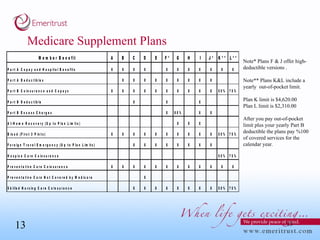
Medicare Supplement Plans Note* Plans F & J offer high-deductible versions . Note** Plans K&L include a yearly  out-of-pocket limit.  Plan K limit is $4,620.00  Plan L limit is $2,310.00 After you pay out-of-pocket limit plus your yearly Part B deductible the plans pay %100 of covered services for the calendar year.
Why a Medicare Supplement Plan They provide low out-of-pocket costs by helping you cover most of your deductibles and co-payments for Parts A and B. You are free to choose any doctor or health care facility as long as they accept Medicare. You are not tied to any network or group of health care providers. Your supplement policy cannot be canceled. It is guaranteed renewable as long as you pay your premiums. Your coverage goes with you. A Medicare supplement plan covers your health care needs anywhere in the United States. Most of the standardized plans include coverage for foreign travel emergencies.
Medicare Supplement Plans: Food for Thought “ Every Medigap policy must follow Federal and state laws designed to protect you, and it must be clearly identified as “Medicare Supplement Insurance.” Medigap insurance companies can only sell you a “standardized” Medigap policy identified by the letters A through L. Each standardized Medigap policy must offer the same basic benefits, no matter which insurance company sells it. Cost is usually the only difference between Medigap policies sold by different insurance companies.” From page 9 of  Choosing a Medigap Policy: A Guide to Health Insurance of People with Medicare  distributed by the  Centers for Medicare & Medicaid Services .
Medicare Supplement Plans To reiterate: Every Medigap policy must follow Federal and state laws designed to protect you. Medigap insurance companies can only sell you a standardized Medigap policy identified by the letters A through L Each standardized Medigap policy must offer the same basic benefits, no matter which insurance company sells it.  Cost is usually the only difference between Medigap policies sold by different insurance companies.
Medicare Supplement Plans: When to Enroll Initial Enrollment Period- Lasts 6 Months and begins on the first day of the month in which you are both at least 65 and enrolled in Medicare Part B. During this period the insurance company  cannot use   medical underwriting .  This means the insurance companies cannot do any of the following: Refuse to sell you any Medigap policy it sells Charge you more for a Medigap policy because of your health  problems If you choose to apply for a Medigap policy after your Initial Enrollment Period, insurance companies are allowed to use medical underwriting to decide whether to accept your application.
Medicare Supplement Plans: Changing Insurance Companies A Medigap policy holder can change insurance carriers as long as the new carrier approves the application. Reasons to change are: Quit paying for benefits you do not need Wanting additional benefits Acquiring the same standardized plan at a lower premium Keep in mind that the insurance carrier can use medical underwriting to approve the plan.
Medicare Part D Prescription Drug Coverage O ffered by health insurance companies Available two ways: 1.  As part of a Medicare Advantage plan. 2.  Stand-alone Part D plan in addition to Part A and/or B and  Medigap plan.  The premium is in addition to Part B and Medigap premiums. Premium doesn't increase with member's age. Must be enrolled in Part A or Part B or both. Premium penalty of 1% per month if the beneficiary doesn't enroll in their initial enrollment period.
Medicare Part D Prescription Drug Coverage Coverage varies based on plan selected with different formularies (drug list). Lots of options and varying premiums, copays, and coinsurance, so it’s important to do your homework. www.emeritrust.com/medicare-part-d/Choosing-a-Medicare-Part-D-Plan/ A penalty of 1% per month may be charged if enrollment in Medicare prescription drug coverage is delayed.
Medicare Prescription Drug Coverage $310.00 deductible. Up to 25% copay until the total paid by both you and the insurer equals $2,830.00. 100% of the drug costs in the coverage gap or doughnut hole. After the beneficiary has paid a total of $4,550.00 out-of-pocket, catastrophic coverage begins. The beneficiary then pays only 5% of all covered prescription drug costs during the plan year.
Medicare Prescription Drug Coverage The bottom line is to get a Part D plan if you are on original Medicare Parts A and B whether or not you have little or no prescription drug costs. The reason is that like all insurance, you acquire it to manage risk. And if you don't sign up in your initial eligibility period, the premium will increase 1 percent for each month until you do enroll.
Medicare Advantage Plans The Medicare program pays health insurance companies to provide health care coverage that replaces Part A and B. These plans are called Medicare Advantage Plans. Their coverage may include benefits not provided by original Medicare.  With an Advantage plan, you pay the Part B premium, plus any insurance premium.  But you are no longer covered by original Medicare Parts A and B.
With an Advantage plan, the insurance company manages your health services and determines whether or not to pay your claim.  If on original Medicare Parts A and B, CMS determines whether or not to pay your claim. Advantage plan benefits may include: Medicare prescription drug coverage Annual physical, vision, and hearing exams Allowances for eyewear, hearing aids, and health club membership Optional dental coverage for an additional monthly premium You cannot be a member of an Advantage plan and be covered under a Medigap policy. Medigap plans cover only the gaps in orginal Medicare Parts A & B.
There Are Four Types of Medicare Advantage Plans 1. Health Maintenance Organization (HMO) Contracts with a provider network to offer more benefits for less.  Members are limited to using the HMO's network of health care providers 2. Preferred Provider Organization (PPO) Also contracts with a provider network to offer more benefits for less Flexibility to use out-of-network doctors and hospitals
There Are Four Types of Medicare Advantage Plans 3. Private Fee-for-Service (PFFS) No provider network, allowing use any health care provider or hospital that  accepts Medicare. Providers must agree to insurance plan's terms 4. Special Needs Plan (SNP) An HMO plan for the chronically ill or receives  government assistance
Medicare Advantage and RX enrollment periods Initial Enrollment Period: Includes the 3 months prior to a 65th birthday, the month of a 65th birthday and the 3 months after a 65th birthday If someone works past the age of 65, their Initial Enrollment Period starts when they retire
Medicare Advantage and RX enrollment periods Annual Election Period  – Nov. 15 through Dec. 31 Anyone eligible for Medicare can enroll in any plan(s) of their choice If you delayed enrolling in a Part D plan, this is the only time you can enroll late New plan benefits start on January 1
Medicare Advantage and RX enrollment periods Open Enrollment Period  –  Jan. 1 through March 31 Allows one limited plan change to the same type of plan Cannot pick up prescription drug coverage unless qualified for a Medicare prescription drug plan Special Election Period
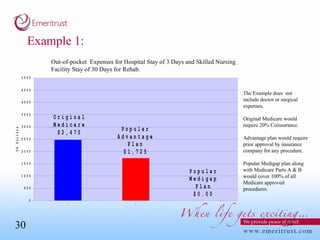
Example 1: Out-of-pocket  Expenses for Hospital Stay of 3 Days and Skilled Nursing Facility Stay of 30 Days for Rehab. The Example does  not include doctor or surgical expenses.  Original Medicare would require 20% Coinsurance. Advantage plan would require prior approval by insurance company for any procedure. Popular Medigap plan along with Medicare Parts A & B would cover 100% of all Medicare approved procedures.
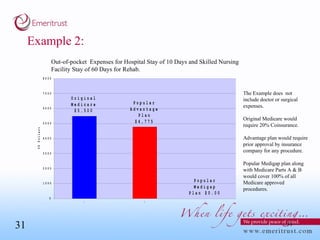
Example 2: The Example does  not include doctor or surgical expenses.  Original Medicare would require 20% Coinsurance. Advantage plan would require prior approval by insurance company for any procedure. Popular Medigap plan along with Medicare Parts A & B would cover 100% of all Medicare approved procedures.  Out-of-pocket  Expenses for Hospital Stay of 10 Days and Skilled Nursing Facility Stay of 60 Days for Rehab.
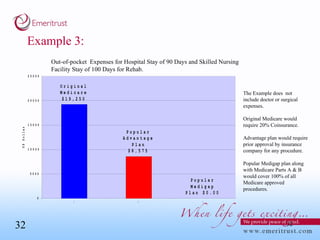
Example 3: Out-of-pocket  Expenses for Hospital Stay of 90 Days and Skilled Nursing Facility Stay of 100 Days for Rehab. The Example does  not include doctor or surgical expenses.  Original Medicare would require 20% Coinsurance. Advantage plan would require prior approval by insurance company for any procedure. Popular Medigap plan along with Medicare Parts A & B would cover 100% of all Medicare approved procedures.
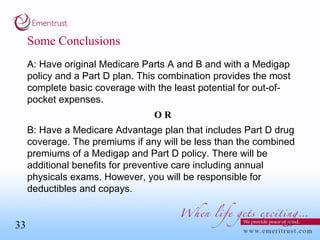
Some Conclusions A: Have original Medicare Parts A and B and with a Medigap policy and a Part D plan. This combination provides the most complete basic coverage with the least potential for out-of-pocket expenses. OR B: Have a Medicare Advantage plan that includes Part D drug coverage. The premiums if any will be less than the combined premiums of a Medigap and Part D policy. There will be additional benefits for preventive care including annual physicals exams. However, you will be responsible for deductibles and copays.
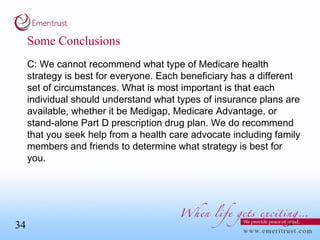
Some Conclusions C: We cannot recommend what type of Medicare health strategy is best for everyone. Each beneficiary has a different set of circumstances. What is most important is that each individual should understand what types of insurance plans are available, whether it be Medigap, Medicare Advantage, or stand-alone Part D prescription drug plan. We do recommend that you seek help from a health care advocate including family members and friends to determine what strategy is best for you.
Questions and Answers
For additional information you may contact: Medicare: 1-800-MEDICARE (TTY: 1-877-486-2048) or  www.medicare.gov Social Security: 1-800-772-1213 (TTY: 1-800-325-0778) or  www.ssa.gov
Thank you! For more information see us after the seminar or go to our web site at  www.Emeritrust.com
Emeritrust Medicare Educational Seminar Presentation Ver. 5 1.17.2010

Emeritrust Medicare Educational Seminar Presentation Ver. 5 1.17.2010

  • 2.
  • 3.
    Medicare Seminar OverviewWhat is Medicare? Who is eligible? What benefits does Medicare cover? What benefits doesn’t Medicare cover? What other coverage is available? Medicare enrollment periods. Things to consider when choosing coverage.
  • 4.
    What is Medicare?The nation's largest health insurance program with over 42 million Americans Administered by the Centers for Medicare & Medicaid Services (CMS)
  • 5.
    Who is eligiblefor Medicare? Most people age 65 and over. Those under age 65 who: have been on Social Security disability benefits for at least 24 months, or have Lou Gehrig’s disease, or need kidney dialysis or a kidney transplant
  • 6.
    Original Medicare CoveragePart A – No premium, in-hospital insurance that helps pay the cost of: Hospital Stays skilled nursing facility care up to 100 days home health agency services hospice benefits Deductible and copays for a benefit period can add up.
  • 7.
    Original Medicare CoveragePart B – Optional outpatient coverage with monthly premium ranging from $110.50 to $353.60 depending on the beneficiary's income. Helps pay the costs of: doctor visits for covered services outpatient surgery lab fees and X-rays durable medical equipment
  • 8.
    What benefits doesn'tMedicare cover? $1,100 Part A deductible for a hospital visit per benefit period that covers the first 60 days Days 61 through 90 costs $275.00 a day in a hospital A 90 day stay in a hospital would cost $8,250 Days 21 through 100 in a skilled nursing facility is $137.50 a day A 100 day stay in a Skilled nursing facility would cost $11,000.00 Note* A benefit period begins the first day in a hospital following 60 consecutive days after not being in a hospital or skilled nursing facility.
  • 9.
    What benefits doesn'tMedicare cover? For Part B there is an annual deductible of $155.00 After the deductible the beneficiary must pay 20% of Medicare Part B covered services.
  • 10.
    Original Medicare AlsoDoes Not Cover: Annual physical exams Hearing aids and exams Eye glasses and exams Worldwide emergency medical coverage Dental care and dentures Prescription drug coverage
  • 11.
    What other coverageis available? Medicare supplement plans. Only available under original Medicare Parts A & B. Medicare Part D Prescription Drug Plans. Medicare Advantage Plans. They replace Parts A & B with reduced copays and deductibles and usually includes prescription drug coverage
  • 12.
    Medicare Supplement PlansOffered by insurance companies to cover gaps left in original Medicare Parts A and B Cover original Medicare deductibles and copays Must be enrolled in Medicare Part B Medigap premium is in addition to the Part B premium. Do not include prescription drug coverage
  • 13.
    Medicare Supplement PlansNote* Plans F & J offer high-deductible versions . Note** Plans K&L include a yearly out-of-pocket limit. Plan K limit is $4,620.00 Plan L limit is $2,310.00 After you pay out-of-pocket limit plus your yearly Part B deductible the plans pay %100 of covered services for the calendar year.
  • 14.
    Why a MedicareSupplement Plan They provide low out-of-pocket costs by helping you cover most of your deductibles and co-payments for Parts A and B. You are free to choose any doctor or health care facility as long as they accept Medicare. You are not tied to any network or group of health care providers. Your supplement policy cannot be canceled. It is guaranteed renewable as long as you pay your premiums. Your coverage goes with you. A Medicare supplement plan covers your health care needs anywhere in the United States. Most of the standardized plans include coverage for foreign travel emergencies.
  • 15.
    Medicare Supplement Plans:Food for Thought “ Every Medigap policy must follow Federal and state laws designed to protect you, and it must be clearly identified as “Medicare Supplement Insurance.” Medigap insurance companies can only sell you a “standardized” Medigap policy identified by the letters A through L. Each standardized Medigap policy must offer the same basic benefits, no matter which insurance company sells it. Cost is usually the only difference between Medigap policies sold by different insurance companies.” From page 9 of Choosing a Medigap Policy: A Guide to Health Insurance of People with Medicare distributed by the Centers for Medicare & Medicaid Services .
  • 16.
    Medicare Supplement PlansTo reiterate: Every Medigap policy must follow Federal and state laws designed to protect you. Medigap insurance companies can only sell you a standardized Medigap policy identified by the letters A through L Each standardized Medigap policy must offer the same basic benefits, no matter which insurance company sells it. Cost is usually the only difference between Medigap policies sold by different insurance companies.
  • 17.
    Medicare Supplement Plans:When to Enroll Initial Enrollment Period- Lasts 6 Months and begins on the first day of the month in which you are both at least 65 and enrolled in Medicare Part B. During this period the insurance company cannot use medical underwriting . This means the insurance companies cannot do any of the following: Refuse to sell you any Medigap policy it sells Charge you more for a Medigap policy because of your health problems If you choose to apply for a Medigap policy after your Initial Enrollment Period, insurance companies are allowed to use medical underwriting to decide whether to accept your application.
  • 18.
    Medicare Supplement Plans:Changing Insurance Companies A Medigap policy holder can change insurance carriers as long as the new carrier approves the application. Reasons to change are: Quit paying for benefits you do not need Wanting additional benefits Acquiring the same standardized plan at a lower premium Keep in mind that the insurance carrier can use medical underwriting to approve the plan.
  • 19.
    Medicare Part DPrescription Drug Coverage O ffered by health insurance companies Available two ways: 1. As part of a Medicare Advantage plan. 2. Stand-alone Part D plan in addition to Part A and/or B and Medigap plan. The premium is in addition to Part B and Medigap premiums. Premium doesn't increase with member's age. Must be enrolled in Part A or Part B or both. Premium penalty of 1% per month if the beneficiary doesn't enroll in their initial enrollment period.
  • 20.
    Medicare Part DPrescription Drug Coverage Coverage varies based on plan selected with different formularies (drug list). Lots of options and varying premiums, copays, and coinsurance, so it’s important to do your homework. www.emeritrust.com/medicare-part-d/Choosing-a-Medicare-Part-D-Plan/ A penalty of 1% per month may be charged if enrollment in Medicare prescription drug coverage is delayed.
  • 21.
    Medicare Prescription DrugCoverage $310.00 deductible. Up to 25% copay until the total paid by both you and the insurer equals $2,830.00. 100% of the drug costs in the coverage gap or doughnut hole. After the beneficiary has paid a total of $4,550.00 out-of-pocket, catastrophic coverage begins. The beneficiary then pays only 5% of all covered prescription drug costs during the plan year.
  • 22.
    Medicare Prescription DrugCoverage The bottom line is to get a Part D plan if you are on original Medicare Parts A and B whether or not you have little or no prescription drug costs. The reason is that like all insurance, you acquire it to manage risk. And if you don't sign up in your initial eligibility period, the premium will increase 1 percent for each month until you do enroll.
  • 23.
    Medicare Advantage PlansThe Medicare program pays health insurance companies to provide health care coverage that replaces Part A and B. These plans are called Medicare Advantage Plans. Their coverage may include benefits not provided by original Medicare. With an Advantage plan, you pay the Part B premium, plus any insurance premium. But you are no longer covered by original Medicare Parts A and B.
  • 24.
    With an Advantageplan, the insurance company manages your health services and determines whether or not to pay your claim. If on original Medicare Parts A and B, CMS determines whether or not to pay your claim. Advantage plan benefits may include: Medicare prescription drug coverage Annual physical, vision, and hearing exams Allowances for eyewear, hearing aids, and health club membership Optional dental coverage for an additional monthly premium You cannot be a member of an Advantage plan and be covered under a Medigap policy. Medigap plans cover only the gaps in orginal Medicare Parts A & B.
  • 25.
    There Are FourTypes of Medicare Advantage Plans 1. Health Maintenance Organization (HMO) Contracts with a provider network to offer more benefits for less. Members are limited to using the HMO's network of health care providers 2. Preferred Provider Organization (PPO) Also contracts with a provider network to offer more benefits for less Flexibility to use out-of-network doctors and hospitals
  • 26.
    There Are FourTypes of Medicare Advantage Plans 3. Private Fee-for-Service (PFFS) No provider network, allowing use any health care provider or hospital that accepts Medicare. Providers must agree to insurance plan's terms 4. Special Needs Plan (SNP) An HMO plan for the chronically ill or receives government assistance
  • 27.
    Medicare Advantage andRX enrollment periods Initial Enrollment Period: Includes the 3 months prior to a 65th birthday, the month of a 65th birthday and the 3 months after a 65th birthday If someone works past the age of 65, their Initial Enrollment Period starts when they retire
  • 28.
    Medicare Advantage andRX enrollment periods Annual Election Period – Nov. 15 through Dec. 31 Anyone eligible for Medicare can enroll in any plan(s) of their choice If you delayed enrolling in a Part D plan, this is the only time you can enroll late New plan benefits start on January 1
  • 29.
    Medicare Advantage andRX enrollment periods Open Enrollment Period – Jan. 1 through March 31 Allows one limited plan change to the same type of plan Cannot pick up prescription drug coverage unless qualified for a Medicare prescription drug plan Special Election Period
  • 30.
    Example 1: Out-of-pocket Expenses for Hospital Stay of 3 Days and Skilled Nursing Facility Stay of 30 Days for Rehab. The Example does not include doctor or surgical expenses. Original Medicare would require 20% Coinsurance. Advantage plan would require prior approval by insurance company for any procedure. Popular Medigap plan along with Medicare Parts A & B would cover 100% of all Medicare approved procedures.
  • 31.
    Example 2: TheExample does not include doctor or surgical expenses. Original Medicare would require 20% Coinsurance. Advantage plan would require prior approval by insurance company for any procedure. Popular Medigap plan along with Medicare Parts A & B would cover 100% of all Medicare approved procedures. Out-of-pocket Expenses for Hospital Stay of 10 Days and Skilled Nursing Facility Stay of 60 Days for Rehab.
  • 32.
    Example 3: Out-of-pocket Expenses for Hospital Stay of 90 Days and Skilled Nursing Facility Stay of 100 Days for Rehab. The Example does not include doctor or surgical expenses. Original Medicare would require 20% Coinsurance. Advantage plan would require prior approval by insurance company for any procedure. Popular Medigap plan along with Medicare Parts A & B would cover 100% of all Medicare approved procedures.
  • 33.
    Some Conclusions A:Have original Medicare Parts A and B and with a Medigap policy and a Part D plan. This combination provides the most complete basic coverage with the least potential for out-of-pocket expenses. OR B: Have a Medicare Advantage plan that includes Part D drug coverage. The premiums if any will be less than the combined premiums of a Medigap and Part D policy. There will be additional benefits for preventive care including annual physicals exams. However, you will be responsible for deductibles and copays.
  • 34.
    Some Conclusions C:We cannot recommend what type of Medicare health strategy is best for everyone. Each beneficiary has a different set of circumstances. What is most important is that each individual should understand what types of insurance plans are available, whether it be Medigap, Medicare Advantage, or stand-alone Part D prescription drug plan. We do recommend that you seek help from a health care advocate including family members and friends to determine what strategy is best for you.
  • 35.
  • 36.
    For additional informationyou may contact: Medicare: 1-800-MEDICARE (TTY: 1-877-486-2048) or www.medicare.gov Social Security: 1-800-772-1213 (TTY: 1-800-325-0778) or www.ssa.gov
  • 37.
    Thank you! Formore information see us after the seminar or go to our web site at www.Emeritrust.com