What's Medicare?
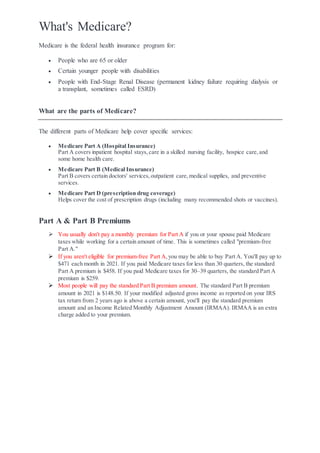
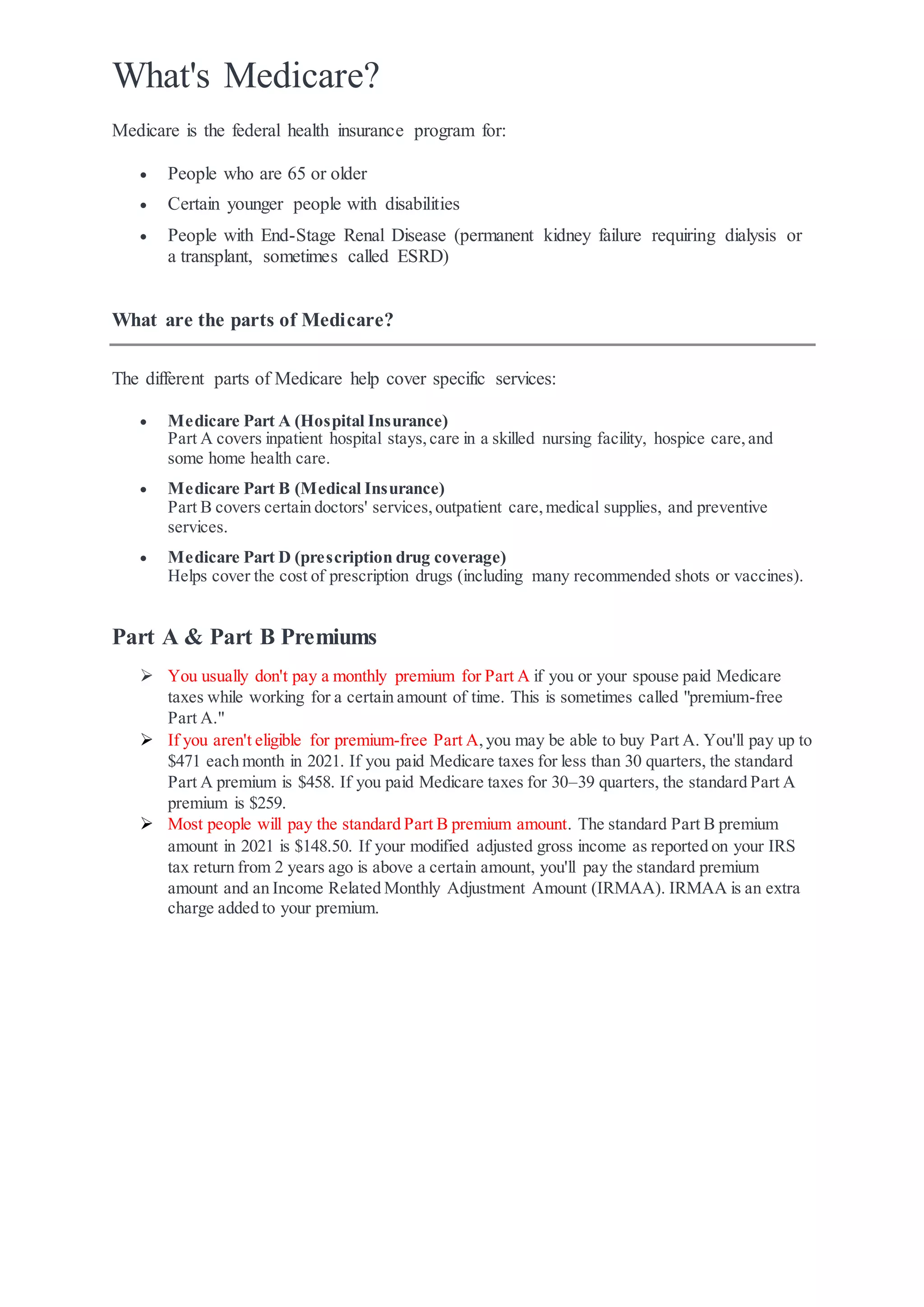
Medicare is the federal health insurance program for:
 People who are 65 or older
 Certain younger people with disabilities
 People with End-Stage Renal Disease (permanent kidney failure requiring dialysis or
a transplant, sometimes called ESRD)
What are the parts of Medicare?
The different parts of Medicare help cover specific services:
 Medicare Part A (Hospital Insurance)
Part A covers inpatient hospital stays,care in a skilled nursing facility, hospice care,and
some home health care.
 Medicare Part B (Medical Insurance)
Part B covers certain doctors' services,outpatient care,medical supplies, and preventive
services.
 Medicare Part D (prescription drug coverage)
Helps cover the cost of prescription drugs (including many recommended shots or vaccines).
Part A & Part B Premiums
 You usually don't pay a monthly premium for Part A if you or your spouse paid Medicare
taxes while working for a certain amount of time. This is sometimes called "premium-free
Part A."
 If you aren't eligible for premium-free Part A,you may be able to buy Part A. You'll pay up to
$471 each month in 2021. If you paid Medicare taxes for less than 30 quarters, the standard
Part A premium is $458. If you paid Medicare taxes for 30–39 quarters, the standard Part A
premium is $259.
 Most people will pay the standard Part B premium amount. The standard Part B premium
amount in 2021 is $148.50. If your modified adjusted gross income as reported on your IRS
tax return from 2 years ago is above a certain amount, you'll pay the standard premium
amount and an Income Related Monthly Adjustment Amount (IRMAA). IRMAA is an extra
charge added to your premium.
How does Medicare work?
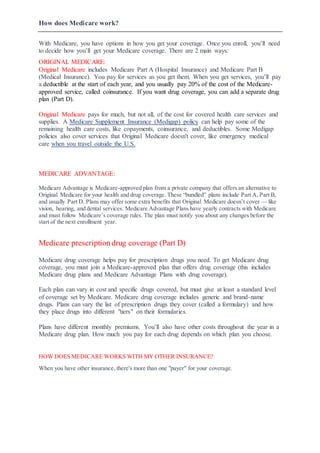
With Medicare, you have options in how you get your coverage. Once you enroll, you’ll need
to decide how you’ll get your Medicare coverage. There are 2 main ways:
ORIGINAL MEDICARE:
Original Medicare includes Medicare Part A (Hospital Insurance) and Medicare Part B
(Medical Insurance). You pay for services as you get them. When you get services, you’ll pay
a deductible at the start of each year, and you usually pay 20% of the cost of the Medicare-
approved service, called coinsurance. If you want drug coverage, you can add a separate drug
plan (Part D).
Original Medicare pays for much, but not all, of the cost for covered health care services and
supplies. A Medicare Supplement Insurance (Medigap) policy can help pay some of the
remaining health care costs, like copayments, coinsurance, and deductibles. Some Medigap
policies also cover services that Original Medicare doesn't cover, like emergency medical
care when you travel outside the U.S.
MEDICARE ADVANTAGE:
Medicare Advantage is Medicare-approved plan from a private company that offers an alternative to
Original Medicare for your health and drug coverage. These “bundled” plans include Part A, Part B,
and usually Part D. Plans may offer some extra benefits that Original Medicare doesn’t cover — like
vision, hearing, and dental services. Medicare Advantage Plans have yearly contracts with Medicare
and must follow Medicare’s coverage rules. The plan must notify you about any changes before the
start of the next enrollment year.
Medicare prescriptiondrug coverage (Part D)
Medicare drug coverage helps pay for prescription drugs you need. To get Medicare drug
coverage, you must join a Medicare-approved plan that offers drug coverage (this includes
Medicare drug plans and Medicare Advantage Plans with drug coverage).
Each plan can vary in cost and specific drugs covered, but must give at least a standard level
of coverage set by Medicare. Medicare drug coverage includes generic and brand-name
drugs. Plans can vary the list of prescription drugs they cover (called a formulary) and how
they place drugs into different "tiers" on their formularies.
Plans have different monthly premiums. You’ll also have other costs throughout the year in a
Medicare drug plan. How much you pay for each drug depends on which plan you choose.
HOW DOES MEDICARE WORKS WITH MY OTHER INSURANCE?
When you have other insurance, there's more than one "payer" for your coverage.
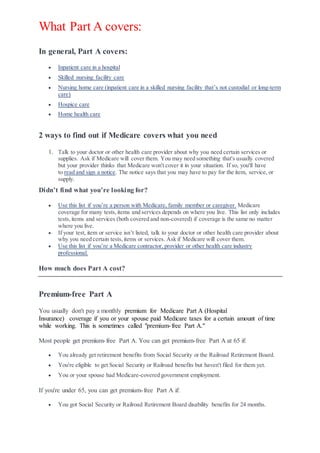
What Part A covers:
In general, Part A covers:
 Inpatient care in a hospital
 Skilled nursing facility care
 Nursing home care (inpatient care in a skilled nursing facility that’s not custodial or long-term
care)
 Hospice care
 Home health care
2 ways to find out if Medicare covers what you need
1. Talk to your doctor or other health care provider about why you need certain services or
supplies. Ask if Medicare will cover them. You may need something that's usually covered
but your provider thinks that Medicare won't cover it in your situation. If so, you'll have
to read and sign a notice. The notice says that you may have to pay for the item, service, or
supply.
Didn’t find what you’re looking for?
 Use this list if you’re a person with Medicare, family member or caregiver. Medicare
coverage for many tests,items and services depends on where you live. This list only includes
tests,items and services (both covered and non-covered) if coverage is the same no matter
where you live.
 If your test, item or service isn’t listed, talk to your doctor or other health care provider about
why you need certain tests,items or services. Ask if Medicare will cover them.
 Use this list if you’re a Medicare contractor, provider or other health care industry
professional.
How much does Part A cost?
Premium-free Part A
You usually don't pay a monthly premium for Medicare Part A (Hospital
Insurance) coverage if you or your spouse paid Medicare taxes for a certain amount of time
while working. This is sometimes called "premium-free Part A."
Most people get premium-free Part A. You can get premium-free Part A at 65 if:
 You already get retirement benefits from Social Security or the Railroad Retirement Board.
 You're eligible to get Social Security or Railroad benefits but haven't filed for them yet.
 You or your spouse had Medicare-covered government employment.
If you're under 65, you can get premium-free Part A if:
 You got Social Security or Railroad Retirement Board disability benefits for 24 months.
 You have End-Stage Renal Disease (Esrd) and meet certain requirements.
Part A premiums
If you don't qualify for premium-free Part A, you can buy Part A.
People who buy Part A will pay a premium of either $259 or $471 each month in
2021 depending on how long they or their spouse worked and paid Medicare taxes. If you
choose NOT to buy Part A, you can still buy Part B.
In most cases, if you choose to buy Part A, you must also:
 Have Medicare Part B (Medical Insurance)
 Pay monthly premiums for both Part A and Part B
What Part B covers
Part B covers 2 types of services
 Medically necessary services: Services or supplies that are needed to diagnose or treat your
medical condition and that meet accepted standards of medical practice.
 Preventive services: Health care to prevent illness (like the flu) or detect it at an early stage,
when treatment is most likely to work best.
You pay nothing for most preventive services if you get the services from a health care
provider who accepts assignment
.
Part B covers things like:
 Clinical research
 Ambulance services- Medicare will only cover ambulance services to the nearest
appropriate medical facility that’s able to give you the care you need.The ambulance
company must give you an " Advance Beneficiary Notice Of Noncoverage (Abn)"
when both of these apply: You got ambulance services in a non-emergency situation.
The ambulance company believes that Medicare may not pay for your specific
ambulance service.
 Durable medical equipment (DME)
 Mental health
o Inpatient
o Outpatient
o Partial hospitalization
 Limited outpatient prescription drugs
2 ways to find out if Medicare covers what you need
1. Talk to your doctor or other health care provider about why you need certain services or
supplies. Ask if Medicare will cover them. You may need something that's usually covered
but your provider thinks that Medicare won't cover it in your situation. If so, you'll have
to read and sign a notice. The notice says that you may have to pay for the item, service, or
supply.
2. Find out if Medicare covers your item, service, or supply.
Medicare coverage is based on 3 main factors
1. Federal and state laws.
2. National coverage decisions made by Medicare about whether something is covered.
3. Local coverage decisions made by companies in each state that process claims for Medicare.
These companies decide whether something is medically necessary and should be covered in
their area.
Medicare Advantage Plans
Medicare Advantage Plans are another way to get your Medicare Part A and Part B coverage.
Medicare Advantage Plans, sometimes called “Part C” or “MA Plans,” are offered by
Medicare-approved private companies that must follow rules set by Medicare. Most Medicare
Advantage Plans include drug coverage (Part D). In most cases, you’ll need to use health care
providers who participate in the plan’s network. These plans set a limit on what you’ll have
to pay out-of-pocket each year for covered services. Some plans offer non-emergency
coverage out of network, but typically at a higher cost. Remember, you must use the card
from your Medicare Advantage Plan to get your Medicare-covered services. Keep your red,
white, and blue Medicare card in a safe place because you’ll need it if you ever switch back
to Original Medicare. Below are the most common types of Medicare Advantage Plans.
 Health Maintenance Organization (HMO) Plans
 Preferred Provider Organization (PPO) Plans
 Private Fee-for-Service (PFFS) Plans
 Special Needs Plans (SNPs)

Medicare

  • 1.
    What's Medicare? Medicare isthe federal health insurance program for:  People who are 65 or older  Certain younger people with disabilities  People with End-Stage Renal Disease (permanent kidney failure requiring dialysis or a transplant, sometimes called ESRD) What are the parts of Medicare? The different parts of Medicare help cover specific services:  Medicare Part A (Hospital Insurance) Part A covers inpatient hospital stays,care in a skilled nursing facility, hospice care,and some home health care.  Medicare Part B (Medical Insurance) Part B covers certain doctors' services,outpatient care,medical supplies, and preventive services.  Medicare Part D (prescription drug coverage) Helps cover the cost of prescription drugs (including many recommended shots or vaccines). Part A & Part B Premiums  You usually don't pay a monthly premium for Part A if you or your spouse paid Medicare taxes while working for a certain amount of time. This is sometimes called "premium-free Part A."  If you aren't eligible for premium-free Part A,you may be able to buy Part A. You'll pay up to $471 each month in 2021. If you paid Medicare taxes for less than 30 quarters, the standard Part A premium is $458. If you paid Medicare taxes for 30–39 quarters, the standard Part A premium is $259.  Most people will pay the standard Part B premium amount. The standard Part B premium amount in 2021 is $148.50. If your modified adjusted gross income as reported on your IRS tax return from 2 years ago is above a certain amount, you'll pay the standard premium amount and an Income Related Monthly Adjustment Amount (IRMAA). IRMAA is an extra charge added to your premium.
  • 2.
    How does Medicarework? With Medicare, you have options in how you get your coverage. Once you enroll, you’ll need to decide how you’ll get your Medicare coverage. There are 2 main ways: ORIGINAL MEDICARE: Original Medicare includes Medicare Part A (Hospital Insurance) and Medicare Part B (Medical Insurance). You pay for services as you get them. When you get services, you’ll pay a deductible at the start of each year, and you usually pay 20% of the cost of the Medicare- approved service, called coinsurance. If you want drug coverage, you can add a separate drug plan (Part D). Original Medicare pays for much, but not all, of the cost for covered health care services and supplies. A Medicare Supplement Insurance (Medigap) policy can help pay some of the remaining health care costs, like copayments, coinsurance, and deductibles. Some Medigap policies also cover services that Original Medicare doesn't cover, like emergency medical care when you travel outside the U.S. MEDICARE ADVANTAGE: Medicare Advantage is Medicare-approved plan from a private company that offers an alternative to Original Medicare for your health and drug coverage. These “bundled” plans include Part A, Part B, and usually Part D. Plans may offer some extra benefits that Original Medicare doesn’t cover — like vision, hearing, and dental services. Medicare Advantage Plans have yearly contracts with Medicare and must follow Medicare’s coverage rules. The plan must notify you about any changes before the start of the next enrollment year. Medicare prescriptiondrug coverage (Part D) Medicare drug coverage helps pay for prescription drugs you need. To get Medicare drug coverage, you must join a Medicare-approved plan that offers drug coverage (this includes Medicare drug plans and Medicare Advantage Plans with drug coverage). Each plan can vary in cost and specific drugs covered, but must give at least a standard level of coverage set by Medicare. Medicare drug coverage includes generic and brand-name drugs. Plans can vary the list of prescription drugs they cover (called a formulary) and how they place drugs into different "tiers" on their formularies. Plans have different monthly premiums. You’ll also have other costs throughout the year in a Medicare drug plan. How much you pay for each drug depends on which plan you choose. HOW DOES MEDICARE WORKS WITH MY OTHER INSURANCE? When you have other insurance, there's more than one "payer" for your coverage.
  • 3.
    What Part Acovers: In general, Part A covers:  Inpatient care in a hospital  Skilled nursing facility care  Nursing home care (inpatient care in a skilled nursing facility that’s not custodial or long-term care)  Hospice care  Home health care 2 ways to find out if Medicare covers what you need 1. Talk to your doctor or other health care provider about why you need certain services or supplies. Ask if Medicare will cover them. You may need something that's usually covered but your provider thinks that Medicare won't cover it in your situation. If so, you'll have to read and sign a notice. The notice says that you may have to pay for the item, service, or supply. Didn’t find what you’re looking for?  Use this list if you’re a person with Medicare, family member or caregiver. Medicare coverage for many tests,items and services depends on where you live. This list only includes tests,items and services (both covered and non-covered) if coverage is the same no matter where you live.  If your test, item or service isn’t listed, talk to your doctor or other health care provider about why you need certain tests,items or services. Ask if Medicare will cover them.  Use this list if you’re a Medicare contractor, provider or other health care industry professional. How much does Part A cost? Premium-free Part A You usually don't pay a monthly premium for Medicare Part A (Hospital Insurance) coverage if you or your spouse paid Medicare taxes for a certain amount of time while working. This is sometimes called "premium-free Part A." Most people get premium-free Part A. You can get premium-free Part A at 65 if:  You already get retirement benefits from Social Security or the Railroad Retirement Board.  You're eligible to get Social Security or Railroad benefits but haven't filed for them yet.  You or your spouse had Medicare-covered government employment. If you're under 65, you can get premium-free Part A if:  You got Social Security or Railroad Retirement Board disability benefits for 24 months.
  • 4.
     You haveEnd-Stage Renal Disease (Esrd) and meet certain requirements. Part A premiums If you don't qualify for premium-free Part A, you can buy Part A. People who buy Part A will pay a premium of either $259 or $471 each month in 2021 depending on how long they or their spouse worked and paid Medicare taxes. If you choose NOT to buy Part A, you can still buy Part B. In most cases, if you choose to buy Part A, you must also:  Have Medicare Part B (Medical Insurance)  Pay monthly premiums for both Part A and Part B
  • 5.
    What Part Bcovers Part B covers 2 types of services  Medically necessary services: Services or supplies that are needed to diagnose or treat your medical condition and that meet accepted standards of medical practice.  Preventive services: Health care to prevent illness (like the flu) or detect it at an early stage, when treatment is most likely to work best. You pay nothing for most preventive services if you get the services from a health care provider who accepts assignment . Part B covers things like:  Clinical research  Ambulance services- Medicare will only cover ambulance services to the nearest appropriate medical facility that’s able to give you the care you need.The ambulance company must give you an " Advance Beneficiary Notice Of Noncoverage (Abn)" when both of these apply: You got ambulance services in a non-emergency situation. The ambulance company believes that Medicare may not pay for your specific ambulance service.  Durable medical equipment (DME)  Mental health o Inpatient o Outpatient o Partial hospitalization  Limited outpatient prescription drugs 2 ways to find out if Medicare covers what you need 1. Talk to your doctor or other health care provider about why you need certain services or supplies. Ask if Medicare will cover them. You may need something that's usually covered but your provider thinks that Medicare won't cover it in your situation. If so, you'll have to read and sign a notice. The notice says that you may have to pay for the item, service, or supply. 2. Find out if Medicare covers your item, service, or supply. Medicare coverage is based on 3 main factors 1. Federal and state laws. 2. National coverage decisions made by Medicare about whether something is covered. 3. Local coverage decisions made by companies in each state that process claims for Medicare. These companies decide whether something is medically necessary and should be covered in their area.
  • 6.
    Medicare Advantage Plans MedicareAdvantage Plans are another way to get your Medicare Part A and Part B coverage. Medicare Advantage Plans, sometimes called “Part C” or “MA Plans,” are offered by Medicare-approved private companies that must follow rules set by Medicare. Most Medicare Advantage Plans include drug coverage (Part D). In most cases, you’ll need to use health care providers who participate in the plan’s network. These plans set a limit on what you’ll have to pay out-of-pocket each year for covered services. Some plans offer non-emergency coverage out of network, but typically at a higher cost. Remember, you must use the card from your Medicare Advantage Plan to get your Medicare-covered services. Keep your red, white, and blue Medicare card in a safe place because you’ll need it if you ever switch back to Original Medicare. Below are the most common types of Medicare Advantage Plans.  Health Maintenance Organization (HMO) Plans  Preferred Provider Organization (PPO) Plans  Private Fee-for-Service (PFFS) Plans  Special Needs Plans (SNPs)