Medicare	
  Presenta-on	


What	
  is	
  	
  
Medicare?	


 What	
  is	
  Medicare?
Medicare	
  is	
  the	
  federal	
  
government	
  program	
  that	
  
provides	
  health	
  care	
  coverage	
  
for	
  individuals	
  that	
  are	
  65	
  or	
  
older,	
  or	
  have	
  a	
  disability.	
  
 What	
  is	
  Medicare?
Medicare	
  is	
  run	
  by	
  	
  
U.S.	
  Department	
  of	
  Health	
  
and	
  Human	
  Services	


through	
  its	
  regional	
  
Centers	
  for	
  Medicare	
  and	
  
Medicaid	
  Services	
  (CMS).	
  
How does
Medicare
work?	


  How	
  Does	
  Medicare	
  Work?	
  
Originally,	
  Medicare	
  was	
  intended	
  to	
  provide	
  basic	
  
medical	
  coverage	
  for	
  the	
  treatment	
  of	
  illness	
  and	
  
injury	
  for	
  eligible	
  individuals—	


It	
  was	
  modeled	
  a@er	
  the	
  
Blue	
  Cross/Blue	
  Shield	
  insurance	
  system	
  that	
  was	
  
in	
  existence	
  at	
  that	
  Bme	
  (1965)	


  How	
  Does	
  Medicare	
  Work?	
  
• Fee	
  for	
  Service	
  payment	
  system	
  
• Use	
  Red,	
  White	
  &	
  Blue	
  Medicare	
  Card	
  as	
  actual	
  
	
  insurance	
  card	
  
• May	
  go	
  to	
  any	
  provider	
  that	
  accepts	
  Medicare	
  
• Referrals	
  are	
  not	
  necessary	
  
• DeducBbles	
  &	
  Coinsurances	
  Apply	
  
• beneficiaries	
  purchase	
  supplemental	
  
	
  insurance	
  to	
  cover	
  these	
  costs	


  What	
  is	
  Medicare?
	
  
Medicare	
  has	
  mulBple	
  
parts,	
  each	
  of	
  which	
  offers	
  
coverage	
  for	
  different	
  
health	
  care	
  areas.	


 The	
  Current	
  Parts	
  of	
  	
  
The	
  Medicare	
  System	


Part	
  A:	
  Hospital	
  Care	
  	
  
• Covers	
  in-­‐paBent	
  care/services	


Part	
  B:	
  Medical	
  Care	


• Covers	
  out-­‐paBent	
  care/services	


Parts	
  A	
  and	
  B	
  are	
  usually	
  referred	
  to	
  as	
  
“TradiBonal”	
  or	
  “Original”	
  Medicare	
  
 Medicare	
  Coverage	
  Basics
Part A
n  Inpatient Hospital Care
n  Skilled Nursing Care
n  Some Home Health Care
n  Hospice Care
Part B
n  Doctors’ Services and Outpatient Care
n  Preventive Services
n  Diagnostic Tests
n  Outpatient Therapies
n  Durable Medical Equipment
Medicare	
  Coverage	
  Op-ons	
  
Basic	
  Medicare	
  
(Parts	
  A	
  and	
  B)	
  
as	
  primary	
  coverage	


Supplement	
  	
  
(Medigap)	


Part	
  D	
  
Drug	
  Plan	


Medicare	
  Part	
  C	
  
(Managed	
  Care	
  Plan)	
  
as	
  primary	
  coverage	


Can	
  include	
  
Part	
  D	
  coverage	
  
Op-on	
  1	
   Op-on	
  2	
  
Access	
  to	
  Part	
  C	
  	
  requires	
  
enrollment	
  in	
  
	
  Basic	
  Medicare	
  
Enrollment in
“Basic”
Medicare	


Medicare	
  Eligibility	


WHO	
  CAN	
  ENROLL	
  IN	
  MEDICARE?	


§ 	
  65	
  years	
  of	
  age	
  and	
  older	


  OR	
  
§ 	
  Under	
  65	
  years	
  and	


  receiving	
  disability	
  benefits	
  from	
  SSA	
  or	
  RRB	


  must	
  receive	
  these	
  benefits	
  for	
  24	
  months	


  before	
  eligibility	
  for	
  Medicare	
  (ALS	
  excepBon)	


  OR	


§ 	
  Under	
  65	
  years	
  and	


  diagnosed	
  with	
  End	
  Stage	
  Renal	
  Disease	
  
Enrollment	
  into	
  Medicare	
  	
  
Enrollment	
  in	
  is	
  handled	
  2	
  ways:	
  
§ 	
  AutomaBc	
  
§ 	
  By	
  applicaBon	
  
Enrollment	
  into	
  Medicare	
  	
  
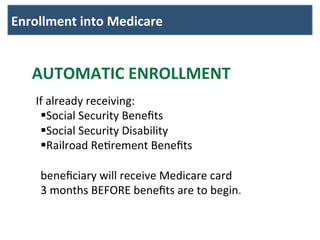
AUTOMATIC	
  ENROLLMENT	


  If	
  already	
  receiving:	
  
§ Social	
  Security	
  Benefits	
  
§ Social	
  Security	
  Disability	
  
§ Railroad	
  ReBrement	
  Benefits	


beneficiary	
  will	
  receive	
  Medicare	
  card	
  
3	
  months	
  BEFORE	
  benefits	
  are	
  to	
  begin.	


Enrollment	
  into	
  Medicare	


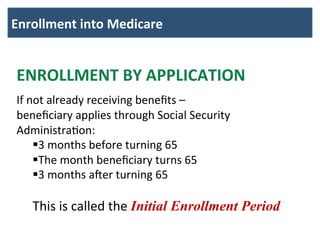
ENROLLMENT	
  BY	
  APPLICATION	


If	
  not	
  already	
  receiving	
  benefits	
  –	
  	
  
beneficiary	
  applies	
  through	
  Social	
  Security	
  
AdministraBon:	
  
§ 3	
  months	
  before	
  turning	
  65	
  
§ The	
  month	
  beneficiary	
  turns	
  65	
  
§ 3	
  months	
  a@er	
  turning	
  65	


This	
  is	
  called	
  the	
  Initial Enrollment Period
Enrollment	
  into	
  Medicare	


May	
  delay	
  enrolling	
  into	
  Medicare	
  if:	
  
Individual	
  (or	
  spouse)	
  is	
  acBvely	
  employed	


  AND	
  
Is	
  covered	
  under	
  group	
  health	
  	
  	
  insurance	
  
policy	
  based	
  on	
  acBve	
  employment	


This	
  is	
  called	
  Delayed Enrollment
Enrollment	
  into	
  Medicare	
  	
  
May	
  later	
  enroll	
  in	
  Medicare	
  when:	
  	
  
Employer	
  Group	
  Health	
  Insurance	
  ends	


  You	
  have	
  Eight	
  Months	
  to	
  enroll.	
  
	
  This	
  Eight	
  Month	
  period	
  is	
  called	
  the	
  
	
  Special Enrollment Period	
  	
  
Enrollment	
  into	
  Medicare	


If	
  you	
  do	
  not	
  enroll	
  during	
  the	
  
Initial or Delayed Enrollment periods,	


Then	
  you	
  can	
  enroll:	
  
§ January	
  1st	
  –	
  March	
  31st	
  of	
  each	
  year	
  
§ Coverage	
  begins	
  July	
  1st	
  
§ Penalty	
  is	
  assessed	
  on	
  Part	
  B	
  premiums	


  This	
  is	
  called	
  General Enrollment
MEDICARE	
  
	
  PART	
  D	


Prescrip-on	
  
Drug	
  Coverage	


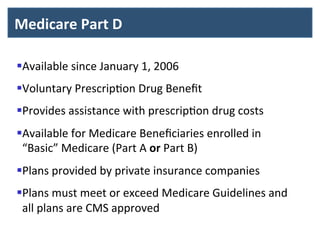
 Medicare	
  Part	
  D	


§ Available	
  since	
  January	
  1,	
  2006	
  
§ Voluntary	
  PrescripBon	
  Drug	
  Benefit	
  
§ Provides	
  assistance	
  with	
  prescripBon	
  drug	
  costs	
  
§ Available	
  for	
  Medicare	
  Beneficiaries	
  enrolled	
  in	


  “Basic”	
  Medicare	
  (Part	
  A	
  or	
  Part	
  B)	
  
§ Plans	
  provided	
  by	
  private	
  insurance	
  companies	
  
§ Plans	
  must	
  meet	
  or	
  exceed	
  Medicare	
  Guidelines	
  and	


  all	
  plans	
  are	
  CMS	
  approved	
  
MEDICARE	
  PART	
  D	


Two	
  versions	
  of	
  coverage:	


§  Stand-­‐alone	
  PrescripBon	
  Drug	
  Plans	


(PDP)	
  
§  Medicare	
  Advantage	
  plans	
  with	
  Rx	
  benefit	
  
(MA-­‐PD)	


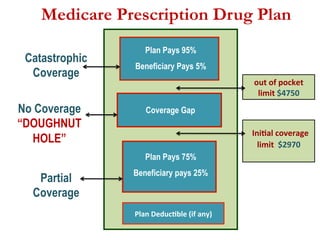
Medicare Prescription Drug Plan
Plan Pays 95%
Beneficiary Pays 5%
Plan Pays 75%
Beneficiary pays 25%
Coverage GapNo Coverage
“DOUGHNUT
HOLE”
Catastrophic
Coverage
out	
  of	
  pocket	
  
limit	
  $4750	


  Ini-al	
  coverage	
  
limit	
  	
  $2970	
  
Partial
Coverage
Plan	
  Deduc-ble	
  (if	
  any)	
  
(2013)	
  Coverage	
  Through	
  the	
  	
  
“Donut	
  Hole”	


•  52.5%	
  discount	
  on	
  brand-­‐name	
  plan	
  covered	
  drugs	
  
(less	
  small	
  pharmacy	
  dispensing	
  fee).	
  	
  
•  Paid	
  by	
  manufacture	
  (50%)	
  and	
  plan	
  (2.5%)	
  
•  Counts	
  toward	
  TrOOP	
  
•  21%	
  discount	
  on	
  plan	
  covered	
  generic	
  drugs	
  
•  Paid	
  by	
  federal	
  government.	


•  Does	
  NOT	
  count	
  toward	
  TrOOP	
  
•  Discounts	
  will	
  increase	
  each	
  year	
  unBl	
  2020	
  
Formulary
•  A	
  list	
  of	
  prescripBon	
  drugs	
  covered	
  by	
  the	
  plan	
  
•  Plans	
  have	
  “Bers”	
  that	
  cost	
  different	
  amounts	
  
Example	
  of	
  Tiers	
  (Plans	
  can	
  form	
  -ers	
  in	
  different	
  ways)	


Tier	


You	
  Pay	
  
PrescripBon	
  	
  
Drugs	
  Covered	
  
1	
   Lowest	
  copayment	
   Most	
  generics	
  	
  
2	
   Medium	
  copayment	
   Preferred,	
  brand-­‐name	
  	
  
3	
   Highest	
  copayment	
   Non-­‐preferred,	
  brand-­‐name	
  	
  
Specialty	
  
Highest	
  copayment	
  or	
  
coinsurance	
  
Unique,	
  very	
  high-­‐cost	


When	
  you	
  can	
  Join	
  or	
  Switch	
  
Medicare	
  Prescrip-on	
  Drug	
  Plans	
  
Ini-al	
  Enrollment	
  Period	
  
(IEP)	
  
§  7	
  month	
  period	
  
§  Starts	
  3	
  months	
  before	
  month	
  of	
  eligibility	
  
Annual	
  Enrollment	
  
Period	
  
October	
  15	
  –	
  December	
  7	
  each	
  year	
  	
  
These	
  are	
  new	
  dates	
  
Annual	
  Medicare	
  
Advantage	
  
Disenrollment	
  Period	
  
§  Between	
  January	
  1–	
  February	
  14,	
  you	
  can	
  
leave	
  an	
  MA	
  plan	
  and	
  switch	
  to	
  Original	
  
Medicare.	
  If	
  you	
  make	
  this	
  change,	
  you	
  
may	
  also	
  join	
  a	
  Part	
  D	
  plan	
  to	
  add	
  drug	
  
coverage.	
  Coverage	
  begins	
  the	
  first	
  of	
  the	
  
month	
  a@er	
  the	
  plan	
  gets	
  the	
  enrollment	
  
form.	
  	
  
Joining	
  or	
  Switching	
  Drug	
  Plans	
  
Special	
  Enrollment	
  
Periods	
  (SEP)	


§  Examples	
  of	
  when	
  you	
  get	
  an	
  SEP	
  include	
  
§  You	
  permanently	
  move	
  out	
  of	
  your	
  plan’s	
  
service	
  area	
  
§  You	
  lose	
  other	
  creditable	
  Rx	
  coverage	
  
§  You	
  weren’t	
  adequately	
  informed	
  your	
  
other	
  coverage	
  was	
  not	
  creditable	
  or	
  was	
  
reduced	
  and	
  is	
  no	
  longer	
  creditable	
  
§  You	
  enter,	
  live	
  in	
  or	
  leave	
  a	
  long-­‐term	
  care	
  
facility	
  
§  You	
  have	
  a	
  conBnuous	
  SEP	
  if	
  you	
  qualify	
  for	
  
Extra	
  Help	
  
Medicaid	


MEDICAID	
  
•  Health	
  Benefit	
  program	
  for	
  individuals	
  with	
  low	
  
income/resources	
  
•  Funded	
  by	
  Federal	
  and	
  State	
  resources	
  
•  Administered	
  by	
  the	
  State	


  In	
  Pennsylvania	
  by	
  DPW	
  –	
  County	
  Assistance	
  Office	


•  Also	
  know	
  as:	


  Medical	
  Assistance	


  Medical	
  Welfare	


  DIFFERENCE	
  BETWEEN	


  MEDICAID	
  AND	
  MEDICARE	
  
•  Medicare	
  is	
  a	
  Federal	
  Insurance	
  Program	
  
with	
  eligibility	
  criteria	
  based	
  on	
  Age	
  or	
  
Health	
  Status	
  
•  Medicaid	
  is	
  a	
  joint	
  State	
  and	
  Federal	
  
Benefit	
  Program	
  with	
  eligibility	
  criteria	
  
based	
  on	
  Income	
  and	
  Resources	
  
Medicaid	
  Eligibility	
  
•  Not	
  all	
  people	
  with	
  low	
  income/resources	


  are	
  eligible	
  
•  Must	
  be	
  a	
  member	
  of	
  a	
  “group”	
  
•  Rules	
  for	
  counBng	
  income	
  and	
  resources	
  vary	
  
from	
  “group”	
  	
  to	
  “group”	


Examples	
  of	
  	
  
Medicaid	
  Eligibility	
  Groups	
  
•  Eligibility	
  based	
  on	
  cash	
  assistance	
  programs	


•  Supplemental	
  Security	
  Income	
  (SSI)	
  
•  Aid	
  to	
  Families	
  with	
  Dependent	
  Children	
  (AFDC)	


•  Eligibility	
  based	
  on	
  non-­‐financial	
  categorical	
  requirements	


•  Pregnant	
  Women	
  
•  Children	
  	
  
•  Aged,	
  blind,	
  or	
  disabled	


Guidelines for
Medicaid Eligibility
(Aged or Disabled)
Single Married
(100% FPL) INCOME: <
$931 month
ASSETS: <
$2,000
INCOME: <
$1,261 month
ASSETS: <
$3,000
 MEDICAID	
  AND	
  MEDICARE	


•  People	
  may	
  be	
  eligible	
  for	
  both	
  
programs	


  For	
  Medicare	
  covered	
  services:	
  
• Medicare	
  pays	
  first	
  
• Medicaid	
  pays	
  second	


People	
  in	
  this	
  situaBon	
  are	
  called	
  
“Dual	
  Eligibles”	
  
• Basic Medicare (red, white & blue card) is Primary
Coverage
• ACCESS card is secondary coverage to Medicare &
will also cover things Medicare does not –
i.e. dental and eye care
• Medicare Part D PDP is drug coverage, use Plan ID
card at pharmacy
• Can change Part D Plans at any time/multiple times
• ACCESS card can cover drugs in classes that
are excluded from Part D (benzos, barbs, some
OTC medications)


Accessing	
  Care:	
  Dual	
  Eligible	


• Can go to any doctor or other health care provider
that takes Medicare
• Must show both Medicare and ACCESS card when
getting health care services
• Provider who does not take ACCESS card can
refuse to treat individual, or can treat the person
& just accept what Medicare pays – they cannot
bill the individual for Medicare cost-sharing –
(Balance Billing)


Accessing	
  Care:	
  Dual	
  Eligible	


•  “Special” Medicare Advantage Plans
•  “Special” because they limit their enrollment to
certain Medicare beneficiaries. Examples:
Medicare/Medicaid dual eligible, nursing home
residents, or persons with certain chronic
conditions
•  Must use in-network providers
•  Includes Part D drug coverage
Special	
  Needs	
  Plans	
  (SNPs)
• SNP Medicare Advantage Plan (e.g. Gateway
Medicare Assured, UPMC for Life Specialty Plan), is
primary coverage – Must go to doctors & other providers in
plan’s network
• Can change Plans at any time of the year/multiple times
• ACCESS card covers things Medicare/Advantage Plan does not
cover (e.g. dental and eye)
• Medicare Managed Care Plan can provide Part D coverage
ACCESS card can cover drugs in classes that are
excluded from Part D (benzos, barbs, some OTC medications)
Accessing	
  Care:	
  	
  
Dual	
  Eligible	
  using	
  SNP	
  
SSI
Supplemental Security
Income


SSI makes monthly payments
to individuals who have low
income, few resources and
are:
• Age 65 or older
• Blind
• Disabled (determined by SSA)


SSI Income Eligibility
Limits:
• Individual $698
• Married Couple $1,048


SSI Resource Eligibility
Limits
• Individual $2,000
• Married Couple $3,000


SSI Recipients
• Anyone eligible for Supplemental Security Income
(SSI) benefits automatically qualifies for MA
• No application for MA required –
automatic eligibility when SSI approved
• Receive full MA benefits including Rx & dental
• Persons on SSI receive help with their
Medicare Part A and B premiums
• State will pay Part B premium for these individuals
• If Part A is not free, state will pay Part A premium
MAWD	


Medical	
  Assistance	
  	
  
for	
  Workers	
  with	
  
DisabiliBes	


MAWD	
  
•  Can	
  be	
  individual’s	
  only	
  insurance	
  
or	
  
•  Can	
  be	
  secondary	
  insurance	
  if:	
  
• Individual	
  is	
  enrolled	
  in	
  Medicare	
  	
  
• Individual	
  has	
  some	
  coverage	
  
through	
  employment	
  
Individuals	
  Enrolled	
  in	
  MAWD	
  
• Receive	
  full	
  Medicaid	
  
Assistance	


• Pay	
  a	
  monthly	
  premium	
  of	
  5%	
  
of	
  countable	
  income	
  	
  
MAWD	
  –	
  Eligibility	
  Criteria	
  
•  Age	
  16	
  -­‐	
  64	
  
•  Illness	
  or	
  condiBon	
  that	
  meets	
  Social	
  Security’s	
  
definiBon	
  of	
  disability	
  
•  Be	
  a	
  recipient	
  of	
  SSDI	
  or;	
  
•  Provide	
  documentaBon	
  to	
  DPW	
  that	
  demonstrates	
  
disability	
  status	
  
•  Working	
  &	
  earning	
  compensaBon	
  from	
  work	


(no	
  minimum	
  work	
  requirement)	
  
•  Countable	
  income	
  <250%	
  FPL	
  	
  
•  $2,325/month	
  single	
  individual	
  –	
  2012	
  
•  $3,150/month	
  married	
  couple	
  –	
  2012	
  
•  Countable	
  assets	
  less	
  than	
  $10,000	
  
MAWD	
  –	
  Work	
  Requirement	


  No	
  minimum	
  requirements	
  for:	
  
•  Number	
  of	
  hours	
  worked	
  
•  Amount	
  individual	
  earns	
  
however	
  
•  Individual	
  must	
  be	
  reasonably	
  compensated	
  
for	
  work	
  
•  Must	
  provide	
  wripen	
  verificaBon	
  of	
  work	
  and	
  
compensaBon	
  to	
  DPW	


MAWD	
  –	
  Disability	
  
To	
  demonstrate	
  disability	
  for	
  MAWD	
  
individual	
  must:	
  
•  Receive	
  SSDI	
  benefits	
  or;	
  	
  
•  Submit	
  documentaBon	
  which	
  can	
  include:	
  
•  Employability	
  assessment	
  form	
  
•  Health	
  sustaining	
  medicaBon	
  form	
  
•  Leper	
  from	
  physician	
  
•  Medical	
  records	


MAWD	
  –	
  Disability	


Individuals	
  who	
  are:	
  	
  
•  On	
  SSDI,	
  employed	
  &	
  in	
  Medicare	
  
•  On	
  SSDI,	
  employed	
  &	
  waiBng	
  to	
  
receive	
  Medicare	
  
•  Employed,	
  not	
  receiving	
  SSDI	
  but	
  
meets	
  definiBon	
  of	
  disability	
  
The	
  PDA	
  
	
  Aging	
  Waiver	
  
	
  Program	
  
Home & Community Based Services
(HCBS)
provides assistance
to the aged & disabled
to permit them to live independently
in homes & communities
HCBS	
  Eligible	
  Individuals	
  Receive:	


• Medicaid	
  Benefits	


• AddiBonal	
  in-­‐home	
  Medical	
  
Services	


• In-­‐home	
  Non-­‐medical	
  Services	


Aging Waiver –
Eligibility Requirements
•  Resident of Pennsylvania
•  U.S. Citizen or qualified non-citizen
•  Age 60 years or older
•  Requires a level of care provided by
SNF
•  Monthly income limit < 300% of the
federal benefit limit for SSI
•  Asset limit - $8,000
Aging Waiver/
Health Care Benefits
•  Some Waiver enrollees are already
receiving Medicaid benefits prior to
entering the Aging Waiver Program.
They already meet the income & asset
guidelines for Medicaid eligibility.
	
  
Aging Waiver/
Health Care Benefits
•  Other enrollees would not otherwise
qualify for Medicaid (do not meet the
income & asset guidelines).
However, enrollment in the Aging
Waiver Program, makes them eligible
for full benefits under Medicaid.
Aging Waiver /
Medicaid ACCESS Card
•  Aging Waiver enrollees will receive an
ACCESS Card that covers Medicare Part A
and Part B Cost Sharing (the deductibles,
co-payments, and co-insurance that the
beneficiary is normally responsible for in
the Medicare system)
•  The ACCESS card also provides services
that Medicare does not cover: dental, vision,
and medical transportation.
Aging Waiver /
Medicaid Access Card
•  Some Aging Waiver enrollees will already
have an ACCESS card, because they are
already enrolled in the Medicaid program
prior to entering the Waiver program.
In either case….
Aging Waiver /
Medicaid ACCESS Card
	
  
•  For Aging Waiver enrollees the ACCESS
Card can be an effective way to cover their
cost sharing under Medicare Part A and Part
B. As a result they can drop their existing
Medicare Supplement (Medigap policy) or
Medicare Advantage Plan (HMOs and
PPOs) and rely on the ACCESS card
instead.
HOWEVER…..
Things to consider when deciding whether or not to
drop Medigap or Medicare Advantage Plans after
receiving the Access Card:
1. Will enrollee’s current medical care providers
(physicians, clinics, medical facilities, etc.) accept the
Access card as secondary insurance?
2. Dropping the Medicare Advantage Plan may also
eliminate their current Part D drug coverage. Part D
coverage is necessary to utilize the LIS-Extra Help
benefit. As a result, the person will need to enroll in a
new stand-alone Part D Plan.
3. The Access Card represents enrollment in Medicaid
which will result in termination of enrollment in the
PACE/PACE NET program.
 Medicare	
  
Savings	
  
Programs	


Medicare Savings Programs –
Help from Medicaid paying Medicare Part B premium.
For individuals with limited income and resources.
§ QMB (Qualified Medicare Beneficiary)
§ SLMB (Specified Low-Income Medicare
Beneficiary)
§ QI-1 (Qualified Individual)
MEDICARE	
  SAVINGS	
  PROGRAMS
MSP	
  Eligibility	
  
To	
  qualify	
  for	
  	
  
Medicare	
  Savings	
  Program:	


• An	
  Individual	
  must	
  be	
  enBtled	
  to	
  
	
  Medicare	
  Part	
  B	


  and	
  
• Have	
  Income	
  and	
  Assets	
  within	
  the	
  
	
  program’s	
  allowable	
  limits	
  
MEDICARE	
  SAVINGS	
  PROGRAMS
Guidelines for
Medicare Savings Program
Single Married
QMB
(100% FPL)
INCOME: <$931 month
ASSETS: <$7,080
INCOME: <$1,261 month
ASSETS: <$10,620
SLMB
(120% FPL)
INCOME: <$1,117 month
ASSETS: <$7,080
INCOME: <$1,513 month
ASSETS: <$10,620
QI-1
(135% FPL)
INCOME: <$1,257 month
ASSETS: <$7,080
INCOME: <$1,703month
ASSETS: <$10,620
Medicare Savings Program
QMB
(100% FPL)
Payment of Medicare Part B premiums;
Payment of Medicare Part A and Part B Cost Sharing,
Eligible for LIS (Prescription Drug benefits)
SLMB
(120% FPL)
Payment of Medicare Part B premiums,
Eligible for LIS (Prescription Drug benefits)
QI-1
(135% FPL)
Payment of Medicare Part B premiums,
Eligible for LIS (Prescription Drug benefits.
• Those approved for QMB
receive payment of Part B premium
and receive an ACCESS card to cover their
Medicare Part A & B deductibles & co-pays
(also qualified for SNP Advantage Plan)
• Those approved for SLMB & QI1
only receive payment of the Part B premium
	
  
MSP	
  Benefits	
  
• Once person is approved for MSP, the state transmits
data to Social Security to arrange for Part B
payments (usually takes 2 – 3 months)
• The state then begins paying the Part B premium
each month & the person’s Social Security or
Railroad Retirement check increases
• SSA will also reimburse the person for the Part B
premiums already paid retroactive to the date MSP
was approved
	
  
MSP	
  Benefits	
  
MSP recipients who are entitled to Medicare
Part B but not yet enrolled will:
• Be enrolled into Part B & receive coverage beginning
the month MSP starts (regardless of Medicare Part B
enrollment period) and
• Not be subjected to a penalty (if any) for late
enrollment into Part B
	
  
MSP	
  Benefits	
  
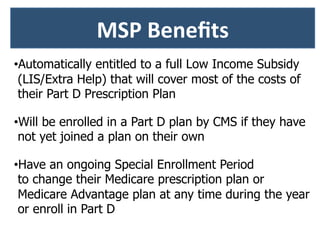
• Automatically entitled to a full Low Income Subsidy
(LIS/Extra Help) that will cover most of the costs of
their Part D Prescription Plan
• Will be enrolled in a Part D plan by CMS if they have
not yet joined a plan on their own
• Have an ongoing Special Enrollment Period
to change their Medicare prescription plan or
Medicare Advantage plan at any time during the year
or enroll in Part D
	
  
MSP	
  Benefits	
  
 LOW-­‐INCOME	
  SUBSIDY	
  
PROGRAM	
  
(LIS	
  or	
  ‘EXTRA	
  HELP’)	


The	
  Medicare	
  Low	
  Income	
  Subsidy	
  
(LIS	
  /	
  Extra	
  Help)
•  Provides	
  extra	
  help	
  with	
  the	


costs	
  of	
  PrescripBon	
  MedicaBons	


for	
  individuals	
  enrolled	
  in	
  Medicare	


that	
  have	
  limited	
  income	
  and	
  assets	


•  Funded	
  by	
  the	
  Federal	
  Government	
  
•  Administered	
  by	
  the	
  Social	
  Security	
  
AdministraBon	
  
§ Income
§ 150% Federal poverty level
§ $1,396 per month for an individual or
§ $1,891 per month for a married couple
§ Based on family size
§ Resources
§ Up to $13,070 (individual)
§ Up to $26,120 (married couple)
Low	
  Income	
  Subsidy
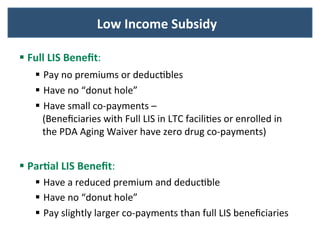
§ Full	
  LIS	
  Benefit:	
  
§  Pay	
  no	
  premiums	
  or	
  deducBbles	
  
§  Have	
  no	
  “donut	
  hole”	
  
§  Have	
  small	
  co-­‐payments	
  –	


  (Beneficiaries	
  with	
  Full	
  LIS	
  in	
  LTC	
  faciliBes	
  or	
  enrolled	
  in	


  the	
  PDA	
  Aging	
  Waiver	
  have	
  zero	
  drug	
  co-­‐payments)	


§ Par-al	
  LIS	
  Benefit:	
  
§  Have	
  a	
  reduced	
  premium	
  and	
  deducBble	
  
§  Have	
  no	
  “donut	
  hole”	
  
§  Pay	
  slightly	
  larger	
  co-­‐payments	
  than	
  full	
  LIS	
  beneficiaries	


  Low	
  Income	
  Subsidy	


Income Guidelines for
Low Income Subsidy (LIS)
Single Married
Full LIS
INCOME: <$1,257 month
ASSETS: <$8,440
INCOME: <$1,703 month
ASSETS: <$13,410
Partial
LIS
INCOME: $1,257 to $1,396
month
ASSETS: $8,440 to $13,070
INCOME: $1,703 to $1,891
month
ASSETS: $13,410 to $26,120
Low Income Subsidy (LIS)
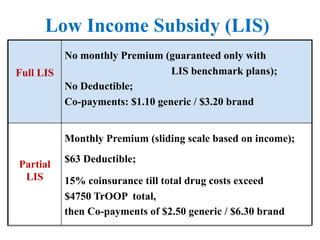
Full LIS
No monthly Premium (guaranteed only with
LIS benchmark plans);
No Deductible;
Co-payments: $1.10 generic / $3.20 brand
Partial
LIS
Monthly Premium (sliding scale based on income);
$63 Deductible;
15% coinsurance till total drug costs exceed
$4750 TrOOP total,
then Co-payments of $2.50 generic / $6.30 brand
§ Some individuals automatically qualify for full LIS
§ People with Medicare who
§  Receive full Medicaid benefits (includes SSI,
MAWD, and Aging Waiver)
§  Receive help paying Medicare Part B premiums
(QMB, SLMB, and QI-1)
§ Others must apply to Social Security Administration
and be found eligible for full or partial LIS
Eligibility	
  for	
  LIS
Applying for LIS


• By	
  mail	
  (must	
  be	
  original	
  LIS	
  paper	


  applicaBon	
  SSA	
  -­‐1020)	


• On-­‐line	
  	
  www.ssa.gov/prescrip-onhelp	
  
• By	
  phone	
  1-­‐800-­‐772-­‐1213	
  
§ Duel Eligibles –
Have both Medicare and Medicaid benefits
§ CMS Notification
§  (Purple Notice) person is deemed eligible for full LIS
§  (Yellow Notice) auto-enrollment notice
§ Beneficiary Action
§  Beneficiary’s enrollment in a Part D plan will off-set
auto-enrollment
§  If no action taken by beneficiary, CMS will auto-enroll
into a Part D Plan
LIS	
  No-fica-ons
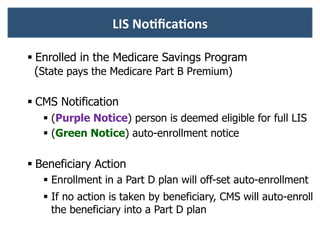
§ Enrolled in the Medicare Savings Program
(State pays the Medicare Part B Premium)
§ CMS Notification
§  (Purple Notice) person is deemed eligible for full LIS
§  (Green Notice) auto-enrollment notice
§ Beneficiary Action
§  Enrollment in a Part D plan will off-set auto-enrollment
§  If no action is taken by beneficiary, CMS will auto-enroll
the beneficiary into a Part D plan
LIS	
  No-fica-ons
§ Point-­‐of-­‐Sale	
  Facilitated	
  Process	
  for	
  pharmacists	


  (LI	
  NET	
  Program)	


§  Pharmacist	
  can	
  call	
  the	
  LI	
  NET	
  Pharmacy	
  Line	


  at	
  1-­‐800-­‐783-­‐1307	


§ DPW	
  “Extraordinary	
  Coverage”	
  
§  DPW	
  will	
  approve	
  only	
  as	
  a	
  last	
  resort	
  
§  Pharmacists	
  calls	
  800-­‐558-­‐4477,	
  opBon	
  1	
  during	
  normal	
  
DPW	
  business	
  hours	


“Safety	
  Nets”	
  for	
  LIS	
  eligible	


PACE/
PACENET	
  
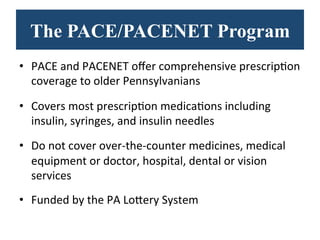
The PACE/PACENET Program
•  PACE	
  and	
  PACENET	
  offer	
  comprehensive	
  prescripBon	
  
coverage	
  to	
  older	
  Pennsylvanians	
  
•  Covers	
  most	
  prescripBon	
  medicaBons	
  including	
  
insulin,	
  syringes,	
  and	
  insulin	
  needles	
  
•  Do	
  not	
  cover	
  over-­‐the-­‐counter	
  medicines,	
  medical	
  
equipment	
  or	
  doctor,	
  hospital,	
  dental	
  or	
  vision	
  
services	
  	
  
•  Funded	
  by	
  the	
  PA	
  Lopery	
  System	


PACE
§ Cannot	
  be	
  eligible	
  for	
  full	
  Medicaid	
  
benefits	
  	
  
§ Can	
  choose	
  to	
  partner	
  with	
  Part	
  D	
  
plan	
  	
  
§ PACE	
  alone	
  is	
  creditable	
  coverage	
  
§ Income	
  is	
  based	
  on	
  previous	
  year	
  
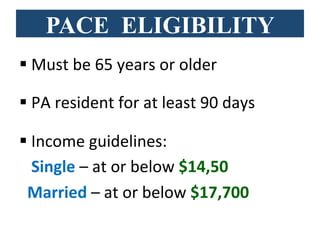
PACE ELIGIBILITY
§ Must	
  be	
  65	
  years	
  or	
  older	
  	
  
§ PA	
  resident	
  for	
  at	
  least	
  90	
  days	
  
§ Income	
  guidelines:	


  Single	
  –	
  at	
  or	
  below	
  $14,50	


  Married	
  –	
  at	
  or	
  below	
  $17,700	
  	
  
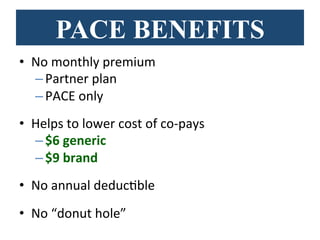
PACE BENEFITS
•  No	
  monthly	
  premium	
  	
  
– Partner	
  plan	
  
– PACE	
  only	
  
•  Helps	
  to	
  lower	
  cost	
  of	
  co-­‐pays	
  
– $6	
  generic	
  	
  
– $9	
  brand	
  
•  No	
  annual	
  deducBble	
  
•  No	
  “donut	
  hole”	
  
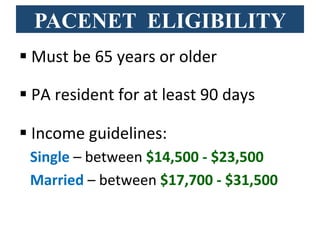
PACENET ELIGIBILITY
§ Must	
  be	
  65	
  years	
  or	
  older	
  
§ PA	
  resident	
  for	
  at	
  least	
  90	
  days	
  	
  
§ Income	
  guidelines:	


  Single	
  –	
  between	
  $14,500	
  -­‐	
  $23,500	


  Married	
  –	
  between	
  $17,700	
  -­‐	
  $31,500	
  
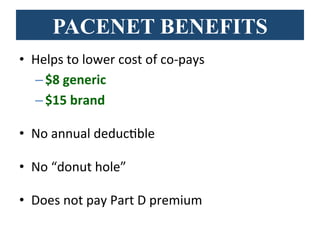
PACENET BENEFITS
•  Helps	
  to	
  lower	
  cost	
  of	
  co-­‐pays	
  
– $8	
  generic	
  	
  
– $15	
  brand	
  
•  No	
  annual	
  deducBble	
  
•  No	
  “donut	
  hole”	
  
•  Does	
  not	
  pay	
  Part	
  D	
  premium	
  
APPLYING for
PACE/PACENET


1-­‐800-­‐225-­‐7223	
  
or	
  
www.aging.state.pa.us	
  
or	
  
PACECares.lsc.com	
  

APPRISE Medicare Presentation

  • 1.
  • 2.
    What  is     Medicare?      
  • 3.
     What  is  Medicare? Medicare  is  the  federal   government  program  that   provides  health  care  coverage   for  individuals  that  are  65  or   older,  or  have  a  disability.  
  • 4.
     What  is  Medicare? Medicare  is  run  by     U.S.  Department  of  Health   and  Human  Services     through  its  regional   Centers  for  Medicare  and   Medicaid  Services  (CMS).  
  • 5.
  • 6.
       How  Does  Medicare  Work?   Originally,  Medicare  was  intended  to  provide  basic   medical  coverage  for  the  treatment  of  illness  and   injury  for  eligible  individuals—     It  was  modeled  a@er  the   Blue  Cross/Blue  Shield  insurance  system  that  was   in  existence  at  that  Bme  (1965)              
  • 7.
       How  Does  Medicare  Work?   • Fee  for  Service  payment  system   • Use  Red,  White  &  Blue  Medicare  Card  as  actual    insurance  card   • May  go  to  any  provider  that  accepts  Medicare   • Referrals  are  not  necessary   • DeducBbles  &  Coinsurances  Apply   • beneficiaries  purchase  supplemental    insurance  to  cover  these  costs  
  • 8.
         What  is  Medicare?   Medicare  has  mulBple   parts,  each  of  which  offers   coverage  for  different   health  care  areas.    
  • 9.
     The  Current  Parts  of     The  Medicare  System     Part  A:  Hospital  Care     • Covers  in-­‐paBent  care/services     Part  B:  Medical  Care       • Covers  out-­‐paBent  care/services     Parts  A  and  B  are  usually  referred  to  as   “TradiBonal”  or  “Original”  Medicare  
  • 10.
     Medicare  Coverage  Basics PartA n  Inpatient Hospital Care n  Skilled Nursing Care n  Some Home Health Care n  Hospice Care Part B n  Doctors’ Services and Outpatient Care n  Preventive Services n  Diagnostic Tests n  Outpatient Therapies n  Durable Medical Equipment
  • 11.
    Medicare  Coverage  Op-ons   Basic  Medicare   (Parts  A  and  B)   as  primary  coverage       Supplement     (Medigap)       Part  D   Drug  Plan     Medicare  Part  C   (Managed  Care  Plan)   as  primary  coverage     Can  include   Part  D  coverage   Op-on  1   Op-on  2   Access  to  Part  C    requires   enrollment  in    Basic  Medicare  
  • 12.
  • 13.
    Medicare  Eligibility             WHO  CAN  ENROLL  IN  MEDICARE?       §   65  years  of  age  and  older                                            OR   §   Under  65  years  and        receiving  disability  benefits  from  SSA  or  RRB        must  receive  these  benefits  for  24  months        before  eligibility  for  Medicare  (ALS  excepBon)                                            OR                       §   Under  65  years  and        diagnosed  with  End  Stage  Renal  Disease  
  • 14.
    Enrollment  into  Medicare     Enrollment  in  is  handled  2  ways:   §   AutomaBc   §   By  applicaBon  
  • 15.
    Enrollment  into  Medicare     AUTOMATIC  ENROLLMENT            If  already  receiving:   § Social  Security  Benefits   § Social  Security  Disability   § Railroad  ReBrement  Benefits       beneficiary  will  receive  Medicare  card   3  months  BEFORE  benefits  are  to  begin.      
  • 16.
    Enrollment  into  Medicare       ENROLLMENT  BY  APPLICATION     If  not  already  receiving  benefits  –     beneficiary  applies  through  Social  Security   AdministraBon:   § 3  months  before  turning  65   § The  month  beneficiary  turns  65   § 3  months  a@er  turning  65     This  is  called  the  Initial Enrollment Period
  • 17.
    Enrollment  into  Medicare             May  delay  enrolling  into  Medicare  if:   Individual  (or  spouse)  is  acBvely  employed                                        AND   Is  covered  under  group  health      insurance   policy  based  on  acBve  employment       This  is  called  Delayed Enrollment
  • 18.
    Enrollment  into  Medicare     May  later  enroll  in  Medicare  when:     Employer  Group  Health  Insurance  ends      You  have  Eight  Months  to  enroll.    This  Eight  Month  period  is  called  the    Special Enrollment Period    
  • 19.
    Enrollment  into  Medicare             If  you  do  not  enroll  during  the   Initial or Delayed Enrollment periods,     Then  you  can  enroll:   § January  1st  –  March  31st  of  each  year   § Coverage  begins  July  1st   § Penalty  is  assessed  on  Part  B  premiums      This  is  called  General Enrollment
  • 20.
    MEDICARE    PART  D     Prescrip-on   Drug  Coverage      
  • 21.
     Medicare  Part  D           § Available  since  January  1,  2006   § Voluntary  PrescripBon  Drug  Benefit   § Provides  assistance  with  prescripBon  drug  costs   § Available  for  Medicare  Beneficiaries  enrolled  in      “Basic”  Medicare  (Part  A  or  Part  B)   § Plans  provided  by  private  insurance  companies   § Plans  must  meet  or  exceed  Medicare  Guidelines  and      all  plans  are  CMS  approved  
  • 22.
    MEDICARE  PART  D         Two  versions  of  coverage:     §  Stand-­‐alone  PrescripBon  Drug  Plans       (PDP)   §  Medicare  Advantage  plans  with  Rx  benefit   (MA-­‐PD)    
  • 23.
    Medicare Prescription DrugPlan Plan Pays 95% Beneficiary Pays 5% Plan Pays 75% Beneficiary pays 25% Coverage GapNo Coverage “DOUGHNUT HOLE” Catastrophic Coverage out  of  pocket   limit  $4750      Ini-al  coverage   limit    $2970   Partial Coverage Plan  Deduc-ble  (if  any)  
  • 24.
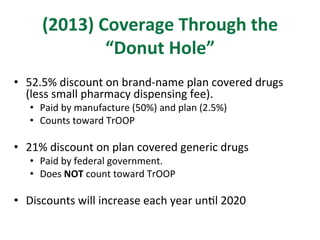
    (2013)  Coverage  Through  the     “Donut  Hole”       •  52.5%  discount  on  brand-­‐name  plan  covered  drugs   (less  small  pharmacy  dispensing  fee).     •  Paid  by  manufacture  (50%)  and  plan  (2.5%)   •  Counts  toward  TrOOP   •  21%  discount  on  plan  covered  generic  drugs   •  Paid  by  federal  government.                                             •  Does  NOT  count  toward  TrOOP   •  Discounts  will  increase  each  year  unBl  2020  
  • 25.
    Formulary •  A  list  of  prescripBon  drugs  covered  by  the  plan   •  Plans  have  “Bers”  that  cost  different  amounts   Example  of  Tiers  (Plans  can  form  -ers  in  different  ways)     Tier     You  Pay   PrescripBon     Drugs  Covered   1   Lowest  copayment   Most  generics     2   Medium  copayment   Preferred,  brand-­‐name     3   Highest  copayment   Non-­‐preferred,  brand-­‐name     Specialty   Highest  copayment  or   coinsurance   Unique,  very  high-­‐cost      
  • 26.
    When  you  can  Join  or  Switch   Medicare  Prescrip-on  Drug  Plans   Ini-al  Enrollment  Period   (IEP)   §  7  month  period   §  Starts  3  months  before  month  of  eligibility   Annual  Enrollment   Period   October  15  –  December  7  each  year     These  are  new  dates   Annual  Medicare   Advantage   Disenrollment  Period   §  Between  January  1–  February  14,  you  can   leave  an  MA  plan  and  switch  to  Original   Medicare.  If  you  make  this  change,  you   may  also  join  a  Part  D  plan  to  add  drug   coverage.  Coverage  begins  the  first  of  the   month  a@er  the  plan  gets  the  enrollment   form.    
  • 27.
    Joining  or  Switching  Drug  Plans   Special  Enrollment   Periods  (SEP)       §  Examples  of  when  you  get  an  SEP  include   §  You  permanently  move  out  of  your  plan’s   service  area   §  You  lose  other  creditable  Rx  coverage   §  You  weren’t  adequately  informed  your   other  coverage  was  not  creditable  or  was   reduced  and  is  no  longer  creditable   §  You  enter,  live  in  or  leave  a  long-­‐term  care   facility   §  You  have  a  conBnuous  SEP  if  you  qualify  for   Extra  Help  
  • 28.
  • 29.
    MEDICAID   •  Health  Benefit  program  for  individuals  with  low   income/resources   •  Funded  by  Federal  and  State  resources   •  Administered  by  the  State          In  Pennsylvania  by  DPW  –  County  Assistance  Office     •  Also  know  as:                Medical  Assistance                  Medical  Welfare      
  • 30.
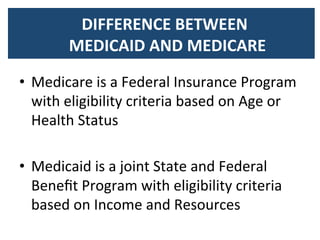
       DIFFERENCE  BETWEEN        MEDICAID  AND  MEDICARE   •  Medicare  is  a  Federal  Insurance  Program   with  eligibility  criteria  based  on  Age  or   Health  Status   •  Medicaid  is  a  joint  State  and  Federal   Benefit  Program  with  eligibility  criteria   based  on  Income  and  Resources  
  • 31.
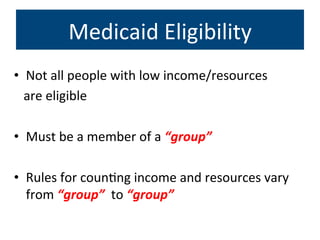
    Medicaid  Eligibility   • Not  all  people  with  low  income/resources        are  eligible   •  Must  be  a  member  of  a  “group”   •  Rules  for  counBng  income  and  resources  vary   from  “group”    to  “group”          
  • 32.
    Examples  of     Medicaid  Eligibility  Groups   •  Eligibility  based  on  cash  assistance  programs       •  Supplemental  Security  Income  (SSI)   •  Aid  to  Families  with  Dependent  Children  (AFDC)     •  Eligibility  based  on  non-­‐financial  categorical  requirements                                 •  Pregnant  Women   •  Children     •  Aged,  blind,  or  disabled                  
  • 33.
    Guidelines for Medicaid Eligibility (Agedor Disabled) Single Married (100% FPL) INCOME: < $931 month ASSETS: < $2,000 INCOME: < $1,261 month ASSETS: < $3,000
  • 34.
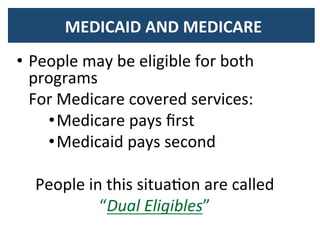
     MEDICAID  AND  MEDICARE       •  People  may  be  eligible  for  both   programs        For  Medicare  covered  services:   • Medicare  pays  first   • Medicaid  pays  second     People  in  this  situaBon  are  called   “Dual  Eligibles”  
  • 35.
    • Basic Medicare (red,white & blue card) is Primary Coverage • ACCESS card is secondary coverage to Medicare & will also cover things Medicare does not – i.e. dental and eye care • Medicare Part D PDP is drug coverage, use Plan ID card at pharmacy • Can change Part D Plans at any time/multiple times • ACCESS card can cover drugs in classes that are excluded from Part D (benzos, barbs, some OTC medications)     Accessing  Care:  Dual  Eligible        
  • 36.
    • Can go toany doctor or other health care provider that takes Medicare • Must show both Medicare and ACCESS card when getting health care services • Provider who does not take ACCESS card can refuse to treat individual, or can treat the person & just accept what Medicare pays – they cannot bill the individual for Medicare cost-sharing – (Balance Billing)     Accessing  Care:  Dual  Eligible        
  • 37.
    •  “Special” MedicareAdvantage Plans •  “Special” because they limit their enrollment to certain Medicare beneficiaries. Examples: Medicare/Medicaid dual eligible, nursing home residents, or persons with certain chronic conditions •  Must use in-network providers •  Includes Part D drug coverage Special  Needs  Plans  (SNPs)
  • 38.
    • SNP Medicare AdvantagePlan (e.g. Gateway Medicare Assured, UPMC for Life Specialty Plan), is primary coverage – Must go to doctors & other providers in plan’s network • Can change Plans at any time of the year/multiple times • ACCESS card covers things Medicare/Advantage Plan does not cover (e.g. dental and eye) • Medicare Managed Care Plan can provide Part D coverage ACCESS card can cover drugs in classes that are excluded from Part D (benzos, barbs, some OTC medications) Accessing  Care:     Dual  Eligible  using  SNP  
  • 39.
  • 40.
    SSI makes monthlypayments to individuals who have low income, few resources and are: • Age 65 or older • Blind • Disabled (determined by SSA)      
  • 41.
    SSI Income Eligibility Limits: • Individual$698 • Married Couple $1,048      
  • 42.
    SSI Resource Eligibility Limits • Individual$2,000 • Married Couple $3,000      
  • 43.
    SSI Recipients • Anyone eligiblefor Supplemental Security Income (SSI) benefits automatically qualifies for MA • No application for MA required – automatic eligibility when SSI approved • Receive full MA benefits including Rx & dental • Persons on SSI receive help with their Medicare Part A and B premiums • State will pay Part B premium for these individuals • If Part A is not free, state will pay Part A premium
  • 44.
    MAWD     Medical  Assistance     for  Workers  with   DisabiliBes    
  • 45.
    MAWD   •  Can  be  individual’s  only  insurance   or   •  Can  be  secondary  insurance  if:   • Individual  is  enrolled  in  Medicare     • Individual  has  some  coverage   through  employment  
  • 46.
    Individuals  Enrolled  in  MAWD   • Receive  full  Medicaid   Assistance       • Pay  a  monthly  premium  of  5%   of  countable  income    
  • 47.
    MAWD  –  Eligibility  Criteria   •  Age  16  -­‐  64   •  Illness  or  condiBon  that  meets  Social  Security’s   definiBon  of  disability   •  Be  a  recipient  of  SSDI  or;   •  Provide  documentaBon  to  DPW  that  demonstrates   disability  status   •  Working  &  earning  compensaBon  from  work                       (no  minimum  work  requirement)   •  Countable  income  <250%  FPL     •  $2,325/month  single  individual  –  2012   •  $3,150/month  married  couple  –  2012   •  Countable  assets  less  than  $10,000  
  • 48.
    MAWD  –  Work  Requirement        No  minimum  requirements  for:   •  Number  of  hours  worked   •  Amount  individual  earns   however   •  Individual  must  be  reasonably  compensated   for  work   •  Must  provide  wripen  verificaBon  of  work  and   compensaBon  to  DPW      
  • 49.
    MAWD  –  Disability   To  demonstrate  disability  for  MAWD   individual  must:   •  Receive  SSDI  benefits  or;     •  Submit  documentaBon  which  can  include:   •  Employability  assessment  form   •  Health  sustaining  medicaBon  form   •  Leper  from  physician   •  Medical  records      
  • 50.
    MAWD  –  Disability     Individuals  who  are:     •  On  SSDI,  employed  &  in  Medicare   •  On  SSDI,  employed  &  waiBng  to   receive  Medicare   •  Employed,  not  receiving  SSDI  but   meets  definiBon  of  disability  
  • 51.
    The  PDA    Aging  Waiver    Program  
  • 52.
    Home & CommunityBased Services (HCBS) provides assistance to the aged & disabled to permit them to live independently in homes & communities
  • 53.
    HCBS  Eligible  Individuals  Receive:     • Medicaid  Benefits       • AddiBonal  in-­‐home  Medical   Services     • In-­‐home  Non-­‐medical  Services          
  • 54.
    Aging Waiver – EligibilityRequirements •  Resident of Pennsylvania •  U.S. Citizen or qualified non-citizen •  Age 60 years or older •  Requires a level of care provided by SNF •  Monthly income limit < 300% of the federal benefit limit for SSI •  Asset limit - $8,000
  • 55.
    Aging Waiver/ Health CareBenefits •  Some Waiver enrollees are already receiving Medicaid benefits prior to entering the Aging Waiver Program. They already meet the income & asset guidelines for Medicaid eligibility.  
  • 56.
    Aging Waiver/ Health CareBenefits •  Other enrollees would not otherwise qualify for Medicaid (do not meet the income & asset guidelines). However, enrollment in the Aging Waiver Program, makes them eligible for full benefits under Medicaid.
  • 57.
    Aging Waiver / MedicaidACCESS Card •  Aging Waiver enrollees will receive an ACCESS Card that covers Medicare Part A and Part B Cost Sharing (the deductibles, co-payments, and co-insurance that the beneficiary is normally responsible for in the Medicare system) •  The ACCESS card also provides services that Medicare does not cover: dental, vision, and medical transportation.
  • 58.
    Aging Waiver / MedicaidAccess Card •  Some Aging Waiver enrollees will already have an ACCESS card, because they are already enrolled in the Medicaid program prior to entering the Waiver program. In either case….
  • 59.
    Aging Waiver / MedicaidACCESS Card   •  For Aging Waiver enrollees the ACCESS Card can be an effective way to cover their cost sharing under Medicare Part A and Part B. As a result they can drop their existing Medicare Supplement (Medigap policy) or Medicare Advantage Plan (HMOs and PPOs) and rely on the ACCESS card instead. HOWEVER…..
  • 60.
    Things to considerwhen deciding whether or not to drop Medigap or Medicare Advantage Plans after receiving the Access Card: 1. Will enrollee’s current medical care providers (physicians, clinics, medical facilities, etc.) accept the Access card as secondary insurance? 2. Dropping the Medicare Advantage Plan may also eliminate their current Part D drug coverage. Part D coverage is necessary to utilize the LIS-Extra Help benefit. As a result, the person will need to enroll in a new stand-alone Part D Plan. 3. The Access Card represents enrollment in Medicaid which will result in termination of enrollment in the PACE/PACE NET program.
  • 61.
  • 62.
    Medicare Savings Programs– Help from Medicaid paying Medicare Part B premium. For individuals with limited income and resources. § QMB (Qualified Medicare Beneficiary) § SLMB (Specified Low-Income Medicare Beneficiary) § QI-1 (Qualified Individual) MEDICARE  SAVINGS  PROGRAMS
  • 63.
    MSP  Eligibility   To  qualify  for     Medicare  Savings  Program:         • An  Individual  must  be  enBtled  to    Medicare  Part  B                                                    and   • Have  Income  and  Assets  within  the    program’s  allowable  limits   MEDICARE  SAVINGS  PROGRAMS
  • 64.
    Guidelines for Medicare SavingsProgram Single Married QMB (100% FPL) INCOME: <$931 month ASSETS: <$7,080 INCOME: <$1,261 month ASSETS: <$10,620 SLMB (120% FPL) INCOME: <$1,117 month ASSETS: <$7,080 INCOME: <$1,513 month ASSETS: <$10,620 QI-1 (135% FPL) INCOME: <$1,257 month ASSETS: <$7,080 INCOME: <$1,703month ASSETS: <$10,620
  • 65.
    Medicare Savings Program QMB (100%FPL) Payment of Medicare Part B premiums; Payment of Medicare Part A and Part B Cost Sharing, Eligible for LIS (Prescription Drug benefits) SLMB (120% FPL) Payment of Medicare Part B premiums, Eligible for LIS (Prescription Drug benefits) QI-1 (135% FPL) Payment of Medicare Part B premiums, Eligible for LIS (Prescription Drug benefits.
  • 66.
    • Those approved forQMB receive payment of Part B premium and receive an ACCESS card to cover their Medicare Part A & B deductibles & co-pays (also qualified for SNP Advantage Plan) • Those approved for SLMB & QI1 only receive payment of the Part B premium   MSP  Benefits  
  • 67.
    • Once person isapproved for MSP, the state transmits data to Social Security to arrange for Part B payments (usually takes 2 – 3 months) • The state then begins paying the Part B premium each month & the person’s Social Security or Railroad Retirement check increases • SSA will also reimburse the person for the Part B premiums already paid retroactive to the date MSP was approved   MSP  Benefits  
  • 68.
    MSP recipients whoare entitled to Medicare Part B but not yet enrolled will: • Be enrolled into Part B & receive coverage beginning the month MSP starts (regardless of Medicare Part B enrollment period) and • Not be subjected to a penalty (if any) for late enrollment into Part B   MSP  Benefits  
  • 69.
    • Automatically entitled toa full Low Income Subsidy (LIS/Extra Help) that will cover most of the costs of their Part D Prescription Plan • Will be enrolled in a Part D plan by CMS if they have not yet joined a plan on their own • Have an ongoing Special Enrollment Period to change their Medicare prescription plan or Medicare Advantage plan at any time during the year or enroll in Part D   MSP  Benefits  
  • 70.
     LOW-­‐INCOME  SUBSIDY   PROGRAM   (LIS  or  ‘EXTRA  HELP’)      
  • 71.
    The  Medicare  Low  Income  Subsidy   (LIS  /  Extra  Help) •  Provides  extra  help  with  the                                                       costs  of  PrescripBon  MedicaBons                                       for  individuals  enrolled  in  Medicare             that  have  limited  income  and  assets       •  Funded  by  the  Federal  Government   •  Administered  by  the  Social  Security   AdministraBon  
  • 72.
    § Income § 150% Federal povertylevel § $1,396 per month for an individual or § $1,891 per month for a married couple § Based on family size § Resources § Up to $13,070 (individual) § Up to $26,120 (married couple) Low  Income  Subsidy
  • 73.
    § Full  LIS  Benefit:   §  Pay  no  premiums  or  deducBbles   §  Have  no  “donut  hole”   §  Have  small  co-­‐payments  –          (Beneficiaries  with  Full  LIS  in  LTC  faciliBes  or  enrolled  in        the  PDA  Aging  Waiver  have  zero  drug  co-­‐payments)     § Par-al  LIS  Benefit:   §  Have  a  reduced  premium  and  deducBble   §  Have  no  “donut  hole”   §  Pay  slightly  larger  co-­‐payments  than  full  LIS  beneficiaries            Low  Income  Subsidy      
  • 74.
    Income Guidelines for LowIncome Subsidy (LIS) Single Married Full LIS INCOME: <$1,257 month ASSETS: <$8,440 INCOME: <$1,703 month ASSETS: <$13,410 Partial LIS INCOME: $1,257 to $1,396 month ASSETS: $8,440 to $13,070 INCOME: $1,703 to $1,891 month ASSETS: $13,410 to $26,120
  • 75.
    Low Income Subsidy(LIS) Full LIS No monthly Premium (guaranteed only with LIS benchmark plans); No Deductible; Co-payments: $1.10 generic / $3.20 brand Partial LIS Monthly Premium (sliding scale based on income); $63 Deductible; 15% coinsurance till total drug costs exceed $4750 TrOOP total, then Co-payments of $2.50 generic / $6.30 brand
  • 76.
    § Some individuals automaticallyqualify for full LIS § People with Medicare who §  Receive full Medicaid benefits (includes SSI, MAWD, and Aging Waiver) §  Receive help paying Medicare Part B premiums (QMB, SLMB, and QI-1) § Others must apply to Social Security Administration and be found eligible for full or partial LIS Eligibility  for  LIS
  • 77.
    Applying for LIS       • By  mail  (must  be  original  LIS  paper                                      applicaBon  SSA  -­‐1020)     • On-­‐line    www.ssa.gov/prescrip-onhelp   • By  phone  1-­‐800-­‐772-­‐1213  
  • 78.
    § Duel Eligibles – Haveboth Medicare and Medicaid benefits § CMS Notification §  (Purple Notice) person is deemed eligible for full LIS §  (Yellow Notice) auto-enrollment notice § Beneficiary Action §  Beneficiary’s enrollment in a Part D plan will off-set auto-enrollment §  If no action taken by beneficiary, CMS will auto-enroll into a Part D Plan LIS  No-fica-ons
  • 79.
    § Enrolled in theMedicare Savings Program (State pays the Medicare Part B Premium) § CMS Notification §  (Purple Notice) person is deemed eligible for full LIS §  (Green Notice) auto-enrollment notice § Beneficiary Action §  Enrollment in a Part D plan will off-set auto-enrollment §  If no action is taken by beneficiary, CMS will auto-enroll the beneficiary into a Part D plan LIS  No-fica-ons
  • 80.
    § Point-­‐of-­‐Sale  Facilitated  Process  for  pharmacists      (LI  NET  Program)     §  Pharmacist  can  call  the  LI  NET  Pharmacy  Line      at  1-­‐800-­‐783-­‐1307       § DPW  “Extraordinary  Coverage”   §  DPW  will  approve  only  as  a  last  resort   §  Pharmacists  calls  800-­‐558-­‐4477,  opBon  1  during  normal   DPW  business  hours       “Safety  Nets”  for  LIS  eligible  
  • 81.
  • 82.
    The PACE/PACENET Program • PACE  and  PACENET  offer  comprehensive  prescripBon   coverage  to  older  Pennsylvanians   •  Covers  most  prescripBon  medicaBons  including   insulin,  syringes,  and  insulin  needles   •  Do  not  cover  over-­‐the-­‐counter  medicines,  medical   equipment  or  doctor,  hospital,  dental  or  vision   services     •  Funded  by  the  PA  Lopery  System    
  • 83.
    PACE § Cannot  be  eligible  for  full  Medicaid   benefits     § Can  choose  to  partner  with  Part  D   plan     § PACE  alone  is  creditable  coverage   § Income  is  based  on  previous  year  
  • 84.
    PACE ELIGIBILITY § Must  be  65  years  or  older     § PA  resident  for  at  least  90  days   § Income  guidelines:          Single  –  at  or  below  $14,50      Married  –  at  or  below  $17,700    
  • 85.
    PACE BENEFITS •  No  monthly  premium     – Partner  plan   – PACE  only   •  Helps  to  lower  cost  of  co-­‐pays   – $6  generic     – $9  brand   •  No  annual  deducBble   •  No  “donut  hole”  
  • 86.
    PACENET ELIGIBILITY § Must  be  65  years  or  older   § PA  resident  for  at  least  90  days     § Income  guidelines:                                                    Single  –  between  $14,500  -­‐  $23,500        Married  –  between  $17,700  -­‐  $31,500  
  • 87.
    PACENET BENEFITS •  Helps  to  lower  cost  of  co-­‐pays   – $8  generic     – $15  brand   •  No  annual  deducBble   •  No  “donut  hole”   •  Does  not  pay  Part  D  premium  
  • 88.
    APPLYING for PACE/PACENET     1-­‐800-­‐225-­‐7223   or   www.aging.state.pa.us   or   PACECares.lsc.com