
EMERGING WORLD TRADE REGIME:
Social clause and implications for employee
relations management
Agenda
   Introduction
   Social realities, culture and organizations: Global
    perspective (Country perspective)
   WTO regime and the social clause
   Centre- State vs State-State pulls
   Employment security
   Labor redundancy
   Wage Policy
   Social Security
   Contract Labor
   Child Labor
Introduction

    Significant changes in social and corporate
     world due to WTO regime
    Reforms impact upon all HR practices and
     trade unions
    Intensity depended upon ownership, culture
    Indian context:
    Reforms treated with suspicion by working class
    Political parties too interfering in the process
New employment relationship
Employee expectations:
   Provide education, training, and skill development
    opportunities
   Provide education, training, and skill development
    opportunities
   Involvement in decision making / empowerment
   Open communication, mentoring
   Challenging meaningful and interesting work
   Performance based compensation
New employment relationship

Employer expectations:
 Assume responsibility for developing and
  maintaining skills
 Produce positive results and add demonstrable
  value
 Understand the nature of employers/business
 Have customer focus
 Work in teams, and take initiatives
 Flexibility and commitment
Social Realities, culture and organizations

Japan:
 Submissive and adaptable nature because
  of agri-centred society
 Work considered source of moral culture
 Work ethics weakened in post World War II
  generation
 High educational level of workers
 Non-confrontational attitude and industrial
  harmony
Social Realities, culture and organizations

Yugoslvia:
 Socialist self-management regime
 Workers’ Council elect top managers
 Success depends on efficiency of
  business enterprises
Social Realities, culture and organizations

Indonesia:
 Three cultural levels:
       Ethnic regional cultural level: tribal group culture
       Regional-national cultural level
       National-international cultural level: internalized western
        values
   Top managers prefer paternalistic style of leadership
   Collectivistic, short-term oriented
   Need vision, less communication barriers
   Orientation towards- God, environment, and self
Social Realities, culture and organizations

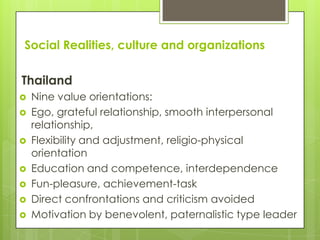
Thailand
   Nine value orientations:
   Ego, grateful relationship, smooth interpersonal
    relationship,
   Flexibility and adjustment, religio-physical
    orientation
   Education and competence, interdependence
   Fun-pleasure, achievement-task
   Direct confrontations and criticism avoided
   Motivation by benevolent, paternalistic type leader
Social Realities, culture and organizations

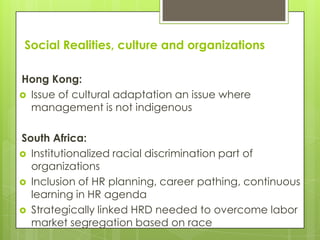
Hong Kong:
 Issue of cultural adaptation an issue where
  management is not indigenous

South Africa:
 Institutionalized racial discrimination part of
  organizations
 Inclusion of HR planning, career pathing, continuous
  learning in HR agenda
 Strategically linked HRD needed to overcome labor
  market segregation based on race
Social Realities, culture and organizations

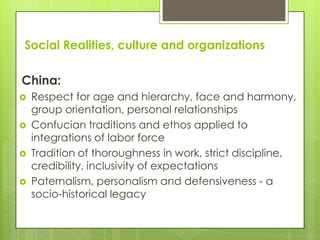
China:
   Respect for age and hierarchy, face and harmony,
    group orientation, personal relationships
   Confucian traditions and ethos applied to
    integrations of labor force
   Tradition of thoroughness in work, strict discipline,
    credibility, inclusivity of expectations
   Paternalism, personalism and defensiveness - a
    socio-historical legacy
Social Realities, culture and organizations

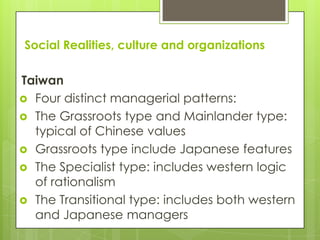
Taiwan
 Four distinct managerial patterns:
 The Grassroots type and Mainlander type:
  typical of Chinese values
 Grassroots type include Japanese features
 The Specialist type: includes western logic
  of rationalism
 The Transitional type: includes both western
  and Japanese managers
Social Realities, culture and organizations

India
 Three types of behavioral dispositions or
  ethics:
 Personal ethic of helplessness
 Organizational ethic of personalized
  relationships
 Idealized family-centered work ethic
Social Realities, culture and organizations

India
 Draws from the authoritarian practices in family
 Reward system based on negativity and
   uncertainty
 Family and religious traditionalism emphasis on past
 Joint family systems – need to meet obligatory
   demands from relatives, friends etc.
 Nurturance, universalism, peer leadership
   enhances member integration
 Synergic and exploitative cultures in large and
   small organizations
WTO regime in India

   A mixed picture
   India being the founder member of the ILO, contributed
    to the codification of international labor standards
   India benefitted from framing its own labor framework
    on labor aspects
   Indian constitution and labor laws uphold all the
    principles evolved in the eight core international labor
    standards
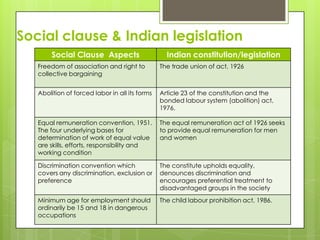
Social clause & Indian legislation
        Social Clause Aspects                     Indian constitution/legislation
   Freedom of association and right to          The trade union of act, 1926
   collective bargaining


   Abolition of forced labor in all its forms   Article 23 of the constitution and the
                                                bonded labour system (abolition) act,
                                                1976.

   Equal remuneration convention, 1951.         The equal remuneration act of 1926 seeks
   The four underlying bases for                to provide equal remuneration for men
   determination of work of equal value         and women
   are skills, efforts, responsibility and
   working condition

   Discrimination convention which              The constitute upholds equality,
   covers any discrimination, exclusion or      denounces discrimination and
   preference                                   encourages preferential treatment to
                                                disadvantaged groups in the society
   Minimum age for employment should            The child labour prohibition act, 1986.
   ordinarily be 15 and 18 in dangerous
   occupations
Centre – State vs State-State Pulls

   Significant changes in labour laws by states
    i.e. trade unions act 1926
       Secret ballot for trade union recognition
       Secret ballot through tripartite social dialogue
       Simplified labour inspection laws (Rajsthan)
       Kerala extended full rights to entrepreneurs for
        hiring of labor

    Implementation has been the weak link
Wage policy

   Wage policy is main concern in the Indian context
   Dearness Allowance is based on the lowest basic wage
    indexing which declines as the basic wage rises
   Bonus payment governed by the payment of bonus act,
    1965
   Average real wage rate tends to decline when inflation
    rate rises above certain level
   Revision of basic wages does not consider labor
    productivity and profitability in organization
   Economic reforms lead to cost adjustment and wage
    flexibility is an important tool
SAAT, 1996
   South Asia Multidisplinary Advisory Team (SAAT)
   Reported by SAAT, government should have several
    objectives-
       Ensuring minimum level of living
       Creating condition for systematic growth of wages
       Sustaining appropriate wage productivity linkages
       Incorporating appropriate incentives structures
       Limiting income inequalities
       Minimum wage should be fixed at national level
Employement Security & labour
market flexibility
  SAAT report indicates that, Indian employment
   security system is based on three premises
( Legislations : Industrial disputes Act 1947,
                 Industrial employment Act 1946 )
   Industrial workers – potential victims of exploitation
    
  Protection from exploitation – must come from
   government regulations
  Income security follows from employment security
 Retrenchment (except under certain conditions) in
  enterprise employing 100 or more workers requires prior
  permission from govt. authorities
Labour Redundancy
    Sizeable lot of redundant labour due to:
     Inapt handling of industrial sickness incidents
     Continuance of non-viable enterprises by the
       Government for employment protection
     Over employment by public enterprises


    Introduction of reforms aimed at:
     Development of institutions for efficient redeployment
        of labour from organized to unorganized sectors
     Stimulation of growth of the unorganized sector
     Commitment of large resources on the part of
        Government
Labour Redundancy
  Measures
     Voluntary Retirement Schemes packaged
      with programmes for counselling, retraining
      and redeployment
     Transparency in the entire system
     Self employment: measures for
      entrepreneurship training

  Unorganised    Labour Market
     Reforms aimed at income security and
      social security
Wage Policy
   Minimum wages set by Government for unorganised sector
   Variations in minimum real wage rates across states and
    across occupations
   Minimum wage rates revised very infrequently
   Revised rates lower in real terms than pre-revision rates
   Statutory minimum wages below the poverty-line wages

    Actual wages below the statutory wages
     Lack of proper indexation
     Irregular revisions and weak enforcements
     Setting different wages for organized and unorganized
      sector
Wage Policy

   Recommendations     for minimum wage

      National minimum wage payable to all
       unskilled workers irrespective of age and
       sex
      Fully indexed and above he poverty-line
      States to derive minimum wages from
       this by using appropriate price indices
Social Security
   Unorganized sector workers mostly covered under LIC,
    General Insurance Corporation of India, National Social
    Assistance Programmes and Annapurna
   Frequent change in occupations : specific occupation
    based programmes rendered useless
   Schemes like Annapurna failed due to administrative
    and operational problems
   Thorough evaluation of schemes in their total structure
   Social security partners need to be strengthened with
    respect to finance, human resource development,
    monitoring and evaluation
Contract Labor Act, 1970
    Provisions for
     Abolition of contract labour in perennial and
       permanent jobs
     Regulating the contract labour system


    Suggested reforms
     New dispensations for the wages, safety and welfare
       of contract labour
     Right to employees to go for contracting without any
       restrictions
     Labourisation or workers’ financial participation as an
       effective remedy
Child Labour
India
   11.28 million child labourers (1991 census)
   40% of the world child labour force


   Child Labour (Prohibition and Abolition) Act, 1986:
    hazardous industries and activities
   Further implementation of national policy and more
    advanced reforms such as creation of Child Labour Cells
    in each state
   Lack effective implementation
   Social initiatives and strenghtening of inspection
    measures required
Discussions

 Pre  WTO, employees enjoyed lifetime employment,
  company sponsored health programmes and
  retirement pensions
 Post WTO, employees expected to work in multi
  faceted teams and update their skills continuously
 Restructuring  Feeling of job insecurity
Recommendations
 Acceleration   of reforms required
 Role of Government important due to legislative
  reforms falling under their purview
 Extensive controls, large Government sector and
  many Government programmes bureaucracy
  leading to failure in implementation
 Monitoring of reforms by independent regulatory
  bodies with greater transparency
Thank You

Emerging World Trade Regime

  • 1.
    EMERGING WORLD TRADEREGIME: Social clause and implications for employee relations management
  • 2.
    Agenda  Introduction  Social realities, culture and organizations: Global perspective (Country perspective)  WTO regime and the social clause  Centre- State vs State-State pulls  Employment security  Labor redundancy  Wage Policy  Social Security  Contract Labor  Child Labor
  • 3.
    Introduction  Significant changes in social and corporate world due to WTO regime  Reforms impact upon all HR practices and trade unions  Intensity depended upon ownership, culture  Indian context:  Reforms treated with suspicion by working class  Political parties too interfering in the process
  • 4.
    New employment relationship Employeeexpectations:  Provide education, training, and skill development opportunities  Provide education, training, and skill development opportunities  Involvement in decision making / empowerment  Open communication, mentoring  Challenging meaningful and interesting work  Performance based compensation
  • 5.
    New employment relationship Employerexpectations:  Assume responsibility for developing and maintaining skills  Produce positive results and add demonstrable value  Understand the nature of employers/business  Have customer focus  Work in teams, and take initiatives  Flexibility and commitment
  • 6.
    Social Realities, cultureand organizations Japan:  Submissive and adaptable nature because of agri-centred society  Work considered source of moral culture  Work ethics weakened in post World War II generation  High educational level of workers  Non-confrontational attitude and industrial harmony
  • 7.
    Social Realities, cultureand organizations Yugoslvia:  Socialist self-management regime  Workers’ Council elect top managers  Success depends on efficiency of business enterprises
  • 8.
    Social Realities, cultureand organizations Indonesia:  Three cultural levels:  Ethnic regional cultural level: tribal group culture  Regional-national cultural level  National-international cultural level: internalized western values  Top managers prefer paternalistic style of leadership  Collectivistic, short-term oriented  Need vision, less communication barriers  Orientation towards- God, environment, and self
  • 9.
    Social Realities, cultureand organizations Thailand  Nine value orientations:  Ego, grateful relationship, smooth interpersonal relationship,  Flexibility and adjustment, religio-physical orientation  Education and competence, interdependence  Fun-pleasure, achievement-task  Direct confrontations and criticism avoided  Motivation by benevolent, paternalistic type leader
  • 10.
    Social Realities, cultureand organizations Hong Kong:  Issue of cultural adaptation an issue where management is not indigenous South Africa:  Institutionalized racial discrimination part of organizations  Inclusion of HR planning, career pathing, continuous learning in HR agenda  Strategically linked HRD needed to overcome labor market segregation based on race
  • 11.
    Social Realities, cultureand organizations China:  Respect for age and hierarchy, face and harmony, group orientation, personal relationships  Confucian traditions and ethos applied to integrations of labor force  Tradition of thoroughness in work, strict discipline, credibility, inclusivity of expectations  Paternalism, personalism and defensiveness - a socio-historical legacy
  • 12.
    Social Realities, cultureand organizations Taiwan  Four distinct managerial patterns:  The Grassroots type and Mainlander type: typical of Chinese values  Grassroots type include Japanese features  The Specialist type: includes western logic of rationalism  The Transitional type: includes both western and Japanese managers
  • 13.
    Social Realities, cultureand organizations India  Three types of behavioral dispositions or ethics:  Personal ethic of helplessness  Organizational ethic of personalized relationships  Idealized family-centered work ethic
  • 14.
    Social Realities, cultureand organizations India  Draws from the authoritarian practices in family  Reward system based on negativity and uncertainty  Family and religious traditionalism emphasis on past  Joint family systems – need to meet obligatory demands from relatives, friends etc.  Nurturance, universalism, peer leadership enhances member integration  Synergic and exploitative cultures in large and small organizations
  • 15.
    WTO regime inIndia  A mixed picture  India being the founder member of the ILO, contributed to the codification of international labor standards  India benefitted from framing its own labor framework on labor aspects  Indian constitution and labor laws uphold all the principles evolved in the eight core international labor standards
  • 16.
    Social clause &Indian legislation Social Clause Aspects Indian constitution/legislation Freedom of association and right to The trade union of act, 1926 collective bargaining Abolition of forced labor in all its forms Article 23 of the constitution and the bonded labour system (abolition) act, 1976. Equal remuneration convention, 1951. The equal remuneration act of 1926 seeks The four underlying bases for to provide equal remuneration for men determination of work of equal value and women are skills, efforts, responsibility and working condition Discrimination convention which The constitute upholds equality, covers any discrimination, exclusion or denounces discrimination and preference encourages preferential treatment to disadvantaged groups in the society Minimum age for employment should The child labour prohibition act, 1986. ordinarily be 15 and 18 in dangerous occupations
  • 17.
    Centre – Statevs State-State Pulls  Significant changes in labour laws by states i.e. trade unions act 1926  Secret ballot for trade union recognition  Secret ballot through tripartite social dialogue  Simplified labour inspection laws (Rajsthan)  Kerala extended full rights to entrepreneurs for hiring of labor Implementation has been the weak link
  • 18.
    Wage policy  Wage policy is main concern in the Indian context  Dearness Allowance is based on the lowest basic wage indexing which declines as the basic wage rises  Bonus payment governed by the payment of bonus act, 1965  Average real wage rate tends to decline when inflation rate rises above certain level  Revision of basic wages does not consider labor productivity and profitability in organization  Economic reforms lead to cost adjustment and wage flexibility is an important tool
  • 19.
    SAAT, 1996  South Asia Multidisplinary Advisory Team (SAAT)  Reported by SAAT, government should have several objectives-  Ensuring minimum level of living  Creating condition for systematic growth of wages  Sustaining appropriate wage productivity linkages  Incorporating appropriate incentives structures  Limiting income inequalities  Minimum wage should be fixed at national level
  • 20.
    Employement Security &labour market flexibility  SAAT report indicates that, Indian employment security system is based on three premises ( Legislations : Industrial disputes Act 1947, Industrial employment Act 1946 ) Industrial workers – potential victims of exploitation   Protection from exploitation – must come from government regulations  Income security follows from employment security  Retrenchment (except under certain conditions) in enterprise employing 100 or more workers requires prior permission from govt. authorities
  • 21.
    Labour Redundancy  Sizeable lot of redundant labour due to:  Inapt handling of industrial sickness incidents  Continuance of non-viable enterprises by the Government for employment protection  Over employment by public enterprises  Introduction of reforms aimed at:  Development of institutions for efficient redeployment of labour from organized to unorganized sectors  Stimulation of growth of the unorganized sector  Commitment of large resources on the part of Government
  • 22.
    Labour Redundancy Measures  Voluntary Retirement Schemes packaged with programmes for counselling, retraining and redeployment  Transparency in the entire system  Self employment: measures for entrepreneurship training  Unorganised Labour Market  Reforms aimed at income security and social security
  • 23.
    Wage Policy  Minimum wages set by Government for unorganised sector  Variations in minimum real wage rates across states and across occupations  Minimum wage rates revised very infrequently  Revised rates lower in real terms than pre-revision rates  Statutory minimum wages below the poverty-line wages  Actual wages below the statutory wages  Lack of proper indexation  Irregular revisions and weak enforcements  Setting different wages for organized and unorganized sector
  • 24.
    Wage Policy  Recommendations for minimum wage  National minimum wage payable to all unskilled workers irrespective of age and sex  Fully indexed and above he poverty-line  States to derive minimum wages from this by using appropriate price indices
  • 25.
    Social Security  Unorganized sector workers mostly covered under LIC, General Insurance Corporation of India, National Social Assistance Programmes and Annapurna  Frequent change in occupations : specific occupation based programmes rendered useless  Schemes like Annapurna failed due to administrative and operational problems  Thorough evaluation of schemes in their total structure  Social security partners need to be strengthened with respect to finance, human resource development, monitoring and evaluation
  • 26.
    Contract Labor Act,1970  Provisions for  Abolition of contract labour in perennial and permanent jobs  Regulating the contract labour system  Suggested reforms  New dispensations for the wages, safety and welfare of contract labour  Right to employees to go for contracting without any restrictions  Labourisation or workers’ financial participation as an effective remedy
  • 27.
    Child Labour India  11.28 million child labourers (1991 census)  40% of the world child labour force  Child Labour (Prohibition and Abolition) Act, 1986: hazardous industries and activities  Further implementation of national policy and more advanced reforms such as creation of Child Labour Cells in each state  Lack effective implementation  Social initiatives and strenghtening of inspection measures required
  • 28.
    Discussions  Pre WTO, employees enjoyed lifetime employment, company sponsored health programmes and retirement pensions  Post WTO, employees expected to work in multi faceted teams and update their skills continuously  Restructuring  Feeling of job insecurity
  • 29.
    Recommendations  Acceleration of reforms required  Role of Government important due to legislative reforms falling under their purview  Extensive controls, large Government sector and many Government programmes bureaucracy leading to failure in implementation  Monitoring of reforms by independent regulatory bodies with greater transparency
  • 30.